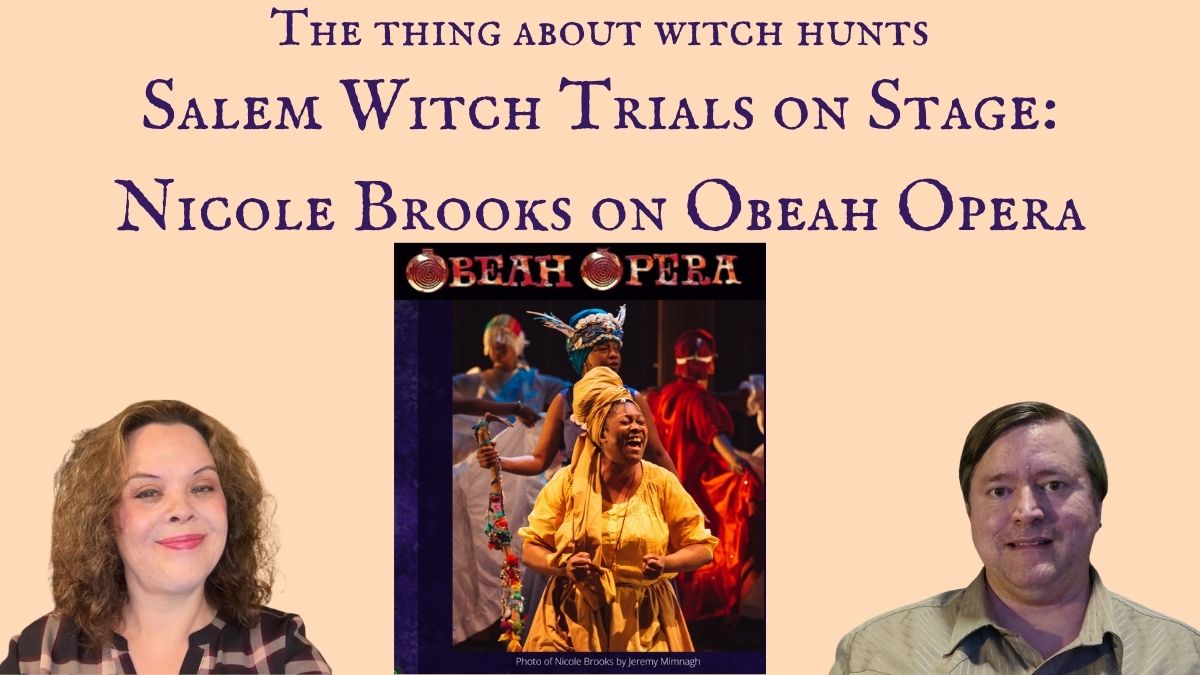
Most people meet Tituba through Arthur Miller. Nicole Brooks met her differently. The Canadian artist, producer, composer, and performer spent over a decade creating Obeah Opera, a fully sung a cappella theatrical work that centers Tituba and the other women of Salem as healers, wise women, and people who loved and were loved. In this conversation Nicole opens up about the research, the music, the controversy, and the story she believes America is ready to hear.
What You Will Learn
How music makes the heaviest history bearable
Who Tituba was beyond The Crucible
Why Nicole positions every woman in the story as a healer
How the word Obeah appears in Puritan records and what that tells us
The love story at the heart of Obeah Opera
How the girls who made accusations were themselves silenced and powerless
Why an all-female cast changes how the story lands
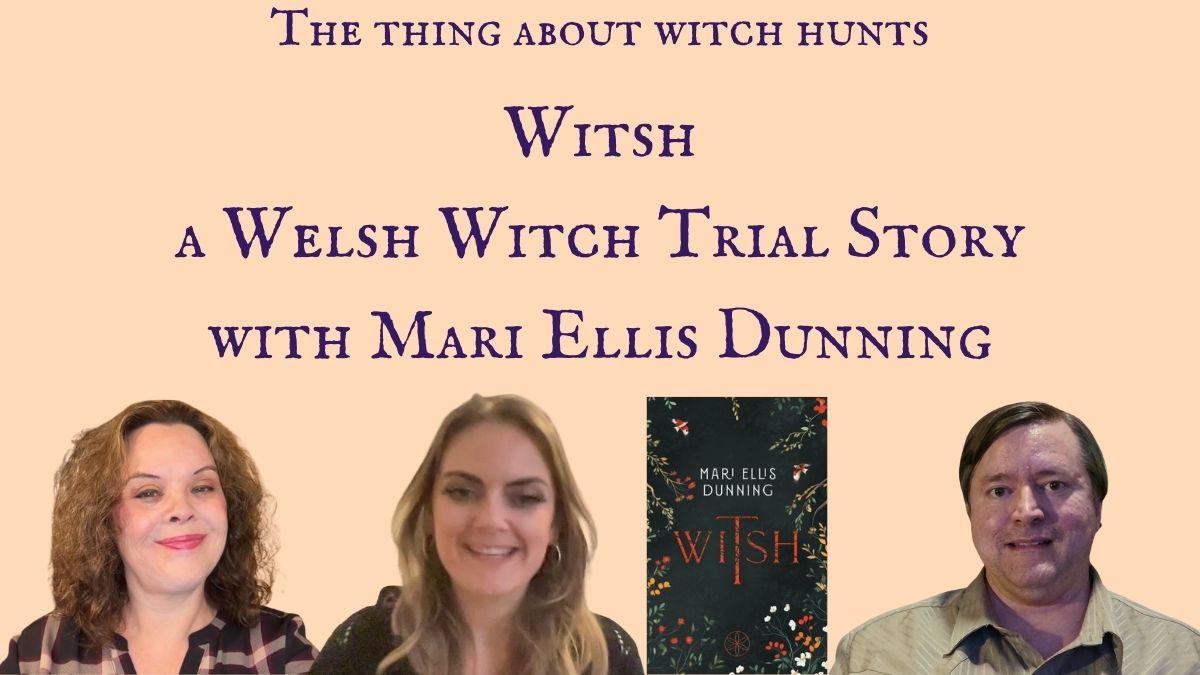
Wales has something most countries don’t: complete, intact court records from every witch trial held in the Court of Great Sessions. Author Mari Ellis Dunning used these archives to write Witch, a historical novel set in 16th century Wales.
About the novel:
Witch follows Dolly, a Welsh young woman desperate to have a baby who seeks help from a local soothsayer. The story explores what happens when accusations arise in a community caught between old Welsh traditions and new English Protestant law.
The historical context:
Five witch trials in Wales resulted in death sentences. The records show fascinating details, including Gwen ferch Ellis’s case where “ignoramus” (case dismissed) was physically crossed out before her conviction.
Mari discusses the tension between licensed and unlicensed midwives, how the Royal College of Physicians excluded women from medicine, and why lay healers were often more effective than the male physicians who replaced them. Class boundaries determined which accusations progressed to trial.
The conversation explores:
How Mari balanced creating relatable, nuanced characters while staying true to the limited agency women actually had in the 16th century
Why Wales’s cultural identity and the conflict between Catholicism and Protestantism shaped different attitudes toward folk practices
The connection between historical witch trials and modern medical misogyny, political rhetoric weaponizing “witch,” and systemic violence against women.
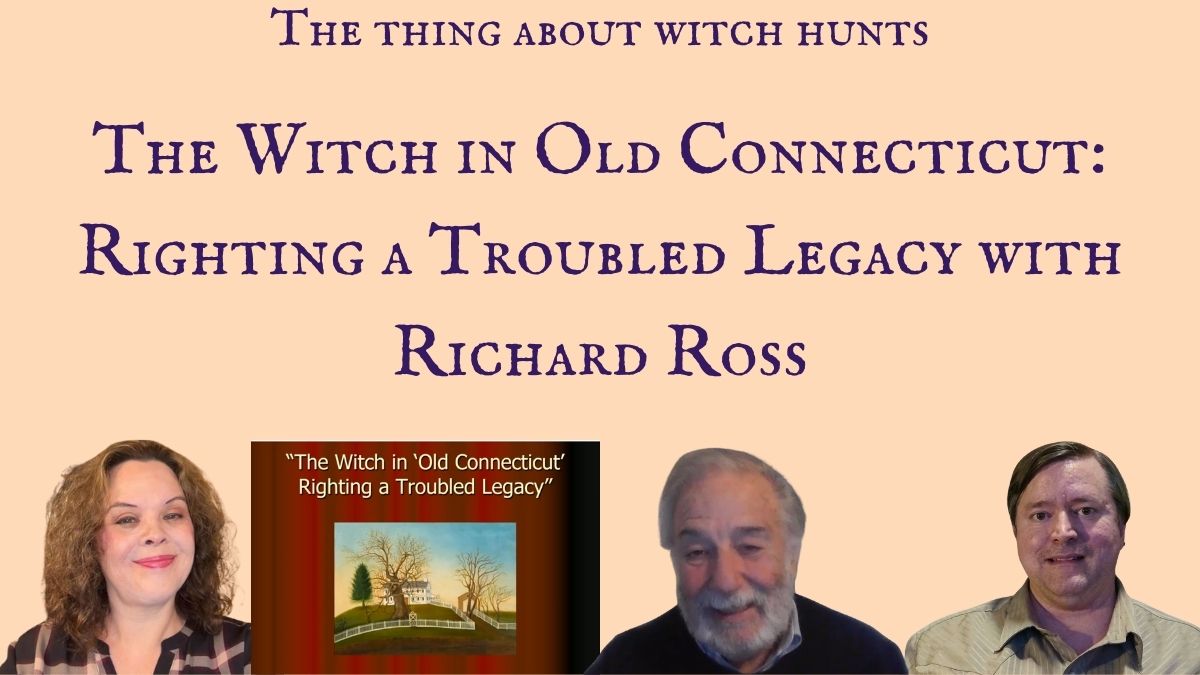
How did 19th century Maryland pro-slavery advocates weaponize witch trial narratives against Connecticut abolitionists? Returning guest Dr. Richard Ross III reveals a fabricated 1848 witch trial story designed to discredit Connecticut’s anti-slavery movement following the Amistad U. S. Supreme Court case victory.
This conversation explores the intersection of witch trial history and American slavery through the curious case of Juliana Cox, a completely fictional Connecticut witch whose story appeared in Maryland newspapers to embarrass Connecticut abolitionists. We consider how missing colonial documents created space for propaganda, examine the real Connecticut witch trials that were hidden for generations, and discuss how witch trial rhetoric became a political weapon in debates over slavery and abolition.
Dr. Ross shares research on how the Wyllys family papers disappeared into private collections, why Connecticut’s witch trial history remained largely unknown until the 20th century, and the deliberate creation of a witch trial hoax borrowed from English folklore sources to serve pro-slavery political goals.
Topics Covered
Connecticut witch trial records and their disappearance into private collections
The Amistad trial and Connecticut abolitionist movement
Fabricated witch trial narratives as political propaganda
How pro-slavery advocates compared abolitionists to Salem witch trial accusers
The real witch trials of colonial Connecticut finally documented
Alice Young: Connecticut’s first executed witch
Examining bodies for witch marks in colonial New England
Literary and political uses of witch trial rhetoric in 19th century America
About the Guest
Dr. Richard Ross III is a historian and Professor Emeritus from Trinity College in Hartford, Connecticut, where he taught a seminar on New England witch trials for over ten years. He is the author of Before Salem: Witch Hunting in the Connecticut River Valley, 1647-1663 and has conducted extensive research on colonial Connecticut witch trials and 19th century American social history.
Keywords
Connecticut witch trials, slavery and witchcraft, Amistad trial, abolition movement, colonial Connecticut, witch trial propaganda, Richard Ross historian, Alice Young witch trial, Connecticut abolitionists, slavery history, colonial New England, witch trial records, 19th century America, anti-slavery movement, political propaganda, witch hunt history, Maryland newspapers
The Thing About Witch Hunts explores historical witch trials and contemporary witch persecution worldwide. Hosted by End Witch Hunts, a 501(c)(3) nonprofit organization founded by Sarah Jack.
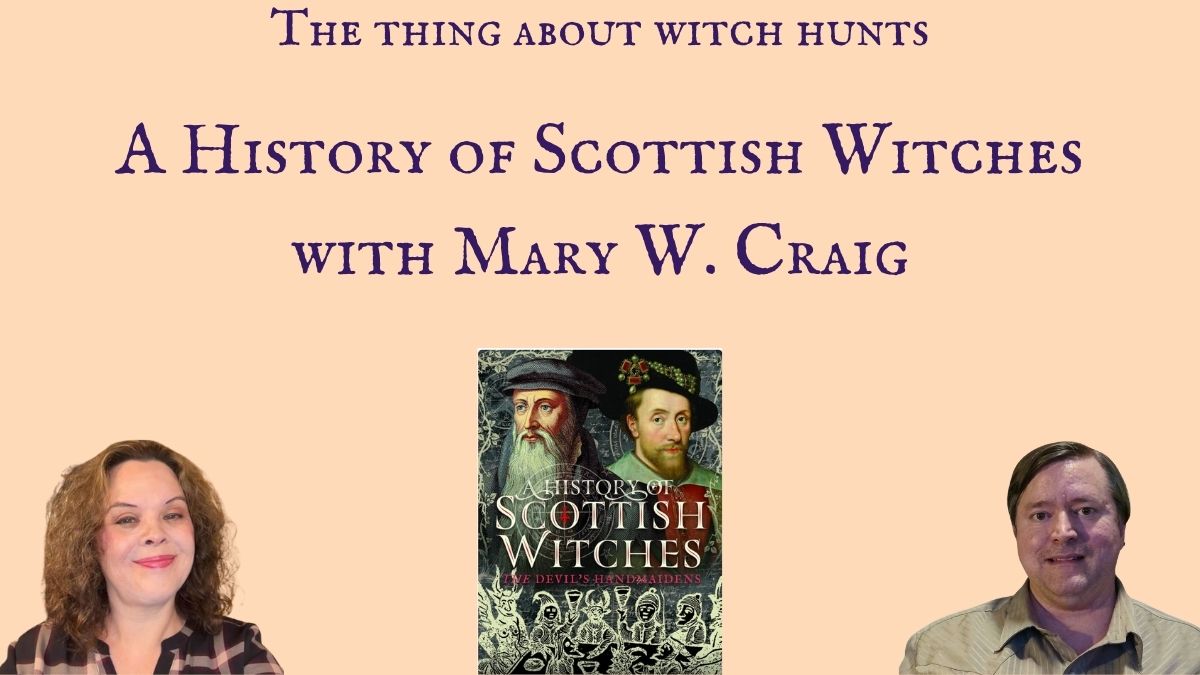
Historian Mary W. Craig returns to discuss her new book, *A History of Scottish Witches: The Devil’s Handmaidens, which traces the arc from the 1563 Witchcraft Act through its abolition in 1736.
Craig explores how beliefs that had existed for generations became capital crimes, examining the theological frameworks, political upheavals, and social structures that shaped prosecutions. The conversation moves from John Knox’s influence on Scottish law to the chaos of 1661-62, when local courts abandoned proper procedures.
Drawing on trial records and historical documents, Craig discusses who was accused, how interrogations were conducted, and why the trauma made Scottish descendants harder to trace than their New England counterparts. She also reflects on what medieval Scottish communities believed before the Reformation and how those beliefs were reinterpreted.
A History of Scottish Witches will be available February 2025 from Pen and Sword Books and is now available for pre-order.
Keywords: Scottish witch trials, Mary W. Craig, Scottish history, 1563 Witchcraft Act, Reformation Scotland, historical research, witch trial records, social history, legal history Scotland
Clinical health psychologist Peter Mintir Amadu explains the hidden mental health emergency affecting nearly 500 women accused of witchcraft in Northern Ghana and the innovative model transforming their lives.
The Crisis No One Talks About
Women accused of witchcraft face a devastating reality: up to 90% suffer from severe depression, PTSD rates exceed 80%, and many live in camps for over 20 years. They’ve lost everything: family, livelihood, dignity, and hope.
But mental health support alone isn’t enough. As one survivor told Amadu: “I can sleep now, but when I wake up, I’m hungry. What happens to me?”
A Revolutionary Approach: ART-LE-PE Model
Initiatives that combine mental health intervention with economic empowerment, creating sustainable change through advocacy, rehabilitation, therapy, livelihood training, and community engagement is being explored. This locally-developed model addresses both psychological trauma and practical survival needs.
Why This Matters Globally
Ghana faces a 98% mental health treatment gap with fewer than 200 psychologists for 30+ million people. Yet TOLEC is proving that culturally-grounded, resource-conscious solutions can work, from teletherapy programs to training religious leaders as mental health advocates.
Beyond the Witch Camps
TOLEC’s work extends to prison mental health, maternal psychological care, youth substance abuse prevention, and school-based interventions, all driven by data and local innovation.
Join the Movement
International collaboration opportunities exist in capacity building, research partnerships, digital health technology, and advocacy. The model is ready to scale. What’s needed is global support for local expertise.
For organizations seeking meaningful partnerships in African mental health innovation, culturally-responsive trauma care, or women’s empowerment initiatives.
Keywords: mental health innovation Africa, witchcraft accusations Ghana, trauma-informed development, sustainable mental health programs, international mental health partnerships, women’s rights Ghana, community psychology, teletherapy developing countries
What is folklore and how does it connect to witch hunts? Join us for an author talk with Professor Owen Davies and Dr. Ceri Houlbrook from the University of Hertfordshire, discussing their new book Folklore: A Journey Through the Past and Present. Discover how folklore shapes our daily lives, from cheese rolling traditions to social media rumors.
Episode Highlights:
• Folklore definition and what folklore actually means today
• British folklore traditions and American folklore customs explored
• How folklore practices became legal evidence in Salem witch trials
• The three types of British witches: conflict witches, accidental witches, and outcast witches
• Folk devils versus theological devils in witch hunt history
• Spectral evidence, pricking tests, touch tests, and folk magic in historical witch accusations
• Why debunked theories like the ergot explanation persist in popular culture
• How contemporary folklore evolves through podcasts and social media
• The ritual year framework and material culture in folklore studies
• Magical thinking and supernatural beliefs across cultures
• How folklore cycles between revival and decline
Whether you’re studying folklore definition, researching folklore examples, or interested in folklore and popular culture, this author talk explores how folklore studies reveals patterns in human behavior across time. Pick up Folklore: A Journey Through the Past and Present at https://bookshop.org/shop/endwitchhunts to support our work and explore opportunities to study folklore at the University of Hertfordshire’s MA folklore program.
Enjoy this in-depth author interview with New York Times bestselling author Kathleen Kent. Kathleen opens up about her writing process, her journey from aspiring writer to published novelist, and the craft behind transforming family history into compelling historical fiction.
Kathleen’s debut novel, The Heretic’s Daughter, tells the story of her ancestor Martha Carrier, who was executed during the Salem Witch Trials on August 19, 1692. Martha was from Andover, the town with the most accused witches was blamed for a smallpox epidemic that killed 13 people. Even when her children were tortured into confessing against her, Martha refused to admit to crimes she didn’t commit.
This episode offers invaluable insights for aspiring novelists and historical fiction writers, covering everything from research techniques to finding your voice as a writer. Whether you’re working on your first novel or looking to deepen your craft, Kathleen’s experience and teaching expertise provide practical guidance for writers at every level.
About Kathleen Kent
Kathleen Kent is a New York Times bestselling author and member of the Texas Institute of Letters. Her novels include:
The Heretic’s Daughter (David J. Langum Sr. Award for American Historical Fiction, Will Rogers Medallion Award)
The Traitor’s Wife
The Outcasts (American Library Association “Top Pick” for Historical Fiction)
The Dime, The Burn, and The Pledge (Edgar Award-nominated crime trilogy)
Black Wolf
Kathleen teaches writing workshops and has worked with Texas Writes to mentor aspiring authors.
Episode Highlights for Writers
Kathleen’s journey from aspiring writer to published author
The writing process behind The Heretic’s Daughter
Research techniques for historical fiction writers
How to balance historical accuracy with storytelling
Finding and developing your unique voice as a writer
Working with family history and sensitive historical material
Navigating the publishing process
Teaching writing and what aspiring novelists need to know
Transitioning between historical fiction and crime fiction genres
For History Enthusiasts
Martha Carrier’s powerful story of resistance
The Andover witch trials and why this town had the most accusations
The 1690 smallpox epidemic and its connection to witch accusations
How children were tortured into testifying against their parents
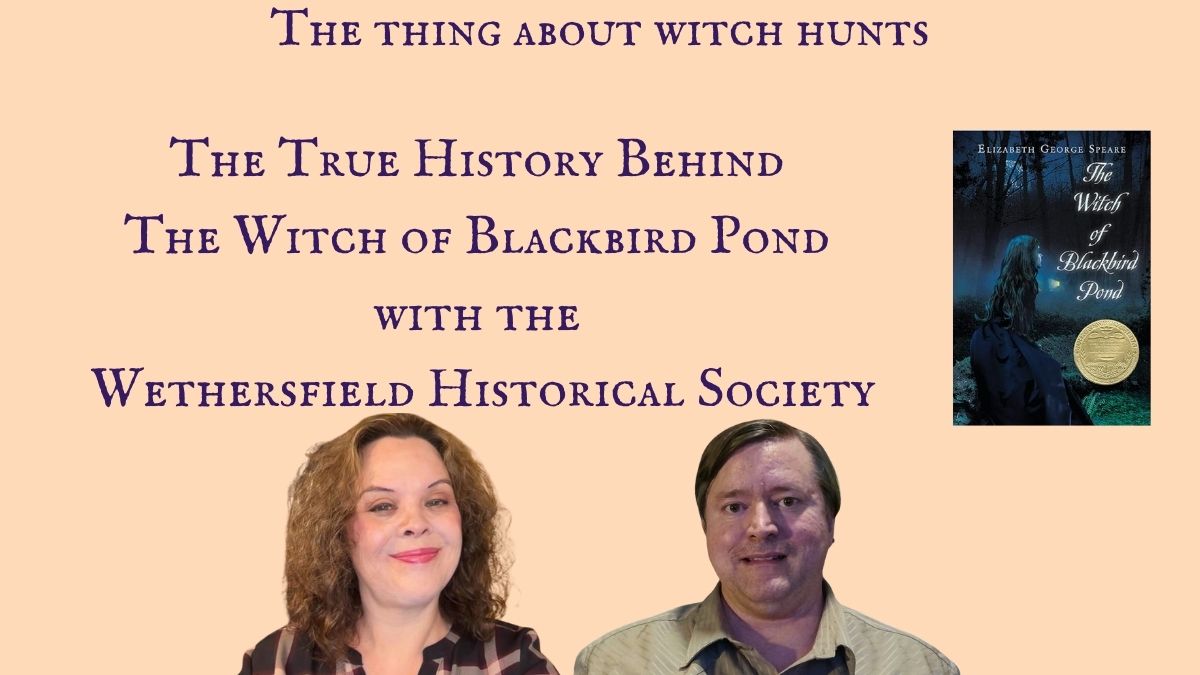
Is The Witch of Blackbird Pond historical fact or beloved fiction? Museum educators Martha Smart and Gillie Johnson from the Wethersfield Historical Society pull back the curtain on Elizabeth George Speare’s classic novel by revealing what she got right and what she invented. This episode demonstrates why Connecticut’s real witch trials deserve more attention than they’ve gotten.
Discover the true story of Katherine Harrison, whose 1669 witch trial revealed the dangerous reality for independent women in Puritan Connecticut. Learn why Gershom Bulkeley, a real historical figure who appears in the novel helped end witch executions in Connecticut by declaring he’d seen no legally proven case of witchcraft.
From the Charter Oak legend to the history of slavery in colonial Connecticut, this conversation goes far beyond the novel to explore what life was really like in 1680s Wethersfield and whose stories have been left out of the history books.
Key Topics
The real Katherine Harrison witch trial and how it differed from the novel’s dramatic courtroom scene
Why Connecticut’s witch trials ended decades before Salem’s panic began
How The Witch of Blackbird Pond has shaped—and sometimes distorted—Wethersfield’s historical identity
What Elizabeth George Speare got wrong about Puritan social customs, trade, and the treatment of outsiders
The truth behind the Charter Oak legend and Connecticut’s resistance to British rule
Guest Information
Martha Smart – Research and Reference Librarian, Wethersfield Historical Society
Gillie Johnson – Museum Educator, Wethersfield Historical Society
Learn more at wethersfieldhistory.org, where you can explore their database of people of color in Wethersfield’s history.
Elizabeth George Speare’s The Witch of Blackbird Pond and Connecticut’s colonial-era witch trials, including the 1669 case of Katherine Harrison in Wethersfield, form an important part of the state’s historical narrative, though they remain less widely recognized than their Salem counterparts.
In this episode, Josh and Sarah speak with the creative team behind “The Witch of Woodbury,” a theatrical production at Connecticut’s Glebe House Museum that brings 17th-century witch trial victims to life through performance.
Featured Guests:
Linda Barr-Gale – Actress portraying Moll Cramer for 13 years and production writer
Loriann Witte – Director of Glebe House Museum, portraying Rebecca Greensmith
Maribeth Cummings – Actress portraying Katherine Harrison for 5 years
Vail Barrett – Actor portraying accuser Thomas Allyn
Key Topics:
The legend of Moll Cramer, the “Witch of Woodbury” who was banished to Tophet Road
Connecticut’s witch trial history from 1647-1663, including 11 executions
How Governor John Winthrop Jr. transformed Connecticut’s approach to witchcraft accusations
Accused Witch Katherine Harrison’s well-documented case and its role in changing spectral evidence standards
Executed woman Rebecca Greensmith’s role in the Hartford Witch Panic of 1662
The perspective of accusers like Thomas Allyn and the climate of fear in colonial Connecticut
Using theatrical performance to make history accessible and memorable for modern audiences
Historical Context: The performance emphasizes the stark differences between Connecticut’s evolving legal standards under Winthrop and the later Salem trials.
Josh Hutchinson: [00:00:00] ” Thou shalt not suffer a witch to live.”
Josh Hutchinson: Welcome to another episode of Thou Shalt Not Suffer: The Witch Trial podcast. I’m Josh Hutchinson.
Sarah Jack: And I’m Sarah Jack.
Josh Hutchinson: Today’s guest is the extraordinary author Katherine Howe. We’ll speak with her about the causes of the Salem Witch Hunt and about her new book on pirates. I’m excited to talk about Salem Witch Hunt again and really curious what her book is about.
Sarah Jack: Yeah, it doesn’t matter what time of year.
Josh Hutchinson: [00:01:00] It’s always Christmas for pirates.
Sarah Jack: Just like Katherine’s other books, you are going to be delighted by the characters and the adventure. Fun getting to hear about it, and it’s gonna be hard to wait for the publishing.
Josh Hutchinson: She has wild swashbuckling shenanigans. But first, on a more serious note, we talk Salem, Witch Trials, what caused them, what didn’t cause them, why Katherine Howe it gets fired up about certain topics.
Sarah Jack: We get to a lot of layers.
Josh Hutchinson: Peeling that onion.
Sarah Jack: We just take Katherine right into the depths of the mechanics.
Josh Hutchinson: We talk about the different spheres that Malcolm Gaskill spoke about that are nested in each other and how each of those [00:02:00] spheres contributed to the witch-hunt.
Sarah Jack: We talk about what kind of perspective do we need to be using when we look back at the individuals that were in a different time in history.
Josh Hutchinson: Oh yes, we do that, don’t we? Wow, this is gonna be one hell of an episode!
Sarah Jack: Aren’t they all?
Josh Hutchinson: Yes, but I have a good feeling about this one. It’s gonna be something special.
Sarah Jack: It’s another dynamic conversation with a phenomenal author and researcher, and she does not hold back.
Josh Hutchinson: She does not. The emotions come out. Be ready.
Josh Hutchinson: I’m going to talk about the before the Salem Witch Trials, what the conditions were in Massachusetts Bay Colony and Salem Village and Andover.
Josh Hutchinson: Colonies used to have charters, so they [00:03:00] were officially recognized by the English government to govern themselves without direct supervision from the Crown and Parliament. Massachusetts Bay lost its colonial charter in 1684, when King Charles II revoked it because they had been naughty boys. And when the witch hunt began in early 1692, they still didn’t have a charter, so they were in legal limbo.
Josh Hutchinson: In addition, they were fighting King William’s War and still recovering from King Philip’s War, which was the costliest and bloodiest of the colonial wars, occurring between 1675 and 1678. In fact, the Massachusetts economy did not recover to pre-war levels [00:04:00] until the 1800s, after the Revolution.
Josh Hutchinson: Economic hardship resulting from the wars and the collapse of land speculation were also contributed to by an influx of refugees from the frontier in Maine and New Hampshire, and Essex County, where Salem’s located, was especially impacted, due to its proximity to that frontier, being the northernmost county in Massachusetts. Many of the settlers of Salem had moved on to Maine and New Hampshire, only to be forced to return when their villages were burned to the ground.
Josh Hutchinson: Beyond these issues, in Salem, the town had recently gone through a bit of a separation, [00:05:00] where Salem Village was allowed to begin its own church. In 1689, Salem Village hired the fourth in a series of unpopular ministers, and there were disputes over his contract, so there was a lot of tension in the area.
Josh Hutchinson: There was also tension in Andover, which was the hardest hit by the witch trials, with some 45 individuals being accused. There, there was a dispute between two ministers, Francis Dane and Thomas Barnard. Francis Dane was an older gentleman with health issues, who was no longer performing full duties as minister. So they had brought in Thomas Barnard, a younger man to take over some of [00:06:00] his duties, but were still paying both men in 1692, leading to tensions within the community that may have fueled some of the allegations there.
Josh Hutchinson: We’ll get into these issues further with Katherine Howe, and specifically we’ll be discussing Andover in a few weeks with author Richard Hite and get into more of whether the dispute over the ministers did or did not contribute to witch-hunt fever in that community.
Sarah Jack: That was good, Josh. Thanks, Josh.
Josh Hutchinson: You’re welcome. It was a fun one to do, and we’re going to dig into that stuff some more with our guest.
Sarah Jack: I am excited to introduce author Katherine Howe, whose works include The Physick Book of Deliverance Dane, Conversion, [00:07:00] The Daughters of Temperance Hobbs. She’s an editor of The Penguin Book of Witches and co-author of Vanderbilt.
Josh Hutchinson: We’ve read that you’re actually connected to somebody accused, which is an interesting connection. So can you tell us about who it is that’s your ancestor?
Katherine Howe: It’s a little bit of a funny story. So my last name is Howe, like, how are you? But with an “e” on the end. And one of the witches who was accused towards the beginning of the Salem panic and who was put to death was Elizabeth Howe. And she was from the same broad region that my family was from also. So it wasn’t a huge surprise when my aunt, back in the nineties, she was doing some genealogical research, and she figured out that that Elizabeth Howe is, I think it’s like my eighth great aunt. So it’s a lateral thing, rather than a direct thing. But at the time, she discovered that Elizabeth [00:08:00] Howe was related to us that way and also that Elizabeth Proctor was also a eighth or ninth great aunt, as well.
Katherine Howe: Just not all that surprising given that those communities were pretty small, and there were lots of intermarriages between different family groups and things like that. So it was in the nineties when I first learned that and thought, of course, it being the nineties and me being a grunge kid, and I thought was like, “oh, that’s so badass. That’s so metal.” thought that was the greatest thing ever.
Katherine Howe: I didn’t give it much thought beyond that, until I was actually living in that region of New England, because my family left New England in the 1930s. I grew up with this sense of it as like the motherland, but I didn’t actually grow up there myself. So I arrived in this region with this kind of funny twin consciousness of, oh, this is home, but I’m also a stranger here. And so it was being a stranger in this place that I felt this kinship that probably contributed somewhat to my getting started [00:09:00] writing fiction.
Katherine Howe: My first book was The Physick Book of Deliverance Dane, which was something I started working on when I was in graduate school at Boston University and just trying to think about the humanity of people living in this time and the, maybe a funny little detail. So one of the historians of witchcraft who I really admire the most is a woman named Mary Beth Norton, who wrote a book called In The Devil’s Snare, which anyone is interested in Salem has to know Professor Norton’s work, cause she’s just like the kind of detail that she can bring to it. And she writes in a novelistic sort of way. It’s just like the most gripping account of Salem ever. And Professor Norton has said that the more you work on witchcraft, the more superstitious you become. And I have to say that this is true. As evidenced by the anecdote I’m about to tell you.
Katherine Howe: So my first book was The Physick Book of Deliverance Dane. It asked, “what if one of the Salem witches the real [00:10:00] thing?” But the real thing the way the colonists believe, which is to be not in that pointy hat fantasy, Harry Potter Sense.
Katherine Howe: And I built that story around a woman named Deliverance Dane who’s a real person. And she was a minor person in the Salem Witch crisis. She was accused towards the end of the panic. She was not put to death. She really, like, was a footnote, I think, in the real history of Salem. And so I felt like it was okay to build a more fantastical story.
Katherine Howe:Physick Book is a magical realist story, so I wanted room to have kind of a fantastical story around a real person. And so I picked her because of her obscurity, but also because of her name. Her name is so evocative of this particular moment in time of this like subculture that she was living in, Puritan New England, Deliverance Dane. Just amazing. So that is why I chose to write about her.
Katherine Howe: That book [00:11:00] came out in 2009, and so several years later I was futsing about on a genealogy website because of course, for people who are interested in family history, life’s gotten a lot easier. Over the last couple of years, with the advent of digital humanities and so many more ways of doing research online. Like, when my aunt was doing research in the nineties, it was really hard to do, and now it’s actually much more accessible, which is a huge gift.
Katherine Howe: So I’m messing about, point, click, point, click, and I come upon Nathaniel Dane, which is actually the name of a character in the book that I wrote, and I was like, “huh, that’s a weird coincidence. Who knew?” Point, click, point, click, point, click. Lo and behold, I learned that it turns out Deliverance Dane, the real one, is my eighth great-grandmother. And so she’s more closely related to me, genetically speaking, than Elizabeth Howe, even though Elizabeth Howe and I have the same last name. And I had [00:12:00] zero idea, no idea whatsoever, and I’d written an entire novel about this person and found that there she was, just hanging out, waiting for me. So I definitely have gotten more superstitious the longer I’ve worked on witchcraft.
Josh Hutchinson: That’s a very strange thing to have happen to you. But it turns out that Deliverance Dane is actually my like eighth or ninth great grand aunt, and Elizabeth Jackson Howe is also an aunt, and Deliverance Dane, in her confession, says that she worked with Mary Osgood, and that’s my grandmother. I connected to a lot of the people you’re connected to.
Katherine Howe: So we’re cousins, Josh.
Josh Hutchinson: And Sarah’s my cousin through Mary Esty.
Katherine Howe: Wow.
Josh Hutchinson: Yeah. It’s a small world when you get back to those little towns back there.
Katherine Howe: Yes. It really is, for sure. It’s still pretty far back there. It’s a long time ago. It was very funny. I once did a book event, and someone came out to me very emotional, [00:13:00] and they were, turns out, a descendant of a judge from the Salem trials. And this person wanted very much to personally apologize to me. And I was like, ” no, it’s really, it’s okay”. Like he’s, this is not something that you need to feel badly about. This is, everything’s fine, cool’s fine. But it is interesting to me how close people can feel to people who are living in such a distant time period.
Josh Hutchinson: We definitely feel connected to our ancestors, and we talk to a lot of descendants of which trial victims, and they have an emotional bond with those ancestors, but that was so long ago. Did you get interested in Salem because of your connection with Howe and Proctor?
Katherine Howe: Partly. I went to graduate school for American and New England studies, which is like interdisciplinary American history. And I actually came to it from an art history [00:14:00] background. I have a background in visual culture, and it’s a where for grad school visual culture and also material culture, which is to say, stuff, objects. On a whim, my husband and I moved to Marblehead, Massachusetts, which is a small town on the water close to modern-day Salem.
Katherine Howe: We’re having this conversation in October, and there was just an article on Boston Globe about how like a hundred thousand people came to Salem for Halloween and running streets. Salem is a town of 40,000 people. I can’t even wrap my head around how many people they cramming in this season. And a lot of people come to Salem for Halloween. It’s like Halloween Central, and understandably.
Katherine Howe: But it was interesting to me while I was living in Marblehead and I was studying history. And I was living in a house that was built in 1705. And so one thing I have to say is people associate me so closely with Salem, because I’ve written so much Salem fiction. I grew up in [00:15:00] Houston, Texas. Okay. So the oldest building extant in Houston, Texas is a wine bar that was originally built as a bakery, and it’s from 1856. So the oldest building in the entire city that I grew up in is six years younger than the new edition of the house that I was living in in Marblehead, Massachusetts. Earlier, when I was talking about having a sense of being home but being a stranger there. I brought my new south eyes to this incredibly old environment, because Marblehead has the biggest collection of century houses in the entire country. They even have more than Colonial Williamsburg, for instance, except that in Marblehead, the houses have been continually occupied.
Katherine Howe: On the second floor of the house was an apartment, but the house had been a single-family house, been carved into apartments. Pine floors were like foot wide, and the ceilings were incredibly low. Like, you couldn’t stretch your arms over your head, cuz [00:16:00] the ceilings were so low. And this is actually when I learned for the first time, talking material culture, that bed headboards actually have a function. They’re not just decorative. And I discovered this, because we were so broke in grad school that we would turn the heat down as far as we could manage.
Katherine Howe: And so the room that we used as our bedroom, ice would form on the inside of the windows, because it was so cold, and we were so broke. And so when we were first living there, we had this futon I’d brought with me from Texas, of course. And there was no headboard on the futon. And so we were freezing, just like having your head up by this wall with ice on the window. We were freezing cold. And it wasn’t until we got like a bed with a headboard, we like, “oh, this is a lot warmer. This is great.” We just only then did I discover that a headboard really is important, at least if you’re living in New England.
Katherine Howe: And in this room, the bedroom that we had was tucked under the eaves of the lean-to part of a house. So if you’re familiar with colonial architecture, houses tended to be built in stages. You’d have room here and a [00:17:00] room here, and you have maybe you’d add a second floor and you might add a lean-to in the back to add some extra space. So we were in what had been the lean-to, and there was a little door that went into the back stair, and over the back stair, there was this little horseshoe-shaped charm over the back door that had been painted over. And of course, horseshoes are something that I think all over the country, we all recognize what they mean, and they mean that they’re there for luck or for protection. And you see this all over the place. This is a piece of folk magic belief that is incredibly widespread, such that we don’t even really notice it, as evidenced by the fact that you can buy horseshoe necklaces at Tiffany’s, wherever. We don’t even think about it anymore. But it was interesting to me to see this little remnant piece of magic. It wasn’t a real horseshoe. It was clearly there. It was tiny. It was a charm. It had been made as a charm, sold as a charm.
Katherine Howe: And so then I started looking around and noticing horseshoes wherever I went. And it got me thinking [00:18:00] between the fact that there was this little remnant magic shred, that there was that and also the fact that I was in this physical space that people had been moving through, who had been present when the trials were happening. Like we were only one town over from Salem, and, of course, when the trials were happening, people were traveling from towns all over the place to come and see, because it was a huge spectacle. People were talking about it.
Katherine Howe: So there was one day when I was sitting and thinking, like, “someone’s foot has been on this board, this actual board under my hand. The same foot was standing and watching what was going on.” And something about that tangibility or that proximate tangibility was really moving to me, and it got me thinking about the humanity of people who were living through that very strange moment in time, cuz I feel like much of the time their humanity is elided by our presentist biases or what have you. I feel like in [00:19:00] highly fantasy versions of witchcraft, the humanity of the people in the past is elided, and in, certainly in Arthur Miller, the actual humanity of people is alighted.
Katherine Howe: I started thinking about what became the story in Physick Book from that perspective, from like occupying this very weird, specific physical space as a stranger and trying to think about what it meant to be in that space and like how it felt to be in this space, over this incredible span of years, and how, in one sense, the early modern period is this incredibly alien and remote time. Their understanding of how reality worked is very different from our understanding of how reality works. But at the same time, there are certain common elements of common humanity that persist, like lying in bed and being freezing cold, unless you have a headboard at your head, and so a lot of my fiction, my desire to write fiction came [00:20:00] from thinking about these common points of humanity across really wide, gaping spans of time.
Josh Hutchinson: Can you give us a little background on what the situation was in Massachusetts Bay, when the witch trials started?
Katherine Howe: A few things were happening. A question that I get a lot is, what is the proximate cause o f the Salem Witch crisis, what caused it? And the thing that I think is interesting about that question is that it suggests that it would be so much easier if there were just one cause, if we could just point to the thing, and be like, “oh, that’s the thing.”
Katherine Howe: When we were corresponding, Josh, you mentioned the ergot hypothesis, that back in the seventies, somebody floated the idea that maybe all the afflicted girls had eaten moldy bread and were suffering from ergotism, and they were all tripping outta their mind. And that hypothesis was actually dismissed, I think, six months after it was first floated. But it still bubbles up periodically in [00:21:00] documentaries and popular discourses about Salem, because, and I think the reason that it doesn’t go away is because it’s so simple. It’s so tidy to be like, “okay, that’s the thing.”
Katherine Howe: And the truth of the matter is there isn’t one thing. The way that I sometimes talk about it is that it’s like a Venn diagram, and Salem is the point of the intersection of all the overlapping circles.
Katherine Howe: So one overlapping circle is the very specific kind of religion that everyone in Salem adhered to. It was a world view that did not hold that there was anything outside of Christianity. So, for instance, the indigenous population that was already living in Massachusetts at that time, by virtue of not being adherents of Christianity in their very specific puritan worldview, that which is not Christian is by definition devilish, and it was actually Mary Beth Norton who’s made the point that a lot of the language that the [00:22:00] people at Salem use to describe the devil is language that is used to describe indigenous people. So, one big Venn diagram circle is the specific religious and cultural moment that they’re living in.
Katherine Howe: Another diagram circle that we could point to is the weather, that the first panicky behavior that erupts with Betty Parris and with Abigail Williams, it starts in January, January, super cold in Massachusetts, cold, dark. The sun sets at 4:30 in the afternoon. And I’m not exaggerating, like it is dark AF. And and that’s true in the 17th century, as it’s today. And also in 1690s, North America was in miniature ice age. It was even colder and more bitter than it is now in Massachusetts.
Katherine Howe: Another piece is pretty relentless class and gender context. The girls who first experienced symptoms that they describe as [00:23:00] fits are Betty Parris, daughter of Samuel Parris, who’s the unpopular minister in Salem Village, Abigail Williams, who’s his 11-year-old, she’s described as being his niece, although that had a different meaning for them than it does for us today, but she was bound out to service.
Katherine Howe: So can you imagine living in a culture where when you can’t afford to feed your 11-year-old, you just give her to somebody to live with, for her to work for them? You just give her away. And so Abigail was this lonely, impoverished, starving, freezing child whose job it was to obey everyone all the time.
Katherine Howe: Oftentimes, I think with great sympathy about Abigail Williams, poor Abigail, who, by the way, in Arthur Miller is turned into a 17-year-old temptress. She’s a child. She’s a child. And if you look at the descriptions of her behavior that are described as her being in her fits, a lot of her behavior sounds to me like playing, [00:24:00] like running around in circles and flapping your arms and saying, ” whish” and saying that you’re gonna fly at the chimney.
Katherine Howe: Is that devilish possession, or is it an 11 year old girl being silly? And I feel like that is a, that is something that’s worth thinking about. So there’s the kind of class and gender politics, that’s another big.
Katherine Howe: So there are a number of different aspects, but you were asking about the politics and the charter. So this is another pretty big circle. So, typically in the early modern period in the colonies, if someone was accused as a witch, they would be accused and have a trial, and if they were found guilty, by the way, it’s hard to find people guilty. They actually had a pretty high bar for for evidence at that time. Believe it or not, you could be tried and found guilty, and if you’re found guilty, you could be put to death, and that could happen within a matter of weeks. Salem, the panic begins in January, the first hangings aren’t until June. That’s like a huge long span of time. And the reason for that long span of time is because the Glorious Revolution was unfolding.
Katherine Howe: Back in England at that [00:25:00] time, Massachusetts Charter had expired, so they didn’t have the legal wherewithal to hold a trial. That’s why the Salem trial trials are conducted by a special Court of Oyer and Terminer. They basically had to convene like a special tribunal to deal with this problem that had come together. In fact, there’s some historians who wondered if the Court of Oyer and Terminer didn’t just deal with witchcraft. They were supposed to deal with all the rest of the backlog. But we just don’t know what that backlog was, cause the records of the witch trials are what have survived.
Katherine Howe: And then there’s another piece of the Venn diagram, and we have to consider it. At the very beginning, the very first person who’s accused as a witch is accused by Abigail and Betty and she’s the only person who has less social and cultural power than they do. And they accuse Tituba or Titube Indian, who is an enslaved woman in the Parris household.
Katherine Howe: So she’s basically the only person who has less ability to protect herself than these children themselves do. And so Tituba’s accused. She [00:26:00] has two confessions, and there’s some evidence that she is beaten in between the two confessions. And in one of the confessions, Tituba introduces the idea of a conspiracy. She says that there is a group of witches at work in Salem Village. She doesn’t know who they are or how many.
Katherine Howe: And so at one point early on, there’s actually a sermon is preached in Salem Village that I’m gonna mangle the title, but it’s something along the lines of “Christ Knows How Many Devils There Are.” And so you have this idea of an unknown number of conspirators, who must be discovered. And when you have this undefined, invisible threat and also no legal relief, there’s no like pressure valve that this tension could be released by, because of the like, unfortunate timing of the expiration of the charter.
Katherine Howe: So you bring [00:27:00] all of these circles in the Venn diagram together, and that is why Salem gets as big as it does. And by the time Salem was over and done, 19 people were put to death and hundreds had been accused, hundreds in a period of time when a given town would only have a couple thousand people.
Josh Hutchinson: That was a great, thorough explanation of how it took all these different factors to create the situation. It wasn’t something, a single bullet theory, that you can put to rest.
Katherine Howe: But I think one reason that, that we keep craving for simplicity is because with a simple explanation for why than it’s easier to consign, to history. It’d be so much more encouraging or it’d be such a relief to be able to say, “Oh, it was air got poisoning. No big deal. That’s all.” But like the fact that it, what really was at stake was this intersection of circumstances and that everyone who was a participant in [00:28:00] Salem pretty much believed that they were doing the right thing. Not only the right thing, but the necessary thing to save their community. That to me is also a moving but also terrifying thing to remember and to realize.
Katherine Howe: Because certainly we all, we’ve all lived through moments where we are convinced that we’re doing the right thing, only to see ourselves perpetuating horrors, and that is I think that’s one of the reasons we as a culture are never really able to let go of Salem.
Sarah Jack: You said, ” as a culture, we’re never able to let go of Salem.” Nathaniel Hawthorne wrote, ” shall we never get rid of this past? It lies upon the present like a giant’s dead body.” I’m wondering what you think you would write now about that.
Katherine Howe: Hawthorne in particular is someone who, like he personally, so felt the weight of Salem’s past in a very personal way, because he was a descendant of Judge Hathorne, obviously. And because he was living there himself, and for many [00:29:00] generations, in fact, much during much of the time period when Hawthorne was living in Salem, the witch trials were not discussed in polite society. This was true into the 20th century, actually. They were not discussed. It was not something that was brought up. It’s certainly something my family never talked about until this is something that my, my aunt uncovered. There was a sense of embarrassment attached to it, I think.
Katherine Howe: But I’m also intrigued by the fact that when Hawthorne has tried to grapple with it, and he has tried to grapple with it, he took the line from he, he knew what had happened. Like he took a line from Sarah Good and put it in the mouth of Matthew Maule, in The House of the Seven Gables.
Katherine Howe: Was it Hawthorne who grumbled about “damn scribbling women?” I think it was. I think it was. And so this is me tweaking his nose a little bit, but Sarah Good. Sarah Good was a beggar. Okay. She was destitute. She was one of the first people accused, because she was in no position to defend herself. She was thrown into jail. She has a baby on her and like [00:30:00] toddler, essentially with her, the baby dies while they’re in jail. The toddler, whose name is Dorothy, ends up losing her mind and has to be like supported by the town after the trials are all over. So like this person is in absolutely dire straits and is and suffers mightily at the hands of the community where she lives and who’s supposed to be helping them.
Katherine Howe: And when she’s on the scaffold, she says the most badass thing anyone has ever said in history of time, my unbiased opinion. She says, “I’m no more than a witch than you are a wizard, and if you take away my life, God will give you blood to drink.” And I wish I had that kind of wherewithal, because who has that kind of wherewithal under in those circumstances?
Katherine Howe: And so Hawthorne takes this line, Hawthorne knows it’s happened, and he puts this line in a guy, in a guy’s mouth. I understand that he’s writing in the 19th century. I get it. But at the same time, I think it’s impossible to look [00:31:00] at Salem and not consider gender politics in place. The fact that virtually everyone who’s accused and put to death was a woman. Any man who was accused cuz he’s associated with a woman who was already accused. Giles Corey was crushed to death between stones. He’s accused cuz his wife, Martha’s accused first, but also the accusers are initially children, but then also women. So there’s a really intense gender politics in place here.
Katherine Howe: So your question was, the past lying with the weight of the giant and what would Hawthorne say today? And I’m actually curious what Hawthorne would say about it today. I think he would sympathize with, or maybe be aggravated by the fact that we’re still having the conversation that he was having a hundred and fifty years ago. But at the same time, I feel like we’re talking about different things from what he was concerned. And and also I think he would be really annoyed because I write novels. I’m a woman.
Sarah Jack: I love [00:32:00] that you brought up that he took Sarah’s words and gave them to a man, because it just dawned on me very recently that Ann Putnam didn’t read her own apology. I just assumed, and I think that possibly other descendants, we read that, we think I don’t know what we really think about it. We’re evaluating what it says anyways, but we’re doing that with her voice in our head, and no, it was not.
Katherine Howe: One thing that, that continues to interest me, as a history person, about Salem is that it’s one of the rare instances when regular people are at the center of the store. So much of history, especially the further you go into the past, the vast majority of people who’ve been alive in history of ever, have left no record of themselves. They weren’t literate, they weren’t of sufficient note to have their burial place noted, [00:33:00] and so much of history, even academic history, as it’s gotten more serious about excavating stories, just by the nature of the way that archives come to exist, there’s still going to be a bias towards power.
Katherine Howe: There’s gonna be a bias towards privilege and a bias towards power, and, when it comes to Salem, that is one of the rare instances where the bias towards power falls away, because the people who are at the center of the drama are regular people, and where historians have put the work in to try to excavate what is able to be excavated of these lives that otherwise would’ve been invisible to us.
Katherine Howe: Would we have known Abigail Williams ever existed, if she hadn’t been part of the Salem Witch Trials? We would not have? And in fact, even with her central position at the beginning of the panic, we don’t know what happened to her. We don’t know where she went. We don’t know how old she was when she died. Nobody actually knows for sure.
Katherine Howe: And so particularly talking about people who are not literate, Anne [00:34:00] Putnam had her confession read. If I remember correctly, Anne Putnam wasn’t literate. And so you’re right in saying here’s this apology that she delivered in front of everybody and that it was read on her behalf. To what extent was she the author of her own apology? And it’s impossible to say. It’s impossible to know.
Katherine Howe: And it’s one of the reasons that you’ve touched on one of my rant buttons, I’m sorry to report, but as a writer of historical fiction, like I have so little patience for historical fiction about kings and queens. I don’t give a damn about kings and queens. Who cares? They get enough attention, they have enough records, they’re all literate, everyone documents every single thing that they do. And I do not give a damn, because history pays them enough attention, and I’m so much more interested in trying to excavate the history of people who would otherwise be forgotten.
Sarah Jack: I caught that from you reading Conversion, because your [00:35:00] main character, Colleen, she’s getting to give us the firsthand experience like no other afflicted person was able to do.
Katherine Howe: Thank you for saying that. I confess I haven’t looked at Conversion in kind a long time. You’re making me think I should look at it again, cuz there’s actually a group of high school students who are reading it right now and I’m gonna talk to next week. I should read that book.
Katherine Howe: But I appreciate you saying that, because I feel like, like one question I sometimes wrestle with as a history person and someone who’s a novelist is what does historical fiction have to offer that nonfiction doesn’t have to offer? Like, why not just write a really good history of something?
Katherine Howe: And I feel like in many instances, in the cases where a story cannot be recovered, that’s where historical fiction can be a really wonderful intervention. If you can build a credible world with credible material culture, and credible details, and credible politics, and credible ideology, and then [00:36:00] people it with people who are credible people, it is a way of accessing history that otherwise is not extant, where it doesn’t exist.
Katherine Howe: Is there going to be some imagination involved? Obviously, but it is, I feel like that’s where the opportunity lies. And I realize we’ve gotten off Salem a little ,bit and I apologize, but it’s something that I think about a lot. Like, particularly for some, a story that’s as revisited as often as the Salem story is, what does fiction have to offer? Like why tell a fictional version of this story? I feel like fiction gives you permission to fill in and shade in stories that where there just is no other shading available. And that to me seems like the real area of opportunity for storytelling.
Josh Hutchinson: I wanted to ask you about the afflicted girls. Do you think it’s plausible that conversion disorder could [00:37:00] explain some of the fits?
Katherine Howe: Yes and no. I’ll explain that hedge of an answer. For one thing I find it always a little bit tricky to apply contemporary psychoanalytic categories to people in the past. Like on the one hand, I believe very urgently in, the shared humanity of people in the past, but at the same time, like we take as natural so many habits of mind that are actually very historically contingent. The fact that you and I might casually talk about what our dreams mean or what our subconscious motivations might be for something like that is indicative of post-psychoanalytic. And I think it’s tricky to try to access the interior light of people who are living in a different moment, especially a moment like the early [00:38:00] modern in Massachusetts. It’s even hard for a scholar of that time period to really grasp the extent to which Christianity informed every, single aspect of existence.
Katherine Howe: So for my second novel I was working on. No, it’s Physick Book. I was reading up about alchemy, and like we know about alchemy as this pseudoscientific practice in early modern practice in which someone tries to turn that into gold. Okay, fine. But that’s actually not what it was. It is actually a way of understanding the order of the universe that took as scientific fact the perfectability of the human soul.
Katherine Howe: There’s this tense layering of religion and materiality and mirroring of structures and images like, like as soon as I would get close to thinking I understood alchemical thought, it would slither out of my grasp. And I would realize this because I’m just [00:39:00] too much of someone born in the 20th century to, to I will never actually really understand that intellectual landscape.
Katherine Howe: So when you ask can conversion disorder explain the girls’ behavior? Like in a way yes. But in another way I don’t know that we can actually really understand their selfhood, the way that these girls thought about themselves or understood themselves as individuals.
Katherine Howe: It’s just very different from the way that we think. It’s very different. So that there’s that qualification. With that qualification in place, I would say that, so conversion disorder is where you are under so much stress that your body converts it into physical symptoms. And then mass psychogenic illness is when a group of people experience strange behavior together.
Katherine Howe: And there are many examples of mass psychogenic illness [00:40:00] or mass psychogenic illness expressions of conversion disorder, and many examples of it across cultures, across time, across continents, across ethnicities. And it very often happens among adolescent girls, for whatever reason. Maybe cause we are conditioned to be more like socially engaged with other people. Who knows? You can try to explain it a number of different ways.
Katherine Howe: But it’s not only adolescent girls. I think that it is, this is gonna be a controversial thing to say, but like the recent incidences of Havana Syndrome are pretty clearly an example of mass psychogenic illness. Now it’s important to say that mass psychogenic illness is real. It counts as a real thing. It’s not just people like, it’s not all in your head. You know what I mean? Like the fact that it is, that it has its origin in mental disorder doesn’t make it any less real to the body. Conversion disorder is a disorder. It is your body being sick. It’s just that the sickness originates from [00:41:00] inside your own organism. That doesn’t make it count less. You know what I mean?
Katherine Howe: All of which is to say, did a group of girls start exhibiting strange behavior? Yes. Did it spread from girl to girl on networks of kinship and friendship? It did. But at the same time, their behavior, when you say “fits” today, that has a very specific connotation. And it sounds like a epileptic seizure or something like that to, to us today. If I say, “Oh my gosh, I just saw this person have a fit.” You’d be like, “Oh no.” And you’d imagine that they fell down twitching and foaming at the mouth, but that’s not what they were doing.
Katherine Howe: What they were doing was behaving out of the ordinary. So like earlier we were talking about Abigail running around flapping her wings and saying, her arms, and saying, “whish, whish, whish.” That is her in her fits. Or like another instance of Abigail in her fits is when she challenges Deodat Lawson to name his text. She like gets up in the middle of church and like mouths off to this very famous divine and rolls her eyes about how boring it’s gonna be when he reads his text. That’s [00:42:00] not her having a fit. That’s her misbehaving.
Katherine Howe: But her behavior was such a challenge to the gender and economic power structure that was in place while she was living. It was so out of the ordinary that her community could only chalk it up to devilish influence because it was that unimaginable that she would behave this way.
Katherine Howe: So was there a social illness aspect to the afflicted girl’s behavior? I feel certain, yes. So that, that’s my long and qualified example about or discussion of conversion disorder.
Josh Hutchinson: Do you think that they were really afraid of witches and that the fear of witches might have also translated?
Katherine Howe: Sure. Oh, for sure. Yeah. I think the fear was real. I think it is a mistake to either chalk it up as craven opportunism or as naked stupidity or superstition. One of the [00:43:00] things that I think is important, I like to give people the benefit of the doubt who live in the past and that is that like absolutely they were afraid.
Katherine Howe: Can you imagine, what does it feel like to live in a world where you really, actually, honest to gosh believe that the devil can go walk about on the earth, as a real person and that he can disguise himself as people you know and love and trust? That at any given time, I could be talking to you right now, Josh, and you could be the devil in disguise, and I wouldn’t know it.
Katherine Howe: That’s a and if you really believe that, you really do believe that, and you actually really believe that hell is a real place that you can go there if you make a mistake. That there is no, this is another like aspect of puritan belief, that like they believed in the elect. The idea that you have no way of saving yourself. That your being saved was only up to God, and you had no control [00:44:00] over it whatsoever. Like what? You couldn’t go to confession. You couldn’t do penance. You could try your best to behave, but it was ultimately just up to God.
Katherine Howe: What an existentially dreadful way to live your life, to have no certainty. It’s a little, a really hard life, first of all, and to believe that there was such a thing as paradise after death, but to have no idea whether or not you got to go there and that nothing you did made any difference. And that everywhere, at every turn, the devil was waiting to trip you up. Like that would be a difficult and impossible mental landscape to occupy.
Katherine Howe: So yes, if your question was did they really believe in witchcraft and was that fear, could not fear contribute to their behavior? Like absolutely. What a terrifying way to live, and also what a relief. Like one of the reasons that I think witches [00:45:00] was such a persuasive idea for so many people at that time was wouldn’t it be great if something was going bad in your life, to be able to not try to see it as a sign of God’s Ill favor, but instead to have someone to blame for it? To be like, “it’s not me. I’m not messing up here. Someone’s doing this to me.”
Katherine Howe: I think that’s also very human, that human feeling. It’s not just bad luck or misfortune or like the luck of the draw, and it’s so much more of a, “no, this person doing something to me. They wish me ill, and that’s why my life is hard.” I think that’s a very human way to be.
Josh Hutchinson: Yeah. We talked a little about Anne Putnam, Jr.’s apology earlier, and she still does that in her apology. “The devil made me do it.” And Samuel Sewall does the same thing, like the two big apologies that come about after Salem is over after everything’s done are Ann Putnam’s and [00:46:00] Samuel Sewall’s apology. But Samuel’s apology, too, is weird where he like, first of all, he comes to it. It’s not that he stops believing in witchcraft or stops believing that there is an invisible world. He comes to it after a series of wonders and marbles, including, if I remember correctly, like his house being tilted with stones. Who knows what really happened? And maybe there was like a passing hailstorm is how it took it.
Katherine Howe: But he comes to it after a series of wonders and marvels, and he comes to believe that the devil tricked them all. That it wasn’t that that the devil wasn’t luring people into witchcraft. Instead, the devil obscured the minds of the people who are supposed to keep the community safe. And but also what a horrifying thing to, to come to believe about yourself. To look back at your actions and think you’re doing the right thing, and think that you are saving your community from the most threatening presence that your imagination can come up with, and instead to conclude that, no, what happened [00:47:00] was that threatening presence tricked you. That you were so weak that you were fooled. Like what a, what a heinous thing to believe about yourself. It’s a very punishing worldview that they subscribe to.
Josh Hutchinson: Do you see any modern parallels to the Witch hunt?
Katherine Howe: Sure. A few years ago a historian of witchcraft named John Demos published a book about witch hunting, in which he has a chapter about the 1980s daycare satanism thing that happened, much of which I was only dimly aware of, being a small person in 1980s myself.
Katherine Howe: But what happened was, a group of people were put on trial, actually put on trial and actually convicted of having you run a daycare center and used the children in satanic rituals. And at the time that it was happening, and this is preposterous, like I, it’s actually just like on the surface of it, I think [00:48:00] preposterous. I think, taken out context, any of us looking at this would say, “this makes, this is ridiculous. Obviously this did not happen.” And at the time that it was unfolding, John Demos saw it unfolding and he was like, “Oh my God, it’s Salem all over again.” Like the same pieces are in place, like the idea of a conspiracy, the idea of trusted people that you cannot trust, the idea of children being at risk.
Katherine Howe: And I think that you see some of the same hysteria and language. I don’t like using the word hysteria, cuz it’s such a specific word, but you see some of this in like contemporary corners of the conspiracy internet, where I try not to spend any time, but Isn’t that Pizzagate? Isn’t there some like thing not too long ago about worrying a particular pizzeria was like putting kids at risk in this same kind of way? Like you see the same kind of like at any time that someone worries that children are at risk, there will be a lot of open-mindedness about it.
Katherine Howe: But of course, here’s me getting political. Like, of course, children actually literally are at risk [00:49:00] by, by school shooting, right? Like the one thing that would really keep children really safe in places where they’re supposed to feel safe and trust people around them, is if they restricted access to military assault weapons. That’s my opinion. My opinion is that if we really care about keeping children safe, we take those guns off the street, right, full stop. But feel free to send me hate mail. I can be reached to KatherineHowe.com/contact.
Sarah Jack: So I think asking the question about are there parallels, we have these modern parallels that are popping into our heads. We have our strong feelings, but what can the understanding of the Colonial Witch trials and those before do to help us with these parallels? Can it help us? Will it help?
Katherine Howe: I’d like to think that it can. One of the things that I like to say when talking about Salem is that I feel that one of the reasons we can’t let Salem go. As a culture, like we come back to it and we, like we can’t let it go.[00:50:00]
Katherine Howe: And I feel that the reason that we can’t let it go, among the many reasons, but I think one of the big reasons is that it forces us to confront how fragile our ideals really are. We are an unusual country in that in many respects, we are, notwithstanding those of us who were brought here against our will, which is many of us, but broadly construed, you could argue that we are something of an intentional community.
Katherine Howe: That the only thing that really holds us together is this set of shared ideals, and that some of our shared ideals include religious freedom. They include a social safety net. That we value people who are different from us, that we value people who are vulnerable. ” Bring us you’re tired, your poor, your huddled masses.” Like that, that arguably this is an ideal that we hold in common. This is an organizing principle of the culture in which we live.
Katherine Howe: And yet Salem is this instance where everybody, believing they were doing the [00:51:00] absolute right thing, instead put to death, the state put to death 19 people. That, in the course of doing the right thing, the state did the absolute wrong thing, and they also put to death people who were, many of them were vulnerable in their community. People who were more likely to be accused were those who were at the most vulnerable, who were the most out step vulnerable in community. And so I feel like Salem is an instructive moment for that, because here’s this moment where, in the course of being convinced of our total moral authority and correctness, a huge miscarriage of justice took place.
Katherine Howe: And I think that’s a really difficult thing to reconcile. And I think especially for a country like ours, where also so many of us are brought up to look to the colonial period for our origin, that we’re told, rightly or wrongly, that we are taught to look into the 18th, and to a lesser extent [00:52:00] the 17th century, and see in it the seeds of the country that we would become.
Katherine Howe: Maybe that’s another way of thinking about it. Like another way of thinking about it, is it more productive to think about what we want the future to look like than it is to try to think about what the past has to tell us? That’s a question. That’s a question that I think is interesting. One, particularly for an intentional community like ours. We have, we get to reinvent ourselves as a country, and we get to decide, and what kind of place do we want to be? Do we want to be the kind of place that protects vulnerable people? Do we want to be the kind of place that protects people who are at risk, who are different from us, who are angry, who are grumpy, who read too many books? I would prefer to live in a place that protects those kinds of people. But we get to choose We choose who we protect.
Sarah Jack: We can make that choice, and not only is it going to stop suffering here, there are places in this world that are still totally captured by [00:53:00] doing the wrong thing, thinking they’re doing the right thing, witch hunting. This discussion it is about us here, but it’s about us there.
Sarah Jack: You have referred to time so much. That is such a strong piece of this. Even in Conversion, one of the simple quotes you have says, “any number of things could happen in the time it took to go down the hall.” You like go right to the time thing. And today when you started talking, you talked about time. And I look at the history, I look at us now, how do we all get caught up on this witch-hunting mentality and start looking out for humanity and protecting other?
Katherine Howe: It’s a hard thing. It’s a really hard thing. And I wish I had easy answers for it. I think simply the act of reflection and awareness is an important one. Stopping to interrogate what our assumptions are.
Josh Hutchinson: We’ve talked about a lot of heavy things. [00:54:00] I wondered if we could switch and discuss your new book project. What can you tell us about it?
Katherine Howe: Oh, so many things. So I’m obsessed with pirates, who isn’t? Hopefully, the answer is everyone is obsessed with pirates.
Katherine Howe: So I have a book coming out in fall, and I think they’re gonna let me keep the title. And you. Okay, Josh, Sarah, you guys have to tell me what you think of the title. You ready? So get comfortable, here it is: A True Account of Hannah Masury’s Sojourn Amongst the Pyrates, Written by Herself. That’s the title. It’s a mouthful.
Katherine Howe: It starts in Boston in 1726 at a very real an actual pirate trial that really did happen. Like most of my stuff, it’s, it is grounded in actual facts and then becomes what I’m describing as a little bit like Gone Girl meets Treasure Island. And I had so much fun with it, and I’m really excited about it. And it is a little bit of a departure from what I’ve done, but it is about a girl, Hannah Masury, who has to disguise herself in order to escape some pretty heavy circumstances. And she [00:55:00] ends up basically stealing away on what turns out to be a pirate ship. And we have to follow her on her adventures.
Katherine Howe: And I have so much fun with some basic pirate tropes. There is treasure, there is a parrot. It’s so much fun, and there’s also some, a little bit of romance, and I have the most fun ever.
Josh Hutchinson: Sounds like a fun one to read.
Katherine Howe: I really hope so.
Sarah Jack: I’m so delighted by what I just heard.
Katherine Howe: That makes me very happy. Makes me very happy. It’s weird because it’s one of the, it’s probably the most violent book I’ve written. If y’all have read my stuff, then you know I’m a teensy bit squeemish and shy away from. So there’s some violence in this book, but what’s strange about it is, I didn’t invent any of it. It is actually all from historical record. I take no responsibility whatsoever for any of the stuff that happens in this book, because it all ripped from the headlines. It all really happened.
Josh Hutchinson: And was Hannah herself based on a real [00:56:00] person?
Katherine Howe: Hannah is based on a couple of people. She’s inspired in part by real accounts of Anne Bonny and Mary Read, who are two working-class women, who ended up disguising themselves as men and going raiding in Jamaica at the end of the 17th century. They were real people ,and there was a real Hannah Masury ,who I talk about a little bit in the author’s note of the book. She was a 19th-century person, and she ended up, I was inspired when I came across her. She was the wife of a ship captain. She was married to a ship captain, and she ended up putting down a mutiny by herself, armed only with a pistol, in the Pacific Ocean.
Katherine Howe: And so I read about her, and she didn’t have any children, and I was like, “oh my gosh, I am obsessed with you.” And so I decided to name my awesome pirate after her. Hannah, Hannah comes from a couple of different sources, but I really like her as a person. She’s a tough character .
Josh Hutchinson: Sounds like it. You said that it’s set [00:57:00] around a pirate trial in Boston?
Katherine Howe: Yeah, it starts, the action starts in Boston in 1726, and in 1726, it’s the end of the golden age of piracy. It’s actually funny that the Salem period, like the witch craze, the end of the witch craze and golden age of piracy are at the same time period, which I think is interesting. And a guy named William Fly was tried as a pirate, and the person who ministered to him and preached about him was none other than Cotton Mather .
Katherine Howe: So Cotton Mather by then was this like hugely famous, successful cleric. He was really rich. He was, like, had a very popular ministry and so he had taken it upon himself to crusade against piracy. So he tries to bring William Fly and his compatriots back to God, and he’s there when they’re hanged. William Fly was hanged, and then he was gibbeted. He was, his body was hung in chains on a tiny island in the Boston Harbor Islands and left [00:58:00] there to rot. He was really avid as a warning to other people who might go out on the account, which is a way of describing going, turning pirate.
Katherine Howe: And so I was fascinated by this. It was only a hundred years later that excursion boats are starting to leave Boston. Like steam boats are going from Boston to Nahant. This is no time all. To think that you could go by Nixes Mate, which is where William Fly was hanged and chained. You could go by there and to see you remnant oft remain dangling there.
Katherine Howe: So that’s where the action begins at William Fly’s trial, and things even crazier.
Josh Hutchinson: Sounds like a fun ride. .
Katherine Howe: I’m excited for it. I’m not sure when it’s coming out. I think it’s gonna be November, 2023. So it’s coming up.
Josh Hutchinson: Here’s Sarah with an important update on what’s happening now in your world.
Sarah Jack: Thank you for listening a few minutes longer to hear End Witch Hunts World Advocacy News. How many innocent world citizens [00:59:00] is it okay to accept as suffering from violent brutalization, due to harmful practices related to accusations of harmful witchcraft and ritual attacks? These attacks are happening now to thousands of innocent people, who are not causing supernatural harm but are being punished by their community, as if they are the ultimate explanation.
Sarah Jack: They are innocent, not dangerous witches. These attacks are happening across countries of Africa and Asia. Please see the show notes for links to read about how some countries have advocacy groups working to intercede. When there is not an answer for unexpected bad luck, unfortunate death, or personal misfortune, blaming others for supernatural malevolence is the actual crime. This witch fear is still causing unfounded, violent attacks against women, children, and sometimes men. Listen and watch for the reports. These attacks are reported on.
Sarah Jack: The Northern Ireland borough of Larne wants to commemorate [01:00:00] eight Witch trial victims from the Islandmagee Witch Trial that took place on March 31st, 1711. A borough counselor raised questions very recently of whether the eight women and a man who were found guilty of witchcraft were actually innocent. In the trial era, using witchcraft was a covenant with the devil against the victims. When this counselor questioned if it is within the counsel’s capacity to say they were innocent, he’s questioning if the accused were indeed working with the devil himself to cause harm.
Sarah Jack: Is it within human capacity to not assign witch harm guilt onto others? I want to answer that question right now. Yes, it is within our capacity to stop questioning other people about their status as a supernaturally harmful witch. It is our duty to stop questioning accused witch innocence, past or present. These accused people were not, and today’s accused witches are not, causing the supernatural harm that is feared of them.
Sarah Jack: [01:01:00] This week, academic research was published that is “a new global data set on contemporary witchcraft beliefs .” It has determined that witchcraft beliefs cut across sociodemographic groups, but are less widespread among the more educated and economically secure. Country-level variation in the prevalence of witchcraft beliefs is systematically linked to a number of cultural, institutional, psychological, and socioeconomic characteristics. Altogether, the resulting data set covers more than 140,000 individuals from 95 countries and territories and 5 continents. Over 40% of all survey respondents claim to believe in witchcraft. Stay tuned for a discussion on this research outcome. Find a link to the report in the show notes.
Sarah Jack: While we watch and wait, let’s support the victims across the world where innocent people are being targeted by superstitious sphere. Support them by acknowledging and sharing their stories. Please use all your communication channels to be an [01:02:00] intervener and stand with them. The world must stop hunting witches. Please follow our End Witch Hunt movement on Twitter @_endwitchhunts. And visit our website, endwitchhunts.org.
Josh Hutchinson: Thank you, Sarah, for that eye-opening update.
Josh Hutchinson: Thank you for listening to Thou Shalt Not Suffer: The Witch Trial Podcast.
Join us next week for a special Connecticut witch trial victim descendant episode.
Josh Hutchinson: And join us in our efforts to end modern witch hunts. Go to endwitchhunts.Org.
Sarah Jack: Subscribe to our podcast wherever you listen.
Josh Hutchinson: Visit thoushaltnotsuffer.com.
Sarah Jack: Remember to tell your friends that you love what you’ve been hearing on Thou Shalt Not Suffer, so that they will not miss out.
Josh Hutchinson: Have a great today and a beautiful tomorrow.
Josh Hutchinson: [00:00:00] “Thou shalt not suffer a witch to live.” Exodus 22:18. Welcome to another episode of Thou Shalt Not Suffer: The Witch Trial Podcast. I’m Josh Hutchinson.
Sarah Jack: And I’m Sarah Jack.
Josh Hutchinson: Today’s guest is Greg Houle, an author currently working on a novel about the Putnams of Salem.
Sarah Jack: Because you like the show, please share it with your friends, family, and followers.
Josh Hutchinson: We hope you’re enjoying a wonderful Thanksgiving. Have a slice of Turkey for me.
Sarah Jack: Share the mashed potatoes.
Josh Hutchinson: Pass that gravy.
Sarah Jack: This is a great topic for [00:01:00] Thanksgiving. I’m looking forward to talking to a Putnam of Salem descendant.
Josh Hutchinson: Yes, and we hope this episode gives you lots of conversation ideas for your Thanksgiving dinner.
Sarah Jack: Especially if you’ve been having boundary disputes with your friends or family.
Josh Hutchinson: Make a peace offering, and be sure to watch Planes, Trains, and Automobiles, the best Thanksgiving anything ever made, hands down.
Sarah Jack: But only after you watched Holly Hunter’s Home for the Holidays.
Josh Hutchinson: Then get back to your Walking Dead marathon. That’s what you’re really watching. Or House of the Dragon.
Sarah Jack: And now Josh is gonna tell us some history about the Putnams of Salem.
The Putnams of Salem Village were instigators of the Witch Hunt. Thomas Putnam and his brother, Edward, were two of the four men who [00:02:00] filed the first complaints against Sarah Good, Sarah Osborne, and Tituba. Thomas went on to make 35 complaints, testify against 17 people, and record 120 depositions, including those of his daughter Ann Putnam, Jr., who was the first villager outside of the parsonage to be afflicted. Later on, she was joined by her mother Ann Putnam, Sr. and their maid, Mercy Lewis, among the ranks of the afflicted. The Putnam family was an important family in the village for three generations. 12 out of the original 25 villagers to sign the church covenant were Putnams, and they ranked among the top taxpayers in the village, along with the Porters.
Josh Hutchinson: After accusing many people and going through [00:03:00] all her theatrics in the courtroom, Ann Putnam, Jr. did apologize in 1706, specifically to Rebecca Nurse’s family, but also to the whole village, as she joined the church under the new minister, Joseph Green.
Sarah Jack: Thank you for introducing us to the Putnams of Salem. I cannot wait to get more of these details from Greg.
Josh Hutchinson: You’re welcome. I’m also looking forward to hearing this family covered in depth. They were so heavily involved, what they did in the witch trials, which was so much. So many Putnams were involved in so many ways.
Sarah Jack: I’m so happy to welcome Greg Houle, writer of short fiction and author of The Putnams of Salem, coming 2025.
Greg Houle: So I came into this story, the story of Salem and the Salem witch hysteria like a lot of people do, with a personal family connection to [00:04:00] it. My mother is a Putnam. She is a direct as descendant of Thomas Putnam, Jr., who, along with his oldest daughter Ann, were probably two of the most prolific accusers during the Salem witch hysteria. But yet, despite that connection, I really didn’t have any interest in exploring the story as I was growing up. And in spite of having a really intense, lifelong interest in history, I really didn’t care, and I think part of that was because of the fact that Salem is such a huge story, and it has a life of its own, and it’s become this kind of larger than life almost true crime story.
Greg Houle: And I think a lot of times what has happened is it’s deflected a lot of the attention away from the important things, the victims, why it happened, how can we prevent it from happening in the future, that [00:05:00] sort of thing. It was always an interesting thing to be connected to, so many of us are.
Greg Houle: Everything changed in the summer of 2021. And that is that summer, I live in LA now, and my wife and daughter went back east to visit our family, and my wife’s family lives in Boston. And while we were there, we decided, let’s go to Salem. And we went there, I thought, “Okay I really want to connect my daughter to my, her grandmother’s side of the family. I really ought to understand the story better and really dig into it. “And that’s really what I did.
Greg Houle: And as soon as I did that, I became immediately enamored by what was going on in the heads of someone like Thomas Putnam, Jr. and Ann. So you have someone who’s accusing all of these people, and then you have another one who is said to be afflicted. And I started exploring [00:06:00] that. And this is the part that’s unknowable for a historian. So we all wish we could be inside their heads and understanding what’s going on during that time. I thought the best way to explore it would really be to look at the environment in which they were in, the things that led to Salem and what happened there and then really just use fiction at that point to tell the story, and, of course, no historian would ever use conjecture , but the beauty of fiction is you can do that. And I think what I tried to do initially in this short story and then now to much greater depth in the novel, is really explore that and look at the forces that created this really tragic event.
Greg Houle: The short story and the novel, at least a tentative title of the novel is The Putnams of Salem. [00:07:00] And there is a sort of subtitle that I’m throwing around. That’s really The Fall of an American Family. Not sure how my family will feel about that, but it’s what we find out in this story.
Greg Houle: And I think it’s really quite fascinating when you think about all the different forces involved in the world that they were living. One of the major themes of the short story and the novel is really fear and the way in which fear drives a lot of what happens and the various types of fear and various sources of fear, from the fear that’s inherent within the Puritan religion to fear of the native population. In the case of Thomas Putnam, there’s fear of losing your place in society. The sense that throughout history there’s the common case of [00:08:00] the patriarch of a family kind of building something, the second generation making it stronger, and then the third generation messing it up somehow. Thomas Putnam Jr. was the third generation of the Putnams in America, and it really does follow that trajectory. And I think it’s really interesting when you insert this man into these circumstances and you see the way in which it drove him to do some pretty awful things.
Josh Hutchinson: You’ve touched on it already, but how did you go from where you were doing your research into your family to deciding to write stories and then a novel about them?
Greg Houle: Yeah, it’s a great question. I, again, a lot of the impetus for this was my 12 year old daughter at the time and really wanting to connect her to this story in a way that I thought was meaningful. For me it was about really trying to get behind any [00:09:00] lore that existed within our family to the actual story, and it’s not always easy to do when you’re dealing with 17th century America. You can’t always get every detail.
Greg Houle: In my family, there was not a lot of detail. I think there was always the sense of we are connected to this great American story, “great” in quotes, by the way. And isn’t that fascinating? But I think, for me, my interest in history has always been about the fact that it is multi-dimensional and dynamic. I think what tends to happen with history is over time we flatten it out, and it becomes very one dimensional. So the sort of typical story of Salem is that it’s these sort of fundamental crazy puritans who experience something one [00:10:00] day, start accusing women of witchcraft, and then put them to death. And while the basic facts may be true, there’s so much more involved in that story. They lived in a different world than we live in today, obviously, but they still wanted to succeed.
Greg Houle: They laughed sometimes. They cried. They had fights, and they, wanted to be successful. And I think a lot of times we forget that. And in looking at the story, the part that really fascinated me was thinking about the context of this tragedy within that parameter.
Greg Houle: And so for me that’s my entry point into this. And so when I really thought about both Thomas and Ann, I kept thinking, ” what must be going on in our heads?” I think a lot of times our simple answer is Thomas [00:11:00] is a devout Puritan, and he believes wholeheartedly that all these people he’s accusing are witches. And isn’t that crazy? But the reality of the fact is that’s probably not true, right? He was very strategic in his efforts. Again, we don’t wanna have too much conjecture here and assume that we know everything that was going on, but, for me, I was fascinated by that.
Greg Houle: And then you also have Ann, who, in my writing of her, tried to present her as the sort of typical, idealized Puritan girl who’s really trying to do all the right things and failing because of her affliction. We know that her afflictions are probably not a real thing, but they are something, and it’s it’s a sort of interesting juxtaposition between [00:12:00] the two of them. And that was what really fascinated me.
Josh Hutchinson: For our listeners who aren’t as familiar with the Putnams, can you explain Thomas’s role in the trials?
Greg Houle: The sort of patriarch of that family was John Putnam, who came over during the great Puritan migration, came over from England probably in the early 1630s. He was one of, not the initial group of settlers that settled Salem, but he was there a few years later. Pretty prominent landowner. But one of the things that the Putnams at least say that they always wanted to do was create this kind of communal society in Salem, where it was a little bit more, ” we’re not worried about individual wealth, we’re gonna just try to bring everyone up.”
Greg Houle: But again, this was at a time where everyone, where Puritans were much more sanguine about their prospects and in the new [00:13:00] world. And I think by the time we get to the witch hysteria 60 years later, everything, the shine has come off a little bit. But so John was the initial patriarch of the family, and then Thomas Sr. was, of course, Thomas Jr.’s father, and he built their land holdings. They were farmers. He was pretty privileged person, but things were different for him, and they weren’t quite so easy. By the time we get to 1692, Thomas is still doing pretty well, and his family is pretty prominent.
Greg Houle: He was known as Sergeant Thomas Putnam, because he fought in King Philip’s War, which was, some say, the bloodiest war in colonial American history, where it was, in many ways, almost like a akin to a world war in some respect. [00:14:00] It was fought throughout New England between the colonists and their Native allies and other native communities. I think by the time of the Salem witch hysteria, 1692, Thomas was a much different person than his father and his grandfather.
Greg Houle: I think that there are a couple of things that, that are going on. One is the realization that the Puritans are not going to have a shining city on the hill like they initially thought. Now, that doesn’t mean that, that they weren’t still trying, or they didn’t still believe that they were superior in many ways. But I think they realized at that point that wasn’t gonna be easy.
Greg Houle: The relationships that they had with the native populations in New England had really soured to the point where that [00:15:00] had created a lot of fear. You may have talked about the fact that they that Massachusetts did not have a charter at that time, had lost its charter. So there’s a lot of uncertainty there. So I think, the way I portrayed in the novel and the short story, to some extent, is that Thomas is really this fading patriarch but family that is still prominent, but like a lot of people with power, he wants to do whatever it takes to keep that power, and this opportunity arises, and he takes advantage of it.
Josh Hutchinson: What were some of the things that he did during the witch-hunt that stand out to mark him as a prominent figure?
Greg Houle: So he accused many people of witchcraft. He also pretty much wrote all of the documents that needed to be submitted to court for Ann, so he was really orchestrating a lot of that. There [00:16:00] was also, as I’m sure you’re aware, quite a rift in the community and had been for generations about who leads the church, and Thomas was very much in favor of the head of the church, Samuel Parris, but others were not. There was a lot of choosing sides there, and that became a big part of it as well.
Greg Houle: In terms of his actual role, he was there during the very first examinations of the first three witches when they were examined by the magistrates. The first three were Sarah Good, Sarah Osborne, and Tituba, who were three kind of outcasts. But he was there and playing a very prominent role. I think that he saw himself as a leader. He was, a military [00:17:00] leader and a fairly wealthy person with land, and I think he saw his role as being someone who should take a prominent role during a time like this. And he certainly did. And I think, certainly, as I explore in the novel, he uses that as an opportunity to really reshape the nature of his relationships.
Sarah Jack: What you had just said about growing and securing their wealth with that land, I think that was a really big part of the fight, as well as having a stake in what was happening with the church.
Greg Houle: That’s a great point. I think that another interesting component with Thomas is his father, Thomas Sr., remarried at a very older age, so Thomas had a half brother who ended up inheriting a lot of what he was expecting to inherit. In many [00:18:00] ways, he comes across by 1692 as really just having this series of just one after another of what he would think are tragedies. But again, the thing I kept coming back to and what was fascinating to me was this idea that, you have this privileged person who’s then throwing a fit because he’s not getting his way every time.
Greg Houle: Maybe I’m projecting something that’s 330 years old to today, but I really, that was the thing that I kept coming back to, and a lot of it is tied up in those land disputes and the endless lawsuits and the just no way to ever solve these problems, either in court or outside of court. And it really brought it to the forefront that you realize that they have a lot of these kind of frivolous and difficult problems that we all deal with [00:19:00] today. And I think, again, going back to what I said earlier, we tend to just have this very one dimensional view that they were this sort of whole community block that just all did, were in lockstep with each other, and it’s just not like that.
The other thing I explore in the novel and have fun with is their desire to gossip and just really spread these, rumors and innuendo and all of this other stuff. Obviously, a lot of it was part of the driving force of the accusations of witchcraft, but it’s really tied up in the same disputes, those family squabbles. They were a big deal obviously, but they go back generations. When you start digging into it, you realize, you know, what a mess it actually is.
Sarah Jack: And it sounds like getting to look inside [00:20:00] the Putnam family the way you are doing it with your novel is a way to redeem them.
Greg Houle: That’s a really great point. I hope so. There’s a lot of redeeming that needs to be done. The one thing that I’ve never really been able to quite put my finger on, and I think it’s really difficult, because we don’t have full knowledge in the historical record, and that sort of thing is what role someone like Thomas really did play. I think, obviously, it’s clear he made a lot of accusations.
Greg Houle: I’m making a lot of conjecture that was purposeful and political and driven by anger and annoyance and all these other things, but we don’t really know how true that is. And we don’t know if he got caught up with the people on his side of the argument. And so it’s really one of those things where I want to be a little [00:21:00] careful. I certainly don’t pull any punches and protect my family members, but I don’t really know, and I’ve never really been able to pinpoint the role precisely that the Putnams played.
Greg Houle: And, for me, what’s more interesting actually is to think about the role that Ann played as a 12 year old , because, you imagine a scenario where she is really believing that she has done something wrong, or she, like a lot of Puritans at the time, thinking that they’ve let the devil into their being and into their world. But then there’s a part of me that thinks, “or was she just doing what her father wanted her to do?” so it becomes one of those things where those are the unknowable questions that I think are challenging for us to understand.
Greg Houle: But you can certainly, looking at the history, looking at [00:22:00] the situation of the Putnam family, you can see where they may have said, “hey, let’s just make this thing happen. Let’s just keep pushing it forward and see what we can do.” And perhaps that was what happened, and that’s what’s so challenging about this, because we never really will know. But part of what’s fun about writing historical fiction is you can then tell the story the way you want to tell it, right?
Josh Hutchinson: I think the way that you’re telling it is so important, because to understand how witch hunts happen, we need to get into the head of both sides of them. So we need to know the people who were making the accusations, what were they thinking, what was going on in their minds, so we can learn from that, and I think it’s just terrific that you are exploring, getting inside the heads of Thomas and Ann in the way that you [00:23:00] are.
Greg Houle: Thank you. I think you’re right. That’s the part that is just so fascinating. I think a lot of it, and certainly the work that you’re doing here with the podcast is really touching on this as well, but I think we live in modern times, and I think we can’t help but think about the way that works today, the way, you know, people are exposed to certain media and develop certain beliefs, and then that manifests itself in certain actions. And so I think the whole time that I’ve been working on this, that’s always been in my mind is it’s easy for us in a one dimensional world to say Thomas was just a leader in the community. He was a devout Puritan. He firmly believed that these women were evil, and he just [00:24:00] wanted to cleanse Salem, which, by the way, the novel is a dual narrative between, first person narrative with Thomas and Anne, and he’s basically saying that the whole time, he’s saying, “no, I’m just trying to cleanse our community.”
Greg Houle: But I think as intelligent people, we know that cannot possibly be the case, that it isn’t just black and white, that there may be an inkling of that there. We don’t want to completely dismiss it, but it’s just too convenient for him not to have taken the opportunity to, essentially, engage in behavior that resulted in the deaths of many needlessly.
Josh Hutchinson: I like the way you frame it as, in the terms of, dimensions that we look at, history as this one dimensional black and white thing. And I like how you’re getting into [00:25:00] the persons of these complicated people, getting into their minds and their characters to analyze them from a human perspective and make them three dimensional. I think that’s very important to our modern understanding of how we operate today.
Greg Houle: Yeah, that’s right. I think it’s a really important component anytime we look at history, I think, for anyone, and I’m sure you both feel the same way. Anyone who has real interest in history tends to be interested in the fact that it’s really about people, right? And it’s about decisions they make and then how those decisions affect other decisions. And this kind of long stretch of what occurs. And I think, a lot of times, people think of history as a series of events and things that happen at certain dates. And it really is about taking that three dimensional or [00:26:00] multidimensional view and really trying to understand what was going through the minds of people when these things were happening.
Greg Houle: I think the probably any legitimate historian listening to me would be very angry, because without actual historical record or information, you can’t extrapolate what is actually happening. But I do think the value of something like historical fiction, in this case, is really trying to use your knowledge and the information you have to make those leaps a little bit and try to understand it.
Greg Houle: One thing I’ll say about the novel is that I really tried hard to make it plausible. Obviously, I wasn’t privy to what was going on inside of Thomas or Ann’s mind, wasn’t privy to a lot of conversations that they may have had with other people, but the world in which they lived [00:27:00] and the thinking that they had were, it’s legitimate, and I’m trying to create something is realistic in terms of, how they would respond to those things. And I think, when you look today, at similar manifestations of persecution, you really do the same thing.
Josh Hutchinson: What can you tell us about Ann Jr. And her struggles during all of this?
Greg Houle: She, very early on, was afflicted, and I’m using the air quotes, and struggled a lot with various manifestations of that affliction. But one thing about Ann that you can tell from what sparse information is available about her, is that she was pretty well liked. And she seemed to, at [00:28:00] least the way I present her is, she was a good girl, I guess you could say, for lack of a better way of putting it, that she tried to live the way Puritan girls were meant to be living.
Greg Houle: What is very interesting, though, about Ann is in 1706, when she went back to the church in Salem and requested to take communion and become a member of the church. And that was when she essentially apologized, although it was a semi apology.
Sarah Jack: I think readers would love to hear what she was thinking around that. We have the apology, but I wanna know what she was thinking. I’ve seen so many family researchers or descendants of the accused talk about that, and they have different [00:29:00] perspectives, which I always enjoy reading. Some feel that it was very acceptable, especially based on what her beliefs of the devil’s work in her life would’ve been. Others think it was not really good enough. Getting to hear what was going on in her mind around the apology would be really interesting.
Greg Houle: I agree. It’s a very rare example for us to hear from someone who was involved so early on being also involved at the end like this. My view is that Ann was a broken woman at that time, and my thinking, and again I wanna preface this by saying, “of course I could be completely wrong here,” but my thinking is that, by that point, everyone knew, of course, that what happened in 1692 was this horrible thing, and she was this last vestige of that. And so [00:30:00] my read of the situation is that she is this outcast, and at the end of the novel, there’s a sort of epilogue where this comes up, and the pastor, Pastor Green at the time, is hesitating and thinking, “do I really wanna let this person back into the church? I worked so hard to try to bring us back together.” And, ultimately, of course, does, because she really has nothing else.
Greg Houle: Both her parents died the same year, in 1699. She never married. By all accounts, her experience was the kind of thing that basically ruined her life. And by the time 1706 rolls around, she basically just realizes that the only thing she has is the church, and she’ll do anything to be a part of it. So that’s my read. Now, whether or not it is [00:31:00] sincere, I think it’s really hard to speculate about. I think that it’s very plausible that it was not, but it’s also plausible that, there is a way of thinking about it where Ann truly was an innocent victim. Not saying that’s the case, but she may very well have manifested all of these afflictions and challenges and that she was encouraged by her father and others and that by the time they were all gone, she thought it was safe now to beg for mercy and try to live a life where she could be member of the church again.
Sarah Jack: I had mentioned family researchers and descendants. I’m wondering, are you ready for other Putnam descendants and other descendants to reach out to you about the book you’re writing?
Greg Houle: You know, I really would love to hear what they have to say. I’m sure I could learn a lot [00:32:00] from those folks. So I really am interested in that. You know, I’m not someone who wants to defend the Putnams or what occurred here. So I’m happy to have those discussions. I think that’s a very dangerous thing, so I would not wanna do that at all, but I would definitely love to hear what others know, and the Putnam family has a very important long legacy in New England, and there’s a lot to be proud of, but this is not one of those events that anyone should be proud of.
Sarah Jack: One of the things that you can be proud of is that there were seven Putnam that signed Rebecca Nurse’s petition.
Greg Houle: I think, you know, it speaks to another aspect of the Salem witch hysteria that really fascinates me, is how quickly it seemed to go south, right? The whole collection of events took place in a very short period of time, but it was like [00:33:00] all of a sudden the bottom fell out and everyone realized it was as if they woke up and realized what were we doing? And so that’s something that I’m not really that knowledgeable about, would love to know more about, because I think it’s really like a community of people realizing at that moment that they were on the wrong side of history and saying, “what are we doing? What have we done? How can we get out of it?” And I think, that’s why we see some of this stuff happening so quickly after, and even maybe why we saw Ann petition to, to want to join the church again.
Josh Hutchinson: I can totally relate to that. I’m a descendant of, among others, Joseph Hutchinson, who was one, along with Thomas Putnam, who complained against the original three suspects, but then later on he changes sides and defends Rebecca nurse. [00:34:00] So I’ve been exploring that a lot in my own mind, how you start off believing in this witchcraft and then at some point you realize you are on the wrong side of history.
Greg Houle: The one thing I’ll add to that is, when you think of the first three women who were accused, they were clearly outside the norm of late 17th century Puritan society. Tituba is a slave from the West Indies. Sarah Good is essentially homeless, for the most part. Sarah Osborne was always outside of the norms. In the beginning you think, “of course they’re gonna be the ones who were accused.” But it’s interesting as the accusations continue to fly going forward. When you get to someone like Rebecca Nurse, who is not like those folks, and that she was [00:35:00] well respected, it’s almost like the fire burned out of control, and you had a point where maybe people realized, “what are we doing at that point?” I think maybe some of that was what was happening, and that’s where you get people switching sides ,and there are multiple cases of that sort of thing. And I think part of that has to do with the fact that, I don’t know if anyone really expected it to become this kind of inferno that ended up really engulfing the entire community.
Sarah Jack: Yeah, I think about that too, cuz I think about when I first realized that people were writing testimony and defense of Rebecca and signing some petitions for her, and there were a lot, I remember thinking, “how was this not enough?” And also, [00:36:00] when her verdict was changed on her. I just remember, I’m like, “how could that happen?” And it’s just another tell of how out of control, when a fire takes off, sometimes you just don’t have enough water to put it out right then, and that was definitely happening.
Greg Houle: Yeah I think in many ways this goes back to the kind of perfect storm that existed, where you have, you know, a community appearance that is moving away from their original purpose, or they know that they’re not as pious as they should be at this point, three generations on, you have fear of, ” what’s gonna happen to our charter? Are we going to remain a colony of England?” And then you have this really burgeoning concern over the native population and the conflicts that were existing there. You have just the [00:37:00] inherent concern that exists within the Puritan religion of, ” am I going to heaven?” This idea of predetermination and that you don’t even really know and it’s all determined. “Am I on God’s path? I don’t know.”
Greg Houle: And I think it was almost like this perfect storm, where some things happen. Some people who are outcast get accused as. One would expect in a case like this, and then it just took off from there, and I would contend that people like Thomas Putnam were fanning the flames. There were others, as well. But I think that is part of what speaks to this, is that convergence of all of those different things and the kind of fear and concern about the future and what their world was gonna be like.
Greg Houle: I think, also, this may be a reach, they’re going into a new century soon, and I think there was a [00:38:00] lot of concern about, ” who are we gonna be?” There was, after King Philip’s War, there was a lot of concern that it was so gruesome that, “are we turning into these savages, who we claim they are?” So there’s all kinds of components here, and I think it’s interesting how they all play together.
Josh Hutchinson: It was a grand conflagration. In previous witch trial cases, you’d have one, maybe two people get accused at a time. And I think that’s what they expected in the beginning, when you had those first three outsiders accused. But then you get things like Tituba’s confession, where she says there’s nine witches, and you have people like Samuel Parris fanning the flames every week in church. And, like you said, a perfect storm of ingredients had to come together for it to continue and to expand the way it [00:39:00] did.
Greg Houle: Yeah. And I’m glad you brought up Tituba, because I think that was really the linchpin of a lot of this. And that scene is portrayed in the novel, and the way I portray it is they, it’s almost like boiler plate. Sarah Good, Sarah Osborne, of course they’re gonna deny it, but we know they’re witches. And then Tituba comes and says, “yeah, the devil came to me. Yeah, he wanted me to kill these girls. Yes, there was a yellow bird,” and saying all this stuff that they are suddenly thinking, “whoa, wait a minute, we weren’t expecting this.”
Greg Houle: So I think in many ways her saying the things that she said to the magistrates really helped get the wheels turning in the heads of a lot of people like Thomas Putnam. Again, it’s conjecture, I know, but I think that it’s an interesting concept to think about that, that really helped turn the tide a little [00:40:00] bit and fan the flames further.
Sarah Jack: And, like you said, there was this uncertainty with the charter. We know there was deceit with the new charter that ended up coming, but the court that was opened that, that was certain, that had procedure. It gave the powerful men power. So you had that piece sliding in when everything else was uncertain.
Greg Houle: Yeah, that’s a really important point. It was a sense of certainty at a time of great uncertainty. And that helps push the process along. And, also, and maybe we’re gonna touch on this, but the other aspect that really fascinates me is how, the new governor’s wife suddenly gets accused and everything falls apart at that point. So it also is a nice button to the story in the sense that you realize these external forces [00:41:00] are really what is driving this, rather than the Satan, the underworld, these dark forces. It’s endlessly fascinating, but there are all kinds of those markers along the way that you see, where you realize, “okay, this is why this happened, or this is why this didn’t happen, and et cetera.”
Sarah Jack: Yeah, I’m thinking, when would’ve the devil have got his foot in the door on some of this? It was already full.
Greg Houle: I don’t know. Yeah. I think again, looking at it from our eyes now with everything we see and just seeing the, maybe some of it, and it’s not, not trying to be political, and the novel is not political in that regard, but I think it’s, we see divisions in our own society and you see how those divisions are further exploited. And so it’s very easy to look back through that lens and [00:42:00] see where that is happening. And I think I was doing a lot of that as I was researching and writing this, this novel.
Josh Hutchinson: So what does it boil down to? What you are trying to say through your writing on the Putnams?
Greg Houle: That’s a really great question. For me, the biggest thing that I want to say, I think about the Putnam’s is that it’s the story of this privileged family who was losing its privilege. And in many ways, as that happened, you see what the family did in order to try to retain that power. For me, that’s what I kept coming back to, is that there is this sort of multi-generational, pretty powerful family that is losing its power in [00:43:00] that moment, and the years leading up to the Salem witch hysteria, it’s a fading family. That’s why I said earlier that a good subtitle for the book would be The Fall of an American Family, because I think it really is that kind of story, and so for me it’s about telling that story through this sort of famous American tragedy. And that’s, I think, probably the biggest thing that I want to try to do.
Sarah Jack: When you talk about their fall, and when one reads about all of their tactics with what was happening with all the families and the boundaries and stuff, they were really put trying to push forward. They were really fighting tooth and nail to not lose footing.
Greg Houle: That’s something that I really try to explore through various flashbacks and so forth. And the novel is just the [00:44:00] idea that Thomas Jr., In particular, has the weight of the world on his shoulders. His father did so much to try to build it up, and now it’s all on him, and you can feel it slipping away. But he’s very arrogant, and he’s got a lot of hubris, and he just is gonna keep saying that he’s great. And what’s interesting about how it appears during the witch hysteria at Salem is that you see there, you witness the fall, you witness the way in which he was trying to take advantage of this opportunity and failing, ultimately.
Greg Houle: And that’s what I really enjoyed exploring, even though it is a tragic story within my own family. And of course, again, a lot of this is fiction. I don’t wanna sound like I know everything that went on inside his [00:45:00] head, but I do think that it’s all plausible, and I think, the way the story sort of progresses before and after Salem, you see it, as we already talked about with Ann, you see what happens to her. She fades from history at that point. And that’s, in many ways, a metaphor for the entire family. Now, I don’t mean to say that my Putnam family no longer exists. They’re fine. They’re all over the country, but it’s not the same. So that is what I was trying to tell that story through this major event.
Josh Hutchinson: What do you hope people take away from your stories and your novel?
Greg Houle: I think the biggest thing I’d like for them to take away is realize that what we’ve been talking about in terms of the multi-dimensional aspect of history is real. When we think of [00:46:00] the Salem witch hysteria, we often think about it as, “well, there was witchcraft and these, this monolithic group of puritans then went crazy and accused witches and then put them to death,” but the reality, of course, is that there were a lot of things that led up to that and a lot of things that happened after it. And I think for me the biggest takeaway’s for people to see this story as a larger story, as the story of various things occurring at the same time, rather than just this one snapshot of an event.
Greg Houle: Because, going back to what I said earlier, my feeling with Salem is that it is often almost like a caricature of what we talk about, this idea that this thing happened [00:47:00] and isn’t that crazy? But the reality is it happened for a variety of reasons. And to me the biggest takeaway that someone reading the novel would get would be, “wow, I understand that there are multidimensions to this. And isn’t that an interesting way of thinking of it?
Sarah Jack: I think right now as a society, there’s a growing number of people who are learning to look at history dimensionally. So many of us were taught it as a snapshot, and I think everyone is ready. Not everyone, I think the amount of people ready to take a deeper look is now, and I think that’s why historical fiction is important, and the history’s important, but I think it’s great timing. I think your book is coming at a great, I know it’s, you still have a little while before it’s released, but that just means more people are gonna be ready to receive it.
Greg Houle: I think the same is true with podcasts. I think that’s why we’re having a [00:48:00] moment with podcasts. I think that’s why, even when you look at like true crime series and things that really take a deep dive into these stories that were often very flat and one dimensional, I think that is, you’re right that we’re at a time where a lot of people are interested in that, and for me that was really what I was trying to do here is create some dimension to this story. Now, I don’t claim to be the first person ever to do that, many others have, but I think that there needs to be as much of that as possible, in order for people to be able to connect to the elements that we hopefully will learn from and avoid, as we go into the future.
Josh Hutchinson: I think your writing is so important to help people understand what really happened. I know it is fiction, but it gets people into the right mindset to [00:49:00] start exploring possibilities of what happened and to reflect on what’s happening now. So I highly recommend that everybody read it. How can people access your writing currently?
Greg Houle: I guess the easiest way is they can visit my website, which is greghoule.info, that’s g r e g h o u l e.info. There are links to some of my writing about the book, and I’ll continue to build that up prior to publication.
Josh Hutchinson: Thank you. We very much appreciate you and your wisdom, and you’ve gone a long way towards answering the fundamental questions that are behind the podcast. We like to get in every episode part of the how do we hunt witches why do we hunt witches, how can we turn away from hunting witches? And your [00:50:00] answers have been quite elegant, speaking on those questions.
Greg Houle: Obviously, it was much different, but they had the same sensibilities. They wanted to succeed. They wanted to defeat their enemies, and they wanted to make sure that their kids succeeded. And there were a lot of the same fears that they had that are very familiar to us today.
Josh Hutchinson: Yeah. I like to point out that witch hunting in one form or another has been going on as long as humans have been around, because we, though the technology evolves and our beliefs evolve, at the core of us, we still have those same insecurities and fears that you point out.
Josh Hutchinson: And now Sarah’s here with another update on real-life witch-hunts happening in the present day.
Sarah Jack: Welcome to this [00:51:00] episodes Witchcraft Fear Victim Advocacy Report, sponsored by End Witch Hunts News. Today’s Thanksgiving 2022 in the United States. I thank you for tuning into our weekly End Witch Hunts News. Thank you to the advocates across the globe standing in the gap. For those who can’t, thank you for being an activist against witchcraft.
Sarah Jack: On its 47th session, the United Nations Human Rights Council adopted a resolution on July 12th, 2021 for the promotion and protection of all human rights, civil, political, economics, social, and cultural rights, including the right to development. Here is what they resolved regarding the situation of the violations and abuses of human rights rooted in harmful practices related to accusations of witchcraft and ritual attacks. It requests the United Nations High Commissioner for Human Rights to organize an expert consultation with states and other relevant stakeholders, including the United Nations [00:52:00] Secretariat and relevant bodies, representatives of subregional and regional organizations, international human rights mechanisms, national human rights institutions, and non-governmental organizations, the result of which will help the office of the High Commissioner to prepare a study on the situation of the violations that abuses of human rights, rooted in harmful practices related to accusations of witchcraft and ritual attacks, as well as stigmatization and to inform further action by existing mechanisms at the United Nations and to submit a report thereon to the Human Rights Council at its 52nd session.
Sarah Jack: Mr. Volker Turk is the current United Nations High Commissioner for Human Rights. He took up official functions as high commissioner on October 17th, 2022. His Twitter handle is @ V O L K E R _ T U R K. Let him know you support his taking a suggested action on the [00:53:00] resolution. Let him know people like you stand against these violations and support finding solutions. Thank him for his work and accomplishments.
Sarah Jack: Next, support the Connecticut Witch Trial Exoneration Project. You can support the project by sharing @_endwitchhunts, CT Witch Hunt, and CT Witch Memorial social media, and especially the news interviews in the first three Thou Shalt Not Suffer Podcast episodes. You can support the project by signing your name on the change.org petition. All these links are in our show episode notes. Go to the links, learn, support, and share.
Sarah Jack: When the state of Connecticut moves forward with an exoneration for their accused witches, they’re taking state action that stands with the promotion and protection of all human rights. Their exoneration decision is for Connecticut, but it is also for Africa and Asia. Their decision shows where they stand on violations and abuses of human rights, rooted in harmful practices related to accusations of witchcraft and ritual attacks, as [00:54:00] well as stigma.
Sarah Jack: While we watch and wait, let’s support the victims across the world where innocent people are being targeted by superstitious fear. Support them by acknowledging and sharing their stories. Please use all your communication channels to be an intervener and stand with them. The world must stop hunting witches. Please follow our End Witch Hunt movement on Twitter @_endwitchhunts and visit our website at endwitchhunts.org.
Josh Hutchinson: Thank you, Sarah.
Sarah Jack: You’re welcome. Join us next week.
Josh Hutchinson: Like, subscribe, or follow wherever you get podcasts.
Sarah Jack: Visit thoushaltnotsuffer.com often.
Josh Hutchinson: And join our Discord for rousing discussions of the show.
Sarah Jack: Follow us on social media, links in description.
Josh Hutchinson: Remember to tell your friends, family, and anybody else you run into about Thou Shalt Not Suffer: The Witch Trial Podcast.
Sarah Jack: Catch you next time.
Josh Hutchinson: Have a great today and a beautiful tomorrow.
Josh Hutchinson: [00:00:00] “Thou shalt not suffer a witch to live.” Exodus 22:18
Josh Hutchinson: Welcome to another episode of Thou Shalt Not Suffer: The Witch Trial Podcast. I’m Josh Hutchinson.
Sarah Jack: And I’m Sarah Jack.
Josh Hutchinson: Today we’re talking to Annika Hylmo and Cassandra Roberts Hesseltine. Their documentary, The Last Witch, covers the exoneration of Elizabeth Johnson Jr., the “Last Witch” of Salem to have her name cleared.
Sarah Jack: Because you like the show, please share it with your friends, family, and followers.
Josh Hutchinson: I’m looking forward to today’s episode. I think we’ll have a deep, [00:01:00] powerful conversation with Annika and Cassandra, and looking forward to diving into how and why we hunt witches with them, what they’ve learned from doing their documentary.
Sarah Jack: Yeah, I’m really excited to get to talk to them directly. I’ve really enjoyed their Facebook Live updates on their work, but we’re gonna get so much more tonight.
Josh Hutchinson: We are, and speaking of getting more, Thanksgiving is next week.
Sarah Jack: I have my turkey. It’s not thawed yet, but I have it.
Josh Hutchinson: Yeah, don’t thaw a week ahead of time. I wouldn’t wanna eat a week old Turkey.
Sarah Jack: There’s this movie that I watch every Thanksgiving if I can get it. It’s Home for the Holidays with Holly Hunter and Dylan McDermott and Robert Downey Jr.
Sarah Jack: Have you seen it?
Josh Hutchinson: I think I’ve seen that. I don’t remember it though.
Sarah Jack: Love that movie. [00:02:00] And it’s all about frustrating family dynamics, and the sister brings a Neutra bird.
Josh Hutchinson: What is a Neutra bird?
Sarah Jack: I I have no idea, but it was like a special health. They called it a Neutra bird or Neutry bird, and she ends up wearing it.
Josh Hutchinson: Oh, like Joey and the turkey in Friends?
Sarah Jack: Oh yeah. See that’s what we should talk about is Friends.
Josh Hutchinson: I wanna talk about Planes, Trains, and Automobiles. That’s my favorite Thanksgiving movie.
Sarah Jack: That is up there. That is up there.
Josh Hutchinson: That’s the classic Thanksgiving movie.
Sarah Jack: Josh, let’s hear some history about Elizabeth Johnson Jr.
Josh Hutchinson: Elizabeth Johnson, Jr. was an unfortunate victim of the Salem Witch Trials. Elizabeth Johnson Jr. was the granddaughter of Reverend Francis Dane of Andover, but, more importantly, she was the first cousin, once removed of Martha Carrier, who Cotton Mather described [00:03:00] as the Queen of Hell and whose family were basically all arrested during the Salem Witch Trials.
Josh Hutchinson: Elizabeth Johnson, Jr. was 22 at the time of her arrest. Her father Steven Johnson had died in 1690, due to a smallpox outbreak that was blamed on Martha Carrier. Elizabeth Johnson, Jr. was arrested shortly before August 10th, 1692, along with her second cousins, Sarah and Thomas Carrier, children of Martha.
Josh Hutchinson: Elizabeth was examined by magistrate Dudley Bradstreet on August 10, and she did confess. She was alleged to have afflicted Sarah Phelps with the help of Sarah and Thomas Carrier. Sarah Phelps was the daughter of Samuel Phelps and the niece of recently deceased Elizabeth Phelps Ballard, the woman for whom [00:04:00] the Andover witch-hunt really started, when her husband invited afflicted girls from Salem Village to come up and detect witches. Elizabeth confessed to afflicting Sarah Phelps, Ann Putnam, Mary Walcott, Lawrence Lacey, Benjamin Abbott, a child of Ephraim Davis, two children of James Fry, the children of Abraham Foster, and Elizabeth Phelps Ballard, who died.
Josh Hutchinson: Elizabeth stated that she had been a witch for four years. She became a witch at her cousin Martha Carrier’s house, and in 1689 she was baptized by the devil by having her head dipped in Martha Carrier’s well. She also scratched the devil’s book with her finger to sign the covenant with him. She was present at a witch sacrament, where red bread and blood wine were served. All the witches there pledged to pull down the Kingdom of Christ and [00:05:00] set up the Devil’s Kingdom.
Josh Hutchinson: While she confessed, she also accused Martha Carrier, George Burroughs, Martha Toothaker’s two children, Richard Carrier, Sarah Carrier, Mary Lacey, Sr., Mary Lacey, Jr., John Floyd, and Daniel Eames. She confessed to using puppets and she showed a place on her knuckle, where her familiar suckled her and said that there were two more places that she couldn’t reveal. So women searched her body, and they found one behind her arm, but didn’t mention any other.
Josh Hutchinson: And now after 330 years, her name has finally been cleared, the last of the convicted Salem witches to have that done.
Sarah Jack: Thank you for all of that information on Elizabeth Johnson, Jr.’s life and for making her experience something that we know about.
Josh Hutchinson: You’re welcome, [00:06:00] and I forgot one detail. She sold her soul to the Devil for one shilling, which is just a bunch of pennies, 5 cents worth, a nickel. She sold herself to the devil. And she never got paid. The devil never paid up anybody who confessed to covenanting with him during the Salem witch trials. Never once did the guy actually do what he said he would do.
Sarah Jack: That sounds like him.
Josh Hutchinson: Yeah, he’s a rascal.
Sarah Jack: Yeah, he’s a liar.
Josh Hutchinson: The Prince of Liars.
Sarah Jack: Welcome to Annika Hylmo and Cassandra Roberts Hesseltine of The Last Witch, a documentary about the work of a middle school teacher and her students to exonerate Elizabeth Johnson Jr., the last person convicted during the Salem Witch Trials to be cleared.
Sarah Jack: We would like to start out by finding out who was the last witch.
Annika Hylmo: The last witch, it depends on [00:07:00] how you see it, depends on what you consider to be a witch. But the last convicted witch from the Salem Witch Trials was Elizabeth Johnson Jr., who was just exonerated on July 28th, 2022, three hundred and twenty-nine years after she was convicted. So with that, I guess you could say that she was the last witch from the Salem Witch Trials, and that kind of ended the Salem Witch Trials.
Sarah Jack: When I saw how you listed that on your social media, the end of them, I thought that’s really a strong statement and thought, and that’s a wrap. So that’s really powerful.
Cassandra Roberts Hesseltine: Yeah, we felt that way too. I think Annika came up with it first, and she said that, and it was like, “wait, you’re right.”
Cassandra Roberts Hesseltine: Oh my gosh. It’s, it made history and it like closed a chapter in history. Not all the way, there’s still more obviously other people that haven’t been exonerated, like in Connecticut and other places around the world, but also and still the lasting effects of it. But [00:08:00] definitely that particular chapter felt like it had come to a close.
Annika Hylmo: It’s incredible when you start to think about it that it’s been almost 330 years, right? And that for all this time that somebody could be considered to be a witch. And it raises, I think, a lot of questions about what we believe to be a witch, who is a witch, who isn’t a witch, who’s culpable, and how we treat people, as well as all the issues that you can trace back to the Salem Witch Trials. History and present are so intertwined, and we tend to forget that history is, it’s happening now, and we’re a part of all of this.
Annika Hylmo: So the fact that this took 330 years for simplicity to get taken care of makes me wonder sometimes what things we’re dealing with now that it will take 330 years to clear and set things right.
Sarah Jack: None of us are gonna allow that. Are [00:09:00] we ?
Annika Hylmo: Let’s hope not.
Sarah Jack: Can you tell us a little bit about where she lived, how old she was, how long she was in prison, a little bit about her experience?
Annika Hylmo: We don’t know an awful lot about her, to be honest. We have snippets of information about her. We know that she lived in what is today, North Andover, Massachusetts, which is outside of Salem. We know that she was about 22 at the time of the witch trials, and we know that she was not married. She did not have children.
Annika Hylmo: And we know that she may have been a little bit different. There was talk of her being simplish. She, there was talk of her being simple-minded, and that came up on a couple of occasions in some of the documents. We also know that she was the granddaughter of Reverend Dane, of Reverend Francis Dane, who was the elder clergyman in town at the time.
Annika Hylmo: But as far as any other specifics, we know [00:10:00] very little. We can assume things. We can assume that she probably lived with family, for example. We do know that she was examined, and that’s another word of being like really threatened, because these were very threatening circumstances. In 1692, early fall of 1692, she was then in prison, we assume, but we don’t know because some of them were let out temporarily, so we don’t know the exact circumstances, but until January of 1693, when her grandfather wrote a letter where he stated that she was simplish at best, but about a week after that she was convicted and sentenced to hang. At the time, the governor of Massachusetts had already pardoned everybody, so she wasn’t going to actually hang, but she was imprisoned, from what we understand, a little bit longer.
Annika Hylmo: We do [00:11:00] have a sense that she was supposed to hang early February. That did not happen because of the pardon, but it wasn’t like people let go of this thing about witch hunts and witch trials and witchcraft. It was just that the governor had said no, and there’s an end to it. From there, we don’t know much about her.
Annika Hylmo: We know that she probably owned some property. She tried to get restitution for the time that she was in prison. Basically, people had to pay their own way, and she tried to get that money back at one point. We know that she sold some property at one point and that she probably died when she was, I think, in her seventies.
Annika Hylmo: But we know very little about her circumstances after the trials, before the trials. She was, in many ways, one of us. Most of us, you don’t know exactly who we are, what we do, even with social media, That’s our modern day version of gossip, but you don’t really know that much about each one of us. And for many of us, once we are gone, we’re gone, as much as we’d like to think otherwise. So [00:12:00] she’s somebody that could be anyone of us at the time and now, and that’s what makes her so compelling. One of many reasons.
Josh Hutchinson: That reputation sticks with the person through the rest of their life and well beyond.
Annika Hylmo: And the interesting thing about that is that the whole connection to the witch trials is profound. When you look at people that have some kind of connection and who you are related to, there’s a big difference when you talk to people who consider themselves to be related to somebody who was a witch compared to somebody who was an accuser compared to somebody who was a judge. That still is part of modern day community, and that has not let go.
Cassandra Roberts Hesseltine: And, unfortunately, I’m related to all three , so I’m confused with my feelings. But yeah, it is true. When we met descendants who were descendants or relatives of people that were accused or witches that were actually executed, the [00:13:00] pain is still pretty strongly, especially with ones that grew up on the east coast, knew about their heritage their whole life.
Cassandra Roberts Hesseltine: And then you have the accusers. I’m a direct descendant actually of an accuser, joseph Ballard, who actually, because of him and his wife, who was ill at the time, is why the Salem girls were brought over to Andover and why people were then accused in Andover’s from my grandfather.
Cassandra Roberts Hesseltine: And I’m actually a cousin through marriage of Elizabeth, as well. So I’m related, and then I’m related to a few that were executed, and I’m related to Judge John Hathorne, which he wasn’t the nicest of people. And it can be confusing and also feel, wow, what a timeframe of what went through with all these people.
Cassandra Roberts Hesseltine: I can’t imagine being a direct descendant of someone who accused and caused more people to be accused than in Salem itself. There is a guilt that came on when I first learned about it, but I wasn’t raised with this. I had to learn about it about ten years ago. Until then, it was a story that happened to someone else.
Cassandra Roberts Hesseltine: But yeah, as Annika says it’s interesting when we’ve talked to other descendants, [00:14:00] relatives of what that has carried on for them.
Josh Hutchinson: Sarah and I are both descendants. Sarah’s a descendant of Rebecca Nurse and her sister Mary Esty. I’m a descendant of Mary Esty and found family connections to several dozen people involved. So I have that thing of being related to judges and jury and accusers and everyone, and it brings up conflicting feelings.
Josh Hutchinson: You try to understand what each of those people was thinking and what their experience was, and that fear of witches was so real back then that kind of understand where they were coming from, but it still doesn’t make it better.
Cassandra Roberts Hesseltine: Josh, when we first started our project, it was actually a narrative feature film that we were working on, a story of about Andover and what happened there. A lot of people have done stories on Salem, so we were wanting to make a movie [00:15:00] about a different version or portion of what happened. And Annika had actually brought that up, and I thought that was really lovely of seeing the humanity, cuz I had the guilt of, oh no, my grandfather, did this horrible thing.
Cassandra Roberts Hesseltine: And she’s, ” but he was in love with his wife and she knew, and they had real fears and this was their religion and their beliefs”. And that really actually helped me. So thank you, Annika. With that portion. At the time as well, when we started, I didn’t realize actually I was related to so many other people at the time. I only thought it was related to the accuser. But as Annika says, they all, they all had to marry each other and everything. It was such a small town. And and so you end up, if you’re related to one, you’re probably related to a few.
Josh Hutchinson: Does the film explain why she was overlooked?
Annika Hylmo: That’s one of the big questions why she was overlooked, and there’s really no good answer, except that it makes for really good drama, because once we discovered this story, it came about because there was an article about school teacher Carrie LaPierre and her middle school students who were working [00:16:00] to study the case of Elizabeth Johnson Junior and to exonerate her from the witch trials and working together with Senator Dizoglio to get that.
Annika Hylmo: So in digging into this story and asking people who were in some way connected to Salem, in some way connected to the witch trials and go, “so why do you think that she was not cleared?” Because there were others who have been exonerated various phases as we know. The last group before her was in 2001.
Annika Hylmo: And so the question is, why was she left out and why is there only one? Why is she the last one? And the response that inevitably came up was that they just forgot about her, and it became an echo. They just forgot about her. They just forgot about her. They just forgot about her. And it got to be a little bit eerie.
Annika Hylmo: Almost there’s a conspiracy theory around this, which opens up a number of questions, right? So why would you forget somebody who was a member [00:17:00] of your family? Why would you forget somebody who was convicted of witchcraft during such an important time and that’s been studied so much. And there are probably a number of reasons why she was forgotten, overlooked, and ultimately considered to be unimportant, which is a critical part of this when we’re gonna be going into some of this, during the story, during the documentary, and obviously dig deeper.
Annika Hylmo: But for our purposes today, and remembering the contemporary side of this is that she did not have kids. She was a single woman who was a little bit different in some way. We don’t wanna go back and give her a diagnosis because that’s not fair to her. It’s not fair to history. And back in the day, people did not have psychiatrists and other people to help them out, but she was different in some way.
Annika Hylmo: And you take all of [00:18:00] those elements, plus the fact that this was a big, dark shadow that was cast over the communities. Nobody really wanted to talk about it. Nobody really wanted to talk about the Salem witch trials. People tried to figure out how to move on through marriage, in some cases by moving away, in some cases by running away. We have a lot of people that disappeared after the witch trials.
Annika Hylmo: And for Elizabeth, she probably lived with her family afterwards for a while, but she didn’t have descendants. And when you don’t have descendants, you’re much easier to forget. It’s like society is saying that you don’t matter if you don’t have descendants. So that’s a really big and important thing for us to look at is when do you stop mattering? And if you don’t have kids, do single people matter less than people who are married or people who have kids? We know that women then and now are still more likely to be struggling financially, economically, for [00:19:00] example.
Annika Hylmo: So some of those issues that she would’ve been dealing with then that would make her less important to people around her are probably the reasons for why she kept being forgotten. All the people that have been exonerated since have had family members that have been speaking for them. We know Rebecca, Nurse’s family, for example, have been integral in making sure that she was never forgotten.
Annika Hylmo: Some of the other families tried to move on and just forget, but Elizabeth didn’t have anybody speaking up for her, and to me that is one really important question and lesson to be taken away from this is who are we as individuals today when we are overlooking people, where we’re not paying attention to that one person who’s alone by themselves, when we walk by somebody who is not connected, who doesn’t have a family, the same way, somebody who doesn’t have kids, who [00:20:00] might need a little bit of support, and how often do we do that without stopping to think about it? Because that’s probably what happened to Elizabeth back then.
Sarah Jack: Yeah, that is very powerful. I just think about how unfortunate for her experience that the exoneration didn’t happen for her and during her lifetime or even in a quick amount of time, but it’s really giving us a lot of power today to do something with it for these people that are getting looked over. And also, when I saw the exoneration news popping up, it was right before the anniversary of Alice Young’s hanging. And I like anything you guys put out, I pushed out and talked about Alice, and I feel like it really was important during the very beginning of the exoneration for the Connecticut witch trials, when that group was forming this [00:21:00] spring, what you guys were doing, about sharing what was happening with Elizabeth with the legislator. That’s like another powerful thing. This is one of those things that it was, a grave oversight, but it’s also something very powerful today.
Annika Hylmo: Yeah, it’s very much something that’s holding up a mirror to us. And for me, that’s why it’s important to tell this story, because it’s asking us to take a look at a lot of the same questions that were happening back then that are happening again today. Historically, we know that Massachusetts didn’t have a charter at the time. We know that people were coming out of war. There was a lot of war going on at the same time. They just had a smallpox. This was a community that was settling, and so economically, there was a lot of instability and it was a community that had a lot of young people and not so many elder people, older people. So it was like a pyramid if you look at it that way, in terms of the numbers of people. [00:22:00] And again, a very unstable time when people were trying to figure things out. People were trying to build a new community, and people were trying to recover from famine, from misfortune when it came to crops and trying to find a way to create a new society. And in some ways did, and in some ways they failed.
Annika Hylmo: And if we look at what’s going on around us right now, we’re very much at that precipice again, that we can either do what people have done over and over in time, right? Which is to look around and blame somebody else, and point a finger at somebody else, and continue with this black and white thinking where whatever is wrong in the world is somebody else’s fault, while we watch and we look around and we see war, we see climate change, we see all sorts of destruction going on around us, we see families being torn apart, we see death and [00:23:00] dying and pandemics taking over regardless of what you think may or may not be. We are seeing a lot of lot similar changes as we’re taking place back then.
Annika Hylmo: And the question for us is really what can we learn from what happened in 1692 so that we don’t push ourselves toward the same kind of apocalypse that happened for them at that time? And so that we can really think about what kind of world do we want to live in and create that world, as opposed to jumping on the bandwagon of the latest rumors and misfortune and catastrophe. So what do we wanna do as individuals and as our society? And I think that’s a big lesson to think about, because otherwise we’re gonna land in the same kind of apocalyptic underworld that they felt like they were in at the time.
Sarah Jack: Were you surprised at the impact your work is [00:24:00] having, even in the stage, like your research stage and now in a new stage of the film? Has the power of your work been a surprise? Was it your hope to get things rolling in people’s minds now at this point of your project?
Annika Hylmo: That’s part of the fun, isn’t it? To shake people up a little bit and to get people to think a little bit, and obviously this story is about a story that was already in motion.
Annika Hylmo: Carrie LaPierre was already working on this based on the work of Richard Hite, who was the one who discovered that Elizabeth was still not exonerated and the wonderful Diana Dizoglio state senator, who pushed this through the Massachusetts Senate. And as you start to look at the story, obviously there’s a reason for why we picked doing this.
Annika Hylmo: It’s like this, there’s curiosity behind this. This is crazy. There’s this, how could this be? And how could this be that there is somebody that’s still convicted as a witch from [00:25:00] 1692? And that became the impetus. But as you start to pull at it and things happening in real time, then you start to realize how much there is to this story.
Annika Hylmo: So then it becomes, how can we have fun with this and challenge people to be a part of it? Because that’s, it’s fun to challenge people to be a part of it and to listen to people and hear their stories. It’s a lot of fun to do that. But as we went on, this, the bill, the initial bill went through this Massachusetts State Senate and then it stalled.
Annika Hylmo: So there are these moments that you come up against where you go, “this is crazy. Why would they not just sign up on this?” So when other people are starting to step up and saying, “yeah, we also think this is crazy, this is nuts,” then you start to feel that community, and when you start having that community that’s doing something good or starting to realize that there’s something good about this, then you [00:26:00] go, “okay, this is fun.”
Annika Hylmo: And filming the kids, and even seeing the kids in the classroom go from, “yeah, this sucks. We gotta do the school project,” which we expected because they’re eighth graders. If they weren’t like that, then I’d be really worried. But they went from that to go, “yeah, I guess this kind of maybe important.”
Annika Hylmo: And then you realize that they go, “yeah, we’re doing something that adults aren’t doing. This is cool.” So it shifts along the way, and seeing them and seeing everybody else take on and let it grow, I think has been affirming more than anything else. This is something that matters. It’s, beyond just the surface level of the story, which is great, like teacher kids exonerating, but the impact, seeing all those accounts start to pop up.
Annika Hylmo: This was especially in July, when we were doing a ton of social media [00:27:00] outreach, and I know you were both part of that and then responding and answering and everything like that. We did a ton of social media outreach in July, and seeing more and more accounts pop up and more and literally around the world and say, “yeah, we too.” So it went from me too to we too when it came to the witches. Was incredible power, incredibly powerful, seeing the story spread, not just here in the US but literally spread around the world, which the original story had as well, when Carrie first started with the project, or when the first articles came out about it that also went around the world, but nothing like this.
Annika Hylmo: But it’s also, I think, giving us hope that we can come together as a community and do the right thing when it comes to many of the people who were convicted back in the day, but also to move forward and really ask those [00:28:00] profound questions about what does this tell us about who we are, about what we need to do? Because we can’t stop. If we stop here, we will have more tragedy. And that’s what the witch trials, I think, can teach us and tell us.
Josh Hutchinson: You’ve touched basically on the central premise of why we’re doing this show and our questions that we’re looking to have answered as we do this, which are how do we witch-hunt?
Josh Hutchinson: Why do we hunt witches? And how can we possibly stop this behavior because it does continue today. So I thank you for getting into so much detail on that. That was wonder.
Cassandra Roberts Hesseltine: And I think, in a way you just want everyone to look at your movie and support it, right? We wanted to be able to make the movie. We loved it. We loved the topic. We were already working on a project prior to it. When Annika had discovered what was going on, I said, “oh my gosh, let’s work on this.”
Cassandra Roberts Hesseltine: So we absolutely were honored when people started paying [00:29:00] attention and when you, yourself, when both of you started paying attention to our project and then it connected us to other witch trials, that was such an honor. I think that’s how I look at it now. And as Annika said, the community of building everybody and coming together.
Cassandra Roberts Hesseltine: And I think also one more part that I wanted to mention from earlier, your question earlier was just that, and Annika’s mentioned this as well. She, as the director, she points out a lot of these things, and so that’s why I keep referring to her, which is great. I’m so honored to have her be able to be so intelligent about it.
Cassandra Roberts Hesseltine: But the middle school news often nowadays is a school shooting. And how amazing is it that this is not that, that this is success, that this is them standing up for someone’s rights? This is changing history. Even if they were bored and didn’t understand it at times, they did get it at times, and especially, when the senator came to visit them and getting when they were able to do it. And one of the young girls even actually ran into the governor before he even signed off and was like, “you should do this.” So it was pretty amazing, to have them fight for something like this.
Sarah Jack: [00:30:00] It’s definitely planting very important seeds.
Annika Hylmo: And that’s how you stop it.
Cassandra Roberts Hesseltine: Josh is saying, “how do you stop some of this?” And it’s I think we do have to start young with this. And inspiring others. Annika’s talked about, that the movie being an inspiration to get you to see how can you help, how can you be part of changing history or the story or what story do we wanna write, because if it happened then, and it’s echoing now and paralleling, then where are we going? Are we going to a second apocalypse? Are we going to have a situation where people are gonna be collected and told they’re witches and hanged? That’s seems so unimaginable, but it must have been very odd then too.
Annika Hylmo: Stop to think about it a little bit, though, this whole thing about witches and witchcraft, which there’s a whole question of who is a witch and who isn’t a witch. And I think witches are something. We’ve always had witches around us in some way, whatever, because we designate, we put a label on people, and they happen to be the witches of the time. Even the Bible has stories [00:31:00] about witches, and those, the Bible is based on oral traditions. I think it’s something that we’ve always had with us. And it’s something that’s morphed at that community. It’s a community that’s morphed in different ways, and we can go into whole conversation around the connection to theology and spirituality and religion.
Annika Hylmo: But it is a very interesting phenomenon to look at. Back in the day, in the 1600s, they were superstitious, just like we are superstitious today. So I think that’s one place to start really considering how close are we to this? They were very superstitious. They used an almanac, which is basically astrology, and anybody that’s ever read their astrological horoscope or something like that, that could have been you.
Annika Hylmo: They would do little rituals, they will do things and they would have sayings just like we have now. There were some stories of people dying very suddenly and nobody understanding why, and so people came up with an explanation. So [00:32:00] there’s a whole range of what that might be. There were, they would sell little booklets about palmistry, about how to read somebody’s hand to tell their fortune, that kind of thing.
Annika Hylmo: During the pandemic, I saw some statistics about Tarot cards, and apparently the sale of Tarot cards went way up during the pandemic. So I would say that anyone who’s listening to this, who’s got a deck of Tarot cards at home, if we consider that to be your local poppet or your local whatever it might have been back in 1692, this is how close it is. Little things that we say and do, little superstitions that we all have in different ways, like throwing salt over your shoulder for one thing what, whatever it might be, everyone’s got something that we do. That could potentially mark us as a witch. Somebody that’s really intuitive could be marked as a witch.
Annika Hylmo: It [00:33:00] happens easier than we think, so that’s when it comes to the whole idea of witches, and of course people go into see a psychic, which Salem is these days, very famous for that. It’s become a safe haven for people who are psychics and who are spiritually minded, and it’s wonderful that it is a safe space in many ways, but it’s also telling us how easily this could be potentially be repeated, if we look just at spirituality and women’s spirituality in some way.
Annika Hylmo: And we take the same thing, and we can look at any other community that’s different in some way, and how easy it is to say that’s you, not me. And then we start to build those walls, and the same challenge comes up. We just had it during this entire pandemic where we had people say, “I believe there’s a pandemic. I believe there’s a virus.” And we had people who said, “no way there is a virus, absolutely not.” People are saying that, “of course I’m gonna get [00:34:00] vaccinated and it’s the right thing to do.” And then people are saying, “no. It’s almost like it’s the devil’s work, right?” It’s closer to us than we think, and we can take that image and place it on so many different social issues, so many different circumstances that are very close to us.
Annika Hylmo: So the whole idea about witch hunts, it’s here. That’s the thing that, witch hunts are here. Look at politics. Every single time there’s an election, somebody’s gonna say something and be called a witch or being called a witch hunter, or something along those lines. There’s a witch-hunt on this, there’s a witch-hunt on that. It happens consistently, and we’re all a part of it. The question is, what are we gonna do about it? And then I think another question is, are we doomed ? For want of a better word, are we doomed to constantly repeat this? Because if we’ve done this for thousands and thousands of years, is this something that’s just by [00:35:00] nature, a part of humanity?
Annika Hylmo: And that I don’t know the answer to, and I don’t know that I want to know the answer to it either, to be honest.
Sarah Jack: We’ve been looking more and more at the modern witch killings that are happening in other parts of the world, and there is a very strong religious superstition tied to it. And so not every community in the world is in the same place as far as the understanding or the tools they have to start changing that next generation. So I just really hope that these powerful words that you’re saying today, the power of your documentary the historical part of the documentary is so important. It’s interesting cuz you brought up the safe, the safeness of Salem today for those that are practicing, and [00:36:00] it’s so how does this all come together without the fear? I just, I want the fear to be. dissipated and yeah, I just really thinking, I’ve just been really thinking.
Josh Hutchinson: We haven’t in many ways changed very much, but we’re hoping that somehow a way to intervene can be found, and these witch hunting behaviors can be stopped.
Josh Hutchinson: They have been going on since basically the beginning of humanity in various forms. Labeling the other, the one you want to scapegoat for all your problems. We saw that with World War II. We’ve seen that so many times in our own lifetimes. I wanted to thank you for bringing that up.
Annika Hylmo: It’s very real. Yeah. I think we all have superstitions and I think it’s it’s a big part of psychology and our [00:37:00] superstitions and our fears. They’re there for a reason as well. They’re there to protect us, so it’s not like we want to get rid of it altogether, but to learn to question it and to learn to take action. Too often do we look at something further away, as opposed to looking at what’s really close at hand and even how we’re talking to each other, how we’re expressing things. I’ve been called a witch. I’ve been called witchy, and there’s probably some truth to that. Do I identify myself as a witch? Not particularly, but depending on what the other person sees in me, then I may well be a witch.
Annika Hylmo: I think the question though, of how it’s expressed and how we’re talking to each other, how we’re talking about one another, not just when we’re in the room, but also when we’re not in the room with one another. How do we express respect for somebody else? How do we talk about, [00:38:00] again, going back to that person who’s alone, but talk about that person in a respectful way to a point where it feels like, “oh my gosh, that’s somebody that I want to invite into my world,” as opposed to, “poor so and so that are by themselves.” So instead talking about something amazing that they’re doing or great sense of humor or whatever it is that person has.
Annika Hylmo: It’s often those little things that where it starts. And that’s a personal responsibility that we have, I think each one of us. And probably should find something that really matters to us and stand for that and stand up for it, not be afraid to express an opinion. But would that also take the responsibility of learning about it? So it’s not just because somebody said or because you picked it up on the news or social media or something, but really take the time to discover different sides to it. Be curious about that [00:39:00] issue, and then stand up and speak for it, and find somebody that you’re going to protect when you’re doing it, somebody who might not be as good at speaking about it as you are, but bring them into your fold. So it’s certainly, I think, a lot about personal responsibility in this that needs to come out. What can we do as individuals? How can we talk about questions in ways that we might not feel comfortable talking about?
Cassandra Roberts Hesseltine: And to speak to that, Dr. Samuel Oliner, who I was very fortunate to get to meet. He taught here locally at the university. He really helped foster and coin the phrase of altruism. And he was a teenage boy and during World War II and had to pretend to be German on a, at a ranch that he stumbled upon after his whole family was killed in a mass grave.
Cassandra Roberts Hesseltine: And he, the woman he found out later had always known he really actually was Jewish and saved him and didn’t turn him in. And so he studied. Instead of studying the negative side, [00:40:00] which we’ve been talking about, that energy of that happening, he studied the opposite, which is the answer, some of the answers, I won’t say it’s the answer, but what Annika was saying of us taking responsibility and caring about someone else. So he studied altruism, and he created a whole facility. He wrote a plethora of books on it. And what he found was that it was a lot of times somebody who, people had more empathy and were more altruistic the more that they were able to see outside their little world.
Cassandra Roberts Hesseltine: So if they traveled, they were the person that was gonna come to a bridge. If they saw a car go over the bridge, they would be the person who would jump into the water to go save someone, versus the spectators who stood and watch. And what made that difference? How do we get more of those people who jump in the water, or who write the letter and say, “no, this is ridiculous? We’re not gonna hang or burn people for playing with Tarot cards, things like that.” And it basically came down to just be more worldly and be more experienced so that you would have more empathy and realize there’s people that do things different [00:41:00] than you. And that’s okay.
Cassandra Roberts Hesseltine: They can still exist and we can still coexist and not have to feel so threatened and blame them for the things that we are confused about or don’t understand. But how do you teach that to everybody? And some people don’t have that, they’re not in the space, the mindset, I think, as Annika said, psychology, they’re going through a tough time.
Annika Hylmo: It brings to mind somebody that I met when I was working on my PhD. And my PhD is in communication, which is basically storytelling. That’s the simplest way of explaining it to everybody. But I met a researcher back then, his name was George Gerbner, and he studied the impact of mass media, and people who are always watching a lot of news, taking in a lot of the bad news, often feel like it’s a very dangerous world of life, bad living in, and as a result, refusing to interact with other people, refusing to make contact with other people and thinking that the world is a lot worse than it actually is.
Annika Hylmo: And [00:42:00] it strikes me that we had another event, just 2020, and that was the Black Lives Matter movement, which came up very suddenly and not suddenly. It was interesting to talk to people who are very different. I’m very pale skinned in comparison to the vast majority of this world. I have blue eyes, I’ve got brown hair, and I found that I had such rich conversations with people who didn’t look like me and with people who looked like me, and I learned so much about myself and about the world through those conversations. That’s something that’s open to anyone to have those conversations, to do that outreach.
Annika Hylmo: And that’s also where a lot of this is going to start. It’s dared to have a conversation who isn’t like you, who doesn’t have the same belief system as you, who might be [00:43:00] different, whether it’s economically, it’s spiritually, it’s sexually, it’s ethnically, whatever it might be. Those conversations are so powerful because they teach you something about you at the same time as it opens up to the rest of the world.
Annika Hylmo: So I think, just like what Cassandra was saying, it’s that really that connecting and seeing how you can connect with other people. There’s a lot of psychology in this and a lot of opportunity for us to step across those boundaries, to step outside of that fear zone a little bit and go, “hey, this is fun. I like hanging out with you. Let’s do this.”
Josh Hutchinson: Yeah, that’s such an excellent point about connecting with people who could alternatively be seen as the other and avoided. One thing, one big step towards getting rid of this witch hunting behavior is exactly that, embracing [00:44:00] people with different beliefs, different appearances, different backgrounds and connecting. But it’s still the problem of how do we get everyone to embrace that?
Annika Hylmo: I think that we need to open up to curiosity a lot more in this world compared to where we might have been. And I actually think that’s a lesson, too, that we have to learn from the 1600s, because their experience was very different with the world compared to ours. Theirs was one of all the senses, and we are not using all of our senses anymore. And with that, we’ve lost some curiosity. And I think this is actually a really important point that we need to not just go, “oh, we don’t wanna be at all like the 1600s” But there are some ways, at least for me, that I wanna be more like the 1600s and that use of all the senses, to me it’s really tied to curiosity.
Annika Hylmo: It’s like it’s stepping outside, being outdoors a little bit and just check in with your senses. Being curious about [00:45:00] that. What does it feel like? Is it warm? Is it cold? Is it windy? What am I tasting? And sometimes if you’re lucky enough that you come across something that you could get a bite of along the way, or that experience that you’re touching something touch is so incredible. I love walking up and down the street, and sometimes I’ll just grab a bit of rosemary, and I’ll smell it, and I’ll touch it, and it feels a little bit oily, and it smells really good, and it just pops me, wakes me up a little bit.
Annika Hylmo: That sense of curiosity with the natural world is something that people had back in the 1600s, because that was part of their life. They didn’t have streetlights the way that we do, and so they had to be curious about the shadows at night. They had to be curious about how to grow their crops, about all of those things.
Annika Hylmo: And I think that kind of curiosity at a very basic level is something that we’ve lost. But it’s a step toward connecting, [00:46:00] cuz that lets us connect with ourself and then connecting with other people as well. That, and that’s something that we all have. That’s something that people, you’re never gonna be able to take that away from us, but as long as all we do is look at a screen all day long, then we’ll forget how to do that.
I think that there is that connecting, like what she said. And then there’s also not labeling too, so there’s a thing that we should be doing and something maybe we need to also stop doing. I had to take a whole class as part of my degree on labels and what it does to a society when we label.
Cassandra Roberts Hesseltine: Besides being, through my mother’s side being related to the witch trials, I’m also half Mexican through my biological father’s side, but a lot of people look at me and think, You’re not Mexican. Where’s your accent?
Cassandra Roberts Hesseltine: I’ve actually been told, “where’s your accent? Were you born in Mexico?” And I giggle, and I’m like, “no, I read white, I appear white, but I am Mexican too.” And stop having these labels and then be curious, as Annika said. Be able to wonder what’s going on and inquire. And those same exact [00:47:00] elements that she was talking about with nature. We could do with people too. Find out more about them. Find out what makes them, instead of labeling them as this thing, and then that thing becomes bad.
Annika Hylmo: The labeling thing is actually a really good thing to look at, and it’s an opportunity to look at a little bit for each one of us as individuals, because there’s a whole movement now that lets people self identify and self label, right? So do you want, what pronouns do you wanna use? And how you react to that has a lot to do with, or tells you a lot about how comfortable you are in a world that isn’t so clear, so specific.
Annika Hylmo: Again, this is what happened in 1692, that things were not clear, crystal clear to people, something as small or big, depending on your worldview and how, what your comfort level is as having people label themselves, self-identify, and/or asking you what your pronouns are and/or getting [00:48:00] comfortable using those pronouns when you’re not comfortable, you’ve never done it before. It’s something completely new to you in a small way.
Annika Hylmo: That encapsulates what people were dealing with back in 1692, because there was so much ambiguity around them. And taking that opportunity to really think about that and then to act on it to say, “maybe I am gonna be making it a little bit more effort to step up and use the pronouns that someone else wants me to use and embrace.” That’s a really small, large step that everybody can take. And that’s the kind of thing that I think we need to look for. It’s what are the small things that we can do as individuals and hold ourselves personally accountable for.
Sarah Jack: And when everybody goes out and does these very important things that Annika and Cassandra are [00:49:00] recommending, talk about that experience. I think that once you’ve had a new experience, be brave enough to talk about it with other people.
Annika Hylmo: And if you feel like you wanna go to church, if you wanna go to synagogue, you wanna go to mosque, please do. If you wanna be out in nature, if that’s where you find your spirituality, please do. If you find that doing something creative, artistic is your spirituality, please do. Whatever it is, talk to animals, go for a long walk, sit on the beach, yoga. Whatever it is, take the time to experience spirituality every day. That will help us a lot too.
Josh Hutchinson: I personally, I just wanna say I love talking to animals. I find that to be very therapeutic, if nothing else, engaging with them and I love engaging with nature in general. So I’m glad you brought that up and the curiosity with our senses that we need to engage all five again. That’s a good [00:50:00] point.
Josh Hutchinson: I think what you’re doing with the film and what you’ve done with the conversation so far today is just so important in so many ways. How can people support the documentary?
Cassandra Roberts Hesseltine: There’s a couple different ways they can. As Annika said, definitely, reach out to us, tell us their stories. It helps educate us, helps us know more of what’s going on. We can’t be everywhere at all times. We weren’t fully aware of everything that was going on in Connecticut until you reached out to us, so helpful. That is so helpful. So that’s one way. Following us on all the social medias. If people do that, obviously we hope that everyone uses it for the right reasons, but following where the project is, commenting participating. Facebook, Instagram, we do a little Twitter. And then we have a website. People can, stop and check out and see where we are with the project.
Cassandra Roberts Hesseltine: And then, if inclined, we always understand this is the awkward part, but we are self-funding as of right now and the contributions and we’re working on our funding for the bigger project. So [00:51:00] that’s obviously a big way would be help us get it made, help us get the word out by helping contribute to actually the process of making the film.
Annika Hylmo: And I would add to that, that if there are nonprofits out there that would be interested in learning more about this project and to see where there is a cause, where there might be an overlay, reach out to us because this is a community effort and there may well be a way that we could partner on this.
Josh Hutchinson: Great. And we’ll have links in the show notes to your website and to your contact form on there, as well.
Annika Hylmo: Thank you, and a huge shout out to these kids in Massachusetts. They are incredible, amazing. Were it not for these middle school kids, two years worth of middle schoolers from North Andover Middle School.
Annika Hylmo: If it weren’t for them and the work that they did together with our teacher, Carrie LaPierre, we would not be sitting here today. We would not be making the documentary, and we wouldn’t be having [00:52:00] this conversation. So guys, thank you to North and over Middle School, cuz you guys are amazing.
Josh Hutchinson: This has been such a great conversation. In many ways don’t want it to end. I thank you both for your powerful insights into humanity and the things that we can be working on to improve ourselves. Thank you for that.
Sarah Jack: Welcome to this episode’s Witchcraft Fear Victim Advocacy Report, sponsored by End Witch Hunts News. You have been hearing Witch Hunt Happenings in Your World from me. Who has heard about these crimes from you? Have you looked up any news? Have you checked out the Africa advocacy links in our episode show notes? Who did you say you have mentioned it to?
Sarah Jack: This week I attended the Colorado Podcaster’s Meetup events sponsored by Podfest Expo and others at the Great Divide Brewery in Denver. I enjoyed meeting other creative conversors out here in the West who run various podcasts of their own. Check Thou Shalt [00:53:00] Not Suffer’s podcast social media to see all of us.
Sarah Jack: I had the chance to tell these podcasters that witch hunts are a very relevant conversation. I talked about the Connecticut Witch Trial Exoneration Project, and that Alice Young, the first accused Witch, executed in the American colonies, died in Hartford 375 years ago and is still waiting for her good name to be restored.
Sarah Jack: She was not using witchcraft to harm others. Neither were the dozens of others accused in the Connecticut colony. If she and the other 10 hanged for witchcraft are exonerated by the state of Connecticut, it will be because we advocated for them. Also, those who have been cleared and memorialized by Massachusetts were not harming others with witchcraft. This week, our episode was about Elizabeth Johnson, Jr. of Andover, Massachusetts, and how she was finally advocated for after she remained overlooked in previous Salem Witch Trial exoneration efforts. Each of these exoneration efforts happened because of advocacy from humans like you. It didn’t just occur for [00:54:00] Elizabeth because she was actually not a harmful Witch, but it happened because a mighty, collaborative effort from the community spanning young and old came together to make it happen. Likewise, efforts to stop the witch attacks in Asia and Africa must come from other people, people who can use their voice to talk about it and to stand against it.
Sarah Jack: This month, a woman lost her life due to superstition fears in the Gaia District of Bihar in the Jarkhand state of India. She was burned alive at her home after neighbors accused her of being a witch. She was 45. You can find a news link in our episode notes.
Sarah Jack: Pre-pandemic, Global Journalist reported this, “for many, witch trials may seem like a relic of early colonial America. But in fact witch-hunting is still a feature of rural life today around the world. One place where it’s prevalent is India. On average, an Indian woman is killed every other day after being accused of witchcraft, according to government [00:55:00] statistics. Many are tortured or publicly humiliated before being burned, stabbed or beaten to death.”
Sarah Jack: I will be researching and reporting more in India. While we watch and wait, let’s support the victims in India and across the world where innocent people are being targeted by superstitious fear. Support them by acknowledging and sharing their stories. Please use all your communication channels to be an intervener and stand with them.
Sarah Jack: The world must stop hunting witches. Please follow our End Witch Hunts movement on Twitter @_endwitchhunts. And visit our website, endwitchhunts.org.
Josh Hutchinson: Thank you, Sarah, for that moving and powerful update.
Sarah Jack: You’re welcome.
Josh Hutchinson: And thank you for listening to Thou Shalt Not Suffer: The Witch Trial Podcast.
Sarah Jack: Join us next week for our guest, Greg Houle, an author writing a book about the Salem Putnams.
Josh Hutchinson: Subscribe or follow wherever you get your podcasts.
Sarah Jack: Visit thoushaltnotsuffer.com [00:56:00] often.
Josh Hutchinson: And join our Discord for discussion of our episodes. Link in the show notes.
Sarah Jack: Follow us on social media, links in description.
Josh Hutchinson: And remember to tell your friends and family and coworkers, and shout it from a mountaintop, about Thou Shalt Not Suffer: The Witch Trial Podcast.
Sarah Jack: So long for now.
Josh Hutchinson: Have a great today and a beautiful tomorrow.
Josh Hutchinson: [00:00:00] “Thou shall not suffer a which to live.” Exodus 22:18. Welcome to another episode of Thou Shalt Not Suffer, the Witch Trial Podcast. I’m Josh Hutchinson.
Sarah Jack: And I’m Sarah Jack.
Josh Hutchinson: Today’s guest is Dr. Danny Buck. We’ll be discussing a witch-hunt in Great Yarmouth, England and comparing that to the Salem Witch-hunt.
Sarah Jack: I am so excited to look at these comparisons with him.
Sarah Jack: Knowing that some of the ancestors and parents of the accused witches in Salem came from Great Yarmouth really intrigues me, [00:01:00] and I’m looking forward to finding out about its history and who was doing what over there in the mid 17th century.
Josh Hutchinson: We both have familial connections to Great Yarmouth, you through Rebecca Nurse and both of us through Mary Esty. The Towne sisters were born in Great Yarmouth.
Sarah Jack: Their parents were married there and able to start their family. Rebecca and Mary and Sarah’s father was a gardener or a small farmer there.
Sarah Jack: Because of Dr. Danny Buck’s area of expertise, we’re getting a chance to look back at the area that Rebecca Nurse’s parents started their life and their family, and that really is exciting to me.
Sarah Jack: There’s an inscription on a tombstone in the cemetery at St. Nicholas Church in Great Yarmouth, England, and this is the church where Rebecca [00:02:00] Towne would’ve been baptized.
Sarah Jack: This life’s a voyage. The world’s a sea where men are strangely tossed about. Heaven’s our port. Steer thou that way. Thou shall anchor safe, no doubt.
Sarah Jack: Not only is Great Yarmouth interesting because we can understand the background of William and Joanna Towne, but because of what was happening there with the Civil War and the politics and the religious strife, it gives us an insight into the people of the Salem Witch Trial history.
Sarah Jack: Having a chance to talk with Dr. Buck about Yarmouth’s history and what created the environment for the witch trials is a great lens for us as we look again at the Salem Witch Trials. You come to the realization of how important looking at them [00:03:00] together is, once you learn more about both. It’s not something that you have to look for common threads. They are related, and that’s because of the people and the types of circumstances .
Josh Hutchinson: Today’s episode will provide valuable insight into not only the witch-hunt in Great Yarmouth but into the witch-hunt later in Salem. These were the same people we’re talking about, the same families coming from Great Yarmouth to New England had the same mentality, the same background, the same upbringing, and the same beliefs about witchcraft.
Josh Hutchinson: Especially important in our discussion are the Towne family. You all know Rebecca Nurse and probably her sister Mary Esty, and maybe their sister, Sarah Cloyce, were all [00:04:00] arrested during the Salem Witch-hunt. Rebecca and Mary were born in Great Yarmouth before their family migrated to Salem, where Sarah was born.
Josh Hutchinson: Ultimately, sadly, Rebecca Nurse and Mary Esty were executed, but Sarah Cloyce was fortunate to survive, though she was jailed under harsh conditions for a long period. We’ll discuss them more when we get to our conversation with Danny Buck.
Sarah Jack: Dr. Danny Buck is a research historian who has identified the relationship of the Great Yarmouth Witch Trials with the religious tensions between Presbyterians and Church of England conformists in the 1620s and 30s. Also the challenge of Congregationalism, particularly in the 1640s.
What are the preconditions for the Great Yarmouth Witch Hunts? What was the background of the community?
Danny Buck: That is a very interesting question cause I, the good thing about getting to write a [00:05:00] PhD on topic is you can really go into detail. And I basically went back to 1625 to argue that some of the preconditions go back to just the existence of King Charles I and his reforms to the church and the tensions that caused between Puritans and particularly Presbyterian Puritans who want to create one unified Puritan church and the Anglicans who at this time are being well, not even properly Anglicans at this time, conformists to the church of England who want to see a church of England that’s very pretty, that’s very ceremonial, and these tensions and the desire for purity, unity that come out of that seem to me, the heart of what the witch hunt represents. The things that start in 1625, so that’s 20 years before the witch hunt proper, create the tensions necessary within the community.
Danny Buck: I feel, and I think it’s something we see throughout all the witch [00:06:00] hunts, I think we’ve, you’ve probably looked at and I’ve looked at certainly is the sense of a community divides and fearful of something. And in the first place, I think the idea of Presbyterianism, of a Puritanism that calls for a godly unified society, really struggles with the concept and reality of division. Before the English Civil War, this division can be maintained, because it could be used as a way of rallying against that Church of England as represented by Laudianism, by this beauty and holiness and particular in Great Yarmouth the hate figure of the local minister, Matthew Brooks, is something they could all rally against. They definitely agreed they are against him. I’ve got a fantastic record from Matthew Brooks saying about how much he’s hated, and you’ll see how they all work together.
Danny Buck: They abuse him, they abuse his assistant, they abuse his children. It’s something they can work against. [00:07:00] So that’s our first step. We’ve got this division within the community, but I don’t think at that point, it’s necessarily inevitable. With the outbreak of what we refer to the English Civil War, we start getting a breakdown in society comparable to other breakdowns I think you must see in North America, just before Salem, whereby government from London is getting truncated. There’s a war on. Power is devolved down to the local area in terms of military government called the Eastern Association.
Danny Buck: That means that instead of judges coming up from London, we’re reliant on military figures. So this creates more power to localities, towns like Great Yarmouth. They have to sort things out themselves. Also there’s a disjunction in government about deciding what religion is going to look like. There’s this great calling together of ministers called the Westminister Assembly of Divines. And they spend years debating, arguing, and they agree they ought to have a Presbyterian [00:08:00] settlement, but there’s enough people who think that’s not a great idea for there to be tension. So this national tension over religion is then played out in Great Yarmouth in a very personal way.
Danny Buck: Firstly, one of the members of the Westminster Assembly of Divines, a man called William Bridge is what the leading proponents of what’s called independency, a belief there’s one big, national Puritan Church, you have a series of separate congregations. He is invited to Great Yarmouth by the MP and later regicide Miles Corbet. He settles there, and from 1643, we see the development of his own separate church. I find this particularly fascinating in how it plays into sort of the tensions that lay behind witch hunting, because it’s both a separation, a division within the community again, one where the Puritans are beginning to fall out amongst themselves. But in particular it’s growth as a separate church peaks in 1645, the same time as the witch-hunt. Is also quite [00:09:00] remarkable in this involves a large number of women joining that community. So we see on an average two to one of the local converts are women, often without their husbands.
Danny Buck: And it’s followed up by the returning Puritan Presbyterian minister, a man by the name John Brinsley, providing a fantastic sermon called A Looking Glass for Good Women. The expectations of how these women should be behaving, which is basically continue to be Puritan. Again, it does include an exclusion saying this doesn’t include our congregationalists, our independent friends, but I can’t help but feel there’s gotta be some tension there, but he’s losing members of his the unification of the Puritan community.
Danny Buck: So this tension, the desire to return to a unified puritan community certainly feeds into a precondition for the members of the elite, the people in the town to support witch hunting. But a more vivid religious threat comes from a group of anabaptists, so these are people [00:10:00] who really are radical for the 17th century.
Danny Buck: I think that we’ve got a wonderful record of this, where John Brinsley, the puritan minister, writes this long letter to Thomas Edwards, the heresiographer, the man who just collects every awful religious view out there. And at one point, he describes it as the worst heresy since time began or since Christian history, when a John Boggis this former member of the army who’s come into the towns, part of garrison, he rolls up and he, first of all, he over grace, he says, “who are we offering thanks to? Not to God.” Another time he describes the Bible as but paper, and probably the most awful thing is he bursts into the puritan minister’s dinner and decides he’s gonna declare they’re gonna debate. So this real separate, private churches, separate communities, creating a real sense of fear and tension that makes this fear of people within your community.[00:11:00]
Danny Buck: Again, attempts to remove John Boggis come as 1645, just after the witch-hunt. It feels like a wider process of religious regeneration and attempt to make the community feel more cohesive. But again, this is still feeding off real fears and tensions. We’ve got people whose children have been languishing for the last year and a half being unwell.
Danny Buck: We have a problem of real economic turmoil caused by the civil wars that feed into this, but I can’t help but feel the religious element is striking in how it defines what’s possible and how people understand their conflict within their community.
Josh Hutchinson: And what were the key differences between the different religious groups?
Danny Buck: The conformist members of the Church of England, they believe in the book of common prayer. They see themselves as Protestant, but their neighbors believe they’re becoming more Catholic. They’ve [00:12:00] brought back in a lot of Catholic traditions.
Danny Buck: So we’ve got things like the rood screen that separates the priest doing the actual communion, looking more like the mass is in secret. The minister who comes in, Matthew Brooks, he puts back in stained glass windows. He removes this special seating for the local Puritans, so they could watch over him. The sense of bringing back power and authority to the minister, as opposed to the role of these local Puritans.
Danny Buck: Now for the Presbyterians, the people like John Brinsley, they want a much more reformed church. They want it to be plain. They have much more focus on giving sermons. There’s again the idea of sermon gadding. When John Brinsley is removed as minister, during the 1620s and the 1630s, his Puritan supporters in the town, they like his preaching so much they’re willing to travel five miles down the road, where he’s preaching in Lound, to go and hear him, so very much focused on the word. But again, that’s [00:13:00] still that sense of community. They seek a moral regeneration of the town. So we see them putting in reforms into local government, and it’s the ministers, their political supporters. They build new hospitals and workhouses, they build spaces to help people. They see that as part of their mission, but they also require people to follow the rules. They need to be married. They try and cut down on unlicensed ale houses. They have soldiers. So very much that focus on social regulation.
Danny Buck: The independents are the people around William Bridge. In some ways they’re quite similar that they believe in lots of these ideas of social regulation, but they don’t want to force people to be part of the Presbyterian church. Instead, they’re defined by the willingness to break.
Danny Buck: During the 1630s, when John Brinsley, he just goes down the road. These people feel that they’re not safe in England. England has become so corrupt, they want to go. So these are some of the people who are the basis of the Mayflower communities and the people who [00:14:00] go. So first of all, they go to the Netherlands, which obviously just across the road, a lot more religious toleration, but obviously some of them feel their parents are becoming a bit too Dutch, obviously want to then move on to the new world. But then some of them do stay in the Netherlands, they stay in touch, and they’re willing to do quite brave things to spread the word of God.
Danny Buck: There’s a couple of them. A man called William Burroughs, who was based in the Netherlands, who comes back to Great Yarmouth in 1635 to smuggle books while disguised as a veteran of the Dutch wars. And then the local MP hides him in his house. So still, there’s a belief. There’s still a connection, but what they want is to form separate covenant with God, form an elect group of people who are willing to worship in their own way, a much flatter structure, no bishops, no great meetings instead a lot more on their own conscience.
Danny Buck: Finally, we have religious radicals, people who want to meet God in their own way and often form private communities, so far beyond the [00:15:00] control of the government. In the 1630s, there’s a talk, what’s called a barn conventicle, where people are sneaking out to this hidden barn in the middle of the countryside. And they’ve got a glassmaker from London and a local alderman come up, and they just talk about things, discuss religion.
Danny Buck: We’ve got the anabaptists we’ve mentioned who seem to have no respect for the structures of the church or the expectations of Bible. Again, some of them obviously still exist in the 1630s, but in the 1640s with the collapse of the Church of England, with the hope for religious reformation, and with the army of the Eastern Association becoming a home for people whose views are unexpected, definitely not acceptable normally, we see a lot of these emerging and using the army as a means to maintain themselves in safety.
I’m looking forward to hearing your thoughts, as we go because religious radicalism, I think it’s a really interesting part of the story of New England [00:16:00] and the colonies there. So again, I believe there’s a famous Hutchinson involved in that story. How does this begin to tie into the fears and tension over the demonic presence in New England?
Josh Hutchinson: In New England, most of them were these independents that wanted particular churches, congregations, independent of each other. They did have ministerial councils that would meet, but otherwise they had no structure with bishops or archbishops. So initially the first generation, they’re all very much committed to this idea.
Josh Hutchinson: As you get into the second and third generation, a lot of the ministers are fearing that the people are backsliding and they’re becoming less Puritan, that they’re less committed to the vision of the new world as the new Jerusalem, which Salem got its name from.
Josh Hutchinson: They’re supposed to be this very pure, covenant community, everyone in [00:17:00] covenant with some congregation, some church somewhere, but the churches largely operating independently of one another. As you get down the line, the requirements for membership start to change in some of the churches. You have what’s called the halfway covenant, where children of members are allowed to become members without going through a conversion narrative, which was the requirement for their parents to get in, and they’re allowed to baptize their children. And then for those baptized children to become members without making this public, very public declaration of their faith and how they were converted. So there’s division, maybe half the churches adopt this rule and half of them say, “no, we’re going to stay pure.”
Josh Hutchinson: So you have in Salem Town, they’re on board with this halfway covenant. Where in the village, the [00:18:00] dominant faction, at least, the minister in 1692 is very opposed to the notion. He wants very strict requirements for membership, a very strict puritanical faith to be followed.
Josh Hutchinson: And when you get that division within Salem Village, between the supporters of the ministers, Samuel Parris, and his opponents, and that village had a 20 year history at that point of arguing over ministers. So it was a tradition in the community at that point to have this very heated conflict, one minister versus another or one minister versus we want to see who else is out there situation. So I think that is quite similar to what you described in Great Yarmouth, and I wonder was that kind of dynamic occurring in the rest of England as well?
There’s definitely a tension in, particularly, the [00:19:00] east coast towns that are particularly godly. And also some extent in London. Historically, they’ve had a process. A lot of these have been purchased by godly merchants, who’ve been able to therefore establish the ministers they wanted and the new reforms under Charles I, but trying to sweep those away, which creates that tension where you still have some places that are able to keep hold of their puritan ministers, other places remove them. You bring them in, and that creates a real source of this conflict we’re seeing religiously. Definitely places like Colchester down the way, Ipswich, all these connected. Again, it’s no coincidence these are often the places where you see their names being repeated New England. People are leaving there, following ministers to set up these new communities.
Josh Hutchinson: Right. You had mentioned a Burroughs and one of the famous characters in the Salem Witch Trials was a Burroughs, minister who was accused of having [00:20:00] Baptist tendencies. He hadn’t baptized most of his children, and that was part of the reason why he got caught up in the conflict.
Danny Buck: By 1690s, how settled is the Salem community? You’ve had you say two or three generations there, are they feeling something unique and new? Obviously we have the idea of the American identity is something that comes more the revolution, but is there a distinct sense that this colonial community having its own sense of itself, by this point?
Sarah Jack: I feel like they were still tug having tug of war over what that identity was gonna be.
Josh Hutchinson: Well, there was a sense in Massachusetts Bay Colony, especially involving the style of government, they very much wanted to be self govern. They really valued the original charter they had from the king. In 1684, King Charles II revoked their charter, and they didn’t have one again until [00:21:00] 1692. After the witch trials had begun, the new governor showed up with the new charter, and they were rather upset in the colony about that charter. They felt that they had lost some of their liberties as a unique government. They were forced to tolerate other religions. That was one of their big things. They didn’t want to tolerate the Quakers and the Anglicans and the Baptist.s Now, they had to accommodate Anglican services in their meeting houses in some places until Anglican meeting houses were built, which I believe you said in your thesis that in great Yarmouth, at the end, they split up the church into three parts. So that’s something of a situation like that by 1692.
Yes. I think that is itself really interesting. So ultimately I see a lot [00:22:00] of the tension of the moment of the witch hunt is about the struggle for unity versus toleration.
Danny Buck: It’s the point where it seems like unity is breaking down. And again, politics at this point is all focused on unity. So your charters, your corporations, again, these separate townships, politics is the idea that you work, you should work as one corporate body, like the frontest piece of Hobbs’ Leviathon. The corporation is one legal man who is made up of many men. So the reality has always been that people always fall out and have factions, but the ideal should be, they all work as one body. The right hand, shouldn’t be fighting the left hand. And the civil wars is a period when that fails because people are in conflict with each other, attempts to purge and remove people who disagree.
Danny Buck: I don’t think Great Yarmouth ever gets quite the job of purging during the point just before the [00:23:00] witch-hunt. It happens, certainly happens afterwards. And that in itself is quite interesting, but the attempt to push unity to again, when I go back to talk about these religious communities, there’s a letter from the Great Yarmouth corporation to members of the independent congregation to tell them to stop.
Danny Buck: We’ve had enough, we should only have one church, everyone together. So in this case, there’s that push for unity over toleration. And then it’s when it collapses, afterwards is when people then push for the opposite. So instead of having, we’re forcing everyone to be together, we find ways to work together. In Great Yarmouth, that takes another four years and a failed coup before they get round to that point where they can accept that and then accept division of their church.
Danny Buck: What a symbol of that, isn’t it? The one Great Yarmouth only has one church, one minister. They all come together still, Anglicans in the north aisle, Presbyterians in the south aisle, and the chancel, [00:24:00] you got the Independents. It’s quite surreal for a community where, you know, up until eight years before, no, even maybe four years before people had by law to attend the one church, listen to the one choice of ministers.
Danny Buck: But again, why this period is so earth shaking in terms of English history and probably, comparable to the shock of the reformation of your church broken up, to see it collapse and having to fend for yourself to some extent. So I can imagine a period where the godly have worked so long to build their communities in New England.
Danny Buck: You see that again, people working so long to build something. What happens when you can’t sustain it? When that dream has turned to ashes in your mouth? Something about the failure of the witch hunt is that it, it comes as a way to protect that, preserve that, but it never works. It’s not, it’s desperate.
Danny Buck: It’s a sense of the devil working amongst you attempt to pull, to purge the body politic of some, [00:25:00] a poison that’s has created a toxic heresy, symbolic of the very worst heresy going on amongst your community, but it can’t do that. It can’t bring back together what’s broken, what’s come untied in society.
Danny Buck: You have to find ways to retie yourselves back together. And the next little decade of history in Great Yarmouth remains so unsettled.
And you have that sense of a diabolical conspiracy in New England. Very much. They basically thought that everybody was out to get them. Even to some extent, the English government being out to ruin their plans for covenant community Puritan church. And they’re surrounded. They’re in a wilderness basically, as they see it. They believe that the original inhabitants of that wilderness worship the devil They have warfare with the French constantly.
Josh Hutchinson: They’re afraid of a papist conspiracy [00:26:00] of the Catholics coming against them, working in league with Satan and with his other worshipers already there. So they’re very much besieged in their eyes at that time of the witch trials.
Danny Buck: I think that’s a really nice comparison, the sense of the siege mentality. So obviously in England at this time, there’s the greater siege mentality of being at war with the king and that war taking on very much that cataclysmic, end of days feel. I imagine it must be similar during King Philip’s War, the sense that all these townships that were thriving are now forced on their uppers.
Danny Buck: In Great Yarmouth, there’s part of a wider trade collapse, as it’s reliant on merchants, is of starving strangling. This is the evidence of an increased population of people fleeing the countryside. On top of that, they are bouts of pestilence mentioned and in particular for Great Yarmouth, the great stranglehold, the besieging [00:27:00] comes from without, from the sea, where as you may have read there’s highly reliant on the herring fleet. Herring, delicious fish, part of the North Sea, but to catch it, you often have to go all the way up to Iceland, right up the North Sea, which is fine in peacetime, but in wartime, Great Yarmouth managed to make an enemy of its nearby neighbor the town of Lowestoft, and there’s one man called Thomas Allen, whose ship was in Great Yarmouth.
Danny Buck: They took it because he was involved in a royalist plot. He flees and he raises that piratical group of privateers in the king’s service and almost wipes out the herring fleet. So this is what’s reliant on the day-to-day living of most ordinary people in the town. That’s the kind of thing where if you think of the model witch carter’s charity refused as Keith Thomas argues, you can see why people Great Yarmouth would be starving.
Danny Buck: The herring, in some ways it’s the living because people go and fish it, sell it. There’s supplies from that. You have the industries linked to [00:28:00] that, so barrelmaking, ropemaking, protecting the keys. But on top of that, a certain amount of the catch was used as the funding for charitable exercises, so it’s like a special tax on it levied by the corporation.
Danny Buck: So you imagine that also collapses at the same time when everything else is going so economically wrong. On top of that, you have some really harsh winters, 1644, 1645, 1646. There isn’t enough money for coal. There’s no coal to be found at times. So people are starving, hungry, and then we have people coming, asking for charity, for support. As part of this, people get rejected for that. Things start going wrong.
Danny Buck: We see why some witchcraft accusations emerge, but they are seen as part of this great war against the great enemy. Certainly it’s something very catastrophic about being civil war on top of that, you’ve had soldiers garrisoned in Great Yarmouth, because it’s seen as a possible invasion [00:29:00] coast. The very top of Norfolk, called King’s Lynn, is seen as a possible entry point for the armies of the king. That is briefly held by a group of rebels, royalists supporting backed rebels for a couple of months, the summer of 1643. We know the supporters of the king on the continent. The queen Henrietta Maria is trying to raise money and mercenaries. And one of those ships is blown into Great Yarmouth, becomes part of their little own protection fleet, but also there’s the, this Great Yarmouth that’s just the south.
Danny Buck: Is this very flat area called Lovingland or Lovingland. I think today it’s Lovingland then it was Lovingland. Contrast, but it’s seems this perfect area to landing is where Lowestoft is, where they have this royalist uprising. So despite seeming in the middle, what’s the most secure part of parliamentary territory in the East Association, good Puritan towns, raising large bits of armies, the Homeland of Oliver Cromwell and his Ironside.
Danny Buck: It still seems fundamentally vulnerable. [00:30:00] I imagine, how far is Salem from the fighting in the 1680s?
Josh Hutchinson: It’s not terribly far. There’s a town called Andover. That’s just miles away. There’s one town in between Salem and Andover, and then beyond Andover there’s another town called Haverhill. Haverhill and Andover ultimately get attacked during King William’s War in the 1690s.
Josh Hutchinson: So they’re very much out near the frontier, exposed. The enemy comes through there, they’re in Salem essentially. So their outpost on the frontier, and you see a lot of accusations, especially in Andover actually has more witchcraft accusations than Salem.
Danny Buck: I think there has to be something to that. The way people rationalize this war against a papist enemy, against an enemy who’s not just, the enemy of [00:31:00] Parliament’s the enemy of God. The fact that Henrietta a cat Catholic is sending over mercenaries. The fact that there allegations that some of the witches in Norfolk are sending their familiars off to help prince Rupert.
Danny Buck: That is part of this papist, demonic conspiracy. Despite being, the second line of this conflict, and being uncomfortably close to billeted soldiers who are being radicalized with this conflict, sense of real tension there.
Josh Hutchinson: There was definitely tension. There was another coastal town called Gloucester just up the coast from Salem.
Josh Hutchinson: And they had sightings, allegedly, were probably not real, but they spotted allegedly French and native American soldiers in Gloucester in 1692 while the witch hunt is happening. So there’s a sense of panic there. One of the accused of witchcraft was [00:32:00] from wanna say Billerica, which is near Andover, and she stated specifically that, when she ultimately confesses to witchcraft, one of her reasons is that she was afraid of the Native Americans and the Devil promised that he would protect her.
Danny Buck: That’s fascinating.
Danny Buck: I also find this devil’s promise is fascinating as a whole. First of all, the Devil is the tempter, but also somehow often a failed figure. So the sense of the one case I’ve got a really good record of, the confession. There’s a woman called Elizabeth Bradwell. She’s old. She hasn’t got any family. I think the records aren’t sure if she’s a spinster or widow. She’s someone who seems to be very lonely. She’s reliant on charity from the local ministers. She’s asking for work or for charity, but she’s refused. So she goes home. She goes, first of all, to the man of business, he says, no, the master’s not here. I can’t give you [00:33:00] anything. She goes to the maid. The maid says the same thing. She goes home, she’s angry, she’s discontented. And this tall, black man appears in front of her and promises her revenge and no more need of money. It doesn’t say how much money he gets her, but it’s enough. And she must sign his book in her own blood. That it’s revenge and a little money. There’s not very much in some ways to damn yourself with.
Josh Hutchinson: There were some cases in Salem where it was a pair of shoes or a fashion book was all they were gonna get. Versus other cases where. One girl claimed that he offered her all the kingdoms that she saw from atop a great mountain that he took her to.
Josh Hutchinson: So you have this whole range from basically a pitance to everything.
Danny Buck: He’s also interesting figure, particularly in that confession I talked of. He does seem almost like a minister himself. He’s got his [00:34:00] little book, he requires her to sign in, he’s got his fancy pen dressed in black, quite an imposing figure. And again, we certainly, by the 1650s, their description of the Devil was the Great Quaker in England.
Danny Buck: What kind of shape does he take in Salem?
Josh Hutchinson: He’s described often as the black man. Sometimes he’s described as being tawny like a Native American. Other times he gets those ministerial features. He’s dressed in black. Sometimes he’s tall, sometimes he’s short, changes a lot. But sometimes he very much resembles that minister George Burroughs that we spoke of. He’s a little, dark-haired man dressed in black, carrying a book, getting people to sign a covenant with him like they would entering the church, but doing it in blood or red ink, or they had different ways of signing it. But generally it was red.
Danny Buck: [00:35:00] And does the tradition of the familiar cross over?
Josh Hutchinson: Very much. They have imps. They have a creature that was hairy all over, but like a man. They have a monkey with a rooster’s head as one of them, lots of cats and dogs. Sometimes pigs, people would shift into. They had a lot of birds, and one girl, they arrest this four year old girl, and she describes having a snake that would suck between her fingers and says that her mother, who was accused before her, gave her this snake as a familiar.
Danny Buck: It makes my reference to a Blackbird seem rather tame by comparison.
Josh Hutchinson: They had quite an imagination in some of these confessions. They get really elaborate.
Danny Buck: So obviously the process of examination is quite interesting. So in Great Yarmouth, we have just a [00:36:00] reference to midwives who are too expensive. So need to be they need to be limited to, I think, just four of them. So we’ve got Elizabeth Howard who’s one of the midwives. The corporation ordered 12 pence a day for their service and in the future, they will only to be hiring four women, cause they were just ruinously expensive to get the evidence there.
Danny Buck: Again, we have dark allegations about what Hopkins is doing. We know that some of the accused witches were being examined by the local ministers. So no, their bodies are being searched by the midwives. There’s no evidence for some of the harsh methods. Matthew Hopkins, who was invited in by the corporation to investigate the cases was famous for.
Danny Buck: So no swimming, no pricking. Again, suspect they’d been kept awake a while in the jail, but we’ve got no evidence of that. What kind of methods are being employed by those searching the witches in Salem?
Josh Hutchinson: You have the same with the midwives [00:37:00] searching for the witches marks, or in the case of the male suspects, they have a group of men search them, which sometimes is the jailer and whoever else they can enlist, the marshal, maybe the sheriff. And in some cases, they find these marks, they test them out, put a pin through the mark to see if anything comes out. If it’s insensitive, the person doesn’t feel it, then that’s a witch’s mark for sure. They have that going on. They have the magistrates doing the other examinations, basically grilling the suspect with a lot of leading questions starting out with, why are you a witch? When did you become a witch?
Josh Hutchinson: How long did you volunteer to serve for? How did Satan appear to you? They’re never asking them their side of the story. They’re telling them their side of the story. There was no swimming. There was a [00:38:00] case in Andover where they did a mass touch test, where they believed that the person that the witch had afflicted, by making contact with the witch, transferred the magic back to the witch and would be healed.
Josh Hutchinson: So they would take these afflicted girls who were having fits. They blindfold them, have them going around, randomly touching people. And if they stop having a fit, that’s a witch. So this actually happens in Andover where they were quite intense and belligerent in trying to get people to confess there.
Sarah Jack: The accused, they were blindfolded for that, were they not?
Josh Hutchinson: Yeah. Everybody’s blindfolded and they’re just going around touching people and trying to decide who’s a witch. Basically they round up dozens of people in Andover. I don’t know how many came out [00:39:00] of that event specifically.
Josh Hutchinson: But they’re doing that kind of testing. No pricking. There are couple cases, though, where they tie them neck and heels until the blood comes out of their nose, and then they get a confession.
Danny Buck: Yeah. I think I’ll probably confess at that point.
Josh Hutchinson: Yeah. And they leave them like that for hours and hours until that happens.
Josh Hutchinson: There’s some other cases where they might have done the thing of keeping them awake. There’s some petitions that referenced that idea, that they were basically out of their minds at the point that they confessed.
Danny Buck: Yeah, it is shocking, quite how close people were able to skirt the lines of what’s expected of legality. Again, partly, the argument of the witch hunt is that it is cruel necessity? That this is part of the war on demonic forces. Do you think that’s why these things burn out so quickly? The [00:40:00] very fact you’re having to create these emergency measures. The fact you’re having to carry something out, and it’s supposed to be this radical solution and it doesn’t work. And also it’s is just so traumatic for everyone involved. Even those making accusations.
Danny Buck: Like in Great Yarmouth we have 15 people accused by the end of the September. So we start off with the first accusations, April 1645, last ones in September of that year, we have half of them are convicted lead to hanging in that year. And then a further five the next year come to trial. None of ’em are found guilty, already the desire to carry this out all burnt out. The midwives are too expensive. Hopkins isn’t invited back. It seems like it’s this very sharp flame, but it can’t be sustained very long.
Sarah Jack: Josh and I were talking about how quickly that turned, that he had been invited on the first incident and [00:41:00] then was not called for the second.
Danny Buck: Again, partly it’s Hopkins’s own myth. He’s someone who’s very effective.. But for me, he is fantastic as this sort of shamanistic figure comes in. He resolves your problem. He’s invited in, but that only works as long as he’s effective.
Danny Buck: Certainly with Great Yarmouth, I feel like Hopkins has already had a bit of a dry run, because he has been invited to previous other towns connected to the MP in Great Yarmouth, Miles Corbet, where he also acts as the judge. The title at the time is recorder. So we’ve already, got Aldeburgh further down the coast in Suffolk, where he is recorder, where he’s obviously been involved in trials where Hopkins has arrived, and obviously Hopkins built his reputation first of all, in Essex, where he’s obviously been very successful about getting conviction after conviction. But already by the middle of 1645, I think his legend is beginning to weigh. People are criticizing his methodology. So got Thomas Scott at the same time. People are feeling [00:42:00] he’s not as effective, and they’re paying him quite a lot for this.
Danny Buck: He obviously he’s a gentleman. I think it’s too cynical to see him as fleecing people to do this. I think he believes he’s got the methodology. I think he believes he owes certain level of respect for his status. Now his self-declared Witchfinder General status, which requires people to pay for his lodging as a gentleman should be kept.
Danny Buck: But that’s still gonna put you off as a time when I’ve mentioned tax income is gonna be down cause of the problems of the trade collapse. The North Sea is lousy with pirates. When they all know people are suffering because their herring has been collapsed, there’s plague going on. Providing the support for ordinary people is now it’s much bigger burden.
Danny Buck: So you can justify bringing Hopkins as a short term response, but you can’t because the English system, he doesn’t get rewarded for this, the money doesn’t come in from witchcraft trials, you might get somewhere like Germany where they can self sustain, but maybe a couple of [00:43:00] years. Instead, yeah, he burns himself out.
Danny Buck: Which doesn’t help that. And on top of that, therefore that the crisis continues in these towns unabated, and it’s from 1646, we see that for religious toleration, as opposed to exclusion, reduces other pressure, I think of the witch hunt, but what brings the dying down in New England?
Josh Hutchinson: In New England, I think they just reach critical mass with the number of accusations. And they’re starting to target the wealthier, more influential people. There’s a rumor that they accuse the wife of the governor himself. But they’re going through these kind of brutal methods, especially in Andover.
Josh Hutchinson: So you’re accumulating resistance that way. There’s a lot of petitions starting to come in saying these people confessed, but they didn’t mean it, because they were forced into it, driven to [00:44:00] it. You have those things. You have just the quality of the people that they’re accusing very much religious people.
Josh Hutchinson: You have Sarah’s ancestor, Rebecca Nurse. She’s seen as a pillar of the religious community in Salem Village, and yet she’s accused. So you get that village divided fairly early on, and other towns that it spreads to, you have similar incidents there. In Salem town. They accuse the minister’s daughter. In Andover, they’re accusing dozens of people related to the minister. And you just get this cumulative effect from those types of things.
Sarah Jack: One of the comparisons between Great Yarmouth and the Salem accusations that I noticed was I believe it was in 1646, when it really mattered if they [00:45:00] had somebody that was standing up for them, if they were attached to a male or a powerful person, but in Salem, they were gathering lots of support and signatures.
Sarah Jack: And that still was not like that. It looked like it was gonna help Rebecca, but then it wasn’t enough. The governor didn’t do anything with all of those signatures.
Josh Hutchinson: Right? At one point, the governor does issue a reprieve of Rebecca Nurse, but then some people who aren’t named, Salem gentlemen, show up and pressure him, and he reverses that. And her sister Mary Towne Esty is actually released from jail. The afflicted people have basically double the fits that they were having before, and the court reverses on that. But you have these petitions starting to gather steam, dozens of people signing [00:46:00] them. There’s one for a woman named Mary Bradbury, which has 200 signatures on it.
Josh Hutchinson: So you have a lot of support for the accused that builds as these popular people are getting accused.
Danny Buck: Yeah, I think the closest we get to that in Great Yarmouth big case is that of the local astrologer Mark Prynn, it was a faceting character. He’s someone who the local MP has a grudge against for quite some time. Cuz there’s a first accusation, 1637. Then comes back again, 1645. It’s the case I’ve really enjoyed, cause I’ve got to talk about it in length in a second article, because this blows up in 1645 in a really interesting way. Because obviously astrology is this fine line. The astrologers themselves claim it’s Christian, it’s science, it’s very ordered and disciplined, it’s about just understanding the stars. This chap, he’s doing a good enough job that people are asking him for lost hats, lost [00:47:00] cushions, lost metal items. So he’s making it as a side hustle, as I think they’d say today between his job as an actual farmer, a tenant farmer. He’s interesting cause he’s got links to the local conformist Church of England minister. He’s one of his tenants, and later the assistant to the minister, Thomas Cheshire, comes back to defend the farmer Mr. Prynn later. But it, but what’s really interesting for the case is the MP involved, the recorder Miles Corbet, he’s made a few enemies, and I’ve got this fantastic 12 stanza poem by the water poet, John Taylor, who just hates Corbet so much. So he uses this case as a way to discredit him. And I think this is part of the reason why I think it’s hard to sustain that campaign when you’re being mocked for it.
Danny Buck: I think this in so much prefigures what goes on in England after the Restoration, where belief in witchcraft is used as a way to label Puritans as superstitious, as foolish in a way that [00:48:00] I don’t think quite manages to get across the colonies in quite the same way. But in short, what happens is that according to the satirical poem, Corbet looks at the collection of astrological books and believes they’ve referenced demons and devils, whether they’re in fact star constellations, or just names of Arabic philosophers.
Danny Buck: So again, it’s trying to make Corbet look credulous and foolish in a way that puritan fears of witches are being increasingly seen as something ridiculous. You see it, the civil war, as well, and Mark Stoyle’s written really convincingly on the poem about Prince Rupert’s dog, Boy, being a familiar, being a royalist satire that already it’s mocked the Puritan sphere of the demonic.
Danny Buck: But in this case, according to the poet, John Taylor, Prynn is just a conman. His friend, Thomas Cheshire comes up speak for him and says, no, he can’t be a demonic. He’s not raising spirits. He’s just conning old ladies out of money. And so making the [00:49:00] whole thing look ridiculous. And in particular making Corbet’s fear of the demonic, witches, and of this suppose seemingly harmless, man, as some kind of sorceror, as something that makes them just look silly.
Danny Buck: And I think that is also something that, that brings an end to general fears is seeing the people making these accusations, not as concerned citizens, as people desperately fearful of an enemy within, but citizens somehow laughably frightened of their aging neighbors or a strange man up the road who just reads almanacs for a living.
Danny Buck: Yeah. I dunno. Is that something you ever see New England, some kind of mockery of how ridiculous the whole thing has become?
Josh Hutchinson: You get some mockery at the very end of it. There’s a man named Thomas Brattle, who’s a scientist, among other things. And he writes a famous letter in October 1692, where he [00:50:00] criticizes the whole philosophy of how witchcraft is supposed to work, how they employ the touch test, why they employ it.
Josh Hutchinson: He criticizes those things. He criticizes the spectral evidence that they’re using. Did they have spectral evidence in Great Yarmouth?
Danny Buck: The only thing I’ve seen mentioned is people mention raising spirits as were the crimes. But no, allegedly Elizabeth Bradwell uses a wax poppet to it buried, which is supposed to create illness, but they never find it. By the time they go and dig it up, it has either rotted away or was never there.
Danny Buck: But spectral evidence as a whole, it’s just reliant on confessions.
Josh Hutchinson: In Salem, they very much rely on spectral evidence. They believe and accuse the suspects of physically being in one place while their spirit goes out to other places to afflict, and their spirit can travel any distance they want [00:51:00] to, 20 miles or more in an instant and afflict somebody, while you have witnesses saying, “I saw them at home. They were at home with me. They couldn’t have done that.” But yet these afflicted, mostly young girls, are coming together and saying, we all saw this happen and they use that evidence, even though we’ve spoken before on the show about the Connecticut witch trials. In Connecticut, you have John Winthrop, Jr. serving as governor for a long time. He’s actually an alchemist, a scientist, and he disputes the spectral evidence, says you need to have at least two witnesses seeing these things happen at the same time, you can’t have one witness come in and say, “I saw it this time,” another witness [00:52:00] saying, “I saw this other incident.” You need to corroborate. So he gets rid of spectral evidence before Salem happens. This is in the 1650s, 60s, 70s. But then interestingly enough, his son Waitstill Winthrop is one of the judges at Salem who accepts the spectral evidence.
Danny Buck: Interesting how this all believes have such a hold over such a time.
Josh Hutchinson: Early on, the judges asked a group of Boston area ministers for advice. They wrote what’s called the return of several ministers. In it, they’re cautioning against the use of spectral evidence and against some of the other aspects, but then at the very end Cotton Mather, one of the most famous of the divines in New England, writes on there, but proceed vigorously against all those who have rendered [00:53:00] themselves obnoxious. So he’s advocating for speedy trials, a quick resolution to this, because he very much believes in the diabolical conspiracy and sort of contradicts what the rest of the letter said.
Josh Hutchinson: So the judges choose to basically ignore all of the letter, except for that last bit.
Sarah Jack: When Dr. Buck asked about mockery, I was thinking Ben Franklin came to mind because there’s that essay that possibly he wrote in 1730, “A Witch Trial at Mount Holly.” That just popped into my mind. So I was thinking about that’s that was like, 40 years after witch trials.
Danny Buck: Again, just the sort of scale of history that again, we’ve got Rebecca Nurse, Sarah Cloyce, both of these, and Mary Towne, they leave Yarmouth 10, 15 years before the trial in the big witch-hunt in Great Yarmouth. We’ve got trial happening. Then the people of that are people who know Ben Franklin and then lead [00:54:00] onto the revolution, only a couple of generations of that span. That’s fascinating. Also, I think it’s very interesting when you talk about Franklin’s mockery, comparing that to the famous poem, which mocks a lot of the civil wars by Samuel Butler, “Hudibras.” He brings in the figure of Hopkins as someone who’s got the devil’s book, he’s secretly a witch himself, and then is hanged for it.
Danny Buck: When in fact he died of tuberculosis a couple of years afterwards. That again, that mock of making it the past, finding a way to get past it and reject that era. I think that’s quite interesting as how you get perspective past it and try and reduce the horror of it all, perhaps.
Josh Hutchinson: Yeah. It’s an interesting point. How this spread of time works there, because in Salem, the oldest victim is 81 years old at the time that he’s pressed to death with stones, [00:55:00] because he refused to stand trial. So they buried him in stones essentially until he refuses to confess, he refuses to stand trial, but he’s 81 years old. So he’s born in around 1611. And you have him on the one end where you have these young afflicted girls. And you have a man named Joseph Putnam is one of the early critics of the trials. He’s related to the chief accusers, the Putman family, but his son, Israel, is a major general in Washington’s army. So just one generation apart, Salem Witch Trials, Revolution.
Danny Buck: Cause again, the whole era is this such a transformation point in global history, but particularly in the Atlantic world, I’ve found it very interesting to read book recently on the regicides who escaped to [00:56:00] America. And the fact that they were able to hide out there for so long and became part of this founding myth of Republican America, which, you know, how this, the two nations interlinked, but also separating at this point, in some cases for some people, the sort of Puritan communities of New England represent what England could have been become, if it didn’t decide to go crawling back to the king. And that sense of those sort destinies and both the positives and negatives of that we can see of the communities riven by a godly dream of regeneration and living a better life. But also with that diabolical fear, seems such an interesting contrast.
Danny Buck: Go back to the Puritans, the same people who are pushing for the witch hunt are the people pushing for new workhouses. It’s such a contradiction at times, people who want to make the world so much better, kinder a lot of ways where people are struggling, but the same people who are [00:57:00] willing to bully a Church of England minister, threaten to throw sand and lime in his eyes to protect their community.
Danny Buck: It’s so wonderfully vivid.
Josh Hutchinson: It’s a fascinating period of history, as you mentioned, there’s such profound change going on. And in a lot of ways that change itself is what’s driving these witch hunts. It’s maybe growing pains. You could describe it as, or all that conflict. They’re trying to pin that conflict on Satan and his agents.
Danny Buck: Yeah. It’s a real sense of a lost identity, I think, or losing identity. I think you could probably put the sort of a hundred years after reformation in England are times when people are really struggling to define themselves and their community, because it is something that’s become very changeable and flexible.
Danny Buck: The classic cases, if you go back to things like the Pendle Witch Trials, where [00:58:00] people, the magic there is allegedly a form of the sympathetic magic that comes from the Catholic medieval traditions that survived, that is a need for folk magic. And to take that away to desacrilize the world. You leave the darkness and the danger there, but you remove a lot the ways that people can combat that. As interesting with a lot of the religious nonconformance groups that emerge, like the Quakers and others. Peter writes about this fascinatingly, that the idea that witchcraft becomes a possession becomes part of their tool.
Danny Buck: So they seek to restore some of that magic to the world. The age of miracles, if you believe in miracles, positive miracles, like the Quakers do be able to speak in tongue, being able to form a relationship with God. That means there’s still room there for the demonic, but also room to protect yourself from it, to be able to be the godly people who can push out the spirits, inhabiting people, but it, then it makes the [00:59:00] identity of witchcraft so much more complex and harder for people who see themselves as orthodox to deal with, if it’s something that’s being taken up with, people who are a lot more radical.
Josh Hutchinson: That’s an excellent point. You have a great shift there when the reformation happens, and they strip all of those Catholic rites, like exorcism and other protective magic kind of elements, as the reformers see it, anyways, as magic. And then you’re left with nothing but witches and the idea of the satanic pact, where people are actually in league with Satan, physically meeting him and covenanting.
Danny Buck: Okay. There’s definitely a case. There are two options for you. If you are godly enough, if you go to church enough, the devil can’t harm you. If you haven’t got that, you’re a small child, then you’re in danger and it doesn’t seem, there’s no kind of protection available except [01:00:00] to get the person to confess, to get the ministers involved, to defeat the magic.
Danny Buck: The power to defeat witchcraft seemed to move upwards in the social scale. Your gentlemen like Hopkins, your witchfinders, your magistrates, the judges who can be given God’s power to judge the unworthy and to deal with them, or ministers who are educated enough to know what’s going on, fits in some of the, I the idea of Puritan and the focus on the words, the focus on ministry.
Sarah Jack: I’m really thinking about the Quaker thing and that piece of their power, their godliness, giving them power over evil, that progression of personal religion. That’s very interesting. My mind’s thinking about that now.
Danny Buck: They say also interesting because people take it the opposite way.
Danny Buck: Elmer written fantastic on this, that the fact they can do miracles means, they seem to be angels clad in rayments of light, but are they secretly of the devil’s party? It’s upon the 1650s where the devil is [01:01:00] called the great Quaker, as a belief that the miracles being done by men like George Fox are, in fact, demonic magic, or that the fact that they suddenly start spreading so quickly, they’re bewitching people.
Danny Buck: There’s a contemporary theory that the ribbons they were giving out were actually charms. During the 1650s, they are so controversial, sometimes they’re playing Jesus, one of them entering Bristol on a donkey, having palm leaves thrown in front of him, sometimes seem to be linked to plots of revolution.
Danny Buck: They’re so nebulous as well that they could be seen as this underground force, but it’s interesting that they, despite these fears of them, there isn’t, the pressure to condemn them as witch is, they’re called witches behind their back. You face these allegations, but they’re not convicted of that.
Danny Buck: So as the, of heresy, so this locks up for being annoying, but they never faced witchcraft accusations against them, even though the popular imagination casts them as witches, which again, post that [01:02:00] shift of that push for toleration after the civil wars.
Josh Hutchinson: Now in Massachusetts Bay, they famously did hang Quakers prior to the Salem witch trials. I believe some decades before they hanged four Quakers. In the Salem witch trials, there are some suspects that have these kind of nebulous connections to Quakers, and that’s believed to be a factor by some, or at least as a possibility.
Josh Hutchinson: There’s a community called Lynn that has a lot of Quakers in it. And so there are suspects from that community that have familial connections and might be suspected of having Quaker tendencies themselves. But there’s no direct, “this person is a Quaker. Let’s hang them as a witch.” You don’t get that direct confrontation as far as I see.
Sarah Jack: And Josh, which executed, accused, quoted [01:03:00] a Quaker curse?
Josh Hutchinson: Sarah Good. When she said, “the Devil will give you blood to drink,” that was from the Bible, but it was used in a famous Quaker sermon or other publication. That was directed to the minister Nicholas Noyes. And then he’s believed to have actually died with blood in his mouth. That’s a famous legend associated with it. There’s a couple curses.
Danny Buck: We can’t let face good in the way of a good story.
Josh Hutchinson: No. Yeah. Don’t let the facts get in the way or anything like that.
Danny Buck: I think my favorite, one of that is, is nearby King’s Lynn. I mentioned before the story of a witch accused there, I think earlier than the Hopkins hunt who was being burnt. So again, popular folk story, her heart exploded out, and you can still see the patch on the nearby church where her exploded heart hit it.
Josh Hutchinson: [01:04:00] That’s intense.
Danny Buck: We got the, again, the sense of wilderness sometimes, which again, we think of England is pretty tamed, but the idea of the giant demonic dog, which is seen, familiars. We also have the story of black shook, who’s again, a dog that represents the devil that’s supposedly lurks in East Anglia and takes the unwary.
Danny Buck: How does that compare to the actual wildlife of new England? Like it is literally dangerous to leave your streets. Not only with the Native Americans, French, but still surrounded by wolves and there’s real sense of wilderness in a way that maybe coastal towns with their salt flats and their bleakness on a sort of North Sea wind in the winter might feel, but not gonna be the same as New England and it’s majesty and harshness and cruelty.
Josh Hutchinson: You still have mountain lions, bears, wolves. They’re all over the place. They have bounties on wolves. You kill a wolf and pin its head to the side of [01:05:00] the church. That sort of thing’s still going on, and you do get stories. There’s one girl, Abigail Hobbs, who’s about 15 when she’s accused, but she said that years earlier, when she lived on the frontier in Maine, that a black dog came to her and was the devil in the form of a dog and spoke with her and got her to agree to be a witch.
Josh Hutchinson: And there’s a case with Sarah Good. They accuse her of, it’s unclear whether they’re accusing her of becoming a wolf or sending a wolf to chase one of them, but allegedly this wolf comes from Sarah Good in some way and chases one of the afflicted persons.
Danny Buck: That’s obviously the foundation myth of Matthew Hopkins and the fact he went out there and was faced this giant black dog. His dog ran away, but he stood firm, as evidence he was [01:06:00] being pursued by these witches. Oh there is one, there is some preventative magic, used in East Anglia, which needs to come across this period with the witch bottle.
Danny Buck: Is this something we see sometimes in New England, the fact that people fill a bottle full of urine, that urine’s believed to contain the magic, often soaking some iron and then put into the fire as way to break.
Josh Hutchinson: You have a variety. We just spoke with someone a few days ago about folk magic in Salem. One of the things that they would do would be to nail a horseshoe above their door to prevent a witch from entering.
Josh Hutchinson: They’d also bury things in or near the hearth to prevent a witch from coming down the chimney. You still find in these old houses, shoes, dead cats, interesting artifacts. You do have some stories of the witch bottle itself. They bake a witch cake to identify a witch. They make a cake, they feed it to a dog and it’s unclear how they [01:07:00] expected to identify the witch, but that was their practice in one case.
Danny Buck: Some of those sound all too familiar, obviously these, the same communities, the same traditions survive. There’s this one dead cat I’ve seen for the Ipswich museum collection a couple of times now. Shoes survive that.
Danny Buck: That’s really interesting. Is there any tradition of marks above the hearth as well as a, for protection?
Josh Hutchinson: Oh, there are, what they call daisy wheels?
Sarah Jack: And hexafoil.
Josh Hutchinson: Hexafoils. That’s what it is. Yeah. They have hexafoils in various locations.
Danny Buck: Yeah. That’s definitely something that’s come directly over.
Danny Buck: Fantastic collection. I think they’re referred Germany as witches marks, but definitely that protective magic, these interest and exit points. You think these communities, they’re still keeping them going. Even that far across the ocean, even these godly communities, these little things that are meant to keep you safe in a world that’s so uncertain.
Josh Hutchinson: And this in 1692. It’s also a few generations removed by that [01:08:00] point. You still have these older individuals the Towne sisters that were born in England and raised by English parents. So they would have those traditions still, but you also have people who are grandchildren or great-grandchildren of the original settlers, and they still believe the very same folk traditions.
Danny Buck: I always find interesting. I’m gonna go complete tangent about the idea of folk, traditions and land, but land that isn’t one you’ve grown up in, because I recently went to SU who, which is this Anglo burial. And you imagine these are people who’ve come over maybe a hundred years before they found places of sacred memory to the previous people who were there.
Danny Buck: And again, not just the recent people like iron age settlements, ancient hinges, and they use those to build their new holy grounds and these important sites that overlook the river and become a place of power for their Kings. And, but they talk about these gods the Anglo-Saxon [01:09:00] gods Odin, Thor. I wonder, is there any sense that the locations picked by the settlers in New England, are these places that were of importance and memory to the Native Americans, and how do they cope with the sort of magic, if especially you say they mentioned the practices of the Native Americas they see as demonic?
Josh Hutchinson: The places they settle largely are along the coast. They’re in places that were visited by disease and where the natives had been established for many hundreds or thousands of years, but have been annihilated by disease brought by European fishermen. So they find these cleared lands, and they just take over where the natives had the before.
Josh Hutchinson: So some of those areas must have been considered sacred or been their burial grounds.
Danny Buck: So there’s no sense of trying to resacrilize them as bringing them into Christian harvest is [01:10:00] it’s something I thought about before just occurred to me. But how do you make this place yours and make it a godly place afterit’s been this godless wilderness?
Josh Hutchinson: I don’t think they did any consecration. My understanding of the Puritans, they didn’t consecrate the grounds. But they would build their meeting house, one of the first things they would do, and introduce their ministry. And they did they did attempt to convert the natives. They translated the Bible into Algonquin
Sarah Jack: I was just thinking Josh with Kings Philip’s war, I believe that some of the Native Americans that were converted were then used politically, in trickery during some of the incidents and battles.
Josh Hutchinson: There was a case I remember where one of the Christian Indians, is what they called the [01:11:00] converts, and they had whole towns of Christian Indians, but one of the Christian Indians at one time sees other Native Americans from the other side of the war, tricks them into coming over, and then kills them.
Sarah Jack: It just really seems like there was not an element of wanting to help them preserve any of their own sacredness of the land.
Josh Hutchinson: There seemed to have been every effort made to drive that out of the land and Christianize the entire land, anglicize it. They wanted it, I mean they wanted it all basically.
Danny Buck: Make it literally new England in every way, transport entire villages across, creating the space, but without the baggage of the Catholic past.
Danny Buck: Again, the sort of revolutionary element of you see that in the civil war, the prelude to Matthew Hopkins at the arrival of William Dowsing, the commissioner for removing idolatrous images. So [01:12:00] where first William dowsing goes to the church to break down the corrupted images of the past.
Danny Buck: It’s no coincidence. It can’t be a coincidence that Matthew Hopkins follows the same route to then remove the demonic influences in the community. And that desire for restoring, not even restoring to, to break that, which is corrupt and to break it down, rebuild. And I suppose that must be easier when you’ve got almost a, I don’t think the Native Americans see it as that, but what the settlers in New England see is a blank slate.
Danny Buck: And I suppose the tension there by the 1690s, if you’ve got, you’ve had a blank slate, what happens to that blank slate after you’ve been there a while and things aren’t going perfectly?
Josh Hutchinson: Just wanna ask if you have any other point you wanna make, any project you’re working on that you wanted to talk about?
Danny Buck: My big fascination is to try and find out more about the regicide Miles Corbet. He is a fascinating man. He comes from relative obscurity. He’s a second son of a minor [01:13:00] gentry figure in Sprowston, which is just the north of Norwich, so my home territory. He goes to Lincolns Inn. He becomes a lawyer.
Danny Buck: He comes back and becomes Great Yarmouth’s recorder, so he’s actually their judge. He’s the secretary, so he mans the records of the corporation and becomes indispensable to them. Eventually he ends up as the MP, but he’s had this, first of all, his religion. He’s happy to work with the Puritans, but he’s already showing independent tendencies.
Danny Buck: But yes, he starts bringing up witchcraft cases in the 1630s, 1637. We’ve got obviously Mark Prynn, and there’s another woman who’s sent to Norwich Castle. I know nothing about her. I’d love to know more, called violet Smith. She’s just sent to the, again, the major capital, that’s all the reference I’ve got in the assembly book.
Danny Buck: And again, cuz her trial is in Norwich. No records in Great Yarmouth, so still needs a bit more digging. He obviously becomes more important in the Long Parliament, the civil war begins. [01:14:00] So obviously that parliament keeps going. He gains a bit of a reputation, not always a good one. Rumors he’s a bit corrupt, rumors he’s engaging in dodgy practices, or he’s just a bit dim, but he’s largely successful.
Danny Buck: But his reputation does seem to be linked to Hopkins in 1645, because he’s in three communities affected by the witch-hunt. So in Aldeburgh, I’ve got chance visited there the weekend, this beautiful, Elizabethan Moot house, another courthouse. These old, converted merchant houses where he was sat there in judgment. Then obviously to Great Yarmouth.
Danny Buck: After Great Yarmouth, to King’s Lynn, so all around the coast, these communities he’s recorded for and Hopkins follows. That can’t be a coincidence. That’s one part of that. But then after this, his reputation declines, in part because he is involved in the regicide. So he’s the last person to sign his name to King Charles I’s death warrant.
Danny Buck: Not his best decision, I’m not [01:15:00] gonna lie. So catches up to him after the restoration. But, um, during the, um, protectorate, for some reason I think he might be his religion, he keeps being referred to as a Jew. Again, he’s, as far as I know, his family has been in Sprowston since Adam, or pretty close to it.
Danny Buck: So I’ve got no reason to think he’s actually Jewish, but he’s also suddenly described as swarthy. He’s very dark. Like there’s this awful royalist propaganda pieces in newspapers talking about how the Earl of Warrick suddenly finds him as coach and starts beating him thinking he’s the devil. Cause he’s so dark.
Danny Buck: And again, he meeting him just to the place where Charles was executed so good of curse. Another, accusing him impropriety on a boat with, uh, a woman of negotiable affection, which is obviously very untoward, but as far as I know, we’ve got this lovely diary. It’s beautiful. It’s like four pages folded together, in which he [01:16:00] lists, you know, when his children are born, his little thoughts, and his marriage dates. It’s so sweet. You know, it’s hard to imagine him of, of having a liaison on a boat in the river Thames and allegedly being beaten up by some other fellows. So his dark reputation, his interest in witchcraft, possibly some corruption involved in Ireland after the Oliver Cromwell’s conquest there. They became a fascinating figure that should tie up together.
Danny Buck: I got a chance to explore him with his feud with Mark Prynn, but it seems more to go with that. Obviously the east coast of England needs a lot more exploration.
Danny Buck: We’re very lucky now to been living in a sort of bit of a renaissance in witchcraft studies of various certain kinds, all kinds of different interpretation approaches.
Danny Buck: And I’m lucky that Peter Elmer, the other political witch-hunt chap has retired, so I’m not doing too badly. We live in a real era when people are exploring the witch in so many different [01:17:00] angles. So it’ll keep you busy and me busy hopefully for the next few years.
Josh Hutchinson: Sarah and I have talked about this a lot. It seems like all the time there’s some new discovery. Um, we’ve learned about cases that weren’t even known about before. Uh, get more details on the cases and the background of them. There’s so many dozens of researchers. We have this whole, long list of a hundred some people we want to talk to, and that’ll keep us busy for a while, but we’re very grateful that you came on the show.
Josh Hutchinson: It’s been a very wonderful chat for us.
Danny Buck: I think if anything I’ve learned more from this than probably you and your audience. So I’ve, I’ve really enjoyed my time.
Josh Hutchinson: Oh, we’ve learned so much from your thesis and from what you’ve said today.
Sarah Jack: Absolutely. Yeah. I, I just, the word essential came to my mind when I was thinking about the research you did.
Sarah Jack: That [01:18:00] what you did your, um, research on is essential to what is happening. With research now, with the, which Charles, like we’re talking about just the Renaissance that you said. So I think having all of that documentation and the, all of the facets of, um, what brewed the perfect environment for these witchcraft.
Sarah Jack: I, I’m just, I’m so thrilled that you did that study. Thank you very much.
Josh Hutchinson: Yeah. Thank you for coming. It’s been wonderful. Thank you. Thank you very much. Hey, Sharon.
Danny Buck: Thank you. Cheer.
Danny Buck: Cheer.
Josh Hutchinson: And now Sarah has an update on witchcraft related persecution going on now.
Josh Hutchinson: Thank you, Sarah, for shining a light on these dark events.
Sarah Jack: You’re welcome.
Josh Hutchinson: Thank you all for listening to Thou Shalt Not Suffer: The Witch Trial Podcast.
Sarah Jack: I’m really looking forward to next week’s topic with Cassandra Roberts [01:19:00] Hesseltine and Dr. Annika Hylmo. We are going to discuss their documentary, The Last Witch.
Sarah Jack: The Last Witch follows the eighth grade class from North Andover Massachusetts and their teacher, Carrie LaPierre, as they’ve worked to exonerate forgotten accused witch Elizabeth Johnson, Jr.
Sarah Jack: We will hear from them on what that journey has been, what it means to descendants and the students. And for Elizabeth Johnson, Jr.
Josh Hutchinson: Like, subscribe, or follow wherever you get your podcasts.
Sarah Jack: Goodbye.
Josh Hutchinson: Have a great today and a beautiful tomorrow. Thou shalt tune in next week.
Josh Hutchinson: [00:00:00] ” Thou Shalt Not Suffer a Witch to Live.” Exodus 22:18.
Josh Hutchinson: Welcome to another episode of Thou Shalt Not Suffer: The Witch Trial Podcast. I’m Josh Hutchinson.
Sarah Jack: And I’m Sarah Jack.
Josh Hutchinson: Today we get to talk to Malcolm Gaskill about his new book, The Ruin of All Witches.
Sarah Jack: Because you love the show, share it with your friends, family and followers.
Josh Hutchinson: Halloween’s in the rear view mirror. Thanksgiving’s coming up.
Sarah Jack: Looking forward to spending this month of thankfulness with you through several episodes.
Josh Hutchinson: Even if you’re not one to do a big [00:01:00] holiday feast, feast on some knowledge this year with your copy of The Ruin of All Witches, which you will forever cherish.
Sarah Jack: And trade your dessert out for another episode of Thou Shalt Not Suffer. Let your friend have that last slice of pie.
Josh Hutchinson: We’re so excited to share this discussion with you today, in this month of sharing. You’ll feast on the wisdom of Malcolm Gaskill and learn about a truly wonderful book, The Ruin of All Witches.
Sarah Jack: I’m excited about that too, and I’m also excited about hearing some history from you.
Josh Hutchinson: The Connecticut Valley settlements of the early to mid 17th century included Saybrook in the South, Wethersfield, Hartford, and Windsor in Connecticut, along with Springfield [00:02:00] located 20 miles north of Windsor and under the jurisdiction of the Massachusetts Bay Colony. All of these communities were connected through trade and migration. Especially connected were Windsor and Springfield just 20 miles apart from each other, where the flow of people and information was nearly constant. They had another thing in common too, which was they all had witch hunts around the same time. Between 1647 and 1663, witch hunting was in fashion, unfortunately, along the Connecticut River.
Sarah Jack: Thanks for sharing that, Josh. I’m sure many listeners are finding out maybe for the first time about the witch trials outside of Salem.
Josh Hutchinson: You’re welcome. I know that they will learn something today from our next guest.
Sarah Jack: I am happy to introduce Malcolm [00:03:00] Gaskill, Emeritus Professor of early modern history at the University of East Anglia. He is unquestionably one of Britain’s leading experts in witchcraft history. His works include the highly acclaimed Witchfinders: A Seventeenth-Century English Tragedy and Between Two Worlds: How the English Became Americans. Today we have the fortunate opportunity to spend this episode with him digging into his just-released, unmatched New England witch trial book, The Ruin of All Witches. It has reached the top of the Times paperback nonfiction bestsellers list in the UK and is now number two in the Sunday Times. It will certainly be in equally high-growing demand in the United States.
Sarah Jack: The publisher describes The Ruin of All Witches as a gripping story of a family tragedy brought about by witch hunting in puritan New England that combines history, anthropology, sociology, politics, theology, and psychology.
Sarah Jack: You’ll be gripped by his [00:04:00] telling of our important witch trial history as you are held fast by every page. So let’s take advantage of the time we have with him and jump into this real life fairytale.
Josh Hutchinson: What drew you to this subject for a book?
Malcolm Gaskill: I’m a historian of witchcraft. I’ve been working on the history of witchcraft for best part of 30 years. You’re always looking for the next story. And I’ve done big overviews, and I’ve done some smaller stories, but there’s something about this one, which is it’s just such a fine grained detailed story of a witch-hunt.
Malcolm Gaskill: So it really enables you to get very close to the story and to the characters involved and actually see what the mechanics of a witch-hunt are, the social, economic, cultural mechanics, really up close over a period of time. Because quite often with the history of witchcraft, we get these kind of big overviews, and we can make assumptions about the way that witch-hunts happen, almost automatically. And I think when you look really close at a story like this, and the [00:05:00] sources allow you to do that, you can see that people hesitate and for a period of time they do nothing and they almost contradict themselves. It becomes a very, much more of a human story, I think.
Malcolm Gaskill: And it’s just a very good insight into the way that our ancestors were probably a bit more like us than we think, in that they weren’t always terribly sure of themselves. But even so at Springfield, Massachusetts, they do still, in the end, all the factors come together, and they do actually have a witch-hunt.
Josh Hutchinson: We were talking the other day about how intimate this felt compared to those other books we’ve read, particularly about other Massachusetts witch trials, had been more of a broad survey, and you don’t get quite this level of detail, so it’s quite refreshing to see that.
I think that’s, again, that’s one of the the things that drew me to the sources is that you really do see the characters, and also [00:06:00] they do, through their depositions that they make to William Pynchon, who is like the landlord and the magistrate, and he runs everything in Springfield, they do tell him how they feel. This is one of the really important things that, so when you’re trying to write this like a story, you don’t have to kind of invent people’s feelings or their nightmares or their dreams or their emotions, because they’re actually set down in the record, and that does turn it into something which is much more novel-like, I suppose, much more fictive, more kind of cinematic.
Those things were always there in all those other stories that you read about in history of witchcraft, but you’re just not always able to get down to ground level and actually peer into people’s homes and listen into their conversations and really get that, as you said, that very kind of intimate sense of what these people’s lives were like and the ways in which they felt vulnerable and the ways in which they felt [00:07:00] afraid, and the way that they acted upon those fears.
Sarah Jack: You mentioned the mechanics of it, and now you’re talking about the listening through the walls and hearing the story. I feel like those pieces really need to come together, especially for those interested in understanding and not just following the assumption. So what you were able to do with that is so great for readers and researchers of all levels. I think it’s gonna be really important in helping so many individuals get to that next level of understanding their ancestor’s experience, how it all comes together. So thanks for doing that.
Malcolm Gaskill: It’s a pleasure.
Malcolm Gaskill: Thank you very much. I’m glad that works cuz of course you sit for a long time with the material and writing, and in the end you talk yourself, as a writer, about whether it’s really working. But I think the response from readers like yourself so far has been quite gratifying that that does come across, and it isn’t just that we are [00:08:00] somehow entertained or titillated by the intimacy of these stories. But actually it really does teach us something about the way that witch trials did take place. And actually also I think why quite a lot of the time they came to nothing. And that’s almost a counterfactual, isn’t it in the history of witchcraft that it’s how do witch trials not happen?
Malcolm Gaskill: Because actually most of the time there are these preconditions there, but they just don’t ever quite come to fruition. And the hesitancy in the characters in Springfield in the middle of the 17th century, I think demonstrates the way that our ancestors are not these kind of crazed, hysterical automata who just naturally blame everything on witchcraft and then accuse the first person they don’t like the look of, that it’s a much more slow, smoldering process towards an accusation. And even then, it’s actually as the book demonstrates, it’s actually very [00:09:00] difficult to make your suspicions come off, to turn them into accusations and to turn them into a prosecution and a conviction.
Malcolm Gaskill: We end up with a picture where almost everybody believes in some level in witchcraft, but the way in which those beliefs translate to a conviction where a witch is actually executed is an extremely torturous and long and difficult path. And that at every stage it’s actually quite likely from the perspective of the accuser, it’s quite likely to result in failure.
Josh Hutchinson: You mentioned that this takes place in Springfield, Massachusetts. Can you give us a little background on the community?
Malcolm Gaskill: Okay, so Springfield is not quite most other New England Puritan communities. It’s a godly town, but it’s founded quite deliberately for trade and for profit, so William Pynchon, who is a migrant from England in 1630s is a trader in [00:10:00] beaver fur, and he realizes that actually it’s one thing to conduct trade on the Eastern seaboard, but actually what you really need to do is to go a hundred miles west, get yourself into the Connecticut Valley, get high up the Connecticut River, and actually then you can receive the beaver fur from source, from the Native American trappers.
Malcolm Gaskill: And that’s really his skill. So this is a very entrepreneurial town. It’s a town which is built up from scratch by Pynchon, attracting the kinds of migrants that he needs in order to make his town function like a middle-sized English town of that time, where you need a division of labor, where you need farmers, but you also need cobblers, and you also need barrel makers, and you need tailors and everything, because everybody needs to be a cog in the machine to make it work. It’s a kind of almost artificially constructed community with Pynchon at the head of it. [00:11:00] And it’s remote from Boston, which is the center of government.
Malcolm Gaskill: And there’s a sense in which this town is rather isolated. And of course there are other towns up and down the Valley at this time, these people don’t seem to like each other very much. There’s a lot of conflict and tension between these communities. You certainly shouldn’t get the idea that just because they all come from England, that somehow there’s some sort of national fraternity between these people. In many ways it’s the opposite. It’s the fact that they are actually very close to each other and in competition for resources and authority and trade and all those things.
Malcolm Gaskill: And so that, if you go back to, to commit to John Winthrop and the ideals of the city on the hill, this, the ideas of Christian charity that John Winthrop and the great migration of the 1630s was supposed to transplant in America. Rather ironically, these seem to be rather grasping, selfish, avaricious individuals and communities who [00:12:00] are at war with their English neighbors, at war with local Native Americans, at war with the Dutch, and even within Springfield itself, as we discover in the book, that actually at war with one another within an individual neighborhood. So some of those ideals of Christian love, Christian charity between neighbors are really rather turned on their head, because actually they seem to be rather selfish and actually have a lot of animosity for one another.
Sarah Jack: That makes me think about how Mary Lewis. I was thinking with the turmoil in her first marriage and then, the church body that she was a part of, she was excited about her future, excited about her faith again, and she decides to go to New England. But then, so quickly there is all of this inter fighting and stuff. I was just thinking how she really wanted to turn over a new leaf, but then when you get there and in that [00:13:00] situation with all that it was taking to survive and to fight to get, a new life going, it just it, it came back to that.
Malcolm Gaskill: This is a story about hope. It’s a story about high ideals. These are, whether these migrants from England or from Wales, from British Isles are puritans who are going for religious reasons or whether they’re economic migrants or whether it’s a mixture of the two you don’t, you just don’t get on a boat in 1630 to cross the Atlantic unless you’ve really got some very high hopes for the improvement in your own future. Now, An almost inevitable consequence of anyone whose hopes are that high is some degree of disappointment. And that actually that this is not a world where there is something for everybody.
Malcolm Gaskill: And this is particularly true in this era of spirituality and religion because there are those , who feel that they are quite convinced in their own [00:14:00] hearts that they are chosen by God. They are, according to Calvinist theology, they are the elect. They are the ones who will reign as saints with Christ at the millennium. And they believe that implicitly.
Malcolm Gaskill: But when they get to New England, they then have to prove themselves all over again before their congregations that actually that God’s grace is in their hearts and so on. And actually sometimes the congregations are not convinced. And this causes, I say it’s really beyond disappointment.
Malcolm Gaskill: I think there are certainly, we can see some cases where people suffer really quite extreme depression and maybe even have nervous breakdowns, because that disappointment is so total. They feel totally spiritually broken, and they feel they may never be accepted. And so that there may be something of that in Mary Lewis.
Malcolm Gaskill: Unfortunately we, one great body of records, we don’t have a Springfield of the church records, so it’s a little bit difficult to know who’s in and who’s out and who’s struggling. But we know from other [00:15:00] sources that we, that she’s definitely someone who’s suffering from, not only from a mental illness, but from spiritual turmoil.
Malcolm Gaskill: And of course at that time, they could be almost one and the same thing, or at least they were fused together, and you couldn’t easily separate one from the other. Her personal experience of mental illness I think was as, was in terms of terror and fear of the devil, the fear of her husband, but also a kind of, a real sort of, existential despair with herself that maybe actually she wasn’t quite as spiritually worthy as she’d imagined before she went to America.
Malcolm Gaskill: There is this history of disappointment, I think, to be written about New England as well as about success and triumph and fulfillment.
Josh Hutchinson: We’ve spoken a little about Mary Lewis and William Pynchon. The third main character in this story is Hugh Parsons. What can you tell us about Hugh?
Almost everything I can tell you [00:16:00] about Hugh comes from the witch trial against him. His origins are obscure. He is almost certainly, I think English rather than Welsh, and he probably goes over in the 1630s as so many others do. And so many other people in Springfield, he is hired by William Pynchon because he has a particular skill in trade, and that is that he’s a brick maker. Now that in Springfield at this time, there are some who have a little bit of disposable income, want to differentiate themselves from their neighbors, want to show off a bit with some conspicuous consumption. And the way that you do that in this kind of timber built town is you build yourself a brick chimney, which is a status symbol, as well as being something that’s practical that stops your house being burned down, because the others have wooden and mud chimneys. Anyway, so that he has this particular skill.
Malcolm Gaskill: So Hugh Parsons arrives in Springfield 1645 with a certain amount of authority and power, and actually that [00:17:00] those who want to order bricks from him and get them to build them a chimney well, you know, they’re sort of at his beck and call. And of course he falls out with them. He falls out with nearly all of them and that this is great source of friction in the town, which contributes to an impression of his character, which is let’s just say it’s more than negative. They despise and fear him, and he threatens people. So he is a, he is someone who doesn’t fit into the community ideal. However, by the time really the more repellent aspects of his character become apparent, he has already married Mary Lewis. That’s not a spoiler. And they’re trying to build a life for themselves, but this is a life which as for so many colonial families was an extreme struggle.
Malcolm Gaskill: But there’s something about the chemistry, this sort of toxic chemistry between their hopes and ideals and ambitions and their kind of underlying character, I think, which means that they [00:18:00] will come to the worst kind of friction with one another as husband and wife, and together as a household will come into the worst kind of friction with their neighbors.
Sarah Jack: And speaking of Mary Parsons, there were two similar names. There’s Mary Lewis Parsons, and Mary Bliss Parsons. What do we need to know about that?
Malcolm Gaskill: The first thing you know is it’s incredibly annoying and confusing that people have the same names when you’re trying to actually set I mean, no novelist would ever do it. It would be madness. But there we are. There are two Mary Parsons. There’s Mary Lewis Parsons, and there’s Mary Bliss Parsons. Now that actually that, we do need to talk about them both. And I do talk about them both in the book. I talk about Mary Bliss Parsons quite briefly, but she does need a mention.
Malcolm Gaskill: So that Mary Bliss has her family come from Devon in the west of England, and she ends up in Springfield. She marries a man called Joseph Parsons who is as say, no relation to Hugh [00:19:00] Parsons that we can determine. And that from about 1649, t’s a bit obscure, but about 1649 it seems that actually she starts to deteriorate, has so many women do after her child dies.
Malcolm Gaskill: We sometimes have this idea that people in the 17th century, women didn’t, child mortality was so high that women didn’t care particularly, or you know, when their children died. This is quite, this is a complete myth, and that women suffer extremely emotionally, when their children die.
Malcolm Gaskill: Her behavior becomes erratic and very strange. She starts leaving the house at night, causing her husband incredible consternation and fear and anger actually. She starts being able to find lost and stolen goods. Now, in, back in Old England, this is what you would call a cunning woman, a kind of witch, a white witch, but still someone who seemed to be using powers that were not entirely natural.
Malcolm Gaskill: Now, her husband locks her in the cellar to try and stop the getting out, [00:20:00] but this just course antagonizes her it tremendously, and she thinks she’s locked down in this cellar with spirits. She feels that she’s imprisoned in a world of spirits. And she even actually hallucinates. She’s washing down by the brook, and she hallucinates this row of rag dolls, this incredible horror film moment where this row of rag dolls comes towards her.
Malcolm Gaskill: And actually that so far she’s not accused as a witch, but she will be, because it’s like this world of negative spirits follows her around so that in the end, the Parsons they leave Springfield and they go and live in the fledgling community of Northampton.
Malcolm Gaskill: And what happens there? They fall out with their neighbors. The suspicions of witchcraft against Mary Bliss Parsons now divides the town. She is finally accused and tried for witchcraft. It goes on right into the 1670s until she is finally acquitted. But you see the way that just [00:21:00] suspicions and feelings of witchcraft. You can follow a person around for their entire lives. And I think in her case almost certainly connected to some kind of psychosis. Which of course within this rather spiritually polarized community is interpreted as some kind of demonic relationship. And so it’s, although that there isn’t, doesn’t seem to be any kind of obvious family connection with between Mary Bliss Parsons and Mary Lewis Parsons, or between Joseph Parsons and Hugh Parsons, that actually that the story of Mary Bliss Parsons does contribute to this sense in Springfield that the devil is hovering around and that there are people in the community who through a kind of frailty in their own hearts is inviting the devil in. And so that successful, I’m successful again, from the point of view of the accuser. Successful witchcraft accusations are ones where there is a [00:22:00] consensus that is at least plausible that people might actually be dealing with Satan. And here we see that cases like this, which are not directly related to the accusations against Hugh and Mary Parsons are part of a climate of opinion, part of an atmosphere where the devil is insinuating themselves into the lives of ordinary people and making it seem that this New England community is under some kind of external demonic attack, perhaps particularly because the people there have been set this task by God to thrive out in the American wilderness and that they just simply can’t live up to it. And that sense of shame and guilt that comes with that sort of failure to live up to God’s covenant creates the sort of despair that makes the idea of witchcraft absolutely plausible in their lives.
Josh Hutchinson: You said that in addition to suspicion, [00:23:00] there are certain other preconditions that need to be met before someone is formally accused of witchcraft. So I’d like to get into those some now. Did part of the tension have to do with the civil wars going on in England?
Malcolm Gaskill: That’s a very good question.
Malcolm Gaskill: I always try to think about the causes of witchcraft accusations in terms of spheres. You’ve got this very small sphere at the center, which is perhaps the individual human heart. And then there’s one around it, which is the sense of the self. And then you’ve got the family, and then another sphere out the household, the neighborhood, the community.
Malcolm Gaskill: So you’re always like layers of an onion. So you’re always working outwards or inwards. And that actually each one of these layers is connected to the one within it. But they’re on different scales. And so that, at the center of this story, we’ve got really a sense of personal despair, anxiety, terror, and marital breakdown.
Malcolm Gaskill: But one of the spheres or layers of the onion, whichever you prefer, [00:24:00] which is right at the outside of all this, is the sense of a Puritan trans-Atlantic world, which is being turned upside down. Maybe not actually even particularly Puritan, but the period of the Civil wars is incredibly important because these are, we sometimes think of the the British civil wars as being, you know, it’s a kind of this set piece from the past where people wear funny costumes and you know, it’s a sort of, you see Reenacters doing this kind of thing in England and actually that the way, that rather belies the fact that at the time the Civil War was experienced as some kind of end of days, some kind of end of time, some moment before Armageddon, where the whole world was being turned upside down.
Malcolm Gaskill: Now the Springfield story really takes off in 1649. That’s the year in which Charles I, King of England, is executed. Now the execution of the King of England is even for those who were on the the side [00:25:00] parliament during the Civil War. Just for listeners, just in case, just make sure everybody knows that there were royalists versus parliamentarians, those who side with the king and those side with parliament, but even parliamentarians are shocked by the execution of the king. People who are constantly asking themselves, what is God’s will, are forced to ask themselves, did God really want the king to be executed?
Malcolm Gaskill: Now, the likes of Oliver Cromwell and those who signed the King’s Death warrant are quite sure that they are doing God’s will. But there are many who start to think God put this king on the throne, God ordained monarchy. Are we doing the right thing, getting rid of it? And I think that does contribute to a sense of anxiety and turmoil.
Malcolm Gaskill: And we should, of course, also remember that those settlers in New England, in Springfield and right across Massachusetts and Connecticut, throughout New England, everybody’s got some relatives in England who they’re still in touch with. Many of them go back to see them. About one in ten men in New England go back to fight [00:26:00] in English regiments, mostly for parliament. So there is this traffic, physical traffic, traffic of letters and books and ideas that’s going back and forth across the Atlantic. So that actually the, just because these New Englanders are might think of as proto Americans, they actually in their emotions and their feelings are still very sentimentally attached to England and still call themselves the English and feel that they are still part of England, so that they are worried and very emotional about the consequences of the fighting in England.
Malcolm Gaskill: And so that you know that feeling that maybe if you do the wrong thing, that the devil has somehow got the better of you and that the devil is raging and very active, or the devil may even be joyful in the face of these calamities, is an essential backdrop to a community like Springfield thinking that perhaps the devil is watching them and that the devil will find [00:27:00] some chink in their godly armor and get in there and destroy them from within.
Malcolm Gaskill: Because there is something really important, as I always tell people about a difference between New England and the sensibilities of its people, which is that although that people in England are heartbroken by war and that they suffer all sorts of anxieties, they never feel that England will cease to exist, whereas the New England colonies do have that existential fear hanging over them at all times, that maybe actually if God is disappointed with the results of his experiment by entrusting this covenant to his new Israelites, he’ll get rid of them, and there will be some kind of Sodom and Gomorrah reborn in 17th century New England.
Malcolm Gaskill: And of course by the 1670s when the wars with the Native Americans really take off that that fear does for a while start to feel like it will it will come to fruition. And Springfield itself is almost completely destroyed in 1675 as a consequence [00:28:00] of those wars. So that existential fear is always hanging over these colonists, and I do think that makes their anxieties rather particular and special.
Sarah Jack: And then along with that, did the witch panics in the 1640s in East Anglia, how did they affect the witch hunting?
Malcolm Gaskill: Yeah that’s another very good point. So the witch-hunt in East Anglia goes between 1645 and 7.
Malcolm Gaskill: Couldn’t really have happened without the Civil War itself. There’s a suspension of legal authority. There is disruption of the normal law courts. There are men, in this case the Witchfinder General Matthew Hopkins and John Stearne, they come forward because this is a time when Puritan men of action feel that they should take the initiative and that they can, and that they feel that there is a righteous war to be won. So that the English Civil War and the East Anglian witch-hunt really do go hand in hand.
Malcolm Gaskill: And then of course, that the news of the East Anglian witch-Hunt does go across the Atlantic [00:29:00] so that it’s quite obvious that William Pynchon in Springfield knows about what’s happened in East Anglian Witch-Hunt, because they start using techniques and methods which have been used in East Anglia and that even during a Boston Witch trial that takes place a little before this, that that before this, the Springfield witch-hunt, that where William Pynchon himself is sitting as one of the magistrates. They say they need to search the suspect and watch her to see whether the devil’s familiars come to her.
Malcolm Gaskill: And they actually say in the record, using the methods as used in England, I’m paraphrasing a bit here, but using the method used in England the surest and the best way. So they’re feeling that they’re very much of this kind of witch finding moment that’s going on in England, and they’re going to try to conduct their witch-hunt using similar kinds of quasi-legal methods, but ways in which they feel that they can expose a crime which otherwise was being concealed by the devil.
Malcolm Gaskill: But again, I [00:30:00] think that all witch hunts, whether they are within New England or whether they are coming across from England, or even news coming from continental Europe, that witch hunts to some extent do breed other witch hunts because they increase the sense, not just that the devil’s out there, but that there are actually people who are engaging with the devil and that they are witches and that these witches can be stopped.
Malcolm Gaskill: So that if for a crime where people naturally lack confidence, success in witch trials gives them some of the confidence they need. It creates fear. So creates a degree of confidence actually that we can do something about.
Josh Hutchinson: So we’ve addressed some preconditions, some layers of the onion. How did New England’s economic and social difficulties impact witch hunting?
Malcolm Gaskill: One of the things that’s interesting about witch hunting is that, I think working backwards from The Crucible and the Salem Witch Hunts of the [00:31:00] 1690s, there’s this sense in which Puritans are predisposed to accuse everybody who having the devil in the accused, witches left, right, and center.
Malcolm Gaskill: But for the first 20 years or so of permanent settlement in New England, there are just about no witch trials at all. There are different theories and different ways of explaining this, but one theory, which is the one that I think speaks most to me, is that if you go back to England and see what creates the kinds of tensions that then make witchcraft accusations, trials happen, they are really about economic conflict between neighbors. They are about competition for resources. They are about overpopulation. They are about anxieties about the poor and difficult feelings about charity. The point about going to America was because England was full, and America had lots of land and all it needed was labor.
Malcolm Gaskill: And that actually, it didn’t always work out this way, but that was certainly one of [00:32:00] those underlying feelings. Somewhere like Boston, originally when they arrived 1629, 1630, there is very little there, there is lots of land they can develop. Boston by 1635 is full, and they have to actually start radiating outwards cuz if you arrived in Boston, you don’t get some plum piece of land in the center of Boston. You get moved out, and that’s why satellite towns have to be founded. Happens in Springfield, as well, later on. And lots of little towns get formed around it because that particular piece of land gets full up, but before it gets full up, you get social conflict between neighbors, you get poverty, you get problems about poor relief.
Malcolm Gaskill: You get beggars, you get theft, you get all sorts of crime. And actually these are some of the ways in which New England starts to resemble Old England quite quickly, and not in a good way. But actually you get some of those problems. And when you get those kinds of economic [00:33:00] preconditions, not macroeconomic conditions, but economic conditions within a community, which are problematic, if you’ve got a belief in witchcraft as well, then you create the kind of tension between neighbors where they start to suspect that maybe someone else is trying to avenge themselves or get the better of them using some kind of demonic power.
Malcolm Gaskill: And once that seed of an idea is planted, that it is almost inevitable you get witchcraft accusations. So of course you do get these very English type accusations in New England. They just take a little bit of time to develop, because you need the right kind of economic problems to develop within a community to allow them to happen.
Sarah Jack: And what was the situation in Springfield when the witchcraft accusations began there? Had there been enough time for that all to develop?
Malcolm Gaskill: Yeah, it has. I think that actually Springfield is doesn’t need [00:34:00] all that time because it starts off already quite competitive, so that these are, as I said before, this isn’t a a transplanted Puritan congregation, which was the nucleus for so many New England communities in Massachusetts during the 1630s. It’s built up from scratch in a very small way initially, but it is rather artificially constructed so that the people that go there, or rather the people that are William Pynchon, who attracts there, are I think already predisposed to want land and to want authority.
Malcolm Gaskill: When you trace the relations between these neighbors way after the 1649-51 witch-hunt, when you go right for into the 1670s and 1680s, you get the same people or you get their children, are in the same kind of loggerheads with one another over issues typically of work and money, authority and [00:35:00] land.
Malcolm Gaskill: And so that it’s, I think it is perhaps a more competitive place perhaps from the get go than some other communities, because it is almost designed that actually that people will fight with each other. And I think that, this isn’t a godless place of saying, this is a place where Christian charity and Christian worship or Christian piety are extremely important.
Malcolm Gaskill: But that creates its own kind of friction because for individuals that inevitably, if you are grasping avariciously for your neighbor’s land, In your heart and in your mind, you are already at odds with the ideals that have been set down for you. And they are actually ideals, I think, that people take very seriously. And so that the consequence of there are feelings of guilt and shame, as I’ve said, and that they’re exactly the kinds of emotions that the devil would revel in and maybe [00:36:00] actually encourage and exploit and so on. So I do think there is something about Springfield which is unusual. And for that reason, I think it does. If there, it hadn’t been a witch-hunt in Springfield, but I’d known everything that I know about its economic and social and religious conditions, I’d be asking myself, why not? Because it’s just the conditions I think are ripe.
Malcolm Gaskill: And particularly, as happens at Salem later on, the fact that there is a sort of a wobble or a wavering about the their legal authority and William Pynchon is, becomes a slightly less I think, reliable natural leader than maybe actually people thought that he was. And that does, for people who feel themselves out on a limb anyway to lose that faith in their strong leader is actually a rather destabilizing thing.
Josh Hutchinson: In the book, you say that witchcraft is an expression of disorder. How was that?
Malcolm Gaskill: Witchcraft is lots of [00:37:00] things. It is a belief and it’s a fear, but it’s also an ideological emblem, and you get sermons, and you get political tracks, and you get poetry and plays and all sorts of literary forms that draw upon the idea of witchcraft as an ideal world inverted, so that you get witch trials, as we’ve discussed during the English Civil War.
Malcolm Gaskill: But that’s not just a crime which is generated within communities, which results in legal trials, but it’s actually stands for, it feeds into propaganda, for example, that, oh, of course in Puritan East Anglia or in Puritan New England, you’re gonna get witch trials, because the people there are so hypocritical. All the puritans will say of course we are going to get witch trials here, because we are so holy and so pious this is where the devil will try and do is damnedest. So that actually you get this kind of toing and froing about witchcraft as an emblem, an idea [00:38:00] of perfect disorder in gender relations, in social relations within a church, within a community, within a state, and so on.
Malcolm Gaskill: So it always has that ideological function when they’re actually real witchcraft trials. Then they become illustrations of that disorder as if, wow, look what’s happening to this land. It’s going to hell in a handcart. So the Bible teaches rebellion is as the sin of witchcraft, in the book of Samuel. So this idea of rebellion and of political chaos and of revolution are tied ideologically to this image of witchcraft. And the communities that have witchcraft accusations, like Salem, find that actually the trials themselves were become much more socially disruptive than the witchcraft that the trials actually set out to get rid of.
Malcolm Gaskill: Is this tragic, cruel irony and that the Salem and many [00:39:00] other places severe what witch hunts do come to realize that it’s almost really losing your temper and saying things you don’t mean, and then calming down and looking back and slightly objectifying yourself and thinking I lost control, and I’m sorry.
Malcolm Gaskill: Exactly that happens at Salem, but 20 people are dead. And so that this sense of a, kind of these emotional volcanoes that then burn themselves out is very much at the heart of the idea of witch hunting. So that witch hunts sometimes when I say feel like a good idea, I’m not even sure people are that consciously thinking about it.
Malcolm Gaskill: I think they can feel righteous. They can feel like a purge. They can feel like a correction to some kind of corruption within a community, but they never quite deliver that sense of purification and of correction at the end of it. On the contrary, they often leave a sense, a feeling, a feel of queasy, feeling of [00:40:00] regret and of remorse. And to set it in its religious framework, perhaps actually the devil was in us, perhaps actually that when we thought we were fighting the devil, we were the ones who were being manipulated by the devil. And that’s what I think happens when your thoughts, when all your actions and all your motivations are keyed to some kind of supernatural superstructure where you feel that your thoughts and your deeds are constantly in a very direct way keyed to the devil’s temptations or to god’s providential impulses.
Sarah Jack: What was a witch to New England settlers? It was that person that was getting manipulated by the devil.
Malcolm Gaskill: Just that question, what is a witch? It’s such an incredibly multifaceted and mutable concept.
Malcolm Gaskill: So again, you have the biblical witch, and you have the legal witch. The witch is someone who forms a covenant with the devil. But how do you prove that? [00:41:00] But in the community, the witch is somebody really who is trying to harm you, your household, your domestic interests, your livestock, your crops, and very particularly, and this is really important for the history of witchcraft, your children.
Malcolm Gaskill: Children are so often at the center of witchcraft accusations. That the fear of parents towards their children is that most intense emotional experience. The parent who thinks, as I think many parents would, I would die to protect my children. If you take that intensity into a situation where people really do believe that someone is trying to use black magic, in effect, to murder their children, you get the most vicious kind of defensive response.
Malcolm Gaskill: And that vicious defensive response often translates into witchcraft accusations. Because witchcraft, the suspicion of witchcraft is often based upon the belief that someone else is jealous and [00:42:00] envious and therefore can’t have what you have and therefore will just destroy it, and spoil it. You know that anxiety is very common.
Malcolm Gaskill: This is part of the Springfield story, as well. There’s a lot about children, a lot about women becoming pregnant and about the anxieties around childbirth and about infant mortality. And that sense that in some pregnant women, that Hugh Parsons is there. He’s watching them or tormenting them when they’re giving birth. We might be apt to think, oh, this is just these women just blaming things they didn’t understand or Hugh Parsons. They understand perfectly well about the birth pangs of giving birth. They just think that in this case, that this man is responsible for it.
Malcolm Gaskill: And that, that genuineness, that authenticity of that belief, that sincerity of belief, I think is something which we have to at least accept, might be possible in this story. So that we don’t just explain it all the way and dismiss it as people so often do and say, oh it was [00:43:00] just because they didn’t like someone, or it was just because they couldn’t explain some natural phenomenon.
Malcolm Gaskill: Whereas actually all those kind of evasions from the historical truth ignore the thing that’s at the center of it, which is for these people, the belief in witchcraft was a real thing and that witchcraft was a real power, albeit one that they found very difficult to identify specifically and even more difficult to prove at law.
Josh Hutchinson: You spoke about them needing to be in covenant with the devil. What was the 17th century New England Puritan view of the devil?
Malcolm Gaskill: There’s so much about the New England law code departs from English common statute law because they stick very closely to the Mosaic code. They stick very closely to the Bible.
Malcolm Gaskill: And this is true about Puritans in England as well. The message which they really wanted to get across was that the devil is a malign spirit. The devil is a fallen angel, [00:44:00] but is the instrument of God, because if you start saying that the devil is the enemy of God, you get into kind of heretical grounds that the devil isn’t some negative equivalent of God. God is supreme. And therefore, that God uses the devil as an instrument, as a kind of chained servant, in order to to tempt the sinful to their own destruction. That’s really what they wanna teach, and they wanna teach, therefore, that the covenant that you have with Satan is in your heart, but these are, both in England and in New England, these are rather abstract theological ideas that are, whether they can be grasped or not, I don’t know. Maybe people don’t want to believe them, but a lot of ordinary people whose religion is also attached to their sense of folklore. And the stories of the woods and the wilds and the wilderness they’ve grown up with.
Malcolm Gaskill: This is a world where actually supernatural beings like fairies and devils and ogres [00:45:00] are tangible. They are actually real monsters that lurk out there. And so that it’s very difficult, say particularly for a child. These children grow up in these communities who are told about the devil. Children first of all understand about monsters. They understand about creatures. They don’t understand about abstract ideas, about ethereal spirits that might infect your heart. And so that some people, I think, don’t necessarily move on from that idea that the devil is some kind of lurking creature. So there is a tension between that theological idea and what we might call a kind of folkloric idea about the devil. Of course, in New England it’s given particular kind of an even stronger tangible sense, because of a certain kind of illision between what the Puritan settler see as godless Native Americans, who many feel that they have tried to bring the gospel to and failed.
Malcolm Gaskill: And they would say the Native Americans don’t realize it, but actually because [00:46:00] they don’t worship a Protestant God, they’re actually worshiping the devil. And particularly when there are political and economic tensions over land and so on, that as I say erupt in the 1670s, you can get this kind of illision between this idea of demons out there in the wilderness and these demonic Native Americans, who really will come into your remote homestead at night and kill people, because of course that’s exactly what happens.
Malcolm Gaskill: And those stories are terrifying and I think do terrify children. There’s certainly some evidence, but the fear of adults at Salem in the 1690s stems from traumas that they experienced as children during those native wars of the 1670s.
Sarah Jack: I just wanna say that one of the quotes that you had in your book when you were discussing some of that was, “let the devil rage.” And I just thought that was like, put in there perfectly. I loved that thought put in there with the other.
Malcolm Gaskill: [00:47:00] I think the thing about the devil raging is that the devil really rages when he feels he’s being fought, when he’s being faced down. So he said really at the early days of the Reformation that, as soon as Martin Luther and the other early Protestants in Germany in the 1520s exposed the Pope as antichrist, then the devil had to start raging, because he’d had a free ride. If you can install antichrist as the head of the Christian Church, then the devil doesn’t have to do anything. But the Protestant reformers and the Puritans who go to New England, particularly, they feel that there is a shape to this battle that they’re fighting. They feel it has a beginning, middle, and an end. And the end will be their righteous victory over antichrist and, and they will get their heavenly reward. And so to think of it in those terms of this being this series of battles as part of a drawn out war, then actually we feel that they really do feel, and this is probably true of the witch finders of [00:48:00] East Anglia, they feel like they’re fighting Satan in the way they can.
Malcolm Gaskill: They can’t fight Satan literally hand to hand, but they can fight those who have truck with Satan. And that is sometimes difficult for us to grasp, because all we can see is barbarism and cruelty and persecution. But if we’re to try to, rather than to judge it, but if we as historians to try and understand it, which is not at all to, as I say, to exonerate or make excuses for, but if we’d actually try and understand it, I think that sometimes that motives which seem barbaric to us were more sincere, because they took very seriously the idea that there was a war, not just that they could fight, but that they actually felt it was their duty to fight.
Josh Hutchinson: In their fight, they took action against suspected witches. What was the penalty for witchcraft in Massachusetts Bay Colony, and what was that based [00:49:00] upon?
Malcolm Gaskill: Okay, so the Massachusetts Bay does follow English common law. The penalty is hanging. Now hanging in this world was extremely unpleasant. It didn’t break the neck. This is where you were basically, you strangled to death. At the end of a rope, we are much more familiar with the the mass kind of bonfires, the burning of witches, which was certainly true in Scotland and was also true in most continental inquisitions, but you get different legal systems, they have different consequences. But the witch hangings are sensational events, where mass crowds would turn out to see them.
Malcolm Gaskill: But they were comparatively rare because the legal process didn’t hurry people. Again, this is a sort of a myth that we have, where as soon as somebody suspected, they’re hurried hung to their execution. The legal process actually more works to towards acquittal than it does towards conviction.
Malcolm Gaskill: And this is one of those surprising facts, but that [00:50:00] even those people who you know, did find themselves being acquitted, it wasn’t necessarily the case that they just then slotted back into the community. I think that we there’s a whole history of witchcraft that isn’t very well documented, which is actually what happens afer unsuccessful trials, after acquittals. Where do people go? How do they go? How do people treat them after that? Are they sorry, are they shamed? I think a lot of the time the people actually do have to go, because it’s just too awful and awkward to live amongst the people who actually tried to have you executed and failed.
Malcolm Gaskill: How can you look someone in the eye, who was actually very happy to see you executed the day before? So I think that, and of course in the Springfield story that people were like, Mary Bliss Parsons, that they don’t stay in Springfield. They do go to Northampton, but, as so often the case, your past follows you around, and it’s much harder to make a clean start than maybe they think, because actually that the rumors [00:51:00] begin.
Malcolm Gaskill: And of course this happens to one of the other characters in the Ruin of All Witches, woman called Mercy Marshfield. And she arrives in Springfield for family reasons from Windsor further down the Connecticut Valley. And it’s not long before the rumors start, Mary Parsons starts saying, “oh, she’s brought the devil with her.”
Malcolm Gaskill: Now this all massively backfires against Mary Parsons. In this case, interestingly, it doesn’t mean that everybody starts whispering about Mercy Marshfield. And then Mercy Marshfield is accused of witch. Actually, on the country, it all blows up in Mary Parson’s face. It works against her. But the, just that insinuation of the idea that somebody might be bringing the devil with them, I think shows us that it’s very difficult just to arrive in a new place from somewhere else and for nobody there to know nothing about you whatsoever.
Sarah Jack: You said in your book, “witches are paradoxically everywhere and nowhere, which made prosecuting them so urgent and so difficult.” [00:52:00]
Malcolm Gaskill: So there’s some very interesting anthropological work about this, about the way that witchcraft exists in tribal communities today or in, certainly in, in recent years.
Malcolm Gaskill: And they have this idea, too, this idea that everybody believes in witchcraft. People everyone’s afraid of witchcraft. Witchcraft is all around, but nobody can quite pin it down on anybody. It’s always glimpsed out of the corner of your eye. It’s always a feeling about somebody that you can’t, you wouldn’t quite like to translate into a pointing the finger at somebody.
Malcolm Gaskill: And that, that’s really what I meant by that. It’s, the idea is absolutely all around. But that doesn’t mean to say, and again, this is one of those cliches, I think of witchcraft, that witchcraft is all around. That mean everybody’s always pointing at somebody else and accusing them cuz they don’t understand or explain things, they don’t like people, and so on. Actually, most of the time they do nothing, and the problem with doing nothing in history is it doesn’t leave a lot of [00:53:00] records. We don’t have records of people doing nothing that I think we have to assume a lot of the time, that’s what happens in the history of witchcraft, because it stays as a kind of ethereal abstraction.
Malcolm Gaskill: Not just as an idea, but even something that you feel about somebody. Because witchcraft is always about fear as well. If you are frightened of somebody in your community, you don’t stand on a box and point the finger at them, you stay out of their way. And so that it’s an important thing with the history of witchcraft, I think, just to use our imagination about what we would do, how would we be?
Malcolm Gaskill: Now we are not absolutely the same as them, of course we are not. But there is a degree of common sense. Actually, what I’d probably do is just be polite, stay outta their way. Keep your mouth shut. Try not to antagonize them, but try not to ostracize them either. I think that is almost certainly what most people do most of the time.
Malcolm Gaskill: It’s [00:54:00] only really when the suspicions against someone reach a kind of critical mass, and something happens to trigger it. And quite often that is the fear of a mother to about her child, because that’s when you know the all caution’s thrown to the wind and they feel actually they’re consumed by this kind of rage and fear that means that they will actually stand up in public and say, “I think that person is a witch, and I think that person bewitched my child.” But behind that’s the tip of the iceberg. And the submerged 99% of the iceberg is all the stuff that often doesn’t leave much of a trace in historical record, because actually, it’s that part of the iceberg that doesn’t actually amount to anything in the end, because accusations just go nowhere, or people just keep them private.
Malcolm Gaskill: I think we’ve covered an awful lot of ground, but I think I’d just say just one concluding remark is that it’s that when we look at the the [00:55:00] documentation, the evidence we have for the history of witchcraft of many different types, I think we have to remember, it’s important to remember that it’s what makes that all stick together in a witch hunt is emotion, toxic emotions of envy and fear and anger and rage. And these are, of course, these, this is where we can bring something of ourselves into the past, because although we apply these emotions to different situations and in different circumstances, and maybe we’re better at restraining them, who knows? Really this, these are things which are, we can identify within our own lives, and they’re things which I think are absolutely central to making witchcraft accusations happen.
Malcolm Gaskill: So really my final remark really is just a, kind of a plea for some imagination history. And that imagination really in witch hunting is to think what part of these emotions play. Because once you get the emotions in action within a story, I think it makes a lot more sense than it might do [00:56:00] otherwise.
Sarah Jack: I feel like I know what this book is gonna mean to American readers. How is it different than what it means to the U.K.?
Malcolm Gaskill: I suppose that would be interesting to see what the response to the American audience is. But for the UK response to it so far, I think that a lot of people have responded to it in one of the ways which I’ve pitched it, which is a kind of a real life fairytale. And the thing about fairytales is they don’t really exist anywhere, and they don’t actually always exist in a set particular time. They feel like the distant, but not too distant past. And they feel like a distant but not too distant place. But still you can identify with it. And I hope actually the American readers will respond to it in the same way rather than just seeing it as a piece of American history.
Malcolm Gaskill: Because I think actually that many of the themes in it, the human story behind it are universal, although obviously it will have, I think, interest to people in New England and Connecticut and Massachusetts and perhaps [00:57:00] even particularly in Springfield as well. We’ll have to wait and see what Springfield does make of it.
Sarah Jack: It has that fairytale feel and when Josh and I were reading through it and talking a little bit as we read, when you go through a fairytale, sometimes you read a chapter or two chapters, and then you know, the next day you come to it again, and you thought it was very much like that for me, I had to take breaks.
Sarah Jack: I had to process the emotion of what I was feeling. I would send Josh messages or turn to whoever was near me, and I’m like, “I feel enraged, I feel scared, I feel the desperation of these women”. And you do, you, you picture the surroundings and all of it. It was just phenomenal.
Malcolm Gaskill: That’s great to hear. Obviously, I don’t wanna manipulate anybody, anyone has emotions. But I’m obviously pleased that you had that kind of visceral response to it, because that’s really what I was hoping for. One of the worst things, [00:58:00] isn’t it about history, the history of witchcraft, or any history, is that people feel that it’s dead, and that it’s gone. And I think by, like I say, by putting the emotions back into the store, you can understand it. But also equally, we can make these stories live in the present, because after all, they are dead in the past. They only exist for us. History only ever really exists in the present, doesn’t it?
Malcolm Gaskill: Where else could it be? So that it should, I think, mean something to us. I think we should, and maybe even we learned something about ourselves, and witchcraft is one of those things where we feel very different from our ancestors. But actually, when you look at the emotions that lead to witchcraft accusations, I hope there’s a perhaps there’s a chasing effect that actually we’re really not so different from them. And maybe we are prone to some of the same paranoia and the same persecuted impulses as our ancestors 3, 400 years ago were.
Sarah Jack: It’s also a handbook as your book has so many [00:59:00] parallels in it. For me, it’s has those two parallels. It’s the fairytale, a narrative, but it’s also a handbook for understanding.
Malcolm Gaskill: That’s great. Thank you so much.
Josh Hutchinson: Now here’s Sarah with another important update on witch hunts happening now.
Sarah Jack: Witch Hunt Happenings in Your World. Here at Thou Shalt Not Suffer Podcast, along with the Connecticut Witch Trial Exoneration Project, we have prioritized remembering the stories and names of innocent witch hunt victims in North America. These victims are from the seventeenth century. We have the benefit of time passing and can look back at past history and write some wrongs.
Sarah Jack: But on the continent of Africa, South African Pagan Alliance’s Advocacy Against Witch Hunts is in the living situation of real witch hunts. It’s not a historical situation. The families of those killed for witchcraft are still living in fear within those communities where killings motivated by superstitious fear are active threats, and have harmed their loved ones. The witch hunting is [01:00:00] intending to stop evil, but the murdering is the evil, and rural South African community members are not safe from it.
Sarah Jack: Podcast listener Damon Leff of the Alliance, legal professional and witch hunt advocate, has kept a record of reported cases. That project is called Remembering Their Names: Victims of Witch Hunts in South Africa, 2000 to 2021.
Sarah Jack: We recently spoke with Damon Leff of the Alliance, who has informed us of the Advocacy’s progress and work with South African leadership. We are so appreciative that he reached out to help us bring awareness to all witch hunts. His advocacy brings the matter of the living situation of witch hunts in African countries to us, and we must respond. His advocacy brings the matter of the living situations of the witch hunts in African countries to you, and you must pay attention. Stay tuned.
Sarah Jack: As you’ve seen, we are highlighting art that stands against the witch hunt. Art is a powerful and special message, and I am so thrilled to see it working to educate the right [01:01:00] message about witch hunting being a crime. However, some art is still not sending the needed message. Witch hunt murders are happening on our planet, yet some American singing and baking artists use the witch burning image lightheartedly to further their art. This choice perpetuates the acceptance of persecuting other. It has a clear message, and that message is that the witch was real, she was to blame, and we killed her. It’s a murder message. Those men and women represented on a burning were innocent, not in a devil pact.
Sarah Jack: Yes, this sounds strong, and maybe it sounds inflexible, unimaginative. It most certainly is a strong and inflexible request I am making to stop witch fear. Many art forms are making efforts to educate against witch hunts, and it’s now out of touch to continue ostentatious use of the image of a witch burning in the flames.
Sarah Jack: We have witch hunting to stop. We still have the flames of witch fear to stomp out. So citizens of the USA, I urge you now that you know what’s happening. If you get out your frosting and ganache [01:02:00] for a witch interpretation, think twice about what you’re saying with her image. Performers, put your microphone all the way up, and stand against witch killing, instead of drawing a crowd with a witch burning theme.
Sarah Jack: Harm is happening to innocent humans while we educate. Listeners, let’s support the countries in Africa and across the world where innocent people are being targeted by superstitious fear. Support them by acknowledging and sharing their stories. Please use all your communication channels, including your art form, to intervene, not disregard the victims. Stand with them.
Sarah Jack: Talk about what you have learned here.
Josh Hutchinson: Thank you, Sarah, for that informative segment.
Sarah Jack: You’re welcome.
Josh Hutchinson: And thank you for listening to Thou Shalt Not Suffer: The Witch Trial Podcast.
Sarah Jack: Join us next week, or Dr. Danny Buck. There’s something for people on both sides of the Atlantic, something for William and Joan Towne descendants and we’ll be comparing Great Yarmouth to Salem. [01:03:00] Dr. Danny Buck studied under Malcolm Gaskell.
Josh Hutchinson: Like, subscribe, or follow wherever you get your podcasts.
Sarah Jack: And visit us every week at thoushaltnotsuffer.com.
Josh Hutchinson: Remember to tell all your friends, family, coworkers, and neighbors about Thou Shalt Not Suffer: The Witch Trial Podcast.
Sarah Jack: Goodbye for now.
Josh Hutchinson: Have a great today and a beautiful tomorrow
Just saw Wicked: For Good (Wicked Part 2) and wondering what it all means? The sequel to 2024’s blockbuster Wicked movie starring Cynthia Erivo and Ariana Grande delivers the pure magic and joy of Wicked’s fairytale storytelling while also serving as a mirror reflecting our world’s darkest patterns of persecution. Join hosts Sarah Jack and Josh Hutchinson for a spoiler-filled celebration of this magical film as they explore both the enchantment of the story and the surprisingly relevant themes hiding behind flying monkeys, sparkly shoes, and that iconic green skin.
From Gregory Maguire’s beloved novel to the Broadway phenomenon with music by Stephen Schwartz, Wicked has captured hearts worldwide. This sequel delivers stunning musical numbers, an enchanting fairytale ending, and America’s greatest modern fairy story—while also offering profound insights about our world. Discover why Elphaba, Glinda, Fiyero, Dorothy, and the Wizard of Oz create a story that’s both entertainment magic and meaningful social commentary.
From the breathtaking songs like “For Good” to the animals in cages vault scene that’s impossible to look away from, this episode explores how the Wicked movie with Jonathan Bailey and Jeff Goldblum delights audiences while helping us understand who gets labeled “wicked”—and who decides.
What You’ll Explore:
The pure magic and joy of Wicked’s fairytale storytelling
Standout musical moments and how the Broadway songs translate to film
The chilling parallels between Oz’s animal persecution and real-world witch hunts
Elphaba and Glinda’s friendship, sisterhood, and the choices that change everything
Why the treatment of talking animals in Oz mirrors modern oppression
How Dorothy’s witch hunt against Elphaba reflects real accusation patterns
Why Nessarose, Boq, and Fiyero’s transformations matter for understanding persecution
How the word “witch” is weaponized as a political tool today
Whether movies like Wicked help or harm the fight against modern persecution
Deep dive into Cynthia Erivo’s Elphaba and Ariana Grande’s Glinda
This is the next installment in our ongoing look at Wicked and Oz! If you haven’t already, be sure to check out our previous episodes “Witchcraft and Stagecraft: Unmasking Wicked’s Magic with Paul Laird and Jane Barnette” and “Wicked Movie: The Making of a Witch” to explore how this beloved story connects to real witch trial history and contemporary persecution.
Content Warning: This episode includes movie spoilers and discusses themes of persecution, banishment, and contemporary witch hunts affecting millions globally.
Ready to see beyond the emerald curtain? This isn’t your childhood Oz anymore—and that’s exactly the point. But it’s also a wicked good time.
In May 1692, one of Boston’s most respected citizens walked into a Salem courtroom—and the accusers couldn’t even identify him. Captain John Alden Jr., son of Mayflower passengers and decorated war hero, seemed an unlikely target for witchcraft accusations. But his connections to Native Americans and the French made him dangerous in the eyes of wartime Massachusetts.
What happened when Salem’s witch hunt reached beyond the village to pull in a prominent Bostonian with impeccable colonial credentials? This episode examines how Captain Alden’s examination revealed the absurdity and danger of the spectral evidence system and how his escape became one of the trial period’s most dramatic moments.
From his parents’ legendary Plymouth courtship to his own flight from justice, Captain Alden’s story shows us who could be accused, who could survive, and what it took to navigate Salem’s machinery of suspicion.
Episode Highlights:
John Alden Sr. and Priscilla: The last surviving Mayflower passenger and the marriage that inspired Longfellow
Captain Alden’s controversial fur trading and the rumors that made him a target
The chaotic May 31st examination where accusers needed prompting
The touch test, the sword, and the claims of “Indian Papooses”
His September escape to Duxbury and surprising return
Key Figures:
Captain John Alden Jr., John & Priscilla Alden, Judges Bartholomew Gedney and John Richards, Rev. Samuel Willard, Robert Calef
Massachusetts has an opportunity to make history, and you can be a part of it. On November 25, 2025, Bill H.1927 goes before the Massachusetts Joint Committee on the Judiciary. This legislation will exonerate 8 individuals convicted of witchcraft in Boston and recognize everyone else who suffered accusations across Massachusetts. Between 1648 and 1693, more than 200 people were formally charged with witchcraft in Massachusetts. Only 31 from Salem have been cleared. The rest have been forgotten—until now.
Co-hosts Josh Hutchinson and Sarah Jack, who helped co-found the Connecticut Witch Trial Exoneration Project and successfully passed Connecticut’s witch trial absolution bill in 2023, share how YOU can help Massachusetts finish the job.
What You’ll Learn in This Episode:
The 8 individuals convicted in Boston who have never been exonerated: Margaret Jones, Elizabeth Kendall, Alice Lake, Hugh Parsons, Eunice Cole, Ann Hibbins, Elizabeth Morse, and Goody Glover
Why this matters today: Witch hunts didn’t end in the 1600s—they’re still happening around the world
The history of Massachusetts exoneration efforts from 1703 to 2022
How Connecticut proved it’s possible with overwhelming bipartisan support in 2023
Exactly what you can do to support H.1927, whether you live in Massachusetts or anywhere else in the world
Key Facts:
250+ individuals were accused of witchcraft in Massachusetts between 1638 and 1693
38 people were convicted (30 in Salem, 8 in Boston)
25 people died: 19 hanged in Salem, 5 hanged in Boston, and Giles Corey pressed to death
Only Salem victims have been exonerated—the 8 Boston convictions remain unaddressed
The Boston Eight:
Five Executed:
Margaret Jones (1648) – The first person executed for witchcraft in Massachusetts
Elizabeth Kendall (1647-1651) – Falsely accused by a nurse covering her own negligence
Alice Lake (c. 1650) – Mother of four, judged for her past
Ann Hibbins (1656) – A widow, called “quarrelsome” for speaking her mind
Goody Glover (1688) – Irish Catholic widow executed just 4 years before Salem
Three Convicted But Not Executed:
Hugh Parsons (1651) – Conviction overturned, released 1652
Eunice Cole (likely 1656) – Convicted and imprisoned, though records are incomplete
Elizabeth Morse (1680) – Sentenced to death but eventually released
CRITICAL DATE: November 25, 2025
The Joint Committee on the Judiciary holds a hearing on H.1927 at 10:00 AM
This bill MUST get through committee to move forward. If it doesn’t receive a favorable report, it gets sent to “study” where it becomes invisible and inactive.
How YOU Can Help RIGHT NOW:
1. Sign the Petition (From Anywhere in the World)
change.org/witchtrials Goal: 3,000+ signatures
2. Submit Written Testimony (From Anywhere in the World)
Keep it short: 2-6 sentences is enough! Include:
Why this bill matters to you
That these people were innocent
Why Massachusetts should complete its exoneration work
Connection to modern witch hunts (optional)
Where to submit: Details at massachusettswitchtrials.org
3. Contact Your Massachusetts Legislators (MA Residents)
Email your state representative and senator
Ask them to support H.1927
Ask them to co-sponsor the bill
Tell them: “Massachusetts exonerated the Salem victims but left the Boston victims behind. Please honor all witch trial victims.”
4. Spread the Word
Share this episode and use hashtags:
#H1927
#WitchTrialJustice
#MassachusettsHistory
#mawitchhuntjusticeproject
#EndWitchHunts
5. Get a Support Pin
Purchase the Massachusetts Witch-Hunt Justice Project pin on Zazzle (under $5) Link in show notes and at massachusettswitchtrials.org
Bill Sponsors:
Primary Sponsor: Rep. Steven Owens (Cambridge and Watertown)
Co-Sponsors:
Rep. Sally P. Kerans
Rep. William C. Galvin
Rep. Natalie M. Higgins
We need more co-sponsors! Contact your legislators if you’re in MA.
Why Exoneration Matters:
✅ Honors innocent victims – They maintained their innocence; we’re their voices now
✅ Acknowledges injustice – This was wrong and Massachusetts needs to say so
✅ Recognizes colonial heritage – Witch hunts are part of our real history
✅ It was human agency, not the devil – People made these choices; people must take responsibility
✅ Confronts coerced confessions – A stand against forcing false confessions (still happening today)
✅ Stands against misogyny – 80%+ of Massachusetts witch trial victims were women and girls
✅ Connects to modern witch hunts – People are STILL being accused, attacked, and killed over witchcraft accusations worldwide
✅ Sets an example – Fear should not drive us to scapegoat vulnerable people
✅ Completes Massachusetts’ work – Salem victims are cleared; Boston victims deserve the same
Connecticut Showed Us It’s Possible:
In 2023, Connecticut passed House Joint Resolution 34:
121 to 30 in the House
33 to 1 in the Senate
Bipartisan support across all political stances
34 victims absolved and official apology issued
Led by regular people: descendants, advocates, history buffs who cared about justice
We documented the entire campaign. We mapped the route from decades of setbacks to legislative success. Now Massachusetts can follow this path.
Quote from the Episode:
“Mary Esty, one of the women hanged during the Salem witch trials, wrote a petition recognizing she was condemned. She told the magistrates: even though you think you’re right, if you continue this way, more innocent people are going to die. Over 300 years between Mary Esty and a survivor in a refugee camp in Ghana—and they were essentially saying the same thing.”
Resources:
📚 massachusettswitchtrials.org – Complete info on the 8 convicted individuals, how to support H.1927, full bill text, history resources
📝 change.org/witchtrials – Sign the petition, find testimony submission info
🎙️ aboutwitchhunts.com/ – The Thing About Witch Hunts podcast
🎙️ aboutsalem.com – The Thing About Salem podcast (our companion show)
🌐 endwitchhunts.org – Our nonprofit’s broader work
🌐 connecticutwitchtrials.org – Learn about Connecticut’s success
📌 Zazzle Shop – Get your Massachusetts Witch-Hunt Justice Project support pin
International Context:
This movement is global:
Scotland: First Minister and Kirk of Scotland issued apologies
Spain (Catalonia): Pardoned hundreds of witch trial victims
Connecticut: Full absolution and apology in 2023
Witch hunts continue today in refugee camps in Ghana, across Africa, Asia, and beyond. When we stand up for historical victims, we stand against witch hunting happening right now.
Organizations working on contemporary witch hunts:
INAWARA (International Network Against Witchcraft Accusations and Ritual Attacks)
AFAW (Advocacy For Alleged Witches)
For Massachusetts Residents:
Your voice carries extra weight. The Joint Committee on the Judiciary needs to hear from constituents. Email, call, submit testimony. Tell your legislators this matters to you and to Massachusetts’ historical legacy.
You Don’t Need a PhD or Political Title
You just need to care and be willing to speak up. Regular people made Connecticut’s exoneration happen. Regular people can make this happen in Massachusetts.
These eight individuals have waited nearly 400 years.
Will you be one of the voices that finally brings them justice?
Podcast Credits:
Hosts: Josh Hutchinson and Sarah Jack A Project of: End Witch Hunts (nonprofit organization)
Listen: Wherever you get podcasts Website: aboutwitchhunts.com/
Companion Podcast: The Thing About Salem (aboutsalem.com)
Take Action Today:
Every signature matters. Every piece of testimony matters. Every call to a legislator matters.
Show up for these victims the way advocates showed up for Connecticut’s victims.
Because history isn’t just something we study—it’s something we can respond to.
Witch hunts didn’t end in colonial America. They continue today.
In 2022, we launched The Thing About Witch Hunts to create space for a crucial conversation the world wasn’t having and to educate the public about efforts to bring justice to historical witch trial victims. For over three years, co-hosts Josh Hutchinson and Sarah Jack have been educating listeners about why we witch hunt, how we witch hunt, and how we stop hunting witches. When the Connecticut Witch Trial Exoneration Project formally launched in 2022, we documented the campaign in real time and gathered oral histories from community members about the much earlier attempts dating back to at least 2008 that laid the foundation for success.
Our listeners were part of Connecticut’s victory. Now, it’s time for the next chapter: bringing justice to five women in Massachusetts who have waited nearly 400 years.
Our Mission: Creating Space for the Conversation
The Thing About Witch Hunts isn’t just a history podcast. We launched this platform to create conversation space for witch hunts and to get the word out about contemporary persecution that most people don’t know is happening.
We cover historical witch trials because understanding the patterns helps us recognize and recognize witch hunting today. We spotlight contemporary witch hunts because they’re happening right now, in every nation around the world, and the world needs to know.
Documenting Connecticut’s Victory
The Thing About Witch Hunts became the platform for education and advocacy focusing on witch hunts. We gathered oral histories from community members about earlier exoneration efforts dating back to at least 2008, honoring the advocates who laid crucial groundwork even when their attempts didn’t succeed.
From 2022 forward, we documented the campaign:
March 27, 2023: Judiciary Committee vote (28 to 9, bipartisan)
May 10, 2023: House passage (121 to 30)
May 25, 2023: Senate passage (33 to 1)
House Joint Resolution 34 absolved 34 victims and apologized to their descendants. Connecticut proved that justice is possible. We mapped the route from decades of setbacks to legislative success. Now Massachusetts needs to finish the job.
Bill H.1927: Five Women Still Wait
Between 1647 and 1688, five women were executed for alleged witchcraft in Boston, Massachusetts: Margaret Jones, Elizabeth Kendall, Alice Lake, Ann Hibbins, and Goody Glover.
Massachusetts has exonerated all those convicted during the Salem witch trials of 1692 and 1693, but left these five women behind. They remain the only people executed for witchcraft in New England who have never been cleared.
Bill H.1927, proposed by Rep. Steven Owens of Cambridge and Watertown, will clear the names of 8 individuals convicted of witchcraft in Boston and recognize all others who suffered witchcraft accusations in Massachusetts.
Why This Matters: The Same Patterns Operate Today
The patterns that led to executions in colonial Massachusetts operate in witch hunts today:
Scapegoating outsiders and vulnerable community members
Targeting vulnerable women, especially those who are unprotected
Using fear to justify violence and injustice
Denying victims basic rights and due process
In every nation around the world, people are still being accused of witchcraft. They still face violence, imprisonment, isolation and death. Witch hunts never stopped. They continue globally with devastating consequences.
When we advocate for Margaret Jones, Elizabeth Kendall, Alice Lake, Ann Hibbins, and Goody Glover, we stand with every person being accused of witchcraft right now. Their stories are separated by centuries but united by the same persecution, the same violence, the same injustice.
Margaret Jones (executed 1648) was a woman whose medicines were deemed too effective, her skill too powerful. When neighbors’ misfortunes occurred, she became the scapegoat. She maintained her innocence to the very end.
Elizabeth Kendall (executed between 1647 and 1651) was falsely accused by a nurse who blamed her for a child’s death, a child who had actually died from the nurse’s own negligence. Even after the nurse’s fraudulent testimony was revealed, Elizabeth was never exonerated.
Alice Lake (executed c. 1650) was a mother of four who had been judged harshly for choices she made as a young woman. That judgment haunted her and was weaponized against her when witchcraft accusations arose.
Ann Hibbins (executed 1656) was called “quarrelsome” for speaking her mind and refusing to accept unfair treatment. Her husband had been an Assistant in the General Court, but even her connections couldn’t save her from being targeted as a widow with property.
Goody Glover (executed 1688) was an Irish Catholic widow whose first language was Gaelic. An outsider within her community, she became an easy target when children exhibited strange behaviors.
These women were not witches. They were healers, mothers, widows, and immigrants who became victims of fear, misogyny, and injustice.
The Hearing: November 25, 2025
The Joint Committee on the Judiciary will hold a hearing on Bill H.1927 on November 25, 2025. This is a critical opportunity for advocates, descendants, and anyone who cares about justice to voice their support.
We’ll be documenting this on the podcast and we hope to report that our listeners helped make it happen.
How Listeners Can Take Action
You’ve been learning with us. You understand the connections between historical and contemporary witch hunting. Now we need you to act.
1. Sign the Petition
Visit change.org/witchtrials. If you signed for Connecticut, sign again for Massachusetts.
2. Submit Written Testimony
Your testimony can include:
Those hanged for witchcraft were innocent
What you’ve learned about witch hunting from experts
Why acknowledging historical injustice matters for addressing contemporary witch hunts
How understanding these patterns has changed your perspective
Why exoneration strengthens our collective commitment to human rights
3. Share Widely
Spread awareness about H.1927. Tag us and use hashtags like #H1927, #WitchTrialJustice, #maswitchhuntjusticeproject #EndWitchHunts.
4. Contact Massachusetts Legislators
Tell them you support H.1927. Massachusetts exonerated the Salem victims but left the Boston victims behind. Ask your legislators to honor all the witch trial victims and ensure every person wrongly convicted receives justice and an official acknowledgment.
5. Keep Learning
Listen to our episodes on Connecticut and Massachusetts witch trials, and our coverage of contemporary witch hunting worldwide.
Why Exoneration Matters
By formally exonerating these victims and acknowledging what was done to them, Massachusetts demonstrates that confronting injustice honestly matters, both historically and in its ongoing, present day reality.
This legislation acknowledges that:
These women did not have a diabolical pact with the devil. They were innocent people falsely accused.
It was human agency that executed alleged witches, not a community deluded by the devil. People made these choices and people must take responsibility for the injustice.
Previous efforts are incomplete. Massachusetts has exonerated those convicted during the 1692 and 1693 Salem witch trials, but has never issued an official acknowledgment of all Massachusetts witch trial victims. Connecticut has completely absolved its witch trial victims and apologized to descendants. Massachusetts can follow this model.
Witch hunting is not a relic of the past. By understanding these patterns and acknowledging injustices, we can better support communities currently grappling with witchcraft accusations, providing education and resources to protect vulnerable people from persecution.
Be Part of Ending Witch Hunts
The Thing About Witch Hunts exists to create conversation space and get the word out. We documented Connecticut’s journey from frustration to victory. We gathered voices and honored decades of advocacy work. We want to document Massachusetts’ success too.
Five women have waited nearly four centuries for justice.
Will you be one of the voices that finally brings it to them?
The Thing About Witch HuntsCo-hosted by Josh Hutchinson and Sarah JackA project of End Witch Hunts nonprofit organization
Listen wherever you get podcasts | aboutwitchhunts.com/
Tune in for this informative virtual panel discussion bringing together three of the world’s leading experts on witchcraft accusations and ritual violence. This free online event, co-hosted by End Witch Hunts and featuring speakers from INAWARA (International Network Against Witchcraft Accusations and Ritual Attacks), addresses one of the most pressing yet under-recognized human rights crises of our time.
Professor Charlotte Baker – Co-Director of INAWARA and Professor at Lancaster University (UK). From 2015-2021, Professor Baker worked with Ikponwosa Ero and Gary Foxcroft to secure UN Resolution 47/8 on eliminating harmful practices related to witchcraft accusations (July 2021).
Professor Miranda Forsyth – Co-Director of INAWARA and Professor at Australian National University’s School of Regulation and Global Governance. Leading socio-legal researcher specializing in legal pluralism and restorative justice, with groundbreaking work on sorcery accusation-related violence in Papua New Guinea and Melanesia since 2013.
Dr. Keith Silika – Criminal investigator, lecturer, and human rights advocate bridging criminology, forensics, and cultural understanding. Born in Zimbabwe with roots in traditional healing, his career spans the Zimbabwe Republic Police to law enforcement and academic work in England.
What You’ll Learn
This panel discussion explores why international collaboration is essential to combating witchcraft accusations and ritual violence across the globe. Our distinguished panelists will discuss:
Global research and coordination: How INAWARA unites experts, practitioners, advocates, and survivors from around the world to share knowledge and develop evidence-based interventions
The new legislative report: Key findings from the June 2025 report, Legislative Approaches to Addressing Harmful Practices Related to Witchcraft Accusations and Ritual Attacks
Cross-border strategies: Why connecting researchers, NGOs, legal professionals, and community advocates across borders has significant value and creates more effective solutions
Challenges and progress: Real-world obstacles faced by communities worldwide and successful approaches to protection and prevention
Advocacy and policy reform: How research translates into legal protections and policy changes at local, national, and international levels
Community protection: Grassroots education and support systems that help vulnerable populations resist witch-hunt violence
About the Organizations
End Witch Hunts is the leading United States organization dedicated to eliminating violence and discrimination against people accused of witchcraft. Through advocacy, education, research, and community engagement, End Witch Hunts works to amplify community advocates worldwide and raise awareness of this critical human rights issue.
INAWARA (International Network Against Witchcraft Accusations and Ritual Attacks) is a global network that connects experts, practitioners, advocates, and survivors from every continent. By fostering international collaboration and supporting evidence-based interventions, INAWARA works to end witch hunts, witchcraft accusations, and ritual attacks wherever they occur.
Who Should Listen
Human rights advocates and activists
Researchers and academics studying witchcraft accusations
NGO workers and humanitarian professionals
Policy makers and legal professionals
Educators and community organizers
Students of anthropology, law, or human rights
Anyone concerned about global justice issues
Why This Matters
Witchcraft accusations continue to drive violence, discrimination, and human rights abuses across Africa, Asia, the Pacific, Latin America, and beyond. Victims are often women, children, the elderly, and those with disabilities. They face torture, exile, property seizure, and death. This panel discussion highlights the power of global cooperation in addressing this crisis and protecting the most vulnerable among us.
The Thing About Witch Hunts is a production of End Witch Hunts, dedicated to educating the public about historical and contemporary witch hunts through expert interviews and in-depth research.
Why do witchcraft accusations persist in modern India, and how do gender and caste inequalities fuel this cycle of violence despite legal protections?
Join Josh Hutchinson and Sarah Jack for a powerful conversation with Bharvi Shahi, a final-year law student at the School of Legal Studies, REVA University, currently pursuing her LL.M. at Christ University, Bengaluru, and Razina Ahmed, Assistant Professor of Law at the School of Law, Presidency University, Bengaluru about from their research work in Northeast India’s tribal communities and international human rights law.
they explore the complex intersection of belief, tradition, and human rights violations in Northeast India’s tribal communities related to witchcraft accusations.
What You’ll Learn:
Understand the critical difference between cultural beliefs and harmful practices under international human rights law. Explore how accusations emerge within community structures when illness or misfortune strikes and medical care is inaccessible. Learn why India’s state-level witchcraft laws face massive implementation challenges, and discover the reality of witch-hunt victim communities living in isolation. Our guests reveal how patriarchal structures weaponize supernatural accusations to control and exclude women.
Razina Ahmed shares firsthand research challenges, including the startling moment an NGO declined to help her visit a village of survivors, revealing how deeply stigma affects even those working in advocacy. Bharvi Shahi examines how freedom of belief becomes weaponized against the most vulnerable: widows, elderly women, and those with disabilities. This episode reveals how community fear, social isolation, and supernatural accusations create complexities that legal protections alone cannot resolve.
Keywords: witch hunts India, tribal communities Northeast India, witchcraft accusations, gender-based violence, human rights violations India, superstition and law, vulnerable women, Assam tribal communities, Implementing Human rights, belief vs harmful practices
Dr. Richard Raiswell, Dr. David Winter, and Dr. Mikki Brock—co-editors of The Routledge History of the Devil in the Western Tradition—explore the devil’s complex history, from his biblical origins to his evolution through Western culture. Discover how the devil has been weaponized to demonize marginalized groups throughout history and examine his surprising presence in contemporary society.
What You’ll Learn
The devil’s backstory and biblical origins
How the devil’s image transformed across different historical periods
The dark history of demonization and scapegoating
The devil’s role in witch hunts and persecution
Modern manifestations of devil imagery and symbolism
Expert insights from the comprehensive Routledge History collection
Featured Guests
Dr. Richard Raiswell
Dr. David Winter
Dr. Mikki Brock
Key Topics Covered
Devil mythology and theology
Historical persecution and witch hunts
Cultural representations of evil
The devil in Western tradition
Religious history and demonology
Social scapegoating through history
About the Book
The Routledge History of the Devil in the Western Tradition features contributions from 30 scholars, offering the most comprehensive examination of the devil’s role in Western culture and history.
SEO Keywords
devil history, witch hunts podcast, demonology, religious history, Dr. Mikki Brock, Dr Richard Raiswell, Dr. David Winter, Routledge History of the Devil, Western tradition, cultural history, persecution history, devil mythology, historical scapegoating, theological history
This October, we’re diving into the fascinating story of Margaret Jones—the first woman tried for witchcraft in Massachusetts—through Andrea Catalano’s debut novel The First Witch of Boston. Josh and Sarah explore this gripping historical fiction that sheds light on a witch trial that happened decades before Salem, in 1648. Discover why this lesser-known story deserves your attention and hear from the author herself about bringing Margaret Jones’s tale to life.
Episode Highlights
October Witchcraft Season: Josh and Sarah kick off the spookiest month with increased witchcraft content
Pre-Salem History: Learn about Massachusetts witch trials that occurred 44 years before the famous Salem trials
Margaret Jones’s Story: The 1648 execution that changed colonial history
Author Interview: Exclusive conversation with debut novelist Andrea Catalano
Chart-Topping Success: How this historical fiction novel reached the top of Amazon charts
Historical Accuracy Meets Fiction: Why Margaret Jones’s story was “ripe for telling”
Key Topics Covered
First Massachusetts witch trial (1648)
Margaret Jones execution
Pre-Salem witchcraft persecution
Colonial Boston history
Historical fiction as a vehicle for forgotten women’s stories
Andrea Catalano’s research and writing process
Featured Book
The First Witch of Boston by Andrea Catalano
Genre: Historical Fiction
Subject: Margaret Jones, executed for witchcraft in 1648
Amazon bestseller with positive critical reception
Why Listen
If you’re interested in:
Witch trial history beyond Salem
Colonial American history
Women’s forgotten stories
Historical fiction
October/Halloween content
Witchcraft history
Keywords
Witch trials, Massachusetts history, Salem witch trials, Margaret Jones, 1648, colonial America, witchcraft history, historical fiction, Andrea Catalano, The First Witch of Boston, Boston history, pre-Salem witch hunts, Halloween podcast, October episodes, women’s history, forgotten history
Subscribe & Support
Join Josh Hutchinson and Sarah Jack every week for your dose of witchcraft history. Subscribe to The Thing About Witch Hunts for more fascinating stories about persecution, superstition, and the women who were accused.
Perfect listening for October, Halloween season, or anytime you want to explore the darker corners of American colonial history.
Sarah Jack: It’s whatever one sees as the main point of the Salem Witch Trials or the Witch City.
Josh Hutchinson: It’s that the people involved in the Salem Witch Trials were just like us.
Sarah Jack: It’s that fear can make communities turn on each other, but understanding that can help us do better.
Josh Hutchinson: It’s that history isn’t just dates and facts, it’s real people making real choices we might face too.
It’s where we share fun, bite-sized episodes focused on the Salem Witch Trials and the factors that influenced them, because these stories matter more than ever today. Welcome to The Thing About Witch Hunts. I’m Josh Hutchinson.
Sarah Jack: I’m Sarah Jack. You’re here for The Thing About Witch Hunts, but you get a special treat.
Josh Hutchinson: We recently created a second podcast called The Thing About Salem to explore Salem history, [00:01:00] culture, and community voices. In this special crossover episode, we’re going to play the extended edition of one of the episodes we did on The Thing About Salem, about the key moments in the Salem Witch Trials.
Sarah Jack: Subscribe to The Thing About Salem on YouTube or wherever you get your podcasts, and share it with someone who needs to hear these stories, too.
Josh Hutchinson: Just the facts, ma’am. Did you use at any time to ride upon a stick or pole?
Sarah Jack: Yes.
Josh Hutchinson: How high?
Sarah Jack: Sometimes above the trees.
Josh Hutchinson: Do not you anoint yourselves before you fly?
Sarah Jack: No, but the devil carried us upon hand poles.
Josh Hutchinson: Tell us all the truth. What kind of worship did you do the devil?
Sarah Jack: He bid me pray to him and serve him, and he said he was a god and lord to me.
Josh Hutchinson: What did he promise to give you?
Sarah Jack: He said I would want nothing [00:02:00] in this world and that I would obtain glory with him.
Josh Hutchinson: Why would they hurt the village people?
Sarah Jack: The devil would set up his kingdom there and we should have happy days and it would then be better times for me if I obey him.
Josh Hutchinson: Did you hear the 77 witches’ names called over?
Sarah Jack: Yes, the devil called them.
Josh Hutchinson: What did he say to them?
Sarah Jack: He told them obey him and do his commands and it would be better for them and they should obtain crowns in hell. And Goody Carrier told me, the devil said to her, she should be a queen in hell.
Josh Hutchinson: Who was to be king?
Sarah Jack: The minister.
Josh Hutchinson: What kind of man is Mr. Burroughs?
Sarah Jack: A pretty, little man, and he has come to us sometimes in his spirit in the shape of a cat, and I think sometimes in his proper shape.
Josh Hutchinson: Do you hear the devil hurts in the shape of any person without their consent?[00:03:00]
Sarah Jack: No.
Josh Hutchinson: Welcome to The Thing About Salem. I’m Josh Hutchinson.
Sarah Jack: And I’m Sarah Jack.
Josh Hutchinson: The interrogation we just reenacted was taken from the record of the July 21st, 1692 examinations of Mary Lacey Jr., Mary Lacey Sr., Ann Foster, Richard Carrier, and Andrew Carrier, and was a pivotal moment, which we’ll have more about later in the episode.
Sarah Jack: We think of the witch-hunt as a runaway train fueled by hysteria, but
Josh Hutchinson: there were a multitude of individual actors that had free will to change the course of the events.
We’ll be tallking about pivotal moments in the witch trials, when a person or group could have made a different decision and led the affair to a more peaceful conclusion.
Sarah Jack: We’ll also cover some times when people did succeed in bringing down the temperature in the [00:04:00] room. Had these choices not been made, the runaway train may have gone off the rails.
Josh Hutchinson: So, of course, we’re talking about the Salem Witch Trials, which we think of as beginning in January 1692 with the afflictions of Abigail Williams and Betty Parris, and it lasted until May 1693, when the final court proceedings were held and the final prisoners were released from jail.
Sarah Jack: There are a lot of these points of escalations. We’re gonna highlight some of our favorites.
Josh Hutchinson: One early turning point was the arrests of Martha Cory, Rebecca Nurse, and Dorothy Good, which took place between March 21st and March 24th. Martha was arrested first on March 21st, and she was the first church member to be accused of witchcraft. She was a member of the Salem Village Church, and yet here [00:05:00] she stands accused of being a witch.
Sarah Jack: Then a few days later on March 24th, my ninth great-grandmother, Rebecca Nurse, was arrested.
Rebecca was the first member of the Salem Town Church to be arrested.
Josh Hutchinson: And the same day that Rebecca was arrested, Dorothy Good was jailed. She was a 4-year-old girl child, the daughter of Sarah Good. And despite her very young age, she’s thrown in jail. They have to make special irons to fit around her little wrists and ankles to keep her in chains in the festering dungeon.
And this tells us that they weren’t looking for just the usual suspects anymore. If church members and little baby children not even old enough for today, kindergarten [00:06:00] are getting accused of being witches that hurt people, anybody is open to accusation.
Sarah Jack: The next turn of events that was critical in escalating what was happening was in April. On April 19th, Abigail Hobbs gave a confession.
are grand.Abigail was the wild child of Topsfield, had a very interesting relationship with her stepmother and had a very interesting relationship with the devil, which she confessed to on April 19th, and in her subsequent questioning of her in jail, she elaborated, but being from Topsfield, that expanded the search radius for witches beyond [00:07:00] Salem Village. So that was a big piece of it. And this was the first confession by anyone since Tituba had confessed on March 1st.
Sarah Jack: There’s also no signs of coercion on this one. It appears to be a voluntary confession. Her confession was a confession of covenanting with the devil. It was a diabolical confession.
Josh Hutchinson: Yeah, and Abigail and her stepmother, Deliverance Hobbs, they filled in key details about the diabolic pact and the witches’ sabbath, how those things worked.
Sarah Jack: And Abigail said that she gave the devil her permission to afflict people. So the devil went out in her specter, her likeness, but only because she said that he could. And this was a big moment, because this said that the [00:08:00] witches had to willingly allow the devil to use their form, that the devil couldn’t use anybody’s shape without their permission. In other words, he couldn’t appear as an innocent person. So therefore, the specters that were being seen by the afflicted people were really the specters of witches who had given the devil their permission.
So this added some cred to spectral evidence, which the ministers and others were really trying to decide. I mean, in other witch trials even, they were questioning whether a spectral form was actually the person or if it was the devil impersonating them.
A very big moment in the Salem Witch Trials happened May 27th. This was what actually led to the trial phase happening, because [00:09:00] for months, the jails had been filling with witchcraft suspects, but Governor William Phips, the brand new governor for the Colony, he comes to Boston on May 14th with a brand new charter and instructions to form new courts, but the General Court, the legislature of the colony, has to be the one that forms the courts, and they don’t get around to doing this until November.
Josh Hutchinson: So what happens in the meantime, Phips creates a special court called the Court of Oyer and Terminer, which means to hear and determine, and he appoints nine judges to it. And they’re gonna start in June. The Chief Justice is gonna be William Stoughton. He’s the new Lieutenant [00:10:00] Governor in this new hierarchy with the royally appointed Governor Phips.
Sarah Jack: Who Margo Burns calls Uncle Billy.
Josh Hutchinson: Uncle Billy was in charge of this court of Oyer and Terminer, and with him, he had judges Bartholomew Gedney, John Richards, Nathaniel Saltonstall, Wait Winthrop, Samuel Sewall, John Hathorne, Jonathan Corwin, and Peter Sargent.
Sarah Jack: Did I just hear Winthrop was one of the judges?
Josh Hutchinson: A Winthrop, the son of John Winthrop Jr., who had been the governor of Connecticut for many years.
Sarah Jack: And the grandson of John Winthrop Senior.
Josh Hutchinson: So this is the third generation of Winthrop that is trying people for witchcraft in the new world because both grandpa and father had previously been involved in witch trials in Boston and in Hartford, [00:11:00] Connecticut.
Sarah Jack: Yeah, and John Winthrop Sr. wrote notes on the very first woman hang for witchcraft in Hartford, which was Alice Young, and then also on Margaret Jones, who was hanged in Boston Tangent. But it’s, it’s good to think about that. You know, Again, these escalations were up against all this historied experience of things coming.
Josh Hutchinson: Hmm.
Sarah Jack: To fruition where women are getting executed for witchcraft, this is that times 10.
Josh Hutchinson: A lot of things had to come together for the Salem Witch trials to happen the way that they happened. And the creation of the court of Oyer and Terminate was a pivotal moment in the witch trial process, because, you know, had they waited for the regular courts to be formed and gone through regular [00:12:00] processes, maybe some of the decisions would’ve come out a little differently about how to, what kind of evidence to admit and what procedures to follow.
Sarah Jack: Another thing about the witch trials that I think we sometimes forget is that ministers and other men were doing a lot of deliberation around the seen world and the unseen world and how that was impacting witchcraft and who the witch was, and if the accusations were about diabolical afflictions or harm and I love taking a look at what the ministers were saying. I love taking a look at the deliberations. I wish they would not have had such a difficult time coming to the conclusions that they needed to come to. But one of the significant ones is the Return of the Ministers on [00:13:00] June 15th.
Josh Hutchinson: Yeah. Boston area ministers had been asked for guidance by Governor Phips. He wanted to know how to handle the witch trials and particularly what types of evidence were admissible and would, could be used as proof that witchcraft had happened. So they question things like spectral evidence. How do we proceed with this?
Sarah Jack: This report was called The Return of Several Ministers, and it was written by Cotton Mather, the son of Increase Mather.
Josh Hutchinson: Yeah, and Increase Mather had just come home from London where he spent years negotiating the new charter for the Colony of Massachusetts Bay, which became the Province of Massachusetts Bay.
Sarah Jack: In the Return, the ministers warned the justices about relying upon spectral evidence. Even though Abigail’s story was so colorful and compelling, [00:14:00] they were urged, and not just hers, of course, a lot of the, the spectral evidence was, could have been very compelling and scary.
They urged the justices to avoid folk tests for witchcraft, and suggested that the justices follow the guidelines set forth in books by English puritans, such as Perkins and Bernard.
Josh Hutchinson: The ministers also recommended that the justices hold their proceedings in calm environments, cautioned them against using spectral visions as proof of guilt, because demons could assume the image of innocent people.
Sarah Jack: And we know from comments in the examination papers that during the examinations of Rebecca Nurse and Dorothy Good and others, it was not calm. It was not a calm environment.
The Return also closed with a recommendation for the speedy and [00:15:00] vigorous prosecution of the witches, so contradicts itself, basically. First, they’re urging caution throughout the report, but then at the end, they’re saying be speedy and vigorous. So the judges, they take this return and they say well, we like spectral evidence. We like doing folk tests. We do things like this touch test where if a witch touches an afflicted person, the afflicted person becomes well because the magic goes back from them to the witch who harmed them. And the judges continued to do those tests and to accept spectral evidence. What if they had stopped here? What if they had had a different response?
Josh Hutchinson: Yeah. What if they, what if Cotton Mather hadn’t written that last line about the speedy and vigorous prosecution? What if he’d been consistent in [00:16:00] advocating for caution? Would there have been a peaceful end to the witch-hunt.
Sarah Jack: In mid-July, there’s another grand turning point, and this one is really what expands the amount of people who are descendants of those who experienced the Salem Witch Trials, because things expanded to the community of Andover.
Josh Hutchinson: Yeah. Andover, including what is today the separate community of North Andover, was the scene of a very heated chapter in the Salem Witch Trials. The town of Andover had more witchcraft accusations than any other community, including Salem. Even if you combine the town center and the village of Salem, they did not have as many accusations as the little town of Andover, which was about the size of Salem Village, had about 500 ish people, [00:17:00] had 45 accusations by the end of the witch trials.
Sarah Jack: Another catalyst in the Andover phase was the sickness of Elizabeth Phelps Ballard. Sickness tends to be part of the story when there’s a witch trial.
Josh Hutchinson: For instance, the Salem Witch Trials all started because of sickness in Samuel Parris’s household that spread through Salem Village. And now here there’s an unexplained illness in Andover.
Sarah Jack:
Josh Hutchinson: One big element of this Elizabeth Phelps Ballard sickness is that her husband at some point called down to Salem Village and got some of the afflicted girls to come up and examine his wife and determine who was bewitching her. And so they came up, they saw specters, they made accusations. July 19th, Joseph Ballard complained [00:18:00] against Mary Lacey, Sr. and her daughter Mary Lacey, Jr.
This was a renewal of arrests, because there’d actually been six quiet weeks, no warrants had been issued since June 6th, and here we are July 19th and we’ve got two people getting arrested.
Sarah Jack: Then also in Andover, on July 21st, Ann Foster confessedthe main aim of the witches was to replace Christ’s kingdom with Satan’s kingdom. So here is a conspiracy unfolding.
Josh Hutchinson: And this conspiracy gets elaborated on. The piece that we read at the beginning was from the examination of Mary Lacy Jr. during this big, they had a just a group of suspects come in. It was Mary, her mother, Andrew Carrier, and Richard Carrier being examined, and they elaborated [00:19:00] on a celestial game of thrones. They said that Martha Carrier and George Burroughs were the queen and king in hell. And they said that the devil did not hurt in people’s shapes without their consent, just confirming what Abigail Hobbs had said earlier and making it seem like spectral evidence was real.
Sarah Jack: Now we do know that those Carrier boys were essentially tortured. ‘ cause
I just pointed out,
Josh Hutchinson: and heels.
Sarah Jack: earlier we mentioned that there isn’t ev, there’s not evidence of Abigail being coerced, but
Josh Hutchinson: Yeah.
Sarah Jack: with the boys, they were not handled gently.
No, Andrew and Richard Carrier were bound neck to heels, which caused blood to run out of their nose. They’re basically, you’re bound up [00:20:00] so tightly, co pressed together and left like that for hours and hours. So very excruciating ordeal. They didn’t call it torture at the time, but that is some torture.Yeah, sadly the sick Elizabeth Ballard did pass away on July 27th.
Josh Hutchinson: Her death just reinforced people’s belief that she had been bewitched. Now she’s murdered by the witches, so that definitely turns up the heat in Andover.
Sarah Jack: Let’s talk about those ministers again. They kicked things up again.
Josh Hutchinson: Yeah, this time they actually did a solid.Increase Mather, I don’t know what took him so long to come to this conclusion and publicly state this, because he visited Salem jail. He had been to [00:21:00] Salem and observed some of the proceedings firsthand, butit took him, apparently, months of deliberation and writing to come to the conclusions that he did about spectral evidence and so forth. And of course, we’re talking Increase Mather. He’s the delegate to London to works with the king and the king’s men to get a new charter. He’s the president of Harvard College. He is a minister at Boston’s leading church. And he’s the father of Cotton Mather, who writes a different book that will mention a little bit is Wonders of the Invisible World. These two books clash, but the men being father and son say that, no, we’re in agreement with each other. They write this into the books. We agree with each [00:22:00] other is very interesting.
Sarah Jack: This important publication, called Cases of Conscience, by Increase Mather came out on October 3rd, and a report of this publication was read to the Cambridge Assembly of Ministers at their monthly meeting at Harvard College, so they were all wanting to know what does Increase have to say about all of this, and their conclusions were read to congregations that week.
Josh Hutchinson: This work, Cases of Conscience, exemplified the shift in opinions about the trials that had happened over the summer, as we get into the fall, there starts to be some people coming out against what’s going on, the way things are being handled.
Sarah Jack: Increasesuggested the afflicted persons may actually be possessed, that bewitched persons are many times really possessed with evil spirits[00:23:00] And there you have this highest trusted ministerial authority saying that it’s certain that’s impactful.
Josh Hutchinson: And then on spectral evidence, Increase writes, “the devil may, by divine permission, appear in the shape of innocent and pious persons.”
Sarah Jack: So now he, all the way after all the hangings he’s saying maybe Rebecca didn’t give permission to the devil to go torment Ann Putnam Senior. I’m not bitter.
Josh Hutchinson: Exactly. Not bitter.
Yeah. It’s just why did he wait so long? He, he goes on, he says in his report, “it were better that 10 suspected witches should escape than that one innocent person should be condemned.”
Sarah Jack: It also said, “it is better that a guilty person should be absolved [00:24:00] than that he should, without sufficient ground of the conviction, be condemned.” Oh my gosh. I had a, I don’t think I’ve actually considered that in light of what happened in Connecticut. Were those,
were those voters reading the records
Josh Hutchinson: oh yes. When they decided to absolve those accused of witchcraft,
Sarah Jack: instead
Josh Hutchinson: had read Cases of Conscience. Yeah.
Also wrote, “I had rather judge a witch to be an honest woman than judge, an honest woman as a witch.” He’s very concerned about mistakes being made and innocent people being killed.
Sarah Jack: Do you think it would’ve made a difference if he’d been in town when Mary Esty wrote her petition, because she was essentially saying she was an honest W woman and they were judging her as a witch.
Josh Hutchinson: I think it definitely, if Increase had spoken up, because remember, he’s [00:25:00] the one who got Governor Phips appointed as the royal governor. He advocated for him in London. So he had him kind of in his thrall or something, he, uh. his debt, the governor was in Increase Mather’s debt for being appointed governor.
So he had the influence at the highest levels of government. He knew all the ministers and all the magistrates and justices. He was the most respected minister in New England probably at the time. It would’ve made a difference, if he had put his foot down and said, “spectral evidence is not proof because the devil can impersonate innocent people.” I think the trials would’ve just come to a screeching halt as soon as he said that, unless Stoughton like did some hurried, [00:26:00] you know, death warrant writing.
Sarah Jack: He would’ve had to scramble.
He, Stoughton, would’ve had to scramble to keep the trials going. I think the governor would’ve said, you know, Reverend Mather is right. These things have got outta hand and it’s gotta stop and would’ve shut it down a lot earlier than he did.Finally, on October 29th, Governor Phips shuts down the special Court of Oyer and Terminer.
Josh Hutchinson: Yeah, one of the assistants, James Russell, so he is a member of the legislature’s upper house, the Assistants, and he asked Governor Sir William Phips directly if the court of Oyer and Terminer should stand or fall, and Phips replied, “it must fall.”
So we had mentioned earlier the legislature established new courts [00:27:00] in November. That happened November 25th. Andthe witchcraft cases that remained were transferred to the new Superior Court of Judicature, which held sessions in 1693 in Salem, Charlestown, Boston, and Ipswich, processed all of these other claims.
Now, spectral evidence was not allowed to be considered by the jurors, so they went through the rest of the cases. Three people did get convicted, but the governor reprieved them, and basically the jails cleared out. The last case was heard May 11th, 1693, and as soon as everyone had paid their jail fees, the jails were cleared out of these accused witches and the Salem Witch trials were basically over.
Sarah Jack: What a [00:28:00] relief. What if he hadn’t shut down that court? What if the spectral evidence hadn’t been halted? Where would we be?
Josh Hutchinson: If the Oyer and Terminer had stayed around, they would’ve had another session in November. There were five women who had already been convicted, who weren’t executed yet, waiting to be hanged. There was maybe 130 people waiting to be tried in the jails. So this could have really, really just snowballed and instead of, you know, 25 casualties of the witch trials, the 19 hanged, the one pressed, the five who passed away in jail. If the Oyer and Terminer had dragged out until the last person was prosecuted, we’d be talking about European levels of [00:29:00] witch hunting with potentially over a hundred people being killed.
Sarah Jack: What a rollercoaster.
Josh Hutchinson: Yeah, what a, What a time to live, have to live through such a difficult period, And you just wonder, if one thing had happened differently in these turning points that we’ve talked about, what would’ve happened? How could things have been different? How could lives have been saved?
Join in on this discussion on our Patreon community. We’d love to see you there and hear what you think.
Sarah Jack: Patreon.com/aboutsalem. Since you’ve enjoyed the episode, why not subscribe to The Thing About Salem to support us and to keep the fun coming?
Josh Hutchinson: have explored themes like Poppets, the Crucible, Witches’ Sabbaths, spectral evidence, the ergot myth, and more. And we have so much more in store for you to [00:30:00] learn.
Sarah Jack: In between episodes, come engage with us in our Patreon community at patreon.com
Josh Hutchinson: /aboutsalem.
if you’re enjoying all of this great content and you want to know even more about witch trials and other things that are considered to be spooky, join us for our Halloween special. We’re gonna talk about witches and monsters and candy and goblins and all of that good stuff. So look for information about that on endwitchhunts.org/events. So when do you get to hear the next episode of The Thing About Salem? Every Sunday. Have a great today and a beautiful tomorrow.
Hosts Josh Hutchinson and Sarah Jack are featuring The Thing About Salem podcast on The Thing About Witch Hunts podcast to introduce our listeners to our companion 15 minute sized episode podcast! Both shows are produced by the End Witch Hunts nonprofit, and we want to make sure you don’t miss out on the incredible stories we’re telling about Salem’s witch trials. This crossover episode gives Thing About Witch Hunts listeners a taste of the detailed historical storytelling you’ll find over on The Thing About Salem.
Episode Summary
What if the Salem witch trials could have been prevented? In this compelling crossover episode, we examine the critical turning points between January 1692 and May 1693 when different decisions could have stopped America’s most notorious witch hunt in its tracks.
From the arrest of four-year-old Dorothy Good to Martha Carrier’s infamous designation as “Queen of Hell,” we explore how a series of escalating choices transformed a local Massachusetts crisis into colonial America’s deadliest legal disaster.
Key Topics Covered
Historical Turning Points
Critical moments when the Salem witch trials could have been halted
The shocking case of Dorothy Good, the youngest accused witch
How local accusations spiraled into regional hysteria
Key Historical Figures
Cotton Mather and his contradictory influence on the trials
Governor William Phips and his delayed intervention
Martha Carrier and her notorious title as “Queen of Hell”
The role of judges, ministers, and community leaders
Geographic Spread
Salem Village and Salem Town dynamics
How 45 Andover residents became entangled in accusations
The regional impact across Massachusetts Bay Colony
Legal and Social Analysis
Spectral evidence and its dangerous precedent
Court procedures that enabled the witch hunt’s growth
Community tensions that fueled the accusations
Episode Highlights
This crossover episode reveals how a perfect storm of fear, superstition, and poor decision-making created one of America’s darkest chapters. We examine the moments when cooler heads could have prevailed and the individuals who either fanned the flames or attempted to restore reason.
Historical Context
The Salem Witch Trials (1692-1693) resulted in the execution of 20 people and the imprisonment of hundreds more. This episode explores the human decisions behind the historical tragedy and the lessons we can learn about mass hysteria, due process, and the importance of critical thinking in times of crisis.
Perfect For Listeners Interested In:
Colonial American history
Legal history and judicial reform
Social psychology and mass hysteria
Women’s history and gender dynamics in early America
Religious history and Puritan society
True crime and historical mysteries
Keywords:
Salem witch trials, Massachusetts Bay Colony, Cotton Mather, spectral evidence, Dorothy Good, Martha Carrier, Governor Phips, Andover witch trials, colonial America, Puritan society, mass hysteria, historical true crime, 1692 witch hunt, Salem Village, judicial history
Listen Now
Join The Thing About Salem and The Thing About Witch Hunts for this special crossover episode exploring how different choices could have changed the course of American history.
This episode contains historical content about persecution, execution, and legal proceedings from the 17th century. Listener discretion advised.
Win Ben Wickey’s “More Weight: A Salem Story” – The Graphic Novel That’s Being Called “What From Hell Did for Jack the Ripper”
Every word is an accusation… and every whisper kills.
After a decade in development, animator Ben Wickey’s haunting debut solo graphic novel has arrived, and critics are calling it a masterpiece. Publishers Weekly praised this “impressive first solo graphic novel” that “does for Salem, Mass., what From Hell did fo[r]” the Jack the Ripper story – delivering the same kind of deep, atmospheric horror that made Alan Moore’s legendary work a classic.
What Makes This Book Special:
Spans three timelines (1692, 1860s & present day) showing how Salem’s witch trials cast their shadow across centuries
Explores the infamous Salem witch trials and their lasting impact over 300 years later through the story of Giles and Martha Corey
Created by a descendant of Mary Eastey, one of the executed accused witches
Features “gorgeous” art that feels “quite cinematic” according to readers
Critics praise its “captivating illustrations” and examination of how “Hawthorne, Longfellow, and we today are all attempting to understand and find meaning in the nightmare”
This isn’t just another witch trial retelling – it’s a multi-generational epic that connects the dots between historical horror and modern pop culture’s obsession with Salem. Perfect for fans of The Crucible, The Witch, American Horror Story: Coven, and anyone who loves graphic novels that tackle real historical nightmares with artistic brilliance.
HOW TO ENTER:
Choose ONE of these entry methods:
FOR NEW SUBSCRIBERS:
Subscribe to The Thing About Witch Hunts Podcast YouTube channel, Subscribe OR
Subscribe to The Thing About Salem Podcast YouTube channel, Subscribe OR
Subscribe to The Thing About Salem Podcast Patreon community (free tier) Subscribe
FOR EXISTING SUBSCRIBERS: Comment #ThingAboutMoreWeight on any of our recent YouTube videos
Entry Period: October 7, 2025 – October 25th, 2025 (11:59 PM ET)
That’s it! Two lucky winners will each receive a copy of “More Weight: A Salem Story” shipped directly from IDW Publishing.
OFFICIAL RULES:
NO PURCHASE NECESSARY TO ENTER OR WIN.
Eligibility: Open to legal residents of the United States, 18 years of age or older.
Entry Period: September 28th, 2025 – October 9th, 2025 (11:59 PM ET)
How to Enter: During the entry period, choose ONE of the following entry methods:
Subscribe to the Witch Hunts Podcast YouTube channel, OR
Subscribe to The Thing About Salem Podcast YouTube channel, OR
Subscribe to The Thing About Salem Podcast Patreon community (free tier), OR
Comment #ThingAboutMoreWeight on any of our recent YouTube videos (for existing subscribers)
Note: Winners who entered via YouTube subscription (options 1-2) must provide a screenshot of their logged-in user channel showing subscription status for verification.
Limit one entry per person/household regardless of method chosen.
Winner Selection: Two winners will be selected at random from all eligible entries (new subscriptions and hashtag comments). Winners must be from different households (same address disqualifies duplicate winner). Winners will be announced on both podcast channels and social media platforms.
Prize: Two copies of “More Weight: A Salem Story” by Ben Wickey, published by IDW Publishing. Each winner receives one book. Approximate retail value per book: $39.99 (total prize value: $59.98). Prizes will be shipped directly from IDW Publishing to winners’ addresses within the United States.
Winner Notification: Winners will be contacted through YouTube comments (reply to their hashtag comment) or through available platform messaging for subscription-based entries. Winners must respond within 48 hours with their mailing address to claim prize.
General Conditions:
Void where prohibited by law
Limit one entry per person/household
Two winners will be selected from different households
Prizes are non-transferable and no cash substitution allowed
Winners responsible for all applicable taxes
Sponsors reserve the right to verify eligibility and re-draw if winners are from same household
Personal information collected for contest entry will only be used for prize fulfillment and will not be used for marketing or other purposes beyond this contest
Winners will be announced publicly on social media platforms
For a winners list, send a self-addressed stamped envelope to [YOUR MAILING ADDRESS] within 60 days of contest end date
Winners who entered via YouTube subscription must provide a screenshot of their logged-in user channel showing subscription status for verification
By entering this contest, participants release YouTube, Patreon, IDW Publishing, and contest sponsors from any liability related to this contest
If entering through YouTube, entrants must comply with YouTube Community Guidelines. Noncompliance will result in disqualification.
By entering, participants agree to these official rules
Sponsors: The Thing About Witch Hunts Podcast and The Thing About Salem Podcast are not affiliated with YouTube, Patreon, or IDW Publishing beyond this promotional arrangement. YouTube is not a sponsor of this contest. Patreon is not a sponsor of this contest
With his highly anticipated debut graphic novel “More Weight: A Salem Story” releasing, Massachusetts-born author Ben Wickey joins us for an exclusive pre-launch interview about this Alan Moore-praised “appalling masterpiece.” The Edward Gorey Award-winning artist’s first solo work tells the harrowing tale of Giles Corey, the only person pressed to death under stones during the infamous 1692 Salem Witch Trials.
What makes this upcoming graphic novel release extraordinary? Beyond Wickey’s stunning and unmatched visual storytelling that brings historical horror to visceral life, he is a descendant of Salem Witch Trial victim Mary Easty, bringing deeply personal perspective to this decade-long project that Publishers Weekly compared to “From Hell.”
We explore the pre-release excitement, Wickey’s meticulous research using historical documents, and his innovative dual-timeline narrative featuring Nathaniel Hawthorne interludes. Using the graphic novel format, Wickey cuts through pop culture mythology to restore the genuine horror and humanity of Salem’s history.
Discover how Corey transformed from testifying against his wife Martha to defiantly uttering his final words “more weight,” and why this Salem witch hunt story will captivate readers everywhere.
Nearly 100 years after Salem, a German immigrant widow in Vermont faced trial by water ordeal for witchcraft. In 1785, Margaret Krieger was dropped through ice into the freezing Hoosick River—and survived.
Guests:
Joyce Held, Pownal Vermont Historical Society – researcher who uncovered Margaret’s full story
Jamie Franklin, Bennington Museum Curator – connected the trial to post-Revolutionary War political tensions
Key Points:
Margaret Schumacher Krieger (1725-1790) married Johann Krieger in 1741, moved to frontier Vermont
After Johann’s death in 1785, neighbors accused her of witchcraft to seize the family’s mill and land
Recent research suggests the family were Loyalists, adding political motivation to the accusations
Margaret was acquitted after surviving the water test and moved back to Massachusetts
Modern Legacy:
Historical marker installed 2023 at Strobridge Recreation Park, North Pownal, VT
Annual Witches Walk commemorating “extraordinary women” – next event September 13, 2025
Connect:
Facebook: Pownal Historical Society
Website: www.pownal.org
This case reveals how witchcraft accusations often masked land disputes, cultural tensions, and political conflicts in post-Revolutionary America.
When Jennifer Tozer, librarian at Pueblo Community College, set out to create an ambitious month-long educational program about the Salem Witch Trials, she knew she needed expert guidance to connect historical events to contemporary issues. That’s when she reached out to Sarah Jack, Director of End Witch Hunts, a Colorado-based nonprofit organization and the parent of The Thing About Witch Hunts.
From Historical Interest to Modern Relevance
Tozer’s passion project, “Witch Trials: Accusation to Exoneration,” began as a way to bring Salem’s history to students who might never visit Massachusetts. But she wanted the program to be more than just a history lesson. “I really wanted to start with something that people would be interested in and might draw them in, but then also talk about why it’s still relevant,” Tozer explained during a recent podcast interview.
Expert Consultation Makes the Connection
Sarah Jack, who works to raise awareness about modern-day witchcraft accusations worldwide, provided crucial consultation during the program’s development. As a descendant of Rebecca Nurse, one of the Salem victims, Jack brought both personal connection and professional expertise to the collaboration.
“I was so thrilled that you were interested in doing this,” Jack shared, acknowledging the challenges Tozer faced building the program from scratch when traditional museum exhibits aren’t available.
Bridging Past and Present
Through Jack’s guidance, the program successfully connects 17th-century witch trials to ongoing issues of injustice today. The collaboration ensures students understand that while Salem feels like ancient history, similar accusations and persecutions continue worldwide.
“We think Salem and we think it’s forever ago and what does that have to do with me?” Tozer noted. “If you think about it, it really wasn’t that long ago, and these things still happen today.”
Community Impact
Jack will present to Pueblo Community College students one of several expert presentations throughout October, alongside special author talks featuring Kathleen Kent (The Heretic’s Daughter) and Daniel Gagnon (A Salem Witch). This collaboration demonstrates how local expertise can enhance educational programming, bringing awareness about End Witch Hunts’ global mission directly to the community.
The partnership showcases how education and advocacy nonprofits and higher education institutions can work together to make historical education both engaging and relevant to contemporary social justice issues.
You can hear more about this collaboration in “Bringing Witch Trial History to Students: A Librarian’s Creative Educational Program” on The Thing About Witch Hunts podcast.
“Witch Trials: Accusation to Exoneration” runs throughout October at Pueblo Community College Library, featuring exhibits, author presentations, and community discussions.
Episode Summary: Jennifer Tozer, librarian at Pueblo Community College in Colorado, shares how she created “Witch Trials: Accusation to Exoneration” – a comprehensive month-long educational program running throughout October. When traditional museum exhibits weren’t available, Jennifer built her own visual displays from scratch, featuring poster exhibits, author presentations, virtual tours with the Salem Witch Museum, and discussions connecting historical witch trials to modern-day accusations.
For Educators: This episode offers practical inspiration for teachers looking to create engaging historical programming with limited budgets. Jennifer’s approach demonstrates how to make distant history relevant to today’s students while addressing misconceptions and encouraging critical thinking.
Program Details: “Witch Trials: Accusation to Exoneration” runs throughout October at Pueblo Community College Library, featuring interactive exhibits, scavenger hunts, and community presentations.
Perfect for history teachers, librarians, and educators interested in innovative programming that brings historical events to life for modern students.
Josh Hutchinson: [00:00:00] “Thou shall not suffer a which to live.” Exodus 22:18. Welcome to another episode of Thou Shalt Not Suffer: The Witch Trial Podcast. I’m Josh Hutchinson.
Sarah Jack: And I’m Sarah Jack.
Josh Hutchinson: Today we’re talking to historian Maya Rook about folk magic in the Salem Witch Trials. We’ll also talk about Tituba, the afflicted girls of Salem, and pop culture.
Sarah Jack: Maya’s approach to discussing these historical topics is very approachable and interesting. So I’m really looking forward to having that conversation with [00:01:00] her on this episode.
Josh Hutchinson: So am I. Been fascinated with the Salem witch trials for a long.
Sarah Jack: And this time of year, you start thinking about these things.
Josh Hutchinson: I think it’s at the forefront of people’s minds, seasonally. It is Halloween coming up.
Josh Hutchinson: I’m pretty jazzed, and I don’t always get into Halloween, but this year there’s something about it that’s drawing me to it.
Sarah Jack: I love seeing the events popping up, the articles coming out, all the different ways that Halloween starts approaching.
Josh Hutchinson: I’m ready for the chocolate.
Sarah Jack: They said there was gonna be a shortage, but we’ve already had quite a bit of Halloween chocolate in our house.
Sarah Jack: Josh, I’m really looking forward to hearing your history segment on this episode. I believe you’re gonna be giving us some details [00:02:00] on Tituba.
Josh Hutchinson: Yes, I am. Thank you. We did talk about Tituba a little bit last week, and we’re going to talk to Maya about Tituba some more.
Josh Hutchinson: So I’m keeping this one brief. Generally people who know about Salem know about Tituba either through The Crucible or history class, some way, but there are a lot of misconceptions out there about her. For one thing, she’s actually an indigenous person, possibly from south America or the. A lot of people out there somehow the legends about her, she morphed and became not an indigenous person, but all of the records referred to her either as a quote “Indian” or a “Spanish Indian”.
Josh Hutchinson: So we do know that she was an indigenous person who was enslaved. The minister, Samuel Parris acquired her when he lived in [00:03:00] Barbados, before he moved to Massachusetts. And became minister of Salem Village.
Josh Hutchinson: Another misconception about her is that she was practicing magic and teaching magic to the girls who became afflicted and became the first accusers in the witch hunt.
Josh Hutchinson: There’s no evidence whatsoever for her doing that. The only time that we know she did practice some magic was when she baked a witch cake, which was at the instigation of an English woman. And we’ll talk to Maya a little bit more about that. I recommend that everybody reads Elaine Breslaw’s book, Tituba: Reluctant Witch of Salem to get more details about what is known about her and the possibilities around her origins.
Sarah Jack: I’m so happy that author was able to present [00:04:00] that origin information. And I’m really happy that we’re talking about her. I think the more that the facts of her life are talked about that we understand her experience in a real important way.
Sarah Jack: I think she’s been an important figure to many people, and I think she can remain that as we get to know her better.
Josh Hutchinson: She was a victim in so many ways, all her life. It’s really important to get her story out there so people know about these things that happened in the past.
Sarah Jack: Thank you for introducing us to some of that information about Tituba.
Josh Hutchinson: You’re welcome.
Sarah Jack: Our next guest wears many hats. She is a cultural historian, a college history teacher, a public speaker and artist, a writer, a podcaster, and a yoga teacher. When she’s not [00:05:00] teaching college, she teaches publicly available classes on a variety of history and cultural topics, including the Salem witch trials. She also posts about Salem online under the banner of Salem Oracle. We’ll have links to all these offerings in the episode description, and these classes that she offers are packed full of great information and just very interesting and intriguing topics. So you definitely want to follow her calendar of events, because there will be something you don’t wanna miss.
Sarah Jack: Without further ado. Here’s Maya Rook.
Sarah Jack: Hi, Maya.
Maya Rook: Hi.
Josh Hutchinson: Hello.
Josh Hutchinson: It’s nice to meet you.
Maya Rook: How’s it going? It’s nice to meet you.
Josh Hutchinson: Great.
Maya Rook: Seen you both a lot on the internet. So I feel like I know you already.
Josh Hutchinson: Yeah, same here. Do you wanna talk a little about folk magic? Figure folk magic is a [00:06:00] good thing to talk about right around Halloween.
Maya Rook: I’ve done some work on the folk magic of Salem. I’ve been really intrigued, because I think a lot of people are drawn to the Salem Witch Trials because of an interest in magic or witchcraft, and it lures people in and it has this air around it.
Maya Rook: And then you start learning about the trials and you realize that they’re just really incredibly brutal and dark, and that there wasn’t actually the kind of magic that I don’t know that a lot of pop culture shows as happening in Salem. So I got curious, though, from going through the records and just reading so much and researching the trials, is there any evidence that folk magic was practiced during the Salem Witch Trials?
Maya Rook: And you can find elements of folk magic throughout it. So I’ve spent some time going through secondary sources, primary sources, and trying to cull out where is the actual magic in Salem. The big things that I have [00:07:00] found are the witch cake incident is a big example of folk magic, the use of poppets, those show up throughout the trials, different forms of divination, as well, and fortune telling. We see that in the trial records, too.
Josh Hutchinson: I understand one of the popular legends out there is probably not true that supposedly may have started the thing, the whole Venus class thing. Can you tell us a little about that?
Maya Rook: Yeah, absolutely. So yes, there was one report from John Hale a few years after the Salem Witch Trials, and he said that he was told by one of the afflicted girls that they were practicing this form of divination, the Venus glass and egg is oftentimes what they called it in 17th [00:08:00] century New England.
Maya Rook: But the practice actually goes back to ancient Greece. So it’s pretty old. It’s called oomancy. And it’s the use of egg in water to divine one’s future. So we do know that this was a practice that people would’ve used during this time. Typically young girls would crack an egg, put it in water and then try to read the shape within it to see who their future husband might be.
Maya Rook: And so John Hale says that one of the girls was playing with this before the afflictions began and they saw a coffin, right? So they got really spooked and it has been this one source, which we don’t even know who the girl is that he’s talking about, has been used to create all these legends around Salem.
Maya Rook: A lot of people say oh, was Abigail and Betty, and then Tituba gets thrown in there too, that they were doing this magic together, and then they got really scared. And then the girls were afraid they had let the [00:09:00] devil in, and then they started exhibiting the afflictions. So would the girls have been playing with this? Possibly because it was a practice that people did, but to me, I don’t really see a lot of credibility in it.
Maya Rook: He doesn’t say who the girl was. So if you look and try to figure out who it possibly could have been, cuz he says that she died by the time this was published, and this is just a few years after the trials. So there’s only about four girls it could be. And I think it’s Mary Beth Norton, and she posits that it’s probably one of the older girls, because she doesn’t think somebody like Abigail Williams, being only 11 years old, would’ve been playing this particular game, trying to figure out who her husband was. That it actually would’ve been one of the older girls, but yeah, people love to latch onto that story.
Maya Rook: I’m a history teacher. I get papers from people and they outline this because it’s in the sources. We have historians who have said that this happened, based off this one source.
Sarah Jack: I noticed one of the [00:10:00] sources that I think sometimes people come across is the book written by W. N. Gemmill, and he has no sources cited from where he wrote his book.
Sarah Jack: And I was actually going to ask you what materials he may have been looking at when he wrote his book. I find it very interesting that he called the afflicted girls, the circle girls, named the 10 of them, said they were meeting nightly with Tituba. Where did he get that information to write about it?
Sarah Jack: And that was in 1924.
Maya Rook: That was in 1924. Interesting. I was gonna ask that because it makes me wonder now. Marion, L Starkey wrote The Devil in Massachusetts in the forties, and she really plays on this whole thing, but now I wonder if maybe she was looking at his book, and that’s where she got those ideas.
Maya Rook: It very well could have come from his imagination, but there are some sources in the late 1800s that start to play with the idea of Tituba teaching the girls [00:11:00] magic and witchcraft. So it could have just been part of that progression as well.
Sarah Jack: Yeah. I noticed The Witchcraft in Salem Village by John Fisk really paints Tituba in this light, that she was pulling them into her magical world, and he has something cited, but a lot of his descriptions would just be coming from his pen, it appears, so Gemmill would’ve had the opportunity to read Fisk, possibly.
Maya Rook: And if we look back at the first real full-length history in the 1860s by Charles Upham, he says in there that Tituba and John Indian may have originated the Salem Witchcraft.
Maya Rook: So I think he plants the seed there, and then other people pick up on it, and it becomes this legend, really, that has no roots. The only magic that Tituba could have been said to have practiced during the Salem Witch Trials [00:12:00] was her help baking the witch cake, which was an English folk magic custom that was taught to her by Mary Sibley, an English Puritan woman.
It’s so unlikely that Tituba would’ve been teaching the girls these things.
Sarah Jack: And I found it also interesting, when we look at Tituba’s examination and she’s naming witches and asked questions and pressed, she, in that circumstance, is saying, no, I did not bring magic over, but yet many authors and writers have portrayed her as most likely having done that.
Sarah Jack: And we can’t obviously take what she said then as any truth, because her whole thing there is untruth, but I just was like, oh, that’s interesting, she just said, no, I didn’t use magic before.
Maya Rook: That happens with another enslaved woman, as well. There was two others in the trial Candy and Mary Black, and I can’t remember, I think it was Candy who [00:13:00] said this. They ask her, cause she’s from Barbados, if she was made a witch in Barbados and she makes it very clear that she was not. She did not become a witch when she was in her home country, that it happened while she was in Massachusetts.
Maya Rook: So I think that’s very interesting that they’re looking. We look for people to blame even as we get into historical accounts in the 1800s, 1900s, like who could have been, who could have been responsible for this? And the same thing is happening then too, right? People are just pointing fingers, looking like, where could this possibly have been coming from?
Maya Rook: And, in a lot of ways, the only people they can really blame are themselves, because it’s from their own minds and beliefs that all of these fears are originating.
Maya Rook: Yeah. And I don’t know if you found this, I’ve been just researching and teaching on the trials for years, but it’s almost like the more I know, the more I realize what I don’t know, and it just keeps expanding. There’s so many different directions and different paths that you can go down and keep exploring.
Sarah Jack: Absolutely. I think I this week [00:14:00] referred to it as peeling my witch hunt onion. I’m like, oh my goodness, it’s another layer, but I often personally think about seeing the trees for the forest. You just see more and more trees and you see the bark on the trunk and how old that tree is and who else has been looking at that tree.
Sarah Jack: And I don’t know. I totally agree with what you’re saying.
Maya Rook: Yeah.
Josh Hutchinson: Could you elaborate on the witch cake?
Maya Rook: So the witch cake, I always find that one of the most fascinating parts of the trials, and when I tell the sort of narrative of the trials, I think it’s this beautiful way that really draws people in, cause they’re like, oh, witch cake, what could it possibly be? So the witch cake incident happens pretty early on Abigail and Betty have been afflicted. They can’t figure out what’s going on. Then they get diagnosed as being Bewitched. And one day, this would’ve been in February, the Parrises are out of the house and their neighbor, Mary Sibley comes over [00:15:00] and the story goes that she is determined to figure out who the Witch is.
Maya Rook: So she instructs Tituba and her husband, John Indian, they’re both enslaved in the Paris household, how to make a Witch cake. And I believe the earliest records we have of witch cakes is in the early 1600s, but essentially what it is it’s called it’s a combination of sympathetic magic and counter magic. So they take urine from the afflicted girls, which must have been an interesting endeavor so they take the urine from ththe girls. They mix it with rye flour, and then they bake it in the ashes and feed it to a dog. So it’s called sympathetic magic because it’s believed that the witch has this connection to the body of the girls, that she has bewitched them, cursed them.
Maya Rook: So if they can take something out of the girls, like the [00:16:00] urine or hair or blood, something that comes from the body, but the witch has a sympathetic connection to that excrement basically, right? So they take it and then it can be manipulated. So it’s manipulated into this cake form, which I always imagined is probably more like a really hard biscuit, like hard tack or something and that once it’s manipulated, they can do something to it that might affect the witch.
Maya Rook: So there’s some debates about how this actually worked. Some people think that maybe it would make the witch reveal herself. Some people think that it might actually hurt the witch. Some people thought that by feeding it to the dog, it might transfer the bewitchment to the dog. This is also known as counter magic because it was using this folk magic tradition as a way to try to counter the harmful magic of this witch. But in the case of the girls it’s not successful.
Maya Rook: My understanding is that the Witch cake happens [00:17:00] after the examination that they have the confirmation that they’re bewitched. And so then it’s okay, if there bewitched, there must be a witch out there somewhere, who could it be?
Josh Hutchinson: I feel bad for the dog.
Maya Rook: Yeah, me too.
Josh Hutchinson: That’s pretty gross.
Maya Rook: We don’t really know much about the dog. I did find out that other ways that people might use witch cakes would also be to bury them in the ground or to burn them. So there is this element of that the cake is being destroyed in some way. That is so it can cause harm to the Witch.
Josh Hutchinson: So when they burned it, would they have believed that the witch would then be burned?
Maya Rook: My understanding is it would just potentially harm the witch or be able to cut that tie of magic.
Josh Hutchinson: Were other methods of detecting witches employed?
Maya Rook: It seems like with the Salem Witch Trials, a lot of the methods for determining witches were just accusations from people. In the records, people will like, oh, I got an argument with them.
Maya Rook: And a lot of times it’s [00:18:00] livestock, right? Like my livestock got ill suddenly afterwards, or there was some strange incident that occurred after I had an issue with this person. So a lot of times just seems like it’s stories that people then interpret. Okay, then maybe that person is a witch. Once somebody has been accused and if they are arrested for it, they’d be examined.
Maya Rook: So a lot of times they did look for some kind of witches mark on them. So they would usually strip the people naked and then, and look for this mark. Sometimes it was believed, described as like a third nipple or something like that. And I always think the thing with the witch’s mark is if you go looking for it, you’re probably gonna find something. It could be a mole. It could be a skin tag. It could be like a weird birthmark. It could even be a bug bite, just like something that is a little bit different. Cause if you wanna find it, then I think you will.
Josh Hutchinson: Yeah. I think everybody has at least one of those things. But they wouldn’t have used [00:19:00] other folk magic methods for detecting witches?
Maya Rook: Oh I feel like there, there are some incidents that show up, which are not the sort of top of my mind, but I remember encountering them and thinking isn’t this person using folk magic to try to determine if this person is a witch or not?
Josh Hutchinson: But there was a case where they burned a cheese or something and Rachel Clinton showed up or somebody like that, but that might have been an accident.
Sarah Jack: Did it work that time?
Maya Rook: Oh, that I don’t know. It does also make me think though, of some of, one of, one of the incidents was with poppets, which I mentioned before. So poppets are similar to the way we might think of voodoo dolls in popular culture. Whatever you do to the doll or the poppet happens to the person it’s supposed to represent.
Maya Rook: So again, that case with Candy, she confesses to the crime of witchcraft and she says that she has poppets. They ask [00:20:00] if there’s poppets you, I want we wanna see them. So they allow her to go and retrieve the poppets and she comes back with like some grass and some rags, a handkerchief, that’s tied into knots and it’s described that they, afflicted girls say, oh she, she plays with the handkerchief and that’s what torments us. So they ask candy to untie the knots. It doesn’t do anything. They make her eat the grass that doesn’t do anything either the girls are still afflicted. So then the magistrates start playing with the handkerchiefs and trying to see, oh if we do it, will it stop the affliction?
Maya Rook: So I’m reading this. I’m like, okay, the magistrates are playing with magic right now. And I love it cuz it gets really out of hand where they try to burn one of the rags and then the girls complain of being burned. They dump it in water. They act like they’re drowning. Someone runs out towards the river.
Maya Rook: So it’s just this incident where things really start to go off the rails. the trials.
Sarah Jack: We need an illustration of that little segment [00:21:00] for sure.
Josh Hutchinson: That’s amazing. The magistrates are doing witchcraft.
Sarah Jack: I can just see the. Comic strip or the, the graphic novel art on that one.
Maya Rook: Absolutely.
Josh Hutchinson: I know there were some other methods of divination. Could you tell us about those?
Maya Rook: I do know. So the Venus glass and egg, or the oomancy definitely shows up. And then the other one that stood out to me was the sieve and scissors, which also goes back to again like ancient Greece. And that shows up a couple times in the trials.
Maya Rook: And I remember one of the cases, the sieve and scissors is just basically a way another fortune telling technique where you turn, I think you like turn the sieve with the scissors. And in one of the cases, the person who was being examined said that. She ended up confessing that she was using it to try to find [00:22:00] something out.
Maya Rook: And this basically led to her making, being approached by the devil and making a pact with him. So it’s almost shown as like a gateway drug, where it’s she was messing around with the sieve and scissors and thought it was this innocent way to figure out the future, and then all of a sudden she’s in the pact with the devil.
Maya Rook: So it’s almost like they planted this little seed and she admitted to playing with that. And then it just spun out into this larger tale.
Sarah Jack: I was thinking some of the other accused witches that entered into a pact with the devil, they were approached at night in their beds. I believe some of them. So this, I wonder this is interesting, cuz that is very different if it happened, like while she was working with her magic.
Maya Rook: Yeah. It’s Sarah Hawks. And she says she confesses at this last spring, after she had turned the sieve and scissors, the devil came to [00:23:00] her and got a promise of her, and then it goes on and says, she saith she went to the Salem Village meeting of witches with Goody Carrier. She promised to serve the devil three or four years and to give him her soul and body and that she signed a paper he offered to her.
Maya Rook: So there’s this very simple folk magic custom. And then yeah, right away, the devil is there.
Sarah Jack: He’s there. She’s got a contract with details.
Maya Rook: It’s crazy.
Josh Hutchinson: Oh, I believe there were a couple people who were supposedly practicing fortune tellers or soothsayers. Is that right?
Maya Rook: Yeah. Dorcas Hoar, who is one of my favorites in the trials was said to be able to tell people’s fortunes. So that comes up and it also is said that she was able to tell her own fortune that she predicted that basically, that she would have a miserable life while her husband was still alive.
Maya Rook: But then after he died that she, she would come [00:24:00] into better fortune. And so then this comes, this is oh, this came true. So she predicted her own fortune. I always thought that was really funny. But yeah, I know she is, and then there’s a man as well.
Maya Rook: Yeah. Dorcas also had it said she had an elf lock, so her hair was like knotted together. I imagine like a giant dreadlock, and it was said to be four feet long. And they believed that it was a place where she could hold power. So during her trial, they actually cut her elf lock off. Which was, yeah, I think that’s should be considered torture. You shouldn’t just cut somebody’s hair they’ve been growing for that long off of them.
Josh Hutchinson: That sounds like Samson, cut his hair off and he loses his power.
Sarah Jack: Yeah, absolutely. I wonder if what they did with the hair, I’d like to know, did they bury it? Did they burn it? Did they construct something out of it? I don’t know. I wanna know. I wonder what color hair she had.
Sarah Jack: It’d be just interesting, [00:25:00] if she had like a really dynamic hair color too, or maybe it wasn’t.
Josh Hutchinson: Yeah. I don’t think they remarked about hair colors very often. Except when they’re describing like George Burroughs as being dark, he might have had dark hair.
Maya Rook: Yeah. And I think she probably was, I think she was on the older side, so she might have had gray hair also.
Josh Hutchinson: They were accused of doing so many things that they couldn’t have done. Could you tell us Some of the powers that the witches were said to have?
Maya Rook: The powers, when with the Salem Witch Trials, it seems like a lot of the powers that these men and women were said to have was really having this like power to harm over the people of Salem, the power to change into different forms. So you have these instances where somebody’s like turning into a cat or turning into, I think a Wolf follows one of them home, turning into a bird and they could change shape that they [00:26:00] could harm people in different shapes that they could actually appear in the shape of somebody else as well. And so tricking people.
Maya Rook: So that you’d think that one person was there, but it was, the witch was actually just throwing their specter around. So that’s pretty big, and the use of their specter to be able to leave their bodies and to go to other locations would be a major power .Of being able to fly as well.
Maya Rook: We do see incidents, reports that the witches would fly. And I think we might have mentioned this before, but like the, these meetings and Sabbaths of the witches where they would gather together in the darkness of night. And a lot of times, and we see, especially with the Salem Witch Trials, they’re kind of inverting Christian practices.
Maya Rook: So they talk about these, basically these dark sacraments, like they’re drinking blood and reversing a communion during the Sabbath
Josh Hutchinson: I get [00:27:00] confused on their flying, because Tituba describes it as she gets on a pole and then she’s instantly at her destination, but then there’s descriptions of Martha carrier or somebody maybe Abigail Faulkner actually their pole breaks and they crash to the ground.
Josh Hutchinson: So they’re actually in the air moving.
Maya Rook: Yeah, the one that always stands out to me is Tituba she’s like and we we were there presently. Like they just, all of a sudden she’s, many miles away from where they started. Maybe the, they couldn’t always get their stories straight about what these witches were doing. They just knew that, they were doing it, they were doing something terrible and evil in the night.
I was just wondering when you spoke about the witches that would have tricked their victims into thinking they were somebody else, is there any specific case that we know that was in?
Maya Rook: Yeah nothing specific is bubbling to the surface right now. But [00:28:00] I do know that this kind of is one of the things that made people call it into question. When people start questioning the trials, it’s do we actually know that the specters that are appearing are of the people that they appear to be.
Maya Rook: It could this be another trick? How much can we trust that it’s actually them?
Josh Hutchinson: Increase Mather. He seems to imply that the devil could be impersonating an angel of light. How widespread do you think his belief was towards the end of the trial? Was that something that was catching on and affecting the outcomes?
Maya Rook: I think that it definitely catches on you start to see the doubt really creeping in really around this time of year. As we wrap up September, begin to get into October. And I think that, this community has been through so much over the last few months and there’s a lot of fear that kind of fear can only.
Maya Rook: Sustain itself for a certain amount of [00:29:00] time. It’s really difficult to live with that kind of mindset where you’re suspicious of everybody and you’re afraid you’re gonna be Bewitched and people are watching really horrible things happening. You have Dorothy Good. Who’s a child who’s been in prison for months at this point in time.
Maya Rook: Her mother and her infant sibling are dead. You have a man has, who’s been pressed to death. He’s been tortured to death in front of everybody. You’ve had a former Reverend who’s been hanged. You’ve had people who are full members of their church being excommunicated and hanged. So I think that, and then for other people, their loved ones are in prison.
Maya Rook: And they’re about to face the winter time. They know it’s gonna be really horrible conditions and people become desperate. They wanna get people. And I think it begins to shift people’s mindsets. You start seeing the petitions increasing September, October. And so I think that idea, people are looking for ways to start prove it the [00:30:00] other way.
Maya Rook: And so like that kind of that that comment, the devil could be tricking them. I think it becomes very valid in people’s minds.
Maya Rook: And I think people were starting to realize that, the people who are dead, what if they were wrong? They can’t bring them back, but maybe they can prevent other innocent from people from dying.
Josh Hutchinson: Who are the afflicted girls as a group, and who are some of the individuals that are key?
I was looking back in my notes today and in Marilynne K. Roach’s book, she has a, an incredible index, and she lists 73 people total as being afflicted.
Maya Rook: So it’s really high. But a lot of times when we talk about the people who are afflicted, we’re talking about this smaller group and it’s just about 10 girls. So two of the really big names where it starts would be Abigail Williams and Betty Paris. They’re the ones that have the initial afflictions and they’re only nine and 11 years old.
Maya Rook: So they’re quite young and they [00:31:00] are an interesting case cuz they, they live in the Reverend Samuel Parris’s household. So this place, this home where he’s supposed to be this spiritual leader in the community and that’s where it all starts. It’s almost like something was rotten at its core, in Salem, and it’s in his home, and there’s a lot of theories about what could have started their afflictions, but it is the spark I think that leads to everything that happens. And it doesn’t stop with them. It spreads to all these other people. So Ann Putnam Jr would be one of the other major names, and she’s probably one of the most in a lot of ways, one of the most well known, because she makes an apology several years later. So Ann Putnam was just about 12 years old and she’s becomes one of the most active people in the trials.
Maya Rook: Abigail Williams sticks around, as well. She’s also well known, because she’s transformed into a character in the play of The Crucible. Now Betty Paris, interestingly drops off [00:32:00] from the trials. They remove her from the situation just maybe a month after the trials start, because she’s not getting better and they don’t want her to be a part of everything that’s going on in Salem.
Maya Rook: But Ann Putnam goes on to become so active, her mother as well. Her family makes a lot of accusations, and it seems like there’s ties of other young girls to Ann Putnam. So she’s been presented a lot of times almost as like a ringleader of the afflicted girls. And she’s the only one to ever apologize for her role in the trials, which is a whole thing we could unpack, because that apology, it happens many years later, and essentially she wants to join the church, and to do she has to make this public apology. And I can give her props. And I’m like, you did say that you were sorry. And she does specifically name Rebecca Nurse and her [00:33:00] role in that trial. But she also says that she was tricked, that she was deluded by Satan. She deflects and is almost like I didn’t really know what I was doing.
Maya Rook: Yeah. So I go back and forth. Depends on what kind of mood I’m in if I’m like gonna be kind to Ann Putnam Jr or not. ,
Josh Hutchinson: It’s like the devil made me do it.
Sarah Jack: I’ve seen in some comments from descendants or just people researching and commenting on social media. They recognize that for them, the devil was an actual you know a real problem, that he was pulling people in. And if she still believed that but was sorry that she got pulled in, then it’s an easier apology pill to swallow. But I know the first time that I read that, cuz Rebecca nurse is my ancestor. So I was like, that’s what apology that the Nurses got for that.
Sarah Jack: But reflecting [00:34:00] on just who, what player the devil was in the problems that happened, then I cool off for a minute.
Maya Rook: Yeah. And Ann Putnam, Jr. also, she didn’t have a very good life. Her parents die. She ends up taking care of her siblings. She’s the eldest. And she dies pretty young as well. And she never marries. So I don’t think that things turned out very well for her.
Maya Rook: I’d love to give the ages because we, a lot of times we think of ’em or like oh the afflicted girls. And so in our imaginations, they’re all pretty young. Like they’re children, but Betty and Abigail are the youngest, so they’re 9 and 11. Ann Putnam, Jr. Is 12, and then we jump up. So Elizabeth Hubbard is 17, Mary Walcott is 17, Mercy Lewis is 18, Mary Warren is 18, Susannah Shelden is 18, Elizabeth Booth is 18, and Sarah Churchill is 25. And she’s [00:35:00] put in with the afflicted girl group, which seems like she’s a little bit old to be hanging out with them.
Maya Rook: But they’re the ones who are pointed to as being this core group of the afflicted girls.
Josh Hutchinson: But then there were also some afflicted adults as well. Weren’t there?
Maya Rook: There were, there was many afflicted I already mentioned, like Ann Putnam’s mother also becomes afflicted and yeah, 73 total are in Roach’s accounts that she’s put together from the records, which is a lot. Even John Indian, Tituba’s husband, becomes one of the afflicted.
Maya Rook: And my guess with him is that I always wonder did they have some way that they met with each other and they talked and, are just like, you need to save yourself basically by pretending like you are afflicted. Otherwise you’re gonna get accused as well.
Josh Hutchinson: I know Mary Warren, she starts as afflicted, but then she gets accused herself.
Maya Rook: She does get accused herself. Yeah. She is afflicted. And then she begins to say that she’s like getting better. Yeah, she’s [00:36:00] doing well. And so there’s this reaction from the afflicted girls and say it’s because she’s actually a witch. And if you look at her trial records, It just goes back and forth. It’s so intense where she appears to be both afflicted and being accused of afflicting others at the same time. Yeah. So pretty wild case.
Sarah Jack: One of the things that you mentioned in one of your podcast episodes that I listened to recently was you pointed out that the afflicted girls don’t really have, we don’t have their perspective.
Sarah Jack: I think that is a huge hole, but I was just thinking, oh we have Ann Putnam, Jr’s apology, we have a little bit, she’s still connecting it to trickery of the devil. And then you mentioned this gal who was afflicted and accusing. So we really have very little of their perspective. What would they say about it? We don’t know. We know what they were [00:37:00] saying about what was happening,
Maya Rook: We are so blessed to have all of these records from the trials, but they’re also, they’re not perfect records, right? It’s not like there was a video and a microphone that was recording everything.
Maya Rook: You have people who are in the room who are writing things down while it’s happening. You also have people who are writing things down afterwards and summarizing what went on. And we don’t know exactly, sometimes there’s direct quotes written down, but how accurate are they? So it is interesting.
Maya Rook: While we have descriptions of what the girls were saying and doing, and maybe even particular things they said during a case, we don’t actually have anything that’s from them. It’s this is what my experience was. It’s one of the reasons I really love if you’re familiar with Katherine Howe the writer she wrote this book conversion, and she plays with a present day situation, but she links it back to the trials, and we see it through [00:38:00] Ann Putnam’s eyes. And, obviously there’s a lot of things that are being fabricated there, but I just appreciated adding this human element to it. What would it have been like to be a 12 year old girl during this time? And how might you get pulled into this situation?
Josh Hutchinson: Could it have been stress related, specifically in the Paris household?
Maya Rook: Yeah. That kind of gets into the, again, the conversion disorder theory that, people will take things, mental anguish, and then convert them into physical symptoms so that these girls could have been experiencing intense emotion, stress, pressure, whatever, and then it manifests this way that they might not even been aware necessarily that they were doing it at least, perhaps not in the beginning, when the symptoms start.
Maya Rook: So the Paris household does seem like it was a pretty intense place. And I think that there probably was a lot of pressure, because things were not going very well for Reverend Paris.
Maya Rook: And he was upset about his situation as a [00:39:00] Reverend not getting enough, people weren’t really coming to the meetings. He wasn’t getting the proper pay and the firewood that he was supposed to be getting. So there could have been a lot of pressure on the family. Like they’re hearing about all of these issues that are going on.
Maya Rook: And then at the same time, we don’t know for sure, but perhaps, he wanted his children to present themselves in a particular way. Like they’re an example to the rest of the community that he would’ve wanted them to display their good, puritan behavior. So I think that it is quite likely that they could have been experiencing stress that would manifest this way.
Maya Rook: Yeah, I think of all the theories about why the girls were afflicted. The conversion disorder offers me the most substance. There’s probably a lot of other factors going on, but I think that that one comes up for me a lot.
Sarah Jack: I was thinking about when it started, and the congregation would’ve been hearing the reverend’s children are [00:40:00] afflicted. The other thing that I think about is how he was in a lot of stress with his congregation. There was a huge financial stress there for him, and then you look at the trials and over the course of it, how costly it was for all those villagers, all those church members. I just think that’s very interesting. Everyone was having a hardship, these families who had their loved ones in the prison. I think it was Giles Cory, he didn’t get to go on the ferry to say goodbye, because he couldn’t afford it.
Maya Rook: He’s been popping up this just the, anniversary of his pressing to death. But I think that’s a great point about the finances, and I think it’s something that a lot of people don’t realize was just how much it cost to be in prison, and people were racking up a bill the entire time. They’re paying for the chains that hold them in place. They’re paying for, whatever kind of like food or water they [00:41:00] might be getting. And so it was really hard even to get bailed out, because the bills could get so high and a lot of people just didn’t have money. And that’s what happens with Dorothy Good being so little, under the age of five, but it took another person coming in to pay for her bail so that she could actually be released, cuz her father couldn’t do it.
Josh Hutchinson: With the afflicted girls and maybe some of the root causes, some of them were refugees from the war, and I wonder how that might have affected them.
Maya Rook: Yeah. So there was a lot of warfare going on in the areas of the frontier at the time. So actually I’m up in Maine. And so the trials, people don’t realize all the time, but they affected as high up as here.
Maya Rook: So there was warfare going on, and some of these girls have been orphaned. Some of them are refugees. They’ve experienced war and death and that fear firsthand. [00:42:00] So again, if we look at that idea that these girls might be converting some of their stress, if they’re suffering from what today, we would call post traumatic stress disorder. If they’re converting that into these afflictions it makes a lot of sense. They’ve experienced really horrific situations being in warfare, losing their families. And then there’s also this kind of association with being on the frontier and being closer to the indigenous people, and in these areas were seen as being very dark, that there was more opportunities for the devil to be out, to be lurking. So even when they lived in these areas for however long they might have been there, they probably also had a lot of things planted in their minds, a lot of fear about where they were and that the devil could be just around the corner, ready to lure them away.
Josh Hutchinson: I know Abigail Hobbs, she mentioned that when she lived at [00:43:00] Casco Bay, which is the area that’s now Portland, that’s where she got converted to witchcraft. I happen to be related to Mercy Lewis. I have a theory that some of these afflicted girls, another thing that they did was bring these stories down to the Salem villagers. Mercy Lewis lived in the household with Ann Putnam Jr., so she must have shared some memories at some time. And I wonder how that could have affected the younger children.
Maya Rook: Yeah. I think that if those stories were being shared, then I think that would’ve a big effect. Stories are how we make sense of the world, and if they’re being told stories about firsthand accounts of warfare, that’s like getting a horror story, horror movie, put into your mind, except it’s very real. So I think that could have definitely contributed to a lot of fear that they experienced.
Maya Rook: And it also seems to have contributed to their descriptions of the afflictions or like [00:44:00] seeing, they might describe people that look like indigenous people as being associated with the devil. So sometimes it seems as though they’re pulling from those experiences that they had on the frontier.
Maya Rook: Between the three of us, we probably have a lot of ancestors in the Salem Witch Trials, and we could be related. That’s possible.
Josh Hutchinson: We could well be I’ve found about 72 connections so far to the Witch Trials either directly or aunt, uncle, cousin, that kind of thing. And I know I’m related to Sarah, because we’re both descendants of Mary Esty.
Maya Rook: Oh, wow. Yeah, my big one is the justice Dudley Bradstreet. So I’m descended from the sort of the Bradstreet clan of the Mass Bay Colony, and he was responsible for issuing a lot of arrest warrants. And then when he said, I’m not gonna do this anymore, and he steps [00:45:00] down from his position, he refuses to issue any more warrants, he’s pretty much immediately accused of Witchcraft, but he flees the area and this waits basically until things have settled down for to come back again.
Josh Hutchinson: He was accused, but I don’t believe he was ever indicted.
Maya Rook: No, he’s just accused. I don’t think there was any like arrest warrants or anything put out for him. And this would’ve happened in September. So things are already starting to they’re intensifying with the trials themselves, but other areas are winding down. And I think because he was a more prominent individual, it probably protected him a bit in that way, too.
Josh Hutchinson: I noticed that some of the other critics, like Samuel Willard was speaking out about it, and somebody would name them, and then the other adults in the room would say, not him.
Maya Rook: Having some element of power, prestige in the community definitely seemed to help, but not always.
Josh Hutchinson: They did go after the Englishes pretty hard, and John Alden.
Sarah Jack: [00:46:00] One of the things I wanted to ask you about Tituba was you mentioned how her image has changed over time. And I thought that is such a very important point. And what we know more of her now is newer and it hasn’t really taken center stage for her yet of who she is. She’s still followed by the previous descriptions of her, but I thought that was a really important point that you made about her.
Maya Rook: Tituba has shape shifted so much over the years, and I always like to point people towards Elaine Breslaw’s work, because I think she was really instrumental in giving us a clearer image of who Tituba really was. So a lot of times Tituba is presented as being an enslaved black woman of African descent to the point where it’s just taken at sort of face value that’s [00:47:00] who she was.
Maya Rook: And that went through a whole development, but I really see The Crucible as a thing that fully cemented it in people’s minds. But if we look back at her life, it appears she was actually an indigenous person, likely from South America and that she was kidnapped and taken to Barbados where she lived and then was purchased by Samuel Parris, served him, and then was brought to Massachusetts. And part of the evidence I love looking at language, and I think that it’s really helpful when we look at the records, because if you look at the way that Tituba is described in every account, it’s Indian servant, Indian woman, Indian servant woman. But like her racial and cultural identifier is always Indian. And then we know from other aspects that she was purchased from Barbados.
Maya Rook: So because of the way the Puritans saw the world, if a person had any African [00:48:00] features, if there was any chance of African ancestry, if they were black at all, they would’ve used the term Negro to describe them in the court records. And we do see that with two other individuals, as you mentioned before, candy and Mary Black, but we don’t see that with Tituba and in all the accounts afterwards, anything that’s written about her, the years immediately following the trials, there’s no indication. So it’s really not until the 1800s that transformation occurs. And at first she’s presented as oftentimes being quote “half Negro”, ” half Indian,” or “half savage”.
Maya Rook: And then at some point, even the indigenous connection drops off, and she’s presented as being a black woman. And then by the time we get to The Crucible, it’s she’s doing things in the woods with chickens and it gets into almost like she’s practicing voodoo and all of this stuff. And that’s the way that she’s largely been remembered in our culture. I have a whole presentation, talk, discussion around this. I’m like, I wanna get it out in the [00:49:00] world of who Tituba really was, as much as we can understand her.
Maya Rook: Although I do think that it’s important that she be has become a figure for other people, there is literature and artwork and poetry of Tituba as the black witch of Salem that is very meaningful to people, so I don’t think we should dismiss that either. But she is a figure that has taken many different forms over the years.
Sarah Jack: It’s so relatable to the actual portrayal of witches over the centuries, how that image has changed.
Maya Rook: It’s really fascinating to see how that’s developed over time. And that’s been some of my favorite research, actually has been on Tituba and diving into what do we know about her? And then looking at the historiography, how have historians portrayed her over time and tracing that development and watching the shifts and how has literature impacted it.
Maya Rook: Because even in the late 1800s, a couple plays come out that include [00:50:00] Tituba that start having her practicing magic, that have her as half black, half Indian. And it almost seems like that literature, those cultural elements enter the scene and then historians actually get inspired by that.
Maya Rook: And then they put that into their stories, right? So there’s this back and forth going on, this interplay between the popular culture and the historical work, that form the image of Tituba.
Sarah Jack: That’s a beautiful explanation of it. I agree with you. I think that who she has symbolized and what she has meant to so many writers and anybody, I think any type of positive strength that one of these victims can be for their descendants or for someone who just looks at them and recognizes they were in a really awful situation and they survived.
Maya Rook: And it’s one of the great mysteries of [00:51:00] the Salem Witch Trials is what happened to Tituba. She’s the first to confess, one of the first people to be imprisoned. And she’s one of the last people to be set free. And then we just have no idea. She’s disappears.
Sarah Jack: I hope we find out I that’s one of the things I love about witch trial history is, you never know what’s gonna pop up in a journal or on a record someone’s looking at. It’s right there, and we’re gonna find out.
Sarah Jack: That’s what I hope.
Josh Hutchinson: Yeah. One of our hopes is that all of the victims will be known as the humans that they were.
Sarah Jack: Absolutely.
Maya Rook: I love that.
Sarah Jack: And I think talking about the history and the different pieces that are interesting to people gives us the opportunity to talk about the individuals. So the ones that came up in our discussion today, that’s humanizing them, and we’re looking at the situation they were in and thinking about them as an individual. I think it’s one of the other great things [00:52:00] about talking about witch trials.
Maya Rook: Yeah. And I think to go back to where we started this discussion around folk magic, it’s that, a lot of people are drawn to Salem because of the, oh was there real magic? There’s witches, you know what’s going on there? And it’s so magical and spooky, and that captures people’s attention. But if you can use that as a hook to draw people in and then present this very human story, that’s where the real power is, I think. And that’s where people make a true connection to what happened.
Josh Hutchinson: In many ways, Salem is so sensationalized. The witchcraft element is really played up, magical aspects and possibilities are played up. But I think that, like you said, is a good way to draw people in and get them interested in the history. And the true story is so much more powerful to me than those legends out there about the magic in witchcraft, the story about [00:53:00] the persecution and the endurance of a lot of those people going through that suffering.
Sarah Jack: I was gonna ask Maya if she wanted to share anything from her, what you’re working on or, what you would like to say today about your work?
Maya Rook: Yeah. So in my sort of general life, I wear many different hats.
Maya Rook: I’m a cultural historian, I teach college history, and I’m also a yoga meditation instructor, but the Salem Witch Trials has just been this longstanding passion in my life and especially with my work with education and researching history. So a lot of this has culminated in recent years, I’ve created just many different talks.
Maya Rook: So we’ve talk touched on some of those topics already, like the folk magic, the afflicted girls, Tituba. I have one looking at, specific people that are involved in the trials, like the first people to be accused [00:54:00] of witchcraft, Salem in popular culture. All these different elements. So all these different dives.
Maya Rook: And then one of the other ways that I’ve been presenting this work to the world is through my Salem Oracle account, which is, I think how I’ve got connected with both of you. So @SalemOracle on Instagram and Twitter is a day by day account of the Salem Witch Trials. And so I try to use this like daily touch in, on the trials as a way to make it more real for people. I found as a historian, especially when you’re telling a story about I have a one, one of my, big talks is just like the Salem Witch Trials. It’s an overview. We pack a lot into an hour for that particular talk. But there’s certain things you just have to gloss over and, be like over the course of these three months, blah, blah, blah, this happened.
Maya Rook: So to go into the day by day details of it really makes you, I think, have a better sense of what really happened and what it might have been like to [00:55:00] watch this unfold in person. So this is the second time around the second year that I’m doing it. I did this once before with the Donner party actually similar idea, and I did that for three.
Maya Rook: And every year you learn something new, and it becomes more real and it becomes more human. So I think we’ve already really touched on, a big part of what I wanna do with this work is to humanize the trials, to make the past something that people can relate to, to understand, to touch and to look at.
Maya Rook: And I also love the magical element, the sensationalism, but to be able to separate those two things to appreciate the sort of that fun, magical quality, but then to be able to see the trials for what they were and the people for what they were, not as witches but as human beings.
Maya Rook: So I think that’s a really important part of the work here.
Josh Hutchinson: To touch on pop culture, which is another thing you talk about I like to separate the pop culture from the fact, [00:56:00] because a lot of the pop culture it’s off base, but it’s entertaining. And you can learn a little bit from every movie that comes out that’s about witch trials. So what are some of your favorite pop culture elements about Salem?
Maya Rook: I will say my favorite pop culture witch probably is Sabrina the Teenage Witch, the version played by Melissa Joan Hart. Sabrina spent through many different iterations, but the show that came out in the nineties. And there are some connections, of course, to Salem. She has a cat named Salem, who’s actually a warlock who is being punished by having to be in a cat’s body for like a hundred years or something like that, but he’s named Salem. But early on in the show, they actually do like a field trip to Salem, her school does, and she’s afraid. She’s like I don’t wanna go to Salem. I’m not going. They weren’t very kind to witches, and her aunts were like, [00:57:00] oh, you don’t have to be afraid. There were no real witches in Salem. Only thing you have to be worried about. There is overpriced souvenirs so you know they have fun. They play with that kind of stuff
Maya Rook: On a more like more serious note, I think one of my favorite pop culture, representations of witches in New England, it’s not specific to Salem, but the movie The Witch that came out a few years ago, I think is really incredible and really powerful. And I really like that they didn’t make it about the Salem Witch Trials, that they fabricated the story about a family, like basically on the frontier, which we’ve been talking about, that element on the edge of the settlement, by themselves and fears that develop around the daughter being a witch, because it allows us to look at what common beliefs around witches and witchcraft were at that time through the lens of this family. But we don’t have to worry about is this accurate to Salem or not? It’s almost like its own [00:58:00] little case study, little horror movie. And I just found from my studies of the Puritans in general of Mass Bay Colony, of the Salem Witch Trials, of my understanding of witches and witchcraft, I just thought they captured so much there.
Maya Rook: It really immerses you in the experience, so I think that’s a really incredible pop culture portrayal of witches during this time or fears around witches, rather I should say.
Maya Rook: And I think something that’s interesting about Salem is that even if people don’t know the details of the Salem Witch Trials, almost everybody in the United States has heard of the Salem Witch Trials. They have some idea, some association, so it shows up in pop culture a lot. There’s a lot of mistakes that are made. I’m sure you’ve encountered this many times, where you have this, a popular depiction and a kind of offhand thing about Salem, and it’s like about witches being burned, and we’re on the sidelines. No, no witches were burned. They were hanged , but it’s just the way that people, they just make this [00:59:00] assumption about it.
Maya Rook: So we see that show up a lot throughout our culture, I think. But it’s becoming little more nuanced. It, it does seem like people are interested in actually learning about what happened during the trials, which I I’m really happy to see, and it’s not, it’s really not that difficult to get a good, solid rundown of more. I have a hard time as a historian saying like the truth, because that’s always iffy, but just getting a more, maybe a more clear picture of what really happened during this time.
Maya Rook: This has really been a pleasure. I appreciate that you asked me to participate in this. I love that you are putting this podcast together and you’re gonna be sharing this and bringing in different people for interviews.
Maya Rook: There’s just so much to, to explore in this realm. And the more ways that we have to do it, I think the better.
Josh Hutchinson: I feel like we could go on the three of us chatting for hours about this because we’re all interested in the same thing. And it’s been really [01:00:00] lovely to meet you, and you’ve been a great guest.
Maya Rook: Yeah. Thank you both. Yeah.
Sarah Jack: Thanks, Maya.
Maya Rook: All right. Bye everybody.
Sarah Jack: Bye.
Josh Hutchinson: Bye.
Josh Hutchinson: Thank you for sharing how ongoing witch hunts are affecting another part of the world, Sarah.
Sarah Jack: You’re welcome.
Sarah Jack: And now we’ll hear from Tom Mattingly in Jami Milne of Ballet Des Moines about their upcoming ballet Salem.
Tom Mattingly: I have always loved ballet as a vehicle for storytelling, and I think that there can be so much left to interpretation with the subject of witchcraft and that interpretation lends itself really well to ballet. So what I’ve done with Salem is I’ve taken inspiration from the historical events to create a fictional story, one that could have happened during the time, but isn’t necessary a recreation of actual events.
Tom Mattingly: Fear itself is very powerful, and when we [01:01:00] are led by fear rather than reason, there are horrific consequences.
Tom Mattingly: The character of fear is very important to this ballet. Fear is played by one of the male dancers in our company, and he is not a townsperson of Salem, but he is a constant presence and influence on the entire cast, so he really interacts a lot with the girl. The girl is the one who is making the accusations of witchcraft. She feels fearful from the pressures of the people around her, and especially her father, the preacher, to continue accusing and testifying against the people of Salem.
Tom Mattingly: The Salem Witch Trials has always been a captivating subject. One of the main reasons I chose the witch trials for a ballet is because I knew it was something that would capture people’s attention.
Tom Mattingly: I hope that people are moved by what they see and think about how they view others, if they’re viewing others with kindness, [01:02:00] with the benefit of the doubt, if they’re giving a chance to these people that they don’t know. I hope that they are inspired to learn more about the Salem Witch Trials themselves.
Tom Mattingly: It is a fictional story that I’m creating, but every element is based on historical fact. A lot of it is different people from the past kind of combined into become one character, like the Mathers with our preacher. There is one character who attempts to defend his wife, who has been accused, and he himself gets accused of witchcraft and demonic possession. Even down to the costuming, it’s going to be a modern reinterpretation but based on the strict puritan dress codes of the time with the muted colors, being covered up, those natural fibers, no lace, no ribbons, very much bare bones, utilitarian in a lot of ways.
Tom Mattingly: Same thing with the set design, too, of these furniture pieces that can be used in many different configurations so that [01:03:00] our meeting house can serve as a place of worship. It can serve as the home for the trials themselves in the courthouse. Our set even has a different modular design to become the gallows when one of the characters is hanged.
Jami Milne: Tom and I were talking just this last week, and he said, “everyone knows the end of the story here. There’s not a surprise, because we all know the Salem Witch Trials and what happened.”
Jami Milne: I don’t want anyone to forget the power of a somber ending and this idea that great change can come, feeling so emotionally disrupted that you have no choice but to think differently upon leaving. And I think that will really be the power of audiences walking in the doors and then leaving with very different emotional state.
The music for Salem will primarily be Stravinsky’s Rite of Spring.
Tom Mattingly:Rite of Spring is typically the story of ritual sacrifice, and in a way, [01:04:00] I feel like that’s what happened with the Salem Witch Trials. It became this ritual of accusations, trials, and hangings that just continued over and over until it was finally put to an end. And it’s an amazing score. It’s difficult as a dancer, because it’s difficult to count and the melodies are so surprising, but the overall effect, I think, is incredible, and it takes this kind of animalistic quality. And the dancers are really able to embody it, especially in these group scenes at the church or at the gallows. It’s really moving.
Tom Mattingly:Salem will be performed at the Stoner Studio Theater in downtown Des Moines, October 20th through the 29th.
Tom Mattingly: Tickets can be purchased at balletdesmoines.org.
Josh Hutchinson: And thank you all for listening to another episode of Thou Shalt Not Suffer: The Witch Trial Podcast.
Josh Hutchinson: You want to set your calendar for this one, folks. Next week, we’ll be talking with the renowned [01:05:00] historian and emeritus professor Dr. Malcolm Gaskill, author of Witchfinders, Witchcraft: A Very Short Introduction,Between Two Worlds: How the English Became Americans, and The Ruin of all Witches: Death and Desire in an Age of Enchantment, which releases in the United States on November 1st. That book details the story of a witch trial in Springfield, Massachusetts.
Josh Hutchinson: Once you hear that episode, you will have to buy that book immediately at your local book seller or online, and you’ll be thrilled.
Sarah Jack: He wrote it. We’re talking about. We’re so excited to have this special opportunity. This timely opportunity.
Josh Hutchinson: We’re excited to have this opportunity to introduce this book to you.
Sarah Jack: You’re gonna buy it.
Sarah Jack: [01:06:00] Please follow us wherever you get your podcasts.
Sarah Jack: And check out our website, thoushaltnotsuffer.com.
Sarah Jack: Our website will keep you up to date on what’s happening with our podcast.
Sarah Jack: You can look forward to our upcoming weekly newsletters.
Dr. Martin Austin Nesvig takes us into colonial Mexico’s magical underground, where cultural exchange happened in kitchens between women of different backgrounds. This isn’t your typical witch hunt story—Mexico never had mass executions or crazes. The Spanish Inquisition there was more interested in heretics than magical practitioners.
But women still took risks. From enslaved women casting freedom spells to Spanish settlers experimenting with peyote (the first documented non-indigenous use), these stories reveal how people navigated colonial power and sought agency in their lives.
You’ll hear about love magic with personal ingredients and indigenous divination techniques. Plus the demographics of colonial Mexico City, where Spanish women were less than 20% of the population.
This episode flips the expected colonial narrative—showing how native practices influenced the colonizers themselves. A story of adaptation, survival, and unexpected cultural blending.
What if history’s most infamous witch hunt could have been stopped with just a few different decisions? We’re examining the pivotal moments between January 1692 and May 1693 when someone—anyone—could have pumped the brakes on Salem’s runaway train of accusations.
From the shocking arrest of four-year-old Dorothy Good to Martha Carrier’s unfortunate promotion to “Queen of Hell,” we’ll explore how escalating choices transformed a local crisis into colonial America’s most notorious legal disaster. We’ll meet the key players who either fanned the flames or tried to douse them—including Cotton Mather’s mixed messages and Governor Phips’ late-in-the-game reality check.
Join us as we dissect the moments when cooler heads could have prevailed and discover how 45 residents of unlucky Andover got swept up in accusations that would make even the devil blush. Sometimes it takes a village—or several villages—to create a catastrophe.
Join hosts Sarah Jack and Josh Hutchinson for this special episode recorded live on August 10th for World Day Against Witch Hunts 2025. This expert panel discussion explores the ongoing crisis of witchcraft accusations in Ghana, where men, women and children are violently expelled from their communities and forced to live in outcast camps.
Featured experts include a representative from Amnesty International Ghana discussing their groundbreaking “Branded for Life” research and report, alongside other advocates also from the Coalition Against Witchcraft Accusations (CAWA), The Sanneh Institute, ActionAid Ghana, Songtaba, and TOLEC Ghana. These frontline organizations share stories of survivors, reveal the devastating impact of modern witch hunts, and highlight the incredible resilience of women rebuilding their lives in these camps.
Learn first hand about the accusations that can stem from something as simple as a dream or refusing a marriage proposal, discover how survivors are creating communities of hope despite losing everything, and understand what these brave women need most to restore their dignity and safety. Ghana’s Parliament passed a Bill to protect citizens from witchcraft accusations in July 2023, but it was never signed into law by the former president; the bill has been reintroduced in 2025.
This powerful World Day Against Witch Hunts program reveals a human rights crisis affecting vulnerable people right now and showcases the dedicated experts working to create lasting change for survivors who desperately need our support.
Hosted by End Witch Hunts nonprofit – working to restore dignity and create safe futures for survivors worldwide.
The Thing About Witch Hunts: World Day Against Witch Hunts 2025
Episode Description
Join hosts Josh Hutchinson and Sarah Jack as they sit down with fellow End Witch Hunts nonprofit board member Mary Bingham for a powerful discussion about modern-day witch hunts and spiritual ritual abuse in the United States. In this special episode commemorating World Day Against Witch Hunts (August 10th), we explore the devastating reality of supernatural fears that continue to harm vulnerable people in over 60 countries worldwide.
What You’ll Learn
The connection between historical witch trials and contemporary spiritual abuse cases
How modern witch hunts manifest in the United States and globally
The devastating impact on society’s most vulnerable members
Personal insights from descendants of Salem witch trial victims
Actionable ways to combat these harmful practices through education and awareness
Featured Guest
Mary Bingham – End Witch Hunts nonprofit board member and advocate. Mary’s compelling research draws crucial connections between historical persecution and contemporary cases of harm inflicted on those believed to be spiritually or diabolically possessed.
Key Topics Discussed
Spiritual and Ritual Abuse: Understanding how supernatural fears manifest in harmful practices today
Global Crisis: The scope of witch hunt-related violence across 60+ countries
Historical Connections: How past and present persecution share common roots
Personal Impact: Why this work holds deep meaning for Salem descendants
Path Forward: Education and awareness as tools for change
Important Dates
World Day Against Witch Hunts: Sunday, August 10th
About The Thing About Witch Hunts
Hosted by Josh Hutchinson and Sarah Jack, this podcast examines the historical and contemporary reality of witch hunts, exploring their impact on vulnerable communities worldwide and advocating for education and awareness to end these harmful practices.
About End Witch Hunts
End Witch Hunts is a nonprofit organization dedicated to raising awareness about modern-day witch hunts and working to raise awareness about supernatural-based persecution and violence.
This episode discusses violence and harm against vulnerable individuals, including cases of spiritual and ritual abuse that may be disturbing to some listeners.
If you found this episode meaningful, please share it to help raise awareness about World Day Against Witch Hunts and the ongoing work to end these harmful practices.
In this gripping episode, we sit down with Dr. Keith Silika, a Zimbabwean-born criminal investigator whose extraordinary journey has positioned him at the crossroads of two worlds most of us never see intersect.
Raised between his father’s traditional healing practice and devout Catholic faith, Dr. Silika brings an unprecedented perspective to one of today’s most misunderstood and dangerous phenomena, ritual attacks. From his early days in Zimbabwe’s police force to his current work in England’s law enforcement and academic circles, he’s witnessed firsthand how supernatural beliefs continue to cause modern-day violence and persecution.
This isn’t your typical true crime discussion. It’s a deep dive into the complex intersection of culture, belief, justice, and human rights that will inspire you to explore this critical issue further and engage in important conversations about protecting vulnerable communities worldwide.
Warning: This episode contains discussions of violence and harm that some listeners may find disturbing.
Journey with us into the dark imagination of medieval Europe as we explore the birth of the witches’ sabbath. These weren’t just stories—they were detailed testimonies that religious authorities believed revealed an existential threat to Christendom itself. From the inlands of Switzerland to the remote mountaintops of France, discover how ancient fears and folklore about nighttime spirits coalesced into a conspiracy theory so powerful it would color centuries of witch hunts.
But the sabbath’s influence didn’t end in medieval Europe. Follow its dark legacy across the Atlantic to the Salem witch trials, where Puritan New England became gripped by visions of devilish sacraments in village pastures. How did these European fantasies of organized devil worship take root in American soil, and what does their evolution tell us about the fears that drive societies to see enemies lurking in their midst?
What happens when a society finally confronts one of its darkest chapters? In Scotland, a growing movement is demanding recognition for the thousands of women killed during the country’s brutal witch hunts—a campaign that reveals how historical injustices continue to shape us today. Dr. Margaret Malloch from the University of Stirling joins us to discuss her project “Memorializing Injustice,” examining different campaigns of remembrance and exploring why remembering these forgotten victims matters now more than ever, and what Scotland’s reckoning can teach us about confronting uncomfortable truths. A thought-provoking conversation about memory, how we understand justice, and the stories society chooses to tell.
For our landmark 150th episode, we explore one of humanity’s most enduring questions: What is a witch? Far from being about broomsticks and cauldrons, the witch serves as a cultural mirror, reflecting society’s deepest anxieties about power, gender, and the unknown.
A witch is a designation that reveals more about the society doing the naming than about the accused. Throughout history, this label has been weaponized against the vulnerable, marginalized, and powerless as a means of social control.
Yet in contemporary Western contexts, “witch” has become a self-claimed identity representing alternative spirituality, feminist empowerment, and connection to nature. This reclamation represents a deliberate rejection of patriarchal control and embrace of personal agency.
We’ll examine how the witch has served as both society’s scapegoat and its rebel. What does it mean when an identity once used to destroy women becomes a source of empowerment? Join us as we explore this complex figure that continues to captivate and challenge us today.
Come explore a forgotten witch panic that happened before Salem. This episode visits Springfield, Massachusetts to discuss a groundbreaking museum exhibit that brings the 1650-1651 Hugh and Mary Parsons case to life. Curator Elizabeth Kapp explains how “Witch Panic: Massachusetts Before Salem” immerses visitors in this early witch panic through interactive elements that put visitors in the role of jury members. The exhibit reveals how this case influenced the more famous Salem trials and why understanding these historical moments remains crucial today.
Today we’re diving into the Salem witch trials with playwright Matt Cox, whose play Witches?! In Salem!? offers a fresh perspective on one of history’s most tragic episodes. This isn’t your typical historical drama – Cox has crafted something that’s both rigorously researched and surprisingly funny, managing to honor the victims while illuminating the very human motivations behind the 1692 tragedy.
Matt spent eight years developing this play, transforming it from a simple comedy about fantasy witches into a nuanced exploration of actual history and human nature. The result is a work that includes real fantasy witches who ironically never get blamed, while the innocent townspeople fall victim to fear, social pressure, and petty grievances that spiral devastatingly out of control.
As a descendant of Rebecca Nurse and Mary Esty – two of the Salem victims – Sarah brings a personal perspective to this conversation about how historical trauma can be transformed into meaningful art. We’ll explore how Matt incorporated real historical research, why he made specific creative choices, and how the play has evolved through different versions and productions.At its heart, Witches?! In Salem!? reminds us that the people involved in Salem weren’t monsters – they were humans like us, making it both a sobering reminder of our capacity for harm and, surprisingly, a source of hope for learning to do better. Join us as we discuss finding truth and even humor in one of history’s darkest chapters.
Why does a 72-year-old play about 333-year-old witch trials still feel urgently relevant today? Arthur Miller’s The Crucible has become theater’s ultimate evergreen story, because it captures something timeless and terrifying about human nature—our willingness to destroy each other when fear takes hold.
When Miller’s play premiered on January 10, 1953, audiences immediately understood it wasn’t really about Salem. This was Miller’s bold response to McCarthyism, a thinly veiled critique of Senator Joseph McCarthy’s communist witch hunts that were tearing through American society. Miller had taken the Salem witch trials and transformed them into a mirror, forcing 1950s America to confront its own capacity for panic and persecution.
But here’s what makes The Crucible truly remarkable: it didn’t stop being relevant when McCarthyism ended. In our current era, when we’re so quick to label people as enemies and deny their humanity, Miller’s allegory feels more essential than ever. The play’s central question—what happens when a community turns against itself in search of hidden enemies—remains one of the most important questions we can ask. Whether you know the play from school, the stage, or the screen, whether you have family who lived through the Red Scare or ancestors who witnessed Salem’s trials, The Crucible speaks to something universal about the human condition. It reminds us that in times of crisis, we all face the same choice: Will we stand with the mob, or will we find the courage to stand for justice?
Join Josh and Sarah as they explore one of Scotland’s most notorious witch trials – the Paisley Witch Trials of 1697 (also known as the Bargarran or Renfrewshire Witch Trials). This case represents a major witch hunt and mass execution in late 17th century Europe, where seven people lost their lives in Paisley after being accused by eleven-year-old Christian Shaw.
What You’ll Learn: • How eleven-year-old Christian Shaw’s accusations against 35 people spiraled into Scotland’s last major witch hunt • The story behind the seven executions that took place in Paisley on June 10, 1697 • How fear and superstition transformed a Scottish community into a site of tragedy • The connection between the Paisley trials and other witch hunts across Europe and America • Insights from someone who has walked the very streets where these events unfolded
The Seven Executed on June 10, 1697: • Margaret Lang • John Lindsay • James Lindsay • John Lindsay of Barloch • Katherine Campbell • Margaret Fulton • Agnes Naismith
Our guest, Gayle Pollock, brings a unique perspective to this dark history. Gayle doesn’t just study these events – she lives and breathes them. Walking the same streets where the accusations were made and lives were lost has given her an intimate understanding of how this tragedy actually unfolded. Her immersion in the landscape and the story provides insights you simply can’t get from books alone.
As we remember the accused in Paisley in 1697 and honor Bridget Bishop, who was hanged in Salem on June 10, 1692, we’re reminded of the importance of questioning fear and superstition wherever it may lead.
Don’t forget to check out this week’s episode of The Thing About Salem podcast, and join us next time as we continue to examine the dark corners of history.
Hosts Josh and Sarah welcome back author Beth Caruso to discuss Alice Young, New England’s first documented witch trial victim, executed in Windsor, Connecticut in 1647. Beth shares her groundbreaking research that led to Alice’s official exoneration by the Connecticut legislature in May 2023, after centuries of her story being nearly lost to history. The conversation explores how Beth pieced together Alice’s life through limited historical records, neighborhood land documents, and epidemiological patterns from a 1647 flu outbreak that may have contributed to the accusations against her. They discuss Alice’s lasting legacy through her descendants, connections to broader New England witch trial history, and what still needs to be done to honor her memory through exhibits and memorials.
Episode Highlights:
• Alice Young’s Story – New England’s first documented alleged witch hanging, executed in Connecticut in 1647 (June 5th by modern calendar)
• Historic Exoneration – Connecticut’s bipartisan legislative vote in May 2023 officially cleared Alice Young’s name after centuries
• Research Challenges – How limited historical records have been pieced together to share Alice’s life
• The 1647 Flu Epidemic – How neighborhood deaths and epidemiological patterns may have led to Alice’s accusation
• Historical Connections – Links between Alice Young’s case and broader New England witch trial history, including connections to the Mather family
• Governor Winthrop Jr.’s Role – His alchemical views and connections to people in Alice Young’s life
• Alice’s Legacy – Her descendants and lasting impact on Connecticut heritage and colonial history
• Ongoing Memorial Efforts – What still needs to be done through exhibits, memorials, and continued awareness
• Beth’s Work – Her Connecticut Witch Trial Exoneration Project, CT Witch Memorial Facebook page, and Connecticut Witch Trials Trilogy
• Podcast Promotion – Launch announcement for The Thing About Salempodcast and its first episode about Tituba
Welcome back to the Witch Hunt Podcast. This is the final episode in the four part series:The Evolution of Diabolical Witchcraft Belief. If you’re just joining us, we recommend checking out the previous series episodes first, though this episode can certainly stand on its own.
This completes our Evolution of Diabolical Witchcraft conversation with Professor Richard Raiswell of the University of Prince Edward Island, expert on Devil lore.
In Part 1 we began examining the critical relationship that developed between demons and witchcraft specifically in the 15th century. In Part 2, we delved deeper into how this connection became the driving force behind the witch hunts that devastated communities across Europe. In parts 3 and 4 we reveal shocking and informing details on the Malleus Maleficarum and its authors Heinrich Kramer, aka Institoris, and Jacob Sprenger. Thank you for joining us as we conclude this chilling and fascinating exploration of how demonology fueled witch persecution.
Today we conclude our series: The Evolution of Diabolical Witchcraft Belief with Professor Raiswell of the University of Prince Edward Island, an expert in medieval devil lore, with another double episode release. If you’re just joining us, we recommend checking out the previous series episodes first, though this episode can certainly stand on its own.
In this episode, part 3 of the series, Dr. Raiswell takes us into the minds and lives of Heinrich Kramer, aka Institoris, and Jacob Sprenger, the authors of the 15th century witch-hunting book, the Hammer of Witches, formally known as the Malleus Maleficarum.
This Dr. Raiswell series is essential for understanding how theological concepts about Satan evolved into specific witchcraft accusations and largely gendered persecution mechanisms that still influence witch hunting today.
The full series, in four parts, is available now wherever you get your podcasts.
Welcome back to the Witch Hunt Podcast. This is episode 2 in the The Evolution of Diabolical Witchcraft Belief. If you’re just joining us, we recommend checking out Part 1 first, though this episode can certainly stand on its own.
This marks the continuation of our conversation with Professor Richard Raiswell of the University of Prince Edward Island, who previously joined us for our fascinating “Speak of the Devil” episode where we explored Satan as one of history’s most enduring and complex figures.
In Part 1 of we began examining the critical relationship that developed between demons and witchcraft specifically in the 15th century. Now in Part 2, we’ll delve deeper into how this connection became the driving force behind the witch hunts that devastated communities across Europe.
Professor Raiswell continues to guide us through how theological concepts about Satan evolved into specific accusations and persecution mechanisms. His expertise in medieval devil lore brings clarity to one of history’s darkest chapters.
Remember, both parts of this special episode are available now wherever you get your podcasts. Thank you for joining us as we continue this chilling and fascinating exploration of how demonology fueled witch persecution. Both Part 1 and Part 2 are available now wherever you get your podcasts.
We have a special treat for our listeners this week – not one but two new episodes dropping simultaneously! Today marks the return of Professor Richard Raiswell of the University of Prince Edward Island, who previously joined us for our fascinating “Speak of the Devil” episode where we explored Satan as one of history’s most enduring and complex figures.
In this two-part special, The Evolution of Diabolical Witchcraft Belief, Professor Raiswell takes us deeper into the dark intersection where demonology meets witch persecution. We’ll explore the critical relationship that developed between demons and witchcraft specifically in the 15th century – a connection that would become the driving force behind the witch hunts.
If you enjoyed our previous exploration of devil lore, these episodes are essential listening, as Professor Raiswell helps us understand how theological concepts about Satan evolved into specific accusations and persecution mechanisms.
Both Part 1 and Part 2 are available now wherever you get your podcasts.
In his return to Witch Hunt Podcast, Antonio Stuckey joins hosts Josh Hutchinson and Sarah Jack to discuss his research and book “Sober and Civil,” chronicling the remarkable life of Salem witch trials survivor Sarah Cloyse. As the younger sister of executed victims Rebecca Nurse and Mary Esty, Sarah Cloyse’s nine-month imprisonment represents a powerful chapter in Massachusetts witch trial history—one with personal significance to both hosts, who count her among their ancestors.
Antonio shares how his focused research through court documents and historical records revealed the multidimensional woman behind the accusation—the same figure who inspired the PBS miniseries “Three Sovereigns for Sarah.” The conversation explores Sarah’s defining act of defiance when she walked out of church slamming the door behind her, her complex first marriage to the dispute-prone Edmund Bridges, and her second husband Peter Cloyse’s unwavering loyalty during her imprisonment.
Discover the once-overlooked story of Elizabeth Johnson Jr., the Salem witch trial victim finally exonerated after 330 years. At just 22, this young Andover woman was pressured into falsely confessing to witchcraft in 1692. She narrowly escaped execution when Governor Phips ended the Salem witch trials. However, she was unjustly left out of the 1711 mass exoneration that cleared many others’ names. Our guest, podcast regular Mary Bingham, reveals Elizabeth’s remarkable life through court records and family histories, including reading us the powerful petition for clemency submitted by Elizabeth at age 42. Learn why this case, with a personal connection to our host Joshua Hutchinson, resonates with justice movements today and how Elizabeth’s name was finally cleared in 2022.
In this week’s episode of Witch Hunt podcast, Josh and Sarah translate to English when the guest speaks in Spanish. Please enjoy this new experience like we have.. We welcome Spanish documentary photographer and filmmaker Judith Prat. With a background in human rights law, Judith powerfully examines the persecution of women accused of witchcraft in the Pyrenees during the early modern period.
Judith discusses her documentary film “Decían Que Era Bruja” (They Said She Was a Witch), which pays tribute to the innocent women targeted during the witch hunts in Spain. She also shares insights about her photography exhibition “Brujas” and accompanying photobook featuring 67 striking images that document the landscapes of the Pyrenees and the women who inhabit them today.
Through her work, Judith challenges the stereotypical portrayal of “witches” as old hags, revealing instead the truth about ordinary women who were unjustly persecuted. Join us for this fascinating conversation about memory, justice, and reclaiming historical narratives through art.
In this powerful episode, we explore the discrimination faced by persons with albinism across Africa through conversations with two remarkable advocates from the Sierra Leone Association of Persons with Albinism (SLAPWA).
Join us as we welcome back Jay Kamara, a familiar voice to our listeners, alongside Daniella Garrick, a model, youth leader, and advocate who is representing Sierra Leone in the upcoming Miss Albinism Africa pageant in June 2025.
Our guests share how marginalized communities can transform visibility from a source of vulnerability into a platform for challenging misconceptions. Through initiatives like the Miss Albinism Africa pageant, they demonstrate how advocacy can operate effectively for communities that have faced persistent discrimination.
This episode offers valuable insights into:
The specific support needed by persons with albinism in Sierra Leone
How pageantry becomes an unexpected vehicle for profound human rights advocacy
Ways you can participate in these important advocacy efforts
How to support: The Sierra Leone Association of Persons with Albinism is seeking support for Daniella’s travel, accommodation, and competition expenses for the Miss Albinism Africa pageant. Learn more at albinismsierraleone.org or visit their Facebook page at facebook.com/slapwa17.
Witch Hunt is dedicated to helping you learn about others’ experiences and providing meaningful opportunities to take action. Join us for this transformative conversation.
In this compelling episode, we welcome back returning guest Dr. Govind Kelkar. Building on her previous insights about women’s experiences in India, Dr. Kelkar shares her recent groundbreaking research across eight northeastern Indian states, examining the complex interplay between traditional beliefs and modern pressures.
Dr. Kelkar’s fieldwork reveals how patriarchal systems have intensified within these communities, fueling the devaluation of women and perpetuating the dangerous practice of witch branding. Her research uncovers unexpected connections between economic development initiatives, efforts at cultural preservation, and gender-based violence.
Listeners will gain deep insights into how evolved capitalist economic structures have transformed traditional gender dynamics in these regions, creating new vulnerabilities for women. We discuss the formidable challenges facing activists working to create safer spaces, and explore how feminist movements can effectively address witchcraft accusations while honoring indigenous rights and cultural autonomy.
This episode offers a straightforward look at the intersection of gender, power, and belief systems, essential listening for anyone seeking to understand the persistence of witch hunts in our modern world.
A cornerstone message of our Witch Hunt podcast and End Witch Hunts nonprofit centers on community-based advocacy paired with holistic intervention programs. Experts are illustrating that sustainable change requires coordinated efforts that empower local communities while addressing the complex root causes that perpetuate these harmful practices across the Americas.
This final episode in our Podcasthon series examines unique manifestations of witch hunts throughout North, Central, and South America – from colonial Salem to contemporary accusations in rural communities. We explore how historical contexts and cultural dynamics have shaped these phenomena differently across the hemisphere, while identifying common patterns and effective intervention strategies.
We encourage our listeners to catch the full series to gain comprehensive understanding of this global issue. By connecting the dots between episodes, you’ll discover how lessons learned in one region can inform approaches elsewhere, creating a powerful framework for lasting change.
In this special episode for Podcasthon 2025, hosts Josh Hutchinson and Sarah Jack explore the history of witch trials throughout the Americas, with a particular focus on New England. As descendants of both victims and accusers from the Salem Witch Trials, they provide a unique perspective on this dark chapter of history. The hosts trace witch trials from their earliest occurrences in Virginia and New Mexico in 1626 through the infamous Salem Witch Trials of 1692-1693 and beyond, demonstrating the interconnectedness of these historical events and their lasting impact on families and communities.
Key Topics Covered
Josh and Sarah’s personal connections to the Salem Witch Trials and other New England witch trials
The first documented witchcraft accusations in America (1626)
Timeline of witch trials in Connecticut and Massachusetts before Salem
The “perfect storm” of conditions that led to the Salem Witch Hunt
Overview of the Salem Witch Trials (156 accused, 30 convicted, 19 hanged, 1 pressed to death)
Post-Salem witch trials in Hartford, Vermont, and Virginia
Recent witch hunt violence in Haiti (December 2024)
Our Ending Witch Hunts Podcasthon series now turns to Europe, home to history’s most notorious stories on witch trials. Hosts Sarah and Josh talk about witch persecutions across England, Scotland, Ireland, Italy, Germany, France, and Portugal, while touching on a surprising truth: these aren’t just historical events.
The episode connects Europe’s witch trial past with present-day manifestations, including physically harming exorcisms, spiritual abuse and ritual abuse cases in the UK and US. With research showing the prevalence of belief in harmful witchcraft, we demonstrate how witch hunt dynamics continue to target vulnerable populations in Western societies.
Join us as we uncover another chapter in the witch hunt story – the uncomfortable reality that these persecutions didn’t end with history—they merely transformed. By understanding Europe’s legacy and its continuing narrative, we gain crucial insights into addressing these harmful phenomena today.
In this episode for Podcasthon 2025, we welcome Holly Bamford, a History PhD candidate at Liverpool University who researches late medieval and early modern witchcraft and superstition. Holly examines the historical context of witch hunts through detailed case studies.
We met Holly at the Magic and Witchcraft conference in York 2024, one of many academic events that help us connect with experts in the field of witch trial history and contemporary witch hunt research.
The conversation covers the 1674 Hinchcliffe case, where neighbors petitioned courts defending the accused family’s innocence, and the 1601 Trevisard case featuring twelve neighbors who approached a magistrate to accuse an entire family of witchcraft.
This episode is part of our contribution to Podcasthon 2025, where 1,500 podcasters are using their platforms from March 15-21 to highlight causes important to them. Our featured nonprofit is End Witch Hunts, which can be found along with other charities at podcasthon.org.
Welcome back to our Podcasthon series, “Ending Witch Hunts.”
In this fourth installment, Josh and Sarah explore the pervasive issue of witch hunts across Asia. As Sarah notes, “The witch hunting story continues to unfold in ways many people don’t realize.” We examine how witch hunts and witch branding remain significant problems throughout parts of Asia, with a particular focus on India.
Throughout the episode, we highlight the work of many local advocates who are fighting these dangerous practices through education, survivor support, and influencing the development of appropriate legal protections and governmental interventions.
Podcasthon is a global movement to spread awareness about charities. Join us each day March 15-21 as we participate in Podcasthon 2025, where more than 1,500 podcasters unite to amplify causes close to their hearts. We’re proud to participate with our nonprofit End Witch Hunts, which works to educate about persecution of alleged witches worldwide.
Welcome back to our Podcasthon series, “Ending Witch Hunts.”
In this third installment of our Podcasthon series, Josh and Sarah continue the full story of witch hunting by examining contemporary SARV- sorcery accusations and related violence in Papua New Guinea. As Sarah reveals, “The witch hunting story is bigger than just what most people know. Pull back each layer and you find that witch hunts aren’t a tall tale or an open-and-shut case.”
We will share about these layers through discussing the complexities and nuances of SARV across the diverse cultures and developing communities of Papua New Guinea. You need to learn about the incredible advocacy and victim support that is happening now through creative education and community development. Find out what makes ending SARV such a challenge.
Podcasthon is a global movement to spread awareness about charities. Join us each day March 15-21 as we participate in Podcasthon 2025, where more than 1,500 podcasters unite to amplify causes close to their hearts. We’re proud to participate with our nonprofit End Witch Hunts, which works to educate about persecution of alleged witches worldwide.
Tune in daily as we uncover this complex story layer by layer. Learn more at podcasthon.org and discover how you can help at www.endwitchhunts.org.
Welcome back to our Podcathon series, “Ending Witch Hunts.” In this second installment, Josh and Sarah continue the full story of witch hunting by examining contemporary witch hunts across Africa. As Sarah reveals, “The witch hunting story is bigger than just what most people know. Pull back each layer and you find that witch hunts aren’t a tall tale or an open-and-shut case.”
We will cover several nations across Africa and how advocates in specific communities are supporting victims and educating the community. On this second day of Podcathon, we feature a special update from human rights activist Dr. Leo Igwe of Advocacy for Alleged Witches in Nigeria.
Podcathon is a global movement to spread awareness about charities. Join us each day March 15-21 as we participate in Podcathon 2025, where more than 1,500 podcasters unite to amplify causes close to their hearts. We’re proud to participate with our nonprofit End Witch Hunts, which works to educate about persecution of alleged witches worldwide.
Tune in daily as we uncover this complex story layer by layer. Learn more at podcasthon.org and discover how you can help at www.endwitchhunts.org.
Join us each day March 15-21 as we participate in Podcasthon 2025, where more than 1,500 podcasters unite to amplify causes close to their hearts. We’re proud to participate with our nonprofit End Witch Hunts, which is working to educate about persecution of alleged witches worldwide. When you think of the Salem Witch Trials, it might seem like ancient history—an open-and-shut case from a bygone era. But as Sarah reveals, “The witch hunting story is bigger than just Salem. Pull back each layer and you find that witch hunts aren’t a tall tale or an opened and shut case.” One minute you think you know the truth. The next, you realize you don’t know the half of it.
Throughout this special week-long series, we’ll explore how witch hunts transcend ancient historic documents and continue happening today. In this installment We examine literal witch hunts—where fear of witchcraft drives accusations of supernatural harm—featuring insights from Economist Boris Gershman on global witchcraft beliefs and the path toward ending these dangerous persecutions. Tune in daily as we uncover this complex story layer by layer. Learn more at podcasthon.org and discover how you can help at www.endwitchhunts.org.
In this episode, Professor Victoria Canning from Lancaster University discusses the overlooked intersection of criminology and witchcraft persecution. Through the lens of “zemiology”—the study of social harm—Canning examines how witchcraft accusations create profound physical, psychological, and cultural damage. Central to our conversation is her concept of “torturous violence,” which expands definitions of torture beyond state actions to include sustained community violence with similar traumatic effects. This framework helps explain how witchcraft accusations function as mechanisms of social control, particularly against women. Canning advocates for an “activist criminology” that uses evidence to drive social change and helps practitioners identify and respond to witchcraft-related persecution. Join us for this informative conversation bridging criminology and witchcraft studies to address these overlooked forms of violence.
Content warning: Contains descriptions of violence.
This International Women’s Day, we revisit the story of Arminda de Jesus, a 32-year-old mother accused of witchcraft in 1933 Portugal. Through our interview with Dr. Inês Tadeu from the University of Madeira, we present the historical facts of this little-known case from the village of Soalhães. Dr. Tadeu’s research through trial records and newspaper accounts provides context for understanding how witchcraft accusations persisted into the 20th century. Arminda’s case, occurring just 22 years after the first International Women’s Day, illustrates the ongoing threat faced by women accused of witchcraft globally.
Content warning: Contains descriptions of violence.
Join us for an informative International Women’s Day 2025 episode where we explore this year’s theme: “Accelerate Action.” We’re shining a light on a global crisis often hidden from headlines – women and girls being accused of witchcraft, subjected to violence, exiled from their communities, and even killed.
Discover how International Women’s Day initiatives have already made tangible progress in combating these human rights violations. Since launching our podcast in 2022, we’ve covered heartbreaking realities affecting women worldwide, and today we’ll connect the core meaning of International Women’s Day directly to ongoing advocacy efforts against modern witchcraft accusations.
This episode provides essential information to help you connect and amplify your voice for change. Join us to discover the power of collective action and how International Women’s Day is still accelerating progress for vulnerable women across the globe.
Professor and author Jane Barnette from the University of Kansas joins us for a discussion on how witch trial narratives continue to influence our cultural understanding.
She shares about her groundbreaking production of Kimberly Bellflower’s “John Procter is the Villain” – a contemporary play that boldly reexamines “The Crucible” through the lens of #MeToo, premiering at the University of Kansas just days before its Broadway debut.
“John Procter is the Villain” considers Arthur Miller’s messaging in “The Crucible,” examining how Miller’s fictional recreations of historical figures like John Proctor and Abigail Williams have shaped public perception of the Salem trials, often at the expense of historical accuracy. Consider with us, how theatrical reinterpretation can help reclaim silenced voices and how the term “witch hunt” has evolved in contemporary discourse.
Theater serves as a powerful medium for confronting and transforming our understanding of the past and modern society. Witch Hunt podcast examines historical witch trials and their continuing impact on society through conversations with experts, descendants, and advocates for justice.
Learn about stigmata and exorcisms with an in-depth conversation with historian Kristof Smeyers, a leading expert on the history of science, religion, and magic during the 19th and 20th centuries. The discussion begins with Kristof’s extensive research on stigmata, exploring the complex phenomenon of the wounds of Christ appearing on people’s bodies. Kristof delves into notable historical cases, such as those of medieval stigmatics including St. Francis of Assisi, and contrasts them with lesser-known instances in Britain and Ireland in the 19th and 20th centuries. As the conversation progresses, Kristof discusses the varying perceptions and practices of exorcism among priests and laypeople, and the role of the church in both supporting and quietly adapting to alternative exorcism methods. Kristof recounts historical cases of exorcisms, including tragic instances.
Join returning guest, author and Salem Witch Trials expert Marilynne K. Roach as she maps the physical landscape of colonial Massachusetts where witch accusations spread in 1692. From the newly identified execution site at Proctor’s Ledge to the tense boundary between Salem Village and Salem Tow. Discover if property disputes and travel routes fueled America’s most notorious witch hunt. Through modern research and historical maps, uncover why location mattered in this dark chapter of New England history.
In this illuminating conversation, Kacey Baker, host of The Cult Vault podcast, shares her journey from lockdown podcaster to advocate and expert in coercive control. What began as a way to stay mentally stimulated during COVID isolation while caring for her newborn has evolved into nearly 400 episodes featuring survivor stories and in-depth discussions about cults and coercive control. Baker recently completed her master’s degree in the psychology of coercive control, bringing academic rigor to her growing expertise in the field.
Throughout the episode, Baker discusses how her understanding of cult dynamics and coercive control has transformed through years of interviewing survivors. She candidly acknowledges her own past misconceptions about people who join cults or remain in abusive relationships, explaining how direct conversations with survivors helped reshape her perspective. A key insight from her work is recognizing how coercive control manifests across various contexts – from cults to domestic relationships, military training, workplace abuse, and human trafficking.
Baker provides valuable information about current legislation around coercive control, particularly focusing on the UK’s Section 76 of the Serious Crime Act (2015). While this law criminalizes coercive control in domestic settings, she explains its limitations in addressing group contexts like cults. She discusses ongoing efforts through organizations like The Family Survival Trust and the National Working Group of Spiritual and Ritual Abuse to expand this legislation’s scope.
The conversation delves into Baker’s thoughtful approach to interviewing survivors, emphasizing ethical storytelling and the importance of avoiding re-traumatization. She explains how most guests reach out to her independently, and she offers various options to protect their identities, including the use of pseudonyms and careful omission of identifying details.
Baker also shares insights from her recent participation in a conference about spiritual and ritual abuse, describing the powerful experience of being among professionals who deeply understand coercive control’s cross-contextual nature. She discusses her role at CrimeCon events, where she often invites survivors to speak alongside her, ensuring their voices remain central to discussions about cult experiences.
The episode concludes with Baker’s reflections on how personal interest can evolve into meaningful advocacy work. Her journey demonstrates how taking time to understand complex issues with compassion and curiosity can lead to significant positive change, both personally and societally.
Witch Hunt is hosted by Sarah Jack and Josh Hutchinson, exploring historical witch hunts and their modern implications. This episode contains discussions of psychological abuse, coercive control, and related topics that some listeners may find disturbing. Listener discretion is advised.
Between 1542 and 1735, British courts convicted over 3,000 people under witchcraft legislation. Now, author Charlotte Meredith is leading a campaign to secure their pardons. We first met Charlotte at this fall’s Witchcraft and Human Rights Conference in Lancaster, where advocates gathered to address both historical and modern witch hunts. Her work is so compelling that we knew we needed to bring this conversation to our listeners. Her “Justice for Witches” campaign gathered over 13,000 signatures, pushing for official recognition of one of Britain’s most profound miscarriages of justice. Charlotte details the stark regional differences in witch persecution, explaining why Scotland’s execution count was five times that of England, and illuminates how these historical injustices echo in modern witch hunts around the world. Through her careful research and advocacy, Charlotte makes a compelling case for why these historical pardons matter in contemporary society, revealing how patterns of persecution persist from past to present. Join us for a conversation that bridges centuries and shows how historical recognition can help address ongoing human rights violations.
“Witch Hunt” explores Maryland’s forgotten witch trial history through a revealing conversation with attorney Elizabeth Pugliese-Shaw, who’s spearheading efforts to exonerate those accused of witchcraft in colonial Maryland. While the colony saw fewer witch trials than its Puritan neighbors, these cases still resulted in tragedy – including the 1685 execution of Rebecca Fowler and the death of Moll Dyer, who froze to death after townspeople drove her from her home.
Pugliese-Shaw discusses how Maryland’s unique status as a Catholic colony with religious tolerance laws may have influenced its handling of witch accusations. She shares promising developments in her exoneration campaign, including a pre-filed legislative resolution to posthumously clear the names of Maryland’s accused witches.
Through historical records and enduring local legends – including Moll Dyer’s story, which later inspired “The Blair Witch Project” – this episode illuminates a lesser-known chapter of colonial American history while examining modern efforts to address historical injustices.
Explore the fascinating evolution of the concept of Satan in Western civilization with medieval devil lore expert Dr. Richard Raiswell from the University of Prince Edward Island. Dr. Raiswell reveals how our modern understanding of the devil emerged not only from biblical texts, but through centuries of popular belief and cultural transformation.
Discover why the devil has endured, reflecting society’s deepest fears across eras – from ancient monasticism to witch hunts, Cold War politics, and contemporary debates. This episode challenges common misconceptions about the devil’s biblical origins while tracing his powerful influence on Western thought, religion, and culture.
Keywords: devil, Satan, medieval history, theology, Western culture, witch hunts, Richard Raiswell, religious history, demonology, Christian theology
Historian Louis Pulford reveals how a 13th-century religious persecution became the blueprint for centuries of persecution. The Albigensian Crusade (1209-1229) marked the first time the Catholic Church turned its crusading armies inward, targeting the Cathar religious minority in southern France. Pulford, who recently completed his PhD research on firsthand accounts of the crusade, traces how tactics developed during this campaign – from systematic interrogations to public marking of the accused – would later be deployed in witch trials across Europe and colonial America. By understanding how these persecution methods were first developed and refined during the Albigensian Crusade, we gain crucial insight into the mechanics of later witch hunts and how established systems of persecution could be turned against any marginalized group. Join us as we explore this pivotal moment when methods of mass persecution were refined and institutionalized, setting dangerous precedents that would echo through the centuries.
On Human Rights Day, December 10th, marking 75 years since the Universal Declaration of Human Rights, we explore one of humanity’s ongoing challenges: how differences continue to be met with fear, persecution, and violence.
We welcome special guest Muluka-Anne Miti-Drummond, United Nations Independent Expert on the Enjoyment of Human Rights by Persons with Albinism, for a critical discussion that epitomizes Human Rights Day 2024. Her vital work documents how harmful practices and ritual attacks continue to threaten the lives of persons with albinism in Africa and globally, challenging the fundamental principles the Universal Declaration of Human Rights was created to protect.
Our conversation examines how beliefs that lead to harm continue to target persons with albinism, particularly women and children. Through the framework of United Nations Resolution 47/8 on accusations of witchcraft and ritual attacks, we explore how countries worldwide are developing protective measures while respecting cultural contexts.
As we mark International Human Rights Day and its vision of dignity for all people regardless of race, color, religion, abilities, or status, this discussion provides both a sobering look at ongoing human rights challenges and hope through education, awareness, and community engagement. Join this crucial exploration of human rights protection, where harmful practices meet National Action Plans, and learn how global communities are working together to ensure safety and dignity for persons with albinism.
Join us for an exciting collaboration as Witch Hunt meets Witches of Scotland in this special crossover episode. Hosts Josh Hutchinson and Sarah Jack sit down with Zoe Venditozzi and Claire Mitchell to explore the parallel paths of witch trial justice advocacy across the Atlantic. From Connecticut to Scotland, discover how these podcasters are working to right historical wrongs while preventing modern-day witch hunts. Key topics include contrasts between American and Scottish witch trial histories, the unique challenges of tracing witch trial ancestry in different cultures, Dorothy Good’s heartbreaking story: imprisoned at age 4 in Salem, current advocacy efforts for exoneration and remembrance, and modern witch hunt phenomena and their global impact. The discussion also features Connecticut’s witch trial history and recent exoneration efforts, Scotland’s unique legal framework for addressing historical injustices, the challenges of creating memorials in both countries, modern-day witch hunts and their global prevalence, and the role of gender in historical and contemporary witch accusations.
Explore the pressing global challenge of modern witch hunts with Kirsty Brimelow KC, one of Britain’s leading human rights barristers and incoming vice chair of the Bar Council. Drawing parallels between harmful traditional practices worldwide, Brimelow shares insights from her groundbreaking work developing protection orders and contributing to the 2021 United Nations resolution on witch hunting and ritual attacks.
Content Warning: This episode discusses sensitive topics including Female Genital Mutilation (FGM) and violence related to witchcraft accusations.
Brimelow shares expert insights on developing effective community engagement strategies while respecting cultural sensitivities. She demonstrates how fear and deeply held beliefs can trigger accusations, illustrating her points with compelling examples from her extensive legal career, policy development work, and international case studies. This episode provides essential context for understanding modern witch hunts as a contemporary global human rights issue requiring coordinated international response. Through examining successful interventions against FGM, we explore proven strategies for combating harmful traditional practices through combined legal action and community engagement.
Join us for this critical discussion about protecting vulnerable populations and building effective systems for monitoring and preventing witch hunting in the modern world.
Key Topics Covered:
Religious freedom and harmful traditional practices
Comparative analysis of legal approaches to FGM and witchcraft accusations
Role of religious leaders in perpetuating or preventing accusations
Challenges facing law enforcement in remote communities
Connection between disability discrimination and witchcraft allegations
Implementation strategies for the 2021 UN resolution
Global initiatives targeting elimination of harmful practices by 2030
In February 1933, while the world was entering the age of radio and automobiles, individuals from the town of Soalhaes, Portugal burned a woman accused of witchcraft. The victim was Arminda de Jesus, a 32-year-old mother of two children, known locally for her kindness and for helping her troubled neighbor. That same neighbor would accuse her of witchcraft, leading to an exorcism ritual that spiraled tragically out of control and ended in Arminda’s death. Through meticulous research in Portuguese archives, Dr. Inês Tadeu from the University of Madeira has reconstructed this forgotten case using trial records and newspaper accounts. She joins us to discuss how witchcraft beliefs persisted into the twentieth century, and why some communities still struggle to confront these dark aspects of our humanity. Together, we explore how a simple accusation of witchcraft could end in murder in 1930s Europe, and why Arminda’s story remained buried for so long.
We step behind Broadway’s emerald curtain to explore Wicked with two leading scholars. The University of Kansas’ Paul Laird, professor emeritus of musicology, received unprecedented access as Stephen Schwartz composed his blockbuster musical and wrote the definitive book on its making, Wicked: a Musical Biography. His colleague Jane Barnette is a professor of theater & dance and the author of Witch Fulfillment: Adaptation Dramaturgy and Casting the Witch for Stage and Screen. She reveals how the evolving story of Oz has redefined witchcraft in modern theater. In this engaging discussion, we prepare for the film while learning more about the book and musical that changed how we see good, evil, and female power and friendship.
Wicked Movie: The Making of a Witch explores the nuanced and powerful portrayal of witches in the highly anticipated Wicked movie. Witch Hunt podcast hosts Josh Hutchinson and Sarah Jack delve into their immediate reactions and the deeper social themes conveyed through the film
Wicked Movie: The Making of a Witch explores the nuanced and powerful portrayal of witches in the highly anticipated Wicked movie. Witch Hunt podcast hosts Josh Hutchinson and Sarah Jack delve into their immediate reactions and the deeper social themes conveyed through the film. From the breath-catching spectacle of Galinda’s grand entrance to the heartbreaking social justice undertones surrounding Elphaba’s journey, this podcast dissects the movie’s profound commentary on othering, power dynamics, and societal hypocrisies. Alongside enthusiastic discussions of standout scenes involving musical numbers, stunts, and emotional turns, Josh and Sarah provide a thorough examination of how the Wicked movie redefines classic witch stereotypes and resonates with contemporary issues. The podcast is an unmissable treat for fans of Wicked, Oz, and beyond, offering a thoughtful and passionate examination of one of the year’s most magical films.
Josh Hutchinson: [00:00:00] There's pandemonium. People are running in the streets in panic because, oh, the Wicked Witch is coming. Like suddenly there's a Wicked Witch. There hasn't been a Wicked Witch before, as far as we know. And now there is one and she's the great enemy. And oh, by the way, she's green.
Josh Hutchinson: Welcome to Witch Hunt, the podcast reviewing the portrayal of witches in literature, theater, and film. I'm Josh Hutchinson.
Sarah Jack: And I'm Sarah Jack. Today we investigate the treatment of witches in the Wicked movie.
Josh Hutchinson: And we're reviewing the Wicked movie because it's something that we obviously enjoy, and it's something a lot of people out there enjoy, and we want to be able to enjoy it together while also critically evaluating the role of the witches in the film.
Josh Hutchinson: So, we saw the Wicked movie today, and Sarah, I'm really curious, how did you feel when you [00:01:00] walked out of the theater?
Sarah Jack: I didn't want to leave. I wanted to walk right back in and watch the next showing.
Josh Hutchinson: That's the same way that I felt, actually, though, even while the movie was going on, I was like, I can't wait to watch this again and catch more of the details and everything because I kind of had to live in the front of screen mostly to focus on what they were saying and singing, but I wouldn't be able to just sit back and enjoy everything.
Sarah Jack: We've spent several weeks preparing for this event, reading, watching. So there's been all this time looking forward to being in Oz in the theater and so being there was fantastic and I wasn't ready to leave Oz. And
Josh Hutchinson: It was a really, it was really just a great [00:02:00] creation of the world of Oz. I thought their rendition of Oz was quite excellent.
Sarah Jack: Maybe we want to talk about Galinda's entrance into the film a little bit.
Josh Hutchinson: Boy, do I. Galinda's entrance is so spectacular. And if you love the Good Witch in the 1939 MGM film, this is very evocative of her coming in, in her bubble. It's. I love the way they show, they pan up to the sky and you just see this like light twinkling in the sky moving. You think, Oh, it looks like the sun, but cause it's so bright and spectacular, but it keeps coming down. And then it's a bubble with Galinda in it. It's amazing.
Sarah Jack: Yeah, and she, Cynthia and Ariana have now created these characters [00:03:00] that I, I don't, I, they will never be matched, in their, the combination together, their partnership, their friendship. And we'll be talking about that more, I'm sure. But I, I fell in love with Glinda immediately and, I'm sure, you know, my love for Glinda the Good Witch from MGM, you know, that sets the stage and, but Galinda was just marvelous right from the get go.
Josh Hutchinson: Yeah, she's spectacular. They really cast the movie very well. I thought all of the actors just fit perfectly the character. You know, I don't know if they, they cast it and then they did some rewrites to, to make it perfect for them, butall of the songs just came straight from the musical and they were able [00:04:00] to sing them perfectly. And, you know, you look at people like Kristen Chenoweth and Idina Menzel and the vocal talents that they have, then you see Ariana and Cynthia able to pick that ball up and run with it. And they just nailed every note. It was literally pitch perfect and beautiful. thought, you know, the whole, the story between the two characters was just beautiful. They don't start out liking each other, but they come that way.
Sarah Jack: I'm just gonna state that I have not been to the musical, but I've read and I've read and read and, you know, seen lots of Oz, and talked to experts, but the first look into Oz today in that theater was [00:05:00] not sparkly. Right out of the gate is the darkness.
Josh Hutchinson: There was a really problematic moment for me, one that I struggled with a little in the first scene. Well, spoiler alert here if you're not familiar with the musical, the first scene of the movie is basically similar to the beginning of Oz, once Dorothy lands in Oz and The Wicked Witch of the East is dead and the Munchkins are celebrating, ding dong and all that. And, so the beginning of Wicked is similar in that they're actually celebrating the death of the Wicked Witch of the West. Which then the whole movie goes back explaining like the story from the beginning of the, before she was the Wicked Witch of the West when she was Elphaba, you know, [00:06:00] and goes through her life and adventures and misadventures, but in the first scene, while they're celebrating the death, they burn a giant, wooden effigy of the witch, which really evoked the terrors of the European witch trials and also modern-day persecutions of people accused of witchcraft.
Sarah Jack: Absolutely. I almost cried.
Sarah Jack: So, you know, my experience as a child watching the 1939 film, you know, for sure that the witch was evil. You just, it's not just assumed, but you know, you knew then. And it's this huge relief. This monster's gone. You just hear that a witch is dead. You see her feet there, and the celebration makes sense. It's [00:07:00] comfortable. It is a celebration of conquering evil.
Sarah Jack: But if you've read Wicked, if you are familiar with the characters at all, and I think also when you have an awareness of what's happening in our world to innocent women and children and men, I've learned to not, so I automatically think it's not a witch.I don't see celebration in killing a witch because of the reality. And I'm fully aware, fully aware that this is a fairy tale. It's a fairy tale I love, but it was hard to start right there, celebrating and watching the burning of this effigy, especially when there's been things in the news this week of deaths of innocent people, but also of effigy burnings. [00:08:00] And so I couldn't, I was like for a minute there, I wasn't in the fairy, fairy tale. It was hard to see it. It's huge. I mean, it's not, it's huge.
Sarah Jack: Yeah.
Sarah Jack: they, I mean,
Josh Hutchinson: It's a Burning Man size, effigy, basically.
Sarah Jack: truly, obviously it goes into the story and you begin to fall in love with Elphaba. It's horrific to realize that that was her, that that is, yeah. I mean,
Josh Hutchinson: Yeah.
Sarah Jack: I want to say it's not just about the things that I said. It does, as a descendant of women that were hanged for witchcraft, it was very upsetting. I'm not saying it was the wrong choice. I don't have an answer. I don't know what I think of that. I think that it is a portrayal of mob mentality against accused and alleged witches.

Josh Hutchinson: That's, uh, the flip side of, you know, what I was saying my [00:09:00] initial shock at it happening. Part of me did feel like this shows what happens. This is like a visual for people that you instantly connect to the historic witch trials most, but, you know, once you know about the modern witch trials, this really just evoked images that we've seen of people being burned alive for this. So it was difficult to see, but I also see it as, Hey, this is a, moment where we can talk about this and maybe shed some light on what's happening now. Like you said, the mob mentality in the manner that they were rejoicing. Everybody's getting caught up in what everybody else is, everybody else's celebration and you know, they just light this thing, but [00:10:00] the image was just so, it's so visceral. And it really just kind of knocks you out for a moment while if, you know.
Sarah Jack: Yeah, I'm really curious if, if they did screen test. If they, what kind of responses they were getting and if they just ignored them, , you know, I think people would've been ho I think, I mean, it's very horrifying to watch and part of the, when you're looking at it from the fairytale perspective, you associate water or a, you know, a falling house with witch death, but it's just a different feeling to watch a giant witch burn.
Josh Hutchinson: Now that said, if I wasn't aware of what's going on today, I might be It might be, my reaction to it might've been measured a little bit more, but still the thought of all the innocents, the tens of thousands of innocent people who were [00:11:00] actually burned or at least their bodies were burned at the stake because of witchcraft accusations in Europe, still knowing, just knowing about that makes me feel some kind of horror at seeing it.
Sarah Jack: Yeah. It was horror. It was horrifying.
Josh Hutchinson: Yeah. But like you were saying earlier, then you go, it's kind of a dramatic switch. You go from this burning effigy, to then
Josh Hutchinson: Glinda starts telling the story of Elphaba and she begins with, well, Elphaba's mother having a relationship that then leads to Elphaba's birth. So you see this little, like, I find it a little adorable green baby, coming out. Everybody who's present for the birth is like shocked and repulsed by it.
Sarah Jack: So [00:12:00] that had another tie to me from that had another tie for me in reality. I read an article this week about a little girl that was born with albinism. And in the interview, the mom responds how disappointing it was, how hurtful it was that when her family came to meet their child, they only stayed five minutes. And that's like a real experience that just happened just a little bit ago. I do think that birth is a celebration. It's supposed to be a celebration and it wasn't.
Josh Hutchinson: Yeah,
Sarah Jack: for Elphaba's family.
Josh Hutchinson: Right. Yeah, the green skin color is obviously a device to mark Elphaba as being different than all the other characters in the movie. It's really just a [00:13:00] signal of her otherness, but like you said, real people go through very similar experiences where a baby's not born the expected skin color. And people don't know how to react to that. There's a lot of superstition. We just did an episode about that earlier this week, and there's so many myths about persons with albinism, especially, but also, you know, people who are born with anything that marks them out as being different than other people. If you have a disability, you're marked out as different right away. If people can see it, then they start thinking about you as being kind of different and maybe less than other people.
Sarah Jack: You made a good point when you said they don't [00:14:00] know how to respond. And I do think that there is that. The shock causes people to not respond.
Josh Hutchinson: The, that scene is so beautiful with her birth. One of the things that we just had a really wonderful conversation with Paul Laird and Jane Barnette earlier this week. And one of the things that I believe Jane brought up and they spoke about looking forward to how. Is this going to look off the stage on camera? And I loved the dimension that that room, the birthing room had. It had the, the family and the characters and the animals just like all around and the baby goes up. It was really a fascinating scene because, even though there was this, [00:15:00] the father's in the background, not responding well, she's still being elevated.
Josh Hutchinson: That's a good point. There's, there's something to that where it begins with her being elevated and then later on in the movie, she's also elevated, like physically lifted above the ground. So you kind of can see her at two stages of life having a similar experience. And we know that flight is so important in portrayals of witches. Of course, the original Wizard of Oz book and film had the Wicked Witch of the West flying around the country on her broom. So you've got that back again and that's wonderful, but you wait for it. It builds up a lot of anticipation for that first actual flight [00:16:00] moment.
Sarah Jack: Yeah.
Josh Hutchinson: So,
Sarah Jack: Yeah. Flight is such a key element in even in Frank Baum's I mean, Dorothy, the wizard, how do they get to Oz? It's through the air.
Josh Hutchinson: And how did the wizard get to Oz? Through the air in his balloon. And, you know, so it's common, like the Oz stories tend to begin and end with, you know, whether it's at the end of the MGM film, the wizard taking off in the balloon to go back and leaving without Dorothy or, you know, you know, the way this one ends with the song, the performance, of Defying Gravity. just leave that as a hint for now. it's very effective. I really loved the way that they closed this movie, but we'll come back to that after we talk about the middle a little more.
Sarah Jack: I really want to talk about Elphaba's. [00:17:00] magic that they do show like right out, right out of the womb. That is flight. Like the magic that they show is the flight.
Josh Hutchinson: But I also love the props, all the props, like all the details. Every little prop was so fun. And it looked like, you know, you just wanted to go play with Galinda's shoes and the poppies and the, the spectacles and glasses. And I wanted to try Elphaba's hat on, like the props were really marvelous.
Sarah Jack: I loved the way that they used the poppies in the scene when Professor Dillamond is removed from the classroom, and another professor comes in with a lion in a cage, and Elphaba gets furious about the way they're treating this lion. She's used to animals walking around freely and being able to converse, and this cage is supposed to suppress the [00:18:00] lion's ability to learn to speak, and she gets really upset about that and begins her like social justice quest for the animals, but she puts everyone to sleep using poppies, which, of course, if you know the 1939 film or the original L. Frank Baum book, the poppies put Dorothy to sleep while she's walking the yellow brick road. And so I thought here they are using those poppies again. They found a way to, to tie those things and, you know, have that element included.
Sarah Jack: This movie wanted to send some social justice messages and, you know, the animal culture that was under attack and being persecuted is something that is very, there's so many examples [00:19:00] in our history and in our modern world that that speaks to. So that is another one. Like with the burning effigy, that's not going to maybe affect everybody the same way, but I feel like what you see happening with the professor and the animals is not as subtle. Not that a burning effigy is subtle, but it was a clear statement.
Josh Hutchinson: It's something that everybody's going to recognize something that's going on today that is reminiscent of the treatment of the animals, the persecution and suppression the animals, because, the animals, they're, you know. In Wicked, the animals begin, they're basically like humans in animal form. They speak, they're intelligent, they can have friendships with humans, and so [00:20:00] forth. They're suppressed and animals start disappearing. I really loved that they included the scene with Dr. Dillamond talking to his animal friends the, in his room, and they're having a little secret hush hush meeting because they can't be caught meeting together anymore, because that would look seditious to the wizard and, and his side of things, which Elphaba doesn't realize that the wizards behind it at first either. What's going on with the animals and them being banned from teaching, they're being banned from preaching. They're being banned from basically any involvement with humans other than as what we think in the real world, the role that animals play as pets and workers and so forth. So they're, they're really suppressed and treated as subhuman. [00:21:00] They're totally dehumanized, and, you know, like with that cage, they don't want the animals to speak anymore. They want them to be quiet, and the board, when Dr. Dillimond flips it over in an earlier scene, says animals should be seen and not heard, which is very upsetting.
Sarah Jack: It's very upsetting. These animals are contributing to society. They're intelligent. They have, you know, they're not, they're being devalued, but they're actually are very valuable to society.
Sarah Jack: Yes. Yeah. And. I said, through, through your own personal lens, you'll see things going on now and you'll know things that have happened in the past that really remind you of what's going on with the animals. There are so many for me. I hope people [00:22:00] think about
Sarah Jack: it's just not a stretch of the imagination whatsoever.
Josh Hutchinson: There's so many different ways that you could apply that to today's world and to the world history because, you know, this cycle of persecution has been going on and we've talked about this a little before, the label "witch," as just meaning, you know, an othered, bad person who's dangerous to us, could be a witch, whoever the witch in that sense of the word is changes from time to time. so, You know, the witch has been Jewish people, the witch has been black people, the witch has been feminists, the witch has been the LGBTQ, um, there's been so many witches over time, it might [00:23:00] be the people in the country next to you, um, who are the witches and, I mean, this is anywhere in the world, these kinds of things have been applied to so many where we just label someone as being this bad guy. And they said something about it in the film. There's a part where they talk about how,
Sarah Jack: the Wizard talks about how to unite people, you create an enemy. And so he created the animals as being the enemy, because he tired of the discord in Oz.
Sarah Jack: Yeah, but then in the next breath, they, they trade that in for Elphaba. She's there, not the enemy, boom, Madame Morrible trades it in. Well, the animal that their usefulness was done, and, it was pretty much squashed. I mean, they, appears that they gotten that handled. [00:24:00] And so then the new enemy is Elphaba.
Josh Hutchinson: Yeah. There's like announcements. You hear Morrible's voice all over Oz and they show it at Shiz. They show it in the Emerald City. People, there's pandemonium. People are running in the streets in panic because, oh, the Wicked Witch is coming. Like suddenly there's a Wicked Witch. There hasn't been a Wicked Witch before, as far as we know. And now there is one and she's the great enemy. And oh, by the way, she's green, so she's easy to spot. So. Easy to hunt her down and treat her as being different and different than human because she doesn't even look like us.
Sarah Jack: Would you like to talk about the friendship and love?
Josh Hutchinson: Yes.
Sarah Jack: in Wicked?
Josh Hutchinson: I definitely do want to talk about.
Sarah Jack: It was amazing.
Josh Hutchinson: it. It's such a good story, because Galinda [00:25:00] and Elphaba start out like their first big song that's the two of them together is Loathing. And, they just talk about how they loathe each other and well, they sing about how they loathe other, but they're always, even before that song starts, you know, they're at odds with each other at every moment and then they get stuck rooming together and they hate it and they hate each other and or loathe each other. So they're not off to a great start.
Sarah Jack: Yeah.
Josh Hutchinson: But then Glinda, or Galinda, as she's known at the time, Galinda, well, there's this dance, you see, and Galinda gets a boy to ask Elphaba's sister, Nessarose, who we haven't talked about yet,to ask her out to [00:26:00] the dance, because she's just sitting there by herself, while everybody else is running off to the dance club, and she, in the film and in the musical she's a wheelchair user and Galinda thinks that oh this will look like I'm doing a nice thing by getting the boy to do a favor for, you know, this girl, but really she's just trying to get the boy out of her own hair. But Nessarose is so happy. She beams at Elphaba and just is so like glittery faced. I would, I don't know, that's not a thing but maybe it is a thing. She's just so happy that Elphaba does something nice for Galinda, and then Galinda does something nice for Elphaba, and then they become really good friends. And scene where they had that, that's one when I was about [00:27:00] crying. I was starting to well up a little because it just tugs at the heartstrings the way, you know, Elphaba's isolated on the dance floor and everybody's laughing at her because she's wearing a funny hat. And Galinda goes and dances with her.
Sarah Jack: Yeah.
Josh Hutchinson: The goofiest Elphaba dance, kind of reminded me of the Elaine from Seinfeld, but it's just
Sarah Jack: Oh, yeah.
Josh Hutchinson: you know, arms flailing kind of dance. Yeah. Little shoulder moves and little, like whatever this thing was and.
Sarah Jack: Yeah. yeah, I just was, I mean, I was there. I felt like I was right there in the, the, the film just really pulls you in. And
Sarah Jack: there's another brand out there that we know as magical, but this one had the magic.
Sarah Jack: This, I, I mean, [00:28:00] I have been to the magic place recently and in my seat in my theater, I felt Elphaba and Galinda's magic and Oz's magic. They really pulled that off. And that scene really does it. I mean, it is, you feel her isolation and this is something that really was a nod to the thread of courage from the original versions of Oz. They don't ever necessarily say courage in Wicked, but Elphaba was demonstrating that there in that scene, I think. So, and you're just like that turning point where Galinda decides that she's gonna go have fun with Elphaba with the silly dance. It's such a key moment. It is, you know, Elphaba was purposely, you know, [00:29:00] vulnerable right then and Galinda took the opportunity to become her friend right there in front of everybody.
Josh Hutchinson: Yeah, it was so powerful. And this movie, the movie, and I know the musical also, they bring that friendship, female friendship so powerful in both of them. That's a big reason why Wicked's been a running on Broadway for over 20 years and has a touring show and shows in other locations. And, it's so massively successful largely because of that friendship story that you don't really expect from a story involving the so-called Wicked Witch of the West that, Oh, she once was young and she had friends. It's really amazing.
Sarah Jack: Yeah. So we just talked about all of that.
Josh Hutchinson: We danced around Fiyero. [00:30:00] We got to talk about all of that without bringing him up, but how fantastic was he?
Josh Hutchinson: Yeah, and Dancing Through Life, his grand, big entrance into the scene and the song Dancing Through Life, it's been stuck in my head since I got out of the theater,along with maybe a dozen other songs, but that one keeps coming through because it's so fun. But they do a lot in the scene also of dancing through life. So it's important. And Fiyero, the character of Fiyero in first Wicked movie, he's very interesting. He's a deeper, guy than kind of, he comes off across at the beginning, he seems just shallow and self-absorbed and, he's, they make him the ultimate [00:31:00] goof off character. He doesn't want to take anything seriously. He wants to dance through life.
Sarah Jack: Yeah, I think it's interesting. So he's one of the main male figures.Wizard is one of the main male figures, and neither one is quite what they say they are. I don't know what that means.
Josh Hutchinson: No. And one has power because he pretends to be powerful, the wizard. Where Prince Fiyero, he's a prince from the Winkie country, which they don't really get into what that is in the movie, but it's very heavily featured in the, this book, the original Wicked. And so he actually is born with real power over people, or at least his parents have authority over people. Yeah, he has authority where [00:32:00] the wizard usurps authority by being able to read a handful of words out of the Grimmerie, which is the ancient magical text in a language no one can read in Oz.
Sarah Jack: Okay, I want to talk about Jeff Goldblum here. Fantastic. It was so great,
Sarah Jack: Yeah. But I, I loved, I loved her trip to Oz. I loved her invitation to Oz. I loved her trip to Oz. You know, the, Wizomania, the, that was all fantastic. And I had seen an interview with the director and Jeff and Cynthia and Ariana and that huge Oz head was right there on the stage for the interview. I thought it was going to play a bigger part in the film. And it is amazing and remarkable, but they just got right to [00:33:00] Jeff, they got right to the Wizard himself. He couldn't wait to meet Elphaba.
Josh Hutchinson: Yeah, I was surprised when he walks out from behind the head on his own, because we're so used to what happens in the 1939 film when Dorothy goes there and they, like, Toto runs around and finds the man behind the curtain that you're not like, don't pay attention to the man behind the curtain. And he's in there on his microphone telling people don't pay attention. Like where here, yeah, Goldbloom Wizard walks out voluntarily, because he's eager to meet Elphaba, because, as is revealed several minutes later, he has a plan for her. He has something that he needs her to do for him.
Sarah Jack: Yeah. Okay. So then actually I want to say another thing about my experience watching this. We get to this [00:34:00] point in the film, and I remember thinking, how come I haven't been scared yet? There hasn't really been anything scary. I, I was thinking it was probably more like childhood fear that I was hoping would be evoked a little bit more.
Sarah Jack: And it wasn't there, but that changed too. Once Elphaba has the Grimmerie, the next few scenes are just brutal. And I just, man, that was, that was something. I'm talking about the flying monkeys.
Josh Hutchinson: Yeah.
Sarah Jack: That was scary and it was scary what was happening to them. but they were scary.
Josh Hutchinson: Yeah. What happens to them when they're transformed to sprout wings all of a sudden from their back, these gigantic wings just breaking the flesh and clothing and coming out? The [00:35:00] poor, Chistery, the head of the Emerald Guard is writhing on the floor and like, you really feel his pain and what he's going through the animations on those monkeys were just really powerful. You first see it with one and then they go into another room and all the guards that were lining the hallway are all on the floor and jumping on walls. They're trying to, like, not feel this pain anymore.
Sarah Jack: And you know what I felt like when Elphaba meets him before she walks up to the Grimmerie and is able to read it, it's like they were kind of, unless I was imagining it, cause I was just so pulled into the story, I wondered if he had been able to talk before and couldn't talk. Like, I felt like he wanted to say something to her. [00:36:00] Cause I feel like they just like paused on his face and his eyes, you know, were looking at her and they showed her eyes. And I just was like, you know why he can't talk. He lost it.
Sarah Jack: Yeah. I really want to see what they do with him in the, in part two. yeah. Because he has a pretty significant role in Gregory Maguire's novel, Chistery, and he, does involve speech in his role there. So, be interesting to see what happens. But yeah, when the, the once the flying monkeys go after Elphaba, because Morrible goes out there and tells them that Elphaba's responsible, it wasn't the wizard's idea, it was Elphaba who did it, and they need to go after her, and they're all in a lot of pain, and they fly off in a [00:37:00] rage, and suddenly they're flinging themselves at windows as Elphaba and Glinda make their way down this, you know, one of those long hallways that they only make for movies like this.That exact hall
Josh Hutchinson: With a lot of windows and it's high above the city, the Emerald city, they're up real high and these monkeys are flying and full force, like throwing their bodies at these windows. And the first time it happened, like everyone in the theater jumped a little bit, so this comes as a surprise at the beginning, I believe, but they are, they're fearsome, you know, adversaries.
Sarah Jack: That Grimmerie was amazing. The way it opened, the way the spells came up off the page, and the language that she read the [00:38:00] spells in, I was so thrilled.
Josh Hutchinson: Yes, I loved that she did this spell and she's pronouncing these mysterious spell words, like, which is what you think that a spell is like. It's some mystery language, you know, repetitive, repeating of syllables and things kind of magic.
Sarah Jack: Maybe I missed this, you know, when they're, there's a couple times that Elphaba's in the forest. She's, it's not scary really. And I know with Oz there's, the, the MGM Oz, there's the scary trees and I don't feel like there are any Easter eggs or nods to talking trees. I would have liked to have seen at least a face on a tree, but maybe I missed it.
Josh Hutchinson: Yeah. Maybe they're saving that for the second part.
Sarah Jack: Could be, but I did the, one of the other Easter eggs that was in it was when they're rescuing the cub [00:39:00] and they bicycle out of there and put the cub in the basket, like Toto went in the basket. That was fabulous.
Josh Hutchinson: see that because it like seeing Elphaba on the bike, you reminded me of MGM watching, the Wicked Witch and the mean lady in Kansas riding the bicycle and Dorothy sees her like riding in the air around the house while it's flying in the cyclone, just I had that image
Josh Hutchinson: I guess I can't do the music from that sequence, but you guys I'm talking about from
Sarah Jack: and then you just.
Sarah Jack: You mentioned the cyclone and I feel like the, the, just a little nod. There was a little nod to when, when, Glinda's like, I like the air and she puts her hair out the window. Like that was a little one. And then obviously there's a storm later, but, yeah, I just,
Josh Hutchinson: [00:40:00] Yeah, that storm's spectacular, too.
Sarah Jack: Yeah.
Josh Hutchinson: Yeah, I love the green flashes in the sky. Very awesome. the end in the Defying Gravity sequence.
Sarah Jack: I Hope You're Happy.
Sarah Jack: I really look forward to being able to see the stage musical because I want to see the songs in that kind of environment and presented like that.
Sarah Jack:
Sarah Jack: Yeah. I know there's, there's a lot of power in going to see a live performance, and you can really feel very close to a story by being in the same room as the people acting it out and singing and playing instruments and all that stuff. You get to see this whole world coming to life in front of you and it feels very immediate. I'm ready to go see the [00:41:00] Nutcracker.
Josh Hutchinson: I was thinking about a Christmas Carol, but like the film also brought a lot of immediacy, I thought, with the ability to do closeups, you know, you can pan back and see the whole world, or you can get really close and intimate with somebody's face and you really get pulled in that way by being able to see the nuances, the little, micro expressions and so forth in people's faces.
Josh Hutchinson:
Sarah Jack: So Josh, do we consider Madame Morrible a witch?
Josh Hutchinson: She is a witch. She is a sorceress. You can call it by different names. She's a professor of magic. She's a spellcaster. She's a lot of things. She's not labeled [00:42:00] witch by anybody in the movie. That's important to note. Where Elphaba gets labeled the wicked witch at the very end, none of the other characters are actually, even Glinda's not called a good witch in this first film, so.
Sarah Jack: But her little friends keep saying how good she is. That was so funny.
Josh Hutchinson: was
Sarah Jack: so good.
Josh Hutchinson: Her and her friends and the, her friends,just every time she does something that's outwardly seems like she's doing a nice thing for somebody, they're just like, oh, she's so good. She is such a good one. She's so good. Like all through the movie, they're just saying that, reinforcing that she has this, she's able to build a reputation as being almost saintly or, you know, whatever she's. She's the good witch [00:43:00] without the label witch yet.
Josh Hutchinson: Even though she did, because Elphaba got her into the sorcery seminar, and they call it sorcery not witchcraft, which is also something to note. But it's interesting because we also know just going back to the original Oz, and people are familiar enough with this story, this isn't giving much away for what happens. When know that there, in the original Oz, there's a Wicked Witch of the East and a Wicked Witch of the West, and then you have a Good Witch of the South and a Good Witch of the North, so there's like the four corner cardinal directions all are represented by some kind of witch, two good ones and two evil ones or wicked ones, I should say. So we know that we're going to see Glinda become the good [00:44:00] witch, but we don't know yet, who's going to be this Wicked Witch of the East who's Elphaba's counterpart, so I don't want to reveal who that is yet, if you're not familiar with the novel or the musical and you haven't seen the film yet um, because that's not going to happen yet, be revealed for another year when part two comes out, so anyways, we have you know, one wicked witch, a sorceress, a phony baloney wizard, a learning Glinda student of sorcery. So you can see there's kind of, basically you could just say there's four witches if you wanted to, even though one's a male.
Sarah Jack: When you were, just reminding us that, you know, It can be anyone who's an accused witch today. That made me think [00:45:00] about childhood Elphaba being used to illustrate like her, her childhood character's there. Elphaba as a child is in this film more than once, but they don't show many of the characters that young. So I was just thinking about, you know, obviously, unfortunately there are children that are branded as witches today, too.
Josh Hutchinson: Yes, and watching Elphaba grow up you can see that people are suspicious of her at an early age and like you said, coming out of the womb, she's already doing magic. She does this involuntary magic whenever she's upset, um, so it's just this emotional driven magic. And she in, right when she comes out of the room, out of the womb, into the room, [00:46:00] she, levitates all these objects in the room up to the ceiling. And it's quite remarkable. And then there's a scene where children are picking on her and she gets angry and something happens to those children. And then she gets yelled at by her father, "what have you done now, Elphaba?"
Sarah Jack: And do you think that there was purpose, whether, I mean, it's really illustrated in the film, but, Elphaba's character seems to be the one that feels the most. And I don't mean those, those necessarily just those moments where her magic flares up, but she's the one that is thinking and looking outside, you know, what is popular and really evaluating what's happening, and then she's also the one that has power in the form of magic.
Josh Hutchinson: She has, now see she's an interesting portrayal of a [00:47:00] witch, because she has this innate power but she's also othered, and therefore, she's people try to render her powerless. She fights back. And, so, but she also, you know, how stereotypically, a witch is like a poor, old crone who lives alone in a, like on the edge of a swamp or deep in the woods somewhere. And Elphaba doesn't have that upbringing. She's the daughter of the governor of Munchkinland. And so she's born into privilege just like Glinda is, or Galinda, born into privilege. They both, their families have servants, and [00:48:00] Elphaba is raised by a nanny, and so her family has resources.
Josh Hutchinson: So what I'm thinking is that, you know, people have this image of the, of, always went after the poorest people. And certainly the, you know, that happened a lot. You look at a case like Sarah Good in Salem. You know, she's out asking people for gifts because she can't support herself and her husband can't support the family. But you also have people caught up in witch trials who were middle class or even who were wealthy, like Philip and Mary English in Salem witch trials were the wealthiest people in Salem and got caught up in it. So when I look at Wicked, I'm seeing all these different kinds of [00:49:00] Witches in it, because they all have different backgrounds and characteristics and their lives really shape what kind of witch they become.
Sarah Jack: And I think it's something to reflect on that Wicked the film, the most evil thing is the mob mentality or the groupthink. It is the character, you know, on either side of each other, the neighbor, the friend together, you know, those that are, you know, extinguishing the animals, those that decide that Elphaba is the Wicked Witch. I don't know in the future what wicked she may do, but from what we've seen of the story, there wasn't an evil source of power, but there was an evil source of [00:50:00] hurt happening to citizens in Oz.
Josh Hutchinson: Yeah, hmm, she's not sworn an allegiance to any kind of devil figure or anything like that. Her power, she came by her power naturally,  which is interesting.
Josh Hutchinson: But, I think, do you think, you know, L. Frank Baum kind of put, flipped witch stereotypes on their head by introducing the idea that there could be a good witch, and then Wicked the novel took that further, by introducing the concept of, you know, a gray area kind of between wicked and good, where, which is the reality that everybody actually lives in, is the space between wicked and good. No, nobody's entirely either one. And, I love exploring that area. Then in [00:51:00] Wicked and in the movie, you really see all of those shades that come between this black-and-white world of good and evil. You see everything that's in between and another way that they change the portrayal of witches is again and I guess L. Frank Baum really started it, because the Wizard, the male figure, patriarch of Oz is a a phony. He can't do any of that real magic. He does the other kind of magic, which is sleight of hand and illusions and things like that so he has a big, giant head that talks and it's supposed to be him. He also takes other forms in the books, so, um, you know, he's effectively powerless. And he has all the power, [00:52:00] but it doesn't come from himself, it comes from these lies that he builds around himself. Whereas the women actually like have, Madame Morrible is a powerful sorceress. Elphaba is a powerful witch. Glinda, we know, is coming into her power. So you've got really, it's a patriarchally run world, but suddenly you've got these three powerful women in it. And what's that going to do? How's that going to shape the next movie?
Josh Hutchinson: I've been intrigued by how it's the wonderful wizard, but it's also the terrible wizard. And they did say terrible. He did say terrible in Wicked today. And I was kind of, I was like glad to hear it. I think we always, you know, think the powerful and wonderful and terrible.
Josh Hutchinson: You know, that other movie that came out [00:53:00] last decade, Oz the Great and Powerful. He's both great, which can mean a lot of different things, and powerful. Where we know that really he's not so powerful, but he has everybody believing that he is.
Sarah Jack: So was there anything else that you loved or that really surprised you?
Josh Hutchinson: I was like really happy to see the ruby slippers slipped in there. They had both, they had the silver and the ruby.
Josh Hutchinson: yes. Yeah. Those slippers, they've. It was interesting that in, in this one, the slippers, they mentioned because,Elphaba and Nessarose's father gives slippers Nessa Rose. And that's a significant moment where he's got a gift for her, but he's got nothing [00:54:00] but grumpiness and anger for Elphaba. So, that's another moment that actually means, like, isolating Elphaba.
Sarah Jack: Yeah, and she feels like she deserves that because she blames herself for Nessa's disabilities.
Josh Hutchinson: When Elphaba and Nessarose's father gives Nessa those shoes, he says, these were your mother's.
Josh Hutchinson: They're not at this moment in time in part one, the shoes are not special yet.
Sarah Jack: She doesn't even put them on then. She's seen in a scene right after that with not those shoes on.
Josh Hutchinson: shoes. Yeah. She must put them, tuck them away because they're so special being from her mother, who she never in Wicked the movie. And I also in the musical, Nessa never knows, never knows her mother because her mother [00:55:00] dies, giving childbirth to Nessarose. So, which is a little different than what happens in the novel.
Josh Hutchinson: What's your favorite scene from a staging standpoint? There are like, I really love one of the dances when they're in the spinning contraption and
Sarah Jack: yeah,
Josh Hutchinson: around on the ladders. I thought that really took a lot of coordination to line up that scene, the choreography and the moving, literal moving parts of the set.
Sarah Jack: Yeah. I got very excited. I pretty sure I almost clapped. I didn't, but I was like, when I like saw what that room looked like, and them putting the books. I was like, oh my goodness, they're going to be dancing there. It's going to spin around. It's going to be awesome.
Josh Hutchinson: Yeah, now, you know, if you were to ask me my favorite scene of the film, [00:56:00] that's the Defying Gravity sequence. The part when Elphaba takes flight for the first time. I found that to be very powerful and also very just entertaining and cool. You know, it's very action-packed and dramatic and bold and, just watching, you know, the stunt work in the film is incredible. I've watched a lot of behind the scenes stuff in the lead up to this, and just the number of times they had actors on wires, flinging them through the air at like top speed, and, and they would be singing. You can watch their, their mouth moving the whole time that they're, I'm like, how do you even concentrate while you're being flung through the air like that? So there's a lot of really cool scenes. There's a lot of great action in it. We've talked about a lot of the [00:57:00] emotions and the themes and the undertones and, and that kind of stuff, but there's, it's an action film too.
Sarah Jack: It is an action film. Yeah.
Josh Hutchinson: Yeah, so, if you don't like musicals, but you like magic and awesome special effects and stunts, it's really a great film.
Sarah Jack: Oh. And you know, the other part that was really great too is just the, the script, like what they're saying and the very special new words that sound like words you know, that are words you know, but don't sound like themselves. That was amazing.
Josh Hutchinson: I love the Ozian language with words like horrendable. They're quite fun. They just take, take a word and throw a twist on it. So as the you still understand what they're saying, but it's kind of Seussian or something. It's [00:58:00] a fun way of Ozifying a word.
Josh Hutchinson: Cause There's almost nothing that I could criticize about this film. I loved it.
Josh Hutchinson: A lot of the stuff, it was like this, you're like looking and seeing so much at once, but then at other times you really are only seeing like a little bit, you know, a more defined, smaller space.
Josh Hutchinson: I liked that variety because one of the good things that I really like about that you can do with musicals is make the scenes really come like there's a lot, so much movement at once. In other words, all the dancers, the choreography, people are moving in different directions, coming at each other, away from each other. You know, you see all these different kinds of people moving around on the screen in different ways at the same time.
Sarah Jack: Yeah. And they really, in this, in the film, the props and the, the [00:59:00] large, the little props and the big, the furnace, like so much is used in the choreography. It's great.
Josh Hutchinson: Yeah, that's another thing I love about musicals, and they did that especially well in this movie, using the entire, like, the sets were practical pieces, because every piece of it is used in some somewhere in the choreography. You've got Galinda gliding, hanging on a ceiling fan at one point going in a circle. You know, people are jumping off walls. There's ladders. There's all kinds of moving parts.
Sarah Jack: Which, I really want to point out that I felt like that was a real statement. You had Galinda singing in her room that she, you know, it was To use a word that Jane Barnette used this week in her interview with her that I loved, frothy. It was a frothy room and Galinda's frothy and she does this frothy little flying around in this room, [01:00:00] but the sky is not the limit there. When Elphaba actually flies, the sky is the limit. And I really, I saw, you know, that comparison as significant.
Josh Hutchinson: Yeah. That reminds me of something else I wanted to say about witch representation. You have the pinkness, another word that Professor Barnette used earlier this week. The pinkness of Glinda and her, Galinda's room is just so stuffed with pink, primarily there's a few other colors in there. It's overwhelmingly pink and so, you know, pink of course being a color traditionally associated with females. While Elphaba there in contrast is in all black, which, you know, a color certainly associated with females, but it's. Like, so different than pink. Pink is like, [01:01:00] we associate it with cheerfulness and happiness and fun and bubbly, cutesy things and gentleness. And black is like a strong, like harsher color. It's a more powerful color. It is associated with evil but Elphaba just
Sarah Jack: Independence,
Josh Hutchinson: like she belongs in it. And she's not wicked. She's, she's nice.
Sarah Jack: Thank you for joining us on Witch Hunt. Tune in Monday for a special interview with experts on Wicked and the representation of witches on stage and screen. Until then, have a great today and a wicked tomorrow.
Discover the heartbreaking true story of Massachusetts Witch Trials victim Goody Glover, an Irish Catholic immigrant who became the last person executed for witchcraft in Boston in 1688. Occurring four years before the infamous Salem Witch Trials began, Glover’s case clearly illustrates the injustice of colonial New England’s witch hunting history. Standing alone between the 1656 execution of Ann Hibbins and the Salem Witch Trials of 1692-93, Goody Glover’s case provides crucial insights into colonial Boston’s religious tensions and social dynamics. While Salem would later become synonymous with witch trials, Boston’s last execution deserves recognition as a pivotal moment in American religious persecution. This episode is the fourth in Witch Hunt’s Massachusetts Witch Trials 101 series exploring the complex history of witch persecution in colonial New England.
Sarah Jack: Welcome to Witch Hunt, the podcast revealing the true stories of witch trials and their victims. I'm Josh Hutchinson.
Sarah Jack: And I'm Sarah Jack. Today, in the fourth episode of our Massachusetts Witch Trials 101 series, we're exploring the life and witch trial of Goody Glover of Boston, who was executed for witchcraft on November 16th, 1688.
Josh Hutchinson: For many years, Goody Glover has been a footnote in histories of the Salem witch trials, her own trial thought of as a preamble to the greater witch hunt to take place four years later.
Sarah Jack: However, in the late 19th century, antiquarians and others began to take some interest in Goody Glover's saga for its own sake.
Josh Hutchinson: And in the 20th and 21st centuries, Goody Glover has become important to many people, including members of the Irish American community and the Catholic Church.
Sarah Jack: She is now recognized as a martyr for dying without turning her back on her faith.
Josh Hutchinson: On the 300th anniversary of Glover's [00:01:00] death, she was honored in Boston when the City Council recognized November 16th, 1988 as Goody Glover Day.
Sarah Jack: Goody Glover Day continues to be recognized each year unofficially. However, no official functions take place.
Josh Hutchinson: We believe Goody Glover deserves greater recognition as the victim of the first fatal witch trial in Boston following the 1656 hanging of Ann Hibbens.
Sarah Jack: Thirty-two years had gone by without a supposed witch being executed in Massachusetts.
Josh Hutchinson: And nobody would ever be convicted of witchcraft or hanged for that crime in Boston again, as the 1692 and 1693 witchcraft convictions and hangings all occurred in Salem.
Sarah Jack: So, who was Goody Glover, the last person hanged for witchcraft in Boston, and what were the accusations against her?
Josh Hutchinson: The earliest source on the events is a letter from minister Joshua Moody to eminent Puritan divine Increase Mather. Dated October 4th, 1688, the letter was written to inform Mather, [00:02:00] who was then in England, of the astonishing events occurring in the household of John Goodwin of Boston.
Sarah Jack: The letter begins, quote, "We have a very strange thing among us, which we know not what to make of, except it be witchcraft, as we think it must needs be."
Josh Hutchinson: Moody explained that "three or four of children of one Goodwin, a Mason, that have been for some weeks grievously tormented, crying out of head, eyes, tongue, teeth, breaking their neck, back, thighs, knees, legs, feet, toes, etc. And then they roar out, 'oh my head, oh my neck.' And from one part to another, the pain runs almost as fast as I write it."
Sarah Jack: And yet, Moody reported that, quote, "when the pain is over, they eat, drink, walk, play, laugh, as at other times. They are generally well at night."
Josh Hutchinson: Moody said that many people observed a day of prayer at the Goodwin home,and he and Charles Morton, Charlestown's minister, each prayed for an hour.
Sarah Jack: Sometime after these [00:03:00] prayers, Goodwife and Goodman Goodwinexpressed that they suspected "an old woman and her daughter living hard by."
Josh Hutchinson: A complaint was filed with the authorities, and the two suspects were jailed.
Sarah Jack: After the women were arrested, the children were well, but only when they were away from home.
Josh Hutchinson: The four afflicted children were placed in neighbors' homes, as they had terrible fits whenever they entered their own house.
Sarah Jack: Moody wrote, "we cannot but think the devil has a hand in it by some instrument."
Josh Hutchinson: Following this letter, the next document referencing the case of Goody Glover is Samuel Sewell's diary entry for November 16, 1688, when he recorded, quote, "about eleven M, the widow Glover is drawn to be hanged. Mr. Larkin seems to be marshal, the constables attend, and Justice Bullivant is there."
Sarah Jack: This is our first indication that Goody Glover had been widowed, and in lieu of a trial record, this is the only known document from 1688 [00:04:00] to tell us the outcome of the case.
Josh Hutchinson: Goody Glover and the Goodwin family next turn up in Cotton Mather's book, Memorable Providences, which was published in 1689.
Sarah Jack: In this book, Mather gives a fairly detailed account of the events leading up to Goody Glover's execution.
Josh Hutchinson: Mather begins the book by extolling John Goodwin's virtues.
Sarah Jack: Quote, "There dwells at this time in the south part of Boston a sober and pious man, whose name is John Goodwin, whose trade is that of a mason, and whose wife, to which a good report gives a share with him in all the characters of virtue, has made him the father of six now living children. Of these children, all but the eldest, who works with his father at his calling, and the youngest, who lives yet upon the breast of its mother, have labored under the direful effects of no less palpable than stupendous witchcraft."
Josh Hutchinson: Mather explains that the oldest son also suffered from pains and continues, "but these [00:05:00] four children mentioned were handled in so sad and strange a manner as has given matter of discourse and wonder to all the country and of history not unworthy to be considered by more than all the serious or the curious readers in this new English world."
Sarah Jack: According to Mather, the oldest of the afflicted children was about 13 years old, and the youngest was about a third as old, so around four.
Josh Hutchinson: The children, quote, "had enjoyed a religious education and answered it with a very towardly ingenuity. They had an observable affection unto divine and sacred things, and those of them that were capable of it seemed to have such a resentment of their eternal concernments as is not altogether usual."
Sarah Jack: He continued, "their parents also kept them to a continual employment, which did more than deliver them from the temptations of idleness, and as young as they were, they took a delight in it. It may be as much as they should have done."
Josh Hutchinson: "In a word, [00:06:00] such was the whole temper and carriage of the children, that there cannot easily be anything more unreasonable than to imagine that a design to dissemble could cause them to fall into any of their odd fits, though there should not have happened, as there did, a thousand things, wherein it was perfectly impossible for any dissimulation of theirs to produce what scores of spectators were amazed at."
Sarah Jack: This belief in the piety of the children and parents perhaps goes some way to explain Mather's gullibility, which will be apparent time and time again throughout his book.
Josh Hutchinson: In Mather's account, the witchcraft scare began in the summer, shortly after some of the Goodwins' linen went missing. The oldest Goodwin daughter, age 13, confronted the unnamed laundress, who was the daughter of Goody Glover.
Sarah Jack: Goody Glover was incensedby the allegations of the theft against her daughter.
Josh Hutchinson: According to Mather, Goody Glover was, quote, "an ignorant and a [00:07:00] scandalous old woman in the neighborhood."
Sarah Jack: Her, quote, "miserable husband before he died had sometimes complained of her, that she was undoubtedly a witch, and that whenever his head was laid, she would quickly arrive onto the punishments due to such a one."
Josh Hutchinson: Unfortunately, Mather does not tell us the name of Goody Glover's husband or give us his occupation or any other identifying information.
Sarah Jack: Mather has a frustrating tendency to leave out such details.
Josh Hutchinson: Continuing Mather's account, quote, "this woman in her daughter's defense bestowed very bad language upon the girl that put her to the question, immediately upon which the poor child became variously indisposed in her health and visited with strange fits beyond those that attend an epilepsy or a catalepsy or those that they call the diseases of astonishment."
Sarah Jack: Soon afterward, the girls' siblings became ill with the same symptoms. Mather writes, "within a few weeks, they were all for [00:08:00] tortured everywhere in a manner so very grievous that it would have broke a heart of stone to have seen their agonies."
Josh Hutchinson: This is a pretty typical witchcraft accusation. Someone has an argument, harsh words are used, and a misfortune occurs.
Sarah Jack: That same recipe is repeated again and again through accounts of both the witch trials of the past and the witch trials of the present. Quarrels with neighbors can have severe consequences when witchcraft is then suspected for whatever misfortune next visits the aggrieved parties.
Josh Hutchinson: Like in Salem four years later, those concerned about the Goodwins' children's afflictions consulted medical authorities. As Mather writes, "skillful physicians were consulted for their help, and particularly our worthy and prudent friend, Dr. Thomas Oakes, who found himself so affronted by the distempers of the children that he concluded nothing but a hellish witchcraft could be the original of these maladies."

Josh Hutchinson: [00:09:00] Quote, "and that which yet more confirmed such apprehension was that for one good while the children were tormented just in the same part of their bodies, all at the same time together, and though they saw and heard not one another's complaints, though, likewise, their pains and sprains were swift like lightning, yet when suppose the neck or the hand or their back of one was racked, so it was at that instant with the other two."
Josh Hutchinson: Like with the story of Salem Village physician William Griggs telling Samuel Parris that his daughter, Betty, and his niece, Abigail Williams, were under an evil hand, we have a medical professional simply giving up and declaring that the problem was beyond his comprehension, so it must be witchcraft.
Sarah Jack: Mather continues, "the variety of their tortures increased continually, and though about nine or ten at night they always had a release from their miseries, and ate and slept all night for the most part indifferently well, yet in the daytime they were handled with so many sorts of ails that it would [00:10:00] require of us almost as much time to relate them all as it did of them to endure them."
Josh Hutchinson: Years later, Beverly minister John Hale wrote about the Salem Village afflicted persons. In A Modest Enquiry into the Nature of Witchcraft, he writes, "I will not enlarge in the description of their cruel sufferings because they were in all things afflicted as bad as John Goodwin's children at Boston in the year 1689. He means 1688. So that he that will read Mr. Mather's Book of Memorable Providences, page 3, etc., may read part of what these children and afterwards sundry grown persons suffered by the hand of Satan at Salem Village and parts adjacent, Anno 1691 1692. Yet there was more in these sufferings than in those at Boston, by pins invisibly stuck into their flesh, pricking with irons, as in part published in a book printed 1693 viz. The Wonders of the Invisible World."
Sarah Jack: So we see [00:11:00] that even in the time of the Salem Witch Trials, the afflictions then were compared to those of the Goodwin children, which themselves can be compared to many earlier afflictions supposedly resulting from witchcraft.
Josh Hutchinson: Back to Memorable Providences,
Sarah Jack: Mather continues, "sometimes they would be deaf, sometimes dumb, and sometimes blind, and often all this at once."
Sarah Jack: As in Salem, these things could be faked and often occurred at convenient times.
Josh Hutchinson: Mather writes, "one while their tongues would be drawn down their throats, another while they would be pulled out upon their chins to a prodigious length."
Sarah Jack: Quote, "they would have their mouths opened unto such a wideness that their jaws went out of joint, and anon, they would clap together again with a force like that of a strong spring lock."
Josh Hutchinson: So were these just childish antics or did the children truly lack control over their bodies?
Sarah Jack: And there's [00:12:00] more. "The same would happen to their shoulder blades, and their elbows, and hand wrists, and several of their joints."
Josh Hutchinson: "They would, at times, lie in a benumbed condition, and be drawn together as those that are tied neck and heels, and presently be stretched out, yea, drawn backwards to such a degree that it was feared the very skin of their bellies would have cracked."
Sarah Jack: Children are more flexible than adults. Were they faking?
Josh Hutchinson: According to Mather, strange behavior was not all that afflicted the children. "They would make most piteous outcries, that they were cut with knives and struck with blows that they could not bear."
Sarah Jack: Quote, "their necks would be broken, so that their neck bone would seem dissolved unto them that felt after it, and yet, on the sudden, it would become again so stiff that there was no stirring of their heads. Yea, their heads would be twisted almost around, and if main force at any time obstructed a dangerous motion [00:13:00] which they seemed to be upon, they would roar exceedingly."
Josh Hutchinson: "Thus, they lay some weeks most pitiful spectacles, and this while as a further demonstration of witchcraft in these horrid effects, when I went to prayer by one of them that was very desirous to hear what I said, the child utterly lost her hearing till our prayer was over."
Sarah Jack: How convenient a time to lose her hearing.
Josh Hutchinson: Yeah. These kids were allergic to work and religious practice.
Sarah Jack: Mather writes, "it was a religious family that these afflictions happened unto, and none but a religious contrivance to obtain relief would have been welcome to them."
Josh Hutchinson: "Many superstitious proposals were made unto them by persons that were I know not who nor what, with arguments fetched from I know not how much necessity and experience, but the distressed parents rejected all such counsels with a gracious resolution to oppose devils with no other weapons but prayers and [00:14:00] tears unto him that was the chaining of them, and to try first whether graces were not the best things to encounter witchcrafts with."
Sarah Jack: As with the controversial witch cake baked in Salem, using the supernatural to explain the supernatural was frowned upon by religious authorities in Massachusetts. It was considered going to the devil for help against the devil.
Josh Hutchinson: Mather's account continues, "accordingly, they requested the four ministers of Boston, with the minister of Charlestown, to keep a day of prayer at their thus haunted house, which they did in the company of some devout people there. Immediately upon this day, the youngest of the four children was delivered and never felt any trouble as afore. But there was yet a greater effect of these applications unto our God."
Sarah Jack: Quote, "the report of the calamities of the family for which we were thus concerned arrived now unto the ears of the magistrates, who presently and prudently applied themselves with a just vigor to [00:15:00] inquire into the story."
Josh Hutchinson: "The father of the children complained of his neighbor, the suspected ill woman, whose name was Glover. And she, being sent for by the justices, gave such a wretched account of herself that they saw cause to commit her unto the jailer's custody."
Sarah Jack: Note that Mather does not give Goody Glover or her husband a first name.
Josh Hutchinson: According to Mather, Glover herself told the magistrates whatever they needed to hear to lock her up.
Sarah Jack: Mather writes, "Goodwin had no proof that could have done her any hurt, but the hag had not power to deny her interest in the enchantment of the children, and when she was asked whether she believed there was a god, her answer was too blasphemous and horrible for any pen of mine to mention."
Josh Hutchinson: Quote, "an experiment was made whether she could recite the Lord's Prayer, and it was found that though clause after clause was most carefully repeated unto her, yet when she said it after them that prompted her, she could not possibly avoid making nonsense [00:16:00] of it, with some ridiculous deprivations. This experience I had the curiosity since to see made upon two more, and it had the same event."
Sarah Jack: Here, we encounter the confusion over what was an acceptable experiment. Those proposed to the Goodwins earlier were not worthy. However, the Lord's Prayer Test was acceptable here and in the Salem Witch Trials.
Josh Hutchinson: According to Mather, "upon the commitment of this extraordinary woman, all the children had some present ease, until one, related unto her, accidentally meeting one or two of them, entertained them with her blessing, that is, railing, upon which three of them fell ill again, as they were before."
Sarah Jack: This is, again, similar to the Salem Witch Hunt, when the afflicted were momentarily freed from suffering whenever a suspect was jailed.
Josh Hutchinson: But would then relapse upon seeing the suspect in court.
Sarah Jack: Mather continues, "it was not long before the witch, thus in the trap, was brought upon her [00:17:00] trial, at which, through the efficacy of a charm, I suppose, used upon her by one or some of her crew, the court could receive answers from her in none but the Irish, which was her native language, although she understood the English very well and had accustomed her whole family to none but that language in her former conversation, and therefore the communication between the bench and the bar was now chiefly conveyed by two honest and faithful men that were interpreters."
Josh Hutchinson: Yeah, it's interesting that Mather believes witches charmed Goody Glover into only speaking Irish at trial. He may have actually exaggerated or misunderstood how well she understood English. Perhaps she couldn't actually follow what the officials were saying to her.
Sarah Jack: Unfortunately, the two "honest and faithful men" that were interpreters are never named.
Josh Hutchinson: Mather goes on, "it was long before she could, with any direct [00:18:00] answers, plead unto her indictment. And when she did plead, it was with confession rather than denial of her guilt."
Sarah Jack: " Order was given to search the old woman's house, from whence there was brought into the court several small images, or poppets or babies, made of rags and stuffed with goat's hair and other such ingredients. When these were produced, the vile woman acknowledged that her way to torment the objects of her malice was by wetting of her fingers with her spittle and stroking of those little images."
Josh Hutchinson: Poppets were commonly used in image magic. When used to represent a person, a poppet was believed to be a very effective way of manipulating a target's health.
Sarah Jack: A magic user could burn a poppet, prick it with pins, cut it, stroke it, or squeeze it,
Sarah Jack: and like effects would supposedly be produced in the personrepresented by the image.
Josh Hutchinson: Memorable Providences continues, "the abused children were then present, and the woman still kept stooping and shrinking as one that was almost [00:19:00] pressed to death with the mighty weight upon her.But one of the images being brought unto her, immediately she started up after an odd manner and took it into her hand, but she had no sooner taken it than one of the children fell into sad fits before the whole assembly."
Sarah Jack: Okay, so I'm thinking about this. These stories make it sound like she's the only woman in town that had a poppet.Especially if there is this language barrier and everybody else is poppeting each other when they're mad. And that's her poppet and they're handling her poppet. She's going to take it. She might wet it and smooth it down, if they were being rough with it. I'm just thinking about what was her experience. What was her perception of the poppet versus what Cotton is making it sound like?
Josh Hutchinson: And the poppet could even have symbolized something else for her, could have been represented one of [00:20:00] her saints, or maybe it represented a loved one and she wanted to be nice to it.It's really unclear, they don't describe the poppet, for us, and poppets were basically just dolls, so any kind of doll that you had in your house for your child, or whatever it was for, could be interpreted as being this magical tool.
Sarah Jack: Quote, " this the judges had their just apprehensions at, and carefully causing the repetition of the experiment found again the same event of it."
Josh Hutchinson: This is interesting because now it's the magistrates doing the experimentation.
Sarah Jack: We hear the word experiment a lot when we're looking at some of the Connecticut Witch Trials, too. Because they would do the experiments with Ann Cole? Oh, yeah.
Sarah Jack: Yeah. Not [00:21:00] just that, they're playing with proverbial fire. Who knows what a real witch could have done to the children with that poppet? If it truly were possible to use one as feared.
Josh Hutchinson: Continuing, quote, "they asked her whether she had any to stand by her. She replied she had, and looking very pertly in the air, she added, 'No, he's gone.'"
Sarah Jack: Quote, "and she then confessed that she had one who was her prince, with whom she maintained I know not what communion, for which cause, the night after, she was
Josh Hutchinson: heard expostulating with a devil, for his thus deserting her, telling him that because he had served her so basely and falsely, she had confessed all."
Josh Hutchinson: Here Mather bothers me because he assumes that she's speaking to a devil rather than God, a saint, or an angel, or any of these other entities she could have been addressing, which would have been a totally logical assumption.
Sarah Jack: He [00:22:00] proceeds, "however, to make all clear, the court appointed five or six physicians one evening to examine her very strictly whether she were not crazed in her intellectuals and had not procured to herself by folly and madness the reputation of the witch."
Josh Hutchinson: "Diverse hours did they spend with her, and in all that while, no discourse came from her but what was pertinent and agreeable, particularly when they asked her what she thought would become of her soul, she replied, 'You ask me a very solemn question, and I cannot well tell what to say to it.'"
Sarah Jack: What if she just said, what?
Josh Hutchinson: Yeah, she might have just said that, and they said that she said what they said she said.
Sarah Jack: Quote, "she owned herself a Roman Catholic and could recite her Pater Noster in Latin very readily. But there was one clause or two always too hard for her, whereof she said she could not repeat it and if she [00:23:00] might have all the world. In the upshot, the doctors returned her Compos Mentis and sentence of death was passed upon her."
Josh Hutchinson: Yeah, Mather doesn't tell us what language was used with Goody Glover in her mental examination.
Sarah Jack: Based upon a later comment on the rarity of her use of English, we can probably assume that the sanity evaluation was conducted in Gaelic through the interpreters Mather mentioned earlier.
Josh Hutchinson: The book continues, "diverse days were passed between her being arraigned and condemned. In this time, one of her neighbors had been giving in her testimony of what another of her neighbors had upon her death related concerning her."
Josh Hutchinson: Quote, "it seems one Howen, about six years before, had been cruelly bewitched to death. But before she died, she called one Hughes onto her, telling her that she laid her death to the charge of Glover,
Sarah Jack: that she had seen Glover sometimes come down her chimney, that she would remember this, [00:24:00] for within the six years, she might have occasion to declare it.
Josh Hutchinson: But it appears that Hughes never made any allegations against Glover prior to 1688, and she may have regretted coming forward then, as we'll see.
Sarah Jack: In Mather's account, quote, "this Hughes, now preparing her testimony, immediately one of her children, a fine boy, well grown towards youth, was taken ill, just in the same woeful and surprising manner that Goodwin's children were."
Josh Hutchinson: "One night particularly, the boy said he saw a black thing with a blue cap in the room, tormenting of him, and he complained most bitterly of a hand put into the bed to pull out his bowels."
Sarah Jack: Quote, "the next day, the mother of the boy went on to Glover in the prison and asked her why she tortured her poor lad at such a wicked rate."
Josh Hutchinson: Quote, "this witch replied that she did it because of wrong done to herself and her daughter. She denied, as well as she might, that she had done [00:25:00] her any wrong."
Sarah Jack: Quote, "well then, says Glover, let me see your child and he shall be well again."
Josh Hutchinson: Quote, "Glover went on and told her of her own accord, 'I was at your house last night.' Says Hughes, 'in what shape?' Says Glover, 'as a black thing with a blue cap.'"
Sarah Jack: " Says Hughes, 'what did you do there?' Says Glover, 'with my hand in the bed, I tried to pull out the boy's bowels, but I could not.'"
Josh Hutchinson: "They parted, but the next day Hughes, appearing at court, had her boy with her, and Glover passing by the boy expressed her good wishes for him, though I suppose his parent had no design of any mighty respect unto the hag by having him with her there. But the boy had no more indispositions after the condemnation of the woman."
Sarah Jack: Of course, it would have been Hughes, not Glover, who told the account of Glover saying that she was at Hughes' house that night, and it's unclear how Hughes would even have communicated with Glover if her jailhouse [00:26:00] visits really took place.
Josh Hutchinson: How is she speaking the Gaelic? Mather goes on to speak of his own visits to Glover. "While the miserable old woman was under condemnation, I did myself twice give a visit unto her. She never denied the guilt of the witchcraft charged upon her, but she confessed very little about the circumstances of her confederacies with the devils. Only she said that she used to be at meetings, which her prince and four more were present at."
Sarah Jack: Quote,
Sarah Jack: As for those four, she told who they were, and for her prince, her account plainly was that he was the devil."
Josh Hutchinson: For reasons known only to Mather, he never revealed the names of the four confederates of Goody Glover, so we do not know who else was named as a witch in Boston in 1688.
Sarah Jack: Mather continues, "she entertained me with nothing but Irish, which language I had not learning enough to understand without an interpreter." I'm so mad right now. She had to have [00:27:00] an interpreter, but I'm just saying an interpreter was fine enough for her, but not for him. I'm going to start over. "She entertained me with nothing but Irish, which language I had not learned enough to understand without an interpreter. Only one time, when I was representing unto her that, and how her prince had cheated her, as herself would quickly find, she replied, I think in English, and with passion, too, 'If it be so, I am sorry for that.'"
Josh Hutchinson: This is the only time Mather, or anyone else, quotes Glover directly.
Sarah Jack: And he thinks it was in English. And he's so certain, he's so certain of everything else. How often would he say, I'm not sure? So we do not have her side of the story at all.
Josh Hutchinson: We really don't. Mather continues, "I offered many questions unto her, unto which, after long silence, she told me she would fain give me a full answer, but they would not [00:28:00] give her leave. It was demanded, they, who is that they? And she returned that they were her spirits or her saints, for they say the same word in Irish signifies both. And at another time, she included her two mistresses, as she called them in that day. But when it was inquired who those two were, she fell into a rage and would be no more urged."
Sarah Jack: Like I can really see here how he was persecuting her religiously because he is saying, he is appropriating the devil and spirits ontowhat her faith is. He knowingly was doing this and portraying her as speaking with the devil, when he understood Catholicism.
Josh Hutchinson: He understood Catholicism a lot better than he's letting on. He was a Harvard trained religious scholar, so of course he knew. And to say that, [00:29:00] you know, saints and spirits, it's the same word. I don't know if that's even true, but, he obviously should know that when she's talking about saints, that's something different than devils.
Sarah Jack: He continues, "I set before her the necessity and the equity of her breaking her covenant with hell and giving herself to the Lord Jesus Christ by an everlasting covenant."
Sarah Jack: Oh, my word, every time I get into these quotes, I'm getting really mad because that isn't the covenant that her faith would have been directly based on. Her covenant isn't broken by hell, nor, that's just not Catholicism.
Josh Hutchinson: Yeah, he's saying that she has a covenant with hell, and she's saying that she has a covenant with God, but it's Roman Catholic God.
Sarah Jack: " And giving herself to the Lord Jesus Christ by an everlasting covenant, to which her answer was that I spoke a very reasonable thing, [00:30:00] but she could not do it, I asked her whether she would consent or desire to be prayed for. To that she said, if prayer would do her any good, she could pray for herself."
Josh Hutchinson: "And when it was again propounded, she said she could not unless her spirits, or angels, would give her leave. However, against her will I prayed with her, which if it were a fault, it was in excess of pity."
Sarah Jack: Quote, "when I had done, she thanked me with many good words, but I was no sooner out of her sight than she took a stone, a long and slender stone, and with her finger and spittle fell to tormenting it, though whom or what she meant, I had the mercy never to understand."
Josh Hutchinson: Mather doesn't say how he knew what she did after he was out of her sight, but presumably the jailer or somebody else present told him, but still, how is she tormenting this stone by rubbing it with her [00:31:00] finger?
Sarah Jack: It was a fidget.
Josh Hutchinson: It's her fidget, her fidget stone.
Sarah Jack: He forcibly prayed for her against her will.
Josh Hutchinson: And Mather continues, "when this witch was going to her execution, she said the children should not be relieved by her death, for others had a hand in it as well as she, and she named one among the rest, whom it might have been thought natural affection would have advised the concealing of."
Sarah Jack: This comment about natural affection has contributed to the belief that she may have been speaking of her daughter there.
Josh Hutchinson: She may not have even been trying to say that her daughter, or whoever it was that she actually named, was a witch. It might have just been a misunderstanding.
Sarah Jack: Mather goes on, quote, "it came to pass accordingly that the three children continued in their furnace as before, and it grew rather seven times hotter than it was."
Josh Hutchinson: " All their former ails pursued them [00:32:00] still, with an addition of, tis not easy to tell how many, more, but such as gave more sensible demonstrations of an enchantment growing very far towards a possession by evil spirits."
Sarah Jack: Quote, "the children in their fits would still cry out upon they and them as the authors of all their harm. But who that they and them were? They were not able to declare."
Josh Hutchinson: "At last, the boy obtained at some times a sight of some shapes in the room. There were three or four of them, the names of which the child would pretend at certain seasons to tell, only the name of one who was counted a sager hag than the rest, he still so stammered at that he was put upon some periphrasis in describing her."
Sarah Jack: Quote, "a blow at the place where the boy beheld the specter was always felt by the boy himself in the part of his body that answered what might be stricken at. And this, though his back was turned, which was once and again, so exactly [00:33:00] tried that there could be
Josh Hutchinson: no collusion in the business."
Josh Hutchinson: "But as a blow at the apparition always hurt him, so it always helped him too, for after the agonies, which a push or stab of that had put him to, were over, as in a minute or two the boy would have a respite from his fits a considerable while, and the hobgoblins disappear.
Sarah Jack: Quote, "It is very credibly reported that a wound was this way given to an obnoxious woman in the town, whose name I will not expose, for we should be tenderer in such relations, lest we wrong the reputation of the innocent, by stories not enough inquired into."
Josh Hutchinson: And here he's calling Goody Glover every name in the book, the 17th century, Puritan book. Except for, yeah, he doesn't tell us her real name and that he's telling us, 'Oh, we should be cautious and not spread stories about people without really knowing,' and I guess that's why he didn't [00:34:00] tell any of the four accomplices' names, but like, where's he drawing the line here? He's like, it's this obstinate, older Irish woman, who's got no husband alive to protect her, so I'll go after her. But like these other ones, he draws a line somehow.
Sarah Jack: And you know he, in his mind, he was going after the Catholic saints as well.
Josh Hutchinson: And, also once again, we see parallels with Salem with an afflicted person seeing the disembodied specters of witches and others striking at thin air in their attempts to remove these tormentors.
Sarah Jack: Of course, the boy was the only one who could see the specter, so he could easily have told them that they had hit the specter's arm or leg or head. They would have been none the wiser. It really didn't matter that his back was turned.
Josh Hutchinson: Yeah. All he really had to do was guess when they hit the witch by listening to what sounds they were making. [00:35:00] And then he'd say, 'Oh, you've got her again. That time you got her arm and, Oh, my arm hurts too.'
Josh Hutchinson: Mather continues, "the fits of the children yet more arrived unto such motions as were beyond the efficacy of any natural distemper in the world."
Sarah Jack: So those afflicted girls in Salem, they knew for sure expressing afflictions was not natural distemper, like that, it would be taken as witchcraft.
Josh Hutchinson: There was no doubt. They already knew. They had the playbook written by one Cotton Mather himself, but also writings of his father, Increase, before. This was the established playbook of how to behave when you were bewitched.
Sarah Jack: This is where it gets fun. Quote, "they would bark at one another like dogs. And again, purr like so many cats."
Josh Hutchinson: "They would sometimes complain that they were in a red hot oven, sweating and panting at the same [00:36:00] time unreasonably. Anon, they would say, cold water was thrown upon them, at which they would shiver very much."
Sarah Jack: Quote, "They would cry out of dismal blows, with great cudgels
Josh Hutchinson: laid upon them. And though we saw no cudgels nor blow, yet we could see the marks left by them in red streaks upon their bodies afterwards."
Josh Hutchinson: "And one of them would be roasted on an invisible spit, run into his mouth and out at his foot, he lying and rolling and groaning as if it had been so in the most sensible manner in the world. And then he would shriek that knives were cutting of him."
Sarah Jack: Quote, "sometimes also he would have his head so forcibly, though not visibly, nailed into the floor that it was as much as a strong man could do to pull it up."
Josh Hutchinson: "One while they would all be so limber that it was judged every bone of them could be bent. Another while they would be so stiff that not a joint of them could be stirred."
Sarah Jack: Much similar imagery was used during the Salem Witch Trial. [00:37:00] During the Salem Witch Hunt, afflicted Mercy Lewis even used the image of a person roasting on a spit in her testimony against Martha Cory.
Josh Hutchinson: And the story continues, "they would sometimes be as though they were mad, and then they would climb over high fences beyond the imagination of them that looked after them."
Sarah Jack: Quote, "yea, they would fly like geese, and be carried with an incredible swiftness through the air, having but just their toes now and then upon the ground, and their arms waved like the wings of a bird," whish, whish. "One of them in the house of a kind neighbor and gentleman, Mr. Willis, flew the length of the room, about twenty foot, and flew just into an infant's high armed chair, as 'tis affirmed, none seeing her feet all the way touch the floor."
Josh Hutchinson: She's just moving really fast. In his book, A True Narrative of Some Remarkable Passages, Deodat Lawson wrote that Abigail [00:38:00] Williams, during the Salem Witch Hunt, " was at first hurried with violence to and fro in the room, though Mrs. Ingersoll endeavored to hold her, sometimes making as if she would fly, stretching up her arms as high as she could, and crying, 'whish, whish, whish,' several times."
Sarah Jack: The afflicted persons of Salem and surrounding communities had definitely imbibed the stories of the Goodwin children and other afflicted children.
Josh Hutchinson: Memorable Providences continues, "many ways did the devils take to make the children do mischief both to themselves and others, but through the singular providence of God, they always failed in their attempts."
Sarah Jack: "For they could never essay the doing of any harm, unless there were somebody at hand that might prevent it, and seldom without first shrieking out, 'they say, I must do such a thing.'"
Josh Hutchinson: How convenient.
Sarah Jack: Mather continues, "diverse times they went to strike furious blows at their tenderest and dearest friends, or to fling them downstairs [00:39:00] when they had them at the top. But the warning from the mouths of the children themselves would still anticipate what the devils did intend."
Josh Hutchinson: "They diverse times were very near burning or drowning of themselves, but the children themselves, by their own pitiful and seasonable cries for help, still procured their deliverance, which make me to consider whether the little ones had not their angels, in the plain sense of our savior's intimation."
Sarah Jack: So, their angels are okay?
Josh Hutchinson: Their angels are okay. Hers are not.
Sarah Jack: They either had angels, or they were stopping themselves just short of inflicting any real harm.
Josh Hutchinson: Mather adds, "sometimes when they were tying their own neck clothes, their compelled hands miserably strangled themselves, till perhaps the standers by gave some relief unto them."
Sarah Jack: Quote, "but if any small mischief happened to be done where they were,
Josh Hutchinson: as the tearing or dirtying of a garment, the falling of a cup, the breaking of a glass, or the like, they would rejoice [00:40:00] extremely and fall into a pleasure and laughter very extraordinary."
Josh Hutchinson: I mean, who doesn't?
Sarah Jack: Quote, "all which things compared with the temper of the children, when they are themselves, may suggest some very peculiar thoughts unto us."
Josh Hutchinson: Yeah, one of the peculiar thoughts occurring to me is that the children were faking. Though it is possible they may have been going through some stress-induced psychogenic illness, which is a theory about the Salem Witch Trials as well, and this illness manifested in these strange behaviors because of this genuine fear of witchcraft.
Sarah Jack: And my laughter and making fun is of the adults, not that the children had no way to work through the stresses that they were feeling. I just want to be clear on that. This is about the narration of the adults about what was going on with the children whose lives were wonderful.
Sarah Jack: Cotton
Josh Hutchinson: [00:41:00] Mathers, gullibility, and, just believes anything.
Sarah Jack: We'll never really know why the children did these things. As far as we can tell, nobody did any where are they now type follow ups years later.
Josh Hutchinson: And none of the sources ever quotes the children themselves.
Sarah Jack: They're not named by the sources. They're named later.
Sarah Jack: Mather continues, "they were not in a constant torture for some weeks, but were a little quiet, unless upon some incidental
Josh Hutchinson: provocations, upon which the devils would handle them like tigers
Josh Hutchinson: and wound them in a manner very horrible."
Josh Hutchinson: "Particularly upon the last reproof of their parents for any unfit thing they said or did, most grievous, woeful, heartbreaking agonies would they fall into."
Sarah Jack: I can just see the eyes welling up with tears, just like that, Josh. Yes. Quote, "if any useful thing were to be done to them or by them, they would have [00:42:00] all sorts of troubles fall upon them."
Josh Hutchinson: Seriously, do these children just not want to work or to get in trouble with their parents?
Sarah Jack: Were they afraid of what punishment their parents would dole out? That's just a question, as we have no way of answering that.
Josh Hutchinson: And Mather writes, "it would sometimes cost one of them an hour or two to be undressed in the evening or dressed in the morning. For if anyone went to untie a string or undo a button about them, or the contrary, they would be twisted into such postures as made the thing impossible."
Sarah Jack: That sounds like toddler transition frustrations that we all see children do in 2024.
Sarah Jack: "And at whiles they would be so managed in their beds that no bedclothes could for an hour or two be laid upon them, or could they go to wash their hands without having them clasped so oddly together there was no doing of it."
Josh Hutchinson: It's just those troublesome kids at bedtime.
Sarah Jack: [00:43:00] Wash your hands! Wash your hands! Did you wash your hands? That's all that is.
Josh Hutchinson: No. Did you just run the water and not wash your hands? Yes, "but when their friends were near tired with waiting, anon, they might do what they would unto them."
Sarah Jack: There were limits.
Sarah Jack: "Whatever work they were bid to do, they would be so snapped in the member which was to do it, that they, with grief, still desisted from it."
Josh Hutchinson: " If one ordered them to rub a clean table, they were able to do it, without any disturbance. If to rub a dirty table, presently they would, with many torments, be made incapable."
Sarah Jack: I can't believe he wrote this down!
Josh Hutchinson: It's just troublesome. Did he never deal with his own children? He had plenty of them. He was 25 or 26 when he wrote this, but he already had several children.
Sarah Jack: Quote, "and sometimes, though but seldom, they were kept from eating their meals by having their [00:44:00] teeth set when they carried anything onto their mouths."
Josh Hutchinson: But even worse than work, another horror awaited the children.
Sarah Jack: Religion was even worse for them than chores.
Josh Hutchinson: As Mather writes, "nothing in the world would so discompose them as a religious exercise."
Sarah Jack: Quote, "if there were any discourse of God or Christ, or any of these things which are not seen, and are eternal, they would be cast into intolerable anguishes."
Josh Hutchinson: Once, those two worthy ministers, Mr. Fisk and Mr. Thatcher, bestowing some gracious counsels on the boy, whom they then found at a neighbor's house, he immediately lost his hearing, so that he heard not one word, but just the last word of all they said."
Josh Hutchinson: How does he hear only the last word? He's waiting for them to stop, obviously, and then he knows what last word they said because he was waiting for them to stop.
Sarah Jack: Was it Deodat's message where they were like, I [00:45:00] just missed that whole thing?
Josh Hutchinson: Yeah,Abigail Williams is saying, if you had a doctrine, I don't know what it was.
Sarah Jack: Quote, "much more, all praying to God and reading of his word would occasion a very terrible vexation to them. They would then stop their own ears with their own hands and roar and shriek and holler to drown the voice of the devotion."
Josh Hutchinson: "Yea, if anyone in the room took up a Bible to look into it, though the children could see nothing of it as being in a crowd of spectators or having their faces another way, yet would they be in wonderful miseries till the Bible were laid aside."
Sarah Jack: "In short, no good thing must be then endured near those children, which, while they are themselves, do love every good thing in a measure that proclaims in them the fear of God."
Josh Hutchinson: And this is how Mather ends his account.
Sarah Jack: But Mather does not conclude his section on Goody Glover here. Instead, he continues with another telling of the story.
Josh Hutchinson: He included a [00:46:00] section supposedly written by John Goodwin himself.
Sarah Jack: Mather labeled this section Mantissa, a term for a minor addition to a text, and it's basically a retelling of the story from Goodwin's perspective.
Josh Hutchinson: "In the year 1688, about midsummer, it pleased the Lord to visit one of my children with a sore visitation, and she was not only tormented in her body, but was in great distress of mind, crying out that she was in the dark concerning her soul's estate, and that she had misspent her precious time, she and we thinking her time was near at an end."
Sarah Jack: Quote, "hearing those shrieks and groans, which did not only pierce the ears but hearts of her poor parents, now was a time for me to consider with myself, and to look into my own heart and life, and see how matters did there stand between God and my soul, and see wherefore the Lord was thus contending with me. And upon inquiry, I found cause to judge myself and to justify the Lord."
Josh Hutchinson: " This affliction continuing some time, the Lord saw good [00:47:00] then to double the affliction in smiting down another child, and that which was most heartbreaking of all, and did double this double affliction, was that it was apparent and judged by all that saw them, that the devil and his instruments had a hand in it."
Josh Hutchinson: A
Sarah Jack: double double. A
Josh Hutchinson: double double.
Sarah Jack: And trouble.
Sarah Jack: "The consideration of this was most dreadful.I thought of what David saidin second Samuel 24:14. If he feared so to fall into the hands of men, oh, then to think of the horror of our condition to be in the hands of devils and witches."
Josh Hutchinson: "This our doleful condition moved us to call to our friend staff. Pity on us for God's hand had touched us."
Sarah Jack: "I was ready to say that no one's affliction was like mine, that my little house that should be a little Bethel for God to dwell in should be made a den for devils, and those little bodies that should be temples for the Holy Ghost to dwell in should be thus harassed and abused by the devil and his cursed
Josh Hutchinson: [00:48:00] brood."
Josh Hutchinson: " But now this twice-doubled affliction is doubled again. Two more of my children are smitten down. Oh, the cries, the shrieks, the tortures of these poor children. Doctors cannot help. Parents weep and lament over them but cannot ease them."
Sarah Jack: " Now, I considering my affliction to be more thanordinary, it did certainly call for more than ordinary prayer."
Josh Hutchinson: Yeah, you might be wondering why he's talking about his affliction when the kids are the ones suffering. And, well, it wasn't uncommon for the men of the time as heads of the households to feel like any misfortune that befell their family was a judgment on them in particular. Cotton Mather behaved the same way, and so did Samuel Sewell, which was why Samuel Sewell did an apology for the Salem witch trials. um, sort of.
Sarah Jack: Thus the gall of John Goodwin to act like he was the one afflicted [00:49:00] when it was his own children who allegedly suffered pain.
Josh Hutchinson: Yeah. What gall? What nerve? His children are suffering. He's like, Oh, God has beef with me. What's this beef with me about?
Josh Hutchinson: And Goodwin continues, quote, "I acquainted Mr. Allen, Mr. Moody, Mr. Willard, and Mr. C. Mather, the four ministers of the town with it, and Mr. Morton of Charlestown, earnestly desiring them that they, with some other praying people of God, would meet at my house, and there be earnest with God on the behalf of us and our children, which they, I thank them for it, readily attended with great fervency of spirit, but as for my part, my heart was ready to sink to hear and see those doleful sights."
Sarah Jack: Quote, "now I thought that I had greatly neglected my duty to my children, and not admonishing and instructing of them, and that God was hereby calling my sins to mind, to slay my children." So which is it? Is it God or witches? [00:50:00]
Josh Hutchinson: Yeah. he can't make up his mind. And, you have to wonder, were they thinking as Cotton Mather referenced earlier, their symptoms were approaching diabolical possession, so they could have been possessed or they could have been bewitched, or it could have been a judgment of God. Either way, ultimately in the Puritan belief of the time, it would have come back to Godjudging them in some way. Whether he used, let the devil and his witches have their way for a little while as a test or judgment, He's the one who ultimately has the power in the situation. Continuing," then I pondered of that place in Numbers 23:23. 'Surely there is no enchantment against Jacob, neither is there any divination against Israel.'"
Sarah Jack: Quote, "and [00:51:00] now I thought I had broke covenant with God, not only in one respect, but in many. But it pleased the Lord to bring that to mind in Hebrews 8:12, 'for I will be merciful, for I will be merciful to their unrighteousness, and their sins and iniquities will I remember no more.'"
Sarah Jack: So then why is Goody Glover getting the ultimate punishment? Yeah. This is all within the household in between God. In his broken covenant, Goodwin's broken covenant with him, what, why are they hanging Goody Glover?
Josh Hutchinson: Yeah. Yeah. Why? Fear. Just lack of understanding because the true will of God was unreadable.But you could go after the devil's instruments. couldn't really go, you couldn't take the devil to court. You couldn't take God to court and say, just to ask him, 'what did I do? I'm sorry, I want to reform.' [00:52:00] You couldn't even do that. Because his mind is unknowable. But you're afraid of the earthly, even as much as you believe in the heavenly, you're afraid of the earthly. And so you're afraid of the witch who you know more than the devil that you don't.
Sarah Jack: Continuing the account, quote, "the consideration how the Lord did deal with Job and his patience and the end the Lord made with him was some support to me."
Sarah Jack: Quote, "I thought also on what David said, that he had sinned, but what had these poor lambs done?"
Josh Hutchinson: Yeah, this part here reminds me of your great grandmother, Rebecca Nurse in Salem, saying that she was unsure what sin God must have found in her, that he would allow her to be accused of witchcraft, where here it's like the flip side of that. John Goodwin is asking, what sins have I and my children not repented of that God would allow the children to be afflicted by a [00:53:00] witch?
Sarah Jack: Goodwin continues his account, quote, "but yet in the midst of my tumultuous thoughts within me, it was God's comforts that did delight my soul."
Josh Hutchinson: "That in the 18th of Luke and the beginning, verse 1, where Christ spake the parable for that end, that men ought always to pray and not faint. This, with many other places, bore my spirit."
Sarah Jack: And I want to point out that much of the same scripture possibly would have been known by Goody Glover, and she could too be asking questions of God and quoting scripture to try to flesh out what was happening to her spiritually.
Josh Hutchinson: The only difference is she's probably thinking of it in Irish, and he's thinking of it in English, but, she would have been just as versed, anybody at the time, drilled again and again, these things into your head.
Sarah Jack: And I'm thinking about when Cotton was speaking of her in the [00:54:00] jail, saying things and asking questions of the spirits. Could it, would it not be just like this account ofGoodman Goodwin questioning and quoting?
Josh Hutchinson: Very much.
Sarah Jack: "I thought with Jonah 2:4 that I would yet again look towards God's holy temple, the Lord Jesus Christ. And I did greatly desire to find the Son of God with me in this furnace of affliction, knowing hereby that no harm shall befall me."
Josh Hutchinson: But now this solemn day of prayer and fasting being at end, there was an imminent answer of it. For one of my children was delivered, and one of the wicked instruments of the devil discovered, and her own mouth condemned her, and so accordingly executed."
Sarah Jack: Goody Glover's death was the answer to John Goodwin's prayer.
Josh Hutchinson: He goes on to say, quote, "here was food for faith and great encouragement still to hope and quietly wait for the salvation of the Lord, the minister still counseling and encouraging me to labor to be found in God's [00:55:00] way, committing my case to him, and not to use any way not allowed in God's word."
Sarah Jack: This really reminds me of
Josh Hutchinson:
Sarah Jack: when Paul Moyer discusses in his book, Wicked and Detestable Arts, how, in our conversation with him on that episode he made with us, how the scriptural family framework was holy and anything that fell outside of that would have not been valuable. And Goody Glover, everything about her life fell outside of that scriptural family, in their perception.
Josh Hutchinson: In the Puritan
Sarah Jack: perception.
Josh Hutchinson: And we never find out if she has any other children. They're never mentioned, only her one daughter. And we know from other cases, like Alice Young had just one daughter that we know of, and you look at the case of [00:56:00] Goody Eunice Cole, who had no children of her own, and was reported to be jealous of others who had children and wanted to take their children. But this like low fertility thing also was considered to be a judgment of God against you, that you had somehow done something wrong, or you weren't chosen by God to have children, so therefore you were valued less in society.
Sarah Jack: It was okay for the ministers and magistrates to try their experiments, but they did not want John Goodwin tempting the devil through folk magic or other means not specifically sanctioned by the Bible.
Josh Hutchinson: Goodwin continues, quote, "it was a thing not a little comfortable to us, to see that the people of God was so much concerned about our lamentable condition, remembering us at all times in their prayers, which I did look at as a token for good. But you must think it was a time of sore [00:57:00] temptation with us, for many did say, yea, and some good people, too, were it their case that they would try some tricks that they should give ease to their children."
Sarah Jack: Why was it so important for them to document that they weren't doing witch cakes and such?
Josh Hutchinson: I think in here part of the, if you look at this from like a propaganda perspective, basically the story that's being sold is that the Goodwin family is very pious and dedicated and devoted and did nothing to bring this on to themselves other than whatever sin Goodwin worries about there. They didn't do any witchcraft. They didn't do any magic. Only Goody Glover tried magic and her four accomplices that are unnamed. So it's like creating, it's like serving as, even though the trial had already happened and the execution had already happened, [00:58:00] it's like preserving for future generations, the high level of decency of the victimsand likewise showing just how detestable Goody Glover was.
Sarah Jack: And then I'm thinking about how important, at the beginning of the tale of the afflicted girls in Salem, the witch cake. That's kicks off the story, that Tituba allowed that to happen.
Josh Hutchinson: Yes, and Tituba gets blamed, even though Mary Sibley's the one who comes up with the idea for it, and she gets scolded in church, but then they vote, and they say, 'oh, we forgive you'.
Sarah Jack: Yeah, Reverend Parris would have been really familiar that Goodman Goodwin refused to use that folk magic, and it happened right in his house.
Josh Hutchinson: Yeah. Reverend [00:59:00] Parris, before he went up to Salem, he was living in Boston in 1688. He moved to Salem Village in 1689. So he was still in Boston while this was going on, and he was a member of Mather's church.
Sarah Jack: And he possibly talked about this in his home.
Josh Hutchinson: Probably. And
Sarah Jack: when I say possibly, I'm being sarcastic.
Josh Hutchinson: He did. Yeah, he did. You know he did.
Sarah Jack: Yeah,
Josh Hutchinson: it's all there was to talk about, really.
Sarah Jack: Continuing, "but I thought for us to forsake the counsel of good old men, and to take the counsel of the young ones, it might ensnare our souls, though for the present it might offer some relief to our bodies, which was a thing I greatly feared, and my children were not at any time free for doing any such thing."
Josh Hutchinson: "It was a time of sore affliction, but it was mixed with abundance of mercy, for my heart was many a time made glad in the house of prayer."
Sarah Jack: And [01:00:00] Goodwin continues, "the neighborhood pitied us and were very helpful to us. Moreover, though my children were thus in every limb and joint tormented by those children of the devil, they also, using their tongues at their pleasure, sometimes one way, sometimes another, yet the Lord did hear and prevent them, that they could not make them speak wicked words, though they did many times hinder them from speaking good ones. Had they in these fits blaspheming the name of the holy God, this you may think would have been a heartbreaking thing to us the poor parents, but God in his mercy prevented them. A thing worth taking notice of."
Josh Hutchinson: "Likewise, they slept well at nights, and the ministers did often visit us and pray with us and for us. And their love and pity was so great, their prayers so earnest and constant, that I could not but admire at it."
Sarah Jack: If they admitted at this point that their fits included blasphemy, then it would totally discredit Cotton's analysis of their pious [01:01:00] family.
Josh Hutchinson: And they had to get out in front of any rumors of blasphemy that might have been spreading.
Sarah Jack: "Mr. Mather, particularly now, his bowels so yearn toward us in this sad condition that he not only prays with us, and for us, but he taketh one of my children home to his own house, which, indeed, was but a troublesome guest. For such a one that had so much work lying upon his hands and heart, he took much pains in this great service, to pull this child, and her brother and sister, out of the hand of the devil."
Josh Hutchinson: So Cotton Mather took one of the Goodwin children in,
Sarah Jack: David D. Hall refers to her as Martha in his book, Witch Hunting in 17th Century in New England.
Sarah Jack: John Goodwin's account continues, "let us now admire and adore that fountain, the Lord Jesus Christ, from once those streams come,
Sarah Jack: the Lord himself requite his labor of love."
Josh Hutchinson: "Our case is yet very sad, and doth call for more prayer. And the good ministers of this town and Charlestown readily came, with some [01:02:00] other good praying people to my house, to keep another day of solemn fasting and prayer, which our Lord saith this kind goeth out by."
Sarah Jack: "My children, being all at home, the two biggest lying on the bed, one of them would fain have kicked the good men, while they were wrestling with God for them, had not I held him with all my power and might, and sometimes he would stop his own ears."
Josh Hutchinson: "This, you must needs think, was a cutting thing to the poor parents. Now our hearts were ready to sink had not God put us under his everlasting arms of mercy, Deuteronomy 33:27, and helped us still to hope in his mercy, and to be quiet, knowing that he is God, and that it was not for the potsherds of the earth to strive with their maker."
Sarah Jack: One thing that I notice here is he says that they talked about keeping fasting and prayer, which our Lord saith, this kind goeth out by. Isn't the kind that goes out by fasting [01:03:00] and prayer having to do with possession and not witchcraft?
Sarah Jack:
Sarah Jack: John Goodwin was concerned for the well being of his children, but he often comes across as more concerned for his own needs, such as here when he talks about his and his wife's hearts being ready to sink because this was, quote, "a cutting thing to the poor parents."
Josh Hutchinson: But to be fair, he's also speaking to the parents in his audience about things they might experience in their own times of need.
Sarah Jack: And giving them advice on how to maintain their faith that God will deliver them from their troubles.
Josh Hutchinson: He continues, "well might David say, Psalms 1:2, that had not the law of his God been his delight, he had perished in his affliction."
Sarah Jack: Quote, "now the promises of God are sweet, God having promised to hear the prayer of the destitute and not to despise their prayer, and he will not fail the expectation of those that wait on him, but he heareth the cry of the poor and the needy."
Josh Hutchinson: "These Jacobs came and wrestled with God for a [01:04:00] blessing on this poor family, which indeed I hope they obtained, and may be now worthy of the name Israel, who prevailed with God and would not let him go till he had blessed us."
Sarah Jack: "For soon after this, there were two more of my children delivered out of this horrible pit. Here was now a double mercy, and how sweet it was, knowing it came in answer of prayer."
Josh Hutchinson: "Now we see and know it is not a vain thing to call on the name of the Lord, for he is a present help in the time of trouble, Psalms 46:1. And we may boldly say the Lord has been our helper. I had sunk, but Jesus put forth his hand and bore me up."
Sarah Jack: And I just keep thinking how Goody Glover would've been clinging to the same scripture, for her hope and rescue. "My faith was ready to fail, but this was the support to me that Christ said to Peter in Luke 22:32, I have prayed for thee, that thy faith fail [01:05:00] not."
Josh Hutchinson: So Goodwin owns his crisis of faith and shares how he overcame it.
Sarah Jack: Quote, "and many other promises were as cordials to my drooping soul. In the consideration of all those that ever came to Christ Jesus for healing, that he healed their bodies, pardoned their sins, and healed their souls, too, which I hope in God may be the fruit of this present affliction."
Josh Hutchinson: "If God be pleased to make the fruit of this affliction to be to take away our sin and cleanse us from iniquity and to put us on with greater diligence to make our calling and election sure, then happy affliction!"
Sarah Jack: So mad right now.
Josh Hutchinson: Meanwhile, this woman died for, to make this guy happy.
Sarah Jack: It's so unhappy that they're willing to kill a woman. It's so unhappy that it was crushing the hearts of the parents, but now it's happy. The rescue.
Josh Hutchinson: Ding dong.
Sarah Jack: "The Lord said that I had need of this to awake [01:06:00] me. I have found a prosperous condition."
Josh Hutchinson: "I have taken notice and considered more of God's goodness in these few weeks of affliction than in many years of prosperity."
Sarah Jack: And this is really a point that we have even discussed with some of the European witch trials that we've discussed, that if witches were being found in your parish or church or community, that was a sign that you were having some spiritual prosperity. And so then you were a target by the devil, just as Goodman Goodwin here said that prosperous condition is a dangerous condition.
Josh Hutchinson: Yes.
Sarah Jack: "I may speak it with shame, so wicked and deceitful, and ungrateful is my heart, that the more God hath been doing for me, the less I have been doing for him. My returns have not been according to my receivings."
Josh Hutchinson: "The Lord help me now to praise him in heart, lip, and life. The Lord help us to see by this [01:07:00] visitation what need we have to get shelter under the wing of Christ, to haste to the rock where we may be safe."
Sarah Jack: I'm really impressed with this mason's writing skills.
Josh Hutchinson: He blows me away. He's better than cotton.
Sarah Jack: "We see how ready the devils are to catch us and torment our bodies, and he is as diligent to ensnare our souls in that many ways, but let us put on all of our spiritual armor and follow Christ, the captain of our salvation. And though we meet with the cross, let us bear it patiently and cheerfully, for if Jesus Christ be at the one end, we need not fear the heft of it. If we have Christ, we have enough. He can make his rod as well as his staff to be a comfort to us. And we shall not want if we be the sheep of Christ."
Josh Hutchinson: " If we want afflictions, we shall have them, and sanctified afflictions are choice mercies. Now I earnestly desire the prayer of all good people that the Lord would be pleased to perfect that work he hath begun, and make it to appear that [01:08:00] prayer is stronger than witchcraft. December 12th, 1688, John Goodwin."
Sarah Jack: John just shared a lot of scripture that is very familiar to many people. And it's just very insightful to see how it can be twisted to sanctify one person and discredit another person's humanity.
Josh Hutchinson: It's so easy to twist words.
Sarah Jack: And that ends the Goody Glover section of Memorable Providences.
Josh Hutchinson: Cotton Mather then goes on to detail other cases. One final source reflects another attitude about the Glover case, Robert Calef vocal critic of Cotton Mather and The Salem Witch-Hunt, wrote More Wonders of the Invisible World as a counterpoint to Mather's own Wonders of the Invisible World, a fawning work praising the actions of the Salem Witch Trial's judges.
Sarah Jack: In More Wonders of the Invisible World, Calef [01:09:00] included a couple paragraphs on the case of Goody Glover.
Josh Hutchinson: Calef wrote that he had perused the trial records of Goody Glover. Unfortunately, these records are not available today.
Sarah Jack: He wrote, "in the times of Sir Edmund Andros, his government, Goody Glover, a despised, crazy, ill-conditioned old woman, an Irish Roman Catholic, was tried for afflicting Goodwin's children, by the account of which trial, taken in shorthand for the use of the jury, it may appear that the generality of her answers were nonsense, and her behavior like that of one distracted."
Josh Hutchinson: "Yet the doctors, finding her as she had been for many years, brought her in compos mentis, and setting aside her crazy answers to some ensnaring questions, the proof against her was wholly deficient. The jury brought her guilty."
Sarah Jack: Quote, "Mr. Cotton Mather was the most active and forward of any minister in the country in those matters, in the country, taking [01:10:00] home one of the children and managing such intrigues with that child. And after printing such an account of the whole and his Memorable Providences as conduced much to the kindling those flames, that in Sir William's time, threatened devouring this country."
Josh Hutchinson: So now we've covered four contemporary sources of information on the Goody Glover case.
Sarah Jack: We talk about them losing hold of the country and here Calef uses the word devouring, that I just find that significant.
Josh Hutchinson: Yeah, it's interesting because Cotton Mather, when he talks about Salem, he talks about the devil's dominion is, New England is the devil's dominion. And, the people of that dominion are all allied to take down the Massachusetts Bay Colony and it's thePuritanized Church. So it's interesting Cotton Mather's saying [01:11:00] that the devouring of the country is by Satan and his instruments, and Calef is saying, no, the devouring is you guys with your witch trial running rampant.
Sarah Jack: And witch hunting is still devouring.
Josh Hutchinson: What do you think caused the afflictions?
Josh Hutchinson: I believe the Goodwin children, like the girls in the Salem Village Parsonage in 1692, were under a great deal of stress. Cotton Mather told us that they were kept continuously employed in order that they could avoid temptation. That sort of strict management of their life could have driven them to extremes in an effort to avoid more work.
Sarah Jack: And Martha wouldn't have wanted to be blamed for the missing linen. So she confronted the laundress in an effort to get it back.
Josh Hutchinson: Or cynically, you might think she was just trying to cover herself by shifting the blame for whatever really happened to the linen to someone else.
Sarah Jack: Then when the [01:12:00] stressed-out Martha Goodwin was bawled out by Goody Glover, she feared the woman was a witch who had cursed her.
Josh Hutchinson: She then embodied the symptoms of bewitchment, which were known at the time.
Sarah Jack: And her younger siblings followed suit either out of their own bewitchment fear or simply to play the game.
Josh Hutchinson: Whatever caused the children's behaviors, we know one thing that didn't, real witchcraft.
Sarah Jack: That's right. We know for a fact that Goody Glover was not guilty of using witchcraft to harm the children.
Josh Hutchinson: With that much known, there's still much that we do not know about Goody Glover.
Sarah Jack: The men who wrote about her in the 17th century did not include details on her background.
Josh Hutchinson: You'll notice in these four sources that nobody ever gave Goody Glover a first name or a maiden name.
Sarah Jack: Or names her husband or daughter.
Josh Hutchinson: Unfortunately, some information that is commonly shared about Goody Glover today is not based on these sources or other true historical [01:13:00] record. Despite best guesses, Goody Glover's first name and maiden name are not known.
Sarah Jack: But part of popular lore.
Josh Hutchinson: Yes, part of popular lore.
Sarah Jack: We only know her by her husband's surname and the honorific Goody, which was short for Goodwife, a term applied to most married women in early Massachusetts. I know many people know her as Ann, but the contemporary sources we have do not include this information.
Josh Hutchinson: In fact, Goody Glover was first given the name Ann in 1905 by Harold Dijon in his article, "The Forgotten Heroine," which was published in the Ave Maria magazine's January 7th, 1905 issue and was later reproduced in the Journal of the American Irish Historical Society.
Sarah Jack: Sadly, Dijon fabricated historical details such as supposed quotes from Glover herself. Still, despite the glaring inconsistencies and inaccuracies, the story of heroic Ann Glover took hold in people's minds.
[01:14:00]
Josh Hutchinson: From this article and others like it, additional misinformation and speculation about Goody Glover has spread.
Sarah Jack: In 1872, Father James Fenton speculated that Goody Glover, quote, "was probably one of the unfortunate women whom English barbarity tore from their homes in Ireland to sell as slaves in America."
Josh Hutchinson: This was published in the book Sketches of the Establishment of the Church in New England.
Josh Hutchinson: Conjecture that Goody Glover was enslaved by OliverCromwell's regime and transported to Barbados made the rounds in the years following publication of this book. Then, in 1905, Harold Dijon removed the conjecture by claiming that Goody Glover, quote, "herself has stated that she and her husband were sold to the Barbados in the time of Cromwell."
Sarah Jack: No author ever cited this seemingly important quote by Goody Glover.
Josh Hutchinson: For his own part, Cotton Mather, writing soon after the execution of Glover, [01:15:00] only quoted the Irish woman briefly, saying, quote, "when I was representing unto her that and how her prince had cheated her, as herself would quickly find, she replied, I think in English, and with passion too, 'if it be so, I am sorry for that.'"
Sarah Jack: Quote, "if it be so, I am sorry for that." Is that really all he could be bothered with writing down out of everything she said?
Josh Hutchinson: Well, he was busy writing the 388 books and pamphlets he published.
Sarah Jack: But he had time to accuse Goody Glover of having familiarity with the devil and evil spirits.
Josh Hutchinson: So, how should this woman be remembered?
Josh Hutchinson: Over the years, various efforts have been made to resuscitate Glover's reputation. These have gone a long way to rehabilitate her image, but her story is still not widely known.
Sarah Jack: In 1987,a committee was formed to change that by erecting a statue in Goody Glover's honor.
Josh Hutchinson: The plan was [01:16:00] referenced in a Boston Globe article titled "In Honor of Goody," found on page 15 of the November 16, 1987 edition.
Sarah Jack: In this article, Patrick G. Russell, described as a local history buff from Stoneham,
Josh Hutchinson: wrote that Reverend Vincent A. Lapomarda of Holy Crossand Reverends Leonard P. Mahoney and Francis W. Sweeney of Boston College had formed a committee to push for the memorial, which has not been built.
Josh Hutchinson: Sadly, these three gentlemen have since passed. If anyone out there knows any more about this committee, we would love to hear what you have.
Sarah Jack: But there is a plaque on a church in Boston, and there is another way we can honor her very soon.
Josh Hutchinson: Goody Glover has never been exonerated of her supposed crime, though it is abundantly clear she was not guilty of being a witch, legally defined at the time as having or consulting with a familiar spirit.
Sarah Jack: As nobody has ever proven a connection with a familiar spirit, nobody [01:17:00] could have proven Glover a witch, as defined by Massachusetts law.
Josh Hutchinson: if you believe, like us, that Goody Glover deserves justice, we encourage you to sign our petition at change. org slash witchtrials.
Sarah Jack: And join us on Zoom this Saturday, November 16th, 2024 at 2 p. m. Eastern for a remembrance ceremony for Goody Glover.
Josh Hutchinson: Please check the show notes for details on that event. There's a Facebook
Sarah Jack: event, yeah,
Josh Hutchinson: There's a Facebook event, you can go to Massachusetts Witch Hunt Justice Project Facebook and Witch Hunt Facebook and find it there, but we'll also have it in the show notes. And at this event, we'll have information on how you can help the Massachusetts Witch Hunt Justice Project clear the names of Goody Glover and seven other individuals who were convicted of witchcraft in Boston, and an apology for all witchcraft prosecutions in Massachusetts.
Sarah Jack: If you would like to get involved right now, and you are in Massachusetts, [01:18:00] please write your senator or representative to encourage them to support legislation to exonerate the eight people convicted of witchcraft in Boston. We're going to need people anywhere to write, but right now we really need people that are local in Massachusetts.
Josh Hutchinson: So please visit massachusettswitchtrials. org to learn more about the project and to complete our simple volunteer registration form.
Sarah Jack: And now Mary Bingham has a new minute with Mary.
Mary Bingham: Imagine a child grieving the loss of her mother as the woman she looked to for comfort and support all her life. Now imagine her mother died because she was hanged for a crime she did not commit. This was the case for Goody Glover's daughter, who was accused of stealing linen, which resulted in her mother's accusation of witchcraft. The younger Glover was orphaned at the moment of her mother's death in [01:19:00] 1688. Unfortunately, what happened to Goody's daughter is lost to history. What we do know is that she died without seeing justice for her mother or herself.
Mary Bingham: Boston did declare November 16th, 1988 as Goody Glover Day, but one day to honor her is not enough. The stain needs to be removed once and for all from Goody Glover. It's time the state of Massachusetts fully exonerate Goody Glover and offer an official state apology to all those who were accused for the capital crime of witchcraft.
Mary Bingham: Thank you.
Sarah Jack: Thank you, Mary.
Josh Hutchinson: Here's Sarah with End Witch Hunts News.

Sarah Jack: For my segment today,I'd like to read for you the proclamation, which set November 16th, 1988, as Goody Glover Day. You will notice the wording includes both [01:20:00] historical fact and some of the lore we have covered in this episode. And now, read for the first time since 1988, the proclamation. "City of Boston and City Council. Resolution of Counselor O'Neill designating November 16th as Goody Glover Day in Boston, commemorating the tricentennial of her religious martyrdom here." Whereas, 300 years ago this day in Boston, on November 16th, 1688, Goodwife Ann Glover, a penniless Irish laundress, was hanged, refusing to renounce her Catholic religion;
Sarah Jack: and "Goody" Glover thus became one of the early Puritan Colony martyrs to the witchcraft mania, which was to spread to Salem four years later; and
Sarah Jack: She was executed one day after her trial in Boston amidst an atmosphere unsympathetic to her Gaelic speech and disapproving of religious relicsfound in a search of meager living quarters the widow and her daughter had; [01:21:00] and
Sarah Jack: At her trial, without benefit of counsel, inarticulate in her defense, she was convicted of witchcraft based on charges stemming from the tantrums of a young girl;
Sarah Jack: The eve of her execution, she refused to save herself by recanting her faith,then failed to recite the Our Father in the version approved by the Reverend Cotton Matherwhen he visited her cell;
Sarah Jack: Goody Glover's martyrdom has been recognized by scholars, although her name has never been cleared on the records;
Sarah Jack: This past Sunday,a plaque to Goodwife Ann Glover was dedicated in Our Lady of Victory Shrine in Bostonas a donation by the order of Alhambra, therefore be it:
Josh Hutchinson: Resolved:The Boston City Council on this anniversary of Goodwife Ann Glover's death, and as a token of redemption of her name, declares November 16, 1988 as Goody Glover Day in Boston. Thank you, Sarah.
Sarah Jack: You're welcome.
Josh Hutchinson: And thank you for joining us for this episode of Witch Hunt.
Sarah Jack: We hope to see you [01:22:00] Saturday at our online event and back next week for another listen.
Josh Hutchinson: Have a great today and remember Goody Glover.
Welcome to Witch Hunt, the investigative podcast exploring modern-day witch hunting in India. In this eye-opening episode, we investigate a critical human rights crisis: the systematic persecution of women through witchcraft accusations. The statistics are haunting: over 2,000 documented witch-hunting murders between 2000-2012—with countless more cases hidden in rural communities. To analyze this intersection of women’s rights, criminal justice, and cultural practices, we’re joined by leading experts: Rashika Bajaj, a human rights advocate at Jharkhand High Court, and Jaya Verma, an assistant professor specializing in gender law at Jindal Global University. Human rights researcher Dr. Amit Anand provides essential insights on how traditional beliefs and economic inequality fuel these violent practices. Together, we’ll examine urgent policy reforms, legal protection measures, and grassroots solutions needed to combat witch-hunting violence. This powerful episode serves as both an exposé and a call to action—through awareness and advocacy, we can challenge harmful practices and protect vulnerable women. Join our investigation into one of India’s most pressing yet under-reported human rights issues. You’re listening to Witch Hunt.
Rashika Bajaj: [00:00:00] 2,097 people were murdered from 2000 to 2012 in the name of witch-hunting.
Josh Hutchinson: Welcome to Witch Hunt, the podcast demystifying modern-day witchcraft accusation-related violence. I'm Josh Hutchinson.
Sarah Jack: And I'm Sarah Jack. Today, we're examining a critical human rights crisis that continues to devastate lives across modern India, the persecution of women through witchcraft accusations.
Josh Hutchinson: The numbers are shocking. Between 2000 and 2012 alone, over 2,000 people in India were murdered after being accused of witchcraft. And those are just the reported cases. The true toll of this violence remains hidden.
Sarah Jack: To help us understandthis complex issue, we're joined by two distinguished legal experts, Rashika Bajaj,
Sarah Jack: a legal advocate at Jharkhand High Court, and Jaya Verma,
Sarah Jack: an assistant professor of law at Jindal Global University.
Josh Hutchinson: Together, we'll explore the deadly intersection of gender-based violence, [00:01:00] poverty, and traditional beliefs that fuels these accusations. Our guests will help us understand why this practice persists and what solutions they propose to protect vulnerable populations.
Sarah Jack: We'll also hear from returning guest, Dr. Amit Anand, who provides crucial context for understanding witch hunting within the broader framework of gender-based violence in India. We'll discuss the urgent need for central legislation, the challenges of implementing effective solutions in rural communities, and the vital role of education and awareness programs in creating lasting change.
Josh Hutchinson: This is more than just a discussion. It's a call to action. Through understanding, we can work together to end this cycle of violence and persecution.
Sarah Jack: Hello, welcome to Witch Hunt podcast. We are so honored to have you joining us today. Please each introduce yourself and tell us about your professional accomplishments and your interest in human rights.
Rashika Bajaj: Myself, Rashika Bajaj, I completed my LLB from Presidency [00:02:00] University, Bangalore and LLM in criminal law from Reva University, Bangalore. Recently, I am practicing as an advocate in Jharkhand High Court. With regard to my interest in human rights, I was introduced this subject in LLM and seeing it around. It's very relatable to real-life circumstances of our life. And then I was introduced by Amit sir about the witchcraft thing, which gave me more interest. Slowly and gradually, I'm learning more about it. Thank you. Thank you for giving me this opportunity also.
Jaya Verma: Hello. Hello, everyone. First of all, thank you so much for this opportunity. It's a great pleasure to be a part of this discussion. I am Jaya Verma. I have done my bachelors in law from Chanakya National Law University, Patna, India. And I also have my master's degree in law from O. P. Jindal Global University, Sonipat, Haryana, [00:03:00] India.
Jaya Verma: Although my specialization lies in corporate and financial laws, I was introduced and rather I became more interested in the topic of witchcraft accusations, allegations, witch hunting, and all about that while my time as an assistant professor of law in Reva University, Bangalore, India, andit was the discussions with Dr. Amit Anand and Ms. Akanksha Madaan that made me find more interest in the topic. Also my connection with human rights was that when I was working inReva University, I was also a coordinator of Center for Human Rights Law and Policy. So that's where it all started.
Josh Hutchinson: Why does witch hunting persist in modern India? And how do gender and caste inequalities fuel this cycle of violence despite legal protections?
Rashika Bajaj: In India, there are various laws which protect the women, but still witch hunting is not very discussed in the present era. People still fear [00:04:00] dominant women in India, and, when it comes to witch hunting, women are specifically regarded as witches over here, because it's perceived over here, the notion is, particularly over there, is that women are the ones who does black magic and everything.
Rashika Bajaj: Apart from the states having various legislations over here, still I believe that witch hunting is being practiced around every rural area of India. Me belonging from Jharkhand specifically, in my locality itself, I can witness this in and around, just outside my house, it's a very common thing for me to witness on regular basis.
Rashika Bajaj: Understanding, first of all, what is witch hunting is basically in common terms, which I feel is the practice of magic with the evil purposes. The best example is that in our area, if I take the example focusing on Jharkhand, which I witnessed on a frequent basis, there are a [00:05:00] lot of crossroads over here, and it's believed that on Saturdays, people come and keep a few substances like rice, or some, lambs lit in the boughs of mud and everything. People generally fear to cross from that area believing it to be a black magic. The people think and there is a evil purpose behind it. Maybe the person doing has not done with the evil intent, but then people are still afraid to act. And when it regards to the gender-based violence, coming to that, in this, it's basically because of the superstition and patriarchy continues still in India, where women are still regarded to as a witches over here.
Sarah Jack: Just to add to her point, yes, India has seen and, in the past also, and in the present, is, it has seen a lot ofincidents of witchcraft andsome states have majorly seen these incidents more than the other, have been [00:06:00] Jharkhand, Odisha, Rajasthan, Assam, Chhattisgarh, all of these. And the incidents have been rising, although remain more and more unreported, is the problem that is there in India. So as Jackasked, despite having some legal norms and some legal structural framework regarding witchcraft allegation, why we could not,why India is not able to put a restraint on this,this practice of witchcraft and this practice of witch hunting, the problem here lies in the fact that the laws are more and more restricted to the regional areas rather than being, India being in focus, as in, there is no central legislation yet, although there are a lot oftherequirement and demand for the witchcraft legislation to be at the central level. We still have not reached to that level. Although there has been a bill in the 2022, till, we, the bill has not yet become the law. That is the reason.
Rashika Bajaj: Would like to add [00:07:00] into it,as Ma'am said, there is a lack of proper awareness also, and people are still not ready to talk about it. Many people witness this in and around, but they ignore it, the fact, and then state laws are inadequately enforced over it. That's also a major issue that we are focusing on the demand of central legislation as a proper base for it.
Sarah Jack: With reference to accusations of witchcraft, what are your perspectives on the fight against gender-based violence?
Jaya Verma: Gender-based violence, it is definitely one of the major forms of human rights violation throughout the world. And the focal point of gender-based violence, they are majorly women. Of course, all the genders are definitely subjected to it, but the ratio of women being affected by gender-based violence throughout the world has been rather high.
Jaya Verma: So for women, the gender-based violence has not just, because it has not just caused physical, mental, or, physical or mental harm, but also a reputational [00:08:00] harm. We have seen that women are more subjected to moral standards, to moral policing, and that is one of the reasons as to why gender-based violence would be said to be more, women could be more prone to the GBV.
Jaya Verma: Also, witchcraft accusations and witch hunting is one such form of gender-based violence, which is pervasive. This is worldwide, and to some extent, it entraps all kinds of genders. It entraps all kinds of genders with the hypothesis that the witchcraft accusation acts as a punishment for those who do not cooperate with social norms. However, seeing this, it cannot be denied that women are the ones who are more prone to it, because the incidents have been evidence throughout the world.
Rashika Bajaj: Adding to these points, I would like to say that the gender-based violence is a global issue, still prevailing around, but in, as I have mentioned before, that witch hunting is more among the rural communities. As for the Indian National Crime Record Bureau, [00:09:00] 2,097 people, 2,097 people were murdered from 2000 to 2012 in the name of witch-hunting.
Rashika Bajaj: The major ratio was among, of the women, among these. And, the main reason was because they wanted to throw the women out of the villages to take the control over the lands. And if women denied the sexual needs of the men, that was also the main reason people used to go for the witchcrafts and everything over there, related to those evil practices.
Josh Hutchinson: And what strategies are needed to fight against gender-based violence, especially with reference to accusations of witchcraft?
Rashika Bajaj: One thing that we have decided on the theme is about the demand for the central legislation. If we go into a rough draft of it, it's very,important to define the term witchcraft as to what all falls into it because it covers a wider ambit. There are different ways people do it.
Rashika Bajaj: If we see in the Hindus, [00:10:00] Hinduism, people, generally there is a kind of, even practices can be done for the, people use witch magics to at least cure something also. And for some, it's like they, you try to harm others also. But then the main perception over here is that people take it in a negative perspective only.
Rashika Bajaj: So for that, a well-defined definition is important. Some punitive measures would be beneficial for the states and the country itself, such as strict punishment for individuals. And apart from this, victim protection and rehabilitation can also help more on these points. And not forgetting about the awareness programs. As I said, we need to change the notion of the people in and around. Education is the base for everything, what I believe is. Seeing mostly witch hunters practice in the rural areas and women who are widowed, divorced, basically try to practice this [00:11:00] thinking that some evil things has happened to them, and to cure them, people go to the witch doctors in and around to find a solution for themselves. And in general terms also, if we see in and around when we, in just a small example, I would like to cite it. When a child falls ill, the mother takes him to the temple to take out the evil eye, or what we call as the drishti.
Rashika Bajaj: So the first aspect of if we want to change the one notion is about what will be is the awareness program will help us a lot. In doing so, educating people, as rural people are not much educated. Apart from that, the laws would work.
Jaya Verma: So about the strategies, adding to Rashika's points, I think that the problem here in India is that yes, India has grown. India, the infrastructure of India, the development in India has been rapid throughout a few decades, past few decades. But the problem here is that even though India has made a name of [00:12:00] itself in the map, in the world map, but still 70 percent of the population in India that resides in rural areas, in rural India. There,  witchcraftaccusation and witch hunting has been more rather than the urban areas.
Jaya Verma: So what we see here in India is that the rural India is rather,it is comprised of mostly a patriarchal structure of society. So apart from all the other reasons, what we see is that the reason why witchcraft and witchcraft accusation and hunting remains pervasive in the rural India is that because there's a lack of infrastructure and they want to maintain that kind of society that already exists. They do not want want their social structure order disturbed at all, and the woman, if at all, they want to change or move out from the traditional roles that they are supposed to follow, like looking after the household or just remaining inside the homes, not studying, not getting educated, not even proper [00:13:00] healthcare.
Jaya Verma: So, if they try to step out of that traditional role, what happens is that they are forced, pulled back by these means of sanction. So in rural India, witchcraft works as a sanction, as a very evil sanction, against those women who want to get out of the structure of patriarchy that, you know,that encapsulates the entire rural India.
Jaya Verma: So, what we need to understand here is that, yes, the laws are definitely, even if they're there, they're not implemented. The strategies that can be followed here is that, first of all, of course, as Rashika pointed out, we need a central legislation. From the legal point of view, we need to have stronger laws.
Jaya Verma: Apart from that, there are, we have to know that witchcraft accusations they're not just something which has religious or superstitious roots.
Sarah Jack: Another strategy that we could adopt here is, the, the trauma that, it causes, the trauma that witch hunting and witchcraft accusation causes to the people, to the [00:14:00] victim of saidsocial evil and the strategies that could implement that could ensure that the mental,the problems that are caused, the mental distress that is caused to them is fixed somehow through therapy and a wide awareness regarding everything that is happening in the country, which is rare because the reporting of the incidents is rare. The printing of said incidents in the print media or in the electronic media is very rare. So that is all is needed as a strategy apart from the laws that is of course required.
Rashika Bajaj: I would like to substantiate those with few datas I have with myself. From the, over the period spanning from 2010 to 2021, 1,500 individuals in India fell victim to acts of violence including burning and lynching following only the allegations of witchcrafts. This was the report by the National Crime Bureau records.
Rashika Bajaj: Apart from this, between 2001 to 2016, the state of Jharkhand witnessed lynching [00:15:00] of 523 women by their local communities who had been labelled as witches. And not only Jharkhand have suffered these, but apart from that, other states such as Orissa, Chhattisgarh, Gujarat, West Bengal also.
Josh Hutchinson: And only 69 percent of the cases are only reported of witch hunting are only reported in India, which resulted into police intervention. And apart from this, Haryana, Madhya Pradesh, and other states are also very common, and it's increasing day by day, and it's not increasing apart from the further generations being educated on this point.
Josh Hutchinson: You had mentioned that there is central legislation, a bill has been proposed. What is the status of that? What can you tell us about that legislation that's been proposed? what's the process? What needs to happen for that bill to pass?
Jaya Verma: Yeah. So the bill was introduced in [00:16:00] 2020 in one of the houses of the parliament, the Rajya Sabha, the upper house. And what requires to be done here is then since it has been introduced, it needs to clear the three hearings of the bill in the parliament. Both houses need to come together and they need todiscuss over the bill, they need to discuss everything regarding it, and then once it passes through both the houses, it requires the assent of the president.
Jaya Verma: So for now, the bill has been introduced, although it has not crossed all the three hearings till date. So it is still pending. It is still requires all the steps to fulfill before it becomes an act. However, there is no development in the process still. So it is pending for now.
Sarah Jack: And during those hearings, is it, is it just government officials who discuss and examine it? Or are there, is there a voice from the public at those hearings?
Jaya Verma: In our [00:17:00] political structure, what happens is that it is a representative democracy, India. So the people are elected, they go to the parliament, the people elect their leaders, and they become members of parliament. Some become members of parliament, the elected people, directly from the people, they become members of Lok Sabha, which is the lower house, and the upper house, that is the Rajya Sabha there, it is not direct representation, there is, from the states, the state legislative assemblies, they are supposed to send members into the Rajya Sabha.
Jaya Verma: So both kinds of representation is there in the parliament. Even though the bills that are introduced are not directly, there's no,the people are not directly asked for their opinion. However, since we are a representative democracy, it is assumed that the voices of the people will be put forth by the people who are already there in the parliament. So they are the leaders and they will be the ones who are, who introduce the [00:18:00] bill. They pass the bill. So that is how it works.
Sarah Jack: Thank you so much.
Josh Hutchinson: And you both had mentioned previously that legal frameworks do need to be strengthened and laws need to be improved upon to better protect women from witch-hunting and related violence. What specifically in the law needs to happen for women to be better protected?
Jaya Verma: So, currently, the penal provisions around the law, as in the witch-hunting, the witchcraft allegations, accusations, everything, all the incidents that are being reported, even though they are very less in number, they get reported and they do not get punished in the, in a particular, in a special, under a special law.
Jaya Verma: There is a very general law, the general law of the Indian Penal Code, which is the general law of the land regarding criminal laws. It lays down the nature of offenses and the [00:19:00] punishment against those offenses. So, witchcraft accusation or witch-hunting specifically does not find a mention in any of the laws that are centrally applied in, currently in India.
Jaya Verma: So what we, what the central legislation demands here is that there should be a special law dealing with witchcraft, and witchcraft accusation laws are there at the state level, as in, on the units which are there in India, right? There's a, it's a unit,it's a quasi-federal structure. So there is a, in the country, there are several units which are called as states. So those states have laws. Some of those states have laws. The places which seemore incidents of witchcraft allegations, they have their state laws. But lack of central legislation is not, is,the punishment is not very clear. The punishment is very fragmented in different states. And also the ones which are already [00:20:00] there, that is not enough to cause a restraint on this particular practice.
Sarah Jack: If the gender-based violence laws were strong enough, would that flow over and add some protection for alleged witches? Also, so it's, I'm trying to understand is, are the current gender-based violence laws, they themselves, the punishments, aren't strong enough to stop it from happening? Even though, even violence that may not be connected to a witchcraft accusation.
Rashika Bajaj: I personally believe that the, whatever the laws India is having based on gender-based violence, it does not cover the point of the witchcraft in itself. Witchcraft is totally a separate aspect of gender-based violence, because it's, as taking the example of domestic violence, if we compare with it, it's committed in a different way and a witchcraft is [00:21:00] committed in a totally different way. There are both different ways of committing it. Though these states have the their general laws, but as I mentioned earlier, the ways of committing witchcraft is very different. Therefore, the specific definitions of the word witchcraft is mandatory. And if we talk about the other legislation type, be it the sexual protection of women, sexual harassment of women at the workplace or domestic violence act, they have their own perspective. And each laws have their own objectives. So I believe a separate legislation would work more over here.
Jaya Verma: Yeah, that is actually correct. That we, in India we see that, despite there being a central legislation regarding crimes in general, the Indian Penal Code and the procedural law that surrounds it, that is the criminal procedure code, we also see that there are criminal laws that arefocused specifically on a particular subject, and they are, they surround the gender-based violence that Rashika correctly pointed out about [00:22:00] thedomestic violence. There is an act, special act for that. Then there is an act against dowry prohibition, which restrains and which punishes people who demand dowrywhile the wedding is happening or the marriage is happening, any,the people who are involved in it, they get punished, especially, so special laws around that.The laws restraining child marriage is also there in India.
Jaya Verma: So all of these are special laws and even though the laws around all of these offenses are there in the Indian Penal Code, that is, it's all there in the Indian Penal Code and, but still special laws have been framed, because the general laws were not enough. So that is what we also think that witchcraft,witch-hunting and witchcraft should also be, there, there should be special laws around that.
Sarah Jack: And how long these, historically, how long have laws to protect women been introduced? [00:23:00] Are we talking decades, just a few decades, or is it still very young in laws that are protecting women's rights?
Jaya Verma: The laws that have been protecting women in India, it's not just been decades, it has been around a few hundred years. Around the year 1800s, this has been happening. A very known pioneer of women's rights protection, he was Raja Ram Mohan Roy, also a freedom fighter while we were under the subjugation or imperialism of British. So during that time, only he started with the idea that women's rights should be,there should be laws around women's, gender-based violence and the women should be protected. So the laws regarding widow remarriage. In India, that was not there. So that was introduced in the, during 1800s. And also child marriage restraint was also, it had also started.
Jaya Verma: Also to [00:24:00] point out that during imperialism, witchcraft and witch-hunting, these issues were also dealt with by the British. And there was restraint put on the people, on the native people here, by the British. They were not supposed topractice this in,India, during, from that time. And from there on, it has been a continued process. Lots of laws, many laws have been introduced. In fact, most of our laws in India, they are, they are more helpful towards bringing a change regarding gender-based violence. And I'm talking in general. Most of the laws. However, of course, improvement is required.
Rashika Bajaj: Adding on to Ma'am's point,as the question was asked, I have read a few,Hindu vedas all have also gone through into those also. There were also few rules which protected women, though they were not properly codified, but still from time immemorial, India is trying to protect the rights of the woman and they have been given the position of [00:25:00] goddess, and the respect for women is always at the supreme level over here.
Jaya Verma: And in addition to legislation itself, there needs to be several other things that happen to help bring an end to this. One thing you mentioned was awareness and education. What type of education is needed in these communities?
Rashika Bajaj: Rural people are basically less educated over here. Imparting education over there is literally difficult. So, our community-level awareness program, as I mentioned, by NGOs, by social workers and local leaders, giving them a basic knowledge about the ideas. Apart from this, we can go into police and judicial reforms, where by improving the sensitivity and understanding of law enforcement agency regarding witchcraft-related violence is also vital, which I believe. And the sensitization programs [00:26:00] for police officers, legal professionals, and other judicial members, which can help more effective enforcement.
Rashika Bajaj: One is that judiciary needs to also work more. When it comes to educational level, it's not only rural people also, but it, as a lawyer, there is a learning every day. So when it comes to understanding, it covers a wider aspect for me as it's a very vast topic. So I believe all the judicial, at the judiciary level, be it the rural people and including us also, me witnessing witchcraft in and around very often, still being so educated, I neglect it. So there must be some other more awareness programs. People should not hesitate to talk about that thing, which I believe is the crucial thing. And that can only be done with the help of the awareness programs by NGOs at the ground level, basically.
Jaya Verma: Also, adding to Rashika's point, some [00:27:00] education is also required at the grassroots level, because, as mentioned before, also that 70 percent of people in India reside in rural areas. So, the education, educational infrastructure has not reached at all. And the literacy standard in India is still at a very low. So we need to raise that. We need to ensure that it has, it becomes a little higher, because for a person to be literate in India, they don't even require to be, youthey don't even require to be past fifth grade or something like that. All they need is till date that they require to be able to write their own name in any language that is there in our country. So the standard itself has to be raised. Apart from that, of course, the infrastructure has to be ensured that it reaches to all the areas in India, which is still scanty. Moreover, even after it reaches, we need to ensure that a gender-based[00:28:00] study or a gender-based awareness happens, which is also rare in India. It still has not happened till now. Only the schools which are, or the, all the institutions which are there in the urban areas, they have that kind of education. And a very big problem that still persists here in India is that it is tabooed. The education regarding gender-based, the gender-based education is tabooed and we are still stuck in professional education as to just to get jobs. The people who are all still here in urban places. So we need to have a more holistic approach towards education.
Josh Hutchinson: You had also mentioned the need to support the survivors of witchcraft accusations. What kind of supports are people needing once they've been through this horrific type of event?
Rashika Bajaj: There have been few incidents reported as I have mentioned earlier, the data which I gave of [00:29:00] the National Crime Record Bureau and about the Jharkhand lynching cases. There are few victims who are not actually liable for that thing but then because just of an as an apprehension they are being treated as, as witches or witchcraft.
Rashika Bajaj: They're like, there are many community witch practices like in Assam also I have heard aboutblack magic thing and witchcraft in India where the common tricks are used is fortune telling through shells and future projections are also done through the piece of broken glasses. So people who so ever even in like I would like to substantiate just a minute I have a data on that just one second I'll just substantiate it.
Rashika Bajaj: So there was a study conducted by the Odisha State Commission for Women and ActionAid, where it was held that because of the social economic structure, gender inequality and insufficient healthcare, women, basically, from the Dalit community weremajorly [00:30:00] focused at the witches over there and treated, they were treated as, mainly focused, focus was that the apprehension was that they used to do evil practices.
Rashika Bajaj: Even if a harm is caused to themselves, they, because they had suffered a lot, it was believed that in future they are doing these evil practices to protect them and take revenge from people over there. Even the intention of the people are not, though also still, there are, like, if so, because that's why I mentioned about the victim protection programs about that.
Rashika Bajaj: And I have added one more point before also stating that people not always do it by bad intentions, but since it's a notion in their mind, we need to change it that which will help in protecting the victim.
Jaya Verma: Yeah, it's correct. Only having a deterrent approach of punishment cannot work here in India, because most of the times they don't even realize whether they're doing something wrong or not. They are in the notion that, since society is accepting it, since everyone is okay with the [00:31:00] fact that this is, this particular thing is happening here, they are right in their own minds. They believe that they are correct. So that needs to be changed and it'll take quite some time to change that, to change this belief.
Jaya Verma: And, I think that,talking about the victim rehabilitation, after this incident of witchcraft accusation happens after, after the victims, they face torture, they face otherissues like they face humiliation, public humiliation. It becomes very difficult for them to go back to that place where they used to live. The ostracizing and the people who are facing the issue right there, they cannot go back to living and they cannot also leave everything and move ahead. So there has to be some institution that couldmake a rehabilitation happen for those victims.
Jaya Verma: And also when trials happen in India, in a sense of, there's a thing called in camera proceedings, so where the names of the victims is not revealed and their identities are not [00:32:00] revealed, which is more dangerous to them when it comes to society. Since this particular kind of social level carries everything, societal reputation is a very big player here. So, these things also need to be accommodated in the victim rehabilitation program, I believe.
Josh Hutchinson: You had talked earlier about,with regard to education, the lack of infrastructure in rural areas, but also, more generally, a lack of infrastructure in rural areas. In addition to schools, what else is needed in these areas? I know you talked about health care being important for women to have good access to get health care.
Jaya Verma: Education and health care definitely being primary infrastructure needs in rural areas. We also need steps to ensure unemployment,unemployment reduces because of the unemployment increasing, poverty increases and as a [00:33:00] result,one of the,one of the professors of sociology at Michigan State University,Soma Choudhuri, she also points out that witchcraft allegations and witch hunting is also a form of stress relief. So, the people there, they are not very,they find their stress gets relieved once they accuse somebody or blame somebody of the problems that are happening to them. Moreover, as poverty increases, they want, there is a superstition, there are beliefs which show that it is, it must be somebody, some person who is causing the evils, because once they do not find an explanation to anything that is happening around them, they start blaming the people, and they start hunting, they start, they start blaming them, punishing them. So, the infrastructure regarding that is also required. Poverty reduction of course.
Rashika Bajaj: Adding to Ma'am's superstitious point,what I have heard from the people in the rural areas when I had a word with them. [00:34:00] Generally, if there is a crop failure or if a woman cannot conceive, basically it's basically in rural areas, be believe that somebody has done something in even to them, the notion of witchcraft comes into their mind. So, in that case, they take them to the witch doctors or what we call you know, Harris Walby or a pandit over here, they take, do some, they with their different means basically cause harm to woman itself as, at times, physical harm, mental harm, which is very stressful for the woman. It's very illogical to hear that beating a woman sometimes can remove the evil spirits inside from inside it, it's, all these are still prevailing in India, and that's basically a violation of human rights of women itself around, which still needs to be worked on over here.
Sarah Jack: What's it going to take to fund these programs?
Rashika Bajaj: With regard to funding of these programs, it's not only [00:35:00] the government who is responsible, but yeah, at one perspective, it's very important for the government to take measures and from the one thing which we have is we can create a specific fund for those women who have been suffered from witchcraft, which can be helpful for them.
Rashika Bajaj: Because once a family takes to, takes a woman to that, that level where she's being tortured by a malvi, and though at times these leads to rape and everything inside, which women are not able to speak because they belong from the rural background, even in the urban, even the women from the urban background, urban background are still not very open to discuss about the issues of rape and all. Government first should provide a specific scheme over there from the state fund itself so that the victims who are there can be given immediate healthcare facilities. And apart from that, as an individual, what I believe is wherever we can have donate or fund create a fund, attend, NGOs. With the help of the [00:36:00] NGO or any other specific body over here. So it will be very helpful for them. And moreover, as I'm pointing out every time, education is the base for everything which I believe.
Sarah Jack: Yeah. That education is really key to give the women their voice.
Rashika Bajaj: Exactly. That's awareness.
Jaya Verma: Regarding the funding, they, they could, since witchcraft accusation and witch hunting, the results of it, the incidence of it is something that is, that is in the nature of an offense, even though it does not find mention in Indian Penal Code, the central criminal legislature in India. But still, if at all a special law is going to be made, it might, there's a possibility that it might be more criminal in nature rather than civil, a civil suit, right? So, if it is criminal, then the funding and all the responsibilities regarding that would lie on the government, on the state here, [00:37:00] more,and,and, the funding has to be done by the government, several, yes, as Rashika said, schemes has to be set up by the government, rehabilitation centers has to be funded by the government itself.
Jaya Verma: However, if, if we could find in the law that it could be in the form of a civil suit or it could be a mixture of criminal and civil, then maintenance to the victims of thewitch hunting or such incidents can be made to be given by the people who are actually responsible for these.
Jaya Verma: And laws regarding maintenance, they work, the laws regarding,making them pay, it works, in our country. Maintenance works in our country, so that could also be, asked for while the trial proceeds towards the decision, yeah.
Josh Hutchinson: Is there a welfare system in India, a social safety net to catch people when misfortune befalls and they lose their money? Is there government support [00:38:00] for people in need?
Rashika Bajaj: We seem to have procedural laws such as CRPC. There are schemes which government have made, government have made for the victims of crimes. If something happens to a member of the family, if they loses a person, then government fund them. In many perspective, government do try to work on these things. The responsibility, states take their own responsibility.
Jaya Verma: Yeah, however, there is not a central structure still.It is also something that, is lacking financial, support or financial stability or security as such, if we have to say that. That is something that is still not, very formalin India. Although, yes, of course, as she pointed out that the disasters that happen,in our country or any accident that happens that,in those cases, compensation is made by the government to the victims. But more so after, if a person loses everything, then there are insurance companies only that are for the rescue, most of the [00:39:00] times.
Josh Hutchinson: And if a person
Jaya Verma: is not, if a person is not, insured, then definitely, they land in trouble. It is a big problem.
Josh Hutchinson: Okay. That's what I was actually going to ask is, are most people insured against things like crop failure and just losing their livelihood?
Jaya Verma: That is another issue here. Why? Because, India, the work, the labor here, the work here is, separated into organized labor and unorganized, organized sector and unorganized sector, and crop failure and things like,agriculture and most of the rural population, whatever they work, the work that they do, they, that falls under the unorganized sector. And the unorganized sector is, it is a little, it's not, in, most of the people are not insured because there's no formal structure of employment in the unorganized sector.So that is something that is not there yet.
Josh Hutchinson: I ask [00:40:00] because we've heard from some other conversations we've had that a social safety net or insurance to help against things like crop failure would help to potentially reduce accusations because. If people have some recourse and they can get their money back or still go on living their life the way they're used to, then they have less reason to accuse somebody.
Josh Hutchinson: Do you have any closing remarks? Is there anything that we didn't talk about today that you wanted to be able to get across?
Sarah Jack: As far as I believe that we have tried to cover most of it like in our own knowledge and whatever we have read through it in our own interest and with regard to witchcraft accusations definitely national strategy is essential to combat that if, which would be my very, essentials, essential and [00:41:00] effective mechanism is necessary. Basically what I want to focus over is that.
Sarah Jack: So, it's not just national law, but national strategies as well.
Josh Hutchinson: Jaya, did you have anything to add to that or anything else you wanted to say?
Jaya Verma: Yeah, definitely, we, about the laws and the strategy, and, they are all required. I also believe that a perspective towards the study of witchcraft accusation that has beengoing through the history of any place, going through the incidents that have been happening, going to the religion and spirituality has been the first step.
Jaya Verma: But if we also move our focus towards sociological and anthropological understanding of why witchcraft accusations happen throughout the world. It is a truth that it happens throughout the world. And it has happened through centuries, through all ages, all the places. And definitely, it must be somewhere connected to how the humans are [00:42:00] reacting to the circumstances, how can something be so pervasive, so worldwide, and not have something in common? So if we find the commonness, if we find that we could maybe work at an international level, since we, it'll all be binding togetherthrough the anthropological or social factors, because history is different for every place and circumstances are different for every place. We know that the reasons for witchcraft in England or in India, in China, they have been similar, but of course, very different as well. So if we could find that would be good. why would a human want to torment or kill or degrade someone so much, do you? Some factors could be de dehumanization or social control orsomething that is making themsome social reputation that they want to have, some predominant nature that they want to impose on somebody else. And of course, one important, very important thing that has made [00:43:00] a lot of human right violations throughout centuries, which is power.how can we focus on that? How can we think over that, is something that, which I wanted to add under the study of this subject.
Amit Anand: Uh,Just like only one thing,maybe we didn't get a chance to talk about today, but obviously this was something that the other episodes have for sure touched on.In terms of, In terms of understanding what is witchcraft and what is gender-based violence,this is what I have observed that at least in India, or at least in societies that are very much, very much patriarchal in their thinking, they tend to confuse these two things. So perhaps they don't have a very clear understanding. So it's all about perception. Either they don't understand what is witchcraft and why it happens, or they do not have a complete understanding of what is gender-based violence. And even if they do [00:44:00] have an understanding of what is gender-based violence, they somehow refuse to include witchcraft within that understanding.
Amit Anand: Now, and this is something, at least in India,most academics or social activists have pointed out that first of all, there is no proper understanding of what is gender-based violence.This was,today both Rashika and Jaya did point out that we have central legislations. We, we also have special legislations. Now, the need for this bifurcation into some extent, one could argue, is because there is no common understanding of what it means. And what do people generally understand in terms of gender-based volumes? If there was, we wouldn't be needing more and more of these things. But again, somebody could also argue that we need special legislations because these are offenses not of a general nature, but of a special character. But then again, the law can only perhaps do so much, and that's why there are more of these bills that are pending. There are [00:45:00] more of these legal loopholes that we need to fill up. So that's one part of it. In terms of the understanding of witchcraft as a whole, I guess this is not, this is something that is very much changing, not just here in India, but everywhere around the world. It could, obviously we are using the term witchcraft and witchcraft accusation, but different places might refer it differently, and although it might fit a very single, it might somehow, obviously there is no definition as such of what is witchcraft accusation anywhere in the world, but practices that might appear to be similar in some ways are clumped together to then fit this kind ofterminology. They are different, nonetheless, and we call it here something else, and somewhere else it might be referred to as some other terminology. Essentially, perhaps in some ways, we are still talking about women being labeled as something because of a [00:46:00] belief or because of superstition or because of just because of the belief in evil or things like that.
Amit Anand: All of this, in some ways, complicates it even more. And you have something as complicated as witchcraft on one side and then you have an international understanding of what is gender-based violence on the global level. And then you come domestically here in India wherein we are still struggling with both of these ideas.
Amit Anand: And then you try to protect victims, survivors. Obviously there are laws and there are mechanisms in place, but then at the end of the day, they really can't in, in some ways everyone's struggling to understand what this is, and that shows not only in the laws that we have or, the laws that we are still trying to implement, but it also shows in terms of those very basic needs that perhaps the government or other bodies could provide to the victims and to the survivors in terms of awareness programs.
Amit Anand: So if we are seeing [00:47:00] awareness program, we really, in some ways, struggle to define the parameters of what that awareness program would look like for communities that haven't had the opportunity to be in the mainstream. We are talking about education, gender-based education. Then what does that actually look like for someone in a metropolitan city and then for someone who is witnessing witchcraft day in and day out in their tribal community?
Amit Anand: So all of this, it's more about how we are understanding it and then how we understand it in the first place, and then how we are in some ways able to make others understand, especially the ones who are suffering and also the ones who are in some ways doing it. So to the oppressor and to the oppressed, what does witchcraft accusation actually look like, or how do they understand these things?
Amit Anand: So the perception of witchcraft and gender-based violence, and how does law fit into all of this, [00:48:00] is something that the more we talk about this, the more episodes we do, the more we talk about people. I guess the answer to this question will come in those conversations. It really can't be just one conversation, because when you get people from diverse backgrounds to talk about these three things, at the very end, we will have a common understanding of, okay, this is, we have a blueprint as such to then in some ways move forward, but again, very large ideas and very vague also to a large extent, but very much needed in order to have a common understanding and provide solutions that actually work on the ground. So yeah, that's the only thing I wanted to say.
Sarah Jack: Thank you, Jaya, Rashika, and Amit. Now, Mary Bingham presents Minute with Mary.
Mary Bingham: Every time a woman is accused of being a witch in many countries, her right to [00:49:00] life is taken away. Even if her physical self survives the often violent ordeal, she will have lost the right to be a vital and contributing member of her family and her community. Community leaders can provide immediate shelter for any woman accused that will create space that her perpetrator cannot penetrate. Then her perpetrator should be prosecuted.
Mary Bingham: But this happens in baby steps. These baby steps are becoming leaps as so many organizations with thousands of volunteers work tirelessly to tell these victim stories, offer services to educate the survivors, and healing through their many different talents, strengthen already recorded data and create new data so that new laws can be implemented.
Mary Bingham: Please contact us at End Witch Hunts to find out how you can help to make a difference. Thank you. [00:50:00]
Sarah Jack: Thank you, Mary.
Josh Hutchinson: And Sarah has this week's edition of End Witch Hunts News.
Sarah Jack: I want to talk with you about something else important. Every day, we see viral posts of animals with albinism, those pure white penguins, deer, real alligators, and even Kim Kardashian's white alligator Halloween costume. When one of the world's most influential celebrities chooses to embody these rare genetic traits as a costume, It amplifies our cultural obsession with these differences. These posts rack up millions of views, with some believing these genetic traits represent something supernatural or extraordinary. While simply viewing albinism as magical might seem harmless, it's part of a larger pattern where we place higher value on these genetic differences, not for their natural diversity, but for their perceived uniqueness. This pattern of elevating and sensationalizing genetic differences has [00:51:00] serious consequences. For persons with albinism, this isn't just about social media posts or celebrity costumes, it's about how society values or devalues their humanity. These same beliefs about magical properties lead to violenceand trafficking. Treating persons with albinism as mere curiosities overshadows their urgent health needs, leading to critical gaps in healthcare access and life saving interventions. When healthcare systems fail to evolve with the real needs of vulnerable populations, real medical necessities get lost in the shadows.
Sarah Jack: But there's another critical threat, climate change. People and animals with albinism face increased health risks from UV exposure. Many states lack access to basic protective resources like sunscreen and protective clothing because society is not more focused on these urgent health needs.
Sarah Jack: Think about it. Viral social media posts, celebrity influence, climate change, and human rights are [00:52:00] deeply intertwined. Each time we share content that treats genetic differences as supernatural or extraordinary, we are reinforcing a worldview that ultimately compromises human dignity and safety. So next time you see one of these posts, pause for sharing. Consider supporting organizations that provide resources to persons with albinism. Learn about how climate change affects vulnerable populations. Share factual information instead of sensationalizing differences, because genetic diversity isn't here for our entertainment or mystification, it's a natural part of our world that deserves understanding, respect, and protection.
Josh Hutchinson: Thank you, Sarah.
Sarah Jack: You're welcome.
Josh Hutchinson: Thank you for joining us for this episode of Witch Hunt.
Sarah Jack: We'll see you next week.
Josh Hutchinson: Have a great today and a beautiful tomorrow.
Modern Halloween emerges from diverse cultural and religious traditions, each contributing distinct elements to today’s celebrations. From the Celtic festival of Samhain to the Roman Catholic Hallowtide, this episode uncovers the historical threads that connect ancient celebrations to contemporary practices.
We examine the influences of Roman festivals like Pomonalia and Lemuria, investigate the connections to England’s Guy Fawkes Night, and explore parallels with Mexico’s Día de los Muertos. Our discussion reveals how these varied traditions merged to create today’s Halloween, with special attention to Salem’s emergence as America’s Halloween capital.
Featuring insights from past guests, this episode offers a scholarly look at Halloween’s evolution while exploring its connections to witch hunts, folklore, and enduring cultural practices.
Sarah Jack: [00:00:00] I do not want to meet a malevolent lemur. That sounds scary.
Josh Hutchinson: Welcome to Witch Hunt and Happy Halloween! I'm Josh Hutchinson.
Sarah Jack: And I'm Sarah Jack O'Lantern. Thank you for joining us today for a Halloween discussion.
Josh Hutchinson: Many traceable cultural and religious influences have shaped the holiday we know and love today.
Sarah Jack: Though Halloween stems largely from the marriage of the Christian celebration of All Hallows' Eve and the Celtic celebration of Samhain, the holiday also contains Roman and English elements and bears some relation to the Mexican Day of the Dead.
Josh Hutchinson: In this episode, we'll talk about the ancient Roman holidays of Pomanalia, Vertumnalia, Parentalia, and Lemuria, Celtic Samhain, Roman Catholic Hallowtide, English Guy Fawkes Night, and Mexico's El Día de los Muertos. If it has anything to do with Halloween, we're covering it.
Sarah Jack: Come with us as we explore how Halloween came to be what it is [00:01:00] today and how it has influenced popular culture.
Josh Hutchinson: And of course, it wouldn't be Witch Hunt podcast without a discussion of witches, the devil, and other spooky Halloween fair.
Sarah Jack: Finally, let's visit Salem and learn how it has become the prime destination for American Halloween celebrations.
Josh Hutchinson: In a Halloween episode we did a year ago, Scott Culpepper told us.
Scott Culpepper: We have legendary ideas about where Halloween comes from. Probably most people have heard the term Samhain, the ancient Celtic festival, which supposedly is one of the precursors of Halloween. And a lot of people are aware of that, but they have a lot of folkloric sort of concepts of what that is, and rightfully so, because we really don't know much about what that festival was. Yeah, I think that is definitely one barrier to people learning more about the past of Halloween, and the legend that it's primarily a pagan holiday has really obscured the fact that it's [00:02:00] got those very strong Christian roots and origins. Especially fundamentalist Christians, they'll go off on the pagan rites, and maybe even Greek and Roman rites if they're a little bit better read, that may have been precursors to Halloween, but they don't acknowledge the very deep roots of the observance in the history of the church and the church's attempt to convert pagan peoples in the early medieval period. So definitely, yeah, I think fear, suspicion, and then just the willingness to accept legends that may not actually have had very little to do with the development of the holiday really obscures people's knowledge of the true origins.
Scott Culpepper: And he told us about the importance of mythology to our contemporary understanding of Halloween. So much of what we think we know about the world is entangled with mythologies, and we all have our personal mythologies that we embrace. So it really is, it's a tricky thing. And sometimes the myth is enriching, the myth is empowering, the myth serves a good [00:03:00] purpose.
Josh Hutchinson: The word Halloween, first used in the 18th century, is derived from Hallow Even, a shortening of Hallow Evening, the night before All Saints' Day, which was November 1st. Along with All Souls' Day observed on November 2nd, this trio of important church observances was known as Allhallowtide.
Sarah Jack: Before we go into the details of Hallowtide, let's explore some of the even more ancient roots of Halloween, beginning with related Roman feasts and festivals.
Josh Hutchinson: It's hard to say exactly how much these Roman festivals have contributed to our modern Halloween festivities, but they may indeed have contributed to the Roman Catholic Church then instituting All Saints' Day and All Souls' Day. Those could be connected to Roman festivals earlier.
Sarah Jack: So it's possible that Roman festivals at least indirectly fed elements of Halloween.
Josh Hutchinson: The first of these festivals that we'll discuss is Pomonalia, feast of the Roman [00:04:00] fruit tree goddess Pomona, which was held August 13th along with Vertumnalia, the feast of Pomona's husband, the god Vertumnus, who ruled the changing of seasons.
Josh Hutchinson:
Sarah Jack: The titular Sean and Carrie McCabe from Ain't It Scary with Sean and Carrie podcast gave us some background information about this feast.
Sean and Carrie: Everyone had different traditions going on, but the Romans, it's interesting because so many cultures had this sort of festival, the mark of the end of the harvest and the beginning of the cold seasons, because seasons don't really change, they change every year, but they haven't, they don't vary wildly. They're like, okay, next is when it gets dark and cold, and then it'll get warm and sunny again. So those were things that people would have celebrated since the beginning of time, because that was another common thing that we all [00:05:00] had. We all experienced when it got cold, and then we all experienced when it got warm again.
Sean and Carrie: So the Romans had their own festival. The day's obviously a little wibbly wobbly, because the calendar is a newer thing than a lot of these traditions. But this would be the end of the harvest season for the Romans, and this would celebrate the goddess Pomona.
Sean and Carrie: And this was the deity of the orchards and the harvest, and so they would have to pay tribute to her, because you want the harvest to be good again next year, so you want her to be happy with you. So you would have feasts of plenty, and that would be apples, nuts, and grapes, and orchard fruits, because orchards were a big thing in Rome and you know in that area and so you'd have this big feast and then put everything away for winter and those are the kinds of things that they would dry or try to preserve for the harder seasons.
Josh Hutchinson: In addition to the Feast of Pomona, the Roman festival Parentalia may also have contributed to [00:06:00] Halloween.
Sarah Jack: This festival was marked by a nine day observance,which began every February 13th.
Josh Hutchinson: This was a time for families to honor their deceased ancestors.
Josh Hutchinson: On the final night of Parentalia, February 21st, Romans observed Feralia, when they would leave offerings to appease the dead and prevent their spirits from coming back to haunt the living.
Josh Hutchinson: Another Roman feast appeasing the spirits of the dead was Lemuria, which was held every May.
Sarah Jack: According to Ovid, Lemuria goes back to the earliest days of Rome,
Sarah Jack: when Romulus observed Remuria to appease the spirit of his brother, Remus, who had been murdered.
Josh Hutchinson: On Lemuria, it was believed that lemures and larvae, two forms of malevolent spirits, visited the homes of the living.
Sarah Jack: I do not want to meet a malevolent malevolent lemur. That sounds scary.
Josh Hutchinson: Or malevolent larva spirit. [00:07:00]
Sarah Jack: Romans lured these spirits out of their homes with incantations and offerings of black beans.
Josh Hutchinson: You know, that always gets me to go. The offering of black beans. Just leave a trail and I'll follow it anywhere. Lemuria is cited by some as a precursor to All Souls' Day, when many Christians remember the dead and pray for their souls.
Sarah Jack: Lemuria is also believed to have been observed by some Christians from the 4th century as a day when Christian martyrs were remembered.
Josh Hutchinson: The holiday was later used by Pope Boniface IV to reconsecrate the Pantheon of Rome to the Blessed Virgin and all the martyrs. The feast celebrating this Dedicatio Sanctae Mariae Ad Martyres was observed May 13th.
Sarah Jack: How the feast was moved to November 1st is a matter of debate. Some say the Celts observed All Saints' Day on November 1st, because it coincided with Samhain, the Celtic New [00:08:00] Year, which we'll cover shortly. Others believe the Germans changed the date.
Josh Hutchinson: Whoever it was that first began observing the feast on November 1st, that new date was fixed in place in 835 by Holy Roman Emperor Louis the Pious, with the ascent of Pope Gregory IV and the Roman Catholic bishops.
Sarah Jack: When All Souls' Day was added to the church calendar on November 2nd in the 10th century, a three day Allhallowtide festival was created, incorporating All Hallows' Eve, All Hallows' or All Saints' Day and All Souls' Day.
Josh Hutchinson: These were days for Christians to pray for the dead, and they remain so in some branches of the Christian faith today.
Sarah Jack: An annual vigil mass is held on All Hallows' Eve.
Josh Hutchinson: Then on All Hallows' Day, participants honor departed saints and martyrs, especially those who have not been canonized and do not have their own feast days.
Sarah Jack: On All Souls' Day, the faithful pray for the souls of all departed Christians, especially their family and friends who may be in [00:09:00] purgatory.
Josh Hutchinson: These days, many Christians combine All Saints' and All Souls' Days.
Sarah Jack: However, from 1430 to 1955, the Roman Catholic Church observeda full eight days of Allhallowtide.
Josh Hutchinson: Scott Culpepper had the following to say about All Hallows'.
Scott Culpepper: It's very interesting. You've got these different observances that mark not only the transition of the seasons, but also there arises this belief that that period is a very liminal time, because you've got that transition from greater light to greater darkness. And part of that liminality is the idea that the barrier between the living and the dead becomes more permeable.
Scott Culpepper: There were Roman festivals that were practiced around May 13th that sort of venerated the dead, those who had gone before, and even posited the idea that the dead might be in contact that night. Samhain seems to have had an element of that as well, where the power of the ancestors is invoked to try to help [00:10:00] increase yields in the future, to preserve the people over the course of the long winter months.
Scott Culpepper: So when you move into the early medieval history of the church, a lot of officials are wanting to reach out in a variety of ways to pagan peoples, people who practice the old religions, and bring them into the Christian fold. And one way they do that is by trying to adopt and then co-opt, transform practices that are very popular amongst them.
Scott Culpepper: And one of the things they'll do is to move that festival that in Roman culture happens around May 13th or May 16th to the end of October. And during that point of transition from the greater light to the greater darkness, they will set aside the observance on November the 1st of what's called All Hallows' and the idea behind that initially was to celebrate the saints, because during the early medieval period, the concept of sainthood is beginning to [00:11:00] rise in prominence in the medieval church. And so first and foremost, they set it as a day to celebrate the saints and the way the saints, through their great actions, have set aside treasury and merit for people. That whole sacramental system is developing within the Catholic church.
Scott Culpepper: People are also having a need to acknowledge their own ancestors, as well, not just the sort of super sanctified Christians represented by the Saints, but people that are dear to them, as well. And so they'll also eventually create another day, November 2nd, which is All Souls' Day. All Hallows Day is set aside to commemorate the Saints. November 2nd is set aside to commemorate others who have gone before. So October 31st becomes known as All Hallows' Eve, the day before All Hallows Day. And eventually it gets transformed from All Hallows' Eve or Even to Halloween, the compound word, it gets all incorporated together.
Sarah Jack: [00:12:00] Sean and Carrie McCabe added this.
Sean and Carrie: There is that, probably in our perspective today of they're connecting with the dead and their ancestors, that's spooky, but they wouldn't have seen it that way. It's very much like something like Dia de los Muertos, where it's more of a reverence. Part of the spookiness, I would have to say, came from the Christians assimilating pagan traditions to try and, you know, like, well, they're already celebrating this, so we can figure it into our feast calendar and try to get them to join Christianity but not have to give up all of their traditions, and so they really went deep into the idea of a time of the dead, because they couldn't really call it the same way that it was, which was like a harvest festival paying tribute to the harvest, which was like a godlike figure.
Sean and Carrie: You can't do that in [00:13:00] Christianity, so they changed it to All Saints' Day and All Souls' Day. That was the time of what would be called Hallowmas, November 1st and 2nd. And so the Saints' Day would be to mark the saints, especially in Catholicism, obviously, and then All Souls' Day would be for the spirits of those who had passed already. The idea of the dead got involved in the tributes. There would be a lot of prayers. People started baking soul cakes to you couldn't make sacrifices anymore to the dead, because that was pagan. So you could bake these cakes and make them as offerings, which became our treats that you would give out on Halloween.
Josh Hutchinson: The eight day observance of All Hallowtide was removed from the liturgical calendar during a series of reforms instituted by Pope Pius XII.
Sarah Jack: Through the millennia, the end of October hasn't only been a time to remember the departed, it has also been a time to celebrate harvests and prepare for winter.
Josh Hutchinson: In parts of Britain, [00:14:00] ancient harvest festivals continued to be observed well into the Christian era.
Sarah Jack: Over time, Halloween emerged as a syncretized holiday, fusing the Christian season of Hallowtide with these earlier pagan festivals, principally Celtic, with some Roman contributions, as we have mentioned.
Josh Hutchinson: The Celtic festival most commonly associated with Halloween is Samhain, which Sarah mentioned was the Celtic New Year festival.
Sarah Jack: Scholars know precious little about what actually went down on Samhain in ancient times.
Josh Hutchinson: It was believed that as the Northern Hemisphere transitioned into the darkest months of the year, the mythical veil between the worlds thinned, allowing spirits to interact with the physical world.
Sarah Jack: To ward off spirits, Celts built great bonfires and called upon the gods, gratifying them with sacrifices of animals and possibly humans.
Josh Hutchinson: While it is known that Northern Europeans did perform human sacrifices, it is not known whether these took place on Samhain or at [00:15:00] other times.
Sarah Jack: It is likely that the participants sacrificed animals as they culled their herds for the harsh winter months.
Josh Hutchinson: No hard evidence exists to prove that Celts used Samhain to honor the dead or to worship their ancestors.
Sarah Jack: We did learn from Mary Craig that the Celts went guising, wearing masks to hide from spirits.
Mary W Craig: We still go out at Halloween, we go out guising, you guys go out trick-or-treating, and that's going way back. That's pre-Christian, that's a pre-Christian festival that we all still know. I mean, it's fun, and the kids get sweeties and candy.
Josh Hutchinson: And Scott Culpepper told us more about Samhain.
Scott Culpepper: It's an ancient Celtic festival that was practiced around the time of the end of October, about the time that we now celebrate Halloween, and it marked the transition from the days of light to the time of darkness. It seems like in a variety of different ancient religious systems there was an attachment of the religious system to the cycles of agriculture, as you would expect, because most people's lives depended very much on that [00:16:00] cycle operating successfully and that ties you to the mystical forces that foster the earth, that whatever deities you believe in, they're expressed through those natural cycles and through natural phenomena.
Scott Culpepper: And so the idea was you're getting to the end of the cycle of growth. You're entering the time of harvest when things need to be as perfect as possible for you to have a good crop to last through the winter. And you're entering the time of darkness. Days are going to get shorter. The nights are going to get longer until, of course, finally, you get to the winter solstice, when you have the very longest night of the year. And so it's seen as a time of death and a time of pending rebirth, so to speak, as you're entering into the winter months.
Scott Culpepper: And so from what we know, Samhain is a celebration of that, an expectation of what's to come and an honoring of what happened in the past. It seems like they were probably ceremonial rituals with bonfires, maybe people bringing some of the [00:17:00] produce that had been harvested in those fall months, and just crying out to the gods for a good winter and fruitful times to come in the future.
Scott Culpepper: And so it's very much marking that point of transition. It's one of several observances throughout the year that marks the point of transition. Having said that, that's what we know, but there's so much we don't know about exactly what happened.
Scott Culpepper: And one of our struggles to understand a lot of the ancient Celtic religions of the British Isles is the fact that most of the information we get about them is mediated through other people, particularly the Romans. And the Romans had all kinds of reasons to exaggerate and to misrepresent what was being practiced. People like Julius Caesar, Tacitus, many other Roman historians, they'll write about the people of the British Isles and they'll record the actions of the Druids, who were said to be the priestly class among the Celtic peoples of the British [00:18:00] Isles, and they'll talk about human sacrifice. They'll talk about the resistance of Celtic peoples to the Romans. And so you get these very enticing images of Celtic peoples worshiping out in the groves with the sacred trees and all of that, a lot of which probably is based on accurate information to some degree, but then you get a lot of things about ritual sacrifice and all that as well that we're not nearly as sure about.
Scott Culpepper: We do appear to have some archaeological evidence of people dying violently in some parts of the British Isles, and so the scholarly community is very divided about the degree to which there might have been human sacrifice, and if there was, in what way or what context it operated. Most scholars that I've seen would argue that where there were sacrifices or offerings, they typically were animals or they were the produce of the earth, the things that had been gathered during the harvest, more so than human [00:19:00] sacrifice. But there is still an ongoing debate about there being pockets where human sacrifice was practiced.
Scott Culpepper: Now, of course, for the Romans, this is the kind of thing that they certainly wanted to magnify and amplify. They're overcoming these, what they would view as twisted cultures, uncivilized cultures. And then with the transition of the Roman Empire to being a Christian empire, you get a lot of Christian leaders who are willing to sign on to those legends, as well, because again, they're Christianizing these people who are uncivilized, who are practicing violence against others. And so it's something that got a lot of legs.
Scott Culpepper: We really don't know all of the specifics, but at least those are some of the things that we know about the traditions of Samhain.
Sarah Jack: Sean and Carrie McCabe added.
Sean and Carrie: So yeah, there's no real start date as these things go. They just appear in time. And the thing that we can really trace back the most to [00:20:00] today's Halloween in the past is to the Celts, the Druids. These are people that lived in early Ireland, Wales, England, Scotland, that whole area. And they had a really nature-based lifestyle. They were a nature-based religion. It was a pagan religion based on nature. And they were farmers and they lived on the land, so they were very connected to the earth.
Sean and Carrie: And the original Halloween was one of their pagan traditions to celebrate, Samhain, is what it was called and still called by pagan practitioners today, and that's really to mark the onset of winter and basically when the harvest was done. Back in the day, we've always had dramatic climate changes and weather changes, and at this point in time, at that place in the world, you really had two halves of the [00:21:00] year. You had the summer half. And the winter half. It was really much more like six months, six months, and this was to celebrate the onset of the winter half of the year, where you would bring in the harvest and hibernate and not be harvesting and farming as much. So it was really their New Year celebration and a lot of those things that we associate with this time of year, those harvests and cornucopias and all that fun stuff, really comes from that this was a harvest, like a pagan harvest celebration to mark the end of that time of year.

Josh Hutchinson: Because of the non-Christian origins of elements of Halloween festivities, there are people who believe that Halloween itself is evil, and that different aspects of it are evil, sinister, and opening doors to Satan.
Sarah Jack: Some Samhain elements like costumes and Jack O'lanterns [00:22:00] are indeed part of Halloween today. However, we just don't think of their original purposes.
Josh Hutchinson: And the pre-Christian Celts did not even have a Satan,so these things don't have satanic origins, though you could look at them as sinister and dark if you believe that human sacrifices were performed at them, like the wicker man sacrifices that some of the Romans wrote about.
Sarah Jack: The Romans who actually wrote about that stuff were recording second and third-hand information and might have really exaggerated things. So we don't know at Samhain if people were being killed or not.
Josh Hutchinson: And while some very old Irish manuscripts reference the practice of killing children, these were written hundreds of years after the Christianization of the British Isles.
Sarah Jack: Whether that was an actual Samhain practice is impossible to know at this point.
Josh Hutchinson: As we've seen, Halloween was thus the offspring of Allhallowtide and Samhain.
Sarah Jack: With some other elements mixed in, depending on the time and place of observation.
Josh Hutchinson: As the child of [00:23:00] Samhain and Allhallowtide, Halloween blended characteristics of both, and thus became a fusion of the sacred and the profane.
Josh Hutchinson: And that was your cat.
Sarah Jack: By profane, we don't necessarily mean obscene. We just mean that whether you're a Celtic pagan or a Christian, Halloween blends what is sacred to you with what is outside the sacred.
Josh Hutchinson: Halloween became very popular in Ireland and Scotland, while after 1605, an event called Guy Fawkes Night gained more traction in England.
Sarah Jack: Guy Fawkes? We went by his house when we were in England!
Josh Hutchinson: In York! And we learned a little bit about the Gunpowder Plot.
Sarah Jack: That's right, Guy Fawkes was one of a group of English Catholic conspirators who plotted to kill King James VI and I.
Josh Hutchinson: They were going to blow up the Parliament while the King was there for the start of its session.
Sarah Jack: The State Opening of Parliament was scheduled for November 5th, and that's when the proverbial fireworks, in this case 36 barrels of gunpowder, were intended to [00:24:00] go off.
Josh Hutchinson: But somebody tipped off the government, and during a search of the House of Lords on the night of November 4th, guards found Guy Fawkes guarding the barrels.
Sarah Jack: It was estimated that the amount of gunpowder was enough to destroy the House of Lords, where the king was due to address Parliament the next day, in a tradition which continues to the present day.
Josh Hutchinson: Unfortunately for Guy Fawkes's cause, the discovery of the plot led to backlash against Catholics, increasing the oppression that the conspirators thought they were fighting against.
Sarah Jack: The parliament found the defeat of this conspiracy to be so worth celebrating that in January 1606 it passed an act mandating annual observances in the Church of England.
Josh Hutchinson: And required all people to go to church for this new annual service.
Sarah Jack: The law stayed on the books until 1859.
Josh Hutchinson: In addition to the mandatory Gunpowder Treason Day church service, individuals and communities celebrated Guy Fawkes night with bells, [00:25:00] bonfires, and fireworks.
Sarah Jack: Guy Fawkes and sometimes other reviled individuals were frequently burned in effigy during these events.
Josh Hutchinson: Early English settlers of the North American colonies brought Guy Fawkes Night over with them.
Sarah Jack: And Irish and Scottish immigrants brought Halloween superstitions to the United States and Canada.
Josh Hutchinson: Scott Culpepper told us.
Scott Culpepper: It comes pretty early in the sense, and I, to kind of preface that, it would be important to talk about where it stood in the British Isles, especially, but in other parts of Europe too, about the time that the American colonies began to come together. The Reformation had really affected people's concept in the British Isles of Halloween and how its origins played into current politics and culture. You'd had the reform movements, the Protestant Reformation. You'd had the answering Catholic reform movements within the Catholic Church. In the British Isles, especially, Halloween is suspect because of its [00:26:00] Catholic associations, which is interesting. Now it's suspect because of its supposed, supernatural or demonic associations. At the time, it was suspect because they rightly saw it as a very Catholic sort of observance.
Scott Culpepper: And of course, Protestants reject the idea of purgatory, and so the entire premise of this in many ways, and also they reject Saints. So the whole premise of this cycle of days is a problem for them. And so they very actively campaigned against it. Protestantism as it comes to the fore in England is somewhat puzzled about how to deal with it. Under Henry VIII, they really didn't do much about it because he was a very pragmatic sort of reformer. With Edward, his son, he tries to ban observances of Halloween, and then of course with his sister Mary, they go the other way, Mary tries to revive it because of her Catholicism.
Scott Culpepper: Finally, under Elizabeth, Protestantism gains control of the conversation, and Halloween is less often commemorated. But then [00:27:00] at the very beginning of the 17th century, in 1605, you get the infamous Gunpowder Plot, where Guy Fawkes tries to blow up the Houses of Parliament, and immediately after that, the year after Guy Fawkes is executed for that crime, you get the birth of Guy Fawkes Day.
Scott Culpepper: And so during the 17th century, a lot of the things we associate with Halloween, they're being practiced as part of Guy Fawkes Day observances, and it's an interesting patchwork quilt where you see Guy Fawkes being magnified. The Guy Fawkes Day Celebration in some parts of the British Isles. And in those pockets where Catholicism is stronger, you see still Halloween, or at least those sort of pre-Halloween observances still practiced.
Scott Culpepper: And it's interesting because a lot of the customs are the same for both. They'll have their cake and eat it too, so to speak. For instance, one thing that's practiced in the Catholic tradition at the time of Halloween is that poor people would go to the homes of people who are a little bit more affluent, [00:28:00] and they would ask for offerings to pray for the souls of those who had gone before, those who are in purgatory. So if you're a poor person, you go to a family and say, if you give me something, I will give prayers throughout the rest of the year for your family members who have gone on. Of course, Protestants are not open to that theology, but it becomes a way still of gathering alms. And so here. you see the incipient origins of the idea of trick-or-treat the idea of people coming for candy.
Scott Culpepper: So I go into all that as background, just to say that it was in a very interesting place in the British Isles. And so when colonists first came to America, they brought that with them. If you had more Protestant immigrants, they're going to tend to commemorate Guy Fawkes Day more in that Protestant tradition.
Scott Culpepper: If you're a Scotch-Irish immigrant, you're from the Highlands or whatever, and you're more Catholic in your orientation, you'll probably practice some of those older [00:29:00] versions of Halloween folklore, Halloween observances. But it's interesting because some of the customs were the same all around.
Scott Culpepper: Looks like it really begins to get a lot of attention from people like Longfellow and Hawthorne in the 19th century. Robert Burns had been writing about it in his Scottish poetry in the late 18th century. it's being practiced, it's part of the custom, probably about the mid to late 19th century is when it really starts to get traction in American culture.
Scott Culpepper: I've heard some people refer to the Civil War and say that the large number of dead, coming out of the Civil War may have given an impetus to this obsession with the dead, with commemorating the dead, with the idea of the veil between this world and the next, as that's also the time when spiritualism is really popular in American culture, probably in part because of all the deaths that were suffered during the civil war and people's desire to get in touch with their loved [00:30:00] ones.
Scott Culpepper: So that seems to be the moment when it becomes more popular, although it's a very different sort of celebration then than it's ultimately going to become.
Sarah Jack: In colonial days, Halloween and Guy Fawkes Night, where they were observed, were in competition with each other.
Josh Hutchinson: The Puritans in New England did not care for either.
Sarah Jack: But evidence of punishment for bonfire-lighting and other holiday activity is evidence that these festivals were observed by some colonists even in New England.
Josh Hutchinson: After the American Revolution, Halloween beat out Guy Fawkes Night to become North America's number one night for bonfires and pranks.
Sarah Jack: Guy Fawkes Night, closely associated with the English monarchy, went out of style over time, though it lingered into the 19th century in parts of the former colonies.
Josh Hutchinson: George Washington himself forbade his troops from celebrating Guy Fawkes Day, particularly from burning an effigy of the Pope, which he worried would offend the people of Canada, [00:31:00] whom he hoped would join the Patriot cause.
Sarah Jack: Sadly, there's no portrait of Washington in Halloween costume.
Sarah Jack: And no record that he ever bobbed for apples with his wooden teeth or handed out gifts to trick-or-treaters. Halloween, from the early modern period well into the 20th century, was a night of vandalism and depending whose side you took, general mischief or depraved hooliganism.
Josh Hutchinson: If you think toilet papering and egg throwing are destructive, you should have seen Halloween in the late 19th and early 20th centuries.
Sarah Jack: Scott Culpepper told us this about Halloween in the 19th and 20th centuries.
Scott Culpepper: There was this tradition of the Lords of Misrule in the early modern period, where people would also play pranks. It was a time a lot like some of the other festivals, too, like Carnival, where you had this inversion of the social structure, where people could pretend to be something else, and you would have people put on [00:32:00] masks and basically pretend to be something other than they were. They could dress like a lord or a lady.
Scott Culpepper: And sometimes people would engage in pranks that were quite cruel. They would damage property. There were instances in the early modern period where people challenged each other to go and to mock a witch as a way of essentially trying to control malevolent powers in the area. So some poor woman is going to be beset by people accusing her of being a witch. And a lot of those sort of customs continue, probably carried by Irish and Scottish immigrants into the late 19th century.
Scott Culpepper: You get a lot of pranks during Halloween, and it begins to get out of hand, so much so that by the time of the Great Depression, there are people who are concerned that there's too much vandalism, too much rowdiness, the holiday has gotten very out of control, and so it's during the Great Depression that retailers and other [00:33:00] culture producers begin to work to transform the holiday.
Scott Culpepper: They basically set out to tame the holiday, and one of the ways they're going to do that is by making it a more child-focused event. They'll take some of these customs, such as coming and asking for favors to be granted, trick-or-treat, and they'll start to encourage the idea of giving candy to those who come, people coming just to seek gifts for nothing in return, as a way to pacify those who might engage in more socially unacceptable behaviors, and this actually came from a custom where people would sometimes pay folks off that they thought were going to engage in rowdy behavior. In the 1910s, 1920s, some people who want to protect their property, they would pay folks off. And so this is a way of taming that, making it more culturally acceptable
Sarah Jack: In [00:34:00] 1908, merrymakers in Belton, Texas made so merry that they practically burned the town down, destroying homes, freight cars, and cotton bales for a total ofup to $250,000 in damages.
Josh Hutchinson: It was common for revelers, mostly young men, to tear up wooden sidewalks, fences, verandas, and anything else they could pry apart.
Sarah Jack: Halloween was a dangerous night to be in an outhouse as groups of young men enjoyed tipping them over.
Josh Hutchinson: Definitely unpleasant to be on the other side of that transaction. And pranksters would unhinge gates and doors and place them in intersections or use them in their bonfires.
Sarah Jack: Intersections were popular places to find automobiles, freight cars, wagons, and anything else movable the morning after Halloween.
Josh Hutchinson: Sounds a lot like the senior prank week in American high schools.
Sarah Jack: But, like, to the max. Some of it was these pranks, but other parts of it were dangerous. There were people putting things on [00:35:00] railroad tracks or actually tearing tracks up and that kind of thing on Halloween to cause real accidents to happen.
Josh Hutchinson: There were some close calls with trains and trolley cars because of obstructions and damage to the tracks. I read about one trolley driver who got a fright from a dummy being placed in the tracks and threw on the brakes as fast as he could. And I've read about others where if a trolley ran uphill, the people would grease the tracks.
Sarah Jack: And stealing, theft, and even strong arm robbery have been part of Halloween since this mischief making element came into play.
Josh Hutchinson: Basically, gangs of teenage boys and young men used to hold shopkeepers hostage, essentially.They'd say, we've got you outnumbered here, give us what we want, and then we'll go away.
Sarah Jack: I hope they did go away.
Josh Hutchinson: I hope so.
Sarah Jack: And girls were expected to have little parties at home, tea party kinds of things.They would play games where they would look in the mirror or other divination [00:36:00] games, possibly the Venus glass, to figure out who their husband was going to be.
Josh Hutchinson: They do some things like burn nuts and see which way that they popped in the fire to know if a relationship was going to last.The thing that people would say was, you're going to be in home where you're safe and everything because you're women. We can't have you out roaming the streets at night.
Sarah Jack: But for the boys, they need to go get it all out on Halloween.
Josh Hutchinson: Yeah, it's like the Purge. They just need to get it all out of their system. All the mischief that they could be doing throughout the year, we're just going to get them to do it all on one night.
Sarah Jack: At this time, there was not formal police. You had a handful of men walking the town, making sure it wasn't under attack from the outside, but you didn't have the professional police forces, like criminal justice, or anything like that.
Sarah Jack: So often when things would get out of hand on Halloween, they'd call in volunteers or a [00:37:00] posse to deal with the rabble-rousing. There were constables, but that was an elected position that basically landholding men took turns doing. So it was like being the neighborhood dog catcher or fence viewer, being a constable.
Sarah Jack: You certainly didn't go to a police academy or anything. You didn't learn criminal procedure. You didn't learn how to investigate. You didn't learn how to do things by the book. There was no book. There was nobody that that was their career.
Josh Hutchinson: Yeah. It was just a temporary job for them for a year at a time, usually. But by the 1920s, however, police forces were professionalized. And many citizens had had enough of the midnight madness on Halloween.
Sarah Jack: Community minded organizations began sponsoring trunk or treats, oh wait, that's not in the 1920s. Sponsoring Halloween celebrations to [00:38:00] distract the youth from destroying their areas.
Josh Hutchinson: And enough people were complaining to the police that cities finally had to listen up and provide better security.
Sarah Jack: Gradually, Halloweenwas subdued and commercialized.
Josh Hutchinson: But the wild revelry did not go down without a fight.
Sarah Jack: Indeed, Halloween vandalismand arson has continued though to a lesser degree, hopefully.
Sarah Jack: Now let's talk about a holiday that's something like a distant cousin of Halloween, the Day of the Dead.
Josh Hutchinson: Yeah, you can look at both Halloween and El Día de los Muertos in similar ways. They're both the result of multiple threads of traditions meeting up with each other.
Sarah Jack: Day of the Dead combines some ancient Mexican traditions that were there prior to contact with the Spanish with All Saints' Day, All Souls' Day and All Hallows' Eve.
Josh Hutchinson: These Catholic holidays and the ancient festivals that came together with them formed the holiday that there is today.
Sarah Jack: And Halloween's the same situation because it's also from Allhallowtide, those same three holy days in [00:39:00] reverence to the dead, and Samhain, the Celtic festival.
Josh Hutchinson: Yeah, those two things come together in both Halloween and the Day of the Dead. They're both fusions of Allhallowtide with older traditions native to the lands where they were developed.
Sarah Jack: And Scott Culpepper said the following about the Day of the Dead.
Scott Culpepper: So many of the areas that commemorate the Day of the Dead, especially in Latin America, Spain, Italy. These are places that are very heavily Catholic influenced, and it's an interesting sort of joining of popular folklore and Catholic tradition.
Scott Culpepper: So definitely, I would say they stem from many of the same roots, and I think you see that, especially in the fact that some of the rites of Mardi Gras, Fat Tuesday, and Carnivale, in parts of Latin America, they're similar to things that are done on the Day of the Dead. They have a similar purpose, commemorating those who have gone before, especially in cultures that believe in purgatory, praying for those you love to advance through purgatory well.
Scott Culpepper: So yes, definitely there are affinities there, and it's [00:40:00] just a great recipe. It's a great mix. As we were talking about earlier, Sarah said the importance of acknowledging mythology and the richness of it. We try to draw these hard barriers, these hard lines, especially in a lot of contemporary cultures, and the reality is it's all a big soup flowing together. It's the Christian traditions, it's the pagan traditions. Once all of that arrives in North and South America, it's the traditions of the Native peoples there, as well.
Josh Hutchinson: Another type of holiday people don't always associate with Halloween is the harvest festival, such as Thanksgiving. Indeed, many harvest festivals and fairs still happen around Halloween today.
Sarah Jack: The kind of concurrent development of Thanksgiving, as well as Halloween, differentiated the two over time. Halloween before was really a very harvest centered occasion.
Josh Hutchinson: And then Americans decided that, well, Thanksgiving's going to be our major harvest festival in the United States.
Sarah Jack: So Halloween still has some harvest themes like candy corn, corn [00:41:00] mazes, bobbing for apples, pumpkins on display.
Josh Hutchinson: And the reason it's like a feast originated with Samhain and with other harvest festivals. There would be a harvest feast, because you had to cull your herds and prepare your food for the winter. So there would be a plentiful supply of meat and crops at Halloween time.
Sarah Jack: You could have just the amount of animals that you could get through the winter, your strongest animals. Then you'd cull the rest of them, and then you'd end up having that meat for the winter. But you'd also celebrate right therethat night on a feast.
Josh Hutchinson: And then that paired up with the All Souls' Day tradition of making soul cakes as kind of an offering for the departed and became the tradition of paying people to do prayers for you, paying them with soul cakes and other treats.
Sarah Jack: Did you say witch cakes? No, I'm just kidding.
Josh Hutchinson: That's probably the biggest. Don't pay with which cakes, soul cakes, ,
Sarah Jack: Over time, Halloween went from a meat-oriented holiday to a dessert-oriented holiday and then to a candy-oriented [00:42:00] holiday as trick-or-treating really took off, because people originally were trick-or-treating for nuts and fruit and bread, whole foods, not just candies.
Josh Hutchinson: They were looking to get meals. And for people facing food insecurity, it was a really important day for them for their own winter preparations to get some food from some other people.
Sarah Jack: But once it became trick-or-treating, and especially with the different scares over supposed razor blades in apples, and people allegedly drugging foods, it became just pre-packaged candies that is now, easy to hand out and easy to just carry around in a big bag.
Josh Hutchinson: Personally, I think we should get back to helping people prepare for winter at Halloween time.
Sarah Jack: I think that's a great idea. People could give to food banks and clothing donation centers.
Josh Hutchinson: Yeah, we could do something good with Halloween.Make a collection drive a community event.
Sarah Jack: It's not too late to donate to your local food bank or to share last year's coat with someone in need now.
Josh Hutchinson: So, now let's [00:43:00] talk pop culture and how pop culture and Halloween influence each other.
Sarah Jack: It's two way communication. People dress up as their favorite characters from movies and TV, but at the same time, the movies and TV reflect what's going on in culture.
Josh Hutchinson: So you get movies and TV about Halloween, and then those become themselves Halloween traditions, so then they're feeding the holiday.
Sarah Jack: It just keeps evolving in those ways, the way that culture presents it. People take that on.
Josh Hutchinson: I've just read Halloween: from Pagan Ritual to Party Night by Nicholas Rogers. And one interesting point that he makes is in the horror genre, originally the monsters used to be literal monsters and not anything like humans.
Sarah Jack: You had people like Frankenstein's monster, King Kong, Godzilla, mummies, and vampires were kind of human, but not. A wolfman would be kind of human, but not.
Josh Hutchinson: Definitely not. Different enough. They're mostly these unreal [00:44:00] monsters. It wasn't human murderers, which is what horror morphed into later as fears of serial killers grew in the 60s, 70s, and 80s. That's when you got all these slashers coming out that featured depraved serial killers and mass murderers.
Sarah Jack: Like Michael Myers from Halloween, basically, a Superman, almost immortal, very hard to destroy, and so are Jason and Freddy Krueger. Freddy's a dream guy. He's really hard to get rid of.
Josh Hutchinson: Another thing was, as these horror films went on also, originally the people who got rid of the monster were professionals, police officers and military. They were always men.
Sarah Jack: But then you got into the final girl situations where it was a young woman or a girl that would actually ultimately defeat the villain.
Josh Hutchinson: But the final girl would only defeat them temporarily. And then the villain would come back in the next movie and do it all over again and get back to another final girl and she'd defeat him [00:45:00] temporarily.
Sarah Jack: And then he would come back in the next movie again.
Josh Hutchinson: And so on through 10 or 12 or 50 movies. The author, Nicholas Rogers, also pointed out some more interesting things about horror and what happened over time. For instance, in Psycho in 1960, during the shower scene, they only showed one stab. It wasn't one of these movies that we have nowadays where it's stab, stab, stab with blood spurting everywhere and body parts coming off, that kind of thing that by the end of the decade, you were starting to get in horror movies.
Sarah Jack: More maiming and dismemberment and blood and guts, gore. You started to get gore where before it was more suspense and the threat really drove the movie. And then it became sex and gore.
Sarah Jack: Yeah. And sex was always a part of Halloween on some level, because there were courtship rituals and the whole, who's going to be my spouse thing. And there were, at least in wealthier [00:46:00] circles, dances where you did have young men and young women coming together at Halloween to try and promote courtship. And as a night with relaxed inhibitions, it became more of a sexy night. And now when you look at the costumes, there's a lot of sexy.
Josh Hutchinson: Right? You go to Spirit Halloween and just walk down the aisles and the number of costumes that are called sexy this or that is staggering. You could be a sexy crocodile or a sexy mummy or a sexy anything, a sexy vegetable, if you want.
Sarah Jack: And there are Halloween sex symbols like Elvira, the queen of Halloween.
Josh Hutchinson: Elvira, definitely a big sex symbol, and even the vampire thing that you got going back to the Gothic era of writing really was very sexual, along with the threat of violence and the actual violence, there was that sexual tension between the vampire and the victim.
Josh Hutchinson: And then a trend that you see in the [00:47:00] development of Halloween is that people are always trying to push the envelope. Whatever the envelope happens to be at that time, Halloween is a day for pushing the boundaries, especially sexual boundaries.
Josh Hutchinson: Now, let's turn our attention to some of the specific Halloween traditions that survive today.
Josh Hutchinson: Yeah, I want to start with the colors. Orange and black have been associated with Halloween longer than I've been alive, and that's saying a lot these days.
Sarah Jack: Purple and green is starting to nudge black and orange over.
Josh Hutchinson: And then there's Jack O'Lanterns, they're still everywhere, and they date back potentially thousands of years, at Samhain they were used to ward off spirits.
Sarah Jack: Back then, they were lanterns made of turnips, and they may have been used to turn spirits away from homes and fields.
Josh Hutchinson: Another way of dealing with malicious spirits was simply to hide from them, and that's why people began masking themselves on Samhain.
Sarah Jack: So there are definitely [00:48:00] pieces of Samhain that still live on today. We just lost our connection with the reasons for why we're doing these things. We're just doing them out of tradition and just for fun, whereas before, they used to have real profound meaning.
Josh Hutchinson: It could have been seen as a matter of life or death to observe the proper rituals and avoid the spirits.
Sarah Jack: Today that masking you mentioned, known as guising, has become trick-or-treat.
Josh Hutchinson: It has. As Halloween matured, parents wanted to give their children an opportunity to participate in the festivities, and going around in costumes seemed a fun way to let them use their little imaginations.
Sarah Jack: And who doesn't like being rewarded with sweet treats?
Josh Hutchinson: I know, I sure do. Trick-or-treating today is a ubiquitous feature of Halloween, but there have been a number of scares which have curtailed, at least for a time, that activity.
Sarah Jack: It started with rumors of razor blades in apples.
Josh Hutchinson: And then spread to involve drugged candy.
Sarah Jack: These days, [00:49:00] people worry that fentanyl is being added to candy.
Josh Hutchinson: And yet, there have been only a handful of confirmed Halloween incidents related to trick-or-treating.
Sarah Jack: Other than some of the strong arm robbery that goes on between little kids and bullies, or the parents who get in the candy bowl after the kids are in bed.
Josh Hutchinson: Oh, yes. And theft from your own children's. But that's a time honored Halloween tradition. You can't take that away from us.
Sarah Jack: It's profound.
Josh Hutchinson: There is that with the bullies stealing from the younger children, but on a more serious note, only a couple of Halloween fatalities have been linked to candy-tampering and those both involve people in the victim's families, not strangers.
Sarah Jack: Though stranger danger continues to be a common fear, which is why parents tend to accompany their children or follow in their cars.
Josh Hutchinson: And a big reason behind the surge in trunk-or-treating today.
Sarah Jack: Personally, I hope trick-or-treating never [00:50:00] dies. I love to be visited by all the costumes.
Josh Hutchinson: And I hope it continues to, I just remember it so fondly from childhood. I want it for all the children.
Sarah Jack: I love hearing the laughter. So there's groups that trick-or-treat together, sometimes it's neighbors.
Sarah Jack: There's laughter in between the houses. It's so great.
Josh Hutchinson: Just sitting on your porch and seeing all your neighbors and the little, the kids and families coming out. It's one of those few days where you actually might talk to a neighbor.
Sarah Jack: Sadly, it's, that's true. So we've covered the candy connection. Now, what about all those frightening costumes and decorations people love so much?
Josh Hutchinson: Well, ghouls, ghosts, and goblins have been associated with Halloween since its inception, as there was that belief in the thin veil between the visible world and the usually invisible world.
Sarah Jack: And skeletons and skulls, of course, are associated with the dead [00:51:00] who are honored on Allhallowtide or may come back to visit the living.
Josh Hutchinson: Anything that goes bump in the night can be useful on Halloween to give a little fright.
Sarah Jack: That sounds like an awesome rhyme from one of those 50s Halloween planner books.
Sarah Jack: That's great. But some of those things that go bump are newer creations from the pop culture we spoke of earlier.
Josh Hutchinson: Some of those things, like bats and black cats, didn't appear at Halloween until the 19th century when Gothic authors wrote about vampires turning into bats and black cats turning their humans into murderers.
Josh Hutchinson: And Black cats have really been maligned as this possible source of bad luck. Every black cat that I've ever met has been pleasant and brought good things. So be nice to black cats today and every day.
Sarah Jack: And I'd like to thank Wesley, the Dread Pirate Roberts, for enriching this episode.
Josh Hutchinson: a fusion of the [00:52:00] sacred
Josh Hutchinson: Do not be mean to the black cats.
Sarah Jack: And of course, those more recent creations in books, comics, radio, theater, television, and film have graced Halloween festivities as they've come out.
Josh Hutchinson: And of course, witches are an important part of modern Halloween and have been part of Halloween for quite some time.
Sarah Jack: Before we discuss that, I'd like to say again that there are different types of witches with very different characteristics and behaviors.
Josh Hutchinson: I agree. You have the notion of the evil witch who gets powers from Satan or other malevolent entities, depending on which culture and religion the witch is in the conception of. These are the mythical witches who are the targets of witch hunts. They do not really exist.
Sarah Jack: Our show is usually about hunts for these types of witches who are still believed to be real by a large portion of the world's population.[00:53:00]
Josh Hutchinson: To learn more about these, we'll turn to what Marion Gibson told us about magic.
Marion Gibson: Magic is a force which cannot be explained by other factors such as science, rationality, observable, physical, or material changes of that kind. But it's more than that, really. It's what people choose to define as magic. So in some cases, some of the phenomena that people have thought were magical in the past or think to be magical today can actually be explained in other ways. But people choose not to because they want to see those things as being magical. And of course, magic can be a positive or a negative thing. So if you accuse your neighbor of being a witch and doing magic, obviously that's a terribly negative thing. But you might also see magic as a positive thing. And one of the ways the witch turns up in contemporary culture is a kind of positive magician, somebody who's sparkly and glamorous and exciting and maybe even a role model. [00:54:00] Magic accompanies the idea of the witch throughout history, really.
Sarah Jack: And Marion said this about the witch.
Marion Gibson: The witch is a very movable thing, but often defined as an enemy. So one of the places that the witch fits into society, even over such a long historical period, is that they are a very useful enemy. And if they, if you don't think they exist already, you need to invent them because they fill that gap in society where scapegoats and those who challenge authority, people who are subversive, people who are seen to be problematic, certain racial, religious, cultural others. Those people fit. So The witch is is useful when you want to say, I do believe the world is full of magic. It's full of spirits. It's a highly religious world. And I think that because God has his good people on one side, therefore, Satan must have his bad people on the other side. And those people [00:55:00] must be witches and they must be able to do real magic.
Marion Gibson: So the witch is useful more than anything else, useful throughout history.
Josh Hutchinson: And Malcolm Gaskill had this to say about the imaginary evil witch.
Malcolm Gaskill: Just that question, what is a witch? It's such an incredibly multifaceted and mutable concept.
Malcolm Gaskill: So again, you have the biblical witch, and you have the legal witch. The witch is someone who forms a covenant with the devil. But how do you prove that? But in the community, the witch is somebody really who is trying to harm you, your household, your domestic interests, your livestock, your crops, and very particularly, and this is really important for the history of witchcraft, your children.
Malcolm Gaskill: Children are so often at the center of witchcraft accusations. That the fear of parents towards their children is that most intense emotional experience. The parent who thinks, as I think many parents would, I would die to protect my children. [00:56:00] If you take that intensity into a situation where people really do believe that someone is trying to use black magic, in effect, to murder their children, you get the most vicious kind of defensive response.
Malcolm Gaskill: And that vicious defensive response often translates into witchcraft accusations. Because witchcraft, the suspicion of witchcraft is often based upon the belief that someone else is jealous and envious and therefore can't have what you have and therefore will just destroy it, and spoil it. You know that anxiety is very common.
Malcolm Gaskill: For these people, the belief in witchcraft was a real thing and that witchcraft was a real power.
Sarah Jack: And Scott Culpepper told us this about witches.
Scott Culpepper: I saw a special a while ago, I think it was produced by the History Channel, where they were talking about the legend of the witch, how it began to arise in the late medieval and early modern period. And they noted the fact that these are primarily [00:57:00] women who are being accused of witchcraft, and her tools are born of the domestic sphere. And talk about the ordinary household broom and the ordinary household cauldron that is used for cooking and how that becomes incorporated into the legends as the tools of the witch, because those are the tools that women would have used in culture.
Josh Hutchinson: You also have very real practicing witches who self identify by that term and have absolutely nothing to do with the evil witches of legend.
Sarah Jack: These individuals are not Halloween witches.
Josh Hutchinson: But of course you do have the pop culture witch, as well, a third type of witch and an ever-evolving creation of the collective imagination who's long been part of Halloween.
Sarah Jack: Even with pop culture, the witch takes many forms, sometimes portrayed in a positive light and other times cast as harmful.
Josh Hutchinson: Sometimes the witch is a strong woman who experiences liberation through her powers.
Sarah Jack: Other times the witch is a barely human creature, like the [00:58:00] hag from old stereotypes.
Josh Hutchinson: In recent decades, many sympathetic accounts have come out about witches and wizards.
Sarah Jack: But other portrayals rely on old images of evil witches.
Josh Hutchinson: In the past, it was believed that evil witches were more likely to be out and about doing things on Halloween because they could manipulate different forces, different occult forces, and summon spirits.
Sarah Jack: The ones that don't exist.
Josh Hutchinson: Evil witches that don't exist.
Sarah Jack: What would a discussion of Halloween be without the coverage of The Witch City, Salem?
Josh Hutchinson: The Witch City, which is now basically the Halloween City as well, we'd indeed be remiss not to mention Haunted Happenings and the well over a million people who now visit Salem, Massachusetts each October.
Sarah Jack: This festival was held first in 1982 on Halloween weekend and now features events throughout the month of October.
Josh Hutchinson: Last year, Rachel Christ-Doane of the Salem Witch Museum [00:59:00] told us that.
Rachel Christ-Doane: So I've been working here for about eight years now, and even in just that time, October has become steadily more and more difficult to manage in some ways as time has gone on. So for those who might be listening who don't know, October is by far the busiest time of year for Salem. The city sponsors an event called Haunted Happenings. It's a fall festival that goes on for the entire month of October. And it was actually envisioned as, it was created as a one weekend event in 1982. It was just supposed to be two days. And nobody could have foreseen how popular this festival would become.
Rachel Christ-Doane: There's all kinds of things happening throughout the city throughout that time. The different businesses do special events and things like that. There's tours, there's concerts. It's a really fun time to be here. But Salem is actually [01:00:00] quite a small city. We were never meant to be hosting a festival that's this popular.
Rachel Christ-Doane: So even in the past few years since the pandemic, last year, we had the busiest year on record. We had over a million people come in the month of October, which was just unbelievably crazy to a point where the city's infrastructure simply can't handle it. Restrooms were breaking all over the city, like the plumbing of Salem couldn't physically handle it. It's a testament to how much people love Halloween and the popularity of that particular fall holiday, which people now very strongly associate with Salem. So it's a blessing and a curse.
Rachel Christ-Doane: It's really fun to work here in October to a degree. You get to meet people from all over the world who are in full-on Halloween costumes for the entire month of October, who are just so happy and excited to be here, so that's really fun. But at the same time it's also [01:01:00] very demanding, and people tend to get a little frustrated trying to get in and out of Salem and are maybe not so nice to the service workers while they're here. So this is a friendly reminder to always be nice to service workers wherever you go, because it's people just trying their best to make your visit fun.
Rachel Christ-Doane: So it's good, and it's stressful. And it's also what allows Salem to thrive as a community, because the revenue that's generated in October is what keeps the city going throughout the winter. So again, it's a blessing and a curse all in one.
Sarah Jack: So right now would be a good time to plan next year's Salem trip.
Josh Hutchinson: Yeah. You definitely want to plan that at least a few months in advance, if not give it the whole year.
Sarah Jack: Salem has a permanent population of 45,000 and expects 1.2 million people in the 31 days of October in 2024.
Josh Hutchinson: That's an average of nearly 40,000 extra people every [01:02:00] single day, almost double the normal population.
Sarah Jack: So expect crowds and don't plan to drive in Salem, as very little parking is available.
Josh Hutchinson: Just get there, check into your hotel, relax, enjoy the festivities at a leisurely place, and please stay off the tombstones in Charter Street Cemetery. They're not props. They're for real people who have real kin today.
Sarah Jack: Everywhere, not just in Salem, Halloween continues to evolve, and many details will, no doubt, change this century.
Josh Hutchinson: But Halloween has survived hundreds of years, perhaps thousands if you count from the dawn of Samhain.
Sarah Jack: And Halloween will, no doubt, continue to flourish beyond our lifetimes.
Josh Hutchinson: The holiday has been spreading beyond North America, making a comeback in Britain, and taking off in other lands.
Sarah Jack: And in today's world, international cultural exchanges between Halloween, the Day [01:03:00] of the Dead, and other celebrations will continue to occur.
Josh Hutchinson: So, who knows what Halloween will look like in another 20 years, or 50, or 100?
Sarah Jack: Halloween has cemented its place in Canadian and American culture as a holiday when the usual rules are thrown out the window and mostly in pursuit of fun.
Josh Hutchinson: As a night when celebrants can let their hair down, its appeal runs deep.
Sarah Jack: And it provides a relatively safe environment for confronting society's deepest fears, allowing us to face death and our other anxieties.
Josh Hutchinson: And then the next morning, we get to rush to the stores to buy up all the leftover candy at half price to help us get through the more anxiety inducing days of the calendar.
Sarah Jack: And now, Mary Bingham is back with Minute with Mary.
Mary Bingham: Witches and goblins and ghosts, oh my. When I was a kid I loved everything spooky in the month [01:04:00] of October. I would rest on my bed and read about witches flying on their broomsticks through the air with the bats flying with them and guiding them across the night sky. I read ghost stories that happened in New England and even visited the scariest cemetery near where I live in the area of Hollis, New Hampshire.
Mary Bingham: Those scary stories were strangely magical to me. Heck, one year I dressed up as a witch. And the two hour makeup and costume session was ghoul enough to cause me to be unrecognizable to both family and friends. Picture it. I look like Alice Cooper with a tall black hat and a black dress.
Mary Bingham: Today, I still love Halloween. I love the decorations both outside the homes and inside. And I'm reminded of my favorite season that soon follows. [01:05:00] Christmas. And as a descendant of three hanged in Salem, I know that Halloween has zero to do with the circumstances of those accused, convicted, and hanged. Thank you.
Sarah Jack: Thank you, Mary.
Josh Hutchinson: Now Sarah has End Witch Hunts News.
Sarah Jack: End Witch Hunts News. We've just discussed the different meanings of the word witch and how sometimes fantasy witches are used for fun and entertainment, but there is absolutely nothing fun or entertaining about real life witchcraft accusations.
Sarah Jack: Natural disasters happen, illness strikes, hard times come, humans make poor choices, act with malice, or harm others through negligence. These are all part of the human experience. They should prompt us to support one another and address real causes, not make witchcraft accusations. Let's work together to reject witchcraft accusations as explanations for misfortunes or human wrongdoing.
Sarah Jack: [01:06:00] Accept that destructive behavior is part of human nature, requiring understanding and intervention rather than demonization. Protect vulnerable community members from divisive suspicion. Promote understanding and accountability. Address problems through dialogue and proven solutions. Stand against the persecution of innocent people.
Sarah Jack: We've all experienced moments when imagination overtakes reality. Whether late at night when concerns grow larger than life, or when rumors start to reshape our views of situations and people. That's not weakness, it's human. We can recognize these moments and have the courage to admit when fear has clouded our judgment.
Josh Hutchinson: Thank you, Sarah.
Sarah Jack: You're welcome.
Josh Hutchinson: And thank you for joining us for this Halloween edition of Witch Hunt.
Sarah Jack: Join us again next week.
Josh Hutchinson: Have a great Halloween and a beautiful time trick-or-treating.
Returning guest, Dr. Scott Culpepper, professor at Dordt University, joins us to examine the social phenomenon known as the Satanic Panic of the 1980s and early 1990s. Drawing from his extensive research, including his forthcoming scholarly work and his novel “The Demonologists’ Daughters,” Dr. Culpepper analyzes how this period of heightened social anxiety developed and influenced American society.
We explore the cultural context of this moral panic, examining its effects on institutions from childcare centers to entertainment, while drawing meaningful parallels to witch hunts. Our discussion includes analysis of media influence, law enforcement response, and the intersection with broader social changes of the era. Through careful historical examination, we consider how this period continues to inform our understanding of mass social fears and institutional responses to perceived threats. Are we in a Satanic Panic again?
Explore one of Europe’s most notorious witch hunts – the Basque witch trials in France and Spain – with historian Jan Machielsen, author of the new release “The Basque Witch Hunt: A Secret History.” We uncover the complex factors behind the trials, including the role of sex-obsessed judge Pierre de Lancre. Machielsen shares the unique Basque Sabbath descriptions and the controversial use of child witnesses, revealing how approximately 100 victims fell prey to these trials. Learn how witch hunt fears persisted and transformed within communities, and draw striking parallels between historical witch hunts and modern witch persecutions. Join us for an eye-opening exploration of the Basque country’s rich history.
Josh Hutchinson: [00:00:00] Welcome to Witch Hunt, the podcast that explores the history and impact of witch hunts around the world. I'm Josh Hutchinson.
Sarah Jack: And I'm Sarah Jack. Today we're uncovering the history of one of Europe's most notorious witch hunts, the Basque Witch Trials.
Josh Hutchinson: We're joined by historian Jan Machielsen, author of the newly released book, The Basque Witch Hunt: A Secret History. Jan's research offers a fresh perspective on this dark chapter of history.
Sarah Jack: From sex obsessed judges to child witnesses, and from bizarre descriptions of witches' sabbaths to lingering societal fears, the episode uncovers the complex factors that fueled the Basque Witch Hunt.
Josh Hutchinson: Jan also draws some intriguing parallels between historical witch hunts and modern day conspiracy theories, reminding us that these events are not just relics of the past.
Sarah Jack: So get ready for a fascinating journey into the heart of the Basque country and the witch hunts that shaped its history.
Josh Hutchinson: Let's begin our conversation with Jan [00:01:00] Machielsen.
Sarah Jack: Welcome to Witch Hunt and congratulations on your new book, The Basque Witch Hunt: A Secret History. Can you tell our listeners about your background and expertise? And have you had any author events?
Jan Machielsen: Oh, so my name is Jan Machielsen. I'm a reader, which is sort of associate professor here in the UK. I'm a reader at Cardiff University. This is my, depending on how you count, my second or my third book. I've written widely about witchcraft in different guises. I have written a biography of a man called Martin Delrio, who some of your readers, listeners, might know. He is one of the very famous demonologists, but this is a very different book.
Jan Machielsen: This is a book about a witch hunt rather than a demonologist, although there is a demonologist involved in it, too. But I didn't really want to start a Jan Machielsen series of biographies of demonologists. So I was very keen on focusing it on the witch hunt rather than on the [00:02:00] demonologist in question, Pierre de Lancre.
Jan Machielsen: And yeah, the book came out, as we're speaking, the book came out last week. So at the moment I have one event here in Cardiff, next week on the 15th of October, but it's sold out. And when I say sold, it's actually a free event. So it's not that difficult. And then there is an event in London that people might want to get tickets for still, and that's on Thursday, from memory, the 23rd of October. And that's at Treadwell's. It's a bookshop in London, in Bloomsbury.
Josh Hutchinson: Thank you. And your book is more than a simple retelling of the story of the Basque Witch Hunt. It offers a lot more. What more can listeners expect to learn about when they pick up your book?
Jan Machielsen: Well, the story of the Basque witch hunt is really famous. It is one of Europe's most [00:03:00] notorious witch hunts. And actually the parallel here is maybe particularly with Salem in the United States. There is, just as Salem is like part of the origin story of the United States, the Basque Witch Hunt is very much part of the origin story of the Basque country as a territory, and the traditional story of the witch hunt that has been retold over the centuries is that this is a witch hunt there's been inflicted on the Basque country by evil outside judges.
Jan Machielsen: The Basque country is,as you may know, divided between France and Spain. On the French side, you have a judge called Pierre de Lancre who wrote a famous book about his experiences in the Basque Country, and he's maybe for that reason always held up as almost an archetypal villain.
Jan Machielsen: And then on the Spanish side you have the Inquisition who got involved. So it's quite easy to see why this is a witch hunt that's often been told as a story of outside [00:04:00] judges like going into a territory and then searching for evil. And that's a story that's like particular resonances in the Basque Country, because the Basque Country is quite an unusual space.
Jan Machielsen: Basque, the language, is Europe's only language isolate, which means that it has no connections whatsoever to any other European language. So the Basque have their very own distinct culture, and part of what seems to have happened also is that that culture ends up being demonized in some ways.
Jan Machielsen: And of course, this attack, or this witch hunt, is then seen as an attack not just on Basque people, Basque women in particular, of course, but also seen as an attack on Basque culture, as well. And what I sort of tried to do in this book is actually turn the story a bit on its head and show that actually a lot of the impulse for this witch hunt was actually homegrown starting in the Basque country and actually that Basques have a very [00:05:00] long-established history of witch hunting that goes back at least a century, a century and a half, possibly longer, and that this is just the most extreme version of a long-existing trend.
Jan Machielsen: That's such a familiar,the secret history part. Really am so happy to see that emphasized. We have seen when we're looking at Salem, there's the history behind what is popularly known. Is there anything else that you want to speak to about the secret history? The other part of the story, I think, in terms of the secret history is the question about the sources that we historians have and how we can use those sources to try and tell a story. Part of the reason why, particularly on the French side of this witch hunt, why this witch hunt was always seen as like Pierre de Lancre being this sole person responsible [00:06:00] for this witch hunt is because he wrote a book about it, and it was like widely believed that no other source survived. And this I think has a sort of like real methodological issue for us as historians, because it raises the question as to how can we see this witch hunt from the eyes of someone else than Pierre de Lancre? And maybe we'll get into this, but Pierre de Lancre is, he's not a nice person. And when I say that this book tries to show that the witch hunts emerged out of the Basque Country itself, it's in no way an attempt to excuse Pierre de Lancre. He was one of the most unpleasant people that I've ever had to work on. And I've worked on other demonologists. So I think that's saying a lot.
Jan Machielsen: What it does mean is trying to escape his perspective. And that's another component, I think, of writing this as a sort of secret history. And in there, I have found other documents that people weren't aware of. Some of them were really difficult documents to work [00:07:00] with. A lot of documents that I found were financial records where I literally just said, payment to this judge, payment to this interpreter, payment to this jailor, and then trying to reconstruct things from there.
Jan Machielsen: But there were also other witnesses out there who've left fragmentary accounts of what happened. And I think when you put all of those things together, you get a different story that shows that Pierre de Lancre is still a significant actor in this story, but he was called in toprosecute this witch hunt, and he was also related by marriage to a member of the local Basque nobility, so he was not actually an outsider, he was actually part of internal factionalism inside the Basque country.
Josh Hutchinson: What can you tell us about the scale and scope, magnitude of this witch hunt? How many victims are we talking about, and what do we need to know [00:08:00] about the victims?
Jan Machielsen: Well, this is a really great question, and it's also a question that doesn't have a very cut and dry answer. Pierre de Lancre, for the French side, Pierre de Lancre is not at all interested in telling usthose types of detail. He doesn't offer like a chronological account, being like, well, today I arrived in Bayonne, the capital of the Basque country, and now I'm going to go and hunt some witches and tomorrow I will execute four. No, all he, all Pierre de Lancre says is that he and his colleague, because there was another judge working alongside him, that they prosecuted between 60 and 80 witches.
Jan Machielsen: That number then gets a bit complex, because he talks about sorcière, so that's the female French for witch, and we know that one set of targets is also priests, who are by definition male, so there might be some men that one could add to that mix. But on the other hand, [00:09:00] we know that some of the people he prosecuted, he ended up banishing rather than executing. So you could take some people away from the equation. And then there is the final thing that is really important to my wider story, is that this witchcraft commission that was sent from Bordeaux In 1609 to deal with this witchcraft problem, and which operated for about four months, that's only one part of the story, like in my book, it's like the middle part.
Jan Machielsen: And what I try to show is that you're actually, there's already witch hunting happening before they call in these outside judges. And actually, after they leave, there's evidence of vigilante justice and people lynching suspected witches. My own estimate is that there is probably about a hundred victims, but that's based not on any clear mathematics. It's really just when you take together the bits and pieces of evidence that we have.
Jan Machielsen: I think that's still a significant number. [00:10:00] It's more than Salem, but it's also,it can also point to some German witch hunts where about a thousand people died. By that count, it's a noticeable number, but it's not exceptionally big by comparative European standards.
Sarah Jack: And was there a lot of confessing that happened with the accused?
Jan Machielsen: So with the testimony that we have,we have quite a few accusations by children that are an important part of this witch hunt.These children were in all likelihood not charged. I think there's one case whereone of these children said the wrong thing and then ended up being executed as a witch. Basically what happened is that they claimed to be taken to the Sabbath by witches, which made them valuable witnesses to use against witches, [00:11:00] and then one of them accidentally said, "Oh yes, but sometimes I went on my own." And that meant that she clearly was not actually taken against her will. And then rather tragically, when she was then on the scaffolds and realized, "Oh my God, I'm being killed too," she said, "No, no, no, I made it all up." And at that point, it was too late. So that makes it actually rather difficult to say how many of the actual accused witches confessed.
Jan Machielsen: Pierre de Lancre really valued the testimony of this particular girl, because he says, witches really rarely confess. But of course,she never thought of herself as a witch. She thought of herself as a witness. So most of the testimony that we have, particularly from Pierre de Lancre's account, comes from children and teenagers who act as accusers rather than the confessions of witches.
Jan Machielsen: But there are definitely some of them in the book. There is one particular moving example of, Pierre de Lancre does not name her, he describes her as a 40-year-old witch from Biarritz, Biarritz is a small town, and it's a seaside resort now on the Basque [00:12:00] coast. But back then it was a small seaside village and there was this, Pierre de Lancre describes this 40-year-old witch like crying and hitting her head against his desk, being so upset about what was happening. So there is some testimony there,but the bulk of the material that we have comes from accused, as well, than from witches.
Josh Hutchinson: And how were those who were convicted, how were they executed?
Jan Machielsen: So Pierre de Lancre doesn't bother to tell or describe the method of execution. I think we can take it for granted that they would be burned. It is possible, I would hope so, hopefully, likely, that they might have been strangled before their bodies were burned. That was common practice in French legal procedure at the time, for reasons that it makes it, makes the whole execution a bit more orderly and a bit more seemly. Sorry, that sounds really grim to say it in that way. [00:13:00] We have one example that he gives where a witch is executed by burning, but at that moment, a toad escapes from her body, and toads are also in the Basque country particularly associated with witchcraft, and he says that at that stage, the public gets so outraged that they start throwing stones at the dying person. And from that, I think it's, it is clear that there is death by burning.
Jan Machielsen: But that's about as close to him bothering to describe anything. As a source, he's really not interested in telling us anything in terms of chronology or detail. What he wants to convey is what he's discovered, which is the world of the Sabbath. And the book is really basically a extended description of the Witches' Sabbath, which he cobbled together from quotations from the witnesses that he had interviewed.
Sarah Jack: What was a Sabbat? And how did his [00:14:00] differ from other European Sabbats?
Jan Machielsen: Partly because of Pierre de Lancre, the Witches' Sabbath has always been associated with the Basque. In his, the second edition of his famous book, he even commissioned a Paris engraver to include an engraving of what the Witches' Sabbath looks like, which is quite an interesting thing to think about, because the Witches' Sabbath takes place at night, only witches are meant to be there, or witches and these witnesses then taken against their will, but in theory only witches are meant to be there and the devil, and it should not be accessible to normal, biased Christian eyes.
Jan Machielsen: And it's only really accessible to the judges, through the testimony of those who went there, and, and yet here, Pierre de Lancre even includes in engraving depicting what it is meant to have looked like. And Pierre de Lancre is really obsessed by the Sabbath, like when he finds out locations where the [00:15:00] Sabbath is meant to have been held, he goes there just to see if he can find any evidence. He claims at one point that he found from a marking that he can found where the pot of the witch's Sabbath, where the poisons and potions were cooked, that he couldn't find the pot where the Sabbath was held.So the Sabbath is really, really associated with the Basque Country, and that's also because the testimony that Pierre de Lancre then gathers up about the Sabbath is much more sensational than any other Sabbath testimony gathered from anywhere else.
Jan Machielsen: Stories about the Witches' Sabbath are often quite commonplace, but one story that you might know and that your listeners might know is that witches were meant to consume the bodies of dead babies at the Sabbath. But what the Basques do is that apparently they go into cemeteries and dig up the bodies of dead witches and that the devil gives them special [00:16:00] dentures, so that at the Sabbath they can eat the bodies of dead witches. So there's a lot of really bizarre graphic detail that's really highly unusual, and there's nothing really similar to it in what survives of sort of European Sabbath narratives.
Josh Hutchinson: That engraving is rather incredible of everything with all the different panels depicting everybody's different involvement. The children guarding the toads is probably my favorite piece of that.
Jan Machielsen: Yeah. Yeah. So I had a whole chapter in the book where, so basically I take every little fragment, every little vignette, and use it to decode the surviving testimony, then, and then by comparing the French material that Pierre de Lancre gathered up, we have the material that the Spanish inquisitors gathered up, you can actually see how much of this material comes from the Basque country. That's not to say that any of these stories were real, it's just is that [00:17:00] a lot of this is folkloric beliefs inside the Basque country.
Jan Machielsen: And that, to me, really explains why someone like Pierre de Lancre ended up writing this book, because he didn't arrive in the Basque Country with preconceived ideas that are that specific, like he presumably had read his Malleus Maleficarum before traveling to the Basque Country. Certainly, he knows books like the Malleus and Martin Delrio's book,the person I wrote on before I worked on Pierre de Lancre. He certainly knows those books, but then he arrives in the Basque Country, and then he has all these witnesses tell him these extraordinary stories that, you know, that as he himself said were never reported in any of the literature that he'd read.
Jan Machielsen: And that's part of his motivation to write his book is basically to show his readers look at what I found here, which is a very different, I think, reason for writing and what most authors or most historians have said about Pierre de Lancre, that he [00:18:00] wrote this book as a way of justifying his witch hunt. So that's not what he is interested in. It's more like this is amazing material, and everyone needs to know about this.
Josh Hutchinson: You wrote about a debate that was going on about whether the Sabbath was a real physical event or whether it was more an illusion or imaginary. Can you explain that?
Jan Machielsen: This is particularly the case in Spain, inside the Spanish Inquisition. And that the Spanish inquisitors really argued amongst themselves whether or not the Sabbath that they were exploring, whether or not that was a real thing or whether or not it was entirely imaginary, and when I say imaginary, I mean that what they were wondering whether or not had happened or whether or not the devil made them think it happened,and that if the devil made them think it happened, so for instance, they were sleeping, and in their sleep, the devil made them think that they traveled to the Sabbath, whether or not these people were then [00:19:00] still legally responsible. Are you still a witch if you dream that you went to the Sabbath, rather than if you actually flew to the Sabbath from on a goat, and these are the types of like really vexing legal questions that the Inquisition, in particular, got really obsessed by. And on the Spanish side, it really seems that those types of debates ultimately frustratedany further action against the witches.
Jan Machielsen: Pierre de Lancre seems not to be interested in this at all. For him, the Sabbathwas a real thing, andwitches deserve to die for going to the Sabbath, but the Spanish Inquisition is a very bureaucraticinstitution. It's also very legally minded. They were also saying, "we cannot prosecute these refugees from France, these people accused of witchcraft who fled into Spain, because they haven't committed any witchcraft here in Spain," which is quite a fun sort of thing to think [00:20:00] about, if you think about it, becauseif you made a pact with the devil, why does it matter that you made a pact with the devil in France as opposed to Spain? But that is the sort of like legal consideration that they really thought about in the Inquisition.
Sarah Jack: And is there anything we need to understand about the French legal framework with witch trials?
Jan Machielsen: That's a really good question, because it gets to the reason why Pierre de Lancre was sent in. The thing about the French legal system is that it's highly bureaucratic in a different way and that they have lots of appeals processes. And that if you are accused of witchcraft or of any other crime, then there would be a trial in Bayonne, but that trial could then be appealed to Bordeaux.
Jan Machielsen: In Bordeaux, you'd have maybe 15 judges looking over your case, and all of those judges needed paying. [00:21:00] And one of the things that's so interesting about the surviving material, the few surviving archival materials, is that a lot of them are invoices and a lot of them are like account books, listing the costs and it really brings out the high cost of French justice.
Jan Machielsen: So one of the reasons then why the Basque communities on the French side really wanted this outside commission was because it would make witch hunting a lot cheaper, because it meant that you didn't have to transport your witches from the Basque Country to Bordeaux, which was about a five days travel at the time,and you wouldn't have to house them and feed them there. You wouldn't have to pay all of those judges, you only needed to pay the two judges on your witchcraft commission. There were actually some strong financial motives for creating a witchcraft commission, because it meant that they could act, the judges could act in the Basque country, and they could act without any possibility of [00:22:00] appeal.So the main thing to notice about the French side is it's just like the high cost of justice in France.
Josh Hutchinson: The commission you mentioned before, they worked for four months. How were they able to work so much more quickly than regular justice?
Jan Machielsen: There are a few factors there, I think. The main thing is that, that there was no possibility of appeal. And this is something that the Bordeaux Parlement, which is the court that Pierre de Lancre himself was part of, that's the appeals court in Bordeaux, the Bordeaux Parlement really resisted registering the King Henry IV's edict setting up this witchcraft commission, because I think they were like, we want to get paid? And it can be maybe that, yeah, it can be that crude. So the fact that there was no longer any forms of appeal meant that they could act more quickly. The fact that they literally traveled from community to community. And I don't know [00:23:00] how accurate or complete my reconstruction has been, but like looking at these invoices and comparing it with dates that Pierre de Lancre casually mentioned, I've been able to create a map as to where they were at any given point in time, I think. And then you can get a sense as to they travel to a village, they would prosecute the witches there, and then they would execute them there, and then they would move on to the next village. And that obviously went a lot quicker than having to send all of those witches and the witnesses accusing them, sending all of them to Bordeaux. And therefore, it's quite plausible to me that they actually did end up executing 50, 60, maybe morepeople in that four months period.
Sarah Jack: You had mentioned that there was a history of witchcraft accusations in the Basque Country.
Jan Machielsen: How is that a perfect expression of the conflicts there?
Jan Machielsen: So a [00:24:00] big part of my argument about this witch hunt is that it's really significant that it took place in a border region. France and Spain in the early 17th century were the two major European powers, and they were almost always at war with one another. Spain at the time had a vast empire, and of course, from an American context, you will know about the Spanish Empire in the Americas. But in Europe, the kings of Spain were also the dukes of Milan, so northern Italy. They also were in charge of what was then called the Spanish Netherlands, which is now Belgium. There were a number of territories to the east of France that owed their allegiance to Spain. So as you can see that Spain almost encircled France at that time. So Spain and France did not reallyget along, and the Basque Country in particular, the [00:25:00] town of, city of Bayonne really is like the entry point between France and Spain, because France and Spain are separated by the Pyrenees.
Jan Machielsen: So this tiny territory of the Pays de Labourd is part of the Basque country that is in France. It's like the first French line of defense against Spain, which makes it really importantfor the French monarchy that people in the Pays de Labourd are all happy and harmonious and working together, just in case the Spanish invade.
Jan Machielsen: But what then also happens is that because of that, and because Paris is so far away, it also means that actually, it's very difficult for the kings of France to assert their authority in a territory like the Pays de Labourd, because they need to keep everyone happy. It's far away. How do youassert your authority?
Jan Machielsen: So there's actually, as a result, constant conflict between the communities and towns of the [00:26:00] Pays de Labourd, where they all argue about scarce resources and also between the nobles and the towns, where it's really clear that the towns are, by French standards, they have a lot of rights, they're incredibly independent, and the nobles are like, they look at what nobles in other parts of France are getting away with, and they're like, we want that too.
Jan Machielsen: So there's actually a lot of conflicts, and it's quite difficult to see how that conflict links to the witch hunt, except that it's clear that it did, in the sense that you can see how people from one faction accuse other people from the opposite faction of witchcraft. So again, there is maybe a parallel there with some of the stuff that's been written about Salem.
Jan Machielsen: But I think it's really important to say that we should never see witchcraft accusations as just a tool of, a cynical tool of accusing the other. I think it's also very natural to believe the worst of an enemy and that if you [00:27:00] are engaged in a long-running dispute that you would be willing to believe that your enemy would make a pact with the devil.
Jan Machielsen: But these conflicts are really gradually tearing this territory apart, and actually then sending a group of commissioners in from the outside, seems like the best way of solving this problem. But then, of course,one of the commissioners is Pierre de Lancre, and he is a rather sex-crazed maniac, who is fascinated by the devil. So he's rather the wrong person to sort out the many different conflicts that exist in this territory.
Josh Hutchinson: Yeah. On the subject you got into at the end, his sex obsession.
Josh Hutchinson: What's the deal with that? Why was he so utterly obsessed with the sex lives of especially the beautiful women and the teenagers?
Jan Machielsen: It's really rather striking [00:28:00] isn't it? When you read his descriptions, he constantly like talks about how bewitching the Basque women are. And he also really represents the Basque country as a feminine space. And to some extent, he's actually justified by doing that because the main economic foundation of the Basque Country is fishing and whaling. And so the menfolk are all off. Actually, some of them go as far away as like the Canadian Maritimes to go hunt for whales.So in Pierre de Lancre's imagination, that means that the women and old men and priests are just all that's left in the Basque country. And, as a result, the devil finds it very easy to infiltrate this space and seduce the women. So yeah, so the Basque Country and its women folk are clearly like an obsession of his. And he describes the Basque women and their dress, that included two contemporary engravings of Basque [00:29:00] women and how they dressed, and it's quite unusual. So if people buy the book, they can look at some images there. So it's clearly taken by how they looked.
Jan Machielsen: I think there is also maybean important factor here that he doesn't speak Basque. He uses interpreters, so he cannot actually get to what these people are saying except, through an interpreter, but he can scrutinize the bodies ofthe witnesses and witches, and they give him some sort of like direct access to this demonic story that the testimony in some sense doesn't.
Jan Machielsen: So I think there are a number of factors there that sort of come together. But yeah, as I write in the book, we know he has an illegitimate son, so it's he's already married to his wife. So there is definitely evidence that he is a bit of a sex pest. Let's put it that way, the very least.
Sarah Jack: [00:30:00] These demonology books and their authors, other men were reading these, other people, other authorities involved in convicting witches were reading these. And so I just think that impact must have really trickled through the communities, the world, the ages.
Jan Machielsen: Yeah,it's interesting cause there is actually a relatively, contemporary German translation of Pierre de Lancre's book, and it has the sort of the, I think quite revealing,title of The Wonderful Secrets of Witches, and that sort of I think really like testifies to what Pierre de Lancre is revealing here is like this exotic,often quite sexually explicit, like he also talks a great length about the size and shape of the devil's penis,like this really like a strange, remarkable worldthat he's uncovered.
Jan Machielsen: But it's also like fair to say that the Tableau, which, so that's the main text that Pierre de Lancre writes, it goes only through two editions. So it's not the Malleus [00:31:00] Maleficarum, where it's not Martin Delrio's Disquisitiones, like it's, as far as early modern demonological texts goes, it's actually not really quite a bestseller. So it's quite, and I don't quite, can't quite explain why it wasn't more successful at the time.
Jan Machielsen: But at the same time, Pierre de Lancre keeps on writing about witches. So after his Tableau, he writes two more books about witches, the last, apparently for his own personal entertainment, and that's literally what the contract with the publisher says, and it's only, it was only printed in 40 copies, and therefore only three or four copies still survive to this day, but if you put all the pages of those books together, you get to about 1700 pages about witches and demons and other sort of related supernatural things. And that does make him, I would argue, I haven't found anyone [00:32:00] else, maybe in response to this interview, someone will come up with a counter example. But I think he may very well be the person who has filled the most pages on demonology in the entire early modern period, because 1700 pages is a lot.
Josh Hutchinson: Yeah, when books of that time were generally pretty short, that, these were some real opuses.
Jan Machielsen: Yeah, very much Yeah.

Jan Machielsen: The only other thing I would bring up is that I also want to spend some time about the way this witch hunt ends, because I think often people think that witch hunting ends once the witch hunter packs up his bag and leaves. And that's like the traditional story that has been told about the witch hunt in the Basque Country. It's like Pierre de Lancre and his colleague, their four months are over, they return to Bordeaux, and then that's [00:33:00] that, basically. Butthe evidence that survived shows that there is substantial panic about witches persisting in the Basque Countryacross the 1610s, almost like a full decade after the judges leave, there's still people being panicked about witches, people going to, visiting missionaries and confess that they were witches.There's lots of stuff still happening. So my book doesn't end in 1609, my book ends in 1619, and it ends there because it's at that moment where I think that the witch hunt really ends, because one thing that happens with the border is that there is another group of refugees, but this time fleeing from Spain into France rather than witches fleeing from France into Spain. And these refugees are religious refugees. They are new Christians, so these are people whose ancestors have been forced to [00:34:00] convert from Judaism and Islam, but were suspected by the Inquisition of having reverted to the faith of their ancestors. And they flee across the border and obviously the Basque country, because it's just across the border, is a place where a lot of them settle. And it seems like a lot of these fears about witches are displaced. They're moved from witches to these new, these refugees.
Jan Machielsen: And in 1619, one of these refugees, a Portuguese woman called Caterina Fernandez, ends up being lynched by a mob in the small town of Saint-Jean-de-Luz, and the way that event is described, to me, sounds very similar to the fears that surround witches a decade earlier.We can have a really, I think, interesting discussion as well, as to like, how do witch hunts end? Because I don't think they end simply because a judge leaves. Because they cause so much [00:35:00] panic in the territory and that lingered. And I think those fears were transferred onto another group of victims who were then ultimately cast out and expelled from the Basque country.
Sarah Jack: I'm really glad that you wanted to speak about that. It's, your book really is going to expand people's understanding of humans and witchcraft fears put on innocent people. But I think the ending thing, they haven't ended in our world, and they don't just have that final chapter. So we do need to get there, but it, when you. Thank you for sharing that, because it's an example of how communities have that panic. And it doesn't just, it's not just over because the judge left, as you said, and how that fear can be transferred.
Jan Machielsen: Yeah, as [00:36:00] I write in my epilogue, I didn't want to write a full conclusion, but I wrote a short epilogue. But as I write there, I think witchcraft is still with us, right? I think previous historians even just five or ten years ago, people would, those historians would all be writing about witchcraft as a thing that's like in the past. And yet, I think these days, I think we're so much more aware about how there are different ways in which people think about witches, like how witchcraft was fuelled by fears about the other that transcends like just the category of witch and how conspiracy theories are not something that is just, just belong to the past. They are very much present in the present as well. And we should never see these stories as I think the witch hunt has often been portrayed as a story of like reason triumphing over superstition. Because that's not how these witch hunts ended.
Jan Machielsen: There is, at least the Basque Witch Hunt did not [00:37:00] end because people woke up and looked around and thought to themselves like, what are we doing? It's like it seems to have ended in a form of transference of fears of one group of outsiders to another group of outsiders. And it seems to have ended because of an act of like popular violence rather than like an act of radical enlightenment of whatever shape. And I think that's probably true for the witch huntwrit large in the early modern period. I don't think witchcraft beliefs were ever defeated by rational argument.
Josh Hutchinson: Right, that whole enlightenment ended the witch trials narrative has prevailed for a long time, and I'm finding myself growing out of that, that realizing that witch trials just went underground and became these extrajudicial actions, and that has continued around the [00:38:00] world.
Jan Machielsen: Yes, a colleague of mine here in the UK, Bill Pooley, who's at the University of Bristol, I don't know if you've had a chance to interview him yet, but he works on witchcraft beliefs in 19th century France, and there you can see how it's, it's no longer than like the witches who appear in front of a judge. It is people who have killed witches who appear in front of judges. And then in many instances, actually, it's like they are let go or they're released, or there's a jury who refuses to convict.The story of like how the witch hunt ends is a story that is continuing in the present day, I think, and it's not a story that has a very neat and uplifting ending either.
Josh Hutchinson: Yeah. Certainly not yet.
Jan Machielsen: Yeah. I think that we're all working towards that ending though in one way or another. I think that's one of the really important ways that your podcast contributes to those [00:39:00] discussions.
Sarah Jack: Thank you. I. It is uplifting to see that from academics and from people who are literally advocating and rescuing folks, there's space for this conversation now, and there's lots of conversation to have. Looking at the history gives us an opportunity to ask important questions about humanity, ones that are, questions that are relevant today that were relevant then too so thanks for. Your book is so enjoyable to read. it really brought questions to mind of other witch hunt histories that I read and study on. So I just, it's a really great tool, but it tells a story that people need to hear about the Basque Country and its people as well. Thank you.
Jan Machielsen: Well, thank you so much again for having me. It's been a real pleasure to speak to the two of you and it's also been an honor to [00:40:00] be invited onto this podcast, because I know you've interviewed quite a number of very famous people already. So it's, it's honor, it's an honor to join that particular list as well.
Jan Machielsen: So
Josh Hutchinson: Thank you. And, when is your book available and how can people get their hands on it?
Jan Machielsen: It's on sale now. I haven't checked the price in dollars, but I think in, at least in pounds and euros, it's quite reasonably priced. I'm hoping that it would reach a wider audience and that people who are interested in finding out more about the Basque Witch Hunts and try and, as the two of you did, try and place that into a wider history,that they'll be interested in in buying it. Yeah, I'm not sure it will hit every bookstore in, in the world, but it's certainly accessible on all the major online retailers at a, I think, a quite affordable price.
Josh Hutchinson: Thank you, Jan. Now Mary Bingham returns with an all new Minute with Mary.
Mary Bingham: Here is a brief [00:41:00] regarding three women over a span of 82 years, all accused of witchcraft, who boldly defended themselves, standing in the truth and though they knew that death was their outcome.
Mary Bingham: María de Echachute, from Navarre, northern Spain, repeatedly denied that she was a witch, though making a false confession would have most likely resulted in a pardon for her. Maria paid with her life in 1610.
Mary Bingham: Ann Hibbins, a well-educated woman who was tried twice and boldly declared her innocence. Ann was hanged at Boston Neck in Boston, Massachusetts, in 1656.
Mary Bingham: Mary Esty, a pillar in her Topsfield, Massachusetts community, was arrested, released, and then yet arrested again in 1692. She never wavered while being badgered by the magistrates, even authoring two petitions, [00:42:00] one advising the magistrates how to proceed with the trials after her death.
Mary Bingham: The strength of character of these three women is inspiring beyond anything that I could ever imagine. Thank you.
Sarah Jack: Thank you, Mary.
Josh Hutchinson: And now Sarah has this week's edition of End Witch Hunts News.
Sarah Jack: On our End Witch Hunts news segment today, we're highlighting a crucial human rights issue affecting persons with albinism. The Africa Albinism Network is campaigning to have sunscreen added to the World Health Organization's essential medicines list. This campaign is driven by compelling evidence from the 2023 report by Maluka Ann Middy Drummond, the UN independent expert on the enjoyment of human rights by persons with albinism.
Sarah Jack: Her findings underscore a critical truth. For people with albinism, sunscreen isn't merely a cosmetic luxury, it's a vital, life-saving medical [00:43:00] necessity that can significantly extend and enhance their quality of life. We strongly support the rights and protection of persons with albinism. Ending their persecution and ensuring their safety is fundamental to upholding human dignity and rights. Making sunscreen more accessible by including it on the world Health Organization's essential Medicines List would significantly improve affordability and access for those who need it most. Do you want to learn about this issue or get directly involved in supporting persons with albinism? Here's an excellent opportunity. On Thursday, October 24th, at 2 p. m. GMT time, there's an important webinar you should know about. Sunscreen as Essential Medicine, a Climate Justice Webinar. It's being hosted by CBM Global Disability Inclusion, the Africa Albinism Network, the Fund for Global Human Rights, and Climate Action Network Europe. This virtual event will dive into the crucial campaign to add sunscreen to WHO's essential medicines [00:44:00] list for persons with albinism, framing it as both a human rights and climate justice issue. You can learn how you can actively support this vital campaign. It's a chance to engage in a critical conversation on human rights and climate justice, particularly for one of the most vulnerable populations affected by climate change.
Sarah Jack: We've included the registration link in our show notes. Remember, your participation can make a real difference in this important cause. Recently, Josh and I had the privilege of meeting and engaging with Muluka-Anne Miti-Drummond at the Witchcraft and Human Rights Conference in Lancaster. During our interactions, we gained valuable insightsinto the critical importance of ensuring the enjoyment of human rights by persons with albinism. Muluka-Anne's expertise and passion for this cause left a lasting impression on us. Following the conference, she shared a powerful statement that directly relates to our End Witch Hunts mission.
Sarah Jack: She said, quote, "This week, I was at Lancaster University attending a conference on the UN resolution on the elimination of [00:45:00] harmful practices related to accusations of witchcraft and ritual attacks. Around the world, people continue to lose their lives and livelihoods due to witchcraft accusations, or in the case of persons with albinism, for example, witchcraft-related practices. Ultimately, whether you believe in witchcraft or not, it cannot be denied that people are dying because of it.And we cannot continue to relegate the topic to the aisles of history and fiction while the rights of so many are violated," end quote.
Sarah Jack: Our conversation with Muluka-Anne reinforced our understanding that protecting the rights of persons with albinism is not just a matter of policy but a fundamental aspect of human dignity. It's clear that addressing harmful practices and ensuring full human rights for persons with albinism are interconnected and crucial goals.
Sarah Jack: How will you use your unique skills, authority, agency, and platform to advocate for persons with albinism? Your collaboration is needed now.
Josh Hutchinson: Thank you, Sarah. [00:46:00]
Sarah Jack: You're welcome.
Josh Hutchinson: Thank you for joining us for this episode of Witch Hunt.
Sarah Jack: Join us every week.
Josh Hutchinson: Have a great today and a beautiful tomorrow.
Join Sarah and Josh as they talk about their recent experiences at two dynamic UK conferences focused on witchcraft and human rights. In this fun and reflective episode, our hosts share the insights gained from the York CREMS Magic and Witchcraft Conference 2024 and the Lancaster “Witchcraft and Human Rights: Past, Present, Future” conference, which centered on the implementation of United Nations Resolution 47/8. Learn about the presentations Sarah and Josh delivered for their nonprofit, End Witch Hunts, including talks on the Connecticut Witch Trial Exoneration Project, the End Spiritual and Ritual Abuse (SARA) data collection project, and the World Without Witch Hunts Project. Our hosts share about the fascinating research and presentations of the other experts in the field, which offered experienced perspectives on both historical and contemporary issues surrounding witchcraft accusations. Get up to speed on the current status of implementing Resolution 47/8, which addresses human rights violations related to witchcraft accusations and ritual attacks. This episode showcases how these conferences bring together a diverse group of historians, human rights advocates, legal experts, and social scientists in a collaborative effort to combat ongoing witchcraft-related human rights abuses. Whether you’re a history enthusiast, a human rights advocate, or simply curious about this often-overlooked global issue, this first hand report promises to broaden your understanding of the intersection between history, human rights, and modern efforts to end witch hunts worldwide.
Josh Hutchinson: [00:00:00] Welcome to Witch Hunt, the podcast where for the last two years, we've been talking to you about witch trial history and contemporary witch hunts, known as harmful practices. I'm Josh Hutchinson.
Sarah Jack: And I'm Sarah Jack. In fact, this week is our second anniversary as a podcast. And
Sarah Jack: this is the episode where we're going to talk about the conferences we were able to attend in England in September.
Josh Hutchinson: That's right. We've come a long way since our first episode about Connecticut witch trial history. Now we've become advocates in this sphere working with others to raise awareness and bring an end to harmful practices related to accusations of witchcraft, where basically people accuse someone of bewitching them or their family or their possessions and then attack them.
Josh Hutchinson: On this trip, we were able to meet for the first time, at least [00:01:00] 11 of our incredible guests who we have featured on previous episodes. We got to talk to them in person and it was amazing.
Josh Hutchinson: It really was. There's something very different about meeting somebody in person versus just talking to them over Zoom and emails.
Sarah Jack: For those of you who podcast or guest, there is an affinity in the podcasting community. You feel like friends when you meet someone who has podcasting experience, or it's their hobby or their profession. And meeting our guests was much like that.
Josh Hutchinson: Was amazing. It was so great to meet people from all around the world, many different nations on most of the continents. And just being in one place with all these brilliant minds, these great thinkers was quite a treat.
Sarah Jack: Let's tell our listeners about how we met our [00:02:00] guests.
Josh Hutchinson: Let's do that. We started with a conference at the University of York, the Magic and Witchcraft Conference sponsored by the Center for Renaissance and Early Modern Studies. And it was quite brilliant. The theme was healing and health from antiquity to 1850. Right from the start of our getting into York, we had such a great experience in that city.
Sarah Jack: We came in on a train. We hopped into a taxi and our accommodations were contemporary, but when you walk out the door and you hit the cobblestone, it was like walking back in time on our way to the university.
Josh Hutchinson: We got to pass through the fabulous road called the Shambles, which has the Shambles Market.
Josh Hutchinson: Used to be the road where they laid out all the meats, [00:03:00] the butchers laid out all their finest cuts of meat, and today it's still a busy shopping and tourist hub and an active outdoor market.
Josh Hutchinson: Well, we passed through the shambles, which is a medieval street. So the buildings are authentic going back centuries. It's quite different coming from the United States, especially the Western United States, where our oldest buildings that we have we are from,the mid 20th century in most of our towns, to go to a place that has 2000 years of history that York has since Roman times. It was quite remarkable. One of the big attractions there is York Minster, which is a very large cathedral and very impressive looking Gothic structure with all of those pointy [00:04:00] things and the gargoyles and the whole bit.
Sarah Jack:
Josh Hutchinson: Yeah. And we also were able to pass through the old city gates in the ancient city wall that again, dates back, the original walls go back to Roman times, but were improved upon many times over the centuries. So what's there today is mostly Norman, I believe, and post Norman, but it's still very ancient, hundreds of years old. Some of the positions there, the actual structures, were first in place in Roman times back in the early first millennium.
Sarah Jack: Passing all of these very special landmarks brought us to the University of York where our conference was.
Josh Hutchinson: Yeah. We went to lovely King's Manor, just got to see this amazing, it has [00:05:00] this beautiful ornate crest above the door that, we'll have to put up a picture here so you can see what I'm talking about.
Josh Hutchinson: But yeah, it's quite,it makes it seem like you're going into the King's Manor. It does feel that way.
Sarah Jack: And you'll see the excitement on our face in this selfie that we took.
Sarah Jack: It was a very lovely experience there.
Sarah Jack: Yeah. It was so fun walking up this very short staircase to a second floor and walking into a classroom, knowing that our friends were going to be in there prepping for their own presentations. It was great. We stood around and greeted each other and drank some coffee and the conference started.
Josh Hutchinson: We got to meet in person, Debora Moretti, Tabitha Stanmore, Javier Garcia Oliva, and Helen Hall. You'll recognize those four as previous [00:06:00] guests that have been on this podcast. And we were in a room with all of them and got to listen to their talks and they got to listen to us and it was just a remarkable experience.
Josh Hutchinson: And we also met future guests.
Sarah Jack: Yeah, it was a great conference. There was an online audience as well as in person attendees, and it was a great day, it flew by so quickly.
Josh Hutchinson: It was so fun learning about healing and healers, different magical practices and beliefs about healing over time, especially,we learned, literally, like it says, from antiquity to 1850, covered the whole time period in between, and was amazing. And then we got to talk.
Sarah Jack: In our presentation at this first conference, we talked about the [00:07:00] beginnings of End Witch Hunts, the Connecticut Witch Trial Exoneration Project, and our podcast.
Josh Hutchinson: We also got to talk about our other projects going on in Massachusetts and Connecticut and the wonderful project happening in the state of Maryland.
Josh Hutchinson: So we got to talk about what's going on in America as far as remembering past victims from historical trials.
Sarah Jack: And we got to speak about our involvement, and especially Mary Bingham's involvement, in the BOLD project, Building Opportunities for Lives and Dignities, which is running in the Jharkhand state in India, which is bringing a holistic solution to ending harmful practices related to accusations of witchcraft and also supporting the survivors of [00:08:00] these accusations.
Sarah Jack: And we're looking forward to future episodes where we talk about that project much more.
Josh Hutchinson: Yes.
Josh Hutchinson: One of the things that I enjoyed about this conference, listening to the academic research, and then when we had our opportunity to present, having things come to mind that I'd heard that day in somebody's paper that matches what's happening right now in communities in different countries. It just really was like this. When we're in an episode and we hearin our conversation, oh, this really matches something we learned in a previous episode. But then when you like go to a conference and the subject matter is just enveloping everything that's still happening. And you just see the continuous, there's it wasn't hard to point [00:09:00] out, well, let me tell you, these things are still happening. It was unfortunately, so easy because it, there were all these examples and, just, we're listening to it. So we were just really able to discuss how, what they are researching and how important it is to understanding even the modern framework of some hunts that are still happening. Yeah. Learning about traditional healers of the past and cunning folk, those sorts of professions that occurred in the medieval period, the early modern period, and learning that, you're realizing that those professions are still around today and still involved in witchcraft accusations as they had been previously, both occasionally being accused, but [00:10:00] not so often themselves, but being used in counter magic and for the detection of witches.
Sarah Jack: When we started this podcast two years ago, there were conversations happening on university campuses, in historical society meetings, at local libraries, and in books and blogs. But over the last two years, this podcast has really made a space for the conversations and it just, I really felt that. The podcast has helped to bring together this network of academics and advocates who talk in this space and being at a conference, which was another forum where networking is able to happen was very,well, it's insightful getting chunks [00:11:00] of everybody's mind.
Sarah Jack: In our talk, in addition to talking about healing and medicinal associations with witchcraft accusations in the contemporary world, we also talked about methods to potentially eliminate those harmful practices from happening in the first place.
Josh Hutchinson: And so what we talked about was the need for a holistic approach with a focus on the conditions that allow witch hunts to occur so that you can cut them off at the source, instead of treating the symptoms of the problem, treat the root cause, pull it out by those roots, and toss it.
Sarah Jack: And that includes addressing economic conditions and creating social safety nets for communities. Often, accusations [00:12:00] are happening to families that are experiencing life-changing misfortune that is unexplainable, and so when you address the infrastructure.
Josh Hutchinson: Addressing those underlying economic conditions that lead to the great poverty, which is a big factor in witch hunting. It's one of the sort of prerequisites. You need some bad things basically to be happening in somebody's life in order for them to kind of resort to making a witchcraft accusation and you need them to have no recourse. When people don't have any recourse, there's no insurance system for crop failures, there's no safety net to catch them if the bottom falls out from them economically, it's very easy for that person to want to blame something [00:13:00] or at least seek a cause. Why did this misfortune happen to me? What can I do about it?
Josh Hutchinson: Where when you have these safety nets and insurance mechanisms, then people are compensated when misfortune happens, and they're not down to that last straw. So these things need to be a big part of it. And just addressing worldwide economic conditions is of course a concern anyways.
Sarah Jack: The things you just heard Josh touching on, those probably sound familiar to you if you've been listening to historical witch trial stories, but also we're finding the same influences now.
Josh Hutchinson: If you listen to anything we've done about Salem or Connecticut or England, Ireland, the same underlying conditions were [00:14:00] part of the problem. Economic conditions, as we know from contemporary life, are one of the key stressors in anybody's life. Andso economic conditions, the fear of losing everything, the actually having that happen to you to where you lose everything and have no support.
Josh Hutchinson: Another area that needs to be addressed is climate change. That is actually intensifying both droughts and storms that can kill livestock and crops, and in turn, the people who rely upon those livestock and crops. And that needs to be addressed, and the economics, and you've got to tackle the refugee crisis as well.
Josh Hutchinson: I read recently, there's some millions of people in [00:15:00] transit right now in refugee status, and you do havea lot of people crammed into these refugee camps and you don't know each other, bad things are happening to people, and it just creates another climate for witchcraft accusations.
Sarah Jack: Another area of importance is to raise awareness about the consequences of witchcraft accusations and about laws that may be on the books. In several nations, there are laws against making witchcraft accusations, but those laws aren't widely enforced or known about. And one of the very important things is that change needs to come from communities locally and through community members raising awareness with each [00:16:00] other, having these difficult conversations that need to be had about witchcraft beliefs, and are there other explanations for what happens when bad things happen?
Sarah Jack: And for the communities where there is legislation in place to protect victims, educating them on what their course of action can be or what their rights would be for seeking justice and protection.
Josh Hutchinson: Yes, so it's very important that advocates work with the local community and with local politicians and religious leaders andthe police force and everyone.
Sarah Jack: Number of accusations arise because of insufficient healthcare treatment and insufficient understanding of healthcare. So this is something that [00:17:00] we talked about at this health and healing conference was the need to provide healthcare in underserved areas. So people don't rely on unlicensed diviners who will then identify witches. And well, traditional healers provide a very valuable service in the communities that they serve. They're often the only people with any sort of a medical background. But they need to be trained on certain fundamental disease diagnoses to understand basic conditions and know when to refer somebody to another doctor. Instead of at the end, you get to the point of, well, it's not this, it's not this, it's not this. So maybe [00:18:00] it's witchcraft. Instead of that, you want to get to, it's not this, it's not this, it's not this. Here's another doctor that you can go to, or that we can call into our community. Maybe they come around periodically. But there just, there needs to be that health care. There needs to be that option for the second opinion. And people need to know about basic conditions and not be afraid of them.
Sarah Jack: That also would have helped during the Salem Witch Trials.
Josh Hutchinson: Would have definitely helped Dr. Griggs or whichever physician it actually was who diagnosed Betty Parris and Abigail Williams as under an evil hand.
Sarah Jack: There's always connections. There's always connections.
Josh Hutchinson: Yeah, so many of these communities, while we're on this,remote communities, especially rural communities. And we see this here in America. We see this everywhere. [00:19:00] Rural communities, just the distances between where people are and where healthcare is, are often put people at an extreme disadvantage.
Josh Hutchinson: And you can't timely get to see a doctor with the knowledge of the condition that you have. So there just needs to be better access to these remote communities. There needs to be more facilities nearby, ambulance services. police services need improvement in a lot of remote areas, because again, the local constabulary might be understaffed, or it might be a great distance that people can't travel to report an attack.
Josh Hutchinson: And then after the attacks or accusations happen, there needs to be support. There needs to be healing, therapy, counseling, everything that a [00:20:00] person who survives such an ordeal and is so traumatized by it, both physically and emotionally, everything that they need to be supported later in their lives, instead of just sending them off to witch camp, supposedly, so called witch camps or other refuge centers,allow these individuals to reestablish some kind of life in their new community. Understandably, in many situations, they can't go back to their old community, at least not very quickly, because the danger is still there that they're going to be reaccused and reattacked. But all the things that we take for granted in life, these individuals are being denied because of their being run out of their towns. They're being forced onto the road. They're [00:21:00] being forced to be jobless, homeless.So they need support so they can get back to sustaining themselves and finding value in themselves.
Sarah Jack: That was all conference number one, and we were getting ready to go to a two day conference in Lancaster that was all about the current state of this effort.
Josh Hutchinson: Yes, the Lancaster conference began a week after the York conference and was hosted by Lancaster University and the International Network Against Accusations of Witchcraft and Associated Harmful Practices, and it was an honor to be invited to be a part of it.
Sarah Jack: That those first moments walking up to the building, there's a gathering [00:22:00] of attendees. Some of us recognize each other or are familiar with some of the work. There was so much excitement to be standing there together and know we're going to walk in and tackle the situation together.
Josh Hutchinson: Yes, this conference, the theme was about implementing UN Human Rights Council Resolution 47/8, which was passed in 2021. And finding ways to come together and compare notes and exchange ideas on how to eliminate these harmful practices that we've been talking about.
Sarah Jack: This was the type of conference where you had to, you wanted to get to every speaker. You wanted to find out what is this research or what is this experience or what is this [00:23:00] program that is getting rolled out? It was a robust gathering of information and people.
Josh Hutchinson: It was so robust. There were presentations occurring in two rooms simultaneously. So it was impossible to be able to take in everything individually, but Sarah and I being two of us were able to split up and each of us attend every event and every presentation that happened. And there were just so many great talks. It's impossible to cover them all in this episode, but we met people from Australia, Papua New Guinea, Tanzania, Zimbabwe, Sierra Leone, Kenya, Nigeria, India, so many places around the world.
Sarah Jack: England, of
Josh Hutchinson: course. [00:24:00] England was well represented.
Josh Hutchinson: During the conference, we were able to meet with our colleague and friend, Dr. Leo Igwe, who've you've heard on this podcast a couple of times talking about his experiences working against witch-hunting in Africa. And he received the
Josh Hutchinson: inaugural award from the International Network Against Accusations of Witchcraft and Associated Harmful Practices. He was recognized, quote, "for his indefatigable work in advocating on behalf of alleged witches at both the global and the regional level, and in so doing, advancing the implementation of the Human Rights Council resolution on the elimination of harmful practices related to accusations of witchcraft and ritual attacks." End quote. Definitely a well-deserved award.
Sarah Jack: Yes, he was so humbled by [00:25:00] it.
Sarah Jack: So the honor was a complete surprise, and he just wants to save lives, and he gets up every day to do that. The conversations he has with colleagues or community leaders or accusers or victims, it's all to save lives and to get others to spring to action, as well. And that's why he got the award, because that is what he does.
Josh Hutchinson: Nonstop, indefatigably, as the award says, he's dedicated to this cause and just saving lives and also helping people once they've been affected by these accusations. He works with a lot of the survivors, helping them get restarted. What Leo does requires a certain amount of courage, as well. [00:26:00] He's putting himself in some vulnerable positions when he's interfacing with an angry mob, for example, or even the police who don't understand what his organization, Advocacy for Alleged Witches, is really about and think, Oh, these are witches meeting and we need to break this up.
Josh Hutchinson: So Leo's very brave. He's very dedicated, committed, very passionate about what he does and everybody loves him.
Sarah Jack: So we attended great talks in the morning, and then it was our turn to come up and give a presentation on spiritual and ritual abuse of how it affects children in the United States of America.
Sarah Jack: That's our newest project. This is a data collection project, so right now, [00:27:00] the project is collecting specific cases of spiritual and ritual abuse that have occurred in the United States.
Josh Hutchinson: Yes, we talked about the project, we talked about our objectives and the challenges that we face and went over our methodology, which right now where the project is, we're searching the internet for these cases. And then once we identify a case of spiritual and ritual abuse, particularly one that's related to an accusation of witchcraft or spirit possession, we look into those more deeply, find out the jurisdiction handling the case and see what other records we can dig up on it.
Sarah Jack: Yeah. Everything that we are collecting is tied to criminal [00:28:00] charges or a criminal death, something that is heading to court.
Josh Hutchinson: Yeah, our main goal with the project is to use this data to raise awareness that there is a problem out there, that these aren't one off, isolated cases, there are beliefs that are behind, behind these cases that link them together. So we're looking just to collect the data and we talked about a few of the cases at the conference.
Sarah Jack: We talk about what spiritual abuse is on our World Day Against Witch Hunt episode.
Josh Hutchinson: We do, and we talk about it in our episode with Jordan Alexander. So go back and yeah, watch that one if you haven't already. That's a great episode.
Sarah Jack: And you've also [00:29:00] heard several minutes with Mary that have told stories of some of these victims.
Josh Hutchinson: This talk at Lancaster focused on children, but our research that we're doing is not limited to any age group or any other group of people, either as perpetrators or as the victims. We're not narrowing this down yet, we're just trying to collect as much data as possible so that we can present it to the media, to government agencies, to say, hey, let's get something going to try and fix this.
Josh Hutchinson: And then after lunch, we had another talk, we talked about mostly the Connecticut Witch Trial Exoneration Project, but exoneration in general, as an opportunity to raise awareness of the ongoing problem with harmful practices [00:30:00] related to accusations of witchcraft and ritual attacks.
Josh Hutchinson: Yeah. And then what was really impactful to me when we're at a conference like this, gathered with advocates in the regions that are seeing witch hunting happening, we don't have to describe or explain in any way the significance of exonerating the historically accused witches. They tell us how significant it is.
Josh Hutchinson: Yes. It was wonderful to be there with Leo Igwe in the room when we were giving this presentation, and we were able to tell the story of how he came to Connecticut and spoke at the state capitol to legislators andthe next week ourexoneration legislation passed the Senate 33 to one, [00:31:00] a week after Leo gave that important talk and spoke with Dr. Senator Saud Anwar and Representative Jane Garibay about how meaningful this is in other parts of the world.
Sarah Jack: But the parts of the resolution that are historical, the naming of every known accused witch in Connecticut is in the legislation and an apology from the state.
Josh Hutchinson: Yeah, those are both the first of their kind, the first bill to name those who were indicted but not convicted, and the first of its kind in America to apologize for a witch trial. So it's very historic. We also got to talk about plans for a Connecticut memorial. And, uh, Day of Remembrance and [00:32:00] exonerations in other states.
Sarah Jack: Yeah. What's so great about this project is it's not just Josh and I and Mary, it's many of us. Our very first episode of this podcast, our guests were Beth Caruso and Tony Griego. They are longtime advocates for the Connecticut Witch Trials. We did join up with them, but it took many volunteers, local and nationally and internationally, as we mentioned, Leo getting to talk at the Capitol, but this remembrance, these remembrance efforts, there's still a large group of people coming together to work on this. So it's a great project and you are welcome to join us.
Josh Hutchinson: Yes, please do. Absolutely.Dozens and dozens of people were involved in the Connecticut effort and are involved in ongoing remembrance efforts. It was also [00:33:00] during this panel that we were a part of, this series of three presentations. we were able to meet,previous guest Alice Markham-Cantor, who presented about her ancestor, Martha Carrier, who was convicted in the Salem witch trials. And we also met Charlotte Meredith of the Justice for Witches campaign in the UK.
Sarah Jack: The four of us really enjoyed speaking about pardons and exoneration and the experiences that we have in our ancestry.
Josh Hutchinson: And also that first day of the conference, there was a keynote by Muluka-Anne Miti-Drummond, who is the current independent expert on the rights of persons with albinism for the United Nations, and she gave a wonderful talk about how to go forward, how to implement the resolution 47/8.
Josh Hutchinson: And you may be [00:34:00] wondering why the independent expert on the rights of persons with albinism was speaking at a witchcraft and human rights conference. And it's because many people around the world believe that persons with albinism have special magical properties in their bodies and collect body parts from persons with albinism for use in magical potions to bring luck or better health or prosperity, whatever the case may be, they're used in these magical concoctions.
Sarah Jack: Which means children with albinism and others are targets.
Josh Hutchinson: Yes, their body parts are typically harvested while they're alive to increase the potency.
Josh Hutchinson: These are attacks that people are surviving, but not always. So the parts are taken while they're alive, and [00:35:00] many don't survive.
Josh Hutchinson: At the conference, there was talk about how many children with albinism are sent to boarding schools specifically for persons with albinism, so that they're safer than if they have to walk to a local school, where their predictable route to that school makes them especially vulnerable to an ambush style attack, and people taking them.
Sarah Jack: And I, I learned at the conference that it's believed at times that persons with albinism don't have a regular death, that they just disappear. And because of that belief, when some are taken and disappear, and have disappeared, there isn't an investigation looking for that person because it's accepted that they just vanished.
Josh Hutchinson: And persons with albinism are also believed to [00:36:00] variously bring you bad luck or good luck, depending on the nature of your interaction with them and where exactly you are with the person. Local belief is exactly shaking a hand with a person with albinism might be considered good luck in one place while walking by them in another place.
Josh Hutchinson: You might feel like you have to spit on yourself or on the ground, to purge yourself of whatever taint there is. It's very terrible.
Sarah Jack: And this is in any culture, in any family. There are persons with albinism in every place needing our protection and understanding.
Josh Hutchinson: Yes. All around the world, every continent, there are persons living with albinism and
Josh Hutchinson: every person deserves dignity and the right to enjoy a [00:37:00] life with the fullest possible health and wellbeing that there can be.
Josh Hutchinson: I
Sarah Jack: Really enjoyed getting to speak with Muluka and seeing her and listening to all the conversations that she was having with the various advocates about all the different complex needs and the crises that are being faced in different communities. She was very tuned in and engaging.
Josh Hutchinson: Yeah, definitely learned a lot from her and the, there was a lively question and answer session at the end of that. Andjust continued to learn more. Everybody was so eager to talk about how do we implement this resolution.
Sarah Jack: That night we had a very special event that we got to [00:38:00] attend.
Josh Hutchinson: Yeah, we went to an art gallery.
Sarah Jack: And Josh had award-winning photos that were a part of a international photo exhibit.
Josh Hutchinson: Yay. That's right. Three of my photos were privileged to be part of this terrific exhibit.
Sarah Jack: Witch Hunts in the 21st century: a Human Rights Catastrophe is traveling the world. It'll be in Lancaster, England for a few more weeks, and then it's traveling to different countries around the world. So people can interact with it and learn about the crisis that's going on right now.
Sarah Jack: If your university has an art gallery that would like to participate in a social justice photo exhibit, please reach out.
Josh Hutchinson: What were your [00:39:00] photos?
Josh Hutchinson: Oh, yes. The first photo was of the Alice Young memorial brick in Windsor, Connecticut. It's a brick dedicated to the first New England, first American colonies, hanging victim of a witch trial. And That is Alice Young. It's a picture of her brick with some roses we had laid during a memorial that we held on May 26th, 2023, the day after the legislation passed the Senate and the 376th anniversary of Alice Young's execution. So that, that was the first one. Then there's a picture of Samuel Parris's sermon book. You may remember him as the [00:40:00] minister of the Salem Village Church involved in the Salem Witch Trials. And the picture is open, the sermon book is open to his sermon he gave on "Christ Knows How Many Devils There are in His Church," which, was the sermon that Sarah Cloyce allegedly stormed out of because he was basically talking about her sister, Rebecca Nurse, which is Sarah's ancestor.
Sarah Jack: Did you go to Salem to get a look at that notebook?
Josh Hutchinson: No, actually it's in Connecticut at the former Connecticut Historical Society, now the Connecticut Museum of Culture and Historyso yeah, there's that picture. And the third picture is of Leo Igwe, paying tribute by laying flowers at the Procter's Ledge Memorial in Salem, which is at the site where [00:41:00] the hangings were believed to have taken place for those convicted under the Salem Witch Trials. And seeing Leo at that photo, looking at it, was very meta experience. It was. Just interesting, I got a picture of him looking at a picture of himself.
Sarah Jack: The other photos that are part of this exhibit are very moving. You are looking at the faces of communities where they have seen persecution against women and children and sometimes men for witchcraft accusations. It's very touching.
Josh Hutchinson: It is. You'll learn a lot about what's going on in the crisis by looking and reading the captions in the booklet that accompanies the exhibit. And then after the art exhibit, we had a lovely [00:42:00] dinner with the other attendees, it was great just sitting at a table. I would have been really thrilled to have been at any of the tables in that room. The only downside is you can only talk to so many people at a dinner. But we had just such wonderful conversation.
Sarah Jack: Yeah, there were attendees from Papua New Guinea at our table, from England. So it was a wonderful conversation.
Sarah Jack: Yeah. It was great chatting. And then at the end of the dinner, Kirsty Brimelow, K.C. gave a talk about the Lancashire Witch Trials. Yeah. And it was a great talk. I really enjoy when this type of gathering is happening. There's just this constant recognition of past matching present. And that even came through in her talk about [00:43:00] the victims of the Pendle witch trials and how that history even sometimes overshadows the court today.
Josh Hutchinson: And I want to say about the barrister here, she, I'm skipping ahead to day two for a minute. I hope you'll forgive me, listener. But she gave another talk about, talking about the history of a resolution against female genital mutilation and how that was implemented and what we can learn from the implementation of that resolution for, to apply to the resolution to eliminate these harmful practices related to accusations of witchcraft and ritual attacks.
Josh Hutchinson: And dessert was yummy.
Sarah Jack: I think I had cheesecake. I'm not really remembering.
Josh Hutchinson: I just remember it was really good.
Sarah Jack: There was coffee [00:44:00] served and I made sure everybody got a second cup who wanted a second cup.
Josh Hutchinson: Yes. And there was salmon, which I remember because I ate salmon like four days that week.
Sarah Jack: We really enjoyed getting to try food in England and there were yummy roasted vegetables so often.
Sarah Jack: And this dinner had them also. It was great.
Josh Hutchinson: It really was. Kudos to the chef and team that pulled that off.
Josh Hutchinson: Day two, we rode a double decker bus most of the way to the university.
Josh Hutchinson: Yeah, it was impossible to get a ride share in the morning and wasn't sure about how to go about getting a taxi in the city. So we ended up just riding the bus out to the university and taking a little walk across the campus, which was [00:45:00] the other thing that.
Josh Hutchinson: I enjoyed eating the food. I enjoyed talking to the people and just being out. But I really enjoyed the weather while we were there. And again, this might be, we are going to do an episode specifically about our tourism that we did, but I want to say England, sunny, mild temperatures,in the sixties to seventies Fahrenheit, while we were there for highs, it was very comfortable. You could just walk around. No jacket usually. and,
Sarah Jack: no umbrella
Josh Hutchinson: be fine. Yeah. And we only had to use umbrellas one day that we were there and one morning and it rain ended in the afternoon. Yeah. It was just a lovely time in England.
Sarah Jack: Day two, we did not have a presentation, so we got to just settle in our conference seats and really soak in the presentations and [00:46:00] talking.
Sarah Jack: Speaking of settling in and having conversations, I was privileged enough to get to chat frequently with Nigel Thompson during this conference. The first day, I enjoyed talking to him about podcasting. The second day, we were talking more about what we learned the first day, at the art gallery. He and his team were there recording the conference and interviewing guests.
Josh Hutchinson: Nigel, very pleasant gentleman to talk to. so
Sarah Jack: There's just something that happens when podcasters find each other. There's just, an acknowledgment of craft that you have with each other, and you can talkall day about it.
Josh Hutchinson:
Josh Hutchinson: At day two, we had more great conversations with the attendees. It was amazing that many of them [00:47:00] know the podcast and knew of us before we met them.
Sarah Jack: Yeah, it was such a warm welcome and getting to plan upcoming episodes in person with experts that you're chatting with right there is so great. It's really beats sending an email.
Josh Hutchinson: Yeah. Andit was so great, day two, we were free, as Sarah said, just to appreciate all the other talks that were going on and we learned so much.One great thing about it is we're going to be interviewing a number of these individuals who spoke at the conference. And so you'll get to hear what they talked about as well.
Sarah Jack: Our friend, Dr. Debora Moretti came into town to hear her boss, keynote. They're working on a project together. [00:48:00] And the keynote that Professor Davies gave was so great about linking historic witchcraft persecution to modern witchcraft persecution.
Sarah Jack: It was so great meeting him.
Sarah Jack: Owen Davies keynote was going to be one of my highlights. And it was, I was really excited that I was going to get to hear him speak in person. Having him as a guest on our podcast was a really big deal to me last year.
Sarah Jack: I hadn't even heard him speak, but I spied him sitting in a seat on that first day. And I was like, I thought, what if this is my only opportunity to say hi? It was the beginning of the day. So I'm like, I have to go over and say hi to Dr. Davies. But a little bit later I go in to get a fresh cup of coffee and my colleague is deep in conversation with Dr. Davies.
Josh Hutchinson: That's right. Yeah, Professor Davies is very [00:49:00] interested in what goes on in America. He wrote a book, which is behind Sarah, America Bewitched, which talks about witchcraft persecutions in the United States after the Salem witch trials. And he talks about how more people were killed because of witchcraft accusations after the Salem witch trials than during.
Josh Hutchinson: And so it just. Lovely catching up with him, chatting with him. It's been at least a year since we talked to him about his book on The Art of the Grimoire. And so great to catch up and we got to talk to him more during the conference as well.
Josh Hutchinson: And his keynote, one of the points that stuck out to me, I think it was basically his main point was that if you look at 19th and [00:50:00] 20th century persecutions, extrajudicial, action against people accused of witchcraft are all around the world in Europe, England, the United States, all over. If you look at those 19th and 20th century events, that's where you can really see the closest similarities to what's happening in the modern world. He talked about the close links between those types of events.
Sarah Jack: And it happens to be one of the spaces of time that we haven't had the opportunity to share a lot of stories.
Josh Hutchinson: Yeah, we're really looking forward to talking about that. It's, there's not really a name for that period of witchcraft accusation. I know Sarah did ask Professor Davies, when he was on the show, last year about what do we call that [00:51:00] time period? But that's the time period that I'm most keen on getting into because we haven't really peeled that layer back of what was happening 18th, 19th and 20th century with those post Salem witchcraft accusations in the Western world.
Sarah Jack: Not only has there been. academic literature published on it, but there is newspaper archives, there's articles. It's in the papers.
Josh Hutchinson: Yeah. If you go to newspapers.com and just type in things like witch killing, witch killed, witch murdered, you'll find a surprising, yeah, witchcraft accusation,you find a surprising amount of things from even your own area. No matter where you are in the world, these things have been going on.
Sarah Jack: [00:52:00] Yeah.
Josh Hutchinson: So yeah, that was a really good keynote.
Josh Hutchinson: And after all the talks were done, a roundtable was formed. We got to sit down,almost all the attendees just sat around tables together and the keynote speakers and some other members of the international network spoke out about what needs to be done to implement the resolution and we got to hear from Professor Davies again, we got to hear from Muluka-Anne Miti-Drummond again.
Sarah Jack: Leo,
Josh Hutchinson: Leo Igwe, Philip Gibbs spoke,friend Samantha Spence spoke, Miranda Forsyth spoke, Charlotte Baker spoke, want to give a shout out to the crew that put on the conference, which was Charlotte Baker, Miranda Forsyth, Samantha Spence, Alice [00:53:00] Markham-Cantor, Leethen Bartholomew.
Josh Hutchinson: it
Josh Hutchinson: took many hands to make that thing run the way that it did.
Josh Hutchinson: And we learned so many things during those two days. We've already talked about the commonalities between historical witch hunts and contemporary harmful practices.They're extensive. They are extensive.
Josh Hutchinson: And what I'd like to point out and, talking again about Professor Davies' book, America Bewitched, really witchcraft accusations didn't end when the European witch trials ended. They continued on but went underground and extralegal.
Sarah Jack: That's why today, every day people are experiencing violence from witch hunts.
Josh Hutchinson: People often look back at historic witch hunts and say, well, [00:54:00] that ended 300, 400 years ago and, depending where you are exactly. And they say, well, let's just not do that again. But we see everyday occurrences of witch-hunting of various forms, and especially the literal, brutal, harmful practices are still going on.
Sarah Jack: And we're going to tackle this by everyone working together.
Josh Hutchinson: That was another point that was raised by Muluka-Anne Miti-Drummond and many of the other speakers at the conference. Implementation of a resolution of this nature, given the scope of this problem, it's really going to take everybody from every background working together. So researchers, academics, advocates, activists, the media, you need [00:55:00] faith-based communities to get involved. You need non faith based NGOs to get involved. You need people who are in the countries that are most effective and part of those nations and cultures, and you also need people in other locations supporting them.So it really is going to take all hands on deck and there are plenty of ways that you can get involved that I think we'll talk about shortly.
Josh Hutchinson: Yeah, one thing that came through the keynotes, but, and also many of the other sessions is the need for more and more data to be collected around the world about the scope and scale of the problem and more data to [00:56:00] both quantify the issue, but also qualify what is the actually happening around the world, on the ground when these things take place.
Sarah Jack: Yeah. And it's really about collecting it because there is information, this tragedy can be substantiated with records and the numbers of those are experiencing gender based violence. There's lots of places that there is data, but it needs to be organized.
Josh Hutchinson: There's no government agencies going around our country or any countrygathering data on harmful practices related to witchcraft accusations or ritual attacks. There's no central repository where you can go and say, oh, here's all the data. Butpeople at the conference did talk about the [00:57:00] need to make, to have a centralized database, also where all this data can reside and different researchers can access it and study the situation. But we need this data to be able to make the case to the nations of the world that they should take steps to do what's said in Resolution 47/8 for them to do, which we'll actually cover shortly.
Sarah Jack: I wanted to say something about so what is a UN resolution, but say, you don't really have to worry about that part. You need to pay attention to the values that it is representing, which are things that are important, not to everybody though, but that are important to those that care about safeguarding children and other vulnerable people.
Sarah Jack: And some of those values are equality, [00:58:00] non discrimination, human dignity, child safety, eldercare, women's rights,
Sarah Jack: freedom of thought,conscience, and religion. And to quote the resolution, everyone has the right to life, liberty, and security of person, and that no one shall be subjected to torture, or to cruel, inhuman, or degrading treatment or punishment.
Josh Hutchinson: That's right. That's a value that we should all share. It's enshrined in constitutions around the world, those rights to life, liberty, and security of person, freedom from cruel and unusual punishment, right there in the U S constitution and other constitutions, and also in the Universal Declaration of Human Rights, which was signed 76 Years ago now.
Sarah Jack: We're now going to read to you [00:59:00] a portion of Resolution 47/8. The entire resolution contains two pages of whereas clauses, basically where it's stating, laying the groundwork, stating all the different international covenants and treaties that have been adopted that apply to this situation that say that you need to follow these rules. So we're going to read the recommendations that the Human Rights Council has for its member, for UN member states, the things that states should be doing to eliminate harmful practices. Here we go.
Josh Hutchinson: The Human Rights Council urges states to condemn harmful practices related to accusations of witchcraft and ritual attacks that result in human rights violations.
Sarah Jack: Also urges states to take all measures necessary to ensure the [01:00:00] elimination of harmful practices amounting to human rights violations related to accusations of witchcraft and ritual attacks, and to ensure accountability and the effective protection of all persons, particularly persons in vulnerable situations.
Josh Hutchinson: Calls upon states to ensure that no one within their jurisdiction is deprived of the right to life, liberty, or security of person because of religion or belief, and that no one is subjected to torture or other cruel, inhuman, or degrading treatment, or punishment, or arbitrary arrest or detention on that account, and to bring justice to all perpetrators of violations and abuses of these rights in compliance with applicable and international law.
Sarah Jack: Invite states in collaboration with relevant regional and international organizations to promote bilateral, regional, and international initiatives to support the protection of all persons vulnerable to harmful practices [01:01:00] amounting to human rights violations related to accusations of witchcraft and ritual attacks, while noting that, in providing protection, attention to local context is critical.
Josh Hutchinson: Also invites states to draw attention to this issue in the context of the Universal Periodic Review.
Sarah Jack: Emphasizes that states should carefully distinguish between harmful practices amounting to human rights violations related to accusations of witchcraft and ritual attacks and the lawful and legitimate exercise of different kinds of religion or beliefs in order to preserve the right to freely manifest a religion or a belief individually or in a community with others, including for persons belonging to religious minorities.
Josh Hutchinson: Encourages human rights mechanisms, including relevant special procedures of the human rights council and treaty bodies to compile and share information on harmful practices related to accusations of witchcraft and ritual attacks, and their impact on the enjoyment of [01:02:00] human rights.
Sarah Jack: Request the United Nations High Commissionerfor Human Rights to organize an expert consultation with states and other relevant stakeholders, including the United Nations Secretariat and relevant bodies, representatives of sub regional and regional organizations, international human rights mechanisms, national human rights institutions, and nongovernmental organizations, the results of which will help the Office of the High Commissioner to prepare a study on the situation of the violations and abuses of human rights rooted in harmful practices related to accusations of witchcraft and ritual attacks, as well as stigmatization, and to inform further action by existing mechanisms at the United Nations, and to submit a report thereon to the Human Rights Council at its 52nd session.
Josh Hutchinson: And that resolution was adopted by the Human Rights Council on July 12th, 2021. And since then, there's been some more activity in implementing it. One thing that has been a [01:03:00] major development is the Pan African Parliament developed guidelines for its member nations to develop their own national action plans to ensure coordinated response to harmful practices occurring in accusations of witchcraft and ritual attacks.
Josh Hutchinson: So how is the report distinct from the resolution?
Josh Hutchinson: The report it goes in more detail about the nature of the crisis. The resolution doesn't really establish the nature of the crisis in terms of magnitude or how it impacts specific communities, which the report breaks down the impacts to various, to children, to women and girls, to elders. It breaks down all those things, what actual human rights violations are being committed, as [01:04:00] well. It gives some specific recommendations that are for the implementation by the member states and other stakeholders.
Josh Hutchinson: So we're going to read a section from this report. It was given in 2023. We had mentioned it in the resolution, one of the steps is for this report to be created, and it was done in February 2023. We'll read the recommendations section.
Josh Hutchinson: Recalling recommendations made by human rights treaty bodies, the Universal Periodic Review, and special procedure mandate holders, the Office of the High Commissioner of Human Rights recommends that states undertake the following actions.

Sarah Jack: Develop and implement comprehensive frameworks at national and local levels focusing on the prevention of human rights violations and abuses rooted in harmful [01:05:00] practices related to accusations of and associations with witchcraft and ritual attacks, as well as stigmatization.With a view to ensuring the effectiveness and sustainability of such efforts, further research should be conducted on the design and implementation of policy and legal measures, including lessons learned from responses to hate crimes, prevention efforts, protective measures, and responsive services.
Josh Hutchinson: Address and promptly investigate human rights violations and abuses rooted in harmful practices related to accusations of witchcraft and ritual attacks, prosecute and adequately punish the perpetrators of such attacks, and in that regard, enhance the capacities of relevant stakeholders, including police officers, prosecutors, and judges.
Sarah Jack: Collect and publish information
Sarah Jack: including updated disaggregated data, exploring the behavioral barriers that prevent law enforcement officers from fulfilling their obligations to promptly investigate harmful practices related to accusations of witchcraft [01:06:00] and ritual attacks and identify strategic entry points for pilot interventions.
Josh Hutchinson: Review and update relevant asylum policy guidance, including country guidance notes to include all countries that have increased vulnerability to harmful practices related to accusations of witchcraft, as well as associations with witchcraft and ritual attacks that potentially threaten the life and safety of persons in vulnerable situations, pushing them to flee their countries and seek asylum.
Sarah Jack: Ensure that national authorities,as well as all human rights mechanisms, effectively address both human rights violations and abuses rooted in harmful practices related to accusations of witchcraft and to association with witchcraft.
Josh Hutchinson: Conduct further research on prevention and responses, including an assessment of the risks related to a variety of settings, including conflict, intercommunal hostility, political and economic instability, elections, natural disasters, environmental [01:07:00] degradation, and public health crises.
Sarah Jack: Ensure that authorities identify, document, disseminate promising practices of combating human rights violations and abuses rooted in harmful practices related to accusations of witchcraft and ritual attacks.
Josh Hutchinson: And organize systematic awareness raising campaigns targeting both men and women, as well as community and village chiefs and religious leaders, particularly in rural areas, with a view to tackling the root causes of harmful practices related to accusations of witchcraft and ritual attacks, as well as stigmatization.
Josh Hutchinson: Many more details on the implementation ideas that people have on how to put together national action plans is available in additional episodes. And, we'll go back to this in many upcoming episodes to give more detail on what still needs to be done. But what I talked about when I [01:08:00] was talking about the our York presentation on Ending Witch Hunts, the holistic approach, is basically what's needed to go forward. You need an all-in strategy encompassing all aspects of life and society.
Sarah Jack: We have many guests that you are going to hear soon presented at this conference.
Josh Hutchinson: Yes, many coming up and many that you've heard in the past or can go back and check out. So check our show notes for links to past episodes with these great guests who spoke at the conferences and subscribe to our newsletter for information on our upcoming guests.
Sarah Jack: We thank everyone who supported this trip and who have shared information and who used their voice, [01:09:00] platform, and community to advocate.
Josh Hutchinson: Yes, thank, everybody that we met at the conferences as well as, like Sarah said, everyone who generously contributed to our travel expenses. We really appreciate you allowing us to do this. We think it's very important for the movement this conference.
Mary Bingham: End Witch Hunts has recorded 99 cases related to spiritual and ritual abuse in the United States. Contributing factors known in some of these cases from the court documents of those who committed the crimes are extreme religious views, government conspiracy theories, Superstition, mental illness, and drugs. Most of these factors were present in the sad case of 13 month old Amora Bain Carson, whose life ended on December 2nd, 2008, at the hands of Blaine Milam and her mother, Jessica Carson. [01:10:00] Court documents tell us that Blaine had a 4th grade education and a history with drugs. Jessica became withdrawn and possibly suffered from psychotic depression after she began to date Blaine and was under his watchful eye 24/7. The pair used a Ouija board to contact their deceased fathers and believed a spirit was released and entered Amora. Blaine later performed the exorcism while Jessica waited in the next room. Blaine was found guilty in 2010 and sentenced to death. However, Blaine filed an appeal stating he can't be executed due to an intellectual disability.
Mary Bingham: Though these factors should be noted in our research, it is most important for us to remember the innocent lives that were lost. Rest in peace, Amora Bain Carson, and all of those who will be remembered in future segments of Minute with Mary. Thank you. [01:11:00]
Josh Hutchinson: And thank you for joining us for this episode.
Sarah Jack: Have a great day and a beautiful tomorrow.
Josh Hutchinson: Yay. She said it.
Fresh from the release of his book The Witch of Pungo: Grace Sherwood in Virginia, historian Scott O. Moore joins us to uncover the true story behind colonial Virginia’s only witch trial. In 1706, Grace Sherwood faced an unusual trial by water—but what really happened, and why does it still captivate us today? Moore examines both the legend and reality of Grace Sherwood, showing how local tensions transformed neighborhood conflict into a witch trial.
Learn how this singular case differed from the infamous Salem trials, and why Virginia Beach continues to grapple with Sherwood’s legacy three centuries later.
From ducking stools to modern-day memorials, this episode challenges what we think we know about witch trials in America, revealing how historical memory shapes—and sometimes distorts—our understanding of the past and present.
Josh Hutchinson: [00:00:00] Welcome to Witch Hunt, the podcast where for the last two years, we've explored the history of witch trials and their impact on society. I'm Josh Hutchinson.
Sarah Jack: I'm Sarah Jack. The first full episode of this podcast premiered October 6th, 2022, with a look at the history of the Connecticut Witch Trials.
Josh Hutchinson: Since that premiere, we have done more than a hundred episodes on the history of witch trials around the world and how witch hunting has continued in the 21st century.
Sarah Jack: From our beginnings in New England, today we are venturing to the Southern U. S. to uncover a fascinating chapter in colonial American history.
Josh Hutchinson: We're digging into the story of Grace Sherwood, known as the Witch of Pungo, who faced accusations of witchcraft in early 18th century Virginia.
Sarah Jack: Taking place 13 years after the end of the Salem witch trials, this is a tale that challenges much of what we think we know about witch trials in America, from the legal proceedings [00:01:00] to the long-lasting cultural impact.
Josh Hutchinson: To help us unravel this intriguing story, we're joined by historian Scott O'Moore, who has extensively researched Grace Sherwood's case and its significance in Virginia's history, and written this book, The Witch of Pungo, available now from your local booksellers.
Sarah Jack: Or bookshop.org/endwitchhunts.
Josh Hutchinson: Scott's insights will take us on a journey from colonial courtrooms to modern day memorials, showing how one woman's story has shaped a community's identity for centuries.
Josh Hutchinson: We'll explore the economic and social factors behind witchcraft accusations, the practice of ducking people accused of witchcraft, and how historical memory can sometimes diverge from historical fact.
Sarah Jack: Here's our conversation with Scott O. Moore.
Sarah Jack: Welcome to Witch Hunt, Scott Moore. It's great to have you today. Can you tell us about your work and interests?
Scott O. Moore: Sure. [00:02:00] I'll start with the big picture, and then I'll narrow down to what brought me here today. If you were to look at the broader scope of my work as a historian, I am more interested in what you could call historical memory more than history itself. In other words, how do communities remember their past? How does that remembrance of their past shape the way they think about themselves, they think about other people, the way they think about the world around them?
Scott O. Moore: And, having grown up in Virginia Beach, Virginia, where the story takes place, I was obviously very exposed to all of the legacy of Grace Sherwood, the so-called Witch of Pungo, and you can't be a historian thinking about other people's history and not have it bleed into your own life. And as I looked around, I was thinking it would be a really interesting project to explore the impact of this singular witch trial and this singular accused witch on Virginia [00:03:00] history. In order to tell that story, I also then had to of course explore the actual history. And so if you were to look at the book, what it essentially does is break the story into three pieces. The first part is the actual history of what we can prove happened, but then also I look at the way legends and stories have been told about this trial and this accused witch, Grace Sherwood, and then I also look at the very long-term cultural impact, the way that, that culturally, this has influenced the way the city of Virginia Beach thinks about itself, thinks about its past and tells its story.
Josh Hutchinson: And so it's been a really rewarding experience to get to, to unpack that story. It's also been, a sort of bedeviling story, because, as I'm sure we'll get into, there is so much missing from the actual history, and also untangling history and legend can be challenging at times, but I think it's still an important story to tell, and it's been an interesting story, and it's been an interesting experience for me.It's a really [00:04:00] interesting book, very entertaining and informative, and it's great for us to get to explore the southern half of the country. We haven't been really south of New England yet on this podcast. So what should we know about colonial Virginia to set the stage?
Scott O. Moore: I think the most important, there are two things that I think are important to unpack, and as I move into the first one, I think, again, dealing with the historical memory, if you were to look at starting in the 1800s, the 19th century, as we began to really write the history of witch trials in North America, and by that I mean English-speaking North America, there was this perception thatwitch trials and witch belief was, and I'm going to use a paraphrase, a direct quote from a source of the time, was a uniquely Puritan dysfunction. There's this sense of this only really happened because the Puritans were in New England and everybody else was quote unquote, "more rational;" they were [00:05:00] lessconsumed by these beliefs. And this really wasn't true. The truth is that it's just all the records were kept in New England, while other places were sparser, and so we have less documentary evidence about witch trials in other places, but that doesn't mean that they didn't happen.
Scott O. Moore: But I do think, and what this basically gets to is that everybody that was part of the English-speaking North American world shared approximately the same beliefs in witches and witchcraft and magic. The main difference, and this gets to the second part, is that once you leave New England, the colonial governments were more hesitant to actually prosecute witchcraft as a crime.All of the New England colonies immediately passed witchcraft statutes when they were founded, and so they had their own laws that were separate and distinct from the rest of the English-speaking world,and in all of those cases, using magic regardless of how, when, and what purpose was technically a capital offense in [00:06:00] New England And this was not the same in Virginia, for example, where they were bound by the English witchcraft statutes, which treated it as a secular crime, not a religious crime. So if you were to look at, for example, everywhere else in Europe, what witches supposedly did with magic was secondary to the fact that by the standards of the time, they were considered heretics, they were devil worshipers.
Scott O. Moore: And so in the rest of Europe, witchcraft was prosecuted as a heresy, first and foremost, which is why it was a capital offense.In the case of England, it was always a secular crime, and so it was prosecuted depending on what witches supposedly did with their magic. And this creates a really bizarre world, and I know for your listeners this will seem strange, where you could actually be convicted of misdemeanor witchcraft or felony witchcraft, depending on what you did with it. If you were a fortune teller, or if you made love potions, or if you cursed someone's crops, that was less punished, or punished by a lesser sentence in England than, let's say, being accused of causing a [00:07:00] miscarriage or killing someone.
Scott O. Moore: The other thing that I think is unique to Virginia, and not unique to Virginia, but what separates it from New England, is because the governors were less likely to prosecute witchcraft,you essentially had witch accusations moreoccurring with slander suits, basically someone being called a witch by their neighbor, and then them taking that neighbor to court to reclaim their good name, to try to restore their standing in the community. So we have literally dozens of people who were called witches by their neighbors, but only a handful of people were formally prosecuted by the actual government of Virginia for witchcraft.
Sarah Jack: Thank you so much. That's so helpful to set the stage for learning about Grace. Before we jump into who she actually was, would you want to tell us about her in popular lore or who the Witch of Pungo is known to be?
Scott O. Moore: Sure, and so I think [00:08:00] the, and this will set that stage for both, I think, the historical and legendary Grace Sherwood, is that we, the only records we have from colonial Virginia at the time she was tried in the early 1700s are court records, and those court records, which I know we're probably going to dig into, are very sparse on details. We know what happened in the trial, but we don't know a lot of, for example, we have no idea what she looked like. We have no idea how she talked, we have no idea what she may have said at any of her trials.
Scott O. Moore: And the challenge, though, is because she was prosecuted, or part of the evidence used against her was that she failed a trial by water. So she was put in water, or "ducked," using the colloquial language and because she floated that kept the trial moving along. Well that was a weird event, tying up a woman and putting her in water to see if she would float to see if she was a witch. And so there's a region of Virginia Beach called Witch Duck Point, and it has been called some variation of that witch duck point, the Witch's [00:09:00] Duck or Witch Duck, really since at least the 1700s and what that did was generate a whole host of legends and stories, some of which are very fantastical, that really have nothing to do with a woman named Grace Sherwood. And once we found out the witch was Grace Sherwood, then they added her name to these legends.
Scott O. Moore: So there are very fantastical stories. For example, she sailed on eggshells to bring back rosemary to Virginia, that she was able to cause storms when she was ducked as a way of ducking the crowd that was watching her. But you also began to see, starting in the 19th century, once knowledge of her case was, uncovered, people essentially filling in an equally legendary story, which is trying to figure out, okay, who was this woman actually? And in this regard, who Grace Sherwood was has really changed in popular consciousness with the times. Starting in the 19th century, she was this meek, demure woman who was victimized by powerful men around her. And that very much fit the vogue of how writers at the time thought about [00:10:00] witch trials, but also thought about the idea of the damsel in distress.
Scott O. Moore: By the time you get to the 1950s, local legend tellers began to make her a little more spirited. So there's a very famous woman named Louisa Venable Kyle, who wrote a children's book called The Witch of Pungo, and it contains a little story about Grace Sherwood. And according to Louisa Venable Kyle, who literally told this story off and on for probably 30 or 40 years,Grace Sherwood was this iconoclastic, unconventional woman who was just out of time, in the sense of she, she belonged more in the modern era than in time she was. And so she offended her neighbors by challenging social norms. And by the 1970s, she, rumor was that she would wear pants, because she found them more comfortable and, essentially better to work in the fields. But this scandalized her neighbors because they were more form-fitting, and longstanding legend also argued that she was breathtakingly beautiful and so there was this assumption that she was this seductress going aroundthe southeastern part of then Princess Anne [00:11:00] County.
Scott O. Moore: This sort of image has stuck, but more recently, I'd say in the last 20 years or so, there also began to be this image of her as a midwife or healer, and so she was a woman who was good with herbs, the person who tried to take care of her community and was in tune with nature. And this is why she ran afoul of those in her community And this is a very modern phenomenon, yet it's also the one almost all of your readers are going to encounter if they immediately Google Grace Sherwood. Everything that pops up is going to say she was persecuted as a midwife or healer. And yet this image is actually less than 25 years old. And there really is no evidence of any of those perceptions. And in fact, I think it's interesting if you look, by the time you get to around 2000, if you were to go to public consciousness or popular consciousness of what made women vulnerable to be accused of witchcraft, by 2000, you did have this image of essentially new age women who were ahead of their time. And in this sense, the stories of Grace Sherwood almost went [00:12:00] national. They essentially began adopting broader characteristics that were ascribed to generically witches in general. But that's the legendary Grace Sherwood. And then I'm sure you'll have questions about the woman we actually can figure out, based on records.
Josh Hutchinson: First I want to say that having a witch be beautiful strikes me as a little unusual that it's not the stereotype that is in my head.
Sarah Jack: Oh yeah, it's really, I think, one of the more unique pieces of the puzzle, because if you look at all of the legends I just went through, a lot of them have antecedents in other witch tales from other places. You even have witch is sailing and eggshells in other traditions. And the fact that she was beautiful is I think an interesting, very local spin. And it's also, I think interestingly, one of the oldest pieces of legend about her. I mean, we have records going back to the early 20th century, late 19th century, that describe her as [00:13:00] shockingly beautiful, but in one of the early sources again said that it disturbed the serenity of her community, how beautiful she was. And that has sort of stuck, but you're right, it runs very much against the grain of what we normally assume witches to be. And who was the actual Grace Sherwood?
Scott O. Moore: Right, so from what we can tell, and again, we're basing our knowledge on very scant surviving evidence, and I want to apologize for the fact you're going to hear a lot of from what we can tell, or you could assume, and I know even just telling the story, when I give talks and speak with people, I know one of the things that often people are frustrated by is they want more meat. They want more truth. And the problem is there's not a lot that we can find. But we do know based on court records, land deeds, and things like that, that Grace Sherwood was the daughter of a relatively successful mid-tier planter. Her father owned 195 acres of land, [00:14:00] which was by no means extravagant, but it made him comfortable. It made him respectable. More importantly, he was also a carpenter, which was a very rare skill in Virginia by the middle of the 1600s. There really wasn't a strong manufacturing sector in Virginia early on. And by all accounts, based on where he shows up in people's wills, the way that he interacted with the community, he was very well respected. I mean no slander to Grace Sherwood's husband, James, but if you judge their marriage purely on socioeconomic conditions, her husband, James Sherwood, was a less prosperous person than her father. He couldn't read, he didn't have a trade, he didn't own land, and what that meant is when they got married and her father died literally a year later, the only thing they had to root them in the community is what her father provided her.
Scott O. Moore: And what we can tell is that their economic condition began to deteriorate. We know, for example, James Sherwood, Grace's husband, was sued several [00:15:00] times for not paying back debts. They were forced to sell off land to some neighbors. These things aren't exceptional, but what is unique is that he is never lending money to anyone, and he is never buying land.
Scott O. Moore: In other words, we only ever see him interacting with the court in a vulnerable economic position, and we do know if you were to compare the broad history of witch trials in both Europe and North America, we do know that people who experience declining economic fortunes are more likely to be targeted as witches by their community, and there's lots of reasons, if y'all want to get into that, we can do that.
Scott O. Moore: Around the time her husband starts planning she also ends up in court with her husband suing to defend her reputation. In 1698, she is involved in 3 lawsuits related to slander. The 1st, we don't know exactly what the slander was; it just says she's suing a neighbor, Richard Capps, for an act of defamation. 2 other cases that occur later that year are explicitly related to witchcraft. She and her husband sue 2 [00:16:00] sets of neighbors, John and Jane Gisburne and Anthony and Elizabeth Barnes, both of whom had apparently told neighbors that she was a witch. These are really the only allegations where we have specific sort of tantalizing details about what people thought Grace Sherwood could do with magic. For example, they sued John and Jane Gisburne, because they were contesting an allegation that Grace Sherwood had cursed and bewitched their cotton and their pigs so basically they were telling neighbors that she had killed some cotton crops and that she had killed some of their pigs. The Elizabeth Barnes allegation is always a little more exciting, because she was apparently telling people that Grace Sherwood came to her at night, rode her like a horse, and then turned into a cat and disappeared out the door.
Scott O. Moore: Your listeners are listening regularly, they'll know these are actually really generic allegations of witchcraft. They are very much out of the stock of what Europeans believed that witches would do to people they were [00:17:00] tormenting. So there's nothing exceptional in and of those allegations.It's notable that Grace Sherwood, even though they brought nine witnesses to allege they had heard the slander, the Sherwoods lost both cases, and the jury found for, for the defendants, which tells me, first off, slander usually had to be very egregious for a jury to actually award somebody damages. Most of the time, it was an action people took just to show they wanted to reclaim their good name. But I think it's notable that the jury discounted nine witnesses, and what that tells me is either they didn't think the slander damaged her reputation that much, because her reputation was already so bad, or that really there was nothing to gain for her for them doing this. I'm not sure if there was, if it was widespread thought that she was a witch, there seems to be evidence. If you look, the only people that ever accused her lived literally [00:18:00] right next to her. And she lived in a very remote part of Princess Anne County, Virginia. And so I'm not sure how much those allegations filtered outside of that region. But, she was suing people that had a lot of respect. She literally sued two sitting constables. Richard Capps, the first person she sued, and then John Gisburne were both constables, who would have had a lot of friendship and support with their courts.Things calm down for Grace Sherwood. Unfortunately, her husband dies in 1701. She also loses the title to her land, most likely for not paying taxes, in 1704. So those economic vulnerabilities keep perpetuating. And in 1705, she's back in court suing another neighbor, Elizabeth Hill, for assault. So she's basically arguing Elizabeth Hill attacked her, and in this case, she actually won, and the odds are, because there was no other evidence besides the testimonies, Grace Sherwood was probably still visibly injured from that assault, and so there was no denying the fact it happened.
Scott O. Moore: But you can tell that she doesn't have a great [00:19:00] reputation, because even though the jury finds for her, they literally award her the equivalent of $66.00 in damages. Which is a far cry. I think she asked for something like $7,000 or $7,500, and I'm adjusting for inflation, obviously. But also the jury foreman never signed the verdict, which meant it was never official, so she never received those damages, and we do have evidence the court asked them to come back and asked him to come back to sign it, and he, there's no evidence he did. And you might think, oh, that could just be an oversight. This is a time where maybe people didn't know what they were supposed to do. Well, this guy, Mark, Mark Powell, had been on countless juries before. He had also been a foreman before. More importantly, there is literally an assault case the exact same day by heard by the exact same jury that finds for the plaintiff and that verdict is signed and the damages are awarded. So, it was a very specific decision to not award Grace Sherwood the damages they gave her. And what that tells me is they wanted to signal a degree of contempt [00:20:00] in Grace Sherwood. They could not deny the validity of her claims, but they didn't want her to actually sort of get the win. Regardless, things get more dire for her because Elizabeth Hill and her husband Luke immediately then accuse her of witchcraft. And this means now there has to be a formal procedure, and at the same time, this is the first witch trial that's had a formal witch accusation of witchcraft in Princess Anne County in several years. There weren't that many to begin with. There's only evidence of 1 other formal witch trial, and that ended with an immediate acquittal. So there's no evidence of 1 where the judges actually had to keep the ball rolling to figure out what to do.
Scott O. Moore: I'm not going to get into the weeds of the trial, because I'm sure you'll have questions, but basically it drags on until finally, in a last ditch effort to resolve the matter, as I mentioned, the judges essentially ask that she be ducked, that they, that, and this is to be evidence of guilt. It's [00:21:00] not actually going to decide her guilt, but it's evidence that could be used in the trial itself. And frustratingly, because the court records from the, from the colonial General Court, which was heard by the governor, those records were destroyed in the Civil War, so we have no idea what the outcome of the final trial would have been if the case was referred to him, but we do know after her ducking, nothing else happened at the county, and so we don't frustratingly know what actually happened at the end of her trial. We just know she was ducked. We do know, however, she lived. We do know she's back on her farm by 1708, where she continued to eke out a living. She did get her land back officially in 1715 by paying back taxes, but she was in court several times for not paying debts, so this tells us she continued to barely make ends meet,though she did live to 1740, to about the age of 80, and by all accounts, from what I can uncover, she actually outlived everybody that accused her, and so she was last woman standing. But [00:22:00] like I said, the sort of final decades were not exactly prosperous, but at least she avoided future legal entanglements.
Josh Hutchinson: So much of her case seems very typical, the neighborly disputes, the crop failure and the livestock getting harmed. We see that a lot, but the witch ducking is unusual in the colonies. We've only seen that a couple of times in New England. Can you explain what the purpose of that test was and how it worked?
Scott O. Moore: Yeah, it's, if you were, if you want to be official, historians like to call it a trial by water ora water test. And it's based on the medieval belief that water repels evil and pure water, especially running water of a river, would be repelled by evil, and therefore, if you put someone unclean in it, they would float unnaturally. This was part of a wide series of medieval tests that were used when you had a trial, but you didn't have evidence of who might be guilty. [00:23:00] And let's say you have murder or theft, something like that.
Scott O. Moore: And we could spend literally an entire podcast talking about the very bizarre trials that Europeans used to determine guilt. For example, you would have a thief hold a red hot iron to see if their hand burned. And if it didn't burn, then that meant they were innocent. If it did burn, that meant they were guilty. All of this was based on the idea that God would not allow an innocent person to be unjustly convicted. And so there would be divine intervention in these tests.
Scott O. Moore: Almost all of them had fallen out of popular use, except for trial by water, which became almost exclusively associated with witchcraft. The idea that witches, being the devil's servants, would be unnaturally repelled by water. That said, even though, thanks to Monty Python and a lot of other sort of popular consciousness, we see this as almost the go to test to determine the guilt of a witch. As you rightly point out, it was relatively infrequently used. In fact, we have more evidence of it being used by vigilante mobs [00:24:00] to determine if somebody was a witch because they're frustrated the courts aren't doing enough. And and many of the cases you mentioned in New England are actually, there's several in Connecticut, where I live, where mobs basically attacked the supposed local witch, tied her up and put her in the water.
Scott O. Moore: And if you look even at the time, you could go back to the 15 and 16 hundreds to see very rigorous fighting over the validity of this test. Plenty of people who very much believed in witchcraft were also saying we don't think this can actually work,and you have lots of skeptics that point out all the various ways somebody might sink or float, depending how they're put in the water, how their body weight is distributed. Because nobody is technically supposed to die, most of the time, somebody was holding on to the rope, and so the idea was if it looks like they're about to drown, you have to pull them quickly out of the water. if you have, two people holding a piece of rope, and they're really nervous already, and all of a sudden somebody's acting weird, what's to stop them from, let's say, pulling it too hard and making that [00:25:00] person look like they're floating simply by how the rope's held? So plenty of people pointed out these issues.
Scott O. Moore: There's another thing that taints the test, and that is during the English Civil War in the 1640s, a man named Matthew Hopkins, who was a Puritan zealot, proclaimed himself to be Witchfinder General, and he argued that he had a divine calling to eradicate all of the witches from England, to help end the unrest of the Civil War. And over the course of about two years, he was responsible for the worst witch hunt in English history. He was responsible for the death of around 300 women,in a very short span of time. And his preferred method of determining the guilt of the accused witches was ducking.
Scott O. Moore: And because the Puritans lost the Civil War, and also because of the fact that you had this association, it was a very dubious test. And in fact, I think the reality that Virginia or that the Princess Anne County Court resorted to this test is a really clear sign that they had no idea [00:26:00] what to do to make this go away. And I think it was a last ditch effort to try to resolve the matter. Even in the court records, they say this was to finally decide if she was guilty or innocent and to sort of determine once and for all what should be done. And I think it's, part of the reason I'm suspicious that she was ever formally tried in Williamsburg, which we'll talk more about that in a second. Part of the reason I'm suspicious of that is because the only evidence Princess Anne County could really give is that we think she floated when we put her in the water. And keep in mind, this is over a decade after the Salem Witch Trials, where you have now, at this point, libraries of books being written about the injustices that happened because of dubious evidence. And so, you know, would Virginia's government, knowing full well of what's been going on in New England at this time, be willing to formally prosecute a woman based on something so dubious and so questionable? I'm suspicious. But I think [00:27:00] it's a sign of desperation.
Scott O. Moore: If you'll indulge about 30 more seconds, I do also think there's another reason she might have been ducked. And that is as rare, she is the only known case where a woman was ducked to test for witchcraft in Virginia. But women were ducked constantly in Virginia as troublesome women. Because of the colonial, the way colonial laws were determined, a husband had to represent his wife in court. So a woman had no right to, to petition the court on her own behalf. So that meant if you were a husband and your wife was sued, you were on the hook for whatever she was fined. There were so many slander suits and other cases involving women that were gossips or scolds or, I'm using the language they would use at the time, that Virginia finally passed a law that said, okay, husbands, if you don't want to pay the penalty, you can have your wife publicly ducked instead as a form of almost public humiliation. And if she is publicly [00:28:00] humiliated and then also promises to never be bad again, that will be sufficient to wipe out whatever the result of the trial would be.
Scott O. Moore: And so in my mind, and knowing that association and knowing that the court would frequently use that as a tool of punishingwomen that were seen as problematic in the community, I can't help but think in their mind, this is a two for one thing. They're able to signal they're taking the witchcraft accusation seriously, while also signaling to both Grace Sherwood and the community around her that they think she's a problem and she needs to essentially get it. And there's no way also the witnesses of the ducking would not have had that association. And so I think there's 2 things going on.
Josh Hutchinson: She's humiliated in public and frightened, of course, by being ducked in the water. And that kind of serves just to say, don't do this again.
Scott O. Moore: Absolutely. Yeah. And I think also, for the folks that thought she was a witch. [00:29:00] That vindicated their suspicion,seeing the fact that she floated, and for the rest of the community that just really didn't want to see her in court again, this signaled, we're signaling to her, get in line, and I'm sure she got the message herself, because she doesn't show up in court for anything besides very mundane matters related to economics.
Scott O. Moore: There are no more disputes with neighbors. And so that doesn't, obviously, we can't say she got along with her neighbors, but nothing rose to the point where people felt the need to bring her to court or she felt the need to bring them to court. And it would obviously, even if it didn't result in a formal conviction for witchcraft, it would have been a very obvious signal of the community to, of trying to essentially, as I said, put her back in line, which is what that punishment was meant for in most other cases.
Sarah Jack: And did they happen to do that in Connecticut as well?
Scott O. Moore: I would have to check. I'm sure there, the idea of the ducking stool was really common. [00:30:00] yeah. And but it, and it was, it, and so I'm guessing there probably would've been some possibility, but I don't wanna get over my skis 'cause I haven't dug into it.
Sarah Jack: Yeah, I'm curious. I descend from Winifred Benham, who Robert Calef reports as being ducked during her last witch trial. So I was curious.She, they had, her and her husband were not community favorites also.
Scott O. Moore: Yeah, it's just, I'm sure that association probably filtered out of Virginia, but I do know Virginia actually took the step of literally passing a law where it was a formal punishment, that was almost exclusively reserved for what they called "brabbling women," women who just talked and gossiped and just didn't stay in their appropriate lanes. And, and there are plenty of court cases where we have women repeatedly submerged, because many counties actually had a formal ducking stool, as I mentioned, which was this little device that literally, put underwater and could be held until they cranked it out again. And [00:31:00] so a woman would be essentially held underwater while she was tied to this chair, and then that would happen several times. And we know based on other counties that women were essentially required to promise to never do bad things again as part of the ducking. When they would pull her out, they'd say, are you ready to be good? And if she seemed hesitant, they would put her back in. And it was a form of almost public, obviously a public humiliation and a form of public torture of women that we're seeing as challenging.
Sarah Jack: I find this so informing because now I'm, and I wasn't aware of this until this conversation, but I know that some of the trials that Governor Winthrop Jr. was on, he, I think it was Katherine Harrison, he told her to straighten up. And I always thought, why are they doing that? But evidently, women, really told to straighten up like physically too, it sounds like. I didn't understand that element of it.
Scott O. Moore: Absolutely. And we [00:32:00] know also in, and again, you can see this with Grace Sherwood's case, but I think looking at other cases of witchcraft help to make her case makes so much more sense. We knowthat sort of one of the things, especially in North America, that made women vulnerable to being accused of being a witch is essentially a rapidly declining reputation.
Scott O. Moore: In other words, it starts out with, oh, she argues too much with her neighbors. Oh, she doesn't do things the right way. Or she's challenging the way things are supposed to operate. Or she's a gossip. She's a scold. We think she has questionable sexual morality. And these things essentially compound until finally when people have something unusual happen, they're like, we need our witch, and so obviously it's her, because who else is going to be a witch? It's going to be the woman who's not doing things the right way. And so it's really hard to not see a lot of the punishments that were donewhen supposed witches were investigated or punished when they weren't executed, but if they were punished in other ways, to also not look at [00:33:00] that in conjunction with the colonial governments punished women who challenged social norms, which was, all of those things were legislative. In other words, the idea that a woman had to be faithful to her husband, a woman could not gossip or talk ill of her neighbors. All of those things were statutory so that you could be prosecuted for essentially those things.
Josh Hutchinson: And I want to go back to something you mentioned earlier. You talked about how a decline in a person's economic status contributes to witch hunting, and we've certainly seen that in cases like in Salem with Sarah Good, who came from a good family, but inherited basically nothing and was reduced to begging for assistance. So how did economic decline, how did that play into Grace Sherwood's trial and other cases like hers?
Scott O. Moore: So, I think there's really two things that are going on, and I want to [00:34:00] acknowledge I'm very much sitting on the shoulders of much better historians than me who have dug deeper into the witch trials in other places.
Scott O. Moore: This is the context that I use to help me make sense of looking at Grace Sherwood's circumstances. Two things are going on, especially in the Puritan case, somebody who experienced rapid decline in economic fortune, that could be seen as a sign of God's displeasure. Obviously, God is withdrawing favor from that individual. And I say, especially in the Puritan case, but also in general, in the broader Christian world during this period in Europe, that could be seen as a sign of something amiss.I think the more robust answer is and this is going to involve sort of two things. We're going to have to try to do the dangerous work of peering into psychology, but, for example, we know that in a small community for especially, let's say, a New England colony or Virginia at this time, which is a very small population, if somebody is [00:35:00] poorer, they're going to occasionally need assistance. They're going to need to borrow money, or they're going to need help. For example, they may need to, let's say, beg for food or beg for other assistance, and we know that when people beg their neighbors for things, that breeds resentment and frustration,and so often what would happen is people would ask for things and they would be denied, and we know that often these denials would then be followed by allegations that the beggar was a witch.
Scott O. Moore: And there are two things that can often go on. Some historians have argued it's basically displaced guilt. In other words, I know from a, let's say, a charitable Christian perspective, I should help my needy neighbor. But I didn't, and so I feel bad about that, and so how can I make myself feel less guilty for not doing the godly thing? Well, obviously, she was a witch, and so I was righteous in not giving it to her.
Sarah Jack: Also, you tended to see, and this is again, almost a guilt by [00:36:00] association, circumstances where somebody denies a neighbor assistance, and then something bad happens to them afterward. And so again, in your mind, wait, is God punishing me for not being charitable? Well, that, I don't like that. And so what if I'm being attacked by the witch because I didn't help her? And you tend to basically blame the misfortune on being bewitched as opposed to, let's say, divinelack of favor. My favorite example of this phenomenon, because it almost lines up too well, there was a woman in the 1600s named Elizabeth Goodman, who was in New Haven in Connecticut. And we have two cases. We know that she was a beggar who tended to beg aggressively in the sense that she would be very insistent for assistance and neighbors thought she did so in quote, "a sullen and ungrateful manner." And we know on one case she asked a neighbor for buttermilk because she needed buttermilk. The neighbor said, I can't, I need to give it to my pigs. And she apparently [00:37:00] looked at him and said, it won't do your pigs any good. And then the pigs started dying one after another, soon after. In another case, she asked the neighbor for beer and was told that he didn't have enough to give. And then all of a sudden his beer started going sour, even though he kept brewing fresh batches. And so take that sort of association, almost ironic misfortune followed after you deny assistance, and then, well, that's obviously your witches. Thank you so much. What do we know, what do we need to know, or what can we know about her trial after the dunking?
Scott O. Moore: And so as I mentioned, so if you look, there's a whole series of events that lead up to Grace Sherwood's dunking. Most of it, to be honest, is back and forth with trying to get evidence. The only evidence the court was able to find was that she had suspicious marks on her body, which were seen as devil's marks or witch's marks, sort of sign that she was in league with the devil, but they didn't have much else. And we know, [00:38:00] for example, Luke Hill, who was the one who brought the case against Grace Sherwood, was frustrated by what he saw as the court dragging at the county level. So he actually took the very bold action for a guy who's essentially very lower middle class and wrote the governor of Virginia personally and said, I want you to intervene and prosecute Grace Sherwood, and he referred that to the attorney general. The attorney general reviewed everything and basically said the charge is too general. I need something specific.
Scott O. Moore: Because remember in Virginia, you had to be accused of specifically doing something with witchcraft. And so all that the charge said is that she bewitched Elizabeth Hill. Well, we, what specifically did she do? He argued that had to be there. He also said, we need more evidence. I can't prosecute based on this evidence.
Scott O. Moore: And so essentially what he's saying is, so Virginia had a two-tier court system. The county court tried all misdemeanors, and the General Court in Williamsburg tried all felonies. And so also what he's basically saying [00:39:00] is, if this is a misdemeanor, I don't have the authority to try it. I can only try this if this is a felony. And so give me evidence, give me a charge, and we'll see what happens.
Scott O. Moore: And so now the county court has to do something, and they have trouble getting more evidence, so they arrive at ducking. We do know that, according to the records, after she's ducked, the argument was she floated contrary to nature, and so they argued this was not enough to secure immediate release, so they remanded her to the county jail to await future trial. And that's the exact phrase, "to await future trial." This was not a conviction. And I keep harping on this, for any of your listeners that don't know why I'm harping on this, because one of the things that constantly pops up in collective memory of her trial is that she is the only convicted witch in Virginia's history. We have no evidence that she was actually convicted. We only know that she was ducked. The county court did not convict her. There was never a jury that heard the case. The judges never rendered a verdict. They essentially just said, we [00:40:00] need to hold her in remand until future trial happens.
Scott O. Moore: The fact that there is no trial that takes place in Princess Anne County signals they didn't have that trial there. And so what is likely the case is they wanted the General Court heard by the governor to be the final say as to what happens, that they didn't want that hot potato in the decision made, so they wanted them to make the final call. As I said, those records were burned, so we have no idea what would have happened.
Scott O. Moore: But there are several, and I, the phrase I use is, there are several dogs that aren't barking. Even if we don't have their records, there are other ways the General Court's actions show up in other places, and I'm going to give you some of them. The governor of Virginia was one of the most well connected men at the time in the English-speaking world. He was personally appointed by the king. I say governor, he was actually lieutenant governor. But what that means is he was very well connected with England. He [00:41:00] was very well connected to other merchants and other governors in North America. So was his governor's council. So were the merchants that came in and out of Williamsburg. Even though nobody would have looked through their records to find evidence of Grace Sherwood, we, other historians have looked through all sorts of stuff that those men have written to tell the story of England's colonial empire. And I have a hard time believing something so weird wouldn't have shown up in a letter somewhere, where the, even if it's just an offhanded. So we had a witch trial today. Or there was this strange case where a woman was ducked in Princess Anne County. There's nothing. It's complete silence.
Scott O. Moore: The other thing is if we think back, the attorney general said, I need a specific charge and I need evidence. While they hadn't clarified the charge at all, and the only new evidence was very dubious. And so would he have found that robust enough to pull ahead for a trial when he was skeptical before. Added to this, because of the way those [00:42:00] trials took place, when a county court sent someone to be prosecuted, they had to provide six jurors, so they had to provide half of the jury, and they also had to provide all of the witnesses. And so that meant people had to pay to travel to Williamsburg, which would have been a week's, if not month's journey, if you think about how long the trial may have taken. And so it was very expensive. And the way Virginia law worked is, whomever lost the trial, so if you were prosecuted in the general court and lost, you had to pay for you to go and everybody else who went.
Scott O. Moore: So it was an enormous financial hit, too. If you couldn't pay, then the county and the colony, colonial government, divvied up the cost. There is no mention in the Princess Anne County records of having to settle accounts for this trial, and even if it had been heard in Williamsburg, they still would have had to pay for their end, or had to have, secure jurors, or they would have had to order somebody to pay.
Scott O. Moore: There is nothing related to that, and we know from other counties and other countycourt records, [00:43:00] you see all the time where you have these mentions of so and so has returned from Williamsburg, or we have to send this money for because so and so had to travel to Williamsburg, and all of that's missing.
Scott O. Moore: My personal suspicion is that it was referred to the general court. And they basically, either the attorney general dismissed it outright and refused to prosecute, or he brought it to the grand jury, who found it unconvincing for an indictment. And then, basically, she was remanded in jail until that was resolved within a few months.
Scott O. Moore: And as I said, we know for certain she was back on her farm by 1708, and there is never any mention of her being punished. And if you want to think of the range of how people were punished for witchcraft, technically if it was a felony, that was death. Technically according to English law, if it was a misdemeanor, you were imprisoned for a year, or, you could face corporal punishment.
Josh Hutchinson: The only known person we know of certain, with certainty, that was convicted by a court in Virginia for witchcraft was a man named William Harding, who was [00:44:00] convicted by a county court in Northumberland, and he was whipped and banished, so it was an immediate punishment, and those were clearly stated in the county court records, and we have no mention of her ever having any punishment. There's never a mention in any of the subsequent court cases related to debts that she had been previously convicted. And it seems like the men who were charged with investigating the case didn't want to proceed with punishment because maybe they were skeptical of the evidence, which seems a shift in attitudes, certainly in the 14 years since Salem. So this seems to be occurring at a turning point inhow these cases were dealt with.
Scott O. Moore: Yeah, I would say absolutely. I think that's two things are going on. So first off, I know from digging through the county court records, merchants from Salem traded in [00:45:00] Princess Anne County. And so even if normal people living on remote farms didn't know what happened, the justices probably did. And also, as I know from all the work y'all have done, literally within years of the Salem Witch Trials, so not decades, years, months, people were writing about it and essentially critiquing it. And so that had to be on the minds of the county justices and especially the colonial General Court, this idea of how, are we going to prosecute somebody based on such tangential evidence? And the county court really just wanted this whole thing to go away. They, first off, they dragged their feet. Most of the time, these things are resolved within 1 or 2 court days. These things, you don't have multi-month trials really, during this period once they're ready to get the ball rolling.
Scott O. Moore: And also we know, you can tell they want it to go away. Because they make the very controversial decision early on, so within the first hearing or two, to basically say to Luke Hill, the accuser, alright, you want us to dig into this? [00:46:00] Fine, we'll keep digging. But you're paying for everything. So we're not waiting for who loses to pay. You're on the hook for all of the costs related to this trial. And he was not a rich man. He was the same class as Grace Sherwood.
Scott O. Moore: And you can, this was obviously the county court basically saying, fix this yourself and leave us out of it. And yet he looks to them and says, fine, I will be happy to keep paying, get the ball rolling. And, and so they're forced to have to keep moving on.When it comes to, I think, though,the comparison, and I don't think I mentioned this when I talked about the difference between, let's say, New England and the rest of the colonies, if you were to look, again, I'm relying on other historians, the biggest determination of when a court is willing to actually prosecute suspected witches, when they're really going to go for it, is the belief in what we would call diabolism,the being convinced the devil is active in your community and is using human agents like witches to try to destroy the godliness of your community.
Scott O. Moore: We know that [00:47:00] in order for witch trials to take place, formal witch trials, where you're going to prosecute and punish women for being witches, that you have to have that belief. And you certainly had it with the Puritans, where, they were very convinced God was attacking their city on a hill.
Sarah Jack: And if you look at other jurisdictions in Europe, it waxes and wanes. And so when you have this fervor, that's when you get these periods of intense witch hunting. For some reason, I have no explanation, the only thing I can say is that it's not that they are more rational and more intelligent, but for some reason, English jurisdictions, and this filters into all of the non New England colonies of England, were never worried about diabolism. There was never this conviction that the devil is active in the community and you have to ferret out the witches. Instead, they're worried about witchcraft the same way normal people are, which is, oh, what if we have a witch who's cursing my crops, and we have to punish her because she's cursing crops? There's not this belief in satanic [00:48:00] conspiracies that's driving their fervor, and I have no idea why, but that is a sort of X factor that's very much missing from those governors. I'm curious if she has any memorials and if she's had any exoneration or anything like that.
Scott O. Moore: Yes, in fact, she has, so there's lots of, I'll call them informal memorials. As I mentioned, we've, Virginia Beach has been telling stories about her literally for centuries. There is that children's book I mentioned, The Witch of Pungo. Pungo, by the way, for anybody who's what is this Pungo place? It's the name given to the small little village that she lived near. She actually lived about a 20 minute drive from it today. But, but it's, today, it's this little tiny rural spot of Virginia Beach, which is this large sprawling city. But if you go to the southern tip of the city, past the ocean front, it's this rural area. And sothe, there has been for decades, until Covid, an event called the Pungo Strawberry Festival. [00:49:00] And one of the dignitaries of that was an honorary witch of Pungo, where people got together and awarded the title to somebody who was a particularly good public servant. And so people who worked with the community well, did charity work, were the honorary witch of Pungo, with lots of jokes of, only in Pungo is it an honor to be called a witch. But more formally, there is a highway marker near Witch Duck Point in Virginia Beach that was put up in 2002that is essentially the standard historical marker you would have near other significant sites.
Scott O. Moore: In the early 2000s, there was a woman named Belinda Nash, who was a, the city's sort of authority on Grace Sherwood, who, by all accounts, felt this very passionately deep connection to Grace Sherwood and her story, and she very much took it upon herself, even though she had no relation. She actually came to the area from Canada. She took it upon herself to exonerate and honor Grace Sherwood. And so it's thanks to her efforts that in [00:50:00] 2006, Governor Tim Kaine did formally quote unquote, restore the good name of Grace Sherwood.It was not a formal pardon because, again, we have no evidence she was actually convicted. And I'm sure there is somebody in the governor's, at the time's, legal department that's like, we cannot issue a formal pardon. We don't have an actual conviction. Also, Virginia doesn't normally pardon posthumously, especially somebody from the colonial era.
Scott O. Moore: And instead, what Tim Kaine did is write a personal letter to Belinda Nash that restored the good name of Grace Sherwood, acknowledged the injustice of her ducking, but that was not the nuances of that were totally lost and everybody said, Virginia just pardoned their witch. And so there was a lot of fanfare, because by this point, Belinda was having annual reenactments of Grace Sherwood's ducking as part of her work with the Historic House. The next year, she built a statue to Grace Sherwood that very much reflected the way Belinda Nash imagined her as this midwife and healer. All of these events [00:51:00] were attended by a lot of local leaders and dignitaries. The mayor of Virginia Beach read the governor's exoneration. City council members were at the statue's unveiling. And Belinda Nash was also responsible or the driving force for getting the church that ascribes itself as the parish church of the whole area for the colonial period to put up a marker that honors Grace Sherwood.
Scott O. Moore: So there are several that were all put up thanks to the efforts of Belinda Nash before she died in 2016. And also, for any of your listeners who are interested, they're all within a walking distance from each other. If you were to drive to where the statue is, the marker is literally like a hundred feet away and the stone that's in the church's front lawn is like a diagonal walk across the street. So all these things are within a walking distance.
Josh Hutchinson: It sounds like she's a very important figure in the local history and to Virginia as [00:52:00] a whole as being what you said is Virginia's witch.
Scott O. Moore: Absolutely. And a lot of this is because she was the first set of records of witchcraft in Virginia that were uncovered back in 1833. My suspicion is, and it's more than a suspicion, it's because of the name Witch Duck, and to give you a brief sort of analysis of why, if you think about it, nobody has access to records in the 1600s, nobody can go to the county court and read through things for the 1700s, and you don't have newspapers at the time. You don't have books written about it. But what you do have are stories. And you have a name called Witch Duck. And we know from the folklore fieldwork that all it takes is a weird name, a weird place, or something that looks strange, and people will tell stories about it. And so you had this name of Witch Duck, and you had these legends about Witch Duck.
Scott O. Moore: And in 1833, the county clerk of Princess Anne County was hand transcribing all of the earliest colonial records, to make sure they were saved, and he was responsible for [00:53:00] specifically writing out the five pages related to her ducking and sending it to the Virginia Historical Society where it got published, and from that point forward, she was literally Virginia's witch. For the next hundred years, she showed up in literary magazines and things like that. And we know also that from folklorists that have done fieldwork, a student named Betty Oliver was there in the 1960s, and she made the argument that folks around Witch Duck have what she called an ironic pride in Grace Sherwood.
Scott O. Moore: There was also a historic house in the Pungo area that was an old farmhouse, very dilapidated by the 1990s, but everybody said it was Grace Sherwood's house. It was not Grace Sherwood's house, but local legend had that that was her house. And by this point, it was literally collapsing. It also didn't have plumbing or electricity. So it, and you couldn't add them because of where it was located. And so the Fish and Wildlife Service bought the property it was on and they were like, we have this dilapidated farmhouse. And the survey report literally says, I'm loathe [00:54:00] to advocate tearing this house down until we find out if it's Grace Sherwood's. And he goes, because we don't want to offend the quote unquote affection that the area has for her. And she is a very active part. She has, her story has literally been a detail in the book, sculpted, reenacted, quilted, drawn, sketched, performed on the ocean front for tourists. And she's this sort of signal point of what it means to be Virginia Beach. As the area grew and expanded, it became a local legend and a local tradition that old timers could latch onto to, to give them bearing and connection to their community as it changed and newcomers could add to basically help them feel acclimated to their area. And what I would argue is that, ironically, that's perversely more important than the actual history of the woman who lived, because all of this was done without really a strong grasp of who that woman actually was. And so that cultural impact though, [00:55:00] few could have ever assumed that she would have had the cultural resonance that she's had. She certainly couldn't have.
Sarah Jack: Thank you, Scott.
Josh Hutchinson: And now Sarah has this week's edition of End Witch Hunts News.
Sarah Jack: Here's End Witch Hunts News. The association of women with witchcraft has historically served and continues to function as a mechanism for obscuring truthand designating scapegoats, a normalized practice that extends far beyond the early modern period into our contemporary society around the globe.
Sarah Jack: Witchcraft accusations serve multiple purposes of shifting blame. Not only is it used as an explanation for unexplained misfortune and perceived evil, but also as a socially acceptable veil for crimes perpetrated against women, crimes that warrant thorough investigation. A case in point from the United States is a popular true crime case that's currently getting highlighted by podcasts and documentaries. Occurring merely [00:56:00] five decades ago, in the 1970s, it illustrates the ongoing nature of this issue. The unexplained death of a missing female teenager, while not officially classified as homicide by officials, was emphatically attributed to Satanic sacrifice by officials. It is being reported that there, in fact, was no evidence linked to the occult. This unacceptable narrative has significantly contributed to the case remaining unsolved. At the time of the death, men in multiple positions of power made satanic accusation claims to the public, using the media to spin the web of deception. The intent of this deception is unknown, and her cause of death has remained unknown.
Sarah Jack: The use of witchcraft accusations as a means to adjudicate any victim's right to justice, humanity, and dignity will persist as an accepted societal construct until collective action is taken to eliminate this practice.
Sarah Jack: We call upon you and all [00:57:00] members of society, institutions of justice, and governing bodies to recognize the ongoing harm caused by witch hunt mentality, properly investigate crimes against women without resorting to supernatural assumptions or excuses, implement policies and practices that protect women from baseless accusations, and ensure their access to justice. We stand firm in our commitment to ending witch hunts in all their forms and establishing a society where every individual's humanity and right to justice are respected and protected. We thank you for joining us today and look forward to next week.
Josh Hutchinson: Thank you, Sarah.
Sarah Jack: You're welcome.
Sarah Jack: And thank you for joining us for this episode of Witch Hunt. Join us every week.
Josh Hutchinson: Have a great today and a beautiful tomorrow.
In this gripping episode of Salem Witch Hunt 101, we delve into the pivotal period of March 8-24, 1692, when the Salem witch trials reached a fever pitch. We explore the dramatic escalation of accusations and arrests that rocked Salem Village, including the unexpected cases of respected community members Martha Cory and Rebecca Nurse, as well as the shocking arrest of 4-year-old Dorothy Good. The episode begins with the election of new selectmen and constables in Salem, setting the stage for the tumultuous events to come. We then chronicle the return of former Salem Village minister Deodat Lawson and his influential sermon that further inflamed tensions. Listeners will hear detailed accounts of the examinations of Martha Cory and Rebecca Nurse, providing chilling insight into the judicial proceedings of the time. Throughout the episode, we discuss the growing role of spectral evidence in the trials and how it shaped the accusations and outcomes. Key moments include Martha Cory’s passionate declaration of innocence, Rebecca Nurse’s heartbreaking plea, and the community’s reaction to the arrest of young Dorothy Good. The episode concludes with an update on End Witch Hunts’ recent activities and a preview of upcoming content. This episode offers a comprehensive look at a crucial turning point in the Salem witch trials, demonstrating how quickly suspicion and fear can escalate into a full-blown crisis. Whether you’re a history buff, a legal scholar, or simply curious about this dark chapter in American history, this episode provides valuable insights and compelling storytelling.
[00:00:00]
Josh Hutchinson: Welcome to Witch Hunt, the podcast bringing you a detailed, turn-by-turn account of the Salem Witch Hunt. I'm Josh Hutchinson.
Sarah Jack: I'm Sarah Jack. We're back with the fourth installment of our Salem Witch Hunt 101 series, covering the pivotal events of from March 8th through March 24th, 1692.
Josh Hutchinson: In today's episode, we'll explore the dramatic escalation of accusations and arrests that rocked Salem Village during this crucial period.
Sarah Jack: We'll examine the unexpected cases of Martha Cory, Dorothy Good, and Rebecca Nurse, three unusual witchcraft suspects.
Josh Hutchinson: We'll also discuss the return of former Salem Village minister to Salem Village and analyze his influential sermon and eyewitness account of the unfolding events.
Sarah Jack: As we walk you through these events, you'll gain insight into how quickly suspicions spread and how the legal machinery of the witch trials began to gather momentum.
Josh Hutchinson: We'll break down the examinations, the testimonies, and the growing atmosphere of fear and [00:01:00] paranoia that gripped the community.
Sarah Jack: So join us as we continue our in depth exploration of one of history's most infamous witch hunts, piecing together the complex tapestry of events that led to the Salem Witch Trials. Let's dive in and uncover the stories behind the accusations, the hidden tensions within the community, and the fateful decisions that set the stage for the tragedy to come.
Josh Hutchinson: Previously in our Salem Witch Hunt 101 series, we've introduced the witch hunt and discussed events up to March 7th, 1692.
Sarah Jack: In the first episode in the series, we presented a broad overview of the Salem Witch Hunt, addressing many of the key events
Josh Hutchinson: and people involved, as well as the reasons behind the crisis. In part two, we focused on the events of February, 1692 as residents of Salem Village began to consider that there was witchcraft in their midst.
Sarah Jack: In the third episode, we covered February 29th through March 7th, 1692,from the arrest of Tituba , Sarah Good, and Sarah Osburn,through their [00:02:00] interrogations and jailings.
Josh Hutchinson: Today, in part four, we follow the cases against church member Martha Cory, baby girl Dorothy Good, and pious grandmother Rebecca Nurse.
Sarah Jack: These cases are captivating, so let's join the action on March 8th, 1692.
Josh Hutchinson: On March 8th, at Salem's town meeting, new selectmen and constables were elected.
Sarah Jack: The new selectmen included future witchcraft suspect Philip English and John Higginson Jr., the son of Salem's senior minister. Along with Salem Village's Israel Porter and Daniel Andrew.
Josh Hutchinson: The newly elected constables included John Putnam Jr. and Jonathan Putnam of Salem Village, two cousins of Sergeant Thomas Putnam.
Sarah Jack: The next day, in Boston, jailer John Arnold bought chains for Sarah Osborn and Sarah Good for 14 shillings.
Josh Hutchinson: Chains were believed to have the power to stop a witch's specter from roaming. And the cost of the chains was added to each accused individual's jail bill, which they would have to pay to [00:03:00] be released if they were acquitted or the charges were dropped.
Sarah Jack: The two Sarahs would be locked in these chains until their deaths months later.
Josh Hutchinson: On March 11th, John Hale and other local ministers attended a fast at the Salem Village Parsonage.
Sarah Jack: Robert Calef later wrote that the afflicted persons were, for the most part, silent, but after any one prayer was ended, they would act and speak strangely and ridiculously, yet were such as had been well educated and of good behavior, the one, a girl of eleven or twelve years old, would sometimes seem to be in a convulsive fit, her limbs being twisted several ways and very stiff, but presently her fit would be over.
Josh Hutchinson: On an unknown date in March, perhaps shortly after this fast, Samuel Parris sent his daughter Betty to stay with his kinsman, Stephen Sewell, the brother of future Salem Witch Trials Judge Samuel Sewell.
Sarah Jack: While staying in Salem Town, separated from the other afflicted persons, Betty's condition appears to improve, and after March, she never [00:04:00] takes part in any further courtroom proceedings or is named as an afflicted person in any arrest warrant or testimony.
Josh Hutchinson: On March 12th, Ann Putnam Jr. was purportedly attacked by Martha Cory's specter.
Sarah Jack: Martha was the wife of Giles Cory. Her maiden name is unknown, but her first husband was Henry Rich, and the two had a son named Thomas. While married to Henry, Martha had a second son, Ben, with another man.
Josh Hutchinson: Martha was accepted as a full member of the Salem Village Church on April 27th, 1690.
Sarah Jack: Which was coincidentally the same day that a certain Mary Sibley was accepted into the church.
Josh Hutchinson: Ezekiel Cheever and Edward Putnam asked Ann Jr. what clothes Martha Cory's specter wore. She told them she was blind and could not see what the supposed witch had on.
Sarah Jack: Cheever and Putnam went to Martha Cory's house, where Martha told them she knew people were talking about her and denied being a witch. She then asked if Ann Jr. had described her clothes.
Josh Hutchinson: [00:05:00] The two men took this question to have come from diabolical knowledge. How else could Martha know what they had asked Ann?
Sarah Jack: Elsewhere in Salem, Martha Cory's specter supposedly attacked Mary Warren at the home of Elizabeth and John Procter.
Josh Hutchinson: On May 12th, Mary Warren would testify that when she was first afflicted by Martha Cory, she reached out for Martha's specter but instead pulled John Procter into her lap.
Sarah Jack: When this happened, John Procter said, "it is nobody, but it is my shadow that you see."
Josh Hutchinson: Mary again reached for the spectral Cory, but instead pulled the shadow figure back into her lap.
Sarah Jack: John Procter said, "I see there is no heed to any of your talkings, for you are all possessed with the devil, for it is nothing but my shape."
Josh Hutchinson: Mary also said she had seen Martha Cory at the Procter house in person, and Martha told Mary that "she would be condemned for a witch as well as she herself. And she said that the children would cry out and bring out all."
Sarah Jack: [00:06:00] On Sunday, March 13th, during worship service in Salem village, Bethshua Pope, an aunt of Benjamin Franklin was allegedly afflicted by specters and was temporarily unable to see.
Josh Hutchinson: Later, Ann Putnam Jr. was visited by an unknown specter at home. She thought she sort of knew the person from seeing her at worship services, and she could just about picture where this woman sat in the meeting house, but she didn't know her name until either her mother or her maid, Mercy Lewis, suggested it was Rebecca Nurse.
Sarah Jack: Like Martha Cory, Rebecca Towne Nurse was a church member. However, she kept her membership in the Salem Town church and never joined the village, though she usually worshipped there. She was noted for her devotion.
Josh Hutchinson: On March 14th, Martha Cory and Elizabeth Procter's shapes supposedly attacked Abigail Williams, niece of village minister Samuel Parris.
Sarah Jack: In the visible world, Thomas Putnam invited Martha Cory to visit Ann Jr. in person. When Martha entered the Putnam house, Ann Jr. had a [00:07:00] fit, contorted into strange positions, and collapsed.
Josh Hutchinson: Ann Jr. cried out against Martha for causing her affliction, but then "her tongue thrust forward, her teeth clamped down, and she was unable to speak."
Sarah Jack: When she regained control of her mouth, Ann Jr. told Martha she saw a yellow bird sucking between her forefinger and her middle finger.
Josh Hutchinson: Ann Jr. claimed Martha was the specter that had covered Bethshua Pope's eyes during the meeting the day before.
Sarah Jack: Ann Jr. 's hands then got stuck in her own eyes and could not be removed for some time.
Josh Hutchinson: Then Ann Jr. had a twisted vision of the invisible world, where she saw a man being roasted in her parents' hearth, with Martha Cory turning the spit.
Sarah Jack: Mercy Lewis, the Putnam's maid, grabbed a stick and struck where Ann said the specter was. The vision went away for a moment.
Josh Hutchinson: Mercy had been orphaned in King William's War and had previously witnessed the killings of most of her extended family as a very young girl during King Philip's War.
Sarah Jack: Her family lived on the [00:08:00] frontier in the vulnerable settlement of Falmouth located in Maine on Casco Bay, where the city of Portland now stands.
Josh Hutchinson: Following each of these wars, Mercy relocated to Essex County, Massachusetts. After her parents were killed, she spent some time in Beverly before taking a position as maid for Thomas and Ann Putnam in Salem Village.
Sarah Jack: Mercy's sister Priscilla had married a Putnam neighbor, Henry Kinney, Jr.
Sarah Jack: When Ann's vision came back, Mercy struck at the specter again. Ann cried out, "do not if you love yourself! "And Mercy shrieked, as Ann said Martha's specter clubbed her with an iron rod. Mercy claimed to see shadowy female figures in the room and said they were trying to get her to write in the devil's book.
Josh Hutchinson: As the real Martha Cory left the Putnam house, Mercy Lewis succumbed to fits so violent it took three men to restrain her.
Sarah Jack: Around 11 o'clock that night, while Mercy sat in a chair before the hearth, the chair creeped forward toward the fire.[00:09:00]
Josh Hutchinson: Two men had to grab the chair to prevent Mercy, who couldn't get up, from being burned.
Sarah Jack: But they couldn't stop the chair until Edward Putnam jumped in front and lifted Mercy's feet.
Josh Hutchinson: Elsewhere in Salem, Giles Cory's ox and cat were strangely afflicted but later recovered.
Sarah Jack: On March 15th, Martha Cory's shape allegedly afflicted Elizabeth Hubbard.
Josh Hutchinson: And Rebecca Nurse allegedly attacked Abigail Williams spectrally.
Sarah Jack: Ipswich's Mary Fuller and Marjorie Thorne were afflicted, allegedly by Rachel Clinton, who turned up at the James Fuller Jr. house at this moment.
Josh Hutchinson: Rachel was a child-free divorcee who had been rumored to be a witch for years.
Sarah Jack: At the Fuller house, she told them she was there to hear their lies about her.
Josh Hutchinson: Suddenly, Joseph Fuller ran in, exclaiming that his sister Betty was dead. Rachel Clinton ran out, and James Fuller Sr. was unable to see her when he tried to follow.
Sarah Jack: As it turned out, Betty Fuller had passed out and would recover [00:10:00] after three to four hours of unconsciousness.
Josh Hutchinson: When she came around, Betty said she'd seen something so frightening that it had made her turn on the spot and run, but she wasn't quick enough and whatever she saw knocked her down.
Sarah Jack: On March 18th, Ann Putnam Sr. reportedly wrestled with Rebecca Nurse's specter for two hours.
Josh Hutchinson: The next day, Ann Putnam Sr. was allegedly assailed by the specters of Martha Cory and Rebecca Nurse because she refused to join their ranks.
Sarah Jack: Henry Kinney and Edward Putnam filed a witchcraft complaint against Martha Cory and magistrates issued a warrant for her arrest. It is unclear which Henry Kinney was involved, father or son.
Josh Hutchinson: The complaint alleged that Martha had afflicted Ann Putnam Sr., Ann Putnam Jr., Abigail Williams, Elizabeth Hubbard, and Mercy Lewis, sister-in-law of Henry Kinney Jr.
Sarah Jack: The warrant issued by John Hathorne and Jonathan Corwin instructed Marshal George Herrick to arrest Martha and take her to Ingersoll's Tavern in Salem Village on Monday, March 21st.
Josh Hutchinson: Also on March 19th, [00:11:00] former Salem Village minister Deodat Lawson returned to the village. Tituba had claimed that his wife and his child were killed by maleficium.
Sarah Jack: After Deodat Lawson checked into a room at Ingersoll's, Mary Walcott, the daughter of near neighbor Captain Jonathan Walcott, called upon him and claimed to be bitten on the wrist.
Josh Hutchinson: In the candlelight, Lawson observed a set of teeth marks.
Sarah Jack: In the beginning of the evening, Lawson visited the parsonage nearby Ingersolls.
Josh Hutchinson: Abigail Williams ran back and forth across the room with her arms held high and flapping like a bird. She said, "whish, whish, whish," as she virtually flew about the home.
Sarah Jack: She stopped suddenly and declared that she saw the specter of Rebecca Nurse before her. Nobody else could see the specter, which proffered the devil's book.
Josh Hutchinson: Abigail said, "I won't, I won't, I won't take it. I do not know what book it is. I'm sure it's none of God's book. It is the devil's book for ought I know."
Sarah Jack: Across town, when Giles Cory went to prayer before bed, he was hindered by some [00:12:00] unseen force. As his wife approached, his lips loosened and he was able to say his prayers.
Josh Hutchinson: On March 20th, Deodat Lawson stood in for Samuel Parris to lead Sunday services, which were interrupted by the afflicted persons.
Sarah Jack: As Lawson prepared to read the text introducing his sermon, Abigail Williams said, "now stand up and name your text." Lawson read the text, and Abigail asserted, "it is a long text."
Josh Hutchinson: Lawson began his sermon. Soon, Bethshua Pope said, "now there is enough of that."
Sarah Jack: Abigail Williams claimed Martha Cory's specter left her body and sat on a beam with her yellow bird. The bird alighted on Lawson's hat, which hung on a peg, but Abigail was silenced by neighbors.
Josh Hutchinson: In the afternoon, when Lawson referred to his doctrine, Abigail said, "I know no doctrine you had. If you did name one, I have forgot it."
Sarah Jack: On March 21st, Joseph Herrick arrested Martha Cory. During the arrest, Herrick spotted a strange ointment in Martha's [00:13:00] house.
Josh Hutchinson: Herrick asked Martha about it, and she told him she got the recipe from future witch judge Major Bartholomew Gedney of Salem.
Sarah Jack: Constable Herrick took Martha to Ingersoll's Tavern, where magistrates were preparing for her interrogation.
Josh Hutchinson: Reverend Nicholas Noyes opened the hearing with prayer, and the very biased Samuel Parris was appointed to record the interrogation.
Sarah Jack: Hathorne began questioning Martha.
Josh Hutchinson: You are now in the hands of authority. Tell me now why you have hurt these persons.
Sarah Jack: I do not.
Josh Hutchinson: Who doth?
Sarah Jack: Pray give me leave to go to prayer.
Josh Hutchinson: We do not sin for you to go to prayer, but tell me why you hurt these.
Sarah Jack: I am an innocent person. I never had to do with witchcraft since I was born. I am a gospel woman.
Josh Hutchinson: Do not you see these complain of you?
Sarah Jack: The Lord open the eyes of the magistrates and ministers. The Lord show his power to discover the guilty.
Josh Hutchinson: Tell us who hurts these children.
Sarah Jack: I do not know. [00:14:00]
Josh Hutchinson: If you be guilty of this fact, do you think you can hide it?
Sarah Jack: The Lord knows.
Josh Hutchinson: Well, tell us what you know of this matter.
Sarah Jack: Why, I am a gospel woman, and do you think I can have to do with witchcraft too?
Josh Hutchinson: How could you tell then that the child was bid to observe what clothes you wore when some came to speak with you?
Sarah Jack: Cheevers interrupted her and bid her not begin with a lie. And so Edward Putnam declared the matter.
Josh Hutchinson: Who told you that?
Sarah Jack: He said, the child said.
Josh Hutchinson: Ezekiel Cheever said, "you speak falsely."
Sarah Jack: Then Edward Putnam read again.
Josh Hutchinson: And Hathorne asked, "why did you ask if the children told what clothes you wore?"
Sarah Jack: My husband told me the others told.
Josh Hutchinson: Who told you about the clothes? Why did you ask that question?
Sarah Jack: Because I heard the children told what clothes the other wore.
Josh Hutchinson: Goodman Cory, did you tell her?
Sarah Jack: The old man denied that he told her so.
Josh Hutchinson: Did you not say your husband told you so?
Sarah Jack: She sighed. [00:15:00]
Josh Hutchinson: Who hurts these children? Now look upon them.
Sarah Jack: I cannot help it.
Josh Hutchinson: Did you not say you would tell the truth why you asked that question? How came you to the knowledge?
Sarah Jack: I did but ask.
Josh Hutchinson: You dare thus to lie in all this assembly? You are now before authority. I expect the truth. You promised it. Speak now and tell who told you what clothes.
Sarah Jack: Nobody.
Josh Hutchinson: How came you to know that the children would be examined on what clothes you wore?
Sarah Jack: Because I thought the child was wiser than anybody if she knew.
Josh Hutchinson: Give an answer. You said your husband told you.
Sarah Jack: He told me the children said I afflicted them.
Josh Hutchinson: How do you know what they came for? Answer me this truly. Will you say how you came to know what they came for?
Sarah Jack: I had heard speech that the children said I troubled them and I thought that they might come to examine.
Josh Hutchinson: But how did you know it?
Sarah Jack: I thought they did.
Josh Hutchinson: Did not you say you would tell the truth? Who told you what they came for?
Sarah Jack: Nobody.
Josh Hutchinson: How did [00:16:00] you know?
Sarah Jack: I did think so.
Josh Hutchinson: But you said you knew so.
Sarah Jack: A child says, there is a man whispering in her ear.
Josh Hutchinson: What did he say to you?
Sarah Jack: We must not believe all that these distracted children say.
Josh Hutchinson: Cannot you tell what that man whispered?
Sarah Jack: I saw nobody.
Josh Hutchinson: But did not you hear?
Sarah Jack: No.
Josh Hutchinson: If you expect mercy of God, you must look for it in God's way by confession. Do you think to find mercy by aggravating your sins?
Sarah Jack: A true thing.
Josh Hutchinson: Look for it then in God's way.
Sarah Jack: So I do.
Josh Hutchinson: Give glory to God and confess then.
Sarah Jack: But I cannot confess.
Josh Hutchinson: Do not you see how these afflicted do charge you?
Sarah Jack: We must not believe distracted persons.
Josh Hutchinson: Who do you improve to hurt them?
Sarah Jack: I improved none.
Josh Hutchinson: Did not you say our eyes were blinded, you would open them?
Sarah Jack: Yes, to accuse the innocent.
Josh Hutchinson: Why cannot the girl stand before you?
Sarah Jack: I do not know.
Josh Hutchinson: What did you mean by that? [00:17:00]
Sarah Jack: I saw them fall down.
Josh Hutchinson: It seems to be an insulting speech as if they could not stand before you.
Sarah Jack: They cannot stand before others.
Josh Hutchinson: You said they cannot stand before you. Tell me what was that turning upon the spit by you?
Sarah Jack: You believe the children that are distracted. I saw no spit.
Josh Hutchinson: Here are more than two that accuse you for witchcraft. What do you say?
Sarah Jack: I am innocent.
Sarah Jack: Then Mr. Hathorne read further of Crossley's evidence.
Josh Hutchinson: What did you mean by that the devil could not stand before you?
Sarah Jack: She denied it.
Josh Hutchinson: Three or four sober witnesses confirmed it.
Sarah Jack: What could I do? Many rise up against me.
Josh Hutchinson: Why confess?
Sarah Jack: So I would, if I were guilty.
Josh Hutchinson: Here are sober persons? What do you say to them? You are a gospel woman. Will you lie?
Josh Hutchinson: Abigail cried out, "next Sabbath is sacrament day, but she shall not come there."
Sarah Jack: I do not care.
Josh Hutchinson: You charge these children with distraction. It [00:18:00] is a note of distraction when persons vary in a minute, but these fix upon you. This is not the matter of distraction.
Sarah Jack: When all are against me, what can I help it?
Josh Hutchinson: Now tell me the truth, will you? Why did you say the magistrates' and ministers' eyes are blinded and you would open them?
Sarah Jack: She laughed and denied it.
Josh Hutchinson: Now tell us how we shall know who doth hurt these if you do not.
Sarah Jack: Can an innocent person be guilty?
Josh Hutchinson: Do you deny these words?
Sarah Jack: Yes.
Josh Hutchinson: Tell us who hurts these. We came to be a terror to evildoers. You say you would open our eyes, we are blind.
Sarah Jack: If you say I am a witch.
Josh Hutchinson: You said you would show us.
Sarah Jack: She denied it.
Josh Hutchinson: Why do you not now show us?
Sarah Jack: I cannot tell. I do not know.
Josh Hutchinson: What did you strike the maid at Mr. Thomas Putnam's with?
Sarah Jack: I never struck her in my life.
Josh Hutchinson: Who are two that see you strike her with an iron rod?
Sarah Jack: I had no hand in it.
Josh Hutchinson: Who had? Do you believe [00:19:00] these children are bewitched?
Sarah Jack: They may, for aught I know. I have no hand in it.
Josh Hutchinson: You say you are no witch. Maybe you mean you never covenanted with the devil. Did you never deal with any familiar?
Sarah Jack: No, never.
Josh Hutchinson: What bird was that the children spoke of?
Sarah Jack: Then witnesses spoke.
Josh Hutchinson: What bird was it?
Sarah Jack: I know no bird.
Josh Hutchinson: It may be you have engaged. You will not confess, but God knows.
Sarah Jack: So he doth.
Josh Hutchinson: Do you believe you shall go unpunished?
Sarah Jack: I have nothing to do with witchcraft.
Josh Hutchinson: Why was you not willing your husband should come to the former session here?
Sarah Jack: But he came for all.
Josh Hutchinson: Did not you take the saddle off?
Sarah Jack: I did not know what it was for.
Josh Hutchinson: Did you not know what it was for?
Sarah Jack: I did not know that it would be to any benefit.
Josh Hutchinson: Did you not say you would open our eyes? Why do you not?
Sarah Jack: I never thought of a witch.
Josh Hutchinson: Is it a laughing matter to see these afflicted persons?
Sarah Jack: She denied it.
Josh Hutchinson: Several prove it. [00:20:00]
Sarah Jack: Ye are all against me, and I cannot help it.
Josh Hutchinson: Do not you believe there are witches in the country?
Sarah Jack: I do not know that there is any.
Josh Hutchinson: Do not you know that Tituba confessed it?
Sarah Jack: I did not hear her speak.
Josh Hutchinson: I find you will own nothing without several witnesses, and yet you will deny for all.
Sarah Jack: It was noted when she bit her lip, several of the afflicted were bitten. When she was urged upon it, that she bit her lip, saith she, "what harm is there in it?"
Josh Hutchinson: What do you say to all these things that are apparent?
Sarah Jack: If you will all go hang me, how can I help it?
Josh Hutchinson: Were you to serve the devil ten years? Tell how many?
Sarah Jack: She laughed.
Josh Hutchinson: The children cried there was a yellow bird with her.
Sarah Jack: When Mr. Hathorne asked her about it, she laughed. When her hands were at liberty, the afflicted persons were pinched.
Josh Hutchinson: Why do not you tell how the devil comes in your shape and hurts these? You said you would.
Sarah Jack: How can I know how?
Josh Hutchinson: Why did you say you would show us?
Sarah Jack: [00:21:00] She laughed again.
Josh Hutchinson: What book is that you would have these children write in?
Sarah Jack: What book? Where should I have a book? I showed them none, nor have none, nor brought none.
Sarah Jack: The afflicted cried out there was a man whispering in her ears.
Josh Hutchinson: What book did you carry to Mary Walcott?
Sarah Jack: I carried none. If the devil appears in my shape.
Sarah Jack: Then Needham said that Parker some time ago thought this woman was a witch.
Josh Hutchinson: Who is your god?
Sarah Jack: The god that made me.
Josh Hutchinson: Who
Sarah Jack: is that God?
Sarah Jack: The God that made me.
Josh Hutchinson: What is his name?
Sarah Jack: Jehovah.
Josh Hutchinson: Do you know any other name?
Sarah Jack: God Almighty.
Josh Hutchinson: Doth he tell you that you pray to that he is God Almighty?
Sarah Jack: Who do I worship but the God that made me?
Josh Hutchinson: How many gods are there?
Sarah Jack: One.
Josh Hutchinson: How many persons?
Sarah Jack: Three.
Josh Hutchinson: Cannot you say so, there is one god in three blessed persons?
Sarah Jack: Then she was troubled.
Josh Hutchinson: Do not you see these children and women [00:22:00] are rational and sober as their neighbors when your hands are fastened?
Sarah Jack: Immediately they were seized with fits, and the standers by said she was squeezing her fingers, her hands being eased by them that held them on purpose for trial. Quickly after, the marshal said, she hath bit her lip, and immediately the afflicted were in an uproar.
Sarah Jack: Why do you hurt these, or who doth? She denied any hand in it.
Josh Hutchinson: Why did you say, if you were a witch, you should have no pardon?
Sarah Jack: Because I am a woman.
Josh Hutchinson: After Martha's initial interrogation, Ezekiel Cheever, Edward Putnam, Elizabeth Hubbard, Samuel Parris, Thomas Putnam, and Nathaniel Ingersoll were deposed against her.
Sarah Jack: Ezekiel Cheever and Edward Putnam described the events of March 12th, when they had confronted Martha Cory at her home.
Josh Hutchinson: Edward Putnam testified about Martha's March 14th visit to the Thomas Putnam family.
Sarah Jack: Elizabeth Hubbard said Martha had afflicted her many times since March 15th. She said, "I believe in my heart that Martha Cory [00:23:00] is a dreadful witch and that she hath very often afflicted and tormented me."
Josh Hutchinson: Samuel Parris, Nathaniel Ingersoll, and Thomas Putnam described how the afflicted were tormented during Martha's examination.
Sarah Jack: After the examination, Marshal Herrick and the magistrates dined and fed their horses at Ingersoll's, racking up a bill of four shillings and sixpence. Then they took Martha Cory to Salem, where Marshal Herrick secured her in jail.
Josh Hutchinson: On March 22nd, Rebecca Nurse's Shape allegedly assaulted Ann Putnam Sr. while wearing nothing but her shift and nightcap.
Sarah Jack: The Nurse specter offered Ann a little red book, but Ann refused to sign and quoted scripture at the specter.
Josh Hutchinson: The specter threatened to tear Ann's soul from her body, but yielded after another two hour battle and left .
Sarah Jack: Around this time in March, Peter Cloyce, Daniel Andrew, and Elizabeth and Israel Porter, visited Rebecca Nurse, who had been in bed for around a week.
Josh Hutchinson: After Rebecca expressed concern for the afflicted, whom she regretted not [00:24:00] visiting but couldn't, the visitors informed her that she too was being accused.
Sarah Jack: Once Rebecca recovered from the shock, she said, "well, as to this thing, I am as innocent as the child unborn. But surely, what sin hath God found out in me unrepentant of, that he should lay such an affliction upon me in my old age?"
Josh Hutchinson: On March 23rd, Martha Cory and Rebecca Nurse's specters reportedly afflicted Ann Putnam Sr. again.
Sarah Jack: Deodat Lawson visited and found Ann in bed, where she was getting over a fit.
Josh Hutchinson: Lawson prayed over Ann.
Sarah Jack: At some point in the prayer, Ann seemed to fall asleep. Thomas Putnam took her in his arms and found her to be stiff as a board.
Josh Hutchinson: He tried to sit her up on his lap, and she eventually had another fit. Her arms and legs jerked about as she argued with the specter of Rebecca Nurse again.
Sarah Jack: That day, Jonathan and Edward Putnam filed complaints against young Dorothy Good and aged Rebecca Nurse.
Josh Hutchinson: The magistrates issued [00:25:00] arrest warrants for Dorothy and Rebecca.
Sarah Jack: Rebecca's warrant stated that she was wanted for allegedly bewitching Ann Carr Putnam and her daughter, Ann Putnam Jr.
Josh Hutchinson: Dorothy's warrant did not specifically list any victims or even what form of witchcraft she'd been accused of, but it was likely given to Marshal George Herrick at the same time as Rebecca's warrant.
Sarah Jack: To the northeast, Captain John Alden traveled to St. John, Canada to ransom captives, including his own son. His attempt failed, and his son and others were moved to Quebec.
Josh Hutchinson: On March 24th, constables arrested Dorothy Good and Rebecca Nurse. They took the girl and the older woman to Ingersoll's Tavern in Salem Village.
Sarah Jack: There, magistrates John Hathorn and Jonathan Corwin interrogated Rebecca Nurse and Dorothy Good.
Josh Hutchinson: Reverend John Hale of Beverly gave the invocation and Samuel Parris again recorded the proceedings through his biased lens.
Sarah Jack: Hathorne began with a question to an afflicted person.
Josh Hutchinson: What do you [00:26:00] say? Have you seen this woman hurt you?
Sarah Jack: Yes, she beat me this morning.
Josh Hutchinson: Abigail, have you been hurt by this woman?
Sarah Jack: Yes,
Sarah Jack: Ann Putnam,in a grievous fit, cried out that she hurt her.
Josh Hutchinson: Goody Nurse, here are two, Ann Putnam, the child, and Abigail Williams, complain of your hurting them. What do you say to it?
Sarah Jack: I can say, before my eternal father, I am innocent, and God will clear my innocency.
Josh Hutchinson: Here is never a one in the assembly but desires it. But if you be guilty, pray God discover you.
Sarah Jack: Then Henry Kenny rose up to speak.
Josh Hutchinson: Goodman Kenny, what do you say?
Sarah Jack: Then he entered his complaint and further said that since this Nurse came into the house, he was seized twice with an amazed condition.
Josh Hutchinson: Here are not only these, but here is the wife of Mr. Thomas Putnam, who accuseth you by credible information, and that both of tempting her to iniquity and of greatly hurting her.
Sarah Jack: I am innocent and clear, and have not been able to get out of doors [00:27:00] these eight or nine days.
Josh Hutchinson: Mr. Putnam, give in what you have to say.
Sarah Jack: Then Mr. Edward Putnam gave in his relation.
Josh Hutchinson: Is this true, Goody Nurse?
Sarah Jack: I never afflicted no child, never in my life.
Josh Hutchinson: You see these accuse you. Is it true?
Sarah Jack: No.
Josh Hutchinson: Are you an innocent person relating to this witchcraft?
Sarah Jack: Here, Thomas Putnam's wife cried out, "did you not bring the black man with you? Did you not bid me tempt God and die? How oft have you eat and drunk your own damnation?"
Josh Hutchinson: What do you say to them?
Sarah Jack: Oh Lord, help me. And she spread out her hands, and the afflicted were grievously vexed.
Josh Hutchinson: Do not see what a solemn condition these are in? When your hands are loose, the persons are afflicted.
Sarah Jack: Then Mary Walcott, who often heretofore said she had seen her, but never could say or did say that she either bit or pinched her or hurt her, and also Elizabeth Hubbard under the like circumstances both openly accused her of hurting them. [00:28:00]
Josh Hutchinson: Here are these two grown persons now accuse you. What say you? Do not you see these afflicted persons and hear them accuse you?
Sarah Jack: The Lord knows I have not hurt them. I am an innocent person.
Josh Hutchinson: It is very awful to all to see these agonies,and you an old professor thus charged with contracting with the devil by the effects of it, and yet to see you stand with dry eyes when there are so many wet.
Sarah Jack: You do not know my heart.
Josh Hutchinson: You would do well if you are guilty to confess and give glory to God.
Sarah Jack: I am as clear as the child unborn.
Josh Hutchinson: What uncertainty there may be in apparitions I know not. Yet this with me strikes hard upon you, that you are at this very present charged with familiar spirits.
Josh Hutchinson: This is your bodily person they speak to. They say now they see these familiar spirits come to your bodily person. Now what do you say to that?
Sarah Jack: I have none, sir.
Josh Hutchinson: If you have, confess and give glory to God. I pray God clear you if you be innocent, and if you are guilty, discover you, [00:29:00] and therefore give me an upright answer. Have you any familiarity with these spirits?
Sarah Jack: No, I have none but with God alone.
Josh Hutchinson: How came you sick? For there is an odd discourse of that in the mouths of many.
Sarah Jack: I am sick at my stomach.
Josh Hutchinson: Have you no wounds?
Sarah Jack: I have none but old age.
Josh Hutchinson: You do know whether you are guilty and have familiarity with the devil, and now when you are here present to see such a thing as these testify a black man whispering in your ear and birds about you. What do you say to it?
Sarah Jack: It is all false. I am clear.
Josh Hutchinson: Possibly you may apprehend you are no witch, but have you not been led aside by temptations that way?
Sarah Jack: I have not.
Josh Hutchinson: What a sad thing it is that a church member here, and now another of Salem, should be thus accused and charged.
Sarah Jack: Mrs. Pope fell into a grievous fit and cried out, "a sad thing, sure enough!"
Sarah Jack: And then many more fell into lamentable fits.
Josh Hutchinson: Tell us, have [00:30:00] not you had visible appearances more than what is common in nature?
Sarah Jack: I have none, nor ever had, in my life.
Josh Hutchinson: Do you think these suffered voluntary or involuntary?
Sarah Jack: I cannot tell.
Josh Hutchinson: That is strange. Everyone can judge.
Sarah Jack: I must be silent.
Josh Hutchinson: They accuse you of hurting them, and if you think it is not unwillingly but by design, you must look upon them as murderers.
Sarah Jack: I cannot tell what to think of it.
Sarah Jack: Afterwards, when this was somewhat insisted on, she said, "I do not think so." She did not understand aright what was said.
Josh Hutchinson: Well, then give an answer now. Do you think these suffer against their wills or not?
Sarah Jack: I do not think these suffer against their wills.
Josh Hutchinson: Why did you never visit these afflicted persons?
Sarah Jack: Because I was afraid I should have fits too.
Sarah Jack: Upon the motion of her body, fits followed upon the complainants abundantly and very frequently. [00:31:00]
Josh Hutchinson: Is it not an unaccountable case that when you are examined, these persons are afflicted?
Sarah Jack: I have got nobody to look to but God.,
Sarah Jack: Again upon stirring her hands, the afflicted persons were seized with violent fits of torture.
Josh Hutchinson: Do you believe these afflicted persons are bewitched?
Sarah Jack: I do think they are.
Josh Hutchinson: When this witchcraft came upon the stage, there was no suspicion of Tituba. She professed much love to that child Betty Parris, but it was her apparition did the mischief. Why should not you also be guilty, for your apparition doth hurt also?
Sarah Jack: Would you have me belie myself?
Josh Hutchinson: She held her neck on one side, and accordingly so were the afflicted taken.
Sarah Jack: Then authority requiring it, Samuel Parris read what he had in characters
Sarah Jack: taken from Mr. Thomas Putnam's wife in her fits.
Josh Hutchinson: What do you think of this?
Sarah Jack: I cannot help it. The devil may appear in my shape.
Josh Hutchinson: When the hearing was over, the magistrates [00:32:00] committed Rebecca Nurse to the jail in Salem.
Sarah Jack: Next, the magistrates questioned little Dorothy Good, daughter of a witchcraft suspect, Sarah Good. Deodat Lawson wrote an account.
Josh Hutchinson: "The magistrates and ministers also did inform me that they apprehended a child of Sarah Good and examined it, being between four and five years of age. And as to matter of fact, they did unanimously affirm that when this child did but cast its eye upon the afflicted persons, they were tormented, and they held her head and yet so many as her eye could fix upon were afflicted, which they did several times make careful observation of. The afflicted complained they had often been bitten by this child and produced the marks of a small set of teeth. Accordingly, this was also committed to Salem prison. The child looked hale and well as other children. I saw it at Lieutenant Ingersoll's."
Sarah Jack: Giles Cory made a statement against his wife Martha.
Josh Hutchinson: He recounted the time when he was stopped from praying and the incidents which [00:33:00] befell his ox and cat.
Sarah Jack: He also described a time when Martha knelt at the hearth, as if in prayer, but he did not hear her pray.
Josh Hutchinson: Ann Putnam Jr. and Mary Walcott were deposed against Dorothy Good.
Sarah Jack: Ann said that she was tortured by the apparition of Dorothy Good many times from March 3rd through the child's examination on March 24th.
Josh Hutchinson: Mary Walcott claimed that she was afflicted by Dorothy's apparition from March 21st through 24th.
Sarah Jack: Ann Putnam Sr. was deposed against Martha Cory and Rebecca Nurse.
Josh Hutchinson: She gave a day by day account of her torments at the hands of the specters of Martha Cory and Rebecca Nurse for March 18th through 24th.
Sarah Jack: Daniel Andrew, Peter Cloyce, Israel Porter, and Elizabeth Porter made a statement for Rebecca Nurse on the 24th.
Sarah Jack: Later on the 24th, Deodat Lawson delivered the Thursday lecture, which he soon published as Christ's Fidelity the Only Shield Against Satan's Malignity.
Josh Hutchinson: In published form, the book was endorsed by [00:34:00] ministers Increase Mather, Cotton Mather, Charles Morton, James Allen, Samuel Willard, and John Bailey.
Sarah Jack: The key verse Lawson used was Zechariah 3:2. "And the Lord said unto Satan, ' The Lord rebuke thee, O Satan, even the Lord that hath chosen Jerusalem, rebuke thee. Is not this a brand plucked out of the fire?
Josh Hutchinson: Lawson stated that his doctrine was "that the Lord Jesus Christ is the only prevalent intercessor with God the Father for the relief of those that are in covenant with him and are made partakers of his special mercy, when they are under the most threatening and amazing distresses that by the rage and malice of Satan they can be exposed unto."
Sarah Jack: Then he put forth six propositions and expounded upon six uses for this verse.
Josh Hutchinson: 1. Satan is the adversary and enemy. He is the original, the fountain of malice, the instigator of all contrariety, malignity, and enmity.
Sarah Jack: 2. [00:35:00] Satan makes it his business to improve all opportunities and advantages, to exercise his malice upon the children of men.
Sarah Jack: He is an indefatigable as well as an implacable enemy.
Josh Hutchinson: Three, the covenant people of God and those that would devote themselves entirely to his service are the special objects of Satan's rage and fury.
Sarah Jack: Four, that in all Satan's malicious designs and operations, he is absolutely bounded and limited by the power and pleasure of the great and everlasting God, the Lord Jehovah.
Josh Hutchinson: Five, that whensoever God hath declared a person or people to be in covenant with him as the objects of his special mercy and favor, he will assuredly and shortly suppress the malice of Satan, however violently engaged against them.
Sarah Jack: 6. The great God doth manage all his designs of mercy to his people under the gospel dispensation in and through the mediator. The very tenure of the gospel covenant is such, and the terms thereof are so methodized as to introduce a [00:36:00] necessity of depending on a mediator. The whole transaction of the gospel covenant betwixt the Great God and fallen Man Is by the Mediator, hence it is on better terms than the Covenant of Works, Hebrews 8:6. Under the new covenant, all addresses to God are by the Mediator, Hebrews 4: 15 and 16, and all communications of grace from God are by the Mediator, John 1:16.
Josh Hutchinson: After stating these six prepositions, Lawson then listed his six uses for the chosen verse.
Sarah Jack: One, let it be for solemn warning and awakening to all of us that are before the Lord at this time and to all other of this whole people who shall come to the knowledge of these direful operations of Satan which the Holy God hath permitted in the midst of us.
Josh Hutchinson: 2. Let it be for deep humiliation to the people of this place, which is in special under the influence of this fearful judgment of God. The Lord doth at this day manage a great controversy with you, to the [00:37:00] astonishment of yourselves and others. You are, therefore, to be deeply humbled, and fit in the dust considering.
Sarah Jack: Three, it is matter of terror, amazement, and astonishment to all such wretched souls, if there be any here in the congregation, and God of His infinite mercy grant that none of you may ever be found such, as have given up their names and souls to the devil, who by covenant, explicit or implicit, have bound themselves to be his slaves and dredges, consenting to be instruments, in whose shapes he may torment and afflict their fellow creatures, even of their own kind, to the amazing and astonishing of the standers by.
Josh Hutchinson: 4. Let it be for caution to all of us that are before the Lord, as ever we would prevail with God, to prevent the spreading of this sore affliction, and to rebuke Satan for us. Let us take heed of siding with, or giving place unto, the Devil.
Sarah Jack: 5. Let it be for exhortation and direction to this whole assembly, and to all [00:38:00] others that shall come to the knowledge of these amazing dispensations, here then give me leave to press those special duties which all persons are concerned to put in practice at such a time as this."
Josh Hutchinson: Six. The sixth and last use is in two words of comfort, to bear up the fainting souls of those that are personally under, or relatively concerned in, these direful operations of the grand enemy of mankind.
Sarah Jack: Lawson wrapped up his sermon with a conclusion.
Josh Hutchinson: He said, "to conclude, the Lord is known by the judgments which he executes in the midst of us. The dispensations of his providence appear to be unsearchable, and his doing pass finding out. He seems to have allowed Satan to afflict many of our people, and that thereupon he has come down in great wrath, threatening the destruction of the bodies,and if the infinite mercy of God prevent not, of the souls of many in this place, yet may we say in the midst of the terrible things which He doth in righteousness. He alone is the [00:39:00] God of our salvation, who represents himself as the savior of all that are in a low and distressed condition, because he is good and his mercy endures forever.
Sarah Jack: Let us then return and repent, rent our hearts and not our garments. Who can tell if the Lord will return in mercy unto us, and by his Spirit lift up a standard against the grand enemy who threatens to come in like a flood among us and overthrow all that is holy and just and good? It is no small comfort to consider that Job's exerciseof patience had its beginning from the Devil, but we have seen the end to be from the Lord, James 5:11, that we also may find by experience the same blessed issue of our present distresses by Satan's malice.
Sarah Jack: Let us repent of every sin that hath been committed, and labor to practice every duty which hath been neglected. And when we are humbled and proved for our good in the latter end, then we shall assuredly and speedily find that the kingly power of our Lord and Savior shall [00:40:00] be magnified in delivering his poor sheep and lambs out of the jaws and paws of the roaring lion.
Josh Hutchinson: Then will Jesus, the blessed anti-type of Joshua, the redeemer and chooser, quell, suppress, and utterly vanquish this adversary of ours with irresistible power and authority, according to our text. And the Lord said unto Satan, The Lord rebuke thee, O Satan, even the Lord that hath chosen Jerusalem rebuke thee. Is not this a brand plucked out of the fire?"
Sarah Jack: Once Rebecca Nurse and Dorothy Good were jailed, there were a total of six people behind bars for allegedly participating in the Salem Witch Conspiracy.
Josh Hutchinson: Also imprisoned were Martha Cory, Sarah Good, Sarah Osburn, and Tituba.
Sarah Jack: In the next episode in our Salem Witch Hunt 101 series, we will cover the remainder of March and the beginning of April, getting into accusations against Rachel Clinton, Sarah Cloyce, and Elizabeth Procter.
Josh Hutchinson: And now Sarah has End Witch Hunts [00:41:00] News.
Sarah Jack: As we wrap up this episode, we're excited to share some recent developments. End Witch Hunts just completed its first international trip, attending and presenting at two academic conferences outside the United States. This journey was more than just a professional milestone; it was a testament to the global community we've built through this podcast. We had the incredible opportunity to meet 10 of our past podcast guests in person for the first time, plus a rare encounter with Leo Igwe, Director of Advocacy for Alleged Witches. The experience of connecting face to face with these experts, along with several of our dedicated listeners, reinforced the impact of our work.
Sarah Jack: This podcast is unique in delivering firsthand experiences and research from organizations and individuals working directly in communities affected by witch hunts.Our guests bring context and perspective from around the world, offering insights you won't find anywhere else. Our time in England, filled with enriching conversations, has inspired [00:42:00] a wealth of important updates and fascinating content that we can't wait to share with you this fall.
Sarah Jack: We'll be bringing you snippets from our conference presentations on our projects, World Without Witch Hunts, End SARA, and the Connecticut Witch Trial Exoneration Project. If you'd like to support our work and help cover the costs of attending these conferences, please consider making a donation. You'll find the link in our show notes.
Sarah Jack: To those who have already contributed, we extend our heartfelt thanks. Your support is crucial in our ongoing efforts to end harmful practicesand witch accusations. Thank you for being part of this critical mission. We'll be back next week with more insights and stories from the front lines of ending witch hunts. Until then, stay informed and stay engaged.
Josh Hutchinson: Thank you, Sarah.
Sarah Jack: You're welcome.
Josh Hutchinson: And thank you for joining us for this episode.
Sarah Jack: Be sure to join us again next week.
Josh Hutchinson: And if you haven't already done so, check out our extensive back catalog of episodes.
Sarah Jack: We have now done 28 episodes on the Salem Witch Trials. A link to these episodes is [00:43:00] included in the show notes.
Josh Hutchinson: And we will continue to bring you the best witch trial content.
Sarah Jack: Subscribe to our newsletter and always know what's coming up. The link is in the show notes.
Josh Hutchinson: Thank you. Have a great today and a beautiful tomorrow.
We’re joined by Antonio Infante, a Salem Witch Trials Historic Tour Guide and author. Antonio shares his journey into becoming a guide, sparked by a personal connection to the Salem witch trials through his ancestor. As he highlights the importance of accurate storytelling, Antonio offers a snapshot look at the Essex National Heritage Area’s historic tour that dispels myths about the trials. This episode also explores broader Massachusetts witch trial history and ongoing efforts for justice for all those wrongfully accused, not just the accused in 1692. He gives us a glimpse into his upcoming book about accused witch Sarah Cloyce, sister of Rebecca Nurse, titled Sober and Civil: Being a true narrative of one Sarah Towne Cloyse, formerly Bridges.
A critical issue still impacting children in parts of Sub-Saharan Africa is the ongoing crisis of witchcraft accusations. Carolyn Gent, a lawyer and chair of the Stop Child Witch Accusations Coalition, has dedicated her career to community development that prioritizes the safeguarding of children from these harmful accusations and the violence that often accompanies them.
Carolyn shares her coalition’s innovative efforts to combat child witch accusations through education, community engagement, and faith-based initiatives. Listeners will gain insight into the root causes of these accusations, including poverty, fear, and misconceptions about child development, and learn about the coalition’s work to train church leaders and community members to foster safer, more compassionate environments.
Key points discussed include the development of the “Heart of the Matter” training resource, the role of media in perpetuating harmful beliefs, and the importance of international collaboration in addressing witch hunts globally. Carolyn’s experience offers hope, demonstrating how education and compassion can transform communities and protect vulnerable children.
This episode is a follow-up to our podcast episode on “The Link between Witchcraft Accusations and Dementia with Berrie Holtzhausen.” We interview Andrias Musigeni Mangundu, a registered nurse with the Ministry of Health and Social Services in Namibia. Andrias shares his journey into dementia care, heavily influenced by his experience and friendship with Berrie Holtzhausen, the founder of Alzheimer’s Dementia Namibia. He discusses how dementia impacted his personal life, particularly through his mother’s misdiagnosed condition, which was wrongly attributed to witchcraft.
Andrias educates listeners on the symptoms and types of dementia, dispelling myths that often confuse dementia with witchcraft in local communities. He emphasizes the importance of awareness programs, community education, and collaboration with healthcare providers to advocate for proper dementia care. The conversation also explores the societal challenges and the need for early diagnosis and support systems.
Join us as we explore the intersection of healthcare and cultural beliefs, highlighting both the obstacles and the inspiring stories of change in Namibian communities. Gain a new perspective on dementia care and the power of education in transforming lives.
Dive with us into one of the most infamous chapters of American history—the Salem Witch Trials. Returning to the show is author and host of The Salem Witch Trials Podcast, Greg Houle, who brings a unique perspective to these events through his historical fiction novel, The Putnams of Salem. As a descendant of Thomas Putnam Jr., a key accuser in the trials, Greg has a personal connection to the story that inspired his writing.
Greg shares his journey in crafting The Putnams of Salem, exploring how his lineage influenced his portrayal of the historical figures involved. Greg’s innovative storytelling approach in his book, which features a dual narrative from the perspectives of Thomas Putnam Jr. and his daughter Ann, offers fresh insights into the trials’ dynamics.
In this conversation we discuss the complexities of the Salem Witch Trials, and the significance of challenging common misconceptions and humanizing the individuals through podcasting and writing. We also discuss how his successful podcast, The Salem Witch Trials Podcast, complements his novel by offering deeper insights..
Throughout our conversation, we examine themes of fear, frontier conflicts, and the personal motivations of those involved in the trials, offering a nuanced perspective that only descendants could provide on a widely misunderstood episode in American history.
Whether you’re a history buff, a fiction lover, or simply curious about the Salem Witch Trials, this episode by Salem descendants promises a fascinating discussion on how fiction can shed light on historical truths and the complexities of the past.
Exorcisms and witchcraft accusations occur all around the world today, including in the United States and the United Kingdom. What does the law say about these things?
In this enlightening episode, we sit down with law professors Helen Hall and Javier Garcia Oliva to explore their research at the intersection of law, religion, and supernatural practices like exorcism and witchcraft accusations.
Helen Hall, an associate professor at Nottingham Trent University and an Anglican priest, and Javier Garcia Oliva, a professor of law at the University of Manchester, share their insights on the delicate balance between religious freedom and the protection of vulnerable individuals within religious communities.
Key topics discussed include:
The challenges of addressing spiritual abuse, particularly how it intersects with domestic abuse and affects children, women, and minority communities.
A nuanced perspective on exorcism, highlighting its role in mainstream religions and advocating for a broad understanding of the practice.
The complexities surrounding consent in cases involving exorcism and witchcraft accusations, where traditional notions of consent may not always apply.
The importance of cultural sensitivity and avoiding outsider assumptions when evaluating potentially harmful practices.
The surprising prevalence of exorcism and witchcraft accusations in countries like the UK and US.
The crucial need to respect religious freedom and diversity while ensuring adherence to the law.
Join us as we consider how modern societies navigate the intricate balance between respecting diversity and upholding a common legal order.
In this milestone 100th episode of Witch Hunt Podcast, hosts Josh Hutchinson and Sarah Jack reflect on their journey of exploring historical witch trials and modern witchcraft accusations. The episode begins with a recap of the podcast’s evolution from its initial focus on early modern witch trials to its current coverage of the ongoing global crisis of witch hunts. The hosts discuss their exploration of historical witch trials in various locations, particularly in New England and Europe, delving into the social, religious, and political factors that contributed to these events. They examine the impact of witch trials on individuals, families, and communities, both historically and in the present day.
The conversation then shifts to efforts to exonerate and memorialize victims of historical witch trials, highlighting the importance of these initiatives for justice and education. A significant portion of the episode is dedicated to discussing modern witch hunts, also known as harmful practices related to accusations of witchcraft and ritual attacks. The hosts outline the United Nations’ recognition of this issue as a human rights concern and various efforts by governments, NGOs, and grassroots organizations to address the problem. They emphasize the need for a multi-faceted approach to combat these harmful practices, including education, legal reform, community engagement, and challenging harmful beliefs.
Towards the end of the episode, Josh and Sarah announce their upcoming speaking engagements at two academic conferences on witchcraft in England, where they’ll discuss modern witch hunts, exoneration efforts, and their project tracking spiritual and ritual abuse in the United States. This comprehensive episode serves as both a retrospective of the podcast’s journey and a call to action for addressing ongoing issues related to witchcraft accusations worldwide.
Welcome to Witch Hunt, the podcast raising awareness of the violent reality of modern witchcraft accusations. Rather than being a relic of the past, witchcraft accusations remain a devastating issue in many parts of the world, leading to violence, ostracization, economic deprivation, mental health crises, and even death.
In recognition of this global crisis, August 10th has been designated World Day Against Witch Hunts. This year’s theme, “Exposing the Witchfinders,” focuses on those who incite violence by suggesting witchcraft as the cause of problems or identifying individuals as witches.
Today’s episode examines the role of witchfinders—individuals exploiting faith and belief for personal gain. We’ll explore who they are, their operations, motivations, and the profound impact they have on their victims. Including key insights in the voices of global advocates who have been guests on our podcast, we invite you to join us as we uncover the stark reality behind witchcraft accusations and advocate for a world free from such violence.
In this episode, hosts Josh Hutchinson and Sarah Jack explore the complex relationships between religion, politics, and harmful practices in India. Joined by experts Arjun Philip George and Giresh Kumar J, they discuss:
1. The persistence of caste-based discrimination across religious lines in India
2. The role of religious texts and traditions in perpetuating gender inequality
3. Challenges in reforming deeply ingrained cultural and religious practices
4. The impact of political leaders and parties on reinforcing or challenging harmful practices
5. The tension between constitutional values and religious beliefs in Indian society
6. The struggle for women’s rights in religious contexts, including the Sabarimala temple controversy
7. The use of religion in politics and its effects on India’s democratic fabric
8. The difficulty of separating harmful practices from mainstream religious beliefs
9. The need for progressive education and individual choice in religious matters
Key topics:
– Caste system
– Gender discrimination
– Secularism in India
– Religious reform
– Constitutional rights vs. religious practices
– Political use of religion
Guests:
– Arjun Philip George: Legal scholar with expertise in violence against women on social media platforms
– Giresh Kumar J: Professor of international human rights and social justice
– Samantha Spence: Associate Professor of International Human Rights and Social Justice
This episode provides a thought-provoking look at how witch hunt mentalities persist in modern forms, particularly through the lens of religious and cultural practices in India.
Thank you for joining us for this narrative history of the Salem Witch Trials. This third part of our Salem Witch-Hunt 101 series focuses on the first arrests and interrogations of Sarah Good, Sarah Osburn, and Tituba in late February and early March 1692.
On Witch Hunt, the people and key events are real. The examinations are taken directly from the historical record. The depositions of afflicted persons Elizabeth Hubbard and Ann Putnam Jr. are paraphrased for natural conversation, while the deposition of the adult men Samuel Parris, Thomas Putnam, and Ezekiel Cheever is presented verbatim.
Join us as we spend time in the early moments of the infamous Salem Witch Trials, based on actual words from the historical documents. Whether you’re a history enthusiast or a curious listener, this episode promises to be both informative and enjoyable.
In this episode, guest host Mary Louise Bingham and special expert Jordan Alexander, chair of the UK’s National Working Group on Spiritual and Ritual Abuse (SARA), join Witch Hunt hosts Josh Hutchinson and Sarah Jack. Jordan shares his journey from the police force and safeguarding roles to advocacy, exploring the complexities of spiritual and ritual abuse, providing concrete examples, discussing the UK’s systemic response, and highlighting the need for global awareness and legislative changes. We also address the rise of SARA cases, global challenges, media portrayals perpetuating harmful stereotypes, and efforts to combat abuse. Additionally, we highlight an upcoming survivor stories conference.
We explore the rise of SARA cases, global challenges, and the need for legislative changes. The conversation also touches on media portrayals of witchcraft, an upcoming survivor stories conference, and efforts by our nonprofit End Witch Hunts to gather data on SARA in the US. While we often focus on historical witch trials, today we examine how similar fears lead to harm to people today through violent exorcisms, accusations of witchcraft, human sacrifice, and other forms of SARA.
Welcome to Witch Hunt, where we uncover the ongoing crisis of modern witch hunts and harmful practices.
In this episode, we talk with Berrie Holtzhausen, founder of Alzheimer’s Dementia Namibia. Berrie’s incredible journey to become a dementia advocate highlights his dedication to educating communities where those with dementia are often mistaken for harming their community with witchcraft.
Hear Berrie’s powerful stories of resilience, his fight against stigma, and his efforts to create dementia-friendly communities. Despite his own Alzheimer’s diagnosis, Berrie continues to rescue those falsely accused of witchcraft due to dementia symptoms.
Sashiprava Bindhani, a human rights advocate and legal expert from Odisha, India, has dedicated her life to raising awareness of witch-hunting and advocating for the protection of vulnerable individuals.
This impactful oral history conversation explores her life of advocating for individuals accused of witchcraft, examining the social ostracism, physical assaults, and the role of policy and legal intervention in protecting the vulnerable and stopping these practices. She shares her professional journey, personal experiences, and significant contributions to human rights. She discusses her work in law, public interest litigation, and efforts in implementing laws against witch branding.
Join Josh Hutchinson and Sarah Jack on the ‘Witch Hunt’ podcast for the second episode of their ‘Salem Witch-Hunt 101’ series. Josh narrates the chilling events of February 1692 in Salem Village, focusing on the strange behaviors of Abigail Williams and Betty Parris that ignited fears of witchcraft. He explores the harsh winter, social tensions, and the reactions of the community, including the infamous ‘witch cake’ and accusations against Sarah Good, Sarah Osborne, and Tituba. In this unique episode, Sarah hears Josh’s account for the first time, providing fresh reactions and questions that enhance the storytelling. The episode concludes with reflections on the motivations behind the Salem Witch Trials, with additional insights from Mary Louise Bingham. Tune in for an engaging retelling of the early days of the Salem Witch Hunt, based on historical records.
[00:00:00]
Josh Hutchinson: Welcome to Witch Hunt, the podcast bringing you the most in-depth coverage of the Salem Witch Trials. I'm Josh Hutchinson.
Sarah Jack: And I'm Sarah Jack. Today we are excited to present the second episode in the Salem Witch-Hunt 101 series.
Josh Hutchinson: We're taking a different approach to this one. I'll be telling a narrative of the events of early 1692.
Sarah Jack: And I'm hearing this telling of the story for the very first time, just like everyone watching or listening.
Josh Hutchinson: Yeah, I've really kept this one under wraps from you, so I can't wait to hear your reactions to it.
Sarah Jack: I can't wait to hear what you've done with your story.
Josh Hutchinson: Yeah, thank you. I think it's going to be quite a new experience for everyone.
Sarah Jack: I'm going to have some questions for you.
Josh Hutchinson: I sure hope so. The Salem Witch Hunt had its beginnings long before the trials began. [00:01:00] We discussed the precursors to the witch hunt in our last Salem Witch Hunt 101 episode. Today, we will focus on events in Salem Village in February, 1692.
Sarah Jack: I am excited.
Sarah Jack: Yes, now that we have those things out of the way, we get to dive in to some story.
Josh Hutchinson: Yeah, we're going to tell some little stories, um, about big events. In these stories we're going to tell in this series, we'll be recreating several major scenes from the Salem Witch Hunt using the facts that are, we get from the records left behind.
Sarah Jack: The records are the story. What we can build out of what is written is all we have.
Josh Hutchinson: And that's what we're working with tonight. So here comes the story. [00:02:00]
Josh Hutchinson: Scene 1, Salem Village, Massachusetts Bay Colony, February 1692. The girl flitters across the room, chirping like a bird. Abigail Williams, the minister's niece and ward, aged 11, has been acting strangely lately. Perhaps a winter's confinement in a frigid house has given her cabin fever. Maybe she's just restless. A preteen in the boring 17th century, Abigail has been orphaned and lives in the care of her relative, Salem Village Minister Samuel Parris, who is known as her uncle, though the exact relationship is unclear. Parris's daughter Elizabeth, called Betty, is at this moment on all fours under a table, barking like a dog, while alternately complaining of terrible pain. Earlier, she had honked like a goose and soared through the air, all the way across the Parsonage's Great Hall. Nobody had seen her toes touching the ground. They'd all been fixated on the [00:03:00] honking and flapping, which would have been hard to ignore.
Josh Hutchinson: Now Samuel Parris paces the floor, following Abigail, constantly praying as he walks behind her. Maybe the girls are ill, but if they are, what manner of illness causes these antics? Whatever it is, the minister has had enough of it. How can anyone expect him to write each week's sermon in this environment? He abruptly stops following Abigail.
Sarah Jack: Two thoughts popped into my mind. Is this truly the first time Betty has been so silly? I think from what we know of what was permitted for behavior, it's possible.
Josh Hutchinson: It is, I'm sure Betty, she's nine years old and Abigail's 11. They're at very silly ages. So probably, but to this extent, it seems like this was the first [00:04:00] time that they were flapping like geese and barking like dogs and mewing like kittens and everything. Um, So it was quite different and everybody was taken aback by it.
Sarah Jack: The other thing I wondered if it went through the minister's mind, is is this affliction? Like, right away.
Josh Hutchinson: Right. He was in Boston at, in 1688 when Goody Glover was arrested and executed for witchcraft towards the Glover children, who behaved in much the same way that Abigail and Betty are described as behaving. And he would have been fully aware, Cotton Mather had written a book about that. And, uh, Samuel Parris definitely was aware, and presumably his children were also aware of that story.
Josh Hutchinson: And this might be something that they [00:05:00] got afflicted, um, through whatever mechanism, and they had imbibed these stories about affliction. So once somebody told them, "oh, you're afflicted" or something, it just triggered these behaviors from them because this is what they have known and heard all their, their lives.
Sarah Jack: All right.
Josh Hutchinson: "I have to get this sermon done, Elizabeth." He says to his wife, the former Elizabeth Eldridge, "I'm going to Ingersoll's. It'll be quieter there."
Sarah Jack:
Josh Hutchinson: "Quieter at Ingersoll's? Well, I'm sure he'd let you use one of his rooms. "
Josh Hutchinson: The minister goes to his desk and grabs his material and Bible. Looking at the ice just forming atop the ink, he says, "warmer at Ingersoll's, too."
Josh Hutchinson: "Why don't you see if he has any more wood to spare?"
Josh Hutchinson: "He doesn't. He's already given us our share. It's those unregenerate types that are withholding."
Josh Hutchinson: [00:06:00] Samuel Parris strides to the door and steps out, letting the door swing shut hard behind him. Betty jumps, striking her head on the bottom of the table. She rubs the sore and then crawls out from underneath, now whimpering like a scolded puppy. Maybe she and her cousin are ill, but, strangely, nobody else in the household has been acting anything but normal. Why has the illness not touched Betty's siblings, Thomas and Susannah? Why not Tituba or John? Why not Elizabeth Parris Sr., who seems to always be sick with something or other?
Josh Hutchinson: Maybe the girls have succumbed to the pressures facing the Parris household this long, cold winter. They received a fraction of the firewood they need to live comfortably, and Samuel often finds himself writing his sermons at Ingersoll's or sometimes the nearby Walcott home or even Thomas Putnam's house. With the minister under intense pressure, [00:07:00] that may have rubbed off on some of the children.
Sarah Jack: It's really important to recognize how brutal that cold was on the Parris household. I mean, you don't feel good when you're cold, and he's writing these sermons that are a remedy to, for his people. They have to hear what he's saying from God's word so that they're headed in the right direction. I just wonder if, if, you know, we say fire and brimstone about some of these messages when he was actually experiencing cold and ice. You just wonder, you know, how much he was taking out on his parishioners because he was so mad that they didn't want to keep him warm.[00:08:00]
Josh Hutchinson: Yeah, there was a point where he said, or wrote down in his sermon notebook, I believe, that he would have, he was going to run out of firewood completely the next day. And so he was trying to get, desperately all the time to get more people to give him more, but of course they need their own firewood for the winter. Um, it's the coldest years of the Little Ice Age. And it's Massachusetts, so it's just brutal, uh, going through this winter. I can hardly imagine living in a house where you're all just like huddled real close because your fire is small and you don't have heat, you know, coming from the central hearth all the way through the house, uh, constantly.
Josh Hutchinson: So I guess they wore a lot of coats.
Sarah Jack: They were just cold. [00:09:00] They were cold.
Josh Hutchinson: They were, it had to have been miserable. And then there's all the stresses facing him. There's other parties in the village who don't want him to be a minister anymore. So he's dealing with that frustration. And I'm sure just the stress level in that household was too much for these girls to bear. Um, I'm surprised that the rest of the household didn't have some kind of reaction to that.
Sarah Jack: Yeah. I was just thinking, there's really no evidence of a reaction of, "hey, cut it out, this is unacceptable." They just reacted to the behavior.
Josh Hutchinson: Right.
Sarah Jack: Although there is somebody who did react to somebody's, that's later in the story. John [00:10:00] Proctor. Isn't he the one that just tells her to cut it out?
Josh Hutchinson: Yeah. Yeah. He sits her at her spinning wheel and threatens to thrash the devil out of her if she keeps behaving, because he really believes that she's acting and just playing around and it's going to be dangerous and people are going to get hurt.
Sarah Jack: Yeah,
Josh Hutchinson: He recognizes that pretty early. Yeah. As soon as people started getting arrested, John Proctor knew, um, this is going bad. So.
Josh Hutchinson: So, the minister has prayed for weeks, but nothing in the girls' conditions has improved. They still contort into strange shapes, impossible to be caused by any known natural illness. They writhe in agony and cry out of pain.
Josh Hutchinson: Samuel knows many of the villagers have turned their backs on him. But this seems more sinister, more diabolical. Or [00:11:00] is it God's judgment on him? No, it can't be personally against him. He's doing the best anyone can. Maybe it is to address the sins of the community collectively.
Josh Hutchinson: If praying isn't working, maybe a fast will be necessary. He will preach another impassioned sermon on Sunday, reminding his congregation of the constant presence of the devil, who lurks about the village, as he does any place where such a beacon of godliness as Samuel Parris dwells. Monday, Samuel will hold a private fast.
Josh Hutchinson: It is the devil who has poisoned men's minds against Samuel's ministry, and if there were ever a time for evil to gain a foothold in the village, he knows it is in this period of division. Samuel has to keep up his sermons and has to warn the villagers before it is too late. He will have to alert area pastors too, but maybe it's time for them to come over anyways to hold a significant fast.
Sarah Jack: [00:12:00] Samuel.
Josh Hutchinson: Alas, the cold numbs Samuel Parris's mind as he walks the short distance to Ingersoll's next door. What is he trying to get at in his sermons this week again? Samuel pulls the front door open and steps inside Nathaniel Ingersoll's Ordinary, a tavern that does quite well for itself with its central location in the village and its close proximity to the meeting house. Come Sunday, this place will be absolutely packed between the two services.
Josh Hutchinson: Nathaniel Ingersoll stands at the back of the room, discussing something with his adopted son, Benjamin Hutchinson, who helps out around the tavern. Samuel closes the door behind himself, and the two other men break off their conversation.
Josh Hutchinson: Nathaniel says, Good day, Samuel.
Josh Hutchinson: And Benjamin says, Good morning, Reverend, will you be needing a room again?
Josh Hutchinson: I would be indebted to you.
Josh Hutchinson: Nathaniel says, think [00:13:00] nothing of it, room's just sitting there unoccupied.
Josh Hutchinson: Thank you, Samuel says, there's a ruckus at the house again.
Josh Hutchinson: I figured as much, Nathaniel says.
Josh Hutchinson: Benjamin leads Samuel upstairs and opens a door. Samuel enters and closes the door behind himself. He will be in here all day, except for meals and trips to the privy out in the yard.
Josh Hutchinson: On Sunday morning, with his sermon written, Samuel Parris leads his family the short distance from their home to the meeting house. Entering, they once again find this building even colder than the house they left. There's no fireplace here. There's no grand hearth for cooking and warming. Measuring a modest 34 by 28 feet, the wooden meeting house features a gallery to help fit the many, many people who worship here.
Sarah Jack: And there's a place today that people can visit a replica of the meeting house.[00:14:00]
Josh Hutchinson: Yes. If you go to the Rebecca Nurse Homestead, you get a replica built to the exact dimensions that were recorded in the Salem Village Record Book. It's quite remarkable to go in there and see a pulpit just like the one Samuel Parris would have preached at.
Sarah Jack: I was able to stop by last May, so a year ago, May now, when advocate Dr. Leo Igwe
Sarah Jack: with Advocacy for Alleged Witches was in New England doing a speaking tour and visiting the memorials, and he did his presentation there, standing in front of the pulpit. It was extremely moving to think about what that room symbolizes and, of course, the message today that Leo is giving the world and the work that he's doing to save lives. The other thing that was special to me was [00:15:00] being able to look out of the window at the meeting house and over to the homestead. I just liked looking through that old glass.
Josh Hutchinson: The homestead is such a wonderful place to visit, but getting inside that meeting house for an actual talk was really a great experience.
Sarah Jack: We're so appreciative to the team at the Rebecca Nurse Homestead for hosting him and opening it up to us and, um, all of those who attended.
Sarah Jack: it was very special to, to have him there.
Josh Hutchinson: Yes. And for you listening, we have done two episodes with Leo Igwe, and I do recommend that you go back and listen to those to hear what's going on in the modern world with witchcraft accusations.
Sarah Jack: The [00:16:00] other thing I wanted to point out is unfortunately we can't, um, go to Ingersoll's. But there is lots of photos and chatter among descendants and locals online about its future.
Josh Hutchinson: Yes. And we've recently done a bonus episode on "Nathaniel Ingersoll and His Tavern in the Salem Witch Trials" and recommend you go back and take a look at that or listen to that. And there is a very passionate community online that has developed around what the future might hold for that institution there.
Josh Hutchinson: On January 3rd, Samuel had preached that, "Christ having begun a new work, it is the main drift of the devil to pull it all down." Today, February 14th, he will warn the church of the dangers of [00:17:00] division and devilry. " is a woeful piece of our corruption in an evil time when the wicked people and the godly party meet with vexations by and by to lay down divine providence as if God has forsaken the earth and there were no prophet in his service."
Josh Hutchinson: His vitriol is largely directed at those in the village who oppose him. They've challenged his ownership of the parsonage and his role as a minister. The village voted to withhold his pay and firewood, and once Joseph Hutchinson, a village committee member who had donated the land for the meeting house, fenced the building in. Now, for those of you keeping track, Joseph Hutchinson was the birth father of Benjamin Hutchinson, who he'd put in the care of the Ingersolls, who had lost their only daughter. Joseph himself had seven sons and four daughters, so obviously had a kid to spare for the Ingersolls. [00:18:00]
Josh Hutchinson: Today, Parris will also speak of "the present low condition of the church in the midst of its enemies." Non-Christians have inhabited this continent since time immemorial, and now those French Catholics to the north are encroaching again with the aid of their Wabanaki allies.
Josh Hutchinson: Monday morning, Samuel Parris rises well before dawn with the rest of his household. Betty and Abigail persist in their afflictions. Samuel needs medical advice, but first he will turn to the ministers. He sits at his desk and breaks out his writing materials, but the ink has frozen overnight again.
Josh Hutchinson: "Elizabeth," Samuel says, "warm this ink for me."
Josh Hutchinson: She takes the inkwell and places it in a pot, which she hangs over the low fire. In a few minutes, she returns the ink to her husband. The inkwell is warm to his touch. He sets it on his desk and draws ink into his pen.
Josh Hutchinson: "John," Samuel [00:19:00] says, now handing John a paper, "take this letter to Nathaniel's, he needs to send messengers to the local ministers to ask them to meet me here as soon as they all can attend to see the girls."
  John takes the note and departs. Samuel and family spend the rest of the day, amidst numerous interruptions by the girls, fasting and praying, but the girls do remain unwell and continue to behave strangely.
Josh Hutchinson: On February 24th, Parris sends John on another errand. This time he is to retrieve Salem Village's only physician, William Griggs, who lives some distance down the road.
Sarah Jack: pulls Samuel aside
Josh Hutchinson: After Griggs examines the girl, he pulls Samuel aside for a conversation. "They're under an evil hand," he says.
Josh Hutchinson: "You're sure it isn't anything medical?"
Josh Hutchinson: Absolutely. This affliction is not natural.
Josh Hutchinson: "Then Satan is after me." [00:20:00]
Josh Hutchinson: "I'm afraid so."
Josh Hutchinson: In the parsonage and around the village, talk turns to witches. Perhaps the girls were bewitched by one of Satan's agents. Christ knew there were devils in his church. On February 25th, Samuel and Elizabeth Parris travel for the Thursday lecture, a weekly event hosted by various neighboring communities on a rotating schedule.
Josh Hutchinson: While they are away, a neighbor, Mary Sibley, stays with the children. Mary Sibley speaks with Tituba and John.
Josh Hutchinson: "Here's what we're going to do," she says. "Tituba, you collect some urine from Betty and Abigail. John, get the rye flour."
Josh Hutchinson: "What do you have in mind?" Tituba asks.
Josh Hutchinson: "We're going to stop a witch."
Josh Hutchinson: "With urine."
Josh Hutchinson: "By baking a special cake, the girl's urine is needed so we can burn off some of the magic that the witch put in them."
Josh Hutchinson: Soon, Tituba collects the urine of the girls, and John retrieves the heavy sack of rye flour, while [00:21:00] Elizabeth gathers the rest of what they'll need. The three adults meet at the hearth and bake the cake, with the girls wailing in agony behind them, contorting again into several bizarre shapes. After John removes the cake from the oven, Mary calls for the family dog, who eagerly devours the morsel. According to English custom, this witch-finding technique will reveal the identity of the woman who has afflicted the girls. Mary isn't exactly sure how, but her own mother taught her to do this. Maybe the witch will be hurt, or maybe she'll turn up at the door.
Sarah Jack: The witch cake is not voodoo.
Josh Hutchinson: The witch cake was English, and Mary Sibley instructed Tituba and John how to bake it, because they hadn't done anything like that before using English [00:22:00] countermagic.
Sarah Jack: How great if that had burned the magic off. What a great quick intervention that would have been.
Josh Hutchinson: Yeah, if only that had worked, could have spared months and months and months of trials and, um, all those deaths.
Josh Hutchinson: Now, the same day the witch cake is baked, two more village girls become afflicted. Ann Putnam Jr. is the daughter of Parris ally Mr. Thomas Putnam Jr. and Mrs. Ann Carr Putnam. Thomas and the two Anns have made several visits to the parsonage since Betty and Abigail have been ill. And I want to throw in that Thomas Putnam was also a sergeant in the local militia, serving under Lieutenant Nathaniel Ingersoll and Captain Jonathan Walcott, who are [00:23:00] also important characters in the Salem Witch Hunt story.
Josh Hutchinson: Now, another visitor who's taken ill is Elizabeth Hubbard, an orphan teenage girl living with her relatives, the Griggses. She has also visited the parsonage along with the physician, whom she serves as maid. At 17, Hubbard is five years older than Ann Putnam Jr., making her the oldest person yet afflicted and the first of legal age to be able to bear witness in court. Her age lends credence to witchcraft accusations against villagers Sarah Good and Sarah Osborne, whom Hubbard accuses of attacking her spectrally, which is to say the shapes of the women appear to her. They do not visit bodily. Everyone knows witches have the ability to leave their bodies and travel great distances to torment their victims.
Sarah Jack: There's some things, like, here where you say, everybody knows. [00:24:00] There were, this is one of the things that everybody knew. It was like, not a question. They believed it. Just as much as they believed the devil was visiting them.
Josh Hutchinson: Um, when I say everyone, of course, I mean, virtually everyone, um, believed in witchcraft. And if you didn't believe in witchcraft, that led people to call you an atheist, because how could you believe in God, not believe in his adversary, the devil, and then the devil's ability to, uh, contract with witches to do his work?
Josh Hutchinson: The girl writhes, twisting and turning, shouting at the top of her lungs, "they got me!"
Josh Hutchinson: "Who got you?" Thomas Putnam Jr. asks.
Josh Hutchinson: I don't know, but it hurts. It hurts. Make it stop.
Josh Hutchinson: Shh. [00:25:00] It's okay, Annie. You'll be fine. God is with you always.
Josh Hutchinson: It's not okay. I won't be fine.
Josh Hutchinson: What makes you say that?
Josh Hutchinson: I feel like my bowels are being torn out.
Josh Hutchinson: We are praying as hard as we can.
Josh Hutchinson: It's not enough.
Josh Hutchinson: Then we'll fast.
Josh Hutchinson: No, I'm being pinched and pricked and choked right now. Don't you see that? How do you fast that away?
Josh Hutchinson: I'm sorry, Annie, but you know the best weapon is prayer, the best weapon that we have in this spiritual battle.
Josh Hutchinson: What's wrong with me, Father?
Josh Hutchinson: I wish I knew.
Josh Hutchinson: Is it natural?
Josh Hutchinson: No, there is something very dark in this village.
Josh Hutchinson: The spectral figure of a woman approaches Ann, holding out a little red book and a red pen. Take it, she says. Sign the book and you'll be freed from your troubles. And if I don't, then we'll kill you.
Josh Hutchinson: Father, save me!
Josh Hutchinson: If father won't save you, nobody will.[00:26:00]
Josh Hutchinson: God, preserve me.
Josh Hutchinson: Just sign the book and you'll be free from your guilt, worry, and pain.
Josh Hutchinson: What book is that?
Josh Hutchinson: My God gave it to me.
Josh Hutchinson: And who is your God?
Josh Hutchinson: You know who I mean, girl.
Josh Hutchinson: A stabbing pain tears through Ann's chest. God save me, she says. Annie, Annie, Thomas Putnam is calling.
Josh Hutchinson: After a moment, Ann snaps too. The spectral woman has gone away with her book, but Ann just knows she'll be back.
Josh Hutchinson: Thomas Putnam shakes his daughter. "Are you all right?"
Josh Hutchinson: "No, father. A woman came to me with a book and said she'd kill me if I didn't sign it."
Josh Hutchinson: "What woman?"
Josh Hutchinson: "I don't know, but it is none of God's book. It is the devil's book for ought I know."
Josh Hutchinson: "What woman?"
Josh Hutchinson: "I couldn't make out her face."
Josh Hutchinson: But you must have seen her before.
Josh Hutchinson: She had a familiar aspect.
Josh Hutchinson: How did she get in here? I didn't see anyone come in.
Josh Hutchinson: She appeared spectrally from [00:27:00] thin air.
Josh Hutchinson: A witch.
Josh Hutchinson: I think so.
Josh Hutchinson: I knew it.
Josh Hutchinson: But how?
Josh Hutchinson: This explains everything. Mercy!
Josh Hutchinson: Panting, maid Mercy Lewis enters the room. "Sir," she says.
Josh Hutchinson: "Run and get my brother Edward. Tell him a witch has assaulted Annie."
Josh Hutchinson: Mercy turns and strides away to the stairs. A moment later, the front door squeaks open and promptly slams shut. Footsteps ascend the stairs, and Mother ducks into the garret.
Josh Hutchinson: "What's all this about a witch, then?" she asks.
Josh Hutchinson: Annie twists and winds.
Josh Hutchinson: "Look at Annie, Thomas says. A witch has done this."
Josh Hutchinson: How do you know it's a witch?
Josh Hutchinson: She saw a shape.
Josh Hutchinson: What shape?
Josh Hutchinson: A woman.
Josh Hutchinson: Annie groans.
Josh Hutchinson: What do you think this means? Witchcraft in our village?
Josh Hutchinson: Yes, and they say the minister's girls are bewitched as well.
Josh Hutchinson: Oh dear, after they've been sick for so long, why do they suddenly suspect a [00:28:00] witch?
Josh Hutchinson: I don't know, but that's all anyone can talk about when I was over this morning. I suppose we'd better fetch Griggs and Parris to tell us if I'm right.
Josh Hutchinson: I'll send Mercy as soon as she gets back from Edwards.
Josh Hutchinson: No, I want to go now. I'll saddle the horse.
Josh Hutchinson: What shall I do while you're gone?
Josh Hutchinson: Pray, he says and mind she doesn't hurt herself.
Josh Hutchinson: God send you back to us safely.
Sarah Jack: So much fear.
Josh Hutchinson: So much fear. There's talk about, um, we recently, in an interview, our guest Francis Bremer talked to us about Chadwick Hansen's book, Witchcraft in Salem, and in there, he posits the theory that if you truly believe in witchcraft, as soon as you believe that you've actually been cursed, your body and mind [00:29:00] takes all that in, and psychogenically you have reactions. You can have psychosomatic symptoms of bewitchment that basically are just brought on by your intense fear. And I believe that's something that is plausible that the girls experienced.
Sarah Jack: Yeah. I mean, they're scared. Their parents are expressing their fear by their response to what's happening to the kids and what they're saying. And yeah, it's just, they have to find the witch.
Josh Hutchinson: Yeah. Imagine if your children were behaving this way, screaming about pain, being twisted up like pretzels and, you know, do just randomly rolling around the room, writhing in agony, [00:30:00] screaming, get off me, get off me, you know, you would think that somebody's attacking them. You can't. I mean, what else do you think at that point?
Sarah Jack: Yeah. If, you know, the cure, the only cure is finding the witch, then that's what has to be found. With the littles that have been in my house, sometimes when they get hurt, they need an ice pack for the injury. They're in pain, you can see the bump on their leg, what's happened, ice is going to make it feel better. It's such a comfort to them that often they might have a bump that they might get bumped and there is no wound. But they want the ice, because it comforts them. And so the ice is an actual remedy for inflammation and swelling, but other times [00:31:00] just knowing that they can go to the freezer and grab an ice pack, and they do it for each other too. I think there's this element of community that, you know, it's a family and you're trying to help each other. And you see that in your own interactions with, um, people in your life. You, you try to solve each other's problems and find the remedy.
Josh Hutchinson: And it's interesting, I had mentioned that Parris had prayed for weeks. He fasted, uh, several times over January and February and the girls, they got sick in the middle of January and this, now we're towards the end of February. It's so interesting to me that it took basically six weeks for them running through all those measures that they normally take when somebody's ill, um, and doing the past, the fasting and the prayer. [00:32:00] You know, nursing the children as, you know, their mothers would have nursed them. Um, others from the community would have pitched in and come to the houses to see how they could help. Um, but after that, they run out of ideas. And basically you're left with, it must be a witch, it must be diabolical, especially after Dr. Griggs says it's nothing natural, uh, at that point, what's left. And like you said, when you know there is something that could cure or help the person in pain, then that's what you do. And when you believe that, that thing that you can do is to stop a witch, you put your whole heart into that. And I think that's what we see, uh, later on in upcoming episodes. We'll see all that playing out that these [00:33:00] people put their hearts in it because they really wanted to stop the afflictions from happening.
Josh Hutchinson: Sometime later, Thomas returns home to find his brother Edward and neighbor Henry Kinney in the Great Hall, praying over Annie, while Ann Sr., Mercy Lewis, and Mercy's sister, Priscilla Kinney, hover over the afflicted girl. When the door shuts, the people in the room stop and turn to Thomas.
Josh Hutchinson: What's the news? Edward Putnam says.
Josh Hutchinson: Where's the minister? Ann Putnam Sr. asks.
Josh Hutchinson: Where's Griggs? Henry Kinney asks.
Josh Hutchinson: Griggs girl is afflicted too. She also complains of women assaulting her.
Josh Hutchinson: Has she named them?
Josh Hutchinson: No.
Josh Hutchinson: And what of the minister?
Josh Hutchinson: He's tied up with his own girls, but he's added Annie to his prayers, says he'll come visit when his man gets back from some errand at Ingersoll's.
Josh Hutchinson: Dear God, Henry says, four of them afflicted now?
Josh Hutchinson: [00:34:00] It's spreading, Edward says.
Josh Hutchinson: The following two days, February 26 and 27, 1692, will prove pivotal, as these are the days the girls begin naming the names. Not one, but three women will be accused by the end of these days. Tituba, the enslaved indigenous woman in the Parris household, is the first accused when Betty and Abigail cry out against her, the woman who has cared for them as much as their own mother has, who will go on to profess much love for them during her examinations by the magistrates. Born in South America or the Caribbean, Tituba may have been an Arawak or a Carib Parris likely purchased her during his time in Barbados, where he tried to run his father's sugar business before his return to the Massachusetts Bay Colony, where he had for a time attended Harvard College, his academic career cut short by his [00:35:00] father's death in Barbados. To say Samuel was a poor businessman is quite an understatement. The man seems to never quite settle into a profession at which he will be able to succeed.
Josh Hutchinson: At any rate, he had Tituba in Barbados, and he brought her to Boston in 1680 or 1681. Except while he served as temporary minister in Stowe in 1685, Samuel remained in Boston working as a merchant until men from Salem Village approached him about being the town's minister in 1688. When he accepted the call in 1689 and moved his family to Salem Village, he brought Tituba with him. It's unclear when he acquired the man known as John Indian, a man of undetermined Indigenous background. And for a time, a third enslaved person, an African American teenage boy, also resided in the parsonage with the Parrises. However, Parris recorded the boy's death in March 1689. [00:36:00] While Tituba's exact origin is unknown, Elaine G. Breslaw's book, Tituba: the Reluctant Witch of Salem, posits one plausible theory and is very well worth a read.
Josh Hutchinson: On February 27th, Ann Putnam Jr. accuses Sarah Good of bewitching her. Elizabeth Hubbard, meanwhile, names both Sarah Good and Sarah Osborne as her, her tormentors. In a dramatic incident, Elizabeth claims to be followed by a wolf, which is supposedly directed by Sarah Good, or may even be the shapeshifting Sarah herself.
Josh Hutchinson: In 1692, Sarah Good is an impoverished woman with no permanent housing or reliable income. But things hadn't always been that way. Born Sarah Soulart in about 1654, she was raised by respectable parents in Wenham.
Sarah Jack: Her father, John Soulart, was likely French by birth and may have been [00:37:00] Huguenot by faith. He worked as an innkeeper and left behind a healthy estate, but he took his own life in 1672. And unfortunately Sarah was left in the lurch, inheriting only three acres of meadow. So Sarah married Daniel Poole. Who promptly ran up an eye-watering debt, which Sarah was forced to pay from his meager estate after his death, leaving Sarah destitute.
Josh Hutchinson: She next married William Good by 1683.
Josh Hutchinson: William was a weaver and a laborer who never seemed to stay employed long. He and Sarah had to sell off the meadow to pay additional debts owed by Sarah's first husband. William Good's origins are unknown, but he had two children with Sarah. The first, Dorothy, was born in about 1687. The second daughter, whose name is unknown, was born in December 1691. And we have much more with, about Dorothy in our episode with Rachel [00:38:00] Christ-Doane, that you can refer back to learning what happened to Dorothy after the witch trials. At the time she was accused, Sarah Good was in the habit of going house to house, seeking charity. She evidently was given something at least once by the Parrises, but she left the house muttering, raising suspicions.
Josh Hutchinson: Sarah Osborne had caused a scandal when, following the 1674 death of her husband, Robert Prince, she married Alexander Osborne, her young indentured servant. She was also involved in a dispute over her husband's first estate with his kin, Thomas and John Putnam, who were the executors. By February 27th, 1692, Osborne had been sick in bed for at least a year and not been able to attend worship at the meeting house all that time.
Josh Hutchinson: All three accused women [00:39:00] were markedly different from the New England Puritan ideal of what a woman should be. All three were outsiders in key ways. Tituba was most clearly an outsider, being indigenous in a period when Massachusetts English settlers were at war with the Wabanaki Confederacy, an alliance of Algonkian-speaking peoples who had chosen to ally themselves with the French over the British.
Josh Hutchinson: But Sarah Good from Wenham was also a relative newcomer to Salem Village. Being indigent placed her further outside the norms of the community. Requesting charity was itself a risky business in the age of witch hunts, as people who refused to give what was asked for felt guilt, and then resented the one who asked. If something shortly went wrong for the refuser, say a child took ill, or a livestock died, perhaps, then the person who refused the gift would suspect the [00:40:00] one they'd refused was seeking revenge through witchcraft.
Sarah Jack: Aren't there some things in the record where those who were turned away for a favor or a handout were mad when it was refused and they wished something ill on the refuser?
Josh Hutchinson: There are a number of cases exactly like that where someone, say, refused to give milk and the requester then said, "your cow will never give you milk or something to that effect in their irritation and anger and, you know, those words come back to haunt them. Definitely.
Josh Hutchinson: Uh, in the case of Sarah Good, though, she's just accused of muttering. And in the next episode, we'll discuss her examination by the [00:41:00] magistrates and what she says about her muttering.
Josh Hutchinson: Lastly, Sarah Osborne had transgressed social norms by wedding a younger man and indentured servant and by failing to attend meetings on Sundays. With three women accused of witchcraft, the witch hunt was ramping up and would soon be in full swing. We'll cover the first arrests and examinations in our next 101 episode.
Josh Hutchinson: And now we'd like to summarize the facts that we covered in today's stories and help separate fact from fiction. In January 1692, Salem village minister Samuel Parris's daughter, Betty, and his niece, Abigail Williams, began displaying strange symptoms and behaviors. Now, there are many, many theories about what caused the girl's symptoms, and many of these theories, such as ergot, have been disproven. [00:42:00] But I believe it's more important to understand the motivations of the adults who filed the complaints that we'll discuss beginning in our next installment. As I mentioned, so many theories about what caused it. Some theorize that the girls ate bad bread and got ergot poisoning. Others point to encephalitis, meningitis, and other physical ailments, while others point to mental health conditions such as mass psychogenic illness. In several instances, fraud was clearly perpetrated. Were the girls and the other people who were known as afflicted lying about everything? Or were they perhaps trying to strengthen their cases against people they truly believed were bewitching them? That's the big question.
Sarah Jack: It's a big question.
Josh Hutchinson: Whatever caused the ailments, we all know how this story ends. By the end of the saga, at least 156 people had been accused of witchcraft. So why did the men file the complaints and make the accusations they did? [00:43:00] That's something we'll be looking at in our future episodes.
Josh Hutchinson: Continuing with the facts, on February 14th, 1692, Samuel Parris did preach that the godly "must war a good warfare to subdue all our spiritual enemies." And the other lines that I quoted that he said in his sermon, he did say as recorded in his sermon notebook. And it is known that Samuel Parris did observe several private fasts. However, we don't have the specific dates for those, so we don't know whether he held one on February 15th, like I said in the story.
Josh Hutchinson: On February 24th, a physician thought to be Salem Village's William Griggs, though there's no record stating a name of a physician, what we have is that from John Hale who wrote a book in [00:44:00] 1697 that was published after his death. We know from his book that this happened with the doctor saying that they are under an evil hand, but we don't know exactly who that doctor was.
Josh Hutchinson: But on February 25th, Mary Sibley instructed Tituba and or John Indian to bake a witch cake to determine who was afflicting the girls, and Ann Putnam Jr. and Elizabeth Hubbard joined Betty and Abigail in displaying symptoms of affliction.
Josh Hutchinson: February 26th, Betty and Abigail did name Tituba as their tormentor.
Josh Hutchinson: And sometime between February 25th and February 29th, several Salem gentlemen and area ministers visited the Parris household and concurred that the hand of Satan was in the girl's afflictions. Under questioning, Tituba admitted to baking the witch cake, but did not implicate [00:45:00] Mary Sibley.
Josh Hutchinson: February 27th, Ann Putnam Jr. claimed that Sarah Good was afflicting her, and Elizabeth Hubbard blamed both Sarah Good and Sarah Osborne.
Josh Hutchinson: The four girls continued to be sick on February 28th, a Sunday. As of that point in time, there were four people believed to be bewitched and three people suspected to have bewitched them. And we can't wait to be able to tell the rest of this story to you.
Sarah Jack: That was great, Josh.
Josh Hutchinson: Thank you so much, Sarah.
Sarah Jack: Now Mary Louise Bingham is back with another excellent Minute with Mary.
Mary Louise Bingham: According to historian Dr. Emerson Baker, in the early 1690s, the ministers complained of the decline of moral values, which resulted in an angry God, who sought revenge. Their solution was to seek a [00:46:00] moral reformation through the court and strictly enforce laws, which served as moral codes that had not been punished to the fullest extent. The ministers feared the community would fail if there was not a return to God.
Mary Louise Bingham: One of the magistrates at the court in 1690, when this reformation was put into effect, was John Richards, who also served on the Court of Oyer and Terminer in 1692. One of the concerned ministers was Cotton Mather. According to author Marilynne Roach, John Richards was a church member held in high esteem at the North Church in Boston. So Cotton penned a letter dated February 13th, 1692, asking John to approve a commitment renewal service. According to Marilynne, John, and I quote, "apparently showed no enthusiasm." [00:47:00] Marilynne also wrote that this was not the only time that John Richards ignored the advice given to him by Cotton Mather in 1692.
Mary Louise Bingham: Thank you.
Sarah Jack: Thank you, Mary.
Josh Hutchinson: And here's Sarah with another informative edition of End Witch Hunts News.
Sarah Jack: Thank you for joining us today for this episode. Your unwavering support and the way you share our message are invaluable to us. We're excited to announce a new fundraiser that we hope you'll consider supporting. This podcast is a project of our nonprofit called End Witch Hunts.
Sarah Jack: We have the opportunity to attend a conference at Lancaster University focused on the human rights issue of witch hunting, hosted by the International Network Against Accusations of Witchcraft and Associated Harmful Practices. This event will debut a powerful photo exhibit focusing on harmful practices related to accusations of witchcraft and [00:48:00] the humanity of people who are accused of being witches globally today.
Sarah Jack: Josh has three photos in the exhibit, and it would be incredibly meaningful for him to be present at its reveal. This exhibit will travel internationally to raise awareness about these important issues, and your support can help make our participation possible.
Sarah Jack: Additionally, we will be gaining valuable knowledge and making invaluable connections, which will advance our interviews and research we do for our education and advocacy projects.
Sarah Jack: We will also have the opportunity to present on our recent exoneration and memorial work in New England, particularly the historic and landmark legislation in Connecticut that formally absolved the witch trial victims of the Connecticut colony. That bill was H. J. 34, a resolution concerning certain witchcraft convictions in colonial Connecticut.
Sarah Jack: If you'd like to contribute to this upcoming opportunity, please donate on our website, endwitchhunts. org. We appreciate anything you can give. Thank you once again for listening, sharing, and supporting us. [00:49:00] Together we can make a difference. Until the next time, take care and stay engaged.
Josh Hutchinson: Thank you, Sarah.
Sarah Jack: You're welcome.
Josh Hutchinson: And thank you for listening to Witch Hunt. We hope you enjoyed today's stories.
Sarah Jack: Join us every week.
Josh Hutchinson: Have a great today and a beautiful tomorrow.
In this Bonus episode, we chat with Rachel Christ-Doane Director of Education for the Salem Witch Museum about their new artifacts for the exhibit, “Witches: Evolving Perceptions.” The first case features four significant books from the 16th to 18th centuries:
– A 1600 edition of Heinrich Kramer’s Malleus Maleficarum.
– A 1586 edition of Johann Weyer’s De Praestigiis Daemonum.
– A 1729 edition of The Secrets of the Invisible World Disclos’d by Andrew Morton (Daniel Defoe).
– A 1796 edition of Robert Calef’s More Wonders of the Invisible World.
These books provide unique perspectives on early modern beliefs about witchcraft, from the notorious Malleus Maleficarum to the critical De Praestigiis Daemonum.
The second case explores witchcraft in popular culture with:
– An 1868 edition of the grimoire Les Secrets Merveilleux De La Magie Naturelle Du Petit Albert.
– A 1919 booklet, “Your Fortune in a Tea Cup,” by Dr. V.M Pierce.
– A signed first edition of Gregory Maguire’s Wicked: The Life and Times of the Wicked Witch of the West.
– A signed first edition of J.K. Rowling’s Harry Potter and the Goblet of Fire.
Rachel shares the stories behind these artifacts and the ongoing renovations at the museum. These new additions provide a deeper understanding of how perceptions of witchcraft have evolved over time.
Tune in to learn about these fascinating artifacts and their impact on the narrative of witchcraft through history and culture and how you can see them for yourself.
Dive into the world of the Puritans with Dr. Francis J. Bremer, a historian with over fifty years of expertise in 17th-century New England and Puritanism. Dr. Bremer sheds light on the core beliefs, historical context, and diversity within Puritanism, including the differences between New England Puritans and those who stayed in England. He discusses myths about Puritans as zealous witch hunters and reveals their lasting impact on society, education, and community values. Join us for an episode filled with historical insights and surprising revelations about this influential group.
In this special bonus episode of Witch Hunt, hosts Josh Hutchinson and Sarah Jack detail the history of the Ingersoll’s Tavern in Danvers, Massachusetts. The episode highlights Nathaniel Ingersoll and his wife’s involvement in the Salem Witch Trials of 1692, where their tavern served as a significant location for key events and imprisonments. The episode outlines various examinations, complaints, and testimonies that occurred at the tavern, and discusses how the Ingersolls and their associates participated in the witch hunts. The preservation efforts for this historical site, now under threat of decay, are also covered, emphasizing the importance of the tavern in understanding the infamous witch trials.