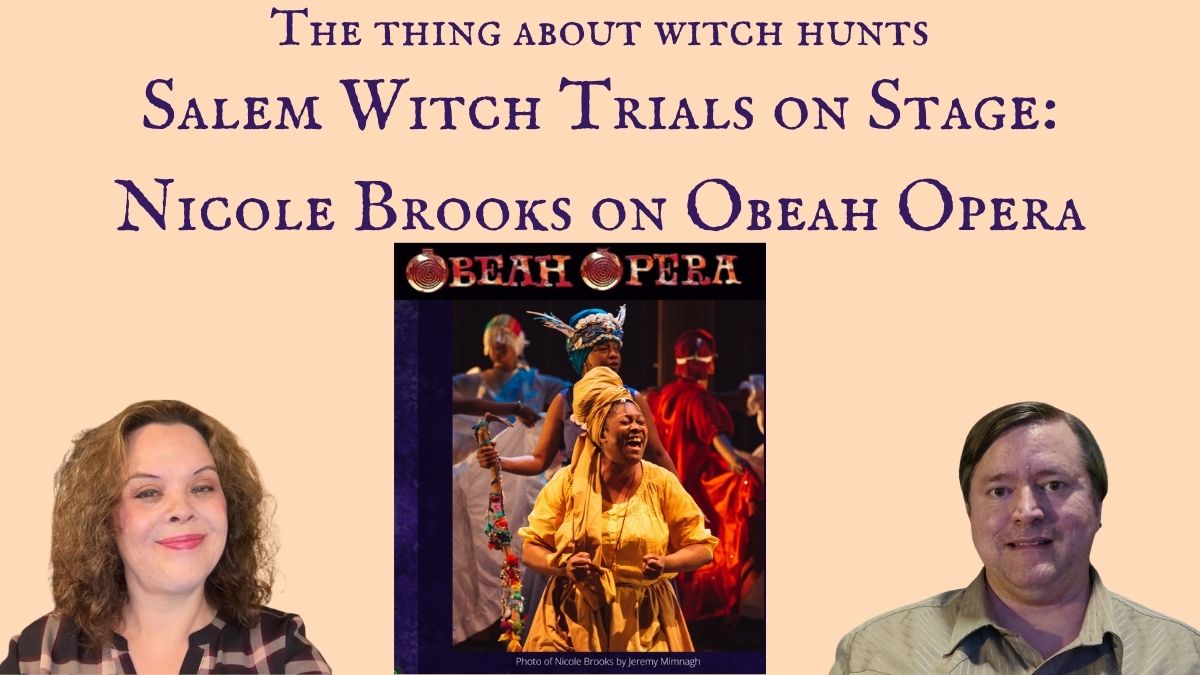
Most people meet Tituba through Arthur Miller. Nicole Brooks met her differently. The Canadian artist, producer, composer, and performer spent over a decade creating Obeah Opera, a fully sung a cappella theatrical work that centers Tituba and the other women of Salem as healers, wise women, and people who loved and were loved. In this conversation Nicole opens up about the research, the music, the controversy, and the story she believes America is ready to hear.
What You Will Learn
How music makes the heaviest history bearable
Who Tituba was beyond The Crucible
Why Nicole positions every woman in the story as a healer
How the word Obeah appears in Puritan records and what that tells us
The love story at the heart of Obeah Opera
How the girls who made accusations were themselves silenced and powerless
Why an all-female cast changes how the story lands
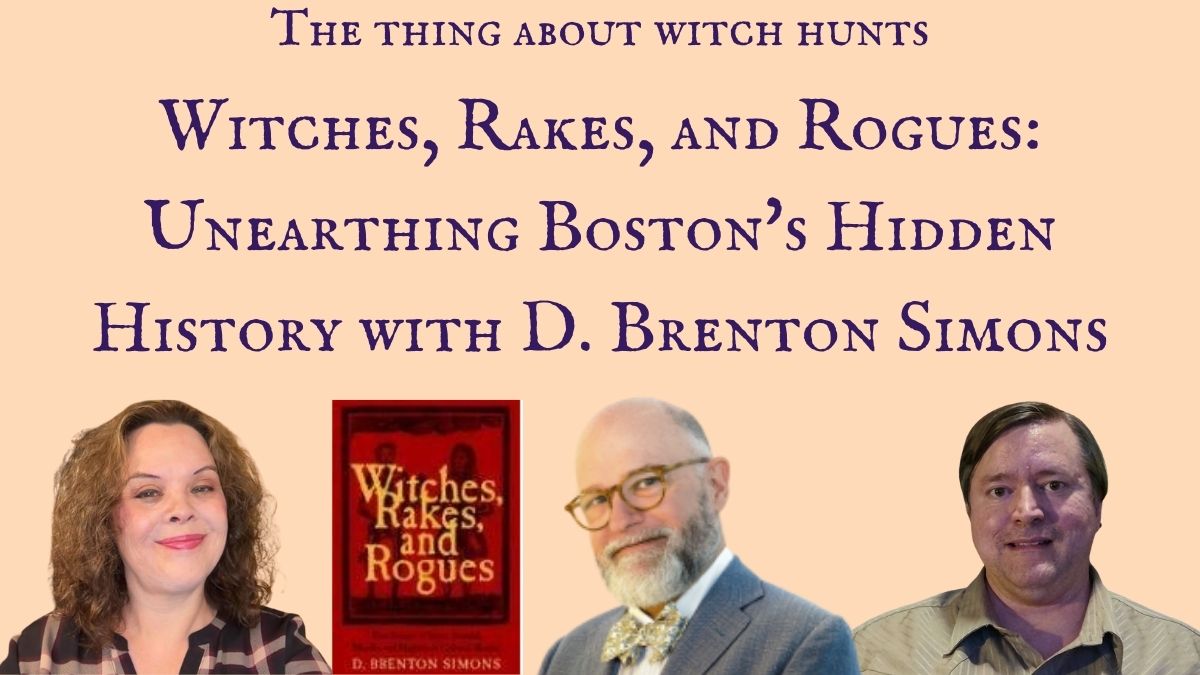
What if Boston’s colonial past held witch trial stories just as gripping as Salem’s but almost entirely overlooked? This week, Sarah and Josh sit down with D. Brenton Simons, President Emeritus and former CEO of American Ancestors (New England Historic Genealogical Society), to uncover the witches, criminals, and scandal-makers that Boston’s official history left out.
Meet Our Guest
D. Brenton Simons spent 18 years leading American Ancestors, one of the world’s foremost genealogical organizations with over 500,000 members in 139 countries. He is the author of Witches, Rakes, and Rogues, a collection of true Boston stories spanning 1630 to 1741, and was honored by King Charles III for his contributions to Anglo-American history.
What You’ll Discover
Boston had a witchcraft period spanning over a century, and the stories from it look nothing like what popular culture has taught us. Brenton walks us through cases that defy every stereotype, including a wealthy, well-connected woman whose “disagreeable” personality made her a target after her husband’s death, an Irish Catholic servant whose foreign language and customs terrified a Puritan community, and women whose only real crime was practicing folk medicine and refusing to be pushed around.
The research behind this book took five years and required digging through court records, personal diaries, and archives. The result is a portrait of real people navigating a world where the devil felt as immediate and dangerous as a neighbor’s grudge.
Highlights
The woman who appears as a background character in The Scarlet Letter and the real, devastating story behind her name
How the Goodwin children’s afflictions during the Goody Glover case reveal something very human about fear and attention
The connection between Mercy Short’s post-traumatic experiences and the Salem trials
Why the discovery of a black cat may have saved Boston from a second wave of witch hunting
What happened to accusations that never became trials, and why those stories matter just as much
Genealogy Connection
For descendants of Boston and Connecticut witch trial victims, this episode is essential listening. Brenton discusses his research connecting Mary Hale, Winifred Benham Sr., and the Benham family line across generations and colonies. If you have colonial New England ancestry, you may have more connections to these stories than you realize.
The Thing About Witch Hunts is produced by End Witch Hunts, the only U.S. nonprofit dedicated to witchcraft accusation awareness. Find us wherever you listen to podcasts and on YouTube.
If you enjoyed this episode, please leave a review and share it with anyone who loves colonial history, genealogy, or untold American stories.
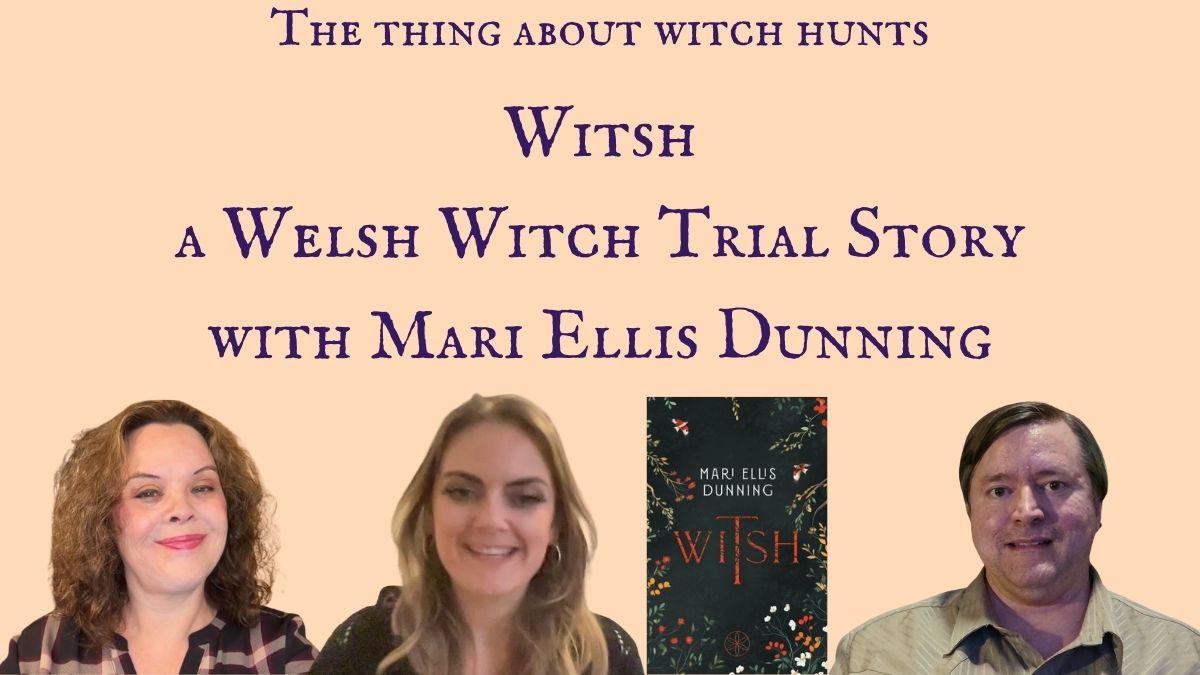
Wales has something most countries don’t: complete, intact court records from every witch trial held in the Court of Great Sessions. Author Mari Ellis Dunning used these archives to write Witch, a historical novel set in 16th century Wales.
About the novel:
Witch follows Dolly, a Welsh young woman desperate to have a baby who seeks help from a local soothsayer. The story explores what happens when accusations arise in a community caught between old Welsh traditions and new English Protestant law.
The historical context:
Five witch trials in Wales resulted in death sentences. The records show fascinating details, including Gwen ferch Ellis’s case where “ignoramus” (case dismissed) was physically crossed out before her conviction.
Mari discusses the tension between licensed and unlicensed midwives, how the Royal College of Physicians excluded women from medicine, and why lay healers were often more effective than the male physicians who replaced them. Class boundaries determined which accusations progressed to trial.
The conversation explores:
How Mari balanced creating relatable, nuanced characters while staying true to the limited agency women actually had in the 16th century
Why Wales’s cultural identity and the conflict between Catholicism and Protestantism shaped different attitudes toward folk practices
The connection between historical witch trials and modern medical misogyny, political rhetoric weaponizing “witch,” and systemic violence against women.
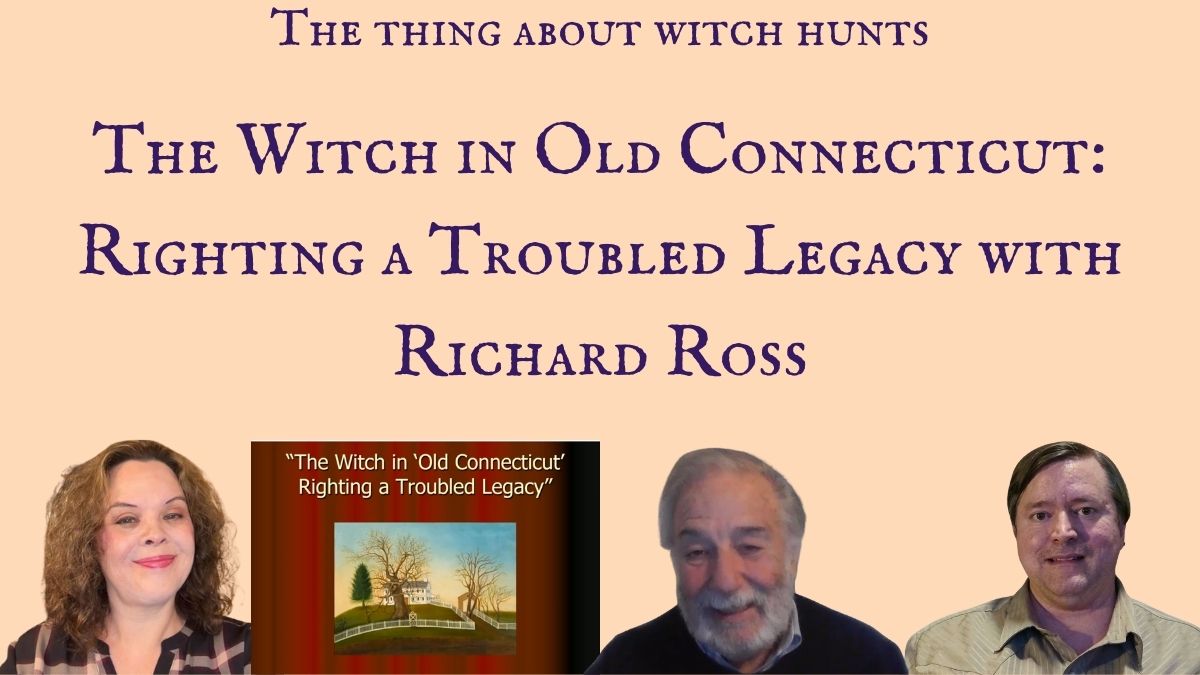
How did 19th century Maryland pro-slavery advocates weaponize witch trial narratives against Connecticut abolitionists? Returning guest Dr. Richard Ross III reveals a fabricated 1848 witch trial story designed to discredit Connecticut’s anti-slavery movement following the Amistad U. S. Supreme Court case victory.
This conversation explores the intersection of witch trial history and American slavery through the curious case of Juliana Cox, a completely fictional Connecticut witch whose story appeared in Maryland newspapers to embarrass Connecticut abolitionists. We consider how missing colonial documents created space for propaganda, examine the real Connecticut witch trials that were hidden for generations, and discuss how witch trial rhetoric became a political weapon in debates over slavery and abolition.
Dr. Ross shares research on how the Wyllys family papers disappeared into private collections, why Connecticut’s witch trial history remained largely unknown until the 20th century, and the deliberate creation of a witch trial hoax borrowed from English folklore sources to serve pro-slavery political goals.
Topics Covered
Connecticut witch trial records and their disappearance into private collections
The Amistad trial and Connecticut abolitionist movement
Fabricated witch trial narratives as political propaganda
How pro-slavery advocates compared abolitionists to Salem witch trial accusers
The real witch trials of colonial Connecticut finally documented
Alice Young: Connecticut’s first executed witch
Examining bodies for witch marks in colonial New England
Literary and political uses of witch trial rhetoric in 19th century America
About the Guest
Dr. Richard Ross III is a historian and Professor Emeritus from Trinity College in Hartford, Connecticut, where he taught a seminar on New England witch trials for over ten years. He is the author of Before Salem: Witch Hunting in the Connecticut River Valley, 1647-1663 and has conducted extensive research on colonial Connecticut witch trials and 19th century American social history.
Keywords
Connecticut witch trials, slavery and witchcraft, Amistad trial, abolition movement, colonial Connecticut, witch trial propaganda, Richard Ross historian, Alice Young witch trial, Connecticut abolitionists, slavery history, colonial New England, witch trial records, 19th century America, anti-slavery movement, political propaganda, witch hunt history, Maryland newspapers
The Thing About Witch Hunts explores historical witch trials and contemporary witch persecution worldwide. Hosted by End Witch Hunts, a 501(c)(3) nonprofit organization founded by Sarah Jack.
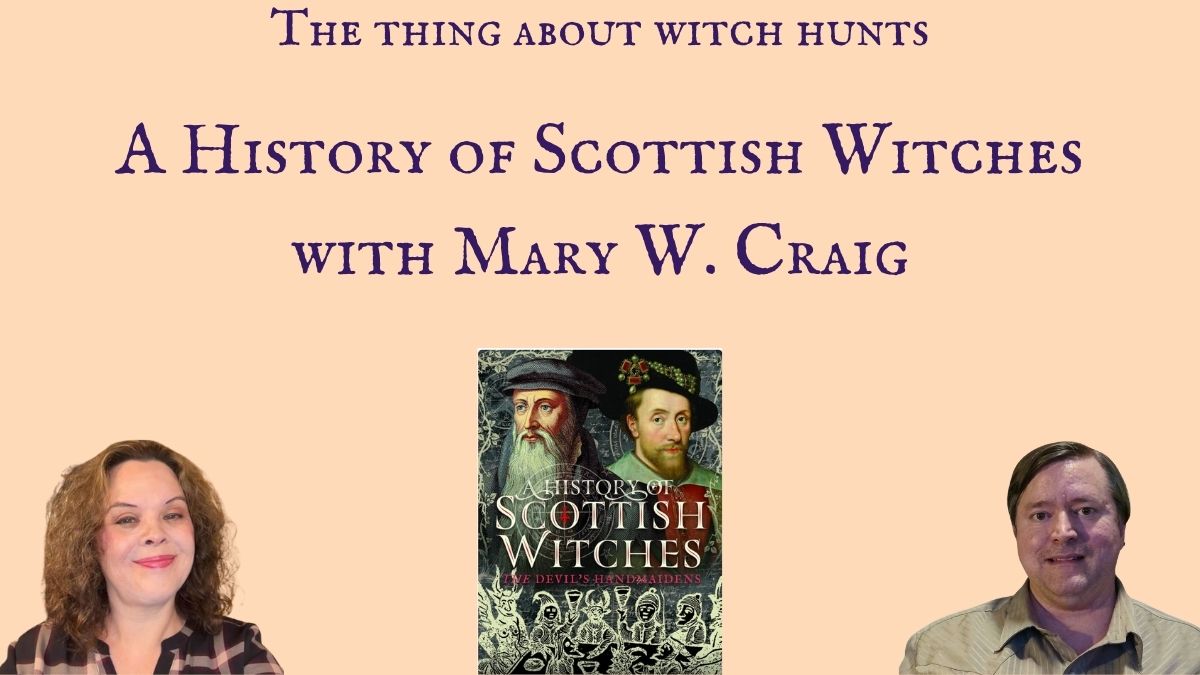
Historian Mary W. Craig returns to discuss her new book, *A History of Scottish Witches: The Devil’s Handmaidens, which traces the arc from the 1563 Witchcraft Act through its abolition in 1736.
Craig explores how beliefs that had existed for generations became capital crimes, examining the theological frameworks, political upheavals, and social structures that shaped prosecutions. The conversation moves from John Knox’s influence on Scottish law to the chaos of 1661-62, when local courts abandoned proper procedures.
Drawing on trial records and historical documents, Craig discusses who was accused, how interrogations were conducted, and why the trauma made Scottish descendants harder to trace than their New England counterparts. She also reflects on what medieval Scottish communities believed before the Reformation and how those beliefs were reinterpreted.
A History of Scottish Witches will be available February 2025 from Pen and Sword Books and is now available for pre-order.
Keywords: Scottish witch trials, Mary W. Craig, Scottish history, 1563 Witchcraft Act, Reformation Scotland, historical research, witch trial records, social history, legal history Scotland
What is folklore and how does it connect to witch hunts? Join us for an author talk with Professor Owen Davies and Dr. Ceri Houlbrook from the University of Hertfordshire, discussing their new book Folklore: A Journey Through the Past and Present. Discover how folklore shapes our daily lives, from cheese rolling traditions to social media rumors.
Episode Highlights:
• Folklore definition and what folklore actually means today
• British folklore traditions and American folklore customs explored
• How folklore practices became legal evidence in Salem witch trials
• The three types of British witches: conflict witches, accidental witches, and outcast witches
• Folk devils versus theological devils in witch hunt history
• Spectral evidence, pricking tests, touch tests, and folk magic in historical witch accusations
• Why debunked theories like the ergot explanation persist in popular culture
• How contemporary folklore evolves through podcasts and social media
• The ritual year framework and material culture in folklore studies
• Magical thinking and supernatural beliefs across cultures
• How folklore cycles between revival and decline
Whether you’re studying folklore definition, researching folklore examples, or interested in folklore and popular culture, this author talk explores how folklore studies reveals patterns in human behavior across time. Pick up Folklore: A Journey Through the Past and Present at https://bookshop.org/shop/endwitchhunts to support our work and explore opportunities to study folklore at the University of Hertfordshire’s MA folklore program.
Enjoy this in-depth author interview with New York Times bestselling author Kathleen Kent. Kathleen opens up about her writing process, her journey from aspiring writer to published novelist, and the craft behind transforming family history into compelling historical fiction.
Kathleen’s debut novel, The Heretic’s Daughter, tells the story of her ancestor Martha Carrier, who was executed during the Salem Witch Trials on August 19, 1692. Martha was from Andover, the town with the most accused witches was blamed for a smallpox epidemic that killed 13 people. Even when her children were tortured into confessing against her, Martha refused to admit to crimes she didn’t commit.
This episode offers invaluable insights for aspiring novelists and historical fiction writers, covering everything from research techniques to finding your voice as a writer. Whether you’re working on your first novel or looking to deepen your craft, Kathleen’s experience and teaching expertise provide practical guidance for writers at every level.
About Kathleen Kent
Kathleen Kent is a New York Times bestselling author and member of the Texas Institute of Letters. Her novels include:
The Heretic’s Daughter (David J. Langum Sr. Award for American Historical Fiction, Will Rogers Medallion Award)
The Traitor’s Wife
The Outcasts (American Library Association “Top Pick” for Historical Fiction)
The Dime, The Burn, and The Pledge (Edgar Award-nominated crime trilogy)
Black Wolf
Kathleen teaches writing workshops and has worked with Texas Writes to mentor aspiring authors.
Episode Highlights for Writers
Kathleen’s journey from aspiring writer to published author
The writing process behind The Heretic’s Daughter
Research techniques for historical fiction writers
How to balance historical accuracy with storytelling
Finding and developing your unique voice as a writer
Working with family history and sensitive historical material
Navigating the publishing process
Teaching writing and what aspiring novelists need to know
Transitioning between historical fiction and crime fiction genres
For History Enthusiasts
Martha Carrier’s powerful story of resistance
The Andover witch trials and why this town had the most accusations
The 1690 smallpox epidemic and its connection to witch accusations
How children were tortured into testifying against their parents
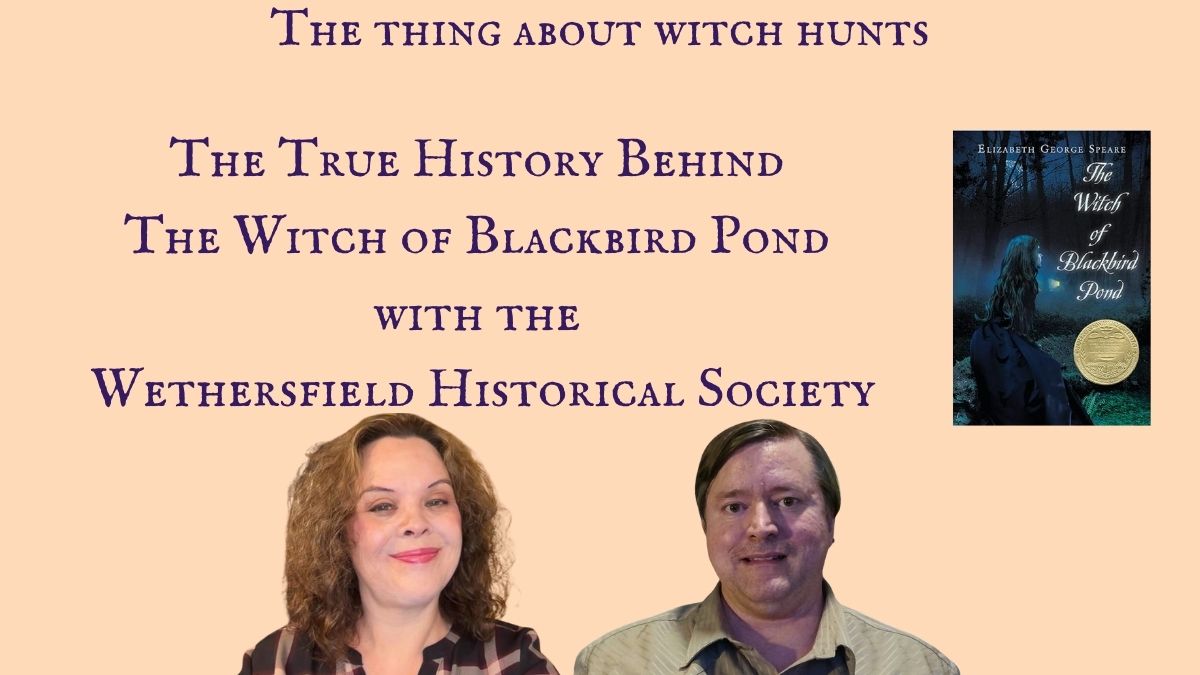
Is The Witch of Blackbird Pond historical fact or beloved fiction? Museum educators Martha Smart and Gillie Johnson from the Wethersfield Historical Society pull back the curtain on Elizabeth George Speare’s classic novel by revealing what she got right and what she invented. This episode demonstrates why Connecticut’s real witch trials deserve more attention than they’ve gotten.
Discover the true story of Katherine Harrison, whose 1669 witch trial revealed the dangerous reality for independent women in Puritan Connecticut. Learn why Gershom Bulkeley, a real historical figure who appears in the novel helped end witch executions in Connecticut by declaring he’d seen no legally proven case of witchcraft.
From the Charter Oak legend to the history of slavery in colonial Connecticut, this conversation goes far beyond the novel to explore what life was really like in 1680s Wethersfield and whose stories have been left out of the history books.
Key Topics
The real Katherine Harrison witch trial and how it differed from the novel’s dramatic courtroom scene
Why Connecticut’s witch trials ended decades before Salem’s panic began
How The Witch of Blackbird Pond has shaped—and sometimes distorted—Wethersfield’s historical identity
What Elizabeth George Speare got wrong about Puritan social customs, trade, and the treatment of outsiders
The truth behind the Charter Oak legend and Connecticut’s resistance to British rule
Guest Information
Martha Smart – Research and Reference Librarian, Wethersfield Historical Society
Gillie Johnson – Museum Educator, Wethersfield Historical Society
Learn more at wethersfieldhistory.org, where you can explore their database of people of color in Wethersfield’s history.
Elizabeth George Speare’s The Witch of Blackbird Pond and Connecticut’s colonial-era witch trials, including the 1669 case of Katherine Harrison in Wethersfield, form an important part of the state’s historical narrative, though they remain less widely recognized than their Salem counterparts.
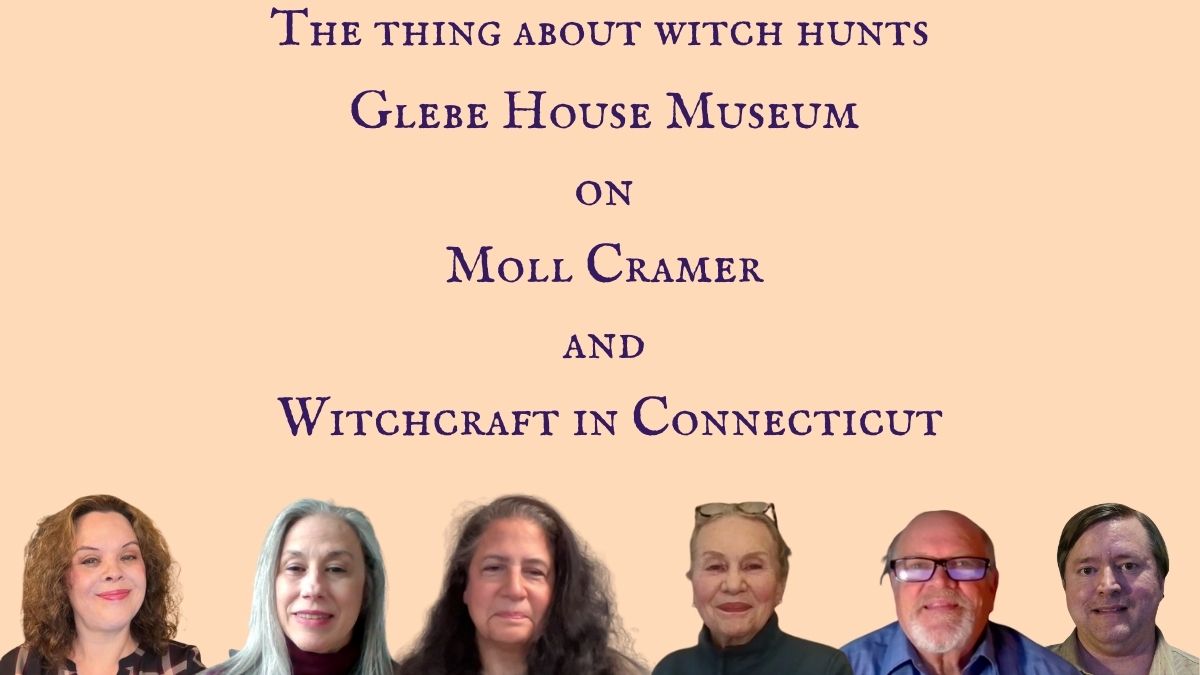
In this episode, Josh and Sarah speak with the creative team behind “The Witch of Woodbury,” a theatrical production at Connecticut’s Glebe House Museum that brings 17th-century witch trial victims to life through performance.
Featured Guests:
Linda Barr-Gale – Actress portraying Moll Cramer for 13 years and production writer
Loriann Witte – Director of Glebe House Museum, portraying Rebecca Greensmith
Maribeth Cummings – Actress portraying Katherine Harrison for 5 years
Vail Barrett – Actor portraying accuser Thomas Allyn
Key Topics:
The legend of Moll Cramer, the “Witch of Woodbury” who was banished to Tophet Road
Connecticut’s witch trial history from 1647-1663, including 11 executions
How Governor John Winthrop Jr. transformed Connecticut’s approach to witchcraft accusations
Accused Witch Katherine Harrison’s well-documented case and its role in changing spectral evidence standards
Executed woman Rebecca Greensmith’s role in the Hartford Witch Panic of 1662
The perspective of accusers like Thomas Allyn and the climate of fear in colonial Connecticut
Using theatrical performance to make history accessible and memorable for modern audiences
Historical Context: The performance emphasizes the stark differences between Connecticut’s evolving legal standards under Winthrop and the later Salem trials.
Just saw Wicked: For Good (Wicked Part 2) and wondering what it all means? The sequel to 2024’s blockbuster Wicked movie starring Cynthia Erivo and Ariana Grande delivers the pure magic and joy of Wicked’s fairytale storytelling while also serving as a mirror reflecting our world’s darkest patterns of persecution. Join hosts Sarah Jack and Josh Hutchinson for a spoiler-filled celebration of this magical film as they explore both the enchantment of the story and the surprisingly relevant themes hiding behind flying monkeys, sparkly shoes, and that iconic green skin.
From Gregory Maguire’s beloved novel to the Broadway phenomenon with music by Stephen Schwartz, Wicked has captured hearts worldwide. This sequel delivers stunning musical numbers, an enchanting fairytale ending, and America’s greatest modern fairy story—while also offering profound insights about our world. Discover why Elphaba, Glinda, Fiyero, Dorothy, and the Wizard of Oz create a story that’s both entertainment magic and meaningful social commentary.
From the breathtaking songs like “For Good” to the animals in cages vault scene that’s impossible to look away from, this episode explores how the Wicked movie with Jonathan Bailey and Jeff Goldblum delights audiences while helping us understand who gets labeled “wicked”—and who decides.
What You’ll Explore:
The pure magic and joy of Wicked’s fairytale storytelling
Standout musical moments and how the Broadway songs translate to film
The chilling parallels between Oz’s animal persecution and real-world witch hunts
Elphaba and Glinda’s friendship, sisterhood, and the choices that change everything
Why the treatment of talking animals in Oz mirrors modern oppression
How Dorothy’s witch hunt against Elphaba reflects real accusation patterns
Why Nessarose, Boq, and Fiyero’s transformations matter for understanding persecution
How the word “witch” is weaponized as a political tool today
Whether movies like Wicked help or harm the fight against modern persecution
Deep dive into Cynthia Erivo’s Elphaba and Ariana Grande’s Glinda
This is the next installment in our ongoing look at Wicked and Oz! If you haven’t already, be sure to check out our previous episodes “Witchcraft and Stagecraft: Unmasking Wicked’s Magic with Paul Laird and Jane Barnette” and “Wicked Movie: The Making of a Witch” to explore how this beloved story connects to real witch trial history and contemporary persecution.
Content Warning: This episode includes movie spoilers and discusses themes of persecution, banishment, and contemporary witch hunts affecting millions globally.
Ready to see beyond the emerald curtain? This isn’t your childhood Oz anymore—and that’s exactly the point. But it’s also a wicked good time.
In May 1692, one of Boston’s most respected citizens walked into a Salem courtroom—and the accusers couldn’t even identify him. Captain John Alden Jr., son of Mayflower passengers and decorated war hero, seemed an unlikely target for witchcraft accusations. But his connections to Native Americans and the French made him dangerous in the eyes of wartime Massachusetts.
What happened when Salem’s witch hunt reached beyond the village to pull in a prominent Bostonian with impeccable colonial credentials? This episode examines how Captain Alden’s examination revealed the absurdity and danger of the spectral evidence system and how his escape became one of the trial period’s most dramatic moments.
From his parents’ legendary Plymouth courtship to his own flight from justice, Captain Alden’s story shows us who could be accused, who could survive, and what it took to navigate Salem’s machinery of suspicion.
Episode Highlights:
John Alden Sr. and Priscilla: The last surviving Mayflower passenger and the marriage that inspired Longfellow
Captain Alden’s controversial fur trading and the rumors that made him a target
The chaotic May 31st examination where accusers needed prompting
The touch test, the sword, and the claims of “Indian Papooses”
His September escape to Duxbury and surprising return
Key Figures:
Captain John Alden Jr., John & Priscilla Alden, Judges Bartholomew Gedney and John Richards, Rev. Samuel Willard, Robert Calef
Massachusetts has an opportunity to make history, and you can be a part of it. On November 25, 2025, Bill H.1927 goes before the Massachusetts Joint Committee on the Judiciary. This legislation will exonerate 8 individuals convicted of witchcraft in Boston and recognize everyone else who suffered accusations across Massachusetts. Between 1648 and 1693, more than 200 people were formally charged with witchcraft in Massachusetts. Only 31 from Salem have been cleared. The rest have been forgotten—until now.
Co-hosts Josh Hutchinson and Sarah Jack, who helped co-found the Connecticut Witch Trial Exoneration Project and successfully passed Connecticut’s witch trial absolution bill in 2023, share how YOU can help Massachusetts finish the job.
What You’ll Learn in This Episode:
The 8 individuals convicted in Boston who have never been exonerated: Margaret Jones, Elizabeth Kendall, Alice Lake, Hugh Parsons, Eunice Cole, Ann Hibbins, Elizabeth Morse, and Goody Glover
Why this matters today: Witch hunts didn’t end in the 1600s—they’re still happening around the world
The history of Massachusetts exoneration efforts from 1703 to 2022
How Connecticut proved it’s possible with overwhelming bipartisan support in 2023
Exactly what you can do to support H.1927, whether you live in Massachusetts or anywhere else in the world
Key Facts:
250+ individuals were accused of witchcraft in Massachusetts between 1638 and 1693
38 people were convicted (30 in Salem, 8 in Boston)
25 people died: 19 hanged in Salem, 5 hanged in Boston, and Giles Corey pressed to death
Only Salem victims have been exonerated—the 8 Boston convictions remain unaddressed
The Boston Eight:
Five Executed:
Margaret Jones (1648) – The first person executed for witchcraft in Massachusetts
Elizabeth Kendall (1647-1651) – Falsely accused by a nurse covering her own negligence
Alice Lake (c. 1650) – Mother of four, judged for her past
Ann Hibbins (1656) – A widow, called “quarrelsome” for speaking her mind
Goody Glover (1688) – Irish Catholic widow executed just 4 years before Salem
Three Convicted But Not Executed:
Hugh Parsons (1651) – Conviction overturned, released 1652
Eunice Cole (likely 1656) – Convicted and imprisoned, though records are incomplete
Elizabeth Morse (1680) – Sentenced to death but eventually released
CRITICAL DATE: November 25, 2025
The Joint Committee on the Judiciary holds a hearing on H.1927 at 10:00 AM
This bill MUST get through committee to move forward. If it doesn’t receive a favorable report, it gets sent to “study” where it becomes invisible and inactive.
How YOU Can Help RIGHT NOW:
1. Sign the Petition (From Anywhere in the World)
change.org/witchtrials Goal: 3,000+ signatures
2. Submit Written Testimony (From Anywhere in the World)
Keep it short: 2-6 sentences is enough! Include:
Why this bill matters to you
That these people were innocent
Why Massachusetts should complete its exoneration work
Connection to modern witch hunts (optional)
Where to submit: Details at massachusettswitchtrials.org
3. Contact Your Massachusetts Legislators (MA Residents)
Email your state representative and senator
Ask them to support H.1927
Ask them to co-sponsor the bill
Tell them: “Massachusetts exonerated the Salem victims but left the Boston victims behind. Please honor all witch trial victims.”
4. Spread the Word
Share this episode and use hashtags:
#H1927
#WitchTrialJustice
#MassachusettsHistory
#mawitchhuntjusticeproject
#EndWitchHunts
5. Get a Support Pin
Purchase the Massachusetts Witch-Hunt Justice Project pin on Zazzle (under $5) Link in show notes and at massachusettswitchtrials.org
Bill Sponsors:
Primary Sponsor: Rep. Steven Owens (Cambridge and Watertown)
Co-Sponsors:
Rep. Sally P. Kerans
Rep. William C. Galvin
Rep. Natalie M. Higgins
We need more co-sponsors! Contact your legislators if you’re in MA.
Why Exoneration Matters:
✅ Honors innocent victims – They maintained their innocence; we’re their voices now
✅ Acknowledges injustice – This was wrong and Massachusetts needs to say so
✅ Recognizes colonial heritage – Witch hunts are part of our real history
✅ It was human agency, not the devil – People made these choices; people must take responsibility
✅ Confronts coerced confessions – A stand against forcing false confessions (still happening today)
✅ Stands against misogyny – 80%+ of Massachusetts witch trial victims were women and girls
✅ Connects to modern witch hunts – People are STILL being accused, attacked, and killed over witchcraft accusations worldwide
✅ Sets an example – Fear should not drive us to scapegoat vulnerable people
✅ Completes Massachusetts’ work – Salem victims are cleared; Boston victims deserve the same
Connecticut Showed Us It’s Possible:
In 2023, Connecticut passed House Joint Resolution 34:
121 to 30 in the House
33 to 1 in the Senate
Bipartisan support across all political stances
34 victims absolved and official apology issued
Led by regular people: descendants, advocates, history buffs who cared about justice
We documented the entire campaign. We mapped the route from decades of setbacks to legislative success. Now Massachusetts can follow this path.
Quote from the Episode:
“Mary Esty, one of the women hanged during the Salem witch trials, wrote a petition recognizing she was condemned. She told the magistrates: even though you think you’re right, if you continue this way, more innocent people are going to die. Over 300 years between Mary Esty and a survivor in a refugee camp in Ghana—and they were essentially saying the same thing.”
Resources:
📚 massachusettswitchtrials.org – Complete info on the 8 convicted individuals, how to support H.1927, full bill text, history resources
📝 change.org/witchtrials – Sign the petition, find testimony submission info
🎙️ aboutwitchhunts.com/ – The Thing About Witch Hunts podcast
🎙️ aboutsalem.com – The Thing About Salem podcast (our companion show)
🌐 endwitchhunts.org – Our nonprofit’s broader work
🌐 connecticutwitchtrials.org – Learn about Connecticut’s success
📌 Zazzle Shop – Get your Massachusetts Witch-Hunt Justice Project support pin
International Context:
This movement is global:
Scotland: First Minister and Kirk of Scotland issued apologies
Spain (Catalonia): Pardoned hundreds of witch trial victims
Connecticut: Full absolution and apology in 2023
Witch hunts continue today in refugee camps in Ghana, across Africa, Asia, and beyond. When we stand up for historical victims, we stand against witch hunting happening right now.
Organizations working on contemporary witch hunts:
INAWARA (International Network Against Witchcraft Accusations and Ritual Attacks)
AFAW (Advocacy For Alleged Witches)
For Massachusetts Residents:
Your voice carries extra weight. The Joint Committee on the Judiciary needs to hear from constituents. Email, call, submit testimony. Tell your legislators this matters to you and to Massachusetts’ historical legacy.
You Don’t Need a PhD or Political Title
You just need to care and be willing to speak up. Regular people made Connecticut’s exoneration happen. Regular people can make this happen in Massachusetts.
These eight individuals have waited nearly 400 years.
Will you be one of the voices that finally brings them justice?
Podcast Credits:
Hosts: Josh Hutchinson and Sarah Jack A Project of: End Witch Hunts (nonprofit organization)
Listen: Wherever you get podcasts Website: aboutwitchhunts.com/
Companion Podcast: The Thing About Salem (aboutsalem.com)
Take Action Today:
Every signature matters. Every piece of testimony matters. Every call to a legislator matters.
Show up for these victims the way advocates showed up for Connecticut’s victims.
Because history isn’t just something we study—it’s something we can respond to.
Tune in for this informative virtual panel discussion bringing together three of the world’s leading experts on witchcraft accusations and ritual violence. This free online event, co-hosted by End Witch Hunts and featuring speakers from INAWARA (International Network Against Witchcraft Accusations and Ritual Attacks), addresses one of the most pressing yet under-recognized human rights crises of our time.
Professor Charlotte Baker – Co-Director of INAWARA and Professor at Lancaster University (UK). From 2015-2021, Professor Baker worked with Ikponwosa Ero and Gary Foxcroft to secure UN Resolution 47/8 on eliminating harmful practices related to witchcraft accusations (July 2021).
Professor Miranda Forsyth – Co-Director of INAWARA and Professor at Australian National University’s School of Regulation and Global Governance. Leading socio-legal researcher specializing in legal pluralism and restorative justice, with groundbreaking work on sorcery accusation-related violence in Papua New Guinea and Melanesia since 2013.
Dr. Keith Silika – Criminal investigator, lecturer, and human rights advocate bridging criminology, forensics, and cultural understanding. Born in Zimbabwe with roots in traditional healing, his career spans the Zimbabwe Republic Police to law enforcement and academic work in England.
What You’ll Learn
This panel discussion explores why international collaboration is essential to combating witchcraft accusations and ritual violence across the globe. Our distinguished panelists will discuss:
Global research and coordination: How INAWARA unites experts, practitioners, advocates, and survivors from around the world to share knowledge and develop evidence-based interventions
The new legislative report: Key findings from the June 2025 report, Legislative Approaches to Addressing Harmful Practices Related to Witchcraft Accusations and Ritual Attacks
Cross-border strategies: Why connecting researchers, NGOs, legal professionals, and community advocates across borders has significant value and creates more effective solutions
Challenges and progress: Real-world obstacles faced by communities worldwide and successful approaches to protection and prevention
Advocacy and policy reform: How research translates into legal protections and policy changes at local, national, and international levels
Community protection: Grassroots education and support systems that help vulnerable populations resist witch-hunt violence
About the Organizations
End Witch Hunts is the leading United States organization dedicated to eliminating violence and discrimination against people accused of witchcraft. Through advocacy, education, research, and community engagement, End Witch Hunts works to amplify community advocates worldwide and raise awareness of this critical human rights issue.
INAWARA (International Network Against Witchcraft Accusations and Ritual Attacks) is a global network that connects experts, practitioners, advocates, and survivors from every continent. By fostering international collaboration and supporting evidence-based interventions, INAWARA works to end witch hunts, witchcraft accusations, and ritual attacks wherever they occur.
Who Should Listen
Human rights advocates and activists
Researchers and academics studying witchcraft accusations
NGO workers and humanitarian professionals
Policy makers and legal professionals
Educators and community organizers
Students of anthropology, law, or human rights
Anyone concerned about global justice issues
Why This Matters
Witchcraft accusations continue to drive violence, discrimination, and human rights abuses across Africa, Asia, the Pacific, Latin America, and beyond. Victims are often women, children, the elderly, and those with disabilities. They face torture, exile, property seizure, and death. This panel discussion highlights the power of global cooperation in addressing this crisis and protecting the most vulnerable among us.
The Thing About Witch Hunts is a production of End Witch Hunts, dedicated to educating the public about historical and contemporary witch hunts through expert interviews and in-depth research.
Why do witchcraft accusations persist in modern India, and how do gender and caste inequalities fuel this cycle of violence despite legal protections?
Join Josh Hutchinson and Sarah Jack for a powerful conversation with Bharvi Shahi, a final-year law student at the School of Legal Studies, REVA University, currently pursuing her LL.M. at Christ University, Bengaluru, and Razina Ahmed, Assistant Professor of Law at the School of Law, Presidency University, Bengaluru about from their research work in Northeast India’s tribal communities and international human rights law.
they explore the complex intersection of belief, tradition, and human rights violations in Northeast India’s tribal communities related to witchcraft accusations.
What You’ll Learn:
Understand the critical difference between cultural beliefs and harmful practices under international human rights law. Explore how accusations emerge within community structures when illness or misfortune strikes and medical care is inaccessible. Learn why India’s state-level witchcraft laws face massive implementation challenges, and discover the reality of witch-hunt victim communities living in isolation. Our guests reveal how patriarchal structures weaponize supernatural accusations to control and exclude women.
Razina Ahmed shares firsthand research challenges, including the startling moment an NGO declined to help her visit a village of survivors, revealing how deeply stigma affects even those working in advocacy. Bharvi Shahi examines how freedom of belief becomes weaponized against the most vulnerable: widows, elderly women, and those with disabilities. This episode reveals how community fear, social isolation, and supernatural accusations create complexities that legal protections alone cannot resolve.
Keywords: witch hunts India, tribal communities Northeast India, witchcraft accusations, gender-based violence, human rights violations India, superstition and law, vulnerable women, Assam tribal communities, Implementing Human rights, belief vs harmful practices
In August 2023, we spoke with playwright Laurie Flanigan-Hegge about Prick, her play about the Scottish witch trials. It had just premiered at the Edinburgh Fringe Festival.
Two years later, the play has traveled to New Orleans, Wellington (New Zealand), and opens November 6-16, 2025 at the Den Theater in Chicago.
We reunite with Laurie and puppet artist Madeline Helling and meet two directors: Jeff Mills of Chicago’s Proboscis Theater Company and Amy Chaffee from Tulane University.
The conversation covers what it’s like staging historical violence, why the single puppet design works so powerfully, and how a play about 17th-century Scotland keeps finding new relevance.
About the Play
Prick examines the Scottish witch trials through three women: an Unknown Woman lost to history, Marioun Twedy of Peebles, and Isobel Gowdie. The title refers to “pricking”—searching accused women’s bodies for the “devil’s mark” with sharp instruments.
The play moves between past and present, uses dark humor and Scottish folk music, and centers on a single haunting puppet created by Madeline Helling.
What They Discuss
The rehearsal process: Both directors talk about the challenge of staging the pricking scenes, even with a puppet. Jeff’s Chicago cast continues working through how to show violence respectfully. Amy’s New Orleans students couldn’t bring the instrument near the puppet—they performed the gesture from twelve feet away.
The puppet’s power: Madeline designed one puppet to represent all the accused women. It’s specific enough to feel real, neutral enough that audiences project onto it. The puppet travels between productions and comes back to her for repairs.
Contemporary connections: The play addresses ongoing witch hunts in countries where witchcraft remains a state crime. Amy teaches in Louisiana and discusses working in a politically charged environment. Jeff talks about theater as “rehumanization” in response to current dehumanization.
The music: Both productions use songs by Heal and Harrow, a folk duo who created an album for the Witches of Scotland Campaign. Jeff adds Scottish guitar with electronics. Amy’s students performed acapella arrangements.
Cultural complications: Amy reflects on taking the play to Wellington, New Zealand—a colonial capital—at a conference focused on integrating Māori culture with acting and voice techniques. The play deals with Scotland as both colonized and colonizer, which created complex responses from audiences of different backgrounds.
“Remembrance Is Resistance”
This Witches of Scotland Campaign motto runs through the conversation. The campaign seeks pardons and memorials for nearly 5,000 documented accused. They created a tartan anyone can wear to show support.
At Tulane, one student built a monument inscribed with every name from the database and installed it in the lobby.
Chicago Production
November 6-16, 2025 The Den Theater, Milwaukee Avenue Tickets: thedentheatre.com (search “Prick”)
Two weekends only. Proboscis Theater Company’s production features new jackdaw puppets and is reaching out to both theater audiences and Chicago’s pagan communities.
Guest Bios
Laurie Flanigan-Hegge is a playwright whose work focuses on historical events. She created Prick in collaboration with the Witches of Scotland Campaign for Justice. The play premiered at the 2023 Edinburgh Fringe Festival and has since been produced in the US and New Zealand. She has been collaborating with Jeff Mills and Amy Chaffee for 35 years.
Madeline Helling is a puppet artist based in Minneapolis. She designed and built the central puppet for Prick, representing the accused women of the Scottish witch trials. The puppet has traveled with the production to all its venues and returns to her for repairs between shows.
Jeff Mills is Co-Artistic Director of Proboscis Theater Company in Chicago. He is directing the Chicago production of Prick (November 6-16, 2025 at the Den Theater). A former member of an Irish-Scottish music band, he is also composing the sound design for the production. He has been friends and collaborators with Laurie and Amy for 35 years.
Amy Chaffee is Associate Professor of Voice and Acting at Tulane University in New Orleans. She directed the North American premiere of Prick at Tulane with nine undergraduate students, then took the production to Wellington, New Zealand for the Oceania premiere at an international theater festival. She primarily works as a voice coach and dialect coach in film and television.
Why Listen
Four theater artists who’ve been friends for 35 years discuss the ethics and challenges of bringing historical trauma to the stage. They’re honest about what works, what’s difficult, and why this particular play keeps finding new audiences.
If you’re interested in historical witch trials, feminist theater, puppetry, or how the past connects to the present, this conversation offers substance without sensationalism.
Related Episode: Episode 47 (August 2023) – Original discussion before Edinburgh premiere
Resources:
Witches of Scotland Campaign
Survey of Scottish Witchcraft database
Heal and Harrow (musicians)
thedentheatre.com
Keywords: Scottish witch trials, Prick play, Witches of Scotland, Chicago theater, Den Theater, puppet theater, witch trial history, Laurie Flanigan-Hegge, Jeff Mills, Amy Chaffee, Madeline Helling
The Thing About Witch Hunts explores historical persecution and its continuing echoes. Subscribe wherever you listen to podcasts.
What do vampires, werewolves, and dragons tell us about ourselves? In this fascinating exploration of monsters in culture and society, we dive deep into why humanity has always been obsessed with creatures that go bump in the night.
From the etymology of “monster” (Latin “monstrum” – to warn or demonstrate) to modern cryptids and creepypastas, discover how these frightening figures serve as mirrors reflecting our deepest fears, repressed desires, and cultural anxieties. Learn why monsters aren’t just entertainment—they’re essential tools for processing trauma, establishing moral boundaries, and creating social cohesion. We’ll also examine the dangerous consequences of labeling real humans as monsters—and why this rhetoric prevents understanding, distances us from accountability, and can lead to dehumanization and violence.
Key Topics Covered
The Nature of Monsters
What defines a monster and the true meaning behind the word
Categories: supernatural beings, humanoid creatures, the undead, cryptids, and human monsters
Why witches became one of history’s most enduring monster figures
The Psychology of Fear
How monsters reflect our fear of ourselves
The intersection of monsters with our anxieties, values, and hopes
Why we’re drawn to “delicious fear” in safe contexts
Cultural Function of Monsters
Monsters as warnings that prefigure societal problems
How monster stories help us handle trauma and explore taboos
The role of monsters in teaching moral boundaries and creating in-groups
The Danger of Labeling Humans as Monsters
Why dehumanization prevents understanding
How calling people “monsters” distances us from accountability
The power of team-ups, protective magic, and courage
Why we need triumph stories to overcome our fears
Episode Highlights
✨ Monsters are cultural constructs that serve as societal mirrors 🧠 Understanding the Latin roots: “to show,” “to warn,” “to demonstrate” ⚠️ The problem with labeling real people as monsters 💪 How monster stories ultimately help us find courage and triumph
Keywords
monsters, cultural anthropology, folklore, mythology, psychology of fear, cryptids, supernatural beings, werewolves, vampires, social cohesion, moral boundaries, dehumanization, monster stories, horror culture, cultural fears, societal anxieties, creepypasta, witches in history
Connect With Us
Have your own thoughts on what monsters reveal about society? Share your perspective and join the conversation!
What makes a monster? In this spine-tingling episode, Josh and Sarah welcome back fellow podcasters Sean and Carrie from the hit show Ain’t it Scary with Sean and Carrie to explore one of the internet’s most notorious creations: Slender Man.
From creepypasta legend to real-world tragedy, discover how this faceless, tentacled entity became modern folklore and what it reveals about our relationship with monsters. Four podcasters who love things that go bump in the night dive deep into digital horror, viral legends, and—because it’s The Thing About Witch Hunts—somehow end up discussing the Salem witch trials.
Whether you run toward mysterious figures in the woods or away from them, this episode will make you question why we create monsters and what happens when fictional nightmares bleed into reality.
Episode Highlights
🎃 What is Slender Man? – The origins of the internet’s most infamous boogeyman 👻 Creepypasta to Crisis – How digital folklore goes viral in the modern age 🕯️ Monster Theory – Why do we need monsters? Why do we treat humans as monsters? 🔮 Salem Connections – The unexpected link between witch hunts and modern monster-making 🎙️ Skeptic Meets Spooky – Sean and Carrie return with their signature perspectives on the paranormal
About Our Returning Guests
Sean & Carrie host Ain’t it Scary with Sean and Carrie, where a skeptic and a believer explore the unknown, unsolved, unbelievable, and just plain weird. With their passion for history and uncovering truth, they bring complementary perspectives to every mystery they tackle.
Keywords
Slender Man, creepypasta, digital folklore, internet legends, monsters, witch hunts, Salem witch trials, paranormal podcast, horror podcast, Ain’t it Scary, folklore, urban legends, monster theory, viral horror, true crime
Listen & Subscribe
Don’t wander off the path—subscribe to The Thing About Witch Hunts and join us every episode as we explore the monsters, myths, and witch hunts throughout history.
Also check out:Ain’t it Scary with Sean and Carrie wherever you listen to podcasts!
Dr. Richard Raiswell, Dr. David Winter, and Dr. Mikki Brock—co-editors of The Routledge History of the Devil in the Western Tradition—explore the devil’s complex history, from his biblical origins to his evolution through Western culture. Discover how the devil has been weaponized to demonize marginalized groups throughout history and examine his surprising presence in contemporary society.
What You’ll Learn
The devil’s backstory and biblical origins
How the devil’s image transformed across different historical periods
The dark history of demonization and scapegoating
The devil’s role in witch hunts and persecution
Modern manifestations of devil imagery and symbolism
Expert insights from the comprehensive Routledge History collection
Featured Guests
Dr. Richard Raiswell
Dr. David Winter
Dr. Mikki Brock
Key Topics Covered
Devil mythology and theology
Historical persecution and witch hunts
Cultural representations of evil
The devil in Western tradition
Religious history and demonology
Social scapegoating through history
About the Book
The Routledge History of the Devil in the Western Tradition features contributions from 30 scholars, offering the most comprehensive examination of the devil’s role in Western culture and history.
SEO Keywords
devil history, witch hunts podcast, demonology, religious history, Dr. Mikki Brock, Dr Richard Raiswell, Dr. David Winter, Routledge History of the Devil, Western tradition, cultural history, persecution history, devil mythology, historical scapegoating, theological history
This October, we’re diving into the fascinating story of Margaret Jones—the first woman tried for witchcraft in Massachusetts—through Andrea Catalano’s debut novel The First Witch of Boston. Josh and Sarah explore this gripping historical fiction that sheds light on a witch trial that happened decades before Salem, in 1648. Discover why this lesser-known story deserves your attention and hear from the author herself about bringing Margaret Jones’s tale to life.
Episode Highlights
October Witchcraft Season: Josh and Sarah kick off the spookiest month with increased witchcraft content
Pre-Salem History: Learn about Massachusetts witch trials that occurred 44 years before the famous Salem trials
Margaret Jones’s Story: The 1648 execution that changed colonial history
Author Interview: Exclusive conversation with debut novelist Andrea Catalano
Chart-Topping Success: How this historical fiction novel reached the top of Amazon charts
Historical Accuracy Meets Fiction: Why Margaret Jones’s story was “ripe for telling”
Key Topics Covered
First Massachusetts witch trial (1648)
Margaret Jones execution
Pre-Salem witchcraft persecution
Colonial Boston history
Historical fiction as a vehicle for forgotten women’s stories
Andrea Catalano’s research and writing process
Featured Book
The First Witch of Boston by Andrea Catalano
Genre: Historical Fiction
Subject: Margaret Jones, executed for witchcraft in 1648
Amazon bestseller with positive critical reception
Why Listen
If you’re interested in:
Witch trial history beyond Salem
Colonial American history
Women’s forgotten stories
Historical fiction
October/Halloween content
Witchcraft history
Keywords
Witch trials, Massachusetts history, Salem witch trials, Margaret Jones, 1648, colonial America, witchcraft history, historical fiction, Andrea Catalano, The First Witch of Boston, Boston history, pre-Salem witch hunts, Halloween podcast, October episodes, women’s history, forgotten history
Subscribe & Support
Join Josh Hutchinson and Sarah Jack every week for your dose of witchcraft history. Subscribe to The Thing About Witch Hunts for more fascinating stories about persecution, superstition, and the women who were accused.
Perfect listening for October, Halloween season, or anytime you want to explore the darker corners of American colonial history.
Hosts Josh Hutchinson and Sarah Jack are featuring The Thing About Salem podcast on The Thing About Witch Hunts podcast to introduce our listeners to our companion 15 minute sized episode podcast! Both shows are produced by the End Witch Hunts nonprofit, and we want to make sure you don’t miss out on the incredible stories we’re telling about Salem’s witch trials. This crossover episode gives Thing About Witch Hunts listeners a taste of the detailed historical storytelling you’ll find over on The Thing About Salem.
Episode Summary
What if the Salem witch trials could have been prevented? In this compelling crossover episode, we examine the critical turning points between January 1692 and May 1693 when different decisions could have stopped America’s most notorious witch hunt in its tracks.
From the arrest of four-year-old Dorothy Good to Martha Carrier’s infamous designation as “Queen of Hell,” we explore how a series of escalating choices transformed a local Massachusetts crisis into colonial America’s deadliest legal disaster.
Key Topics Covered
Historical Turning Points
Critical moments when the Salem witch trials could have been halted
The shocking case of Dorothy Good, the youngest accused witch
How local accusations spiraled into regional hysteria
Key Historical Figures
Cotton Mather and his contradictory influence on the trials
Governor William Phips and his delayed intervention
Martha Carrier and her notorious title as “Queen of Hell”
The role of judges, ministers, and community leaders
Geographic Spread
Salem Village and Salem Town dynamics
How 45 Andover residents became entangled in accusations
The regional impact across Massachusetts Bay Colony
Legal and Social Analysis
Spectral evidence and its dangerous precedent
Court procedures that enabled the witch hunt’s growth
Community tensions that fueled the accusations
Episode Highlights
This crossover episode reveals how a perfect storm of fear, superstition, and poor decision-making created one of America’s darkest chapters. We examine the moments when cooler heads could have prevailed and the individuals who either fanned the flames or attempted to restore reason.
Historical Context
The Salem Witch Trials (1692-1693) resulted in the execution of 20 people and the imprisonment of hundreds more. This episode explores the human decisions behind the historical tragedy and the lessons we can learn about mass hysteria, due process, and the importance of critical thinking in times of crisis.
Perfect For Listeners Interested In:
Colonial American history
Legal history and judicial reform
Social psychology and mass hysteria
Women’s history and gender dynamics in early America
Religious history and Puritan society
True crime and historical mysteries
Keywords:
Salem witch trials, Massachusetts Bay Colony, Cotton Mather, spectral evidence, Dorothy Good, Martha Carrier, Governor Phips, Andover witch trials, colonial America, Puritan society, mass hysteria, historical true crime, 1692 witch hunt, Salem Village, judicial history
Listen Now
Join The Thing About Salem and The Thing About Witch Hunts for this special crossover episode exploring how different choices could have changed the course of American history.
This episode contains historical content about persecution, execution, and legal proceedings from the 17th century. Listener discretion advised.
With his highly anticipated debut graphic novel “More Weight: A Salem Story” releasing, Massachusetts-born author Ben Wickey joins us for an exclusive pre-launch interview about this Alan Moore-praised “appalling masterpiece.” The Edward Gorey Award-winning artist’s first solo work tells the harrowing tale of Giles Corey, the only person pressed to death under stones during the infamous 1692 Salem Witch Trials.
What makes this upcoming graphic novel release extraordinary? Beyond Wickey’s stunning and unmatched visual storytelling that brings historical horror to visceral life, he is a descendant of Salem Witch Trial victim Mary Easty, bringing deeply personal perspective to this decade-long project that Publishers Weekly compared to “From Hell.”
We explore the pre-release excitement, Wickey’s meticulous research using historical documents, and his innovative dual-timeline narrative featuring Nathaniel Hawthorne interludes. Using the graphic novel format, Wickey cuts through pop culture mythology to restore the genuine horror and humanity of Salem’s history.
Discover how Corey transformed from testifying against his wife Martha to defiantly uttering his final words “more weight,” and why this Salem witch hunt story will captivate readers everywhere.
Nearly 100 years after Salem, a German immigrant widow in Vermont faced trial by water ordeal for witchcraft. In 1785, Margaret Krieger was dropped through ice into the freezing Hoosick River—and survived.
Guests:
Joyce Held, Pownal Vermont Historical Society – researcher who uncovered Margaret’s full story
Jamie Franklin, Bennington Museum Curator – connected the trial to post-Revolutionary War political tensions
Key Points:
Margaret Schumacher Krieger (1725-1790) married Johann Krieger in 1741, moved to frontier Vermont
After Johann’s death in 1785, neighbors accused her of witchcraft to seize the family’s mill and land
Recent research suggests the family were Loyalists, adding political motivation to the accusations
Margaret was acquitted after surviving the water test and moved back to Massachusetts
Modern Legacy:
Historical marker installed 2023 at Strobridge Recreation Park, North Pownal, VT
Annual Witches Walk commemorating “extraordinary women” – next event September 13, 2025
Connect:
Facebook: Pownal Historical Society
Website: www.pownal.org
This case reveals how witchcraft accusations often masked land disputes, cultural tensions, and political conflicts in post-Revolutionary America.
Episode Summary: Jennifer Tozer, librarian at Pueblo Community College in Colorado, shares how she created “Witch Trials: Accusation to Exoneration” – a comprehensive month-long educational program running throughout October. When traditional museum exhibits weren’t available, Jennifer built her own visual displays from scratch, featuring poster exhibits, author presentations, virtual tours with the Salem Witch Museum, and discussions connecting historical witch trials to modern-day accusations.
For Educators: This episode offers practical inspiration for teachers looking to create engaging historical programming with limited budgets. Jennifer’s approach demonstrates how to make distant history relevant to today’s students while addressing misconceptions and encouraging critical thinking.
Program Details: “Witch Trials: Accusation to Exoneration” runs throughout October at Pueblo Community College Library, featuring interactive exhibits, scavenger hunts, and community presentations.
Perfect for history teachers, librarians, and educators interested in innovative programming that brings historical events to life for modern students.
Dr. Martin Austin Nesvig takes us into colonial Mexico’s magical underground, where cultural exchange happened in kitchens between women of different backgrounds. This isn’t your typical witch hunt story—Mexico never had mass executions or crazes. The Spanish Inquisition there was more interested in heretics than magical practitioners.
But women still took risks. From enslaved women casting freedom spells to Spanish settlers experimenting with peyote (the first documented non-indigenous use), these stories reveal how people navigated colonial power and sought agency in their lives.
You’ll hear about love magic with personal ingredients and indigenous divination techniques. Plus the demographics of colonial Mexico City, where Spanish women were less than 20% of the population.
This episode flips the expected colonial narrative—showing how native practices influenced the colonizers themselves. A story of adaptation, survival, and unexpected cultural blending.
What if history’s most infamous witch hunt could have been stopped with just a few different decisions? We’re examining the pivotal moments between January 1692 and May 1693 when someone—anyone—could have pumped the brakes on Salem’s runaway train of accusations.
From the shocking arrest of four-year-old Dorothy Good to Martha Carrier’s unfortunate promotion to “Queen of Hell,” we’ll explore how escalating choices transformed a local crisis into colonial America’s most notorious legal disaster. We’ll meet the key players who either fanned the flames or tried to douse them—including Cotton Mather’s mixed messages and Governor Phips’ late-in-the-game reality check.
Join us as we dissect the moments when cooler heads could have prevailed and discover how 45 residents of unlucky Andover got swept up in accusations that would make even the devil blush. Sometimes it takes a village—or several villages—to create a catastrophe.
Join hosts Sarah Jack and Josh Hutchinson for this special episode recorded live on August 10th for World Day Against Witch Hunts 2025. This expert panel discussion explores the ongoing crisis of witchcraft accusations in Ghana, where men, women and children are violently expelled from their communities and forced to live in outcast camps.
Featured experts include a representative from Amnesty International Ghana discussing their groundbreaking “Branded for Life” research and report, alongside other advocates also from the Coalition Against Witchcraft Accusations (CAWA), The Sanneh Institute, ActionAid Ghana, Songtaba, and TOLEC Ghana. These frontline organizations share stories of survivors, reveal the devastating impact of modern witch hunts, and highlight the incredible resilience of women rebuilding their lives in these camps.
Learn first hand about the accusations that can stem from something as simple as a dream or refusing a marriage proposal, discover how survivors are creating communities of hope despite losing everything, and understand what these brave women need most to restore their dignity and safety. Ghana’s Parliament passed a Bill to protect citizens from witchcraft accusations in July 2023, but it was never signed into law by the former president; the bill has been reintroduced in 2025.
This powerful World Day Against Witch Hunts program reveals a human rights crisis affecting vulnerable people right now and showcases the dedicated experts working to create lasting change for survivors who desperately need our support.
Hosted by End Witch Hunts nonprofit – working to restore dignity and create safe futures for survivors worldwide.
The Thing About Witch Hunts: World Day Against Witch Hunts 2025
Episode Description
Join hosts Josh Hutchinson and Sarah Jack as they sit down with fellow End Witch Hunts nonprofit board member Mary Bingham for a powerful discussion about modern-day witch hunts and spiritual ritual abuse in the United States. In this special episode commemorating World Day Against Witch Hunts (August 10th), we explore the devastating reality of supernatural fears that continue to harm vulnerable people in over 60 countries worldwide.
What You’ll Learn
The connection between historical witch trials and contemporary spiritual abuse cases
How modern witch hunts manifest in the United States and globally
The devastating impact on society’s most vulnerable members
Personal insights from descendants of Salem witch trial victims
Actionable ways to combat these harmful practices through education and awareness
Featured Guest
Mary Bingham – End Witch Hunts nonprofit board member and advocate. Mary’s compelling research draws crucial connections between historical persecution and contemporary cases of harm inflicted on those believed to be spiritually or diabolically possessed.
Key Topics Discussed
Spiritual and Ritual Abuse: Understanding how supernatural fears manifest in harmful practices today
Global Crisis: The scope of witch hunt-related violence across 60+ countries
Historical Connections: How past and present persecution share common roots
Personal Impact: Why this work holds deep meaning for Salem descendants
Path Forward: Education and awareness as tools for change
Important Dates
World Day Against Witch Hunts: Sunday, August 10th
About The Thing About Witch Hunts
Hosted by Josh Hutchinson and Sarah Jack, this podcast examines the historical and contemporary reality of witch hunts, exploring their impact on vulnerable communities worldwide and advocating for education and awareness to end these harmful practices.
About End Witch Hunts
End Witch Hunts is a nonprofit organization dedicated to raising awareness about modern-day witch hunts and working to raise awareness about supernatural-based persecution and violence.
This episode discusses violence and harm against vulnerable individuals, including cases of spiritual and ritual abuse that may be disturbing to some listeners.
If you found this episode meaningful, please share it to help raise awareness about World Day Against Witch Hunts and the ongoing work to end these harmful practices.
In this gripping episode, we sit down with Dr. Keith Silika, a Zimbabwean-born criminal investigator whose extraordinary journey has positioned him at the crossroads of two worlds most of us never see intersect.
Raised between his father’s traditional healing practice and devout Catholic faith, Dr. Silika brings an unprecedented perspective to one of today’s most misunderstood and dangerous phenomena, ritual attacks. From his early days in Zimbabwe’s police force to his current work in England’s law enforcement and academic circles, he’s witnessed firsthand how supernatural beliefs continue to cause modern-day violence and persecution.
This isn’t your typical true crime discussion. It’s a deep dive into the complex intersection of culture, belief, justice, and human rights that will inspire you to explore this critical issue further and engage in important conversations about protecting vulnerable communities worldwide.
Warning: This episode contains discussions of violence and harm that some listeners may find disturbing.
Journey with us into the dark imagination of medieval Europe as we explore the birth of the witches’ sabbath. These weren’t just stories—they were detailed testimonies that religious authorities believed revealed an existential threat to Christendom itself. From the inlands of Switzerland to the remote mountaintops of France, discover how ancient fears and folklore about nighttime spirits coalesced into a conspiracy theory so powerful it would color centuries of witch hunts.
But the sabbath’s influence didn’t end in medieval Europe. Follow its dark legacy across the Atlantic to the Salem witch trials, where Puritan New England became gripped by visions of devilish sacraments in village pastures. How did these European fantasies of organized devil worship take root in American soil, and what does their evolution tell us about the fears that drive societies to see enemies lurking in their midst?
What happens when a society finally confronts one of its darkest chapters? In Scotland, a growing movement is demanding recognition for the thousands of women killed during the country’s brutal witch hunts—a campaign that reveals how historical injustices continue to shape us today. Dr. Margaret Malloch from the University of Stirling joins us to discuss her project “Memorializing Injustice,” examining different campaigns of remembrance and exploring why remembering these forgotten victims matters now more than ever, and what Scotland’s reckoning can teach us about confronting uncomfortable truths. A thought-provoking conversation about memory, how we understand justice, and the stories society chooses to tell.
For our landmark 150th episode, we explore one of humanity’s most enduring questions: What is a witch? Far from being about broomsticks and cauldrons, the witch serves as a cultural mirror, reflecting society’s deepest anxieties about power, gender, and the unknown.
A witch is a designation that reveals more about the society doing the naming than about the accused. Throughout history, this label has been weaponized against the vulnerable, marginalized, and powerless as a means of social control.
Yet in contemporary Western contexts, “witch” has become a self-claimed identity representing alternative spirituality, feminist empowerment, and connection to nature. This reclamation represents a deliberate rejection of patriarchal control and embrace of personal agency.
We’ll examine how the witch has served as both society’s scapegoat and its rebel. What does it mean when an identity once used to destroy women becomes a source of empowerment? Join us as we explore this complex figure that continues to captivate and challenge us today.
Come explore a forgotten witch panic that happened before Salem. This episode visits Springfield, Massachusetts to discuss a groundbreaking museum exhibit that brings the 1650-1651 Hugh and Mary Parsons case to life. Curator Elizabeth Kapp explains how “Witch Panic: Massachusetts Before Salem” immerses visitors in this early witch panic through interactive elements that put visitors in the role of jury members. The exhibit reveals how this case influenced the more famous Salem trials and why understanding these historical moments remains crucial today.
Today we’re diving into the Salem witch trials with playwright Matt Cox, whose play Witches?! In Salem!? offers a fresh perspective on one of history’s most tragic episodes. This isn’t your typical historical drama – Cox has crafted something that’s both rigorously researched and surprisingly funny, managing to honor the victims while illuminating the very human motivations behind the 1692 tragedy.
Matt spent eight years developing this play, transforming it from a simple comedy about fantasy witches into a nuanced exploration of actual history and human nature. The result is a work that includes real fantasy witches who ironically never get blamed, while the innocent townspeople fall victim to fear, social pressure, and petty grievances that spiral devastatingly out of control.
As a descendant of Rebecca Nurse and Mary Esty – two of the Salem victims – Sarah brings a personal perspective to this conversation about how historical trauma can be transformed into meaningful art. We’ll explore how Matt incorporated real historical research, why he made specific creative choices, and how the play has evolved through different versions and productions.At its heart, Witches?! In Salem!? reminds us that the people involved in Salem weren’t monsters – they were humans like us, making it both a sobering reminder of our capacity for harm and, surprisingly, a source of hope for learning to do better. Join us as we discuss finding truth and even humor in one of history’s darkest chapters.
Why does a 72-year-old play about 333-year-old witch trials still feel urgently relevant today? Arthur Miller’s The Crucible has become theater’s ultimate evergreen story, because it captures something timeless and terrifying about human nature—our willingness to destroy each other when fear takes hold.
When Miller’s play premiered on January 10, 1953, audiences immediately understood it wasn’t really about Salem. This was Miller’s bold response to McCarthyism, a thinly veiled critique of Senator Joseph McCarthy’s communist witch hunts that were tearing through American society. Miller had taken the Salem witch trials and transformed them into a mirror, forcing 1950s America to confront its own capacity for panic and persecution.
But here’s what makes The Crucible truly remarkable: it didn’t stop being relevant when McCarthyism ended. In our current era, when we’re so quick to label people as enemies and deny their humanity, Miller’s allegory feels more essential than ever. The play’s central question—what happens when a community turns against itself in search of hidden enemies—remains one of the most important questions we can ask. Whether you know the play from school, the stage, or the screen, whether you have family who lived through the Red Scare or ancestors who witnessed Salem’s trials, The Crucible speaks to something universal about the human condition. It reminds us that in times of crisis, we all face the same choice: Will we stand with the mob, or will we find the courage to stand for justice?
Join Josh and Sarah as they explore one of Scotland’s most notorious witch trials – the Paisley Witch Trials of 1697 (also known as the Bargarran or Renfrewshire Witch Trials). This case represents a major witch hunt and mass execution in late 17th century Europe, where seven people lost their lives in Paisley after being accused by eleven-year-old Christian Shaw.
What You’ll Learn: • How eleven-year-old Christian Shaw’s accusations against 35 people spiraled into Scotland’s last major witch hunt • The story behind the seven executions that took place in Paisley on June 10, 1697 • How fear and superstition transformed a Scottish community into a site of tragedy • The connection between the Paisley trials and other witch hunts across Europe and America • Insights from someone who has walked the very streets where these events unfolded
The Seven Executed on June 10, 1697: • Margaret Lang • John Lindsay • James Lindsay • John Lindsay of Barloch • Katherine Campbell • Margaret Fulton • Agnes Naismith
Our guest, Gayle Pollock, brings a unique perspective to this dark history. Gayle doesn’t just study these events – she lives and breathes them. Walking the same streets where the accusations were made and lives were lost has given her an intimate understanding of how this tragedy actually unfolded. Her immersion in the landscape and the story provides insights you simply can’t get from books alone.
As we remember the accused in Paisley in 1697 and honor Bridget Bishop, who was hanged in Salem on June 10, 1692, we’re reminded of the importance of questioning fear and superstition wherever it may lead.
Don’t forget to check out this week’s episode of The Thing About Salem podcast, and join us next time as we continue to examine the dark corners of history.
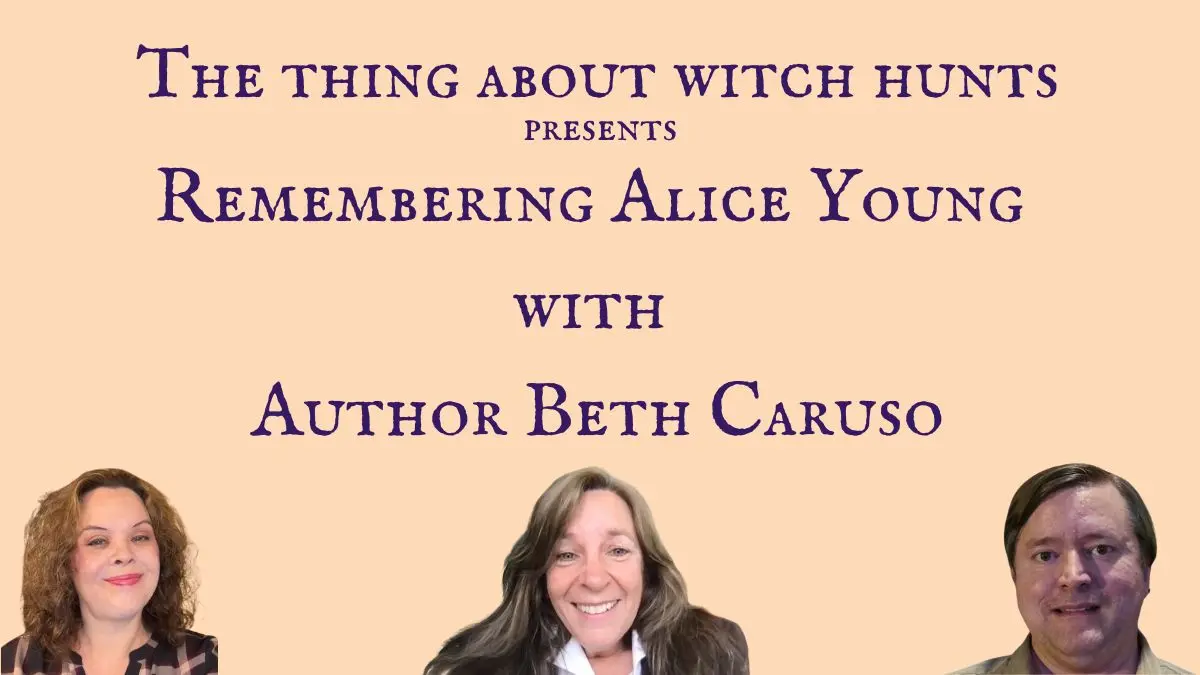
Hosts Josh and Sarah welcome back author Beth Caruso to discuss Alice Young, New England’s first documented witch trial victim, executed in Windsor, Connecticut in 1647. Beth shares her groundbreaking research that led to Alice’s official exoneration by the Connecticut legislature in May 2023, after centuries of her story being nearly lost to history. The conversation explores how Beth pieced together Alice’s life through limited historical records, neighborhood land documents, and epidemiological patterns from a 1647 flu outbreak that may have contributed to the accusations against her. They discuss Alice’s lasting legacy through her descendants, connections to broader New England witch trial history, and what still needs to be done to honor her memory through exhibits and memorials.
Episode Highlights:
• Alice Young’s Story – New England’s first documented alleged witch hanging, executed in Connecticut in 1647 (June 5th by modern calendar)
• Historic Exoneration – Connecticut’s bipartisan legislative vote in May 2023 officially cleared Alice Young’s name after centuries
• Research Challenges – How limited historical records have been pieced together to share Alice’s life
• The 1647 Flu Epidemic – How neighborhood deaths and epidemiological patterns may have led to Alice’s accusation
• Historical Connections – Links between Alice Young’s case and broader New England witch trial history, including connections to the Mather family
• Governor Winthrop Jr.’s Role – His alchemical views and connections to people in Alice Young’s life
• Alice’s Legacy – Her descendants and lasting impact on Connecticut heritage and colonial history
• Ongoing Memorial Efforts – What still needs to be done through exhibits, memorials, and continued awareness
• Beth’s Work – Her Connecticut Witch Trial Exoneration Project, CT Witch Memorial Facebook page, and Connecticut Witch Trials Trilogy
• Podcast Promotion – Launch announcement for The Thing About Salempodcast and its first episode about Tituba
Welcome back to the Witch Hunt Podcast. This is the final episode in the four part series:The Evolution of Diabolical Witchcraft Belief. If you’re just joining us, we recommend checking out the previous series episodes first, though this episode can certainly stand on its own.
This completes our Evolution of Diabolical Witchcraft conversation with Professor Richard Raiswell of the University of Prince Edward Island, expert on Devil lore.
In Part 1 we began examining the critical relationship that developed between demons and witchcraft specifically in the 15th century. In Part 2, we delved deeper into how this connection became the driving force behind the witch hunts that devastated communities across Europe. In parts 3 and 4 we reveal shocking and informing details on the Malleus Maleficarum and its authors Heinrich Kramer, aka Institoris, and Jacob Sprenger. Thank you for joining us as we conclude this chilling and fascinating exploration of how demonology fueled witch persecution.
Today we conclude our series: The Evolution of Diabolical Witchcraft Belief with Professor Raiswell of the University of Prince Edward Island, an expert in medieval devil lore, with another double episode release. If you’re just joining us, we recommend checking out the previous series episodes first, though this episode can certainly stand on its own.
In this episode, part 3 of the series, Dr. Raiswell takes us into the minds and lives of Heinrich Kramer, aka Institoris, and Jacob Sprenger, the authors of the 15th century witch-hunting book, the Hammer of Witches, formally known as the Malleus Maleficarum.
This Dr. Raiswell series is essential for understanding how theological concepts about Satan evolved into specific witchcraft accusations and largely gendered persecution mechanisms that still influence witch hunting today.
The full series, in four parts, is available now wherever you get your podcasts.
Welcome back to the Witch Hunt Podcast. This is episode 2 in the The Evolution of Diabolical Witchcraft Belief. If you’re just joining us, we recommend checking out Part 1 first, though this episode can certainly stand on its own.
This marks the continuation of our conversation with Professor Richard Raiswell of the University of Prince Edward Island, who previously joined us for our fascinating “Speak of the Devil” episode where we explored Satan as one of history’s most enduring and complex figures.
In Part 1 of we began examining the critical relationship that developed between demons and witchcraft specifically in the 15th century. Now in Part 2, we’ll delve deeper into how this connection became the driving force behind the witch hunts that devastated communities across Europe.
Professor Raiswell continues to guide us through how theological concepts about Satan evolved into specific accusations and persecution mechanisms. His expertise in medieval devil lore brings clarity to one of history’s darkest chapters.
Remember, both parts of this special episode are available now wherever you get your podcasts. Thank you for joining us as we continue this chilling and fascinating exploration of how demonology fueled witch persecution. Both Part 1 and Part 2 are available now wherever you get your podcasts.
We have a special treat for our listeners this week – not one but two new episodes dropping simultaneously! Today marks the return of Professor Richard Raiswell of the University of Prince Edward Island, who previously joined us for our fascinating “Speak of the Devil” episode where we explored Satan as one of history’s most enduring and complex figures.
In this two-part special, The Evolution of Diabolical Witchcraft Belief, Professor Raiswell takes us deeper into the dark intersection where demonology meets witch persecution. We’ll explore the critical relationship that developed between demons and witchcraft specifically in the 15th century – a connection that would become the driving force behind the witch hunts.
If you enjoyed our previous exploration of devil lore, these episodes are essential listening, as Professor Raiswell helps us understand how theological concepts about Satan evolved into specific accusations and persecution mechanisms.
Both Part 1 and Part 2 are available now wherever you get your podcasts.
In his return to Witch Hunt Podcast, Antonio Stuckey joins hosts Josh Hutchinson and Sarah Jack to discuss his research and book “Sober and Civil,” chronicling the remarkable life of Salem witch trials survivor Sarah Cloyse. As the younger sister of executed victims Rebecca Nurse and Mary Esty, Sarah Cloyse’s nine-month imprisonment represents a powerful chapter in Massachusetts witch trial history—one with personal significance to both hosts, who count her among their ancestors.
Antonio shares how his focused research through court documents and historical records revealed the multidimensional woman behind the accusation—the same figure who inspired the PBS miniseries “Three Sovereigns for Sarah.” The conversation explores Sarah’s defining act of defiance when she walked out of church slamming the door behind her, her complex first marriage to the dispute-prone Edmund Bridges, and her second husband Peter Cloyse’s unwavering loyalty during her imprisonment.
Anthropologist Dr. Nora Groce from University College London discusses the troubling connection between disability and witchcraft accusations. Dr. Groce shares her research on why people with disabilities are targeted, including her study on the experience of persons with albinism in East Africa. We explore how traditional beliefs create stigma, discuss the global disability rights movement, and examine community-based solutions to protect vulnerable populations. This conversation will inform you on lesser-understood human rights issues related to witchcraft accusations worldwide.
Content Warning: This episode contains discussion of explicit sexual content related to historical witchcraft allegations.
In this scholarly episode of Witch Hunt Podcast, hosts Josh Hutchinson and Sarah Jack welcome historian Dr. Michael Ostling to examine one of witchcraft history’s most persistent legends: the hallucinogenic flying ointment.
Dr. Ostling carefully separates historical evidence from modern misconceptions, revealing how contemporary interpretations often reflect our own misogynistic projections rather than the experiences of those accused of witchcraft. Through thoughtful analysis, this episode respects the memory of innocent victims while providing listeners with a deeper understanding of how witchcraft myths evolve and persist across centuries.
This conversation challenges popular assumptions and offers valuable historical context on this fascinating yet frequently misunderstood aspect of witch hunt history.
In this powerful episode, Josh and Sarah welcome Peter Ogik, Executive Director of Source of the Nile Union of Persons with Albinism in Uganda, who shares his personal story and advocacy work.
About our guest: Peter Ogik was born and raised on an island in Lake Victoria, Uganda. As the first person with albinism in his community of about 600 people, Peter faced discrimination from birth but was fortunate to have supportive parents who advocated for him, especially in school settings where he initially struggled due to bullying and visual impairments associated with albinism.
Key topics discussed:
Personal experiences with discrimination: Peter shares how he was called “a thing” rather than a person, and how children were told not to sit near him because of harmful myths.
Educational challenges: Teachers initially placed Peter at the back of the classroom despite his visual impairments until his father intervened, leading to improved academic performance.
Dangerous misconceptions: Peter survived three kidnapping attempts by those seeking to harvest his body parts for witchcraft, based on the false belief that they bring wealth.
Health challenges: Persons with albinism face high risks of skin cancer, with over 90% dying before age 30 without proper protection and care.
Women and girls with albinism: They face additional challenges, including sexual violence based on the myth that intercourse with a woman with albinism can cure HIV/AIDS.
Advocacy work: Through his organization, Peter works to:
Educate communities and change harmful perceptions
Provide mobile skin clinics and sun protection
Train teachers to better support students with albinism
Advocate for policy changes like tax exemptions on sunscreen
Signs of progress: Peter notes how community attitudes are changing, with more persons with albinism now graduating as doctors, lawyers, engineers, and other professionals.
International Albinism Awareness Day: This UN-recognized day (celebrated since 2015) has become a powerful platform for education and policy influence in Uganda.
Resources mentioned:
Source of the Nile Union of Persons with Albinism (SNUPA)
Advantage Africa, a partner organization since 2013
This episode highlights how education and advocacy can combat deadly superstitions and improve lives for marginalized groups. Peter’s message is one of resilience and hope: “I can’t wait to see the tomorrow whereby a person will not define me by my appearance, but will define me by my abilities.”
Discover the once-overlooked story of Elizabeth Johnson Jr., the Salem witch trial victim finally exonerated after 330 years. At just 22, this young Andover woman was pressured into falsely confessing to witchcraft in 1692. She narrowly escaped execution when Governor Phips ended the Salem witch trials. However, she was unjustly left out of the 1711 mass exoneration that cleared many others’ names. Our guest, podcast regular Mary Bingham, reveals Elizabeth’s remarkable life through court records and family histories, including reading us the powerful petition for clemency submitted by Elizabeth at age 42. Learn why this case, with a personal connection to our host Joshua Hutchinson, resonates with justice movements today and how Elizabeth’s name was finally cleared in 2022.
In this week’s episode of Witch Hunt podcast, Josh and Sarah translate to English when the guest speaks in Spanish. Please enjoy this new experience like we have.. We welcome Spanish documentary photographer and filmmaker Judith Prat. With a background in human rights law, Judith powerfully examines the persecution of women accused of witchcraft in the Pyrenees during the early modern period.
Judith discusses her documentary film “Decían Que Era Bruja” (They Said She Was a Witch), which pays tribute to the innocent women targeted during the witch hunts in Spain. She also shares insights about her photography exhibition “Brujas” and accompanying photobook featuring 67 striking images that document the landscapes of the Pyrenees and the women who inhabit them today.
Through her work, Judith challenges the stereotypical portrayal of “witches” as old hags, revealing instead the truth about ordinary women who were unjustly persecuted. Join us for this fascinating conversation about memory, justice, and reclaiming historical narratives through art.
Historian Louis Pulford reveals how a 13th-century religious persecution became the blueprint for centuries of persecution. The Albigensian Crusade (1209-1229) marked the first time the Catholic Church turned its crusading armies inward, targeting the Cathar religious minority in southern France. Pulford, who recently completed his PhD research on firsthand accounts of the crusade, traces how tactics developed during this campaign – from systematic interrogations to public marking of the accused – would later be deployed in witch trials across Europe and colonial America. By understanding how these persecution methods were first developed and refined during the Albigensian Crusade, we gain crucial insight into the mechanics of later witch hunts and how established systems of persecution could be turned against any marginalized group. Join us as we explore this pivotal moment when methods of mass persecution were refined and institutionalized, setting dangerous precedents that would echo through the centuries.
On Human Rights Day, December 10th, marking 75 years since the Universal Declaration of Human Rights, we explore one of humanity’s ongoing challenges: how differences continue to be met with fear, persecution, and violence.
We welcome special guest Muluka-Anne Miti-Drummond, United Nations Independent Expert on the Enjoyment of Human Rights by Persons with Albinism, for a critical discussion that epitomizes Human Rights Day 2024. Her vital work documents how harmful practices and ritual attacks continue to threaten the lives of persons with albinism in Africa and globally, challenging the fundamental principles the Universal Declaration of Human Rights was created to protect.
Our conversation examines how beliefs that lead to harm continue to target persons with albinism, particularly women and children. Through the framework of United Nations Resolution 47/8 on accusations of witchcraft and ritual attacks, we explore how countries worldwide are developing protective measures while respecting cultural contexts.
As we mark International Human Rights Day and its vision of dignity for all people regardless of race, color, religion, abilities, or status, this discussion provides both a sobering look at ongoing human rights challenges and hope through education, awareness, and community engagement. Join this crucial exploration of human rights protection, where harmful practices meet National Action Plans, and learn how global communities are working together to ensure safety and dignity for persons with albinism.
Join us for an exciting collaboration as Witch Hunt meets Witches of Scotland in this special crossover episode. Hosts Josh Hutchinson and Sarah Jack sit down with Zoe Venditozzi and Claire Mitchell to explore the parallel paths of witch trial justice advocacy across the Atlantic. From Connecticut to Scotland, discover how these podcasters are working to right historical wrongs while preventing modern-day witch hunts. Key topics include contrasts between American and Scottish witch trial histories, the unique challenges of tracing witch trial ancestry in different cultures, Dorothy Good’s heartbreaking story: imprisoned at age 4 in Salem, current advocacy efforts for exoneration and remembrance, and modern witch hunt phenomena and their global impact. The discussion also features Connecticut’s witch trial history and recent exoneration efforts, Scotland’s unique legal framework for addressing historical injustices, the challenges of creating memorials in both countries, modern-day witch hunts and their global prevalence, and the role of gender in historical and contemporary witch accusations.
Explore the pressing global challenge of modern witch hunts with Kirsty Brimelow KC, one of Britain’s leading human rights barristers and incoming vice chair of the Bar Council. Drawing parallels between harmful traditional practices worldwide, Brimelow shares insights from her groundbreaking work developing protection orders and contributing to the 2021 United Nations resolution on witch hunting and ritual attacks.
Content Warning: This episode discusses sensitive topics including Female Genital Mutilation (FGM) and violence related to witchcraft accusations.
Brimelow shares expert insights on developing effective community engagement strategies while respecting cultural sensitivities. She demonstrates how fear and deeply held beliefs can trigger accusations, illustrating her points with compelling examples from her extensive legal career, policy development work, and international case studies. This episode provides essential context for understanding modern witch hunts as a contemporary global human rights issue requiring coordinated international response. Through examining successful interventions against FGM, we explore proven strategies for combating harmful traditional practices through combined legal action and community engagement.
Join us for this critical discussion about protecting vulnerable populations and building effective systems for monitoring and preventing witch hunting in the modern world.
Key Topics Covered:
Religious freedom and harmful traditional practices
Comparative analysis of legal approaches to FGM and witchcraft accusations
Role of religious leaders in perpetuating or preventing accusations
Challenges facing law enforcement in remote communities
Connection between disability discrimination and witchcraft allegations
Implementation strategies for the 2021 UN resolution
Global initiatives targeting elimination of harmful practices by 2030
In February 1933, while the world was entering the age of radio and automobiles, individuals from the town of Soalhaes, Portugal burned a woman accused of witchcraft. The victim was Arminda de Jesus, a 32-year-old mother of two children, known locally for her kindness and for helping her troubled neighbor. That same neighbor would accuse her of witchcraft, leading to an exorcism ritual that spiraled tragically out of control and ended in Arminda’s death. Through meticulous research in Portuguese archives, Dr. Inês Tadeu from the University of Madeira has reconstructed this forgotten case using trial records and newspaper accounts. She joins us to discuss how witchcraft beliefs persisted into the twentieth century, and why some communities still struggle to confront these dark aspects of our humanity. Together, we explore how a simple accusation of witchcraft could end in murder in 1930s Europe, and why Arminda’s story remained buried for so long.
Welcome to Witch Hunt, the podcast raising awareness of the violent reality of modern witchcraft accusations. Rather than being a relic of the past, witchcraft accusations remain a devastating issue in many parts of the world, leading to violence, ostracization, economic deprivation, mental health crises, and even death.
In recognition of this global crisis, August 10th has been designated World Day Against Witch Hunts. This year’s theme, “Exposing the Witchfinders,” focuses on those who incite violence by suggesting witchcraft as the cause of problems or identifying individuals as witches.
Today’s episode examines the role of witchfinders—individuals exploiting faith and belief for personal gain. We’ll explore who they are, their operations, motivations, and the profound impact they have on their victims. Including key insights in the voices of global advocates who have been guests on our podcast, we invite you to join us as we uncover the stark reality behind witchcraft accusations and advocate for a world free from such violence.
In this episode, hosts Josh Hutchinson and Sarah Jack explore the complex relationships between religion, politics, and harmful practices in India. Joined by experts Arjun Philip George and Giresh Kumar J, they discuss:
1. The persistence of caste-based discrimination across religious lines in India
2. The role of religious texts and traditions in perpetuating gender inequality
3. Challenges in reforming deeply ingrained cultural and religious practices
4. The impact of political leaders and parties on reinforcing or challenging harmful practices
5. The tension between constitutional values and religious beliefs in Indian society
6. The struggle for women’s rights in religious contexts, including the Sabarimala temple controversy
7. The use of religion in politics and its effects on India’s democratic fabric
8. The difficulty of separating harmful practices from mainstream religious beliefs
9. The need for progressive education and individual choice in religious matters
Key topics:
– Caste system
– Gender discrimination
– Secularism in India
– Religious reform
– Constitutional rights vs. religious practices
– Political use of religion
Guests:
– Arjun Philip George: Legal scholar with expertise in violence against women on social media platforms
– Giresh Kumar J: Professor of international human rights and social justice
– Samantha Spence: Associate Professor of International Human Rights and Social Justice
This episode provides a thought-provoking look at how witch hunt mentalities persist in modern forms, particularly through the lens of religious and cultural practices in India.
Thank you for joining us for this narrative history of the Salem Witch Trials. This third part of our Salem Witch-Hunt 101 series focuses on the first arrests and interrogations of Sarah Good, Sarah Osburn, and Tituba in late February and early March 1692.
On Witch Hunt, the people and key events are real. The examinations are taken directly from the historical record. The depositions of afflicted persons Elizabeth Hubbard and Ann Putnam Jr. are paraphrased for natural conversation, while the deposition of the adult men Samuel Parris, Thomas Putnam, and Ezekiel Cheever is presented verbatim.
Join us as we spend time in the early moments of the infamous Salem Witch Trials, based on actual words from the historical documents. Whether you’re a history enthusiast or a curious listener, this episode promises to be both informative and enjoyable.
In this episode, guest host Mary Louise Bingham and special expert Jordan Alexander, chair of the UK’s National Working Group on Spiritual and Ritual Abuse (SARA), join Witch Hunt hosts Josh Hutchinson and Sarah Jack. Jordan shares his journey from the police force and safeguarding roles to advocacy, exploring the complexities of spiritual and ritual abuse, providing concrete examples, discussing the UK’s systemic response, and highlighting the need for global awareness and legislative changes. We also address the rise of SARA cases, global challenges, media portrayals perpetuating harmful stereotypes, and efforts to combat abuse. Additionally, we highlight an upcoming survivor stories conference.
We explore the rise of SARA cases, global challenges, and the need for legislative changes. The conversation also touches on media portrayals of witchcraft, an upcoming survivor stories conference, and efforts by our nonprofit End Witch Hunts to gather data on SARA in the US. While we often focus on historical witch trials, today we examine how similar fears lead to harm to people today through violent exorcisms, accusations of witchcraft, human sacrifice, and other forms of SARA.
Welcome to Witch Hunt, where we uncover the ongoing crisis of modern witch hunts and harmful practices.
In this episode, we talk with Berrie Holtzhausen, founder of Alzheimer’s Dementia Namibia. Berrie’s incredible journey to become a dementia advocate highlights his dedication to educating communities where those with dementia are often mistaken for harming their community with witchcraft.
Hear Berrie’s powerful stories of resilience, his fight against stigma, and his efforts to create dementia-friendly communities. Despite his own Alzheimer’s diagnosis, Berrie continues to rescue those falsely accused of witchcraft due to dementia symptoms.
Sashiprava Bindhani, a human rights advocate and legal expert from Odisha, India, has dedicated her life to raising awareness of witch-hunting and advocating for the protection of vulnerable individuals.
This impactful oral history conversation explores her life of advocating for individuals accused of witchcraft, examining the social ostracism, physical assaults, and the role of policy and legal intervention in protecting the vulnerable and stopping these practices. She shares her professional journey, personal experiences, and significant contributions to human rights. She discusses her work in law, public interest litigation, and efforts in implementing laws against witch branding.
Join Josh Hutchinson and Sarah Jack on the ‘Witch Hunt’ podcast for the second episode of their ‘Salem Witch-Hunt 101’ series. Josh narrates the chilling events of February 1692 in Salem Village, focusing on the strange behaviors of Abigail Williams and Betty Parris that ignited fears of witchcraft. He explores the harsh winter, social tensions, and the reactions of the community, including the infamous ‘witch cake’ and accusations against Sarah Good, Sarah Osborne, and Tituba. In this unique episode, Sarah hears Josh’s account for the first time, providing fresh reactions and questions that enhance the storytelling. The episode concludes with reflections on the motivations behind the Salem Witch Trials, with additional insights from Mary Louise Bingham. Tune in for an engaging retelling of the early days of the Salem Witch Hunt, based on historical records.
[00:00:00]
Josh Hutchinson: Welcome to Witch Hunt, the podcast bringing you the most in-depth coverage of the Salem Witch Trials. I'm Josh Hutchinson.
Sarah Jack: And I'm Sarah Jack. Today we are excited to present the second episode in the Salem Witch-Hunt 101 series.
Josh Hutchinson: We're taking a different approach to this one. I'll be telling a narrative of the events of early 1692.
Sarah Jack: And I'm hearing this telling of the story for the very first time, just like everyone watching or listening.
Josh Hutchinson: Yeah, I've really kept this one under wraps from you, so I can't wait to hear your reactions to it.
Sarah Jack: I can't wait to hear what you've done with your story.
Josh Hutchinson: Yeah, thank you. I think it's going to be quite a new experience for everyone.
Sarah Jack: I'm going to have some questions for you.
Josh Hutchinson: I sure hope so. The Salem Witch Hunt had its beginnings long before the trials began. [00:01:00] We discussed the precursors to the witch hunt in our last Salem Witch Hunt 101 episode. Today, we will focus on events in Salem Village in February, 1692.
Sarah Jack: I am excited.
Sarah Jack: Yes, now that we have those things out of the way, we get to dive in to some story.
Josh Hutchinson: Yeah, we're going to tell some little stories, um, about big events. In these stories we're going to tell in this series, we'll be recreating several major scenes from the Salem Witch Hunt using the facts that are, we get from the records left behind.
Sarah Jack: The records are the story. What we can build out of what is written is all we have.
Josh Hutchinson: And that's what we're working with tonight. So here comes the story. [00:02:00]
Josh Hutchinson: Scene 1, Salem Village, Massachusetts Bay Colony, February 1692. The girl flitters across the room, chirping like a bird. Abigail Williams, the minister's niece and ward, aged 11, has been acting strangely lately. Perhaps a winter's confinement in a frigid house has given her cabin fever. Maybe she's just restless. A preteen in the boring 17th century, Abigail has been orphaned and lives in the care of her relative, Salem Village Minister Samuel Parris, who is known as her uncle, though the exact relationship is unclear. Parris's daughter Elizabeth, called Betty, is at this moment on all fours under a table, barking like a dog, while alternately complaining of terrible pain. Earlier, she had honked like a goose and soared through the air, all the way across the Parsonage's Great Hall. Nobody had seen her toes touching the ground. They'd all been fixated on the [00:03:00] honking and flapping, which would have been hard to ignore.
Josh Hutchinson: Now Samuel Parris paces the floor, following Abigail, constantly praying as he walks behind her. Maybe the girls are ill, but if they are, what manner of illness causes these antics? Whatever it is, the minister has had enough of it. How can anyone expect him to write each week's sermon in this environment? He abruptly stops following Abigail.
Sarah Jack: Two thoughts popped into my mind. Is this truly the first time Betty has been so silly? I think from what we know of what was permitted for behavior, it's possible.
Josh Hutchinson: It is, I'm sure Betty, she's nine years old and Abigail's 11. They're at very silly ages. So probably, but to this extent, it seems like this was the first [00:04:00] time that they were flapping like geese and barking like dogs and mewing like kittens and everything. Um, So it was quite different and everybody was taken aback by it.
Sarah Jack: The other thing I wondered if it went through the minister's mind, is is this affliction? Like, right away.
Josh Hutchinson: Right. He was in Boston at, in 1688 when Goody Glover was arrested and executed for witchcraft towards the Glover children, who behaved in much the same way that Abigail and Betty are described as behaving. And he would have been fully aware, Cotton Mather had written a book about that. And, uh, Samuel Parris definitely was aware, and presumably his children were also aware of that story.
Josh Hutchinson: And this might be something that they [00:05:00] got afflicted, um, through whatever mechanism, and they had imbibed these stories about affliction. So once somebody told them, "oh, you're afflicted" or something, it just triggered these behaviors from them because this is what they have known and heard all their, their lives.
Sarah Jack: All right.
Josh Hutchinson: "I have to get this sermon done, Elizabeth." He says to his wife, the former Elizabeth Eldridge, "I'm going to Ingersoll's. It'll be quieter there."
Sarah Jack:
Josh Hutchinson: "Quieter at Ingersoll's? Well, I'm sure he'd let you use one of his rooms. "
Josh Hutchinson: The minister goes to his desk and grabs his material and Bible. Looking at the ice just forming atop the ink, he says, "warmer at Ingersoll's, too."
Josh Hutchinson: "Why don't you see if he has any more wood to spare?"
Josh Hutchinson: "He doesn't. He's already given us our share. It's those unregenerate types that are withholding."
Josh Hutchinson: [00:06:00] Samuel Parris strides to the door and steps out, letting the door swing shut hard behind him. Betty jumps, striking her head on the bottom of the table. She rubs the sore and then crawls out from underneath, now whimpering like a scolded puppy. Maybe she and her cousin are ill, but, strangely, nobody else in the household has been acting anything but normal. Why has the illness not touched Betty's siblings, Thomas and Susannah? Why not Tituba or John? Why not Elizabeth Parris Sr., who seems to always be sick with something or other?
Josh Hutchinson: Maybe the girls have succumbed to the pressures facing the Parris household this long, cold winter. They received a fraction of the firewood they need to live comfortably, and Samuel often finds himself writing his sermons at Ingersoll's or sometimes the nearby Walcott home or even Thomas Putnam's house. With the minister under intense pressure, [00:07:00] that may have rubbed off on some of the children.
Sarah Jack: It's really important to recognize how brutal that cold was on the Parris household. I mean, you don't feel good when you're cold, and he's writing these sermons that are a remedy to, for his people. They have to hear what he's saying from God's word so that they're headed in the right direction. I just wonder if, if, you know, we say fire and brimstone about some of these messages when he was actually experiencing cold and ice. You just wonder, you know, how much he was taking out on his parishioners because he was so mad that they didn't want to keep him warm.[00:08:00]
Josh Hutchinson: Yeah, there was a point where he said, or wrote down in his sermon notebook, I believe, that he would have, he was going to run out of firewood completely the next day. And so he was trying to get, desperately all the time to get more people to give him more, but of course they need their own firewood for the winter. Um, it's the coldest years of the Little Ice Age. And it's Massachusetts, so it's just brutal, uh, going through this winter. I can hardly imagine living in a house where you're all just like huddled real close because your fire is small and you don't have heat, you know, coming from the central hearth all the way through the house, uh, constantly.
Josh Hutchinson: So I guess they wore a lot of coats.
Sarah Jack: They were just cold. [00:09:00] They were cold.
Josh Hutchinson: They were, it had to have been miserable. And then there's all the stresses facing him. There's other parties in the village who don't want him to be a minister anymore. So he's dealing with that frustration. And I'm sure just the stress level in that household was too much for these girls to bear. Um, I'm surprised that the rest of the household didn't have some kind of reaction to that.
Sarah Jack: Yeah. I was just thinking, there's really no evidence of a reaction of, "hey, cut it out, this is unacceptable." They just reacted to the behavior.
Josh Hutchinson: Right.
Sarah Jack: Although there is somebody who did react to somebody's, that's later in the story. John [00:10:00] Proctor. Isn't he the one that just tells her to cut it out?
Josh Hutchinson: Yeah. Yeah. He sits her at her spinning wheel and threatens to thrash the devil out of her if she keeps behaving, because he really believes that she's acting and just playing around and it's going to be dangerous and people are going to get hurt.
Sarah Jack: Yeah,
Josh Hutchinson: He recognizes that pretty early. Yeah. As soon as people started getting arrested, John Proctor knew, um, this is going bad. So.
Josh Hutchinson: So, the minister has prayed for weeks, but nothing in the girls' conditions has improved. They still contort into strange shapes, impossible to be caused by any known natural illness. They writhe in agony and cry out of pain.
Josh Hutchinson: Samuel knows many of the villagers have turned their backs on him. But this seems more sinister, more diabolical. Or [00:11:00] is it God's judgment on him? No, it can't be personally against him. He's doing the best anyone can. Maybe it is to address the sins of the community collectively.
Josh Hutchinson: If praying isn't working, maybe a fast will be necessary. He will preach another impassioned sermon on Sunday, reminding his congregation of the constant presence of the devil, who lurks about the village, as he does any place where such a beacon of godliness as Samuel Parris dwells. Monday, Samuel will hold a private fast.
Josh Hutchinson: It is the devil who has poisoned men's minds against Samuel's ministry, and if there were ever a time for evil to gain a foothold in the village, he knows it is in this period of division. Samuel has to keep up his sermons and has to warn the villagers before it is too late. He will have to alert area pastors too, but maybe it's time for them to come over anyways to hold a significant fast.
Sarah Jack: [00:12:00] Samuel.
Josh Hutchinson: Alas, the cold numbs Samuel Parris's mind as he walks the short distance to Ingersoll's next door. What is he trying to get at in his sermons this week again? Samuel pulls the front door open and steps inside Nathaniel Ingersoll's Ordinary, a tavern that does quite well for itself with its central location in the village and its close proximity to the meeting house. Come Sunday, this place will be absolutely packed between the two services.
Josh Hutchinson: Nathaniel Ingersoll stands at the back of the room, discussing something with his adopted son, Benjamin Hutchinson, who helps out around the tavern. Samuel closes the door behind himself, and the two other men break off their conversation.
Josh Hutchinson: Nathaniel says, Good day, Samuel.
Josh Hutchinson: And Benjamin says, Good morning, Reverend, will you be needing a room again?
Josh Hutchinson: I would be indebted to you.
Josh Hutchinson: Nathaniel says, think [00:13:00] nothing of it, room's just sitting there unoccupied.
Josh Hutchinson: Thank you, Samuel says, there's a ruckus at the house again.
Josh Hutchinson: I figured as much, Nathaniel says.
Josh Hutchinson: Benjamin leads Samuel upstairs and opens a door. Samuel enters and closes the door behind himself. He will be in here all day, except for meals and trips to the privy out in the yard.
Josh Hutchinson: On Sunday morning, with his sermon written, Samuel Parris leads his family the short distance from their home to the meeting house. Entering, they once again find this building even colder than the house they left. There's no fireplace here. There's no grand hearth for cooking and warming. Measuring a modest 34 by 28 feet, the wooden meeting house features a gallery to help fit the many, many people who worship here.
Sarah Jack: And there's a place today that people can visit a replica of the meeting house.[00:14:00]
Josh Hutchinson: Yes. If you go to the Rebecca Nurse Homestead, you get a replica built to the exact dimensions that were recorded in the Salem Village Record Book. It's quite remarkable to go in there and see a pulpit just like the one Samuel Parris would have preached at.
Sarah Jack: I was able to stop by last May, so a year ago, May now, when advocate Dr. Leo Igwe
Sarah Jack: with Advocacy for Alleged Witches was in New England doing a speaking tour and visiting the memorials, and he did his presentation there, standing in front of the pulpit. It was extremely moving to think about what that room symbolizes and, of course, the message today that Leo is giving the world and the work that he's doing to save lives. The other thing that was special to me was [00:15:00] being able to look out of the window at the meeting house and over to the homestead. I just liked looking through that old glass.
Josh Hutchinson: The homestead is such a wonderful place to visit, but getting inside that meeting house for an actual talk was really a great experience.
Sarah Jack: We're so appreciative to the team at the Rebecca Nurse Homestead for hosting him and opening it up to us and, um, all of those who attended.
Sarah Jack: it was very special to, to have him there.
Josh Hutchinson: Yes. And for you listening, we have done two episodes with Leo Igwe, and I do recommend that you go back and listen to those to hear what's going on in the modern world with witchcraft accusations.
Sarah Jack: The [00:16:00] other thing I wanted to point out is unfortunately we can't, um, go to Ingersoll's. But there is lots of photos and chatter among descendants and locals online about its future.
Josh Hutchinson: Yes. And we've recently done a bonus episode on "Nathaniel Ingersoll and His Tavern in the Salem Witch Trials" and recommend you go back and take a look at that or listen to that. And there is a very passionate community online that has developed around what the future might hold for that institution there.
Josh Hutchinson: On January 3rd, Samuel had preached that, "Christ having begun a new work, it is the main drift of the devil to pull it all down." Today, February 14th, he will warn the church of the dangers of [00:17:00] division and devilry. " is a woeful piece of our corruption in an evil time when the wicked people and the godly party meet with vexations by and by to lay down divine providence as if God has forsaken the earth and there were no prophet in his service."
Josh Hutchinson: His vitriol is largely directed at those in the village who oppose him. They've challenged his ownership of the parsonage and his role as a minister. The village voted to withhold his pay and firewood, and once Joseph Hutchinson, a village committee member who had donated the land for the meeting house, fenced the building in. Now, for those of you keeping track, Joseph Hutchinson was the birth father of Benjamin Hutchinson, who he'd put in the care of the Ingersolls, who had lost their only daughter. Joseph himself had seven sons and four daughters, so obviously had a kid to spare for the Ingersolls. [00:18:00]
Josh Hutchinson: Today, Parris will also speak of "the present low condition of the church in the midst of its enemies." Non-Christians have inhabited this continent since time immemorial, and now those French Catholics to the north are encroaching again with the aid of their Wabanaki allies.
Josh Hutchinson: Monday morning, Samuel Parris rises well before dawn with the rest of his household. Betty and Abigail persist in their afflictions. Samuel needs medical advice, but first he will turn to the ministers. He sits at his desk and breaks out his writing materials, but the ink has frozen overnight again.
Josh Hutchinson: "Elizabeth," Samuel says, "warm this ink for me."
Josh Hutchinson: She takes the inkwell and places it in a pot, which she hangs over the low fire. In a few minutes, she returns the ink to her husband. The inkwell is warm to his touch. He sets it on his desk and draws ink into his pen.
Josh Hutchinson: "John," Samuel [00:19:00] says, now handing John a paper, "take this letter to Nathaniel's, he needs to send messengers to the local ministers to ask them to meet me here as soon as they all can attend to see the girls."
  John takes the note and departs. Samuel and family spend the rest of the day, amidst numerous interruptions by the girls, fasting and praying, but the girls do remain unwell and continue to behave strangely.
Josh Hutchinson: On February 24th, Parris sends John on another errand. This time he is to retrieve Salem Village's only physician, William Griggs, who lives some distance down the road.
Sarah Jack: pulls Samuel aside
Josh Hutchinson: After Griggs examines the girl, he pulls Samuel aside for a conversation. "They're under an evil hand," he says.
Josh Hutchinson: "You're sure it isn't anything medical?"
Josh Hutchinson: Absolutely. This affliction is not natural.
Josh Hutchinson: "Then Satan is after me." [00:20:00]
Josh Hutchinson: "I'm afraid so."
Josh Hutchinson: In the parsonage and around the village, talk turns to witches. Perhaps the girls were bewitched by one of Satan's agents. Christ knew there were devils in his church. On February 25th, Samuel and Elizabeth Parris travel for the Thursday lecture, a weekly event hosted by various neighboring communities on a rotating schedule.
Josh Hutchinson: While they are away, a neighbor, Mary Sibley, stays with the children. Mary Sibley speaks with Tituba and John.
Josh Hutchinson: "Here's what we're going to do," she says. "Tituba, you collect some urine from Betty and Abigail. John, get the rye flour."
Josh Hutchinson: "What do you have in mind?" Tituba asks.
Josh Hutchinson: "We're going to stop a witch."
Josh Hutchinson: "With urine."
Josh Hutchinson: "By baking a special cake, the girl's urine is needed so we can burn off some of the magic that the witch put in them."
Josh Hutchinson: Soon, Tituba collects the urine of the girls, and John retrieves the heavy sack of rye flour, while [00:21:00] Elizabeth gathers the rest of what they'll need. The three adults meet at the hearth and bake the cake, with the girls wailing in agony behind them, contorting again into several bizarre shapes. After John removes the cake from the oven, Mary calls for the family dog, who eagerly devours the morsel. According to English custom, this witch-finding technique will reveal the identity of the woman who has afflicted the girls. Mary isn't exactly sure how, but her own mother taught her to do this. Maybe the witch will be hurt, or maybe she'll turn up at the door.
Sarah Jack: The witch cake is not voodoo.
Josh Hutchinson: The witch cake was English, and Mary Sibley instructed Tituba and John how to bake it, because they hadn't done anything like that before using English [00:22:00] countermagic.
Sarah Jack: How great if that had burned the magic off. What a great quick intervention that would have been.
Josh Hutchinson: Yeah, if only that had worked, could have spared months and months and months of trials and, um, all those deaths.
Josh Hutchinson: Now, the same day the witch cake is baked, two more village girls become afflicted. Ann Putnam Jr. is the daughter of Parris ally Mr. Thomas Putnam Jr. and Mrs. Ann Carr Putnam. Thomas and the two Anns have made several visits to the parsonage since Betty and Abigail have been ill. And I want to throw in that Thomas Putnam was also a sergeant in the local militia, serving under Lieutenant Nathaniel Ingersoll and Captain Jonathan Walcott, who are [00:23:00] also important characters in the Salem Witch Hunt story.
Josh Hutchinson: Now, another visitor who's taken ill is Elizabeth Hubbard, an orphan teenage girl living with her relatives, the Griggses. She has also visited the parsonage along with the physician, whom she serves as maid. At 17, Hubbard is five years older than Ann Putnam Jr., making her the oldest person yet afflicted and the first of legal age to be able to bear witness in court. Her age lends credence to witchcraft accusations against villagers Sarah Good and Sarah Osborne, whom Hubbard accuses of attacking her spectrally, which is to say the shapes of the women appear to her. They do not visit bodily. Everyone knows witches have the ability to leave their bodies and travel great distances to torment their victims.
Sarah Jack: There's some things, like, here where you say, everybody knows. [00:24:00] There were, this is one of the things that everybody knew. It was like, not a question. They believed it. Just as much as they believed the devil was visiting them.
Josh Hutchinson: Um, when I say everyone, of course, I mean, virtually everyone, um, believed in witchcraft. And if you didn't believe in witchcraft, that led people to call you an atheist, because how could you believe in God, not believe in his adversary, the devil, and then the devil's ability to, uh, contract with witches to do his work?
Josh Hutchinson: The girl writhes, twisting and turning, shouting at the top of her lungs, "they got me!"
Josh Hutchinson: "Who got you?" Thomas Putnam Jr. asks.
Josh Hutchinson: I don't know, but it hurts. It hurts. Make it stop.
Josh Hutchinson: Shh. [00:25:00] It's okay, Annie. You'll be fine. God is with you always.
Josh Hutchinson: It's not okay. I won't be fine.
Josh Hutchinson: What makes you say that?
Josh Hutchinson: I feel like my bowels are being torn out.
Josh Hutchinson: We are praying as hard as we can.
Josh Hutchinson: It's not enough.
Josh Hutchinson: Then we'll fast.
Josh Hutchinson: No, I'm being pinched and pricked and choked right now. Don't you see that? How do you fast that away?
Josh Hutchinson: I'm sorry, Annie, but you know the best weapon is prayer, the best weapon that we have in this spiritual battle.
Josh Hutchinson: What's wrong with me, Father?
Josh Hutchinson: I wish I knew.
Josh Hutchinson: Is it natural?
Josh Hutchinson: No, there is something very dark in this village.
Josh Hutchinson: The spectral figure of a woman approaches Ann, holding out a little red book and a red pen. Take it, she says. Sign the book and you'll be freed from your troubles. And if I don't, then we'll kill you.
Josh Hutchinson: Father, save me!
Josh Hutchinson: If father won't save you, nobody will.[00:26:00]
Josh Hutchinson: God, preserve me.
Josh Hutchinson: Just sign the book and you'll be free from your guilt, worry, and pain.
Josh Hutchinson: What book is that?
Josh Hutchinson: My God gave it to me.
Josh Hutchinson: And who is your God?
Josh Hutchinson: You know who I mean, girl.
Josh Hutchinson: A stabbing pain tears through Ann's chest. God save me, she says. Annie, Annie, Thomas Putnam is calling.
Josh Hutchinson: After a moment, Ann snaps too. The spectral woman has gone away with her book, but Ann just knows she'll be back.
Josh Hutchinson: Thomas Putnam shakes his daughter. "Are you all right?"
Josh Hutchinson: "No, father. A woman came to me with a book and said she'd kill me if I didn't sign it."
Josh Hutchinson: "What woman?"
Josh Hutchinson: "I don't know, but it is none of God's book. It is the devil's book for ought I know."
Josh Hutchinson: "What woman?"
Josh Hutchinson: "I couldn't make out her face."
Josh Hutchinson: But you must have seen her before.
Josh Hutchinson: She had a familiar aspect.
Josh Hutchinson: How did she get in here? I didn't see anyone come in.
Josh Hutchinson: She appeared spectrally from [00:27:00] thin air.
Josh Hutchinson: A witch.
Josh Hutchinson: I think so.
Josh Hutchinson: I knew it.
Josh Hutchinson: But how?
Josh Hutchinson: This explains everything. Mercy!
Josh Hutchinson: Panting, maid Mercy Lewis enters the room. "Sir," she says.
Josh Hutchinson: "Run and get my brother Edward. Tell him a witch has assaulted Annie."
Josh Hutchinson: Mercy turns and strides away to the stairs. A moment later, the front door squeaks open and promptly slams shut. Footsteps ascend the stairs, and Mother ducks into the garret.
Josh Hutchinson: "What's all this about a witch, then?" she asks.
Josh Hutchinson: Annie twists and winds.
Josh Hutchinson: "Look at Annie, Thomas says. A witch has done this."
Josh Hutchinson: How do you know it's a witch?
Josh Hutchinson: She saw a shape.
Josh Hutchinson: What shape?
Josh Hutchinson: A woman.
Josh Hutchinson: Annie groans.
Josh Hutchinson: What do you think this means? Witchcraft in our village?
Josh Hutchinson: Yes, and they say the minister's girls are bewitched as well.
Josh Hutchinson: Oh dear, after they've been sick for so long, why do they suddenly suspect a [00:28:00] witch?
Josh Hutchinson: I don't know, but that's all anyone can talk about when I was over this morning. I suppose we'd better fetch Griggs and Parris to tell us if I'm right.
Josh Hutchinson: I'll send Mercy as soon as she gets back from Edwards.
Josh Hutchinson: No, I want to go now. I'll saddle the horse.
Josh Hutchinson: What shall I do while you're gone?
Josh Hutchinson: Pray, he says and mind she doesn't hurt herself.
Josh Hutchinson: God send you back to us safely.
Sarah Jack: So much fear.
Josh Hutchinson: So much fear. There's talk about, um, we recently, in an interview, our guest Francis Bremer talked to us about Chadwick Hansen's book, Witchcraft in Salem, and in there, he posits the theory that if you truly believe in witchcraft, as soon as you believe that you've actually been cursed, your body and mind [00:29:00] takes all that in, and psychogenically you have reactions. You can have psychosomatic symptoms of bewitchment that basically are just brought on by your intense fear. And I believe that's something that is plausible that the girls experienced.
Sarah Jack: Yeah. I mean, they're scared. Their parents are expressing their fear by their response to what's happening to the kids and what they're saying. And yeah, it's just, they have to find the witch.
Josh Hutchinson: Yeah. Imagine if your children were behaving this way, screaming about pain, being twisted up like pretzels and, you know, do just randomly rolling around the room, writhing in agony, [00:30:00] screaming, get off me, get off me, you know, you would think that somebody's attacking them. You can't. I mean, what else do you think at that point?
Sarah Jack: Yeah. If, you know, the cure, the only cure is finding the witch, then that's what has to be found. With the littles that have been in my house, sometimes when they get hurt, they need an ice pack for the injury. They're in pain, you can see the bump on their leg, what's happened, ice is going to make it feel better. It's such a comfort to them that often they might have a bump that they might get bumped and there is no wound. But they want the ice, because it comforts them. And so the ice is an actual remedy for inflammation and swelling, but other times [00:31:00] just knowing that they can go to the freezer and grab an ice pack, and they do it for each other too. I think there's this element of community that, you know, it's a family and you're trying to help each other. And you see that in your own interactions with, um, people in your life. You, you try to solve each other's problems and find the remedy.
Josh Hutchinson: And it's interesting, I had mentioned that Parris had prayed for weeks. He fasted, uh, several times over January and February and the girls, they got sick in the middle of January and this, now we're towards the end of February. It's so interesting to me that it took basically six weeks for them running through all those measures that they normally take when somebody's ill, um, and doing the past, the fasting and the prayer. [00:32:00] You know, nursing the children as, you know, their mothers would have nursed them. Um, others from the community would have pitched in and come to the houses to see how they could help. Um, but after that, they run out of ideas. And basically you're left with, it must be a witch, it must be diabolical, especially after Dr. Griggs says it's nothing natural, uh, at that point, what's left. And like you said, when you know there is something that could cure or help the person in pain, then that's what you do. And when you believe that, that thing that you can do is to stop a witch, you put your whole heart into that. And I think that's what we see, uh, later on in upcoming episodes. We'll see all that playing out that these [00:33:00] people put their hearts in it because they really wanted to stop the afflictions from happening.
Josh Hutchinson: Sometime later, Thomas returns home to find his brother Edward and neighbor Henry Kinney in the Great Hall, praying over Annie, while Ann Sr., Mercy Lewis, and Mercy's sister, Priscilla Kinney, hover over the afflicted girl. When the door shuts, the people in the room stop and turn to Thomas.
Josh Hutchinson: What's the news? Edward Putnam says.
Josh Hutchinson: Where's the minister? Ann Putnam Sr. asks.
Josh Hutchinson: Where's Griggs? Henry Kinney asks.
Josh Hutchinson: Griggs girl is afflicted too. She also complains of women assaulting her.
Josh Hutchinson: Has she named them?
Josh Hutchinson: No.
Josh Hutchinson: And what of the minister?
Josh Hutchinson: He's tied up with his own girls, but he's added Annie to his prayers, says he'll come visit when his man gets back from some errand at Ingersoll's.
Josh Hutchinson: Dear God, Henry says, four of them afflicted now?
Josh Hutchinson: [00:34:00] It's spreading, Edward says.
Josh Hutchinson: The following two days, February 26 and 27, 1692, will prove pivotal, as these are the days the girls begin naming the names. Not one, but three women will be accused by the end of these days. Tituba, the enslaved indigenous woman in the Parris household, is the first accused when Betty and Abigail cry out against her, the woman who has cared for them as much as their own mother has, who will go on to profess much love for them during her examinations by the magistrates. Born in South America or the Caribbean, Tituba may have been an Arawak or a Carib Parris likely purchased her during his time in Barbados, where he tried to run his father's sugar business before his return to the Massachusetts Bay Colony, where he had for a time attended Harvard College, his academic career cut short by his [00:35:00] father's death in Barbados. To say Samuel was a poor businessman is quite an understatement. The man seems to never quite settle into a profession at which he will be able to succeed.
Josh Hutchinson: At any rate, he had Tituba in Barbados, and he brought her to Boston in 1680 or 1681. Except while he served as temporary minister in Stowe in 1685, Samuel remained in Boston working as a merchant until men from Salem Village approached him about being the town's minister in 1688. When he accepted the call in 1689 and moved his family to Salem Village, he brought Tituba with him. It's unclear when he acquired the man known as John Indian, a man of undetermined Indigenous background. And for a time, a third enslaved person, an African American teenage boy, also resided in the parsonage with the Parrises. However, Parris recorded the boy's death in March 1689. [00:36:00] While Tituba's exact origin is unknown, Elaine G. Breslaw's book, Tituba: the Reluctant Witch of Salem, posits one plausible theory and is very well worth a read.
Josh Hutchinson: On February 27th, Ann Putnam Jr. accuses Sarah Good of bewitching her. Elizabeth Hubbard, meanwhile, names both Sarah Good and Sarah Osborne as her, her tormentors. In a dramatic incident, Elizabeth claims to be followed by a wolf, which is supposedly directed by Sarah Good, or may even be the shapeshifting Sarah herself.
Josh Hutchinson: In 1692, Sarah Good is an impoverished woman with no permanent housing or reliable income. But things hadn't always been that way. Born Sarah Soulart in about 1654, she was raised by respectable parents in Wenham.
Sarah Jack: Her father, John Soulart, was likely French by birth and may have been [00:37:00] Huguenot by faith. He worked as an innkeeper and left behind a healthy estate, but he took his own life in 1672. And unfortunately Sarah was left in the lurch, inheriting only three acres of meadow. So Sarah married Daniel Poole. Who promptly ran up an eye-watering debt, which Sarah was forced to pay from his meager estate after his death, leaving Sarah destitute.
Josh Hutchinson: She next married William Good by 1683.
Josh Hutchinson: William was a weaver and a laborer who never seemed to stay employed long. He and Sarah had to sell off the meadow to pay additional debts owed by Sarah's first husband. William Good's origins are unknown, but he had two children with Sarah. The first, Dorothy, was born in about 1687. The second daughter, whose name is unknown, was born in December 1691. And we have much more with, about Dorothy in our episode with Rachel [00:38:00] Christ-Doane, that you can refer back to learning what happened to Dorothy after the witch trials. At the time she was accused, Sarah Good was in the habit of going house to house, seeking charity. She evidently was given something at least once by the Parrises, but she left the house muttering, raising suspicions.
Josh Hutchinson: Sarah Osborne had caused a scandal when, following the 1674 death of her husband, Robert Prince, she married Alexander Osborne, her young indentured servant. She was also involved in a dispute over her husband's first estate with his kin, Thomas and John Putnam, who were the executors. By February 27th, 1692, Osborne had been sick in bed for at least a year and not been able to attend worship at the meeting house all that time.
Josh Hutchinson: All three accused women [00:39:00] were markedly different from the New England Puritan ideal of what a woman should be. All three were outsiders in key ways. Tituba was most clearly an outsider, being indigenous in a period when Massachusetts English settlers were at war with the Wabanaki Confederacy, an alliance of Algonkian-speaking peoples who had chosen to ally themselves with the French over the British.
Josh Hutchinson: But Sarah Good from Wenham was also a relative newcomer to Salem Village. Being indigent placed her further outside the norms of the community. Requesting charity was itself a risky business in the age of witch hunts, as people who refused to give what was asked for felt guilt, and then resented the one who asked. If something shortly went wrong for the refuser, say a child took ill, or a livestock died, perhaps, then the person who refused the gift would suspect the [00:40:00] one they'd refused was seeking revenge through witchcraft.
Sarah Jack: Aren't there some things in the record where those who were turned away for a favor or a handout were mad when it was refused and they wished something ill on the refuser?
Josh Hutchinson: There are a number of cases exactly like that where someone, say, refused to give milk and the requester then said, "your cow will never give you milk or something to that effect in their irritation and anger and, you know, those words come back to haunt them. Definitely.
Josh Hutchinson: Uh, in the case of Sarah Good, though, she's just accused of muttering. And in the next episode, we'll discuss her examination by the [00:41:00] magistrates and what she says about her muttering.
Josh Hutchinson: Lastly, Sarah Osborne had transgressed social norms by wedding a younger man and indentured servant and by failing to attend meetings on Sundays. With three women accused of witchcraft, the witch hunt was ramping up and would soon be in full swing. We'll cover the first arrests and examinations in our next 101 episode.
Josh Hutchinson: And now we'd like to summarize the facts that we covered in today's stories and help separate fact from fiction. In January 1692, Salem village minister Samuel Parris's daughter, Betty, and his niece, Abigail Williams, began displaying strange symptoms and behaviors. Now, there are many, many theories about what caused the girl's symptoms, and many of these theories, such as ergot, have been disproven. [00:42:00] But I believe it's more important to understand the motivations of the adults who filed the complaints that we'll discuss beginning in our next installment. As I mentioned, so many theories about what caused it. Some theorize that the girls ate bad bread and got ergot poisoning. Others point to encephalitis, meningitis, and other physical ailments, while others point to mental health conditions such as mass psychogenic illness. In several instances, fraud was clearly perpetrated. Were the girls and the other people who were known as afflicted lying about everything? Or were they perhaps trying to strengthen their cases against people they truly believed were bewitching them? That's the big question.
Sarah Jack: It's a big question.
Josh Hutchinson: Whatever caused the ailments, we all know how this story ends. By the end of the saga, at least 156 people had been accused of witchcraft. So why did the men file the complaints and make the accusations they did? [00:43:00] That's something we'll be looking at in our future episodes.
Josh Hutchinson: Continuing with the facts, on February 14th, 1692, Samuel Parris did preach that the godly "must war a good warfare to subdue all our spiritual enemies." And the other lines that I quoted that he said in his sermon, he did say as recorded in his sermon notebook. And it is known that Samuel Parris did observe several private fasts. However, we don't have the specific dates for those, so we don't know whether he held one on February 15th, like I said in the story.
Josh Hutchinson: On February 24th, a physician thought to be Salem Village's William Griggs, though there's no record stating a name of a physician, what we have is that from John Hale who wrote a book in [00:44:00] 1697 that was published after his death. We know from his book that this happened with the doctor saying that they are under an evil hand, but we don't know exactly who that doctor was.
Josh Hutchinson: But on February 25th, Mary Sibley instructed Tituba and or John Indian to bake a witch cake to determine who was afflicting the girls, and Ann Putnam Jr. and Elizabeth Hubbard joined Betty and Abigail in displaying symptoms of affliction.
Josh Hutchinson: February 26th, Betty and Abigail did name Tituba as their tormentor.
Josh Hutchinson: And sometime between February 25th and February 29th, several Salem gentlemen and area ministers visited the Parris household and concurred that the hand of Satan was in the girl's afflictions. Under questioning, Tituba admitted to baking the witch cake, but did not implicate [00:45:00] Mary Sibley.
Josh Hutchinson: February 27th, Ann Putnam Jr. claimed that Sarah Good was afflicting her, and Elizabeth Hubbard blamed both Sarah Good and Sarah Osborne.
Josh Hutchinson: The four girls continued to be sick on February 28th, a Sunday. As of that point in time, there were four people believed to be bewitched and three people suspected to have bewitched them. And we can't wait to be able to tell the rest of this story to you.
Sarah Jack: That was great, Josh.
Josh Hutchinson: Thank you so much, Sarah.
Sarah Jack: Now Mary Louise Bingham is back with another excellent Minute with Mary.
Mary Louise Bingham: According to historian Dr. Emerson Baker, in the early 1690s, the ministers complained of the decline of moral values, which resulted in an angry God, who sought revenge. Their solution was to seek a [00:46:00] moral reformation through the court and strictly enforce laws, which served as moral codes that had not been punished to the fullest extent. The ministers feared the community would fail if there was not a return to God.
Mary Louise Bingham: One of the magistrates at the court in 1690, when this reformation was put into effect, was John Richards, who also served on the Court of Oyer and Terminer in 1692. One of the concerned ministers was Cotton Mather. According to author Marilynne Roach, John Richards was a church member held in high esteem at the North Church in Boston. So Cotton penned a letter dated February 13th, 1692, asking John to approve a commitment renewal service. According to Marilynne, John, and I quote, "apparently showed no enthusiasm." [00:47:00] Marilynne also wrote that this was not the only time that John Richards ignored the advice given to him by Cotton Mather in 1692.
Mary Louise Bingham: Thank you.
Sarah Jack: Thank you, Mary.
Josh Hutchinson: And here's Sarah with another informative edition of End Witch Hunts News.
Sarah Jack: Thank you for joining us today for this episode. Your unwavering support and the way you share our message are invaluable to us. We're excited to announce a new fundraiser that we hope you'll consider supporting. This podcast is a project of our nonprofit called End Witch Hunts.
Sarah Jack: We have the opportunity to attend a conference at Lancaster University focused on the human rights issue of witch hunting, hosted by the International Network Against Accusations of Witchcraft and Associated Harmful Practices. This event will debut a powerful photo exhibit focusing on harmful practices related to accusations of witchcraft and [00:48:00] the humanity of people who are accused of being witches globally today.
Sarah Jack: Josh has three photos in the exhibit, and it would be incredibly meaningful for him to be present at its reveal. This exhibit will travel internationally to raise awareness about these important issues, and your support can help make our participation possible.
Sarah Jack: Additionally, we will be gaining valuable knowledge and making invaluable connections, which will advance our interviews and research we do for our education and advocacy projects.
Sarah Jack: We will also have the opportunity to present on our recent exoneration and memorial work in New England, particularly the historic and landmark legislation in Connecticut that formally absolved the witch trial victims of the Connecticut colony. That bill was H. J. 34, a resolution concerning certain witchcraft convictions in colonial Connecticut.
Sarah Jack: If you'd like to contribute to this upcoming opportunity, please donate on our website, endwitchhunts. org. We appreciate anything you can give. Thank you once again for listening, sharing, and supporting us. [00:49:00] Together we can make a difference. Until the next time, take care and stay engaged.
Josh Hutchinson: Thank you, Sarah.
Sarah Jack: You're welcome.
Josh Hutchinson: And thank you for listening to Witch Hunt. We hope you enjoyed today's stories.
Sarah Jack: Join us every week.
Josh Hutchinson: Have a great today and a beautiful tomorrow.
In this Bonus episode, we chat with Rachel Christ-Doane Director of Education for the Salem Witch Museum about their new artifacts for the exhibit, “Witches: Evolving Perceptions.” The first case features four significant books from the 16th to 18th centuries:
– A 1600 edition of Heinrich Kramer’s Malleus Maleficarum.
– A 1586 edition of Johann Weyer’s De Praestigiis Daemonum.
– A 1729 edition of The Secrets of the Invisible World Disclos’d by Andrew Morton (Daniel Defoe).
– A 1796 edition of Robert Calef’s More Wonders of the Invisible World.
These books provide unique perspectives on early modern beliefs about witchcraft, from the notorious Malleus Maleficarum to the critical De Praestigiis Daemonum.
The second case explores witchcraft in popular culture with:
– An 1868 edition of the grimoire Les Secrets Merveilleux De La Magie Naturelle Du Petit Albert.
– A 1919 booklet, “Your Fortune in a Tea Cup,” by Dr. V.M Pierce.
– A signed first edition of Gregory Maguire’s Wicked: The Life and Times of the Wicked Witch of the West.
– A signed first edition of J.K. Rowling’s Harry Potter and the Goblet of Fire.
Rachel shares the stories behind these artifacts and the ongoing renovations at the museum. These new additions provide a deeper understanding of how perceptions of witchcraft have evolved over time.
Tune in to learn about these fascinating artifacts and their impact on the narrative of witchcraft through history and culture and how you can see them for yourself.
Dive into the world of the Puritans with Dr. Francis J. Bremer, a historian with over fifty years of expertise in 17th-century New England and Puritanism. Dr. Bremer sheds light on the core beliefs, historical context, and diversity within Puritanism, including the differences between New England Puritans and those who stayed in England. He discusses myths about Puritans as zealous witch hunters and reveals their lasting impact on society, education, and community values. Join us for an episode filled with historical insights and surprising revelations about this influential group.
In this special bonus episode of Witch Hunt, hosts Josh Hutchinson and Sarah Jack detail the history of the Ingersoll’s Tavern in Danvers, Massachusetts. The episode highlights Nathaniel Ingersoll and his wife’s involvement in the Salem Witch Trials of 1692, where their tavern served as a significant location for key events and imprisonments. The episode outlines various examinations, complaints, and testimonies that occurred at the tavern, and discusses how the Ingersolls and their associates participated in the witch hunts. The preservation efforts for this historical site, now under threat of decay, are also covered, emphasizing the importance of the tavern in understanding the infamous witch trials.
Welcome to Witch Hunt, where we uncover the truths behind some of history’s most compelling events. Today, we are joined by award-winning filmmaker Tom Phillips, who is here to discuss his new award-winning screenplay, “Salem Aftermath.” “Salem Aftermath” will be a drama series that explores the strained relationships following the Salem Witch-Hunt and the psychological impacts on those who lived through it like never before. Tom’s extensive research and collaboration with leading scholars infuses real life perspective into this often sensationalized period. Find out which historical voices he has brought to life and how science enabled these stories to unfold. Additionally we discuss the powerful Massachusetts Witch Hunt Justice Project, an active effort working to exonerate the remaining accused witches of Massachusetts. Below, you can check out Tom Phillips’ award-winning film “Chasing the Dead: Requiem,” streaming now. Please see links below to get in touch with Tom’s team or to join the Justice Project efforts.
In this episode, hosts Josh and Sarah explore the complexities of witchcraft legislation relating to witch branding and witch hunting in India. They are joined by Riya A. Singh, a third year law student specializing in human rights, and Dr. Amit Anand, an Assistant Professor of Law at Reva University. They discuss the differences in legal frameworks and implementation across Indian states, underscoring the urgent need for central legislation. The discussion highlights how the shortcomings of current laws are impacting the lives of vulnerable community members. They address the importance of tailoring education, systemic changes, and community programs to fit the unique needs of each region. Join us for an insightful conversation on the urgent need for legal reforms and societal action to combat witch-hunting in India.
In this episode, we welcome back Beth M. Caruso, author of the compelling novel One of Windsor and its sequel The Salty Rose, to discuss her latest book, Between Good and Evil: Curse of the Windsor Witch’s Daughter, the final entry in her Connecticut Witch Trials trilogy. Beth takes us through the chilling history of the Connecticut Witch Trials, focusing on Alice Young Jr., the daughter of the first person executed for witchcraft in Connecticut.
Beth shares insights into Alice Jr.’s experiences, her family’s history, and the extensive research behind the book, including work with historians Malcolm Gaskill and Kathy Hermes. We also explore themes of trauma, healing, and the lasting impact of the witch trials, along with efforts to honor the victims and educate the public. Join us for a compelling mix of historical insights and personal stories with Beth M. Caruso.
Josh Hutchinson: [00:00:00] Hello, and welcome to another episode of Witch Hunt, the podcast where we dive deep into the fascinating and often untold chapters of history, like the Connecticut Witch Trials. I'm Josh Hutchinson.
Sarah Jack: And I'm Sarah Jack. Today, we are thrilled to welcome back a very special guest, author and historian, Beth Caruso. Beth is the creator of the Connecticut Witch Trials Trilogy, and she's here to talk about her latest book, Between Good and Evil: Curse of the Windsor Witch's Daughter.
Josh Hutchinson: That's right, Sarah. In this episode, Beth will take us on a journey through the chilling history of the Connecticut Witch Trials, focusing on the life of Alice Jr., the daughter of Alice Young, the first person executed for witchcraft in Connecticut. This episode promises to be a compelling mix of historical insights, personal trauma, and the quest for respectful memory.
Sarah Jack: We'll also hear about the extensive research that went into Beth's book, including some surprising discoveries and the real life connections [00:01:00] between the characters in her narrative. Plus, we'll explore the ongoing efforts to memorialize the victims of these tragic events and Beth's exciting future projects.
Josh Hutchinson: So, grab your headphones and get ready for a deep dive into a dark and intriguing chapter of American history. Let's welcome Beth Caruso back to the show.
Sarah Jack: Hello, Josh.
Josh Hutchinson: Hi, Sarah.
Sarah Jack: Hey, Beth.
Beth Caruso: Hi. How are you, Sarah?
Sarah Jack: I'm good.
Josh Hutchinson: Hi, Beth.
Beth Caruso: Hi, Josh. And I hope you're doing well, too.
Josh Hutchinson: Yeah, I am. Thank you.
Sarah Jack: Thank you for returning to the podcast. I am so excited to get to talk to you about your new project, and I want to thank you for all the years you've worked to ensure the legacy of this history, and we are excited to hear about Between Good and Evil: Curse of the Windsor Witch's Daughter. What can you [00:02:00] tell us about that?
Beth Caruso: Well, I'm thrilled to be back. Uh, you two are old friends. That's not a secret. So, um, I'm really happy to tell you a little bit more about the new book, Between Good and Evil. It is the third book in the Connecticut Witch Trials, uh, Trilogy, which by the way, it didn't start out as a trilogy; it started out with a book about Alice Young and then more information just kept coming. And It ended up being a trilogy, but this last one is about Alice, Jr., her only daughter, and what happened to her and what she saw and how she dealt with the trauma of losing her mother to a witch hanging.
Josh Hutchinson: How have the descendants [00:03:00] of Alice Young inspired you?
Beth Caruso: Well, the descendants had asked me a long time ago, after reading One of Windsor, when the book about Alice Jr. would be coming out. And at that point I said, "well, I don't have any plans for it. I just don't have enough information about her." Well, time went by, and there were some things that happened that gave me a lot more information where I got to a place where I could say, "hmm, okay, there's enough historical information now that I can piece together into a dramatic history."
Beth Caruso: Um, one of the biggest developments was, um. I think it's a couple years ago now, The Ruin of All Witches by Malcolm Gaskill. Can you see this okay? Um, he [00:04:00] did research into the witch trials in Springfield, Massachusetts. Of course, you know, up the Connecticut River Valley was a hotbed of the early witch trials in New England. Not just Windsor, Wethersfield, and Hartford, all the way up to Springfield, as well, with the trials of Hugh and Mary Parsons and subsequently, um, Mary Parsons pointing fingers and accusing other people of being witches, such as, um, Mercy Marshfield, who had originally been from Windsor, um, or had settled in Windsor and then, uh, Mary Bliss Parsons, as well, who, who later had trials of her own.
Beth Caruso: So, what Malcolm Gaskill did, I had read those records [00:05:00] before, but, you know, it's, they can be confusing. There's quite a lot of them, but, you know, this person had this type of aggression towards that person, and then they, Hugh Parsons did all these crazy things, and so did his wife, and without a historian putting it into a great context. It was very confusing. Gaskill was brilliant. He laid out the town of Springfield in a way that was understandable. Uh, the first pages, he says, these are the characters. And, um, I knew that Alice Junior's husband, Simon Beamon, had been living in Springfield, and he had actually been a participant in those trials against the Parsons.
Beth Caruso: Um, But it helped me understand that whole background [00:06:00] much more and how people were interconnected with each other, um, and, and how these trials weren't really black and white. Um, so I had a lot more background information about Alice Junior's life after she married and she went to Springfield and how that all like came pieced together.
Beth Caruso: But I also learned more on my own, and, and with historian Kathy Hermes, um, with our article, which I've been on your show and talked about, it's in Connecticut History Review, and it's "Between God and Satan: Thomas Thornton, Witch Hunting and Religious Mission in the English Atlantic World".
Beth Caruso: We were doing some research at the Connecticut State Archives, and [00:07:00] it was thought before that Alice Jr. had, had somehow ended up in Springfield and ended up meeting Simon Beamon there and then she married there. But we realized by looking at the original, um, archives at the Connecticut State Library that she had indeed stayed in Windsor, Connecticut, which is mind-blowing if you think about the first accusation of witchcraft happening there to her mother and her mother being murdered.
Beth Caruso: Um, we know she didn't go with her historical father, and this was also really interesting, too, in piecing together the story. Um, John Young, he went to Stratford pretty, pretty soon after [00:08:00] Alice Young's hanging. And in Stratford, he dies in 1661, but he was sick for seven months. Still, he died intestate. Basically, he had no will that he left behind. So I thought, well, wow, isn't, isn't that, um, fascinating and dramatic in some way? This, this man who's supposedly her father, like he splits, he goes to Stratford, but somehow she still stays in Windsor. Wow. What a revelation.
Beth Caruso: So you can come up with all kinds of dramatic theories about that. Did she, you know, have a parting of the ways with her father because of him not standing up for the mother? Or was he really more, in fact, a stepfather? Because it's, it, in the records, it shows that John Young was [00:09:00] sick for seven months before he died. If you have a child or children and you know you're sick and you know it's not going well, what's the one thing you make sure you do for your children? You write a will for them. He did not write a will. And furthermore, nobody came to claim the will.
Beth Caruso: So his property in Stratford sat vacant for seven years. The town couldn't sell it. They had to wait seven years to make sure no one would claim it. But once that seven years was passed, the town sold the property.
Beth Caruso: And you can't say this is because, oh, well, Alice Jr. was a woman, because by that point she had four sons. She was married with a husband. So they certainly could have claimed it, but they never did. And so I thought all those pieces together were [00:10:00] pretty interesting.
Beth Caruso: And the other thing, you know, Mercy Marshfield, I told you she was one of the people who was accused of witchcraft by Mary Parsons in Springfield during that time, I think it was early 50s. Correct me if I'm wrong, Josh. Um, but Mercy Marshfield had a daughter, Sarah, Uh, Sarah Miller, she, she married a man named Thomas Miller in Springfield, but they had been in Windsor. They would have been in Windsor for Alice Young's accusations and everything leading up to her hanging. Um.
Beth Caruso: So, Sarah ends up, Sarah, Mercy Marshfield's daughter, ends up being the next door neighbor of Alice Young, Jr., um, and, and this is, again, due to the work of, uh, Gaskill. Uh, they're right next door to each [00:11:00] other. Their two husbands work for William Pynchon, who's the head of the colony. Both of their mothers get accused of witchcraft, you know? So I thought, "oh my gosh, they, they have to be tight." They hold, they're both from Windsor. They have this unique common thing. Both their husbands know each other. They're working for Pynchon. On top of that, they have lots of children, both of them. They both have like a dozen children. And then finally, they, those children intermarry. The, they become truly family.
Beth Caruso: And, um, so I thought, well, that's a great basis too, because here is, I know this has to be, um, a unique friendship and a strong friendship. So when we talk about Alice Jr. and we talk about how she could have made it through, certainly that could have been an element of it.
Sarah Jack: It's [00:12:00] so great to get to talk about the Youngs again. This is wonderful. Um, one of your themes, um, with Alice Jr. in this story is her internal conflicts and the guilt by association. Can you tell us about how that impacted her as a mother and friend and wife?
Beth Caruso: Well, you know, of course I can only theorize, um, but I thought, here's, here's a trauma. Um, there's probably post traumatic stress syndrome in some way. And let me look at, you know, just cases that I know about, some horrific cases of childhood trauma, whether we're talking about like child sexual abuse by priests or, um, doctors or people like [00:13:00] that, or war or things like that, um, or even, even divorce within a family. How do children process that?
Beth Caruso: And for extremely traumatic events, the children will often, you know, push all those traumatic memories, all those things into their subconscious, because it's just too much for their little psyches to handle when they're children like that. And you find them later on as adults with repressed memories that come to the surface that are often quite shocking. So, that's one element.
Beth Caruso: And the other one is that when a child goes through trauma, a lot of times what they do is they internalize it. It's very common in divorce. Oh, what [00:14:00] did I do to cause mommy and daddy to break up? It's my fault in some way. Um, so those are just things that we can easily observe by these childhood traumas that we can see in present day.
Beth Caruso: Well, of course, those things are, you know, part of humanity and the human experience. And so I thought, "well, Alice Jr, it wouldn't be unbelievable at all that she would go through something like that, that she would have repressed memories that would eventually be triggered with time." and as she's more mature as a woman, you know, these memories might seep out and, um, she would have to deal with them. How would she deal with them? Another, you know, great tool to use to [00:15:00] dramatize the story. Um, because what memories are repressed?
Beth Caruso: Well, of course, I, I wanted to paint a good picture of what happens in One of Windsor, some of it fictionalized, some of it real, but I thought, "oh, wouldn't it be, wouldn't it be, um, juicy for readers to realize, oh, well, maybe there's other secrets that were not told and couldn't be told because it's from Alice Jr's viewpoint." And so I tried to do that with her repressed memories.
Beth Caruso: And then also the feeling of guilt, one, because it does fit these childhood patterns of trauma. But also because there was such a stigma in those days about, uh, someone in your family being called a witch. And there were real and deadly consequences to [00:16:00] that.
Beth Caruso: Sarah, you know, in your own, um, family history with the Connecticut Witch Trials and the Benhams and how the the stigma of witchcraft carried on from generation to generation. In fact, with Alice Young, it, it most certainly carried on and we have a story about it.
Beth Caruso: And in this case, a lot of people think that she was actually accused of witchcraft. She wasn't accused, per se, but her reputation was tarnished and known as the daughter of a witch, no doubt by this story. Her, her, um, son, Thomas, and of course this is after her husband dies. Her son, Thomas, gets into a fight with someone, and because he has said that Thomas looks like a witch and his mother's a witch, [00:17:00] um, no formal accusation there, but Thomas was extremely upset by this, because being called a witch and that may lead to being accused of something may lead to, of course, death. And he knew this all too well, and he lost it. He beat up this guy.
Beth Caruso: Um, the guy countersued. The guy brought him to court, but Thomas brought the guy to court as well. They countersued each other. The guy who basically slandered Thomas and his mother got a stiffer fine than Thomas Beamon for beating up the guy. Because I think the courts understood how dangerous it could have been for that family. And people were, this was, I [00:18:00] think in the 1670s. So things were dying down a little bit, at least until they picked up again with Salem. But so yeah, there were real consequences to all these things.
Josh Hutchinson: There were. Just having your reputation ruined in that way could really impact how you were able to do commerce and trade with others in your community and, uh, get the help that you needed from the community, because everybody had to work together.
Beth Caruso: Yes, absolutely. Absolutely. It wasn't, you know, always black and white, though. And that's, what's so interesting about this story. As I said before, the man that [00:19:00] Alice Jr. marries has been an active participant in the Hugh and Mary Parsons trials. He shares his stories. He truly believes that Hugh Parsons is a witch. And so how ironic that, you know, just a couple years later, basically, he meets Alice Jr. and marries her and in a way I see him standing up for her with the timing of that marriage.
Beth Caruso: The interesting thing about Alice Jr. being in town, in Windsor, in 1654, was that Windsor's second witch trial victim, Lydia Gilbert, was being accused of witchcraft. [00:20:00] So it just so happens that only about two weeks after Lydia Gilbert's conviction is when Simon Beamon marries Alice Young, Jr. And then she's out of town. So the timing is very interesting, because by marrying her when he did, he may have helped to save her life, because, of course, everyone in Windsor is in a witch hunting frenzy once again. Later, you see Simon Beamon go to trial, another witch trial, the one of Mary Bliss Parsons, the second Mary Parsons, I swear it's a nightmare to keep them straight, but he stands up for her. And you know, he talks about her trauma of, of losing a child [00:21:00] and, um, is supportive of her. So there's two sides to the coin, and it's definitely not clear.
Sarah Jack: Lydia Gilbert's story. There's so much more there than, um, what we're able to know about Alice. And what do we need to know about Lydia?
Beth Caruso: Well, the first part of the book, the first third of the book, takes place in Windsor, Connecticut. And I do tell Lydia's story through the eyes of Alice Jr. And I use the latest research to tell her story.
Beth Caruso: Um, there's been a lot, a lot of confusion about who Lydia Gilbert was and did she have children? Who exactly [00:22:00] was she married to? There's a Thomas Gilbert Sr. and a Thomas Gilbert Jr. And most historians think now that she was married to Thomas Gilbert, Jr. And if you don't mind, I want to read the exact passage that really helps us to figure this out that's in the Connecticut archives, the, in the historical record. So in the particular court in 1642, so we're talking about 12 years before Lydia's conviction, there's a record from March 2nd, states Will Rescew, he was the jailer, "is to take into his custody James Hullet, [00:23:00] Thomas Gilbert, Lydia Bliss, and George Gibbs and to keep them in guides or shackles and give them course diet, hard work, and sharp correction."
Beth Caruso: So what were one of the factors of someone being targeted for a witch? Of course, it's previous crime. So you see Thomas Jr. here and you see him with a woman named Lydia, but her name is Lydia Bliss. There was one Bliss family in Hartford that she, that we know of. Um, a lot of times when you have records for families, there may be a missing child or two, so Lydia could be a missing child accounted for in the Bliss family, or she could be a cousin or a stepchild or something like that. But in any case. um, [00:24:00] most historians think that because of this record, and because we know that Thomas Jr. bought land in Windsor, that this is the Lydia Gilbert we're talking about, the wife of Thomas Junior, not Senior.
Beth Caruso: So Thomas Jr., and there's more evidence to show that this is probably the case, although we can't say this for a hundred percent sure. Thomas Gilbert went to, um, Springfield as well, right after Lydia's Hanging. We find him marrying into the Bliss family again in Springfield in 1655. He married, um, a woman by the name of, I forget her first name right at the [00:25:00] second, but her maiden name was Chapin, and she married a Samuel Bliss. He was the brother of Mary Parsons, Mary Bliss Parsons. And so Lydia Bliss could have been the sister of both of them. Lydia Bliss could have been the sister of both of them. Um, and so this suggests, you know, more family connection.
Beth Caruso: The other thing was, we don't, a lot of us don't think that Lydia had any children. For those who think they are descended from her, please don't hate me, um, but I really don't think she had children. And I think this is one of the reasons why she may have been targeted. So some people say, well, no, no, there's children there, because when Thomas Jr. dies [00:26:00] in Springfield in 1662, in his will, he mentions the, the Chapin children, um, he mentions the children that he had in the marriage in Springfield, but he also mentions a previous family of four children. That would have been referring to his wife's previous marriage to Samuel Bliss. It wouldn't have been any children with Lydia. There are no records for children for Lydia. And those children being married to a Lydia Bliss would have already been family to him. So, so there was a combined family there in Springfield already. So, um, this is, [00:27:00] you know, this is all very interesting.
Beth Caruso: And Malcolm Gaskill, again, he, his research was so phenomenal. He spent so much time talking about the witch accusations for Mary Bliss Parsons and Mary Lewis Parsons, um, as their peculiar behavior related to grief and loss of a child. And in those days, fertility was everything for women. They were told by the patriarchy it was important for them. And Gaskill does define and other researchers define how it was suspicious for women who had low fertility, um, such as Alice Young with one child, such as Lydia Gilbert with no [00:28:00] children, and that they would be jealous of women who were fertile and who had lots and lots and lots of children. Of course, back in those days, so much of it was out of their control, right? But, um, this, this fed into all the superstition that they would be willing to make a pact with the devil to improve their fertility. Of course, this is all, you know, patriarchal musings that probably have no, nothing related to reality at all, including real feelings of women at that time.
Josh Hutchinson: We've even seen cases where women were accused of luring children to come with them. And that was suspicious to make you a witch, because if [00:29:00] you had especially lost a child, then there was an assumption that you had that child envy and you craved to have one, because that's the natural role of the woman in that, the thinking of the time.
Beth Caruso: Yeah, absolutely. And you know, that could have played a role in the Hartford witch panic with Judith Ayers, um, befriending little Betty Kelly before she died, helping feed her soup. Supposedly she had lost a child, um, and you know, oh, so now she's, she's got this yearning within, and so is she trying to lure this other child, because she gets blamed, Judith Ayers gets blamed for this child's death. You can see how it all feeds into this story.
Beth Caruso: [00:30:00] You know, what else is part of the book, like the, the aspect of, okay, There's trauma, but then what happens with healing and, uh, respectful memory, especially those witch trial victims who were just, you know, probably thrown in a ditch.
Sarah Jack: Yeah.
Beth Caruso: How this is, uh, part of respectful memory and honoring Alice and the other victims.
Sarah Jack: Beth, the romance dynamic that you're able to weave into your stories is so enjoyable. Is there anything of that nature that you would like to share with us today out of your new book?
Beth Caruso: Hmm. Well, let's see. I can talk to you about when Simon Beamon and Alice Young Jr meet each other again. In my story, I have [00:31:00] Alice Jr. going to Springfield briefly, um, because I had that in One of Windsor, so I wanted to continue that, but then she quickly came back to Windsor to, and I suppose, I'm not sure if this is true or not, but in the story, to live with her Aunt Rhody. As we're talking, you know, I've been saying Alice Jr., but to make it less confusing, I called her Alissa, which is what she was called in One of Windsor.
Beth Caruso: So Simon Beamon, his profession, I told you he worked for Pynchon up in Springfield. A lot of what he did was, besides being a cobbler, was he was a messenger for the leader of that colony. And he often took canoe trips down the Connecticut River, which is called the Big River in those days. And he [00:32:00] made many, many trips to Windsor.
Beth Caruso: So even if they didn't know each other before, like I have in my story, you know, even if it was different in real life, Simon Beamon was often in Windsor, canoeing down the river and exchanging goods, sending messages from William Pynchon to the people of Windsor and probably going down further down the Big River to share news with the Connecticut leaders in Hartford, as well.
Beth Caruso: So in this early chapter, chapter four, this is where Simon Beamon and Alissa, Alice Jr. meet each other for the very first time again. "'Alissa! Alissa! Is that really you?,' a voice beamed from the water. [00:33:00]
Beth Caruso: Aunt Rhody was surprised to hear an unfamiliar voice talking to me and looked on with curiosity. I squinted and looked down to see. I held Rhody's arm.
Beth Caruso: 'That's Simon Beamon, Uncle John's friend and Mr. Pynchon's assistant,' I whispered.
Beth Caruso: She finally remembered and nodded. 'Aye, he works for Springfield's leader. I remember,' she said.
Beth Caruso: Simon was boyish with straight brown hair and navigated the river currents so skillfully he might as well have been a shadfish. His satchel was full of papers for the leaders of Windsor and Hartford from Mr. Pynchon. The leather bag was always kept dry in his capable care. He'd been coming around for a long time to Windsor from Springfield, doing errands for his boss, Mr. Pynchon.
Beth Caruso: I smiled shyly. 'Aye, Simon, tis I, the little girl you [00:34:00] used to tease so mischievously.'
Beth Caruso: He grinned. 'Aye, I was guilty of that. But I needed you to laugh then, so I was only helping your uncle to get a smile out of you. It wasn't so bad, was it?'
Beth Caruso: 'No, well, I suppose it wasn't.' I grinned.
Beth Caruso: 'I was hoping that I would see you here in Windsor. I heard you were here, but never had the good fortune to see you again until today.' He smiled.
Beth Caruso: 'She's become quite the young woman now, almost unrecognizable for the child she once was,' Aunt Rhody said, beaming as proud as if I were her own daughter."
Beth Caruso: And in this chapter, later on, they go on, they're all going to Hartford by river and, um, Alice Jr. was going to take the [00:35:00] shallop with Aunt Rhody and her future husband, but Aunt Rhody, at this time, all these witch trials are, are, they're still going, and now all these accusations against Lydia Gilbert are happening, and she's very worried, and she sees, oh, this man seems interested in Alice Jr., so she kind of nudges her, 'well, why don't you go in the canoe with this guy?' And in this chapter they just they have a lovely time, and they get to know each other, and, um, they truly do love each other, and they have, as I said, about a dozen children together, and he's the, one of the main parts of her healing along with her friendship, and each of her children is a part of her healing, too.
Beth Caruso: Aunt Rhody says to her at one point, 'hold your children around [00:36:00] you like a protective cloak.' Again, this is the idea that women who have few children and no children are very vulnerable. Have many, many children with your husband, and indeed having those children and having a male child and Thomas Beamon at the time that, you know, the slander happens in the 1670s, even though her husband is not around anymore, her son is standing up for her. So having these male children is another form of protection.
Sarah Jack: The healing element in your book is another one of those important threads, as you just mentioned, and, um, I remember, you know, just really, um, reflecting on his [00:37:00] excitement and support of her when she has her first, um, , they have their first child coming, and then as their story unfolds, you just, you see how the family was a strength to her, the, you know, through the very difficult things that come along.
Beth Caruso: Absolutely. You know, in those days she couldn't go to therapy. Um, they had no name for post-traumatic stress syndrome. And so I thought, 'well, back in those days, how would she have healed?' Of course, healing is always possible and to some degree, um, even without the level of knowledge we have about psychology today. And what would have been those traditional ways? And I really wanted to show those.
Beth Caruso: Um, as I mentioned, her, her husband seems to be, you know, a [00:38:00] good guy. After he meets her, he's sticking up for others who have been accused of witchcraft. And they have many children together. And then, of course, Mercy Marshfield's daughter, Sarah, would have also been the neighbor right next door with the same unique experiences supporting her, and they're all, they're having children together at the same time. They would have supported her.
Beth Caruso: Um, but you know, the other part of this is I think that she comes to terms with what happened as she remembers and she understands how she can heal by remembering her mother in a way that's not the witch. She can remember her as a child remembers their mother fondly, anyway, [00:39:00] children who do have a good relationship with their mother. And those respectful memories are not just for those who have passed on. They are for us, to heal us from the grief, especially if it's been a traumatic grief and someone hasn't been buried properly, like a witch trial victim who has just been thrown in a ditch unceremoniously.
Beth Caruso: Um, so for this reason, I have a English ballad that I put, put in the book, and its theme is very much about respectful memory. You know, this is a very common thread throughout all humanity, how we treat our dead, how we remember our dead, especially those that were wronged at some point.
Beth Caruso: And last [00:40:00] year, we all did the journey together through the Connecticut General Assembly to get recognition for Connecticut's witch trial victims. This was also a form of respectful memory, trying to educate the public about who these women really, really were, um, at, uh. Josh recently pointed out at several, um, witch memorials throughout the world, there have been signs like, "just people," "just ordinary people," um, to help get the respectful memory on track and correct the assumptions and the, the, you know, reasons for the tarnished reputations, the, the propaganda against these people when they were alive. So anyway, this is a big part of the [00:41:00] story, as well. And it's, you know, it's the perfect thing to wrap up this trilogy.
Josh Hutchinson: And you've been studying the history of the Connecticut Witch Trials and educating people about it through your books and talks for a number of years now. And I know you're continuing to do that in many ways. Uh, we just had the anniversary episode of the Connecticut Witch Trial Exoneration Project, but the exoneration isn't the end of the work. So what's next?
Beth Caruso: Well, what we're all working on right now is we're discussing, we have a whole group of people in Connecticut, outside of Connecticut. Um, carrying on this whole theme of respectful memory. We would like there to be a memorial [00:42:00] for Connecticut's witch trial victims. In addition to that, there is really a void in telling this history in Connecticut. I mean, it's one thing for myself and others to come up with a few novels. That does help, but, you know, there are, of course, fictional aspects to these.
Beth Caruso: And we want, we would love for people to know the full history, the accurate history, how it was a major important part of the whole witch trial saga in New England, how Connecticut was the first, how we had the first witch panic, um, how these ideas got promoted and spread. And we would like more people to know about that.
Beth Caruso: So, um, we're also working with others in Connecticut, institutions and museums, stakeholders, who are [00:43:00] involved in public history, to talk about ways that this history, the real history, not the propaganda, can be shared, um, through different venues using the archives that we do have in Connecticut.
Josh Hutchinson: Right. And there's also talk about getting something about the Connecticut Witch Trials into the school curriculum.
Beth Caruso: Yes. Well, we had a meeting with someone recently. And, uh, with a few people actually. And that was, uh, that was a pretty cool thing to bring up. We're at the beginning stages, but the work is not done, and, of course, this is all, this is all pertinent to people who are persecuted today as witches, [00:44:00] both, uh, you know, symbolic types of finger pointing as well as real witch hunts. Um, I posted today on CT Witch Memorial Facebook page an article about how exonerations, modern day exonerations of countries' past witch trial victims can have an effect on witch hunts that are still happening in many parts of the world.
Josh Hutchinson: And that article was written by Witch Hunt recent guest, Brendan Walsh.
Beth Caruso: Oh, wonderful. I didn't realize that.
Josh Hutchinson: We can, uh, you can refer back to Brendan's episode to hear him.
Beth Caruso: Absolutely. Yes. Um, I'll have to post that link next.
Sarah Jack: Yeah, it was so, like, seeing the article was exciting and then, you know, immediately I'm like, okay, who, who publishes, oh, [00:45:00] it's, it's Dr. Walsh. So that was like a, a neat surprise.
Beth Caruso: Oh, that's, that's very cool. That's very cool. Yeah.
Sarah Jack: But it just, you know, it's another way you see this conversation that is around this history, it has become ongrowing and very alive and lots of people from all different backgrounds and expertise have insight and reflect on what, what, what does that past mean for what's happening today? So it's really good to see.
Beth Caruso: It is. And there are parallels, you know, not just from a witch trial standpoint, or it's also just generalized misogyny. I mean, some of the things I'm hearing in present day are shocking to me. This, you know, [00:46:00] um, a legislator in Indiana talking about women not voting, how it should be a family vote, and the male in the family should vote, things like this. I'm like, "what? Is this really 2024?" So you know, this is pertinent on so many different levels.
Sarah Jack: Absolutely. Do you have any new projects that you have your sights on?
Beth Caruso: Um, aside from what we just talked about, I am doing, I am working on another novel, and it's also historical fiction, but based on a story, family legend about a kidnapping and immigrants from Sicily. So, um, that it's interesting and, um, [00:47:00] I'm all pumped up about it.
Beth Caruso: It's fun to kind of change gears after a while and share some different history, but, um, that, immigrant histories are very interesting too, because, you know, they didn't just come for economic reasons, um, or more freedom of religion or things like that. I mean, they, they also had hidden histories where they might not have been able to stay in the village or things like that. And, um, it's just so fascinating. And sometimes it can be just as hard to find out about them if they change their names after they come to this country.
Beth Caruso: But, um, not all those things will be an element in the next book, but it just in general, I'm saying, I think the immigrant stories are very interesting and I think [00:48:00] very pertinent to humanize now as well, because, of course, now immigrants are being demonized. Um, so I think this will be an important commentary, not a blatant commentary, but just a story that truly does humanize immigrants and everything that they go through to be a part of this country.
Josh Hutchinson: The level of rancor in politics today, people are literally being called demons, followers of Satan, and evil. It's, yeah. So it's very important to humanize all these stories of different people from different backgrounds. So thank you for that.
Beth Caruso: Completely agree with you, Josh.
Josh Hutchinson: Yeah.
Beth Caruso: On the same page. We're all part of [00:49:00] humanity.
Josh Hutchinson: Yes.
Beth Caruso: Yes.
Josh Hutchinson: Do you have any events coming up?
Beth Caruso: There is a, there's a fair called Made in Connecticut. I am going to be there sharing the books and connecting with people.
Beth Caruso: Yes.
Beth Caruso: In the fall, I'm also going to be at the Webb Dean Stevens Museum. I'm going to be giving a lecture about the Connecticut Witch Trials there. Um, that's a great venue. So I'm very excited to go to Wethersfield, another, you know, hot spot in the Connecticut Witch Trials. I think there were, well, there were four victims right off the bat that I can think of.
Josh Hutchinson: And where can people go to [00:50:00] learn about your events and your books?
Beth Caruso: I have a website, it's called oneofwindsor.com, and I have links to each book that tell you a little more about each book. I have links to events. I also have a cool link to media. Um. I have been fortunate enough to be invited to be on things like Rhode Island Public, uh, Public Television. I have a clip from that. I have a clip from, uh, some news stations here in Connecticut. I have clips from the Witch Hunt podcast. Um, a couple of your, there's one episode on there now, but I'm, I'm building up the site some more. So there will be more of your episodes that will be linked there.
Beth Caruso: Um, I have a research page, if you [00:51:00] want to learn more about the research that I did with Kathy Hermes, that really went quite in depth about the Alice Young case, as well as a man named Thomas Thornton, her next door neighbor, who, uh, curiously ends up knowing so many people from the Salem Witch Trials and is in Salem at that time hobnobbing with the Mathers and, um, people like that. So we did a pretty in-depth research article about that.
Beth Caruso: Um, so that is there on the site and, you know, I add events to it all the time. I add media to it all the time. I can't wait to post this podcast on it. Um, so yeah, please, please visit the site and, uh, gosh, I, I thank you guys so much for everything you've done [00:52:00] to bring light to this Connecticut history. I think you've done an enormous amount to get the word out, and I appreciate that so much.
Sarah Jack: Thank you so much. It's such an honor that much of that has been something we've gotten to partner with or collaborate with you on. And the broad coalition of descendants and historians and authors, much of which are in Connecticut. And, um, this discussion today is so special to me. And I, I just keep thinking about that very first time I sent a Facebook message to CT Witch Memorial to you and Tony. And I just, I think, 'wow, if I could have looked into the future and seen everything that we were going to learn together. I wouldn't have believed it.'
Beth Caruso: I'm so, I'm so glad you did, Sarah. I'm really glad that you reached out. Um, [00:53:00] and it's, I, I think it's a really good reminder, like you don't know who's going to reach out to you and maybe you don't know them then, but you have no idea what they're going to do with their enthusiasm and their passion, you know. Always keep possibilities open.
Sarah Jack: Well, you're very generous, um, in responding to people. And I think that's one of your great strengths as an author and advocate.
Beth Caruso: Thank you so much. And I have to, I really, I have to say the same for you too. It's, you're very good at connecting people.
Josh Hutchinson: Thank you so much. And we'll have links to oneofwindsor. com in the show notes, and it'll appear on the screen right about here. [00:54:00] So you'll be able to see it.
Beth Caruso: Thank you so much.
Josh Hutchinson: Thank you so much for joining us today. It was wonderful.
Beth Caruso: It's my pleasure, always.
Sarah Jack: Mary Louise Bingham is back with A Minute with Mary.
Mary Louise Bingham: As many of you already know, I have been researching the life and legacy of John Winthrop, Jr. Beth Caruso has been such an inspiration in this endeavor because of her own desire to keep telling his story and help people understand the important role he played in saving many wrongfully accused of the capital crime of witchcraft in colonial Connecticut.
Mary Louise Bingham: Beth and I have had many conversations where I learned so much of Winthrop Jr. 's interest in alchemy, his medical practice. In addition, she has introduced me to some of his very dear friends, such as Edward Howes and Gershom Bulkeley.
Mary Louise Bingham: Beth will also appear in an upcoming presentation of [00:55:00] my program, Wednesdays with Winthrop, Jr. We will keep our audience posted of the exact time and date. Thank you, Beth, for your graciousness and your continued support, and for being the wonderful friend you will always be to me.
Sarah Jack: Thank you, Mary.
Josh Hutchinson: And thank you for listening to this special episode of Witch Hunt.
Sarah Jack: Visit us on YouTube.
Josh Hutchinson: Have a great today and a beautiful tomorrow.
Join us for a special episode marking the first anniversary of the groundbreaking legislation that cleared the names of Connecticut’s witch trial victims. On May 25, 2023, House Joint Resolution 34 was adopted, officially absolving the innocent victims of the colonial witch trials and offering a formal state apology to their descendants. In this episode, hear from the five advocates who founded the Connecticut Witch Trial Exoneration Project in 2022 as they reflect on their journey to legislative success, share their personal experiences, and discuss the profound impact of the 2023 resolution. We’ll delve into their efforts to raise awareness, the plans for a state memorial, and how this historical victory resonates with the ongoing modern witch hunt crisis worldwide. Don’t miss this insightful conversation about justice, remembrance, and the continued fight against wrongful persecution.
In this episode of “Witch Hunt,” we are privileged to share the expert insights of Mary Beth Norton, a distinguished historian specializing in early American history. Mary Beth shares her profound research on the impact of frontier warfare on the dynamics of the Salem Witch Trials, offering a unique perspective that centers on the accusers. Mary Beth gives insights from her experiences teaching this intriguing topic of history at Cornell University, alongside the compelling witch trial research her students undertook. Join us as we discuss key takeaways from her groundbreaking book, In the Devil’s Snare, and hear firsthand about the innovative research conducted by her students. Don’t miss this deep dive into one of the most mysterious chapters of American history.
We present a thought-provoking episode that considers the enduring legacy of witch hunts, tracing their historical roots through the Salem Witch Trials to the present day with Martha Carrier descendant and author Alice Markham-Cantor. Her personal journey and research, lead our reflection on the economic, political, and personal motivations driving witch hunts. Witch hunt history reveals how accusations of witchcraft, intertwined with social disputes and global dynamics, persist across time, necessitating a call for historical truth, awareness of ongoing injustices, and activism against this continuing phenomenon. Alice’s new book, The Once and Future Witch Hunt: A Descendant’s Reckoning from Salem to the Present, releases May 8, 2024, and stay tuned to awitchstory.com for updates on the new documentary, A Witch Story, featuring Alice.
This comprehensive discussion brings together experts Dr. Akanksha Madaan and Dr. Amit Anand, focusing on witch hunts, the intersection of spirituality and gender roles in societies, particularly within Hinduism, and comparisons with African contexts. Dr. Madaan, an Assistant Professor of Law with extensive study in Victimology, and Dr. Anand, also an Assistant Professor who has researched violence against women in India, including aspects of witchcraft and honor-based abuse, discuss the historical and sociocultural facets of witch-hunting. They examine how witch hunts have been influenced by various factors, including patriarchal structures, lack of education, and misconceptions about religious and spiritual practices. The conversation extends beyond India, touching on similar practices in Africa and drawing parallels to historical European witch trials, highlighting the universal scapegoating of women in such accusations. The discussion underscores the complexity of tackling witch hunts, calling for multidimensional approaches involving law, education, and community engagement to address this grave human rights issue.
This episode features a comprehensive discussion on superstitions and their impact on child rights in India, specifically focusing on the harmful ritual of Pillai Thookkam. The guests, Naveen Suresh, a PhD researcher on anti-superstition law in India, and Dr. Samantha Spence, an expert in human rights law, dive into the legal, cultural, and psychological aspects of superstitions and their enforcement. Naveen shares unsettling details about Pillai Thookkam, a ritual involving putting babies at risk without safety measures, to highlight the severe neglect of child rights under the guise of tradition. Both guests discuss the complexities of applying existing laws against such practices, emphasizing the importance of scientific temper, education, and mental health awareness. The episode concludes with insights into how media and education can play pivotal roles in combating superstitions and fostering a rational and empathetic societal outlook towards child welfare.
In today’s episode, we sit down with Brendan Walsh, an expert in Early Modern Intellectual History and Religion to examine a chilling account of a 17th century demonic child possession in Connecticut, as chronicled in Cotton Mather’s “Memorable Providences Relating To Witchcrafts And Possessions.” Brendan takes us through the golden age of demonic possession, spotlighting significant figures such as the English exorcist John Darrell and notorious New England minister Cotton Mather. As we consider the account of the “Boy of Tocutt,” Brendan elucidates how such reports reflect the fundamental Puritan perceptions of the diabolical or malevolent and their assault on the spiritually weak. Join us for a fascinating journey into the past, exploring how immemorial beliefs in witchcraft, the devil’s pact, demonic obsession and possession continue to shape our understanding of evil in our society and ourselves.
Witch Hunt presents “The Ultimate Introduction to the Salem Witch Trials,” the first episode of the Salem Witch-Hunt 101 series. This episode provides a comprehensive overview of the Salem Witch Trials, emphasizing the event’s extensive reach, the variety of people involved, and its unique characteristics compared to other witch hunts in history. We discuss the origins and progression of the witch hunt, debunking myths and shedding light on the social, legal, and political factors feeding the crisis. Also covered are some of the key accusers, victims, opposition, and lasting legacy of the trials, with an emphasis on the importance of remembrance and learning from this dark chapter in history.
Hosts Josh Hutchinson and Sarah Jack, descendants of people hanged for witchcraft in the Salem Witch-Hunt, welcome you to explore the witch-hunt in great detail in this episode and the rest of the series. Look for much more in-depth Salem coverage over the coming months and years.