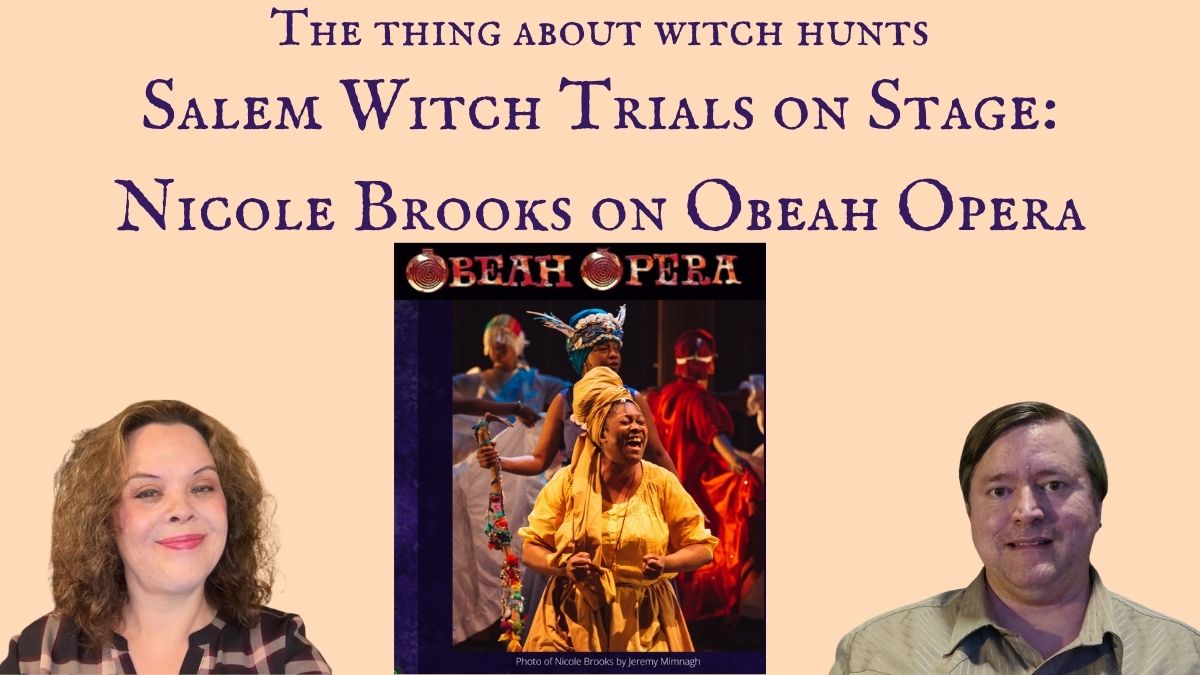
Most people meet Tituba through Arthur Miller. Nicole Brooks met her differently. The Canadian artist, producer, composer, and performer spent over a decade creating Obeah Opera, a fully sung a cappella theatrical work that centers Tituba and the other women of Salem as healers, wise women, and people who loved and were loved. In this conversation Nicole opens up about the research, the music, the controversy, and the story she believes America is ready to hear.
What You Will Learn
How music makes the heaviest history bearable
Who Tituba was beyond The Crucible
Why Nicole positions every woman in the story as a healer
How the word Obeah appears in Puritan records and what that tells us
The love story at the heart of Obeah Opera
How the girls who made accusations were themselves silenced and powerless
Why an all-female cast changes how the story lands
Enjoy this in-depth author interview with New York Times bestselling author Kathleen Kent. Kathleen opens up about her writing process, her journey from aspiring writer to published novelist, and the craft behind transforming family history into compelling historical fiction.
Kathleen’s debut novel, The Heretic’s Daughter, tells the story of her ancestor Martha Carrier, who was executed during the Salem Witch Trials on August 19, 1692. Martha was from Andover, the town with the most accused witches was blamed for a smallpox epidemic that killed 13 people. Even when her children were tortured into confessing against her, Martha refused to admit to crimes she didn’t commit.
This episode offers invaluable insights for aspiring novelists and historical fiction writers, covering everything from research techniques to finding your voice as a writer. Whether you’re working on your first novel or looking to deepen your craft, Kathleen’s experience and teaching expertise provide practical guidance for writers at every level.
About Kathleen Kent
Kathleen Kent is a New York Times bestselling author and member of the Texas Institute of Letters. Her novels include:
The Heretic’s Daughter (David J. Langum Sr. Award for American Historical Fiction, Will Rogers Medallion Award)
The Traitor’s Wife
The Outcasts (American Library Association “Top Pick” for Historical Fiction)
The Dime, The Burn, and The Pledge (Edgar Award-nominated crime trilogy)
Black Wolf
Kathleen teaches writing workshops and has worked with Texas Writes to mentor aspiring authors.
Episode Highlights for Writers
Kathleen’s journey from aspiring writer to published author
The writing process behind The Heretic’s Daughter
Research techniques for historical fiction writers
How to balance historical accuracy with storytelling
Finding and developing your unique voice as a writer
Working with family history and sensitive historical material
Navigating the publishing process
Teaching writing and what aspiring novelists need to know
Transitioning between historical fiction and crime fiction genres
For History Enthusiasts
Martha Carrier’s powerful story of resistance
The Andover witch trials and why this town had the most accusations
The 1690 smallpox epidemic and its connection to witch accusations
How children were tortured into testifying against their parents
Josh Hutchinson: [00:00:00] ” Thou shalt not suffer a witch to live.”
Josh Hutchinson: Welcome to another episode of Thou Shalt Not Suffer: The Witch Trial podcast. I’m Josh Hutchinson.
Sarah Jack: And I’m Sarah Jack.
Josh Hutchinson: Today’s guest is the extraordinary author Katherine Howe. We’ll speak with her about the causes of the Salem Witch Hunt and about her new book on pirates. I’m excited to talk about Salem Witch Hunt again and really curious what her book is about.
Sarah Jack: Yeah, it doesn’t matter what time of year.
Josh Hutchinson: [00:01:00] It’s always Christmas for pirates.
Sarah Jack: Just like Katherine’s other books, you are going to be delighted by the characters and the adventure. Fun getting to hear about it, and it’s gonna be hard to wait for the publishing.
Josh Hutchinson: She has wild swashbuckling shenanigans. But first, on a more serious note, we talk Salem, Witch Trials, what caused them, what didn’t cause them, why Katherine Howe it gets fired up about certain topics.
Sarah Jack: We get to a lot of layers.
Josh Hutchinson: Peeling that onion.
Sarah Jack: We just take Katherine right into the depths of the mechanics.
Josh Hutchinson: We talk about the different spheres that Malcolm Gaskill spoke about that are nested in each other and how each of those [00:02:00] spheres contributed to the witch-hunt.
Sarah Jack: We talk about what kind of perspective do we need to be using when we look back at the individuals that were in a different time in history.
Josh Hutchinson: Oh yes, we do that, don’t we? Wow, this is gonna be one hell of an episode!
Sarah Jack: Aren’t they all?
Josh Hutchinson: Yes, but I have a good feeling about this one. It’s gonna be something special.
Sarah Jack: It’s another dynamic conversation with a phenomenal author and researcher, and she does not hold back.
Josh Hutchinson: She does not. The emotions come out. Be ready.
Josh Hutchinson: I’m going to talk about the before the Salem Witch Trials, what the conditions were in Massachusetts Bay Colony and Salem Village and Andover.
Josh Hutchinson: Colonies used to have charters, so they [00:03:00] were officially recognized by the English government to govern themselves without direct supervision from the Crown and Parliament. Massachusetts Bay lost its colonial charter in 1684, when King Charles II revoked it because they had been naughty boys. And when the witch hunt began in early 1692, they still didn’t have a charter, so they were in legal limbo.
Josh Hutchinson: In addition, they were fighting King William’s War and still recovering from King Philip’s War, which was the costliest and bloodiest of the colonial wars, occurring between 1675 and 1678. In fact, the Massachusetts economy did not recover to pre-war levels [00:04:00] until the 1800s, after the Revolution.
Josh Hutchinson: Economic hardship resulting from the wars and the collapse of land speculation were also contributed to by an influx of refugees from the frontier in Maine and New Hampshire, and Essex County, where Salem’s located, was especially impacted, due to its proximity to that frontier, being the northernmost county in Massachusetts. Many of the settlers of Salem had moved on to Maine and New Hampshire, only to be forced to return when their villages were burned to the ground.
Josh Hutchinson: Beyond these issues, in Salem, the town had recently gone through a bit of a separation, [00:05:00] where Salem Village was allowed to begin its own church. In 1689, Salem Village hired the fourth in a series of unpopular ministers, and there were disputes over his contract, so there was a lot of tension in the area.
Josh Hutchinson: There was also tension in Andover, which was the hardest hit by the witch trials, with some 45 individuals being accused. There, there was a dispute between two ministers, Francis Dane and Thomas Barnard. Francis Dane was an older gentleman with health issues, who was no longer performing full duties as minister. So they had brought in Thomas Barnard, a younger man to take over some of [00:06:00] his duties, but were still paying both men in 1692, leading to tensions within the community that may have fueled some of the allegations there.
Josh Hutchinson: We’ll get into these issues further with Katherine Howe, and specifically we’ll be discussing Andover in a few weeks with author Richard Hite and get into more of whether the dispute over the ministers did or did not contribute to witch-hunt fever in that community.
Sarah Jack: That was good, Josh. Thanks, Josh.
Josh Hutchinson: You’re welcome. It was a fun one to do, and we’re going to dig into that stuff some more with our guest.
Sarah Jack: I am excited to introduce author Katherine Howe, whose works include The Physick Book of Deliverance Dane, Conversion, [00:07:00] The Daughters of Temperance Hobbs. She’s an editor of The Penguin Book of Witches and co-author of Vanderbilt.
Josh Hutchinson: We’ve read that you’re actually connected to somebody accused, which is an interesting connection. So can you tell us about who it is that’s your ancestor?
Katherine Howe: It’s a little bit of a funny story. So my last name is Howe, like, how are you? But with an “e” on the end. And one of the witches who was accused towards the beginning of the Salem panic and who was put to death was Elizabeth Howe. And she was from the same broad region that my family was from also. So it wasn’t a huge surprise when my aunt, back in the nineties, she was doing some genealogical research, and she figured out that that Elizabeth Howe is, I think it’s like my eighth great aunt. So it’s a lateral thing, rather than a direct thing. But at the time, she discovered that Elizabeth [00:08:00] Howe was related to us that way and also that Elizabeth Proctor was also a eighth or ninth great aunt, as well.
Katherine Howe: Just not all that surprising given that those communities were pretty small, and there were lots of intermarriages between different family groups and things like that. So it was in the nineties when I first learned that and thought, of course, it being the nineties and me being a grunge kid, and I thought was like, “oh, that’s so badass. That’s so metal.” thought that was the greatest thing ever.
Katherine Howe: I didn’t give it much thought beyond that, until I was actually living in that region of New England, because my family left New England in the 1930s. I grew up with this sense of it as like the motherland, but I didn’t actually grow up there myself. So I arrived in this region with this kind of funny twin consciousness of, oh, this is home, but I’m also a stranger here. And so it was being a stranger in this place that I felt this kinship that probably contributed somewhat to my getting started [00:09:00] writing fiction.
Katherine Howe: My first book was The Physick Book of Deliverance Dane, which was something I started working on when I was in graduate school at Boston University and just trying to think about the humanity of people living in this time and the, maybe a funny little detail. So one of the historians of witchcraft who I really admire the most is a woman named Mary Beth Norton, who wrote a book called In The Devil’s Snare, which anyone is interested in Salem has to know Professor Norton’s work, cause she’s just like the kind of detail that she can bring to it. And she writes in a novelistic sort of way. It’s just like the most gripping account of Salem ever. And Professor Norton has said that the more you work on witchcraft, the more superstitious you become. And I have to say that this is true. As evidenced by the anecdote I’m about to tell you.
Katherine Howe: So my first book was The Physick Book of Deliverance Dane. It asked, “what if one of the Salem witches the real [00:10:00] thing?” But the real thing the way the colonists believe, which is to be not in that pointy hat fantasy, Harry Potter Sense.
Katherine Howe: And I built that story around a woman named Deliverance Dane who’s a real person. And she was a minor person in the Salem Witch crisis. She was accused towards the end of the panic. She was not put to death. She really, like, was a footnote, I think, in the real history of Salem. And so I felt like it was okay to build a more fantastical story.
Katherine Howe:Physick Book is a magical realist story, so I wanted room to have kind of a fantastical story around a real person. And so I picked her because of her obscurity, but also because of her name. Her name is so evocative of this particular moment in time of this like subculture that she was living in, Puritan New England, Deliverance Dane. Just amazing. So that is why I chose to write about her.
Katherine Howe: That book [00:11:00] came out in 2009, and so several years later I was futsing about on a genealogy website because of course, for people who are interested in family history, life’s gotten a lot easier. Over the last couple of years, with the advent of digital humanities and so many more ways of doing research online. Like, when my aunt was doing research in the nineties, it was really hard to do, and now it’s actually much more accessible, which is a huge gift.
Katherine Howe: So I’m messing about, point, click, point, click, and I come upon Nathaniel Dane, which is actually the name of a character in the book that I wrote, and I was like, “huh, that’s a weird coincidence. Who knew?” Point, click, point, click, point, click. Lo and behold, I learned that it turns out Deliverance Dane, the real one, is my eighth great-grandmother. And so she’s more closely related to me, genetically speaking, than Elizabeth Howe, even though Elizabeth Howe and I have the same last name. And I had [00:12:00] zero idea, no idea whatsoever, and I’d written an entire novel about this person and found that there she was, just hanging out, waiting for me. So I definitely have gotten more superstitious the longer I’ve worked on witchcraft.
Josh Hutchinson: That’s a very strange thing to have happen to you. But it turns out that Deliverance Dane is actually my like eighth or ninth great grand aunt, and Elizabeth Jackson Howe is also an aunt, and Deliverance Dane, in her confession, says that she worked with Mary Osgood, and that’s my grandmother. I connected to a lot of the people you’re connected to.
Katherine Howe: So we’re cousins, Josh.
Josh Hutchinson: And Sarah’s my cousin through Mary Esty.
Katherine Howe: Wow.
Josh Hutchinson: Yeah. It’s a small world when you get back to those little towns back there.
Katherine Howe: Yes. It really is, for sure. It’s still pretty far back there. It’s a long time ago. It was very funny. I once did a book event, and someone came out to me very emotional, [00:13:00] and they were, turns out, a descendant of a judge from the Salem trials. And this person wanted very much to personally apologize to me. And I was like, ” no, it’s really, it’s okay”. Like he’s, this is not something that you need to feel badly about. This is, everything’s fine, cool’s fine. But it is interesting to me how close people can feel to people who are living in such a distant time period.
Josh Hutchinson: We definitely feel connected to our ancestors, and we talk to a lot of descendants of which trial victims, and they have an emotional bond with those ancestors, but that was so long ago. Did you get interested in Salem because of your connection with Howe and Proctor?
Katherine Howe: Partly. I went to graduate school for American and New England studies, which is like interdisciplinary American history. And I actually came to it from an art history [00:14:00] background. I have a background in visual culture, and it’s a where for grad school visual culture and also material culture, which is to say, stuff, objects. On a whim, my husband and I moved to Marblehead, Massachusetts, which is a small town on the water close to modern-day Salem.
Katherine Howe: We’re having this conversation in October, and there was just an article on Boston Globe about how like a hundred thousand people came to Salem for Halloween and running streets. Salem is a town of 40,000 people. I can’t even wrap my head around how many people they cramming in this season. And a lot of people come to Salem for Halloween. It’s like Halloween Central, and understandably.
Katherine Howe: But it was interesting to me while I was living in Marblehead and I was studying history. And I was living in a house that was built in 1705. And so one thing I have to say is people associate me so closely with Salem, because I’ve written so much Salem fiction. I grew up in [00:15:00] Houston, Texas. Okay. So the oldest building extant in Houston, Texas is a wine bar that was originally built as a bakery, and it’s from 1856. So the oldest building in the entire city that I grew up in is six years younger than the new edition of the house that I was living in in Marblehead, Massachusetts. Earlier, when I was talking about having a sense of being home but being a stranger there. I brought my new south eyes to this incredibly old environment, because Marblehead has the biggest collection of century houses in the entire country. They even have more than Colonial Williamsburg, for instance, except that in Marblehead, the houses have been continually occupied.
Katherine Howe: On the second floor of the house was an apartment, but the house had been a single-family house, been carved into apartments. Pine floors were like foot wide, and the ceilings were incredibly low. Like, you couldn’t stretch your arms over your head, cuz [00:16:00] the ceilings were so low. And this is actually when I learned for the first time, talking material culture, that bed headboards actually have a function. They’re not just decorative. And I discovered this, because we were so broke in grad school that we would turn the heat down as far as we could manage.
Katherine Howe: And so the room that we used as our bedroom, ice would form on the inside of the windows, because it was so cold, and we were so broke. And so when we were first living there, we had this futon I’d brought with me from Texas, of course. And there was no headboard on the futon. And so we were freezing, just like having your head up by this wall with ice on the window. We were freezing cold. And it wasn’t until we got like a bed with a headboard, we like, “oh, this is a lot warmer. This is great.” We just only then did I discover that a headboard really is important, at least if you’re living in New England.
Katherine Howe: And in this room, the bedroom that we had was tucked under the eaves of the lean-to part of a house. So if you’re familiar with colonial architecture, houses tended to be built in stages. You’d have room here and a [00:17:00] room here, and you have maybe you’d add a second floor and you might add a lean-to in the back to add some extra space. So we were in what had been the lean-to, and there was a little door that went into the back stair, and over the back stair, there was this little horseshoe-shaped charm over the back door that had been painted over. And of course, horseshoes are something that I think all over the country, we all recognize what they mean, and they mean that they’re there for luck or for protection. And you see this all over the place. This is a piece of folk magic belief that is incredibly widespread, such that we don’t even really notice it, as evidenced by the fact that you can buy horseshoe necklaces at Tiffany’s, wherever. We don’t even think about it anymore. But it was interesting to me to see this little remnant piece of magic. It wasn’t a real horseshoe. It was clearly there. It was tiny. It was a charm. It had been made as a charm, sold as a charm.
Katherine Howe: And so then I started looking around and noticing horseshoes wherever I went. And it got me thinking [00:18:00] between the fact that there was this little remnant magic shred, that there was that and also the fact that I was in this physical space that people had been moving through, who had been present when the trials were happening. Like we were only one town over from Salem, and, of course, when the trials were happening, people were traveling from towns all over the place to come and see, because it was a huge spectacle. People were talking about it.
Katherine Howe: So there was one day when I was sitting and thinking, like, “someone’s foot has been on this board, this actual board under my hand. The same foot was standing and watching what was going on.” And something about that tangibility or that proximate tangibility was really moving to me, and it got me thinking about the humanity of people who were living through that very strange moment in time, cuz I feel like much of the time their humanity is elided by our presentist biases or what have you. I feel like in [00:19:00] highly fantasy versions of witchcraft, the humanity of the people in the past is elided, and in, certainly in Arthur Miller, the actual humanity of people is alighted.
Katherine Howe: I started thinking about what became the story in Physick Book from that perspective, from like occupying this very weird, specific physical space as a stranger and trying to think about what it meant to be in that space and like how it felt to be in this space, over this incredible span of years, and how, in one sense, the early modern period is this incredibly alien and remote time. Their understanding of how reality worked is very different from our understanding of how reality works. But at the same time, there are certain common elements of common humanity that persist, like lying in bed and being freezing cold, unless you have a headboard at your head, and so a lot of my fiction, my desire to write fiction came [00:20:00] from thinking about these common points of humanity across really wide, gaping spans of time.
Josh Hutchinson: Can you give us a little background on what the situation was in Massachusetts Bay, when the witch trials started?
Katherine Howe: A few things were happening. A question that I get a lot is, what is the proximate cause o f the Salem Witch crisis, what caused it? And the thing that I think is interesting about that question is that it suggests that it would be so much easier if there were just one cause, if we could just point to the thing, and be like, “oh, that’s the thing.”
Katherine Howe: When we were corresponding, Josh, you mentioned the ergot hypothesis, that back in the seventies, somebody floated the idea that maybe all the afflicted girls had eaten moldy bread and were suffering from ergotism, and they were all tripping outta their mind. And that hypothesis was actually dismissed, I think, six months after it was first floated. But it still bubbles up periodically in [00:21:00] documentaries and popular discourses about Salem, because, and I think the reason that it doesn’t go away is because it’s so simple. It’s so tidy to be like, “okay, that’s the thing.”
Katherine Howe: And the truth of the matter is there isn’t one thing. The way that I sometimes talk about it is that it’s like a Venn diagram, and Salem is the point of the intersection of all the overlapping circles.
Katherine Howe: So one overlapping circle is the very specific kind of religion that everyone in Salem adhered to. It was a world view that did not hold that there was anything outside of Christianity. So, for instance, the indigenous population that was already living in Massachusetts at that time, by virtue of not being adherents of Christianity in their very specific puritan worldview, that which is not Christian is by definition devilish, and it was actually Mary Beth Norton who’s made the point that a lot of the language that the [00:22:00] people at Salem use to describe the devil is language that is used to describe indigenous people. So, one big Venn diagram circle is the specific religious and cultural moment that they’re living in.
Katherine Howe: Another diagram circle that we could point to is the weather, that the first panicky behavior that erupts with Betty Parris and with Abigail Williams, it starts in January, January, super cold in Massachusetts, cold, dark. The sun sets at 4:30 in the afternoon. And I’m not exaggerating, like it is dark AF. And and that’s true in the 17th century, as it’s today. And also in 1690s, North America was in miniature ice age. It was even colder and more bitter than it is now in Massachusetts.
Katherine Howe: Another piece is pretty relentless class and gender context. The girls who first experienced symptoms that they describe as [00:23:00] fits are Betty Parris, daughter of Samuel Parris, who’s the unpopular minister in Salem Village, Abigail Williams, who’s his 11-year-old, she’s described as being his niece, although that had a different meaning for them than it does for us today, but she was bound out to service.
Katherine Howe: So can you imagine living in a culture where when you can’t afford to feed your 11-year-old, you just give her to somebody to live with, for her to work for them? You just give her away. And so Abigail was this lonely, impoverished, starving, freezing child whose job it was to obey everyone all the time.
Katherine Howe: Oftentimes, I think with great sympathy about Abigail Williams, poor Abigail, who, by the way, in Arthur Miller is turned into a 17-year-old temptress. She’s a child. She’s a child. And if you look at the descriptions of her behavior that are described as her being in her fits, a lot of her behavior sounds to me like playing, [00:24:00] like running around in circles and flapping your arms and saying, ” whish” and saying that you’re gonna fly at the chimney.
Katherine Howe: Is that devilish possession, or is it an 11 year old girl being silly? And I feel like that is a, that is something that’s worth thinking about. So there’s the kind of class and gender politics, that’s another big.
Katherine Howe: So there are a number of different aspects, but you were asking about the politics and the charter. So this is another pretty big circle. So, typically in the early modern period in the colonies, if someone was accused as a witch, they would be accused and have a trial, and if they were found guilty, by the way, it’s hard to find people guilty. They actually had a pretty high bar for for evidence at that time. Believe it or not, you could be tried and found guilty, and if you’re found guilty, you could be put to death, and that could happen within a matter of weeks. Salem, the panic begins in January, the first hangings aren’t until June. That’s like a huge long span of time. And the reason for that long span of time is because the Glorious Revolution was unfolding.
Katherine Howe: Back in England at that [00:25:00] time, Massachusetts Charter had expired, so they didn’t have the legal wherewithal to hold a trial. That’s why the Salem trial trials are conducted by a special Court of Oyer and Terminer. They basically had to convene like a special tribunal to deal with this problem that had come together. In fact, there’s some historians who wondered if the Court of Oyer and Terminer didn’t just deal with witchcraft. They were supposed to deal with all the rest of the backlog. But we just don’t know what that backlog was, cause the records of the witch trials are what have survived.
Katherine Howe: And then there’s another piece of the Venn diagram, and we have to consider it. At the very beginning, the very first person who’s accused as a witch is accused by Abigail and Betty and she’s the only person who has less social and cultural power than they do. And they accuse Tituba or Titube Indian, who is an enslaved woman in the Parris household.
Katherine Howe: So she’s basically the only person who has less ability to protect herself than these children themselves do. And so Tituba’s accused. She [00:26:00] has two confessions, and there’s some evidence that she is beaten in between the two confessions. And in one of the confessions, Tituba introduces the idea of a conspiracy. She says that there is a group of witches at work in Salem Village. She doesn’t know who they are or how many.
Katherine Howe: And so at one point early on, there’s actually a sermon is preached in Salem Village that I’m gonna mangle the title, but it’s something along the lines of “Christ Knows How Many Devils There Are.” And so you have this idea of an unknown number of conspirators, who must be discovered. And when you have this undefined, invisible threat and also no legal relief, there’s no like pressure valve that this tension could be released by, because of the like, unfortunate timing of the expiration of the charter.
Katherine Howe: So you bring [00:27:00] all of these circles in the Venn diagram together, and that is why Salem gets as big as it does. And by the time Salem was over and done, 19 people were put to death and hundreds had been accused, hundreds in a period of time when a given town would only have a couple thousand people.
Josh Hutchinson: That was a great, thorough explanation of how it took all these different factors to create the situation. It wasn’t something, a single bullet theory, that you can put to rest.
Katherine Howe: But I think one reason that, that we keep craving for simplicity is because with a simple explanation for why than it’s easier to consign, to history. It’d be so much more encouraging or it’d be such a relief to be able to say, “Oh, it was air got poisoning. No big deal. That’s all.” But like the fact that it, what really was at stake was this intersection of circumstances and that everyone who was a participant in [00:28:00] Salem pretty much believed that they were doing the right thing. Not only the right thing, but the necessary thing to save their community. That to me is also a moving but also terrifying thing to remember and to realize.
Katherine Howe: Because certainly we all, we’ve all lived through moments where we are convinced that we’re doing the right thing, only to see ourselves perpetuating horrors, and that is I think that’s one of the reasons we as a culture are never really able to let go of Salem.
Sarah Jack: You said, ” as a culture, we’re never able to let go of Salem.” Nathaniel Hawthorne wrote, ” shall we never get rid of this past? It lies upon the present like a giant’s dead body.” I’m wondering what you think you would write now about that.
Katherine Howe: Hawthorne in particular is someone who, like he personally, so felt the weight of Salem’s past in a very personal way, because he was a descendant of Judge Hathorne, obviously. And because he was living there himself, and for many [00:29:00] generations, in fact, much during much of the time period when Hawthorne was living in Salem, the witch trials were not discussed in polite society. This was true into the 20th century, actually. They were not discussed. It was not something that was brought up. It’s certainly something my family never talked about until this is something that my, my aunt uncovered. There was a sense of embarrassment attached to it, I think.
Katherine Howe: But I’m also intrigued by the fact that when Hawthorne has tried to grapple with it, and he has tried to grapple with it, he took the line from he, he knew what had happened. Like he took a line from Sarah Good and put it in the mouth of Matthew Maule, in The House of the Seven Gables.
Katherine Howe: Was it Hawthorne who grumbled about “damn scribbling women?” I think it was. I think it was. And so this is me tweaking his nose a little bit, but Sarah Good. Sarah Good was a beggar. Okay. She was destitute. She was one of the first people accused, because she was in no position to defend herself. She was thrown into jail. She has a baby on her and like [00:30:00] toddler, essentially with her, the baby dies while they’re in jail. The toddler, whose name is Dorothy, ends up losing her mind and has to be like supported by the town after the trials are all over. So like this person is in absolutely dire straits and is and suffers mightily at the hands of the community where she lives and who’s supposed to be helping them.
Katherine Howe: And when she’s on the scaffold, she says the most badass thing anyone has ever said in history of time, my unbiased opinion. She says, “I’m no more than a witch than you are a wizard, and if you take away my life, God will give you blood to drink.” And I wish I had that kind of wherewithal, because who has that kind of wherewithal under in those circumstances?
Katherine Howe: And so Hawthorne takes this line, Hawthorne knows it’s happened, and he puts this line in a guy, in a guy’s mouth. I understand that he’s writing in the 19th century. I get it. But at the same time, I think it’s impossible to look [00:31:00] at Salem and not consider gender politics in place. The fact that virtually everyone who’s accused and put to death was a woman. Any man who was accused cuz he’s associated with a woman who was already accused. Giles Corey was crushed to death between stones. He’s accused cuz his wife, Martha’s accused first, but also the accusers are initially children, but then also women. So there’s a really intense gender politics in place here.
Katherine Howe: So your question was, the past lying with the weight of the giant and what would Hawthorne say today? And I’m actually curious what Hawthorne would say about it today. I think he would sympathize with, or maybe be aggravated by the fact that we’re still having the conversation that he was having a hundred and fifty years ago. But at the same time, I feel like we’re talking about different things from what he was concerned. And and also I think he would be really annoyed because I write novels. I’m a woman.
Sarah Jack: I love [00:32:00] that you brought up that he took Sarah’s words and gave them to a man, because it just dawned on me very recently that Ann Putnam didn’t read her own apology. I just assumed, and I think that possibly other descendants, we read that, we think I don’t know what we really think about it. We’re evaluating what it says anyways, but we’re doing that with her voice in our head, and no, it was not.
Katherine Howe: One thing that, that continues to interest me, as a history person, about Salem is that it’s one of the rare instances when regular people are at the center of the store. So much of history, especially the further you go into the past, the vast majority of people who’ve been alive in history of ever, have left no record of themselves. They weren’t literate, they weren’t of sufficient note to have their burial place noted, [00:33:00] and so much of history, even academic history, as it’s gotten more serious about excavating stories, just by the nature of the way that archives come to exist, there’s still going to be a bias towards power.
Katherine Howe: There’s gonna be a bias towards privilege and a bias towards power, and, when it comes to Salem, that is one of the rare instances where the bias towards power falls away, because the people who are at the center of the drama are regular people, and where historians have put the work in to try to excavate what is able to be excavated of these lives that otherwise would’ve been invisible to us.
Katherine Howe: Would we have known Abigail Williams ever existed, if she hadn’t been part of the Salem Witch Trials? We would not have? And in fact, even with her central position at the beginning of the panic, we don’t know what happened to her. We don’t know where she went. We don’t know how old she was when she died. Nobody actually knows for sure.
Katherine Howe: And so particularly talking about people who are not literate, Anne [00:34:00] Putnam had her confession read. If I remember correctly, Anne Putnam wasn’t literate. And so you’re right in saying here’s this apology that she delivered in front of everybody and that it was read on her behalf. To what extent was she the author of her own apology? And it’s impossible to say. It’s impossible to know.
Katherine Howe: And it’s one of the reasons that you’ve touched on one of my rant buttons, I’m sorry to report, but as a writer of historical fiction, like I have so little patience for historical fiction about kings and queens. I don’t give a damn about kings and queens. Who cares? They get enough attention, they have enough records, they’re all literate, everyone documents every single thing that they do. And I do not give a damn, because history pays them enough attention, and I’m so much more interested in trying to excavate the history of people who would otherwise be forgotten.
Sarah Jack: I caught that from you reading Conversion, because your [00:35:00] main character, Colleen, she’s getting to give us the firsthand experience like no other afflicted person was able to do.
Katherine Howe: Thank you for saying that. I confess I haven’t looked at Conversion in kind a long time. You’re making me think I should look at it again, cuz there’s actually a group of high school students who are reading it right now and I’m gonna talk to next week. I should read that book.
Katherine Howe: But I appreciate you saying that, because I feel like, like one question I sometimes wrestle with as a history person and someone who’s a novelist is what does historical fiction have to offer that nonfiction doesn’t have to offer? Like, why not just write a really good history of something?
Katherine Howe: And I feel like in many instances, in the cases where a story cannot be recovered, that’s where historical fiction can be a really wonderful intervention. If you can build a credible world with credible material culture, and credible details, and credible politics, and credible ideology, and then [00:36:00] people it with people who are credible people, it is a way of accessing history that otherwise is not extant, where it doesn’t exist.
Katherine Howe: Is there going to be some imagination involved? Obviously, but it is, I feel like that’s where the opportunity lies. And I realize we’ve gotten off Salem a little ,bit and I apologize, but it’s something that I think about a lot. Like, particularly for some, a story that’s as revisited as often as the Salem story is, what does fiction have to offer? Like why tell a fictional version of this story? I feel like fiction gives you permission to fill in and shade in stories that where there just is no other shading available. And that to me seems like the real area of opportunity for storytelling.
Josh Hutchinson: I wanted to ask you about the afflicted girls. Do you think it’s plausible that conversion disorder could [00:37:00] explain some of the fits?
Katherine Howe: Yes and no. I’ll explain that hedge of an answer. For one thing I find it always a little bit tricky to apply contemporary psychoanalytic categories to people in the past. Like on the one hand, I believe very urgently in, the shared humanity of people in the past, but at the same time, like we take as natural so many habits of mind that are actually very historically contingent. The fact that you and I might casually talk about what our dreams mean or what our subconscious motivations might be for something like that is indicative of post-psychoanalytic. And I think it’s tricky to try to access the interior light of people who are living in a different moment, especially a moment like the early [00:38:00] modern in Massachusetts. It’s even hard for a scholar of that time period to really grasp the extent to which Christianity informed every, single aspect of existence.
Katherine Howe: So for my second novel I was working on. No, it’s Physick Book. I was reading up about alchemy, and like we know about alchemy as this pseudoscientific practice in early modern practice in which someone tries to turn that into gold. Okay, fine. But that’s actually not what it was. It is actually a way of understanding the order of the universe that took as scientific fact the perfectability of the human soul.
Katherine Howe: There’s this tense layering of religion and materiality and mirroring of structures and images like, like as soon as I would get close to thinking I understood alchemical thought, it would slither out of my grasp. And I would realize this because I’m just [00:39:00] too much of someone born in the 20th century to, to I will never actually really understand that intellectual landscape.
Katherine Howe: So when you ask can conversion disorder explain the girls’ behavior? Like in a way yes. But in another way I don’t know that we can actually really understand their selfhood, the way that these girls thought about themselves or understood themselves as individuals.
Katherine Howe: It’s just very different from the way that we think. It’s very different. So that there’s that qualification. With that qualification in place, I would say that, so conversion disorder is where you are under so much stress that your body converts it into physical symptoms. And then mass psychogenic illness is when a group of people experience strange behavior together.
Katherine Howe: And there are many examples of mass psychogenic illness [00:40:00] or mass psychogenic illness expressions of conversion disorder, and many examples of it across cultures, across time, across continents, across ethnicities. And it very often happens among adolescent girls, for whatever reason. Maybe cause we are conditioned to be more like socially engaged with other people. Who knows? You can try to explain it a number of different ways.
Katherine Howe: But it’s not only adolescent girls. I think that it is, this is gonna be a controversial thing to say, but like the recent incidences of Havana Syndrome are pretty clearly an example of mass psychogenic illness. Now it’s important to say that mass psychogenic illness is real. It counts as a real thing. It’s not just people like, it’s not all in your head. You know what I mean? Like the fact that it is, that it has its origin in mental disorder doesn’t make it any less real to the body. Conversion disorder is a disorder. It is your body being sick. It’s just that the sickness originates from [00:41:00] inside your own organism. That doesn’t make it count less. You know what I mean?
Katherine Howe: All of which is to say, did a group of girls start exhibiting strange behavior? Yes. Did it spread from girl to girl on networks of kinship and friendship? It did. But at the same time, their behavior, when you say “fits” today, that has a very specific connotation. And it sounds like a epileptic seizure or something like that to, to us today. If I say, “Oh my gosh, I just saw this person have a fit.” You’d be like, “Oh no.” And you’d imagine that they fell down twitching and foaming at the mouth, but that’s not what they were doing.
Katherine Howe: What they were doing was behaving out of the ordinary. So like earlier we were talking about Abigail running around flapping her wings and saying, her arms, and saying, “whish, whish, whish.” That is her in her fits. Or like another instance of Abigail in her fits is when she challenges Deodat Lawson to name his text. She like gets up in the middle of church and like mouths off to this very famous divine and rolls her eyes about how boring it’s gonna be when he reads his text. That’s [00:42:00] not her having a fit. That’s her misbehaving.
Katherine Howe: But her behavior was such a challenge to the gender and economic power structure that was in place while she was living. It was so out of the ordinary that her community could only chalk it up to devilish influence because it was that unimaginable that she would behave this way.
Katherine Howe: So was there a social illness aspect to the afflicted girl’s behavior? I feel certain, yes. So that, that’s my long and qualified example about or discussion of conversion disorder.
Josh Hutchinson: Do you think that they were really afraid of witches and that the fear of witches might have also translated?
Katherine Howe: Sure. Oh, for sure. Yeah. I think the fear was real. I think it is a mistake to either chalk it up as craven opportunism or as naked stupidity or superstition. One of the [00:43:00] things that I think is important, I like to give people the benefit of the doubt who live in the past and that is that like absolutely they were afraid.
Katherine Howe: Can you imagine, what does it feel like to live in a world where you really, actually, honest to gosh believe that the devil can go walk about on the earth, as a real person and that he can disguise himself as people you know and love and trust? That at any given time, I could be talking to you right now, Josh, and you could be the devil in disguise, and I wouldn’t know it.
Katherine Howe: That’s a and if you really believe that, you really do believe that, and you actually really believe that hell is a real place that you can go there if you make a mistake. That there is no, this is another like aspect of puritan belief, that like they believed in the elect. The idea that you have no way of saving yourself. That your being saved was only up to God, and you had no control [00:44:00] over it whatsoever. Like what? You couldn’t go to confession. You couldn’t do penance. You could try your best to behave, but it was ultimately just up to God.
Katherine Howe: What an existentially dreadful way to live your life, to have no certainty. It’s a little, a really hard life, first of all, and to believe that there was such a thing as paradise after death, but to have no idea whether or not you got to go there and that nothing you did made any difference. And that everywhere, at every turn, the devil was waiting to trip you up. Like that would be a difficult and impossible mental landscape to occupy.
Katherine Howe: So yes, if your question was did they really believe in witchcraft and was that fear, could not fear contribute to their behavior? Like absolutely. What a terrifying way to live, and also what a relief. Like one of the reasons that I think witches [00:45:00] was such a persuasive idea for so many people at that time was wouldn’t it be great if something was going bad in your life, to be able to not try to see it as a sign of God’s Ill favor, but instead to have someone to blame for it? To be like, “it’s not me. I’m not messing up here. Someone’s doing this to me.”
Katherine Howe: I think that’s also very human, that human feeling. It’s not just bad luck or misfortune or like the luck of the draw, and it’s so much more of a, “no, this person doing something to me. They wish me ill, and that’s why my life is hard.” I think that’s a very human way to be.
Josh Hutchinson: Yeah. We talked a little about Anne Putnam, Jr.’s apology earlier, and she still does that in her apology. “The devil made me do it.” And Samuel Sewall does the same thing, like the two big apologies that come about after Salem is over after everything’s done are Ann Putnam’s and [00:46:00] Samuel Sewall’s apology. But Samuel’s apology, too, is weird where he like, first of all, he comes to it. It’s not that he stops believing in witchcraft or stops believing that there is an invisible world. He comes to it after a series of wonders and marbles, including, if I remember correctly, like his house being tilted with stones. Who knows what really happened? And maybe there was like a passing hailstorm is how it took it.
Katherine Howe: But he comes to it after a series of wonders and marvels, and he comes to believe that the devil tricked them all. That it wasn’t that that the devil wasn’t luring people into witchcraft. Instead, the devil obscured the minds of the people who are supposed to keep the community safe. And but also what a horrifying thing to, to come to believe about yourself. To look back at your actions and think you’re doing the right thing, and think that you are saving your community from the most threatening presence that your imagination can come up with, and instead to conclude that, no, what happened [00:47:00] was that threatening presence tricked you. That you were so weak that you were fooled. Like what a, what a heinous thing to believe about yourself. It’s a very punishing worldview that they subscribe to.
Josh Hutchinson: Do you see any modern parallels to the Witch hunt?
Katherine Howe: Sure. A few years ago a historian of witchcraft named John Demos published a book about witch hunting, in which he has a chapter about the 1980s daycare satanism thing that happened, much of which I was only dimly aware of, being a small person in 1980s myself.
Katherine Howe: But what happened was, a group of people were put on trial, actually put on trial and actually convicted of having you run a daycare center and used the children in satanic rituals. And at the time that it was happening, and this is preposterous, like I, it’s actually just like on the surface of it, I think [00:48:00] preposterous. I think, taken out context, any of us looking at this would say, “this makes, this is ridiculous. Obviously this did not happen.” And at the time that it was unfolding, John Demos saw it unfolding and he was like, “Oh my God, it’s Salem all over again.” Like the same pieces are in place, like the idea of a conspiracy, the idea of trusted people that you cannot trust, the idea of children being at risk.
Katherine Howe: And I think that you see some of the same hysteria and language. I don’t like using the word hysteria, cuz it’s such a specific word, but you see some of this in like contemporary corners of the conspiracy internet, where I try not to spend any time, but Isn’t that Pizzagate? Isn’t there some like thing not too long ago about worrying a particular pizzeria was like putting kids at risk in this same kind of way? Like you see the same kind of like at any time that someone worries that children are at risk, there will be a lot of open-mindedness about it.
Katherine Howe: But of course, here’s me getting political. Like, of course, children actually literally are at risk [00:49:00] by, by school shooting, right? Like the one thing that would really keep children really safe in places where they’re supposed to feel safe and trust people around them, is if they restricted access to military assault weapons. That’s my opinion. My opinion is that if we really care about keeping children safe, we take those guns off the street, right, full stop. But feel free to send me hate mail. I can be reached to KatherineHowe.com/contact.
Sarah Jack: So I think asking the question about are there parallels, we have these modern parallels that are popping into our heads. We have our strong feelings, but what can the understanding of the Colonial Witch trials and those before do to help us with these parallels? Can it help us? Will it help?
Katherine Howe: I’d like to think that it can. One of the things that I like to say when talking about Salem is that I feel that one of the reasons we can’t let Salem go. As a culture, like we come back to it and we, like we can’t let it go.[00:50:00]
Katherine Howe: And I feel that the reason that we can’t let it go, among the many reasons, but I think one of the big reasons is that it forces us to confront how fragile our ideals really are. We are an unusual country in that in many respects, we are, notwithstanding those of us who were brought here against our will, which is many of us, but broadly construed, you could argue that we are something of an intentional community.
Katherine Howe: That the only thing that really holds us together is this set of shared ideals, and that some of our shared ideals include religious freedom. They include a social safety net. That we value people who are different from us, that we value people who are vulnerable. ” Bring us you’re tired, your poor, your huddled masses.” Like that, that arguably this is an ideal that we hold in common. This is an organizing principle of the culture in which we live.
Katherine Howe: And yet Salem is this instance where everybody, believing they were doing the [00:51:00] absolute right thing, instead put to death, the state put to death 19 people. That, in the course of doing the right thing, the state did the absolute wrong thing, and they also put to death people who were, many of them were vulnerable in their community. People who were more likely to be accused were those who were at the most vulnerable, who were the most out step vulnerable in community. And so I feel like Salem is an instructive moment for that, because here’s this moment where, in the course of being convinced of our total moral authority and correctness, a huge miscarriage of justice took place.
Katherine Howe: And I think that’s a really difficult thing to reconcile. And I think especially for a country like ours, where also so many of us are brought up to look to the colonial period for our origin, that we’re told, rightly or wrongly, that we are taught to look into the 18th, and to a lesser extent [00:52:00] the 17th century, and see in it the seeds of the country that we would become.
Katherine Howe: Maybe that’s another way of thinking about it. Like another way of thinking about it, is it more productive to think about what we want the future to look like than it is to try to think about what the past has to tell us? That’s a question. That’s a question that I think is interesting. One, particularly for an intentional community like ours. We have, we get to reinvent ourselves as a country, and we get to decide, and what kind of place do we want to be? Do we want to be the kind of place that protects vulnerable people? Do we want to be the kind of place that protects people who are at risk, who are different from us, who are angry, who are grumpy, who read too many books? I would prefer to live in a place that protects those kinds of people. But we get to choose We choose who we protect.
Sarah Jack: We can make that choice, and not only is it going to stop suffering here, there are places in this world that are still totally captured by [00:53:00] doing the wrong thing, thinking they’re doing the right thing, witch hunting. This discussion it is about us here, but it’s about us there.
Sarah Jack: You have referred to time so much. That is such a strong piece of this. Even in Conversion, one of the simple quotes you have says, “any number of things could happen in the time it took to go down the hall.” You like go right to the time thing. And today when you started talking, you talked about time. And I look at the history, I look at us now, how do we all get caught up on this witch-hunting mentality and start looking out for humanity and protecting other?
Katherine Howe: It’s a hard thing. It’s a really hard thing. And I wish I had easy answers for it. I think simply the act of reflection and awareness is an important one. Stopping to interrogate what our assumptions are.
Josh Hutchinson: We’ve talked about a lot of heavy things. [00:54:00] I wondered if we could switch and discuss your new book project. What can you tell us about it?
Katherine Howe: Oh, so many things. So I’m obsessed with pirates, who isn’t? Hopefully, the answer is everyone is obsessed with pirates.
Katherine Howe: So I have a book coming out in fall, and I think they’re gonna let me keep the title. And you. Okay, Josh, Sarah, you guys have to tell me what you think of the title. You ready? So get comfortable, here it is: A True Account of Hannah Masury’s Sojourn Amongst the Pyrates, Written by Herself. That’s the title. It’s a mouthful.
Katherine Howe: It starts in Boston in 1726 at a very real an actual pirate trial that really did happen. Like most of my stuff, it’s, it is grounded in actual facts and then becomes what I’m describing as a little bit like Gone Girl meets Treasure Island. And I had so much fun with it, and I’m really excited about it. And it is a little bit of a departure from what I’ve done, but it is about a girl, Hannah Masury, who has to disguise herself in order to escape some pretty heavy circumstances. And she [00:55:00] ends up basically stealing away on what turns out to be a pirate ship. And we have to follow her on her adventures.
Katherine Howe: And I have so much fun with some basic pirate tropes. There is treasure, there is a parrot. It’s so much fun, and there’s also some, a little bit of romance, and I have the most fun ever.
Josh Hutchinson: Sounds like a fun one to read.
Katherine Howe: I really hope so.
Sarah Jack: I’m so delighted by what I just heard.
Katherine Howe: That makes me very happy. Makes me very happy. It’s weird because it’s one of the, it’s probably the most violent book I’ve written. If y’all have read my stuff, then you know I’m a teensy bit squeemish and shy away from. So there’s some violence in this book, but what’s strange about it is, I didn’t invent any of it. It is actually all from historical record. I take no responsibility whatsoever for any of the stuff that happens in this book, because it all ripped from the headlines. It all really happened.
Josh Hutchinson: And was Hannah herself based on a real [00:56:00] person?
Katherine Howe: Hannah is based on a couple of people. She’s inspired in part by real accounts of Anne Bonny and Mary Read, who are two working-class women, who ended up disguising themselves as men and going raiding in Jamaica at the end of the 17th century. They were real people ,and there was a real Hannah Masury ,who I talk about a little bit in the author’s note of the book. She was a 19th-century person, and she ended up, I was inspired when I came across her. She was the wife of a ship captain. She was married to a ship captain, and she ended up putting down a mutiny by herself, armed only with a pistol, in the Pacific Ocean.
Katherine Howe: And so I read about her, and she didn’t have any children, and I was like, “oh my gosh, I am obsessed with you.” And so I decided to name my awesome pirate after her. Hannah, Hannah comes from a couple of different sources, but I really like her as a person. She’s a tough character .
Josh Hutchinson: Sounds like it. You said that it’s set [00:57:00] around a pirate trial in Boston?
Katherine Howe: Yeah, it starts, the action starts in Boston in 1726, and in 1726, it’s the end of the golden age of piracy. It’s actually funny that the Salem period, like the witch craze, the end of the witch craze and golden age of piracy are at the same time period, which I think is interesting. And a guy named William Fly was tried as a pirate, and the person who ministered to him and preached about him was none other than Cotton Mather .
Katherine Howe: So Cotton Mather by then was this like hugely famous, successful cleric. He was really rich. He was, like, had a very popular ministry and so he had taken it upon himself to crusade against piracy. So he tries to bring William Fly and his compatriots back to God, and he’s there when they’re hanged. William Fly was hanged, and then he was gibbeted. He was, his body was hung in chains on a tiny island in the Boston Harbor Islands and left [00:58:00] there to rot. He was really avid as a warning to other people who might go out on the account, which is a way of describing going, turning pirate.
Katherine Howe: And so I was fascinated by this. It was only a hundred years later that excursion boats are starting to leave Boston. Like steam boats are going from Boston to Nahant. This is no time all. To think that you could go by Nixes Mate, which is where William Fly was hanged and chained. You could go by there and to see you remnant oft remain dangling there.
Katherine Howe: So that’s where the action begins at William Fly’s trial, and things even crazier.
Josh Hutchinson: Sounds like a fun ride. .
Katherine Howe: I’m excited for it. I’m not sure when it’s coming out. I think it’s gonna be November, 2023. So it’s coming up.
Josh Hutchinson: Here’s Sarah with an important update on what’s happening now in your world.
Sarah Jack: Thank you for listening a few minutes longer to hear End Witch Hunts World Advocacy News. How many innocent world citizens [00:59:00] is it okay to accept as suffering from violent brutalization, due to harmful practices related to accusations of harmful witchcraft and ritual attacks? These attacks are happening now to thousands of innocent people, who are not causing supernatural harm but are being punished by their community, as if they are the ultimate explanation.
Sarah Jack: They are innocent, not dangerous witches. These attacks are happening across countries of Africa and Asia. Please see the show notes for links to read about how some countries have advocacy groups working to intercede. When there is not an answer for unexpected bad luck, unfortunate death, or personal misfortune, blaming others for supernatural malevolence is the actual crime. This witch fear is still causing unfounded, violent attacks against women, children, and sometimes men. Listen and watch for the reports. These attacks are reported on.
Sarah Jack: The Northern Ireland borough of Larne wants to commemorate [01:00:00] eight Witch trial victims from the Islandmagee Witch Trial that took place on March 31st, 1711. A borough counselor raised questions very recently of whether the eight women and a man who were found guilty of witchcraft were actually innocent. In the trial era, using witchcraft was a covenant with the devil against the victims. When this counselor questioned if it is within the counsel’s capacity to say they were innocent, he’s questioning if the accused were indeed working with the devil himself to cause harm.
Sarah Jack: Is it within human capacity to not assign witch harm guilt onto others? I want to answer that question right now. Yes, it is within our capacity to stop questioning other people about their status as a supernaturally harmful witch. It is our duty to stop questioning accused witch innocence, past or present. These accused people were not, and today’s accused witches are not, causing the supernatural harm that is feared of them.
Sarah Jack: [01:01:00] This week, academic research was published that is “a new global data set on contemporary witchcraft beliefs .” It has determined that witchcraft beliefs cut across sociodemographic groups, but are less widespread among the more educated and economically secure. Country-level variation in the prevalence of witchcraft beliefs is systematically linked to a number of cultural, institutional, psychological, and socioeconomic characteristics. Altogether, the resulting data set covers more than 140,000 individuals from 95 countries and territories and 5 continents. Over 40% of all survey respondents claim to believe in witchcraft. Stay tuned for a discussion on this research outcome. Find a link to the report in the show notes.
Sarah Jack: While we watch and wait, let’s support the victims across the world where innocent people are being targeted by superstitious sphere. Support them by acknowledging and sharing their stories. Please use all your communication channels to be an [01:02:00] intervener and stand with them. The world must stop hunting witches. Please follow our End Witch Hunt movement on Twitter @_endwitchhunts. And visit our website, endwitchhunts.org.
Josh Hutchinson: Thank you, Sarah, for that eye-opening update.
Josh Hutchinson: Thank you for listening to Thou Shalt Not Suffer: The Witch Trial Podcast.
Join us next week for a special Connecticut witch trial victim descendant episode.
Josh Hutchinson: And join us in our efforts to end modern witch hunts. Go to endwitchhunts.Org.
Sarah Jack: Subscribe to our podcast wherever you listen.
Josh Hutchinson: Visit thoushaltnotsuffer.com.
Sarah Jack: Remember to tell your friends that you love what you’ve been hearing on Thou Shalt Not Suffer, so that they will not miss out.
Josh Hutchinson: Have a great today and a beautiful tomorrow.
Josh Hutchinson: [00:00:00] “Thou shalt not suffer a witch to live.” Exodus 22:18. Welcome to another episode of Thou Shalt Not Suffer: The Witch Trial Podcast. I’m Josh Hutchinson.
Sarah Jack: And I’m Sarah Jack.
Josh Hutchinson: Today’s guest is Greg Houle, an author currently working on a novel about the Putnams of Salem.
Sarah Jack: Because you like the show, please share it with your friends, family, and followers.
Josh Hutchinson: We hope you’re enjoying a wonderful Thanksgiving. Have a slice of Turkey for me.
Sarah Jack: Share the mashed potatoes.
Josh Hutchinson: Pass that gravy.
Sarah Jack: This is a great topic for [00:01:00] Thanksgiving. I’m looking forward to talking to a Putnam of Salem descendant.
Josh Hutchinson: Yes, and we hope this episode gives you lots of conversation ideas for your Thanksgiving dinner.
Sarah Jack: Especially if you’ve been having boundary disputes with your friends or family.
Josh Hutchinson: Make a peace offering, and be sure to watch Planes, Trains, and Automobiles, the best Thanksgiving anything ever made, hands down.
Sarah Jack: But only after you watched Holly Hunter’s Home for the Holidays.
Josh Hutchinson: Then get back to your Walking Dead marathon. That’s what you’re really watching. Or House of the Dragon.
Sarah Jack: And now Josh is gonna tell us some history about the Putnams of Salem.
The Putnams of Salem Village were instigators of the Witch Hunt. Thomas Putnam and his brother, Edward, were two of the four men who [00:02:00] filed the first complaints against Sarah Good, Sarah Osborne, and Tituba. Thomas went on to make 35 complaints, testify against 17 people, and record 120 depositions, including those of his daughter Ann Putnam, Jr., who was the first villager outside of the parsonage to be afflicted. Later on, she was joined by her mother Ann Putnam, Sr. and their maid, Mercy Lewis, among the ranks of the afflicted. The Putnam family was an important family in the village for three generations. 12 out of the original 25 villagers to sign the church covenant were Putnams, and they ranked among the top taxpayers in the village, along with the Porters.
Josh Hutchinson: After accusing many people and going through [00:03:00] all her theatrics in the courtroom, Ann Putnam, Jr. did apologize in 1706, specifically to Rebecca Nurse’s family, but also to the whole village, as she joined the church under the new minister, Joseph Green.
Sarah Jack: Thank you for introducing us to the Putnams of Salem. I cannot wait to get more of these details from Greg.
Josh Hutchinson: You’re welcome. I’m also looking forward to hearing this family covered in depth. They were so heavily involved, what they did in the witch trials, which was so much. So many Putnams were involved in so many ways.
Sarah Jack: I’m so happy to welcome Greg Houle, writer of short fiction and author of The Putnams of Salem, coming 2025.
Greg Houle: So I came into this story, the story of Salem and the Salem witch hysteria like a lot of people do, with a personal family connection to [00:04:00] it. My mother is a Putnam. She is a direct as descendant of Thomas Putnam, Jr., who, along with his oldest daughter Ann, were probably two of the most prolific accusers during the Salem witch hysteria. But yet, despite that connection, I really didn’t have any interest in exploring the story as I was growing up. And in spite of having a really intense, lifelong interest in history, I really didn’t care, and I think part of that was because of the fact that Salem is such a huge story, and it has a life of its own, and it’s become this kind of larger than life almost true crime story.
Greg Houle: And I think a lot of times what has happened is it’s deflected a lot of the attention away from the important things, the victims, why it happened, how can we prevent it from happening in the future, that [00:05:00] sort of thing. It was always an interesting thing to be connected to, so many of us are.
Greg Houle: Everything changed in the summer of 2021. And that is that summer, I live in LA now, and my wife and daughter went back east to visit our family, and my wife’s family lives in Boston. And while we were there, we decided, let’s go to Salem. And we went there, I thought, “Okay I really want to connect my daughter to my, her grandmother’s side of the family. I really ought to understand the story better and really dig into it. “And that’s really what I did.
Greg Houle: And as soon as I did that, I became immediately enamored by what was going on in the heads of someone like Thomas Putnam, Jr. and Ann. So you have someone who’s accusing all of these people, and then you have another one who is said to be afflicted. And I started exploring [00:06:00] that. And this is the part that’s unknowable for a historian. So we all wish we could be inside their heads and understanding what’s going on during that time. I thought the best way to explore it would really be to look at the environment in which they were in, the things that led to Salem and what happened there and then really just use fiction at that point to tell the story, and, of course, no historian would ever use conjecture , but the beauty of fiction is you can do that. And I think what I tried to do initially in this short story and then now to much greater depth in the novel, is really explore that and look at the forces that created this really tragic event.
Greg Houle: The short story and the novel, at least a tentative title of the novel is The Putnams of Salem. [00:07:00] And there is a sort of subtitle that I’m throwing around. That’s really The Fall of an American Family. Not sure how my family will feel about that, but it’s what we find out in this story.
Greg Houle: And I think it’s really quite fascinating when you think about all the different forces involved in the world that they were living. One of the major themes of the short story and the novel is really fear and the way in which fear drives a lot of what happens and the various types of fear and various sources of fear, from the fear that’s inherent within the Puritan religion to fear of the native population. In the case of Thomas Putnam, there’s fear of losing your place in society. The sense that throughout history there’s the common case of [00:08:00] the patriarch of a family kind of building something, the second generation making it stronger, and then the third generation messing it up somehow. Thomas Putnam Jr. was the third generation of the Putnams in America, and it really does follow that trajectory. And I think it’s really interesting when you insert this man into these circumstances and you see the way in which it drove him to do some pretty awful things.
Josh Hutchinson: You’ve touched on it already, but how did you go from where you were doing your research into your family to deciding to write stories and then a novel about them?
Greg Houle: Yeah, it’s a great question. I, again, a lot of the impetus for this was my 12 year old daughter at the time and really wanting to connect her to this story in a way that I thought was meaningful. For me it was about really trying to get behind any [00:09:00] lore that existed within our family to the actual story, and it’s not always easy to do when you’re dealing with 17th century America. You can’t always get every detail.
Greg Houle: In my family, there was not a lot of detail. I think there was always the sense of we are connected to this great American story, “great” in quotes, by the way. And isn’t that fascinating? But I think, for me, my interest in history has always been about the fact that it is multi-dimensional and dynamic. I think what tends to happen with history is over time we flatten it out, and it becomes very one dimensional. So the sort of typical story of Salem is that it’s these sort of fundamental crazy puritans who experience something one [00:10:00] day, start accusing women of witchcraft, and then put them to death. And while the basic facts may be true, there’s so much more involved in that story. They lived in a different world than we live in today, obviously, but they still wanted to succeed.
Greg Houle: They laughed sometimes. They cried. They had fights, and they, wanted to be successful. And I think a lot of times we forget that. And in looking at the story, the part that really fascinated me was thinking about the context of this tragedy within that parameter.
Greg Houle: And so for me that’s my entry point into this. And so when I really thought about both Thomas and Ann, I kept thinking, ” what must be going on in our heads?” I think a lot of times our simple answer is Thomas [00:11:00] is a devout Puritan, and he believes wholeheartedly that all these people he’s accusing are witches. And isn’t that crazy? But the reality of the fact is that’s probably not true, right? He was very strategic in his efforts. Again, we don’t wanna have too much conjecture here and assume that we know everything that was going on, but, for me, I was fascinated by that.
Greg Houle: And then you also have Ann, who, in my writing of her, tried to present her as the sort of typical, idealized Puritan girl who’s really trying to do all the right things and failing because of her affliction. We know that her afflictions are probably not a real thing, but they are something, and it’s it’s a sort of interesting juxtaposition between [00:12:00] the two of them. And that was what really fascinated me.
Josh Hutchinson: For our listeners who aren’t as familiar with the Putnams, can you explain Thomas’s role in the trials?
Greg Houle: The sort of patriarch of that family was John Putnam, who came over during the great Puritan migration, came over from England probably in the early 1630s. He was one of, not the initial group of settlers that settled Salem, but he was there a few years later. Pretty prominent landowner. But one of the things that the Putnams at least say that they always wanted to do was create this kind of communal society in Salem, where it was a little bit more, ” we’re not worried about individual wealth, we’re gonna just try to bring everyone up.”
Greg Houle: But again, this was at a time where everyone, where Puritans were much more sanguine about their prospects and in the new [00:13:00] world. And I think by the time we get to the witch hysteria 60 years later, everything, the shine has come off a little bit. But so John was the initial patriarch of the family, and then Thomas Sr. was, of course, Thomas Jr.’s father, and he built their land holdings. They were farmers. He was pretty privileged person, but things were different for him, and they weren’t quite so easy. By the time we get to 1692, Thomas is still doing pretty well, and his family is pretty prominent.
Greg Houle: He was known as Sergeant Thomas Putnam, because he fought in King Philip’s War, which was, some say, the bloodiest war in colonial American history, where it was, in many ways, almost like a akin to a world war in some respect. [00:14:00] It was fought throughout New England between the colonists and their Native allies and other native communities. I think by the time of the Salem witch hysteria, 1692, Thomas was a much different person than his father and his grandfather.
Greg Houle: I think that there are a couple of things that, that are going on. One is the realization that the Puritans are not going to have a shining city on the hill like they initially thought. Now, that doesn’t mean that, that they weren’t still trying, or they didn’t still believe that they were superior in many ways. But I think they realized at that point that wasn’t gonna be easy.
Greg Houle: The relationships that they had with the native populations in New England had really soured to the point where that [00:15:00] had created a lot of fear. You may have talked about the fact that they that Massachusetts did not have a charter at that time, had lost its charter. So there’s a lot of uncertainty there. So I think, the way I portrayed in the novel and the short story, to some extent, is that Thomas is really this fading patriarch but family that is still prominent, but like a lot of people with power, he wants to do whatever it takes to keep that power, and this opportunity arises, and he takes advantage of it.
Josh Hutchinson: What were some of the things that he did during the witch-hunt that stand out to mark him as a prominent figure?
Greg Houle: So he accused many people of witchcraft. He also pretty much wrote all of the documents that needed to be submitted to court for Ann, so he was really orchestrating a lot of that. There [00:16:00] was also, as I’m sure you’re aware, quite a rift in the community and had been for generations about who leads the church, and Thomas was very much in favor of the head of the church, Samuel Parris, but others were not. There was a lot of choosing sides there, and that became a big part of it as well.
Greg Houle: In terms of his actual role, he was there during the very first examinations of the first three witches when they were examined by the magistrates. The first three were Sarah Good, Sarah Osborne, and Tituba, who were three kind of outcasts. But he was there and playing a very prominent role. I think that he saw himself as a leader. He was, a military [00:17:00] leader and a fairly wealthy person with land, and I think he saw his role as being someone who should take a prominent role during a time like this. And he certainly did. And I think, certainly, as I explore in the novel, he uses that as an opportunity to really reshape the nature of his relationships.
Sarah Jack: What you had just said about growing and securing their wealth with that land, I think that was a really big part of the fight, as well as having a stake in what was happening with the church.
Greg Houle: That’s a great point. I think that another interesting component with Thomas is his father, Thomas Sr., remarried at a very older age, so Thomas had a half brother who ended up inheriting a lot of what he was expecting to inherit. In many [00:18:00] ways, he comes across by 1692 as really just having this series of just one after another of what he would think are tragedies. But again, the thing I kept coming back to and what was fascinating to me was this idea that, you have this privileged person who’s then throwing a fit because he’s not getting his way every time.
Greg Houle: Maybe I’m projecting something that’s 330 years old to today, but I really, that was the thing that I kept coming back to, and a lot of it is tied up in those land disputes and the endless lawsuits and the just no way to ever solve these problems, either in court or outside of court. And it really brought it to the forefront that you realize that they have a lot of these kind of frivolous and difficult problems that we all deal with [00:19:00] today. And I think, again, going back to what I said earlier, we tend to just have this very one dimensional view that they were this sort of whole community block that just all did, were in lockstep with each other, and it’s just not like that.
The other thing I explore in the novel and have fun with is their desire to gossip and just really spread these, rumors and innuendo and all of this other stuff. Obviously, a lot of it was part of the driving force of the accusations of witchcraft, but it’s really tied up in the same disputes, those family squabbles. They were a big deal obviously, but they go back generations. When you start digging into it, you realize, you know, what a mess it actually is.
Sarah Jack: And it sounds like getting to look inside [00:20:00] the Putnam family the way you are doing it with your novel is a way to redeem them.
Greg Houle: That’s a really great point. I hope so. There’s a lot of redeeming that needs to be done. The one thing that I’ve never really been able to quite put my finger on, and I think it’s really difficult, because we don’t have full knowledge in the historical record, and that sort of thing is what role someone like Thomas really did play. I think, obviously, it’s clear he made a lot of accusations.
Greg Houle: I’m making a lot of conjecture that was purposeful and political and driven by anger and annoyance and all these other things, but we don’t really know how true that is. And we don’t know if he got caught up with the people on his side of the argument. And so it’s really one of those things where I want to be a little [00:21:00] careful. I certainly don’t pull any punches and protect my family members, but I don’t really know, and I’ve never really been able to pinpoint the role precisely that the Putnams played.
Greg Houle: And, for me, what’s more interesting actually is to think about the role that Ann played as a 12 year old , because, you imagine a scenario where she is really believing that she has done something wrong, or she, like a lot of Puritans at the time, thinking that they’ve let the devil into their being and into their world. But then there’s a part of me that thinks, “or was she just doing what her father wanted her to do?” so it becomes one of those things where those are the unknowable questions that I think are challenging for us to understand.
Greg Houle: But you can certainly, looking at the history, looking at [00:22:00] the situation of the Putnam family, you can see where they may have said, “hey, let’s just make this thing happen. Let’s just keep pushing it forward and see what we can do.” And perhaps that was what happened, and that’s what’s so challenging about this, because we never really will know. But part of what’s fun about writing historical fiction is you can then tell the story the way you want to tell it, right?
Josh Hutchinson: I think the way that you’re telling it is so important, because to understand how witch hunts happen, we need to get into the head of both sides of them. So we need to know the people who were making the accusations, what were they thinking, what was going on in their minds, so we can learn from that, and I think it’s just terrific that you are exploring, getting inside the heads of Thomas and Ann in the way that you [00:23:00] are.
Greg Houle: Thank you. I think you’re right. That’s the part that is just so fascinating. I think a lot of it, and certainly the work that you’re doing here with the podcast is really touching on this as well, but I think we live in modern times, and I think we can’t help but think about the way that works today, the way, you know, people are exposed to certain media and develop certain beliefs, and then that manifests itself in certain actions. And so I think the whole time that I’ve been working on this, that’s always been in my mind is it’s easy for us in a one dimensional world to say Thomas was just a leader in the community. He was a devout Puritan. He firmly believed that these women were evil, and he just [00:24:00] wanted to cleanse Salem, which, by the way, the novel is a dual narrative between, first person narrative with Thomas and Anne, and he’s basically saying that the whole time, he’s saying, “no, I’m just trying to cleanse our community.”
Greg Houle: But I think as intelligent people, we know that cannot possibly be the case, that it isn’t just black and white, that there may be an inkling of that there. We don’t want to completely dismiss it, but it’s just too convenient for him not to have taken the opportunity to, essentially, engage in behavior that resulted in the deaths of many needlessly.
Josh Hutchinson: I like the way you frame it as, in the terms of, dimensions that we look at, history as this one dimensional black and white thing. And I like how you’re getting into [00:25:00] the persons of these complicated people, getting into their minds and their characters to analyze them from a human perspective and make them three dimensional. I think that’s very important to our modern understanding of how we operate today.
Greg Houle: Yeah, that’s right. I think it’s a really important component anytime we look at history, I think, for anyone, and I’m sure you both feel the same way. Anyone who has real interest in history tends to be interested in the fact that it’s really about people, right? And it’s about decisions they make and then how those decisions affect other decisions. And this kind of long stretch of what occurs. And I think, a lot of times, people think of history as a series of events and things that happen at certain dates. And it really is about taking that three dimensional or [00:26:00] multidimensional view and really trying to understand what was going through the minds of people when these things were happening.
Greg Houle: I think the probably any legitimate historian listening to me would be very angry, because without actual historical record or information, you can’t extrapolate what is actually happening. But I do think the value of something like historical fiction, in this case, is really trying to use your knowledge and the information you have to make those leaps a little bit and try to understand it.
Greg Houle: One thing I’ll say about the novel is that I really tried hard to make it plausible. Obviously, I wasn’t privy to what was going on inside of Thomas or Ann’s mind, wasn’t privy to a lot of conversations that they may have had with other people, but the world in which they lived [00:27:00] and the thinking that they had were, it’s legitimate, and I’m trying to create something is realistic in terms of, how they would respond to those things. And I think, when you look today, at similar manifestations of persecution, you really do the same thing.
Josh Hutchinson: What can you tell us about Ann Jr. And her struggles during all of this?
Greg Houle: She, very early on, was afflicted, and I’m using the air quotes, and struggled a lot with various manifestations of that affliction. But one thing about Ann that you can tell from what sparse information is available about her, is that she was pretty well liked. And she seemed to, at [00:28:00] least the way I present her is, she was a good girl, I guess you could say, for lack of a better way of putting it, that she tried to live the way Puritan girls were meant to be living.
Greg Houle: What is very interesting, though, about Ann is in 1706, when she went back to the church in Salem and requested to take communion and become a member of the church. And that was when she essentially apologized, although it was a semi apology.
Sarah Jack: I think readers would love to hear what she was thinking around that. We have the apology, but I wanna know what she was thinking. I’ve seen so many family researchers or descendants of the accused talk about that, and they have different [00:29:00] perspectives, which I always enjoy reading. Some feel that it was very acceptable, especially based on what her beliefs of the devil’s work in her life would’ve been. Others think it was not really good enough. Getting to hear what was going on in her mind around the apology would be really interesting.
Greg Houle: I agree. It’s a very rare example for us to hear from someone who was involved so early on being also involved at the end like this. My view is that Ann was a broken woman at that time, and my thinking, and again I wanna preface this by saying, “of course I could be completely wrong here,” but my thinking is that, by that point, everyone knew, of course, that what happened in 1692 was this horrible thing, and she was this last vestige of that. And so [00:30:00] my read of the situation is that she is this outcast, and at the end of the novel, there’s a sort of epilogue where this comes up, and the pastor, Pastor Green at the time, is hesitating and thinking, “do I really wanna let this person back into the church? I worked so hard to try to bring us back together.” And, ultimately, of course, does, because she really has nothing else.
Greg Houle: Both her parents died the same year, in 1699. She never married. By all accounts, her experience was the kind of thing that basically ruined her life. And by the time 1706 rolls around, she basically just realizes that the only thing she has is the church, and she’ll do anything to be a part of it. So that’s my read. Now, whether or not it is [00:31:00] sincere, I think it’s really hard to speculate about. I think that it’s very plausible that it was not, but it’s also plausible that, there is a way of thinking about it where Ann truly was an innocent victim. Not saying that’s the case, but she may very well have manifested all of these afflictions and challenges and that she was encouraged by her father and others and that by the time they were all gone, she thought it was safe now to beg for mercy and try to live a life where she could be member of the church again.
Sarah Jack: I had mentioned family researchers and descendants. I’m wondering, are you ready for other Putnam descendants and other descendants to reach out to you about the book you’re writing?
Greg Houle: You know, I really would love to hear what they have to say. I’m sure I could learn a lot [00:32:00] from those folks. So I really am interested in that. You know, I’m not someone who wants to defend the Putnams or what occurred here. So I’m happy to have those discussions. I think that’s a very dangerous thing, so I would not wanna do that at all, but I would definitely love to hear what others know, and the Putnam family has a very important long legacy in New England, and there’s a lot to be proud of, but this is not one of those events that anyone should be proud of.
Sarah Jack: One of the things that you can be proud of is that there were seven Putnam that signed Rebecca Nurse’s petition.
Greg Houle: I think, you know, it speaks to another aspect of the Salem witch hysteria that really fascinates me, is how quickly it seemed to go south, right? The whole collection of events took place in a very short period of time, but it was like [00:33:00] all of a sudden the bottom fell out and everyone realized it was as if they woke up and realized what were we doing? And so that’s something that I’m not really that knowledgeable about, would love to know more about, because I think it’s really like a community of people realizing at that moment that they were on the wrong side of history and saying, “what are we doing? What have we done? How can we get out of it?” And I think, that’s why we see some of this stuff happening so quickly after, and even maybe why we saw Ann petition to, to want to join the church again.
Josh Hutchinson: I can totally relate to that. I’m a descendant of, among others, Joseph Hutchinson, who was one, along with Thomas Putnam, who complained against the original three suspects, but then later on he changes sides and defends Rebecca nurse. [00:34:00] So I’ve been exploring that a lot in my own mind, how you start off believing in this witchcraft and then at some point you realize you are on the wrong side of history.
Greg Houle: The one thing I’ll add to that is, when you think of the first three women who were accused, they were clearly outside the norm of late 17th century Puritan society. Tituba is a slave from the West Indies. Sarah Good is essentially homeless, for the most part. Sarah Osborne was always outside of the norms. In the beginning you think, “of course they’re gonna be the ones who were accused.” But it’s interesting as the accusations continue to fly going forward. When you get to someone like Rebecca Nurse, who is not like those folks, and that she was [00:35:00] well respected, it’s almost like the fire burned out of control, and you had a point where maybe people realized, “what are we doing at that point?” I think maybe some of that was what was happening, and that’s where you get people switching sides ,and there are multiple cases of that sort of thing. And I think part of that has to do with the fact that, I don’t know if anyone really expected it to become this kind of inferno that ended up really engulfing the entire community.
Sarah Jack: Yeah, I think about that too, cuz I think about when I first realized that people were writing testimony and defense of Rebecca and signing some petitions for her, and there were a lot, I remember thinking, “how was this not enough?” And also, [00:36:00] when her verdict was changed on her. I just remember, I’m like, “how could that happen?” And it’s just another tell of how out of control, when a fire takes off, sometimes you just don’t have enough water to put it out right then, and that was definitely happening.
Greg Houle: Yeah I think in many ways this goes back to the kind of perfect storm that existed, where you have, you know, a community appearance that is moving away from their original purpose, or they know that they’re not as pious as they should be at this point, three generations on, you have fear of, ” what’s gonna happen to our charter? Are we going to remain a colony of England?” And then you have this really burgeoning concern over the native population and the conflicts that were existing there. You have just the [00:37:00] inherent concern that exists within the Puritan religion of, ” am I going to heaven?” This idea of predetermination and that you don’t even really know and it’s all determined. “Am I on God’s path? I don’t know.”
Greg Houle: And I think it was almost like this perfect storm, where some things happen. Some people who are outcast get accused as. One would expect in a case like this, and then it just took off from there, and I would contend that people like Thomas Putnam were fanning the flames. There were others, as well. But I think that is part of what speaks to this, is that convergence of all of those different things and the kind of fear and concern about the future and what their world was gonna be like.
Greg Houle: I think, also, this may be a reach, they’re going into a new century soon, and I think there was a [00:38:00] lot of concern about, ” who are we gonna be?” There was, after King Philip’s War, there was a lot of concern that it was so gruesome that, “are we turning into these savages, who we claim they are?” So there’s all kinds of components here, and I think it’s interesting how they all play together.
Josh Hutchinson: It was a grand conflagration. In previous witch trial cases, you’d have one, maybe two people get accused at a time. And I think that’s what they expected in the beginning, when you had those first three outsiders accused. But then you get things like Tituba’s confession, where she says there’s nine witches, and you have people like Samuel Parris fanning the flames every week in church. And, like you said, a perfect storm of ingredients had to come together for it to continue and to expand the way it [00:39:00] did.
Greg Houle: Yeah. And I’m glad you brought up Tituba, because I think that was really the linchpin of a lot of this. And that scene is portrayed in the novel, and the way I portray it is they, it’s almost like boiler plate. Sarah Good, Sarah Osborne, of course they’re gonna deny it, but we know they’re witches. And then Tituba comes and says, “yeah, the devil came to me. Yeah, he wanted me to kill these girls. Yes, there was a yellow bird,” and saying all this stuff that they are suddenly thinking, “whoa, wait a minute, we weren’t expecting this.”
Greg Houle: So I think in many ways her saying the things that she said to the magistrates really helped get the wheels turning in the heads of a lot of people like Thomas Putnam. Again, it’s conjecture, I know, but I think that it’s an interesting concept to think about that, that really helped turn the tide a little [00:40:00] bit and fan the flames further.
Sarah Jack: And, like you said, there was this uncertainty with the charter. We know there was deceit with the new charter that ended up coming, but the court that was opened that, that was certain, that had procedure. It gave the powerful men power. So you had that piece sliding in when everything else was uncertain.
Greg Houle: Yeah, that’s a really important point. It was a sense of certainty at a time of great uncertainty. And that helps push the process along. And, also, and maybe we’re gonna touch on this, but the other aspect that really fascinates me is how, the new governor’s wife suddenly gets accused and everything falls apart at that point. So it also is a nice button to the story in the sense that you realize these external forces [00:41:00] are really what is driving this, rather than the Satan, the underworld, these dark forces. It’s endlessly fascinating, but there are all kinds of those markers along the way that you see, where you realize, “okay, this is why this happened, or this is why this didn’t happen, and et cetera.”
Sarah Jack: Yeah, I’m thinking, when would’ve the devil have got his foot in the door on some of this? It was already full.
Greg Houle: I don’t know. Yeah. I think again, looking at it from our eyes now with everything we see and just seeing the, maybe some of it, and it’s not, not trying to be political, and the novel is not political in that regard, but I think it’s, we see divisions in our own society and you see how those divisions are further exploited. And so it’s very easy to look back through that lens and [00:42:00] see where that is happening. And I think I was doing a lot of that as I was researching and writing this, this novel.
Josh Hutchinson: So what does it boil down to? What you are trying to say through your writing on the Putnams?
Greg Houle: That’s a really great question. For me, the biggest thing that I want to say, I think about the Putnam’s is that it’s the story of this privileged family who was losing its privilege. And in many ways, as that happened, you see what the family did in order to try to retain that power. For me, that’s what I kept coming back to, is that there is this sort of multi-generational, pretty powerful family that is losing its power in [00:43:00] that moment, and the years leading up to the Salem witch hysteria, it’s a fading family. That’s why I said earlier that a good subtitle for the book would be The Fall of an American Family, because I think it really is that kind of story, and so for me it’s about telling that story through this sort of famous American tragedy. And that’s, I think, probably the biggest thing that I want to try to do.
Sarah Jack: When you talk about their fall, and when one reads about all of their tactics with what was happening with all the families and the boundaries and stuff, they were really put trying to push forward. They were really fighting tooth and nail to not lose footing.
Greg Houle: That’s something that I really try to explore through various flashbacks and so forth. And the novel is just the [00:44:00] idea that Thomas Jr., In particular, has the weight of the world on his shoulders. His father did so much to try to build it up, and now it’s all on him, and you can feel it slipping away. But he’s very arrogant, and he’s got a lot of hubris, and he just is gonna keep saying that he’s great. And what’s interesting about how it appears during the witch hysteria at Salem is that you see there, you witness the fall, you witness the way in which he was trying to take advantage of this opportunity and failing, ultimately.
Greg Houle: And that’s what I really enjoyed exploring, even though it is a tragic story within my own family. And of course, again, a lot of this is fiction. I don’t wanna sound like I know everything that went on inside his [00:45:00] head, but I do think that it’s all plausible, and I think, the way the story sort of progresses before and after Salem, you see it, as we already talked about with Ann, you see what happens to her. She fades from history at that point. And that’s, in many ways, a metaphor for the entire family. Now, I don’t mean to say that my Putnam family no longer exists. They’re fine. They’re all over the country, but it’s not the same. So that is what I was trying to tell that story through this major event.
Josh Hutchinson: What do you hope people take away from your stories and your novel?
Greg Houle: I think the biggest thing I’d like for them to take away is realize that what we’ve been talking about in terms of the multi-dimensional aspect of history is real. When we think of [00:46:00] the Salem witch hysteria, we often think about it as, “well, there was witchcraft and these, this monolithic group of puritans then went crazy and accused witches and then put them to death,” but the reality, of course, is that there were a lot of things that led up to that and a lot of things that happened after it. And I think for me the biggest takeaway’s for people to see this story as a larger story, as the story of various things occurring at the same time, rather than just this one snapshot of an event.
Greg Houle: Because, going back to what I said earlier, my feeling with Salem is that it is often almost like a caricature of what we talk about, this idea that this thing happened [00:47:00] and isn’t that crazy? But the reality is it happened for a variety of reasons. And to me the biggest takeaway that someone reading the novel would get would be, “wow, I understand that there are multidimensions to this. And isn’t that an interesting way of thinking of it?
Sarah Jack: I think right now as a society, there’s a growing number of people who are learning to look at history dimensionally. So many of us were taught it as a snapshot, and I think everyone is ready. Not everyone, I think the amount of people ready to take a deeper look is now, and I think that’s why historical fiction is important, and the history’s important, but I think it’s great timing. I think your book is coming at a great, I know it’s, you still have a little while before it’s released, but that just means more people are gonna be ready to receive it.
Greg Houle: I think the same is true with podcasts. I think that’s why we’re having a [00:48:00] moment with podcasts. I think that’s why, even when you look at like true crime series and things that really take a deep dive into these stories that were often very flat and one dimensional, I think that is, you’re right that we’re at a time where a lot of people are interested in that, and for me that was really what I was trying to do here is create some dimension to this story. Now, I don’t claim to be the first person ever to do that, many others have, but I think that there needs to be as much of that as possible, in order for people to be able to connect to the elements that we hopefully will learn from and avoid, as we go into the future.
Josh Hutchinson: I think your writing is so important to help people understand what really happened. I know it is fiction, but it gets people into the right mindset to [00:49:00] start exploring possibilities of what happened and to reflect on what’s happening now. So I highly recommend that everybody read it. How can people access your writing currently?
Greg Houle: I guess the easiest way is they can visit my website, which is greghoule.info, that’s g r e g h o u l e.info. There are links to some of my writing about the book, and I’ll continue to build that up prior to publication.
Josh Hutchinson: Thank you. We very much appreciate you and your wisdom, and you’ve gone a long way towards answering the fundamental questions that are behind the podcast. We like to get in every episode part of the how do we hunt witches why do we hunt witches, how can we turn away from hunting witches? And your [00:50:00] answers have been quite elegant, speaking on those questions.
Greg Houle: Obviously, it was much different, but they had the same sensibilities. They wanted to succeed. They wanted to defeat their enemies, and they wanted to make sure that their kids succeeded. And there were a lot of the same fears that they had that are very familiar to us today.
Josh Hutchinson: Yeah. I like to point out that witch hunting in one form or another has been going on as long as humans have been around, because we, though the technology evolves and our beliefs evolve, at the core of us, we still have those same insecurities and fears that you point out.
Josh Hutchinson: And now Sarah’s here with another update on real-life witch-hunts happening in the present day.
Sarah Jack: Welcome to this [00:51:00] episodes Witchcraft Fear Victim Advocacy Report, sponsored by End Witch Hunts News. Today’s Thanksgiving 2022 in the United States. I thank you for tuning into our weekly End Witch Hunts News. Thank you to the advocates across the globe standing in the gap. For those who can’t, thank you for being an activist against witchcraft.
Sarah Jack: On its 47th session, the United Nations Human Rights Council adopted a resolution on July 12th, 2021 for the promotion and protection of all human rights, civil, political, economics, social, and cultural rights, including the right to development. Here is what they resolved regarding the situation of the violations and abuses of human rights rooted in harmful practices related to accusations of witchcraft and ritual attacks. It requests the United Nations High Commissioner for Human Rights to organize an expert consultation with states and other relevant stakeholders, including the United Nations [00:52:00] Secretariat and relevant bodies, representatives of subregional and regional organizations, international human rights mechanisms, national human rights institutions, and non-governmental organizations, the result of which will help the office of the High Commissioner to prepare a study on the situation of the violations that abuses of human rights, rooted in harmful practices related to accusations of witchcraft and ritual attacks, as well as stigmatization and to inform further action by existing mechanisms at the United Nations and to submit a report thereon to the Human Rights Council at its 52nd session.
Sarah Jack: Mr. Volker Turk is the current United Nations High Commissioner for Human Rights. He took up official functions as high commissioner on October 17th, 2022. His Twitter handle is @ V O L K E R _ T U R K. Let him know you support his taking a suggested action on the [00:53:00] resolution. Let him know people like you stand against these violations and support finding solutions. Thank him for his work and accomplishments.
Sarah Jack: Next, support the Connecticut Witch Trial Exoneration Project. You can support the project by sharing @_endwitchhunts, CT Witch Hunt, and CT Witch Memorial social media, and especially the news interviews in the first three Thou Shalt Not Suffer Podcast episodes. You can support the project by signing your name on the change.org petition. All these links are in our show episode notes. Go to the links, learn, support, and share.
Sarah Jack: When the state of Connecticut moves forward with an exoneration for their accused witches, they’re taking state action that stands with the promotion and protection of all human rights. Their exoneration decision is for Connecticut, but it is also for Africa and Asia. Their decision shows where they stand on violations and abuses of human rights, rooted in harmful practices related to accusations of witchcraft and ritual attacks, as [00:54:00] well as stigma.
Sarah Jack: While we watch and wait, let’s support the victims across the world where innocent people are being targeted by superstitious fear. Support them by acknowledging and sharing their stories. Please use all your communication channels to be an intervener and stand with them. The world must stop hunting witches. Please follow our End Witch Hunt movement on Twitter @_endwitchhunts and visit our website at endwitchhunts.org.
Josh Hutchinson: Thank you, Sarah.
Sarah Jack: You’re welcome. Join us next week.
Josh Hutchinson: Like, subscribe, or follow wherever you get podcasts.
Sarah Jack: Visit thoushaltnotsuffer.com often.
Josh Hutchinson: And join our Discord for rousing discussions of the show.
Sarah Jack: Follow us on social media, links in description.
Josh Hutchinson: Remember to tell your friends, family, and anybody else you run into about Thou Shalt Not Suffer: The Witch Trial Podcast.
Sarah Jack: Catch you next time.
Josh Hutchinson: Have a great today and a beautiful tomorrow.
In May 1692, one of Boston’s most respected citizens walked into a Salem courtroom—and the accusers couldn’t even identify him. Captain John Alden Jr., son of Mayflower passengers and decorated war hero, seemed an unlikely target for witchcraft accusations. But his connections to Native Americans and the French made him dangerous in the eyes of wartime Massachusetts.
What happened when Salem’s witch hunt reached beyond the village to pull in a prominent Bostonian with impeccable colonial credentials? This episode examines how Captain Alden’s examination revealed the absurdity and danger of the spectral evidence system and how his escape became one of the trial period’s most dramatic moments.
From his parents’ legendary Plymouth courtship to his own flight from justice, Captain Alden’s story shows us who could be accused, who could survive, and what it took to navigate Salem’s machinery of suspicion.
Episode Highlights:
John Alden Sr. and Priscilla: The last surviving Mayflower passenger and the marriage that inspired Longfellow
Captain Alden’s controversial fur trading and the rumors that made him a target
The chaotic May 31st examination where accusers needed prompting
The touch test, the sword, and the claims of “Indian Papooses”
His September escape to Duxbury and surprising return
Key Figures:
Captain John Alden Jr., John & Priscilla Alden, Judges Bartholomew Gedney and John Richards, Rev. Samuel Willard, Robert Calef
Massachusetts has an opportunity to make history, and you can be a part of it. On November 25, 2025, Bill H.1927 goes before the Massachusetts Joint Committee on the Judiciary. This legislation will exonerate 8 individuals convicted of witchcraft in Boston and recognize everyone else who suffered accusations across Massachusetts. Between 1648 and 1693, more than 200 people were formally charged with witchcraft in Massachusetts. Only 31 from Salem have been cleared. The rest have been forgotten—until now.
Co-hosts Josh Hutchinson and Sarah Jack, who helped co-found the Connecticut Witch Trial Exoneration Project and successfully passed Connecticut’s witch trial absolution bill in 2023, share how YOU can help Massachusetts finish the job.
What You’ll Learn in This Episode:
The 8 individuals convicted in Boston who have never been exonerated: Margaret Jones, Elizabeth Kendall, Alice Lake, Hugh Parsons, Eunice Cole, Ann Hibbins, Elizabeth Morse, and Goody Glover
Why this matters today: Witch hunts didn’t end in the 1600s—they’re still happening around the world
The history of Massachusetts exoneration efforts from 1703 to 2022
How Connecticut proved it’s possible with overwhelming bipartisan support in 2023
Exactly what you can do to support H.1927, whether you live in Massachusetts or anywhere else in the world
Key Facts:
250+ individuals were accused of witchcraft in Massachusetts between 1638 and 1693
38 people were convicted (30 in Salem, 8 in Boston)
25 people died: 19 hanged in Salem, 5 hanged in Boston, and Giles Corey pressed to death
Only Salem victims have been exonerated—the 8 Boston convictions remain unaddressed
The Boston Eight:
Five Executed:
Margaret Jones (1648) – The first person executed for witchcraft in Massachusetts
Elizabeth Kendall (1647-1651) – Falsely accused by a nurse covering her own negligence
Alice Lake (c. 1650) – Mother of four, judged for her past
Ann Hibbins (1656) – A widow, called “quarrelsome” for speaking her mind
Goody Glover (1688) – Irish Catholic widow executed just 4 years before Salem
Three Convicted But Not Executed:
Hugh Parsons (1651) – Conviction overturned, released 1652
Eunice Cole (likely 1656) – Convicted and imprisoned, though records are incomplete
Elizabeth Morse (1680) – Sentenced to death but eventually released
CRITICAL DATE: November 25, 2025
The Joint Committee on the Judiciary holds a hearing on H.1927 at 10:00 AM
This bill MUST get through committee to move forward. If it doesn’t receive a favorable report, it gets sent to “study” where it becomes invisible and inactive.
How YOU Can Help RIGHT NOW:
1. Sign the Petition (From Anywhere in the World)
change.org/witchtrials Goal: 3,000+ signatures
2. Submit Written Testimony (From Anywhere in the World)
Keep it short: 2-6 sentences is enough! Include:
Why this bill matters to you
That these people were innocent
Why Massachusetts should complete its exoneration work
Connection to modern witch hunts (optional)
Where to submit: Details at massachusettswitchtrials.org
3. Contact Your Massachusetts Legislators (MA Residents)
Email your state representative and senator
Ask them to support H.1927
Ask them to co-sponsor the bill
Tell them: “Massachusetts exonerated the Salem victims but left the Boston victims behind. Please honor all witch trial victims.”
4. Spread the Word
Share this episode and use hashtags:
#H1927
#WitchTrialJustice
#MassachusettsHistory
#mawitchhuntjusticeproject
#EndWitchHunts
5. Get a Support Pin
Purchase the Massachusetts Witch-Hunt Justice Project pin on Zazzle (under $5) Link in show notes and at massachusettswitchtrials.org
Bill Sponsors:
Primary Sponsor: Rep. Steven Owens (Cambridge and Watertown)
Co-Sponsors:
Rep. Sally P. Kerans
Rep. William C. Galvin
Rep. Natalie M. Higgins
We need more co-sponsors! Contact your legislators if you’re in MA.
Why Exoneration Matters:
✅ Honors innocent victims – They maintained their innocence; we’re their voices now
✅ Acknowledges injustice – This was wrong and Massachusetts needs to say so
✅ Recognizes colonial heritage – Witch hunts are part of our real history
✅ It was human agency, not the devil – People made these choices; people must take responsibility
✅ Confronts coerced confessions – A stand against forcing false confessions (still happening today)
✅ Stands against misogyny – 80%+ of Massachusetts witch trial victims were women and girls
✅ Connects to modern witch hunts – People are STILL being accused, attacked, and killed over witchcraft accusations worldwide
✅ Sets an example – Fear should not drive us to scapegoat vulnerable people
✅ Completes Massachusetts’ work – Salem victims are cleared; Boston victims deserve the same
Connecticut Showed Us It’s Possible:
In 2023, Connecticut passed House Joint Resolution 34:
121 to 30 in the House
33 to 1 in the Senate
Bipartisan support across all political stances
34 victims absolved and official apology issued
Led by regular people: descendants, advocates, history buffs who cared about justice
We documented the entire campaign. We mapped the route from decades of setbacks to legislative success. Now Massachusetts can follow this path.
Quote from the Episode:
“Mary Esty, one of the women hanged during the Salem witch trials, wrote a petition recognizing she was condemned. She told the magistrates: even though you think you’re right, if you continue this way, more innocent people are going to die. Over 300 years between Mary Esty and a survivor in a refugee camp in Ghana—and they were essentially saying the same thing.”
Resources:
📚 massachusettswitchtrials.org – Complete info on the 8 convicted individuals, how to support H.1927, full bill text, history resources
📝 change.org/witchtrials – Sign the petition, find testimony submission info
🎙️ aboutwitchhunts.com/ – The Thing About Witch Hunts podcast
🎙️ aboutsalem.com – The Thing About Salem podcast (our companion show)
🌐 endwitchhunts.org – Our nonprofit’s broader work
🌐 connecticutwitchtrials.org – Learn about Connecticut’s success
📌 Zazzle Shop – Get your Massachusetts Witch-Hunt Justice Project support pin
International Context:
This movement is global:
Scotland: First Minister and Kirk of Scotland issued apologies
Spain (Catalonia): Pardoned hundreds of witch trial victims
Connecticut: Full absolution and apology in 2023
Witch hunts continue today in refugee camps in Ghana, across Africa, Asia, and beyond. When we stand up for historical victims, we stand against witch hunting happening right now.
Organizations working on contemporary witch hunts:
INAWARA (International Network Against Witchcraft Accusations and Ritual Attacks)
AFAW (Advocacy For Alleged Witches)
For Massachusetts Residents:
Your voice carries extra weight. The Joint Committee on the Judiciary needs to hear from constituents. Email, call, submit testimony. Tell your legislators this matters to you and to Massachusetts’ historical legacy.
You Don’t Need a PhD or Political Title
You just need to care and be willing to speak up. Regular people made Connecticut’s exoneration happen. Regular people can make this happen in Massachusetts.
These eight individuals have waited nearly 400 years.
Will you be one of the voices that finally brings them justice?
Podcast Credits:
Hosts: Josh Hutchinson and Sarah Jack A Project of: End Witch Hunts (nonprofit organization)
Listen: Wherever you get podcasts Website: aboutwitchhunts.com/
Companion Podcast: The Thing About Salem (aboutsalem.com)
Take Action Today:
Every signature matters. Every piece of testimony matters. Every call to a legislator matters.
Show up for these victims the way advocates showed up for Connecticut’s victims.
Because history isn’t just something we study—it’s something we can respond to.
Hosts Josh Hutchinson and Sarah Jack are featuring The Thing About Salem podcast on The Thing About Witch Hunts podcast to introduce our listeners to our companion 15 minute sized episode podcast! Both shows are produced by the End Witch Hunts nonprofit, and we want to make sure you don’t miss out on the incredible stories we’re telling about Salem’s witch trials. This crossover episode gives Thing About Witch Hunts listeners a taste of the detailed historical storytelling you’ll find over on The Thing About Salem.
Episode Summary
What if the Salem witch trials could have been prevented? In this compelling crossover episode, we examine the critical turning points between January 1692 and May 1693 when different decisions could have stopped America’s most notorious witch hunt in its tracks.
From the arrest of four-year-old Dorothy Good to Martha Carrier’s infamous designation as “Queen of Hell,” we explore how a series of escalating choices transformed a local Massachusetts crisis into colonial America’s deadliest legal disaster.
Key Topics Covered
Historical Turning Points
Critical moments when the Salem witch trials could have been halted
The shocking case of Dorothy Good, the youngest accused witch
How local accusations spiraled into regional hysteria
Key Historical Figures
Cotton Mather and his contradictory influence on the trials
Governor William Phips and his delayed intervention
Martha Carrier and her notorious title as “Queen of Hell”
The role of judges, ministers, and community leaders
Geographic Spread
Salem Village and Salem Town dynamics
How 45 Andover residents became entangled in accusations
The regional impact across Massachusetts Bay Colony
Legal and Social Analysis
Spectral evidence and its dangerous precedent
Court procedures that enabled the witch hunt’s growth
Community tensions that fueled the accusations
Episode Highlights
This crossover episode reveals how a perfect storm of fear, superstition, and poor decision-making created one of America’s darkest chapters. We examine the moments when cooler heads could have prevailed and the individuals who either fanned the flames or attempted to restore reason.
Historical Context
The Salem Witch Trials (1692-1693) resulted in the execution of 20 people and the imprisonment of hundreds more. This episode explores the human decisions behind the historical tragedy and the lessons we can learn about mass hysteria, due process, and the importance of critical thinking in times of crisis.
Perfect For Listeners Interested In:
Colonial American history
Legal history and judicial reform
Social psychology and mass hysteria
Women’s history and gender dynamics in early America
Religious history and Puritan society
True crime and historical mysteries
Keywords:
Salem witch trials, Massachusetts Bay Colony, Cotton Mather, spectral evidence, Dorothy Good, Martha Carrier, Governor Phips, Andover witch trials, colonial America, Puritan society, mass hysteria, historical true crime, 1692 witch hunt, Salem Village, judicial history
Listen Now
Join The Thing About Salem and The Thing About Witch Hunts for this special crossover episode exploring how different choices could have changed the course of American history.
This episode contains historical content about persecution, execution, and legal proceedings from the 17th century. Listener discretion advised.
With his highly anticipated debut graphic novel “More Weight: A Salem Story” releasing, Massachusetts-born author Ben Wickey joins us for an exclusive pre-launch interview about this Alan Moore-praised “appalling masterpiece.” The Edward Gorey Award-winning artist’s first solo work tells the harrowing tale of Giles Corey, the only person pressed to death under stones during the infamous 1692 Salem Witch Trials.
What makes this upcoming graphic novel release extraordinary? Beyond Wickey’s stunning and unmatched visual storytelling that brings historical horror to visceral life, he is a descendant of Salem Witch Trial victim Mary Easty, bringing deeply personal perspective to this decade-long project that Publishers Weekly compared to “From Hell.”
We explore the pre-release excitement, Wickey’s meticulous research using historical documents, and his innovative dual-timeline narrative featuring Nathaniel Hawthorne interludes. Using the graphic novel format, Wickey cuts through pop culture mythology to restore the genuine horror and humanity of Salem’s history.
Discover how Corey transformed from testifying against his wife Martha to defiantly uttering his final words “more weight,” and why this Salem witch hunt story will captivate readers everywhere.
Episode Summary: Jennifer Tozer, librarian at Pueblo Community College in Colorado, shares how she created “Witch Trials: Accusation to Exoneration” – a comprehensive month-long educational program running throughout October. When traditional museum exhibits weren’t available, Jennifer built her own visual displays from scratch, featuring poster exhibits, author presentations, virtual tours with the Salem Witch Museum, and discussions connecting historical witch trials to modern-day accusations.
For Educators: This episode offers practical inspiration for teachers looking to create engaging historical programming with limited budgets. Jennifer’s approach demonstrates how to make distant history relevant to today’s students while addressing misconceptions and encouraging critical thinking.
Program Details: “Witch Trials: Accusation to Exoneration” runs throughout October at Pueblo Community College Library, featuring interactive exhibits, scavenger hunts, and community presentations.
Perfect for history teachers, librarians, and educators interested in innovative programming that brings historical events to life for modern students.
What if history’s most infamous witch hunt could have been stopped with just a few different decisions? We’re examining the pivotal moments between January 1692 and May 1693 when someone—anyone—could have pumped the brakes on Salem’s runaway train of accusations.
From the shocking arrest of four-year-old Dorothy Good to Martha Carrier’s unfortunate promotion to “Queen of Hell,” we’ll explore how escalating choices transformed a local crisis into colonial America’s most notorious legal disaster. We’ll meet the key players who either fanned the flames or tried to douse them—including Cotton Mather’s mixed messages and Governor Phips’ late-in-the-game reality check.
Join us as we dissect the moments when cooler heads could have prevailed and discover how 45 residents of unlucky Andover got swept up in accusations that would make even the devil blush. Sometimes it takes a village—or several villages—to create a catastrophe.
Today we’re diving into the Salem witch trials with playwright Matt Cox, whose play Witches?! In Salem!? offers a fresh perspective on one of history’s most tragic episodes. This isn’t your typical historical drama – Cox has crafted something that’s both rigorously researched and surprisingly funny, managing to honor the victims while illuminating the very human motivations behind the 1692 tragedy.
Matt spent eight years developing this play, transforming it from a simple comedy about fantasy witches into a nuanced exploration of actual history and human nature. The result is a work that includes real fantasy witches who ironically never get blamed, while the innocent townspeople fall victim to fear, social pressure, and petty grievances that spiral devastatingly out of control.
As a descendant of Rebecca Nurse and Mary Esty – two of the Salem victims – Sarah brings a personal perspective to this conversation about how historical trauma can be transformed into meaningful art. We’ll explore how Matt incorporated real historical research, why he made specific creative choices, and how the play has evolved through different versions and productions.At its heart, Witches?! In Salem!? reminds us that the people involved in Salem weren’t monsters – they were humans like us, making it both a sobering reminder of our capacity for harm and, surprisingly, a source of hope for learning to do better. Join us as we discuss finding truth and even humor in one of history’s darkest chapters.
Why does a 72-year-old play about 333-year-old witch trials still feel urgently relevant today? Arthur Miller’s The Crucible has become theater’s ultimate evergreen story, because it captures something timeless and terrifying about human nature—our willingness to destroy each other when fear takes hold.
When Miller’s play premiered on January 10, 1953, audiences immediately understood it wasn’t really about Salem. This was Miller’s bold response to McCarthyism, a thinly veiled critique of Senator Joseph McCarthy’s communist witch hunts that were tearing through American society. Miller had taken the Salem witch trials and transformed them into a mirror, forcing 1950s America to confront its own capacity for panic and persecution.
But here’s what makes The Crucible truly remarkable: it didn’t stop being relevant when McCarthyism ended. In our current era, when we’re so quick to label people as enemies and deny their humanity, Miller’s allegory feels more essential than ever. The play’s central question—what happens when a community turns against itself in search of hidden enemies—remains one of the most important questions we can ask. Whether you know the play from school, the stage, or the screen, whether you have family who lived through the Red Scare or ancestors who witnessed Salem’s trials, The Crucible speaks to something universal about the human condition. It reminds us that in times of crisis, we all face the same choice: Will we stand with the mob, or will we find the courage to stand for justice?
In his return to Witch Hunt Podcast, Antonio Stuckey joins hosts Josh Hutchinson and Sarah Jack to discuss his research and book “Sober and Civil,” chronicling the remarkable life of Salem witch trials survivor Sarah Cloyse. As the younger sister of executed victims Rebecca Nurse and Mary Esty, Sarah Cloyse’s nine-month imprisonment represents a powerful chapter in Massachusetts witch trial history—one with personal significance to both hosts, who count her among their ancestors.
Antonio shares how his focused research through court documents and historical records revealed the multidimensional woman behind the accusation—the same figure who inspired the PBS miniseries “Three Sovereigns for Sarah.” The conversation explores Sarah’s defining act of defiance when she walked out of church slamming the door behind her, her complex first marriage to the dispute-prone Edmund Bridges, and her second husband Peter Cloyse’s unwavering loyalty during her imprisonment.
Discover the once-overlooked story of Elizabeth Johnson Jr., the Salem witch trial victim finally exonerated after 330 years. At just 22, this young Andover woman was pressured into falsely confessing to witchcraft in 1692. She narrowly escaped execution when Governor Phips ended the Salem witch trials. However, she was unjustly left out of the 1711 mass exoneration that cleared many others’ names. Our guest, podcast regular Mary Bingham, reveals Elizabeth’s remarkable life through court records and family histories, including reading us the powerful petition for clemency submitted by Elizabeth at age 42. Learn why this case, with a personal connection to our host Joshua Hutchinson, resonates with justice movements today and how Elizabeth’s name was finally cleared in 2022.
Professor and author Jane Barnette from the University of Kansas joins us for a discussion on how witch trial narratives continue to influence our cultural understanding.
She shares about her groundbreaking production of Kimberly Bellflower’s “John Procter is the Villain” – a contemporary play that boldly reexamines “The Crucible” through the lens of #MeToo, premiering at the University of Kansas just days before its Broadway debut.
“John Procter is the Villain” considers Arthur Miller’s messaging in “The Crucible,” examining how Miller’s fictional recreations of historical figures like John Proctor and Abigail Williams have shaped public perception of the Salem trials, often at the expense of historical accuracy. Consider with us, how theatrical reinterpretation can help reclaim silenced voices and how the term “witch hunt” has evolved in contemporary discourse.
Theater serves as a powerful medium for confronting and transforming our understanding of the past and modern society. Witch Hunt podcast examines historical witch trials and their continuing impact on society through conversations with experts, descendants, and advocates for justice.
Join returning guest, author and Salem Witch Trials expert Marilynne K. Roach as she maps the physical landscape of colonial Massachusetts where witch accusations spread in 1692. From the newly identified execution site at Proctor’s Ledge to the tense boundary between Salem Village and Salem Tow. Discover if property disputes and travel routes fueled America’s most notorious witch hunt. Through modern research and historical maps, uncover why location mattered in this dark chapter of New England history.
In this gripping episode of Salem Witch Hunt 101, we delve into the pivotal period of March 8-24, 1692, when the Salem witch trials reached a fever pitch. We explore the dramatic escalation of accusations and arrests that rocked Salem Village, including the unexpected cases of respected community members Martha Cory and Rebecca Nurse, as well as the shocking arrest of 4-year-old Dorothy Good. The episode begins with the election of new selectmen and constables in Salem, setting the stage for the tumultuous events to come. We then chronicle the return of former Salem Village minister Deodat Lawson and his influential sermon that further inflamed tensions. Listeners will hear detailed accounts of the examinations of Martha Cory and Rebecca Nurse, providing chilling insight into the judicial proceedings of the time. Throughout the episode, we discuss the growing role of spectral evidence in the trials and how it shaped the accusations and outcomes. Key moments include Martha Cory’s passionate declaration of innocence, Rebecca Nurse’s heartbreaking plea, and the community’s reaction to the arrest of young Dorothy Good. The episode concludes with an update on End Witch Hunts’ recent activities and a preview of upcoming content. This episode offers a comprehensive look at a crucial turning point in the Salem witch trials, demonstrating how quickly suspicion and fear can escalate into a full-blown crisis. Whether you’re a history buff, a legal scholar, or simply curious about this dark chapter in American history, this episode provides valuable insights and compelling storytelling.
[00:00:00]
Josh Hutchinson: Welcome to Witch Hunt, the podcast bringing you a detailed, turn-by-turn account of the Salem Witch Hunt. I'm Josh Hutchinson.
Sarah Jack: I'm Sarah Jack. We're back with the fourth installment of our Salem Witch Hunt 101 series, covering the pivotal events of from March 8th through March 24th, 1692.
Josh Hutchinson: In today's episode, we'll explore the dramatic escalation of accusations and arrests that rocked Salem Village during this crucial period.
Sarah Jack: We'll examine the unexpected cases of Martha Cory, Dorothy Good, and Rebecca Nurse, three unusual witchcraft suspects.
Josh Hutchinson: We'll also discuss the return of former Salem Village minister to Salem Village and analyze his influential sermon and eyewitness account of the unfolding events.
Sarah Jack: As we walk you through these events, you'll gain insight into how quickly suspicions spread and how the legal machinery of the witch trials began to gather momentum.
Josh Hutchinson: We'll break down the examinations, the testimonies, and the growing atmosphere of fear and [00:01:00] paranoia that gripped the community.
Sarah Jack: So join us as we continue our in depth exploration of one of history's most infamous witch hunts, piecing together the complex tapestry of events that led to the Salem Witch Trials. Let's dive in and uncover the stories behind the accusations, the hidden tensions within the community, and the fateful decisions that set the stage for the tragedy to come.
Josh Hutchinson: Previously in our Salem Witch Hunt 101 series, we've introduced the witch hunt and discussed events up to March 7th, 1692.
Sarah Jack: In the first episode in the series, we presented a broad overview of the Salem Witch Hunt, addressing many of the key events
Josh Hutchinson: and people involved, as well as the reasons behind the crisis. In part two, we focused on the events of February, 1692 as residents of Salem Village began to consider that there was witchcraft in their midst.
Sarah Jack: In the third episode, we covered February 29th through March 7th, 1692,from the arrest of Tituba , Sarah Good, and Sarah Osburn,through their [00:02:00] interrogations and jailings.
Josh Hutchinson: Today, in part four, we follow the cases against church member Martha Cory, baby girl Dorothy Good, and pious grandmother Rebecca Nurse.
Sarah Jack: These cases are captivating, so let's join the action on March 8th, 1692.
Josh Hutchinson: On March 8th, at Salem's town meeting, new selectmen and constables were elected.
Sarah Jack: The new selectmen included future witchcraft suspect Philip English and John Higginson Jr., the son of Salem's senior minister. Along with Salem Village's Israel Porter and Daniel Andrew.
Josh Hutchinson: The newly elected constables included John Putnam Jr. and Jonathan Putnam of Salem Village, two cousins of Sergeant Thomas Putnam.
Sarah Jack: The next day, in Boston, jailer John Arnold bought chains for Sarah Osborn and Sarah Good for 14 shillings.
Josh Hutchinson: Chains were believed to have the power to stop a witch's specter from roaming. And the cost of the chains was added to each accused individual's jail bill, which they would have to pay to [00:03:00] be released if they were acquitted or the charges were dropped.
Sarah Jack: The two Sarahs would be locked in these chains until their deaths months later.
Josh Hutchinson: On March 11th, John Hale and other local ministers attended a fast at the Salem Village Parsonage.
Sarah Jack: Robert Calef later wrote that the afflicted persons were, for the most part, silent, but after any one prayer was ended, they would act and speak strangely and ridiculously, yet were such as had been well educated and of good behavior, the one, a girl of eleven or twelve years old, would sometimes seem to be in a convulsive fit, her limbs being twisted several ways and very stiff, but presently her fit would be over.
Josh Hutchinson: On an unknown date in March, perhaps shortly after this fast, Samuel Parris sent his daughter Betty to stay with his kinsman, Stephen Sewell, the brother of future Salem Witch Trials Judge Samuel Sewell.
Sarah Jack: While staying in Salem Town, separated from the other afflicted persons, Betty's condition appears to improve, and after March, she never [00:04:00] takes part in any further courtroom proceedings or is named as an afflicted person in any arrest warrant or testimony.
Josh Hutchinson: On March 12th, Ann Putnam Jr. was purportedly attacked by Martha Cory's specter.
Sarah Jack: Martha was the wife of Giles Cory. Her maiden name is unknown, but her first husband was Henry Rich, and the two had a son named Thomas. While married to Henry, Martha had a second son, Ben, with another man.
Josh Hutchinson: Martha was accepted as a full member of the Salem Village Church on April 27th, 1690.
Sarah Jack: Which was coincidentally the same day that a certain Mary Sibley was accepted into the church.
Josh Hutchinson: Ezekiel Cheever and Edward Putnam asked Ann Jr. what clothes Martha Cory's specter wore. She told them she was blind and could not see what the supposed witch had on.
Sarah Jack: Cheever and Putnam went to Martha Cory's house, where Martha told them she knew people were talking about her and denied being a witch. She then asked if Ann Jr. had described her clothes.
Josh Hutchinson: [00:05:00] The two men took this question to have come from diabolical knowledge. How else could Martha know what they had asked Ann?
Sarah Jack: Elsewhere in Salem, Martha Cory's specter supposedly attacked Mary Warren at the home of Elizabeth and John Procter.
Josh Hutchinson: On May 12th, Mary Warren would testify that when she was first afflicted by Martha Cory, she reached out for Martha's specter but instead pulled John Procter into her lap.
Sarah Jack: When this happened, John Procter said, "it is nobody, but it is my shadow that you see."
Josh Hutchinson: Mary again reached for the spectral Cory, but instead pulled the shadow figure back into her lap.
Sarah Jack: John Procter said, "I see there is no heed to any of your talkings, for you are all possessed with the devil, for it is nothing but my shape."
Josh Hutchinson: Mary also said she had seen Martha Cory at the Procter house in person, and Martha told Mary that "she would be condemned for a witch as well as she herself. And she said that the children would cry out and bring out all."
Sarah Jack: [00:06:00] On Sunday, March 13th, during worship service in Salem village, Bethshua Pope, an aunt of Benjamin Franklin was allegedly afflicted by specters and was temporarily unable to see.
Josh Hutchinson: Later, Ann Putnam Jr. was visited by an unknown specter at home. She thought she sort of knew the person from seeing her at worship services, and she could just about picture where this woman sat in the meeting house, but she didn't know her name until either her mother or her maid, Mercy Lewis, suggested it was Rebecca Nurse.
Sarah Jack: Like Martha Cory, Rebecca Towne Nurse was a church member. However, she kept her membership in the Salem Town church and never joined the village, though she usually worshipped there. She was noted for her devotion.
Josh Hutchinson: On March 14th, Martha Cory and Elizabeth Procter's shapes supposedly attacked Abigail Williams, niece of village minister Samuel Parris.
Sarah Jack: In the visible world, Thomas Putnam invited Martha Cory to visit Ann Jr. in person. When Martha entered the Putnam house, Ann Jr. had a [00:07:00] fit, contorted into strange positions, and collapsed.
Josh Hutchinson: Ann Jr. cried out against Martha for causing her affliction, but then "her tongue thrust forward, her teeth clamped down, and she was unable to speak."
Sarah Jack: When she regained control of her mouth, Ann Jr. told Martha she saw a yellow bird sucking between her forefinger and her middle finger.
Josh Hutchinson: Ann Jr. claimed Martha was the specter that had covered Bethshua Pope's eyes during the meeting the day before.
Sarah Jack: Ann Jr. 's hands then got stuck in her own eyes and could not be removed for some time.
Josh Hutchinson: Then Ann Jr. had a twisted vision of the invisible world, where she saw a man being roasted in her parents' hearth, with Martha Cory turning the spit.
Sarah Jack: Mercy Lewis, the Putnam's maid, grabbed a stick and struck where Ann said the specter was. The vision went away for a moment.
Josh Hutchinson: Mercy had been orphaned in King William's War and had previously witnessed the killings of most of her extended family as a very young girl during King Philip's War.
Sarah Jack: Her family lived on the [00:08:00] frontier in the vulnerable settlement of Falmouth located in Maine on Casco Bay, where the city of Portland now stands.
Josh Hutchinson: Following each of these wars, Mercy relocated to Essex County, Massachusetts. After her parents were killed, she spent some time in Beverly before taking a position as maid for Thomas and Ann Putnam in Salem Village.
Sarah Jack: Mercy's sister Priscilla had married a Putnam neighbor, Henry Kinney, Jr.
Sarah Jack: When Ann's vision came back, Mercy struck at the specter again. Ann cried out, "do not if you love yourself! "And Mercy shrieked, as Ann said Martha's specter clubbed her with an iron rod. Mercy claimed to see shadowy female figures in the room and said they were trying to get her to write in the devil's book.
Josh Hutchinson: As the real Martha Cory left the Putnam house, Mercy Lewis succumbed to fits so violent it took three men to restrain her.
Sarah Jack: Around 11 o'clock that night, while Mercy sat in a chair before the hearth, the chair creeped forward toward the fire.[00:09:00]
Josh Hutchinson: Two men had to grab the chair to prevent Mercy, who couldn't get up, from being burned.
Sarah Jack: But they couldn't stop the chair until Edward Putnam jumped in front and lifted Mercy's feet.
Josh Hutchinson: Elsewhere in Salem, Giles Cory's ox and cat were strangely afflicted but later recovered.
Sarah Jack: On March 15th, Martha Cory's shape allegedly afflicted Elizabeth Hubbard.
Josh Hutchinson: And Rebecca Nurse allegedly attacked Abigail Williams spectrally.
Sarah Jack: Ipswich's Mary Fuller and Marjorie Thorne were afflicted, allegedly by Rachel Clinton, who turned up at the James Fuller Jr. house at this moment.
Josh Hutchinson: Rachel was a child-free divorcee who had been rumored to be a witch for years.
Sarah Jack: At the Fuller house, she told them she was there to hear their lies about her.
Josh Hutchinson: Suddenly, Joseph Fuller ran in, exclaiming that his sister Betty was dead. Rachel Clinton ran out, and James Fuller Sr. was unable to see her when he tried to follow.
Sarah Jack: As it turned out, Betty Fuller had passed out and would recover [00:10:00] after three to four hours of unconsciousness.
Josh Hutchinson: When she came around, Betty said she'd seen something so frightening that it had made her turn on the spot and run, but she wasn't quick enough and whatever she saw knocked her down.
Sarah Jack: On March 18th, Ann Putnam Sr. reportedly wrestled with Rebecca Nurse's specter for two hours.
Josh Hutchinson: The next day, Ann Putnam Sr. was allegedly assailed by the specters of Martha Cory and Rebecca Nurse because she refused to join their ranks.
Sarah Jack: Henry Kinney and Edward Putnam filed a witchcraft complaint against Martha Cory and magistrates issued a warrant for her arrest. It is unclear which Henry Kinney was involved, father or son.
Josh Hutchinson: The complaint alleged that Martha had afflicted Ann Putnam Sr., Ann Putnam Jr., Abigail Williams, Elizabeth Hubbard, and Mercy Lewis, sister-in-law of Henry Kinney Jr.
Sarah Jack: The warrant issued by John Hathorne and Jonathan Corwin instructed Marshal George Herrick to arrest Martha and take her to Ingersoll's Tavern in Salem Village on Monday, March 21st.
Josh Hutchinson: Also on March 19th, [00:11:00] former Salem Village minister Deodat Lawson returned to the village. Tituba had claimed that his wife and his child were killed by maleficium.
Sarah Jack: After Deodat Lawson checked into a room at Ingersoll's, Mary Walcott, the daughter of near neighbor Captain Jonathan Walcott, called upon him and claimed to be bitten on the wrist.
Josh Hutchinson: In the candlelight, Lawson observed a set of teeth marks.
Sarah Jack: In the beginning of the evening, Lawson visited the parsonage nearby Ingersolls.
Josh Hutchinson: Abigail Williams ran back and forth across the room with her arms held high and flapping like a bird. She said, "whish, whish, whish," as she virtually flew about the home.
Sarah Jack: She stopped suddenly and declared that she saw the specter of Rebecca Nurse before her. Nobody else could see the specter, which proffered the devil's book.
Josh Hutchinson: Abigail said, "I won't, I won't, I won't take it. I do not know what book it is. I'm sure it's none of God's book. It is the devil's book for ought I know."
Sarah Jack: Across town, when Giles Cory went to prayer before bed, he was hindered by some [00:12:00] unseen force. As his wife approached, his lips loosened and he was able to say his prayers.
Josh Hutchinson: On March 20th, Deodat Lawson stood in for Samuel Parris to lead Sunday services, which were interrupted by the afflicted persons.
Sarah Jack: As Lawson prepared to read the text introducing his sermon, Abigail Williams said, "now stand up and name your text." Lawson read the text, and Abigail asserted, "it is a long text."
Josh Hutchinson: Lawson began his sermon. Soon, Bethshua Pope said, "now there is enough of that."
Sarah Jack: Abigail Williams claimed Martha Cory's specter left her body and sat on a beam with her yellow bird. The bird alighted on Lawson's hat, which hung on a peg, but Abigail was silenced by neighbors.
Josh Hutchinson: In the afternoon, when Lawson referred to his doctrine, Abigail said, "I know no doctrine you had. If you did name one, I have forgot it."
Sarah Jack: On March 21st, Joseph Herrick arrested Martha Cory. During the arrest, Herrick spotted a strange ointment in Martha's [00:13:00] house.
Josh Hutchinson: Herrick asked Martha about it, and she told him she got the recipe from future witch judge Major Bartholomew Gedney of Salem.
Sarah Jack: Constable Herrick took Martha to Ingersoll's Tavern, where magistrates were preparing for her interrogation.
Josh Hutchinson: Reverend Nicholas Noyes opened the hearing with prayer, and the very biased Samuel Parris was appointed to record the interrogation.
Sarah Jack: Hathorne began questioning Martha.
Josh Hutchinson: You are now in the hands of authority. Tell me now why you have hurt these persons.
Sarah Jack: I do not.
Josh Hutchinson: Who doth?
Sarah Jack: Pray give me leave to go to prayer.
Josh Hutchinson: We do not sin for you to go to prayer, but tell me why you hurt these.
Sarah Jack: I am an innocent person. I never had to do with witchcraft since I was born. I am a gospel woman.
Josh Hutchinson: Do not you see these complain of you?
Sarah Jack: The Lord open the eyes of the magistrates and ministers. The Lord show his power to discover the guilty.
Josh Hutchinson: Tell us who hurts these children.
Sarah Jack: I do not know. [00:14:00]
Josh Hutchinson: If you be guilty of this fact, do you think you can hide it?
Sarah Jack: The Lord knows.
Josh Hutchinson: Well, tell us what you know of this matter.
Sarah Jack: Why, I am a gospel woman, and do you think I can have to do with witchcraft too?
Josh Hutchinson: How could you tell then that the child was bid to observe what clothes you wore when some came to speak with you?
Sarah Jack: Cheevers interrupted her and bid her not begin with a lie. And so Edward Putnam declared the matter.
Josh Hutchinson: Who told you that?
Sarah Jack: He said, the child said.
Josh Hutchinson: Ezekiel Cheever said, "you speak falsely."
Sarah Jack: Then Edward Putnam read again.
Josh Hutchinson: And Hathorne asked, "why did you ask if the children told what clothes you wore?"
Sarah Jack: My husband told me the others told.
Josh Hutchinson: Who told you about the clothes? Why did you ask that question?
Sarah Jack: Because I heard the children told what clothes the other wore.
Josh Hutchinson: Goodman Cory, did you tell her?
Sarah Jack: The old man denied that he told her so.
Josh Hutchinson: Did you not say your husband told you so?
Sarah Jack: She sighed. [00:15:00]
Josh Hutchinson: Who hurts these children? Now look upon them.
Sarah Jack: I cannot help it.
Josh Hutchinson: Did you not say you would tell the truth why you asked that question? How came you to the knowledge?
Sarah Jack: I did but ask.
Josh Hutchinson: You dare thus to lie in all this assembly? You are now before authority. I expect the truth. You promised it. Speak now and tell who told you what clothes.
Sarah Jack: Nobody.
Josh Hutchinson: How came you to know that the children would be examined on what clothes you wore?
Sarah Jack: Because I thought the child was wiser than anybody if she knew.
Josh Hutchinson: Give an answer. You said your husband told you.
Sarah Jack: He told me the children said I afflicted them.
Josh Hutchinson: How do you know what they came for? Answer me this truly. Will you say how you came to know what they came for?
Sarah Jack: I had heard speech that the children said I troubled them and I thought that they might come to examine.
Josh Hutchinson: But how did you know it?
Sarah Jack: I thought they did.
Josh Hutchinson: Did not you say you would tell the truth? Who told you what they came for?
Sarah Jack: Nobody.
Josh Hutchinson: How did [00:16:00] you know?
Sarah Jack: I did think so.
Josh Hutchinson: But you said you knew so.
Sarah Jack: A child says, there is a man whispering in her ear.
Josh Hutchinson: What did he say to you?
Sarah Jack: We must not believe all that these distracted children say.
Josh Hutchinson: Cannot you tell what that man whispered?
Sarah Jack: I saw nobody.
Josh Hutchinson: But did not you hear?
Sarah Jack: No.
Josh Hutchinson: If you expect mercy of God, you must look for it in God's way by confession. Do you think to find mercy by aggravating your sins?
Sarah Jack: A true thing.
Josh Hutchinson: Look for it then in God's way.
Sarah Jack: So I do.
Josh Hutchinson: Give glory to God and confess then.
Sarah Jack: But I cannot confess.
Josh Hutchinson: Do not you see how these afflicted do charge you?
Sarah Jack: We must not believe distracted persons.
Josh Hutchinson: Who do you improve to hurt them?
Sarah Jack: I improved none.
Josh Hutchinson: Did not you say our eyes were blinded, you would open them?
Sarah Jack: Yes, to accuse the innocent.
Josh Hutchinson: Why cannot the girl stand before you?
Sarah Jack: I do not know.
Josh Hutchinson: What did you mean by that? [00:17:00]
Sarah Jack: I saw them fall down.
Josh Hutchinson: It seems to be an insulting speech as if they could not stand before you.
Sarah Jack: They cannot stand before others.
Josh Hutchinson: You said they cannot stand before you. Tell me what was that turning upon the spit by you?
Sarah Jack: You believe the children that are distracted. I saw no spit.
Josh Hutchinson: Here are more than two that accuse you for witchcraft. What do you say?
Sarah Jack: I am innocent.
Sarah Jack: Then Mr. Hathorne read further of Crossley's evidence.
Josh Hutchinson: What did you mean by that the devil could not stand before you?
Sarah Jack: She denied it.
Josh Hutchinson: Three or four sober witnesses confirmed it.
Sarah Jack: What could I do? Many rise up against me.
Josh Hutchinson: Why confess?
Sarah Jack: So I would, if I were guilty.
Josh Hutchinson: Here are sober persons? What do you say to them? You are a gospel woman. Will you lie?
Josh Hutchinson: Abigail cried out, "next Sabbath is sacrament day, but she shall not come there."
Sarah Jack: I do not care.
Josh Hutchinson: You charge these children with distraction. It [00:18:00] is a note of distraction when persons vary in a minute, but these fix upon you. This is not the matter of distraction.
Sarah Jack: When all are against me, what can I help it?
Josh Hutchinson: Now tell me the truth, will you? Why did you say the magistrates' and ministers' eyes are blinded and you would open them?
Sarah Jack: She laughed and denied it.
Josh Hutchinson: Now tell us how we shall know who doth hurt these if you do not.
Sarah Jack: Can an innocent person be guilty?
Josh Hutchinson: Do you deny these words?
Sarah Jack: Yes.
Josh Hutchinson: Tell us who hurts these. We came to be a terror to evildoers. You say you would open our eyes, we are blind.
Sarah Jack: If you say I am a witch.
Josh Hutchinson: You said you would show us.
Sarah Jack: She denied it.
Josh Hutchinson: Why do you not now show us?
Sarah Jack: I cannot tell. I do not know.
Josh Hutchinson: What did you strike the maid at Mr. Thomas Putnam's with?
Sarah Jack: I never struck her in my life.
Josh Hutchinson: Who are two that see you strike her with an iron rod?
Sarah Jack: I had no hand in it.
Josh Hutchinson: Who had? Do you believe [00:19:00] these children are bewitched?
Sarah Jack: They may, for aught I know. I have no hand in it.
Josh Hutchinson: You say you are no witch. Maybe you mean you never covenanted with the devil. Did you never deal with any familiar?
Sarah Jack: No, never.
Josh Hutchinson: What bird was that the children spoke of?
Sarah Jack: Then witnesses spoke.
Josh Hutchinson: What bird was it?
Sarah Jack: I know no bird.
Josh Hutchinson: It may be you have engaged. You will not confess, but God knows.
Sarah Jack: So he doth.
Josh Hutchinson: Do you believe you shall go unpunished?
Sarah Jack: I have nothing to do with witchcraft.
Josh Hutchinson: Why was you not willing your husband should come to the former session here?
Sarah Jack: But he came for all.
Josh Hutchinson: Did not you take the saddle off?
Sarah Jack: I did not know what it was for.
Josh Hutchinson: Did you not know what it was for?
Sarah Jack: I did not know that it would be to any benefit.
Josh Hutchinson: Did you not say you would open our eyes? Why do you not?
Sarah Jack: I never thought of a witch.
Josh Hutchinson: Is it a laughing matter to see these afflicted persons?
Sarah Jack: She denied it.
Josh Hutchinson: Several prove it. [00:20:00]
Sarah Jack: Ye are all against me, and I cannot help it.
Josh Hutchinson: Do not you believe there are witches in the country?
Sarah Jack: I do not know that there is any.
Josh Hutchinson: Do not you know that Tituba confessed it?
Sarah Jack: I did not hear her speak.
Josh Hutchinson: I find you will own nothing without several witnesses, and yet you will deny for all.
Sarah Jack: It was noted when she bit her lip, several of the afflicted were bitten. When she was urged upon it, that she bit her lip, saith she, "what harm is there in it?"
Josh Hutchinson: What do you say to all these things that are apparent?
Sarah Jack: If you will all go hang me, how can I help it?
Josh Hutchinson: Were you to serve the devil ten years? Tell how many?
Sarah Jack: She laughed.
Josh Hutchinson: The children cried there was a yellow bird with her.
Sarah Jack: When Mr. Hathorne asked her about it, she laughed. When her hands were at liberty, the afflicted persons were pinched.
Josh Hutchinson: Why do not you tell how the devil comes in your shape and hurts these? You said you would.
Sarah Jack: How can I know how?
Josh Hutchinson: Why did you say you would show us?
Sarah Jack: [00:21:00] She laughed again.
Josh Hutchinson: What book is that you would have these children write in?
Sarah Jack: What book? Where should I have a book? I showed them none, nor have none, nor brought none.
Sarah Jack: The afflicted cried out there was a man whispering in her ears.
Josh Hutchinson: What book did you carry to Mary Walcott?
Sarah Jack: I carried none. If the devil appears in my shape.
Sarah Jack: Then Needham said that Parker some time ago thought this woman was a witch.
Josh Hutchinson: Who is your god?
Sarah Jack: The god that made me.
Josh Hutchinson: Who
Sarah Jack: is that God?
Sarah Jack: The God that made me.
Josh Hutchinson: What is his name?
Sarah Jack: Jehovah.
Josh Hutchinson: Do you know any other name?
Sarah Jack: God Almighty.
Josh Hutchinson: Doth he tell you that you pray to that he is God Almighty?
Sarah Jack: Who do I worship but the God that made me?
Josh Hutchinson: How many gods are there?
Sarah Jack: One.
Josh Hutchinson: How many persons?
Sarah Jack: Three.
Josh Hutchinson: Cannot you say so, there is one god in three blessed persons?
Sarah Jack: Then she was troubled.
Josh Hutchinson: Do not you see these children and women [00:22:00] are rational and sober as their neighbors when your hands are fastened?
Sarah Jack: Immediately they were seized with fits, and the standers by said she was squeezing her fingers, her hands being eased by them that held them on purpose for trial. Quickly after, the marshal said, she hath bit her lip, and immediately the afflicted were in an uproar.
Sarah Jack: Why do you hurt these, or who doth? She denied any hand in it.
Josh Hutchinson: Why did you say, if you were a witch, you should have no pardon?
Sarah Jack: Because I am a woman.
Josh Hutchinson: After Martha's initial interrogation, Ezekiel Cheever, Edward Putnam, Elizabeth Hubbard, Samuel Parris, Thomas Putnam, and Nathaniel Ingersoll were deposed against her.
Sarah Jack: Ezekiel Cheever and Edward Putnam described the events of March 12th, when they had confronted Martha Cory at her home.
Josh Hutchinson: Edward Putnam testified about Martha's March 14th visit to the Thomas Putnam family.
Sarah Jack: Elizabeth Hubbard said Martha had afflicted her many times since March 15th. She said, "I believe in my heart that Martha Cory [00:23:00] is a dreadful witch and that she hath very often afflicted and tormented me."
Josh Hutchinson: Samuel Parris, Nathaniel Ingersoll, and Thomas Putnam described how the afflicted were tormented during Martha's examination.
Sarah Jack: After the examination, Marshal Herrick and the magistrates dined and fed their horses at Ingersoll's, racking up a bill of four shillings and sixpence. Then they took Martha Cory to Salem, where Marshal Herrick secured her in jail.
Josh Hutchinson: On March 22nd, Rebecca Nurse's Shape allegedly assaulted Ann Putnam Sr. while wearing nothing but her shift and nightcap.
Sarah Jack: The Nurse specter offered Ann a little red book, but Ann refused to sign and quoted scripture at the specter.
Josh Hutchinson: The specter threatened to tear Ann's soul from her body, but yielded after another two hour battle and left .
Sarah Jack: Around this time in March, Peter Cloyce, Daniel Andrew, and Elizabeth and Israel Porter, visited Rebecca Nurse, who had been in bed for around a week.
Josh Hutchinson: After Rebecca expressed concern for the afflicted, whom she regretted not [00:24:00] visiting but couldn't, the visitors informed her that she too was being accused.
Sarah Jack: Once Rebecca recovered from the shock, she said, "well, as to this thing, I am as innocent as the child unborn. But surely, what sin hath God found out in me unrepentant of, that he should lay such an affliction upon me in my old age?"
Josh Hutchinson: On March 23rd, Martha Cory and Rebecca Nurse's specters reportedly afflicted Ann Putnam Sr. again.
Sarah Jack: Deodat Lawson visited and found Ann in bed, where she was getting over a fit.
Josh Hutchinson: Lawson prayed over Ann.
Sarah Jack: At some point in the prayer, Ann seemed to fall asleep. Thomas Putnam took her in his arms and found her to be stiff as a board.
Josh Hutchinson: He tried to sit her up on his lap, and she eventually had another fit. Her arms and legs jerked about as she argued with the specter of Rebecca Nurse again.
Sarah Jack: That day, Jonathan and Edward Putnam filed complaints against young Dorothy Good and aged Rebecca Nurse.
Josh Hutchinson: The magistrates issued [00:25:00] arrest warrants for Dorothy and Rebecca.
Sarah Jack: Rebecca's warrant stated that she was wanted for allegedly bewitching Ann Carr Putnam and her daughter, Ann Putnam Jr.
Josh Hutchinson: Dorothy's warrant did not specifically list any victims or even what form of witchcraft she'd been accused of, but it was likely given to Marshal George Herrick at the same time as Rebecca's warrant.
Sarah Jack: To the northeast, Captain John Alden traveled to St. John, Canada to ransom captives, including his own son. His attempt failed, and his son and others were moved to Quebec.
Josh Hutchinson: On March 24th, constables arrested Dorothy Good and Rebecca Nurse. They took the girl and the older woman to Ingersoll's Tavern in Salem Village.
Sarah Jack: There, magistrates John Hathorn and Jonathan Corwin interrogated Rebecca Nurse and Dorothy Good.
Josh Hutchinson: Reverend John Hale of Beverly gave the invocation and Samuel Parris again recorded the proceedings through his biased lens.
Sarah Jack: Hathorne began with a question to an afflicted person.
Josh Hutchinson: What do you [00:26:00] say? Have you seen this woman hurt you?
Sarah Jack: Yes, she beat me this morning.
Josh Hutchinson: Abigail, have you been hurt by this woman?
Sarah Jack: Yes,
Sarah Jack: Ann Putnam,in a grievous fit, cried out that she hurt her.
Josh Hutchinson: Goody Nurse, here are two, Ann Putnam, the child, and Abigail Williams, complain of your hurting them. What do you say to it?
Sarah Jack: I can say, before my eternal father, I am innocent, and God will clear my innocency.
Josh Hutchinson: Here is never a one in the assembly but desires it. But if you be guilty, pray God discover you.
Sarah Jack: Then Henry Kenny rose up to speak.
Josh Hutchinson: Goodman Kenny, what do you say?
Sarah Jack: Then he entered his complaint and further said that since this Nurse came into the house, he was seized twice with an amazed condition.
Josh Hutchinson: Here are not only these, but here is the wife of Mr. Thomas Putnam, who accuseth you by credible information, and that both of tempting her to iniquity and of greatly hurting her.
Sarah Jack: I am innocent and clear, and have not been able to get out of doors [00:27:00] these eight or nine days.
Josh Hutchinson: Mr. Putnam, give in what you have to say.
Sarah Jack: Then Mr. Edward Putnam gave in his relation.
Josh Hutchinson: Is this true, Goody Nurse?
Sarah Jack: I never afflicted no child, never in my life.
Josh Hutchinson: You see these accuse you. Is it true?
Sarah Jack: No.
Josh Hutchinson: Are you an innocent person relating to this witchcraft?
Sarah Jack: Here, Thomas Putnam's wife cried out, "did you not bring the black man with you? Did you not bid me tempt God and die? How oft have you eat and drunk your own damnation?"
Josh Hutchinson: What do you say to them?
Sarah Jack: Oh Lord, help me. And she spread out her hands, and the afflicted were grievously vexed.
Josh Hutchinson: Do not see what a solemn condition these are in? When your hands are loose, the persons are afflicted.
Sarah Jack: Then Mary Walcott, who often heretofore said she had seen her, but never could say or did say that she either bit or pinched her or hurt her, and also Elizabeth Hubbard under the like circumstances both openly accused her of hurting them. [00:28:00]
Josh Hutchinson: Here are these two grown persons now accuse you. What say you? Do not you see these afflicted persons and hear them accuse you?
Sarah Jack: The Lord knows I have not hurt them. I am an innocent person.
Josh Hutchinson: It is very awful to all to see these agonies,and you an old professor thus charged with contracting with the devil by the effects of it, and yet to see you stand with dry eyes when there are so many wet.
Sarah Jack: You do not know my heart.
Josh Hutchinson: You would do well if you are guilty to confess and give glory to God.
Sarah Jack: I am as clear as the child unborn.
Josh Hutchinson: What uncertainty there may be in apparitions I know not. Yet this with me strikes hard upon you, that you are at this very present charged with familiar spirits.
Josh Hutchinson: This is your bodily person they speak to. They say now they see these familiar spirits come to your bodily person. Now what do you say to that?
Sarah Jack: I have none, sir.
Josh Hutchinson: If you have, confess and give glory to God. I pray God clear you if you be innocent, and if you are guilty, discover you, [00:29:00] and therefore give me an upright answer. Have you any familiarity with these spirits?
Sarah Jack: No, I have none but with God alone.
Josh Hutchinson: How came you sick? For there is an odd discourse of that in the mouths of many.
Sarah Jack: I am sick at my stomach.
Josh Hutchinson: Have you no wounds?
Sarah Jack: I have none but old age.
Josh Hutchinson: You do know whether you are guilty and have familiarity with the devil, and now when you are here present to see such a thing as these testify a black man whispering in your ear and birds about you. What do you say to it?
Sarah Jack: It is all false. I am clear.
Josh Hutchinson: Possibly you may apprehend you are no witch, but have you not been led aside by temptations that way?
Sarah Jack: I have not.
Josh Hutchinson: What a sad thing it is that a church member here, and now another of Salem, should be thus accused and charged.
Sarah Jack: Mrs. Pope fell into a grievous fit and cried out, "a sad thing, sure enough!"
Sarah Jack: And then many more fell into lamentable fits.
Josh Hutchinson: Tell us, have [00:30:00] not you had visible appearances more than what is common in nature?
Sarah Jack: I have none, nor ever had, in my life.
Josh Hutchinson: Do you think these suffered voluntary or involuntary?
Sarah Jack: I cannot tell.
Josh Hutchinson: That is strange. Everyone can judge.
Sarah Jack: I must be silent.
Josh Hutchinson: They accuse you of hurting them, and if you think it is not unwillingly but by design, you must look upon them as murderers.
Sarah Jack: I cannot tell what to think of it.
Sarah Jack: Afterwards, when this was somewhat insisted on, she said, "I do not think so." She did not understand aright what was said.
Josh Hutchinson: Well, then give an answer now. Do you think these suffer against their wills or not?
Sarah Jack: I do not think these suffer against their wills.
Josh Hutchinson: Why did you never visit these afflicted persons?
Sarah Jack: Because I was afraid I should have fits too.
Sarah Jack: Upon the motion of her body, fits followed upon the complainants abundantly and very frequently. [00:31:00]
Josh Hutchinson: Is it not an unaccountable case that when you are examined, these persons are afflicted?
Sarah Jack: I have got nobody to look to but God.,
Sarah Jack: Again upon stirring her hands, the afflicted persons were seized with violent fits of torture.
Josh Hutchinson: Do you believe these afflicted persons are bewitched?
Sarah Jack: I do think they are.
Josh Hutchinson: When this witchcraft came upon the stage, there was no suspicion of Tituba. She professed much love to that child Betty Parris, but it was her apparition did the mischief. Why should not you also be guilty, for your apparition doth hurt also?
Sarah Jack: Would you have me belie myself?
Josh Hutchinson: She held her neck on one side, and accordingly so were the afflicted taken.
Sarah Jack: Then authority requiring it, Samuel Parris read what he had in characters
Sarah Jack: taken from Mr. Thomas Putnam's wife in her fits.
Josh Hutchinson: What do you think of this?
Sarah Jack: I cannot help it. The devil may appear in my shape.
Josh Hutchinson: When the hearing was over, the magistrates [00:32:00] committed Rebecca Nurse to the jail in Salem.
Sarah Jack: Next, the magistrates questioned little Dorothy Good, daughter of a witchcraft suspect, Sarah Good. Deodat Lawson wrote an account.
Josh Hutchinson: "The magistrates and ministers also did inform me that they apprehended a child of Sarah Good and examined it, being between four and five years of age. And as to matter of fact, they did unanimously affirm that when this child did but cast its eye upon the afflicted persons, they were tormented, and they held her head and yet so many as her eye could fix upon were afflicted, which they did several times make careful observation of. The afflicted complained they had often been bitten by this child and produced the marks of a small set of teeth. Accordingly, this was also committed to Salem prison. The child looked hale and well as other children. I saw it at Lieutenant Ingersoll's."
Sarah Jack: Giles Cory made a statement against his wife Martha.
Josh Hutchinson: He recounted the time when he was stopped from praying and the incidents which [00:33:00] befell his ox and cat.
Sarah Jack: He also described a time when Martha knelt at the hearth, as if in prayer, but he did not hear her pray.
Josh Hutchinson: Ann Putnam Jr. and Mary Walcott were deposed against Dorothy Good.
Sarah Jack: Ann said that she was tortured by the apparition of Dorothy Good many times from March 3rd through the child's examination on March 24th.
Josh Hutchinson: Mary Walcott claimed that she was afflicted by Dorothy's apparition from March 21st through 24th.
Sarah Jack: Ann Putnam Sr. was deposed against Martha Cory and Rebecca Nurse.
Josh Hutchinson: She gave a day by day account of her torments at the hands of the specters of Martha Cory and Rebecca Nurse for March 18th through 24th.
Sarah Jack: Daniel Andrew, Peter Cloyce, Israel Porter, and Elizabeth Porter made a statement for Rebecca Nurse on the 24th.
Sarah Jack: Later on the 24th, Deodat Lawson delivered the Thursday lecture, which he soon published as Christ's Fidelity the Only Shield Against Satan's Malignity.
Josh Hutchinson: In published form, the book was endorsed by [00:34:00] ministers Increase Mather, Cotton Mather, Charles Morton, James Allen, Samuel Willard, and John Bailey.
Sarah Jack: The key verse Lawson used was Zechariah 3:2. "And the Lord said unto Satan, ' The Lord rebuke thee, O Satan, even the Lord that hath chosen Jerusalem, rebuke thee. Is not this a brand plucked out of the fire?
Josh Hutchinson: Lawson stated that his doctrine was "that the Lord Jesus Christ is the only prevalent intercessor with God the Father for the relief of those that are in covenant with him and are made partakers of his special mercy, when they are under the most threatening and amazing distresses that by the rage and malice of Satan they can be exposed unto."
Sarah Jack: Then he put forth six propositions and expounded upon six uses for this verse.
Josh Hutchinson: 1. Satan is the adversary and enemy. He is the original, the fountain of malice, the instigator of all contrariety, malignity, and enmity.
Sarah Jack: 2. [00:35:00] Satan makes it his business to improve all opportunities and advantages, to exercise his malice upon the children of men.
Sarah Jack: He is an indefatigable as well as an implacable enemy.
Josh Hutchinson: Three, the covenant people of God and those that would devote themselves entirely to his service are the special objects of Satan's rage and fury.
Sarah Jack: Four, that in all Satan's malicious designs and operations, he is absolutely bounded and limited by the power and pleasure of the great and everlasting God, the Lord Jehovah.
Josh Hutchinson: Five, that whensoever God hath declared a person or people to be in covenant with him as the objects of his special mercy and favor, he will assuredly and shortly suppress the malice of Satan, however violently engaged against them.
Sarah Jack: 6. The great God doth manage all his designs of mercy to his people under the gospel dispensation in and through the mediator. The very tenure of the gospel covenant is such, and the terms thereof are so methodized as to introduce a [00:36:00] necessity of depending on a mediator. The whole transaction of the gospel covenant betwixt the Great God and fallen Man Is by the Mediator, hence it is on better terms than the Covenant of Works, Hebrews 8:6. Under the new covenant, all addresses to God are by the Mediator, Hebrews 4: 15 and 16, and all communications of grace from God are by the Mediator, John 1:16.
Josh Hutchinson: After stating these six prepositions, Lawson then listed his six uses for the chosen verse.
Sarah Jack: One, let it be for solemn warning and awakening to all of us that are before the Lord at this time and to all other of this whole people who shall come to the knowledge of these direful operations of Satan which the Holy God hath permitted in the midst of us.
Josh Hutchinson: 2. Let it be for deep humiliation to the people of this place, which is in special under the influence of this fearful judgment of God. The Lord doth at this day manage a great controversy with you, to the [00:37:00] astonishment of yourselves and others. You are, therefore, to be deeply humbled, and fit in the dust considering.
Sarah Jack: Three, it is matter of terror, amazement, and astonishment to all such wretched souls, if there be any here in the congregation, and God of His infinite mercy grant that none of you may ever be found such, as have given up their names and souls to the devil, who by covenant, explicit or implicit, have bound themselves to be his slaves and dredges, consenting to be instruments, in whose shapes he may torment and afflict their fellow creatures, even of their own kind, to the amazing and astonishing of the standers by.
Josh Hutchinson: 4. Let it be for caution to all of us that are before the Lord, as ever we would prevail with God, to prevent the spreading of this sore affliction, and to rebuke Satan for us. Let us take heed of siding with, or giving place unto, the Devil.
Sarah Jack: 5. Let it be for exhortation and direction to this whole assembly, and to all [00:38:00] others that shall come to the knowledge of these amazing dispensations, here then give me leave to press those special duties which all persons are concerned to put in practice at such a time as this."
Josh Hutchinson: Six. The sixth and last use is in two words of comfort, to bear up the fainting souls of those that are personally under, or relatively concerned in, these direful operations of the grand enemy of mankind.
Sarah Jack: Lawson wrapped up his sermon with a conclusion.
Josh Hutchinson: He said, "to conclude, the Lord is known by the judgments which he executes in the midst of us. The dispensations of his providence appear to be unsearchable, and his doing pass finding out. He seems to have allowed Satan to afflict many of our people, and that thereupon he has come down in great wrath, threatening the destruction of the bodies,and if the infinite mercy of God prevent not, of the souls of many in this place, yet may we say in the midst of the terrible things which He doth in righteousness. He alone is the [00:39:00] God of our salvation, who represents himself as the savior of all that are in a low and distressed condition, because he is good and his mercy endures forever.
Sarah Jack: Let us then return and repent, rent our hearts and not our garments. Who can tell if the Lord will return in mercy unto us, and by his Spirit lift up a standard against the grand enemy who threatens to come in like a flood among us and overthrow all that is holy and just and good? It is no small comfort to consider that Job's exerciseof patience had its beginning from the Devil, but we have seen the end to be from the Lord, James 5:11, that we also may find by experience the same blessed issue of our present distresses by Satan's malice.
Sarah Jack: Let us repent of every sin that hath been committed, and labor to practice every duty which hath been neglected. And when we are humbled and proved for our good in the latter end, then we shall assuredly and speedily find that the kingly power of our Lord and Savior shall [00:40:00] be magnified in delivering his poor sheep and lambs out of the jaws and paws of the roaring lion.
Josh Hutchinson: Then will Jesus, the blessed anti-type of Joshua, the redeemer and chooser, quell, suppress, and utterly vanquish this adversary of ours with irresistible power and authority, according to our text. And the Lord said unto Satan, The Lord rebuke thee, O Satan, even the Lord that hath chosen Jerusalem rebuke thee. Is not this a brand plucked out of the fire?"
Sarah Jack: Once Rebecca Nurse and Dorothy Good were jailed, there were a total of six people behind bars for allegedly participating in the Salem Witch Conspiracy.
Josh Hutchinson: Also imprisoned were Martha Cory, Sarah Good, Sarah Osburn, and Tituba.
Sarah Jack: In the next episode in our Salem Witch Hunt 101 series, we will cover the remainder of March and the beginning of April, getting into accusations against Rachel Clinton, Sarah Cloyce, and Elizabeth Procter.
Josh Hutchinson: And now Sarah has End Witch Hunts [00:41:00] News.
Sarah Jack: As we wrap up this episode, we're excited to share some recent developments. End Witch Hunts just completed its first international trip, attending and presenting at two academic conferences outside the United States. This journey was more than just a professional milestone; it was a testament to the global community we've built through this podcast. We had the incredible opportunity to meet 10 of our past podcast guests in person for the first time, plus a rare encounter with Leo Igwe, Director of Advocacy for Alleged Witches. The experience of connecting face to face with these experts, along with several of our dedicated listeners, reinforced the impact of our work.
Sarah Jack: This podcast is unique in delivering firsthand experiences and research from organizations and individuals working directly in communities affected by witch hunts.Our guests bring context and perspective from around the world, offering insights you won't find anywhere else. Our time in England, filled with enriching conversations, has inspired [00:42:00] a wealth of important updates and fascinating content that we can't wait to share with you this fall.
Sarah Jack: We'll be bringing you snippets from our conference presentations on our projects, World Without Witch Hunts, End SARA, and the Connecticut Witch Trial Exoneration Project. If you'd like to support our work and help cover the costs of attending these conferences, please consider making a donation. You'll find the link in our show notes.
Sarah Jack: To those who have already contributed, we extend our heartfelt thanks. Your support is crucial in our ongoing efforts to end harmful practicesand witch accusations. Thank you for being part of this critical mission. We'll be back next week with more insights and stories from the front lines of ending witch hunts. Until then, stay informed and stay engaged.
Josh Hutchinson: Thank you, Sarah.
Sarah Jack: You're welcome.
Josh Hutchinson: And thank you for joining us for this episode.
Sarah Jack: Be sure to join us again next week.
Josh Hutchinson: And if you haven't already done so, check out our extensive back catalog of episodes.
Sarah Jack: We have now done 28 episodes on the Salem Witch Trials. A link to these episodes is [00:43:00] included in the show notes.
Josh Hutchinson: And we will continue to bring you the best witch trial content.
Sarah Jack: Subscribe to our newsletter and always know what's coming up. The link is in the show notes.
Josh Hutchinson: Thank you. Have a great today and a beautiful tomorrow.
We’re joined by Antonio Infante, a Salem Witch Trials Historic Tour Guide and author. Antonio shares his journey into becoming a guide, sparked by a personal connection to the Salem witch trials through his ancestor. As he highlights the importance of accurate storytelling, Antonio offers a snapshot look at the Essex National Heritage Area’s historic tour that dispels myths about the trials. This episode also explores broader Massachusetts witch trial history and ongoing efforts for justice for all those wrongfully accused, not just the accused in 1692. He gives us a glimpse into his upcoming book about accused witch Sarah Cloyce, sister of Rebecca Nurse, titled Sober and Civil: Being a true narrative of one Sarah Towne Cloyse, formerly Bridges.
Dive with us into one of the most infamous chapters of American history—the Salem Witch Trials. Returning to the show is author and host of The Salem Witch Trials Podcast, Greg Houle, who brings a unique perspective to these events through his historical fiction novel, The Putnams of Salem. As a descendant of Thomas Putnam Jr., a key accuser in the trials, Greg has a personal connection to the story that inspired his writing.
Greg shares his journey in crafting The Putnams of Salem, exploring how his lineage influenced his portrayal of the historical figures involved. Greg’s innovative storytelling approach in his book, which features a dual narrative from the perspectives of Thomas Putnam Jr. and his daughter Ann, offers fresh insights into the trials’ dynamics.
In this conversation we discuss the complexities of the Salem Witch Trials, and the significance of challenging common misconceptions and humanizing the individuals through podcasting and writing. We also discuss how his successful podcast, The Salem Witch Trials Podcast, complements his novel by offering deeper insights..
Throughout our conversation, we examine themes of fear, frontier conflicts, and the personal motivations of those involved in the trials, offering a nuanced perspective that only descendants could provide on a widely misunderstood episode in American history.
Whether you’re a history buff, a fiction lover, or simply curious about the Salem Witch Trials, this episode by Salem descendants promises a fascinating discussion on how fiction can shed light on historical truths and the complexities of the past.
Thank you for joining us for this narrative history of the Salem Witch Trials. This third part of our Salem Witch-Hunt 101 series focuses on the first arrests and interrogations of Sarah Good, Sarah Osburn, and Tituba in late February and early March 1692.
On Witch Hunt, the people and key events are real. The examinations are taken directly from the historical record. The depositions of afflicted persons Elizabeth Hubbard and Ann Putnam Jr. are paraphrased for natural conversation, while the deposition of the adult men Samuel Parris, Thomas Putnam, and Ezekiel Cheever is presented verbatim.
Join us as we spend time in the early moments of the infamous Salem Witch Trials, based on actual words from the historical documents. Whether you’re a history enthusiast or a curious listener, this episode promises to be both informative and enjoyable.
Join Josh Hutchinson and Sarah Jack on the ‘Witch Hunt’ podcast for the second episode of their ‘Salem Witch-Hunt 101’ series. Josh narrates the chilling events of February 1692 in Salem Village, focusing on the strange behaviors of Abigail Williams and Betty Parris that ignited fears of witchcraft. He explores the harsh winter, social tensions, and the reactions of the community, including the infamous ‘witch cake’ and accusations against Sarah Good, Sarah Osborne, and Tituba. In this unique episode, Sarah hears Josh’s account for the first time, providing fresh reactions and questions that enhance the storytelling. The episode concludes with reflections on the motivations behind the Salem Witch Trials, with additional insights from Mary Louise Bingham. Tune in for an engaging retelling of the early days of the Salem Witch Hunt, based on historical records.
[00:00:00]
Josh Hutchinson: Welcome to Witch Hunt, the podcast bringing you the most in-depth coverage of the Salem Witch Trials. I'm Josh Hutchinson.
Sarah Jack: And I'm Sarah Jack. Today we are excited to present the second episode in the Salem Witch-Hunt 101 series.
Josh Hutchinson: We're taking a different approach to this one. I'll be telling a narrative of the events of early 1692.
Sarah Jack: And I'm hearing this telling of the story for the very first time, just like everyone watching or listening.
Josh Hutchinson: Yeah, I've really kept this one under wraps from you, so I can't wait to hear your reactions to it.
Sarah Jack: I can't wait to hear what you've done with your story.
Josh Hutchinson: Yeah, thank you. I think it's going to be quite a new experience for everyone.
Sarah Jack: I'm going to have some questions for you.
Josh Hutchinson: I sure hope so. The Salem Witch Hunt had its beginnings long before the trials began. [00:01:00] We discussed the precursors to the witch hunt in our last Salem Witch Hunt 101 episode. Today, we will focus on events in Salem Village in February, 1692.
Sarah Jack: I am excited.
Sarah Jack: Yes, now that we have those things out of the way, we get to dive in to some story.
Josh Hutchinson: Yeah, we're going to tell some little stories, um, about big events. In these stories we're going to tell in this series, we'll be recreating several major scenes from the Salem Witch Hunt using the facts that are, we get from the records left behind.
Sarah Jack: The records are the story. What we can build out of what is written is all we have.
Josh Hutchinson: And that's what we're working with tonight. So here comes the story. [00:02:00]
Josh Hutchinson: Scene 1, Salem Village, Massachusetts Bay Colony, February 1692. The girl flitters across the room, chirping like a bird. Abigail Williams, the minister's niece and ward, aged 11, has been acting strangely lately. Perhaps a winter's confinement in a frigid house has given her cabin fever. Maybe she's just restless. A preteen in the boring 17th century, Abigail has been orphaned and lives in the care of her relative, Salem Village Minister Samuel Parris, who is known as her uncle, though the exact relationship is unclear. Parris's daughter Elizabeth, called Betty, is at this moment on all fours under a table, barking like a dog, while alternately complaining of terrible pain. Earlier, she had honked like a goose and soared through the air, all the way across the Parsonage's Great Hall. Nobody had seen her toes touching the ground. They'd all been fixated on the [00:03:00] honking and flapping, which would have been hard to ignore.
Josh Hutchinson: Now Samuel Parris paces the floor, following Abigail, constantly praying as he walks behind her. Maybe the girls are ill, but if they are, what manner of illness causes these antics? Whatever it is, the minister has had enough of it. How can anyone expect him to write each week's sermon in this environment? He abruptly stops following Abigail.
Sarah Jack: Two thoughts popped into my mind. Is this truly the first time Betty has been so silly? I think from what we know of what was permitted for behavior, it's possible.
Josh Hutchinson: It is, I'm sure Betty, she's nine years old and Abigail's 11. They're at very silly ages. So probably, but to this extent, it seems like this was the first [00:04:00] time that they were flapping like geese and barking like dogs and mewing like kittens and everything. Um, So it was quite different and everybody was taken aback by it.
Sarah Jack: The other thing I wondered if it went through the minister's mind, is is this affliction? Like, right away.
Josh Hutchinson: Right. He was in Boston at, in 1688 when Goody Glover was arrested and executed for witchcraft towards the Glover children, who behaved in much the same way that Abigail and Betty are described as behaving. And he would have been fully aware, Cotton Mather had written a book about that. And, uh, Samuel Parris definitely was aware, and presumably his children were also aware of that story.
Josh Hutchinson: And this might be something that they [00:05:00] got afflicted, um, through whatever mechanism, and they had imbibed these stories about affliction. So once somebody told them, "oh, you're afflicted" or something, it just triggered these behaviors from them because this is what they have known and heard all their, their lives.
Sarah Jack: All right.
Josh Hutchinson: "I have to get this sermon done, Elizabeth." He says to his wife, the former Elizabeth Eldridge, "I'm going to Ingersoll's. It'll be quieter there."
Sarah Jack:
Josh Hutchinson: "Quieter at Ingersoll's? Well, I'm sure he'd let you use one of his rooms. "
Josh Hutchinson: The minister goes to his desk and grabs his material and Bible. Looking at the ice just forming atop the ink, he says, "warmer at Ingersoll's, too."
Josh Hutchinson: "Why don't you see if he has any more wood to spare?"
Josh Hutchinson: "He doesn't. He's already given us our share. It's those unregenerate types that are withholding."
Josh Hutchinson: [00:06:00] Samuel Parris strides to the door and steps out, letting the door swing shut hard behind him. Betty jumps, striking her head on the bottom of the table. She rubs the sore and then crawls out from underneath, now whimpering like a scolded puppy. Maybe she and her cousin are ill, but, strangely, nobody else in the household has been acting anything but normal. Why has the illness not touched Betty's siblings, Thomas and Susannah? Why not Tituba or John? Why not Elizabeth Parris Sr., who seems to always be sick with something or other?
Josh Hutchinson: Maybe the girls have succumbed to the pressures facing the Parris household this long, cold winter. They received a fraction of the firewood they need to live comfortably, and Samuel often finds himself writing his sermons at Ingersoll's or sometimes the nearby Walcott home or even Thomas Putnam's house. With the minister under intense pressure, [00:07:00] that may have rubbed off on some of the children.
Sarah Jack: It's really important to recognize how brutal that cold was on the Parris household. I mean, you don't feel good when you're cold, and he's writing these sermons that are a remedy to, for his people. They have to hear what he's saying from God's word so that they're headed in the right direction. I just wonder if, if, you know, we say fire and brimstone about some of these messages when he was actually experiencing cold and ice. You just wonder, you know, how much he was taking out on his parishioners because he was so mad that they didn't want to keep him warm.[00:08:00]
Josh Hutchinson: Yeah, there was a point where he said, or wrote down in his sermon notebook, I believe, that he would have, he was going to run out of firewood completely the next day. And so he was trying to get, desperately all the time to get more people to give him more, but of course they need their own firewood for the winter. Um, it's the coldest years of the Little Ice Age. And it's Massachusetts, so it's just brutal, uh, going through this winter. I can hardly imagine living in a house where you're all just like huddled real close because your fire is small and you don't have heat, you know, coming from the central hearth all the way through the house, uh, constantly.
Josh Hutchinson: So I guess they wore a lot of coats.
Sarah Jack: They were just cold. [00:09:00] They were cold.
Josh Hutchinson: They were, it had to have been miserable. And then there's all the stresses facing him. There's other parties in the village who don't want him to be a minister anymore. So he's dealing with that frustration. And I'm sure just the stress level in that household was too much for these girls to bear. Um, I'm surprised that the rest of the household didn't have some kind of reaction to that.
Sarah Jack: Yeah. I was just thinking, there's really no evidence of a reaction of, "hey, cut it out, this is unacceptable." They just reacted to the behavior.
Josh Hutchinson: Right.
Sarah Jack: Although there is somebody who did react to somebody's, that's later in the story. John [00:10:00] Proctor. Isn't he the one that just tells her to cut it out?
Josh Hutchinson: Yeah. Yeah. He sits her at her spinning wheel and threatens to thrash the devil out of her if she keeps behaving, because he really believes that she's acting and just playing around and it's going to be dangerous and people are going to get hurt.
Sarah Jack: Yeah,
Josh Hutchinson: He recognizes that pretty early. Yeah. As soon as people started getting arrested, John Proctor knew, um, this is going bad. So.
Josh Hutchinson: So, the minister has prayed for weeks, but nothing in the girls' conditions has improved. They still contort into strange shapes, impossible to be caused by any known natural illness. They writhe in agony and cry out of pain.
Josh Hutchinson: Samuel knows many of the villagers have turned their backs on him. But this seems more sinister, more diabolical. Or [00:11:00] is it God's judgment on him? No, it can't be personally against him. He's doing the best anyone can. Maybe it is to address the sins of the community collectively.
Josh Hutchinson: If praying isn't working, maybe a fast will be necessary. He will preach another impassioned sermon on Sunday, reminding his congregation of the constant presence of the devil, who lurks about the village, as he does any place where such a beacon of godliness as Samuel Parris dwells. Monday, Samuel will hold a private fast.
Josh Hutchinson: It is the devil who has poisoned men's minds against Samuel's ministry, and if there were ever a time for evil to gain a foothold in the village, he knows it is in this period of division. Samuel has to keep up his sermons and has to warn the villagers before it is too late. He will have to alert area pastors too, but maybe it's time for them to come over anyways to hold a significant fast.
Sarah Jack: [00:12:00] Samuel.
Josh Hutchinson: Alas, the cold numbs Samuel Parris's mind as he walks the short distance to Ingersoll's next door. What is he trying to get at in his sermons this week again? Samuel pulls the front door open and steps inside Nathaniel Ingersoll's Ordinary, a tavern that does quite well for itself with its central location in the village and its close proximity to the meeting house. Come Sunday, this place will be absolutely packed between the two services.
Josh Hutchinson: Nathaniel Ingersoll stands at the back of the room, discussing something with his adopted son, Benjamin Hutchinson, who helps out around the tavern. Samuel closes the door behind himself, and the two other men break off their conversation.
Josh Hutchinson: Nathaniel says, Good day, Samuel.
Josh Hutchinson: And Benjamin says, Good morning, Reverend, will you be needing a room again?
Josh Hutchinson: I would be indebted to you.
Josh Hutchinson: Nathaniel says, think [00:13:00] nothing of it, room's just sitting there unoccupied.
Josh Hutchinson: Thank you, Samuel says, there's a ruckus at the house again.
Josh Hutchinson: I figured as much, Nathaniel says.
Josh Hutchinson: Benjamin leads Samuel upstairs and opens a door. Samuel enters and closes the door behind himself. He will be in here all day, except for meals and trips to the privy out in the yard.
Josh Hutchinson: On Sunday morning, with his sermon written, Samuel Parris leads his family the short distance from their home to the meeting house. Entering, they once again find this building even colder than the house they left. There's no fireplace here. There's no grand hearth for cooking and warming. Measuring a modest 34 by 28 feet, the wooden meeting house features a gallery to help fit the many, many people who worship here.
Sarah Jack: And there's a place today that people can visit a replica of the meeting house.[00:14:00]
Josh Hutchinson: Yes. If you go to the Rebecca Nurse Homestead, you get a replica built to the exact dimensions that were recorded in the Salem Village Record Book. It's quite remarkable to go in there and see a pulpit just like the one Samuel Parris would have preached at.
Sarah Jack: I was able to stop by last May, so a year ago, May now, when advocate Dr. Leo Igwe
Sarah Jack: with Advocacy for Alleged Witches was in New England doing a speaking tour and visiting the memorials, and he did his presentation there, standing in front of the pulpit. It was extremely moving to think about what that room symbolizes and, of course, the message today that Leo is giving the world and the work that he's doing to save lives. The other thing that was special to me was [00:15:00] being able to look out of the window at the meeting house and over to the homestead. I just liked looking through that old glass.
Josh Hutchinson: The homestead is such a wonderful place to visit, but getting inside that meeting house for an actual talk was really a great experience.
Sarah Jack: We're so appreciative to the team at the Rebecca Nurse Homestead for hosting him and opening it up to us and, um, all of those who attended.
Sarah Jack: it was very special to, to have him there.
Josh Hutchinson: Yes. And for you listening, we have done two episodes with Leo Igwe, and I do recommend that you go back and listen to those to hear what's going on in the modern world with witchcraft accusations.
Sarah Jack: The [00:16:00] other thing I wanted to point out is unfortunately we can't, um, go to Ingersoll's. But there is lots of photos and chatter among descendants and locals online about its future.
Josh Hutchinson: Yes. And we've recently done a bonus episode on "Nathaniel Ingersoll and His Tavern in the Salem Witch Trials" and recommend you go back and take a look at that or listen to that. And there is a very passionate community online that has developed around what the future might hold for that institution there.
Josh Hutchinson: On January 3rd, Samuel had preached that, "Christ having begun a new work, it is the main drift of the devil to pull it all down." Today, February 14th, he will warn the church of the dangers of [00:17:00] division and devilry. " is a woeful piece of our corruption in an evil time when the wicked people and the godly party meet with vexations by and by to lay down divine providence as if God has forsaken the earth and there were no prophet in his service."
Josh Hutchinson: His vitriol is largely directed at those in the village who oppose him. They've challenged his ownership of the parsonage and his role as a minister. The village voted to withhold his pay and firewood, and once Joseph Hutchinson, a village committee member who had donated the land for the meeting house, fenced the building in. Now, for those of you keeping track, Joseph Hutchinson was the birth father of Benjamin Hutchinson, who he'd put in the care of the Ingersolls, who had lost their only daughter. Joseph himself had seven sons and four daughters, so obviously had a kid to spare for the Ingersolls. [00:18:00]
Josh Hutchinson: Today, Parris will also speak of "the present low condition of the church in the midst of its enemies." Non-Christians have inhabited this continent since time immemorial, and now those French Catholics to the north are encroaching again with the aid of their Wabanaki allies.
Josh Hutchinson: Monday morning, Samuel Parris rises well before dawn with the rest of his household. Betty and Abigail persist in their afflictions. Samuel needs medical advice, but first he will turn to the ministers. He sits at his desk and breaks out his writing materials, but the ink has frozen overnight again.
Josh Hutchinson: "Elizabeth," Samuel says, "warm this ink for me."
Josh Hutchinson: She takes the inkwell and places it in a pot, which she hangs over the low fire. In a few minutes, she returns the ink to her husband. The inkwell is warm to his touch. He sets it on his desk and draws ink into his pen.
Josh Hutchinson: "John," Samuel [00:19:00] says, now handing John a paper, "take this letter to Nathaniel's, he needs to send messengers to the local ministers to ask them to meet me here as soon as they all can attend to see the girls."
  John takes the note and departs. Samuel and family spend the rest of the day, amidst numerous interruptions by the girls, fasting and praying, but the girls do remain unwell and continue to behave strangely.
Josh Hutchinson: On February 24th, Parris sends John on another errand. This time he is to retrieve Salem Village's only physician, William Griggs, who lives some distance down the road.
Sarah Jack: pulls Samuel aside
Josh Hutchinson: After Griggs examines the girl, he pulls Samuel aside for a conversation. "They're under an evil hand," he says.
Josh Hutchinson: "You're sure it isn't anything medical?"
Josh Hutchinson: Absolutely. This affliction is not natural.
Josh Hutchinson: "Then Satan is after me." [00:20:00]
Josh Hutchinson: "I'm afraid so."
Josh Hutchinson: In the parsonage and around the village, talk turns to witches. Perhaps the girls were bewitched by one of Satan's agents. Christ knew there were devils in his church. On February 25th, Samuel and Elizabeth Parris travel for the Thursday lecture, a weekly event hosted by various neighboring communities on a rotating schedule.
Josh Hutchinson: While they are away, a neighbor, Mary Sibley, stays with the children. Mary Sibley speaks with Tituba and John.
Josh Hutchinson: "Here's what we're going to do," she says. "Tituba, you collect some urine from Betty and Abigail. John, get the rye flour."
Josh Hutchinson: "What do you have in mind?" Tituba asks.
Josh Hutchinson: "We're going to stop a witch."
Josh Hutchinson: "With urine."
Josh Hutchinson: "By baking a special cake, the girl's urine is needed so we can burn off some of the magic that the witch put in them."
Josh Hutchinson: Soon, Tituba collects the urine of the girls, and John retrieves the heavy sack of rye flour, while [00:21:00] Elizabeth gathers the rest of what they'll need. The three adults meet at the hearth and bake the cake, with the girls wailing in agony behind them, contorting again into several bizarre shapes. After John removes the cake from the oven, Mary calls for the family dog, who eagerly devours the morsel. According to English custom, this witch-finding technique will reveal the identity of the woman who has afflicted the girls. Mary isn't exactly sure how, but her own mother taught her to do this. Maybe the witch will be hurt, or maybe she'll turn up at the door.
Sarah Jack: The witch cake is not voodoo.
Josh Hutchinson: The witch cake was English, and Mary Sibley instructed Tituba and John how to bake it, because they hadn't done anything like that before using English [00:22:00] countermagic.
Sarah Jack: How great if that had burned the magic off. What a great quick intervention that would have been.
Josh Hutchinson: Yeah, if only that had worked, could have spared months and months and months of trials and, um, all those deaths.
Josh Hutchinson: Now, the same day the witch cake is baked, two more village girls become afflicted. Ann Putnam Jr. is the daughter of Parris ally Mr. Thomas Putnam Jr. and Mrs. Ann Carr Putnam. Thomas and the two Anns have made several visits to the parsonage since Betty and Abigail have been ill. And I want to throw in that Thomas Putnam was also a sergeant in the local militia, serving under Lieutenant Nathaniel Ingersoll and Captain Jonathan Walcott, who are [00:23:00] also important characters in the Salem Witch Hunt story.
Josh Hutchinson: Now, another visitor who's taken ill is Elizabeth Hubbard, an orphan teenage girl living with her relatives, the Griggses. She has also visited the parsonage along with the physician, whom she serves as maid. At 17, Hubbard is five years older than Ann Putnam Jr., making her the oldest person yet afflicted and the first of legal age to be able to bear witness in court. Her age lends credence to witchcraft accusations against villagers Sarah Good and Sarah Osborne, whom Hubbard accuses of attacking her spectrally, which is to say the shapes of the women appear to her. They do not visit bodily. Everyone knows witches have the ability to leave their bodies and travel great distances to torment their victims.
Sarah Jack: There's some things, like, here where you say, everybody knows. [00:24:00] There were, this is one of the things that everybody knew. It was like, not a question. They believed it. Just as much as they believed the devil was visiting them.
Josh Hutchinson: Um, when I say everyone, of course, I mean, virtually everyone, um, believed in witchcraft. And if you didn't believe in witchcraft, that led people to call you an atheist, because how could you believe in God, not believe in his adversary, the devil, and then the devil's ability to, uh, contract with witches to do his work?
Josh Hutchinson: The girl writhes, twisting and turning, shouting at the top of her lungs, "they got me!"
Josh Hutchinson: "Who got you?" Thomas Putnam Jr. asks.
Josh Hutchinson: I don't know, but it hurts. It hurts. Make it stop.
Josh Hutchinson: Shh. [00:25:00] It's okay, Annie. You'll be fine. God is with you always.
Josh Hutchinson: It's not okay. I won't be fine.
Josh Hutchinson: What makes you say that?
Josh Hutchinson: I feel like my bowels are being torn out.
Josh Hutchinson: We are praying as hard as we can.
Josh Hutchinson: It's not enough.
Josh Hutchinson: Then we'll fast.
Josh Hutchinson: No, I'm being pinched and pricked and choked right now. Don't you see that? How do you fast that away?
Josh Hutchinson: I'm sorry, Annie, but you know the best weapon is prayer, the best weapon that we have in this spiritual battle.
Josh Hutchinson: What's wrong with me, Father?
Josh Hutchinson: I wish I knew.
Josh Hutchinson: Is it natural?
Josh Hutchinson: No, there is something very dark in this village.
Josh Hutchinson: The spectral figure of a woman approaches Ann, holding out a little red book and a red pen. Take it, she says. Sign the book and you'll be freed from your troubles. And if I don't, then we'll kill you.
Josh Hutchinson: Father, save me!
Josh Hutchinson: If father won't save you, nobody will.[00:26:00]
Josh Hutchinson: God, preserve me.
Josh Hutchinson: Just sign the book and you'll be free from your guilt, worry, and pain.
Josh Hutchinson: What book is that?
Josh Hutchinson: My God gave it to me.
Josh Hutchinson: And who is your God?
Josh Hutchinson: You know who I mean, girl.
Josh Hutchinson: A stabbing pain tears through Ann's chest. God save me, she says. Annie, Annie, Thomas Putnam is calling.
Josh Hutchinson: After a moment, Ann snaps too. The spectral woman has gone away with her book, but Ann just knows she'll be back.
Josh Hutchinson: Thomas Putnam shakes his daughter. "Are you all right?"
Josh Hutchinson: "No, father. A woman came to me with a book and said she'd kill me if I didn't sign it."
Josh Hutchinson: "What woman?"
Josh Hutchinson: "I don't know, but it is none of God's book. It is the devil's book for ought I know."
Josh Hutchinson: "What woman?"
Josh Hutchinson: "I couldn't make out her face."
Josh Hutchinson: But you must have seen her before.
Josh Hutchinson: She had a familiar aspect.
Josh Hutchinson: How did she get in here? I didn't see anyone come in.
Josh Hutchinson: She appeared spectrally from [00:27:00] thin air.
Josh Hutchinson: A witch.
Josh Hutchinson: I think so.
Josh Hutchinson: I knew it.
Josh Hutchinson: But how?
Josh Hutchinson: This explains everything. Mercy!
Josh Hutchinson: Panting, maid Mercy Lewis enters the room. "Sir," she says.
Josh Hutchinson: "Run and get my brother Edward. Tell him a witch has assaulted Annie."
Josh Hutchinson: Mercy turns and strides away to the stairs. A moment later, the front door squeaks open and promptly slams shut. Footsteps ascend the stairs, and Mother ducks into the garret.
Josh Hutchinson: "What's all this about a witch, then?" she asks.
Josh Hutchinson: Annie twists and winds.
Josh Hutchinson: "Look at Annie, Thomas says. A witch has done this."
Josh Hutchinson: How do you know it's a witch?
Josh Hutchinson: She saw a shape.
Josh Hutchinson: What shape?
Josh Hutchinson: A woman.
Josh Hutchinson: Annie groans.
Josh Hutchinson: What do you think this means? Witchcraft in our village?
Josh Hutchinson: Yes, and they say the minister's girls are bewitched as well.
Josh Hutchinson: Oh dear, after they've been sick for so long, why do they suddenly suspect a [00:28:00] witch?
Josh Hutchinson: I don't know, but that's all anyone can talk about when I was over this morning. I suppose we'd better fetch Griggs and Parris to tell us if I'm right.
Josh Hutchinson: I'll send Mercy as soon as she gets back from Edwards.
Josh Hutchinson: No, I want to go now. I'll saddle the horse.
Josh Hutchinson: What shall I do while you're gone?
Josh Hutchinson: Pray, he says and mind she doesn't hurt herself.
Josh Hutchinson: God send you back to us safely.
Sarah Jack: So much fear.
Josh Hutchinson: So much fear. There's talk about, um, we recently, in an interview, our guest Francis Bremer talked to us about Chadwick Hansen's book, Witchcraft in Salem, and in there, he posits the theory that if you truly believe in witchcraft, as soon as you believe that you've actually been cursed, your body and mind [00:29:00] takes all that in, and psychogenically you have reactions. You can have psychosomatic symptoms of bewitchment that basically are just brought on by your intense fear. And I believe that's something that is plausible that the girls experienced.
Sarah Jack: Yeah. I mean, they're scared. Their parents are expressing their fear by their response to what's happening to the kids and what they're saying. And yeah, it's just, they have to find the witch.
Josh Hutchinson: Yeah. Imagine if your children were behaving this way, screaming about pain, being twisted up like pretzels and, you know, do just randomly rolling around the room, writhing in agony, [00:30:00] screaming, get off me, get off me, you know, you would think that somebody's attacking them. You can't. I mean, what else do you think at that point?
Sarah Jack: Yeah. If, you know, the cure, the only cure is finding the witch, then that's what has to be found. With the littles that have been in my house, sometimes when they get hurt, they need an ice pack for the injury. They're in pain, you can see the bump on their leg, what's happened, ice is going to make it feel better. It's such a comfort to them that often they might have a bump that they might get bumped and there is no wound. But they want the ice, because it comforts them. And so the ice is an actual remedy for inflammation and swelling, but other times [00:31:00] just knowing that they can go to the freezer and grab an ice pack, and they do it for each other too. I think there's this element of community that, you know, it's a family and you're trying to help each other. And you see that in your own interactions with, um, people in your life. You, you try to solve each other's problems and find the remedy.
Josh Hutchinson: And it's interesting, I had mentioned that Parris had prayed for weeks. He fasted, uh, several times over January and February and the girls, they got sick in the middle of January and this, now we're towards the end of February. It's so interesting to me that it took basically six weeks for them running through all those measures that they normally take when somebody's ill, um, and doing the past, the fasting and the prayer. [00:32:00] You know, nursing the children as, you know, their mothers would have nursed them. Um, others from the community would have pitched in and come to the houses to see how they could help. Um, but after that, they run out of ideas. And basically you're left with, it must be a witch, it must be diabolical, especially after Dr. Griggs says it's nothing natural, uh, at that point, what's left. And like you said, when you know there is something that could cure or help the person in pain, then that's what you do. And when you believe that, that thing that you can do is to stop a witch, you put your whole heart into that. And I think that's what we see, uh, later on in upcoming episodes. We'll see all that playing out that these [00:33:00] people put their hearts in it because they really wanted to stop the afflictions from happening.
Josh Hutchinson: Sometime later, Thomas returns home to find his brother Edward and neighbor Henry Kinney in the Great Hall, praying over Annie, while Ann Sr., Mercy Lewis, and Mercy's sister, Priscilla Kinney, hover over the afflicted girl. When the door shuts, the people in the room stop and turn to Thomas.
Josh Hutchinson: What's the news? Edward Putnam says.
Josh Hutchinson: Where's the minister? Ann Putnam Sr. asks.
Josh Hutchinson: Where's Griggs? Henry Kinney asks.
Josh Hutchinson: Griggs girl is afflicted too. She also complains of women assaulting her.
Josh Hutchinson: Has she named them?
Josh Hutchinson: No.
Josh Hutchinson: And what of the minister?
Josh Hutchinson: He's tied up with his own girls, but he's added Annie to his prayers, says he'll come visit when his man gets back from some errand at Ingersoll's.
Josh Hutchinson: Dear God, Henry says, four of them afflicted now?
Josh Hutchinson: [00:34:00] It's spreading, Edward says.
Josh Hutchinson: The following two days, February 26 and 27, 1692, will prove pivotal, as these are the days the girls begin naming the names. Not one, but three women will be accused by the end of these days. Tituba, the enslaved indigenous woman in the Parris household, is the first accused when Betty and Abigail cry out against her, the woman who has cared for them as much as their own mother has, who will go on to profess much love for them during her examinations by the magistrates. Born in South America or the Caribbean, Tituba may have been an Arawak or a Carib Parris likely purchased her during his time in Barbados, where he tried to run his father's sugar business before his return to the Massachusetts Bay Colony, where he had for a time attended Harvard College, his academic career cut short by his [00:35:00] father's death in Barbados. To say Samuel was a poor businessman is quite an understatement. The man seems to never quite settle into a profession at which he will be able to succeed.
Josh Hutchinson: At any rate, he had Tituba in Barbados, and he brought her to Boston in 1680 or 1681. Except while he served as temporary minister in Stowe in 1685, Samuel remained in Boston working as a merchant until men from Salem Village approached him about being the town's minister in 1688. When he accepted the call in 1689 and moved his family to Salem Village, he brought Tituba with him. It's unclear when he acquired the man known as John Indian, a man of undetermined Indigenous background. And for a time, a third enslaved person, an African American teenage boy, also resided in the parsonage with the Parrises. However, Parris recorded the boy's death in March 1689. [00:36:00] While Tituba's exact origin is unknown, Elaine G. Breslaw's book, Tituba: the Reluctant Witch of Salem, posits one plausible theory and is very well worth a read.
Josh Hutchinson: On February 27th, Ann Putnam Jr. accuses Sarah Good of bewitching her. Elizabeth Hubbard, meanwhile, names both Sarah Good and Sarah Osborne as her, her tormentors. In a dramatic incident, Elizabeth claims to be followed by a wolf, which is supposedly directed by Sarah Good, or may even be the shapeshifting Sarah herself.
Josh Hutchinson: In 1692, Sarah Good is an impoverished woman with no permanent housing or reliable income. But things hadn't always been that way. Born Sarah Soulart in about 1654, she was raised by respectable parents in Wenham.
Sarah Jack: Her father, John Soulart, was likely French by birth and may have been [00:37:00] Huguenot by faith. He worked as an innkeeper and left behind a healthy estate, but he took his own life in 1672. And unfortunately Sarah was left in the lurch, inheriting only three acres of meadow. So Sarah married Daniel Poole. Who promptly ran up an eye-watering debt, which Sarah was forced to pay from his meager estate after his death, leaving Sarah destitute.
Josh Hutchinson: She next married William Good by 1683.
Josh Hutchinson: William was a weaver and a laborer who never seemed to stay employed long. He and Sarah had to sell off the meadow to pay additional debts owed by Sarah's first husband. William Good's origins are unknown, but he had two children with Sarah. The first, Dorothy, was born in about 1687. The second daughter, whose name is unknown, was born in December 1691. And we have much more with, about Dorothy in our episode with Rachel [00:38:00] Christ-Doane, that you can refer back to learning what happened to Dorothy after the witch trials. At the time she was accused, Sarah Good was in the habit of going house to house, seeking charity. She evidently was given something at least once by the Parrises, but she left the house muttering, raising suspicions.
Josh Hutchinson: Sarah Osborne had caused a scandal when, following the 1674 death of her husband, Robert Prince, she married Alexander Osborne, her young indentured servant. She was also involved in a dispute over her husband's first estate with his kin, Thomas and John Putnam, who were the executors. By February 27th, 1692, Osborne had been sick in bed for at least a year and not been able to attend worship at the meeting house all that time.
Josh Hutchinson: All three accused women [00:39:00] were markedly different from the New England Puritan ideal of what a woman should be. All three were outsiders in key ways. Tituba was most clearly an outsider, being indigenous in a period when Massachusetts English settlers were at war with the Wabanaki Confederacy, an alliance of Algonkian-speaking peoples who had chosen to ally themselves with the French over the British.
Josh Hutchinson: But Sarah Good from Wenham was also a relative newcomer to Salem Village. Being indigent placed her further outside the norms of the community. Requesting charity was itself a risky business in the age of witch hunts, as people who refused to give what was asked for felt guilt, and then resented the one who asked. If something shortly went wrong for the refuser, say a child took ill, or a livestock died, perhaps, then the person who refused the gift would suspect the [00:40:00] one they'd refused was seeking revenge through witchcraft.
Sarah Jack: Aren't there some things in the record where those who were turned away for a favor or a handout were mad when it was refused and they wished something ill on the refuser?
Josh Hutchinson: There are a number of cases exactly like that where someone, say, refused to give milk and the requester then said, "your cow will never give you milk or something to that effect in their irritation and anger and, you know, those words come back to haunt them. Definitely.
Josh Hutchinson: Uh, in the case of Sarah Good, though, she's just accused of muttering. And in the next episode, we'll discuss her examination by the [00:41:00] magistrates and what she says about her muttering.
Josh Hutchinson: Lastly, Sarah Osborne had transgressed social norms by wedding a younger man and indentured servant and by failing to attend meetings on Sundays. With three women accused of witchcraft, the witch hunt was ramping up and would soon be in full swing. We'll cover the first arrests and examinations in our next 101 episode.
Josh Hutchinson: And now we'd like to summarize the facts that we covered in today's stories and help separate fact from fiction. In January 1692, Salem village minister Samuel Parris's daughter, Betty, and his niece, Abigail Williams, began displaying strange symptoms and behaviors. Now, there are many, many theories about what caused the girl's symptoms, and many of these theories, such as ergot, have been disproven. [00:42:00] But I believe it's more important to understand the motivations of the adults who filed the complaints that we'll discuss beginning in our next installment. As I mentioned, so many theories about what caused it. Some theorize that the girls ate bad bread and got ergot poisoning. Others point to encephalitis, meningitis, and other physical ailments, while others point to mental health conditions such as mass psychogenic illness. In several instances, fraud was clearly perpetrated. Were the girls and the other people who were known as afflicted lying about everything? Or were they perhaps trying to strengthen their cases against people they truly believed were bewitching them? That's the big question.
Sarah Jack: It's a big question.
Josh Hutchinson: Whatever caused the ailments, we all know how this story ends. By the end of the saga, at least 156 people had been accused of witchcraft. So why did the men file the complaints and make the accusations they did? [00:43:00] That's something we'll be looking at in our future episodes.
Josh Hutchinson: Continuing with the facts, on February 14th, 1692, Samuel Parris did preach that the godly "must war a good warfare to subdue all our spiritual enemies." And the other lines that I quoted that he said in his sermon, he did say as recorded in his sermon notebook. And it is known that Samuel Parris did observe several private fasts. However, we don't have the specific dates for those, so we don't know whether he held one on February 15th, like I said in the story.
Josh Hutchinson: On February 24th, a physician thought to be Salem Village's William Griggs, though there's no record stating a name of a physician, what we have is that from John Hale who wrote a book in [00:44:00] 1697 that was published after his death. We know from his book that this happened with the doctor saying that they are under an evil hand, but we don't know exactly who that doctor was.
Josh Hutchinson: But on February 25th, Mary Sibley instructed Tituba and or John Indian to bake a witch cake to determine who was afflicting the girls, and Ann Putnam Jr. and Elizabeth Hubbard joined Betty and Abigail in displaying symptoms of affliction.
Josh Hutchinson: February 26th, Betty and Abigail did name Tituba as their tormentor.
Josh Hutchinson: And sometime between February 25th and February 29th, several Salem gentlemen and area ministers visited the Parris household and concurred that the hand of Satan was in the girl's afflictions. Under questioning, Tituba admitted to baking the witch cake, but did not implicate [00:45:00] Mary Sibley.
Josh Hutchinson: February 27th, Ann Putnam Jr. claimed that Sarah Good was afflicting her, and Elizabeth Hubbard blamed both Sarah Good and Sarah Osborne.
Josh Hutchinson: The four girls continued to be sick on February 28th, a Sunday. As of that point in time, there were four people believed to be bewitched and three people suspected to have bewitched them. And we can't wait to be able to tell the rest of this story to you.
Sarah Jack: That was great, Josh.
Josh Hutchinson: Thank you so much, Sarah.
Sarah Jack: Now Mary Louise Bingham is back with another excellent Minute with Mary.
Mary Louise Bingham: According to historian Dr. Emerson Baker, in the early 1690s, the ministers complained of the decline of moral values, which resulted in an angry God, who sought revenge. Their solution was to seek a [00:46:00] moral reformation through the court and strictly enforce laws, which served as moral codes that had not been punished to the fullest extent. The ministers feared the community would fail if there was not a return to God.
Mary Louise Bingham: One of the magistrates at the court in 1690, when this reformation was put into effect, was John Richards, who also served on the Court of Oyer and Terminer in 1692. One of the concerned ministers was Cotton Mather. According to author Marilynne Roach, John Richards was a church member held in high esteem at the North Church in Boston. So Cotton penned a letter dated February 13th, 1692, asking John to approve a commitment renewal service. According to Marilynne, John, and I quote, "apparently showed no enthusiasm." [00:47:00] Marilynne also wrote that this was not the only time that John Richards ignored the advice given to him by Cotton Mather in 1692.
Mary Louise Bingham: Thank you.
Sarah Jack: Thank you, Mary.
Josh Hutchinson: And here's Sarah with another informative edition of End Witch Hunts News.
Sarah Jack: Thank you for joining us today for this episode. Your unwavering support and the way you share our message are invaluable to us. We're excited to announce a new fundraiser that we hope you'll consider supporting. This podcast is a project of our nonprofit called End Witch Hunts.
Sarah Jack: We have the opportunity to attend a conference at Lancaster University focused on the human rights issue of witch hunting, hosted by the International Network Against Accusations of Witchcraft and Associated Harmful Practices. This event will debut a powerful photo exhibit focusing on harmful practices related to accusations of witchcraft and [00:48:00] the humanity of people who are accused of being witches globally today.
Sarah Jack: Josh has three photos in the exhibit, and it would be incredibly meaningful for him to be present at its reveal. This exhibit will travel internationally to raise awareness about these important issues, and your support can help make our participation possible.
Sarah Jack: Additionally, we will be gaining valuable knowledge and making invaluable connections, which will advance our interviews and research we do for our education and advocacy projects.
Sarah Jack: We will also have the opportunity to present on our recent exoneration and memorial work in New England, particularly the historic and landmark legislation in Connecticut that formally absolved the witch trial victims of the Connecticut colony. That bill was H. J. 34, a resolution concerning certain witchcraft convictions in colonial Connecticut.
Sarah Jack: If you'd like to contribute to this upcoming opportunity, please donate on our website, endwitchhunts. org. We appreciate anything you can give. Thank you once again for listening, sharing, and supporting us. [00:49:00] Together we can make a difference. Until the next time, take care and stay engaged.
Josh Hutchinson: Thank you, Sarah.
Sarah Jack: You're welcome.
Josh Hutchinson: And thank you for listening to Witch Hunt. We hope you enjoyed today's stories.
Sarah Jack: Join us every week.
Josh Hutchinson: Have a great today and a beautiful tomorrow.
In this Bonus episode, we chat with Rachel Christ-Doane Director of Education for the Salem Witch Museum about their new artifacts for the exhibit, “Witches: Evolving Perceptions.” The first case features four significant books from the 16th to 18th centuries:
– A 1600 edition of Heinrich Kramer’s Malleus Maleficarum.
– A 1586 edition of Johann Weyer’s De Praestigiis Daemonum.
– A 1729 edition of The Secrets of the Invisible World Disclos’d by Andrew Morton (Daniel Defoe).
– A 1796 edition of Robert Calef’s More Wonders of the Invisible World.
These books provide unique perspectives on early modern beliefs about witchcraft, from the notorious Malleus Maleficarum to the critical De Praestigiis Daemonum.
The second case explores witchcraft in popular culture with:
– An 1868 edition of the grimoire Les Secrets Merveilleux De La Magie Naturelle Du Petit Albert.
– A 1919 booklet, “Your Fortune in a Tea Cup,” by Dr. V.M Pierce.
– A signed first edition of Gregory Maguire’s Wicked: The Life and Times of the Wicked Witch of the West.
– A signed first edition of J.K. Rowling’s Harry Potter and the Goblet of Fire.
Rachel shares the stories behind these artifacts and the ongoing renovations at the museum. These new additions provide a deeper understanding of how perceptions of witchcraft have evolved over time.
Tune in to learn about these fascinating artifacts and their impact on the narrative of witchcraft through history and culture and how you can see them for yourself.
Dive into the world of the Puritans with Dr. Francis J. Bremer, a historian with over fifty years of expertise in 17th-century New England and Puritanism. Dr. Bremer sheds light on the core beliefs, historical context, and diversity within Puritanism, including the differences between New England Puritans and those who stayed in England. He discusses myths about Puritans as zealous witch hunters and reveals their lasting impact on society, education, and community values. Join us for an episode filled with historical insights and surprising revelations about this influential group.
In this special bonus episode of Witch Hunt, hosts Josh Hutchinson and Sarah Jack detail the history of the Ingersoll’s Tavern in Danvers, Massachusetts. The episode highlights Nathaniel Ingersoll and his wife’s involvement in the Salem Witch Trials of 1692, where their tavern served as a significant location for key events and imprisonments. The episode outlines various examinations, complaints, and testimonies that occurred at the tavern, and discusses how the Ingersolls and their associates participated in the witch hunts. The preservation efforts for this historical site, now under threat of decay, are also covered, emphasizing the importance of the tavern in understanding the infamous witch trials.
Welcome to Witch Hunt, where we uncover the truths behind some of history’s most compelling events. Today, we are joined by award-winning filmmaker Tom Phillips, who is here to discuss his new award-winning screenplay, “Salem Aftermath.” “Salem Aftermath” will be a drama series that explores the strained relationships following the Salem Witch-Hunt and the psychological impacts on those who lived through it like never before. Tom’s extensive research and collaboration with leading scholars infuses real life perspective into this often sensationalized period. Find out which historical voices he has brought to life and how science enabled these stories to unfold. Additionally we discuss the powerful Massachusetts Witch Hunt Justice Project, an active effort working to exonerate the remaining accused witches of Massachusetts. Below, you can check out Tom Phillips’ award-winning film “Chasing the Dead: Requiem,” streaming now. Please see links below to get in touch with Tom’s team or to join the Justice Project efforts.
In this episode of “Witch Hunt,” we are privileged to share the expert insights of Mary Beth Norton, a distinguished historian specializing in early American history. Mary Beth shares her profound research on the impact of frontier warfare on the dynamics of the Salem Witch Trials, offering a unique perspective that centers on the accusers. Mary Beth gives insights from her experiences teaching this intriguing topic of history at Cornell University, alongside the compelling witch trial research her students undertook. Join us as we discuss key takeaways from her groundbreaking book, In the Devil’s Snare, and hear firsthand about the innovative research conducted by her students. Don’t miss this deep dive into one of the most mysterious chapters of American history.
We present a thought-provoking episode that considers the enduring legacy of witch hunts, tracing their historical roots through the Salem Witch Trials to the present day with Martha Carrier descendant and author Alice Markham-Cantor. Her personal journey and research, lead our reflection on the economic, political, and personal motivations driving witch hunts. Witch hunt history reveals how accusations of witchcraft, intertwined with social disputes and global dynamics, persist across time, necessitating a call for historical truth, awareness of ongoing injustices, and activism against this continuing phenomenon. Alice’s new book, The Once and Future Witch Hunt: A Descendant’s Reckoning from Salem to the Present, releases May 8, 2024, and stay tuned to awitchstory.com for updates on the new documentary, A Witch Story, featuring Alice.
Witch Hunt presents “The Ultimate Introduction to the Salem Witch Trials,” the first episode of the Salem Witch-Hunt 101 series. This episode provides a comprehensive overview of the Salem Witch Trials, emphasizing the event’s extensive reach, the variety of people involved, and its unique characteristics compared to other witch hunts in history. We discuss the origins and progression of the witch hunt, debunking myths and shedding light on the social, legal, and political factors feeding the crisis. Also covered are some of the key accusers, victims, opposition, and lasting legacy of the trials, with an emphasis on the importance of remembrance and learning from this dark chapter in history.
Hosts Josh Hutchinson and Sarah Jack, descendants of people hanged for witchcraft in the Salem Witch-Hunt, welcome you to explore the witch-hunt in great detail in this episode and the rest of the series. Look for much more in-depth Salem coverage over the coming months and years.
Paul Moyer delves into New England’s witch-hunt history this week on Witch Hunt. Drawing from his book, Detestable and Wicked Arts, Moyer discusses the origins of witchcraft beliefs, transatlantic connections, and infamous trials like Salem and Hartford. Learn about the societal pressures behind these hunts, from religious conflicts to political turmoil, and gain new insights into this haunting chapter of American history. How did heavy societal expectations on family and marriage bring out the hunting of diabolical duos, couples accused of being witches? Paul Moyer discusses his upcoming book about a gripping murder case set in antebellum America, an enthralling history with themes of social justice and defiance of gender norms.
Pulitzer-prize-winning author Stacy Schiff joins hosts Josh Hutchinson and Sarah Jack for a dive into the heart of the Salem Witch Trials on this week’s episode of Witch Hunt. Celebrated for her book, The Witches: Suspicion, Betrayal, and Hysteria in 1692 Salem, Stacy sheds light on the trials’ misunderstandings, explores their actual origins, and spotlights the pivotal individuals involved. Her insights and story telling make history accessible and engaging. Together, they reflect on the timely relevance of lessons learned from the Salem Witch Trials.
Stacy Schiff: [00:00:00] There had been witchcraft accusations before, there had been outbreaks of witchcraft before. Never before had there been this kind of prosecution where no one who walked into that courtroom exited innocent.
Josh Hutchinson: Welcome to Witch Hunt. I'm Josh Hutchinson, but you can also call me excited. We get to talk about Salem today!
Sarah Jack: And I'm Sarah Jack. In this episode, we are joined by Pulitzer Prize-winning author, Stacy Schiff.
Josh Hutchinson: Schiff is the author of six books, including The Witches: Suspicion, Betrayal, and Hysteria in 1692 Salem.
Sarah Jack: In this exciting conversation, Stacy clears up some major misconceptions about the witch hunt.
Josh Hutchinson: And reviews many of the theories [00:01:00] that have been proposed to explain what started the witch hunt.
Sarah Jack: And you're about to hear the factors that really did shape the witch hunt.
Josh Hutchinson: And we'll learn about many significant actors, including Tituba, in this conversation with discussion of the roles that they played.
Sarah Jack: It was such a treat to get to hear about her research process and approach to making historical events so understandable.
Josh Hutchinson: Together, we reflect on key lessons from the Salem witch hunt.
Sarah Jack: Welcome Stacy Schiff, Pulitzer Prize-winning author known for her compelling narratives and deep research into historical events and figures. Her notable works include The Witches: Suspicion, Betrayal, and Hysteria in 1692 Salem.
Sarah Jack: What are some major misconceptions people have about the Salem Witch Trials?
Stacy Schiff: Oh, my goodness, it's such a, it's a long and distinguished list, isn't it? I think generally people tend to [00:02:00] assume that people burned, not hanged. So I think that's the first one. I think the general assumption is that all the victims were women, but as we know, five men were also victims that year. They were not universally poor women, they were not older women. They were, there was a 5-year-old accused as well.
Stacy Schiff: Because I think we take a lot of what we understand to have been the history from Arthur Miller, I think we have assumed that voodoo and naked dancing in the forest were part of it, and that's taken from The Crucible, either the play or the movie, not from the actual events of 1692. And I think the word Salem is slightly misleading because 25 communities wind up being implicated, being involved in any case, not only the town of Salem. And I guess the biggest misconception is that there were witches, of which there were none.
Josh Hutchinson: And what are some of the theories about how the Salem witch hunt happened?
Stacy Schiff: I think that the epidemic that year, the panic that year, has been pretty much written down [00:03:00] to anything you can possibly think of, from regional hostilities, to class conflict, to tensions within the church, to food poisoning, to teenage hysteria, to fraud, to taxes, political instability, trauma due to the frontier with the Native Americans, the weather. You could go mad actually staring at the events and trying to pick a pattern. As with all things, if you're really looking for a pattern, you can almost always find one, which is something of a key to what happens that year.
Stacy Schiff: So I think many of those things have been applied and then discarded. And I think we can get into this. One of the issues, of course, with that year is that so many forces come into play that it isn't predominantly actually one thing. There isn't a key. As much as we would like for there to be one, there isn't a key to the Salem witch epidemic of that year.
Sarah Jack: And how did you manage to clarify the true causes behind the witch trials? You made them so easy to understand for the readers, despite the reputation for [00:04:00] the mystery and the complexity.
Stacy Schiff: Thanks Sarah, that's a lovely, it's a lovely way to put it. I hope it's clear. I think what I did is that when I started the research, I read through all of the paper that survives, and it's about a thousand pages of, as the court papers are missing, but we have about a thousand pages of arrest documents or depositions or jailers' accountings. We have about a thousand pages of paper, and I read through all of that, and try to make that material really speak for itself in some way, because you can see the story mutating from beginning to end. What initially passes for witchcraft when the first girls are afflicted is not what will be discussed as witchcraft by late summer when this thing has really snowballed to just tremendous effect. So you can begin to tease out who's carrying the narrative and how the narrative twists and turns and what the sources of that are.
Stacy Schiff: And I guess to that end, I would say 2 things. I would say. I went back and I read all [00:05:00] eight or nine, I can't remember any longer, volumes of the records and files of the quarterly courts of Essex County, which is not, it's to the years prior to 1692, but it is a complete record of all of the, these are very litigious people, these are all of the collisions in court that all of these families had over these years. And the same issues and the same names come up as you will later see in some of the witchcraft accusations. So that was almost like a template to both the sensibility and the history of these people.
Stacy Schiff: It's interesting that about half of the women who hang had been accused previously of witchcraft. There's obviously some lingering resentment or some lingering questions here. And then the other, from a textual point of view, the other great guide was the writings of Cotton Mather, the minister who's at the center, the young minister who is at the center of the trials, and who had written a bestseller in which he had incorporated an account of the European witchcraft, Swedish witchcraft panic of years earlier, which [00:06:00] infiltrates the New England drinking water and which bears a mark on Salem. I think there's actually, I think, a great doctoral thesis to be written about this, because he imports elements from Sweden that had never before been seen in any kind of New England witchcraft testimony.
Stacy Schiff: That's a long answer to your extremely good question, but that was how I began to decode it. You can see, I read all of the sermons that the girls would have heard that year, and you can see bits and pieces of that sermon in their testimony. You can see that they're recycling the imagery that they've heard on Sundays.
Josh Hutchinson: And what were some of the factors which actually did lead to the Salem witch trials?
Stacy Schiff: Guess the chief ones, this is an overdetermined event. It's very hard, as I said, to tease one thing or another thing out. I would say more than anything, the question that year becomes not what was afflicting these young women, but why was the court so intent on prosecution?
Stacy Schiff: Because there had been witchcraft accusations before, there had been outbreaks of witchcraft before. Never before had there been this kind of [00:07:00] prosecution where no one who walked into that courtroom exited innocent. And for that, I would say that it was something of the political environment which makes that year stand apart. You have on this court a group of men who, for reasons of their own, given political instability of the previous few years, need to prove they are a law and order administration. And in particular, the Chief Justice of the Court, who has been something of a political, he's been very ambidextrous politically. He's played both sides repeatedly. needs to prove that he is solely in command and is not going to relax his hold. And he is the one who's pushing, it's very clear to us, he's the one who's pushing for convictions. So I think that the politics is something that we haven't necessarily paid enough attention to in the past.
Stacy Schiff: I think, as I said, some of those earlier accusations, some of that sense of suspicion that had never really been dissipated before. And you really do have a community that's very much under fire. Salem Village, which is where the first girls begin to show [00:08:00] signs of some sort of affliction of some disorder, is a village that has had serious trouble with its ministers, and in different ways, all of those prior ministers will play a role in what happens this year, but the minister in whose household the witchcraft, so to speak, breaks out, is under siege with his, in his community. He's at war with his parishioners and he's very much driving these events forward in some ways.
Sarah Jack: Were there any other primary actors who caused the witch trials to proceed as they did? And if you're interested in following that with what halted the witch trials?
Stacy Schiff: So yeah, I think you could probably draw something of a schematic if you wanted to just take like the, how does this thing snowball? What are the bases it has to hit, to, to produce this storm of accusations? And I think household under siege, obviously, it's a hothouse environment. You have these girls living in a situation where they can see that their father and uncle is in disfavor with the community, [00:09:00] so there's a sense of an explosion within that household. One of the first people accused, as you know, was Tituba, the Indian slave in the household. And Tituba's testimony is so vivid and so kaleidoscopic and so convincing that once she, and moreover, she establishes, she's the one of the only one of the three first accused who says, yes, witchcraft was at work. Yes, I flew on a pole to Boston with my accomplices. And moreover, I saw these spectral cats. It's a crazy testimony. Once she has established in the eyes of the community that witchcraft has been at work, it's very hard for anybody to reverse course. So that's another sort of post on the way. And then one of the first girls who testifies, a teenager named Abigail Hobbs, who's the bad girl of Topsfield, she then spreads the accusations out beyond Salem Village, because she suddenly points a finger to, toward a former minister of the town, of the village, in fact.
Stacy Schiff: And so there you begin [00:10:00] to see that the thing has tentacles, and it begins to spread beyond the immediate household. And then I guess the, I should add actually, Thomas Putnam, one of the villagers, who has had a run of terrible luck, and who will complain against, I think, 35 of the ultimate accused witches, and who will file the first charges, he does something as well to help this thing explode. And then from the other side, you have the head of the witchcraft court, Stoughton, and you have Cotton Mather, who's always in the background, trying very hard to help advise the court, but always in a way that seems to press them toward prosecution. As much as he's pretending to be even handed, he seems quite intent on somehow exorcising this ill and purifying the community. So you have these other forces that are both massaging the narrative and enforcing the prosecution.
Josh Hutchinson: It's hard to say what single element shuts down the prosecution. A [00:11:00] number of things happen, and I think the timing is crucial, as well. The trials, the witchcraft breaks out in late January, early February. The trials take place largely over the summer. And by fall, the accusations have begun to spread in every direction.
Stacy Schiff: We've got to the point where it is far easier to accuse someone else or to confess than it is to claim your innocence. And so obviously in that situation, the snowballing is out of control. It's also, however, the fall, which is traditionally the season when you wanted to make sure that you had plenty of stores in your cellar and you were ready for the winter, and so the interest in spending all day in witchcraft courtrooms tended to wane a little bit. So it may be that a healthy dose of skepticism begins to creep in for practical reasons.
Stacy Schiff: It's also true that the newly appointed, newly installed Massachusetts governor is not a Puritan. He doesn't buy into these trials the way the other authorities had, and he reaches out late that year to the New York ministers to get their opinion on what's happening in [00:12:00] Salem. And that's the first attempt to go beyond the kind of monolith, which is the New England establishment. And their opinion is very different from what the judges in Massachusetts are hearing. So you get this outside opinion, as well.
Stacy Schiff: And slowly but surely you get people in the community, and Thomas Brattle would be the best instance of this. He's a 35-year-old Boston merchant who doesn't have any relationship to any of the other well born justices, which is unusual, because they are a very inbred, familiar group one to the other, and who realizes that basically if someone gives testimony with her eyes closed, she's not observing what's happening, she's imagining something, and sees that a great miscarriage of justice is taking place and will be very hard to erase from history and very quietly, and in fact anonymously, he writes a small pamphlet about the court's proceedings, and he is one of two voices.
Stacy Schiff: There's a Boston minister as well, also very quietly, who will begin to speak up against the trials, and it may be that at that point, the [00:13:00] accusations have just reached a very high level, and too many important people have been implicated. It may just be that it begins to stretch the imagination. At first, there had been 5 witches, and then there had been 10 witches, and suddenly there were 500 witches.
Stacy Schiff: And it may be, it's as if suddenly everyone awoke from this great delirium is what it does begin to feel like. But even at that juncture, there are two things that are interesting. One is that Stoughton, the Chief Justice, is unwilling to shut down the court, and he has to be forced to shut down the court, because he's convinced still of his rectitude and of the court's probity in prosecuting.
Stacy Schiff: And secondly, and this, I think, is something we tend to lose sight of. The belief in witchcraft will persist well after the trials. People believe that they themselves were innocent or that the accused that year were innocent, but they don't yet lose their faith in witchcraft. It's an interesting thing where the trials end, but there is still this lingering sense that there was something supernatural at work.
Josh Hutchinson: And there's still a lot of supernatural [00:14:00] explanations for Salem. Sarah was talking to somebody the other day who was asking, did they have powers?
Stacy Schiff: When you see, when you begin to read the testimony in court, I don't know if you all have household mysteries the way we do, but the kitchen scissors always goes missing. Who's got the kitchen scissors? You begin to realize how much can be explained by witchcraft. It's such an elastic and versatile definition, and especially in a world where you didn't have science, where you couldn't explain illness, where weather was not something you could understand, much less control, where things seem to happen in the night, where there was a lot of drinking, by the way, where the dark was very dark, where you had Native Americans or people with whom you were at, with whom you had conflicts at your doorstep, you can see how this would be the perfect cauldron in which to dissolve your questions.
Sarah Jack: How should Tituba's station in life and experiences, especially in contrast to those of the Puritan [00:15:00] women, inform our understanding of her role in the witch trials?
Stacy Schiff: Three women are initially accused, and they are the three most obvious women one would have chosen. One is a, one is a woman who's homeless, one is a woman who'd been at, who had sued multiple times and was in disfavor in the community, and the third was Tituba, who's who's the household slave.
Stacy Schiff: And who would have had more, she's the only one of the three, as I said, who actually confesses that she is involved in something satanic, and would have had more reason, obviously, than either of the other two women, to give these men in authority what they were looking for. It's really clear when you look at the papers, how much these young women, in particular, how much all the youngsters really were cowed by these men in authority. These were the most eminent men in town. They lived in the most beautiful homes. They dressedwith the greatest of fashion. And their authority would've been something very difficult to resist for anyone but much less someone who was a slave.
Stacy Schiff: Tituba [00:16:00] has every reason to cough up this extraordinary tale about yellow birds and flying cats and flying off to Boston on a pole. She makes it very clear that the devil has said that if she talked about this, he would slice off her head. So she sounds like she's terrified of something anyway and that testimony possibly was beaten out of her, but even if it wasn't beaten out of her, there's one hint that perhaps it may have been.
Stacy Schiff: Those men knew what they were about to hear, because there were at least three people sitting in the room that day waiting for her to testify. So they knew that this was the goldmine, that she was going to be the witness who was going to make this thing real. It's very hard to believe she would have had any grounds with which to resist them given her station in life.
Josh Hutchinson: Very true. And I have to fess up that my great grandfather, Joseph Hutchinson, was one who filed the complaint along with Thomas Putnam.
Stacy Schiff: I love that. [00:17:00] Wait, are you related to Thomas Hutchinson, too?
Josh Hutchinson: No there's the. Yeah, Salem Hutchinsons and Boston Hutchinsons, and so far, genetically, nobody's found a DNA connection between the two. Anyways, what key lessons should be learned from the Salem witch hunt and applied today?
Stacy Schiff: I suppose we should avoid jumping to conclusions. This is what happens when fear paralyzes reason and when we overcorrect and sort of overanalyze and, I guess what the best that could be said for this real mishap, this tragedy, is that it should serve as a sort of vaccine for us all. We have this instance in our record. We should be looking at it and using it when we think we might be heading in this direction. So we don't end up with McCarthyism, basically. We've seen this, we've seen the dynamic so vividly so often. And it is so clearly where you end up going if you head down the road of conspiratorial thinking. This is the end of the road.
Stacy Schiff: And, as early as [00:18:00] really Thomas Brattle's writings that year, people were very aware of the fact that this was something that was going to be a stain on history, and that was going to be there a blinking red light or a guardrail for future times, which is a, which is indeed how we should be looking at it.
Stacy Schiff: It's always been interesting to me, it's very much in line with Richard Hofstadter's Paranoid Style in American Politics, but it doesn't figure in that book. But it really is the beginning of that this overheated rhetoric and the need, this tribal need to prosecute in some way and the inability to basically defer to reason when you realize that the reasonable is actually the right solution, somehow the complicated answer seems somehow like the more appealing answer often.
Sarah Jack: I wanted to talk a little bit about how you brought out some really strong themes in your book, like the darkness or the tension between people's expectations and disappointments with each other. What, how did you [00:19:00] draw those out into the forefront of your book?
Stacy Schiff: I don't know that I have an exact answer for you. I think what was important to me was to get beyond the theory. I wanted the reader to feel something of what it was like to be in New England in the 17th century, and that is why the darkness became such an obsession of mine, because so much of the testimony is based on a man trying to find his way home from the inn at night and being able to, unable to maneuver through the trees and, therefore, assuming the trees have moved, not that he might have had a few too many drinks earlier himself. But that the darkness is just constant and a sort of disability almost to everyone. So I wanted to bypass the theory at the early end of the book, leave all the explanations to the end, which may or may not have been successful, but just to plunge the reader immediately into what it felt like.
Stacy Schiff: That's why the book begins with Ann Foster, who, and I think I read fairly early on of Ann Foster, who's this older, Andover [00:20:00] farm woman who testifies in court under oath to the fact that she flew through the air on a pole, and moreover, not only flew through the air on a pole, but crash landed. I wanted the reader to think what would possess a person to swear to that under oath? How could you be so certain that this had happened and even tell the authorities about the cheese and bread you had put in your pocket before your flight? So I just wanted to literally plunge right into that New England feel and into this, into where, how a person could wind up believing that of herself, or at least believing that if she swore to that, she was telling the truth.
Josh Hutchinson: On the flying, you had mentioned the Swedish witch trials before, and is the flying, did that come from Sweden?
Stacy Schiff: Oh, I'm so glad you asked because I should have mentioned that, Joshua. Yes, there had never, witches in New England had never flown before 1692. So there were two things that were new. Basically the whole, and I should have gone back to mention this, the whole question of what was a [00:21:00] witch? A witch was basically a devil's accomplice who's target wasn't your body, but your soul. She or he was there to do the devil's work with her little menagerie of helpers who were generally cats and dogs and toads and all the diabolical creatures we can imagine, but the idea of a pact with the devil was very much an Anglo-Saxon concept, while the idea of a witch being able to fly to do her business was not. That was a continental witch.
Stacy Schiff: And continental witches tended to be much more exotic creatures. They engaged in all kinds of sexual acts. Puritan witches never engaged in sexual acts. And they did not have, Anglo-Saxon witches did not have a satanic Sabbath. That, too, was a continental idea. So both the flying and the satanic Sabbath came to New England, it seems to me, through the writings of Cotton Mather, who wrote about that Swedish outbreak of witchcraft, which almost completely parallels what happens in Salem down to the ages of [00:22:00] the first girls who are afflicted, first children who are afflicted, and with very similar results, in fact, in that innocents die. But those two concepts were something that were entirely foreign to previous, both the lore of witchcraft in New England, and to previous witchcraft testimony.
Sarah Jack: Having written extensively on various historical figures and events, how does your latest project, The Revolutionary: Samuel Adams, compare to your other works in terms of research challenges or thematic focus and the narrative approach you take?
Stacy Schiff: That's a big question, Sarah. To start with the thematic piece, there's a funny footnote in a way to the, with the American Revolution in that Salem lives on. And that's an interesting thing with Salem generally is to see how it then gets recycled and used by different parts of the country.
Stacy Schiff: Abolitionists will end up saying that basically slavery is on par with, essentially, hanging witches and pro slavery people in the South will basically point to New England and say abolition is on [00:23:00] par with, and they'll say the opposite. So both sides will end up going back to cite Salem witchcraft.
Stacy Schiff: But in the run up to the Revolution, as Stamp Act protests and other protests take off, an extraordinary number of people compare the moment to the delusion of 1692. So you get this constant drumbeat of things that there has never been this much unrest. There has never been such delusion. People have never been so mad since the Bedlam of 1692. And it's just funny to see that there's a comparison between Stamp Act protests and trying witches in the court in Salem town.
Stacy Schiff: From a research point of view, I was at a great loss, because although there are things missing from the Salem record, Samuel Adams' papers are very incomplete. He destroyed a lot of paper, because he needed to destroy his trail, because he's obviously fomenting revolution. So there is a no fingerprint school at work here, and I was working from a somewhat mutilated record for that reason. So that was a big challenge, and a challenge that I ended up filling by reading a [00:24:00] lot in the archives in London, which are essentially what his enemies were saying about him. So he would never claim credit, for example, for some misdeed, some street protest or street ambush. But you can be certain that the customs commissioners in Boston or the Lieutenant Governor in Boston was writing back to London saying, 'let me tell you what this rascal Samuel Adams is up to this week.'
Stacy Schiff: So I ended up being able to fill in a certain amount of his whereabouts and his machinations from the other side, with a grain of salt, I should add. And there was a great deal. I think this is a big difference between the two. There's a great deal of Adams in the newspapers, because he's writing constantly for the Boston newspapers, and one of the reasons the Revolution takes off, as it does from Boston, is because there are so many newspapers and such a literate populace.
Stacy Schiff: And that, in a funny way, is a fallout from something that was true in 1692. You didn't have newspapers in 1692, but you did have a highly literate populace, because in order to pray, you needed to know how to read. And it is, in [00:25:00] a funny way, that very erudition that fuels the Salem Witch epidemic, because people have bought into this library of books which Cotton Mather brings to the forefront and which these men are consulting.
Stacy Schiff: And so they have these shelves of literature on witchcraft. What they don't have are the skeptical texts on witchcraft, because those had been banned from coming into Boston. So in a funny way, you have a case of too much erudition. But anyway, it's that very, it's that literate tradition which flows obviously from one book to the other.
Josh Hutchinson: And Cotton Mather, ironically, spurred a lot of the activity on by writing about the other events. So you have the Swedish trials and the Goodwin case, and they're all feeding into the behaviors of these afflicted people. So Cotton was involved from the beginning, I suppose.
Stacy Schiff: It's funny, the court appeals to him, I think, three times. I'm now forgetting, but I think it's three times. And [00:26:00] three times, he basically says, you need to go very carefully, you need to exercise exquisite caution. And then he adds, nevertheless, I would vote for a speedy and vigorous prosecution. And there's always that nevertheless attached to each of his statements. And after the trials, there is a document and I no longer remember if it's 1694 or if it's later, where he talks about how essentially the trials had done good, because they had filled the pews, and they had awakened a sluggish generation to its faith, and really nobody who mattered had been lost in the process. It's not a statement had been meant for public consumption, but it tells you something of how the establishment viewed both the victims and the prosecution.
Josh Hutchinson: It's remarkable.
Sarah Jack: How do you hope your books impact reader understanding of history and its relevance to the present?
Stacy Schiff: I called the trials a kind of vaccine. I like to think this is something of which we don't lose sight, so that we do not repeat this kind of [00:27:00] demented behavior, but generally, on a sort of happier front, I'd like to think that there's something about biography that allows one to open the window to history from a more personal point of view. In other words, through the sensibility of the individual in question, so that if you can see something like the strains and the tensions in the family of someone like Samuel Adams, you can begin to understand why someone would feel so deeply wed to American rights and privileges and so deeply sensitive to British overreach, and therefore begin to publish the kind of supposedly seditious statements that he publishes, and really spearhead what becomes a revolution. Why this cause becomes so very vital to him. And you don't really understand that if you don't really understand sort of the personal history that goes behind it. And I think we lose that sometimes when we talk about history from a higher altitude. I think when you're seeing it through the sensibility of one person, whether that person is [00:28:00] Cleopatra or Samuel Adams, you begin to understand those forces better.
Josh Hutchinson: And what subjects or events are you drawn to explore next? Is there anything that you can tell us about?
Stacy Schiff: I am working on a new book. Interestingly or not, it's actually a return to a subject, something I've never done before, it's a book about, it's another book about Benjamin Franklin, and this time it's about, the previous time I had written about the almost nine years that Franklin spends in France soliciting aid and and guns and men for the revolution, and he comes home in 1785 from that stint and will die in 1790. So this is a book which is going to tell the story of his life through those last five Philadelphia years. So it's really sort of the finale. It's Franklin's last act in a way.
Josh Hutchinson: I'm looking forward to that.
Stacy Schiff: Thank you. So am I. I'm looking forward to having written it, to being on the other side of it.
Sarah Jack: Thank you for your work in your book, but your work today too, [00:29:00] the getting this information out and dissecting it like this is just really key for the world. So I know it sounds dramatic, but
Stacy Schiff: No, it's not. And the one thing we didn't talk about, and to your point, is the silence that comes, that descends after this wipe out, right? Because for a generation, nobody would talk about it. Exoneration was impossible, because people were unwilling even to admit that they were related to victims of the trials.
Stacy Schiff: So you, even in those first, attempts So when you look at attempts at getting reparations for families in 1711, families avoiding the word witchcraft. It's basically, I lost my relative in the recent unpleasantness is essentially what they're saying. And that whole sort of cushion of shame and regret that falls, guilt that descends on the scene afterwards means that so much has been lost to us, so much of the history has been lost to us, so much of the record goes missing, because everyone just wanted to pretend this had [00:30:00] never happened.
Stacy Schiff: And I guess that's why, when we're saying this is really crucial for us to bring back to the forefront, there's your reason.
Stacy Schiff: And now, for Minute with Mary.
Mary Louise Bingham: Let me update you about Female Gleason. We found that Susanna, wife of Thomas Gleason. All the records were found proving she lived at Cambridge in 1665, when she was supposed to have been accused for witchcraft. However, the author who listed a Female Gleason accused for witchcraft in their book did not cite their source. We have reached out to that author, who has yet to respond. However, our team didn't stop. Contact was made with both the Massachusetts State Archives and the Judicial Archives. These archivists exhausted all their resources and could not locate any document tying an accusation to any woman with the surname Gleason.
Mary Louise Bingham: Therefore, until we [00:31:00] hear from this author, it can be declared as of this recording that no woman named Gleason was ever accused of witchcraft who lived at Cambridge, Massachusetts, or in any surrounding town. This is why looking at the original source or primary document is so important. Thank you.
Sarah Jack: Thank you, Mary.
Josh Hutchinson: Sarah has End Witch Hunts News.
Sarah Jack: End Witch Hunts News. We want to extend our heartfelt gratitude to each and every one of you for your unwavering support for this growing nonprofit. Your monetary donations and the invaluable time you've dedicated as volunteers have been pivotal in fueling the growth of our vital projects. It's through your contributions of time and money that we're able to continue our mission, bringing to light critical lessons from history, and fostering a deeper acknowledgment of witch-hunting today.
Sarah Jack: Your involvement not only aids in amplifying this history, but [00:32:00] also in ensuring that the lessons derived from it resonate far wide and clearly. Thank you for being an integral part of our journey and for your commitment to helping us make a meaningful impact worldwide. Your engagement is what makes all of this possible, and we're immensely grateful for the community we've built together.
Sarah Jack: We're thrilled to announce the upcoming Salem 101 series on witch hunt podcasts. This original series is a comprehensive deep dive into the Salem witch trials written by Josh Hutchinson, also known as @salemwitchhunt on social media, each episode promises to peel back the layers of this unmatched account of community betrayal, guided by the records and writings that have propelled the story to this day. Join us, Salem Witch Trial Descendants, as we examine the year these events unfolded. Join us as we look closely at the fascinating individuals that many of us call ancestors. We will tackle the pressing questions that have intrigued the world, revealing insights that have led to the [00:33:00] current understanding of the Salem Witch Trials. For those eager to broaden their knowledge, we encourage you to explore our past catalog of episodes. These recordings offer an insightful introduction to the subject and cover witch trials that predate Salem, setting the stage for this monumental series.
Josh Hutchinson: Thank you, Sarah.
Sarah Jack: You're welcome.
Josh Hutchinson: And thank you for listening to Witch Hunt.
Sarah Jack: Join us again every week.
Josh Hutchinson: Have a great today and a beautiful tomorrow.
Dr. Marion Gibson, highly esteemed historian returns to talk about her new book, ‘Witchcraft, A History in Thirteen Trials’. The importance of the book in bridging the gap between historical witchcraft trials and the concept of witch hunts existing today is emphasized. Learn how the stories of real victims presented in her book explore aspects of witchcraft from a 700-year period, touching on the evolution from being considered a magical crime to being a societal metaphor. Dr. Gibson also delves into the sexism inherent in witch trials, the impact of demonology on witch hunting, the impact of individual testimonies from witch trials and the enduring potency of witchcraft accusations in today’s society. Marion shares a glimpse of her future work around the Witchfinder General trials during the English Civil War.
Josh Hutchinson: Welcome to Witch Hunt, the podcast that explores the past, present, and future of witch hunting. I'm Josh Hutchinson.

Sarah Jack: And I'm Sarah Jack. Join us as we explore fascinating tales of witch hunts from the ancient to the modern day, delving into the societal, religious, and psychological factors that fueled them.

Josh Hutchinson: Our podcast features expert interviews, in depth analysis, and compelling storytelling that bring to life the complex narratives surrounding these trials.

Sarah Jack: In this episode, we will be covering both historic and contemporary witch trials.

Josh Hutchinson: That's right. Today, we have the privilege of being joined by scholar Marion Gibson to discuss her captivating new book, Witchcraft: A History in Thirteen Trials.

Sarah Jack: Over the next hour, Gibson will be providing us with a fascinating overview of the evolution of witch hunting and persecution over 700 years, from the [00:01:00] earliest European witch trials in the late 15th century to contemporary cases today.

Josh Hutchinson: By closely examining 13 pivotal witchcraft trials throughout history, Gibson reveals how notions of magic and the stereotypical idea of the witch have been adapted to serve as a convenient enemy and outlet for broader societal fears and prejudices.

Sarah Jack: Gibson will explain how women who were seen as overly outspoken, sexually deviant, or simply unconventional were especially vulnerable to accusations of witchcraft across eras.

Josh Hutchinson: We'll learn how profoundly misogynistic witch hunting manuals helped spread dangerous ideas that enabled the targeting of women.

Sarah Jack: Our discussion will also cover how the myth of the witch disturbingly endures today, with continued cases of witchcraft-related violence globally, as well as powerful figures co-opting the term witch hunt for their own political motives.

Josh Hutchinson: You won't want to miss Gibson's insightful [00:02:00] commentary on the gendered and political dimensions of historic witch hunts and the unsettling parallels that can be drawn with present times. So get ready to journey through 700 years of fascinating witchcraft history.

Sarah Jack: Welcome to Witch Hunt, Marion Gibson, author and historical consultant on witchcraft and magic.

Josh Hutchinson: First of all, I just want to say thank you for writing this wonderful book, Witchcraft: A History in Thirteen Trials. It fills a need that Sarah and I have talked about for something that bridges the gap between the historic witchcraft trials and the witch hunts going on today. So, thank you for doing that.

Marion Gibson: Oh, thank you. That's what I thought needed doing, really. I think you need to, when you've seen the horror of witch trials in the past, and you've read all the history books that you can read about those, it seems to me that it's time to consider how relevant this idea still is today. And one of the things we talked about when we [00:03:00] met last time time was actually, it's very relevant. People keep using the term witch hunts and we know that people are still literally being accused of witchcraft around the world today. So there seemed a need to me to bring the story of the historic witch trial right up to date.

Josh Hutchinson: And the cases you chose are just, they're so good at illustrating, not just individual cases, but the trends and grand themes that connect all of the history and the present together.

Marion Gibson: I'm glad that worked, yeah. Every now and again I find myself still in the process of selecting, if you know what I mean, because I took so long over it and agonized so much over, is this the right one? Is that the right one? Will this really fit? Will this carry the themes through the book? Is this too complicated for the reader because there are some twisty turny moments in the book where the definition of witchcraft shifts? So where it moves, for example, from being a [00:04:00] magical crime to being a crime imagined as one of fraud. And then again, in contemporary times, to being kind of metaphor for a whole bunch of other kinds of things that the society of the time deemed to be unacceptable. So I'm really glad. I'm really glad that I do seem to have pulled that off because it was one of the things that bothered me most writing the book.

Sarah Jack: You have pulled it off and it's going to expand minds and inform and so thank you and great job.

Marion Gibson: Good. Thank you. Oh, that's great. I just come here for validation, basically.

Sarah Jack: Good, good, good.

Josh Hutchinson: You sent the book to the right people.

Sarah Jack: Can you give us a brief overview of what Witchcraft: A History in Thirteen Trials is?

Marion Gibson: Yeah, it is what it says on the tin, but that doesn't quite cover the scope of it, I think. It covers a 700 year period, which again was one of the things that I agonized and worried about writing the book, because [00:05:00] that's a very long period of time. Our first witch trial is in 1485. And our final witch trial is effectively still going on. It's the ongoing legal battle between Donald Trump and Stormy Daniels and the many adversaries who were embroiled in that legal battle. So that is our last witch trial. And it tries to tell the story of the idea of the witch and the ways that the idea of the witch has been put on trial, both in formal courts and more informally in society, over the course of those 700 years, to give people a sense of what witchcraft meant in the past, the era of the witch trials, if you like, but then how the idea of the witch is still current today and the era of the witch trials really hasn't finished. So it tries to bring everything up to date and get people to think about what witch means now, and what a witch trial means now.

Josh Hutchinson: I want to get to what a witch is, but you point out in the introduction, [00:06:00] you first need to understand what magic is. So can you explain how would you define magic?

Marion Gibson: It's even harder than defining witches, isn't it? I think magic is a force which cannot be explained by other factors such as science, rationality, observable, physical, or material changes of that kind. But it's more than that, really. It's what people choose to define as magic. So in some cases, some of the phenomena that people have thought were magical in the past or think to be magical today can actually be explained in other ways. But people choose not to because they want to see those things as being magical. And of course, magic can be a positive or a negative thing. So if you accuse your neighbor of being a witch and doing magic, obviously that's a terribly negative thing. But you might also see magic as a positive thing. And one of the ways the witch turns up in contemporary culture is a kind of positive magician, [00:07:00] somebody who's sparkly and glamorous and exciting and maybe even a role model. Magic accompanies the idea of the witch throughout history, really.

Sarah Jack: And what does that lead the witch to be? What is the witch?

Marion Gibson: The witch is a very movable thing, but often defined as an enemy. So one of the places that the witch fits into society, even over such a long historical period, is that they are a very useful enemy. And if they, if you don't think they exist already, you need to invent them because they fill that gap in society where scapegoats and those who challenge authority, people who are subversive, people who are seen to be problematic, certain racial, religious, cultural others. Those people fit. So The witch is is useful when you want to say, I do believe the world is full of magic. It's full of spirits. It's a highly religious world. And I think that because God has his good people on one [00:08:00] side, therefore, Satan must have his bad people on the other side. And those people must be witches and they must be able to do real magic.

Marion Gibson: So the witch is useful more than anything else, useful throughout history.

Josh Hutchinson: One of the things I love about this book is that you're telling the individual stories of victims of persecution. What is the impact? How does that impact our perception of the events to learn the individual stories?

Marion Gibson: I think it's really important. I think it would be quite easy to write a long history of witchcraft where you said all the things that I say about how it's still relevant, et cetera, and how it's now a metaphor for other things. You could say all of that without the individual stories, butI don't think it would really land with people in the same way. And I don't think it would be nearly as engrossing. I find those personal stories the most engrossing and interesting part of writing a history. And I think if you don't feel [00:09:00] history, we talked about this a little bit with my last book, The Witches of St. Osyth, when I came on to talk about that. If you don't feel history, then you don't learn from history. You don't get the sense that, you know what, persecution is a bad thing. We might want to try to do less of it and work towards a world which is more equitable and just and so on. So it's really an attempt to engage people in the story as much as possible by showing individual people who were victimized as witches or who continue to be, and getting people to think but that could have been me, that could have been me in that position, or my neighbor who I care about, or my partner who I care about. I want people to have that sense of emotional investment, and I want as far as possible to give a voice back to the people who were persecuted in the past, and who perhaps were not at the time able to speak for themselves or certainly can't now.

Marion Gibson: I want people to feel those stories and feel like they're on the side of the persecuted [00:10:00] people, and they want to do something to make their stories better known and hopefully stop those kind of stories recurring again. So it's quite a big aim really, but I think the personal is really important.

Sarah Jack: The stories are so engrossing. I really felt the vulnerability of many of the characters. And Tituba has been on my mind a lot lately and how people view her. And I really felt her vulnerability when reading about her. Why are some of these people vulnerable? Why are they easy marks?

Marion Gibson: A lot of it is to do with gender. So about 75 percent of the people who we know were accused of witchcraft across all the jurisdictions that historians have studied were women. So that's a really important thing that seems to make people vulnerable to the accusation of witchcraft. But in her case, there's also the racial factor to be considered, so she's a Native American woman, and she's [00:11:00] positioned as the enemy of the colonists, the people living around her. So there's that. There's also her position within society, so she's an enslaved person and a servant, somewhere on the continuum between those positions, this very disempowered woman sits, depending on whose jurisdiction she's having to live within and how she's being treated by the community around her. All of those things matter. And she's positioned in that way because she's been translocated from one place to another. So sometimes factors like migration matter. Sometimes it's a forced migration, as in her case. In other cases, it's somebody who's perceived to be out of place in some way. And obviously these are all things that we see in today's society as making people more likely to be persecuted and scapegoated.

Josh Hutchinson: In the book, you talk a lot about demonology. What is that? And how did that shape witch hunting?

Marion Gibson: It's really the theory of witch hunting. And it's not [00:12:00] just a theory. It's a practical manual, if you like, for the finding of witches. So theory and practice, and it's stated, and this is where the first chapter of the book kicks off, really. It's stated that witches were the devil's people and they should be hunted down in society. They were more likely to be women than men, some of the first demonologists asserted.

Marion Gibson: And we start off with Heinrich Kramer, or Kramer, one of the first demonologists, somebody who people might have heard of because he wrote the witch hunting manual, Malleus Maleficarum, The Hammer of Witches, which has become notorious since the 1480s when he wrote it for being not only Yeah, a manual for hatred and for hunting people, but particularly a very misogynistic manual.

Marion Gibson: So demonology didn't really have to go those ways. It didn't have to be as misogynistic as it was, but it seems inevitable in the context of a broadly patriarchal society that it would have gone that way. And people like [00:13:00] Heinrich Kramer make sure that it does. And the first witch trial in the book is his attempt to put into practice his demonology.

Marion Gibson: So he's thinking through these ideas, and he's presumably thinking about writing a manual for witch hunting, but he decides to put this into practice. And one of the trials that I talk about in chapter one is his attempt to do that. He finds a group of women and decides he's going to persecute them.

Marion Gibson: But demonology is really important. It underpins so many of the stories, particularly in part one of the book, which goes from the 1480s to the 1730s, really the period of the witch trials as people tend to think of it. And if it wasn't for demonology, those witch trials wouldn't be possible. So first of all, you need the theory and it's a conspiracy theory. It's about Satan's people in the world and how we must find them out. And here are the ways you identify them. And this is what you need to do to them. If it wasn't for that theory, the witch trials wouldn't have happened in quite the way that they did.

Sarah Jack: What do you attribute to [00:14:00] the level of misogyny that he was directed by writing that book?

Marion Gibson: It's hideous, isn't it? And it's really upsetting to contemplate just how misogynistic he was. It's partly perhaps to do with his position in society. He's a Dominican monk, so he's a celibate individual living in a basically patriarchal, closed, masculine community. But that didn't mean that he had to be misogynistic.Lots of people managed to live in those communities without being as misogynistic as he was. It makes you wonder about factors in his biography, which we don't know about, sadly. We know where he comes from, and we know some of his previous life.

Marion Gibson: He seems to be a deeply unpleasant individual. He was accused throughout his life of all sorts of nastiness, whether that was attacking academic colleagues, embezzlement, and his job was not a particularly attractive one. So he was responsible in part for the selling of indulgences, which is a way that rich people could [00:15:00] basically buy a piece of paper which bought them out of some time in purgatory, burning off their sins, as the theology of the time said that they would.

Marion Gibson: He just seems to have been a really quite unpleasant person, who was haunted by the idea that women were out to get men, and perhaps to get him specifically. But most certainly that he thought that they were ignorant, they were lustful, they were prone to believing the wrong things about God and Satan. They were malevolent and petty and strove to take out their frustrations on other people, primarily men. He identifies them as enemies in a whole variety of ways and it is inexplicable. You can always look at factors in people's life to say, 'that's why they hate that group or that's why they're just so unpleasant to everybody,' but at the end of the day, there is no real clue to why he was who he was. [00:16:00]

Marion Gibson: What is depressing is that a lot of people listened to him and credited what he was saying and thought of him as an expert. Some people questioned it, some people stood up against it, and I think one of the interesting things about that first chapter is that we look at the people who stood up against it, which include the people on trial, the women on trial, and things don't go quite the way that he might have hoped that they would have done, which I think is good because it gives the reader a nice surprise, a starting point for the book, which is not maybe quite what they'd expected.

Marion Gibson: But whilst people challenged him, a lot of people went along with what he said. And of course, that was one of the reasons why the witch trials take off. Sometimes all you need is one quite powerful individual to want to punch down on others. And unfortunately, the human imagination often goes along with that.

Marion Gibson: It was a book that made me think twice about whether I really thought people were at bottom good or bad. And the prevalence of that kind of hatred and the [00:17:00] way that it recurs throughout human history is a really depressing thing. And I think it's something that we really ought to think more about. There are always Heinrich Kramers.

Josh Hutchinson: And to your point that you needed demonology to have witch hunting, you had to have the science of how to do witch hunting, so you needed these books in order to do that. But specifically with the Malleus Maleficarum, if that book had never been written, do you think the European Witch Trials would have played out the same way?

Marion Gibson: That's a really interesting one. Scholars have argued a lot about whether that book is a really key one or not. I think it is. It's very difficult to get a clear sense of how books circulated in this period. We know that they did. And we know they circulated in manuscript and people translated them and passed them around.

Marion Gibson: And if you were a member of an academic community or a monastic community, you might make copies [00:18:00] of books, you might give them to your friends, you might give them as a gift to somebody, you might send them abroad to friends that you'd made through letter writing and things like that. So you can see the kind of network of circulation, but actually tracing the progress of an individual book is quite hard.

Marion Gibson: So scholars have said other demonologies are probably more important, particularly the less misogynistic, less radical ones, if you like. But nevertheless, the progress of the witch hunt suggests to me that all demonologies were important and that a very misogynistic demonology most certainly had a place in the spread of those ideas.

Marion Gibson: Look what the outcome was! Oh look, 75 percent of those who are accused are women. This cannot be really a coincidence. So I do think it was quite an important book and certainly the way it was rediscovered in the 20th century and translated into English for the first time, for example, makes me think that although it's long [00:19:00] pre history of publication and circulation, it's difficult to see the fact that people in the 20th century identified it as a key one and translated it and then talked about it a lot makes me think that actually it probably always was a key text and that we should pay quite a lot of attention to it. It's quite tempting to dismiss it as an outlier, but I'm not really sure that it was.

Josh Hutchinson: It's translated by one of your subjects in here, Montague Summers. Is his translation considered reliable? Is there any other academic translation of it?

Marion Gibson: Yeah, there is. His translation is not considered particularly reliable. He had his own biases and one of the reasons that he turns up in book is that he is fascinated by the idea of witchcraft and Satanism, and to some extent he's quite like Heinrich Kramer. He too is a Roman Catholic clergyman, or at least he presents himself as such. It's not entirely clear [00:20:00] exactly how he was ordained or how he went on that path. He regards himself as somebody who's quite a superior intellect and somebody who might know something about the spiritual world and might have some theories about things like ghosts and vampires and demons and so on.

Marion Gibson: I think he and Heinrich Kramer would have had some things to talk about had they met, but he's also very different, because he's gay and he's quite openly gay, which is a surprising thing for a clergyman and indeed any man in the England of his period. So he's really interesting. He sits on both sides of being, being a scapegoated witch, because he's accused of Satanism during the course of his life. Wow.

Marion Gibson: But on the other hand, being somebody who's very interested in persecuting other people and thus translating Kramer's book. So yeah, it's not a particularly reliable translation because of his own very complicated personal history and his own deep interest in these subjects, which I think [00:21:00] sometimes led him to over read or to propose a controversial interpretation of something Kramer had said.

Marion Gibson: If people want to look at Malleus Maleficarum, the best literal translation, that's one I talk about in the footnotes of the book, and it's by Christopher S. Mackay, and people should look for that one. He's also written a great book on Heinrich Kramer and the witch trial that I talk about in the first chapter. So if you want to know more about that and you feel like you want to read Malleus Maleficarum in a translation that gives you the best possible access to what Heinrich Kramer had to say, then I think it would probably be Mackay's book that I'd point you to.

Josh Hutchinson: Excellent. Yeah, I'm going to pick that up. I know it's going to be an infuriating experience.

Marion Gibson: It really is. Yeah. I get my students to look at it when I teach my module about witchcraft in history and literature, and every year, I go into the first class, it's the first class and I look at their faces and they're just like, what? [00:22:00] What? And sometimes people say to me, 'is this, you know, is this real? Did people really write?' Yeah, yeah, they really wrote this. Yes, they wrote it. They published it. This is what they had to say about the women of their period.

Marion Gibson: And their jaws really drop, especially students who quite often think, oh, well, you know, we've progressed such a long way since this time, I'm not really sure that we still need to be banging on about feminism and talking about the position of women in society. It is always quite satisfying to see those students think,' oh, wait, hang on a minute. No, people can say these kinds of things. And this kind of thing is still said in contemporary society from time to time. And shouldn't we talk about this in our classes?' So I always enjoy presenting it to people. And it will probably be quite a disturbing experience. Yeah. And it sort of should be, but no, I'm not recommending, I'm not recommending you get a mug of cocoa and sit down with your bedtime reading, because you won't enjoy it.[00:23:00]

Sarah Jack: Reading her trial and then thinking about him going on to write that, it really struck me. She couldn't pick up a pen and write her story and push it out into the world. And so here we are in 2023 fighting that story. The power of your pen, your writing is powerful. And it's going to be combating this mentality. So I feel excited about the era we are in, because women can write and express now, but then their words, what they were able to say, the limited power they had, and they got in trouble for it.

Marion Gibson: It's a powerful thing that, isn't it? Yeah. And again, it's quite deeply felt because particularly if you are a woman, you think about how you might have fared in that society. So Heinrich Kraemer, the [00:24:00] woman who is at the center of this Witch Trial in 1485 is a woman called Helena Scheuberin, and she's quite a wealthy woman probably, in a number of ways. She's a merchant's wife. She's had some education. She has some ideas about religion of her own, which is one of the reasons why she's able to stand up and fight back a bit against her persecutors, and she and her husband have access to sufficient money to, spoiler alert, hire a lawyer during the course of her trial.

Marion Gibson: So she's a really important prefigure, it seems to me, of the position of women in contemporary society. And I did find it powerful. And I did find myself thinking, 'you have to write this. You have to write this as a woman. You have to answer back. It may be too late for many of these people, but at least I can say something from my perspective and the perspective of other women. This wasn't right. You shouldn't have done this. This is what I think of you.' And I found that quite powerful. Looking back at my own female ancestors, I've been [00:25:00] going through some of the family records recently for other reasons. My great grandmother couldn't write. She couldn't write her own name. And that's incredibly recent. That's really very recent. And it makes you think about how important it is that women do have that voice and how important it is that we should try and use it to make sure that this kind of institutional misogyny that we see in the world around us doesn't continue to flourish.

Marion Gibson: So yeah, it felt like a powerful thing. It felt like an important book to write and it felt like I had to write it. It was important to try to set the record straight, even though, in many cases, it's many centuries too late. At least something was done, I guess.

Josh Hutchinson: It's definitely important to highlight that these were and still are male-dominated societies and who are they targeting with their witch trials, not usually men.

Marion Gibson: Not usually, [00:26:00] no. And when you look towards the end of the book, you see,in the African communities that I talk about, in the North American communities that I talk about at the end of the book, very often those who are accused are womenAnd they're persecuted, at least in part, for being women under the heading of being witches. So I think this is an argument that we absolutely still have not won. And we still do need feminism. We still do need women writers and male writers who are willing to tell those stories to keep telling them and to keep telling the story of the witch trial as a story of persecution of women specifically, as well as some men as well.

Josh Hutchinson: One thing I like to point out to people is that, in New England, at least 78 percent or so of the accused were women. And that you look at that and see, 22%, that's still a reasonable representation. There's [00:27:00] some men. Half of them were directly connected to a female suspect and they were accused after she was. It's even more misogynistic than when you first look at the 78%, I think.

Marion Gibson: Yes, I think so. That's very nicely put that the men who are drawn into the witch trials are very often drawn in because they're the husband or the son or an acquaintance in some way of a woman who is the primary accused. So yes, they are drawn in. Yes, it's a terrible fate for them, too. But one of the reasons that they are accused is because they're seen to be an associate and affiliates, somebody perhaps who is defending a woman who's been accused first.

Marion Gibson: I do think that is a really important point.

Josh Hutchinson: And then I was just thinking in there, A lot of the representations, the males, even though they're much more rare as suspects, they're given authority over the female witches.

Marion Gibson: Yes, they often [00:28:00] are, which is fascinating to see, isn't it? So even in the course of the accusations, you find that the essentially patriarchal assumptions of those who are doing the persecuting are replicated. It is quite fascinating, isn't it? Once you start to unpick and you look at the kind of qualitative experience behind the quantitative statistics, you find that it is even worse than it looks when you simply look at a table of figures. Absolutely.

Marion Gibson: That's why the individual stories are so important, I think, because you want to think about the experience of those people and why they were put in the positions that they were, and the stories that were told about them, and the stories that they managed to tell about themselves. So that it's not just the kind of hard data, if you like, of history that we're talking about. It's the lived experience of history, which often determines the outcome of events as we know.

Josh Hutchinson: We've talked about a little about why women are accused, but specifically you talk about how[00:29:00] women witches are seen as being unwomanly.

Marion Gibson: Yes, often they are. So women of all ages and classes get accused during the course of the book. So we have very poor women, who barely have enough to support themselves and their families. And we have relatively wealthy women, people like Helena, who we were talking about just now,and we even have noble women. So chapter two is about a Scottish witch trial. One of those who is accused and unfortunately ultimately condemned to death is a noble woman. So we've got all kinds of women, but one of the things that holds all those women's stories together is that they are thought of as insufficiently submissive or insufficiently modest or overly lustful or overly mouthy and difficult, women who fall out with people in their communities, women who are bad mothers or are thought to [00:30:00] be attacking other people's children and just are generally women who are, as you say, sufficiently unwomanly to have attracted the attention of their community. And that does come about in a whole variety of different ways. Maybe they are accused of having an affair with somebody else's husband, or maybe they have an illegitimate child, or maybe they've fallen out with a neighbor in a dispute over, it can be anything really, anything from child rearing to business practices. Maybe they're also notable in other ways.

Marion Gibson: So some of the women, there's a woman in one of the chapters about the English Civil War, who is a disabled woman, a woman who actually only has one leg. So maybe in her case, there's not only concern about her illegitimate child, she has a young daughter outside of marriage, but maybe also they're thinking about her appearance and the way that it's not a traditionally beautiful, attractive womanly appearance that is desirable to men. And therefore they [00:31:00] single her out for those reasons, as well.

Marion Gibson: So there's a whole variety of different ways that women can be thought by others to be unwomanly. And when you look at that again, you just see the unfairness of that stereotyping and the confinements of the image of the woman within these incredibly narrow boundaries to which they must conform or else they're going to find themselves in trouble.

Marion Gibson: And of course they could get into trouble in all sorts of different ways in the societies in which they live. But being accused of witchcraft seems to be quite a powerful tool alongside all the other accusations that might be made against them.

Sarah Jack: Women in leadership roles are labeled as witches by men.

Marion Gibson: Yes, they are. Yes, they are. Yeah. So again, that sort of sense that if you stick your head above the parapet, somebody's going to come along and want to knock it off then. That applies very much across the course of many of these stories. But again, we've got women who are incredibly [00:32:00] disempowered and women who are seen as leaders or who are seen as notable in their society in some way. So all of those kinds of people get accused. And because women are more likely to be leaders in modern society, really that idea has strengthened over time that a woman leader is fair game, can be accused of witchcraft. You know, that can be something as, it's as simple as drawing a cartoon of her or making a crass comment on social media, or it can be people literally believing that woman is a witch and deciding to attack her for those reasons.

Marion Gibson: Again, it's the idea that a woman is a witch is a very malleable kind of idea. You can twist it around any way you want to and make it apply to almost any woman. But if a woman stands out in society in some way, so much so that people consider her to be unwomanly, according to the definitions of their stereotype, then that does make her more likely to be accused.

Sarah Jack: Yeah. She's out of place [00:33:00] and it's because she's evil.

Marion Gibson: Yes, see, that must be it, mustn't it? There we go. There, that's all sorted now. Yeah, that's why women become eminent in their societies, isn't it? Because they're evil, obviously. And yes, it's funny, isn't it? Yeah, we find it laughable, but at the same time, we can see how all around us, that is unfortunately a really serious thing that many people think.

Marion Gibson: And really, I would so much rather that the book contributed to people questioning that. Every time a reader picks up a book, I do want them to think, 'hang on a minute, this actually is still the case, isn't it? I need to notice those instances a little bit more. I need to push back a little bit more against those and think a bit more about why that's that.'

Marion Gibson: Essentially fairly humorous thing might still be possible to be said. Why can we still make that joke? Why can we still make jokes about witches, which we should do because the idea of the witch is inherently laughable, but why can we still do it? And that's, [00:34:00] we can still do it because it still works in society. It still works in culture. We still know people do sometimes think these things.

Josh Hutchinson: Yeah, and now we see that powerful women get labeled as witches, powerful men take on the label of witch in that they're the victims of the witch hunt.

Marion Gibson: They do. This was a real gift, I have to say. But it was also one of the things that prompted me to shape the book the way I did. If you'd said to me in the early years of the 21st century, or the 1990s, when I first got interested in witches, if you said to me, people will be claiming in the society around you that they are the victims of a witch hunt, and they won't be the people that you expect. They will be powerful men in charge of the societies that they essentially run. I wouldn't have believed you. I would have thought that's nonsense, isn't it? Of course, they're not going to be doing that, but the fact that they are, this is something that's happened in Britain with Boris Johnson [00:35:00] claiming to be the victim of a witch hunt, just the same as with Donald Trump in the United States.

Marion Gibson: So this travels across cultures, it's not a uniquely American thing. We see this happening quite regularly now, and it was an absolute gift for structuring the book because it gave me the opportunity to demonstrate very, very clearly just how relevant the idea of the witch is, and to talk about that curious reversal whereby it's the wealthy, white male, powerful individuals who are doing the claiming to be the victims of a witch hunt, whereas in fact it's the people who stand against them who are much more likely to fit the traditional stereotype of the witch.

Sarah Jack: You talked about the malleability of the witch. How do we recognize and interrupt a witch hunt in progress?

Marion Gibson: I think I end the book with this, and I've put a checklist, really, at the end of the book so that people can think about this. I think if you are being [00:36:00] asked to persecute and scapegoat somebody and identify them as an enemy of society, and they are female, maybe of a different race to the majority of people in a particular society, maybe they're poorer than the majority of people in a particular society, maybe they stand out in some way and are regarded as being inherently subversive in some way, maybe they're disabled or set apart by their physicality in some way. You might want to consider whether what you're being asked to participate in is in fact a witch hunt.

Josh Hutchinson: So I think if you can look for some of those signs, they might be signs that actually that old human stereotype is reasserting itself.And you're involved with The International Network Against Accusations of Witchcraft and Associated Harmful Practices. What's important about being involved in that?

Marion Gibson: I think it's really important for historians to try and find ways that their work is relevant [00:37:00] today. That's the first thing and secondly, that network is important in trying to stop witchcraft accusations happening today. And there are of course other harmful practices that are involved as well. So for example, people being murdered in order to be used, their body parts, for example, to be used in magical processes. So really the network is about putting together not just a group of experts on witch trials, but also a group of experts on that earlier thing we talked about, magic and human belief in magic, which, there is nothing wrong with at all, but when it leads to harming other people to the extent of killing them even, then clearly that's something that we need to be challenging. So yeah, I'd recommend people have a look at the, the network and some of the people involved in it. People like Leo Igwe, for example, who is an activist against witchcraft persecution and the harmful practices associated with it and has personal experience of being scapegoated [00:38:00] in this way and trying to help people who have today been accused literally of witchcraft, of bewitching their neighbors and worshipping the devil and so on. So if people feel like they want to know more about the notion of witchcraft in contemporary society, want to try and do something about it, then I'd recommend looking at the Network and some of the people involved in it to find out more about that.

Sarah Jack: And you mentioned that Leo and others that are doing work like him are sometimes persecuted. They're misunderstood as being supporters of witchcraft, even. How does fear cloud perspectives on efforts to educate about witch hunting?

Marion Gibson: It's very easy, isn't it, to turn the word witch against somebody, which is one of the points of the book, really. Like I say, it can be used against more or less anybody. Of course, standing up for somebody who is accused of witchcraft can lead to you being accused of witchcraft too. And that's certainly something that we see in the [00:39:00] past, and it's something we see today with people like Leo.

Marion Gibson: And there are other examples that I talk about in the book, too. For example, two female professors who organized a conference at one of the campuses of the University of Nigeria were themselves accused of witchcraft, not ultimately to the extent of being tried, which is great. But they were still accused of witchcraft. And the academic conference about witchcraft persecution was represented by some of the religious spokespeople in the area as being a meeting of witches, a kind of witch's Sabbath, which made things very difficult for them. So that kind of misunderstanding and the harassment that arises from it is one of the things that the network is really keen to combat.

Josh Hutchinson: And we've also seen, in addition, you had that conference in Nigeria that was affected by this belief. We've seen in America, school classes, college courses be cancelled because they [00:40:00] had to do with witch trial history but were represented as teaching occult practices. And I've seen articles about there's a new course being offered by one of the universities in the UK, and they're coming under a little bit of fire, it seems like, for teaching witchcraft and occultism.

Marion Gibson: They are. That would be the university that I actually work at. Yes. The University of Exeter. That's absolutely right. and one of my colleagues has brought together this fascinating master of arts in Magic and Occult Science, I think something like that. And it's pretty obvious really, as soon as you look at the course description, this is about history. This is about the history of magic and she's also based within the Institute of Arabic and Islamic Studies. So it's specifically about Eastern Occultism and the way that many of the kind of discussions of magic and the [00:41:00] occult in early Eastern societies led to the sort of Western esotericism that people see now and some people practice, but other people just find a fascinating cultural phenomenon. So yeah, absolutely. There's been quite a lot of pushback about the advertisements for this course in some quarters, as if it were an attempt to, to teach people how to do magic and witchcraft, which of course, as academics, it is not our business to do.

Marion Gibson: So yeah, absolutely. These are still very live terms, aren't they? And we do see all the time challenges to particular books in libraries or challenges to courses which examine the history of witchcraft and magic, because people don't always understand that this is, it's just about history.

Marion Gibson: So it's, exactly the same as examining, I don't know, the history of the industrial revolution or the history of 17th century Puritanism or whatever, you can look at anything through the historical lens and find something valuable in it, but people don't always see that.

Sarah Jack: Yeah, it [00:42:00] really speaks to how powerful and dangerous witchcraft is perceived by some who fear it, that even a look at the history is dangerous.

Marion Gibson: Yes. It's almost as if it's going to contaminate you, isn't it? The very word witch or the idea of witchcraft or magic is going to harm you just by your association with it, or by having noticed it. That's a theme that comes up over and over again in the book, actually, the idea that, that witchcraft spreads like a virus the second you engage with it. It will draw you in and either you yourself will become a witch, which is a terrible thing, or you will be the victim of witchcraft, which is also a terrible thing. So there is this sense that it is, it's like a bacteria or a virus or a germ or something like that. And once set loose in society, it can't be put back into the box, if you like.

Sarah Jack: Well, this [00:43:00] is out of the box now too, and it's going to spread. I'm really excited.

Marion Gibson: I'm glad you've enjoyed it so much. I loved writing the book. It was very hard because, hey, it's a 700 year history of some really complicated stuff. And I found it really, really difficult. But I also thought that it was something that needed doing. We need this big history of the idea of witchcraft, because it's something that just hasn't gone away, and to that extent, I suppose it's more relevant in some ways than some of the other histories I've talked about. They too have this long legacy, but we've seen the vitality of the idea of witchcraft. And it's something that surprised me that it's come back into culture with such force and that so many people are interested in it from so many different perspectives.

Marion Gibson: And people are still using the word witch as a weapon, by the self assertion or attack on other people. So I think when you've got something that appears to be part of history, that's just medieval superstition [00:44:00] unites the past, don't worry about that, but you realize that it's actually still very powerful within your society, then that's something that particularly needs the attention of historians, it seems to me. So that's what the book tries to do, show people where it's still relevant and get people to pay attention to it where they see it arise.

Josh Hutchinson: It reminds me of something Wolfgang Berenger said in a documentary video released this summer, Why Witch Hunts Are Not Just a Dark Chapter of the Past. He said, 'there have never been so many witch hunts as there are today.' And people just don't realize that, so I thank you for raising the awareness of that.

Marion Gibson: Yeah, I think that's very true, what he says, particularly if you look at places like Southern Africa, if you look at Indonesia, if you look at Papua New Guinea, some of the places where witch hunting has become most endemic, you can see that actually witch [00:45:00] hunting is more popular than it's ever been. And that's partly because of the spread of different kinds of media.

Marion Gibson: We talked about demonology spreading through textbooks in the middle ages right through to the sort of 18th century or so, but of course now today it's the internet, it's social media, it's podcasts, it's videos, it's in some ways ancient technologies now like video cassettes and audio cassettes and CDs and people think of witchcraft also spreading through cell phones, through private conversations as if it could run through the air and infect people.

Marion Gibson: So all the new technologies, which some people would have thought would have put an end to the idea of witchcraft belief, have in fact just been incorporated into it. And so witchcraft belief and witchcraft trials spread now through new media, just as once they spread through the printed word when that was a new media phenomenon.

Marion Gibson: So yeah, it's, there are more witch trials than there have ever been. He's absolutely right about [00:46:00] that.

Sarah Jack: And that demonology theory is just right there, propelling the fear through modern technologies.

Marion Gibson: Yes, it is. It hasn't really changed that much. It's one of the great human ideas, in this case, a very bad one, that really hasn't changed that much over time. And it's still just as powerful, even though we might've tried to tell ourselves that it really wasn't, and that this was part of history and part of the past, and we'd moved on now, surely, hadn't we, but we hadn't and we need to think about why that is.

Josh Hutchinson: How do things change?

Marion Gibson: How do things change? How do things get better? That's a really difficult question. And I thought about it throughout the course of the book and I, maybe it's just because I'm old and tired, I don't know, but it struck me that they wouldn't. And that seems to me to be a horrifying insight, really, I've always lived as quite a positive person and thought, ah, things are getting better, but I think one of the things we've seen in the [00:47:00] past 10 years, say, is things slipping backwards?

Marion Gibson: So maybe over time things will get better. Maybe we will move on from witchcraft belief. Maybe society will become more just and equal and all the things that we want it to be. But I'm beginning to think that we have to push harder to make that happen because I think we had got quite complacent, or I had anyway, and thought that naturally things were getting better, right? There would be progress. Everything wasn't perfect, everything could get better, but we were broadly moving in the right direction in society. And then a whole slew of things happened that made me think, actually, this wasn't the case. So I'm not sure that it will get better, but I think we have to try.

Marion Gibson: And it takes every person's effort and everybody can do something. Yes, I think so. I think the fact that the stories I tell are individual ones shows [00:48:00] that because sometimes a witch trial can turn on the intervention of a single individual, perhaps somebody you wouldn't even expect. And that can make a huge difference for good or ill. So if we can, yeah, if we can try to be that person, if we can try to be one of those people, then perhaps there is some hope that things will get better and that people will stop being persecuted as witches, both in reality and in metaphor. It would be so nice if we could move on, wouldn't it? I, as much as anybody else, I value the idea of the witch in popular culture and I enjoy consuming fictions about witches, but if only it could be confined to the fictional realm, wouldn't that be a marvelous thing?

Sarah Jack: Absolutely.

Josh Hutchinson: Witchcraft: a History in Thirteen Trials, when is it out in the States and how can people get it?

Marion Gibson: It will be out mid January, so it's out in the UK at the moment, but there will be a lovely American edition with a fabulous cover with a little fiery red cat on it, which I hope people very much enjoy [00:49:00] when they see it. And it's coming out with Scribner, so it should be available in all good bookshops, as they say.

Sarah Jack: What is next for you?

Marion Gibson: Oh, I do know already, which is good. And guess what? It's about witches. I'm going to write a book about the Witchfinder General trials of the English Civil War, which you've probably talked about. Matthew Hopkins, John Stearne, a group of, a merry band of witch hunters, unfortunately, once again, persecuting people from about 1645 to 1647, mostly in eastern England, but a trial that, although it's confined to quite a small locality, is as big as the Salem trial and involves 200 to 300 suspects, possibly as many as 200 people executed, which is absolutely astonishing.

Marion Gibson: I don't think we talk about it enough. People will probably know some of those names. They might know the name Witchfinder General. But for the first time, because of digitization of records, we're able to [00:50:00] explore the whole series of the trials. And they move across seven counties. They are across two years and increasingly records are turning up, which casts new light on some of the people involved.

Marion Gibson: So what I'm going to try and do is tell the stories of some of those individuals, just as I've done in this book, and try to give them back their histories, their voices, and also just talk about, really talk about the national context, and to some extent, the international context, the way that trials like the Witchfinder General trials influence trials in North America, so Salem in particular.

Marion Gibson: But also the way it makes us reflect on, what we think Englishness is, what we think Britishness is, what we think those kinds of identities that subsequently traveled all around the world were. Because it's so easy, I think, for us to present ourselves as this wonderful, enlightened people who value fairness and justice and all the rest of it. But again, recent events have suggested actually we might have a slightly darker history, and it might be quite [00:51:00] important to talk about that. So it will be a book about the biggest English witch hunts and its repercussions all around the world. And that's the Witchfinder General Trials of the 1640s.

Sarah Jack: Fantastic.

Josh Hutchinson: You do give people a taste of that in Witchcraft: A History in Thirteen Trials. once you, everybody out there, once you've read Witchcraft: a History in Thirteen Trials, I know you'll just be salivating waiting for the next book to come out.

Marion Gibson: I can't wait to write it. Yeah. There's one of the chapters deals with parthenogenesis of that hunt and a particular individual who's accused. So yeah, if I can do for many of the other suspects what I've done for her, I should be very happy. Again, it's a very big project and it will take a little while, but I cannot wait to do this. I've already started on the research. In fact, I'm off to Essex, our Essex County here in England, next week to do some more work on it.

Sarah Jack: Wonderful.[00:52:00]

Josh Hutchinson: I want to recommend that everybody follow the project. You're on X as the Seven Counties Witch Project, right? Witch Trial Project.

Marion Gibson: That's right. Yeah. It's @witches7hunt, I think our address is.

Josh Hutchinson: And we'll have that link for everybody in the show description.

Marion Gibson: Please follow along. We do a regular blog, which explores our adventures in different archives.

Sarah Jack: And now, for a minute with Mary.

Mary-Louise Bingham: How do we know what we know? Historian Margo Burns has challenged her audiences many times with that question as part of her public presentations regarding the colonial New England witch trials. As I prepared to tell the story of the evening of the second arrest of Mary Esty for a past episode on this podcast, I contacted Margo. We spent two hours trying to figure out the route George Herrick rode the night of May 20th, [00:53:00] 1692, to apprehend Mary and bring her to Salem for her second examination. We pulled all the information from the best primary source, Records of the Salem Witch Hunt, of which Margo was the project manager with a top notch team who compiled and translated these documents over a 12 year period.

Mary-Louise Bingham: I would like to thank Margo for her time and expertise, and for challenging us lay historians to look to the primary sources so that our ancestor stories will be told with authority. Thank you.

Sarah Jack: Thank you, Mary.

Josh Hutchinson: Here's Sarah with End Witch Hunts News.

Sarah Jack: End Witch Hunts, a nonprofit 501(c)3, Weekly News Update. This podcast is a project of our nonprofit called End Witch Hunts. It is dedicated to the global collaboration to end witch hunting in all forms. We collaborate on and create projects that build awareness, [00:54:00] education, exoneration, justice, memorialization, and research of the phenomenon of witch hunting behavior. End Witch Hunts employs a three pronged approach to the problem, focusing on knowledge, memory, and advocacy through our various projects. Get involved. Visit endwitchhunts.org to learn about the projects.

Sarah Jack: Martin Luther King Jr. said, "whenever you are engaged in work that serves humanity and is for the building of humanity, it has dignity and it has worth."

Sarah Jack: Our mission is to actively enlighten the public on historical and contemporary dimensions of all witch trials. Today the issue of witch hunts represents a significant human rights crisis recognized by the United Nations Human Rights Council. This global concern calls upon nations and leaders to intensify their efforts in addressing harmful practices associated with witchcraft accusations. The United States can intensify their efforts, too. There are still witch trial victims here that need a formal apology and exoneration. [00:55:00]

Sarah Jack: Massachusetts Bill H 1803, an Act to Exonerate All Individuals Accused of Witchcraft During the Salem Witch Trials, is currently being reviewed by the Joint Committee on Judiciary in the Massachusetts General Court. They must choose to pass the bill onto the House by February 7th. Please consider submitting written testimony now as to why you support acknowledging all those who suffered in the Salem Witch Trials. This bill transcends the realm of mere legislation. It holds profound significance in the pursuit of human rights. Beyond the previously exonerated victims of the Salem Witch Trials, this bill sheds light on the vast scale of mass suffering that occurred. It represents a significant step towards rectifying this injustice and delivering more comprehensive justice. This legislation holds the power to provide more long-overdue formal acknowledgment to overlooked victims. It symbolizes a collective commitment to dismantling the historical and contemporary shackles of injustice and to find the way to a just and [00:56:00] humane world for all.

Sarah Jack: Join the Massachusetts Witch Hunt Justice Project and House Representative Andres Vargas in advocating for this crucial piece of legislation. Anyone can submit written testimony. Simply write a short letter stating why this bill is important. You can send it to this address, which will also be in the show notes.

Sarah Jack: Send to judiciary committee at 24 Beacon Street, room 136, Boston, Massachusetts 0 2 1 3 3 or by email to michael.musto@mahouse.gov. That's m i c h a e l dot m u s t o at m a h o u s e dot g o v.

Josh Hutchinson: Thank you, Sarah.

Sarah Jack: You're welcome.

Josh Hutchinson: Thank you for listening to Witch Hunt.

Sarah Jack: Join us again next week.

Josh Hutchinson: Subscribe wherever you get podcasts

Sarah Jack: Visit us at aboutwitchhunts.com/.

Josh Hutchinson: And remember to tell your friends and family about the show.[00:57:00]

Sarah Jack: Support our efforts to end witch hunts. Visit endwitchhunts.org to learn more.

Josh Hutchinson: Have a great today and a beautiful tomorrow.
In this episode of ‘Thou Shalt Not Suffer, The Witch Trial Podcast’, hosts Josh Hutchinson and Sarah Jack delve into an intriguing conversation with Mary Louise Bingham about their mutual ancestor, Mary Esty, who was executed during the Salem Witch Trials. They explore their genealogical connections to Mary Esty, discuss her life and tragic fate, and shed light on the historical context of the time. Hear Mary Esty’s own words from original documents, including her impassioned plea to end the witch hunt.
[00:00:10] Josh Hutchinson: Welcome to Thou Shalt Not Suffer: The Witch Trial Podcast. I'm Josh Hutchinson.
[00:00:16] Sarah Jack: And I'm Sarah Jack. In this episode, Josh and I talked to Mary Louise Bingham about our mutual ancestor, Mary Esty, who was hanged for witchcraft during the Salem Witch Hunt.
[00:00:26] Josh Hutchinson: And stay tuned at the end for a special announcement
[00:00:30] Sarah Jack: We hope you had a wonderful Thanksgiving.
[00:00:32] Josh Hutchinson: And enjoy any other holidays you celebrate this time of year.
[00:00:36] Sarah Jack: One thing I know you'll enjoy is our chat with Mary.
[00:00:41] Josh Hutchinson: Sarah, how are you connected to Mary Esty?
[00:00:44] Sarah Jack: So Mary Esty was the second Towne connection, direct connection that I found. I knew that I descended from Rebecca since the nineties. That was something my family had passed down. And then when I was doing my own [00:01:00] research, I realized the Mary line was there. I couldn't believe it. Their grandchildren married. So John Esty, their son, married and then had Hannah, and Francis and Rebecca had Elizabeth who married William Russell and William Russell married Hannah. And then my Russell's go all the way to my fifth great grandmother's maiden name was Russell.
[00:01:28] Josh Hutchinson: So you're connected to Mary through a grandchild, and I'm connected to Mary through her son, Isaac Jr., who married Abigail Kimball, and they had a daughter, Sarah Esty, who married Joseph Cummings. How did you say you were connected, Mary, through Isaac Jr. also?
[00:01:51] Mary Louise Bingham: Yes, I'm connected through Isaac Jr., as well. But in terms of the Towne family, so Mary's siblings, [00:02:00] I descend from Edmund, who I found out about first, Jacob, Joseph, and then it was Gail Garda who discovered Mary Esty, and that was such a surprise. I had no inkling about that, it was such a surprise. In fact, it's one of those where I remember exactly where I was when I found out that Mary Esty was my nine times great grandmother.
[00:02:28] Josh Hutchinson: I just found out that I'm an Edmund also.
[00:02:33] Mary Louise Bingham: Here we go again, Josh!
[00:02:37] Sarah Jack: I think it's interesting that Mary Esty, Mary Towne, was not any of ours first known link to the Salem Witch Trials. She was our secondary find. All of us. Second or third, third, fourth, fifth, maybe for Josh, and with history, she always, you know, is a little less known than her [00:03:00] sister.
[00:03:01] Mary Louise Bingham: And that's why I think this episode is very historic, because it's the first episode where we're telling the story of Mary Esty. I don't think I've ever heard any other podcast episode about the Salem Witch Trials even mention her name. They name a lot of the others, but Mary Esty is not one of them.
[00:03:25] Sarah Jack: I'm so excited that we're gonna talk about her today.
[00:03:29] Josh Hutchinson: And if you've listened to this podcast at all, you've probably heard me tell the story about how it was at Mary Esty's sister's house, the Rebecca Nurse Homestead, where I found out my first connection to the witch trials through my ancestor, Joseph Hutchinson, and that inspired me to get into the genealogy, which then led to a cousin in Massachusetts who had our connection to Mary [00:04:00] Esty researched. One Towne led to another in my tree. And now I've got Edmond Towne also in my tree.
[00:04:11] Mary Louise Bingham: Edmund is also an ancestor of Lucille Ball.
[00:04:16] Josh Hutchinson: So I'm a little bit closer to Lucille Ball than I was before. Like, one step on the genealogy.
[00:04:25] Mary Louise Bingham: It really is exciting.
[00:04:28] Sarah Jack: When we first teamed up last year on the Connecticut Witch Trial Exoneration Project, Mary Bingham and Sarah Jack knew that they were related through Mary Esty, but we didn't know Josh was yet. So three Mary Estys teamed up to work on the exoneration for Connecticut.
[00:04:48] Sarah Jack: That's
[00:04:49] Mary Louise Bingham: Yes.
[00:04:50] Josh Hutchinson: Yeah, without realizing it.
[00:04:55] Mary Louise Bingham: I know that's wonderful though. That's our connection, our spiritual [00:05:00] connection to each other, too, so as far as I'm concerned.
[00:05:03] Sarah Jack: right.
[00:05:04] Josh Hutchinson: It's imprinted into our DNA. We're supposed to be friends.
[00:05:14] Sarah Jack: Mary, please tell us the story of the mutual ancestor who brought us all together.
[00:05:20] Mary Louise Bingham: Mary was the sixth child born to William and Joanna Towne about the year 1634 at Great Yarmouth, Norfolk, England. And William was a farmer and a basket weaver in this seaport town, known for its smoked herring, and he lived on a three acre house lot.
[00:05:38] Josh Hutchinson: You can learn more about the lives of William and Joanna Towne in Great Yarmouth by listening to our December 29th, 2022 episode, Rebecca Nurse of Salem with Dan Gagnon, and our November 10th, 2022 episode, Witch Hunts in Great Yarmouth and Salem with Dr. Danny Buck.
[00:05:55] Mary Louise Bingham: So why did the Townes leave? [00:06:00] Well, William wanted to worship as what we term today as a Puritan, but back in the 1600s, that term was considered to be derogatory. William would have considered himself and his family to worship as a community of believers known as the people of God. Their belief centered on reading the scripture without the superstitious articles in the church that had significant monetary value. During William and Joanna's time, some of those items were sold, smashed, or demolished, as in many of the side altars. And according to author Dan Gagnon, the Townes probably attended, and I quote, and unquote, 'unofficial services,' where they hired their own clergy to preach on Sunday afternoons and market days.
[00:06:51] Mary Louise Bingham: The new Archbishop of Canterbury in 1633 further reformed the liturgy to resemble that of the Catholic [00:07:00] tradition, and that was the straw that broke the camel's back. Two years later, between April and September of 1635, William and Joanna decide to leave everything behind, making a dangerous journey across the Atlantic Sea with four children, including one year old Mary, to worship as they saw fit in new surroundings of which held both mystery, danger, and hope.
[00:07:30] Mary Louise Bingham: Upon their arrival, the Townes ended up at the northeastern part of Salem today, which is known as Danversport in Danvers, Mass, current day North Shore Avenue on what was a nine and a half acre farm. Their first house would have probably been an English wigwam, which did not protect well from the outside elements, though there was a fireplace, but the fireplace was made of wood, of all [00:08:00] things. About a year after their move, there was a hurricane, which caused great damage and wiped away many of the homes. So sometime after that, William would have had a more colonial wooden structure built. It was at this residence where the final two Towne siblings were born, Sarah and Joseph.
[00:08:22] Mary Louise Bingham: Young Mary would have learned how to operate the day-to-day activities of the household, such as cooking, sewing, weaving, spinning, using a cheese press and a butter churn, eventually milking the cows, taking care of the chickens, as long as the activity was in the home, in the herb or kitchen garden, or in the barn. Mary would master each skill with precision to perfection. In time, Mary would have to teach her own daughters what she herself was taught by her own mother.
[00:08:54] Mary Louise Bingham: Rebecca moved out of this residence about 1645, when she [00:09:00] married Frances Nurse. Then in 1652, William and Joanna moved the rest of the family more inland to Topsfield on a 40 acre farm, a definite move up for 18-year-old Mary and her family. Eventually, as William and his sons were granted and purchased land neighboring their parents, the entire Towne and Esty families owned the whole length of the seven mile drumlin running from east to west from what is now Essex County Co-op and the Fairgrounds all the way out to Beverly.
[00:09:37] Mary Louise Bingham: What is not certain, however, is whether or not Mary knew Isaac Esty while she was living in Salem or met him when they both lived in Topsfield. The first time Isaac appeared in the court records was in 1652, where he acknowledged judgment to Edmund Botter at a court held at Salem on November [00:10:00] 30th, but this entry does not specify where Isaac was living at that time. Also, 18 years old was considered young for a woman to get married, so she probably was married when she was 20 or 21. And since the Topsfield records from its incorporation in 1650 to 1658 were lost in a house fire, we can't be certain when Mary and Isaac were married and exactly when their eldest child, Isaac Jr., was born. In fact, Isaac Jr. is not even mentioned in the Massachusetts Vital Records to the year 1849 for the town of Topsfield.
[00:10:42] Mary Louise Bingham: But we do know that Mary eventually moved just across the street from her parents after her marriage to Isaac. And we know that Isaac loved Mary, as he demonstrated in both words and action. He said in his petition to the General [00:11:00] Court after he reviewed his travel and jail expenses, as well as the cost to provide provisions for Mary in 1692, that his total expenditures for that year for that travel was 20 pounds. Isaac continued, and I quote, 'besides my sorrow and trouble of heart in being deprived of her after such a manner which this world can never make me any compensation for,' end quote. Today, that dollar value might be about $2,070. Again, this dollar amount certainly does not include the trauma experienced by Isaac himself, his and Mary's children, and their grandchildren. Isaac traveled two times a week for five months, without fail, to bring provisions to Mary. These were long journeys, and Mary spent time in [00:12:00] three jails. The round trip from his home to the Salem jail was 14 miles. The round trip to the Ipswich jail was 14 miles. The round trip to the Boston jail was 44 miles. So this clearly demonstrated that Isaac was a devoted and loving husband to Mary and she a devoted wife to him.
[00:12:26] Sarah Jack: Forty four miles was a long way to travel in those days. Even traveling by horseback, you'd be hard pressed to complete the trip without overnighting somewhere, and he would have had all his work at home waiting for him.
[00:12:41] Josh Hutchinson: And Isaac Sr. wouldn't have been the only one in the family to be affected by this. As he was away, his adult children would have been helping tend to chores on his farm, therefore leaving their own families [00:13:00] and spending more time away than they would have, working extra hours, because they still had to work full time in their own professions and working their own farms and then go off and tend to their parents' farm.
[00:13:17] Sarah Jack: And they were used to seeing their mother there if they were visiting. If they were there before this, they would have gotten to spend time with her.
[00:13:26] Josh Hutchinson: Yeah, there was always that empty seat at the table.
[00:13:31] Mary Louise Bingham: Mary and Isaac had nine children who lived into adulthood. At least two of her sons were active in town affairs as surveyors, constables, and bricklayers. Isaac Jr. learned the trade of cooper, presumably from his father.
[00:13:49] Mary Louise Bingham: Both Mary and Isaac were members in full communion at the Topsfield Church before 1684. This meant that the community of believers believed that both [00:14:00] Mary and Isaac were God-fearing Christians and that they were going to heaven once they died. They were among the Elect who received communion once a month.
[00:14:09] Josh Hutchinson: And most colonists were not church members, though they were required to attend services.
[00:14:16] Sarah Jack: Before the Salem Witch Hunt, it was rare for a full church member to be accused of witchcraft.
[00:14:22] Josh Hutchinson: Even in Salem, most of the population was not full church members, so most of the people that accused were not full church members, but there were enough church members accused that it stood out.
[00:14:40] Josh Hutchinson: It's one of the contrasts between Salem and a regular witch trial, which only involved one or two suspects at a time. Those cases, generally, it was not church members.
[00:14:53] Mary Louise Bingham: Mary was also known to tell someone if they spoke out of turn and to be very careful what [00:15:00] they say. She was also described by both the jail keepers at the Salem and Ipswich locations as a model prisoner. So we might assume that Mary did what she was supposed to do, but stood in the truth, or in her truth all the while.
[00:15:20] Mary Louise Bingham: So how do we get from a woman who was totally accepted by her community to a woman accused of being in league with the devil? One reason could be that Mary's sisters, Rebecca and Sarah, were already in jail for the same crime, which increased the likelihood that Mary would also be charged at some point.
[00:15:41] Mary Louise Bingham: Reason two, John Putnam Jr., who is a cousin-in-law to Ann Putnam Sr., said later that he heard Ann Putnam Sr. say something about the Townes sister's mother, gossip also most likely heard by two of Mary's chief [00:16:00] accusers, Ann Putnam, Jr. and Mercy Lewis, who was the Putnam servant living with Thomas Putnam Jr. and Ann Putnam. And please remember, it was believed that witchcraft could be passed from mother to daughter.
[00:16:15] Josh Hutchinson: John Putnam Jr. testified that, 'I, the said John Putnam, had reported something which I had heard concerning the mother of Rebecca Nurse, Mary Esty, and Sarah Cloyce.'
[00:16:27] Sarah Jack: And Ann Putnam Sr. testified that, quote, 'Young John Putnam had said that it was no wonder they were witches for their mother was so before them.'
[00:16:37] Mary Louise Bingham: Sure enough, the warrant for Mary's arrest was issued or sworn out on April 21st, and her chief accusers were Ann Putnam Jr., Mercy Lewis, Mary Walcott, and quote unquote 'others.' She would have been brought to Nathaniel Ingersoll's tavern until it was her turn for her pre-trial examination, when she would have walked down the [00:17:00] street to the meeting house. And the meeting house would have been packed on the inside, and people peering in the windows on the outside, making it very difficult to see. The atmosphere inside would have been incredibly noisy and disruptive. But Mary stood her ground against her accusers and the magistrates, even though they tried to bully her into a confession with leading questions such as, 'What do you say? Are you guilty? And, what have you done to these children?' Mary replied, 'I can say before Christ Jesus, I am free. I know nothing.' The magistrates then ask, 'how can you say that? You see that these tormented and accuse you. You know nothing'? Then Mary turned the tables and questioned the magistrates, 'would you have me accuse myself?' they reply, 'yes, if you were guilty.' Then they continue to badger her. 'How [00:18:00] far have you complied with Satan, whereby he takes this advantage against you?' Mary replied, 'Sir, I have never complied but prayed against him all my days. I have no compliance with Satan in this. What would you have me do?' And then they repeat, 'confess if you'd be guilty.' Mary doesn't waver, 'I will say it if it were my last time. I am clear.'
[00:18:28] Mary Louise Bingham: After Mary's pretrial examination was done, she was taken to the Salem jail and stayed there until possibly May 13th, when she may have been transferred to Boston. And this, we are not sure of because Margo Burns has stated that that particular document has a tear in it and it's missing one of the names. But we suppose that that's Mary Esty, because all of the others in Topsfield who the warrant went out [00:19:00] for that same day were all transferred to Boston at that time.
[00:19:03] Mary Louise Bingham: It seems that three of Mary's accusers changed their minds regarding her guilt, and she was released from prison on May 18th to the home of her son, Isaac. Her family must have been relieved, and the Nurse and Cloyce families must have received hope that maybe Rebecca and Sarah might be returned to their homes, as well.
[00:19:26] Mary Louise Bingham: So why not go home to her husband? One might surmise that Isaac, Sr. may not have been able to adequately nurse Mary back to health and since Isaac, Jr. only had his wife Abigail and their infant daughter at their house, he and Abigail may have been the best choice to care for Mary until she could return to her home. Sadly, that did not happen.
[00:19:52] Mary Louise Bingham: There were a lot of people in and out of John and Hannah Putnam, Jr. 's house on May 20th. The [00:20:00] reason? Because their servant, Mercy Lewis, who previously was a servant to John's cousin, Thomas Putnam, Jr., was violently sick in both mind and body. In fact, Samuel Abbey got wind of Mercy's condition, and he went to the Putnam household to see what was happening.
[00:20:20] Mary Louise Bingham: He saw Mercy in bed and unable to speak. Because John was not home, Hannah asked Samuel to retrieve Ann Putnam Jr. so that she could ID the specter who tormented Mercy. Samuel returned with Ann and Abigail Williams, and possibly Sarah Trask, who was along for the ride. So Ann and Abigail ID'd the specter as the quote unquote 'woman who was sent home the other day,' end quote.
[00:20:50] Mary Louise Bingham: The other specters were visiting as well, namely Anne Whitridge and John Willard. According to Ann and Abigail, they all seemed to be [00:21:00] attacking Mercy while she lay still and unable to speak. But that changed, and Mercy, when she was able to speak, begged God not to let the specters kill her. She further declared that Mary's specter would kill her by midnight, because Mercy remained steadfast in her belief that Mary was a witch, when the others basically cleared her.
[00:21:24] Mary Louise Bingham: Mary Walcott entered the scene at some point that same day and said Mary's specter told her that she would kill Mercy by midnight if she was able. So finally, Constable John Putnam returned home about 8 p. m. with his friend, Marshal George Herrick, as well as Benjamin Hutchinson.
[00:21:45] Josh Hutchinson: Benjamin Hutchinson was my ninth great granduncle, and this isn't the only time he stuck his nose in it. In fact, we'll have tales of some of his adventures in future episodes.
[00:21:56] Josh Hutchinson: And Mercy Lewis is my cousin. [00:22:00] So I'm related to so many of the characters in this episode. It's really personal to me and to see my relatives, Mercy Lewis and Benjamin Hutchinson being deployed almost against Mary Esty, my grandmother, is very weird to me to think about all my relatives fighting for life in such a way. We got Mercy and everybody, Benjamin Hutchinson, thinking that Mercy's going to die by midnight if they don't go and arrest Mary Esty, and just so tense for both sides. And I'm related to people on either side and that itself being related to the people who did the accusations, who made the arrests, that is a weighty [00:23:00] kind of ancestry, and the way I tried to use that to understand why accusations were made, and that helps to learn how we can stop witch hunts if we understand how they started in the first place, and having ancestors who accused gets me thinking about that a lot.
[00:23:28] Mary Louise Bingham: They seriously thought that Mary's specter would kill Mercy before midnight. Now the rush was on to apprehend Mary. Though John and Benjamin's travels for the next three hours or so are not recorded, George Herrick's travels are, and it's possible that they all may have traveled together. Anyhow, Herrick would have traveled south five miles to John Hathorne's house so that Hathorne could sign the complaint. Then [00:24:00] Herrick travels north 8 miles to Isaac Esty Jr. 's house. Isaac probably saw Herrick approach the house, gathered Mary, and swiftly brought her downstairs into the basement, which would have been a small root cellar at that time And she was probably crouched, most likely in a fetal position, by the cornerstone. Words were most likely exchanged between Isaac Jr. and Herrick. I cannot even let my mind and heart begin to imagine the gripping fear Mary experienced as she heard everything going on, then to hear those footsteps approach closer and closer until they find her and she is arrested yet again. And lore states that Herrick was not patient with those whom he arrested.
[00:24:54] Mary Louise Bingham: Then Herrick, with Mary, was required to travel nine miles south to [00:25:00] Beedle's Tavern in Salem. This must have been harrowing again for Mary. The men testified that they had returned to John Putnam, Jr. 's house by midnight only to discover Mercy was still not well, and she continued to have seizure like fits, complained of severe stomach issues until she fell asleep at dawn.
[00:25:22] Josh Hutchinson: When they put the time, the midnight deadline in here, it really gets very dramatic and intense. It's like watching a Hollywood thriller with that bomb ticking down and are they going to be able to defuse it in time?
[00:25:42] Sarah Jack: It's like a scene. It gives us the opportunity to see this commotion and this reaction and this fear and these men going after, hunting the witch. And I, personally, a lot of times I'm thinking of just that courtroom [00:26:00] and people riled up and, backing each other, but this is different.
[00:26:04] Josh Hutchinson: And it shows you the intensity of the fear of witchcraft that they're willing to travel all these miles at top speed trying to arrest her before the deadline so that Mercy's affliction would stop and she wouldn't be murdered. They think they're preventing a murder by doing this.
[00:26:30] Sarah Jack: Was John Hathorne asleep or was he waiting? He was probably asleep and they didn't mind waking him to stop the murder.
[00:26:39] Josh Hutchinson: It's a warrant getting issued to call the judge in the dead of the night and try and get a suspect apprehended or a site searched in a hurry. And This guy's dead asleep, passed out, who knows what condition he's in.[00:27:00]
[00:27:00] Sarah Jack: is recovering, presumably.
[00:27:04] Josh Hutchinson: Presumably that family doesn't know what's going on at the Putnam house, because they're all in bed for the night. And they're thinking she's a free woman and she's going to be okay. And then it gets pulled back. That's, gut wrenching. It's ripping your heart right out of you. Imagine what both of the Isaacs felt at that moment and the rest of the family.
[00:27:31] Josh Hutchinson: You think your wife and mother is in the clear and then she's just jerked away from you.
[00:27:39] Sarah Jack: And they know she's innocent. It's like a community betrayal to them.
[00:27:44] Josh Hutchinson: Yeah, it would be so easy just to be angry at basically half the community is lining up against them. So many powerful people, the Putnams being involved and getting [00:28:00] George Herrick out in the dark of night. He also, the marshal of Essex County, would he have been asleep? Was he still awake on duty somewhere?
[00:28:12] Josh Hutchinson: How did they get him over there to Salem Village so fast?
[00:28:17] Sarah Jack: Not one of these men said, hold up, let's discuss this in the morning, because there wasn't time.
[00:28:24] Josh Hutchinson: And they're just, yeah, because there's that midnight deadline, it's that ticking clock, just ticking down and they're desperate people at this time, willing to do basically anything. It's I picture, just horses zipping along rough trails and roads in the dark at night, people carrying lanterns or torches, maybe.
[00:28:54] Sarah Jack: And Mercy's suffering.
[00:28:56] Josh Hutchinson: Yeah, and Mercy the whole time is having this, these [00:29:00] seizures, these fits, and everybody around her is just gotta be so tense with worry. So everybody here is getting dragged through the emotional wringer this night. Nobody's winning this one.
[00:29:19] Josh Hutchinson: So arresting Mary Esty, maybe it saved Mercy Lewis's life in these people's minds, but it didn't stop her afflictions altogether. So what does that mean? What are the implications of that? Does it mean there are other people afflicting her, or is Mary Esty somehow still doing damage from jail?
[00:29:46] Sarah Jack: There would've been accused in the jail, right?
[00:29:48] Josh Hutchinson: There would have been other accused people in the jail.
[00:29:50] Sarah Jack: Yeah. So Mary arrives at the I can just imagine the wail, the wailings that could have happened, the gasping, [00:30:00] the shock, the disappointment, and the fear.
[00:30:04] Josh Hutchinson: Right.
[00:30:05] Sarah Jack: Big brother or Yeah, Big Brother. When the house is sequestered those, they're waiting to see who's gonna come to the sequester house. shocked who walks in. But this is not just somebody losing a game.
[00:30:22] Josh Hutchinson: I'm just thinking about the people who were in jail already. They get awoken in the middle of the night, they're curled up on their piles of straw and trying to sleep on the rough floors of the really dank dungeon. And they had woken up and they're in their half. Asleep state seeing Mary Esty come to them thinking, Oh, I was so hopeful when she got released that the rest of us would soon be released. And now she's back.
[00:30:59] Josh Hutchinson: [00:31:00] Totally stunned, totally caught off guard. Yeah. Just in shock, jaws dropped to the ground and just, still rubbing the sleep out of their eyes. Am I seeing this? This is Mary Esty? Yeah. And I'd be crying my eyes out just thinking, I thought I might have a chance to get out of here like she did.
[00:31:22] Sarah Jack: Because nobody's been hanged at this point.
[00:31:25] Josh Hutchinson: No, this is still early. Nobody's been tried yet. But there've been people sitting in jail for two months by this point and just more and more people getting thrown in jail. And finally, there's a ray of hope for all the prisoners when Mary's freed that, oh, maybe, they're coming to their senses and this madness is going to end and then she's back.
[00:31:53] Sarah Jack: Absolutely. Because it's been several [00:32:00] people were hanged in the colonies.
[00:32:02] Josh Hutchinson: But the recent Goody Glover hanging in 1688, just three and a half years before this is unfolding would have still been,
[00:32:15] Josh Hutchinson: ,
[00:32:15] Josh Hutchinson: yeah. And that is tied to afflictions of children. And you're seeing that scenario play out but on this much larger scale. There's many more afflicted people, and they're pointing the finger at everybody. It doesn't matter your status or anything. They're coming after you.
[00:32:39] Sarah Jack: Those afflictions were affirmed by the authorities just a few years before.
[00:32:46] Josh Hutchinson: Cotton Mather himself had written his book, Memorable Providences, which featured the Goody Glover case and the so called possession or affliction of the [00:33:00] Goodwin children, the four children she was supposed to have tormented. And so that's fresh. People have read that book. They've heard that book being read. They've seen it around, they've heard sermons about witchcraft and everything, so it's all in their minds, and this is unfolding in real life, in their own lives.
[00:33:29] Sarah Jack: Right before their eyes.
[00:33:31] Josh Hutchinson: Yeah, it's just shocking. I would have been so bewildered and befuddled by Mary's return, panic stations right there.
[00:33:46] Mary Louise Bingham: Since the records of her second pretrial examination do not exist, one can surmise that Mary was interrogated this time at Beedle's Tavern or at the Salem Town Meeting House. Either way, [00:34:00] Mary was sent to the Boston jail on May 23rd. Two days later, Rebecca Nurse and Sarah Cloyce were transferred to that same jail. This would be the last time that all three sisters were together and hopefully found some type of comfort in each other.
[00:34:20] Mary Louise Bingham: In a deposition offered against all three Towne sisters, and most likely used at both Rebecca and Mary's trial, was that of John Putnam Jr. and his wife, Hannah. He spoke of his own afflictions, from which he recovered, and the afflictions of his infant child, who died. John and Hannah described the affliction of their baby as similar to those afflictions suffered by those who accused Mary. John and Hannah were so frightened for their child's life they sent for his mother and, later, a doctor. His mother believed the child was bewitched, and the doctor could not offer relief. John [00:35:00] said that the baby died such a violent death, and I quote, 'being enough to pierce a stony heart,' end quote. However, he does not say who bewitched the child.
[00:35:15] Mary Louise Bingham: So the gossip of which John referred somehow morphed into Joanna Towne, Mary's mother, being accused as a witch about 22 years prior to 1692. After researching, I discovered that Joanna was never formally accused of being a witch.
[00:35:34] Mary Louise Bingham: While Mary was in jail, her sister in law, Mary Browning Towne, who was the wife of Edmond Towne, was summoned to appear in court with all of her children on September 7th. They don't show up. Mary Towne issued a statement September 8th that the entire family was too sick to appear in court. At this time, her daughter, Rebecca, was [00:36:00] continually falling down for no apparent reason.
[00:36:03] Mary Louise Bingham: A second summons was issued only for Mary and her daughter, Rebecca, to appear. The return for the summons does not exist, so one might assume that Mary doesn't show up again, and it turns out that her daughter, Rebecca, does accuse Sarah Cloyce of bewitchment. The fact that they don't show up for Mary's trial does not save Mary's life, but it may have helped to delay Sarah's trial and saved Sarah's life. You see, the indictment against Sarah, which involved her niece, was returned ignoramus, along with the other three indictments. Sarah Cloyce never stood trial.
[00:36:48] Mary Louise Bingham: On September 9th, Mary and Sarah offered three suggestions to the magistrates. Number one, judges should offer legal advice to the accused, who did not have legal [00:37:00] representation. Number two, testimony should be heard from the family of the accused, their neighbors, and their religious leaders. And number three, balance the testimony of the afflicted with legal evidence.
[00:37:16] Mary Louise Bingham: Furthermore, Mary's solo petition to the court, which was composed to save others from being hanged, though her date was already chosen, suggests that the magistrates examine the afflicted separately and try some of the people who confessed. Mary was confident that some of the confessors were actually innocent and believed that they were innocent. And they disguised the fact that they had nothing to do with witchcraft.
[00:37:45] Mary Louise Bingham: Mary was hanged on September 22nd, 1692. Some of the family members start to petition to lift the stain from their family name in 1703. Isaac Esty, [00:38:00] Sr. and Jr., as well as Mary's daughter, Sarah Gill. And the same thing happened in 1709 and was signed by Isaac Esty and John Nurse, among others, who had other family members that were hanged. And then, of course, Isaac Senior's petition, spoken of earlier in 1710. October 17th, 1711, was Mary's reversal of attainder. Isaac had possibly passed away. His death date is not recorded, and Jacob is a subscriber for the Esty family. They were awarded the 20 pounds, and it was equally divided amongst their surviving children, who were Isaac Esty Jr., Joseph Esty, John Esty, Benjamin Esty, Jacob Esty, Joshua Esty, Sarah Gill, and Hannah Abbott.
[00:38:59] Sarah Jack: [00:39:00] We would like to close this segment with a reading of a petition Mary Esty submitted to the governor, judges, and ministers.
[00:39:06] Josh Hutchinson: The humble petition of Mary Esty unto His Excellencies Sir William Phipps, to the Honored Judge and Bench now sitting in Judicature in Salem, and the Reverend Ministers humbly showeth that whereas your poor and humble petitioner, being condemned to die, do humbly beg of you to take it into your judicious and pious considerations, that your poor and humble petitioner, knowing my own innocency, blessed be the Lord for it, and seeing plainly the wiles and subtlety of my accusers, I myself cannot but judge charitably of others that are going the same way of myself if the Lord steps not mightily in. I was confined a whole month upon the same account that I am condemned now for, and then cleared by the same afflicted persons, as some of your honors know. And in two days time, I [00:40:00] was cried out upon by them and have been confined, and now am condemned to die. The Lord above knows my innocency then, and likewise does now, as of the great day will be known to men and angels.
[00:40:14] Sarah Jack: I petition to your honors not for my own life, for I know I must die, and my appointed time is set. But the Lord, he knows it is that if it be possible, no more innocent blood may be shed, which undoubtedly cannot be avoided in the way and course you go in. I question not, but your honors does to the utmost of your powers in the discovery and detecting of witchcraft and witches, and would not be guilty of innocent blood for the world. But by my own innocency, I know you are in the wrong way. The Lord in His infinite mercy direct you in this great work if it be his blessed will that no more innocent blood be shed. I would humbly beg of you that your honors would be pleased to examine these afflicted persons strictly and keep them apart sometime, and likewise to try some of these [00:41:00] confessing witches, I being confident, there are several of them has belied themselves and others, as will appear, if not in this world, I am sure in the world to come, whither I am now a going, and I question not but you'll see an alteration of these things.
[00:41:15] Josh Hutchinson: ThEy say, myself and others, having made a league with the devil, we cannot confess. I know, and the Lord knows, as will shortly appear, they belie me, and so I question not but they do others. The Lord above, who is the searcher of all hearts, knows that, as I shall answer it at the tribunal seat, that I know not the least thing of witchcraft, therefore I cannot, I dare not, belie my own soul. I beg your honors not to deny this, my humble petition, from a poor, dying, innocent person, and I question not, but the Lord will give a blessing to your endeavors.

[00:41:56] Josh Hutchinson: Remember to stay tuned for a special announcement [00:42:00] following End Witch Hunts News.
[00:42:01] Sarah Jack: Discover your Towne family heritage with the Towne Family Association, dedicated to preserving the history of William Towne, Joanna Blessing, and their six children, including the three sisters from the Salem Witch Trials, Rebecca, Sarah, and Mary. Open to all interested in Towne family history, membership costs 22 for individuals and 25 for families annually. Take advantage of the special two year memberships at $40 for individuals and $44 for families. Join the community on Facebook in the Towne Cousins Facebook group to connect with over 2,000 other Towne family descendants. Embrace your roots. The Towne Family Association gets together every year for a reunion. In 2024, it will be in Salt Lake City, Utah. Find out more, visit the Facebook group Towne Cousins today.
[00:42:52] Sarah Jack: End Witch Hunts urges collective action to end witch hunting practices worldwide.
[00:42:57] Sarah Jack: At End Witch Hunts, we firmly believe in the power of [00:43:00] collective action to bring about positive change. In alignment with our mission, we proudly support the International Network Against Accusations of Witchcraft and Associated Harmful Practices. Explore the impactful work of this global network and its affiliated advocacy organizations at theinternationalnetwork.org. Take a moment to visit their website, where you can scroll to the bottom of the homepage and subscribe to receive their latest news and updates. By staying informed and sharing what you learn in your daily conversations, you contribute to a deeper understanding of ongoing initiatives worldwide.
[00:43:35] Sarah Jack: Join us in actively participating in these crucial efforts. Our podcast episodes feature insightful conversations with experts deeply involved in the network. Hit play to gain valuable perspectives from Damon Leff, Leo Igwe, Govind Kelkar, Samantha Spence, Amit Anand, and Miranda Forsyth. By listening to their experiences, you'll not only broaden your knowledge but also become a part of the movement against witch hunts. [00:44:00] Together, let's make a difference.
[00:44:02] Sarah Jack: Are you a part of the Massachusetts Witch Hunt Justice Project? It is seeking exoneration for wrongfully convicted individuals in Boston's witch trials. We aim to secure formal apologies for all formerly accused of witchcraft in Massachusetts. Give your support by signing and sharing the petition at change.org/witchtrials. If you're in Massachusetts, engage your representatives in proposing the amendment. And if you're a voting member of the Massachusetts General Court, lead or collaborate on this amendment effort. Reach out to us for support. Let's unite to close this chapter of American history. Take action now.
[00:44:38] Sarah Jack: Thank you for supporting our projects by listening to and sharing our podcast episodes. If you'd like to further contribute, please consider a financial contribution. Your financial support empowers us to continue our education and advocacy efforts. During this holiday season, we invite you to keep End Witch Hunts in mind when considering your charitable gifts. We have [00:45:00] donate buttons on our websites. Your gift is tax deductible. Your support is instrumental in driving positive change and bringing an end to the dark history of witch hunting practices. For more information and to contribute, visit endwitchhunt.org.
[00:45:16] Josh Hutchinson: Thank you, Sarah.
[00:45:17] Sarah Jack: You're welcome.
[00:45:19] Josh Hutchinson: now we have our special important announcement.
[00:45:25] Josh Hutchinson: Thou Shalt Not Suffer: The Witch Trial Podcast will be renamed Witch Hunt and the change will take effect January 1st, 2024 when the ball drops in New York City.
[00:45:41] Sarah Jack: Josh and I will continue to host the show with important contributions from Mary.
[00:45:46] Josh Hutchinson: Witch Hunt will feature interviews with leading scholars and advocates.
[00:45:50] Sarah Jack: Topics will include past witch trials, modern extrajudicial witch hunts, and everything in between.
[00:45:58] Josh Hutchinson: We will also continue [00:46:00] to create 101 episodes about specific events, regions, and topics.
[00:46:05] Sarah Jack: As well as bonus episodes focused on representations of witches and witch hunts in popular culture.
[00:46:12] Josh Hutchinson: So thank you for continuing to listen to Thou Shalt Not Suffer: The Witch Trial Podcast, and for listening to Witch Hunt next year.
[00:46:21] Sarah Jack: Join us next week.
[00:46:23] Josh Hutchinson: Subscribe wherever you get your podcasts.
[00:46:26] Sarah Jack: Visit thoushaltnotsuffer.com.
[00:46:29] Josh Hutchinson: Which will become aboutwitchhunts.com/ January 1st. And remember to tell your friends about Witch Hunt, coming January 1st, and stay tuned for more great episodes of Thou Shalt Not Suffer all through December.
[00:46:46] Sarah Jack: Thou Shalt Not Suffer and Witch Hunt are presented by End Witch Hunts. Visit endwitchhunts.org to learn more.
[00:46:54] Josh Hutchinson: Have a great today and a beautiful tomorrow.
Meet Lori Prescott Hansen and Matthew C. S. Julander writer and co-director of the upcoming film I Be a Witch. The film tells the story of Lori’s ancestor, Salem witch trial victim Ann Foster of Andover Massachusetts. Ann’s story is told through visions and memories that Ann is experiencing during her last days in the Salem jail. Lori and Matthew reflect together on the making of the movie and the impactful lessons the history offers.
[00:00:10] Josh Hutchinson: Welcome to Thou Shalt Not Suffer: The Witch Trial Podcast, the show that asks why we hunt witches and how we can stop hunting witches. I'm Josh Hutchinson.
[00:00:19] Sarah Jack: I'm Sarah Jack, and today we speak with Lori Prescott Hansen and Matthew C. S. Julander about their film, I Be a Witch.
[00:00:28] Josh Hutchinson: The film tells the stories of Lori's ancestor, Salem Witch Trial victim Ann Foster of Andover. Based on actual events, Ann's story is told through visions and memories Ann is experiencing during her last days in the Salem jail.
[00:00:43] Sarah Jack: Welcome Lori Prescott Hansen, Salem Witch Trial descendant, writer, and actress, and I Be a Witch film director, Matthew C. S. Julander.
[00:00:52] Lori Prescott Hansen: I'm Lori Prescott Hanson. I always throw in the Prescott, because I live in a small town, and there's five Lori Hansons just here. My husband and I have been theater artists for a long time. We actually met in a production of King Lear. And we began to do professional storytelling quite a while ago. And we've been doing that ever since. He taught theater at the university here for 20 years, and I did a lot of directing of shows here and here in small town, Idaho as far as being a storyteller goes, there's not a lot of venues unless you create them yourself. And so that's what led me along the path of doing one person shows. And this one about Ann is the second one I've done. And so that's my background. Matthew, take it away.
[00:01:47] Matthew C. S. Julander: So I'm in Utah. I went to film school at Brigham Young University and then zapped off to Los Angeles for close to 20 years of unsuccessful attempts to make my way into the film industry in earnest. So I worked on a few shows and made some corporate videos and just bounced around.
And then eventually decided to move back to Utah. And at which point I met Sherry Julander, who I then married and she is the lady who co directed our movie. And also adapted the screenplay from Lori's one-woman show. And so the story goes that I don't know, two years ago Sherry comes to me and says, 'Hey, I have some friends who are putting on a one woman show up in Idaho,' so we drove for six hours and like about hour one of the drive, she said, Oh, by the way, it's a middle aged woman doing a one woman show. And she was worried that I was going to hate the whole thing and want to turn
[00:02:43] Lori Prescott Hansen: it under wraps.
[00:02:44] Matthew C. S. Julander: But so she waited until we got far enough along that I was stuck. So we went up and watched it, and the story is really compelling. I was just struck. And so I, as soon as the lights came up, I turned to Sherry and said, we, do you want to try and make a short film out of this? And thus was hatched our little plot here. What started as something that was going to be a 25 to 30 minute movie has ballooned up to a short feature length movie. And now we're on your podcast.
[00:03:16] Lori Prescott Hansen: Sherry was actually a former student of my husband's. And so we had worked together. I've done plays with her in the past. And we had talked years ago about wanting to do something around Salem just because we've both always been intrigued by the subject. Then I found out later my ancestor was actually one of the accused women, and Sherry said that name sounds so familiar and she went back and checked her personal history and lo and behold we are both descendants of Ann Foster. We felt a real a real bond and a real kinship doing that. And something that we meandered around years ago finally became a reality.
[00:03:58] Josh Hutchinson: Wow. What's it like to find out that your friend is also your cousin?
[00:04:03] Lori Prescott Hansen: It couldn't have happened to a nicer person. I love her. I love her to death. And she is an amazing actor as well as screenwriter, and she and Matthew are a force together to be reckoned with, as far as film production. We're really excited that they joined on.
[00:04:23] Josh Hutchinson: Yeah, Sarah and I also have a common Salem ancestor. We started doing this show, and then found out that we're cousins.
[00:04:31] Lori Prescott Hansen: Really?
[00:04:33] Josh Hutchinson: Yeah, we're both from Mary Esty.
[00:04:36] Lori Prescott Hansen: Oh, wow.
[00:04:38] Josh Hutchinson: yes.
[00:04:39] Lori Prescott Hansen: Yeah. You hear all these names and there's so many stories. So many stories. Yeah.
[00:04:48] Sarah Jack: Do you wanna tell us about Ann Foster's story?
[00:04:52] Lori Prescott Hansen: My son called me one day. He's known as a storyteller. I've always been drawn to crone figures, to wise women, to that sort of thing. And jokingly have always said I'm part witch. But he called me one day and said, "did you know that you are related to an accused witch of Salem?" And it just floored me. And I, cause I had no idea. So I went back and he showed me the timeline, the link from grandmother to grandmother. And she's my 11th great grandmother. And so I began to just read into her life, and the more I read, the more compelled I was and because her story is so unique and uniquely tragic, because of the elements in her life that it just it just pulled me in, and I wanted to do something about and for this woman that I felt a real kinship to. So that's the kernel of the beginning of it for me and my appeal to Ann, because like I say, even if she weren't a relation, her story is so compelling, because it's very unique in its own right. Go for it, Matthew.
What was it about Ann that sucked you in as a non relation?
[00:06:14] Matthew C. S. Julander: Something that I found striking about this whole process is how much of just the dialogue in our movie is pulled straight from like court reports. This is apparently what, at least whoever was writing it down, got, is the exact things that people were saying. And so that makes it very it does make it very personal.
And you're saying, 'oh my gosh, this isn't just a story, this isn't the Avengers, this is like a real person that all this stuff happened to.' So as we set about to make a movie of it, in large part we just followed what we saw Lori when she put on the one woman show, but we, we treated it with a certain degree of gravity or reverence or care, because we wanted to keep it a true story. We wanted to keep it true to what, as far as we can tell, Ann Foster might've really felt. I have a feeling that Lori might be, I don't know, a feistier person than Ann was? Because I'm told that at the time of, yeah, maybe Ann was feistier in her younger years, but at the time of her incarceration, she'd gotten on in years and she was quite feeble.
[00:07:20] Lori Prescott Hansen: No one will ever accuse me of being feeble.
[00:07:23] Matthew C. S. Julander: But on the other hand, just from the life that she led and some of the things that she did that were contrary to what would have been culturally accepted, especially since being culturally accepted was, I think it was a much bigger deal for the Puritans in New England. I think she probably was a feisty lady. She probably was a little bit of a rebellious lady. And maybe she was forced to be that way just because she married a guy who was way too old for her and defied some expectations.
So in any case, it was really interesting being able to look into the life of this very real person and have some of the words that she came up with when she was in the trial, when she was giving her confession and just trying to not just see through that window, but try and open that window up to other people so they could see into it as well.
[00:08:14] Josh Hutchinson: And so this began as a solo project, a one person play, and then evolved from there. What can you tell us about the one woman play?
[00:08:27] Lori Prescott Hansen: When I began writing this whole thing, I began it through a storytelling approach. I was going to tell her story third person. And I actually wrote it out, and I began reading it to my husband, and I realized it was so boring, and it sounded like a book report. And so I played around with combinations of narration and then character, and that became really singsongy back and forth and he finally said one day, you just need to write it as a play. And so I did. I take on other voices throughout the script but not a lot. It's mostly her own voice, her own words. My creation, but it's through her voice. And yeah, it was really well received where I've done it. I've only really done it a handful of times.
But the thing that really turned the corner for me on writing it was my husband again, who is also a playwright, said to me one day, 'you're writing it like you're writing about a woman who knows she's going to die. And he said, that's not interesting. You should be writing about a woman who is fighting to live.' And that was like a huge light bulb moment for me, and I realized he was exactly right, and that's when the writing really began to flow.
And like I say, it was really well received. I was really very proud of it. When Sherry and Matthew came up and saw it and they talked to us about it directly after the show, honestly, I feel such a, not ownership, but such a, this is my thing. And I was really afraid to turn what I had envisioned and done over to someone else. And if it hadn't been that it was Matthew and Sherry, I may never have said, 'okay, you can take this and do it you want with it.' But I did. And I couldn't have been more happy.
They were true to Ann. They were true to her story. They were true to how I envisioned the show, and they only heightened it with a full cast and fleshed out dialogue and lots of scenes in the jail. And anyway, so that was the metamorphosis of it for me.
[00:10:57] Sarah Jack: Is there anything about her history, the story, that you want to share today?
[00:11:03] Matthew C. S. Julander: I can give you like a slight overview of what what the story is about. So Ann Foster was in Andover. She was not among the first people that were accused or tried for witchcraft. Her story started because there was a man in her town. So Joseph Ballard's wife was ill and he thought maybe it was witchcraft. He had heard about all these people getting accused and convicted of witchcraft in Salem, so he went down to Salem and grabbed some of the teenagers who had been accusing people and brought them back up to Andover.
And they spotted Ann Foster and accused her of being a witch. And so then she was dragged in and eventually tried, convicted, and set up in the the Salem jail. We basically tell that story and something that's interesting. This is maybe not so much about Ann's story, but it's more about how this, the way that we tell the story is like structured.
When Lori wrote this script, she wasn't following like the formulaic stuff that they use for say, like writing screenplays. Whereas the story that we told it's almost as if the inciting moment happens before the story starts. And it happens like in a flashback because the whole story is told from Ann Foster's perspective in the Salem jail. And the question that we're trying to put into the minds of the audience right out of the gate is, 'okay how did she get here? What happened? How did this madness ensue?'
And then she just tells the whole story. She goes back to the whole Salem witch like craziness, to her earlier life. She talks about how she was married to a man who was quite a bit older than she was. She talked about her children. She talks about something that happens, one of the terrible events that happens to one of her children, which maybe I don't want to reveal yet, because you have to watch the movie. All these things could have had an influence on why the people of the time thought, 'oh, yeah, that makes sense that Ann Foster would be a witch.'
[00:13:00] Lori Prescott Hansen: Because when you're already the other, you're a sitting duck.
[00:13:03] Matthew C. S. Julander: She was already like an easy target for the accusations. I think that everybody who does a Salem witch trial story or tries to tell the story, the central question is, 'how did this happen?' It's always, 'how did this happen? How did these people get to the point where they're actually executed people for a thing that nowadays we see is just like being a fiction, just completely made up?
And so we tried to get in there, too. And because we have Ann's personal story. And some of the things that she said, we have some of her words, we can say, okay, this is at least the perspective of one person, how she was able to, how she sees it ,why she was dragged into it.
One of the striking things for me is that Ann Foster herself, in our dialogue, she says, 'Oh, I believe there's witches. I'd just be not one of them.' That's not the exact quote, but it's close. So it's oh yeah, everybody believed that it was real. But everyone also knew about I'm not one, though.
We even got into the idea that some people maybe started toying with the idea that, 'am I a witch? Maybe I've had bad thoughts about this person or that person. Maybe I projected some evil onto that person. Maybe that's some witchcraft. Maybe I'm somehow involved.' And that's the sort of thing that allowed it to roll.
[00:14:21] Lori Prescott Hansen: That's one Ann's lines in it is, 'can one be a witch and not know it?' Which is an interesting question. The most poignant question to me that we raise in the script is a line of Ann's. She's in jail. She's been there quite a long time. And she says, 'so what do you do with a broken, old witch?' No one's paying for her to get out, whether they could or chose not to, we really don't know. She's there for the duration until she dies
[00:14:52] Matthew C. S. Julander: Spoiler alert.
[00:14:54] Lori Prescott Hansen: So what do you do with people like this that are the throwaways? Even though your sentence has been stayed, you're still a convicted witch. That's probably the most poignant question to me in the film is 'what do you do with a broken, old witch?'
[00:15:12] Matthew C. S. Julander: And it's maybe not a question that we answer in great detail. It's something that the audience is left to think about for themselves. Because since we stay in Ann's, in her perspective, in her mind the whole time, it's yeah, we don't know why her son Andrew never showed up to pay the jailer's fees.
[00:15:30] Lori Prescott Hansen: Abraham is the one that paid to take her body. They paid to retrieve her body. They did not pay to have, you had to pay for everything. You had to pay for your straw. You had to pay for your chains. You had to pay for your food or water, anything. And we don't know if they didn't have the money to pay her way out or whether they chose not to. We know they did not sign the petition that the town raised when everyone had decided enough was enough. Whether they didn't want to bring more attention to her story or there's just so many questions that we don't have answers to.
[00:16:07] Matthew C. S. Julander: So we asked the questions.
[00:16:09] Lori Prescott Hansen: We asked the questions, and we did take a bit of a slant on things, because we realized if we're going to do this project, we have to make choices. We can't just have the whole thing be ambivalent. We have to make some choices. I hope they were the right ones, but we'll see.
[00:16:28] Sarah Jack: Yeah, I think the creative piece of telling the story is an essential part. I'm really looking forward to seeing what you guys have put together.
[00:16:38] Matthew C. S. Julander: So are we!
[00:16:40] Lori Prescott Hansen: Me too.
We actually just did our first submission of it.
[00:16:45] Matthew C. S. Julander: That's a rough cut.
[00:16:47] Lori Prescott Hansen: It's this close to being done, but we were able to slip it in on a deadline that was important to us. Yeah, it's very close. We actually, the four of us traveled three weeks ago? Four weeks ago? We actually flew out to Andover and Salem and met with some people out there and particularly in Andover we met with a woman that works at the North Church, which is the congregation Ann would have been part of. We met with the caretaker of the cemetery on the South side of Andover.
We met with Jill Christiansen from the Salem Witch Museum, and she was very, very helpful and very kind. And in fact, all of them were, and it just, we really hope to be able to do a screening in, I would really prefer Andover to Salem, because that's where it began, and that's where it would be full circle. So anyway, we've talked to a few people and nothing's set in stone, but we're excited, excited.
[00:17:58] Josh Hutchinson: A lot of people don't realize the involvement of Andover, even though Andover had more accused than Salem did.
[00:18:10] Lori Prescott Hansen: And Martha Carrier was from Andover. It's almost treated as an afterthought in some ways to Salem, and I guess that's probably because of the hype.
And I think there are many people in Andover that feel those strong, still connections to their history.
[00:18:30] Matthew C. S. Julander: It's striking as we went to the graveyard at the South church in Andover and then the other, the cemetery it's up closer to the North Church. When we went to those places and we looked at gravestones, I was struck that very often the people who were buried in, the official graveyard, the official cemetery, are what I would now consider the villains of this story, lots of the judges, but none of the people who were accused of witchcraft and then who would not cop to it.
The ones who would never give up and say yes, I'm a witch. The ones who actually maintain their integrity, those are the ones that don't get to be buried there. And, it's not even sure where many of them any of them, are buried. Because even the ones that were officially hanged, it's they have a, there's a Walgreens. Up the street from, that's where the which memorial is it?
[00:19:23] Josh Hutchinson: That's the Proctor's Ledge,
[00:19:25] Matthew C. S. Julander: the proctor's ledge. So they have a sense of, we think they must be buried here or here, but it's not really known.
[00:19:33] Sarah Jack: It's the exact situation in Connecticut with their victims and the, the founders that ran the witch trials and those kind of things. Their statues are there honoring the history, the impact of their history. And we worked on an exoneration project for the Connecticut victims last year, and the state did pass a bill apologizing to the 34 indicted, 11 hanged.
Now we're working on. State memorial for the victims and one of the things that we're up against is making room for these accused because there's already, all the space is taken by those who have already been buried and honored and,
[00:20:22] Josh Hutchinson: in a lot of cases are the accusers.
[00:20:24] Sarah Jack: They are the accusers. When you started talking about that, I'm like, oh my goodness, there's some other ancient burial grounds in New England, it's the same situation.
[00:20:32] Lori Prescott Hansen: And just following your Facebook posts and that, I realized that the Connecticut thing has been a passion project for you a labor of love, and,
[00:20:43] Sarah Jack: Yeah. It was interesting because there were local Connecticut residents and advocates and descendants who, for many years, have tried to get an acknowledgment. And then last year when North Andover was working on Elizabeth Johnson Jr. 's exoneration. It was happening during the 375th anniversary of the hanging of Alice Young who was the first hanged in Connecticut and it just seemed so unfair that nobody knows her name. She has not been apologized to, and it really just fired a bunch of us up and everything, it was just the right timing. The politicians there were ready to make an attempt, and so this project, which we've talked quite a bit about in several episodes, it was a passion, and we all came together and found a route to that apology.
[00:21:37] Lori Prescott Hansen: Wow.
[00:21:39] Sarah Jack: But now they need a memorial. There's a few individual bricks in some of the local towns honoring some specific victims, but there's nothing. Nothing, there's no monument for the history, so that's what's next. We'll see how that unfolds.
[00:21:59] Lori Prescott Hansen: Yeah. Because people don't even really think of Connecticut. It's that Salem story, no, it was all over. Yeah. Connecticut was earlier than Salem and Massachusetts, wasn't it?
[00:22:13] Josh Hutchinson: It, yes, it began much earlier, started in 1647, so 45 years before. But Andover also, there's not, a specific site to go to in Andover to remember the victims from there. And there were, what was it? 45 or 48 people accused from Andover? Very high number. And there's nothing there, there's no plaque, there's no statue, there's no wall or benches or
[00:22:52] Matthew C. S. Julander: Something that when we set out to make this movie, making movies can be a pretty A large undertaking. Although this movie was quite small by comparison to some. We shot the entire thing in a 20 by 30 garage. So even though it is a period piece, we built a couple of sets.
So we have a prison set that is meant to look very realistic, and we had a Foster home set that ended up looking very realistic over the course of the shoot. The first scenes that we did in that, we only had two walls of that set, but later on, we built out the whole thing. In any Case it takes over your life for a while, because you end up realizing, oh, it's I'm building a house. There's something where you have to decide that you want to go through all the trouble, right? You have to tell yourself this is worth it. And so as we've been talking about the people who are past and the people who went through this incredibly unjust situation, and some of them lost their lives I, I was thinking, eh, whether you believe in an afterlife or not, I would think that those people, maybe it doesn't matter what we think of them now, right?
If you don't believe in an afterlife, then clearly they don't care. If you do believe in an afterlife, they might be busy with something else. And so it's maybe not so much for them that we do these memorials and that we try to try to set things right. It might be more for us. And so that's the thought that I had when we were making this film is, 'I want this film to be something that shows how that happened back then.'
In that sense, that those who don't learn from history will repeat it. If you do learn from history, hopefully you grow. And yeah. As we were making the film, I was always trying to think, okay, how is this going to affect people? How can we show people something that hopefully makes them into better people?
And the crazy thing about the whole witchcraft trial fervor that ran across Europe and then America in many cases, it wasn't as if there was some ulterior motive. But a lot of times it was just, I don't know, the arrogance of the judges. The arrogance of the people in their religion thinking that they were infallible. It was just, things got out of hand, and people's emotions were driven to a certain direction and there was no one to say, 'whoa, let's calm down. Let's think about this.' And so it seems like that is an informative lesson for us right now. And maybe always, everybody always likes to say, 'Oh, in our time, things are so tough.' And it's so similar to now. And you could say that about now, you could say that about probably any epic in the Earth's history as well.
In any case, it seems like it's a useful story for us to look at and say, 'Hey, do I have any prejudices? Do I have any arrogance? Do I have any beliefs that are untested that I'm so sure about that I would do something that might turn out to be reprehensible?' And I hopefully the movie and these stories, and even when we talk about the monuments and trying to call attention to it, so like Alice Young that nobody's ever heard of. If we can call attention to these people and say, 'look, these stories all happened,' hopefully that'll affect us now and say, 'okay I don't want to create another story for somebody 375 years from now to look back at and go,'
[00:26:06] Josh Hutchinson: And Ann Foster's story is so compelling because of so many reasons. You alluded to earlier something that happens to one of her daughters before the trials. And then there are things that happen to her family during the trials.
[00:26:27] Lori Prescott Hansen: Ann, humble, meek, fragile, old Ann was very well known, because of her family and what had happened in it. Everyone knew Ann Foster's history. She was very ripe for the picking. Yeah.
[00:26:45] Matthew C. S. Julander: I think that's actually an interesting thing about the story. So maybe most people's entrance into their understanding of the Salem Witch Trials is the Crucible. That seems to be the most famous story that's been told. But the Crucible sets it portrays John Proctor and is it Elizabeth Proctor? They're portrayed as having John had an affair, right? He's portrayed as having this sin that he committed.
Ann is interesting in that there's really no sin for her, but there is this circle of bad things that have happened, things that, okay, your son in law is a really bad guy though and maybe there's a little impropriety with this and maybe like your granddaughter is a bit of a mess. She's not being very Puritan. There was things that made it look like she could be looked at as being bad somehow.
I think that's a really important thing to look at in the story. If I were to tell another story from the witch trials, I maybe would want to do one about Rebecca Nurse, because she's theoretically like the perfect Puritan, just angelic in every way.
But the idea that I'm going at is some of these people who got roped up in this, they really were unimpeachable. I guess you can't say they were above reproach. They would probably, had their, personal interactions where they might get mad at somebody or do something that people would remember and think of them as having been sinful or wicked or something.
They really were just good people, just fairly honest, fairly good. People like hopefully you and me.
[00:28:10] Lori Prescott Hansen: And John Proctor himself, the same thing that, historically there was not an affair or anything like that. That was Arthur Miller's slant on it that pulled us all in. John Proctor was unique in that he didn't buy it, and he decided he was going to beat the witchcraft out of, was there, was it Mary Warren? And because he didn't go along with it, he was pegged.
 The other thing that was interesting about Ann, too, with Joseph Ballard is that was the first time anyone had gone to Salem and literally recruited these girls and brought them back to Andover. And then they singled out Ann, who they already were aware of who she was, everyone was, but that was interesting to me, the lengths that he went to to find a witch, to literally go recruit the girls and bring them up to Andover from Salem.
[00:29:08] Josh Hutchinson: That was a major turning point in the course of the witch hunt, bringing them to Andover, starting that whole, it just snowballed after that, Andover, you had Martha Carrier accused previously to that, but it was limited to her.
And then that just opened the floodgates, and they had the mass touch test where they brought everybody in and had the afflicted people touch them to see if that cured them.
The touch test, basically the belief was that when a witch used their magic against their victim they're transferring this effluvia, this kind of substance from the witch to the victim, and then on contact, the substance would go back from the victim into the witch.
[00:30:09] Lori Prescott Hansen: A literal substance.
[00:30:11] Josh Hutchinson: Yeah, a literal substance that they could...
Yeah, so they could beam at you through the evil eye
or they could get you with it, an image of you, there was, there were poppets and image magic and spells and curses. So they had a few ways to strike at you. But there were ways to cure. You just had to get really close to the person you thought had bewitched you.
[00:30:40] Matthew C. S. Julander: So what the part about it that was backwards is they would, they would blindfold or somehow make it so that the witch was unaware of who was touching them, but they would let the person, the afflicted, still be able to see. So when they did these touch tests, the afflicted person would come in, they'd know exactly who they were touching, so if they like, oh, it's Ann Foster is the one we're accusing. When I touch Ann Foster, I'm suddenly going to not be afflicted anymore, right? So they could clearly fake it. Whereas, Ann Foster didn't know who was touching her, right? So the idea was, 'we don't trust the witches, so we have to blindfold them. But clearly our accusers are perfectly honest, good people, so we don't have to blindfold them.'
And that's just you guys are very bad at interrogation. It never occurred to you that maybe the accusers are not being honest. If we're doing the test, either they're being honest or they're, it's one of the possibilities that we should be testing for. And we can, we just blindfold everybody.
[00:31:30] Josh Hutchinson: Or even if they truly believed that the person was bewitching them, they would behave differently around the person. They buy into this stuff, they first, they see that person, they fall into one of their fits, then they touch the person believing that's going to cure them, and the fit suddenly stops.
[00:31:54] Lori Prescott Hansen: We have tried with the film to be as accurate as we know and as we can be. We all felt, I think, a real sense of obligation to do that. We want it to be true to her story. It's sensational enough on its own. We didn't need to hype it up even more than her story already is. To me, it may be the most compelling of that era, her story, because of so much, but I'm also biased.
[00:32:23] Matthew C. S. Julander: We've talked about how in Andover, it was like a much bigger problem. It was, it's really where it got it blew up more. I said something that maybe for the listeners, it'd be nice to clarify. I said maybe it was because of Ann. So Ann Foster apparently is the first one to have ever said that there were 300 some odd. 307, oddly specific, but maybe she knew that would, made the story sound more authentic. She said there were some 307 witches in our county and nobody had ever put a big number on it like that. And so maybe when she said that, everybody was like, and so then the authorities are like, 'okay buckle on your swords, boys. We got to go pick up some more people,' or something like that.
[00:33:06] Josh Hutchinson: That's also something that makes her confession really interesting, and it is a big turning point, again, in the witch hunt, because, early on, Tituba says there's nine witches, so they're looking for nine people, but then the number just keeps growing, and then it leaps with Ann Foster to this 300 some people, and yeah, they really were looking under every stone, trying to find a witch in Andover.
[00:33:40] Lori Prescott Hansen: Was she the first one, I can't remember, was she the first one in her confession that talked about flying on a stick, or had someone done that before her?
[00:33:49] Josh Hutchinson: Tituba had talked about it.
[00:33:54] Lori Prescott Hansen: and even that she had cheese in her pocket, which I thought was not funny, but like that's really specific. And you do get the idea, too, the question is raised, she was old, she was feeble, she was frail. Did she start to believe these things? Was her mind beginning to wander? Was she confessing to save herself and members of her family, to take it on herself? We don't know all those things, but they're all really compelling questions.
[00:34:27] Josh Hutchinson: And we do know that people, as you mentioned earlier, were thinking, 'could I be a witch and not know it?' Was a theme that was going through the Andover Confessions,
[00:34:41] Lori Prescott Hansen: Right.
[00:34:42] Josh Hutchinson: People questioning themselves, could I have committed some sin that turned me over to the devil?
And could I unwittingly be causing these people harm?
Yeah, people were truly confused about it.
[00:34:59] Lori Prescott Hansen: It's interesting too, to me, that Ann called out Martha Carrier. She wasn't guiltless in accusing others. In her mind, Martha Carrier is already in prison, so I'm not doing any additional harm. You could spend years delving into all of this and never get to complete answers.
[00:35:23] Matthew C. S. Julander: I feel like one of the things when we're trying to figure out how it all happened is this idea of like they had competing virtues. Like one of the virtues was you had to have faith and believe. And another virtue was you had to have integrity and be honest. And those were competing virtues in the sense that say with John Proctor, who thought that all the witch stuff was a bunch of hubbub. And Lori said he tried to beat it out of his servant. He's, ' I'll show you, say that you've sensed witches, whack whack, do you still sense witches? Nope!' For that, for Proctor to do that, it's like he's saying, 'okay, so witches, that's a bunch of nonsense,' but witches are in the Bible and witches are something that we all believe is part of, it's tied to the religion.
And so is John Proctor like showing a lack of faith and a lack of belief? That means John Proctor is not virtuous. But on the other hand, John Proctor went to his execution and wouldn't say that he was a witch. He would, he never I don't want to say admitted because that suggests that he actually was. He never copped to it, right?
And so in that sense, he had the other virtue of the integrity. So these people who were trying to say, 'maybe I am a witch. Can I be a witch and not know it?' That's their attempt to make those two competing virtues work together. I'm still going to believe, but I don't want to lie. It's a form of like cognitive dissonance for them, but like that's an interesting and I guess kind of awful way that they had to try to do the mental gymnastics to make it so they could keep all their virtues.
[00:36:52] Josh Hutchinson: That's a really good analysis. And there was so much going on in Andover contributing to the confessions. Really most of the people in Andover did ultimately confess, and they were being pressured by their own families to do so, because there was a rumor going around that if you confessed, you'd be spared.
[00:37:17] Lori Prescott Hansen: be forgiven. You were capable of being forgiven or of repenting.
[00:37:22] Josh Hutchinson: Unfortunately, they did end up convicting a number of people who confessed, but fortunately for them it was late enough in the game that they were never actually executed. But that rumor was going around. And then there was the whole, 'could I be one and not know it? Everybody's telling me I am a witch. If the magistrate is telling you you're a witch, and he's a reliable guy and trusted and looked up to, and maybe you start believing him instead of yourself.
[00:37:58] Lori Prescott Hansen: And if you look at that in terms of Ann, she had so much tragedy in her life that maybe this has happened because I am this and she's old and she's feeble and she's worn down and she's seen so much in her family that's just remarkable. I'm sure she was just, in some ways, just done.
[00:38:21] Matthew C. S. Julander: I do wonder how she came up with all the details that she came up with. Like the bird that came black and left white, or the dog, the stick, the cheese in the pockets. There were so many like interesting little tidbits. It's is it because she was in that kind of feeble place and her mind was just making things up now and she was in fever dream mode? Or was she like knowingly trying to protect her family and she's, this is the best way to do it. I've seen enough lying. I if she had, but I'm going to do details with the lies so they seem more.
[00:38:52] Lori Prescott Hansen: And the details of life that are given extra magical or whatever stories to explain them. Ann had a bad leg or a bad hip. She says it's because she fell off the stick. So anyway, just so many things that make it. It's interesting and sad and educational that, if we can learn the lessons that we ought to learn, we'd be better off for our own futures.
[00:39:23] Matthew C. S. Julander: Somebody was talking about how dense those forests are and imagine them without electric lighting, like how there'd be so little that you could see and how everything would be so close. There was the dangers of getting diseases. There was plenty to be afraid of that you couldn't see and wouldn't know was coming, right? And that seems like that also made it rife for people to work up in stories of things and to believe in things that maybe weren't there. It's a really strange place.
[00:39:53] Lori Prescott Hansen: New England is, it's to me a magical place. It's beautiful. It's picturesque. The houses are amazing. I love the styles and all that. I love the toll roads, but it's interesting that such a tragic thing could take place in such a beautiful place. And that's, that happens everywhere, it can happen anywhere. And it was the frontier, particularly Andover. It was the frontier.
[00:40:22] Josh Hutchinson: I've camped in the forest near Andover. There's a Harold Parker State Forest right there. And I spent about 10 days, I believe, in the woods right there. And even today, the woods are so thick that if you're out on one of those hiking trails, it doesn't take long to not have roads and sounds from roads and so just imagining back then, and coming from England where it's a little more crowded and there'd be some more lights to this very wilderness. It's so hauntingly frightening. You actually have wolves and bears and things that they don't have in England anymore. Yeah, it's just a spooky environment, but so beautiful.
[00:41:16] Lori Prescott Hansen: beautiful.
[00:41:18] Sarah Jack: At this stage with your project, what is it that you need from listeners, from supporters?
[00:41:25] Lori Prescott Hansen: We need viewers. Yeah. And exposure. Exposure. That's why we appreciate this podcast so much because it's huge. It's a huge benefit to us. So we need energy.
[00:41:39] Matthew C. S. Julander: We are going to try to put it into festivals, and as we do, we'll post about it on our Facebook page and on our website so that anybody who's interested in seeing the film can go see it. So one thing would be great for us is if you go search for I Be a Witch on Facebook and follow us there. Or you can go to ibeawitch. com, bookmark that, and go back to it. You can also go to ibeawitch. com and find your way to the Facebook group from there.
And that way, anybody who's interested in the film can keep track of, like, where it ends up, so where they can see it. And that, then, as we start, rolling it out and showing it in different places, the exposure would be great. If you, if... If you want to help us with the film, you can, "Hey, they just said they're going to be in this film festival in North Carolina. Everybody who wants to go see it in North Carolina." And that, that, that'd be helpful for us. Eventually, we hope to get it onto a streaming platform. And when we do that, of course, we'll tell everybody where that is. And then it's just a matter of, yeah, tell your friends, go watch the movie.
[00:42:38] Sarah Jack: And right now they can watch the preview,
[00:42:40] Lori Prescott Hansen: They can. You can watch the trailer.
[00:42:42] Matthew C. S. Julander: The trailer's on ibeawitch. com.
[00:42:44] Lori Prescott Hansen: The trailer, I have to say. I'm tickled with it.
[00:42:48] Josh Hutchinson: We'll have a link to that in the show description to both the Facebook and the website. And as you start to have showings, we'll definitely share that on our social media to help get the word out. It's something that our listeners are going to be interested in. We'll definitely be helping promote that as we can.
[00:43:12] Sarah Jack: And now for a minute with Mary.
[00:43:14] Mary Louise Bingham: Alice Markham Cantor, a freelance writer and a fact checker for the New York Magazine. She is creating a database regarding worldwide witch hunts. Alice uses her writing skills by weaving the common threads of witch hunts from the 1300s to the current day. Alice introduced me to the story of Iquo Edet Iyo, a prosperous woman looked on with suspicion for years who was accused of using black magic to cause a motorcycle accident at Cross River State, Nigeria. As a result, Iquo was brutally murdered in October of 2022. Alice reminded me that there are over 1,000 innocent people killed due to ongoing deadly witch hunts every year. I encourage the listeners to read Alice's story titled, "Social Turmoil Has Increased Witch Hunts Historically" on Portside.Org. Check out her profile on theinternationalnetwork.org. Thank you, Alice Markham Cantor, you are one powerful advocate.
[00:44:17] Sarah Jack: Thank you, Mary.
[00:44:22] Josh Hutchinson: Here's Sarah with End Witch Hunts News.
[00:44:25] Sarah Jack: End Witch Hunts urges collective action to end witch hunting practices worldwide. At End Witch Hunts, our commitment is unwavering to actively engage in educating and advocating for the cessation of witch hunting practice. We can do this through the power of collective action. Thank you for already supporting our projects by listening to and sharing our podcast episodes. If you'd like to further contribute, please consider a financial contribution. Your financial support empowers us to continue our education and advocacy efforts. As the holiday season approaches, we invite you to keep End Witch Hunts in mind when considering your charitable gifts. We have donate buttons on our websites.
Our latest historical justice initiative, the Massachusetts Witch Hunt Justice Project, is dedicated to securing formal exoneration for those wrongfully convicted as witches in Boston. We are also seeking a formal apology for all documented victims of the Massachusetts Colony Witch Trials. Each of these individuals has a story of innocence, Injustice and life altering consequences due to false accusations. You can make a difference immediately by signing and sharing the petition. Do so now at change.org/witchtrials.
If you live in Massachusetts, you can share this project with your legislative representatives and ask them to propose the amendment. If you are a voting member of the Massachusetts General Court, we need you to lead or collaborate on this amendment effort now. Please consider reaching out to the project so that we can support you as you propose or support such an amendment. Please take action, and let's work together to help close a chapter of American history that calls out to us all for answers.
Commemorating Goody Glover Day, November 16th.
On this day of witch trial memorialization in Boston, we want to highlight the significance of November 16th, proclaimed as Goody Glover Day by the Boston City Council in 1988.
Goody Glover, an Irish Catholic widow, was falsely accused, convicted, and hanged for witchcraft on this date in 1688. We invite you to commemorate Goody Glover Day by visiting her memorial plaque at the parish of Our Lady of Victories. The memorial plaque recounts the tragic tale of Ann Glover, emphasizing her unwavering commitment to the Catholic faith.
You may not be able to visit the memorial plaque, but you are able to pay tribute through various means, including social media discussions, coffee shop conversations, educational programs, and moments of reflection. Your support is instrumental in driving positive change and bringing an end to the dark history of witch hunting practices.
For more information and to contribute, visit endwitchhunts. org.
[00:46:58] Josh Hutchinson: Thank you, Sarah.
[00:47:01] Sarah Jack: You're welcome.
[00:47:02] Josh Hutchinson: And thank you for listening to Thou Shalt Not Suffer: The Witch Trial Podcast.
[00:47:07] Sarah Jack: Join us next week.
[00:47:09] Josh Hutchinson: Subscribe wherever you get your podcasts.
[00:47:13] Sarah Jack: Visit us at thoushaltnotsuffer.com.
[00:47:16] Josh Hutchinson: Remember to tell your friends about the show.
[00:47:19] Sarah Jack: Support our efforts to end witch hunts. Visit endwitchhunts.org to learn more.
[00:47:24] Josh Hutchinson: Have a great today and a beautiful tomorrow.
Learn about the latter life of Salem witch trial victim Dorothy Good and Discover what the Salem Witch Museum is all about as we chat with Rachel Christ-Doane, director of education at the Salem Witch Museum.
Rachel discusses the history of the museum and the story of the building, the exceptional online educational programming that is available and she explains what a tour of the museum is like. You even get to hear a little about the tourism of the iconic city of Salem, aka Witch City. Next Rachel discusses her recent research project that has brought shocking details to light of what life became for Dorothy Good, the four year old child that was tried for witchcraft in the Salem Witch Trials. During our advocacy talk we reflect on the plight of people in need in early modern New England and how we stop hunting witches.
[00:00:20] Josh Hutchinson: Welcome to Thou Shalt Not Suffer: The Witch Trial Podcast. I'm Josh Hutchinson.
[00:00:25] Sarah Jack: And I'm Sarah Jack.
[00:00:27] Josh Hutchinson: In this episode, we talk to Rachel Christ-Doane, director of education for the Salem Witch Museum, about the museum, Salem, and the tragic life of Dorothy Good, youngest victim of the Salem Witch Trials.
[00:00:40] Sarah Jack: This is such a special episode. We are talking to the Salem Witch Museum in this episode. If there is an extended tour, this might be what it's like. You're gonna learn so much about the Salem Witch Museum history, their robust educational programming, and the future of the museum.
[00:01:01] Josh Hutchinson: We'll get the behind the scenes of the Salem Witch Museum. Rachel has done a lot for the museum. She does excellent research and has put together a number of very special educational opportunities and offerings. You can find many of them on the website, salemwitchmuseum.com. Others you can experience in the museum or purchase in the gift shop, such as their descendant packets of information on the victims of the Salem Witch Trials.
[00:01:41] Sarah Jack: And those packets were researched personally by Rachel and Jill Christiansen.
[00:01:47] Josh Hutchinson: They do thorough research putting together biographies of each of those individuals who were involved in the trials, and as Rachel says, coming up in the episode, it's an extended project. They're always coming out with new packets.
[00:02:08] Sarah Jack: I visited the Salem Witch Museum for the first time in May.
[00:02:12] Josh Hutchinson: How was your experience there, Sarah?
[00:02:15] Sarah Jack: It was really exciting. I actually enjoyed seeing the tourists' excitement as they walked in. And it's just you're anticipating what is it you're gonna learn? What is it you're gonna see? And the staff is so welcoming.
[00:02:36] Josh Hutchinson: I was actually there at the same time you know what that experience was like. I've been to Salem several times, but that was my first time going in the museum and seeing their highly engaging presentation about the history of the Salem Witch Trials. And the tour guide was very knowledgeable. After the initial presentation, you'll be guided into another room where you'll see exhibits on the history of witch trials and the image of the witch over time, and then you'll be taken to a wall with a timeline of witch hunts over several centuries.
[00:03:28] Sarah Jack: You are left wanting more, and that is why their virtual programming is so great. You can stay in touch and keep learning.
Our visit was extra special, because we were accompanied by Dr. Leo Igwe, director of Advocacy for Alleged Witches, and that same day he did a virtual presentation for the Salem Witch Museum, which you can watch, and we have the link in our show notes.
That really was special that we got to do that with him.
[00:04:02] Josh Hutchinson: You'll remember Dr. Leo Igwe from two of our previous episodes, and we'll have links to those in the show notes.
We're also going to learn about the history of the Salem Witch Museum's iconic building.
[00:04:16] Sarah Jack: What is dark tourism? Is Salem tourism and its attractions dark tourism?
[00:04:21] Josh Hutchinson: We're gonna get an introduction to young Dorothy Good, who was four years old when she was arrested in the trials. We'll learn what happened to her and her family.
[00:04:35] Sarah Jack: Rachel has uncovered new details of Dorothy's life after the trials.
[00:04:41] Josh Hutchinson: We'll learn where she went and how she lived.
[00:04:46] Sarah Jack: You will also find out a little bit about Ann Dolliver and how some of her adult experiences mirrored what Dorothy and other women in those situations suffered through.
Welcome Rachel Christ-Doane, the director of education at the Salem Witch Museum. She holds a bachelor's in history from Clark University and a master's in history and museum studies from Tufts University. Today she's going to introduce us to the educational programming the Salem Witch Museum offers and introduce us to the recently discovered details of the life of Dorothy Good, Salem's youngest witch trial victim.
So we're gonna start with talking about the museum first. Can you tell us when it was founded?
[00:05:31] Rachel Christ-Doane: The Salem Witch Museum was founded in 1972, so last year was our 50th anniversary.
[00:05:39] Josh Hutchinson: Wow, that's a big one.
[00:05:41] Rachel Christ-Doane: Yeah, it was very exciting. It was a lot of fun. We had a private party, but various kind of Salem officials came, and then quite a few people who were involved in actually creating the museum were here, which was really neat to meet them, because our museum's a very kind of unusual format. It's presentation-based, and especially for the seventies, that was a very unusual way to present historical information. So it was really neat hearing about what the process was like creating it and how it's endured and remained, with kind of minimal changes over the years. That's really it. It was like a series of happy accidents led to this place, which is very neat.
[00:06:24] Josh Hutchinson: We had a great time there in May, and we love the building that you're in. What can you tell us about that?
[00:06:32] Rachel Christ-Doane: We are very fortunate to have it, but it's also one of our kind of greatest obstacles. So it's a really neat historic building. It was built in mid 19th century, and it was constructed as a church. So it was originally constructed for the East Church congregation of Salem that eventually became known as the Second Unitarian Church, and it served as a church until about the like 1940s, quite, quite a long time. And then the congregation disbanded and was absorbed into other local churches. The building was then an antique car museum for a while. It was an auto and Americana museum, which the pictures from that museum were really wild, seeing these old timey cars in here. And then there was actually a really serious internal fire that destroyed a significant portion of the inside, the internal portion of the museum. So the car museum was gone, and the Salem Witch Museum was founded a couple years later.
[00:07:31] Sarah Jack: It's very fortunate that they didn't just level it and leave, start from scratch, because the image is such a iconic piece now.
[00:07:42] Rachel Christ-Doane: Yeah, that's actually the second fire in the museum's history that we know of. We're actually internally not sure that some say there were three fires. There were definitely two. There was another one in the early 20th century, which damaged the towers. So we have those two towers in front of the museum and they actually used to be much taller, and the fire weakened one of the towers, so they both had to be taken down, reduced to their present size. So hopefully that's it for fires with the building.
[00:08:13] Josh Hutchinson: And for our listeners who haven't been able to join you there yet, what is the presentation like? What's a tour consist of at the museum?
[00:08:25] Rachel Christ-Doane: So we're a two-part presentation. So the first part, you go into a large darkened auditorium, which was actually where kind of the main congregational space when this building was a church. And you see an audiovisual presentation about the Salem Witch Trials. So it's about 20 minutes long. Large life-sized dioramas that tell you the story of the Salem Witch Trials from the very beginning to the very end, an overview of the event. It is theatrical. It's intended to be entertaining, engaging, I should say, but it is a history presentation at its core. And then our visitors go into a second exhibit, which was added in 1999. It's called Witches: Evolving Perceptions, and that's about the evolving image of the witch, the European witch trials, modern day witchcraft. And then we talk a little bit about the meaning of the word witch-hunt and why we should be learning about these events.
[00:09:24] Sarah Jack: Your social media is really strong, and you're always enticing us into the programs that you're offering. Do you wanna tell us about what programs are available and how people can experience those?
[00:09:38] Rachel Christ-Doane: One of the silver linings of the pandemic we can say is we really surged into kind of the virtual stratosphere. So one of the resources we've been offering in the past couple of years are these virtual programs, which are honestly really fun. They're maybe my favorite part of the job. Myself and our assistant education director, Jill Christiansen, work on these programs from year to year.
So we typically offer three to four programs a year, sometimes more, sometimes less. And they cover just a variety of topics from researching the Salem Witch Trials and how historians make mistakes in the research process, we did an event about that this year, to contemporary witch hunts, such as those that are going on in Africa, which we posted a guest lecture. Dr. Igwe was here this year. We do events about women's history. We did an event about race and the Salem Witch Trials a few years ago, where we talked about how contemporary conceptions of race informed the way the trials or impacted the way the trials took place and then also how ideas about race have informed the narrative of the witch trials over time. So it's a variety of different events.
We create in-house a lot of lectures, which is really fun for us. And then we also bring in guest speakers. And that's just been a way for us to widen our audience and get our information out to people who can't necessarily come visit us in person or who want to visit us in person but haven't had an opportunity yet.
[00:11:11] Sarah Jack: I just appreciate how broad and deep and enriching the program topics that you offer, and as an out of state descendant, I gleaned a lot of history and information from attending, last May, I attended the panel that you did with several of the Salem authors and that was probably my introduction to the museum, actually. And then getting to visit this May, a year later. But I really appreciate when I see that a program is gonna be happening, it's not, "oh, it's more of the same thing." It's always something that is gonna be really important for people to get to experience. So thanks for doing that.
[00:11:54] Rachel Christ-Doane: Thank you. That's always really good to hear. And that's the kind of best part about this subject is it's so rich, there's so many different angles you can come into talking about the history of witchcraft. I don't think we'll ever run out of topics for these events.
[00:12:11] Josh Hutchinson: And you have another event coming up that looks very intriguing.
[00:12:16] Rachel Christ-Doane: It's July 20th. We are offering an event called Witch Trials and Antisemitism: a Surprisingly Tangled History. So this is an event that I personally have really wanted to do for several years now. So basically we're gonna very broadly be discussing the kind of overlap in connections between the treatment of Jews in European history and witches. And essentially the kind of very short version is a lot of the stories that are used to demonize Jewish individuals in the medieval period, stories about how Jews eat children and kill babies and drink blood, things that are, of course, 100% incorrect. These are just stories used to demonize others.
Those same stories end up getting recycled and used again during the witch trials period. But instead of being used against Jews, they're used against witches. So we're gonna really dive into that overlapping history, and we felt that this was a particularly important topic to talk about, because there has been such a surge in antisemitism over the past few years, and a lot of these same stories are coming up again.
There's this secret conspiracy of people who are hiding in plain sight, and they're eating children, and it's you hear a lot of rhetoric today that could have been copied and pasted from 1200 or 1500, so we felt like this was a really important topic to really dive into.
And it's a little bit outside of our comfort zone, cuz we're really diving into the medieval period. But we've put a lot of time and effort into this research, and we've had some really wonderful outside sources consulting with us for this. So I think it's gonna be a really great program.
[00:13:59] Sarah Jack: That's wonderful. Would you like to tell us how you got started at the museum?
[00:14:05] Rachel Christ-Doane: Yeah, I ended up here by accident. I always say. It was a fortuitous journey. So when I was in the midst of my undergrad career, I was a history major, and I was interested in women's history, and I didn't quite know how I was going to ever make money out of, find a profession that would actually pay me to do that kind of history.
I applied to a bunch of different museums across Massachusetts, thinking it would be good to just get some experience in a museum space. And I applied at the Salem Witch Museum, and they had a opening position. So I worked here on the floor as just a general staff member, and I just fell in love with Salem and with this history. And I, you know, have have been here ever since. That was 2015. So I ended up finishing out my undergraduate career really focusing on witchcraft history. And then when I graduated, I came back to the museum and was able to pursue a master's degree while working here. And I've been the director of education since about 2018.
So it's been a really fun journey and now I always joke that I'm so specialized in this now I can't leave. Not that I would ever want to, this is definitely a job like no other, which is really special.
[00:15:24] Josh Hutchinson: We're so glad that you're there. You're doing wonderful work with all these programming and the educational offerings that you have. I know summer's a busy season for you, but what is life like there in October?
[00:15:41] Rachel Christ-Doane: So I've been working here for about eight years now, and even in just that time, October has become steadily more and more difficult to manage in some ways as time has gone on. So for those who might be listening who don't know, October is by far the busiest time of year for Salem. The city sponsors an event called Haunted Happenings. It's a fall festival that goes on for the entire month of October. And it was actually envisioned as, it was created as, a one weekend event in 1982. It was just supposed to be two days. And nobody could have foreseen how popular this festival would become.
There's all kinds of things happening throughout the city throughout that time. The different businesses do special events and things like that. There's tours, there's concerts. It's a really fun time to be here. But Salem is actually quite a small city. We were never meant to be hosting a festival that's this popular.
So even in the past few years since the pandemic, last year, we had the busiest year on record. We had over a million people come in the month of October, which was just unbelievably crazy to a point where the city's infrastructure simply can't handle it. Restrooms were breaking all over the city, like the plumbing of Salem couldn't physically handle it. It's a testament to how much people love Halloween and the popularity of that particular fall holiday, which people now very strongly associate with Salem. So it's a blessing and a curse.
It's really fun to work here in October to a degree. You get to meet people from all over the world who are in full-on Halloween costumes for the entire month of October, who are just so happy and excited to be here, so that's really fun. But at the same time it's also very demanding, and people tend to get a little frustrated trying to get in and out of Salem and are maybe not so nice to the service workers while they're here. So this is a friendly reminder to always be nice to service workers wherever you go, because it's people just trying their best to make your visit fun.
So it's good, and it's stressful. And it's also what allows Salem to thrive as a community, because the revenue that's generated in October is what keeps the city going throughout the winter. So again, it's a blessing and a curse all in one.
[00:18:12] Sarah Jack: And is there any other aspects of the tourism that you might like to speak to as far as the city or your museum?
[00:18:21] Rachel Christ-Doane: So I always say that Salem is a very unique example of tourism. We're a case of what would be called dark tourism. Contemporary tourists traveling to a site associated with dark or tragic history. So Salem is this very kind of unique, strange place because when most people think of the word witch today, they don't necessarily think of the historic criminal offense of witchcraft.
Of course, they know witch trials happened here and usually are aware that resulted in the deaths of innocent people. But for most people, witches are a pop culture phenomena. They're Hocus Pocus and Harry Potter and Wicked and Charmed and all of these kind of beloved cultural figures we know today.
So that makes tourism here very tricky, because what draws people here is not necessarily a colonial history lesson. It's this kind of deeper story of the supernatural and magic and the occult and things like that. Which I always say is not a bad thing. It's very tempting to condemn the contemporary tourism industry here and say, "this is so inappropriate, none of it should happen. Why would the city feed into this at all?" And I always say, it's not a bad thing that people have this in mind. You can't criticize people, because that's just what our culture is today. The important thing to do is once they're here and they're excited about being here, is to then use it as an opportunity to educate them about the importance of this history and what really happened and what a witch really was in 1692.
And you know, I won't flatter myself to say that every person leaves our museum, for example, with this kind of more enlightened view of the witch, but we certainly hope that many of our visitors do. And again, it's this kind of really unique opportunity to educate that most historical sites only dream about. So it's an interesting place, Salem.
[00:20:26] Josh Hutchinson: And what are some of the historical points of interest that are near the museum?
[00:20:33] Rachel Christ-Doane: There's lots of stuff nearby the museum, lots of places with direct connections to the witch trials and also just to the broader history of Salem. Salem is an embarrassment of riches when we talk about the history here, beyond the witch trials.
But in terms of our witch history, we're very close to several important sites. The site where the Salem Jail stood is right around the corner from our building. The site where the courthouse was and the meeting house. Those are all very near where we are. And when you guys were here, we obviously, we did a little walking tour and showed you the sites. And we do have a witch trials online sites tour on our website, where you can see different sites in Salem and across Essex County that have these connections.
So even if a marker isn't there today, we will show you the approximate location and the history of that site. That's our assistant education director's baby. That's a project she will work on for the rest of her life. So it's an ever expanding resource. But then we also have the Witch Trials Memorial that's very close to us.
So that memorial was actually in part created by our museum. We were very involved in its creation. Our director at the time and education director were extremely involved in organizing the tercentenary and the creation of the Witch Trials Memorial. And we actually have an entire virtual lecture about the history of the memorial, if anybody is interested in it, but that site is a really special place. It's right next to the Old Buring Point Cemetery, which is one of the oldest cemeteries in America, and several of the judges from the witch trials are buried there. Yeah, if anybody's ever visiting Salem, I always recommend going to the memorial, because it's really, it's a good place to reflect on what really happened here and the real people who were involved.
[00:22:25] Sarah Jack: Yes. Thank you so much for that walking tour. It was really memorable to be able to do that with you. And we had Dr. Igwe with us, and I remember when we were at the memorial, when we walked up and he saw the quotes there from some of the victims, how much that struck him, because he hears those words now too many times where he's working. So thank you for giving us that extra little history lesson and experience when we visited.
What is next for the Salem Witch Museum?
[00:22:59] Rachel Christ-Doane: It's kind of a two-part answer. So we're in the midst of the series of very large updates, interpretive updates. This is something we've been working on for many years now. The kind of first leg of this project was updating our second exhibit, Witches: Evolving Perceptions. So when I say updating, the kind of most significant element of this is removing some dated scholarship.
So scholarship, as we know, changes all the time. We learn more and more all the time about this history and kind of particularly in regards to witchcraft history. This field is still relatively new. It doesn't become a very serious academic discipline until the mid 20th century. So a lot of research has been produced since the creation of our museum and the creation of these exhibits.
So updating the interpretation, removing some dated content, such as when that exhibit, second exhibit was created. It was widely believed that a million people were executed during the European witch trials. Now, we now know that that's actually impossible given the population of Europe and the effects of the Black Plague. And historians have come up with the more reasonable estimate that it's closer probably to about 45,000 people on the lower end of the spectrum. Getting rid of information like that, adding new information just in response to our audience and what we see people interested in learning about, adding some new artifacts back there has been a big push in recent years.
We have a first edition of The Wonderful Wizard of Oz in our section where we talk about the evolving image of the witch. We do actually have a copy of the book, The Malleus Maleficarum, which was an incredibly important text during the European witch trials. It was a manual for witch hunters. We have a copy of that and several other texts related to demonology in our collection that are not yet on display, but are hopefully going on display in the next few years.
And then the next big saga or the next chapter is updating our main presentation and doing the same thing, removing points of dated scholarship. So that presentation was created in 1972, and since 1972, we've learned a lot about the trials. We've learned a lot about the kind of story of events. So the kind of cause and effect at the beginning of the trials, particularly the role of Tituba, who's an enslaved woman who's one of the first accused. That's something we've learned a lot about and had to unlearn some narratives since 1972. Things like knowing the location of the hangings, knowing it's not Gallows Hill, it's Proctor's Ledge, these are all relatively recent elements of the scholarly conversation. So all this to say, this is the next big project.
But the project has been going on for many years now, and it's been a series of really unfortunate events. The first time we started working on this, the front of the building started to separate from the building. It started to sag off. So that was a million dollar project just to fix the structure of the building.
And that's why I say our building is a blessing and a curse, because maintenance to a 19th century building is very difficult. And then the second time we had pulled the plug on this, it was January of 2020 and a couple months later, the entire country shut down. So we are now in round three.
I swear if there are any more destructive, life-altering events, we're gonna have to burn a sage bonfire or something, cuz it's feeling like this project is a little cursed. But anyway that's the next big thing on our horizon is just finishing finally that big project so that we can move on and work on building additional exhibits and adding additional content and things like that.
[00:26:44] Josh Hutchinson: Thank you for sharing so much about the museum. We absolutely enjoyed ourselves there and your programming. And you also are heavily involved in research, and you've done some very incredible research into Dorothy Good, one of your subjects. And could you introduce Dorothy to the audience?
[00:27:10] Rachel Christ-Doane: Yeah. So Dorothy is arguably one of the saddest stories from the Salem Witch Trials. So she is the daughter of Sarah Good, who's one of the first people accused. She is executed during the trials, and Dorothy is four years old, so she is accused of witchcraft not long after her mother. She is arrested and placed in prison, and she remains in jail for about eight months, seven or eight months. So she's not released from prison until December of 1692. And she is so traumatized by her experience that she is never able to recover. Her mother dies. Her infant sister, who accompanies her mother to jail, because she's too young to be separated from her mother, also dies in jail. And she's four years old, shackled in a prison cell. So the emotional trauma she carried with her through the rest of her life is just, it's very hard for us to really even imagine today.
[00:28:15] Sarah Jack: I was wondering what, were there other types of situations where they would have imprisoned and shackled a child of that age during that time?
[00:28:25] Rachel Christ-Doane: Maybe. It's very hard to envision. There are cases of extreme poverty where, they wouldn't necessarily, and this is also a little bit later after 1692, you wouldn't necessarily be arrested and shackled, but you might be sent to a poor house. But yeah, it's very difficult to envision another situation where a child that young would be arrested for a crime. It would have to be a very unusual situation.
[00:28:54] Sarah Jack: It really struck me when you were giving your presentation for History Camp and you talked about what it would've even been like to get her to the prison, that she would've not walked herself there. She would've been brought there, like physically carried, picked up.
[00:29:12] Rachel Christ-Doane: Yeah. So my research in recent years, the past couple years, has been about her adult life. And I stumbled upon these records in the Salem town selectmen record book that show she kind of, as an adult, bounces around from house to house for most of her adult life, because she's unable to care for herself. So it's this really horrible story about not only the youngest accused witch during the Salem Witch Trials but also the life of a colonial woman who couldn't contribute to society. So if you weren't able to fulfill the role of mother, wife, keeper of the house, society struggled to deal with you.
And honestly, it's, that is true to this day, right? We still have a difficult time dealing with people who can't contribute to society. And Dorothy is, it turns out, a really clear example of that, so I have been working on this research about this story of her adult life for a few years. I published an article in the American Ancestors Magazine this past, I think it was the Spring edition, where I talk about the discovery and what we know now.
And now I'm currently pivoting and trying to work on this as a full book, just really diving into what do these records really tell us about a woman in the 18th century who couldn't function, who's struggling with a mental health issue, whatever that may be in clinical terms? She's not able to care for herself, so what does that mean? So it's really depressing research, but it's really interesting, and it certainly aligns with, I've always been interested in women's history. Turns out women's history is extremely depressing.
[00:31:05] Josh Hutchinson: What does the story mean? What is the importance of this new information about Dorothy for understanding the aftermath of the Salem witch trials?
[00:31:17] Rachel Christ-Doane: Sometimes people are a little shocked when they hear that 20 people are executed and shocked in terms of they think that number should be much higher. And I think that stems from the Salem Witch Trails are just so famous. You hear about them in popular culture so frequently. They're arguably the most famous witchcraft trial in Western history. So they assume that the, quote, unquote, "body count" should be higher or it should have been more brutal or something like that. And this is a reminder of 20 people being executed is a very large amount, number one. We can't discount that, but then we also can't discount the people who lived afterwards were forever altered by this experience. You didn't just go back to your day-to-day life like nothing had happened. So many people were traumatized, would've certainly struggled to live in this community or just live out the rest of their lives. We can only imagine, especially those people who were imprisoned for months and months. So it's kind of a reminder of these events were absolutely devastating to every person involved, not just the executed but the survivors were also forever destroyed by these events.
[00:32:36] Sarah Jack: And in the Good case, prior to the execution of Sarah, their family was already really struggling. Mr. Good wasn't necessarily helping Sarah contribute to society, and now she's gone, but he is still there. So Dorothy still has a father. Did he remarry? Did he take care of Dorothy? What happened?
[00:33:03] Rachel Christ-Doane: So he does remarry. He remarries relatively quickly after the trials. I don't remember the date exactly, it's I'll have to look it up, but it's maybe a year or two later. It's pretty fast, which was not uncommon during the time, especially because he now has this very traumatized four-year-old daughter. He likely needed a partner in the house to help him. He actually submits a request for a reparations payment when the reparations process is happening in the 1700s. And previously, that request for a payment had been all that we knew about Dorothy.
So he says in that payment that he is asking on behalf of his wife who's died, his other child who has died, and then his daughter Dorothy, who was shackled in a prison for months. And he says she is "chargeable, having little or no reason to govern herself." So when you look up the phrase chargeable, it actually means she's expensive. So meaning that her care is difficult, it's taxing on him financially. And then saying with little or no reason to govern herself, we have long inferred that meant she's clearly struggling with some sort of debilitating mental illness as a result of her trauma.
So we know that she lives with her father for quite a few years after the trials and his new wife. However, she in, I think it's around 1708 or so, starts to appear in the care of other people. So he clearly is not capable of taking care of her. And when he actually is awarded his reparation payment in 1711, he directs that payment go to the person who's currently caring for her, which indicates she's not living with him, certainly by that time.
William Good does not come across as a good person in history, and it's always hard to draw those definitive lines about who's a good person and who's not, especially cuz we have such little information about them. But he's not a good provider for Sarah. We know that the couple were destitute, they were forced to beg in the years before 1692.
Then during Sarah's trial or pre-trial examinations, he comes forward, and he says that she's probably a witch. Like he implicates her. And then after the trials are over, he ends up giving up Dorothy into the care of somebody else. We don't know what's going on with him. Maybe he's struggling with his own demons. Maybe he just wasn't capable of providing for a child that was that sick. But he does abandon her ultimately into the care of someone else. And then he disappears. And interestingly, his second wife, whose name is Elizabeth, she actually appears in the Selectmen records as well and seems to be in the care of other people. So I think he abandons both of them. He either dies, and his death is not recorded, which is certainly possible, or he just disappears, and he leaves them both, and he moves away. So either way, not a great ending for William Good.
[00:36:06] Josh Hutchinson: And given the struggles that her family had with poverty and then her own challenges, I'd like to know, was there a system in place to aid people who had needs like that?
[00:36:21] Rachel Christ-Doane: Yes. And that's actually why we know why there are records about Dorothy in the years that follow. So New England's poverty laws are very much mimicking the poverty laws in England. So essentially they're supposed to have an overseer, set of overseers of the poor, people who pay attention to the poor in your area and make sure that they're being cared for.
They do have a requirement about quote, unquote, "deserving poor." So these are people who are legal residents of your town. So that's to say that if somebody wandered into your town who was from Billerica, let's say, wanders into Salem Village. Salem Village would not be legally obligated to provide for that person. They would pass them back to Billerica, because it was Billerica's duty to be the one who's caring for them.
 So it's, yes, they did have a system in place to care for them, but it's, they're really trying to pass people off. They try very hard not to have to care for you if they don't have to. And basically the systems that it is in place for many years is people would be put into the care of a local family. So you would live with someone for X amount of time. Usually they're doing it year by year, and the town would pay that family for your care. So they would pay for your clothing, for your food, things like that, and then, a year later, if that family still wanted to take care of you, they would keep you, and there would be a notation about it in the selectman records, or if not, somebody else would take you in, ideally, and the cycle would continue.
So that's how I was able to find Dorothy, is I was looking in the selectman records for somebody else, for Ann Dolliver, who is also accused of witchcraft, and she lived where our museum actually stands today. I was trying to figure out when her death date is, and I knew she was involved in this system of caring for the poor. And in looking for her, I found all these records from selectman, year to year, commenting on the care of Dorothy.
[00:38:28] Sarah Jack: Who ended up taking care of Dorothy?
[00:38:31] Rachel Christ-Doane: So it's a series of people. There's a Putnam who actually cares for her for a little while. It's Benjamin Putnam. Who is in terms of, if you know anything about the witch trials, the Putnam's are the villain family. They're the chief accusers, we can say, Thomas Putnam's family is. But this is a very large family, and there's certainly members of the Putnam families who are not involved in the witch trials or are sympathetic to the victims. So Benjamin is part of the family where his father hadn't been very involved. He hadn't been very involved. His father signed a petition, in fact, in favor of Rebecca Nurse. So they seem to have been sympathetic to the victims.
So he cares for her for a while. He then passes away, and his son Nathaniel takes over her care for a little while. And then she actually disappears and comes back pregnant. So that's, we don't really know what happened, or I'm working on finding out what happens to her, but whether she got pregnant living in Nathaniel's house, whether she left the house, went somewhere else, and returned pregnant is unclear. There is no record indicating who the father of the child is, so it's a big question mark. She and the baby end up living with Nathan for a little while, and then she bounces around from a few different houses.
She ends up in the house of corrections for a little while, which is like a poorhouse. It's places that people who were impoverished, who weren't showing signs of participating in society at all, so who were not helping in the houses they were living in or being quote, unquote, "lazy." Things like that could get you a stay in the house of correction. So she's there for a little while. She ends up getting pregnant a second time and gives birth in Concord, which is very confusing. How and why she ends up in Concord is still very unclear.
And then ultimately she ends up for most of her life, or most of her adult life, in the care of a man named Jonathan Batchelder, who lives in Beverly. He's very interesting, because he actually testified against Sarah Good years before, during the witch trials. He's young at the time. He's a a teenager. But he's one of the people who offers testimony against her. So we can make all kinds of speculations about is he taking care of Dorothy, Sarah's child, out of guilt, out of Christian charity, because he feels remorse for what he did? Whatever the case, he ends up taking care of her and her second child.
And then after Jonathan dies, Dorothy disappears, no idea where she goes. That's, I have some theories about it, but no definitive proof. And we don't know when or where she dies definitively, although I'm probably gonna spend the rest of my life trying to figure it out.
[00:41:20] Josh Hutchinson: One of those men you mentioned in your talk and in the article in American Ancestors was Robert Hutchinson, and he's my ninth great grand uncle. And thought I'd mention that. But his father, Joseph, was one of the ones who accused Sarah Good. So I always wondered, once I learned that Robert had involvement with Dorothy Good, was he making up for something? It's speculation, of course.
[00:41:49] Rachel Christ-Doane: Yeah, that's fascinating. Especially because, so I will confess, I have a negative view of Robert, because Dorothy doesn't seem to wanna stay with him. So there's two or three occasions where she's, there's a record that says she's supposed to go into his care, and then she ends up somewhere else, either in the House of Corrections, or she ends up in Concord giving birth to a child.
She, it seems like there's a couple of attempts for her to stay with him, and she does maybe stay with him for some amount of time, but it's very interesting to me that it doesn't really stick. And we can make a lot of speculations as to why, so I, we all have like fictional narratives of what's going on, and then I kind of wonder if maybe she just didn't like him or didn't like living in his house for some reason. Is something going on there? But that's very interesting. If you find anything else about your relative, let me know.
[00:42:43] Josh Hutchinson: Yeah, absolutely.
[00:42:45] Sarah Jack: My speculative narrative on that situation is maybe Mrs. Hutchinson didn't want her there.
[00:42:51] Rachel Christ-Doane: Yeah. So the kind of darkest narrative, I will confess, is she does get pregnant around one of the times where she's supposed to be living with him. Is he the father of her child? That is total speculation. I have literally no reason to think that other than she's just near him. But so I don't wanna slander the name of Robert Hutchinson, but it's interesting to consider, you know, especially because we have no leads.
Normally in a case of an unwed mother, or I should say regularly in a case of an unwed mother, they would really try to figure out who the father is, because that helped with the financial situation. It was in the town's best interest to have a recorded father, because then they could be financially responsible for the child, as opposed to if no father is named, then now you've got a baby born out of wedlock, so you have to support the mother and the baby.
I have been through the records looking at cases of premarital sex and bastard children, and there's a lot of records of women and their baby daddies, for lack of a better term, that the court would force them to on record say who it was, and Dorothy just does not appear in those records. So that's really interesting. Could they just not get her to say who it was? We don't know. Given her mental state, was she capable of telling them who it was? It's unclear. We don't know how cognitive she is. We don't know how she might not have been a verbal person. It's very kinda shady the way her mental health is described.
So yeah, we can, we can, and I do, make many speculations about it on my own, but in lack of firm evidence, all we can say is there's two babies. One's a boy and one's a girl, and we have no idea who the fathers are.
[00:44:42] Josh Hutchinson: And you mentioned a house of corrections. What was that?
[00:44:49] Rachel Christ-Doane: So it's like a workhouse, poorhouse. So the house of corrections in Salem is actually built as an attachment onto the jail, which is a whole other layer of kind of, a whole other disturbing layer here, because Dorothy is certainly in jail in Salem for some amount of time. I don't think she's there for the majority of her imprisonment. I think she's in Boston. But she was brought there for her initial questioning. She may have been transferred there at some point. Her mother is certainly transferred there before her trial. The fact that Dorothy is then as an adult sent to the house of correction, which is just a building added on to that jail space, that's horrible that we can only imagine how triggering that would be.
So when people who are sent there, there are some lines in the records describing other women who are there, who were set to work like spinning and things like that. So this was a place for people who, again, were not contributing to society. There's some very strong language in the Massachusetts laws that say, if you're idle, if you're slothful, things like that, you will be sent to the house of correction. So yeah, what she's actually doing in there, who can say, but other people who were in that situation were required to like spin wool and things like that.
[00:46:13] Sarah Jack: I was wondering who took care of her children.
[00:46:17] Rachel Christ-Doane: So both children become indentured servants, which was very common for children in that situation. Even if both parents were known, if they were both impoverished parents who couldn't necessarily care for the children, the kids would be sent out to work in other people's homes and be raised there.
So an indentured contract essentially says you are going to be a servant in my home for X amount of years. I believe for boys it's 18 years. For girls it's 21 years. I think I could have that backwards, but I think it's boys 18, girls 21. And in exchange, the master of the house will teach them a set of skills. So they will clothe them, they will bathe them, they will feed them, and they will teach them a trade. So for girls, domestic work, for boys, depended on the trade that person was in. And we'll teach them to read and write. We'll teach them some amount of literacy. So it was, in a way, kind of a good solution.
The idea was a child will be able to leave an indentured contract and have a trade, so be able to support themselves to some degree. So we know that her daughter is indentured to Nathaniel Putnam, and she's there for her set term, and her son, whose name is William, is indentured to Jonathan Batchelder.
And Dorothy actually disappears before Williams' indentured contract is up. So I would assume both kids stay where they're supposed to be for their full contracts. But I haven't been able to find any records of where they might go from there. Maybe they die, maybe they move away and they're just gonna appear in a different town records. They're not in the vital records at all. So that's another thing I'm gonna be hunting down for the rest of my life. I was joking with Marilynne Roach, the historian, that this is gonna deteriorate into me going selectman record to selectman record, town to town. And she laughed, cuz she wrote the Day by Day Chronicle, which took her like 30 years. So who am I to complain?
[00:48:27] Josh Hutchinson: And is it known what trades the children were being trained for?
[00:48:35] Rachel Christ-Doane: So Dorothy, the, girl is being trained as a domestic worker, so to be able to serve in a house. I don't remember off the top of my head what William's trade was. I think it might have been carpentry, but I'll have to look it up. The indentured records for both of them exist. This housewright? And there's no record of him. I have got, so he's living in Beverly at the time. So I have been to Beverly to look through their records to see if there's any indication of him working as a housewright. And nothing yet. Unfortunately, their records are missing a big chunk in the exact time I'm looking for, which that happens. Maybe there was a record of him that just hasn't survived. So we will never know.
[00:49:19] Sarah Jack: Some of the timeline of Dorothy's adult life shows that she was a wanderer. It looks like there's records that show she was warned outta town. What does that mean, warned outta town?
[00:49:31] Rachel Christ-Doane: So warned out of town is essentially somebody who is being forced to leave for one reason or another. So it oftentimes has to do with a woman becoming pregnant. And it has to do with your status as a resident. So again, if you're not considered to be a legal resident of that town and you do something that it is not favorable to the town. For example, Martha Carrier, she and Thomas Carrier are warned out of Andover after the smallpox epidemic in the 1690s. So they don't actually end up leaving, it seems. They're told to go, and it doesn't seem like they do. So it's like a kind of official notice saying you need to go.
Dorothy is warned out. In her case, which is very common, it's after she gets pregnant, there's this notice that says you have to go, we're not taking financial responsibility for you, essentially. In her case, she doesn't, she also doesn't leave. And it seems that she then immediately kind of ends up in the care of Nathaniel Putnam. So my thought is that there's this notice issued and Nathaniel steps in and says, "I will take her, and she will live with me, and that will be the solution to this."
Yeah, it's, it's just kind of part of their system of caring for the poor. It's a really kind of brutal system of care and it's, a lot of it has to do with money, as it does today.
[00:50:54] Josh Hutchinson: Yeah, that's just another layer of this multi-layered tragedy. Just that she gets pregnant, has children, the fathers don't step up, the town won't want to assume the bills, so basically nobody does, except that, fortunately, Nathaniel Putnam does offer to take her in.
[00:51:20] Rachel Christ-Doane: Yeah, but there's, this is just one case of, it's an interesting and really sad window into women's lives, of what happens if nobody stepped up for you. You're just left destitute. And Sarah, her mother is in that position. She's got, she does have a husband, but the husband's pretty useless. She's wandering around the town, she's, she doesn't have anywhere permanent to live, and she's got a four year old and an infant baby in 1692. And her life has deteriorated into just living off of charity.
[00:51:56] Sarah Jack: I just think that it's really gonna be incredible as you're working on your book that you can take, you know, this tale of little Dorothy from the Salem Witch Trials. But these records that are emerging are going to put a lens on the experience of women in the 17th century in these situations. So it's really a beautiful thing. She's gonna be able to teach us more about those experiences, and you're able to give that to the world. So thank you.
[00:52:29] Rachel Christ-Doane: Yeah, and I say that there's a silver lining to this horror. It's, number one, it's, it gives us this really interesting window into the life of impoverished women in the colonial period. There has been some really excellent work about women's lives during this time. Laurel Thatcher Ulrich, for example, has written some phenomenal works about being a woman and just your day-to-day life.
But it's so rare to have information about impoverished people, because they don't, they're not showing up in the records, unless they're, they have done something wrong. They're not, they're, the records of their lives don't exist. So having access to that is really incredible.
But I also, I've said a few times this discovery is meaningful, because it also tells us that Sarah Good's line might have continued. So until now, we've thought that it stopped after Dorothy and her sister, who dies, and Dorothy, we just assumed didn't have children, and we now know she has both a son and a daughter. You know, I've yet to figure out what happens from there. But the fact that she has two children certainly may suggest her line continues. So that would be really incredible to find out that she has living descendants to this day.
[00:53:48] Josh Hutchinson: We're talking about 17th and 18th century, how unfortunate people were treated, and, unfortunately, our legacy of treatment of the unhoused, the impoverished, unwed mothers hasn't been stellar since then, either.
[00:54:09] Rachel Christ-Doane: I'm thinking that's the epilogue of this book is that we, when we're talking about the 17th century or the 18th century, we tend to say, "oh, those unenlightened early colonists, they were just less intelligent than us today, more brutish, less civilized. And we have made it so far since then." And the truth of the matter is that is absolutely not the case. We have so many similarities with people living during this time. We are still struggling with the same issues they struggled with. We may have indoor plumbing, but that doesn't make us better than them or more intelligent than they were.
So that's something that I always feel like it's really important to stress. And yeah, in this case, looking at the treatment of unwed mothers, of women who struggle with a mental illness that's debilitating, there's a lot of similarities between then and now. And we can't ignore them.
[00:55:09] Josh Hutchinson: There are so many laws that really disturb me today, and more come up every day about, that almost make it illegal just to be impoverished. You can't sleep in public. People are taking benches away, so you can't even sit down in a lot of places, and it just makes it, it's an impossible situation you're in already, and it's so much harder. You end up spending a lot of time behind bars, unfortunately.
[00:55:43] Rachel Christ-Doane: Yep. And again, it's not very different. It's not so different from the 17th century, unfortunately.
[00:55:49] Josh Hutchinson: Yeah, and so we don't know where she went after Salem and Beverly?
[00:55:57] Rachel Christ-Doane: Not definitively. So I say at the end of the lecture there's a theory. So there is this very intriguing newspaper article that is published in New London, Connecticut that says, that's a death notice for a woman named Dorothy Good that describes her as a transient, vagrant person who has been found laying dead in a bog meadow. And it is, I don't remember the exact timing, but it's maybe like 20 years after she disappears. So I can certainly speculate.
I think maybe, and this is all super speculation, but Jonathan Batchelder may have been a consistent person in her life. She stays with him for a very long time. That's the truth of the matter. Does she feel safe with him? Does she, is that kind of becoming a home for her? And then he passes away, and she disappears? So my thought is, and she also has this recorded tendency to wander, that's something that comes up in the records a couple of times, that she's a wandering person. So my thought is he dies, and maybe she leaves, and she just ends up wandering town to town, maybe getting warned out of other places. That's my, not hope, but going forward, my last kind of thread here is looking at other notices of people being warned out to see if she appears anywhere else that would at least give us some indication of where she is.
And maybe because it's a period of numerous years, she certainly theoretically could have wandered as far as Connecticut. It's a very long period of time she's missing. That is a very far distance to go. It seems impossible, but it's, it is, it is technically possible. And just the description of her, Dorothy Good, a transient, vagrant person. It sounds like her, it sounds the way that she's described in the records in Salem.
So it's been pointed out by my colleague, this could also be her daughter, whose name is also Dorothy Good. It seems less likely to me, because Dorothy Good, Jr. is in a more stable situation. She's an indentured servant for Nathaniel Putnam. She's learning a trade. It feels to me like why would she end up being a transient person? It's possible. But yeah, it does feel like that could. I have this kind of just feeling it's her. I can't say it definitively, but, and what a horrible ending, though. Like part of me doesn't want it to be her, because if it is, she ends up dead in a bog. She ends up dead outside probably having died from exposure. And that's horrible. I really want her to have ended up somewhere where she's being cared for by a loving family. But who can say? It doesn't always work out that way, unfortunately.
[00:58:53] Sarah Jack: Yeah, it's really incredible that a name was even included in that description, because then it, you could have never put this as a possibility to her story. And then I know you had mentioned how this post was in multiple news outlets. That's very interesting.
[00:59:14] Rachel Christ-Doane: Yeah, it's republished in three other papers in addition to the one in New London, including one in Massachusetts. There's, I believe it's two in New York, one in Massachusetts. I did have a long conversation with the historian in New London or the archivist in New London about this. She very kindly is the one who helped me find the full text for it. And she was wondering, is it just because it's so sensational of a story, it could just be that's a horrible way for someone to die. Maybe that's why it's published in multiple news outlets. It also feels to me, though, like it's certainly possible people were aware of her role in the witch trials. It's a reach, because they don't say anything about the witch trials in that death notice. Maybe that's why it reaches so far is because people are aware, or maybe people regionally had been aware she was involved in the witch trials in New London, and they wanted people back home to be aware she had died. So it's a very interesting little piece of text.
And I also mentioned in the article that Good is not a very common surname at this time. If you look in vital records in both Massachusetts and Connecticut, there are very few Goods, if any, beyond this family. There's variations of the name Good, like longer versions of the name, but just to have someone with the last name Good, and then to have also the first name Dorothy. It's either a very remarkable coincidence, or it's one of the two Dorothys from Salem.
[01:00:47] Josh Hutchinson: Yeah, after I had heard you mention that, I did some searching online, and it was very difficult to find anybody named Good. It, you'd think it sounds like it would be a common name, and then it's absolutely not.
[01:01:05] Rachel Christ-Doane: There's lots of Goodwins, there's no Goods. And that actually makes it very difficult. I have no idea what William's story is, Sarah's husband, where he's born, where he comes from, where he's living before he meets Sarah, that is all up in the air. Because again, there's just very, there, I have not been able to find any mentions of his family or his lineage at all.
So that's another kind of big question mark of where did he come from? Is he the one who's starting the kind of Good family name here? Because there are Goods showing up in the 19th century, so a full century later. So what is happening there? That's an interesting question.
[01:01:52] Sarah Jack: Yeah, this research on Dorothy Good and then how could pieces get filled in through identifying descendants, that is like, there's so much promise there possibly.
[01:02:07] Rachel Christ-Doane: Yeah. That's the interesting part about a research project like this is there's a lot of possible ends, and some of them will have reward. I went to the Phillips Library looking for indentured records, not knowing if I would find anything, and I did find William and Dorothy, so that was a huge day for me. But then, going back and looking again through prison records and court records of unwed mothers and their children, nothing, dead ends. That's the kind of frustrating and rewarding part about research is you'll have a spurt where you find something and it's thrilling and then dead ends for years. So we'll see.
[01:02:53] Josh Hutchinson: I was really blown away that you found anything at all, because I had always thought that her story dead-ended with her just being chargeable and needing maintenance the rest of her life.
[01:03:07] Rachel Christ-Doane: Yeah, me too. This, as I said, was a total accident. It was just, it was research about another person who I didn't know if I would be able to find anything about her. But, Ann Dolliver is a pretty obscure research subject. She, she, like Dorothy, is another person who struggles with mental health issues. She's the daughter of Reverend John Higginson, who is one of, he's the older minister of Salem in 1692. So I was just looking for, I knew she was in the care of the town after her father died, and I felt like logically there should be a record of the payments for her care from that point on, cuz it's a financial transaction, and theoretically when those payments stop, that means she has died. And so I was just super lucky to have access to the selectmen records. They were digitized only a few years ago, evidently. And it, you could have knocked me over the day where I started to realize that there was another very familiar name in these records that I kept coming across.
So yeah, it's, it was all just kind of luck. But and it also begs the question of what else is hiding out there, what other stories are in records that we haven't found yet?
[01:04:28] Josh Hutchinson: And Ann Dolliver also is interesting to me that she ends up in a similar situation, because of who her father was and the status of her brother, John Higginson Jr., also.
[01:04:40] Rachel Christ-Doane: Yeah, so she actually has a lot of similarities to Dorothy, in a way. So she is married to a fisherman in Gloucester, who appears to be a horrible guy. They have three kids together, and then he abandons her. So because he has abandoned her, she ends up having to come back and live with her father.
And the similarities are in terms of the way that they're described in records indicates she's not stable to a degree, you know, and again it's such vague language, we can't really make a diagnosis of what's going on in either case. But Ann also seems to really have struggled with what they would call melancholy. She is not able to live independently or remarry. And she ends up in the care of another family, very similar, in a similar way that Dorothy does, who take care of her for the rest of her life, again indicating she's not able to support herself, and she actually ends up living away from her children like Dorothy, probably because she either couldn't or wouldn't care for them.
So yeah, it's, again, it's just a window into this is what happened to a woman if you couldn't marry and have kids and fulfill your expected role.
[01:06:00] Sarah Jack: I think it's incredible how, when historians and writers and researchers like yourself start to work on a story, records start revealing the story. It's, it really is like a voice from the past, but it's also a look into ourselves. It's such an important thing, the story. So I'm so excited about this era of research in general for our society and, but particularly with the witch hunts it, there's so much to glean from it.
[01:06:36] Rachel Christ-Doane: Yeah, very much so. My hope is that these warned out records will show up, so that's, it's why you can never put the pen down, right? Because things will just keep coming up.
[01:06:47] Josh Hutchinson: Do you have anything that you want to add or anything else you wanted to talk about? Either the museum or anything else?
[01:06:57] Rachel Christ-Doane: I would say that just the best way to keep up with what we're doing here is following us on social media. So we are just @SalemWitchMuseum on both Facebook and Instagram, and actually TikTok, also, which kind of our new, newest addition to social media, which I still don't know if I like or not. But yeah, that's where we post about our upcoming virtual events like the antisemitism lecture, which is coming out next week. And that's where we post about new research that's going on, like additions to our online sites tour or new descendant packets. We will actually have hopefully five new descendant packets, we currently have four finished, we're going for the fifth, that will be ready in September this year. So that's where you can see what's new, what's happening, and then also just our day-to-day, what our hours are and things like that. Please follow us on social media, and then check out our website, which is salemwitchmuseum.com, which has a whole bunch of different resources for descendants, for teachers, for students, for just avid history lovers. So yeah, that's the best place to see what we're doing and what's going on here.
[01:08:04] Josh Hutchinson: I also want to plug your YouTube channel. Do put these wonderful virtual events on there, and I've gone again and again to watch video after video, so I appreciate that you do that.
[01:08:20] Rachel Christ-Doane: Thank you. Yeah, that's another one. We also have the videos on our website as well, so there's a couple different places you can see them, but we always try to record virtual lectures. The only lectures we don't record are the ones that are ticketed, which these days are not many. Almost all of them are free now. So if we can record it, we do. And then, yes, those are available on our YouTube page and also on our website.
[01:08:43] Sarah Jack: And now for Minute with Mary.

[01:08:54] Mary Bingham: Joanna Towne. I would like to address the misconception that our grandmother, Joanna, was accused of being a witch. She was not formally accused ever, but she was named in 1692, long after her death.
The misconception originated circa 1670 when Reverend Thomas Gilbert of Topsfield was accused of being drunk before Sunday service, during Sunday service, and at the dinner following the Sunday service. Actually, he was so late to service that morning that some congregants actually left, but those who stayed were in for quite a show. Thomas was seen falling as he entered the building, slurring his words, and messing with the order of the service so that Isaac Cummings stood up and declared, "Stop. You are out of order and dangerously close to blaspheming the Lord's name." Thomas told Isaac to zip it and sit down. Things got so wild that Thomas quit his ministry at Topsfield right then and stormed out of the building, only to return three weeks later.
If that wasn't enough, there was a dinner that same afternoon after the fiasco at the parsonage, where many accused the minister of swigging too generously from the communion cup he shared with the diners, one of whom was Joanna Towne. Joanna, however, was the only person in attendance at that dinner who did not notice any odd behavior displayed by Thomas, nor did she think that he drank too much from the cup.
When this matter eventually went to court, Joanna proclaimed that everyone else was wrong. According to Joanna, Thomas ate and drank in moderation that day, and he was fully aware of his behavior.
Fast forward to 1692, 10 years after Joanna died. John and Hannah Putnam's infant daughter became sick and died within two days. Sadly, the child died such a violent death, as John Putnam said, it was enough to pierce a stony heart. According to a prior conversation with his cousin-in-law, Ann Putnam, Sr. regarding Joanna Towne's daughters, he said that the apples didn't fall far from the trees. John had heard that rumors that Rebecca Nurse's and Mary Esty's mother was a witch. After all, it was a common belief that witchcraft was passed from mothers to their daughters. John concluded that since Rebecca and Mary's specters could not kill him, they killed his child.
The Putnams were distant cousins to the Goulds, who were present at that service and dinner at Topsfield in 1670. Ensign John Gould, who filed the complaint on behalf of his wife against Thomas Gilbert, does not mention Joanna Towne in his complaint, though she offers the deposition in defense of Thomas. So I can only speculate that the gossip about Joanna's role traveled via the Gould family members, most likely those female family members, to their Putnam cousins who lived five miles south in Salem Village. I imagine these families visited from time to time, therefore sharing some of the gossip from their towns.
Thank you.

[01:12:42] Sarah Jack: Thank you, Mary.
[01:12:44] Josh Hutchinson: Here's Sarah with End Witch Hunts News.

[01:13:04] Sarah Jack: End Witch Hunts, a nonprofit 501(c)(3), Weekly News Update. Today is July 20th. It is the day after the 331st anniversary of the hanging of five innocent alleged witches in Salem, Massachusetts on July 19th, 1692. The mother of Dorothy Good, Sarah Good, was among them, along with Sarah Wildes, Susannah Martin, Elizabeth How, and Rebecca Nurse. Rebecca, an accused elderly woman, was examined the same day Dorothy was examined.
The Rebecca Nurse Homestead Facebook page posted yesterday, quote, "accounts say that Rebecca Nurse was seen to be praying while on the cart and right before execution, only stopping to look at her children and family in the crowd. Sarah Good would have none of that. When they arrived at the hill, Reverend Noyes urged her to confess so she would at least not die a liar. She denied the guilt. Noyes said he knew she was a witch. 'You are a liar,' she snapped. 'I am no more a witch than you are a wizard, and if you take away my life, God will give you blood to drink.' This curse was based loosely on a verse in Revelation.
What happened to these accused witches of the past is not unlike what is happening today. What you learned about Dorothy's experience as a four-year-old and the outcome of her adult life is the same story we hear today. Right now, people are targeted and hunted just like the Goods. They're believed to have used sorcery or evil to cause misfortune to their family, neighbors, or community. In many, many countries today, misfortunes like dangerous weather and unexplained or even everyday common sickness or death are still believed to be caused by humans doing supernatural harm.
In Ghana, women are hunted as witches, and thousands of them are now in refugee camps. These refugee camps are known as witch camps. The women sent away to them are alleged witches. They're innocent. They are not witches. These are not witch camps. These are refuge camps loaded with forgotten women, women who have not forgotten the life they were torn from, women who carry the visible scars and damage on their bodies from the attacks they endured. They survived brutal attacks, but now they are set aside. Their existence is buried in the past that they were plucked from. They're barely surviving. Many of them do not survive.
Multitudes of women do not supernaturally cause mischief and misfortune. Once a person, once a child, is targeted as a witch, their old life is over. Nothing is ever the same for them again, the family is never whole, they are no longer in their home with their family unit living life as it was prior to the accusations. Most often, extended family is no longer close. Family is scattered.
Awareness of the violent, modern witch Hunts against alleged witches is increasing across the world. You are aware and can take action, share the information, make a financial contribution to an advocacy organization. International media, organizations, governments, and individuals are taking action and educating about it directly in the affected communities. In Africa, India, Melanesia, and in additional affected places, many advocates are risking their lives to educate, rescue, intervene, and rehabilitate victims in the communities gripped by harmful practices and violence due to sorcery fear or witchcraft fear.
The United Nations Human Rights Council is acknowledging the crisis and urging additional efforts by all stakeholders. We are all stakeholders in efforts to stop these witch attacks and abuse crimes against men, women, and children. When you see it in the news, read about it and share it. Educate yourself and others.
Next week, you'll hear from advocate and professor Miranda Forsyth, director of the working committee of The International Network Against Accusations of Witchcraft and Associated Harmful Practices. Expect to hear specific ways many organized groups of people are working as advocates. Learn about Papua New Guinea's action plan for sorcery accusation-related violence. Expect to hear specific ways you can start advocating. You do not have to wait to get involved. It is everybody's business to take a stand against the violence humans endure due to the supernatural fears of other humans.
Thou Shalt Not Suffer Podcast supports the global efforts to end modern witch hunts. Get involved. Financially support our nonprofit initiatives to educate and intervene. Visit endwitchhunts.org to make a tax-deductible contribution. You can also support us by purchasing books from our bookshop, merch from our Zazzle shop, or by subscribing as a Thou Shalt Not Suffer Podcast super listener for as little as $3 a month at thoushaltnotsuffer.com. Keep our t-shirts, available on zazzle.com, in mind when you start to get excited about Halloween 2023, and buy some fun wear. Sport one of our awesome shirts, and introduce people to the podcast or one of our projects by leaving your house looking cool.

[01:17:57] Josh Hutchinson: Thank you, Sarah.
[01:17:59] Sarah Jack: You're welcome.
[01:18:01] Josh Hutchinson: And thank you for listening to Thou Shalt Not Suffer: The Witch Trial Podcast.
[01:18:06] Sarah Jack: Thank you for joining us every week for our great episodes.
[01:18:10] Josh Hutchinson: Subscribe wherever you get your podcasts.
[01:18:12] Sarah Jack: Don't miss one. Visit thoushaltnotsuffer.com.
[01:18:16] Josh Hutchinson: Remember to tell your friends.
[01:18:19] Sarah Jack: Please support our efforts to end witch hunts. Visit us at endwitchhunts.org to learn what we're doing.
[01:18:26] Josh Hutchinson: And please rate and review wherever you get your podcasts.
[01:18:32] Sarah Jack: Thank you.
[01:18:34] Josh Hutchinson: Have a great today and a beautiful tomorrow.
Welcome back local historian Dan Gagnon, who brings us the unexpected journey of Salem Witch Trial victim George Jacobs Sr., one of the men executed for witchcraft on August 19, 1692. We discuss the complicated trauma and experiences of the many members of the Jacobs household involved in the trials. Learn about the fascinating travels of George Jacob Sr’s remains. Where did his bones rest across the centuries and why were they being moved? We address the importance of victim memorials and exonerations of innocent accused witches by contrasting the way Rebecca Nurse has been remembered to the way George Jabob Sr was set aside. The Rebecca Nurse Homestead history is discussed, and this part of the conversation will be meaningful to descendants. This discussion communicates End Witch Hunts’ message: Why do we witch hunt? How do we witch hunt? How do we stop hunting witches?
[00:00:00]
[00:00:20] Josh Hutchinson: Welcome to Thou Shalt Not Suffer: The Witch Trial Podcast. I'm Josh Hutchinson.
[00:00:26] Sarah Jack: I'm Sarah Jack.
[00:00:28] Josh Hutchinson: In this episode, we speak again with author Dan Gagnon, who wrote the article "Skeletons in the Closet: How the Actions of the Salem Witch Trials Victims' Families in 1692 Affected Later Memorialization", which was published in the New England Journal of History in 2019. And we'll be talking to him about George Jacobs, Sr., the oldest Salem Witch Trials victim. We'll talk about how his family got caught up in the witch trials and how disruptive that was.
[00:01:03] Sarah Jack: It was really interesting to hear how when faced with charges, the different family members responded.
[00:01:10] Josh Hutchinson: Yes, that was very interesting. They all have different reactions that we will get into later, but you have the whole fight or flight or freeze response, and you get all three answers when they come for the Jacobs family.
[00:01:30] Sarah Jack: I enjoyed this look at the afflicted girls. It's the older afflicted young women, and how greatly their accusations stuck.
[00:01:45] Josh Hutchinson: We'll get into how weak the evidence was and how heavily it depended upon the testimony of these girls and young women and other afflicted persons.
[00:01:59] Sarah Jack: We talk a little bit about the jail time and the execution on August 19th, 1692.
[00:02:08] Josh Hutchinson: We'll talk about who else was hanged on that date and what other events unfolded.
[00:02:16] Sarah Jack: George is highlighted in this article by Dan, because of the stark contrast between his burial and memorialization compared to someone like Rebecca Nurse's burial and memorialization.
[00:02:31] Josh Hutchinson: We'll ask why some people received physical displays of their family's memory while others were kept in their family's hearts alone. And we'll learn about the history of how all that unfolded and how he finally received some recognition.
[00:02:56] Sarah Jack: It's thought-provoking in regards to how different families have responded to the witch trial history over the years and how that plays into the remembrance of the victims, as well.
[00:03:13] Josh Hutchinson: And I don't think any of that should reflect on George Jacobs, Sr. himself. I always find him to be a heroic figure in the witch trials, one of those several people who stood against the charges against him, and he delivered some of the best lines of the witch trials in the face of the questions from the magistrates while the afflicted girls were putting on a spectacle around him.
[00:03:47] Sarah Jack: Another indication that he's someone who is a hero is even though some of his family members might have had some disappointing responses that greatly impact the outcome of his trial, you find that he made decisions in the end with his will that were favorable for his family.
[00:04:07] Josh Hutchinson: He made sure that they were going to be provided for in the future.
[00:04:12] Sarah Jack: I thought it was really good that Dan points out that these people who are facing death are still dictating their wishes on the handing down of their property and personal artifacts. They have that power left. That power, you know, is a statement.
[00:04:32] And now welcome back Dan Gagnon, local historian and author of A Salem Witch: The Trial, Execution, and Exoneration of Rebecca Nurse. Let's take a journey with Dan to the George Jacobs, Sr. witch trial of 1692 and on the journey of his restless bones that finally found peace centuries later.
[00:04:54] Dan Gagnon: So with the 1692 Salem Witch-Hunt, the era of memorialization takes place much later, really doesn't start till 200 years later, just about. The first memorial dedicated to one of the victims of the witch-hunt is the memorial to Rebecca nurse in 1885. Then in 1892, the 200th anniversary, right next to the 1885 Memorial in Nurse Family Cemetery, there's a monument constructed to those who defended Rebecca Nurse in 1692.
[00:05:33] Then after that, the next era of physical memorialization doesn't happen till 1992. In 1992 in March, the Salem Village Memorial on Hobart Street in Danvers is dedicated with the names of all of those who are killed in 1692. And it's placed right across from where the original Salem Village meeting house would've been. And then that summer of 1992, the City of Salem dedicates a memorial in kind of an empty lot in downtown Salem. Then most recently, not till 2017, on the 325th anniversary, the City of Salem dedicates a memorial near Proctor's Ledge in Salem, which is about the area where we believe the hangings probably took place.
[00:06:22] Josh Hutchinson: Great. I don't know if you've noticed, but my name is on that 1892 Memorial. It has Joseph Hutchinson, but it spells it J O S apostrophe H. So it looks like Josh. That's what got me into this whole thing, was my first visit there. I saw my own name and was like, "wow, Josh Hutchinson defended Rebecca Nurse. That's awesome."
[00:06:48] Dan Gagnon: Oh, that's cool.
[00:06:50] Josh Hutchinson: So that's how I got into it. And then I think the the 1992 Danvers Memorial might be on Hutchinson land, originally, Joseph's land across from the meeting house. He donated the land for the meeting house.
[00:07:08] Dan Gagnon: Yeah. Yeah, so definitely across the street and probably the other side of the street, too, where the memorial is.
[00:07:15] Josh Hutchinson: That's what I think just looking at the Marilynne Roach map, I got that impression. So at least to me it's on Hutchinson land, and that's my ancestor.
[00:07:26] Dan Gagnon: All good.
[00:07:27] Josh Hutchinson: That's how I got into all this stuff. But going on to the next question, you mentioned that there is a memorial for Rebecca Nurse. Why is there not a memorial or was there not originally placed a memorial for George Jacobs, Sr.?
[00:07:46] Dan Gagnon: So with George Jacobs, I always thought this was an interesting case. It's in a way maybe most interesting for what happens after he dies, after he's killed in 1692, but he is not remembered until March of 1992 when the Salem Village Memorial includes everybody's name. That's the first time that he has his name carved on any stone in his memory. Now, in terms of the reason for this, when I examined his case, the, I guess the foil of a case was I saw Rebecca Nurse as she's the first memorialized. He is not memorialized for 300 years and trying to figure out the difference.
[00:08:38] What I had come across is really, it's not through any fault of their own. They're both accused. They both say that they're innocent. They're both found guilty and executed anyway. They even have like similar language. Rebecca Nurse says she's as innocent as the child unborn. He says, "I'm as innocent as the child born tonight." It's so similar. They're both similarly old members of the community, but the only difference that could cause this seems to be their family members. With Rebecca Nurse, the Nurse family does really the greatest job out of the families of anybody accused in standing up for her, in defending her, collecting evidence, not giving up, all the way towards even after she's found guilty, trying to lobby the governor, and then after the trials are over, about two decades later, lobbying the province of Massachusetts to try to clear their names. They do everything that they can.
[00:09:37] In contrast, Jacobs family does not. With Jacobs, we have the twist where his own granddaughter essentially turns sides, testifies against him. We have that. There are other members of the Jacobs family accused, and that makes it a lot messier to remember.
[00:09:59] Sarah Jack: I was doing some digging around online trying to learn what is out there about George? What do people say about him? And I saw. That there appeared to have been a photo of possibly his home at one point. Do you know what happened to his house, if that was his home when it was destructed?
[00:10:19] Dan Gagnon: Yeah, we do have photographs of it. Some of the photographs come from the era of the New Deal as part of Roosevelt's New Deal Projects is the Historic American Building Survey that thoroughly documents the house, photographs the inside, the outside and such. The house at some point, which is fortunate that they documented it, cuz in the 1930s, it is struck by lightning and burns down, and just a hulk remains. And then in, I believe it's 1940, it was as close as I could get to the date of when it actually was taken down, it's removed then.
[00:10:57] Josh Hutchinson: Wow. That's really tragic how that ended, because it stood there for so many hundreds of years, 250 years past the trials, it's finally being torn down. But so fortunate that there are photographs, and you can see what it looked like and get a sense of how that property was. So regarding George Jacobs, where was he first buried?
[00:11:24] Dan Gagnon: So with Jacobs, he is one of the few victims of the witch-hunt that we believe, or in his case, we have much more conclusive proof, was buried by his family after his execution. The others that have strong claims to this are Rebecca Nurse, John Proctor, Jacobs, and there's some theories for probably a couple others.
[00:11:50] It's believed that Jacobs is reburied on his farm. Now, his farm was in the very top of what was considered the Northfields in Salem. He actually lived on the farm next door to the one that Rebecca Nurse grew up on. They didn't live there at the same time, like he bought it after she, her family moved away, or she at least moved away. So that's an interesting coincidence. And so today it's in Danversport, part of Danvers, and it's right along the border with the city of Peabody. His farm basically like was the line?
[00:12:26] Sarah Jack: Wow. And what caused them to exhume those bones, his likely body?
[00:12:34] Dan Gagnon: So with his body, it was buried there towards the corner of his fields, and when it's buried, he doesn't get a headstone or anything with his name like that. It's just known that at this corner of the field is where they'd put him. And the family remembers this. It's not a secret. It's known that that was the case, not just by the family, but by the neighborhood, which we'll see evidence for that in a second, and just ignored. He's not buried next to a family member or in a family cemetery. It's just him alone stuck in the corner.
[00:13:12] He will be exhumed now the first time in 1854. He will be exhumed twice, and each time is weird in a different kind of way. The first time, so in 1854, his family sells that field to another guy. This person had heard that George Jacobs might be buried in this field, and as he's buying the land, he kinda wanted to see if it was true. So he digs him up. They find bones, they mention like hair, like real parts of him there. And what they do is they put him back in like, all right, he's here, and then they put him back.
[00:14:00] This, however, becomes really big news far outside of Danvers and Salem. It's reported in newspapers as far south as Virginia. It's, again, it's no secret. It's front page news, really across the country that they found one of the Salem witches, and somewhere along the line, it seems to be here, but allegedly they took a finger out and they put it in a glass bottle. This is kept by a person in Danversport who's an antiquarian, a local historian, Samuel Fowler and his family, and he keeps it, his, a brick house at the port corner in Danversport. A very nice house. It was owned by Historic New England for a while. It's very nice. And it was just kept. It had been claimed that they had somehow found this bones in the 1780s, but there's no record of it ever being exhumed in the 1780s. So it must have been here in 1854. That just seems to be the case. And, but other than that, he's reburied and he'll be left for about a hundred years.
[00:15:17] Josh Hutchinson: And then he was exhumed a second time.
[00:15:20] Dan Gagnon: Yes. So this time is an accident, whereas the first time was on purpose. The second time with his house having burned down, fallen apart and his farm open, the farm will be subdivided. And what happens is in the 1950s, they're bulldozing, flattening the land, dividing into house lots like it is today. There's the roads Jacobs Way, Jacobs Landing, and others. But those two are named after him, at least. What happens is while they're bulldozing, they find bones. They stop, of course, and try to figure out what's going on. They know that this is just at about a farm, it's not a cemetery. And by that point in time, they've forgotten about old George Jacobs.
[00:16:10] So what happens next is a little bizarre and confusing, but really what it stems from is if you put yourself in this position in the 1950s, like what the heck are they gonna do with him? There's no family that like comes to claim him 300 years, almost later. There's, can you prove at that point that it's him. Can you prove that it's not? It's just a lot of mystery. What happens is he'll be turned over essentially to a cemetery in town. It's not owned by the town, but it's associated. It's its own corporation, and they just keep 'em in a box in this granite building, which is where in the old days you'd have to keep a body when you couldn't dig a grave with the frozen ground. It's the winter. The building where they would store remains.
[00:17:10] It ends up in a couple different places. It was given to a local lawyer, Steven Weston, who was involved in purchasing Endicott Park which is actually a lot of land that was part of Salem Village that's now preserved as a park. It had been farmland. It's now a town of Danvers Park. He kept it as a lawyer, interested in historic preservation. He was trying to figure out what to do with this. And I apparently never really came to a conclusion. He had a fancy house. And as it goes, his housekeeper eventually is fed up and threatens to quit because she's dusting around the box with a human body in it, in his dining room.
[00:17:50] And so that's when he is actually the one who gives it to that cemetery to keep in the winter storage building. It's there for years, and then it will be taken out late 1960s and by another local historic preservationist who had heard it was there. You just heard a rumor, asked the cemetery people, "can I go see the box?" And they say, "sure." And then they said, "we don't want it, do you?" And he said, "sure." Trying to figure out keep it until there's a way to resolve this, but it's not gonna be resolved in the 1960s, seventies, or eighties. And it really isn't resolved until 1992.
[00:18:30] In the meantime, he's just in a box. It's even displayed a couple times. My favorite one, since I went to school there, is it ends up in the Danvers High School cafeteria at one point. The Danvers Historical Society used to have like a community antique sale, essentially. And when they would do this, they'd always have a table of exhibits, as well, so you know bring people in.
[00:18:57] And so he, him in a glass box, was on the table of exhibits, along with John Hathorne's notebooks that were borrowed from the Essex Institute, alleged George Jacobs' canes that were also the property of the Essex Institute. So interesting display table. But it's odd. He then he ends up in the Danvers archives for a while, just in a box on the shelf. While he is there, is the first time they really try to confirm, like, the identity of the remains. It's still difficult to go through and document, because you can imagine that those who had it at the time were you know concerned about this, were genuinely trying to do the right thing here and rebury him somehow, but it is a little weird. So they get a a pathologist from one of the Boston hospitals to come and look at his bones and examine them. Even here, there's no signed written report. There's a tape. It was said into a tape recorder, the doctor's examinations. So there's not a paper trail.
[00:20:04] And what he said was that, from the historical evidence that he had been given ahead of time and then his examination of the bones, that it does seem to be Jacobs, that it's an elderly man. We think Jacobs was in his early eighties. There's one record of somebody named George Jacobs being born in 1609. Many historians think that's a record for our George Jacobs. This is tough to pinpoint, but we know that he was quite old, so was an old man. He suffered terrible arthritis in his legs. We know George Jacobs had to walk with two canes, so that seems to fit.
[00:20:45] They knew it was a European man. Weird for the settlers from Europe to have just buried one person alone. That's not really typical. It's not a Native American burial from that time period or anything such as that. And so just really by eliminating variables, it seems quite credibly that it's probably him, especially with the documented family tradition that he was always there and then they found him right there.
[00:21:13] What ends up happening in the end is this is, unfortunately before DNA tests really, or anything like that, and they never as part of this examined or compared it to the bones in the bottle at the Essex Institute, now the Peabody Essex Museum. That on one hand is a missed opportunity, but on the other hand, without DNA testing, like how could you have ever actually compared them? There's really no, what could you have done?
[00:21:48] So in the end, he's buried in 1992 at the Rebecca Nurse Homestead Cemetery. He has no family connection despite the Nurse Family Cemetery. The main reason for that is simply it was the only place they believed another victim of the witch-hunt was buried. It's always been thought Rebecca Nurse was buried there. Makes sense, therefore, to put him there. The volunteers at the Rebecca Nurse Homestead had, were those who were working to try to resolve this weird situation. And so of course, we're willing to do this with the help of others in the community, and so that seemed to make the most sense.
[00:22:26] With his burial, as you can probably imagine it. What would be proper? How, what service would you have? These were all really significant and complicated questions. This event was done not a hundred percent publicly. There was one part that there was a service of burial, and then he's buried in August of 1992. Then there was a like kind of remembrance ceremony that August that was published as one of the events for the tercentennial of the witch trials.
[00:23:04] With his burial, it was done by a minister at the Baptist church in Danversport. Now you might think, all right if he's a Puritan, why would you get the guy from the Baptist church? They didn't really like each other back then. That's not what you'd expect. All of his descendants had attended that church. So it seems to fit. Some of his descendants had been deacons in the church. One of 'em, my great-grandfather worked for one of the Jacobs on the farm in the early 1900s, the one who was one of the deacons there. He just worked as a farmhand for Jacobs, can't tell you which generation that was. So yeah, they had the minister from that church, who was willing, cuz he had known or think he knew the family's association. So that was the kind of service that they held.
[00:23:55] Josh Hutchinson: On the other hand, Rebecca Nurse, when she's buried on her homestead, she's left alone. They don't dig her up. They don't put her in a box.
[00:24:07] Dan Gagnon: Yeah. It's just assumed that she's there, the oldest being under just plain field stone rocks. Nobody has ever, in the sense of like DNA testing or anything? No. That grave has never been disturbed and won't be. It's just somewhere there. That's the question that people often ask who visit the Nurse house is like, "why haven't you started digging people up and DNA testing?" I was like that's very not respectful of a cemetery. And so the only reason that Jacobs has this examination opportunity is really because he wound up dug up by accident.
[00:24:43] Josh Hutchinson: I just wondered because with the memorials, Rebecca gets very different treatment than George, and then it seems like, the body itself is, it's respected and left alone.
[00:24:57] Dan Gagnon: Yeah, with their memorials, you're right to point to that. Whereas Nurse in the middle of the cemetery, again, not necessarily on top of her grave, but just the middle of the cemetery has that wonderful obilisk made outta Rockport granite. It's carved, it has a poem by John Greenleaf Whittier. It is really the height of remembrance. With Jacobs, that was another question they had in 1992 is, if you bury him, how are you gonna mark it? And what they do is they have a simple, it's a reproduction of what a 1690s slate gravestone would've been. To see examples of those, the burial ground in downtown Salem is a good example of other stones such as that. They're pretty simple. It really just has his name and dates and a little skull symbol at the top, which was typical of that time. But it is very simple and in comparison. Yeah. So still now there's this kind of continuing disparity, but in a way, Jacobs is the one who actually got the most typical final resting place with a service and a typical headstone.
[00:26:08] Sarah Jack: Yeah, it's interesting. Neither of their stories died. His just has been carried on by these strange circumstances around his body and land. It's very interesting, and thank you for going through that very interesting, I better come up with a better word, timeline of how it was, his resting place was considered, what do we do? What else would be special about the Rebecca Nurse Homestead burial grounds?
[00:26:44] Dan Gagnon: So being one of our earliest cemeteries around, it's significant cuz we believe it as the grave Nurse, it's the site of that first memorialization of the victims of the witch-hunt. And again, it is really significant. They later put up that monument to those who signed the petition for her. That's another aspect that really hasn't gotten its fair shake at remembrance. That's the only example of that.
[00:27:10] But the cemetery continues to be important with later generations. We assume that her husband is also buried in there, some of her sons, her son-in-law, John Tarbell, who plays a role in the witch-hunt, is buried there, as well as his son, also John Tarbell, is buried there. When we get to the American Revolution, we have Rebecca and Francis' great-grandson, also named Francis Nurse, answers the call that they've elected to Concord with the Danvers militia to go fight against the British soldiers. We have other graves in there of those who fought in the revolution, either the Nurse family connection or when they're extended family cousins, a branch of the Putnam family, buy it. Some of those were the revolutionary generation. And the last burial there, other than George Jacobs, the last regular burial is in the 1920s, so it continued to be in use for quite a while.
[00:28:10] Sarah Jack: When I recently visited the Homestead for the first time, the day of Dr. Leo's talk, getting to walk through the field out to the burial ground was very moving to me. Cuz I felt like here, here I am middle age, I've known about her since I was a teenager. I'm finally getting out here, and then getting to just walk the path where many other people who have memorialized her have walked, where family members, community members, the Nurses walked, it was really moving, and it was spring, and there were lily of the valley. I just was, that was a really wonderful experience to add onto, actually, I'm getting to go over to these beautiful monuments, and they are really beautiful, and it's been taken care of so well, and the trees are so grand. I, I love right now that they have these magnificent trees looking over everything, too.
[00:29:08] Dan Gagnon: And with that cemetery, those trees, the giant, really tall pine trees are there in 1885 when they dedicate that memorial to nurse and they're already like medium sized trees at that point. So they are much older than that. I can't really guess how old, but they're quite old. And with the cemetery, it was recently restored by the Rebecca nurse Homestead. There were some stones that had broken and fallen. Some were barely legible, and there were some stones that were missing. When the Rebecca Nurse Homestead, the current museum, it's owned by the Danvers Alarm List Company, the nonprofit group of Revolutionary War reenactors, they had purchased or started leasing and then purchased starting in the late 1970s around the bicentennial and purchased it in 81.
[00:30:02] They purchased it from Historic New England, who was putting it up like open market for sale, which was worrying and dangerous. It had been bought in 1909, originally, to be preserved. And when the Alarm List took over in the seventies, in one of the outbuildings, they just found a bunch of headstones, didn't know where they went.
[00:30:27] And so that was done really like during the pandemic, those two summers, working with Epoch Preservation that works in like historic cemeteries in Ipswich, historic cemeteries in Salem, real experts. And I had gone to Richard Trask at the Danvers Archives to see what the oldest photos he had of the cemetery, and we could match up the shape of the stones with the picture and then check, okay, that one seems to go there. Oh, and that person is a husband and wife. So that probably goes there and matched through both family evidence, the picture evidence. We have some surprisingly old photos of that cemetery from the late 1800s. And so we were able to piece together every stone we had where it belonged. So it is the most complete that it has been in like almost a hundred years, since, at least the early 1900s.
[00:31:20] Josh Hutchinson: That is remarkable. Now I want to turn to get a little background on George Jacobs, Sr. Do we know much about his early life? Do we know where he was born or when he came to New England?
[00:31:35] Dan Gagnon: So we have very sparse details. It's interesting with those involved in the Salem Witch-hunt, how the, their background information, the depth of it that's known today radically varies. With Jacobs, we believe he was born in 1609. That's the date that historians have typically gotten back to, which would make him 83 in 1692. He is the first generation to come over, like Rebecca Nurse, though he is a dozen years older that he was born in England. The 1609 date, there's a record of somebody of that name being baptized in West London. So one assumes from that area. We don't know exactly why his family comes over, but with all those early settlers, it's really puritanism. It's their religion. They're being persecuted in England. They wanna come to Massachusetts to establish their own society and be Puritans, and George Jacobs from his statements in the witch-hunt, clearly that is very important to him. So I would point to that as the main reason.
[00:32:47] Sarah Jack: And what kind of work did he do?
[00:32:50] Dan Gagnon: So Jacobs, he has a farm in the Northfields area, which at that point in time that was all entirely farmland. You had to take a ferry across the North River from downtown Salem, and then there's one main road, and it's just farms, fields, stretching out from there. I can't tell you exactly what crops he grew. Really, all of those farms had a variety. With the farm, the previous owner, Waters, Richard Waters, who it's now Water Street and it's the Waters River after him, so Waters was the one that was Rebecca Nurse's neighbor, and at that point in time, Waters raised cows. So there is the potential for that, as well, but most of it was just purely like growing crops on those farms.
[00:33:40] Josh Hutchinson: And what do we know about his family?
[00:33:45] Dan Gagnon: His family is interesting, which plays into kind of how they end up intentionally, unintentionally, a whole variety, really fragmented when the witch-hunt breaks out. We know that he lives there. His son, George Jacobs Jr., will live there. His son's wife, Rebecca Jacobs, lives there, and his granddaughter Margaret, we think among others. Those are the ones that will play a role in the witch-hunt elsewhere. He has a daughter, Ann Andrews, who lives elsewhere in Salem Village at that point in time. So he has family around. Near him there's several, which again, I would see as a similarity to Nurse. It's not quite as big, but the idea that you have a couple generations right nearby.
[00:34:35] Sarah Jack: And he mentioned in his examination that he was unable to read, when they were asking him about praying with his family. Is it unusual that at that time he was not a reader, owning land and not reading?
[00:34:51] Dan Gagnon: It's interesting. With so many of the Puritan men, that is important to them as it's, they believe, necessary for each person to read the Bible. Massachusetts is really, at that point in time, the most literate place on earth when it's the Puritans, because they wanted everybody to at least have a basic understanding of reading the Bible. With my own research, looking into different cases in the witch-hunt, he is the only one who seems to admit that, that I've ever come across, at least in, in my travels here. By contrast, there are women who might not know if they could read or not, but we know that they couldn't write, and they had other people sign for them and things such as that. So that is interesting.
[00:35:48] If he had been his son's generation, it would be very striking. Him being one of the oldest in town and knowing in England the literacy rate was way lower kinda explains it, but no, one would've thought that in his 83 years in that type of a society, that one would've picked that up, knowing that like religious importance angle. So it is a little surprising just given that one specific time and place.
[00:36:23] Josh Hutchinson: Why is it important to talk about George Jacob, Sr.?
[00:36:27] Dan Gagnon: Jacobs' case is one that we see with all of them. We have innocent people that are convicted and killed, and his somehow is all the more powerful, because his granddaughter turns against him. And as part of that saga, you see firsthand how flimsy the accusations are. This reveals it, I think, in a way that other cases don't.
[00:36:58] With Jacobs, he's accused by Sarah Churchill, who was hired servant of his in his household along with then Mercy Lewis, Ann Putnam Jr., Abigail Williams. And in terms of where he falls in the timeline, there's the first accusations. The first the afflicted begin to be afflicted late winter and then into February. They'll be the first accusations into March. His hearing is May 11th. So he's past kind of that first phase.
[00:37:35] With his case, it's interesting, because he's accused, and his granddaughter is accused simultaneously here, and they have hearings on the same day. They're hearings that appears that they're literally back to back, because we know that George Jacobs is in the next room during his granddaughter's hearing or just outside the door. So we think that they were back to back.
[00:38:01] Now, the accusation against him is, he's a, quote, "dreadful wizard," which appears in several of the testimony against him. That is probably one of those phrases that Thomas Putnam adds when he writes for these young women, their depositions. We see this in several instances, as I'm sure other others on the podcast have mentioned that. All right. These three people didn't probably use exactly the same phrase when they were talking to Thomas Putnam. He probably just wrote it that way. Just seems likely.
[00:38:35] And in particular, beyond that, the accusation is that since he walked with two canes that he used them to beat Sarah Churchill or that his specter did this. Obviously, he was not able to go around hitting anybody, cuz he needed two canes to walk around. He's not, agile enough to do this. So it's his specter, that's the accusation. With this, that's what takes him arrested, hearing on May 11th. And what happens, when I mention that they were almost at the same time as the one with his granddaughter, is he maintains his innocence. He knows nothing of it with witchcraft. She will confess, and then she goes on to testify against her own grandfather.
[00:39:24] And Jacobs, being right outside the room, is told by a witness. Someone comes out to him and tells him his granddaughter has confessed. And to paraphrase, he says, "confess to what?" and is told that she is confessing to having a contract with the devil and their definition of witchcraft.
[00:39:40] Josh Hutchinson: Through the records that we still have, is it possible to glean anything about his personality?
[00:39:48] Dan Gagnon: This is tough. So what we have is Sarah Churchill's accusation when that was one of the pieces of evidence that we might have. I would tend to totally discount that. The accusations say such wild and crazy things that I don't take any of that seriously in terms of one's personality, when the accusations are as wild as as a gentleman from what was, what's now today that the town of Middleton, who was accused of walking on a flying saucer down the North River. So I take those accusations, and think that means you can't trust any of them. I don't know.
[00:40:26] There's another example. The one time he ends up in court, and it's remarkable. It only happened once, cuz everybody in Salem Village is like suing one another. So it seems, if you read those court records, it's amazing the number of times people are in court. See him only once. He got into some kind of physical fight with one of his neighbors, we don't know the circumstances. We don't know who was right, who was wrong. We don't know what was going on. So I wouldn't quite draw a conclusion from that, either. I will say that some in the 19th century do describe him as a cantankerous old man because of that, but I'm not sure that reputation is earned. We really just don't know.
[00:41:10] Josh Hutchinson: I think that's a great way to answer that, because you can't infer so much from one isolated event, and you don't have any details about it, so why read into it? I'd seen somewhere that he's described as having a temper and being feisty, et cetera, but how do you know?
[00:41:33] Sarah Jack: One of the things that I read into, but I agree with you and Josh on not reading into things, but one of the things that I read into was when he said to the magistrates that he was as innocent as them. I wondered if that is an insight into his confidence. I know that, I, it seems like the men who would try to rise up to these levels of, that they don't belong in typically found themselves in trouble.
[00:42:04] Dan Gagnon: I think using his statements in front of the judges is a much better way to figure out his personality. From those, we do see that he's just very forthright, that not me, I didn't do it. And he's very clear and he's almost a little forceful in that. So perhaps one could read that. He's at least very determined that he is innocent with his great quote that they put on the Salem Village Memorial in Danvers, "burn me or hang me. I will stand in the truth of Christ. I know nothing of it." With "it" meaning witchcraft. So he is, he's pretty unambiguous there and very direct.
[00:42:42] Josh Hutchinson: And he is pretty witty. He says, "you tax me for a wizard. You may as well tax me for a buzzard." So that probably didn't sit well with Hathorne and Corwin, but it's pretty funny.
[00:42:57] Dan Gagnon: Yes.
[00:42:59] Sarah Jack: And then another point that you know, you can compare Rebecca and George, they were both determined when they were facing those magistrates in the words that they said and in fighting for themselves.
[00:43:11] Dan Gagnon: It would've been so easy to back down that, Sarah. That's an important point.
[00:43:15] Josh Hutchinson: Yeah, he stands out as one of the heroes of the trials because of his fortitude. He's up there with Rebecca and Mary and the others who maintained their innocence throughout. All 19 who were hanged maintained their innocence, and he goes to his death bravely, seemingly. And do we know anything more about his servant, Sarah Churchill? Do we know her background?
[00:43:47] Dan Gagnon: She is one of the, not the very first round of those who became afflicted with these. She is also slightly older. She's 20, whereas some of the very early who are afflicted, like Abigail Williams is 11, Ann Putnam, Jr.'s 12, Mercy Lewis, who also accused him, is 17, though. She's not among those who are afflicted in the first couple weeks, but as it expands out. And with her, there's a couple instances that spring during the witch-hunt where people testify that they hear, either they say directly or overheard some of the accusers essentially saying their accusations aren't true.
[00:44:32] With Sarah Churchill, we have George Jacobs' daughter, Ann Andrews, that her and Sarah Ingersoll, the wife of the Tavern Keeper. She's also a tavern keeper, but the Ingersolls run the tavern. That they overheard her saying that the afflicted accusers essentially threatened Churchill into accusing Jacobs, according to their testimony given to the court, where they claimed that she told them that she had to go tell, and she mentions Mr. Noyes, the minister in Salem. I'm not clear why him specifically, but apparently him specifically, that she thought her master, she puts it ,George Jacobs, her employer was a witch or else basically they would accuse her. This is early for us to have this sort of doubting comment, but it's interesting that the two women overhear her say this. This does not get in the way of Jacobs being convicted.
[00:45:34] And then we have something similar with his granddaughter, Margaret. Why does she confess? Why does she then testify against her own grandfather? This is strange. And so what happens is George goes to trial in August. He is put on trial on August 4th, summer. And Margaret, I mentioned that Margaret is about 17, his granddaughter's about 17 at this point in time. She goes through that spring after having confessed. Three days after her and George have their hearing, basically, the rest of their family's accused. Margaret's parents, George Jr. and Rebecca Jacobs are both accused. George Jacobs, Jr. flees. Rebecca Jacobs is arrested at home.
[00:46:29] Rebecca Jacobs seems to be, Margaret's mother, mentally unwell. So Rebecca Jacobs is described by her own mother, Mrs. Fox, as, quote, "crazed, distracted, and broken in her mind." So with this household yeah, the mother of the family appears to be unwell. You can't quite guess from that description but somehow mentally not stable.
[00:46:58] With her in jail, spring, summer testifies against George at his August 4th trial, and then he's convicted and she has a change of heart. And what she says really draws back to Sarah Churchill's statement, I would say. So at some point in the first two weeks of August, but a after the fourth, and she has a written recantation of her confession, which is interesting cause what, was she then able to write? Or did someone write this for her? We don't really know. And the reason for that is that document is something that we find copies but not to hold in our own hands an original. With her recantation, she says her quote is, "they," meaning the people that accused her back in May, quote, "told me that if I would not confess, I would be put down into the dungeon and would be hanged, but if I would confess, I should have my life, the which did so afright me with my own vile and wicked heart to save my life, made me make the confession." So it's again just being like threatened and pressured into it.
[00:48:19] Sarah Jack: And she did end up serving time in the jail. I was thinking how scaring the young girls like that. It would be very scary. They saw little Dorothy Good was over there in the jail, so they knew it didn't matter what your age was, they're gonna lock up a witch.
[00:48:39] Dan Gagnon: The accusation against her is as real as the one against Jacobs. And we see where that led in his case, in that even though she recants after the conviction but before the hanging date, it doesn't matter. He is still hanged, even though essentially one of his lead witnesses has changed their tune, but it, that doesn't change his conviction.
[00:49:00] Josh Hutchinson: And is there any real evidence? Is it all spectral evidence? What's the evidence the jury uses to convict him?
[00:49:09] Dan Gagnon: It's really just based on words. It's words like his granddaughter's. We don't exactly have her testimony against Jacobs. We know that she has testimony, we think at the grand jury and the trials. But we don't actually know specifically what she said against him. We just know from her recantation that, yes, she apparently testified against him, but we don't know the exact words.
[00:49:37] Sarah Jack: What about Sarah's words? I'm wondering, because he does discuss the devil can take any form with the magistrates.
[00:49:49] Dan Gagnon: Yeah, he's one of the earliest with the devil can take any form that seeks to undermine the belief that some thought that the devil only takes the form of someone who's essentially a guilty person, somebody who gave him permission to do so. That is a not really a legal, but more of a theological debate going on.
[00:50:17] And it is interesting that George Jacobs is one of the first to raise that. That he sees through it. When Rebecca Nurse is examined in late March, it doesn't, she doesn't quite take a position but mentions that, like, her position is she has a comments about perhaps the devil can use my shape. She's not really taking a position. It's just, I guess that was her assumption that she, what she believed, whereas Jacobs is clear that, yeah, he thinks that could happen to an innocent person, and basically the devil could frame you.
[00:50:56] There'll be a lot more debate about this later in 1692, because it comes down to the obvious. The obvious rebuttal is, "you trust the devil? You shouldn't, you know what he's up to. You probably shouldn't be trusting his actions as evidence against somebody," which seems as though that would go to the strongest counterarguments here in 1692. But those who bring it up, it doesn't have that power that one would logically think that it would.
[00:51:26] So he's right to mention that. He's early on to mention it, but when they, his specter again is the example of the two canes allegedly attacking Sarah Churchill. Cause obviously he cannot do this physically. We know from his condition. But that he doesn't think that's him and he says it is not, and that he's innocent. It must just be someone basically impersonating him, I guess would be the way to put it.
[00:51:50] Sarah Jack: Yeah, that is interesting because Rebecca would've also been too frail to do the choking.
[00:51:57] Dan Gagnon: Yeah. With her saying she had been essentially sick in bed for eight or nine days before she was arrested in March, she's not going around whipping someone with a chain or strangling people or anything like, no. That, again, you're right to point that out as a another example of that not being logical.
[00:52:15] Josh Hutchinson: When was George Jacobs, Sr. executed?
[00:52:19] Dan Gagnon: August 19th. So he's executed along with John Proctor, along with the Reverend George Burroughs, who Margaret Jacobs also apparently testified against, because we know that she also recants her testimony against him and apparently goes in person to apologize to him in jail. So one assumes he also said that to her grandfather. But we don't specifically have a document that she also personally apologizes to him. But I guess one would assume.
[00:52:55] It's the August 19th, which interesting in that's when we see men executed for the first time in 1692. And then, of course, the last execution in September is also both women and men, which is probably one other way that Jacobs is, with your question about the significance of his case, is the majority of people accused of witchcraft in New England are women, especially pre-Salem. When we get to Salem in 1692, we have a surprising proportion of men. Still mostly women, though, but it often is that the men who are accused are, I don't know, a little bit overlooked, in that they don't fit that stereotype of it being women. And again, with this witch-hunt and with previous witch-hunts, I probably shouldn't say a stereotype, cuz that, I mean that, unfortunately, is the true pattern that it is mostly women, overwhelmingly.
[00:53:54] But the cases of the men accused are by definition kind of a different category. It's a different social background to these accusations. And so with him, I think that's significant. The only case, one of the men that really gets discussed the most is John Proctor, and, unfortunately, most people do that through The Crucible, which isn't really true and doesn't really do that any justice as to who he actually was. So that's a different category.
[00:54:31] Josh Hutchinson: The August 19th hanging, as you mentioned, is significant, because it's the first time there's four men and one woman hanged. And yeah, it's the first time they execute the men. But also Robert Calef wrote about the August execution and the supposed actions of Cotton Mather.
[00:54:55] Dan Gagnon: Yeah, the showdown with, not showdown, but the sort of last, that's a showdown, I guess the, that last moment with Reverend Burroughs who, and this is not a like legal belief at the time, it's more of a folk belief that one could not recite the Lord's Prayer if one was a witch, that somehow by signing a contract with the devil, you could not repeat those words, which has a certain logic to it that one would, if one believed you signed a contract with the devil, one could see why that would conflict with that. We first see this, I believe, in Bridget Bishop's case, where she tries to recite the Lord's prayer back in June, and she does garble a line or two, and that's seized upon. With Burroughs, though, at the gallows, he does recite it correctly. He's a minister. Of course, he knows how to say that, and it causes doubt at the last minute in the crowd, and you're right, Reverend Mather says, steps in and then says to execute him anyway, that doesn't change the situation. And again, legally, no, it did not change the situation. There's no law saying if you could do that, you weren't a witch. But in people's minds that would lead to doubt.
[00:56:14] Josh Hutchinson: And George Jacobs, I believe Sheriff Corwin confiscated some of his property.
[00:56:22] Dan Gagnon: Yes. This is a topic that is almost a rabbit hole to get down, the seizing of property during the witch trials and that so many people think that's like a cause of the witch trials, and no, people's property was not seized, other than a couple exceptions. The exceptions are for people who fled. So it's not George Jacobs, Sr. who fled. It's his son. The sheriff goes, but they're all living in the same household. So Sheriff Corwin goes there and seizes belongings that he says belonged to George Jacobs, Jr., who fled, which is a little dubious, but especially because it's really George Jacob's, Sr.'s house, and so you wouldn't assume that the belongings were the son's. This is a messy one, and it's recorded as that he even allegedly seizes the wedding ring off George Jacobs' wife's, Mary's, finger, which doesn't make sense, because he's not the one who fled. It's a son who fled. Why would you take the wedding ring from the mother of the person who fled and not their wife? This is bizarre, and he's clearly not following the law.
[00:57:48] The one clear-cut example we have of alleged or so-called forfeiture of property is Philip English and his wife Mary. They live in downtown Salem, very rich. They flee after if they had been in custody, and their belongings are seized, and they never get 'em back, even when they sue. And it is unfortunate. But in that case, that was the law that they were legally charged with the felony. If they did obviously flee, can you lose your belongings? It's definitely not fair or just, but in that case, that is following the law.
[00:58:25] With Jacobs, this is him being overzealous and not making sense and not the way that it should have been done.
[00:58:33] Josh Hutchinson: And the seizures, the property basically was seized for the king, is that right?
[00:58:39] Dan Gagnon: Yeah. It's in the name of the king. It would've gone to the government of Massachusetts, not to the sheriff. And with that process is fine with the Englishes. The Sheriff Corwin is not in the background trying to make himself rich in such a case. With this one, it's also less clear.
[00:59:02] I'm not sure I've ever come across an inventory of what was taken. So here you see something a little sketchy that, although it's one isolated incident, this is what leads people to think that was a motivation, that this was all a scheme by the sheriff and such. Whereas Corwin doesn't become the sheriff until around the time Oyer and Terminer is established at the end of May. He's brand new to the job, cuz they didn't have a sheriff until the new governor arrived. And then we had sheriffs, so he couldn't have had the job prior to that. He was not the marshal of Essex County, which was the prior name for the job. So he's new in it and no, he wasn't there when this all started. He did not have a job when it all started. So he's not a reason for the accusations starting.
[00:59:47] Sarah Jack: That's a really good point. And what was the deal with the will? Who was ultimately cut out and who was left in?
[00:59:57] Dan Gagnon: As part of that, what we know is that when Margaret Jacobs goes and apologizes in jail to the Reverend Burroughs, she does that on August 18, the day before, he and her grandfather are going to be executed. So we assume that she also talked to him, who was also in the jail, probably in the same room. But we do know that he had at least heard that she recanted, because he writes Margaret back into the will at the last minute. This again is another argument against the seizing of property is that these people in jail, that with land holding, it would only be the men who were in jail. Only men could own real estate, real property at that point. They do write their wills and that they are carried out. So he does change his will, because he knows or thinks at least it will be carried out. We see John Proctor in jail will write a will, because he knows it will be carried out and go to his heirs, that they're not losing their farms from this.
[01:01:10] And that's one of the arguments against that. But that is one of those, one of those, I don't know, misconceptions, I guess that just goes and goes, cuz in a way everybody wants a very complicated event to be easy to explain. And yet that theory would make it easy to explain. The problem is it's not true.
[01:01:34] But they always want what's the one answer that kind of unlocks the whole thing? Whether the one answer is land or the one answer is that ergot, dare I say the word, that they always want the one thing, and there, there just is no one thing.
[01:01:52] Josh Hutchinson: Yeah, I look at that, you're looking at this single bullet theory that it just took one thing, and to me it's a way of absolving humanity of having these behavioral tendencies that we have that are really what explains what happened, comes down to human behavior. And we don't want to admit. It's almost a cop out to say that, "oh, they must have been on drugs. We're not capable of doing that."
[01:02:26] Dan Gagnon: Yeah, you're right with that example, it's a way to actually, it's an excuse. It excuses what has happened.
[01:02:32] Josh Hutchinson: Yeah. Something very strange and peculiar must have happened. It can't be this confluence of all these events and situations that happen regularly. Things like the economic hardship and the warfare and the fear of being attacked in your village. Those things that still happen today and disease and childhood death, stuff that's hard to explain. People want to say, "that happens all the time. So surely that can't be the reason why that happened," but it is. It's normal situations that just converge and create these conditions.
[01:03:17] Sarah Jack: And who did end up with George Senior's property?
[01:03:21] Dan Gagnon: It does remain in the Jacobs family. They do own it through the 19 hundreds and through 1854 when it's divided. So it does continue through, which is also a, comparison to the Nurse family that the family like doesn't go anywhere, or at least one part of the family always stays on that farm.
[01:03:43] And with the family, afterwards, Margaret is in jail for months and such. Her mother Rebecca had been in jail for months. And that's when we get that document of Rebecca's mother, Mrs. Fox, asking for Rebecca to be released because of her mental health. And so the family is very much disrupted, the whole family by this. And on top of Rebecca being put in jail, Margaret does have siblings who are just left there, and the parents, one was arrested and one flees, so presumably with their grandmother, but that really wrecks the household.
[01:04:21] Sarah Jack: Is there anything else about George or Rebecca or your article that you'd like to touch on?
[01:04:30] Dan Gagnon: I think one other thing to mention is with Jacobs having a strong physical legacy like Nurse and the Nurse family, but in a way even more that his farm is there till 1940, allegedly his finger exists in the storage of the Peabody Essex. Peabody Essex also has his canes that are donated at early 1900s. With the Essex Institute, the precursor to the Peabody Essex, their cataloging is not excellent, and so when it has an early 20th century date, that's when they went through and gave it a date. Who knows how long it had been in that room, but that's when they first gave it a number. So that's vague. That was allegedly given by one of the descendants still around who had kept them in the family. So that part has at least some traditional backing to it. They were recently on display last year at the PEM. And really beyond that, George Jacobs' case is famous for the giant Tompkins Matteson painting done right around 1854, and it was done because of the brief exhumation of his remains. That also now is in the collection of the Peabody Essex Museum. The giant painting is not with historically accurate outfits or room decor, but it's one on book covers all the time. George Jacobs down on one knee, like pleading before the judges as his accusers, the young women, are like falling down all around him.
[01:06:12] That for somebody who is so mistreated after death, as well as during his life, and weirdly almost intentionally forgotten about, that painting of him in the 1850s is one of the prime images of the Salem Witch Trials we see today. That's just not necessarily what one would expect.
[01:06:31] Sarah Jack: Here's Mary with Minute with Mary.
[01:06:34]
[01:06:41] Mary Bingham: After the executions stopped at Salem in 1692, people immediately moved forward with their lives for their survival. Soon after these horrific circumstances, the affected families found comfort within their nuclear families and from outside sources. This was evident in the Wildes family. Ephraim Wildes clearly stated in primary sources that his father, John, discussed the tremendous monetary loss the farm suffered when Sarah was incarcerated that year. Don't forget, John and Ephraim had to pay not only for her jail fees, but for her personal needs, as well as for her shackles. Ephraim also spoke to his own relationship with his mother in his petition to the court in 1710 describing his loss of, and I quote, "so dear a friend." John and Ephraim's personal conversations probably were a guiding force to help them navigate their immense grief. John Wildes was about 74 years old when Sarah was executed. Before Sarah's arrest in the April of 1692, there were only four adults, one toddler and one infant living at their house on Perkins Row. There is no evidence that the Wildes family had either slaves or indentured servants. They may have received help to run the farm from their Averill relatives, living very close by.
[01:08:17] Sarah's physical absence put the entire family at risk, and most of the household chores fell now to Mary Wildes, Ephraim's young wife. Sarah was incarcerated at Salem from April 22nd until May 13th, when she was transferred to the Boston Jail. These jails were small, overcrowded, rotten, filthy, stinking spaces not suitable for human beings to live. Sarah was housed both at Salem and the Boston jails for about two months total with her stepdaughter and son-in-law, Sarah and Edward Bishop, as well as George Jacobs, among others.
[01:09:00] John and Ephraim made the trips to the jails once or sometimes twice a week, much to Sarah's relief, one can be sure. Though the trip to the Salem jail was about eight miles, the trip to Boston jail was 26 miles, putting the entire farm at risk if both men were not at home on those days that one of them made that long journey.
[01:09:24] There are no other primary sources placing the Wildes family and the Jacobs family close in proximity during their lifetimes. Therefore, John Wildes probably first set his eyes on Mary Jacobs of Salem when they were visiting their spouses in either Salem or Boston at the jails.
[01:09:47] Here are the reasons why I believe this to be so. After his move from Ipswich to Topsfield as a very young man, John stayed close to home. It seems that only twice he physically appeared at the Salem Court, which was again eight miles south of Topsfield. His other court appearances were at Ipswich, which was about five and a half miles north of Topsfield, and John did not go often. These were mostly cases where he needed to offer witness testimony. Also, Topsfield had its own local economy after 1664, when Francis Peabody erected his gristmill and then a sawmill seven years later. Another much needed addition was that of a blacksmith, who was Samuel Howlett, making it much easier for residents to purchase horseshoes, plows, pots, hinges, and latches locally. So John and his family did not need to travel to Salem for necessary goods. Therefore, he would not have occasion to meet up with the Jacobs family. After briefly looking at all those who were incarcerated with Sarah Wildes, it might make some sense that Mary Jacobs and John Wildes would find comfort in each other, but I will let the listener decide.
[01:11:07] George Jacobs revised his will just prior to his execution, but a good time after Mary would have met John. George's earlier will stipulated that Mary would have the homestead until her death. His later will stated she would have the homestead until she remarried. This meant that when she married John Wildes June 26th, 1693, she moved to Topsfield and lived on Perkins Row.
[01:11:37] John had a companion, and there was now another woman to help take care of Ephraim's ever-growing family. Mary also now had a companion in her new husband and a place to live, but most importantly, they had a shared tragedy that no one else could possibly understand except each other. Thank you.
[01:12:01]
[01:12:09] Sarah Jack: Thank you, Mary.
[01:12:11] Josh Hutchinson: And now here's Sarah with End Witch Hunts News.
[01:12:14]
[01:12:31] Sarah Jack: End Witch Hunts News.
[01:12:34] The second week of June is a significant time of remembrance for the Salem Witch Trials. This week there will be at least two events honoring two of the women hanged for witchcraft crimes during the trials of 1692, Bridget Bishop and Rebecca Nurse. The first event is for remembering Bridget Bishop. Historians, performers, and others interested in Salem's witchcraft history will meet at the witch trials memorial off of Liberty and Charter Street Saturday, June 10th to remember her, the first of 19 accused witches executed during the Salem witch trials of 1692. She was executed by hanging at Proctor's Ledge on June 10th.
[01:13:08] Dustin Luca of the Salem News writes, quote, "remembering Bridget as a fellow human being is crucial to understanding the madness that ensued." I'm so glad Dustin wrote that important message. Let's take it a step further. Remembering Bridget and the people hanged for witchcraft convictions as fellow human beings is crucial to recognizing the children, women, and men that are attacked in madness today, also fellow human beings. These modern victims are punished as witches, blamed for misfortunes, death, sicknesses, and family disasters. Those hanged for witchcraft in the early years of the American colonies and those vulnerable people who are targets today are our fellow human beings.
[01:13:47] The second event is also on June 10th, the annual gala day at the Rebecca Nurse Homestead. It is a Homestead fundraiser, and the theme is 1920s lawn party. The very first gala day and garden party bazaar was held at the Rebecca Nurse Homestead in 1912, right after becoming a museum, and they continued to be held annually through the 1920s. It was a way to welcome the community to explore the newly restored historic house and learn about the local history and just enjoy the beautiful grounds and summer day.
[01:14:14] This year, they hope to raise funds to restore and improve the kitchen garden. The deadline to pre-order picnic boxes was June 7th, but you are welcome to bring a picnic lunch. Plan on enjoying vintage entertainment like era music, silent moving pictures in the meeting house, and period style table and lawn games. Explore the historic Nurse Homestead and spend the day.
[01:14:34] You can hear two important researchers speak about the stories of these two women in our previous episodes. Please listen to Marilynne Roach clarify the record on who Bridget Bishop was, and dig into the life of aged accused witch Rebecca Nurse with Dan Gagnon on the episodes called "Marilynne K. Roach on the People of the Salem Witch Trials" and "Rebecca Nurse of Salem with Dan Gagnon."
[01:14:55] On May 25th, 2023, the Connecticut General Assembly passed House Joint Resolution 34, Resolution Concerning Certain Witchcraft Convictions in Colonial Connecticut. This happened because the majority of the house, 80%, voted yes on May 10th to pass it to the Senate. The Senate voted almost unanimously yes, only one senator voted no, completing the passage of HJ 34. HJ 34 was sponsored and passed by both Republican and Democratic lawmakers. Because accused witch innocency matters, Connecticut did not let the votes fall to party differences.
[01:15:29] In another state, a similar exoneration attempt failed just a few weeks before the success of HJ 34. Eunice Cole, also popularly referred to as Goody Cole, was an accused witch that spent time in trial and in jail in Massachusetts. Essentially, the colonial boundary line changing made her a New Hampshire resident, as well. She was up for a posthumous exoneration. Her bill was House Bill 89. New Hampshire House Bill 89 is listed as a democratic partisan bill, but it passed the house with bipartisan support. However, it was killed in the Senate, when the lawmakers voted down party lines. It failed 10 to 14. Eunice Cole was declined exoneration for her witchcraft convictions by four no votes. No, no, no, no. This is disheartening but not shocking.
[01:16:20] Passing HJ 34 seemed like a long shot, but many of us worked hard to keep building up education around the crisis of modern, dangerous witch persecution. We reached the Connecticut lawmakers with the message that witch hunts were wrong and witch hunts must end.
[01:16:34] We commend the New Hampshire lawmakers that voted yes to clear the name of innocent Eunice Cole. They were her voice, just as the state of Massachusetts has recognized some of their witch trial victims as innocent, and 34 indicted accused witches of Connecticut, of which 11 were hanged, have now all had their names cleared. Eunice Cole will be added to the list of children, women and men waiting for a state acknowledgement for their suffering from witchcraft trials past. The American colonies still have many victims who suffered through witch trials waiting for their names to be cleared, and Eunice is just one of them. They need lawmakers to be their voice. They said they were innocent, and the plea went unheard.
[01:17:10] Thou Shalt Not Suffer podcast and End Witch Hunts will work for all names to be cleared and for all lawmakers and global leaders to become better educated about witch trials past and present. We will continue to be voices for the innocent harmed by witchcraft accusations. Lawmakers of any party can support legislation that has a real and resounding global impact. They need to be told a yes vote for innocence here saves lives now. Other countries need our leadership. They need to see us taking a deliberate stand for alleged witches in our history with expressed concern for stopping alleged witchcraft violence today.
[01:17:43] Official state acknowledgement of the innocency of the 17th century accused and hanged witches of the Connecticut Colony resounds globally today. It is that important. Please learn more about the ongoing mob witch-hunts that are killing and violently abusing extensive numbers of women, men, and children in dozens of countries now.
[01:18:00] Thou Shalt Not Suffer podcast supports the efforts to end modern witch-hunts. You can learn more by visiting our websites and the websites listed in our show notes for more information about country-specific advocacy groups. Get involved. Visit endwitchhunts.org. To support us, purchase books from our bookshop, merch from our Zazzle shop, or make a financial contribution to our organization. Our links are in the show description.
[01:18:23]
[01:18:39] Josh Hutchinson: Thank you, Sarah for that enlightening report.
[01:18:43] Sarah Jack: You're welcome.
[01:18:45] Josh Hutchinson: And thank you for listening to Thou Shalt Not Suffer: The Witch Trial Podcast.
[01:18:49] Sarah Jack: Join us next week.
[01:18:51] Josh Hutchinson: Subscribe in whatever podcast app you choose.
[01:18:56] Sarah Jack: Visit thoushaltnotsuffer.com.
[01:19:00] Josh Hutchinson: Remember to tell your friends, family, acquaintances and neighbors about Thou Shalt Not Suffer: The Witch Trial Podcast.
[01:19:07] Sarah Jack: Support our efforts to end witch hunts. Visit endwitchhunts.org to learn more.
[01:19:12] Josh Hutchinson: Have a great today and a beautiful tomorrow.
[01:19:15]
Esteemed historian and author Marilynne K. Roach (The Salem Witch Trials, Six Women of Salem) gives us a focused conversation on four individuals of the Salem Witch Trials: Reverend John Hale, Samuel Wardwell, Bridget Bishop and Rebecca Nurse. She also gives us an inside scoop on the 2022 Elizabeth Johnson Jr. exoneration hearing. Get a glimpse of what her next book, Six Men of Salem has in store. Enjoy the return of “Minute with Mary” by Mary Bingham, accused witch descendant, writer and researcher. Be sure to listen all the way through the episode to hear about the opportunities to hear Dr, Leo Igwe of Advocacy for Alleged Witches during his May 2023 New England speaking tour.
[00:00:00]
[00:00:20] Josh Hutchinson: Welcome to this episode of Thou Shalt Not Suffer: The Witch Trial Podcast. I'm Josh Hutchinson.
[00:00:27] Sarah Jack: And I'm Sarah Jack.
[00:00:28] Josh Hutchinson: We're joined in this episode by acclaimed Salem Witch Trials historian and author Marilynne K. Roach. We'll be talking about two women and two men involved in the Salem Witch Trials: Bridget Bishop, Rebecca Nurse John Hale, and Samuel Wardwell.
[00:00:47] Sarah Jack: Marilynne compiled all the biographies in Records of the Salem Witch Hunt.
[00:00:51] Josh Hutchinson: She wrote Six Women of Salem, and now she's working on Six Men of Salem.
[00:00:58] You're welcome. It's my pleasure.
[00:01:02] Sarah Jack: I'm pleased to introduce Marilynne K. Roach, author of the Salem Witch Trials: A Day-by-Day Chronicle of a Community Under Siege, Six Women of Salem: The Untold Story of the Accused and Their Accusers in the Salem Witch Trials, who is currently working on Six Men of Salem.
[00:01:21] Josh Hutchinson: You compiled the biographical notes for Records of the Salem Witch Hunt. Did that prepare you for writing your biographies in Six Women of Salem?
[00:01:30] Marilynne K. Roach: I would imagine that working on the biographies would've helped, cuz I knew more about where you can look. Genealogy books were great, if something existed for that particular person, and old town histories, as well as standard histories of the witch trials, the base, the contemporary sources.
[00:01:51] Of course that always helps, but for obscure characters, a lot of it can be luck, but just trying to look at everything you can get your hands on or over the internet or library archives when you can. That seems to be the way to find things. I think serendipity is the word that refers to find things, but you just have to keep digging.
[00:02:18] Sarah Jack: What's the difference between writing history and writing biographies?
[00:02:24] Marilynne K. Roach: A narrower focus on biographies. Well, history is the big concept, also, but it's human history, and individual humans are making it. One really leads into the other. And I think of myself as a storyteller, wanting to tell a good story, witch trials are, but getting the facts correct, being accurate, and trying to understand it in context, and then explaining it, presenting it in context, because the events of 1692 didn't take place in a vacuum in their own time. And it certainly didn't take place in a 20th or now 21st century mindset, either.
[00:03:11] So yes, you have to think about a big picture, but if it's a particular individual, also focusing it more narrowly on that first. But there's an amazing amount of connections that you could find, where if you find out who else is in the room when things happen or who they're related to or if they had a quarrel with a particular neighbor, which suddenly makes sense of a name that might show up in the testimony or some other paperwork, wills are good, deeds. But just look at everything you can. It's my advice.
[00:03:53] Josh Hutchinson: With biographies, once you've collected all the sources that are available, how do you fill in gaps? Do you just look at other people's lives?
[00:04:06] Marilynne K. Roach: The lives of the people that your subject interact with, yeah, you need that. But finding all the information, I only wish. There's always something that's missed, something you don't know about the archive, you can't get. As I write, I find, and I'm all reminded by seeing my agent, that there is something that's not explained, that there's a hole in the story, and you have to go looking in that direction and hope, hope that you find something and then backtrack and put it in, put the information in. And does it affect the other events that you've already found out about? Does it put them in a new light? It just makes it a little more interesting or complete lot there? There's really no end to it, but try to get as much as I can about people. Of course, as soon as a manuscript, let's say a publisher takes it, and they're gonna print it, and they've wrenched it out of my hands, then something always turns up. But not necessarily anything huge.
[00:05:13] Sarah Jack: Why is it important to think of the historical figures as individual people rather than statistics, stereotypes, or symbols?
[00:05:22] Marilynne K. Roach: The Salem Witch Trials particularly and history in general tend to be stock characters or two dimensional stereotypes, as you said and not for real people at all. There's just here's an example of someone who lived 2, 300 years ago. They didn't have a lot advantages. Some people it seems nowadays can't really get over the fact that people had to live differently because just because of the technology. To the point where people say things almost they weren't very smart, then they had to watch TV by candlelight because there was no electricity.
[00:06:02] And also, information turns up as various people look into an era or a personal topic so that more information does become available, and the more real a particular person will seem, and they were individuals. Assuming I'm remembered 300 years from now, I hope the book's still in print, but not necessarily. I am a person, and I would like my individuality. Not that I broadcast that. I'm always talking about some other character.
[00:06:39] Too many historical characters generally, and the Witch trials specifically, which has a lot of urban legend attached to it. The characters seem to be not real people. They're symbols of something else. They're symbols of something we don't approve of or just of the past, which is a really foreign country to most people. None of us have been there personally, but I don't think there's a great knowledge of what other eras were like, and they're all slightly different.
[00:07:13] They are individuals, and they were actual people then. If we can find out what they were like, we'd have a better understanding of what they went through and what their resources were and what they had to face.
[00:07:28] Josh Hutchinson: With the past being a foreign country, as you described, how do you get inside historical figures' heads?
[00:07:37] Marilynne K. Roach: I try to get inside my subjects by trying to find out about not just their lives, but the culture and what their particular place within it was. In my other book, Six Women of Salem, I prefaced the, and the chapters were fiction, identifiable, fictional episodes, in italics. Oh, I'm not lying about anything. This is make believe, but I believe it's based on as much as I could find. So I'm trying to get in the heads, but there's no guarantees. I don't want people to assume I'm either lying about it or believe the whole thing. With the book I'm currently working on about Six Men of Salem, a lot of that was done during Covid when I was quarantined with all six men. It seemed like ghosts, and their opinions, and I had to get down to work and go out and do things. So it made me get down to work, but it also focused me on thinking about them as I tried to do with the six women in the first book. But yes I'm still haunted by them, and I only hope I get what they might have been thinking generally accurate to their personalities. Otherwise, I could be haunted, even.
[00:09:07] Sarah Jack: When you consider what the other people in their era were saying about them and then what we can say about them now, they're not gonna haunt that. They're gonna celebrate that.
[00:09:19] Marilynne K. Roach: I hope so. You could read somebody's testimony about their terrible neighbor, and we read it, and she seems perfectly innocent, so I'm assuming the transcription of whatever they said was accurate, but the viewpoint totally different.
[00:09:36] Sarah Jack: How can we look at what an individual's perspective is versus what their experience is? For example, on the way to the gallows, they were experiencing something going there, but their perspective of what's happening to them, are those two important dynamics?
[00:10:00] Marilynne K. Roach: They're facing death. They know it's unfair. Sometimes family was in the crowd waiting to see them off, who was sympathetic to them, and they got to say a heartfelt goodbye. That was allowed. They were allowed to speak at the gallows to give last words, and that you often described as very affecting, and it moved some people to. But there's other people there who still believe that they're guilty as charged, that the person about to be hanged is guilty as charged, and they're not being sympathetic about it. I don't know which side had the more population in the crowd, probably the people who didn't like them. So I try to imagine what that would like.
[00:10:48] And besides the fact that this is gonna hurt, it's a considered a shameful death to be hanged. It's embarrassing. Certainly it hurts, it's death for crying out loud. But they're also gonna have to face God and answer their lives, which is why the people wouldn't lie and say that they were guilty. They weren't going to have that stain on their soul if they could possibly help. And they stood fast and spoke the truth to the crowd, and only some people were listening.
[00:11:20] But more and more as the summer went on, I guess I tried to put myself in their place and what would I experience? But, that's really the guesswork, because my life has been different than theirs.
[00:11:33] Josh Hutchinson: We'd like to talk about John Hale now, and how was he involved with the trials?
[00:11:41] Marilynne K. Roach: Reverend John Hale was the minister in Beverly, which is across the estuary from Salem. His house still stands, by the way. Some of his parishioners were accused by neighbors, and he was, I guess you get a summons to come to court as a witness. He did relate what the various feelings feelings of neighbors had been about those individuals.
[00:12:08] He doesn't come out and say they're witches or that he thinks they're guilty, but he's relating these suspicious events, and some of them were suspicious, and their general character in the neighborhood, but he believed that the afflictions on the supposed bewitched was real longer than others did. There's a mention in Thomas Brattle's letter explaining why things were going wrong, why he thought the court is proceeding wrong, and he said, by this time it's fall, " only Paris, Noyes, and Hale still believe that this is witchcraft." And Samuel Parris's daughter and niece have been the first to be afflicted, so he is worried sick kids in the family.
[00:12:56] Reverend Noyes is one of the ministers in Salem, which is where all the turmoil trials is going on and then Hale across the river in Beverly. You could get there in a few hours on horseback. I find him sympathetic, Hale, because although he believes that's what's going on for longer than he should have, he does come to his senses.
[00:13:22] He seems like an otherwise nice person. And after the trials are over, his congregation still thinks highly of him. They're not cutting off his pay as in some, as with Samuel Parris. They were ongoing problems with his congregation. But Hale didn't have those problems, and he wrote a book afterwards. That helps. We have his words. He wrote about witchcraft, turned out to be mistaken that they relied too much on ancient, as in pre-Christian even, opinions about what a witch was and how you identified them and later in the Christian Europe as assumptions that turn out not to be true. They're not really in scripture, but, and they really don't add up in retrospect, because 19 people have been hanged at this point and others have died by other means like disease. But I found him a sympathetic character, and he's on both sides. He's not actually an accuser. He believes them, he's on the side of the court and then it, in the end, he realizes he was so tragically wrong. The accusations get too close to home with his own family, which helps.
[00:14:48] He seems to have doubts, and every time throughout the course of the months that were consumed by this, people were confessing out of fear and the desire to live a little longer, but then someone would confess and say, "no, I really did that." And he believed them, too. Hale was caught between different information and too long trusted the wrong facts and opinions, but I think he came around, and it was too late, as you could see, to help the people who had died.
[00:15:24] Sarah Jack: I really like that you point out how his congregation was still supporting him at the end, because you definitely see how it was part of their church culture to often be in conflict with their minister.
[00:15:42] Marilynne K. Roach: It was a lot as conflict. Sometimes it stereotypes. The ministers were authoritarian, and people had to do what they said. They weren't even getting paid much of the time. Not that they wanted to be rich from being a minister in a small, rural town. But you did have to support your family.
[00:16:00] And there were conflicts. People had opinions. They spoke up, and they criticized. There was a lot of that in Salem Village, where the whole panic began, but not so much in Beverly, where Hale was the minister.
[00:16:16] Sarah Jack: And can you tell us a little bit about his family.
[00:16:19] Marilynne K. Roach: He was married to his second wife at the time of the trials. First one having died. And let's see, when his first wife was alive, the maid servant, hired girl, was stealing from them. They didn't realize that she's pretty clever about it. And the one of the neighbors was in on it and her family. They began to notice things missing.
[00:16:48] But the maid servant at least threatened Hale's daughter that she could raise the devil and that the neighbor was a witch, who would come and hurt her if she told her parents what was happening. And so, after the thefts were discovered, the maid servant, they never knew where she went. She just left.
[00:17:10] But the daughter didn't tell her father how afraid she had been until after all this was over, and he finds it out when his daughter's dead practically. That was sad. But she dies. There's a son from the first marriage, who's still alive, and he remarries some years later, and his children from that marriage, and his wife is, the second wife is going to have another baby, when somebody in the neighborhood accuses her of sending her specter to afflict them. This is at the very end of things of the panic.
[00:17:52] It's also getting into winter, and I think people's heads were cooling after the summer of everybody suspecting everybody else. But that's giving away the plot. But I mean, it's right in the history. He realizes his doubts before were what he should have been paying attention to.
[00:18:11] He wrote Modest Enquiry about in 1697, which was after the public fast that Massachusetts ordered, which is a church service. Everybody goes to their respective meeting house, and there's a religious service where people apologize to God and the community, for whatever's been going wrong, that has made life more difficult.
[00:18:35] The witch trial fiasco was one of the problems, not quite mentioned in the order for the fast, but everybody knows that's what it's about, along with other things like, oh, generally bad behavior, fractious youth and, therefore, there's international problems, because life is out of joint. But everybody knows this is about the witch trials. That was the occasion when the former high court Judge Samuel Sewall, who was on the court of Oyer and Terminer, made a personal apology in his congregation, which people noticed, cuz I guess he was the only one who stood up. But after that, Hale is thinking about what actually happened, and he begins to write the book. Let's see. I may have gotten this from Sewall's diary because he traveled to Salem now and then on court business or just cause he had relatives there, and he was talking with Hale, who mentions maybe we're writing a book. So it's 1697 when he does, but it didn't get published until after he died. So it was like 1701 that it came out, and it was not a huge seller, as I said. People get sick of the whole subject. Let's get beyond that and deal with the current topics and so forth, so on.
[00:20:02] A lot of people would really have forgotten it. Didn't wanna be reminded that they had been that wrong about so many things. But Massachusetts did finally make reparations to the survivors. Not everyone who was found guilty was hanged, because the panic ended before that happened. And also there were reparations to the families of people who didn't survive.
[00:20:31] And beginning in the early 18th century, some of the people who had been found guilty but managed to survive petitioned to have their names cleared. So just in case everything went wrong again, the death sentence would be not be reinstated, and that started them. But in 1711, the attainder, that is the guilty verdict, was reversed for the people who had petitioned for it.
[00:20:57] But not everybody got into the petitions, so actual exonerations continued and the last person was cleared by name last July, in 2022. So it took a while, but at least on paper they're clear, which was interesting to hear about and be a small part of writing letters to your legislature. But this is part of the actual paperwork of the trials. And I get the result in an email, not pen and ink with a quill, but the process had gone on through all that, those changes in history, and the history was completed in my own time.
[00:21:44] Sarah Jack: Thanks for sharing your experience.
[00:21:47] Marilynne K. Roach: It was a little thrilled when that finally happened, a lot of people who had worked on that and really worked on it.
[00:21:55] Sarah Jack: I'm so glad you got to be a part of that.
[00:21:57] Marilynne K. Roach: Middle school teacher in North Andover and her class were the driving forces behind it, in the civic class, to get justice for Elizabeth Johnson. And there was a hearing some while ago with the judicial committee in Massachusetts considered the question, and along with a whole list of other judicial questions about people who needed exoneration now, while they were still alive or other legal matters. And I was able to get a slot to speak a few words, strict time limit on it, in favor of Elizabeth Johnson, and I did it by Zoom. It helped to clear and then it went through other hoops and other commitments that other people were working on.
[00:22:49] Sarah Jack: Can you give us an idea of what you said for her during your testimony?
[00:22:54] Marilynne K. Roach: She survived, and she petitions to have her name cleared and she's left out of the names in the reversal of detainer and writes to. the General Court of Massachusetts, asking them to insert her name, and she never hears back from them again. So I told them that General Court, through the committee, that she had made this petition, and 300 years later we hoped that you finally do it.
[00:23:25] I quoted her words, because she was saying she was innocent, but a lot of people worked on that, and there's a documentary being made about process with the historians and the school kids and teacher. And it took years. It took less time for the state to declare the official dinosaur and the official cookie. But this is more important. Chocolate chip.
[00:23:53] Sarah Jack: Right now there's a bill proposed for the exoneration of the accused witches from Connecticut Colony.
[00:24:04] I descend from one of the accused, but she was not executed. Her name was Winifred Benham, and she was accused in 1697, so she was at the very tail end of Connecticut's trials, and she was the daughter of Mary Hale, who was accused in Boston.
[00:24:27] I feel very excited to be able to speak as a descendant. You were able to quote Elizabeth Johnson. We don't have a lot of that from Connecticut, because their records just are not with us. But we still have all of these other women, like Elizabeth Johnson Jr.
[00:24:49] They're an example that these women in this era that experienced this, they said they were innocent, and they asked to have their names cleared. But for the Connecticut victims, we have to say this for them, cuz, if they got a chance, we don't know what their words were, but I believe that they begged as well to be recognized as innocent.
[00:25:12] Marilynne K. Roach: In the eyes of the world, as well as in the eyes of God.
[00:25:16] Sarah Jack: We're excited for that. And it could all happen really fast, so we're on the brink of it. We're on the brink of it.
[00:25:26] Marilynne K. Roach: I look forward
[00:25:27] News at 11.
[00:25:30] Film at 11. Oh, that would be exciting.
[00:25:34] Sarah Jack: Thanks for all that great information on John Hale.
[00:25:36] Josh Hutchinson: And now it's time for your favorite segment. That's right, Minute with Mary. And here's Mary Louise Bingham to tell us more about Reverend John Hale and some of the lives that he touched.
[00:25:51] Mary Bingham: Reverend John Hale, the longtime minister at Beverly, Massachusetts, offered testimony at several trials for witchcraft in 1692 at Salem. Two testimonies of which are often spoken are those testimonies against Sarah Bishop and Dorcas Hoar, both who either lived near Beverly or in the town itself. However, he was also summoned to testify at my ancestor's trial on the 2nd of July, 1692. That was the trial of Sarah Wildes.
[00:26:29] Reverend Hale told the court about 1677 his member, Mary Herrick, brought her aging mother, Mary Reddington, to him for spiritual counsel at his home. Mary Reddington lived at Topsfield next door to Sarah and John Wilds. Mary did not like Sarah for reasons of which we can only speculate today.
[00:26:54] Could it be that Sarah had a supposed unsavory past and was now the stepmother to Mary's nieces and nephews? After all, Mary's sister, Priscilla was the first wife to John Wildes. Could it also be that John married Sarah only seven months after Priscilla died? We cannot be sure. However, according to Reverend Hale, Mary Reddington spoke of so many stories as to how Sarah afflicted or bewitched her, that he could not recount all of them.
[00:27:31] Mary, however, does tell Reverend Hale, her beloved nephew, John Wildes, Jr. did feel sorry for her. This signified to Mary that her nephew believed his stepmother was a witch.
[00:27:45] Reverend Hale continued by saying that on a separate occasion in 1672, he was invited to travel to Ipswich to pray and advise for Jonathan Wildes, Sarah's other stepson. Jonathan was possibly living with his uncle on East Street and seemed to be exhibiting strange behavior. Some neighbors thought he was strange. Others thought he was possessed, while others thought he was just a faker. After Mary Reddington's visit to him in 1677, Reverend Hale now believed that Jonathan was bewitched. Imagine if such hearsay was not acceptable as part of the court proceedings during Sarah's trial.
[00:28:34] Josh Hutchinson: Thank you, Mary, for those fascinating insights.
[00:28:39] Sarah Jack: Should we talk about Samuel Wardwell?
[00:28:41] Marilynne K. Roach: Samuel Wardwell was a farmer and a carpenter, but in the spare time, he was also a fortune teller, which was the problem. I think he could probably read people very well, but he would tell fortunes, and he was much addicted to it, said a neighbor who had to testify. He'd look at their hand, and he'd ponder and think about it and then come out with some kind of fortune.
[00:29:08] And enough of it came true that he had a reputation, but the orthodox line was, humans cannot do that. God's not going to tell you the future. So where is your information coming from, if not the devil? And if not deliberately palling around with satanic forces, certainly being sucked into it by buy some fast-talking devil, who you didn't realize was doing that until it's too late, and you were in their clutches. So he's known as a fortune teller. You're really not supposed to do that. It was like the end of August that he's finally named. He lives in Andover, which is north of Salem. And more people were accused in Andover than in Salem. In July, the infection of paranoia or bewitchment spreads to other communities, notably Andover.
[00:30:07] So he's named, and he is arrested on the 1st of September. Not all of the paperwork is there, but he and his wife and two eldest daughters are all arrested, and they all confess, but there's a lot of confession by then, especially among Andover, but he retracts his confession. They were led to believe, or they were just scared, said anything. At least bought them time, because if you confessed, you were held as a co-conspirator to testify against the rest of gang, which some of them acted as if they thought that they would be. That they wouldn't be killed if they turned state's evidence, but that would not have been the case. Eventually, as happened with some of the confessors, eventually they were tried and found guilty, because the confession was believed when the retraction was not.
[00:31:09] Some of the women in Andover who were questioned on a particular occasion that submitted a statement later when things were turning around and said that they didn't know what they said when they were being questioned at the hearing. They were just so frightened that they just agreed with whatever the magistrates were asking them. And they tended to lean towards really leading questions in those days, that occasion. So they just agreed with what they were being accused of to make the questions stop. Or they didn't remember what they'd said at all.
[00:31:43] One of the women said that, remember the name of the monarchs at the beginning of the whatever the clerk said. And after that they really could not remember what it said, but apparently they had confessed, and now they're going through tortures of conscience, because they've lied before God and the community and said that they were in Satan's grasp.
[00:32:04] And some of them would wonder, were they, had I really done this and not remembered it, had I really sold out to the devil? They came around to remembering that they had not. But Samuel Wardwell, did deny his confession. Some people were in jail for months, and then they tried. And the longer you were in jail, if you could stand the lack of sanitation, the better chance you had surviving for this panic to be over.
[00:32:32] But he's arrested the beginning of September. He's tried couple weeks later, where he denies his confession. He took it back. He said, "I did say those things in the written confession, but it's all false." But now the magistrates don't believe that. They believe what he said earlier. And he's tried and he's executed on the 22nd of September. So it took 22 days for the whole process, whereas his wife and the two girls held to the con fession. The wife did her, but they're not tried until the following year, January.
[00:33:11] Trials started up again, but we're not supposed to use spectral evidence. They eventually survive all this, and his wife, Sarah, is one of the first to petition to have her name cleared, so she survived. But course Samuel, he's in, I feel sorry for him. And I like the idea of fortune telling, even though it's a risky thing to try, but he's, things just don't work out for him. He keeps trying.
[00:33:41] Sarah Jack: He confided that he was afraid he would be named. Was he already worried if perhaps he had made some compact with the devil?
[00:33:53] Marilynne K. Roach: I'm not sure if he worried that he had himself compacted with the devil, but people certainly knew he was a fortune teller. He didn't seem to hide it. And that was, that prospect more and more dangerous. So he probably heard that the people were bandying his name around, as he told his brother-in-law. But after he revealed those suspicions of fears of what people might say about him, it seemed, I don't know if it made it worse, or if it was just going get bad anyway. Cause he was a known fortune teller.
[00:34:31]
[00:34:31] He did not get a premonition that he should get out of town now, but it takes money to successfully get away very far. Some people did escape, but they tended to have more money.
[00:34:46] Abigail Hobbs confessed fairly early on. Abigail Hobbs had been rather strange girl before all this panic started. But she had confessed cause she, "oh, I was out talking to devil last night." Sort of a joke. They took it seriously after things started getting really dicey.
[00:35:06] So she was witness against the other supposed witches. She'd seen so and so's spirit at such and such a witch meeting. So she was quite willing to testify against other people. But even that, eventually she was tried and found guilty, it's just that hangings were put on hold in October, so until they could get advice from England as how to proceed with the mess. And so she survives by default, even though she confessed, accused others, and was found guilty. But her name's included. She doesn't seem to have deserved it. On the other hand, she really wasn't a witch, just an inconvenient person to have around.
[00:35:56] Sarah Jack: Let's talk about Bridget. Why was she the first to be tried and executed?
[00:36:01] Marilynne K. Roach: Because she was a likely suspect, having been suspected before. She's a feisty character, but not a witch. I like her feistiness, as people tend to do now. They didn't appreciate it so much then. She had been accused of witchcraft, and the case went to the upper court . There's not enough of the paperwork left. There are only some depositions, as far as I know, by Juan, spelled, w o n n. And he says that he saw her spirit in the chicken house, and she's stealing eggs, and there was a black cat bothering people at night, while they were trying to sleep, but there really was no cat, so it was sent by Bridget Bishop.
[00:36:53] There's not a lot of specific details about the earlier case. But she had been suspected and the case referred to the upper court, which would've tried all capital cases, but then she's alive, so apparently the case was either dismissed or she was found not guilty.
[00:37:10] But neighbors remember that sort of thing. And she had had various disagreements, arguments with neighbors over boundary lines, chickens getting into the garden, a pig going amuck, and various neighborhood things. So she was probably a more likely suspect first, which she was hanged by herself, having been found guilty that was that case. Later executions, it was a group of people who had been hanged. Course of a few weeks, but after that first hanging in June, just Bridget had died at this point, one of the judges on the Oyer and Terminer Court quit, Nathaniel Saltonstall. He didn't like the overuse of spectral evidence where the supposed victims of witchcraft can see the forms, the apparitions, like a ghost, only from a living person coming at them.
[00:38:16] Only the victim can see this, not the other people in the world, they say. So he didn't think that was ironclad evidence, causing the court and Governor Phips to consult with experts on spiritual matters, the Boston-area ministers. And their answer was, you can't trust spectral evidence. It could be the devil's delusion which After the trials were all over, they realized, "we were deluded. The devil deluded us." But they ended this letter of advice by saying, "we trust your best good judgment to use proper scriptoral things.
[00:39:06] And witchcraft is illegal in England, too. And all the precautions, you know, the whole several paragraphs of precautions were pretty much ignored. And they continued with the other cases for that summer. Nobody who was tried in the summer of 1692 was found innocent. They were all found guilty. When the court convened in January 1693, it's now the Superior Court, because Massachusetts had just received a new charter to make its government legal. They did not have as much self-government as before, because the governor had to be appointed by the king, for one thing, but they had to reconsider all their laws and make sure they didn't conflict with the English code, witchcraft being illegal in England, too. Because of the way the trials had been going so wrong, the legislature established a permanent court for the capital cases and upper court, it's now a regular superior court, and also would not allow spectral evidence to be used against anyone.
[00:40:23] Those two things together, the people who were tried the following winter and the next spring, only three were found guilty, and those three were reprieved and eventually exonerated, they survived. During the summer of 1692, just the feeling was so out of hand that nobody had a chance, unless they could stay in jail for a good long time. Some of the women who were going to have babies but were condemned as witches got to wait until after they gave birth, and by then the panic was over and they got to survive and go home.
[00:41:03] Sarah Jack: There's so many layers to what was happening.
[00:41:07] Marilynne K. Roach: Stories within stories. It's not a simple story, good guys, bad guys, no.
[00:41:13] Sarah Jack: Is there anything that we need to set the record straight on around Bridget Bishop?
[00:41:19] Marilynne K. Roach: Well, her court papers were at an early date filed with another Goodwife Bishop's court papers so that they were assumed to be one person. This Bridget Bishop who lives in the middle of Salem and this Sarah Bishop who lived in the Danvers- Beverly line north of that in farming country. They're both married to men named Edward Bishop, which also makes it difficult. So Sarah and Edward Bishop ran an unlicensed, rowdy tavern. That story gets attached to Bridget, whose spector is identified by a few people as wearing a red petty coat or red bodice, which wasn't that unusual a color, if you could afford a good quality of dye. It's not considered too fancy necessarily, but the red petticoat, the tavern get put together, and she's running some dive somewhere in a lot of fiction, but yes, they're confused.
[00:42:34] Interesting character. Her second marriage before Edward was to an abusive husband, and she hit him back, and they both had to stand on the stalk, actually stand on in public as an apology for that sort of, which happened on Sunday.
[00:42:54] A genealogist figured her first husband was somebody Wasselbee, and if he didn't die just before, or on the voyage, shortly after they landed, because she gives birth in Boston to a child, who died. And there had been a child back in England who had died, also.
[00:43:19] She, at least a widow here in New England for a year before she marries Thomas Oliver. She supported herself somehow and moved to Salem and as her life there, which was apparently rocky. They do have a child, who's an adult, married woman in 1692. By then Bridget's Oliver has died.
[00:43:44] And she Bridget's married to one of the many Edward Bishops around, not necessarily related to the other Edward Bishops, but maybe someday someone will figure that out. So she's had an interesting life, and hard.
[00:43:59] Sarah Jack: She had child loss along with spouse loss. Would've that been looked at as just an experience many of the women were having, or would've that added to this list of negative things about her in people's eyes.
[00:44:17] Marilynne K. Roach: Sometimes the families where there had been a number of dead children blame the neighbors witching them too. Some other hard times that she had had to deal with, which maybe made her look cranky sometimes, I can identify. Not well, that's not my experience, but I can identify with her crankiness, but not the same reason. The crankiness seems to be standing up for her rights.
[00:44:47] Arguing with the neighbor whose chicken or Bridget's chickens got into the neighbor's garden and scratched it up, and she had words with the neighbor. But yes, she stood up for herself. Who owned the pig that was in contention? Was it hers? Should her husband have gone and sold it without asking.
[00:45:12] Josh Hutchinson: You've mentioned some trouble with her marriage to Thomas Oliver. What do we know about her relationships with him and with Edward?
[00:45:22] Marilynne K. Roach: They do have the child together, and that child survives. She grows up, but he hit her, and she hit him back. They both complained to neighbors at different times about being bruised by the other person. So she fought back. When they apparently did something in public, yelling at each other in public on a Sabbath, and they were both on the stand out in public with the crime on their hat or something. Be it stand out in public to the gaze of the populous or be fined. Thomas's grown daughter paid the fine for him and left stepmother to stand on the pillory, to the public gaze. So I guess she wasn't on the best of terms with her stepchildren, so it was odd, like Edward sounds not abusive, but on the other hand, he never shows up to speak on her behalf.
[00:46:33] Nobody speaks on her behalf. It's bad. It's, it's an interesting character. You hardly know he was still around, except she's identified as Edward Bishop's wife, something. And he shows up when Oliver's estate is settled after Bridget's death. He's living in the house that he built on the Oliver land that Bridget was given permission to use for the rest of her life, even though she was widowed, it didn't immediately pass to Oliver's heirs, interestingly enough.
[00:47:10] So he's in on the deeds and he's with probate, and the daughter inheritance, something like that. He certainly did not come to the and demand that his wife be perceived as an innocent person. John Proctor did that. He got arrested too. So there's that.
[00:47:33] Sarah Jack: Nobody was speaking up for her, but men were talking about dreaming about her, they were speaking about her. Why were they dreaming about her? Why were they complaining about that?
[00:47:46] Marilynne K. Roach: Pretty obviously dreams that certain men in the neighborhood had had. Either they found her threatening or alluring and therefore a threat. It's not my fault I had thoughts about her. Certainly it's all her doing in their minds, perhaps. She's identified by her clothing. They're obviously afraid of one reason or another. And the description of not being able to breathe, because she's pressing down on them in the night, supposedly, does match sleep disorder, which I think it's traditionally called the hag, where somebody dreams there's a witch on them trying to stop their breath, or sounds like those old legends of cats sitting on somebody's chest and sucking their breath out.
[00:48:42] They phrased their dreams in that manner, I think. Maybe she's so defiant. She's got fan base now. That is where you wanna be a fly on the wall.
[00:49:00] Josh Hutchinson: And you mentioned that she had a daughter who survived. What happened with her?
[00:49:07] Marilynne K. Roach: She's grown up and married a Christian, their first name. She's married to a fisherman. And they have a daughter. And the daughter's daughter was a school teacher in early 19th century Salem, taught all little kids to learn to read.
[00:49:25] She does have descendants, so they would just, I don't know how they got along with the neighbors, but after a few generations, they trusted to send their kids there to learn to read. And then they'd been, you know, the apology, reversal of attainder, and so forth. Or that generation just thought, we have come so far in this, these modern times, that would be like during the China trade years, but there were quite a few children in like the fourth generation.
[00:50:09] Rebecca Nurse was quite a different character and it didn't help her that she had a good reputation generally, and people spoke up for her. She had a, an extended family around her. Lots of kids. They're married, they have kids and the neighbors, the children to pull, testify for at least on paper, don't know if they called it to court. They get petitions signed.
[00:50:36] Lots of people signed the petition, which could be risky. By signing a petition, it might seem that then you, too, were backing a witch, if she's found guilty. But a lot of people stood up for her, and it still didn't do anything in the law. Whereas Bridget had a quarrelsome reputation, probably justified, she had reason to quarrel, but she's hanged, Rebecca's hanged. It was very dangerous.
[00:51:08] Sarah Jack: How do we know that Rebecca was so pious? Her contrast was so different to Bishop's.
[00:51:14] Marilynne K. Roach: Rebecca was a full member of the Church of Salem Town, lives in Salem Village, before the Village had its own parish. Her family supported her and a lot of neighbors did think highly of of her. I would say the level of support that she had indicated what people thought of her.
[00:51:38] And she was found not guilty, actually, the first part of her trial, which caused the afflicted witnesses, first those victims, to writhe in extreme pain and cry out that they were being hurt. If she's not actually indicted for that, at least, is a reason why the uh, chief justice had the jury reconsider some evidence that hadn't been emphasized before, where she had actually made the remark when certain confessed witches had been led into the court to testify.
[00:52:23] But she commented to whoever, "why are you bringing them in? They're one of us." Meaning us accused. The jury reconsidered whether she meant one of us confessed witches. She hadn't confessed, but was she witch? So the jury sent out. They come back and they ask, "what exactly did you mean by that statement?" And she doesn't say anything. She doesn't, so they figure, alright, she's guilty, they pronounce her guilty, and that's that. Then somebody tells Rebecca what had just happened and she realizes she hadn't heard the question from jury foreman. She's hard of hearing, considered elderly in her time, exhausted by all this and she lost her chance to speak up, presumably, would've helped. And might even have turned the tide of the trials, if somebody had actually been found not guilty at this point, but guilty. And that's how the court proceeds. Maybe it wouldn't have made a difference, but almost.
[00:53:42] Josh Hutchinson: She was nearly reprieved, wasn't she?
[00:53:47] Marilynne K. Roach: Yes. After the verdict comes down, then her family and supporters get depositions together and the petition and get it as far as Governor Phips, who does issue a reprieve, and we don't have the paperwork, but he, he did. And that caused such reactions of agony, presumably they believed it themselves, such a reaction from her supposed victims, that some gentlemen of Salem, not named but maybe the magistrates, persuaded the governor to rescind it, and she's back on the list. That was an up and down, up and down. Hopes dashed. Hopes revived. Quite a rollercoaster there.
[00:54:40] Josh Hutchinson: She has quite a number of descendants. Sarah's one. She and I are both descended from Mary Esty, and we know there's a very active Towne Cousin Association and of course there's the Rebecca Nurse Homestead. So she has quite more of a legacy than many of the other persons that were accused.
[00:55:04] Marilynne K. Roach: And lots of descendants. I've met many of them. The fact that the farm, or most of it is there, and the house, it helps make it more real if you can go to a place where things happen. And the Towne Family Association website and all that. I did give a talk on Six Women of Salem to one of the reunions several years ago.
[00:55:33] Josh Hutchinson: Do you wanna tell us anything about your new book you're working on?
[00:55:38] Marilynne K. Roach: I've my fingers is crossed. Makes you want to work a little magic spell to attract publishers, but you know, one mustn't do that. There's still a lot of work to do on it, but just proceeding chronologically, we've reached September. I need to fill in some blanks to explain things better or just blanks that, explain something more that's been lost, and the six guys are all very real. Some, realer than others. There's more information on some than on others, but there's that they were chosen as these six women were chosen because there is some biographical information. Just the trials where there might be a few papers to somebody about being arrested and jail bill or something, but what did they say?
[00:56:41] What were the neighbors saying about, and before all this blew up and the panic started getting out of hand, what did they, what were they doing the rest of their lives? Does it show up in town records? Especially for the men who had a wider world to move around in. Military stuff going on.
[00:57:02] The problems with French Canada, the French King, the English Glorious Revolution over there. What's going on in New York? What's going on in the wilds of Maine, practically coast, not a lot of hinterland for the English yet, but the indigenous people, the French allying, the economic situation. I had to try and find out something about all that, but it all touches the story, and I hope I know enough to at least make it logical.
[00:57:39] Sarah Jack: It's gonna be great. It's gonna be really important. Thanks for taking it on.
[00:57:45] Marilynne K. Roach: It's fascinating. It's whole bunch of rabbit holes, but they're all interesting. I hope they approve. Maybe sometimes a writer is more accurate than the subject would like that to be, depending what you're saying. But there can be surprises, too of it. Hathorne for example, was praised for his mercy at one point, not by the accused witches, but you'll see when it happens.
[00:58:17] Josh Hutchinson: Now here's Sarah with another important update.
[00:58:20] Sarah Jack: This is End Witch Hunts News.
[00:58:22] I am so excited to announce an incredible east coast speaking tour week that we get to assist with Dr. Leo Igwe, the director of the Advocacy for Alleged Witches nonprofit organization will be in the area. Myself and Josh Hutchinson are Salem Witch Trial descendants and co-founders of End Witch Hunts Movement, our parent organization. It is an incredible honor for us to organize a week of these speaking engagements during his May speaking tour in the United States and to accompany him as he speaks in both the Salem, Massachusetts area and in the Hartford, Connecticut area. Both places of historical significance to Early American Colony Witch Trials History.
[00:59:01] We would like to thank friends of the Connecticut Witch Trial Exoneration Project, Rachel Christ-Doane and the Salem Witch Museum, for hosting a virtual presentation of Leo Igwe on Monday, May 15th. Please go to their Facebook event to RSVP.
[00:59:15] Witch persecutions and trials are ongoing incidents in Africa and other nations, reportedly at least 60. Witchcraft accusation is still a form of death sentence. Across the continent, thousands, mainly women and elderly persons or children are accused, tried, attacked, killed, imprisoned, or banished every year.
[00:59:37] Join the Salem Witch Trial Museum on May 15th for a fascinating virtual lecture given by Dr. Leo Igwe. In his presentation, he will use several cases to illustrate the range of Witch persecutions, and why this early modern phenomenon persists in contemporary Africa. The Zoom link will be shared on their event page 24 hours prior to the event. This first event at the Salem Witch Museum is virtual, but Dr. Leo Igwe will be with us in Salem, touring the historic sites guided by a local seasoned in the history, End Witch Hunts board of directors member, and Thou Shalt Not Suffer podcast host of "Minute with Mary," Mary Bingham.
[01:00:15] Tuesday, May 16th is your chance to experience a very special evening of in-person conversation with Leo at the Rebecca Nurse Homestead in Danvers. Please see the Facebook event for details. Thank you to Dan Gagnon and the homestead director and board members for hosting us.
[01:00:33] Isn't this a great week? Make sure you mark your calendars.
[01:00:37] Next you can enjoy an in-person speaking event with Dr. Igwe at Central Connecticut State University on Wednesday, May 17th. Thank you for hosting, Dr. Kathy Hermes, Connecticut Explored Magazine, and the University Library. While in the Hartford area, Leo will be touring known witch trial historic sites with author and co-founder of the Connecticut Witch Memorial Facebook page, and End Witch Hunts board of directors member Beth Caruso.
[01:01:01] But wait, there is more. On Thursday afternoon, May 18th, Leo will be presenting at the Stanley-Whitman House living history center in Farmington, Connecticut. This is hosted by friend of the podcast, Andy Verzosa. I want to break off to congratulate Andy and the Stanley-Whitman House. They have been selected by the award committee of the Connecticut League of History Organizations to be awarded, not one but two 2023 Awards of Merit. The first award is for the museum's book, Memento Mori: Remembered Death, and the second award is for their commissioned play, The Last Night.
[01:01:35] And last but not least, you can support the Stratford Historic Society by attending their inaugural Goody Bassett Ball on May 20th. This is not a speaking engagement for Leo, but Sarah, Josh, and Leo and other members of the Connecticut Witch Trial Exoneration Project will be in attendance. And we would love to talk to you about the history, the podcast, and how the speaking tour went.
[01:01:56] Thank you to all these witch hunt and witch trial advocates and leaders of witch trial history for your thoughtful collaborations and for giving Leo a platform to amplify his message. We want to see you there, listeners. Please come hear the talk and shake hands with us. This is a very important and special opportunity that is history in the making.
[01:02:14] This is my first time to the historic sites of my ancestors, Rebecca Nurse and Mary Esty. This is Leo's first in-person interactions with historic witch trial communities in New England. Come join us and make this a week that magnifies the importance of witch hunt education and action against it. Look for Facebook events for all these occasions posted by our social media.
[01:02:37] Would you like to know more about Leo or any of these event hosts? You are in luck, because we have some great podcast episodes for you to listen to. For more on Leo, listen to episode, "Witchcraft Accusations in Nigeria with Dr. Leo Igwe." And to learn more about Beth Caruso and Dr. Kathy Hermes, listen to episode, "Between God and Satan." And to learn more about Dan Gagnon, listen to the episode "Rebecca Nurse of Salem." And to learn more about Andy Verzosa and The Last Night play, listen to episode, "Introducing The Last Night, a Connecticut Witch Trials Play" and keep your eyes open, because another episode with Andy Verzosa will be publishing in the next few weeks.
[01:03:16] Get involved by visiting endwitchhunts.org. To support us, purchase books from our bookshop or merch from our Zazzle shop. Our links are in the show description. Come hear Leo. Invite your friends and family. See you there.
[01:03:31] Josh Hutchinson: Thank you, Sarah, for that information. We'll be sure to head out and attend these events.
[01:03:40] Sarah Jack: Meet you there.
[01:03:41] Josh Hutchinson: Thank you for listening to Thou Shall Not Suffer: The Witch Trial Podcast.
[01:03:46] Sarah Jack: Join us next week for our next round of Connecticut Witch Trials 101.
[01:03:52] Josh Hutchinson: Subscribe wherever you get your podcasts.
[01:03:56] Sarah Jack: Visit thoushaltnotsuffer.com.
[01:03:59] Josh Hutchinson: Tell all your friends, family, acquaintances, neighbors, and pets about Thou Shalt Not Suffer: The Witch Trial Podcast.
[01:04:07] Sarah Jack: Keep supporting our efforts to End Witch Hunts. Visit endwitchhunts.org again.
[01:04:14] Josh Hutchinson: Have a great today and a beautiful tomorrow.
[01:04:17]
Take in this informative research conversation with author David Allen Lambert, Chief Genealogist from the New England Historic Genealogical Society and Stoughton, MA town historian. This is a family research tip-packed episode with laughs and heartfelt dialogue about our family histories. Thoughtful reflection about descending from ancestors involved in the Salem Witchcraft Trials pulls us into an instructive talk on utilizing American Ancestors resources and expansive archives. We connect past witch trials to today’s witchcraft fear with a discussion answering our advocacy questions: Why do we witch hunt? How do we witch hunt? How do we stop hunting witches?
[00:00:00]
Josh Hutchinson: Welcome to Thou Shalt Not Suffer: The Witch Trial Podcast. I'm Josh Hutchinson.
Sarah Jack: And I'm Sarah Jack.
Josh Hutchinson: In this episode, we speak with the chief genealogist of the New England Historic Genealogical Society, David Allen Lambert. We're going to talk with him about verifying your descent from those accused of witchcraft during the Salem Witch Hunt, and you can apply these same tools, many of the tips that he gives us, to genealogy in general. It'll help you [00:01:00] become a better family history researcher.
Sarah Jack: You are gonna find this conversation very motivating. You're gonna wanna open those projects back up right now and start working and using his tips.
Josh Hutchinson: His advice to you and to us is so good, it makes me want to write books about my family history right now. I wanted to immediately get on the websites and do all the things.
Sarah Jack: When you hear David talk about American Ancestors and the genealogical society, you realize what a supportive community is available with a vast amount of resources.
Josh Hutchinson: We have a fun chat. Serious advice is given [00:02:00] out. You'll want to take notes while you're listening to this one and follow the steps that he provides to confirm that you have one of these ancestors in your tree. Or if you're just starting to look at your tree and investigate who your ancestors were, he gives pointers on how you can link them to a historical event like the Salem Witch trials.
Sarah Jack: He refers to many important, available collections and databases. So you wanna take note of those.
Josh Hutchinson: Or if you're unable to take notes right now, just download the episode and listen to it again. You'll have a good time both times.
Sarah Jack: Have your friend listen to it and make them take notes for you.
Josh Hutchinson: Or pull up the transcript at thoushaltnotsuffer.com.
And David also shares about his [00:03:00] own personal family connections to the witch trials and has many interesting stories to tell us.
Sarah Jack: It really shows how when you get to looking more specifically at the lives of some of these ancestors, how meaningful it can be and personal. Those personal connections are right there and you can hear that come out of David's discussion and why his connections are so meaningful to him. And he talks about where they were from and some of the things going on in their lives. And it's very interesting.
Josh Hutchinson: And you'll learn from him many ways that you can investigate the story of your ancestor and get to know them on a more personal level than you have before. If you implement David's [00:04:00] techniques and take advantage of the resources and databases that he points us all to, you will experience a new level of genealogy.
David Allen Lambert has 30 years of experience at New England Historic Genealogical Society, and yet is fresh and young and motivated by what he does, enjoys his job. You'll get a real good sense of how much he loves what he does.
Sarah Jack: And that really adds a richness to their offerings.
Josh Hutchinson: And we chat about how much things have changed in genealogy in the past 30 years, going from microfiche to internet databases and DNA, and then he gives so much good information in the show about the resources, how many there are. It's mind boggling. So much [00:05:00] information that is available now that you used to have to go do a lot of traveling and spend an extensive hours of time navigating through microfiche and old papers. And now it's available with a mouse and a keyboard from the comfort of your own home. It just, I remember going to the Family History Center in town and going to town, public libraries and historical societies and looking through collections manually. And you can still do that. There's a lot of extra records at NEHGS in Boston. It's well worth a visit, and you'll discover so much.
 It's great to learn the individual stories of your ancestors and try [00:06:00] and put yourself in their place for a little while. I wanted to say getting into the heads of our ancestors whichever side they were on is so important to help us understand why witch trials took place, so we get an insight into our own behaviors and thoughts and how we treat people today. Just talking about ancestors, it reminds, you know, how instead of just putting the names in the blanks on the tree, you wanna learn the stories of the individual people and like you're learning the stories. You get into their head a little bit, and it gives you a good insight. You start thinking, why did they accuse people of this? And then you're like do I behave like that? Do I think like that? And it gives you really good, [00:07:00] valuable insight and education. And that's part of our mission, I think, to help people get to that point. So I think this episode, learning about your family history is a really good way to get connected to the history and to try to understand both sides of it. They are witches, they aren't witches.
Sarah Jack: And now you get to enjoy our guest, David Allen Lambert, chief genealogist of the New England Historic Genealogical Society in Boston, Massachusetts. We talk about verifying descent from those accused of witchcraft during the Salem Witch Hunt. Learn about the broad scope of membership benefits, the vast and unique record collection at American Ancestors, and the professional genealogical assistance available to members.
David Allen Lambert: You guys have done some really wonderful interviews. I'm really honored to be part of this, [00:08:00] actually. One of the ironic twists of this is because my seventh-great grandmother was Ann Sewall Longfellow, the sister of Judge Samuel Sewell. He was in Boston and had his minister read his apology, and every year for the rest of his life, until 1730, he had a day of fasting and prayer, but I can tell you, our town's namesake, Lieutenant Governor William Stoughton, didn't seem to shed a tear that we know of. It's remiss to me why he would've not had any reason not to. But then he followed a major political career, and he died in 1701.
So maybe if he lived past, he was about 70 years old when he died. Maybe he would've later in life decided that it was wrongdoings. But in 1727, 25 years after he died, they named my community where I live after him. There's some talk that maybe have been honor of him or his father, Israel Stoughton, who actually had a mill in Dorchester on the Neponset River. And so what was the south [00:09:00] precinct of Dorchester became my hometown, Stoughton. And I'm the town historian there, but my main job is chief genealogist for the New England Historic Genealogical Society. And I've been here, this year will be 30 years. I started when I was two.
 I started doing genealogy when I was seven. So there's some, great interest. I've always had. I I've always known through family stories of our connection with the witchcraft trials through Sewall. And then with my own research learning further information about Mary Perkins Bradbury, one of the fortunate to almost meet the gallows in September of 92. And she made it clear, and we don't really know if she was they bribed the jailer or her husband bribed a jailer, but she got out of there and they, we believe escaped to what is now Northern Maine or lived pretty much, we know by 1695 when her husband died, Thomas, I leaves in his will, care for my wife, so she wasn't out living in the woods still. And by then, of course it had died down by a couple of [00:10:00] years.
 Sewall is somebody I've always admired. I thought, for one, the book he wrote early on, The Selling of Joseph, which is almost like an abolitionist movement, a century and a half before there really was an abolitionist movement.
And then, of course, with having that connection with the witchcraft trials with Mary Perkins Bradbury, and ironically my wife and I share some colonial New England ancestors, and the only accused witch she has is Mary Perkins Bradbury, so my two daughters have her twice. She's my 10th great-grandmother. However, Sewall was the older brother of my seventh great-grandmother. My generations are a little askew. Where some people would be their 10th or 12th great-grandparents in that generation, sometimes it's my fifth and seventh. My, in fact, my, one of my fifth great-grandfathers who I still have autosomal DNA for, was born in 1678. I still, he's my fifth great-grandfather. He had a child in the 1730s with his younger wife who had the [00:11:00] last child was my ancestor, their last child was my ancestor. So it's fascinating.
Sarah Jack: That's super fascinating.
Josh Hutchinson: Yeah, that's really close relationship for that period of time.
David Allen Lambert: Yeah, to think that I have DNA alive that was actually around during the witchcraft trials is kinda scary in a little bit.
Sarah Jack: Wow. That is fascinating.
Josh Hutchinson: Really fascinating.
David Allen Lambert: I can tell you a little bit about what I do, just to give you a little background myself. So I'm the chief genealogist for the American Ancestors, the New England Historic Geological Society in Boston. We're the oldest genealogical organization in the nation, for that matter, really in the world. Europeans really didn't have a need to research their ancestors and create a library, cuz well, there most cases, they were still there. When we were created in 1845, there was a need of preserving the past of New England, getting those stories. And of course, we're American Ancestors now. So we far exceed the collection of books we started with. Our website, American [00:12:00] Ancestors, has 1.4 billion searchable records, and that's at americanancestors.org. And you can even sign up as a guest member. You don't have to be a paid member right off. We have, let's see, a quarter of a million books, local history and genealogies.
We have in our manuscript collection over 28 million manuscripts, including a letter from September 20th, 1692 between Cotton Mather and Stephen Sewell that discusses the witchcraft trials, which I'm hoping will get linked on the Salem Witch Documentary Archives down in Virginia, cuz it's, we have it on our DLA, our digital library archive. I'd be glad to share you a link to see that.
And of course one of the things that we continue to do is help people with their genealogy, no matter where in the world they come from. But I have a special place in my heart when I run across people who have someone who is accused of witchcraft. And I even still have a warm place in my heart for those descendants of the accusers. I've met a few [00:13:00] Putnams, and I don't have any anger towards them. You can't be responsible for what your ancestors do. And then when I tell them I live in a town that's named for the judge, so I guess it balances out.
Josh Hutchinson: My grandfather is from Danvers, so I have quite a lot of ties to all sides of the witch trials from Salem Village. My Hutchinsons were involved on both sides of the trials.
David Allen Lambert: Yeah, I'm an Ingersoll, and I have the next generation of my immigrant, they were accusers. There's distant connections in my family with other people that were accusers. I did the honor of doing the genealogy of a few notable people. I did genealogy via NEHGS for David McCullough, Michael Dukakis, Ken Burns, and the one I did recently a few years back was for Nathaniel Philbrook. And he thanked me for the work I did, and I said, "I'm just returning a favor." And he said, "what do you mean?" And so, "one of your ancestors signed the petition to [00:14:00] save my ancestor Mary Perkins Bradbury's life. I'm just returning the favor. So thank you for what your ancestor did." So that was fun.
Sarah Jack: That's
cool.
Josh Hutchinson: That's, .
It sounds like you have a very, I don't know, cool seems the best word for it. A cool job.
David Allen Lambert: It really is. I think it doesn't have any element of getting boring because every question's different. What I do now, a combination of lecturing. I travel around the country representing NEHGS. There's a big conference coming up in the beginning of March called Roots Tech in Salt Lake City, and the last one before Covid drew 27,000 people there. And now of course it's even a bigger audience, because of the virtual aspect.
I had the honor of writing 11 books, a few through NEHGS, and authoring a variety of different honorary genealogies for people that have been our keynote speakers over the past 30 years. It's really rewarding because in some cases you're connecting a person not with [00:15:00] just their distant ancestor from 300 plus years ago, but maybe it's finding what happened to their grandmother that disappeared or reconnecting people by using DNA and finding cousins that are still in Europe that survived the Holocaust.
So we have a strong element of a global outreach for genealogy that tries to serve all people, and the building's expanding. A lot of places are going forward with, just being a website per se, not to name any in particular. We actually purchased the building next door. in March, we will be closing the building at the end of the month for probably the remainder of the year it seems. But we're gonna be expanding our footprint on Newbury Street in Boston, where we're located, and putting in a new discovery center, which is actually going to introduce genealogy on a global level for the person who just walks in off the street, wants to know a little bit more.
And then, of course, we have the resources and the staff to take you on a global trip back, or if we don't have the resources, we'll tell you how to find them.[00:16:00]
Sarah Jack: What an exciting project.
David Allen Lambert: I wanna commend both of you for all the efforts you're doing to help with the exoneration of the Connecticut witches, I must say that I was one of the people who signed the thousand name petition, because I think that's wonderful. That's wonderful. My fingers and toes crossed for you. I think, I can't imagine there would be any instance where there would not be a hundred percent approval of that.
It's interesting with the last recognized Salem accused was finally just last year by the efforts of school children. And then I find out indirectly, she's a distant cousin of mine through a shared ancestor. One of my New England ancestors, Edmund Ingalls of Lynn, had quite a few family members that were tied into that.
And even with the Bradburys, there always seems to be some sort of riff, if you will, where like the Carr family had issues with my family in Salisbury, George Carr's house lot, I mean, and then of course the [00:17:00] spectral evidence is just a wonderful thing anyways, to read some of the nonsense that people are being accused of. And we think about it now and how we would not even think twice something that's just ridiculous. But the idea that my ancestor becomes a blue boar and rushes out at George Carr's horse and then disappears into thin air, it's like you would think that people were, I don't know. I would've thought more well adjusted in realizing what's rational and what's not.
And I don't know what your personal take on how the hysteria got started, but I always like to say it's a bunch of teenagers that got caught up in a lie. And and then fingers are pointed towards we need more people. There must be more. And then they're just naming people. They don't even have any common sense of, oh, it must be this person. It must be that person. And it truly a hysteria. And we're just so lucky that it didn't go on for longer. Look at what happened in Germany or in Scotland. It's un unthinkable that if that went on for another [00:18:00] decade, how many hundreds of people could have been executed or jailed? The ideas that infants died in jail, that had been born. I know I'm putting a toddler on trial. it's, but and in 300 years people look at us and think that we're archaic.
Sarah Jack: So we wanted to talk just a little bit about your webinar that you have done around Salem descendants and so what historical background on Salem Witch Trials should a family history researcher know?
David Allen Lambert: As we know about the witchcraft trials, you don't necessarily have to be from Salem Town or Salem Village. And you could have been like my ancestor from Salisbury, Massachusetts up in Essex County. You could have been from Boston, Middlesex County, like the Toothakers are over in Reading. You really were part of the New England community, and your ancestors were alive in 1692, they would've known this was going on. This would've been the talk in the church. So your [00:19:00] connection may not be going online to, say, Salem's Witchcraft Trial Documentary Archives, and finding out your ancestor was an accuser or accused for that matter. You probably had somebody who was alive that knew this. This was front page news. We didn't have a newspaper then. But we had the word of mouth.
The way to look into your genealogy, obviously you wanna start with yourself anyways, but if you know that fast forward, you have 17th century ancestors, a lot of these vital records are already published and online on American Ancestors. We have for at least Essex County and other counties, all of the pre 1850 birth, marriages and deaths, searchable, right online. We also have periodicals like the 19th century Journal of the Essex Antiquarian, the 20th century the Essex Society of Genealogists up in Lynnfield, Mass. published The Essex Genealogist. We have that online and that has plenty of articles about various witchcraft related families, accusers, accused, et cetera.
But one of the best pieces of academic scholarship was done by the late David L. Green, and [00:20:00] he was the editor of The American Genealogist. And what he did was start to do the families of the witches that had been accused and basically took their ancestry back to try to find if they could find a baptism in England or a marriage or find that voyage that came over. My ,ancestor Mary Perkins Bradbury, her family arrive early into the 1630s and then settle up in Ipswich, originally.
And so looking for that type of detail, but now with the sense of the internet, we can pretty much Google a name and then put the word witchcraft after it, yup, here's your link. But it does take federal research, because unfortunately there's a lot of trees out there online where people make leaps of faith, if you will, that ancestor was this person or that person. And it turns out that it's not them at all. The worst one I ever saw was somebody had an online tree of their ancestor who died in 1802 was an [00:21:00] accused witch of Salem. And I said, "that math doesn't work at all. Did you mean 1702?" And no, the person was born in 1755 and was born 60 years or so after the trials, approximately. You have to be careful with online trees. I'm one of the people that feels that if you are gonna see something online, I wanna click on a link, see the original document, and be a hundred percent certain that all t's are crossed and i's are dotted, that I'm looking at the genuine article.
There's, there's a lot of leaps of faith being done in research online now. So when I gave my lecture, the witchcraft presentation, which is back in October, I also created a 10 page syllabus that we sold at that time. And what I decided to do is put together all the material that is in print on specific accused witches. That way you could look person by person, see what was available, see what the best scholarship. I There are some things that were done in the 19th century which are still nice to have. Samuel Gardner Drake wrote an [00:22:00] account, I think back in the 1860s, which is interesting. I Of course, stuff that Sidney Perley does is tremendous, and of course has led us to know now where the gallows were with the ledges.
So gathering up material that is already in print but also looking at new scholarship. I know that there's a new book that was just recently done on Rebecca Nurse, so we're still learning. Turning those pages of the documents are giving a fresh approach. And I think it's important. in respect to your topic on the Connecticut hysteria, I wish there was equally that much amount of scholarship written up about them.
I've been to Williamsburg, Virginia, where they do a presentation of Colonial Williamsburg called "Cry Witch" about the accused witch in colonial Williamsburg. And at the end of it, they, " do you judge her guilty or innocent?" And they don't know what happened to her, cuz they don't have the surviving court records to know that if she was executed or set free.
So there, there's a lot of gray area in research, and one of the [00:23:00] fascinating elements that a people are doing now are reconnecting other family members and having reunions of descendants and whatnot. I The Associated Daughters of American Witches, of course, are taking Connecticut, as well. And the same thing with Salem. And you're really having a good chance of combining efforts, if you will, to get more research done.
Josh Hutchinson: We see a lot of groups online about that, and sometimes they have those in-person reunions, like the the Towne cousins do reunions every year, and we are both Towne cousins, Sarah and I.
David Allen Lambert: Oh, okay. We were all in the same mix back in the day, weren't we?
Josh Hutchinson: Yeah, exactly.
David Allen Lambert: And it's ironic to think that the people that our ancestors lived next to, went to church, sat in the same pew with, would turn on you just like that. For what gain? Correct me if I'm wrong, were any of the accusers given a financial kickback, compensation of any sort? I know ultimately there was thought about land, but I can't [00:24:00] recall seeing anything where would be of any, maybe they thought they were saving their soul . I don't quite understand it.
Sarah Jack: Yeah.
Josh Hutchinson: Yeah.
Sarah Jack: We actually have some interviews coming up soon that we'll be answering some of those questions. We just had a really good chat with a historian yesterday on some of that.
David Allen Lambert: Oh, excellent.
Josh Hutchinson: So if someone is looking at their family tree and trying to determine if they're related to one of the accused, what's their first step? How should they get started doing that?
David Allen Lambert: Again, it's looking at where geographically you're placing your ancestors. I'm not saying that there weren't accused, there weren't in Southern New Hampshire and what's now Southern Maine, but again, Essex County, Middlesex County seem to be the hotbed of where the accused and the accusers are from. You don't have to do anything more than familiarize yourself with those that were part of those lists. And again, the Documentary Archives with Virginia edu on [00:25:00] the Salem Witchcraft Trials is a great place to start, cuz you have all the cross reference to the names, et cetera.
When you look at the records, you may not find a published genealogy that gives extraordinary detail as to the person's life. A lot of early genealogies were just names and dates, children, names, dates, and children. It's more of the modern sense of genealogies probably done within the last, let's say 75 years, that people have dug a little deeper, start looking at court records and saying, "oh, wait a second. This person was an accuser during the witchcraft trials. And he may have just been at one of the trials, but it's still an important fact." So you may have to stumble across it. So I would say the first thing, Josh, would be to have people make a list of their 17th century ancestors that were in Essex County, Massachusetts, and then kind of spiral out from there. That would probably be the best opening part of the research.
Josh Hutchinson: What is your connection to Samuel Sewell?[00:26:00]
David Allen Lambert: And of course, Samuel Sewell is the older brother of my seventh great-grandmother, Ann Sewell Longfellow. She married William Longfellow, and they are actually the immigrant ancestors of Henry Wadsworth Longfellow. So they're the Longfellows all come from William Longfellow ,who came from a town near Leeds in England, and he unfortunately perished. The interesting thing about Sewall, he doesn't speak very highly of Longfellow. I'm not sure if he calls him a drunkard, but pretty short of that. But then in 1690, his brother-in-law perishes when the Phips expedition to Canada the ship went down in the St. Lawrence, and a lot of men from Newbury and Dorchester perished.
And I joined the Colonial War Society under William Longfellow. And then, of course, in his diary, he laments his poor brother. And at that point in time, their son, my ancestor, Stephen Longfellow, was only four or five years old. And with Longfellow's poetry, you hear [00:27:00] of the courtship of Miles Standish. And that's on his mother's side of the family. There are some historians will debate this. Some say it's a blacksmith in Cambridge. But Longfellow's son, Stephen Longfellow, he actually was the village blacksmith in West Newbury, Massachusetts in the 17th century. And in the Longfellow Mansion in Cambridge, they have Stephen's account book. So he had some influence. So I think he did one poem for his mother's side, one for his father's. Again, other people will debate that, cuz we don't have a clear answer to that. But I like to think that blacksmith, and his house is still standing.
And he definitely would've known his Uncle Samuel Sewell and that Stephen was my sixth great-grandfather. And my fifth great-grandmother, Anna Longfellow Poor would've been about 14 when her Great Uncle Samuel Sewall died. And her son went off to fight in the American Revolution, Captain Jonathan Poor, [00:28:00] and my grandmother knew his grandson. It's a really closer connection to history, if we really stop and think of the older generations that we have.
Sarah Jack: I really love the way your organization has the documents and the support to help people stitch that stuff together and see all the dimensions.
David Allen Lambert: There is, and the nice thing about our website is besides being able to just plug in a name, I like to use the the advice of looking at what categories in the databases that we have. And that's just on americanancestors.org. You come into our facility, and we have a quarter of a million books over an eight story research facility. The seventh floor is nothing but published genealogies. The fifth floor is nothing but local history for U.S. and Canada. The first floor is all international. You could get lost here for a week or two, if you've just started in your genealogy. And I can tell you that I still find things, and I've been a member since I was 17 years old, when I [00:29:00] first came in back in the late eighties.
And it, it is mind blowing to think that some people say they're done with their genealogy. I always say, come on in. I bet I can find something new. Cuz just using the FAN approach and using that with the Salem Witchcraft Trials, how, what are the connections? You have family obviously, so you might wanna see the siblings and are they related to someone who was accused, because all the girls are gonna have different married names, so you should be looking for them, as well. Then you have associates. Did somebody they went to church with get accused. And then they have their neighbors that could have been an accuser or an accused. And how that changed the dynamic of their own community. I know that we spoke before our call, and I wanted to share one connection with Mary Towne Esty. Mary Towne Esty had a son, Jacob, and he actually left the Topsfield area, and he went to the south precinct of Dorchester. And before he died, the town that he settled in became named for the man that put his mother to death, Stoughton. Is [00:30:00] that not a terrible irony?
Sarah Jack: It is. Yeah. Yeah. You just can't get away from some things.
David Allen Lambert: No, you were, like I say, in this case, he moved. I'm not sure, I'm sure that there was probably some connection for generations. I can tell you, and I have no problem with sharing this story. When I was about eight or nine years old, I bought a Ouija board and at a yard sale, thought it was cool. My friends had one, and I brought it home. And we weren't very overly religious. I was raised Congregational, some things don't change in nearly 300 plus years, right? And my mother looked at using that, and she picked it up and took it away and threw it away. And she goes, "our family doesn't use those." And I never really asked her. My mother's been gone for 25 years now, and I often think cuz she knew of the story, of our connection with the witchcraft trials. Even then, it had been passed down in somewhat that probably you didn't want to get caught with [00:31:00] something like that.
Or it could have just been my mother didn't like Ouija boards. It's set a precedent in my mind and thinking to myself, I said, "how many generations of my Bradbury's were, oh, your mother was her. Huh? Your grandmother was, oh, you're one of them." And that must have been went on until the Revolution era, if not longer in some cases, especially in small towns. I know that there's still people when you say that you're a Putnam and you're from Danvers, oh, you're one of them, but it's ,of course, that referring to an accuser. But if I had to pick any judge to be related to by an uncle, I think Sewall was the one I'd want to be connected to.
Sarah Jack: What kind of responses do your visitors and researchers have when they are surprised by a connection to Salem?
David Allen Lambert: Some of them are shocked because they're like, "oh, I love going there. I must have some connection in my family to Essex County or to Salem." And then when you find out they actually have somebody that was [00:32:00] accused or executed or was an accuser, when they find out they have an accuser, I mean, it's not with everybody, but there's some remorse. They're like, "do we have involvement in doing that?" And it's, you think of just other parts of history where a person's ancestor was on the wrong side, if you will, that you almost hold blame for something you know, your parent may have done. But this is for your great-great-great grandparents. And I think that it shows that the human spirit and people have this remorse after that many years. So that is something. So then they wanna learn more about who did their ancestor accuse, what's their story? And I think that is part of what Sewall did for his apology. I think being repentant in the respect of knowing what harm your own ancestor did is probably a good way of moving forward with some sort of healing.
 When they find out that their ancestor was an accused witch, they're like, they want to know locations, they want to know where [00:33:00] the trials were. Some of them were held in the Boston Jail, and the Boston Jail is not very far from government center in downtown Boston. The ironic twist on that, if you've ever stood at where the Boston Jail is, it was later the building for the Boston School Department, and kids will sometimes associate being in jail with school. This jail was also used for pirates. William Kidd was held there later, before he was transported to London and executed. It has a plaque on it. But I always bring tell people that you don't have to go very far. Others will want to go to where they're buried. And I say unbeknownst to us, we just know of, perhaps, where Rebecca Nurse or her family, secreted her body back and buried her at the homestead. We really don't know of the others. I think there's speculation that was it that Giles Corey maybe buried on the Nurse property? There was one of the male accused.
Josh Hutchinson: George Jacobs.
David Allen Lambert: Jacobs. Yeah. And then there's the macabre. I, I remember [00:34:00] years ago where people were, " should I name my child after somebody who was involved in the witchcraft trials? Oh my gosh. I named my daughter Ann. It's one Ann Putnam." I don't think that there's a generality with that, but people may be naming their child in honor of someone who was accused and maybe giving them the middle name as their surname or something like that. Like by naming somebody Mary Bradbury Johnson or whatever. That's, that I think is touching.
The other thing with research, I think people have a tendency fixate on now they have this connection, so going to where the thanks to Emerson Baker and, the late Sydney Pearl for writing it down to begin with. Where, where the ledges are, where the gallows were in that, the lovely memorial that they've erected. And even before then, the benches were nice, by the cemetery right there. But people will misinterpret that as that's where they're buried. I'm like, no, those are just memorial benches actually.
Sarah Jack: Yeah, that's [00:35:00] good to clarify that.
David Allen Lambert: People are apt to want to download all the documents and they can get their hands on their ancestor. And then then it becomes really, truly job security when people are trying to suffer reading the 17th century court script. And I can turn and actually read it for them, but then I have to say in most cases it's already been transcribed. Cuz that ominous tome that I own that has all the documentary records from the witchcraft trial that I call that one a toe breaker. But that's, it's a great book. And that's one of the ones in my syllabus.
Josh Hutchinson: Yeah, I've got that one beside me. And we had the privilege of speaking with Margo Burns recently, who did quite a lot of that transcription work.
David Allen Lambert: I'm looking forward to meeting with her about William Stoughton very shortly. I have mixed feelings about the gentleman myself. We've actually had people in Stoughton want to consider renaming the town over the years, and our town is about to have, its tercentary. We'll be 300 years old on the 22nd [00:36:00] of December, 2026. And it'll be interesting to see what we do with regard to William Stoughton. As town historian and on the 300th committee, I can tell you that much his memory will not be heralded. But if Margo or anyone writes a book, I know that we'll definitely want to be involved with helping out with whatever we can telling about the connection with our town.
Josh Hutchinson: Margo actually explained some of his good side, as well, that he donated quite a lot of money to charities, and a charity of his, fund he established, recently helped some people with the Covid recession. Town actually paid out a fund that he had donated 300 plus years ago.
David Allen Lambert: And of course, the Stoughton Hall at Harvard University. The original one was barracks for the Revolutionary War soldiers. And the one that's here now, I think is from 1805, but it's still called Stoughton Hall and Harvard University.
 [00:37:00] The sad thing about Stoughton is that we don't know a lot about him, from the point of fact that his diary, if he kept one, doesn't exist. Many of his papers don't exist. For that matter, much of his library doesn't exist. So unlike a lot of people, where their collections, like the Sewall diaries are at the Mass Historical Society, and I'm an elected fellow of the Mass Historical Society. And I was viewing the original pages of the Sewall diary, even though it's been published for years. And just going to the entries where he talks about, I visited my sister Ann to, I'm like, wow, he just, he could have just been right there writing it right beside me. So yeah, so for Stoughton, we don't have a lot of those documents. I'm lucky myself as a collector. I have one or two documents that he signed. It's interesting, his wax seal was a black swan on some things, which is interesting, because the Associated Daughters of Colonial Witches uses a swan on the logo.
Sarah Jack: They do. Yeah. Was that incidental?
David Allen Lambert: The [00:38:00] story of Stoughton is an intriguing one, and I wish Margo luck. I, 30 years ago started to gather up stuff with the idea that I thought I would write something. But it's just, it's piecemeal, and with history, when you only have certain things, you have to leap to conclusion. But I understand that she has been over to England and may have found some things on his early ecclesiastical training. I said, I think he originally wanted to be a minister.
Josh Hutchinson: She told us she went to Oxford and did some research in basically an old castle there and had a great time doing that. On the research side of things, we wanted to talk about how do people firm up their branches and know that they've got true connections? How do people, say you're getting information from your aunt or your third cousin, how do you know, confirm that's accurate information?
David Allen Lambert: Yeah, and this is true with every aspect of genealogy. So you could create a genealogy chart. [00:39:00] Some people call them pedigree charts. And you put your lineage down. It's one thing to fill in the blanks. It's one thing to have the solid evidence. Primary sources say for the 17th century, right through the 19th century, practically about the same.
So you're gonna have your birth records, your marriage records, your death records are gonna be recorded on the town level. Some vital records like marriages and births in Essex County were recorded in the quarterly court in Salem. So you may find some vital records there, but for the most part, for prior to 1850, if we're using Massachusetts as the baseline here, they're all in print, for the most part. Starting in 1841, Massachusetts becomes the earliest state in the union to record birth, marriages, and deaths, getting returns from the town and city clerks. So we're lucky we have that checks and balances system. 1841, right down through 1920, you can search on American Ancestors every birth, marriage, and death besides the records early on.
The other thing that people want to do to find connection, when you [00:40:00] can't find a birth, is maybe find the church record. The christening record of a child would name his parents or her parents. A marriage record in a church won't necessarily name who the parents are, but a witness might be a clue, because maybe it's the father or maybe it's the mother or a married sister, who is identified as one of the children of their ancestor.
The burial records can give you some clues, obviously to where they're buried, and maybe it's the placement of that gravestone in the cemetery that groups a family together.
Probate's really a, a true cement though, Josh, because that's going to name in the probate record I leave to my daughter, Sarah, now the wife of John Taylor, so that helps. Deeds too, because you could sell a piece of property for a dollar or a pound and have it, or simply love and affection to I give to my child. So these are the main things, vital [00:41:00] records, church records, probates, and deeds, just count on one hand, let alone court records with depositions.
There's a really untapped collection that I use all the time, and it is on familysearch.org. It's the Mass Archives Collection, and this is 328 volumes that are now digitized. There is a card index, and it is petitions and letters to the governor, muster rolls. 328 volumes, and they go from 1629 to 1783 I and most genealogists I know that are researching that era have never even heard of that collection. Like for instance, volume 135 of the Mass Archives Collection is where most of the witchcraft trial documents are housed in. And in fact, you'll find them on the Salem site, as well. But familysearch.org is free, and you can register for an account there. And if you just search under records for the Secretary of State's [00:42:00] office of the Massachusetts State Archives, you'll find the Mass Archives collection pretty fairly simple.
And it's great. And again, that's gonna be a document that may say, I was there when my father died, and on his deposition, he recounted the following. And that shows you a relationship. And of course, we have that wonderful thing called DNA now, which we can use as a clue in some cases.
Josh Hutchinson: We wanted to ask about the DNA. We know that it's, you can now link it to your tree on americanancestors.org. Can you tell us about what resources are available once you've linked your DNA to your family tree?
David Allen Lambert: Sure. We have some applications under American AncesTrees, as it's called, that will allow you to see how your results pan out. So that's a tremendous added advantage. The other thing that we have on American Ancestors, is we have people like Melanie McComb, who I work with, and she is well versed in genetic [00:43:00] genealogy.
Autosomal DNA is what you typically test. Most people will test that with ancestry.com or 23andme or a variety of different other, MyHeritage. That really only goes back to your fifth great grandparents. And like I say with mine, I have that one exception of somebody born in 1678, but if you're trying to get back to the earlier generations, it's something that our grandparents and our great-grandparents probably should have done. Of course, the technology wasn't there.
Where the DNA is helping out, I think people for the accused of the witchcraft trials or accusers or whatnot is the Y-DNA, because that's the direct male line. So if your Hutchinson line, you'll have the same Y-DNA signature as your immigrant ancestor and even thousands of years, even before surnames. And that's where the strength of trying to connect links back, because if you knew that, say for instance, if using this as an example, if Giles Corey was [00:44:00] the only one that had this particular Y-DNA and a proven line to Giles Corey, what his Y-DNA is may help somebody who's a Corey in South Carolina, who suspects that they may be related to him based upon that haplogroup.
And there's a whole plethora of study projects on Y-DNA. Mitochondrial is useful, too, not to discount what our mothers give to us. And ladies, of course, have the mitochondrial DNA they can test, whereas men only have the Y-DNA and the mitochondrial. Mitochondrial will be your daughter's daughter, so you'd have to find a daughter of Mary Perkins Bradbury, daughter of that person, all the way down to a living male or daughter to test that back. Where the surnames change every generation, it makes it a little bit more difficult, but it's still a valuable tool.
Sarah Jack: What kind of organizing do you guys recommend for people? You've got the pedigree stuff people are building out, they're trying to gather records, they're trying to connect to [00:45:00] cousins, they're trying to learn about locations. Is there multiple things you have to do to organize?
David Allen Lambert: Well, it really depends what the end result is gonna be. I give a lecture called "What Time is it on Your Genealogical Clock?," because I think as genealogists, we gather, it's going to the grocery store for 30 years but never going to the checkout counter. Essentially, you get all this material ,and what happens is that people just don't publish it, don't distribute it, and then when they pass away, there are kids that are not interested, that don't know what to do with it. And I have too many horror stories where I can tell you bags upon bags of things are just thrown out. But we have also become the repository, if you will, for a lot of these genealogists works since the 1840s, that they never did do a book or they never decided how exactly they wanted to put it out.
So I always say just like anything in life, create a plan. First off, what you want to have done with it. Are you gonna create a website? Are you going to create something you [00:46:00] wanna self-publish? We have an NEHGS, for those that have the budget for what's called the Newbury Street Press, and where we take and put together the entire book. Now that does cost a quarter of million dollars, but we do have people that produce these books and we've, over the past, nearly 25 or more years.
But you can self-publish by getting your genealogy program that you buy and just print out the copies and then just put on the title page, "this is the 2023 edition." Make it a PDF and send it to other cousins. Create a tree on AncesTrees. Create a tree on ancestry.com, Family Search, and just organize it.
And then what people will do is that they occasionally, all right, what is the next step? What's right for me? A lot of times they'll have consultations with myself or my colleague Melanie McComb. They'll come in and talk to a genealogist in the library, who's on the desk and say," I really don't know what, what I should do with this". And we will help guide people to, what should [00:47:00] be the final deposition of the paperwork they have. And sometimes our archivist may suggest another repository, because it may not fit the scope of what we have.
We had somebody one time that had clipped out obituaries for generations out of newspapers in the town, but we determined that it would've been better to give it to the local historical society. The other thing is work in a group. I think just any project, it's better with more than one person. And if you can involve a child and nephew or a niece or a cousin or better yet, find out somebody who's also working on the same ancestor, combined efforts, that's a checks and balances. You're checking in with the other person. You have that end results. And of course NEHGS with a quarter of a million books, we're always welcome any new book that's being produced, so if you create something, and it doesn't have to be ready for a Pulitzer Prize. My only suggestion is if you're gonna state something in your genealogy or your work, try to put the citation to where it comes from .
That even goes true with [00:48:00] family stories. People say I never was able to solve this mystery in my family. It's only a family story. Great. Write the story out in the genealogy and footnote it and say when you heard that story from your grandmother or your grandfather on the porch in Stoughton, Massachusetts in 1975. And then ask your other cousins that they've heard another version of it. And I always say there's a pound of truth, even in all the different ounces of fact and fiction that may be there. There's gotta be some story to it.
My grandmother told me it when I was a child, when I was seven, that my great-grandfather was on a whaling ship. That's a great story, but how do you prove it? I tracked down the whaling ship log and found his name on it in 1871, and then 20 years later, somebody found the log book for the ship, and there's his name right in it.
You never can give up. I think genealogy is like wet cement. It's never completely dry, solid. And there's always gonna be new material that's being found. What [00:49:00] people find now in their DNA to find that maybe their paternity or great-great-great grandfather isn't who they think it is, because DNA's disproved. And now you have to open up that can of worms in your research. And then when you write something down, like I say, if you want to do a second version or an addendum, go for it. There. There's no rules. But getting it out and getting it finished is a good thing. So if you set aside, I'm gonna get this done by the end of 2023 or by the end of 2024 or maybe five years down the road, but set yourself a goal and stick to it. And we're here at American Ancestors to help in case you need any guidance or just a nudge in the right direction.
Sarah Jack: Is it by appointment only. How far ahead does somebody need to plan to come visit you guys?
David Allen Lambert: If they're just coming in to do research and use the library, we're open Tuesday through Saturday, so Tuesdays we're open nine to one. That's our early day. Wednesday through Saturday, we're open nine to five. That being said, on March [00:50:00] 24th, we will be closed for the rest of the year, because of renovations and construction of a new building next door attached to what we have.
It's $20 a day to use the library if you're not a member. Membership ,you can do a three month membership, or you can join for a year for $99.95. And then, of course, when you're home, you have access to all of the databases that we have on American Ancestors. And we even have external databases, including Early American Newspapers, so every newspaper that was published between, I mean, there's one issue of Boston's Public Occurrences from 1690. Then you have to fast forward to the Boston Newsletter in 1704. So I always say 1690, 1704. All those early papers are searchable right through about the 1830s, and that's part of your, what you get for this subscription. And then, of course, if you're in the library, and you want to meet with one of us, the people are on the reference desk are always available there. We do paid consultations for members for 150 an hour. We book them usually four to six weeks out, but we [00:51:00] can also do them through Zoom or through a telephone call, whatever medium works best for you, and we can help people with that as well.
Josh Hutchinson: That's excellent. You have so many resources available. It's hard to grasp almost.
David Allen Lambert: It really depends on the avenue that you're going in. There are people that have ancestors involved in the witchcraft trials that live in Canada now, because two generations or so afterwards, they become planters, or three generations afterwards, they become loyalists, and they go up to Canada, and their families are still up there. So I have people that are Canadian that come down and say, "I'm related to a Salem Witch, really?" And then, of course, now they have to figure in time how they're gonna get the Salem up from, "can you walk from Boston to Salem?" I'm like, "not really, but you can take the train." I always advise people don't go to Salem during Halloween. And for just not a principle. I don't know. Personally, I try to avoid it during Halloween. I just think that isn't the best way I'm gonna remember my ancestors.
Josh Hutchinson: I've been there in October, and I remember walking into [00:52:00] the Old Burying Point, and there was like a carnival set up next to it. So people were eating funnel cake, walking through the cemetery, just walking off the path and everywhere, and that really got to me.
David Allen Lambert: I think that people are entertained by history, and then some of us respect history and try to preserve it and tell the story and get the word out. I've always think of us as historians, as sentinels of their past. We're keeping their memory alive. They have no voice anymore, so we have to apply it for them. And yeah, I don't think I approve of funnel cake or cotton candy or balloons running through a cemetery, especially in Salem, or any place for that matter.
Josh Hutchinson: I know now they control the cemetery in October. They limit how many people can be in there so they can keep an eye and make sure people stay on the paths and behave themselves. So [00:53:00] it's improved since the last time I was there.
David Allen Lambert: Yeah, I've had a great love for cemeteries. One of the books I've published for NEHGS is called A Guide to Massachusetts Cemeteries. It started as a Rolodex when I worked at the Mass State Archives right outta high school, cuz nobody knew where all the cemeteries were in Boston, or for Salem for that matter, and how to get in contact, what was in print. So I created this book. Now it's even an app that you can have on your Kindle, but it gives every cemetery, when it was created, the alias names and anything that's been published on, it's for every town in Massachusetts. So that I have a great love for cemeteries.
Sarah Jack: That's a fascinating project that you did. That was one of your first projects maybe.
David Allen Lambert: The day after I turned 18, I went to work as an intern at the Mass State Archives, and I was hired as a genealogist to work in the reference desk. And what I did basically in my free time is people would ask about Granary Burying Ground or King's Chapel Burying Ground. I'd say, all right, where is that? [00:54:00] So I'd take the yellow pages out and look for the phone for the addresses. There was no guide to cemeteries. There wasn't a Findagrave or Billion Graves back then. And then I went to NEHGS, and we have thousands of gravestone inscriptions, and what's, why those are so valuable, a lot of those are done in the 19th century when the stone was still upright and legible. So we have these transcriptions. The DAR library in Washington also has thousands of transcriptions. So I linked all of those in the published vital records in Massachusetts, there's usually a code if they got the information from a gravestone. So here's a book done in 1902. You can't read the stone anymore, but it tells you the location from that inscription. So I linked all of those.
So it was a real labor of love. It went from being a Rolodex to a 300-page-plus book. So and I'm still finding stuff on it ,which is amazing, Sarah. It's people say, "oh, there's a graveyard out in the back woods with about four gravestones. Do you know about that one?" No. But I do now. So it's still a work in progress after 20 [00:55:00] years
Josh Hutchinson: That's a remarkable resource.
David Allen Lambert: Thank you. Yeah. It's a pleasure to work on.
Josh Hutchinson: And you mentioned earlier you're also involved with the Extreme Genes Podcast and radio show. How does that show help family researchers?
David Allen Lambert: Well, we mix a little bit of sometimes black sheep in your family history makes an interesting, old, crazy Uncle Charlie that everybody used to talk about at the Thanksgiving dinner table. How do you find out why he was so crazy? It's interesting. We have a variety of topics everywhere from DNA to having guests like Henry Louis Gates on this show, leaders in the genealogical field, CeCe Moore, who's a genetic genealogist, a good personal friend of ours, is on there.
We highlight what's new in genealogy news. So what I give every week, including when I tape today, is what's called Family Histoire News, and essentially talking about what's new in the industry, what's going on, like upcoming conferences, and I help him find guests. So [00:56:00] like the two fine people I'm talking to right now that we want to talk about what you're doing, because we have to have the audience of genealogists because, genealogists, not everybody's on Twitter, on Facebook, but we're on radio, we're on 60 radio stations nationwide, and on our podcast download now we're on iHeartRadio, YouTube, Spotify, and we get on an average 20,000 to 50,000 downloads a month.
And he's been out for eight years sponsored by ancestry.com, but we're not, the mouthpiece of Ancestry, obviously, but they're one of the sponsors. But it's a lot of fun. We make it fun. I, one of the things I like to highlight are the unusual stories in genealogy or in history that will parallel or some centenarian that just passed is the last of the Dambusters from World War II that helped destroy the German dams, which were an integral part of the war effort. He just died at 101 years old, and thinking, does somebody have a [00:57:00] connection with that?
It started when I was on the show, it was Fisher thought I had a pretty good dynamic with him, and he calls me his brother from another mother. And I was telling em about friends I've had. I was lucky to be friends with over 25 years with the last passenger of the Titanic. I met her when I was a teenager, and she used to send my children Christmas gifts every year, so we fondly recalled our Auntie Millvina. She was eight weeks old when she was on the Titanic, but I knew the last first class passenger, unlike Kate Winslet's character in Titanic. There was a woman who lived to be 101 in Massachusetts. Her name was Marjorie Robe, and I remember talking with her on the phone about, were they playing "Nearer my God to Thee" on the boats and her and her stories and all that.
So I've always had a connection with trying to find something as far back as I possibly can. I mean, I remember writing to Spanish American War veterans and widows of Civil War veterans when I was a kid, silent movie actresses. I sat with Carla Lemley, whose uncle started [00:58:00] Universal Studios, when she was like 103 years old. She was in Phantom of the Opera in 1925 as the prima ballerina and was delivered the first speaking lines in a horror movie, 1931 Dracula. She is sitting in her house in Hollywood she owns since 1937, reciting her lines from all these movies as and wearing a, like a Chinese dressing gown, and we're eating Chinese food. I knew her niece, and it was great. I love touching history. I used to be a Civil War reenactor, because I wanted to know that next step to what the past was like.
Sarah Jack: I love that you just said touching history, because it is, and there's so many ways that people can, and they need to be brave and do it, reach out and get started.
David Allen Lambert: Yeah. And then with genealogy, I think that, even if you sit down and somebody listens to this, and we got one person who calls up their grandmother or their mother and say, "hey, what was your grandparents' [00:59:00] name?" I mean, if you ask your grandmother who her grandparents are, you now have your great-great-grandparents.
And it's so easy, especially with younger folks or people that are fortunate to have their parents and grandparents or even great-grandparents alive, to just get started. Don't put it off, because if you put it off, they may not be there. And there are so many great stories that you can ask people. When you're doing genealogy, one of the big key questions, I always say, ask your parents how they met. Ask your grandparents how they met. You won't find that on any record. It won't be on the marriage record, won't be on the marriage license. Might have been written up in a newspaper article on their 50th wedding anniversary, but probably not. Adding the human element, and I think that's what we search for as genealogists and family historians, is we pour over these records.
The unfortunate ancestors we have that were accused and executed during the witchcraft trials, but we have their depositions, we have their words. They're more than just a name and a date. They're, they actually come alive. And it's to, to me it's so personal when you can see a [01:00:00] deposition or you can see, either pro or con against somebody, that this is their words, this is their thought process. This is what they believed in. And they're just more than a piece of paper or a gravestone.
Sarah Jack: Yeah. Specifically, Rebecca Nurse, my ninth great grandmother, she said that the world would know of her innocence. And when I read that, I just, I'm like, they do.
David Allen Lambert: Have you been to her homestead?
Sarah Jack: I have not had the opportunity yet, but it won't be long. I'm gonna make it happen.
David Allen Lambert: It will be amazing. And I only have the connection by association, having someone in the trials, and it was moving for me. To think that you're in the home of somebody who was basically dragged out of bed and brought into trial on a cart. The whole story is just is amazing. But when you can have those touch points in history where you can physically see a building or be at a graveyard or now, like I say at the gallows. I think [01:01:00] that's really important cuz it's more than just reading something. So I look forward to hearing your reaction when you actually go there.
Josh Hutchinson: Yeah, I hope I get to see that, because the Rebecca Nurse Homestead is actually what got me started in both genealogy and witch trial research, because I visited, I was fortunate to be able to visit when I was in high school, up there looking around at colleges and went there with my father and my brothers and we learned that our family was connected to the witch trials. And that got me hungry to do more research. And it was just a really powerful experience to actually be present where somebody accused had been.
David Allen Lambert: And that's usually the reaction that people get, Josh. And obviously it's the same with you, Sarah. It's like you find that you have that connection. It's like [01:02:00] a yearning. I like to attribute genealogy as a very thick book that we know the first couple of chapters cuz we know that generation, but somebody's tore all of those pages out. I like to think of places like NEHGS where I work in Boston. We have those pages, and they do all fit in there. It's just a matter of doing the work to put it back together again. We're only trying to relearn what wasn't told to us and what's been lost to us. And I can almost see where in some cases where people may not want to remember having somebody accused in the witchcraft trials because the pain and just a disassociation.
I Look at Mary Towne Esty's son going to what became Stoughton. I mean, it's, starting anew, and we don't talk about the past. I hear that all the time from people. I said did your grandfather ever tell Oh, nope. They never, they said, leave the past. In the past. We don't talk about things. We talk about now. Live in the present. And that's why a lot of this history has been lost, I think, to people. [01:03:00]
Sarah Jack: Yeah. There always seems to be somebody in a generation that really wants to dig back and find out about their family, but things are lost forever.
David Allen Lambert: Yeah. Photographs specifically. And I think David McCullough, when I had the honor of work on his genealogy, he gave a presentation to us and he said, if you want to be remembered in the 22nd century, keep a journal. Think of what we're doing, Sarah. We have, everything is, a cell phone right here, we have our photos on it, we have our correspondence, we have our text. What do we print out? How many people go and print off on a quarterly basis or a yearly basis, more than maybe a handful if any of their photographs? They put 'em on Facebook, they put 'em on Twitter, on Flickr, whatever, in Instagram. They don't print out something that's going to be there for the next generation.
We don't send postcards anymore. In fact, you go to [01:04:00] most places now, you won't find a postcard. When I was in Disney World, I thought, it'll be fun. I'll send a postcard. There aren't any postcards at Disney World. You can't buy them. There are places that we would look at, alright, we're gonna get a letter when somebody had a baby born. And now we're getting, a Facebook update with a picture. Those important events should be printed out and saved. We're really not leaving much to the 22nd century in this century. There's almost gonna be a real void of information. So like I always tell people, if you want a New Year's resolution, leave the future a picture of yourself. Write down what you do. Talk about yourself. It's not vanity. It's leaving a chapter of history.
Sarah Jack: Wow. What a really important point.
David Allen Lambert: Could you imagine if we had diaries of all those people that were involved in the witchcraft trials, how the story, and think about that. How many voices do we really have from the trials that are day by day? It's Sewall's diary, and when I was turning the pages [01:05:00] reading September of 1692, I just was like, this page is as old as what he's writing about. And I'm like, I'm turning this page. And it was one thing to read it. I have the published version of his diaries, but it was one thing to see the original. And that's, I think, again, just touching history and learning about it.
Josh Hutchinson: That has to be a remarkable experience to know somebody wrote that 330 years ago, and that's amazing to connect with that.
David Allen Lambert: I mean, and that's true with probate records. You could go to the Mass State Archives and ask to see, you have to make an arrangement, but the original probate record can be taken out, and you can look through the handwritten last will and testament of an ancestor. You can go to the cemetery and see the gravestone and read that faded epitaph at the bottom that meant something to the family.
May it be biblical or just, some verse. You can sometimes stand in the doorway of your ancestor's home or the cellar hole where they [01:06:00] stood. It gives you a closer connection. I always say genealogy field trips are important. We're doing a trip to Scotland in June, and one of the things I plan on doing is reading up more on the Scottish witchcraft trials and trying to visit some of the sites that are around Edinburgh that occurred. And it just fascinates me. And again, I don't have a connection with it. In fact, I have very little Scottish heritage. My wife is a quarter Scottish, and I often think the records only go back for the most part in Scotland in, for genealogical purposes into the 1600s, sometimes if you're lucky with the church. So she could have easily had ancestors who were executed during the witchcraft trial by historians that went on in Scotland, or for those matter in Germany or something like that. And the ancestors will never know or connect to just because there's no records between that point in history and when the records start being recorded.
Josh Hutchinson: Yeah. We learned from Mary W. Craig when we spoke with her about the Scottish Witch [01:07:00] trials that a lot of the people who are descendants of the accused and executed have no idea about it because the future generations felt such shame at their ancestors being executed. They basically erased them from the family tree.
David Allen Lambert: Yeah. And that's, I think that kinda hearkens back to New England through the Victorian era. People just didn't wanna mention it because, oh, your ancestor was accused as a witch. From being teased in the schoolyard to maybe being refused employment or maybe not given that bank loan or whatever you might need. It's funny to think what may have been the trickle down for how many generations that stigma was still there. Even if, for those who weren't executed, the ones who were just accused, the humiliation of the whole thing and public scrutiny.
Sarah Jack: In the countries that we've been talking to, [01:08:00] Nigeria, South Africa, where people are experiencing accusations, family have to try to leave and find another community that doesn't know what happened to try to reestablish themselves, that the shame does follow. It's interesting how many parallels there are, but witch hunting, whether 300 years ago or this week, it has a lot of the same harmful elements.
David Allen Lambert: Are they using spectral evidence, as well? I mean, is that where the most of the accusations are coming from? Claiming somebody got sick or an animal died based upon what somebody may have done?
Josh Hutchinson: It's mostly illness and death that they attribute to extraordinary causes rather than a cause that's known to them. And it's generally, it's mob violence. It's they [01:09:00] go to a diviner or someone and have them name the witch, they call it witch finding. And so once the witch is named, they just gather their acquaintances and go over there and execute them.
David Allen Lambert: Wow not even with a trial.
Josh Hutchinson: Yeah. No trials. It's just mob violence, brutality, torture. If you're lucky, you just get chased outta town or you run to the police, and the police lock you up for your own safety.
David Allen Lambert: Wow. We really haven't come very far, Josh, in 300 plus years have we as a society in the world.
Josh Hutchinson: No, no. And we see parallels in America and Europe and everywhere in the world, that same mentality of treating people who we think are different from us poorly.[01:10:00]
Here's Sarah with another important update.
Sarah Jack: End Witch Hunts News.
Here's an update on the Connecticut witch trial exoneration bill, HJ Number 34, Resolution Concerning Certain Witchcraft Convictions in Colonial Connecticut. There are currently 23 bipartisan Connecticut legislators who are supporting the exoneration by co-sponsoring the bill.
The bill must be voted on in the Joint Committee on Judiciary. Please continue to write Connecticut legislators of all political parties, asking them to sponsor the bill and vote Yes. Please go to our show description for the link for the March 8th press conference held by Senator Saud Anwar and State Representative Jane Garibay. Please listen to the statement of support by Connecticut's Lieutenant Governor Susan Bysiewicz. Take time to understand what historian Dr. Kathy Hermes states at this conference. Share the bold words that author Beth Caruso, student Catherine Carmon, and descendant Sue Bailey arm us with. Arm yourself with the facts of history, and find yourself a [01:11:00] platform to work with us and share the message.
The Connecticut Witch Trial Exoneration Project, an organized collaboration of diverse collaborators, has been working for an official state exoneration of the 17th century accused and hanged witches of the Connecticut colony. We support the Joint Committee on Judiciary's bill, HJ number 34, Resolution Concerning Certain Witchcraft Convictions in Colonial Connecticut. Will you take time today to write a member of the judiciary committee asking them to recognize the relevance of exonerating Connecticut witch trial victims? You can do this whether you are a Connecticut resident or anywhere else in the world, you should do it from right where you are. You can find the information you need to contact a committee member with a letter in the show links.
You can follow our progress by joining our Discord community or Facebook groups. Links to all these informative opportunities are listed in the episode description. Please use all your communication channels to be an intervener. The world must stop hunting witches. Please follow our project on social media @ctwitchhunt and visit our website [01:12:00] at ConnecticutWitchTrials.org.
The Connecticut Witch Trial Exoneration Project is a project of End Witch Hunts movement. End Witch Hunts is a nonprofit organization founded to educate about witch trial history and advocate for alleged witches. Please support us with your donations or purchases of educational witch trial books and merchandise. You can order a white rose exoneration supporter pin in our merch shop at zazzle.com/store/endwitchhunts, shop our other Zazzle store, zazzle.com/store/thoushaltnotsuffer, and shop our books at bookshop.org/endwitchhunts. We want you as a super listener. You can help keep Thou Shalt Not Suffer Podcast in production by super listening with your monthly monetary support. See episode description for links to these support opportunities. We thank you for standing with us and helping us create a world that is safe from witchcraft accusations.
Josh Hutchinson: Thank you Sarah for that update on the Connecticut Witch Trial Exoneration [01:13:00] Project.
Sarah Jack: You're welcome, Josh.
Josh Hutchinson: And thank you for listening to Thou Shalt Not Suffer: The Witch Trial Podcast.
Sarah Jack: Join us again next week.
Josh Hutchinson: Subscribe wherever you get podcasts.
Sarah Jack: Visit us at thoushaltnotsuffer.com.
Josh Hutchinson: Remember to tell your friends, family, associates, and neighbors.
Sarah Jack: Please support our efforts to end witch hunts. Visit endwitchhunts.org to learn more.
Josh Hutchinson: Have a great today and a beautiful tomorrow.
Jump into an informative discussion about revealing research of the Connecticut and Massachusetts witch hunt with Beth Caruso and Katherine Hermes, authors of the article “Between God and Satan: Thomas Thornton, Witch-Hunting, and Religious Mission in the English Atlantic World, 1647–1693 which was published in the Fall 2022 issue of Connecticut History Review.
Beth Caruso, a Thou Shalt Not Suffer Podcast listener favorite, is the author of the books One of Windsor and The Salty Rose, and Cofounder of the CT Witch Memorial and Connecticut Witch Trial Exoneration Project.
Dr. Katherine Hermes, J.D., Ph.D., is professor of history at Central Connecticut State University, co-host of Grating the Nutmeg podcast, and publisher of Connecticut Explored, the premier magazine of Connecticut History. We connect past witch trials to today’s witchcraft fear with a discussion answering our advocacy questions: Why do we witch hunt? How do we witch hunt? How do we stop hunting witches?
Sarah Jack: Welcome to another episode of Thou Shalt Not Suffer: The Witch Trial Podcast. I’m Sarah Jack.
Josh Hutchinson: And I’m Josh Hutchinson.
Sarah Jack: Today’s guests are Beth Caruso and Katherine Hermes, authors of the article ” Between God and Satan,” which was published in the fall 2022 Issue of Connecticut History Review. It brings the witch trial bystander Thomas Thornton into focus. Although Thomas Thornton could be considered a possible bystander to New England witchcraft trials, he was a neighbor [00:01:00] of Alice Young, the first accused witch of the American colonies executed, in Connecticut Colony in the Backer Row neighborhood in Windsor, Connecticut, where he also lived.
Josh Hutchinson: He was also present at many other Witch trials, in the same place at the same time, including the Salem Witch trials towards the end of his life. So he’s the one person who connects the first witchcraft execution in New England to the last.
Sarah Jack: And this very researched and informative article is available for you to read and to continue research.
Josh Hutchinson: You’ll enjoy the conversation we have today and learn more about [00:02:00] Thomas Thornton later.
We have so much good content coming to you in this 2023.
Sarah Jack: It’s very exciting to be able to bring so many great conversations. It’s really setting the stage for a great year of content.
Josh Hutchinson: We’re having a wonderfully busy and productive year. We’ve got a lot going on with End Witch Hunts and with the Connecticut Witch Trial Exoneration Project. Legislation is on the table to exonerate those accused of witchcraft in colonial Connecticut, and we couldn’t be more excited about that.
Sarah Jack: I’m very excited. I’m personally excited as I descend from one of the accused victims of Connecticut, Winifred Benham, Sr. of Wallingford, and not just because of my connection to her, but [00:03:00] having my interest in the American colony witch trials has encompassed Connecticut, and there’s dozens of accused from that colony that are gonna have the opportunity to no longer be looked at as guilty.
Josh Hutchinson: And whether you’re a descendant of one of the accused or you’re just interested in seeing justice for the victims of the witch trials, please join us on our Discord server to learn how you can help get that legislation passed. We’ll have a link in the show notes.
Sarah Jack: If you are even a little bit interested in volunteering or finding a way to participate in this exoneration project, we want you. Anybody who’s interested, there’s room for you to join us.
Josh Hutchinson: We’re coming from across the country to direct our [00:04:00] message at Connecticut that we believe this legislation is important and that they should pass it and clear these names.
Sarah Jack: We believed that a collaboration would be important to fulfill this project, and it is. It’s a huge collaboration. There’s lots of Connecticut residents that want this, but we’re able to support them, and everybody’s doing it for these victims and coming together to correct a historical wrong.
Josh Hutchinson: And we’re looking to send a message about the other witch hunts going on in our world right now. We think that the legislature of Connecticut and the governor can make a powerful statement that we will not tolerate witch hunts.
Sarah Jack: When our country has completely stood against this horrible history, [00:05:00] it is a statement to the rest of the world that it needs to stop, that it was never okay, that it isn’t an acceptable behavior now.
Josh Hutchinson: As we speak, volunteers are mailing letters and sending emails to legislators in Connecticut, and there will be a hearing of the judiciary committee in February or March, we don’t have the date yet, but we’re looking for volunteers to come there and just be part of a show of strength and support for this legislation. If you’re interested in doing either of those things, again, please follow the link in the show description to our Discord server.
Sarah Jack: Thank you for joining us and for making our efforts stronger.
Josh Hutchinson: Yes, thank you. And we want to announce that we have a new [00:06:00] Zazzle store for End Witch Hunts and a Zazzle store for Thou Shalt Not Suffer: The Witch Trial Podcast. So if you’re interested in showing your support of witch hunt victims from around the world, those in Connecticut, or you want to buy merch from the show, please head on over to our Zazzle stores, follow the links in the show description.
For additional news on what’s going on with the exoneration effort, visit Connecticutwitchtrials.org or join our Discord server.
And now I present to you a summary of the life of Thomas Thornton, the subject of today’s episode.
Thomas Thornton was a tanner who came from near London to Dorchester, Massachusetts, and then settled in Windsor, Connecticut by 1638. In 1647, there was a spate of child deaths and an outbreak [00:07:00] of influenza in Windsor, where Thomas Thornton was still living. Four of his six children died at that time. His neighbor, Alice Young, was hanged as a witch in Hartford in that same year. After that, Thomas relocated his family to Stratford, Connecticut, where Goody Bassett was tried for witchcraft in 1651 and executed. Her trial and execution led in turn to the trial and execution of Goody Knapp of Fairfield, whose trial and execution led to an accusation against Mary Staples of New Haven.
Thomas Thornton later became a minister and preached in Ireland for a time before King Charles II was restored to the throne, and Thornton was ejected as a Non-conformist. He returned to New England and settled in the Plymouth Colony in the town of Yarmouth, where he was the minister for many years. On March 6th, 1677, Thomas Thornton wrote a [00:08:00] letter to Increased Mather, which is significant because that was the same day that Mary Ingram was tried for witchcraft in Plymouth. Katherine Hermes and Beth Caruso believe that Thomas Thornton sent that letter from Plymouth on the date of Mary Ingham’s trial.
Thomas Thornton was connected to many important figures in politics, religion, and witch trials. He communicated with Connecticut Governor John Winthrop, Jr., the Mathers, including Increase and Cotton, the Cottons, John Sr. And John Jr., and witch trial Judge Samuel Sewell.
In 1692, Thomas Thornton moved to Boston, where he became a member of the Mathers’ Church. He was present at Margaret Rule’s bedside while she was dealing with her affliction, possible diabolical possession, as believed by many at the time. Later on, when Thornton was on his deathbed, which trial Judge Samuel Sewell kept [00:09:00] vigil.
Thomas Thornton had many links to Witch trials, from the first witchcraft execution in the colonies, that of Alice Young in 1647, to the last witchcraft execution in the colonies, which was in Salem in 1692. He was connected to key players involved in these trials.
Sarah Jack: Thank you for that summary, Josh.
Josh Hutchinson: You’re welcome.
Sarah Jack: And I’m excited to introduce Beth Caruso and Katherine Hermes, authors of the article “Between God and Satan,” which was published in the fall 2022 issue of Connecticut History Review. Beth Caruso is the author of One of Windsor and The Salty Rose
Dr. Katherine Hermes, JD, PhD, is professor of history at Central Connecticut State University. She’s co-host of Grating The Nutmeg podcast and publisher of Connecticut Explored, the premier magazine of Connecticut history.
Josh Hutchinson: What can you [00:10:00] tell us about the meaning behind the title of your manuscript published in Connecticut History Review called “Between God and Satan?”
Kathy Hermes: So the title really comes from a number of sermons that talked about the fact that New England was part of the battleground between God and Satan. Cotton Mather, in particular, was famous for holding this view, but many other ministers in New England believe that because it was this godly mission that the devil took a special interest in undermining that mission.
Beth Caruso: I think in the article, that title also refers to children as being vulnerable in a space where they are vulnerable to influences by Satan, they are vulnerable to being bewitched or falling to evil. And at that [00:11:00] time, it’s the parents’ duty and responsibility and the church’s responsibility to raise them and instill the proper morals, because they’re not truly grounded in those morals at that point in time.
Sarah Jack: Who was Thomas Thornton before his exposure to witchcraft accusations?
Beth Caruso: Thomas Thornton was a tradesman, basically. He came to New England from an area outside of London, and he first settled in Dorchester, Massachusetts. And after that he settled with many others from Dorchester in Windsor, Connecticut. He had several properties in Windsor. His home lot was on Backer Row. He also had properties which were farm lots and wood lots, and also [00:12:00] probably a place where he did his tannery business, which was in the Palisade on the Farmington. We have to remember tannery can be a little stinky and needs water, but the property record for him as a home lot is on Backer Row. And his wife was Ann Tinker, who was one of several sisters who also landed in Windsor on Backer Row.
Josh Hutchinson: What was Thornton’s first experience with witchcraft?
Beth Caruso: We know in 1647 there was an epidemic that came through Windsor, and at the very same time, Thornton’s neighbor, Alice Young, was hanged for witchcraft. It just so happened that Thornton had six children, [00:13:00] possibly five. His youngest we’re not sure if he was born in Windsor during the epidemic or shortly after. But we found out through research that four of those children, three definitively died. And the fourth, because the records for him stop at the same time Alice Young was hanged. So we don’t know for sure if he had any other exposure to witch trials before that, but that incident on Backer Row was so tragic and so influential in his life that he went from being a tanner to a minister in just a short time.
I just wanna say as far as Thornton, he wasn’t [00:14:00] initially the focus. The focus was Alice Young, and there was so little information about her. There’s only three direct records about her. One was, “one of Windsor hanged as a witch in Hartford.” That was by Winthrop Sr. There was another notation by Winthrop Jr. in a disease about John Young. On the back it said, “his wife was hanged as a witch in Hartford.” And then the very last one was on the inside cover of the Matthew Grant diary, which said, “Alice Young was hanged on May the 26th, 1647.” So this whole investigation into Thomas Thornton really started out as a investigation [00:15:00] into what happened to Alice Young.
And I thought, why not investigate her neighborhood, the people where she lived? And it was in doing that that Thomas Thornton showed up, and the interesting facts about Thornton just really stood out so much. It was still difficult to find information about Alice Young, although through Thomas Thornton, we know much, much more now.
But when I was working on this for information about my book, One of Windsor, and then later to try and write a article about Alice, Kathy was mentoring me and I had tried a couple times to put out an article, but I said, “I want your honest feedback. What do you think?” [00:16:00] And, in discussing this, we realized that Thomas Thornton was really the person that we needed to focus on, because of all his connections from this first witch panic on Backer Row to what we found out later on, information where he was involved, at least on the periphery, in other witch trials, including Salem.
In investigating Thomas Thornton, the things that really jumped off the page right from the get-go were that I saw that he had a daughter, Priscilla, who died in 1647, and Cotton Mather wrote a testament to her piety. He was giving examples of children [00:17:00] who were pious, and I was amazed. I thought, “how in the world does Thomas Thornton, this tanner person, later become a minister? And Cotton Mather writes about his daughter, and his daughter is one of the ones that died in 1647 on Backer Row.” And in this description of Priscilla and her piety, there are also things about brushes with the devil and wanting to do a day of humiliation with fellow children that needed to become more good and righteous.
I thought, “that’s strange.” And then the other thing that stood out too is he’s at the bedside of Margaret Rule, which is someone who’s bewitched during that whole same Salem period in Boston. And finally, you know what really blew my mind was [00:18:00] here’s this guy, he’s dying, he lives a very old age, and Samuel Sewall, a judge during the Salem Witch trials, is at his bedside doing vigil with him. So all these things about Thornton really stood out.
Kathy Hermes: Yeah. Thornton had an extraordinary life, and we didn’t know anything about really his time in Ireland. There are big gaps in the biographical information about Thomas Thornton that I think we finally closed by finding the letter from Reverend Hook in New Haven to Cromwell saying that Thomas Thornton would be coming over to Ireland and was joining the recruits for the ministry. Finding a little documentary evidence of his time in Ireland about where he served at several garrisons, like six Mile Bridge and in Limerick and so on. And then realizing that [00:19:00] his time was coterminous with that of the Mathers themselves, that Samuel, Nathaniel, and Increase Mather were all in Dublin at that time, under the tutelage of a man named Samuel Winter. And, even though my dissertation work was on religion and law in colonial New England in the 17th century, I really hadn’t studied the input of Irish ministers or ministers who were in Ireland. Many of them were actually from England who were in Ireland. And so I hadn’t really heard of Samuel Winter, even though he had connections with the Reverend John Cotton of Boston and then, later on, the Mathers. Winter turned out to be a very fascinating character, who I think was probably greatly influential on all of the ministers who were later ejected from Ireland when the interregnum ended and King Charles II was restored to the throne of England.
Sarah Jack: [00:20:00] What else would you like us to know about Alice Young?
Beth Caruso: Alice Young was in the middle of all these Tinker sisters on Backer Row, so I thought she possibly could be related to them or maybe her husband was related to them. It was not just because of her placement on Backer Row. It was also that after this witch trial in 1647, everyone left Backer Row fairly quickly, except for one woman, Rhodie Tinker, who was then widowed and was waiting to remarry. And those days you certainly didn’t wanna be connected to a witch, a defined witch in your society, because that could come down on you later on that connection.
So I found it [00:21:00] interesting how all these people from the same family, they all left, and we know Thomas Thornton and his wife left, as well after their children died. You find them pretty early on in Stratford, and that’s the same place where John Young ends up going. His daughter ends up staying in Windsor, because we know that Alice Young had one daughter, Alice Jr., and we do know that she stayed in Windsor, because the marriage record we found is that she married Simon Beamon in Windsor before they went to Springfield together. But Backer Row during that time, there were a lot of children living there. And unfortunately, during the epidemic, there were, like I said before, four of the Thornton’s children who died, but [00:22:00] another household right up the way, there was another child who died, Sarah Sension. I thought it was interesting because piecing together the ages of the children, that there were a lot of young girls right around menarche age. Priscilla was 11 years old when she died. Her sibling Ann was nine when she died. These would’ve been the playmates of Alice Young’s daughter right next door. And then Sarah Sension, she was right around that age. Rhodie Tinker Hobbs Taylor, she had two daughters from her first marriage, and we think they probably would’ve been right around that age, too. So what’s interesting when we’re looking at this case and we’re piecing things together, is the amount of young girls. This [00:23:00] element that you see later in Salem, but also this element of illness connected to a witch panic during the Hartford Witch Panic. It all started with a young girl on her deathbed who was sick.
Josh Hutchinson: That’s a very interesting connection. So many witch trials, you have the childhood illness, and a lot of it revolves around young girls. Why do you think that might be the case?
Beth Caruso: The Puritans thought of women as the weaker sex than men. They certainly weren’t the only religion to do that or the only religious sects to do that, but in so many of these witch trials, it’s a young girl right around the age of menarche who’s bewitched. I mentioned Thomas Thornton at the bedside of Margaret Rule. She’s another young girl of that age. So [00:24:00] the young girls, they’re weak, because they’re susceptible to being bewitched.
You don’t really see that with the young boys. At least I can’t recall seeing that. It’s the adult women who tend to be accused of witchcraft. The majority of people accused were female, and they were supposed to be the weaker sex, because they were more susceptible to the devil, as well, not with the outcome of bewitchment, but with the outcome of being actual witches and signing a pact with the devil. So it was interesting to see some of those elements that pop up again and again on Backer Row.
Kathy Hermes: I kinda look at it maybe a little differently. The Puritans believed in a morphology of conversion. They really saw [00:25:00] life in terms of stages. And it’s a little like Eric Erikson’s terrible twos and so on. Where they thought the children were born really in a state of depravity without salvation, they had to be baptized as infants, and that would help as a converting ordinance.
But they would have to go through a stage of preparation, where they learned moral behavior, and these things had kind of age ranges attached to them. They weren’t hard and fast. Normally, in the teenage years people would experience, if they were going to experience it, saving grace, what they call justification. And so that conversion experience that people often expected in the teenage years was a time of great spiritual crisis. And it was often preceded by what was called a period of humiliation.
I think of it as most of us can relate to this, right? That when you’re, like in middle school or [00:26:00] whatever, you just feel like awful about yourself, and through your teenage years you’re struggling, and then you come out of them. And often you have some period of realizing you’re not so bad after all. The same kind of transformation took place with a religious understanding that, and I think that, in particular, first of all, women were more often converts. They were more likely to experience justification.
That period of crisis also is a period where they might realize that they aren’t justified, and they realize they are in fact damned. And it’s really these two things that puritans struggle with. Am I saved, am I damned? We have examples of women, for example, killing their infant children or trying to, because they can’t take the tension of not knowing whether they’re saved or damned. I see that context as well.
Sarah Jack: That’s a really great [00:27:00] layer. And Priscilla was facing this health crisis, as well as the spiritual transformation crisis at the same time, and she made statements about that.
Kathy Hermes: She’s a little bit young for a conversion experience, but sometimes the very pious have them a little earlier, or mature 11 year olds might have them sooner. And she’s on her deathbed, and it’s a critical moment.
Josh Hutchinson: What was the significance of Priscilla’s story on how she faced death and the spiritual statement she made in the story of Thomas Thornton and witchcraft?
Kathy Hermes: So Priscilla died in 1647, as we’ve said, and the story was recorded later on by Cotton Mather around 1698, published in 1700. My assumption is, and this is an inference, is that Thomas Thornton was telling that story, [00:28:00] because there’s so many details that are quite precise. And so I think he’s committing this story to memory and sharing it with people as he goes through life, because it dovetails with this critical moment of the accused witch being executed and being his neighbor. And he’s got this godly child who’s really saved from the snares of the devil, and when he finally recounts this to Cotton Mather, or when Mather writes it down, right in the late 17th century, by then mentioning witchcraft is off the table, right?
And by 1698, no one wants to talk about witchcraft anymore. And I think elements of the story are divorced from that. It’s more about her conversion. But we have another instance where that story is mentioned, or at least we believe it’s [00:29:00] the one referred to by Nathaniel Mather when he writes to his brother Increase and says, why didn’t you tell the story of the girl in Connecticut? And we thought about could this be a different girl? Could this be Mary Johnson, for example, who was executed in Weathersfield? And Johnson was a woman. She already had a child. She was not a girl. And Mather doesn’t mention an execution. “She died for the same crime,” he says, and with a conversion, a genuine conversion. And I think that what Mather’s talking about here is an earlier version of the story, in which the witchcraft was probably mentioned along with the conversion.
We were trying to piece together a kind of oral history of this narrative. So what you find in the Magnalia where Cotton Mather published it, or in the catechism that he published that was written first by a guy named Janeway. There’s no [00:30:00] mention of the witch element, but I think it’s there, I think it’s implicit in the story. She talks very much about wanting to save the other children, as Beth mentioned. And she talks about needing a day of humiliation and prayer.
Beth Caruso: I printed off what he wrote about her. And there are several references to good and evil, brushes with evil, needing to be pious and get, and this is a direct quote, “get power against their sinful natures.” And even on her deathbed, she says she was thanking her superiors and the direct quote is, “twas because they had curbed her and restrained her from sinful vanities.”
And she said, “were I now to choose my company, it should be among the people of God.” [00:31:00] There’s so many interesting polarities within that description. The other reason why, and this isn’t directly said that this is Thornton, but Cotton Mather also writes in “Enchantments Encountered,” a chapter in Wonders of the Invisible World. He mentions this, and Kathy and I believe Cotton Mather, in this, is referring to Thornton. He said, “we have been advised by credible Christians still alive that a malefactor accused of witchcraft as well as murder and executed in this place,” meaning the colonies, “more than 40 years ago, did then give notice of a horrible plot against the country by witchcraft. And the foundation of witchcraft then laid, which if it were not [00:32:00] seasonably discovered, would probably blow up and pull down all the churches in the country.” And again, this also ties into what Kathy was describing as the space between good and evil, between God and Satan.
Sarah Jack: Do you think that Priscilla could have been Alice’s accuser?
Kathy Hermes: I think it’s possible. It’s interesting that Thornton remains close to John Young. Whatever happened there on Backer Row, Thornton didn’t distance himself from John Young in any intentional way. So it’s hard to say if his daughter had been the accuser, there might have been more distance between the men, but it doesn’t appear that John Young came to his wife’s defense. So it’s also possible John Young thought the same thing. I think it’s just too speculative to know, but of course it’s possible.
Sarah Jack: And Thornton was looking out for Young’s health.[00:33:00]
Beth Caruso: We do think that they maintained a relationship, because in one of the references to Alice Young being a witch and connected to John Young that I mentioned in the beginning is a description of John Young’s disease. There is no signature on that as to who the author was, but this would’ve been somebody at the bedside of John Young describing his disease. Kathy had found a letter from Thomas Thornton to Increase Mather. And so we had his handwriting.
Kathy Hermes: Beth and I went to the Massachusetts Historical Society to look at some documents, and in particular John Winthrop Jr’s papers, because that’s where this account of John Young’s disease was. And it was considered an anonymous account. We then, from the Boston Public Library, [00:34:00] got a copy of the letter that Thomas Thornton wrote to Increase Mather. And as I was looking at the two, I thought this handwriting looks the same. And it’s pretty distinctive, because it’s more in the Elizabethan style than in the later style of handwriting that even John Winthrop himself had or someone of Thomas Thornton’s age. It’s a little bit like seeing the cursive of your grandmother, right, rather than the handwriting of, if you wrote like your grandmother, instead of someone now.
And so Beth actually did the close up comparison. She focused in on some letters, and it was pretty clear once we put the letters side by side that this was the same handwriting. And these letters provide important clues for a number of reasons, not only that Thornton wrote about this disease, but that he was in [00:35:00] communication with important people, John Winthrop Jr., Increase Mather. We don’t have many things written in Thomas Thornton’s hand. These are the two things that survive, that we know of.
Beth Caruso: And just the fact that he’s at the bedside, and he’s writing about the disease, and he sends it to Winthrop, Jr., tells us that he still has a relationship with John Young. At the time, John Winthrop Jr., he was physician to most of Connecticut, but obviously he couldn’t always be there in person to cover all that territory. So people would be at the bedside of a sick person. They would write a description of the disease and then send it to Winthrop. So we were extremely excited to make this discovery, because it did fit in with the order of where they both were at the time. It [00:36:00] reflects on their continuing relationship, but it’s also extremely exciting for the possibility of more things showing up later that may give light to more layers and more information about the witch trials in New England. This was a snippet that he had written about John Young, which he hadn’t signed. There are many other documents out there that have no signatures. His signature is very distinctive. We know he’s all over the place, as far as which trials in New England. So we’re hopeful that maybe more documents of his will show up now that there are two good examples of his handwriting.
Kathy Hermes: I’ll also say [00:37:00] about the letter, it goes into graphic detail about Young’s disease. And if Young had this in Windsor, it might have contributed to some of the feelings about Alice Young, because his skin is peeling off, and it’s in striations, and it’s a very gruesome illness. And he seemed to have experienced it while in Stratford where Thornton writes the letter, right?
He is experiencing it in Stratford, where there’s also, at the very same time witchcraft accusations going on, and this is total speculation, that this disease pops up during times of witchcraft. Cuz actually when John Young died in his final illness, we don’t know if he had this disease, but it seems like it, and that too is simultaneous with some witchcraft accusations, I think, in Hartford.
Beth Caruso: It’s Goody Bassett at the time and then Goody Knapp. [00:38:00] So there were the two hangings in the south, and Goody Bassett had been from Windsor. Thomas Thornton and John Young would have known her. She came there probably after both of them, but we just don’t know any details about that case.
But then there’s the Goody Knapp case, which is right nearby in 1653, and it was late 1653 that Thornton joined the ranks in Ireland, but by this time he had gained some clout. He was a deputy in the legislature for Stratford. If we can find some more documents, or if other researchers could really look through some of these documents from that era, from other eras connected to witch trials to see are there testimonies, are there other descriptions that are unsigned with [00:39:00] this unique handwriting, then maybe we can learn a little more. Because, unfortunately, no trial records are left for Alice Young. I don’t know if they’ll ever show up. As for so many others in Connecticut, including Goody Knapp and Goody Bassett in the South, I did just hear that the Winthrop Jr. medical records are going to go online probably this summer, and they haven’t been thus far. Because also of his atrocious handwriting, I think there are probably a lot of incredible little chunks of history that we would wanna know more about in those records, as well.
The other part of John Young’s disease that’s really interesting is that in the probate records, John Young was noted to have a disease for seven [00:40:00] months before he actually died. Yet he did not leave a will, so his property was left unclaimed in Stratford for seven years. Alice Young Junior never claimed it.
Josh Hutchinson: Thank you both for such great answers. It’s been wonderful, and I’m excited to hear that Winthrop Jr.’s papers are coming online. That’s really big. And we have a friend going off to read some Winthrop papers right now, and she testified to the quality of the handwriting or lack of quality to the handwriting.
Beth Caruso: She’s the one who told me she had talked to them at the Massachusetts Historical Society, and they expect his works to be online by the summer, hopefully.
Josh Hutchinson: That’s exciting. And It’s [00:41:00] very interesting to me how Thornton shows up in all these places where witchcraft accusations are happening. He’s in Windsor for Alice Young. He’s in Stratford for Bassett and Knapp, and later on, he’s possibly connected to some others as well. Is that correct, with his time in the Plymouth Colony?
Kathy Hermes: I think it’s interesting that he went from Ireland to Plymouth, avoiding the witchcraft trials in Hartford, right? He diverts himself from there and goes to Massachusetts, and Plymouth Colony was the only colony among the orthodox colonies, we’re excluding Rhode Island here, to not have any witchcraft accusations until the one in 1677 that involved Mary Ingham, and we think he was there because of the letter to Increase Mather right at that time, [00:42:00] dated March 1st.
There’s a lacuna, a hole in the manuscript, that leaves some letters blank, and then ends with M O U T H, where it was sent from. And of course, the editors of the Mather papers assumed Yarmouth because that’s where Thomas Thornton lived and ministered from, but we believe it was Plymouth. Now again, no proof of that except that Thornton would almost certainly have had to be at that court day. It’s a court day where three native men were accused of murder and where Mary Ingham’s accused of witchcraft and where money is going to be distributed. A collection was taken up in Ireland to help people who suffered in King Philip’s War in 1676, and so that money’s going to be distributed in Plymouth Colony in the towns where Thornton [00:43:00] lived and near where Thornton lived. And so this is the guy who would clearly meet all three criteria, for taking care of the funds, having witchcraft expertise, and having experience with native men because he ministered to a praying town, Mattakeeset.
Again, speculative. It makes me think about many years ago when I was in graduate school we were all pointed to a book by Robin Winks, The Historian as Detective. And every time we present this article or talk about this, historians always say to us, “it’s really circumstantial evidence.” And yet most criminal cases are made on circumstantial evidence. The number of coincidences just can’t be accounted for any other way. And, of course, sometimes you’re wrong when you do something on circumstantial evidence, but I feel like here we’ve tried to be good detectives. We’ve tried to look at things objectively and see where there might be other possible [00:44:00] answers.
Sometimes there aren’t, but I think here the letter coming from Plymouth makes much more sense, and he also would’ve had a way for that letter to be delivered to Increase Mather, if he was in Plymouth rather than in Yarmouth. That letter’s, I think, critical to placing him at the trial of Mary Ingham.
Beth Caruso: And the other interesting thing about Thornton is he was one of the few ministers who was interested in the Halfway Covenant, which allowed for children to be baptized.
Kathy Hermes: I’ll say a little bit more about the Halfway Covenant. Children were not being baptized, because their parents had not become full members of congregations. Now, in order to become a member of a congregation to be in the church, a person had to be [00:45:00] baptized and had to have the experience of justification, which allowed the person then to take communion, right? And that created a full membership in the church. Full members had their children baptized.
Those children of the second generation wanted to baptize their own children, but many of them had not yet had the conversion experience or the justification experience. And so some churches adopted the Halfway Covenant, something championed by Increase Mather. No other churches in Plymouth Colony adopted the Halfway Covenant, except for Thomas Thornton’s church. So this, too, was a critical thing. He’s got this very close relationship with Increase Mather that I think shaped his theological views in many ways. And he was distinctive in that with respect to the adoption of the [00:46:00] Halfway Covenant.
Josh Hutchinson: And he was very interested, Thornton, in infant baptism, wasn’t he?
Kathy Hermes: Yes. There was a baptism controversy in the 1640s that eventually is resolved with the Cambridge Platform. And the minister in Windsor was away for a time that summer in 1647, in Boston discussing baptism. So this is an issue of critical concern. When he went to Ireland, he was exposed to a number of sermons and debates about infant baptism because in the Cromwellian period, the Anabaptists as they were called, or the Antipedobaptists, believed in adult baptism, not infant baptism.
And Thornton would’ve come into contact with that controversy in Ireland. It was a big thing at the time, during the Cromwellian period. [00:47:00] And then when he got back to Plymouth, they’re faced with this crisis in the 1660s of people not converting. So it would’ve been right on his doorstep. He would’ve been in the midst of that everywhere he went.
Beth Caruso: With his experience with the four tragic deaths of his children during this flu epidemic in Windsor, one could speculate about how it might have been an influence for him to see that children could die early and could die under horrible circumstances, influenced by the devil in some way, and how it would be important for children to have some kind of protection that baptism might afford them.
Sarah Jack: I’m really seeing how you have these network of ministers, these controversial spiritual things. You have the development of these [00:48:00] colonies and law. It’s all really interesting.
Kathy Hermes: The reform congregationalists, the people we call Puritans, they were really trying to dive into a kind of primitive theology, to get back to the earliest days of the Christian Church, and they wanted to be very pure about it. And the reason the Halfway Covenant, something like the Halfway Covenant, was so controversial is that some Congregationalists thought that it was getting away from the pure church, right? That it was a compromise done for social reasons, rather than for sound theological reasons. But for people who were worried about the souls of children, the Halfway Covenant allowed for, as Beth said, some protection for the children. It was considered a saving ordinance. Most Congregationalists also believed in the perseverance of the saints, that [00:49:00] is that salvation would persist in families, right? Not always, but for the most part that godly families produced godly children. And so this was a way to continue the perseverance of the saints. They really had a long-term vision in mind. They thought that they were near the end times and were interested in converting native people. Some of the English people were even what they called philosemites and believed that native people were members of a lost tribe of Israel. And so this was part of the conversion of the Jews that had to take place before the Millennium. So there are many, many complicated ideas that go into these saving ordinances like baptism.
Josh Hutchinson: We’ve talked about a lot of Thornton’s connections to witchcraft. After [00:50:00] Yarmouth, he moved to Boston and joined the Mathers’ church in the year that the Salem Witch Trials were happening. Do you think that Thornton’s views on witchcraft could have influenced the Mathers to any degree?
Beth Caruso: At this point in time, we really don’t know if he was a shadow influencer, because he certainly is in line with the thinking of theirs, coupled with his early experience. What we need is more information about what his actual views were, and that is why we are so excited to put forth this research in hopes that other researchers will get ahold of it, and it will open many more doors and that we can find more documentation about Thornton or more works that he’s written, more sermons, [00:51:00] things like that. I think there’s more to discover before we can fully answer that question.
Kathy Hermes: Yeah, I think that’s true. I do think that the Mathers were quite well educated and Thornton was not, and so he would probably have deferred to them in theological matters, at the same time that his direct experience would have been of interest to them, but how they influenced one another, we can’t say, and I think this is important. Something we came to late in writing the article was to discuss Thornton’s position as a bystander. In Holocaust studies, they talk a lot about bystanders, because bystanders are, by the mere fact that they’re there, influencing what’s going on, right? But often in ways that are intangible. We didn’t write this in the article, but it’s what we both thought of as the Forrest Gump effect, right? What [00:52:00] effect does somebody being there all the time at all these situations have in the history of the way in which these things develop? And Thornton was not a theologian. The Mathers were theologians, but by virtue of his being present at so many things and having so much direct experience, it’s unlikely he stood mute and neutral.
And what I would like to see, if I can make a plug for it to some listener, is a master’s thesis that uses maybe distant reading techniques on the writings of the ejected ministers from Ireland who wind up in the Boston area, James Allen and Bailey and some of these other folks, Thomas Walley, who was in Barnstable near Thomas Thornton. I think if you took that kind of literary approach to their writings, you might be able to find ideas that [00:53:00] connected them all. And you might be able then to determine some of the influence that these collective ideas had on the Mathers, because the Mathers were themselves in Ireland. They weren’t part of the ejected ministers, but they were there at the same time the ejected ministers were. So I think that’s actually a very promising kind of area of scholarship.
Josh Hutchinson: Thank you so much for that plug. We think that’s important for the story to be continued. And for the research done.
We know that the spectral evidence was accepted early on in Connecticut, and then John Winthrop Jr. basically rejected it, but then it turns back up in Salem, and we’re wondering where that influence came from, that spectral evidence. Is there any, are there ideas out there of how spectral evidence came back at Salem?
Kathy Hermes: So there were only two witchcraft cases in [00:54:00] Ireland at the time that Thornton was there. And we don’t know, again, because of the fire, I think they don’t have any records of what went on. But typically Ireland was not a place that accepted the idea of specters. And what’s interesting is that I think some of the ejected ministers question the acceptance of specters in Boston. What Thornton’s view was, we don’t know. It was always a debatable thing about whether you could trust a specter. The idea that specters existed was accepted, but what to do with the presence of a specter and any information one received from the specter was the matter of debate.
Josh Hutchinson: And Cotton in his Wonders of the Invisible World seems to defend spectral evidence, [00:55:00] while Increase in Cases of Conscience says that the Devil can appear as an angel of light. And that was a big turning point in Salem rejecting the spectral evidence. But I find it interesting also that John Winthrop Jr. rejected it and then his son, Waitstill, is one of the judges at Salem. And it’s all kinds of weird connections with the spectral evidence.
Kathy Hermes: With any Puritan debate, they picked these things to death, and they loved argument. And I know that often, particularly when witchcraft trials come up, people tend to think of the Puritans as irrational and unscientific, and really nothing could be further from the truth. Cotton Mather himself was quite interested in Isaac Newton’s discoveries and things like that. They thought of themselves as rational, and they were trying to work through supernatural experiences, which [00:56:00] they believed in rational ways. And sometimes that doesn’t make sense to us in the 21st century, but I think that’s why you have these debates among people who are even very close. And obviously no two people were closer than Increase and Cotton Mather, who shared a congregation and a family linkage.
Sarah Jack: Is there anything else about Thomas Thornton’s connection to Salem?
Kathy Hermes: Beth did talk about Margaret Rule, but maybe a little clearer explanation of that incidence. Margaret Rule suffered from what appeared to be a demonic possession or a diabolical possession, which was a bit different from some other types of possessions. And many people were called to her bedside. Again this is a point where we’re in contradiction to some other historians, but we believe the Thomas Thornton who signed the evidence about Margaret Rule was Reverend Thomas [00:57:00] Thornton.
But Samuel Drake, who was one of the early publishers of documents on this case, suggested that it was a bricklayer named Thomas Thornton. And it doesn’t make sense that the bricklayer would be there . But that incidence of Rule being possessed, she levitated during the viewing and all of these men witnessed it. This was a scene that must have conjured up memories of Priscilla. And it may be again, something that shapes that final story of Priscilla, as it goes through its various oral iterations in this, because Margaret Rule is really the last case in Massachusetts where the supernatural is front and center, as far as I know, and no witchcraft accusation results from it. They’re done with that.
Beth and I debated a lot about whether Thornton [00:58:00] was a believer in witchcraft and how zealous he was in terms of rooting out witchcraft. And I think both of us feel like, and again, this is a feeling, it’s speculation, nothing definitive, that he probably had a somewhat nuanced view of it that might account for the acquittal of Mary Ingham. That there were certain tests that were applied in figuring out who in fact was a witch, according to their own ideas. Had Thornton had a vehement reaction against Mary Ingham’s acquittal, we might have seen some evidence of that, since he did write to Increase Mather on that day.
Beth Caruso: The thing is, Thomas Thornton had a very long life, so he may have started thinking about witchcraft and rooting out witchcraft crimes in one way, and [00:59:00] that may have evolved to be in a different place. Again, it’s very hard for us to know, because he never directly says how he feels about witchcraft. It’s all very circumstantial of him showing up at these different places and the whole trajectory, starting out with this personal tragedy, and then having very strong connections later on to people who were connected to the Salem trials. The biggest clue we can get to Thomas Thornton as a person and his personality is probably in his sermon that Sewall wrote down, and in it the king has taken over again, and he doesn’t seem like a bitter person. He seems [01:00:00] like a kind and loving person. He says, “have nothing but love for the king in your heart.” And of course, the king has just taken over again, and Puritans are probably not liking that so much. They’d rather have Cromwell in there. But he’s taking a charitable approach.
You can often at least tease out a little bit of someone’s personality through their letters and the way they word things. He seems like a fairly humble person. He doesn’t seem aggressive or bitter or anything like that. So combined with his showing up at these different witch trial scenes and eras, it’s difficult to know. I hope a researcher’s out there. I hope you’re listening. This is something that [01:01:00] is an invitation for you to explore.
And I, in my heart of hearts, I do really think that there are more documents that will be discovered of Thomas Thornton, and people may have those documents already, but he just hasn’t been on the radar, because, quite frankly, no one has ever connected the Thomas Thornton who’s in Salem as a minister, hobnobbing with Judge Sewell and the Mathers, with the humble tradesman in Windsor, who tragically loses all these children in 1647. Our article is the bridge between these two Thomas Thorntons, which even, you know, some descendants in the past writing about him never connected. So we hope that now that he’s on the radar with this [01:02:00] article, that there will be more discoveries and they will shed a lot more light on the New England Witch trials and about him and his attitude toward all of this.
Sarah Jack: How do people access the article?
Kathy Hermes: The article will be in the Connecticut History Review, which is published by the University of Illinois Press. So copies can be ordered through the Association for the Study of Connecticut History, A S C H, the ASH organization. And you can subscribe to Connecticut History Review. It’s the only scholarly journal for the history of Connecticut.
Josh Hutchinson: Now here’s Sarah with information on the efforts to exonerate the accused on the efforts to exonerate those accused of witchcraft in Connecticut.
Sarah Jack: Here is Connecticut witch trial exoneration legislation news. The first [01:03:00] community led remembrance day for all Connecticut Witch trial victims was on an anniversary of Alice Young’s execution, May 26th, 2007. It was held at South Green in Hartford. Tony Griego, police officer and co-founder of the Connecticut Witch Trial Exoneration Project and other commemorations, memorialized the executed witch trial victims with 12 white roses, one for each of the 11 victims hanged and one for all the children Orphaned. He would like a white rose on a permanent stone memorial in Hartford.
Tony’s exoneration efforts with several descendants followed. Attempts were first launched in 2008 and 2009. These unsuccessful efforts stirred minds and produced important witch trial history, exoneration, and permanent memorial site conversations.
In the beginning of 2016, the Connecticut Witch Memorial Facebook page and effort was formed to reach the masses when Beth Caruso joined up with the education and advocacy endeavors of Tony Griego. The social media and storytelling project allowed for victim stories to be told, [01:04:00] events to be shared, and updates to be given on efforts and calls for action to be amplified. They have connected descendants and others with a common interest in witch trial justice. Next, the CT Witch Memorial team went town to town, looking for local communities to remember and acknowledge the witch trial victims from their history.
Out of this effort, a collaboration with the First Church of Windsor, and Windsor Town Council, a resolution passed nine to zero on February 6th, 2017, recognizing the town’s two victims, Alice Young and Lydia Gilbert. Stay tuned next week to hear about more localized efforts to memorialize individual victims at the local community level.
Today, the Connecticut Witch Trial Exoneration Project is an organized collaboration of these founding advocates and many other diverse collaborators working for an official state exoneration of the 17th century accused and hanged witches of the Connecticut colony. We are also seeking [01:05:00] out all local communities to continue recognizing their local accused witches. We are all coming together, along with the state representative Jane Garibay and senator Saud Anwar, to support the proposed exoneration legislation, the Joint Committee on Judiciary’s bill, HJ Number 34, Resolution Concerning Certain Witchcraft Convictions in Colonial Connecticut. This proposal could bring a public hearing shortly.
This resolution will be an example to others working to recognize and address historic wrongs. Connecticut is taking a stand against injustice. By acknowledging the mistakes of the past, we educate the public that similar actions are not acceptable today. The Connecticut Witch Trial Exoneration Project strongly urges the General assembly to hear the voices of the witch trial victims being amplified by the community today. They were not witches. We hope you will pass this legislation without delay. Our project is offering several ways for exoneration supporters to plug in and participate or learn about the exoneration [01:06:00] and history. Please download our robust lineup of episodes featuring witch trial descendants, education about hanged witch Alice Young and other victims, and Connecticut Colony’s governor John Winthrop, Jr.’s positive influence against convicting Witches.
You can go to our project website for an informative and easy to understand fact sheet of the Connecticut Colony witch trial victims, places, and dates. You can follow along by joining our Discord community or Facebook groups. Links to all these informative opportunities are listed in the episode description.
Use your social power to help Alice Young, America’s first executed witch, finally be acknowledged. Support the descendants by acknowledging and sharing their ancestor’s stories. Remember the victims in modern day facing the same unfair and dangerous situations. Please use all your communication channels to be an intervener and to stand with them. The world must stop hunting witches. Please follow our projects on social media @ctwitchhunts and visit our website at ConnecticutWitchTrials.org. [01:07:00]
The Connecticut Witch Trial Exoneration Project is a project of End Witch Hunts movement. End Witch Hunts is a nonprofit organization founded to educate about witch trial history and advocate for alleged witches. Please support us with your donations or purchases of educational Witch trial books and merchandise. You can shop our merch at zazzle.com/store/endwitchhunts or zazzle.com/store/thoushaltnotsuffer. And shop our books at bookshop.org/endwitchhunts. We want you as a Super Listener. You can help keep Thou Shalt Not Suffer podcast in production by super listening with your monthly monetary support. See episode description for links to these support opportunities. We thank you for standing with us and helping us create a world that is safe from witchcraft accusations.
Josh Hutchinson: Thank you, Sarah, for that important update. And thank you for listening to Thou Shalt Not [01:08:00] Suffer: The Witch Trial Podcast.
Sarah Jack: Join us next week.
Josh Hutchinson: Subscribe wherever you get podcasts.
Sarah Jack: Visit thoushaltnotsuffer.com and our Zazzle store.
Josh Hutchinson: Remember to tell all your friends and encourage them to listen to the show and buy our merch.
Sarah Jack: Support our efforts to end witch-hunts. If you’d like to learn more or make a donation, visit endwitchhunts.org.
Josh Hutchinson: Have a great today and a beautiful tomorrow.
Part 2 of our enjoyable Margo Burns Witch Trial talk series brings more fun and informative conversation. This information-packed two part series, includes background on her research and editing of the book Records of the Salem Witch-Hunt. Be sure to catch both talks! Discover how we know what we know from the study of historical records. We have some laughs and heartfelt conversation about some of her new project discoveries on Chief Magistrate William Stoughton of the Salem Witch Trials. We connect past witch trials to today’s witchcraft fear with a discussion answering our advocacy questions: Why do we witch hunt? How do we witch hunt? How do we stop hunting witches?
[00:00:00]
Josh Hutchinson: Welcome to Thou Shalt Not Suffer: The Witch Trial Podcast. I'm Josh Hutchinson.
Sarah Jack: And I'm Sarah Jack.
Josh Hutchinson: Today, we feature part two of our interview with Margo Burns, associate editor of Records of the Salem Witch-Hunt.
Sarah Jack: In our conversation, you'll hear how Margo is not done researching and investigating. She has an exciting project that she is working on, the biography of William Stoughton. She even traveled across the sea to look at his handwriting.
Josh Hutchinson: She tells some wonderful stories from her research and what [00:01:00] she's been able to uncover, what she still looking for, and what she wishes still existed that unfortunately has been lost. We talked about Robert Calef's More Wonders of the Invisible World and whether or not his records can be trusted and how historians use those documents in Records of the Salem Witch Hunt.
Sarah Jack: And what is it like to do one of these biographies on a main character from the Salem Witch-Hunt. We heard a little bit from Dan Gagnon on what it's like. His project's complete Margo's in the trenches with it right now, and it's very interesting.
Josh Hutchinson: And similar to Rebecca Nurse, William Stoughton didn't leave a lot of documents behind.[00:02:00] Nobody knows where his records are, if they're still in existence at all. Unlike the Mathers, where you have volumes and volumes of their diaries and their correspondence to anyone whoever wrote them a letter, you just don't have the papers there to analyze Stoughton's life. So Margo is having to use a tangential approach, I would say, where she's coming in at it sideways, looking at all of his associates to find out what they ever wrote about Stoughton and looking through other people's correspondence to see what was said about his life at the time. And she's traveled back to [00:03:00] Oxford in England to have a look at where he studied and see if he left anything behind there.
 We also talk about Stoughton's other side. We know him as the villain of the Salem Witch Trials, but he did have a philanthropical side, where he did bequeath sums of money to charitable causes. So you get to learn more about that, and you get to hear all of Margo's great stories about chasing down the shadowy figure.
And we talked to her about the records that we know are missing and what could be missing, because Governor Thomas Hutchinson wrote a history of Massachusetts Bay [00:04:00] in the 18th century and included references and transcripts. He said he had the documents, the primary source documents from the Salem Witch Trials and copied them into his history, but those documents are missing, and it's believed that they disappeared in the Stamp Act Riot, when patriots stormed his house and went through all his things and threw everything out into the streets.
But how do you know what's missing? I wanna know how do we know what we don't know? So we ask both questions, how do we know what we know, and how do we know what we don't know?
Sarah Jack: Now, one thing we know is that Dorothy Good's name was not Dorcas.
Josh Hutchinson: And we know that because Margo got on the case [00:05:00] and corrected the transcription of the records about Dorothy Good, not Dorcas. There was a transcription error long ago, and people have been using the same transcription for decades and repeating the name Dorcas, until Margo came along and discovered that her real name was Dorothy.
Sarah Jack: And you'll hear Margo talk about the handwriting analysis, and it's a science, and she applied it.
Josh Hutchinson: We'll have a link in the show notes to a talk given by Salem Witch, museum Education Director Rachel Christ-Doane about Dorothy Good and what we know about her life after the trials.
Sarah Jack: Thank you, Margo.
Thank you, Rachel.
Josh Hutchinson: Yes, thank you Margo and Rachel for [00:06:00] setting the record straight on little Dorothy Good, the four year old child who was chained up in the prison.
We talk to Margo again and get some good stories, and it's awesome, and you're gonna love it, and it's fantastic.
Sarah Jack: And now here's some great history from Josh.
Josh Hutchinson: William Stoughton was the chief justice of the Court of Oyer and Terminer that met in Salem to try those accused of witchcraft in Massachusetts in 1692. Still, no biography has yet been written about him. What we do know about Stoughton is that he was born in 1631 or 1632, the son of Elizabeth Knight and Israel Stoughton. William's family migrated to Dorchester, Massachusetts shortly after his birth in England. William graduated from Harvard College in 1650 and Oxford University [00:07:00] in 1652. He began his working life as a minister and preached in Oxford until 1660, when King Charles II was restored to the throne.
In 1662, Stoughton returned to Dorchester and began a career as a merchant. He was first elected to the General Court in 1671 and went on to hold many significant posts in the militia, judiciary, legislative, and executive branches of the Bay Colony's government. In May 1692, Stoughton was appointed Lieutenant Governor and named Chief Justice of the Court of Oyer and Terminer. He presided over the trials and executions in 1692 and then served as chief justice of the new Superior Court of Judicature in 1693, signing more death warrants, which fortunately were not carried out, as Governor Phips granted a reprieve. As Deputy Governor, [00:08:00] Stoughton led the colony from the death of Governor Phips in 1695 until his own death in 1701.
Sarah Jack: Thank you for that great history, Josh.
Josh Hutchinson: You're welcome.
Sarah Jack: Is everybody ready for part two? Here's Margo Burns, historian, associate editor, and project manager of Records of the Salem Witch Hunt.
Josh Hutchinson: Yay. Applause.
Margo Burns: William Stoughton is responsible for just about everything. I will give some of that credit, if it's credit, to Hathorne and Corwin, the two initial magistrates who were interrogating people, because they just accepted every, single accusation, and they kept everybody in jail and just went forward. But when we finally get to the trials, William Stoughton is in charge of everything. He set down the rules. He was making sure everything went correctly, if I put it that way. So when Rebecca Nurse was [00:09:00] found not guilty, he sent the jury back to reconsider, twice. Twice! And even though it turns out that she hadn't heard a question the second time, and she couldn't answer, and that was, of course, if you get asked a question and you don't have a reply, that's tantamount to saying, "you got me."
And that's what ended up happening, but you can imagine the chaos in that courtroom when she was found not guilty. And she didn't hear. Now a lot of people say, "oh, she was deaf." I challenge just about anybody to hear over what ruckus had to have been happening in that room. And later on, we have the account of the grand jury foreman and we have her account that, no, that wasn't what it was. And they appealed. They appealed. But we have a thing in Calef saying that the governor was ready to do it, but then a gentleman of Salem talked him out of it. Stoughton was in charge. He got it exactly. Now he wasn't a gentleman of Salem. We don't know who that was that got the governor's ear [00:10:00] and said, "nah, you shouldn't do that." A lot of us speculate. We try and figure out who it could have been, but we don't know.
Sarah Jack: I've been wondering why Robert Calef's reports are given so much weight.
Margo Burns: He published them. That's the thing. You find out more about people if they left a paper trail. And he also, he and Cotton Mather were at it all the time. They were just public foes writing things about each other. So this just sorta fit right in. And Calef had access to some documents and accounts that nobody else had. We don't have a hard copy of John Alden's description of what happened to him. We only have it through Calef. And we do try and keep track of what Calef says, not just because he hated Cotton Mather, but he does have some accounts from other people. So when we have this document, as put into Calef, that is Rebecca Nurse saying this is what happened, and we have other pieces that he [00:11:00] puts into it. That's not necessarily him, but that's him picking and choosing. The joy of being an editor, you get to pick and choose what pieces you'll put in, but, generally speaking, people have found his sources credible. And also, when you leave paper trail, you're the one that people are interested in.
And there's an explanation why the Salem Village cases are more interesting to people than the Andover cases. Well, not if you're from Andover, they're more important. But part of that is the vivid descriptions from those interrogations that were done by Samuel Parris. We like vivid. We wanna see the paper trail. And when we get to Andover and just have all these things that say, "after several questions purpounded and negative answers given, she confessed." So those start sounding the same, and we're not as interested in those. So that's why the interest in the Salem Village accounts hold people. When you have a paper trail, [00:12:00] that's what you look at.
And, in my research in Stoughton, I tell people a little joke, and it goes like this. There's somebody, one o'clock in the morning, crawling around on the sidewalk underneath the streetlight.
And police car stops by to say, "excuse me, what's going on here?"
And the guy says, " I dropped my wallet. I'm looking for it."
And police officer has a nice big flashlight, looking around and going, "dude, it's not here. If you dropped your wallet here, I'd find it. Are you sure you dropped it here?"
And the guy said, "no, I dropped it in that dark alley back there."
And the officer says, "okay, what are you doing looking for here?"
And the guy said, "the light's better."
And that's what a lot of history ends up being. We have a lot of interest in Samuel Sewall, because he kept a diary. He had letters, he had ledgers, he had all sorts of stuff. He had ancestors. People are really interested in his stuff, and is he necessarily the right person that you want to say, put everything on for being a witch judge?
 We also have conversion [00:13:00] narratives. That was a big thing, when you wanna become a covenanted member in a church. And Thomas Shepard wrote them all down in Cambridge, so that we have these incredible records. But was that really emblematic, or was that just, we have this, so we can talk about it? We know about a whole lot of people's lives, and are they necessarily the right people for us to be investigating and extrapolating from?
So when I decided, what can I do? I've read everything. I've read everything, and I'm going, what do I add to this? We've done Records of the Salem Witch Hunt. That's great. People are using it. That's great. But what do I get to do? What am I gonna do? And I looked for, I looked down the dark alley. I said, "what's down the dark alley, and who do we wanna know more about?" Yeah. There's this wonderful play recently on, on Nathaniel Saltonstall, then what his role was in these, but the key person is William Stoughton. He's the one who's in charge of things.
So I said, you know what, [00:14:00] I'm gonna go down that dark alley, and I've had to bring a little flashlight and tweezers to find things. And there's a reason why nobody has written about him before. There isn't a cache of documents. He did not leave a paper trail. So we get little teeny pieces about it, and people make up stuff about him.
Go, "oh, he must have hated women." "He was not married." "Oh, maybe he was gay." All these things to explain why he did what he did to convict and execute all these people. But there's really not much information. There's not much more than what you can find in Sibley's history of Harvard Graduates.
And most times when people talk about 'em, that's all they can cite. They don't have more. I decided I would keep hunting. Now when I say this, there's no cache of papers, that doesn't mean there never was one. There had to have been a cache of papers. Just his library alone, his library, he donated the bulk of it to his niece's husband, John Danforth, who was the minister in Dorchester, and his law books he gave to John [00:15:00] Temple, who was the husband of another one of his nieces.
So there were books. There were books out there. I've only been able to locate seven. Seven books from his library. That just amazes me. And somebody recently said, "oh, I found three more for you. There's a fellow who's written this book. He found them in his attic when he was a kid, and he's written a book about it." I said, "great, that's wonderful." And then I read the book and went, "oh, nope, I already knew about those three. They went up for auction in 2015." So that's a lot of stuff that I can't find.
Somebody said, "oh it'll turn up," and I'm going, "that scale." We don't have letters, we don't have anything personal. We don't have ledgers. He got his money from land. You have to keep track of that stuff. Where is it? He also had a silver ink stand. They called it a standish. And in his will, he gave that to John Danforth as well. And that doesn't exist. I've talked to all the leading colonial silver people, the curators at the Met and Yale, [00:16:00] and a silver ink stand is very rare. So if that survived, we'd know about it. We would know about it. So where did it go? For something like that, you have to have catastrophe. Otherwise it's little pieces missing here and there. But that's a lot of stuff, a lot.
And I've been looking at the family houses, and his particular mansion house in Dorchester went down through his nephew, William Taylor, who also became lieutenant governor of Massachusetts. But it went down through the Taylor family, and I found records of it to 1752, when it was in a probate record, a little map. But by 1831, the maps of Dorchester, which label all the different buildings in it, there's no building there. So maybe something happened there. But then again, he gave his books to a different person. So maybe something happened to one of those houses.
But then I came across this little fact. [00:17:00] In 1764, Harvard's library burned to the ground and nothing was salvageable, nothing. The only books from their library that exist are ones that were already checked out. So I don't have evidence for this yet. I'm looking for it, but I think on the scale of the loss of primary sources and the paper trail, that there's so much missing, a catastrophe that size.
It could have been that the family gave his papers and all of his things to Harvard for safekeeping. I'm looking for anything. I'm looking for other catastrophic events. Did the Danforth house burn down or things like that, because fires happened? But I haven't found anything. That's the only working theory I have, and I have to call it a working theory, because I don't have any primary sources. How do I know this?
This one is one of those times where you have to say, "are these two things connected?" That book that came out recently that had the three books, the fellow, [00:18:00] he made a couple of these leaps. Anytime you have two pieces of things and you, two pieces of evidence, and you're trying to figure out how they're connected, and I'm making a, I'm making a leap saying it could have all burned up in the Harvard fire. He would find things and make leaps, but his tended to be more, I don't wanna say "woo," but they're, "ooh." For instance, these books that he'd found also had John Danforth's name in them. He didn't know that Stoughton had willed these books to John Danforth. And he made a conclusion that Stoughton was a mentor to John Danforth, who was a generation younger. And although true, he didn't, he missed the part where John Danforth is married to his niece. So that explains something. But later on, he said, "in a truly bizarre instance or something, John Danforth is buried in the same tomb as Stoughton." And I'm thinking that's not bizarre. It was the family tomb. So sometimes when you take two [00:19:00] pieces of evidence and try and find what connects them, you can make leaps that sometimes just show you don't know all the details. So in this case, the relationship he had with John Danforth has so many other layers. It isn't just a mentor and a young man.
But for me, my leap is what happened to all those papers, and does it have anything to do with that catastrophic fire at Harvard? Now by 1810, another descendant from the Cooper line gave Harvard the portrait that we have of Stoughton, so I know that the family felt that stuff about him belonged at Harvard. It was a different line, and you're down several generations, but that sense that his stuff belongs at Harvard. He paid to have a building made. It was Stoughton Hall. And when that fell apart, they built another Stoughton Hall. So Harvard feels very strongly about what a benefactor he was. And [00:20:00] Harvard is justifiably proud of having him.
So can I make that connection that his stuff all burned up in the fire? I wish I had some evidence to prove that, but something catastrophic had to have happened. He was well-read. He was known as being a scholar. Very intelligent. Where'd it all, where'd it all go?
And maybe that's just my silver bullet, and I'm trying to find other things that could explain it. But right now that's my working theory. I just wish I had more concrete evidence of it.
 I have a great deal of fun doing the research. Recently, I was in Oxford, cuz he spent a decade of his life in England, when he was in his twenties. And I got to do some of my research, literally, in a medieval tower, a stone, medieval tower, because the records from the time he was there are still held in this medieval tower. I think that was the most exciting research [00:21:00] location that I've ever been in. I was so psyched to be in this space, but I was more psyched to look at these records that were held there. So I wasn't really looking around a whole lot. I'm going, "oh my God, look at this."
And just, it wasn't in itself really interesting. It's just so granular. How much was his charge for that particular week in that particular term of that particular year? How much was he charged for his extra food, things like that? Because you got. It came with the commons, but if you wanted more food than that, you would be charged for it if there were any other fees.
So there's these gigantic 17th century spreadsheets, essentially, that I'm picking through, and there's so many details. As I said, I do this research with tweezers, but there I was, in a medieval tower with stone walls three feet thick. You had to go up this stone, circular staircase to get up to this place. The [00:22:00] archivist was very kind, and he said they had talked about taking these records out of this place, because it's a stone, medieval tower. But the argument had been that they had survived intact for all these centuries, so why move them? I'm going, "okay, it's okay by me to go up in, in this muniment tower at New College."
My focus was more on what was actually there, but I came away from it going, "wait a minute, where was I just now?" I was in a room that, that he had spent time in. It was really one of those evocative moments to just find a place, like when I saw Samuel Parris's handwriting, writing down the account of the interrogation of Rebecca Nurse, he was part of her being executed, but going to Oxford and being in this really incredible room that he had spent time in. It was really moving, [00:23:00] but I was concentrating on what I was finding, and yeah, I have a story to tell about him at Oxford.
Josh Hutchinson: And you don't get those opportunities to go in medieval buildings in America.
Margo Burns: England has some really cool stuff. One of my challenges being at Oxford was it's all old, but how old is it? And in looking around New College, there's a big yard they go into, and on two sides, there's three stories of rooms where people would stay. But in his era there was only two stories, so trying to pick apart the things that weren't there when he was there versus the stuff that was there. Which is why, being in the muniment tower, it's going, "he was definitely here. He walked on these stairs, this little spiral staircase made of stone." That was there. It's interesting work. It's interesting work to do.
Josh Hutchinson: It sounds like you've been at it for a little [00:24:00] while.
Margo Burns: Part of it is I just retired in August, and I've been working on Records of the Salem Witch-Hunt. I did that while I was fully employed. I had my summers off, but still I would come home and work on the book. Wasn't popular in my household. "Oh, you're working on the book, okay."
But now that I'm retired, one of the first things I did was decide to take a trip, and one of my locations was to go to Oxford. So I think because I have more time now, and I can have a more constant stream of research from one day to the next, I'm working on Stoughton every day now, which I never could have done while I was working. I'm hoping it goes faster now.
Sarah Jack: But take your time and do it right the way you do it. There's no, there's, yes, time matters, but it's the work that matters.
Margo Burns: And that's the thing about Stoughton. Nobody has done this before. Somebody told me, "oh, you could just write what you know now, and people would buy it." And I go, "yeah, [00:25:00] but there's more." And I haven't been able to plumb all the places that I want to go, found all the things I know I wanna find. I wanna do it right. I definitely do wanna do it right, because nobody has done this before.
And the research is that painstaking. If there's somebody who's writing a dissertation, this is not the topic they're gonna do. If somebody's trying to get out a book regularly on a topic, this is not the topic they would pick, because it's not easy to do and just come up with something, because there isn't a body of work to draw from. So I'm down in the dark alley trying to find all these little things and then make sense of it.
So part of it is, I don't know that I can even start writing it now, because I don't have a sense of everything that I want to know and trying to find all these pieces. But he's a very interesting person. I will say one other thing. It's really weird to be trying to write a biography of a [00:26:00] dead white guy, another dead white guy. Here he is, is not only just a dead white guy. He was one of those Puritans in Massachusetts. Who really wants to read about that? There are lots of people who do wanna read about it, but I also find myself saying, "dead white guy, who's gonna read this? Are my friends gonna read this?"
I have found a whole lot of things about race, class, and gender that play into his story. His investment in the Christianization of the indigenous people alone is worth a great deal of discussion. The fact that he never married and yet had a family full of blood relatives, most of whom were women. He was surrounded by women in his family, and how does that work? How does that work? And then he had slaves, he had African slaves, he owned slaves. Then at one point, performed a marriage between one of his slaves and one of the slaves [00:27:00] in the Danforth family. They're probably all living in one place, but he performed a marriage between two slaves.
Yeah. So there, there are these different things that keep popping up. And then of course, class, he has money and wealth, and anything he wanted to do, he could do because he had class and money and things like that. And how did he deal with people who are not like him? So I'm trying to address some of those things, race, class, and gender, in ways that I hope will be revealing and not just put this down as, you know, dead white guy.
Josh Hutchinson: You said in one of your talks that we've watched that you're having to look at him through other people's lives. You're looking at other people's diaries and correspondence to find out who was the Stoughton character.
Margo Burns: Right? All these parallel narratives, and what are the little points when they touched? Who did he know, and [00:28:00] who do we know for certain he knew that we don't have any other evidence for? So for instance, at Oxford, I look to the list of all the fellows and I know people he had to have known. So I have to look at those parallel lives, the parallel stories, and find those little points when they connect and hope that helps me, because I can find out more in some cases of sending these other parallel lives and just these little sparks along the way.
Josh Hutchinson: I like your analogy about the guy looking for the wallet, because people have been focused on like the Mathers, who are out in the light with their hundreds of books and diaries and letters, but you're looking for that guy who's way back in the alley where barely any light gets.
Margo Burns: And yet, very important to the whole story, there are a lot of different ways that people do history. Sometimes people try and pick somebody who's the every [00:29:00] man or somebody, Martha Ballard, Midwife's Tale. And looking at history through an ordinary human being, to pick one person and see what happened in their lives. That's a particular kind of history to do and it's fascinating, absolutely fascinating.
And I pick a big guy, and that's a fairly standard. You get the biography of some big guy, but I'm really hoping that I can bring some of the qualities of that kind of research into somebody who is not well known. How do you figure out what that person was like, cuz you don't have a whole lot of records about them?
So I'm hoping I can bring that to this story of somebody who is a major figure, even though we don't have a whole lot of information about 'em. I'm having fun. I really have a lot of fun doing this, and I know that the day I sent out the manuscript of records, I had to put it on, burn it to a CD and print out two copies of it to send to Cambridge University Press.
And as that day when it's just like [00:30:00] it's gone. And I was like, "I really liked working on it." That's just it. I really like this work, doing the research and getting to the other end is okay, fly, be free. And that day is far away from me on Stoughton, and I don't wanna rush it, because this is so much fun. This research is a lot of fun and I know nobody else is gonna do it.
Josh Hutchinson: Enjoy it.
Margo Burns: Oh yeah, I will also say one other thing about what I do on my work with Stoughton is that in addition to his life, he has a legacy. I've already mentioned that Harvard has Stoughton Hall, and that's the second Stoughton Hall, that they're very proud of their portrait that they have of him that was donated by the Cooper family.
There's a lot of stuff that has trickled down from his life, and one of the most fascinating ones was recent, and you don't really think about somebody who's died in 1701 having an impact on today. In his will, he [00:31:00] donated money to Dorchester, where he lived, and to the next town over, Milton, which had been part of Dorchester, but had divided in his lifetime. And one of the things he gave was a plot of land to Milton for the support of the poor in the town. And quite often what that would be is if you gave a plot of land, the town or whatever would rent it out to a farmer or something, and the proceeds from those rents would then get used to help support the poor in the town or whatever the thing was, that if he gave something to Harvard and Harvard rented out a pasture, the rents from that would support Harvard.
In this case, it was supposed to be supporting the poor in Milton. And this will from 1701, I guess it was two years ago, at the beginning of the Covid outbreak, a lot of people were having a hard time putting together their budgets and paying their bills. And in Milton, there were more people who appealed to this particular part of Milton [00:32:00] that helped support the poor, and at one point they said, "I wonder if we can get something from that fund." And sure enough, they applied to the select board to see if they could get some of the money from the endowment from that 1701 bequest to help support the people who were struggling financially because of Covid. And sure enough, they issued $85,000 toward that fund to help support people in need in Milton.
Josh Hutchinson: So something good came from Stoughton.
Margo Burns: A lot of things good came from Stoughton, a lot of interesting things, but the whole legacy from him just doesn't correlate with, oh, he was the witchcraft judge. But there's a lot that's come through the years that has been his legacy, and I've got lots of interesting stories about that. It's gonna have to be a whole chapter at the end about these things, because they, in themselves, are interesting. A bequest from his will in 1701 benefited people who were struggling [00:33:00] financially from covid.
Josh Hutchinson: Makes him a really rounded character. Really fascinating person to look at.
Margo Burns: He was a benefactor, and in a way that we can see it today, today, and just, "oh yeah, at Harvard, they built this building and whatever." Now this is real lives, real human beings today. So that part of the book goes beyond his death, but his legacy continues and in a very good way.
Josh Hutchinson: You mentioned what happened with Governor Hutchinson's house, and he was researching his history of Massachusetts. Do we have an idea what Salem-related documents we're missing?
Margo Burns: There are a lot of little things that he's quoting from, and most of them were interrogations. They call 'em examinations. They're interrogations. So they're little, teeny pieces, and some of them were reproduced by an antiquarian named Poole and published in, there were an awful lot of those [00:34:00] really interesting antiquarian groups that published things. So you can find little pieces, and you say well, that came out of a bigger document, and we don't have it. We know it existed, because he quoted from, and I'm, I think it had most, a lot of stuff with the Carrier boys, little, teeny pieces of that, and we really would like to know more of this, but in the Stamp Act Riot, people went through his house and trashed it. There were an awful lot.
He didn't just have Salem stuff. He had other major documents from the founding of Massachusetts, and he brought 'em all home. There's some talk that one of the draft papers, there's actually a footprint on a draft that he had been working on of his history. But things disappear.
There are a lot of things that have just disappeared. For instance, the interrogation of Abigail Hobbs, we don't have that document. We have the text, because in the early part of the 20th century there were a lot of people, libraries and stuff like that, had ways to copy them. They had photostats. People would have an [00:35:00] interesting document. They'd bring it in and say, "hey, do you wanna make a copy of this?" And it would come out with a negative and a positive. So the interrogation of Abigail Hobbs would have the positive photostat of that at the Mass Historical Society.
When we were working on our project, the microfilm for the documents that the Massachusetts State Archives were really bad. Ben had found a grant to digitize everything, but the microfilm for those was one that had been in public use. They couldn't find the master one, so it was already pretty bad.
And also the documents had been silked for preservation, and silking, you take the document and you put a layer of very fine silk on either side, into a hole in a piece of paper. And that way you can see both sides of it when you turn the pages, but it makes it a little murkier. And the microfilm was really pretty bad.
And I'd gone in to the Mass State Archives and got permission, and they brought it out and it was all in one volume as a book, this [00:36:00] big volume, and you turn the pages, and I got permission from them to photograph everything. And I had to have it on a V-shaped support because it wasn't an open flat. And I'd have to angle my camera to take each one. And I took all these pictures, front and back of all these documents. And the silking really is a problem, because it really obscures a lot of detail. But remember, this is a bound thing. Inside the front cover of it, this piece of paper falls out, and it's a negative photo stat.
And I'm going, what is this doing in here? Nobody would've known it was there, except I actually got the book, the bound book of this volume 135 from Mass Archives Collection. And I opened it up and suddenly went, "oh, please let this be something we don't have." And it turned out to be the negative photostat of the photostat that they have at the Mass Historical Society.
So, in the years since then, though, they have taken that bound volume apart and put the individual [00:37:00] pages in archival-quality storage. But having seen this book at one point, it was just like, can't believe this is how it is. But they have since done more to help preserve them. But there was this thing inside the cover.
Josh Hutchinson: Are there certain parts of the trials that we have more documents and parts where we have fewer documents?
Margo Burns: I already mentioned that we have more for the Salem Village stuff than we do from Andover, but we also have several people are executed that we really don't have much information. Margaret Scott, there's very little information about her, and we have two documents in her case that basically have been auctioned off between collectors fairly frequently. It's, "oh, that one just came up for auction again. Okay. It's an indictment." And then there are four documents that were copied and in an 1830, 1840 history of Rowley, where she was from. So there [00:38:00] were some documents in there, maybe four, five, and trying to figure out where those were. And we've got some that were in the collection, the Essex County Court archives, but there were only like a handful of them. And some of them we had to deal with as somebody else had transcribed them.
And we included things like that in Records of the Salem Witch-Hunt. We didn't just take the handwritten things. Sometimes there was one and somebody else had transcribed it, and that's the only evidence we had. That's the case in a lot of the Governor Hutchinson pieces. This is all we have, but we know it came from a primary source. So we knew these other pieces that had come. I think there were a total of nine documents, and we'd known some of them only through this history of Rowley.
Fast forward after Records had been published. Matti Peikola, he was one of the ones that we'd started doing the stuff on the handwriting, and then Peter Grund joined in, and we had done all this work on the handwriting. It took three of us, and we [00:39:00] decided we wanted to see if we could identify some of the others, and Peter got a grant, and we were gonna look at other documents from that period by people doing legal stuff to see if we could figure out who some of these other documents were written by. So they came for two weeks, and we did our archive-hopping.
It was just delightful. We would make agreements ahead of time, and people would be ready for us. We went to town halls. We went to all the major archives, and they were staying down in Boston, in the Back Bay, so they were really near the Boston Public Library. They were near the New England Historical Genealogical Society. It was easy to take public transportation out to the Mass State Archives. It was great. It was really great. Oh, and also they were right around the corner from the Mass Historical Society. So they put themselves in a really great place.
So here we are looking at all these things, and at the Boston Public Library in their manuscripts and rare book section, off the top of my head, I don't remember the year, but they had this big card [00:40:00] catalog, literally a physical card catalog. And what we were doing was trying to look for people in the various towns who were where the accused were from. So Peter pulled open one of the drawers, and he is looking for Rowley, and there's a card that says "four documents in the case of Margaret Scott for witchcraft."
And he showed it to me. He said, "what do you think this is?" I said, "oh my God. More documents. That would be great. In the Margaret Scott Case, we don't, we only have a handful. More documents! Ah, too bad we didn't find this earlier." So we put in a call slip, and they brought them out. And turns out these were several other ones that had been in The History of Rowley.
So The History of Rowley had five, and these were four documents, as I remember. And so we already had the texts. So it wasn't anything new. For us, it was exciting, cuz we could look at the handwriting, because we were recognizing handwriting, and we would've put that into [00:41:00] Records of Salem Witch-Hunt. So there they are. There are things hiding in plain sight.
Now, I will say this about the Boston Public Library. They have since closed for a while to completely redo that collection. I think they were horribly embarrassed when that, was it a Dürer and a Rembrandt went missing? It made the front page of the Boston Globe. People lost their jobs over it, that these very valuable things had been missing. And it turns out they had just misshelved them. And I read about that and went, they misshelved the witchcraft papers. Because when we gave the folder back after looking at these fabulous documents and taking pictures and getting all excited having found them, Peter went back a couple of days later to look at them again, cuz they were staying right around the corner, and they couldn't find them. That took a while to get that resolved, and I found a few people to talk to there, and they had found them again. They were in fact misshelved. And then, another year later, two years later, they can't find this Dürer and Rembrandt, and I'm just laughing cause [00:42:00] I'm going, "they misshelved it."
But to their credit, the Boston Public Library has closed that. I don't know if they're open again. I hope so. But they completely redid that archive, and it's a good thing. It's really a good thing, because I can't imagine, if those documents had gone missing and somebody had taken them. And we were also a little wary about that, because that same week, one of those indictments in Margaret Scott's case that would come up periodically at auction, that one sold that week for, I wanna say $30,000. So we were a little concerned that maybe somebody connected the two, but they were just misshelved.
Josh Hutchinson: What do you believe is the next frontier in witch trials research?
Margo Burns: Oh boy. Next Frontier. We've done a whole lot in getting the primary sources, which is great. And I've also seen a lot of the current work to get the cases resolved and to clear the names of so many people, and I think that's great. [00:43:00] But. What do you do after that? Every generation finds this material, and these circumstances have value or resonance for them. It's been very interesting watching these middle school kids in North Andover working on the Elizabeth Johnson Jr. case. It's fabulous, absolutely fabulous.
And then we also see the people in Scotland working for rep. I don't know if, they're probably not doing reparations, but to go back and make amends, and then the cases in Connecticut. I think that I'll give a lot of credit to those middle schoolers in North Andover.
But there's an effort to come to terms with history, the real lives of people, and to admit things went wrong, and how do we address that? And I think that's also something that's happening just now in general, that our culture is really looking at the past and saying, "we made mistakes. What do we do?"
So that's what's going on now. It's admitting fault [00:44:00] from the past and trying to make some kind of reparations. We also see it for slavery in this country. What do we do? It was wrong. And can you make reparations? If so, how do you do it? And is it definitive?
When they started to try and overturn, they weren't overturning the actual convictions in Salem. It was something that they were overturning attainder, reversing the attainder, which is tainting of the blood, stuff like that. So during the lifetimes of a lot of the people who were involved or who were convicted or their families, there was an effort to say, "yeah, we did the wrong thing."
But not everybody came forward. If your family didn't, you'd been executed and nobody in your family came forward, your attainer was never reversed yet to the 1950s. That's when they started going to the courts at that point and say, "we really need to resolve this." But then they said one person's name and others, okay, for sure you got one person's attainder reversed, and then you [00:45:00] have to go forward and say there were others. They're just called others.
And what was the name of the acting governor? Is it Jane Swift? She. Yeah, so people kept pushing. People from Salem were pushing, and on Halloween that year, she issued a pardon or whatever it was, but I was going, "Halloween, great." But they named the others who had been and others. They gave them their names.
And then most recently, this wonderful class in North Andover said, "we don't see that Elizabeth Johnson Jr was included in that." And she was overlooked, and she was overlooked in a few other things. In her lifetime, she did speak up that she was overlooked and forgotten. Now we think we have everybody officially done, at least for Salem.
But there's this sense of looking backwards, and how do you do that? It's really interesting. And I feel sorry for the next class in middle school, cuz they don't have a project that big. They're not gonna have a project that will make it into a documentary and get that much, it'd be helpful.
But what do we do next? And I don't know, cuz right now, [00:46:00] as a culture, we're looking to figure out what we did wrong in the past and how to move forward from there. And that's our lens, that's our our cultural filter of how we're looking at some of these older things to take.
And you also get a lot of people who are just owning them, "this is my ancestor, this is important." You find the Wiccan community owning this abuse of people in the past who happen to have the same word associated with them. Wiccans now are self-defined witches, but they're not like the people who are accused of witchcraft in Salem, and yet they share a word. And I think that the Wiccan community has really come together to try to help mend things. That hasn't been the case in previous generations. What did it mean to other people and then why they looked at it? And I think this is a really good one. That as we try and come up with our past, you really can't move forward unless you know your past.
So I'm curious to see what the next wave will be. We're not, we're still in this wave of really looking at our [00:47:00] past and coming to terms with it and making amends, but what's next? I don't know. But because Salem is so interesting so many people, there will be something else that comes along.
Part of the reason I think that, oh, the stuff on moldy bread and ergot was so enticing was at the time that the first article positing it came out, it was in the middle of when people were coming to grips with the drug culture of the hippie thing. And since LSD is derived from ergot, that just resonated at the time, and it gave an explanation, because people wanna find meaning.
So if you go into the seventies and you see that, it made perfect sense that people would gravitate toward that as some kind of explanation. But right now, we're trying to figure out how do we come to terms what we did wrong? So I don't know what the next, the next one will be. I'm looking forward to it, but we're not through with this wave because we're still coming to terms and making amends. I don't know.
Have the Connecticut cases been resolved yet? Do you know? [00:48:00]
Josh Hutchinson: No, we're hoping they'll be resolved within a few months.
Margo Burns: Yeah, it's now, and do you know if the Scottish ones have been resolved at this point?
Josh Hutchinson: The pardon hasn't gone through the parliament yet. The first Minister did issue an apology. The Kirk did an apology. But the bill is still with the Parliament.
Margo Burns: And isn't that an amazing thing? And part of the reason that the past things for Salem took their time getting through is that the legislatures have lots of things on their minds. They're trying to get stuff for today done. So when somebody brings them a bill to resolve something that happened centuries ago, that sort of gets to the bottom of the pile. But trying to go back in time, the legislatures and the the people who can actually make that happen, it has to be done on their schedule. And sometimes you can really push that for political reasons and they want to get a little a little bang for your buck. They get a political [00:49:00] push to take care of something, but it has to be on a slow newsday.
Josh Hutchinson: They've gotta see what's in it for them.
Margo Burns: Absolutely. I have to say that the work that Tad Baker and Marilynne Roach and Ben Ray and others did for the public installation to identify the actual site of the hangings. The work they did, they really tried to cover every single possibility. They were looking at the primary sources, they were looking at maps, they were looking at everything they possibly could. They had ground penetrating radar. They had all sorts of stuff. They tried to do everything, because they wanted politicians to know that we all agree.
I already knew that was the place, who am I? Yes. Okay. I'm an historian, but I hadn't done, I hadn't dotted all the i's crossed the t's. Those of us who knew. But the whole idea that it was at the top of Gallows Hill or we're going, "no, not really." They did do [00:50:00] diligence, but part of the reason they had to do that is they were gonna get Salem, who owned that piece of land, to actually do something about it and create this. It's a beautiful, it's a beautiful installation.
But if you're gonna get a politician to get on board and do something like that, you know that politician is looking around and goes, "there's not gonna be anybody who says not really." They didn't wanna find that after they've invested all their political power and their, all that stuff, they really wanna make sure that it reflects well on them. And they don't want somebody else to come along and say, "that's just them." That's why that group had to do their due diligence and make sure they'd covered absolutely every possibility. Because a politician was not about to commit to that, if they thought they'd get egg on their face over it.
Josh Hutchinson: And now here I am with an update on the Connecticut Witch trial Exoneration Project.
The Connecticut Witch Trial Exoneration Project is a collaborative effort to give voices to those accused of [00:51:00] witchcraft in colonial Connecticut.
Between 1647 and 1697, at least 45 people were accused of witchcraft in the Connecticut and New Haven colonies. 34 people were indicted on formal charges of witchcraft, including 24 women, 6 of their husbands, 3 men charged alone, and 1 unidentified individual. 11 victims are known to have been hanged, 9 women and 2 men. Both men were married to women who were also executed. The accused came from 10 Connecticut towns and 1 Long Island town, which is now part of New York. They came from Fairfield, Farmington, Hartford, New Haven, Saybrook, Stamford, Stratford, Wallingford, Wethersfield, Windsor, and [00:52:00] Easthampton.
The "witches" of the 17th century were not the witches we envision today. They did not wear pointy hats. They did not ride on broomsticks. They did not employ familiars in the forms of animals. They did not covenant with the Devil. In fact, they were not witches at all, by our standards or by the standards of the time.
Those accused of witchcraft were wholly innocent of the charges brought against them. They were ordinary men, women, and children, mostly women of middle age, who were swept up in tides of fear brought on by ordinary human misfortune.
The witchcraft of the early modern period had little in common with the witchcraft of today. It was an entirely malign concept, based on a belief that people could covenant with the devil and gain power to harm others. It was not a peace loving, nature-based form of Paganism. It was entirely malevolent and based [00:53:00] upon the archetype of the anti-woman, the malicious woman whose very soul was set against the virtues of femininity and motherhood commonly expected of women in those times.
 The Connecticut Witch Trial Exoneration Project supports the exoneration of those charged with witchcraft in colonial Connecticut, an apology to all accused, memorials to the victims, and education of residents and visitors about the witch trials. The project is a collaboration of people who want to see injustice corrected. It includes dozens of descendants of witch trial victims and other advocates from both in Connecticut and around the nation.
We seek exoneration, because the victims of the witch trials were universally innocent of the impossible crimes with which they were charged. No one covenanted with the Devil. No one manipulated supernatural forces to harm others.
In righting the wrongs of the past, we [00:54:00] recognize our mistakes and enable ourselves to move past them.
Exoneration makes a statement that these actions and actions like them are not acceptable today. Exoneration of Connecticut's witch trial victims will set an example for others on understanding and correcting historic injustices. Exoneration is a stand against the mistreatment of others. Exoneration is a stand against witch hunting in all its forms, including the deadly witchcraft accusations occurring around the world today. Exoneration will resonate in other parts of the world.
The United Nations Human Rights Council will soon assemble in Geneva, Switzerland to discuss the crisis of Harmful Practices Related to Witchcraft Accusations and Ritual Attacks.
 In many nations, literal witch hunts continue to plague society with banishments, violence, torture, and death directed at innocent people accused of an [00:55:00] impossible crime. These accusations and extrajudicial punishments are often directed at vulnerable people, notably elderly women, children, the disabled, those with albinism, and indigenous persons.
Each year, thousands of people are targeted. They live in nations around the world on every populated continent. If they are lucky enough to survive, they face an uncertain future. From roaming village to village to being placed in prison or so-called witch camps for their own safety, their lives are never their own.
By exonerating those accused of witchcraft in Connecticut, we send a powerful message that witch-hunting will not be tolerated. By exonerating the accused, we join with other states and nations in confronting the past and righting wrongs. By exonerating the accused, we make a clear statement condemning witch-hunting, which will resonate with leaders in nations affected by witchcraft-accusation-related [00:56:00] violence today.
Let's stand together against witch-hunting. Make that strong statement. Clear the names of those accused of witchcraft in colonial Connecticut and let the world know we oppose witch hunting in the strongest terms. The Connecticut Witch Trial Exoneration Project strongly urges the General Assembly to pass this exoneration resolution without delay.
Sarah Jack: Thank you for that important news, Josh.
Josh Hutchinson: You're welcome.
And thank you for listening to Thou Shalt Not Suffer: The Witch Trial Podcast.
Sarah Jack: You get to join us again next week.
Josh Hutchinson: So subscribe now, and your download will be ready for you when you wake up next Thursday.
Sarah Jack: For lots of great information and episodes, visit thoushaltnotsuffer.com.
Josh Hutchinson: Remember to tell your friends, family, acquaintances, and neighbors about Thou Shalt Not Suffer: the Witch Trial Podcast.
Sarah Jack: Support our [00:57:00] efforts and donate to End Witch Hunts. Visit endwitchhunts.org to learn more.
Josh Hutchinson: Have a great today and a beautiful tomorrow.
[00:58:00] [00:59:00]
Sit back and enjoy the day with Part 1 of our enjoyable Margo Burns Witch Trial talk. In this information-packed episode, she discusses her research and editing of the book Records of the Salem Witch-Hunt. Discover how we know what we know from the study of historical records. We have some laughs and heartfelt conversation about some of her favorite project discoveries. We connect past witch trials to today’s witchcraft fear with a discussion answering our advocacy questions: Why do we witch hunt? How do we witch hunt? How do we stop hunting witches?
[00:00:00]
Sarah Jack: Welcome to this episode of Thou Shalt Not Suffer: The Witch Trial Podcast. I'm Sarah Jack.
Josh Hutchinson: And I'm Josh Hutchinson.
Sarah Jack: Today our guest is Margo Burns, associate editor of Records of the Salem Witch Hunt. She tells us about the project of putting the sources together.
Josh Hutchinson: She does. And you're gonna love this episode so much. She's so entertaining. She's a wonderful storyteller. You're gonna hear stories from her, as well as details about the records, what's in the volume.
Sarah Jack: This was a project that she spent over ten years [00:01:00] in.
Josh Hutchinson: She knows what records still exist and what records we're missing. She knows about the wide variety of records involved and tells us about what can be found in the records.
Sarah Jack: I can't believe we're talking about Margo Burns.
Josh Hutchinson: We're talking about the writer of the Bible for the Salem Witch Trials, the manager who actually physically put it together with her algorithms, and we get to learn about algorithms. We get to learn about her favorite surprise in the records, and that is a really entertaining story. You're gonna really get a kick out of that.
Sarah Jack: Her experiences of going into the archives and evaluating the manuscripts is so fun to hear her talk about that.
Josh Hutchinson: And she'll [00:02:00] tell us all about the massive handwriting analysis project that was associated with identifying who created each of the records.
Sarah Jack: Margo does not hold back on details and experiences from her project years. It was like a firsthand account. There's something special about hearing about the accounts out of the records, about hearing about her accounts, examining the records, because it's Margo Burns, and she was the one right there holding the records, and she does not hold back when she tells us what she read and what she examined.
Josh Hutchinson: She also tells us her Salem Witch trial research origin story and talks about her family connection to the trials.
Sarah Jack: And now enjoy the conversation with Margo Burns, [00:03:00] historian, associate editor, and project manager of Records of the Salem Witch Hunt.
Margo Burns: I have Records of the Salem Witch Hunt, but that came out in 2009, and when it came out, and it's the size of a ream of paper with a hard cover on it, and I confess, I pulled it out of the box. And went, "is that all there is?" It took 12 of us 10 years to produce it, so I had to remind myself it had just been distilled down from all that work we had done, but it still felt small.
Josh Hutchinson: It's not small when you're reading it, though.
Margo Burns: Right? It's condensed. It's just really jam-packed, and, as the project manager, I managed all that stuff that was coming in, so I saw everything. I worked directly with Bernie as we tried to come up with the chronology of how the book was gonna get laid out, how it was gonna get organized. It was a lot of work.
Josh Hutchinson: I imagine. And one thing I picked up on your video in one of your videos that we might [00:04:00] get back to later you said you had four versions of it with, that you made with algorithms and how long did that take to produce them to produce the algorithms and the four versions?
Margo Burns: The algorithms were pretty straightforward, and it was mostly, essentially all the information was in a gigantic database, a relational database. So then I'd have to write something that would say what order things would be in, and I'd set certain variables for everything. So I'd say, okay, let's produce this, and it would make this gigantic net with 970 or whatever many holes in it. And then using features of Microsoft Word, I could take all those individual Word files and then just import them into those holes. So that was easy to just produce a whole version of it. And I printed it out all every one of those times and mailed it to Bernie, so he got to read [00:05:00] through it. I'm really granular and Bernie's very linear, and I think, as a duo, we complimented each other.
Josh Hutchinson: I used do algorithms for work, so that's why I was curious about that.
Margo Burns: Oh, there were all sorts of things, all sorts of weights for things. If you look at a page in there, and you see something that has multiple dates associated with it, the organization chronologically was just, "how do we wanna put these together? If we're gonna do it chronologically, and there are a bunch of things that happen on the same date, and what happens if the second instance from that particular document happens on another date? And how do we organize them according to the names of the people?" There were all these decisions we made all along.
And then those just got kept in the database, and I could write a little thing to say, "okay, let's sort them." And we couldn't really give each one a numeric unique identifier because we were going to put them all in order and they kept changing. So we had [00:06:00] code names for just about every single document based on what archive had them. So the Essex County Court Archives were E C C A, Ecca.
The last iteration of everything, Bernie and I got on Skype, just like a phone call, and it took us two days to go through absolutely every single item in Records to check for all of our dating all the different things that we wanted to do. So on one day, we went from eight in the morning till noon, took an hour for lunch, went one to five, took an hour for dinner, and work six to ten. And the next day, the exact same.
And we went through every single decision that we were making. And if he'd say, "Ooh, I wanna put this in this other place," I'd say, "okay, no, we have to figure out if there's anything else that will be in that kind of category that can get changed." We built ourselves up that we could actually work together that long on Skype.
And it was just [00:07:00] audio. We didn't worry about the video, because we just were talking, and we had the same things on our screens. So that was really, those two days were just, they were a lot of work, but it was just the culmination of everything we had. We finally were organizing the book and that was it.
Josh Hutchinson: I'm so glad you all did that and produced the book that you produced.
Margo Burns: It was really Bernie. Bernie had gotten stung with an incorrect transcription and had written a whole article about it, because apparently there was a date that was wrong, saying that Tituba's grand jury was May whatever in 1692. And he thought, "why would her case be done differently?" And it was a typo, cause hers was done in 1693, the last one in May. And so he'd gotten stung, and he decided that there were enough errors that they should get corrected, and he figured it would be two or three years, and it took us ten.
 I keep everything in my head. There are a few of us who know all of those [00:08:00] documents intimately, and also because we were making decisions about them. "What is this document? Who is it about? What's going on?" And so having looked at every single one of those documents that just, it's all inside of me. There are times I forget some things, but I go, "oh yeah, I remember that decision."
For me doing history and doing, especially this subject that has so much popular interest, I always ask, "how do we know what we know?" That's a really important thing for me in this, because there's so many fanciful notions or things that people wanna believe. They wanna believe that the people in Salem were all midwives and there aren't midwives in that group. And they, oh, they had they were nurses and midwives and the men were jealous. It sounds nice, but I always say, "how do we know what we know?" And there's no primary source evidence to that effect.
So that's what history is for me. I was at a, [00:09:00] I'm trying to remember when it was before Records came out, and I was at a a conference, an Omohundro conference, and we were in Quebec City, and it was before the book came out, and Bernie and I were there to talk about how we were working on the book. And Ben Ray and Dick Latner, who's at Tulane, were also on our panel. Bernie and I got up there, and we described what we were doing. I said Thomas Putnam's handwriting was on over 200 of the documents, and the person who was doing comment was John Putnam Demos from Yale, so when he got up, he basically, I felt like I got a little paternalistic pat on the head for telling him something about his ancestor that he didn't know. But then Ben Ray was talking about the geography and the maps, and Dick Latner was talking about the tax rolls, and both of them were challenging what Boyer and Nisenbaum had included in their book and basically saying they got the map wrong. And for the tax rolls, how do you tell [00:10:00] somebody's family's worth is going up or down, if you only use one year? So they basically were taking it apart, and John Demos was very unhappy with them, and he said, "they had a big idea and how dare they criticize Boyer and Nissenbaum."
 I'm just new to history, and I'm finding myself going, "if they got the facts wrong, isn't that a big deal?" So I was kind of really into that how do we know what we know, where he was thinking at they made a big change in how history was done. They were looking at the primary sources ,and they were looking at all this stuff, even though they did get some things wrong. For me, it was like, "I'm siding with them."
Josh Hutchinson: We were wondering about that the other day, because Sarah was pointing out in science it's always, "what do we know right now?" Not, "what's the big ideas, and how do we build on those?" It's, "does this change our understanding?"
Margo Burns: And I think John Demos did major things in his heyday, [00:11:00] but it's hard when somebody else comes along and says, "you know what? It's different." But I'm always willing to take more information in, because, as I said, "how do we know what we know?" And I know I probably said I wouldn't talk about this, when it comes to the moldy bread, ergot stuff, that was my operating principle. So many people think it's plausible, means believable, possible, but it's not really possible. And so that's why I made the video that I did that you, you posted, what do we actually know? And I still have people say, "do you believe it?" I said, "it's not about belief it's this is what happened. This is what happened." And nobody has challenged me on any of that, but I think it's a very fun video. I enjoyed making it.
Josh Hutchinson: We enjoyed watching it.
Sarah Jack: You really had me thinking about the science versus the history lens and how, science, we're always looking for the latest discovery, and with history, the latest ideas, and [00:12:00] sometimes discoveries are more challenged, but I guess science that happens, too.
Margo Burns: I think one of the problems comes from the fact that it was a scientist who was doing this, and she was just saying, "are all the pieces there for this to possibly happen?" And if one of them was missing, she would've said, "no." And I can challenge some of those things that she's using as evidence, but she was just saying, "can I rule this out?" And she basically said, "no, we can't rule it out." And then you get the historians, you get the people who really get into this and they go, "ah, she made an argument for this being the case," and she really didn't. So what a scientist will do and what a historian or the public will do with something can be very different.
I really enjoyed talking with her. We emailed back and forth a lot. The interviews I did with her were really eye-opening. So a lot of people who don't approve of the ergot stuff will say, "oh, Linda Caporeal." I had a great time talking to her. And that [00:13:00] she actually said, "I think it's Mary Matossian"
But she gets cited all the time, and then people read it and they feel like, "yes, she's on our side." And it's not about a side, it's about how do we figure out? For me, one is how do we figure out what the causes were? And there are so many of them, but the other part is why does this resonate? And it does.
Josh Hutchinson: I looked at that the latest, the IFL Science article, and I only skimmed it. I didn't read verbatim what they wrote, because it was just a rehashing of this 40-some-year-old argument.
Margo Burns: If you scroll to the bottom of it, I replied. I will sometimes go into the fray, and other times I'll just back right out. But sometimes I poke the bear. I'll poke the bear on the Crucible.
Sarah Jack: It's good to leave those crumbs for the right people who might look at that article.
Margo Burns: It just keeps popping up.
And I'm really glad that the talk has been recorded three times [00:14:00] actually. And if I wanted to do it again in Salem, I know a bunch of people say, "yep, okay, we'll do it." Then when they get into those conversations, they can just go, "okay, I've been here before. Go watch Margo's video."
Josh Hutchinson: Thinking of our questions that we have for you, they're primarily about Records. Could you start with just a bird's eye of what Records is for those people who aren't familiar with it?
Margo Burns: Certainly. Records of the Salem Witch Hunt is a collection of all the primary source records, legal records, primary source legal records of the Salem witchcraft trials. So we won't have Samuel Sewell's diary entries, but it's all the legal records. Most of them are handwritten and they're in 12 different archives. Mostly they're at the Peabody Essex and at the Massachusetts Archive, State Archives.
And we saw just about all of them in person and learned how to read their handwriting. There were over 200 [00:15:00] different handwriting examples throughout all of them. And a lot of documents had multiple people adding to them over a period of days. So we had to start recognizing them so that we could do as accurate transcriptions as possible. And when I say accurate, it isn't just was is this an A or an E?
Couple of things that we corrected were oh, names, dates. Those are really critical when you start doing things in history. You need to get those things correct. Also, there were some words, there was one that historically has been translated as basin, B A S I N and the, like some vision they were offering her this girl a basin. If you think about basin and religion, you start thinking things about baptism. And the thing is that this was, somebody's handwriting, was very kind of crab, wasn't a really polished one. And the more we looked at it, they went, "it's not basin, it's coffin," because you got a B and a K. Which one is it? [00:16:00] You've got an A, so it could be an O and then the middle one if you, it's long. So it could be the long S or an F. And then we ended with the E N. So the first three letters were really challenging and then when we really looked at it, we realized, oh my god, she's being offered a coffin, and you get a completely different sense of what was happening.
When we did these transcriptions, there were a half a dozen linguists, historical linguists from Scandinavia, most of them from Finland. And they have been at the top of their game in historical linguistics, especially with English. They've been doing that for decades and decades. And I had been in a a graduate program at the University of Southern California when we had looked at some of these legal records. And so when I met them on this project, it was like, "oh, I've already read your work before." They're like the top linguists, and they were very precise about getting everything exactly right.
And they really are [00:17:00] good at historical handwriting. And that's just, that's a critical thing when you start reading these because you can make mistakes reading something. And for us, part of our accuracy was to keep track of whose handwriting was on them, because if you've got two or three lines of something, and you find something ambiguous, how do you clarify it?
But if you have a whole page of somebody's handwriting, it's easier to resolve ambiguities. So we started keeping track of handwriting across all these documents. I remember the meeting when Matti Peikola and I looked at each other and said, "is this possible?" And we said, "yes," but it was being done, not necessarily to identify the people, but to increase our accuracy in our transcriptions. So that was part of it. We're really looking at all this handwriting to be able to make those decisions. And by the end, it was just like, we have all this wonderful information. So we decided, we picked about two dozen people whose handwriting appeared a lot, [00:18:00] and we identified them, because one of the things about legal papers is that they keep getting pieces added to them.
So if there's, for instance, on a warrant for somebody's arrest, the magistrates would write it out. It'd be two magistrates. One would write it, usually John Hathorne. And they would give this to the sheriff and say, "tell this person they have to come in, go arrest them and bring them into us." So that's got one date and one person's handwriting, but then at the bottom you find another thing, the return from that officer and in another handwriting saying, "yes, I have apprehended Rebecca Nurse, and I have brought her to you on this day," and it's a different date. So trying to take all these pieces apart and have them be a coherent whole was really a challenge, especially with these smaller things like the officer's return.
Usually there would only be one or two documents with some people's handwriting on it. Another thing that would happen, though, is if we could identify somebody's handwriting, maybe not even them, we could use that as [00:19:00] part of our chronology. When we're trying to figure out when things happened, because that's important, timelines are important. You wanna do history, it's people, it's places, it's dates.
So as we were looking at some of the indictments, we're trying to figure out what day was the grand jury? And if we could find the same handwriting from the foreman of the grand jury on multiple documents that we didn't have any evidence when these other grand jury documents were being done. If we could find the same jury foreman, that gave us a clue as to exactly what the timetable was, because that jury foreman and that jury were hearing specific people's cases.
And that was fantastic when we could figure out that, and we could look at who was in the room. That's really hard to see over history. Some of these documents, you could actually see who was in the room, who was doing the interrogating, who was writing it down. That was really important. And when we look at some of the most important documents, and I'll just say important, because they have so much [00:20:00] content and so much connection for people, the interrogations of the people early on. They're so strong. You hear the voices of people.
One of the other things, too, is when you look at it, you know who wrote it down, because that was Samuel Parris. Now he may not be in the text itself, but he's the guy writing it down. He was in the room. He has an impact on the content of what's in that document, even though you can't see him just reading the text. So these are the kinds of things that we felt were important.
We worked so hard on these things, but the transcriptions themselves, the transcriptions, the number of pairs of eyes that looked at them was phenomenal. Each document was given to a two-person team to do the first rough transcription of, and sometimes they were based on some of the transcriptions that appeared in Boyer and Nissenbaum Salem Witchcraft Papers sometimes, but a [00:21:00] base to go on.
And they would polish it up, and that would be round one, and then it would be round two when those same documents are rearranged. Sometimes trying to put some together that made sense, because the first round we just went after everything scatter. So the second round we organized them a little bit better, and then another two person team would look at the transcription and do a finer job with it.
We thought we'd have two rounds, because we just kept going through and Merja Kytö who is the wrangler of all the, all the linguists over in Finland. She just said, "we have one chance to get it right, so let's do it." And that, that was important.
I'm sure that there's some errors in there. I hope there aren't big ones, but the pairs of eyes that looked at every single thing. So if you look at, two people are looking at the first round, two people are looking at the second round, usually not the same two people. The third round, anybody could have been that. And then also just Bernie and I were working on other [00:22:00] things, so we were looking at these documents again, and it really had to be something radical for us to miss it.
Sarah Jack: I'd love to hear how you jumped on board with this project.
Margo Burns: Oh, good. It's weird. People say, "oh, you have an ancestor." Yes. One of my ancestors is Rebecca nurse, and I think most people when they find I'm interested in this, think that it was because I have an ancestor. I have to say my grandmother who did all the family genealogy, she was interested in the DAR and the Mayflower Society. That's what she was looking for.
And it must have been the early eighties, I knew somebody who was in a performance of The Crucible. He was playing Francis Nurse, and I'd just gotten all this family stuff, and I looked and went, "wait a minute, Francis Nurse, I think that's a real person." And I opened up my grandmother's research, and I'm poking around. I said, "oh, he is." And then it, for the entry on the display, it said, oh, Rebecca Nurse, asterisk. I look at the bottom of the page, asterisk, executed for witchcraft, July [00:23:00] 19th, 1692 in Salem. That was all it was to my grandmother. It was an asterisk. So it was a new thing for me to discover.
Fast forward to the early nineties, and I'd already gotten my master's in linguistics from the University of New Hampshire, and I was pursuing a doctoral degree in linguistics out there. And I was in a seminar on legal language. The professor was very interested in legal language across time, and he had finished all of his research in England and was starting with doing things about legal language in America.
So it was starting, so it was the second half of the 17th century. And so he was handing out at one point just cases for us to look at. And his name's Ed Finnegan, absolutely amazing guy. Here's a murder, here's an infanticide, here's piracy. And said, then I got witchcraft. I got Salem witchcraft trials. And I'm in California, mind you, not here in New England. He said, "I don't know if there's much stuff on this." And I said, "I'll take it. I'll just take that. My great whatever [00:24:00] was executed then." And that's the only real connect that I had toward this path that I went on to join this project. It was just like in the seminar I said, "sure, I'll take that."
Dropped outta my doctoral program and came back to New England. And when I got here I thought, " that was really interesting. Maybe my family would like to have something about that. I should write up." But not one to just go into something lightly, I just read everything I could, everything. And I was reading these things, and I said, " I can't do all of that research. There have to be people out there who have already been interested in their family members."
So this was late 1990s. RootsWeb had LISTSERVs, that tells you exactly how old it is, a LISTSERV. And I made a new one for Salem Witch List, that's all. And I think it, it, at its high point, it had maybe 300 people, and people would put little things out there. Now we have Facebook groups for that. There was [00:25:00] nothing at that time except these LISTSERVs. So I would keep track of who was signing up, and that's when I noticed one day that Bernie Rosenthal had signed up. And I just read his book, and it was like, "oh, this is cool." But, I wrote to him and I said, 'happy to have you here. This is mostly a genealogy thing. I liked your book." And I asked him, " what are you doing now that you've finished this?" And he said he really wanted to correct the errors that he had encountered in the primary sources. That's great.
Fast forward a couple years. I'm finally reading Boyer and Nissenbaum Salem Witchcraft Papers, all of the transcriptions that existed in that three-volume set. And I'm reading along, and at one point, I'm keeping track of things in my head, and I found this document that was testimony against George Burroughs, but it was a month after he'd already been executed. And I'm looking at that and [00:26:00] going, "why would somebody be testifying against him a month after he is already been tried and executed?" So I said, "ah, I wonder if that's one of those errors that Bernie had found." I wrote him an email, and I said, "is this the case? Is this one of the errors that you're gonna be fixing?"
And he wrote back and said, "no. I wrote about that in my book," and I'm thinking, "oh God, now I feel stupid." But it had been a couple of years since I'd read it. And then he said, "there's something else I want to talk to you about, but I feel I don't really like email." He really doesn't, knowing him all these years, he really didn't like email, and would I feel comfortable calling him or him calling me, so he could talk to me about this? And I'm thinking, "what the heck?" So I said, "sure". We got on the phone, and he told me that they'd just gotten this great National Endowment for the Humanities grant.
He and Ben Ray had gotten this together, cuz they both had applied for National Humanities grant. And somebody said, "oh, you guys should get together, cuz you're on the same subject." But they'd gotten it, [00:27:00] and he was about to start into it, and he had a project manager. But his project manager was Joe Flibbert from Salem State, and Joe sadly passed away very suddenly, and he was bereft to lose his friend, but also he was gonna be the project manager. And they'd just gotten this grant, and what do you do? And then out of the blue, I was writing to him about what he was doing and asking a question very specific to what he was doing and why he was doing it. And he decided to invite me to be his project manager. So that took a little bit of doing, because there was grant money and how the grant money was gonna come to me. But before I said yes, I met with him.
And he was at a chess tournament in Vermont, I think it was Stratton Mountain, and he'd driven over from New York. And I drove up there from New Hampshire and met him for the first time. And from the moment he opened a [00:28:00] computer and showed me the digital images of these documents, I was hooked, because I had already had this sense that if you could look at the actual documents, you could identify who was writing them.
And so that sort of carried forward on the whole project, because I thought that was important. Who was writing these things down? Because you put so much more of yourself into these documents than people necessarily know, and just seeing them, it was one of those moments like, I will do anything. I will do anything to be on this project. And so for the first year and a half, I got some of the money, but I didn't do anywhere nearly as much work as I did later on when I was earning nothing.
And Bernie is a fantastic human being. I will have to add that in. He is a professor of English at Binghamton University, head of the English Department. His specialty was Moby Dick and Herman Melville. But he also, more than that, [00:29:00] is really invested in social justice. And that's what caught him to do this, because he was visiting Salem and thinking, "this is really weird. These people were executed wrongly. And yet there's an ice cream stand with a witch on it. There's an image of a witch on the police cars." And so he felt very strongly about that. And so as a literary critic, being somebody interested in texts from English department kind of perspective, he decided to read everything closely.
And that's what his approach to it was. Not a historian, he was a close reader of texts, and my undergraduate degree was in English, so I knew exactly where he was coming from. So even though I didn't major in history or any of that, we had a whole lot in common on how we were approaching the texts.
It was wonderful, because we had Mary Beth Norton being a great supporter. She and Bernie are great friends, and so we had a lot of good historians with us. But I think because our background was in literature and just looking to see [00:30:00] what is in the text without bringing any preconceived notion to it, I think that really benefited everything that we were doing and putting together the book.
 It just goes to show you can have all sorts of different people and perspectives and working on the same project, getting them all to integrate and it was a fantastic project to be on. There'll be nothing like that in my lifetime. And it was 10 years. I remember in my household it was just like, "oh, you're working on the book again." Okay. It was all about the book, and it was just like, yep.
One of the things about it is that there are three at the end that were in the Salem Witchcraft Papers by Boyer and Nissenbaum, and we discovered that they had nothing to do with the Salem witchcraft trials. So, we decided we couldn't leave them out, because they were in this other book, and if we left them out, inevitably there was somebody who was going to look very superficially at and compare the two and say, "oh, they forgot these [00:31:00] documents." So we included them with fine transcriptions just to make sure that people didn't think we had missed them. And then we have reasons why we don't think that they were part of the trials.
It was just, it was constant for me. As a matter of fact, we did have more than those entries in our database. We had a lot more things in the database that we had to decide whether they were gonna keep them or not. And I made the case that we needed to include some of the pieces from Deodat Lawson's accounts of the interrogations.
They weren't legal documents, but they were accounts of a legal proceeding. But there were other things that you'll find from Deodat Lawson's text that aren't in the book. And we were making a decision to just deal with the legal aspects of it. So you won't find Parris's sermon, you won't find Deodat Lawson's sermon. You won't find entries by Samuel Sewall in his diary. These were things that we felt were outside of scope of what we were trying to do. We wanted to show how the legal [00:32:00] process worked.
And it's very interesting to me when somebody said, "didn't they do blah, blah?" And I say, "let's go to the documents." And I show people what each little piece means. And it's really interesting, because people still don't quite get how legal proceedings go, and they'll make conclusions about things that really aren't there in the documents.
Here's something. It was not about Salem, but if you watched, Who Do You Think You Are?, there was something this season where one of the celebrities descended from somebody who was accused of witchcraft in Connecticut and in the promos for the show, they zoom in on a document and highlight guilty of the crime of witchcraft, but it turns out that if you thought that she was found guilty and executed and things like that, that's wrong because that's a piece of text from an accusation saying that they thought this woman was guilty of the crime of witchcraft. [00:33:00] She ended up being found not guilty, but you can take text out of context and draw conclusions. So I think that was one of those things for Who Do You Think You Are? where they had a really nice hook, just when you think, ah, she got it and it turns out she was found not guilty.
And Who Do You Think You Are? does great story arcs. And also I give them so much credit. They have the best researchers. They read all the right stuff. They talk to the right people. They ask the right questions. And I've been on the show twice, and I'm really impressed by what they do. And I'm really not impressed by a whole lot of other documentaries.
Watching them work the day before, even the morning before one of the tapings, they said, "if this celebrity asks you a question and it's an unknown, you have to say, 'we don't know,'" because they didn't want anybody making up something. "It could have been this." no. Everything had to be by the primary sources. And yes, there's a story arc for these [00:34:00] things. You get there, but you've been, I've been working with them to figure out what the documents are. They knew what they want the story arc for Scott Foley's ancestor Samuel Wardwell. They knew what the story arc was for Jean Smart and Dorcus Hoar.
And they had come up with a series of primary sources, and I'd worked on them with that. And I had a pile to my left . And I would tell the story based on those primary sources, which was just, that was right up my alley, absolutely right up my alley. And they like to put somebody who really knows what they're talking about to talk to the celebrity, because you don't know what the celebrity's gonna ask, something about their family, you never know. And they needed to make sure they have people who can field those questions and who can also say we don't know confidently. So that was just fabulous, absolutely fabulous.
And, one after another, you show a, a document that's in old handwriting, and they can say, "oh, I can't read that." Immediately we have the transcription to hand out. And I remember watching the one with Melissa Etheridge, she was up [00:35:00] in Quebec, and the records were handwritten in French. So not only could she not read the handwriting, she couldn't even read the French. So they had a translation ready for her. The preparation for that show is just fantastic, and I have nothing but good things to say about how they do it.
And again, it's primary sources. We're gonna tell the story based on the facts. How do we know what we know? When the people go away with something real and concrete, not just some kind of weird story we can tell about their ancestor, we tell them something real.
Sarah Jack: When were the records written?
Margo Burns: The actual handwritten things for the legal process, they were written as the process was going along. So when we get those first accusations in Salem Village, they sat down and started writing these things. The arrest warrants were written as the magistrates were having people arrested. Everything was just written live. So having things [00:36:00] handwritten is just fabulous, because when they did it you know who was there.
And the fact that we have so many, we have so many of the originals is absolutely fantastic. And also it isn't just, "oh, we have the indictments and this record and stuff like that." We actually have records of the bills from the blacksmiths who were making the chains and the handcuffs. That's just an amazing document that we could have that, and I don't know who was responsible for keeping all those together. It may have been that it was organized by Governor Hutchinson. We lost a lot of those documents, probably when his house was ransacked during the Stamp Act Riot, cuz he clearly had access to more documents than have survived.
But the fact that we can have something that small and that, I dunno, I think it's evocative when you can get to that, when it's just, "here's the bill, I made these chains, I fixed this, and here's the bill for it." It takes it to a level that's so much more tangible because [00:37:00] it's easier to think about a chain and an iron handcuff than it is necessarily to understand what an indictment is.
Josh Hutchinson: You mentioned Samuel Parris as one of the writers. Who were some of the others?
Margo Burns: In those first ones, we also have Ezekiel Cheever taking it down. We also have Jonathan Corwin taking things down. But for the interrogations that took place in Salem Village, he was the one who was taking them down. After that, you start getting an assortment of people who would record them.
If you get into the Andover ones, they all sound alike. They all sound alike. They're nothing like the ones that were taken down in Salem Village because Samuel Parris was trying to take things down word for word. The Nurse family kind of challenged him on that later on, but he could do shorthand, and he took these things verbatim as well as he could and then reconstituted it into regular English. So you actually get to hear the [00:38:00] voices of the people professing their innocence. And those are just, those are what get to people and why I think the Salem trials are so evocative and why people get so passionate about them. They see somebody saying, "I am innocent." And we know, we hear that. We read it, and we know that they're gonna die.
When we get to the Andover cases. You, if you read the, what they've done for those, it starts off with, "she was propounded several questions and gave a negative answer." So, sort of like, "are you a Witch?" "No." "And then she confessed to having a thing with the Devil." So it sounds like the whole beginning part when they were saying, making their accusations and they're doing their professions of their innocence, all those things don't matter. So they weren't taken down, and like, "several questions asked, negative answers given, and then she confessed." And that was the important part to the court. So [00:39:00] whoever was doing those, that's the part they were taking down, whereas Samuel Parris was just trying to take down everything.
And if you look at the records of the interrogations in Andover, they all start sounding the same. They're all the same. There may be a little variation in there, but if you look at them compared to the accounts of the interrogations that were done by Samuel Parris in Salem Village, those are all different. Those are really amazing documents, an attempt to capture what people actually said. Whereas in Andover, they were just putting down the stuff that they could use to convict somebody because a confession was basically the gold standard. It is today. A confession is a gold standard, and it's really hard to not convict somebody, if at some point they confess to it.
There's a lot of research that's been done about the roles of false confessions, but clearly the court wanted those confessions cuz then they could convict people more easily. Saul Kassin [00:40:00] at Williams has done a lot of work on false confessions. He just produced a book called Duped, and I was reading some of it, and he said that even in the Salem witchcraft trials, nobody that confessed falsely was executed. So I wrote to him. I said, "oh, I heard you on Hidden Brain the other day, and your book is great, but I gotta tell you, "yes, one of the people who confessed was executed. It was Samuel Wardwell." And he wrote back, said, "that's great to know. I wish I'd known this before." And so he was very gracious about it.
But that's one of the myths that the people who confessed weren't executed, weren't tried. And anytime I bring up Samuel Wardwell, they go, "he recanted his." It doesn't matter if he recanted, because once somebody confesses, that just sticks to you. And he was indicted on that charge, and he was convicted and executed. Those are the kind of details I like.
Sarah Jack: You mentioned the bill of sale from the blacksmith. What other type of records still [00:41:00] exist?
Margo Burns: There are accounts by the jailers saying what the charges were. There's one from John Arnold, one of the jailers. He was in Boston, and it's really interesting because, in addition to the names of the people, he says when they came into his jail and when they left, and then he's charging for their diet, what it costs to feed them. And as a result, we can actually find the individual stories of people. If you're tracing an ancestor or you really wanna know about a particular person, with those documents you can find when they went into jail and when they came out. And you also get who is in the same jail at the same time. Having those different timelines going together. Those documents are really helpful. Who is in the jail at the same time? So those are fabulous.
Josh Hutchinson: Going into this you said earlier that you had already read the Salem Witchcraft Papers. Were you at all surprised by any of the records that you found?
Margo Burns: [00:42:00] Actually, this one that I laughed so hard, I fell off the couch.
Okay. It comes from one of the words in it that I didn't know, and I looked it up, and I fell apart. It's in the case of Elizabeth Howe, and the Cummings family, especially Mary, the wife, really didn't like her. Elizabeth Howe wanted to join the church to become a covenanted member in it, and Mary was just dead set against it. She would invoke something that had happened years before to one of her Perley relatives. There's a family named Perley where somebody accused Elizabeth Howe, and she just never forgot it, even though the accusation went nowhere.
Fast forward. I don't know exactly when it was, but Elizabeth Howe's husband went blind. Before he went blind, so let's say six or seven years before Salem, he went to the neighbors', the Cummings', house and said he wanted to borrow a horse. And neither Mary or her husband, Isaac, he was the deacon, and neither of them were [00:43:00] home, but Isaac Junior was there. And here's this neighbor coming and asking, "can I borrow a horse?"
And as teenagers can be, he said, "we don't have a horse." And you've got Howe saying, "I'm hearing some whinnying in your barn. What do you mean you don't have a horse?" And wise guy that the guy was, he said, "we have a mare. You asked if we had a horse. We have a mare." So he says, "can I borrow your mare?" And the teenager goes, "it's Thursday. Mom and Dad usually take the mare to go visit a relative on Fridays. I'm gonna say, 'no.'" Okay. He goes away.
So on Saturday morning, Mom and Dad have taken the mare on this trip, and Saturday morning they wake up, and the animal is in their yard, not in the pasture, not in the barn, and apparently had very sore gums. It was described as if ridden with a hot bridle. Okay. And they really were trying to figure out what was going on. And it was [00:44:00] Saturday morning, and the deacon had to do something elsewhere. And Mary asked her brother to come over and take a look at the animal, cause apparently he was pretty good with animals.
So he came over, and he's looking and Isaac Sr. said, "I got stuff to do. I leave this with you." And Isaac came back later that night, and his brother-in-law was still there and said, "I've tried everything. I looked to see if maybe it was from bot flies." You know what a bot is? It basically is this, is a little worm, will burrow into the gums and flesh of animals, especially horses and maybe sheep. And it's really gross. And so he said, "I looked to see if the inflamed gums had any evidence of bot flies. And he didn't."
And but then he tells Isaac that, "there's only one thing I can think of. You might not like it." And Isaac said, "what?" He said, "okay, go get a pipe with some tobacco." At this point, Isaac is going, [00:45:00] "I don't know."
Now I have to tell you that this story comes from four accounts. Everything in here is from these sources, one from Isaac Sr., one from Isaac Jr., one from Mary, and one from her brother. He asks him to go and get some tobacco and a pipe. And this point the deacon is going, "I don't like where this is going." And his brother-in-law said, "oh no. This is legal for man or beast." And Isaac is going, "I don't know."
So they bring out the pipe, light the pipe. And then in the records it says, "and they put it under the fundament of the horse." And I'm going, "what the heck's a fundament?" It's the area underneath the tail, for lack of a better word. And they put this lit pipe underneath the tail, in front of the fundament of the horse.
And blue flames shot out of the back of this poor animal and singed the fur. I was just like, "okay." And apparently they did it two or three times. I can't quite tell from the descriptions, but they did it at least twice. [00:46:00] And then Isaac said, "you know what?" It was catching the hay on fire. They were doing it inside. They were doing it inside, and it was catching the hay on fire. Finally, Isaac said, cut" it out. No, no more. I need the barn more than I need this animal. That's enough."
Okay, next morning is Sunday morning, and people are all on their way to the meeting house. And one of the neighbors is passing by and hears this story about this poor animal that was still sick, and he goes in to look at the mare, and they're talking about it, and the neighbor said, " maybe it's bewitched." Therein always lies the tale. He said, "but we can figure it out, if we cut off a piece of the ear and burn it."
Now, this was sympathetic magic that if a witch had somehow bewitched somebody, there would be this invisible effluvia. If you listen to Thomas Brattle's account of it, this invisible effluvia would emanate from their eyes and go into the person or the animal. And if you could [00:47:00] somehow get some of that effluvia, and you could hurt it, you could hurt the witch.
So when we think about the witch cake in Salem, it had the girls' urine. Clearly some of this effluvia could have been in the urine. You also sometimes hear about witch bottles that have hair. It's easier on people to take urine and hair or fingernails, but with animals, they would say, oh, let's cut off the ear. And the idea is if you could hurt it. In this case for the witch cake, the dog biting it, or in this case with an ear, you could set fire to it. It would hurt the witch, and the witch was supposed to come and try and stop this, because they were in pain. That's how it was supposed to work.
So this neighbor is talking to Deacon Cummings about doing this with the ear of the mare, and the deacon, being a deacon, and saying, " it's Sunday, and I don't know about this. This is a little iffy, but if you wanna come back tomorrow, you know you can try it." Right then, the poor animal has been very sick and falls over, [00:48:00] almost on top of them. If they hadn't gotten out the door, this animal would've crushed them. Big horse. Oh, excuse me, mare. And the animal was dead.
Okay, so I'm going okay, "this is interesting." I am still laughing about the fundament stuff, but then I started wondering why was this tale so important that four people, four people would tell the story? And why was this being used as evidence against Elizabeth Howe? Her husband is the only one who appears in it. Why was this being used about against her? And I kept reading 'em and reading 'em, and suddenly I found something in Mary's account. Apparently, when they got to church that day, when they got to the meeting house, word had gotten around and Elizabeth Howe had said something, a really smart remark. She said, "well, of course this happened when you feed an animal brimstone and other combustible things." And I'm thinking, "why would she even say that? Why?" It turns out that to make laxatives, they [00:49:00] were using things like that, oil and brimstone, sulfur, things like that to try and get the stuff going through the animal. It turns out horses can't vomit. That's what colic is. Everything has to go in one direction. So they would try and give the animal a laxative, and it comes out the other end. It's flammable. So she was making this smart remark that of course this happened. What happens when you feed your animal combustibles?
And I think that smart remark and Mary Cummings' existing animosity against Elizabeth Howe combined, so that story of the men in her family being idiots turned into this woman is responsible for what happened. But that particular one about Elizabeth Howe, that sticks with me, Three Stooges meet Joan of Arc, so that's the story that just always gets me.
Josh Hutchinson: That caught my eye, because the Cummings are ancestors of mine and Elizabeth Jackson Howe is [00:50:00] an aunt by marriage. I always thought it was just a really gassy horse and or mare.
Margo Burns: The other part is that in this, the accusations that she had afflicted one of the Perley daughters earlier, it's interesting, because they'd brought in two ministers, Phillips and Payson. And they came over from Rowley to investigate, and they concluded that it was the younger brother egging her on to say, "ooh, Goody Howe is afflicting me."
So they actually got Phillips and Payson to testify on Elizabeth Howe's behalf to say, "no, this really didn't happen. We were there, we made this decision." So to get two really good ministers to show up and testify on her behalf and then that was ignored, that was pretty amazing. And to make it worse, this is something people don't know, Reverend Phillips was at Harvard the same time as William Stoughton, and Reverend Payson was also from Dorchester, where Stoughton [00:51:00] grew up and lived. So they were known people to him. And then they still just ignored it, so that there's a little complication in there.
Josh Hutchinson: For more tales from Margo Burns, tune in to the exciting conclusion next week. Now we go to our own Sarah Jack for another edition of End Witch Hunts News.
Sarah Jack: Here is Connecticut Witch Trial Exoneration Legislation News. The Connecticut Witch Trial Exoneration Project is an organized effort of diverse collaborators working for a state exoneration of the 17th century accused and hanged witches of the Connecticut Colony. Many advocates have come together, along with State Representative Jane Garibay and Senator Saud Anwar to support proposed exoneration legislation. The 2023 winter session of the Connecticut General Assembly includes the bill [00:52:00] proposals of two exoneration resolutions for innocents accused and tried for witchcraft crimes during the years of 1647 to 1697. Senate Joint Resolution proposed by Senator Saud Anwar, SJ Number 5, "Exonerating the Women and Men Convicted for Witchcraft in Colonial Connecticut" and House Joint Resolution in the General Assembly, proposed by representative Jane Gariaby, HJ Number 21, "Resolution Recognizing the Unfair Treatment of Individuals Accused of Witchcraft During the 17th Century." These proposals could bring a public hearing shortly.
This resolution will be an example to others working to recognize and address historic wrongs. Connecticut is taking a stand against injustice. Connecticut is taking a stand against misogyny. Connecticut is also taking a stand against witch-hunting, which will resonate in parts of the world where witchcraft accusations continue to lead to violence today. By acknowledging the mistakes of the past, we educate the public that similar [00:53:00] actions are not acceptable today. The Connecticut Witch Trial Exoneration Project strongly urges the General assembly to pass this legislation without delay.
Our project is offering several ways for you to plug in and participate or learn about the exoneration and history. Please download our robust lineup of episodes featuring Witch Trial Descendants, education about hanged witch Alice Young and other victims, and Connecticut Colony's Governor John Winthrop, Jr.'s positive influence against convicting witches. You can go to our project website for an informative and easy to understand fact sheet of the Connecticut Colony witch trial victims, places, and dates.
You can follow along by joining our Discord community or Facebook groups. Please keep your eye on the social media accounts of state Representative Garibay and Senator Anwar for live events and local opportunities to learn more about what's happening and show support for the bills. Links to all these informative opportunities are listed in the episode description.
Use your social power to help Alice Young, America's first executed witch, finally be [00:54:00] acknowledged. Support the descendants by acknowledging and sharing their ancestor's stories. Remember the victims in modern day facing the same unfair and dangerous situations. Please use all your communication channels to be an intervener and stand with them. The world must stop hunting witches. Please follow our project on social media @CTwitchhunt and visit our website at ConnecticutWitchTrials.org.
The Connecticut Witch Trial Exoneration Project is a project of End Witch Hunts Movement. End Witch Hunts is a nonprofit organization founded to educate about witch trial history and advocate for alleged witches. Please support us with your donations or purchases of educational witch trial books and merchandise. Shop our merch at zazzle.com/store/EndWitchHunts or zazzle.com/store/thoushaltnotsuffer, and shop our books at bookshop.org/EndWitchHunts.
We want you as a super listener. You can support Thou Shalt Not Suffer podcast production by super [00:55:00] listening with your monthly monetary support. See episode description for links to these support opportunities. We thank you for standing with us and helping us create a world that is safe from witchcraft accusations.
Josh Hutchinson: Thank you Sarah for enlightening us.
Sarah Jack: You're welcome.
Josh Hutchinson: And thank you for listening to Thou Shalt Not Suffer: The Witch Trial Podcast.
Sarah Jack: Join us next week.
Josh Hutchinson: Subscribe to Thou Shalt Not Suffer wherever you get your podcasts.
Sarah Jack: Visit us at thoushaltnotsuffer.com
Josh Hutchinson: Remember to tell your friends and family and boss and coworkers about how wonderful Thou Shalt Not Suffer: The Witch Trial Podcast is and how groovy it is to listen.
Sarah Jack: Support our efforts to End Witch Hunts. Visit endwitchhunts.org to learn more about our organization.
Josh Hutchinson: Have a great today and a beautiful tomorrow.
[00:56:00]
We have the honor of discussing the book In the Shadow of Salem with author and archivist Richard Hite. This episode focuses our witch trial investigation on a distinct element of the Salem Witch-Hunt community story. We check out the neighboring town of Andover to discover what is eyebrow raising about its accusers and accused persons. Hear about large family involvements, shocking confessions and colorful accusations full of spectral claims. We connect past witch trials to today’s witchcraft fear with a discussion answering our advocacy questions: Why do we witch hunt? How do we witch hunt? How do we stop hunting witches?
Transcript
[00:00:00]
Josh Hutchinson: Welcome to Thou Shalt Not Suffer: The Witch Trial Podcast. I'm Josh Hutchinson.
Sarah Jack: And I'm Sarah Jack.
Josh Hutchinson: Today we speak with author and archivist Richard Hite, who's written In the Shadow of Salem: the Andover Witch Hunt of 1692.
Sarah Jack: In the Shadow of Salem takes a focused look at one community that had the most accusations.
Josh Hutchinson: More accusations than Salem and Salem Village combined. And [00:01:00] a ton of confessions.
Sarah Jack: Confessions and wild accusations, full of spectral evidence.
Josh Hutchinson: The confessions featured satanic baptisms, the queen in hell, and one woman said there were 305 witches in the country, so they were looking for them everywhere. Andover wasn't a big town. But they discovered and accused at least 45 people of witchcraft. Most of the accused there confessed to witchcraft.
Sarah Jack: One of the reasons that I think descendants have really gravitated towards this book and they talk about it on social media is because so many names are talked about and placed into the story, and you see where these different [00:02:00] families fit in to what was happening. Richard does a really great job of talking about the area, the territory, where they were living.
Josh Hutchinson: In spite of the scale of the Andover phase of the Salem Witch Hunt, there hasn't been a lot written about it until Richard Hite came along and wrote In the Shadow of Salem, and it really, for the first time, shines the spotlight on this particular village in Essex County, Massachusetts.
 He looks at the conclusions other historians have drawn or come to about the Andover phase and evaluates those critically and makes his own determinations based on his research. [00:03:00] And it's very enlightening and enriching and there's so many interesting things about Andover that it's really deserves its own limelight deserves its own book or even. , more can be written about it because there's just so much there and we get to learn quite a lot from our conversation.
Sarah Jack: I was surprised at how many people in these families were involved that, when you're looking at some of the other history of the Salem Witch, yes, Rebecca Nurse and her sisters are in the story. But when you're looking at the Andover phase, you've got mothers and daughters and grandchildren and sons and cousins, and [00:04:00] they're all saying something or accusing or confessing, and it's just there's a lot of voices saying a lot of things.
And if you've read the book, you're just gonna really enjoy the conversation and details that Richard shares with us when we're asking questions than discussing what we read. If you haven't read the book, you're gonna order it right away, cuz you're gonna wanna read what he has to say about these stories that we talk about in the episode.
Josh Hutchinson: We're gonna learn about the Ingalls family and how many of them were accused. Like Sarah said, it wasn't just the immediate family, it was like every branch. There were in-laws that got caught up in it. There were children, grandchildren, so many people involved from the Ingalls family. The [00:05:00] Tyler family was another of the big ones involved. We're gonna learn about those from our conversation with Richard Hite.
Sarah Jack: One of the other things that really jumped out to me is how long it involves some of the conflicts that were between families or neighbors or community members. Anthills became molehills in a lot of situations over the years. When you look at the interactions the Andover community members had with each other, there was years of disagreements or not seeing eye to eye, and it affected how the accusations played out later.
Josh Hutchinson: We're also going to take a look at the proposed conflict between supporters of Minister Francis Dane and supporters of Thomas [00:06:00] Barnard and discuss whether there was a North-South clash in Andover at the time.
We're gonna talk about Francis Dane's granddaughter Elizabeth Johnson Jr., who was just exonerated this past summer by the state of Massachusetts. We'll learn how middle school classes got involved in exonerating Elizabeth Johnson Jr. and really helped push it through. So we'll discuss what middle school was involved, who their teacher was, how Richard was put in contact with that teacher, and how it all unfolded.
 We're also going to learn about how Andover got caught up in this whirlwind of accusations, how afflicted girls from Salem Village were invited to Andover, what they did there, and how that really got [00:07:00] the ball rolling on accusation after accusation.
Sarah Jack: All of that information enables you to visualize how much like us they were and sense the whole struggle they were in and just the fear and it's very it just brings it that history to life when you're reading that.
Josh Hutchinson: The book and learning about the different people helps you to realize that they're basically us and we're them, and we have the same fears and desires and everything.
Sarah Jack: And then it also, that dimensional piece that I'm thinking of, it helps you understand some of the Salem Village narrative more ,too, because you had the stuff coming in from Andover impacting. [00:08:00] It broadens the understanding of the scope of the community at large. We get the Salem and Salem Village pieces in our mind, but there was actually all these other communities that were close but larger.
Josh Hutchinson: It shows you the real scale and scope of the witch-hunt.
Sarah Jack: Here's Josh with some history.
Josh Hutchinson: Martha Carrier was born in Andover to Andrew Allen and Faith Ingalls in about 1650. Later on, she moved to Billerica, where she met Thomas Carrier, a.k.a. Thomas Morgan. The two were married in 1674. They returned to Andover and were blamed for a smallpox outbreak in 1690 and warned out of town.[00:09:00] Given the testimony against her, it's possible that she did not have the friendliest demeanor.
A warrant was issued for Martha carrier's arrest on May 28th, 1692.
Under examination, Mary Lacey, Jr. claimed that Martha carrier was the queen in Hell and that she initiated others into her coven, and she participated in Satanic Baptisms. Sometimes these occurred in her own well. Other times they occurred in places. She was reported to have participated in several broom flights.
Martha was tried, convicted, and condemned, and four of her children were also accused. Those were Andrew Carrier, Richard [00:10:00] Carrier, Sarah Carrier, and Thomas Carrier Jr. Martha Was hanged on August 19th, 1692.
Sarah Jack: Thank you for sharing that history with us, Josh.
Josh Hutchinson: You're welcome. And now, before we go to Richard Hite, we'll hear a word from Virginia Wolf and Debra Walsh about their play, The Last Night.
Virginia Wolf: Many people don't know that Connecticut has a history of witchcraft witch panics in the 17th century. In fact the first person to be hanged for witchcraft was Alice Young. Arthur Miller, God bless him, has made the Salem witchcraft panics the standard by which everything is considered and people don't even realize that the history, and it's not necessarily a history to be proud of, but it is something that it happened. It was an outcome of the religious beliefs at the time, the patriarchal society of the [00:11:00] time, and in Connecticut, 1663, January 25th was the last execution, Rebecca and Nathaniel Greensmith and Mary Barnes. And this is 30 years before the Salem Witch trials ever happened and how. And acknowledging that date is so important so that people are aware that this did happen.
Debra Walsh: How do museums get people in to their buildings? What are the stories we can tell that happened right outside the door of the museum? How do we appeal to younger people? And I think theater can do that by having the education or the story is done theatrically and thoughtfully.
I think it for me relates to any time someone is considered the Other. When I think of the immigration crisis, and so maybe it will get us thinking about how do we treat the Other, what do we, what do we [00:12:00] think about, oh, especially innocent people executed for these crimes. A hanging? Like where is our humanity? And those questions are very important to me as an educator, as a theater educator, and also to stretch out the bonds of theater. What else can theater artists be doing?
Virginia Wolf: It's been a really wonderful thing to be writing this because aren't a lot of records of what happened at the time. There are more records based on Rebecca Greensmith in her trial and what she said. There's really virtually nothing on Mary Barnes. So we work from primary sources to write this, to make, as factual as we can, but then weaving in informed conjecture what could have happened, since we don't know what happened. And then the dramatic arc, which we've done the writing, but Andy and our director have really helped with that, so that the story is alive and it's vibrant, but it is based on history, and we are not saying [00:13:00] anything false, but we are taking the facts and elaborating them to make them an interesting story.
Josh Hutchinson: A stage reading of The Last Night will be performed at the Stanley-Whitman House at 37 High Street in Farmington, Connecticut on January 21st at 7:00 PM. Doors open at 6:30 PM. Tickets are $20 for members, $25 for non-members and can be purchased at s-wh.org. The video premiere is January 25th at 7:00 PM online for free. You can register at the Stanley-Whitman House website. Again, that's s-wh.org, and we will include the link in the show description. Thank you.
Sarah Jack: I'm excited to introduce Richard Hite, state records [00:14:00] coordinator at Rhode Island State Archive and author of In The Shadow of Salem: the Andover Witch Hunt of 1692.
Josh Hutchinson: I wondered if you might take just a minute or two to summarize the Andover phase of the Salem Witch Hunt.
Richard Hite: It starts in the middle of July of 1692. Now one person from Andover had already been arrested by that point. That was Martha Carrier. She had somehow caught the attention of the uh, afflicted people in Salem Village, probably because uh, her own and her family's reputation was not the greatest. They'd been blamed for starting a smallpox epidemic in Andover a couple of years earlier.
But in mid-July, accusations had actually ground to a halt for about six weeks, because the court of Oyer and Terminer had been put in place and was [00:15:00] trying the people who had already been arrested. There were a little over 60 at that point.
But there was a woman in Andover who was gravely ill, Elizabeth Phelps Ballard. Her husband took the unprecedented step of inviting two of the afflicted girls from Salem Village to Andover to determine whether or not she was bewitched. Apparently, it wasn't his own idea. Some others had put the idea in his head, but of course, once they came, obviously they concluded that she was, in fact, bewitched. The person they initially named was a widow named Ann Foster, who was quite frail and who had experienced several tragedies in recent years, worst of which was the murder of her daughter by the daughter's husband three years earlier.
Ann Foster was arrested and questioned over a period of four days. For two days, she resisted [00:16:00] admitting guilt, but finally on the third day, her will cracked and she confessed. But as I said, there were a little over 60 people who had been arrested at that point. In her confession, she indicated that there were 305 witches throughout the region, so that throws a scare into everybody.
They go from thinking, yeah, it was very possible at that point that there could have been no more accusations. They may have just gone ahead and tried the ones who had already been arrested, but then all of a sudden you've got people thinking that only 20% of the people who were witches had been arrested. So that starts a whole new round of arrests.
As had been the case in Salem Village but became even more pronounced in Andover, once one family member was arrested, more others were vulnerable. The next two to be arrested were um, both Ann Foster's own daughter and granddaughter, both of [00:17:00] whom were named Mary Lacey. Both of them also confessed under pressure, but the younger Mary Lacey added a new wrinkle and um, implicated Martha Carrier, and she designated Martha Carrier as the future queen in hell, so to speak.
Martha Carrier has not only been accused of witchcraft, she's expected to be the queen of hell. Well, she's likely a recruiter of new witches based on that. Who's she gonna recruit? Her neighbors in Andover. Before the whole thing was over in Andover, 45 people from that one town were accused. Now I should stress what was then Andover included at that time what's today North Andover, at least part of Lawrence, and part of the town of Middleton.
But then also in Martha Carrier's own extended family, one of her sisters was accused, four of her five children, two nieces, and then it extended even further to [00:18:00] cousins and the cousins of children. Ultimately, 17 members of Martha Carrier's extended family were accused of witchcraft, which was more than any other family throughout the region. The 45 from Andover, who were accused, that was more than any other town, including Salem Village, where it all started.
Salem Village, which is today Danvers, had only 26 accused, the town of Salem 12. So that's those two places combined at fewer than Andover. A distinct feature in Andover was that very early on, people began confessing, and that was apparently because a rumor had spread in Andover that if one confessed, one would ultimately be exonerated or their life would be spared, at the very least. That is the way it turned out. It was never the intention of the court. People who confessed were being [00:19:00] kept alive longer, in order to provide evidence against others.
Now, initially, the ones primarily testifying against suspects from Andover were some of the same afflicted people, mostly teenage girls from Salem Village. But after the first month, the core of afflicted girls started forming in Andover, and some of them were coming out and testifying against suspects. A real turning point, I think, came on the 10th of September, when suddenly they began bringing confessors to trial. There were so many confessors by that time, they didn't need them all anymore to provide evidence.
A few were brought to trial and convicted and sentenced to death just like the others. The last round of hangings, there were eight people hanged on September 22nd. Those who had confessed were not hanged at that time. It was not unusual for someone who confessed to a capital crime to be given [00:20:00] additional time to prepare their souls, so to speak, for the afterlife.
And before any of the confessors got around to being executed, they got around to introducing any of the confessors, executing them, Governor Phipps suspended all further legal actions, which gave them a reprieve. But the fact that confessors were being sentenced to death scared the life outta any, any number of people in Andover who had actually encouraged loved ones to confess, believing their lives would be spared. So a series of petitions began circulating in Andover, which were ultimately signed by 72 people in town. A large number of them were family members of those who had been accused, but not entirely.
And then um, of course, Thomas Brattle, a Boston merchant, wrote a letter criticizing the trials, Increase Mather, a minister in [00:21:00] Boston, wrote a detailed critique of the process, and then a new court was constituted that had much stricter standards for conviction. It started trying people in January of 1693. Of the 52 came before the court, all but three were either acquitted or had the charges dropped. Three more were convicted, sentenced to death, all either from Andover or had ties to Andover. They and the previous confessors were slated for execution on February 1st, of 1693, but Governor Phipps intervened again, not pardoning them, but reprieving them, and because the prosecutor had said there was really no more evidence against those people than there were against the ones who had been acquitted. And while they were not at that time pardoned, they began trying more people. No one else was convicted, and, essentially, people [00:22:00] were just eventually let out, and they could pay their expenses and no one else was executed. .
Sarah Jack: I was curious about your research and archiving and what started your journey into that and what that's like for you or anything that would be important for us to know about it.
Richard Hite: I've been in the archives profession since the late 1980s and have been working for the Rhode Island State Archive since 2003. I had not lived in this region of the country prior to that, but I've had a very long-time interest in the witchcraft trials. I did two term papers on them when I was at graduate school, and then of course, moving to this region gave me easier access to material on the witch-hunt than I'd ever had.
And reading nearly all the major publications on the whole event, I came to realize that very little had been written about Andover, despite the fact that [00:23:00] it obviously had a major role in the whole thing, but previous authors seemed to just treat it as just a practically meaningless extension of what had happened in Salem Village and the town of Salem. But I thought with 45 people having accused there, that it seemed that there was a separate story to be told about it. And the more I researched it, the more I realized that there definitely was. The research into the transcribed documents of the witch-hunt, which were compiled in 2010 by a team of editors led by Bernard Rosenthal, and I should add, Margo Burns played a major role in it, was really a major source for me. But one of the things I should point out, though, that it's very much worthwhile to mention, mention that the path I expected to follow, what I thought happened in Andover turned out not [00:24:00] to really be the case at all.
There's a very well-known work on the Witch Hunt in Salem Village from the mid 1970s by historians Paul Boyer and Steven Nisenbaum. They talk about a factionalism that formed in Salem Village over the uh, minister in town with a significant faction supporting him and a significant faction opposing him. And they stress how it tended to break down on regional lines, with people more in the east end of the village, who were near the Salem town, tending to oppose it, further west in the more rural isolated area, tending to support him. I already knew that Andover had been semi-formally divided into north and south ends by that time, not not into separate towns, although the border is fairly close to what now separates North Andover from Andover. There were two ministers in what was then Andover, Francis Dane and Thomas [00:25:00] Barnard. I was expecting to find some kind of a north-south divide in Andover between accusers and accused.
And it's well known that Francis Dane was an opponent of the witch-hunt from the beginning. And some writers had hinted that Thomas Barnard, who was actually the younger of the two, had offered his support to the process. But I didn't find anything like that. In terms of the north and south ends, of the 45 accused, there were 24 from the north end and 21 from the south end, so practically an even split. And people involved in accusations in one way or another, 12 from the north end, 11 from the south end. Again, a practically an even split.
And although Thomas Barnard's attitude toward the witch-hunt was not as vocal as Francis Dane's, he signed the petitions just like Francis Dane and everyone else defending the suspects. So he didn't [00:26:00] support it anymore than Francis Dane did. I think in part, it may have been because the minister in Salem Village, Samuel Parris, played such a major role there, had just made historians may have just generally thought for it to take off in Andover like it did, at least one of the ministers had to be leading the charge, so to speak. That wasn't the case at all. I did research the lives of people involved in the witch hunt afterward, and there were people who strongly supported Barnard in the first decade of the next century, who had close family members accused of witchcraft, and two of 'em were even the sons of Samuel Wardwell, who had been hanged for witchcraft. And I just can't believe that those people would've supported Reverend Barnard if he had been a major booster of the witch-hunt. It just doesn't make sense.
Josh Hutchinson: Certainly different in Salem Village with Parris.
Richard Hite: [00:27:00] Definitely. And it just seemed more in Andover to break down along family lines, particularly among the accused. I already mentioned Martha Carrier's extended family. Her maternal grandparents were Edmund and Anne Ingalls of Lynn, Massachusetts. Of course, they were long dead by the time of the witch-hunt. But altogether they had 17 descendants accused. No other family was that heavily persecuted.
The Tyler family, in and around Andover, they had 10 members accused. Now, unlike the extended Ingalls clan, they also had some accusers, as well, within the family. But those in the family who were accusers were not accusing their own family members, with the exception of a stepdaughter of Moses Tyler named Martha Sprague. It seems to me that her accusations against some of his family may have been a reflection of a negative attitude she held [00:28:00] toward him, and there was just a way of lashing out at his family.
And I should clarify something I said. There were 45 accused from Andover, and that's correct. There were an additional 18 from surrounding communities who people from Andover played a role in accusing. So based on that, I would actually say that the Andover phase resulted in 63 accusations, and 27 out of 63 came from those two extended family groups. So not quite half, but nonetheless a significant portion.
But there were other families who had several members accused, the Barker family, for instance, they had four who were accused. You add those four in, that's 31. And then there were a few others who had at least multiple members accused as well.
Sarah Jack: And was there anything else contributing to that number of accusations other than [00:29:00] thinking, oh, confession is going to save me? What else would've contributed to that many accusations?
I
Richard Hite: think it was just that once things took off there and got some of the locals believing in, and of course again, the accusation of Martha Carrier as Queen of Hell, giving the idea that she's one of the ring leaders of the whole episode, shifted a focus to Andover in that way. Now the people who were confessing, I should point out, were not generally accusing new people. They were just offering evidence against others who had already been accused. It was just something like in Salem Village. Once it got started, it just got out of control in Andover, as well.
And yes, the fact that people were confessing was giving added credence to it in the minds of the accusers. William Barker, for example, [00:30:00] gave probably one of the more detailed confessions of the whole thing. He described how the Devil was involved. The Devil and his followers had a conspiracy to bring down the Church and the region. He went on to say that the witches were much vexed, as he put it, at the judges and the afflicted, because they were interfering with their plans. And he specifically said, to his knowledge, not a single innocent person had been accused. That was exactly what the judges and the accusers wanted to hear. And he probably said that thinking it would get him off the hook. As it worked out, it did. But again, that was just a coincidence of timing. Had governor Phipps not suspended legal actions when he did in October, some of those who had confessed but then subsequently been convicted would probably have been executed before the month was over.
I think it's worth pointing it out that [00:31:00] earlier in New England witch trials, people who confessed were in fact executed.
Josh Hutchinson: So the thing then about having their lives spared if they confessed, that was just a baseless rumor?
Richard Hite: Early on, those who were confessed, there were only a handful of those prior to Andover, but they were not being brought to trial. And so that probably just contributed to the rumor, because those who were being brought to trial were not confessing and had not confessed previously. But confessions throughout really helped spread the whole thing.
At the very beginning of the whole event, there were three accused, Sarah Good, Sarah Osborne, and the Reverend Parris's slave, Tituba, from Salem Village. Previous witch trials throughout the region, it usually would be only one or two, maybe three people accused. Those people might be convicted, might not, [00:32:00] but Tituba not only confessed, she claimed to have put her mark in a book that listed nine other names. So that gave a hint to the prosecutors. We don't have everybody.
And then by the time they had arrested about seven, six or seven more, this teenage girl from Topsfield, Abigail Hobbs, also confesses. Now she doesn't provide numbers. But yeah, Tituba said she had only signed the book a few weeks before. Abigail Hobbs said that she had given her soul to the devil three or four years earlier. So now that's telling them that this has been going on a while.
It's one of the most frustrating things about reading the whole episode is realizing how many times it reached a point where it could have died down, and then something else, usually another accusation followed by a [00:33:00] confession, suddenly starts at getting out of control again.
Sarah Jack: Why would've she and some of the other confessors said that they had been working with the devil for so many years?
Richard Hite: In the case of Tituba, is really hard to fathom why she confessed. There's a legend that her master, the Minister Samuel Parris, whipped it out of her, but I don't buy that, and I'll tell you why I don't. Because she was questioned in court over a period of two days. The first day she refused to confess, and then she spent the next night in jail. Parris wouldn't have had a chance to whip her then.
The way Judge John Hathorne phrased his questions, he was always presuming guilt. In the case of Sarah Good, for example, he did not ask her, "Sarah Good, do you have familiarity with any evil spirits?" He asked, "Sarah Good, what evil spirit have you familiarity [00:34:00] with?" In reading this examination of Tituba, it seems that he tricked her into confessing, cause he would not relent in questioning her about that. And then finally, I think she said something she thought might get her out of trouble, because she did at one point finally admit she had harmed these children through occult means but had recanted and would do so no more. But then that just caused Hathorne to press even further, twisting her words.
 Of course, she was in the courtroom with these shrieking afflicted girls. I think she just cracked under the pressure. Now Abigail Hobbs, she's written about heavily, and Mary Beth Norton's book titled In the Devil's Snare, Mary Beth Norton stresses the importance of Abigail Hobbs' confession. Abigail Hobbs, she was only in her mid teens, apparently quite disturbed. She and her [00:35:00] family had been on the Maine frontier when the wars with the Native Americans broke out. They were essentially back in the Topsfield area as refugees. But Abigail Hobbs had some strange habits. Apparently, she was talked about how she would sleep in the woods at night, would publicly talk about having sold herself body and soul to the Old Boy, which was a way of describing the Devil. My suspicion is that whatever eccentricity she had, she was probably ridiculed to a degree by her peers and maybe had cultivated the reputation of a Witch in a hope of scaring them into leaving her alone. And so again, I can't be sure about that, but that seems as logical a reason as any. I think there were only three more who confessed until the confessions took off in Andover.
Josh Hutchinson: You mentioned earlier that a lot of what happened in Andover took off because of what the [00:36:00] Ballards did. Can you tell us a little more about that?
Richard Hite: Sure. Actually, in a way, it almost starts, I think, with Samuel Wardwell, who ended up being hanged, but see, Samuel Wardwell was well known among the young people in Andover as a fortune teller. And he was well liked by them because of that. My suspicion is, some of Ward well's, things that he told were surprisingly accurate. What I suspect about him is that he had a very keen sense of being able to read people's thoughts by mannerisms, the way they phrased certain things, or by facial expressions.
For instance, he had told one young man named James Bridges that he knew that he was in love with a certain girl in the area. And James Bridges admitted it. Yes he was. And then other things that people believe in 'em strongly enough that can [00:37:00] become self-fulfilling. Well, Samuel Wardwell's wife was Sarah Hooper Wardwell. Her sister Rebecca was married to John Ballard. Now, John Ballard was not the husband of the woman who was sick. John Ballard was the constable of the south end of Andover, and he had already arrested Martha Carrier and taken her to jail in Salem.
Wardwell was getting worried when he heard that Elizabeth Ballard was sick. He thought people were getting suspicious of his being a fortune teller. And so he was afraid he'd be accused of witchcraft. He expressed this to his brother John, he was afraid that John's brother, Joseph, might be blaming him for Elizabeth Ballard's illness. John Ballard then went and said this to Joseph, and that was what put the idea in Joseph Ballard's head that maybe my wife is bewitched. So he sent for these girls from Salem Village,[00:38:00] and of course, they obviously said, yes she was, and Wardwell was not accused immediately, but he was about a month later. And in a sense, expressing his own concerns probably led to him ultimately being accused and executed.
 A few days after people began being accused and arrested in Andover, Elizabeth Ballard died. And see, that was a first. None of the afflicted people in Salem Village had died, regardless of what might have been wrong with them or anybody else. But here, for the first time, a supposedly afflicted person had actually died. That was another hint that there were more people at large, and now there was obvious evidence these witches could actually kill.
Sarah Jack: Bringing the afflicted girls in to try to detect some supposed witches was a big deal. It really affected the next[00:39:00] circumstances?
Richard Hite: Yeah. So that was the first place where that had been, where that was done. Gloucester didn't even get involved until very late in the game. Gloucester did have nine people accused. After Andover, Salem Village, and the town of Salem, they were number four, but none of the accusations there really ended up going much of anywhere ,because it started so late in the process.
Josh Hutchinson: You talked about Anne Foster's confession, 305 witches?
Richard Hite: Where she got that number, I have no idea. The only one of the things I find myself thinking about the whole process, both in terms of confessors and accusers, is I really wondered to what extent nightmares played a role in whatever caused this. Because we have to remember that, and even 19th century writers had trouble accepting this, I think because, so many have tried to point to some kind of conspiracy [00:40:00] in this whole thing. We have to remember these people genuinely believed in it. Believing in witchcraft and that witches could bring harm to people that, that era, it was every bit as normal as believing in God is today.
But I think even 19th century writers had a hard time accepting that in some of their writings about it, because you'll run into all kinds of accounts, and I think it's based partly on fiction, that one of the reasons people were accused was because the accusers wanted the land of the people they were accusing. And that's not the case at all, because they wouldn't, it wasn't going to get them any land because it's, again, and I think this was made popular by Nathaniel Hawthorne's novel, The House of the Seven Gables, because that's the reason that the judge there accuses the victim of witchcraft, is because he wants his land, and he ends up getting it. But in reality, even if someone is hanged for witchcraft in that era, their heirs are still going [00:41:00] to inherit their land. Two of the people who were executed, John Proctor and George Jacobs, neither from Andover, but yeah, they wrote their will while they were in jail awaiting execution, and the terms of their wills were honored.
Sarah Jack: So there, there were nightmares in the surviving testimony. At what point in the Andover phase was that, was it throughout? Did several confessor or accusers talk about nightmares?
Richard Hite: They didn't describe it as such. I can't help but believe that's where some of the testimony came from, was people had dreamed something and dreams and reality became blurred, because they so strongly believed what was happening.
Sarah Jack: So even outside a trial scenario, those individuals would've been considering dreams real experiences?
Richard Hite: It's possible. But some would have. Yes. [00:42:00] Yes. Through much of human history, dreams have often been seen as portents of some sort. And in reality, too, some of the confessors and Ann Foster comes to mind with this, because she had experienced so much tragedy in recent years. She could have come to actually believe she had, without realizing it, become a witch and was being punished for it.
It's just as people who are devoutly religious today might have doubts about, okay, whether their souls have been saved, so to speak, or not. When one so devoutly believes in something such as witchcraft, they may actually come to believe themselves to have become witches.
Josh Hutchinson: Sarah and I were talking about the nightmares and dreams thing the other night, and I went through a phase in my life where I had sleep paralysis several times, and it very much resembled to me some of the accuser testimony, especially, [00:43:00] of people coming into your room at night, because you wake up, but you're still in a dream state, so everything feels very real.
Richard Hite: I occasionally had dreams as a child of, and occasionally as an adult, of falling off of something and waking up as I was falling, and it felt as though I landed on my bed. And then other symptoms can manifest themselves, too. If you believe very strongly in witchcraft, and if you think that someone has a poppet that they are using a poppet that they're identifying as you and sticking pins at it, you're probably going to experience some symptoms.
A personal experience, when I've led tours, I have sometimes cited, I grew up in a religious tradition, in which 12 was considered the age of accountability for one's sins, so that, anything you did prior to age 12 was not going to be held against you, [00:44:00] so to speak. But once you're 12, you're responsible for everything. Three weeks after my 12th birthday, I broke out in a severe case of hives. My mother took me to the doctor, and they were assuming I had some sort of allergy. The doctor concluded, I think, because I had probably recently started taking adult aspirin instead of baby aspirin when I needed it, that I was allergic to aspirin. For over three decades, I believed that I was allergic to aspirin. But then, learning some of the potential medical benefits of it, I decided to go to an allergist and undergo what's called a drug challenge. I'm not allergic to aspirin, probably never was. I firmly believe that breaking out in hives was probably a nervous reaction over the idea that I was suddenly responsible for my own sins.
Josh Hutchinson: That's a great example. You talked in the book, this is about the [00:45:00] psychosomatic symptoms that people feel?
Richard Hite: Yes, absolutely. I think that was a major factor. Now, I can't help but think that some of the performances by the afflicted in the courtroom, those probably were to some degree staged, because it wouldn't be the sort of thing that someone could just easily turn on and off. But even if the ones in the courtroom were staged, what happened at home, probably psychosomatic, and by testifying as they did in the courtroom, I'm sure that many of them thought that they were bringing criminals to justice, even if they did exaggerate what was actually happening at that moment.
Sarah Jack: When you talked about Abigail Hobbs and like a perceived purification process, they were maybe exaggerating to help accomplish getting rid of the evil.
Richard Hite: Yes. I, that's what I, but that, that doesn't mean that some of [00:46:00] what they experienced was not real. But again, for psychosomatic reasons.
Josh Hutchinson: I I also wonder when they got into the courtroom and they were facing the people who they believed were witches, could they have had stress reactions then as well?
Richard Hite: That's absolutely a possibility, very much a possibility, because they were deathly afraid of these people, even though, you know, they did not have to be in that person's presence for the person to afflict them according to their belief, to actually be in their presence would be, would've been a frightening experience.
Josh Hutchinson: I wanted to talk some more about Martha Carrier, because she seems to play a very prominent role in the Andover situation. What more can you tell us about her as a person?
Richard Hite: She was she had been born in Andover and grown up there. Then, as a young adult, she, or possibly [00:47:00] even in her late teens, she went to the neighboring town of Billerica and lived with her older sister, who was married to a man from there, and she found her husband there, Thomas Carrier, and they were married. But they were not too secure financially, and in the late 1680s, they were warned out of town. It's not clear why. Now warning someone out of town did not automatically mean you had to leave, but if you were warned out of town, it meant if you fell into difficult financial circumstances, the town had no obligation to help support you.
Martha seems to have been of a bit of a turbulent spirit. She got into a quarrel with a neighbor of hers named Benjamin Abbott, and this was once they moved back to Andover over a property line. And it was after Benjamin Abbott later testified against her, saying that after this quarrel, he had become seriously ill and developed [00:48:00] some type of soar on his foot, which upon being lanced, oozed, as he described it, gallons of corruption. Most bizarrely, he also claimed to have gotten some boils on his manhood, which only left after she was arrested.
 Now whether or not she really was as quarrelsome as she's been portrayed or just was very quick to defend her family, who knows? There were things that made people frightened of her. And there was a smallpox epidemic that started Andover shortly after they moved there in 1690, which led to 13 people dying in Andover, and that was apparently known in the region, because one of the young girls who testified against her, who was not from Andover but Salem Village, described an encounter with 13 ghosts, who blamed their deaths on Martha Carrier. [00:49:00] No coincidence, the exact number of people who died in the smallpox epidemic.
Now there are legends about Martha Carrier's husband, which I seriously do not believe are true. The one aspect of it that apparently is true is that he apparently changed his last name for some reason. Their marriage record even describes him as Thomas Morgan alias Carrier. The legend about him is that he had ended up fleeing England, because he was the executioner of King Charles I in 1649. But for one thing, by the time he died in 1735, he would've had to have been well over a hundred years old. His death record actually does say he was 109, but death records at that time with exaggerated ages like that are, weren't unusual in New England, particularly for people who had been born in England and come over.
I have an ancestor myself who's own grave [00:50:00] indicates he died in 1694 at age 97, which would place his birth in 1597, but his baptism in England gives his year of birth as 1611, so he was actually only 83. But even regardless of whether that story about her husband is true or not, if people around thought that it was, that wouldn't have helped the family's reputation.
Sarah Jack: Was that legend, when did it develop? Did it develop during their lifetime or did we hear about it after?
Richard Hite: To my knowledge, it only appears in print in the 1880s with a published history of Andover. Whether it was told verbally during his lifetime or not, no. A couple of historical novels have been written about it as if it was an absolute fact. One of the bad things about historical novels is that so many people are inclined to believe that they are actually [00:51:00] factual, and you know that, but you can take a historical novel and write anything.
He's also said to have been stood well over seven feet tall, for instance. And combination of that and living to be over a hundred years old, even today, extraordinarily tall people have lower life expectancies than the average person, because being that extraordinarily tall is a strain on one's circulatory system. The fact that Boston Celtics legend Bill Russell, who died earlier this year at age 88, the fact that he lived that long is nothing short of miraculous. And Thomas Carrier was said to have lived 20 years longer than he did. So it's just a combination of things that are just really not believable.
Now, I know I've strayed away from Martha herself and talked about her family. Whether she was genuinely just a disagreeable [00:52:00] person, which there's evidence to suggest that she was, her children ended up being accused along with her, and they ended up confessing and implicated their mother in the confessions.
But I'm quite certain if there was a rumor of your life being spared if they did confess, she might very well have told them to implicate her, to save them and probably was willing to die herself, as long as they could be spared.
Josh Hutchinson: Now she had an interesting brother-in-law, Roger Toothaker, right? And he talked about using folk magic to actually kill a witch.
Richard Hite: That's true. He said he had taught his daughter how to do it, and his daughter Martha, who was married to a man named Emerson, ended up being arrested as well. But the way that was supposedly done was, and I don't know how they did this, was to procure the urine of a witchcraft [00:53:00] suspect and boiling it, which would supposedly kill the witch. Now, I don't count Roger Toothaker as among the ones who was as part of the Andover Witch Hunt for the simple reason that he had been arrested, and he died in jail before anybody other than Martha was accused from Andover.
But that's true. Her connection to him probably didn't help her case at all. Ultimately, I think the rest of the family being accused was because of her. But her own dubious reputation and her family's dubious reputation. It wasn't helped by the connection to him by any means.
Josh Hutchinson: Samuel Wardwell and Roger Toothaker both seemed to be comfortable openly talking about magic. And why would they have felt comfortable talking about that openly before the Witch hunt?
Richard Hite: There was certainly folk magic of various types was often practiced, and generally it didn't [00:54:00] really always aros suspicion. And I think, now Roger Toothaker probably thought that, okay, if he used counter magic to kill a witch, that was maybe a positive thing. Obviously he calculated wrong.
But Samuel Wardwell had apparently done this for years without suspicion. And, in times like this, when suddenly all these accusations start happening, people who are known for things like that suddenly fall under suspicion, whereas maybe they didn't before. I think that was why he started becoming nervous that he would fall under suspicion, but by voicing his suspicions to his brother-in-law, John Ballard, it ended up becoming a self-fulfilling prophecy in a way.
Sarah Jack: And so likewise, Martha Carrier would've been fine being a little bit turbulent, because the accusations hadn't become such a problem. [00:55:00] Cause I was thinking she has this reputation, possibly she wasn't hesitant to be rude.
Richard Hite: She didn't hesitate to speak her mind, but she wasn't worried about witch trial, not until this all came about. I mean there were previous cases, of course, when only one or two people in an area would be accused, and, in fact, there were people who ultimately were accused in Salem who had fallen under suspicion previously. That was not true of Martha Carrier, but there were certainly others, but some previous examinations, not only did the accused person get off the hook, that person could then sue the accuser and in some cases even won the suit.
Susanna Martin of Amesbury was hanging in 1692, but in 1669 in her home community of Amesbury, she had been accused. Not only did the accusation [00:56:00] not go anywhere, but her husband sued the man who accused her and won the suit. But Susanna Martin was another one who didn't hesitate to speak her mind, but not everybody was accused was like that.
Sarah Jack: When she later was accused, her husband was gone, and it was men accusing her. Am I right?
Richard Hite: Men would file the formal complaints, but one mistaken idea about the whole thing, though, is that in general, the widows were more vulnerable in Salem. That was not the case. In fact, of the 19 who were hanged, see it was 14 women and 5 men. 10 of those women had living husbands, only 4 were widows. There were 45 who were accused in Andover, of which 34 were women . Of those 34, only 4 were widows.
[00:57:00] Then of course, I should also point out one thing that was different about Andover was you had a lot of younger people being accused, because among the other, and I should say females, because some of them were girls, of the 30 others, 12 of them had living husbands, and eight of the other 18 were women and girls under the age of 30 who were not yet married. A lot of them, most of them had living fathers. So it's the idea that women who did not have a man to protect them were more vulnerable than others. The statistics don't bear that out.
Josh Hutchinson: It doesn't seem like the men were able to do much to protect them when they did have the men.
Richard Hite: Not in Salem in 1692. And I should say all of Essex County. There really seems to have been very little that they could do. And in fact there were some, a few men who attempted to, who ended up [00:58:00] being accused themselves. John Proctor in Salem Village, along with Giles Corey, both their wives were accused. They ended up being accused themselves.
Andover had a unique situation in that Samuel Wardwell was accused. And then in the wake of that, his wife, one of his daughters, and a stepdaughter were all accused as well. But in that particular case, the accusation started with a male member of the family. And that was that was not the norm. It would usually be a woman who would be accused first. Really the men really could do little protective. Plenty of the men who signed the petitions in Andover starting in October of 1692 were men who had wives or daughters that had been arrested. And you know that by then it did start to have some effect.
In talking about Thomas Carrier's reputation, I've always found it very interesting that he didn't [00:59:00] sign the petitions, and I can't help but wonder if he was not, if he was shrewd enough to know that maybe his signing a petition, because if he had a bad reputation, might have done more harm than good. Now, granted, his wife Martha, had already been executed. But 4 of his children were still in jail under suspicion. It's a little surprising he was not accused himself. Why he wasn't, I don't know.
Josh Hutchinson: You talked about the confession of Abigail Hobbs and how significant that was. And in the book you mentioned that she said that she gave the devil her permission to afflict. Why was that important?
Richard Hite: That was related to spectral evidence. See, one of the real controversies of the whole thing was the use of spectral evidence. The idea that if someone's specter attacked a person, [01:00:00] whether that was acceptable as evidence of guilt or not. And the reason that was controversial was there were those who believed that the devil could not take one's shape to attack a person without that person's consent, but there were others who thought that the devil could take anyone's shape with or without permission. The court initially ultimately decided that it could only be done with the person's consent, so therefore, spectral evidence was considered acceptable.
Now, when the original court was disbanded in October and a new court was created, that new court did not allow that type of evidence. Increase Mather wrote that it was impossible to know that the devil could not take the shape of an innocent person, and also said it was better for 10 witches to go free than for one innocent person to be put to death, so in the following January, when the new court [01:01:00] began trying people, of the 52 people they brought to the court, only three were convicted. And all those three, two of them actually lived in Andover, and the other one had family ties to Andover. But there were unique things about all three of them that made it more likely that they would be convicted.
I can elaborate on that, if you like. One of 'em was, in fact, Samuel Wardwell's widow, Sarah. Her husband had been hanged soon before that. Most of the confessors describe squeezing puppets or cloth or even their own hands and imagining the people they wish to harm. Sarah Wardwell claimed a very shocking thing. She had a child, who was not quite a year old yet at the time. One of the people she was accused of afflicting was Martha Sprague, who was the Tyler's stepdaughter I spoke of earlier. In her confession, she actually described picking up her own child in an attempt to hurt Martha Sprague and [01:02:00] squeezing her own child, effectively using her own child as a weapon of witchcraft, so to speak. That was quite a shocking thing to say.
The other two, Elizabeth Johnson and Mary Post, they were both apparently mentally challenged in some way. Robert Calef, who wrote about the trials three years later, and, of course, people were much less diplomatic then in describing people who were mentally challenged, he described Elizabeth Johnson and Mary Post as two of the most senseless and ignorant creatures who could be found.
Now Elizabeth Johnson was one of the extended Ingalls clan. She was the granddaughter, in fact, of the town minister, Francis Dane, whose late wife had been an Ingalls. Francis Dane, in writing his letter condemning the trials and describing his granddaughter, Elizabeth Johnson, who was in her early twenties, stated that she is but simplish at the best. And it's [01:03:00] noteworthy that Elizabeth Johnson and Mary Post, both of whom went on to live long lives, neither of them ever married, which was obviously unusual in that era. It's evident from the other younger people who were accused that being accused of witchcraft in 1692, that there's no evidence that it really hurt anybody's marriage prospects later. If anything, it probably hurt the marriage prospects of the accusers more. Elizabeth Johnson, being one of the ones who was convicted, she was the one whose conviction actually remained on the books until just this past July, when she was finally exonerated by an action of the Massachusetts General Assembly.
Sarah Jack: We'd love to hear about your noticing that in your research, and you did note it in your book. Tell us about that, and did you expect her to be exonerated already?
Richard Hite: There were so many things I learned in this course of researching the [01:04:00] book. With the exception of Elizabeth Proctor, who was only ended up surviving because she was pregnant, I didn't know that there were people who had actually been convicted but not executed. But one of the things I wanted to research and with Andover was the aftermath of the witch hunt for people involved, both accusers and accused.
And in reading about it, I learned, of course, that there were people who were convicted, but not hanged. And that even as soon as eight years after started petitioning for exoneration. And those who had been convicted and survived, all except Elizabeth Johnson were ultimately exonerated in one way or another by 1711. Elizabeth Johnson did submit a petition for it, but somehow, some way it just never happened. Now, the fact that she was unmarried, apparently mentally challenged in some way, and probably lived out her life in the care of various relatives. Maybe it just wasn't considered as [01:05:00] pressing for her.
But then of course there were some, there were also, because of the efforts of family members, some of those hanged in 1692 were exonerated at that time. Those hanged who had not been exonerated then, one was exonerated in 1957, the rest in 2001. Elizabeth Johnson was probably missed at that time, because she wasn't hanged.
When I realized, okay, this one person has never been exonerated, all the rest have, and I thought maybe the Massachusetts General Assembly should actually address this. But I'm not a resident of Massachusetts. I live in Rhode Island now. Had I been a resident of Massachusetts, I probably would've just reached out to my own senator or representative. So I started asking around at the North Andover Historical Society about it. One of their boards of trustees thought getting this person exonerated would probably be a good eighth grade civics project.
There [01:06:00] was a retired teacher there named Greg Pasco, and he put me in touch with Carrie LaPierre, who teaches at North Andover Middle School. She was certainly willing to get her class interested in undertaking this project just a week before everything shut down in 2020 because of the pandemic. I went up there one day and addressed her class. And of course it ended up taking, I think two, if not three years worth of her classes to finally get it done. But they took the process from there through their own state Senator Diane DiZoglio.
The initial bill was committed to further study, so to speak, early in 2022. But then these two people from California began working on a documentary on it, which got some more attention, although the documentary has not been released in final form yet. And so they ended up just adding it to the budget bill, which was approved by both chambers of the assembly and was signed by the governor [01:07:00] on July 28th this year. Elizabeth Johnson, after nearly 330 years has finally been exonerated, and media, not only all over the country, but it was reported in news media throughout the world. So all kinds of references to it in other languages, countries all over the world.
Sarah Jack: Thanks so much for doing this for her.
Richard Hite: I'm so glad this class undertook it. I give credit where credit is due. I, yes, I discovered that it hadn't been done. I thought it should be. Once I called their attention to, the teacher's attention to it, and her students, and she did the same, they really took it from there. At least two, maybe three years worth of classes worked toward it by collecting signatures, writing their own letters to members of the committee. I wrote letters to the committees myself, how much do they care what a Rhode Island resident has to say about something? It's not like I can vote for or [01:08:00] against any of 'em, but I'm just so glad that a away was found to get around the fact that I don't live in Massachusetts and to get that many people involved, and I'm just so happy for these students. It's going to be something that they'll remember their involvement in. This is gonna be something they'll remember for the rest of their lives, and if it spurs some of them own to take up other worthy causes in the future, so much the better.
Josh Hutchinson: We're actually working on a project to exonerate the accused in the state of Connecticut, and we're hoping to follow suit. There's a middle school class that's interested in doing the same thing.
Richard Hite: Yes, I've been reading about that, and I very much hope that happens. Although of course now everybody associated with the Salem Witch Hunt has been exonerated, but yet there were witchcraft trials earlier in Massachusetts, and with some people convicted and hanged, I don't know if [01:09:00] those people have ever been exonerated or not.
Josh Hutchinson: We've looked at it, and there's no indication that they ever were, those other five individuals from Massachusetts.
Richard Hite: And I don't recall all, I don't recall all their names. I know Alice Jones was the first one was hanged on Boston Common in 1648. The last one was Goody Glover, whose first name, as far as I know, is lost to history in 1688. There was one named Elizabeth Morse in Newbury, who like Elizabeth Johnson was convicted but for some reason never hanged. I also know that a few others were hanged in Massachusetts prior to 1692, but I don't recall their names at the top of my head. The source I know of I can refer to for that is John Demos's work from the early 1970s called Entertaining Satan, because that work is totally focused on the [01:10:00] New England witch trials, apart from the events in Salem.
Josh Hutchinson: That's what we've used primarily to gather the names of the New England accused. And there were a total of five in Massachusetts before Salem and 11 hanged in Connecticut.
Now here's Sarah with an important update.
Sarah Jack: Here is Connecticut Witch Trial Exoneration News. The Connecticut Witch Trial Exoneration Project, an organized effort for the state exoneration of the 17th century accused and hanged witches of the Connecticut colony has been led by retired police officer Tony Grego, author Beth Caruso, descendant and advocate Sarah Jack, and advocates Mary Bingham and Joshua Hutchinson.
After years of educating Connecticut residents locally and online, Tony and Beth of the CT Witch Memorial joined up with fellow advocates Sarah, Mary, and Joshua, together with state representative Jane Garibay. The exoneration project now includes [01:11:00] many witch trial victim descendants and other advocates, both in the state of Connecticut and countrywide. The Connecticut Witch Trial Exoneration Project now brings an exoneration bill to the Judiciary Committee for the 2023 winter session of Connecticut's General Assembly.
Did you know this podcast was born from this exoneration effort? It was initially created as a social and educational tool to amplify and project an overlooked history. This obscure history needed to be offered in a package that educated the state, country, and the world about the known individuals that were executed by a court of law in New England's Connecticut Colony for witchcraft crimes. This colony hanged the first accused witch in the American colonies in 1647. Her name is Alice Young. She had one daughter. Her one daughter, Alice Young Beamon had eight children. She has many, many descendants, but no family association for her descendants. Her story is relatively unknown by even Connecticut residents.
We are now at the [01:12:00] winter session of 2023, getting ready to testify for an exoneration bill, asking for the exoneration of Alice Young, america's first executed witch, along with the other known accused witches of Connecticut colony. Dozens of individuals were accused, outcast from their lives, family and community, or killed by the courts. Those convicted of witchcraft crimes found themselves proven guilty by spectral evidence. It was acceptable to take their lives based on unseen or unexplained misfortune, sickness, and unexplained or sudden deaths of family and neighbors. Now you are aware of the history.
Have you been tuned into our robust lineup of episodes teaching about Alice Young and the other victims, as well as Connecticut Colony's governor, John Winthrop, Jr.'s, influence on the trials? If you haven't, when you download those episodes now, you'll learn so much and be able to share more about the Connecticut witch trial history.
The Connecticut Witch Trial Exoneration Project is asking the judiciary committee to vote yes on this exoneration bill. The [01:13:00] Connecticut Witch Trial Exoneration project is asking you to take action with us by writing letters to the legislature. You can find out more by going to our Discord community through the link in the show notes.
Use your social power to help Alice Young, America's first executed witch, to finally be acknowledged. Support the descendants by acknowledging and sharing their ancestor's stories. Please use all your communication channels to be an intervener and stand with them. The world must stop hunting witches. Please follow our project on social media @ctwitchhunt, and visit our website at ConnecticutWitchTrials.org. The Connecticut Witch Trial Exoneration project is a project of End Witch Hunts movement.
Josh Hutchinson: Thank you, Sarah for educating us on real world events occurring as we speak.
Sarah Jack: You're welcome.
Josh Hutchinson: Thank you for listening to Thou Shalt Not Suffer: The Witch Trial Podcast.
Sarah Jack: Join us next week.
Josh Hutchinson: Subscribe to Thou Shalt [01:14:00] Not Suffer wherever you get your podcasts.
Sarah Jack: Visit thoushaltnotsuffer.com.
Josh Hutchinson: Remember to tell all your friends and family and colleagues and everybody who you see about Thou Shalt Not Suffer: the Witch Trial Podcast.
Sarah Jack: Continue to support our efforts to End Witch Hunts. Visit endwitchhunts.org to learn more.
Josh Hutchinson: Have a great today and a beautiful tomorrow.
This is the Rebecca Towne Nurse podcast episode that we have all been waiting for. We discuss the monumental story of her life and the Salem witch trials with historian and Danvers native Dan Gagnon. Learn about the unique layers of this infamous witch hunt from the author of Rebecca’s biography, A Salem Witch: The Trial, Execution and Exoneration of Rebecca Nurse. We address the importance of victim memorials and exonerations of innocent accused witches. This discussion communicates End Witch Hunts’ message: Why do we witch hunt? How do we witch hunt? How do we stop hunting witches?
[00:00:00]
Josh Hutchinson: Welcome to the latest episode of Thou Not Suffer: The Witch Trial Podcast. I'm Josh Hutchinson.
Sarah Jack: And I'm Sarah Jack.
Josh Hutchinson: In this episode, we talk to Dan Gagnon, author of A Salem Witch: The Trial, Execution, and Exoneration of Rebecca Nurse, who happens to be my 10th great-grandaunt.
Sarah Jack: And she is my ninth great-grandmother, a history that I've known since the nineties when I was a high schooler, and this episode was very meaningful to me. Getting to read Dan's [00:01:00] biography on her, and then the conversation that we have about the details of her story is really great.
Josh Hutchinson: I learned about my connections to the Salem Witch trials on my first ever visit to the Rebecca Nurse Homestead, which is one of the places where Dan spends his time as a tour guide, something he first did when he himself was in high school. I was on a high school trip with my family and went to the Rebecca Nurse Homestead and to the replica meeting house. Saw the Rebecca Nurse Memorial and the memorial to those people who signed the petition in defense of her and saw the cemetery where her body's believed to rest and learned that my Hutchinson family was involved in the witch [00:02:00] trials. Later on, I learned that Rebecca Nurse was my grandaunt through her sister, Mary, who also suffered from the Salem Witch Trials and is another of Sarah's grandmothers.
Sarah Jack: She is. She is my ninth great grandmother also. I learned of that connection more recently, in the last five years. Their grandchildren married.
Josh Hutchinson: Ah, also in recent years, I've learned that my ancestor, Joseph Hutchinson, was a friend of the Nurse family, a neighbor to them. He went around with them when they were fighting with the minister after the witch-hunt, because the minister insisted that they still go to his church, though he had done them wrong. My ancestor, Joseph, [00:03:00] accompanied them as a witness to the meetings between Nurse's family and Minister Parris.
One of the things that we learn in Dan's book is just how supportive Rebecca's family was. Her children, her sons and daughters-in-law, they all had her back. Even years after the witch-hunt, they never wavered. They never backed down. They knew she was innocent, and they supported her forever.
Sarah Jack: Dan's biography gives so much details on what life was like for them prior to the witch trials, what roles Francis had in the community, how hardworking they were, what it took for those families in that community to build Salem Village.
Josh Hutchinson: [00:04:00] One of the things Dan does well in the book is to clear up a lot of the misconceptions about why Rebecca was accused. So you'll enjoy reading about that and getting a fuller picture of Rebecca's life, from her baptism in Great Yarmouth, England, right up through the trials and her unfortunate execution. Learn about the support of her descendants and how they've been able to keep her memory alive, as well.
Sarah Jack: What has been done for her, as far as her story being known, is remarkable. What Dan has done for her and her descendants, I greatly appreciate it, and I know many people do. One of the things that Rebecca is recorded as saying is that she would like the world [00:05:00] to know of her innocency, and I see that we do, and I think that is a big deal.
Josh Hutchinson: The memory of her innocency has reached so many people. She's one of the best known of the accused. Rebecca's memory is cherished. She's a beloved figure. She's a hero to many. She stood her ground, never confessed to something that she didn't do, that she couldn't have done.
She was an older woman at the time, and she truly wondered what she had done to bring the accusations upon her herself, what sin there was in her life. That's what kind of person she was. She didn't blame the accusers. She looked inward to try and resolve the issue within [00:06:00] herself but couldn't find what transgression she had done to deserve any of that, and she hadn't. Truth is she hadn't done a single thing to merit any of what was brought upon her.
Sarah Jack: It's quite terrible to read what she went through, starting with the accusations, through the examination and the trial. The biography really gives you an idea of how harmful spectral evidence was to these victims. And with Rebecca's story, it's unbelievable how wild it got, how harmful and evil they portrayed her to be, and she stood there and listened to all of that.
Josh Hutchinson: She stood up for herself. Her family stood up for her. What happened to her was[00:07:00] grievous, was a terrible miscarriage of justice, but she stood her ground and maintained her innocency and wanted future generations, the world, to know that innocent people were being killed at Salem.
And you learn a lot about her life before the trials from Dan's book, she wasn't perfect, but she was pretty great. In the trials themselves, in many of the cases, there were multiple witnesses coming forward saying that they had had arguments with the accused over this and that. But with Rebecca, you get one single instance, and it's a stretch, that she was angry that somebody's pigs had broken into her yard and damaged her [00:08:00] garden, her crops, and that was apparently the one time that she ever got angry that is recorded.
She was a church member for many years. You'll learn about that from Dan. And she truly was astonished when she was accused. And I know her family's minds must have just been blown. Their whole world must have come collapsing around them. Everything that they thought they knew was suddenly flipped on its head, but they never wavered in their loyalty to her. They never questioned her innocence. They always brought forward in many petitions and letters and through their prolonged struggle with the minister after the trials. Reverend Samuel Parris really wanted her family to come to his church even after he had done them such a terrible wrong[00:09:00] by being one of the leaders of the accusers, in general, in starting the Salem Witch Trials. But that's where I learned that my ancestor had got involved and come along with the Nurse family to witness their encounters with the minister post-witch-hunt.
We really enjoyed our conversation with Dan, and we know you will, too.
Sarah Jack: You will probably listen to it at least twice.
Josh Hutchinson: Maybe three times.
Sarah Jack: Maybe.
I'd like to introduce Dan Gagnon, the author of A Salem Witch: the Trial, Execution, and Exoneration of Rebecca Nurse.
Josh Hutchinson: What can you tell us about the Towne family?
Dan Gagnon: The Towne family is one of these first families here that settled the North Shore of Massachusetts, are are significant in the witch-hunt and significant in really the settling of Massachusetts as a whole. [00:10:00] And currently they have a big organization of descendants, so they're very, a very proud family.
But originally our one who came from England, and we think around 1635, roughly, we don't have the paperwork that we wish that we had to narrow it down further. And they leave England fleeing persecution, strife, and a lot of disputes having to do with their Puritan religion that they do not see eye-to-eye with the established Church of England, which, on the one hand is a religious issue, but after the Reformation, when the King of England separated from the Catholic Church, he put himself in charge of the Church of England. So if you disagree with them, it's also a political issue, which really leads to this persecution.
Sarah Jack: And what do we need to know about the sisters?
Dan Gagnon: So in terms of the witch-hunt in [00:11:00] 1692, there's three women from the Towne family who play key roles. The first is Rebecca Towne, Rebecca Nurse. We have Mary Towne, Mary Easty, and Sarah Towne, who becomes Sarah Cloyce, who has married more than once. So we've Edmunds in there, as well.
And with the three of them, they will settle with their parents and their other siblings in the Northfields of Salem. And really what's interesting, I find, is they seem to have reasonably ordinary lives for these first settlers. There's nothing that leaps out as being bizarre, strange, highly unusual, and I think they're interesting cases, therefore. They seem like three regular people, regular settlers here.
But when the witch-hunt breaks out, Rebecca Nurse is going to be accused and later executed. Mary Easty will be accused and later executed, and Sarah Cloyce will be accused. And really the witch-hunt ends, or at least the court stops [00:12:00] sitting before her time comes. But we have one family that has a lot of suffering in these three women. And of course the suffering affects their families too.
Josh Hutchinson: What can you tell us about the notion that their mother was an accused witch?
Dan Gagnon: That is an interesting point. So in many things that I've read over the years, there's been this reference to their mother, Joanna Blessing, Joanna Towne, being previously accused of witchcraft, as a way to try to explain then the three sisters being accused of witchcraft.
There is no record that has been found from the time she was allegedly accused a couple decades before the witch-hunt saying that she actually was accused a couple decades before the witch-hunt. Where this comes up is in testimony in 1692. It's mentioned by the [00:13:00] accusers, including Ann Putnam and family, that this is somehow an explanation for their accusation.
One of Ann Putnam's family members tells the court that he had repeated a rumor he had heard about the three Towne sisters' mother, and afterwards his young child begins to be unwell, seriously ill, and he thinks this retribution from these three Towne sisters for spreading this, what he claims is information, but I would think is misinformation. But in his record, he never says what the rumor was. He just says he said something that he knew of their mother, and it's Ann Putnam who, in a different document, says he was referencing the fact that their mother was accused of witchcraft. So she's the one who's, to us, putting together, whether or not we believe her, as to what he probably said. [00:14:00] Both no documentation from the time and knowing the wild and crazy things that Ann Putnam Sr will say throughout the witch-hunt, I would not give that more credibility than any of these other wild accusations, and especially because no one else specifically says that accusation happened. It's a one-off, and it's from someone who we would not consider a very reliable source as to the truth.
Sarah Jack: I'm really excited that you covered a lot, all of this stuff in your book, and I feel like we're in a time right now where all of these pieces that have traveled through the decades, the misconceptions, we're starting to sort through them and be more familiar with who said what in the records. And I feel like your book was so timely, and I'm really glad that we get to talk about the stuff with you today.
I'm gonna move to Reverend Parris. I was wondering why did he feel besieged [00:15:00] by Judases and devils before the hunt, and why did it influence his preaching so much?
Dan Gagnon: Reverend Parris is such a key, interesting figure here, and I would also consider him to be one that's been, I don't know if misunderstood is the term, or that many people have understood him differently. When you see programs on television that might be on the more sensational side. He's the easy person to make the, quote, "bad guy," of this story that people will claim things about him as orchestrating this whole thing from the start, which I do not think there is evidence. Oh, and I think it actually really seems to catch him off guard when his daughter and niece begin to be afflicted and apparently unwell, as it appeared then.
With him feeling besieged, we get this from his collection of sermons, which is a wonderful source that kind of gives us a sense on [00:16:00] what, like in terms of mood, like what the temperature is in the community, what they would've heard each Sunday. He tends to preach darker sermons. This new church has been formally established, and he's trying to get other people to join, to baptize their children. Even if they're attending, they might not be joined as part of the congregation. And I think as other historians have looked at this, there's been this assumption that Reverend Parris was immediately controversial that I don't quite see. I see as time goes on, not everyone is up to date on their ministry taxes to support him and things like that. With prior ministers, that does seem like a sign of discontent. With him, it's not as significant in terms of the numbers of people, and other historians have looked into this, such as like Marilynne Roach, and noting that that's not actually as significant, [00:17:00] given that things like that happened in other communities, people not paying their taxes.
With Reverend Parris, it really appears to be just those last couple months before the witch-hunt when he comes into conflict with the village, really over the ownership of the parsonage is what I saw, reading the documents as the turning point. But prior to that, it does seem as though he's finally brought stability to a congregation that desperately needed some stability after the first few ministers not working out.
And when I mentioned the parsonage, the issue is the ownership, that something's discovered in the village record book that seems to imply the village voted to give the parsonage to Parris after they had signed a contract with him not doing that. And this confusion, this lack of understanding, of how that got in the book as if a town meeting had decided that, but in a New England town meeting, every voter is invited, and of all these [00:18:00] people had never heard of it. You can't have a secret town meeting. So when they get mad and riled up about this in the fall of 1691, it seems righteously so, and that is really the fracture. It it's more of a short term issue, not long term, since he got there in 1689.
Josh Hutchinson: I got the idea from your book that a lot of what we believe about factionalism in Salem Village wasn't really true, particularly about the role of the different village committees. Could you explain what the village committee was and what the other committees were responsible for?
Dan Gagnon: So this theory of factionalism, as put forward around 1970 by Boyer and Nissenbaum, has the village split among, according to the theory, two factions, one in the west, led by the Putnam family, that's more agrarian, more wanting independence for Salem Village, and one in the east, allegedly led by the Porters, who were more tied to [00:19:00] downtown Salem Town at that time. And then there's a claim that this somehow explains the accusations.
 The village committee is like the selectmen of a town in New England. It's not a town, so you can't call 'em that. And what they do is they're the executive. In a New England town, the selectmen serve in place of a mayor. You have five people instead of one doing that role.
And their job is to call town meetings in the village. They set the agenda, and they're responsible for making sure that the tax is collected as the executive there. With their role, we've seen in the years before the witch-hunt, different village committees elected, and one will admit from the records, it seems interesting that they don't necessarily all seem to last the same amount of time or have the same length of a term, which I quite [00:20:00] honestly cannot entirely explain. It's not like they're elected every January 1st or something like that. But with the committee, it had been thought previously that right before the witch-hunt, in that fall of 1691, a committee that was, quote, "pro-Parris" was replaced by a committee that was, quote, "anti-Parris" and that was evidence of factionalism.
This doesn't really seem to bear out, in that the evidence used to claim that new committee is anti-Parris comes from after the witch-hunt. They only became anti-Parris because of the witch-hunt. They were not anti-Parris before the witch-hunt. So that is not a good way to characterize them. What we do see is the people chosen are those who are involved in examining the village record book, it [00:21:00] appears those who are the leaders of the group that is suddenly very angry about the parsonage public land being given to a private individual. But, for example, Francis Nurse on the Village Committee had been on one of the committees earlier, a special committee that was assigned to negotiate with Reverend Parris, and that he apparently supports Reverend Parris. Rebecca Nurse's son-in-law, John Tarbell, was on another committee that decides to hire Reverend Parris, and so they seem to be his supporters in 1689. I would not label it as an anti-Parris committee, though afterwards some of them end up being anti-Parris, but they were not at that moment in time.
Sarah Jack: Why wouldn't they give him his pay and his wood so much so that he's preaching about it, disgusted about it, it appears? Why did that happen?
Dan Gagnon: With Parris, once this issue, their dispute about the parsonage land [00:22:00] comes up, we have records in the Village Church record book, and then we have the village, like the village government record book. And the church record book is a better source, in that it's clearly in chronological order, and we understand what develops. But by looking at the two together, as well as a later deposition there, we see Parris being challenged over this alleged vote. Historians have viewed this in different ways, in terms of basically where did it leave off before the witch-hunt started?
I, in my reading of this, by putting documents in the order that logically to me seems to make sense, which is different than how, for example, Boyer and Nissenbaum in about 1970 had looked at this, really shows that [00:23:00] public outcry against Parris leading up to a town meeting in early December 1691. We have a deposition describing this town meeting, and it's signed by all of the people who were on the depositions from years later, but it's signed by the people who are on the Village committee in 1691 except Francis Nurse, because he just had passed away of old age by the time that document was written. So I wouldn't read into that any lack of support. He's simply not there to sign the piece of paper. And what they testified in court years later is that there is this town meeting, Nathaniel Putnam is the moderator, and they're talking about Parris's contract, canceling his contract.
I see that happening that year. It logically fits with the buildup we see at meetings at the church in the Village Church record book, clearly everything escalating and Reverend Parris pointing out he's afraid that the village may be taking a [00:24:00] step like this. We see at that moment, At this town meeting in that early December of 1691, outraged to the point that they invite Reverend Parris to the town meeting. Apparently, he didn't seemingly normally attend town meetings. I He could have, he lived there. But he's not at this town meeting, which is a little interesting. And when this topic of his contract comes up, they send someone to get him, would've been like a couple minutes down the road from the parsonage to the meeting house.
So they get him to come to this town meeting, and with the disputes presented as the moderator of the town meeting, Nathaniel Putnam announces basically that there is no longer a contract between the two, as it had been broken. This is a weird situation to be in, and I've described it before as him being basically like halfway fired.
What it means is his contract's canceled, and he won't get paid. But he still has a job. What [00:25:00] is a job if you're not getting paid? And it's only the core members of the village church that can fire him, and they don't. So he continues as the minister. He continues preaching, but he is outta luck in terms of being compensated that winter.
And here we get in the church book, him writing over and over, "I ask the members for firewood." He's desperate, because in that time, if you suddenly stop getting paid in December, and he doesn't really have a giant farm, he doesn't have a way to support himself, he relied on that salary. That family is in for a pretty horribly tough winter, and without outside help might not have enough food and firewood to make it through. .
Josh Hutchinson: When the witch trials started, his daughter and niece reported that they were afflicted, and then later on other people became afflicted, allegedly. What caused those afflictions?
Dan Gagnon: This here is probably like the million dollar question of [00:26:00] the witch trials, I would say, and it is an important one. It is one that we can answer, at least in part, or mostly. In terms of those who will eventually claim to be afflicted or appear to be afflicted, we're gonna end up with a couple dozen, and each of them is unique as to why they would be doing this.
But to start with the two you mentioned, Betty Parris, Abigail Williams, living in the parsonage with Reverend Parris, Betty's nine, Abigail's eleven, and that winter at the beginning of 1692, they have these fits. They're screaming, yelling, crawling under furniture, walking around on all fours, saying they see these specters, these images, weird shapes, colored animals, very bizarre, and to someone who saw this, presumably really frightening and strange.
With them as the first two, I would think that we have an example of a [00:27:00] psychological cause here, and there's other historians who have written really well on this. I would say that one that I found to be a good, description of this potential would be in Dr. Emerson Baker's book. That to me, I would say, is what I read that got me down this track, as I started to then look into these possibilities, look into these potential instances and disorders that would cause this. That was what first caught my attention. And looking into other examples, cuz there are other examples, even some quite recently, I guess this decade in the 2010s, so almost this decade, within 10 years, we'll say that frightening things like this have happened. And not only have they happened, but they've spread among people, which to me, and I think to most readers, is the part that's scary and confusing. What we see in the Parris household is these two young girls would've seen their parents under a lot of stress, would've [00:28:00] seen the family under stress.
I'm sure that Reverend and Mrs. Parris are constantly talking about," we might not have enough food to last the winter." They're gonna hear this and be worried. And so we could see some sort of manifestation of anxiety that then the two of them in this house in the winter kind of builds and builds. With Abigail Williams being Reverend Parris's, quote "niece," just being some sort of female relative, her background isn't quite as known.
And we will see that with the people who it spreads to next, who live across Salem Village and will be teenage young women, women in their young twenties. Many of them had some sort of traumatic incident in their past that would set them as some prime candidates for post-traumatic stress, which would lead to that maybe next. But Abigail Williams, not really knowing a ton about her background, that could have been the case with her. Why isn't she living with her parents? Why is she living with Reverend Parris? Did something happen to [00:29:00] them? So there's an open-ended possibility, but we don't know. We can't really come to a conclusion there.
With the others, we're gonna see people, some of these young women who had lost parents, had seen them killed, and once they had witnessed, this may have awoken some of that traumatic stress. As it goes on, though, I don't think that explains everything. In part, I said each person is their own case. And I would say as time goes on in Rebecca Nurse's case, as in like the accusations against Nurse, but then especially when we get to that summer, when we get away from the winter into the summer of 1692, there are cases of just fraud, fraud and the way that it's done, it means that somebody has to be lying.
The example I note that I really think is a key moment is with Ann Putnam Jr. After Rebecca Nurse has been arrested, she, according to her uncle, one of the deacons of the church, he [00:30:00] submits records to the court saying that Ann Putnam had chain marks on her, that she had been like whipped by one of these specters, these ghostly images, and he says that she came from the other room, has like marks on her arm, and that he's seen them and there's someone, another adult there as well.
That's not all in your mind then. We have two possibilities. He's lying under oath to the court, I don't think we necessarily have evidence to prove that, or he actually did see rings on her arm and he thinks he's telling the truth, which means that either Ann Putnam Jr or somebody else pressed something to her arm to fool him. But either way it's a lie, and it's fraud. And that's relatively early on.
Sarah Jack: I'm gonna ask about Rebecca getting accused. Can you clear up the misconceptions about why?
Dan Gagnon: I'm happy you phrased it that way, in that she [00:31:00] does not fit the typical mold, and by the typical mold or the attributes that would likely get one accused of a witch. When we describe them, you do have to keep in mind this is the Puritan perspective. This is this is not my categorization.
This is what they viewed at the time would likely get you accused of witchcraft, and many historians have gone through demographics of those accused of witchcraft in colonial New England and I'm sure other witch-hunts as well. But with New England, we have cases that are pretty well documented, really just one century period of time, and so it's really ripe for study and it's wonderful what other previous historians have done. One of the best I think is Carol Karlsen's book, The Devil in the Shape of a Woman, describing how this is, of course, primarily a story of women, unfortunately being accused of witchcraft, though with Salem we have both.
Now, Rebecca Nurse is a woman, and that is the only demographic trait about her that would put her in a higher risk [00:32:00] category of being accused of witchcraft. Other things that could do that could be a person who gets into a lot of disputes with their family. We don't have any evidence of this, and out of all the people accused, her family goes the greatest distance to support her. No, that doesn't seem true.
People in general, but especially women who may have had different views and controversies with the local religious authorities, their minister, their congregation. She's a covenant member of the church in Salem. Very few of the people who show up every Sunday attained that status. It's really the highest status a woman could get in the Puritan congregation. And you had to be voted in by the other members who, in the short version, had to believe that you were probably going to heaven. So this is really like the opposite of having controversy or disputes with your church. She is, seems entirely on board and is a high level member.
Other things [00:33:00] could be coming to control land. 17th century New England women couldn't own land, and so how they could come to control land was if their husband died, or especially if their husband died and they didn't have any children. That's not true of Rebecca. Francis nurse is alive. She has eight children, not likely.
Things that Puritans in general look down upon could be those who were less well off, poor. In this point, I really come to Sarah Good, one of the first three women accused, who was not exactly homeless but had lived with various people over the time, had begged for goods and things. She would fall into that category. So we don't really see this fit.
And with the, when I mentioned the coming into land one, there's other things like financial jealousy that could lead one to be accused, whether they were a woman or a man. And we don't see that with the Nurses. Frequently in debt, behind in their taxes, they have what is [00:34:00] really like the world's sweetest deal of a mortgage and still cannot make those small annual payments on time, so they're not a candidate for financial envy.
Josh Hutchinson: Did Topsfield land dispute or her other land dispute about her property have anything to do with her accusation?
Dan Gagnon: The land dispute or land as an issue overall is seemingly one of the oldest theories, one of one of the longest lived. There's different like varieties or iterations of the theory. Some people will ask me, when I do walking tours of sites in Salem Village, "oh, it was all about taking, right? It was all a scheme. The people were accused to steal their farms." And there is no truth to this.
With Nurse specifically, as you ask, there's an instance where the Nurse family gets into a dispute with the Endicott family. These are the descendants of John Endicott, early governor of [00:35:00] Massachusetts. The Endicotts had a large farm, the Orchard Farm, that John Endicott had established. By this point, it's later generations living there, and this dispute actually predates the nurse family. It's the previous owner, Reverend Allen of Boston, who got into this dispute. He gets into this dispute with Zerubbabel Endicott, who's a doctor. We have his journal of recipes for medicine, I guess. It's some weird stuff like cat blood, and it's, there's weird stuff there. But he's a doctor, in theory.
And what happens is Reverend Allen comes to ownership of the Nurse farm right next door to his through a, there's a marriage. Reverend Allen's wife had inherited this land from an Endicott who she'd been married to at first. Then she marries Allen. Tries to transfer the land to them. As I mentioned previously, women couldn't own land, so it couldn't [00:36:00] pass through her hands to another person.
This is complicated. So in the Endicott family, I guess what I mean is they do think they have a strong claim to this. They will try to sue Allen, but then this happens after his wife passed away and it's left to him. But could it be left to him? This is the legal question, and there'll be a lot of disputes there.
Allen will then lease it to another person, Sanford, for a little while, and Sanford basically gives up after a short amount of time, cuz Endicott thinks he owns the whole farm. He comes into an issue with Nathaniel Putnam, who lives to the north of the Nurse family farm. There's a few acres there, and it's a mess.
Next, the Nurse family comes along into what already seems like a complicated situation, and it's safer for them, though, than what happened to Sanford. Allen has given up [00:37:00] on that land, a couple acres of Nathaniel Putnam. He's out of the picture. This is not a problem anymore. And when he will sell this to the Nurse family, a hundred percent mortgaged, but it is a sale, it's not a lease. When he sells it to the Nurse family, he promises in that agreement to defend title of the land. So for Francis Nurse and Rebecca, this is a good deal, really low annual mortgage payments, big farm. They have adult children to help farm this. It's a great opportunity, and if anybody starts complaining about who owns it, that's Allen's problem. It's not their problem.
Now, obviously in a practical matter, it is their problem, but at least not legally. And with these disputes there, there's various iterations that really seem like they're drowning in court cases. There's suits, countersuits. Then somebody wins and the other side doesn't like it, so they [00:38:00] appeal.
One that comes in particular is a trespass suit. The important part is Francis Nurse is sued for trespass in a field that he believes to be his. Okay is he trespassing or not? That depends on who owns the land. And so that's really just a venue to try to reopen this land dispute that had already been settled several times.
It really involves a strip of land with firewood, in particular the border on the Nurse farm and the Endicott farm. But in theory, there's a claim to the whole farm even by the Endicotts. We know that this doesn't lead to the accusation against Nurse, in that Zerubbable, the Endicott who was really getting into this with Allen and Francis Nurse, is not around, that he's died at that point in time. In fact, he had launched an appeal of one of the court cases, and he is too ill to actually make the appeal. And then he had died. So it's a son, Samuel, [00:39:00] who's the Endicott now living next to the nurse family. And when Rebecca Nurse is accused of witchcraft he will defend her. He will sign the petition in support of her. Maybe they weren't best friends, but he believed she was innocent enough that he would look past the fact that maybe their families hadn't been best friends, and he does not accuse her or nobody else. So that, to me, limits that.
It was Nathaniel Putnam. Again, in some strict technical sense, there was still those couple acres at issue that was not Francis's problem, that was Reverend Allen living in Boston. And Nathaniel Putnam also will defend Rebecca Nurse when she's accused of witchcraft. So I can't really see a way that plays in.
Sarah Jack: What effect did the Devil Pact, as a part of the 1604 Witchcraft Act, have on witch-hunting?
Dan Gagnon: Good legal question. I like it. So with the Witchcraft Act of 1604, we get all the way back to England. We get to King James of King James Bible fame, [00:40:00] and oh, as of course, "thou shalt not suffer a witch to live" is a quote from the King James Bible. I don't even need to say that. I should know my audience well.
So with this act, there's an idea that the definition of witchcraft has changed at that point. Now, this is before Rebecca Nurse is born. She's not born until 1621. So this is already, will be established by this point in time. This is the law that they appear to be going under in, in 1692.
Previously witchcraft was more difficult to prove. I don't really want to use, I mean that in a legal sense, which we're not actually proving witchcraft here, but legally to prove that one had to have used witchcraft, for example, in an earlier iteration of the law, to actually kill somebody, in order for that to be legally witchcraft. And you had to prove. That's a high bar, and we know it's impossible, but from the beliefs in that day and age, highly unlikely to meet that bar.
And [00:41:00] when King James changes it to making a pact with the Devil, you had to look for kind of secondary evidence. You can't call the Devil to the witness stand. You don't actually have the contract to present to the court. And so they would try to find roundabout, peripheral things that could prove that had happened, which is really loose and not hard evidence. And this change will make it easier to prosecute someone for witchcraft.
King James was really fascinated with this stuff. He writes his book Demonology. He really thinks this is fascinating and goes to great lengths in Scotland, before he becomes King of England, when he is King of Scotland, to crack down on what he seems to believe is real. Like he seems to really believe in the witchcraft and will be involved in torturing people to get confessions and really horrible things. But that change really does open the door to what we see in Salem. And had it not happened, legally, really, [00:42:00] I'm racking my brain to think of any of the accusations that could have fit under previous versions of the law.
I can't in this moment, think of one that they would've had to have been immediately been a murder, and somebody would've been in to it through witchcraft. It could not have started the way that it does in Salem. It could not have continued, and it could not have spread to 200 people. It would've had to been one very specific accusation.
No, the Salem Witch-Hunt really couldn't have happened without this change.
Josh Hutchinson: Another thing that seemed to change with the Salem Witch-Hunt, they didn't require the accusers to post a bond when they made their complaints. Why did they waive the bond?
Dan Gagnon: So typically if one files a complaint against somebody for a capital crime, basically the colony of Massachusetts didn't want frivolous accusations of any large [00:43:00] crime, and so they made you put your money where your mouth is and put out a bond that you would follow through on this charge as that person would be arrested and sent through the court process.
It's not really clear, and I have never found a good explanation of why, and those from the first accusations on, people in Salem Village would go to Salem, meet with the two local magistrates, the local judges, John Hathorne and Jonathan Corwin, whose house still exists as The Witch House in Salem, which is a wonderful 17th century home, and they weren't asked for money. They just filed the complaints. I cannot explain this. It is very unusual. It doesn't fit with what the law appears to be and definitely doesn't fit with prior precedence. But we see in effect, if you can make an accusation no strings attached, that'll lead to a lot more accusations [00:44:00] than you can only make an accusation if you lay out a certain number of pounds as a like surety here. So that will definitely lead to this increasing, which Salem being unique from other witch-hunts in a lot of ways, is really unique with just the sheer number of people accused.
Prior witchcraft accusations were just one people, two people. I will say I listened the other day to both of you talking to Malcolm Gaskill there, and in that, the Springfield, Massachusetts case and thought that was fascinating. But to use that as an example, there's not 200 people accused. It's small scale. Other New England witch-hunts were one or just a few people. Salem getting us to about 200 probably is because it was easier to make an accusation.
So spectral evidence is not hard evidence that can be produced in court. As was mentioned with the question about the 1604 act, when it changes to somebody being able to be accused for having a pact with the Devil, lowering the [00:45:00] threshold of an accusation, and what can you submit as evidence? If you claimed you saw somebody's specter, which would be like the ghostly image of somebody hurting you, the belief is one can only make a specter if they had signed that pact with the devil.
So this spectral evidence is meant to tie them to having made a pact with the devil. The problem is pretty straightforward in that, okay, if I say that I see the specter of somebody and nobody else can see it, you just have to take my word for it. Do you believe me or not? And so it just becomes one person's word against another. You can't prove it, which back to the number of people accused, really makes it easier to accuse people.
And it's hard to refute. If somebody says they see their specter, and it seems like people are believing them, how do [00:46:00] you disprove it? You can't. You can say, " I wasn't there. I was at home." Yeah, okay, but the belief is you can send your specter somewhere you aren't. So even if you have an alibi, it doesn't matter. Alibis don't work. With Nurse, for example, she is home sick in bed. She says she's sick in bed for eight or nine days prior to being accused. People said they'd seen her specter. Nurse has an alibi. She's been home sick. Her family can tell you this. Neighbors can tell you this, but it doesn't matter. Because you can't have an alibi with that. And so it's an accusation that can't be disproved or really refuted. Well, from our point of view, because it shouldn't be believed in the first place. But if it is believed you, you can't get out from under it.
Sarah Jack: And I was thinking as you read through Rebecca's experience, that was, she was everywhere causing harm, and so over and over she was hearing them say, yes, she had the Devil pact, and she was causing harm. That's a gut punch. [00:47:00] Every time every new person had spectral evidence against her, it was that.
Josh Hutchinson: On the subject of taking their word for it, a lot of people whose word they were taking were children. Ordinary for them to take the word of children in court?
Dan Gagnon: No. Now, socially, the Puritans had a different view of children than we do. They, for example, I described some of them as being teenagers. That word didn't exist. It doesn't exist until the mid 20th century. It's one of those 1950s words, "those teenagers," and that whole concept of categorizing people didn't really exist.
And so this, I think, is socially hard for us to kind of put ourselves in their shoes or try, because even basic understandings of like stages of human life and social development aren't really at all understood. With children, if one reads things written by like Cotton [00:48:00] Mather and such, there seems to be this belief that children have been, like less corrupted by the world than adults, which would lead one to maybe actually believe they're more likely to speak the truth.
Now, in the 21st century, we would not necessarily think this, that, there might be like, little white lies all the time with kids. I teach teenagers. I understand this well, so our view on that is different. And in terms of their evidence in court, no, you had to be a certain age, you had to be in your late teens or older to be legally admitted as evidence.
And this is not followed in 1692. Just like we noted about requiring posting of a bond in order to make an accusation, we have another irregularity. With the first accusers, we have Betty Parris who's nine, Abigail Williams, who's eleven, Ann Putnam Jr who is just on the cusp of being a preteen and a [00:49:00] teenager, and we'll have other teenagers or people in the early twenties, but they shouldn't have been allowed to really submit and swear to evidence at trial.
And as part of that, what I note as being important in Nurse's case is when not Ann Putnam Jr., who seems to be the first person to have named Rebecca Nurse, but her mother, Ann Putnam Sr., who is, we believe, in her mid thirties, when she joins the accusation, that makes it different, because there's a full-fledged adult now making the same accusations, and legally that's important. That's also why, in terms of paperwork and sources, the complaints with John Hathorne and Jonathan Corwin early on against people in Salem Village, it's not written by Betty Parris. It's not written by Abigail Williams. They're all written by adults. An adult [00:50:00] had to make the accusation. Also, they're all written by their male family members, cuz they're the ones more likely to know how to write. So I, there is like a practical aspect of that. But there is an age aspect ,that no, they didn't have children testifying in capital cases regularly.
Sarah Jack: What is, you mentioned Ann Sr, which has me thinking about the fraud again, the possibility of fraud. And did the accused people claim fraud was happening?
Dan Gagnon: Yes, as time goes on. At first with Rebecca Nurse being accused early on, she doesn't openly say that this is a lie. Which is, in a way, is almost probably smart, because it was so believed by the community that probably would've just soured her public hearing against her. She says it's not true, but she doesn't go to the point of saying they're intentionally, [00:51:00] falsely accusing her. Her words as you go through seem to be more along the lines of, "this is a misunderstanding," not, "why are you doing this to me intentionally?"
As time goes on, more and more of the accusers will be called out for intentional acts. Like at Nurse's trial in June, we have an example of Sarah Bibber, a middle-aged woman, a fully-grown adult, again, to differentiate from some of those younger accusers in, and we discussed a moment ago who, at her trial, at Nurse's trial is present, as seemingly all of her accusers are, except maybe Mrs. Ann Putnam, which is interesting, and Sarah Bibber does, is, everyone in the room sees her point at somewhere in the room and say there's Nurse's [00:52:00] specter. Meanwhile, Rebecca Nurse is up front, and everybody could see where she actually is, but point somewhere and see what she claims is her specter, scream, clutch her leg, and pull out a pin. And she's bleeding, and she says, "Nurse's specter just did that. See, here's the pin, here's the blood that I was just attacked by witchcraft." She's gonna be called out. We know that Rebecca Nurse's daughter-in-law is going to write to the court afterwards. It's a document. It's not addressed to one person in particular. We believe it's sent in with the documents to her appeal, saying, "that wasn't true. I was watching Sarah Bibber, and I saw her pull the pin out of her clothing, stab herself, and then point and say there's a specter, and yell, and that, that's obviously fraud."
There's the infamous incident at Sarah Good's trial at about the same time where somebody comes forward with that part of a knife, claiming that they snapped the knife off from a specter stabbing them, and then someone else says, "oh, that's actually mine. [00:53:00] I broke it the other day," and shows the other half. And I mean of calling somebody out for lying, that is really the most public and prime example of this.
With some of Nurse's defense testimony that her family gathers, they do also approach that line of calling out people as having lied in the past and therefore being untrustworthy. We will see, for example, Abigail Williams will have her credibility, I don't even want to say tested, really destroyed, pointing out incidents where she's lied and been unreliable for like basic facts about her day. And if you can't trust her with those, you can't really trust her with an accusation that could lead to the death penalty. And she won't be used as witnesses in court after that. That's why her, really, her credibility is wrecked.
There'll be others as well [00:54:00] who've been pointed out, as Sarah Bibber and such, as having fits in the past in a way that does make them sound fake and convenient and being really dramatic about things that calls into question, which that example with the pin only builds upon it, and the Nurse family does that well.
That idea that they have defense evidence for Nurse defending her, speaking to her having a good character and being a good person, but also the category of evidence attacking the credibility of her accusers. I mean that this is a modern, like, defense strategy. It's like the textbook example. And they're doing that as, frankly, like amateurs. None of them are lawyers. There are no defense lawyers. So it is impressive how they put this together. And Nurse, because of her family, really has the best defense out of anyone at trial.
Josh Hutchinson: Why did the defense evidence carry less weight than [00:55:00] prosecution evidence?
Dan Gagnon: There's two parts to why the defense evidence carries less weight. The first is, there's just that burden of assumed guilt in the background that by this point, people were convinced, seemingly a majority or a grand part of the locals, that witchcraft was actually happening. And after seeing, like Nurse's first hearing, the behavior of the accusers couldn't be explained another way.
So already you're starting out in a hole, trying to dig yourself out. Second, we have a procedural thing with the prosecution's evidence, according to the rules of trial, at that point in time, Ann Putnam, Jr., I'll just pick as an example, had submitted written evidence. She herself did not write this, her father wrote this. She, we don't think, can write. And was brought forward. Evidence is read in front of the court. She swears an oath saying, yes, those are my words. Yes, this is true. I'm paraphrasing, [00:56:00] but that's the gist of the oath.
With the defense evidence, it could not be sworn. It's not the same status then. The prosecution evidence, someone swore under oath it's real. The defense evidence, eh, some guy just wrote it down on a piece of paper. It's not the same category and can't be, and it can't be just, you're not allowed to do that with defense evidence. It's strange. It's not something that will really continue too much past here.
As to reasons why, it's, in one way, it's often by like legal historians phrased as a way that kind of allowed you to do more for your defense. Like you didn't actually have to worry if you're telling the truth to defend yourself, written in a way that like implies this helps somebody on trial in their defense, maybe in some instances. But for a jury that's following the strict rules, yeah, you're not gonna hold that defense evidence to the same weight, cuz it's not sworn under oath. There's no penalty of perjury. [00:57:00] There's no penalty. They could be saying whatever, and there's no consequence. So that is really just a system stacked against you.
Sarah Jack: That's really clarifying, because as I've been on my journey of coming to understand more of this, the Salem Witch-Hunt, I remember how puzzled I was. These petitions were getting signed, and these people were standing up and standing for these accused, and I just thought, why was it taking so much? And it still didn't, they had to keep trying a new, someone else to back them up. Another plea. And that really speaks to why.
Dan Gagnon: Because otherwise you'd look at it, and in my look at this, they have some pretty great defense evidence. It looks like it's a lopsided case in favor of the defense, but no.
Sarah Jack: What drove your project about Rebecca?
Dan Gagnon: My project about Rebecca has really [00:58:00] early starts. My connection to the story of Rebecca Nurse goes back a lot of years. I grew up right down the road. I live in Danvers, there used to be Salem Village. I'm coming to you live from Salem Village, I suppose that could be the the billing, and being around these historic sites and the monuments.
 I played soccer for years at the field behind the Salem Village Witch Trials Memorial. Lost more games than I won, but we played in that field all the time. That's where the Danvers youth soccer plays. So I was just always around these places, and in particular, my first summer job as a teenager was at the Rebecca Nurse Homestead, as the guy selling tickets and then eventually the person doing tours as a tour guide. And that kind of is really the start, learning from the wonderful volunteers there. Once I started giving tours, I was trying to read all of these books to make sure I was doing it right, and you never wanted a question that would [00:59:00] stump you as the 15 or 16 year old tour guide that was a wary and happened naturally.
So that was when I first started looking into this, talking with people who came through, hearing the questions that people had. Some who would ask questions that you'd think to yourself, never would've thought of that angle. Also hearing the questions about things that were just debunked myths that somehow lived on.
I know that Margo Burns does such a great talk about why Ergotism doesn't make sense, but if I had a dollar for every time somebody asked me about Ergotism, I would not need to be a public school teacher anymore. That how often that comes up, or the land grab theory, and that showed me that despite this being one of the quintessential events in American history, everybody's heard of the Salem Witch trials, many people through high [01:00:00] school with reading The Crucible, I suppose, is many people's first introduction, but despite this event being so well known, a lot of people actually don't know it. That kind of stuck with me. Another thing that was important, as I went around to other historic sites, visiting other museums on vacation and things like that, is I realized it's really weird that there's no full biography of Rebecca Nurse.
The Nurse Homestead was selling this little pamphlet written by a gentleman, Charles Tapley, a local historian in Danvers, who really just wrote it based on Charles Upham's work in the 19th century, and it's really just about her time in 1692. So it's not a biography. There's nearly nothing about the before, nothing about the after. It's just the actual time of the witch trials.
And as I went to other historic sites, I realized that every museum related to a person, they do sell a biography of that person. God, if you go to Mount Vernon, think about how many biographies of George Washington you could buy. And that makes [01:01:00] sense. That's good. That should be the norm.
With my then look at the witch-hunt I went to college, I went to graduate school. I studied contemporary Europe. It's the formation of the European Union. Not really relevant to this. When I returned home after I completed graduate school, I then turned to this project, in about 2017, and I realized that a biography also gives us a better view, I think, into how people are affected.
When I go around to museums, historical societies and give talks about the book, I always start out with, maybe in a good, Puritan way, my defense of this project, like a minister writing his book. You start with your defense of why you'd be so bold as to do something like write a book about this. And I start that way, because inevitably people would ask, there's a ton of great books about the witch trials. Why one more? And it is a good question. There are excellent ones, amazing ones, but there was no, at this point in [01:02:00] time, there was no standalone full scholarly biography of a victim of the witch-hunt on the market. That is a category that should have been filled. A biography allows us to get to what a tragedy this is.
Many of these other books written about the witch-hunt, especially the more academic ones, the way that I saw it, is they tried to cover too much. This event is too big to actually really understand it, if you try to include all 200 people who are accused. You'll never get to know them. You'll never understand them as a person, understand how an accusation affected them, affected their family. You can't, or at least I can't, keep that many people straight in my mind as I'm reading about it. But if you pick one person, you can tell it as a real narrative of a human life where they start out. In the case of Rebecca Nurse, a life being [01:03:00] fairly ordinary, she lives in a somewhat exceptional time, though, being born in England in chaos, coming to the new world, settling that is an exceptional time. But out of those who make that journey, yeah, the Towne family is reasonably average. It's nothing really exceptional.
And then have a life utterly wrecked and destroyed in the witch-hunt. And then you see, because it's a story about one human being, of course, their immediate family is key to this story, both before but especially after. How can the Nurse family try to go back to normal after people in their town are responsible for killing their mother, or wife, in the case of Francis Nurse? And we see this as a tragedy. It really should be seen as a tragedy, cuz it is. And I really think a biography is the one way you can actually, like get that true emotional understanding of how this ruins people's lives.
Sarah Jack: You definitely were able to convey the [01:04:00] lack of respect and the inhumanity that they were receiving, how she had to stand and she wasn't well, all of the ways the experience in the jail was horrible, what they were witnessing, what they were being told, what they were hearing, the conditions. So you definitely that. Thank you for putting that in there.
Josh Hutchinson: You've heard us talk about the case in Springfield, and we really love these intimate portrayals, where you get a close feeling of what happened to a person. Like you said, the big surveys, it's hard to grasp everything that happened, because there's just so much of it, and every subject has to get glossed over, basically, to fit it all in a book. So we really love that you did this book. What do you want people to take away from their reading experience?
Dan Gagnon:   I would start with things that I learned along the way compared to me starting out as a teenager [01:05:00] talking to visitors about the witch-hunt and where I got through this research project to my kind of, new understanding, hopefully better understanding, but new understanding of the event is things start small.
This starts in a very tiny way, and this is true in basically all events in history that what we think of as giant historical events start one thing out of the ordinary, and it goes from there. When I talk about this on my walking tours, that's really how I phrase it. When we're standing at the parsonage site, it's one small thing. One day, two children became unwell, and that's where everything starts. We also see an element of just unfortunate things that happen to people that are not in any way their fault. Like with Nurse, there's nothing that she has done to warrant this. There's nothing that really could have [01:06:00] even set her up for this accusation.
It just happens to her and in a way that you can't anticipate. Maybe it's the history teacher in me, but whenever we study historical events, we already know the ending and we work back from there. But we really need to start at the beginning. That's why the biography narrative, I think, is important, because you need to see how it develops. The causes of things are not necessarily how you'd view it if you start at the end.
The last thing again is just the the fact that this story is about real people is really the big takeaway. That is something to be considered. And the fact that it's about real people who never did anything that they were accused of doing. They are not witches. They did nothing like that. And that it really is innocent people.
Josh Hutchinson: How does this story compare to other witchcraft cases?
Dan Gagnon: [01:07:00] So we have other witchcraft cases in New England. We have other witchcraft cases in Old England, in continental Europe. And the Salem Witch-Hunt is unique in a lot of ways. Is it the worst example of a witch-hunt ever? No. There's examples in Germany of more people being accused, more people being executed, things that lasted even longer.
Those places aren't Witch City, even though Salem is witch city, rightfully or wrongfully, but that is the way that it is labeled and billed. With the Salem Witch-Hunt. It's unique because of so many people. Out of the New England witch-hunts, at least, it's the biggest, up to about 200 people accused is wildly different than the previous ones.
The aspect of how geographically far and [01:08:00] wide it is is interesting. It's not just one town. It starts in Salem Village, now Danvers, and Salem Village does really remain the focal point throughout, but the accusations are far and wide, as far north as Maine with Reverend George Borroughs, as far south as Charlestown, today part of Boston, as far west as the towns of Billerica, Woburn or around there, it's a broad area. We will see, for example, some towns it's just one person or a handful accused there from people in Salem Village, other towns that it's people from that town accusing people from that town, like Andover that actually has the highest number of people accused. That's almost a little like microcosm of the witch-hunt in itself. It's its own category. Richard Hite's book In the Shadow of Salem does an amazing job of looking at the Andover category, cuz it really is its own category.
Other [01:09:00] ways that the Salem Witch-Hunt is unique compared to others is the ending. When you only have one or two people accused of witchcraft, you don't usually have a growing public opposition, because it's over swiftly. When you have 200 people accused, it takes a while to put all these people on trial, naturally, and so what we have here is an example of people really opposing and turning against a witch-hunt. You don't see that in every other instance. The opposition comes from families of the accused most naturally, most obviously. We could have guessed that.
One other thing that I had found that I thought was interesting is really the opposition from the high-level ministers. I think that people's understanding of the witch-hunt doesn't really have them as opponents, but they were opponents of, at least, the process. It's not that they doubted the witches were real. To them, witches were real, but they did not think the court was doing the process the right way. And so they are opponents and critics in that [01:10:00] regard.
And lastly, with the witch hunt, as I mentioned, Salem allegedly being Witch City, it really captures the American imagination in a way that others don't today. A lot of that is thanks to The Crucible, but it did even before then. With Nurse as an example, the idea that she's the first person in North America accused of witchcraft to get a memorial in 1885. Clearly there's something special and unique about this compared to other accusations and witch hunts.
Sarah Jack: I was gonna ask you what does your book do to authenticate Rebecca's fame? But you've really captured that with your answers today. And so I wanna, as one of her descendants, I really wanna thank you for that.
Dan Gagnon: I appreciate it, and I'm happy to be talking to a descendant of Rebecca Nurse. I will say that wherever I have gone, [01:11:00] every time that I have talked, anywhere that I've ever talked, whether it's online or in person, there's always people in the room who are descendants of Rebecca Nurse that turn out. And that is an amazing thing, and I think that also shows how it's important for people as yourself, who do have a connection to people involved in the witch-hunt, or as Josh mentioned, a connection to other people in Salem Village. That kind of makes the story closer to the 21st century, and I am always happy when I talk with people who have that connection.
Josh Hutchinson: Sarah and I are both descendants of Rebecca's sister Mary, so we have that cousin connection between us that we probably wouldn't realize if it was any other great grandparent, we wouldn't have made that connection.
Sarah Jack: When you talked about the double marriage, Elizabeth, she married a Russell, and then the grandchildren of Mary and Rebecca married, and [01:12:00] that's why I connect to both of them. It's the same line that a couple other cousins in the Towne Association connect through, too. So there's a little group of us, maybe a big group.
Dan Gagnon: And there's another example of the significance of the Salem Witch-Hunt, is not just I have met descendants one off, but that there are organizations of descendants, clearly, that there's something really meaningful here, if people are forming organizations.
Sarah Jack: When it came to the exonerations in Massachusetts, it was because people petitioned for them. It would've stayed as it was without people standing up whatever time in history. They did that, and Massachusetts responded to that. And it just, it makes me think of the other descendants that are coming forward out of Connecticut and other trials. And one of the questions why is this relevant? Why is it important? But it's important for many of the things that you pointed out about the meaningfulness of the [01:13:00] story, the connection to the ancestor, and if, you know, nobody stands up and asks it, it won't happen. So I was, that resonated with me too when I was reading that in your book, how people came forward and asked.
Dan Gagnon: And with that, I really think of the scene when they dedicate the Rebecca Nurse Monument in the family cemetery, that you have the minister from the Salem Village Church, who comes out and says, "it is right for us to be reevaluating these things. It is right for us to be remembering these people," countering that claim of why does it matter that apparently exists in 1885 too, not just today. And that he really sets out, it's the Reverend Rice, that this is important to do, and it is just to build this monument. To take this day to remember that because it is important and he connects it to, we learn from it and hope to do better in the future.
Josh Hutchinson: How does this [01:14:00] story relate to the present? Do you see any parallels?
Dan Gagnon: I do. There's writers, filmmakers who have made all sorts of connections to the present, whether the present was 1980 or the present is 2022, depending on when they were writing or making their media. And there's some that are timeless. This idea of a community gripped by fear of something they don't understand is, there's millions of ways that could be relevant to basically every community on earth.
There's things about people assuming something they've been told without critically evaluating it. Witchcraft was part of their worldview, and that was something that they very much took for granted. It's not that we actually would've quite found that in 1692, but it's one of those that hopefully we've progressed past.[01:15:00]
And what we also see at the end I think of is even somewhere where there has been some awful incident where people are to blame. And in this case, meaning the accusers that yeah, a community might take a while, it might take a long while, might need some outside help, but they do need to try to go back to normal afterwards, and that I think is really hard to imagine.
We know it's hard to imagine the idea that people believed in witchcraft. Everybody can think, oh, how could they believe that? But how can you imagine them going back to normal afterwards? And I'm sure around the world there are countless examples of horrible tragedies where somebody is at blame that, through whatever circumstance, have to try to put things back together.
And in Salem Village it takes years. It takes years. [01:16:00] Maybe you could say generations, cuz people weren't really open to talking about this for generations. But it happened. There's a memorial to the victims. There was the memorial to Nurse a while back, and then the memorial in Salem Village in 1992, and then one in, in downtown Salem a couple months later in, in 1992. So it, it's eventually dealt with and recognized, but it really, it can't just be the elephant in the room. It has to be that acknowledged, and the people who are wronged should be remembered.
Sarah Jack: And it's not just moving forward, it's, as you said, dealing with it to move forward. And I think that's kind of what we're finding in Connecticut. They pushed forward, but some of the stuff is bubbling up. People have questions, they wanna know more, they wanna remember their ancestors. They want to have names made good again. So it, there's lessons to be learned for sure. And it is very relatable [01:17:00] to, like you said, horrible situations where there is bad happened, because people did bad things.
Josh Hutchinson: And we have some guests coming up that you might find interesting from other nations, where witch-hunts are still happening. And one of the things we want to talk to them about is how does a community move forward after something like that happens?
And that's something that we can learn a little from Salem and other trials.
Sarah Jack: Modernly this happens, and then you see it in some other cases in New England, where a stigma sticks with a family, and then maybe some new accusations on the new generation come up. In Salem it was that they were able to move on without a new thing erupting. Why is that?
Dan Gagnon: So I think that's another way of getting back to the Salem trials as being unique in that no, there really[01:18:00] couldn't have been future accusations in that community after this, because it was done, and it was really recognized by the majority, not every soul, but the majority of having been wrong and misguided right when it ended.
It doesn't really take time for people to realize it was wrong. They discovered it was wrong, and that's why they put pressure to get the court stopped. That realization comes first. With some of these other witchcraft accusations in New England with only one person, they are in some instances, found guilty and executed, and only later do people begin to think back, maybe that wasn't quite right. Whereas with Salem, it's the belief that wasn't quite right comes first, before the end of the event. And it's interesting in that one would think that there would've been much more immediate sort of coming to [01:19:00] terms with the whole event right away.
It doesn't happen it, there are a couple reasons that the government of Massachusetts really didn't want to get into this. I always roll my eyes when I read the act that eventually clears names and they will go on, and they'll eventually compensate, not as reparations, cuz the government doesn't admit doing anything wrong, but a level of compensation. And in these laws, they're very clear to say, you can't sue us, you can't sue the Commonwealth of Massachusetts over this. And I think that kind of stops, in a way, drags out the coming to terms with it, because that's a shifting of guilt. And so that, that lengthens it.
Sarah Jack: I was just gonna ask you, Dan, if you wanted to say anything else or share anything else before we wrap up.
Dan Gagnon: I think that I would. I would say that one thing about the witch-hunt that I also think is important, and not just with [01:20:00] my prior involvement with the Rebecca Nurse Homestead, but is the idea that so many people also come and visit the actual places where this is involved.
The people I know have gone, they go to the memorials in Salem at Proctor's Ledge in Salem, the one in Salem Village, the Salem Village Memorial in Danvers. They go to the parsonage site where Reverend Parris had lived. That's now an archeological dig. They try to go to these places and try to get a connection that way to the history of the event. And people will even do this, going to places where there isn't necessarily a house. There's people who go up to Topsfield, where some of those people who were accused lived, and some of it's still farmland and just kinda walk around to try to get a feel for the place, a connection to the event, try to remember. If there is a family connection, then trying to make a family connection.
But in the sense that these places can be visited, and I think that is a good way to learn about history. It's going to [01:21:00] those places, I'm a big proponent of you can really get a sense of a place just in a like walk around it. I think of people who walk the Freedom Trail in Boston, which has wonderful historic sites. Yeah. When you're walking along skyscrapers, lose the historic sense, though, as you're going through downtown Boston. Whereas some of the Salem Village sites, you can still feel it. The Nurse Homestead 30-acre farm. It feels like a farm. There's an accurate feel. The parsonage site isolated enough you can kind of get a feel of this place. And of course there are the memorials in downtown Salem that are busier. I would encourage people to do that or really do that with any historical event that interests them, not just this one, but by going to places I think you can learn even more than just reading.
Josh Hutchinson: And now here's Sarah with another edition of End Witch Hunts News.
Sarah Jack: Here is End Witch Hunts [01:22:00] World Advocacy News. This week, you listened in on some informative conversation about the memorial projects for Rebecca Towne Nurse and the other executed accused witches of the Salem Witch trials that were organized by their descendants and community. If you have listened through the episode catalog of our podcast, you are now familiar with the enacted exonerations, requested exonerations, memorializations of those accused and executed witches. Descendants, historians, and advocates are telling the stories of the innocent victims from 330 years ago or more. Some victims now have monuments, and all are remembered because we are writing, filming, and talking about what happened. Doesn't it feel like some enduring wrongs are being righted?
The layers of circumstances that created these past witch trial situations are pulling apart under examination. We are pointing out how indoctrination of witch fear and misfortune-blaming were part of the consistent contributors that led to historical [01:23:00] witch-hunts. In many world communities, witch-hunts are past, but as much as this is to be celebrated, we have to stay focused on the witch-hunt dangers many women and children find themselves in today.
This week, Nigerian advocate and activist, Dr. Leo Igwe , wrote an article speaking about the fear and illusion of witchcraft meetings and witchphobia in his community. He's telling us that witchphobia is being perpetuated and disruptive to the end of witch-hunts in Nigeria. This is not a historical reflection.
This thriving fear of harmful witchcraft is the cause of substantial abuse and murder against children and elderly women now. Just like in early modern witch trial history, the educated and powerful are often not intervening, but today, according to the established law, they should intervene to protect the vulnerable alleged witches.
He writes, "like people in western countries, Africans should abandon the illusion that supernatural witchcraft meetings and other occult nocturnal gatherings [01:24:00] take place. They should discard this notion that supposed witches embark on magical flights to a coven where they engage in cannibalism or initiate children and other adults into the witchcraft world. These illusions drive irrational fears and horrific abuses of alleged witches in Nigeria, Ghana, Malawi, Zimbabwe, and other African countries."
 Does this not sound like an echo of all witch-hunt history? An echo of the Salem Witch trial accusations and charges? Leo states that through socialization or indoctrination, the belief that witches metaphysically convene is pervasive. Remember you just heard in today's episode that alleged witches in Salem were found guilty of magically convening to cause harm.
The witch-hunt mentality is alive, and humanity is still gripped by illusions. Please follow Leo Igwe and read his updates. Hear what he says must be addressed. Stop believing in these illusions. Please reflect and consider his message. Share his message now. [01:25:00] These strongly held fears must be addressed so that they can be stopped immediately.
While we watch and wait, let's support the victims across the world. Use your social power to help them. Support them by acknowledging and sharing their stories. Please use all your communication channels to be an intervener and stand with them. The world must stop hunting witches. Please follow our End Witch Hunts movement on Twitter @_endwitchhunts. And visit our website at endwitchhunts.org
End Witch Hunts movement and Thou Shalt Not Suffer podcast support the worldwide movement to recognize and address historical wrongs.
Josh Hutchinson: Thank you, Sarah, for that critical information. We need to learn more about what's going on in the world around us with these ongoing tragedies.
Sarah Jack: You're welcome.
Josh Hutchinson: And thank you for listening to Thou Shult Not Suffer: The Witch Trial Podcast.
Sarah Jack: Join us next week for a very important guest from across the [01:26:00] ocean. Damon Leff of South Africa will be talking to us about his years of advocacy and what it's like for the victims experiencing witch-hunts in his country.
Josh Hutchinson: Like, subscribe, or follow wherever you get your podcasts.
Sarah Jack: Visit us at thoushaltnotsuffer.com.
Josh Hutchinson: Remember to tell everybody you know and everybody you meet about the show.
Sarah Jack: Please support our efforts to end witch-hunts. Visit endwitchhunts.org to learn more.
Josh Hutchinson: Have a great today and a beautiful tomorrow.

[01:27:00]
Presenting New York Times best selling author Katherine Howe. She discusses how we should view the individuals from the Salem, MA witch trial history. Katherine gives us an exciting preview of her current fiction book project on 17th century female pirates:: A True Account of Hannah Masury’s Sojourn Amongst the Pyrates, Written by Herself: a novel. We continue the conversation inquiring with our advocacy questions: Why do we witch hunt? How do we witch hunt? How do we stop hunting witches?
[00:00:00] Josh Hutchinson: " Thou shalt not suffer a witch to live."
[00:00:03]
[00:00:24] Josh Hutchinson: Welcome to another episode of Thou Shalt Not Suffer: The Witch Trial podcast. I'm Josh Hutchinson.
[00:00:31] Sarah Jack: And I'm Sarah Jack.
[00:00:33] Josh Hutchinson: Today's guest is the extraordinary author Katherine Howe. We'll speak with her about the causes of the Salem Witch Hunt and about her new book on pirates. I'm excited to talk about Salem Witch Hunt again and really curious what her book is about.
[00:00:56] Sarah Jack: Yeah, it doesn't matter what time of year.
[00:00:59] Josh Hutchinson: [00:01:00] It's always Christmas for pirates.
[00:01:02] Sarah Jack: Just like Katherine's other books, you are going to be delighted by the characters and the adventure. Fun getting to hear about it, and it's gonna be hard to wait for the publishing.
[00:01:17] Josh Hutchinson: She has wild swashbuckling shenanigans. But first, on a more serious note, we talk Salem, Witch Trials, what caused them, what didn't cause them, why Katherine Howe it gets fired up about certain topics.
[00:01:37] Sarah Jack: We get to a lot of layers.
[00:01:40] Josh Hutchinson: Peeling that onion.
[00:01:42] Sarah Jack: We just take Katherine right into the depths of the mechanics.
[00:01:48] Josh Hutchinson: We talk about the different spheres that Malcolm Gaskill spoke about that are nested in each other and how each of those [00:02:00] spheres contributed to the witch-hunt.
[00:02:03] Sarah Jack: We talk about what kind of perspective do we need to be using when we look back at the individuals that were in a different time in history.
[00:02:12] Josh Hutchinson: Oh yes, we do that, don't we? Wow, this is gonna be one hell of an episode!
[00:02:19] Sarah Jack: Aren't they all?
[00:02:20] Josh Hutchinson: Yes, but I have a good feeling about this one. It's gonna be something special.
[00:02:26] Sarah Jack: It's another dynamic conversation with a phenomenal author and researcher, and she does not hold back.
[00:02:36] Josh Hutchinson: She does not. The emotions come out. Be ready.
[00:02:43] I'm going to talk about the before the Salem Witch Trials, what the conditions were in Massachusetts Bay Colony and Salem Village and Andover.
[00:02:56] Colonies used to have charters, so they [00:03:00] were officially recognized by the English government to govern themselves without direct supervision from the Crown and Parliament. Massachusetts Bay lost its colonial charter in 1684, when King Charles II revoked it because they had been naughty boys. And when the witch hunt began in early 1692, they still didn't have a charter, so they were in legal limbo.
[00:03:34] In addition, they were fighting King William's War and still recovering from King Philip's War, which was the costliest and bloodiest of the colonial wars, occurring between 1675 and 1678. In fact, the Massachusetts economy did not recover to pre-war levels [00:04:00] until the 1800s, after the Revolution.
[00:04:04] Economic hardship resulting from the wars and the collapse of land speculation were also contributed to by an influx of refugees from the frontier in Maine and New Hampshire, and Essex County, where Salem's located, was especially impacted, due to its proximity to that frontier, being the northernmost county in Massachusetts. Many of the settlers of Salem had moved on to Maine and New Hampshire, only to be forced to return when their villages were burned to the ground.
[00:04:50] Beyond these issues, in Salem, the town had recently gone through a bit of a separation, [00:05:00] where Salem Village was allowed to begin its own church. In 1689, Salem Village hired the fourth in a series of unpopular ministers, and there were disputes over his contract, so there was a lot of tension in the area.
[00:05:23] There was also tension in Andover, which was the hardest hit by the witch trials, with some 45 individuals being accused. There, there was a dispute between two ministers, Francis Dane and Thomas Barnard. Francis Dane was an older gentleman with health issues, who was no longer performing full duties as minister. So they had brought in Thomas Barnard, a younger man to take over some of [00:06:00] his duties, but were still paying both men in 1692, leading to tensions within the community that may have fueled some of the allegations there.
[00:06:13] We'll get into these issues further with Katherine Howe, and specifically we'll be discussing Andover in a few weeks with author Richard Hite and get into more of whether the dispute over the ministers did or did not contribute to witch-hunt fever in that community.
[00:06:35] Sarah Jack: That was good, Josh. Thanks, Josh.
[00:06:39] Josh Hutchinson: You're welcome. It was a fun one to do, and we're going to dig into that stuff some more with our guest.
[00:06:48] Sarah Jack: I am excited to introduce author Katherine Howe, whose works include The Physick Book of Deliverance Dane, Conversion, [00:07:00] The Daughters of Temperance Hobbs. She's an editor of The Penguin Book of Witches and co-author of Vanderbilt.
[00:07:09] Josh Hutchinson: We've read that you're actually connected to somebody accused, which is an interesting connection. So can you tell us about who it is that's your ancestor?
[00:07:22] Katherine Howe: It's a little bit of a funny story. So my last name is Howe, like, how are you? But with an "e" on the end. And one of the witches who was accused towards the beginning of the Salem panic and who was put to death was Elizabeth Howe. And she was from the same broad region that my family was from also. So it wasn't a huge surprise when my aunt, back in the nineties, she was doing some genealogical research, and she figured out that that Elizabeth Howe is, I think it's like my eighth great aunt. So it's a lateral thing, rather than a direct thing. But at the time, she discovered that Elizabeth [00:08:00] Howe was related to us that way and also that Elizabeth Proctor was also a eighth or ninth great aunt, as well.
[00:08:07] Just not all that surprising given that those communities were pretty small, and there were lots of intermarriages between different family groups and things like that. So it was in the nineties when I first learned that and thought, of course, it being the nineties and me being a grunge kid, and I thought was like, "oh, that's so badass. That's so metal." thought that was the greatest thing ever.
[00:08:27] I didn't give it much thought beyond that, until I was actually living in that region of New England, because my family left New England in the 1930s. I grew up with this sense of it as like the motherland, but I didn't actually grow up there myself. So I arrived in this region with this kind of funny twin consciousness of, oh, this is home, but I'm also a stranger here. And so it was being a stranger in this place that I felt this kinship that probably contributed somewhat to my getting started [00:09:00] writing fiction.
[00:09:00] My first book was The Physick Book of Deliverance Dane, which was something I started working on when I was in graduate school at Boston University and just trying to think about the humanity of people living in this time and the, maybe a funny little detail. So one of the historians of witchcraft who I really admire the most is a woman named Mary Beth Norton, who wrote a book called In The Devil's Snare, which anyone is interested in Salem has to know Professor Norton's work, cause she's just like the kind of detail that she can bring to it. And she writes in a novelistic sort of way. It's just like the most gripping account of Salem ever. And Professor Norton has said that the more you work on witchcraft, the more superstitious you become. And I have to say that this is true. As evidenced by the anecdote I'm about to tell you.
[00:09:54] So my first book was The Physick Book of Deliverance Dane. It asked, "what if one of the Salem witches the real [00:10:00] thing?" But the real thing the way the colonists believe, which is to be not in that pointy hat fantasy, Harry Potter Sense.
[00:10:07] And I built that story around a woman named Deliverance Dane who's a real person. And she was a minor person in the Salem Witch crisis. She was accused towards the end of the panic. She was not put to death. She really, like, was a footnote, I think, in the real history of Salem. And so I felt like it was okay to build a more fantastical story.
[00:10:30] Physick Book is a magical realist story, so I wanted room to have kind of a fantastical story around a real person. And so I picked her because of her obscurity, but also because of her name. Her name is so evocative of this particular moment in time of this like subculture that she was living in, Puritan New England, Deliverance Dane. Just amazing. So that is why I chose to write about her.
[00:10:59] That book [00:11:00] came out in 2009, and so several years later I was futsing about on a genealogy website because of course, for people who are interested in family history, life's gotten a lot easier. Over the last couple of years, with the advent of digital humanities and so many more ways of doing research online. Like, when my aunt was doing research in the nineties, it was really hard to do, and now it's actually much more accessible, which is a huge gift.
[00:11:25] So I'm messing about, point, click, point, click, and I come upon Nathaniel Dane, which is actually the name of a character in the book that I wrote, and I was like, "huh, that's a weird coincidence. Who knew?" Point, click, point, click, point, click. Lo and behold, I learned that it turns out Deliverance Dane, the real one, is my eighth great-grandmother. And so she's more closely related to me, genetically speaking, than Elizabeth Howe, even though Elizabeth Howe and I have the same last name. And I had [00:12:00] zero idea, no idea whatsoever, and I'd written an entire novel about this person and found that there she was, just hanging out, waiting for me. So I definitely have gotten more superstitious the longer I've worked on witchcraft.
[00:12:11] Josh Hutchinson: That's a very strange thing to have happen to you. But it turns out that Deliverance Dane is actually my like eighth or ninth great grand aunt, and Elizabeth Jackson Howe is also an aunt, and Deliverance Dane, in her confession, says that she worked with Mary Osgood, and that's my grandmother. I connected to a lot of the people you're connected to.
[00:12:39] Katherine Howe: So we're cousins, Josh.
[00:12:40] Josh Hutchinson: And Sarah's my cousin through Mary Esty.
[00:12:44] Katherine Howe: Wow.
[00:12:45] Josh Hutchinson: Yeah. It's a small world when you get back to those little towns back there.
[00:12:50] Katherine Howe: Yes. It really is, for sure. It's still pretty far back there. It's a long time ago. It was very funny. I once did a book event, and someone came out to me very emotional, [00:13:00] and they were, turns out, a descendant of a judge from the Salem trials. And this person wanted very much to personally apologize to me. And I was like, " no, it's really, it's okay". Like he's, this is not something that you need to feel badly about. This is, everything's fine, cool's fine. But it is interesting to me how close people can feel to people who are living in such a distant time period.
[00:13:26] Josh Hutchinson: We definitely feel connected to our ancestors, and we talk to a lot of descendants of which trial victims, and they have an emotional bond with those ancestors, but that was so long ago. Did you get interested in Salem because of your connection with Howe and Proctor?
[00:13:51] Katherine Howe: Partly. I went to graduate school for American and New England studies, which is like interdisciplinary American history. And I actually came to it from an art history [00:14:00] background. I have a background in visual culture, and it's a where for grad school visual culture and also material culture, which is to say, stuff, objects. On a whim, my husband and I moved to Marblehead, Massachusetts, which is a small town on the water close to modern-day Salem.
[00:14:19] We're having this conversation in October, and there was just an article on Boston Globe about how like a hundred thousand people came to Salem for Halloween and running streets. Salem is a town of 40,000 people. I can't even wrap my head around how many people they cramming in this season. And a lot of people come to Salem for Halloween. It's like Halloween Central, and understandably.
[00:14:41] But it was interesting to me while I was living in Marblehead and I was studying history. And I was living in a house that was built in 1705. And so one thing I have to say is people associate me so closely with Salem, because I've written so much Salem fiction. I grew up in [00:15:00] Houston, Texas. Okay. So the oldest building extant in Houston, Texas is a wine bar that was originally built as a bakery, and it's from 1856. So the oldest building in the entire city that I grew up in is six years younger than the new edition of the house that I was living in in Marblehead, Massachusetts. Earlier, when I was talking about having a sense of being home but being a stranger there. I brought my new south eyes to this incredibly old environment, because Marblehead has the biggest collection of century houses in the entire country. They even have more than Colonial Williamsburg, for instance, except that in Marblehead, the houses have been continually occupied.
[00:15:46] On the second floor of the house was an apartment, but the house had been a single-family house, been carved into apartments. Pine floors were like foot wide, and the ceilings were incredibly low. Like, you couldn't stretch your arms over your head, cuz [00:16:00] the ceilings were so low. And this is actually when I learned for the first time, talking material culture, that bed headboards actually have a function. They're not just decorative. And I discovered this, because we were so broke in grad school that we would turn the heat down as far as we could manage.
[00:16:16] And so the room that we used as our bedroom, ice would form on the inside of the windows, because it was so cold, and we were so broke. And so when we were first living there, we had this futon I'd brought with me from Texas, of course. And there was no headboard on the futon. And so we were freezing, just like having your head up by this wall with ice on the window. We were freezing cold. And it wasn't until we got like a bed with a headboard, we like, "oh, this is a lot warmer. This is great." We just only then did I discover that a headboard really is important, at least if you're living in New England.
[00:16:48] And in this room, the bedroom that we had was tucked under the eaves of the lean-to part of a house. So if you're familiar with colonial architecture, houses tended to be built in stages. You'd have room here and a [00:17:00] room here, and you have maybe you'd add a second floor and you might add a lean-to in the back to add some extra space. So we were in what had been the lean-to, and there was a little door that went into the back stair, and over the back stair, there was this little horseshoe-shaped charm over the back door that had been painted over. And of course, horseshoes are something that I think all over the country, we all recognize what they mean, and they mean that they're there for luck or for protection. And you see this all over the place. This is a piece of folk magic belief that is incredibly widespread, such that we don't even really notice it, as evidenced by the fact that you can buy horseshoe necklaces at Tiffany's, wherever. We don't even think about it anymore. But it was interesting to me to see this little remnant piece of magic. It wasn't a real horseshoe. It was clearly there. It was tiny. It was a charm. It had been made as a charm, sold as a charm.
[00:17:54] And so then I started looking around and noticing horseshoes wherever I went. And it got me thinking [00:18:00] between the fact that there was this little remnant magic shred, that there was that and also the fact that I was in this physical space that people had been moving through, who had been present when the trials were happening. Like we were only one town over from Salem, and, of course, when the trials were happening, people were traveling from towns all over the place to come and see, because it was a huge spectacle. People were talking about it.
[00:18:26] So there was one day when I was sitting and thinking, like, "someone's foot has been on this board, this actual board under my hand. The same foot was standing and watching what was going on." And something about that tangibility or that proximate tangibility was really moving to me, and it got me thinking about the humanity of people who were living through that very strange moment in time, cuz I feel like much of the time their humanity is elided by our presentist biases or what have you. I feel like in [00:19:00] highly fantasy versions of witchcraft, the humanity of the people in the past is elided, and in, certainly in Arthur Miller, the actual humanity of people is alighted.
[00:19:12] I started thinking about what became the story in Physick Book from that perspective, from like occupying this very weird, specific physical space as a stranger and trying to think about what it meant to be in that space and like how it felt to be in this space, over this incredible span of years, and how, in one sense, the early modern period is this incredibly alien and remote time. Their understanding of how reality worked is very different from our understanding of how reality works. But at the same time, there are certain common elements of common humanity that persist, like lying in bed and being freezing cold, unless you have a headboard at your head, and so a lot of my fiction, my desire to write fiction came [00:20:00] from thinking about these common points of humanity across really wide, gaping spans of time.
[00:20:06] Josh Hutchinson: Can you give us a little background on what the situation was in Massachusetts Bay, when the witch trials started?
[00:20:17] Katherine Howe: A few things were happening. A question that I get a lot is, what is the proximate cause o f the Salem Witch crisis, what caused it? And the thing that I think is interesting about that question is that it suggests that it would be so much easier if there were just one cause, if we could just point to the thing, and be like, "oh, that's the thing."
[00:20:36] When we were corresponding, Josh, you mentioned the ergot hypothesis, that back in the seventies, somebody floated the idea that maybe all the afflicted girls had eaten moldy bread and were suffering from ergotism, and they were all tripping outta their mind. And that hypothesis was actually dismissed, I think, six months after it was first floated. But it still bubbles up periodically in [00:21:00] documentaries and popular discourses about Salem, because, and I think the reason that it doesn't go away is because it's so simple. It's so tidy to be like, "okay, that's the thing."
[00:21:11] And the truth of the matter is there isn't one thing. The way that I sometimes talk about it is that it's like a Venn diagram, and Salem is the point of the intersection of all the overlapping circles.
[00:21:24] So one overlapping circle is the very specific kind of religion that everyone in Salem adhered to. It was a world view that did not hold that there was anything outside of Christianity. So, for instance, the indigenous population that was already living in Massachusetts at that time, by virtue of not being adherents of Christianity in their very specific puritan worldview, that which is not Christian is by definition devilish, and it was actually Mary Beth Norton who's made the point that a lot of the language that the [00:22:00] people at Salem use to describe the devil is language that is used to describe indigenous people. So, one big Venn diagram circle is the specific religious and cultural moment that they're living in.
[00:22:15] Another diagram circle that we could point to is the weather, that the first panicky behavior that erupts with Betty Parris and with Abigail Williams, it starts in January, January, super cold in Massachusetts, cold, dark. The sun sets at 4:30 in the afternoon. And I'm not exaggerating, like it is dark AF. And and that's true in the 17th century, as it's today. And also in 1690s, North America was in miniature ice age. It was even colder and more bitter than it is now in Massachusetts.
[00:22:50] Another piece is pretty relentless class and gender context. The girls who first experienced symptoms that they describe as [00:23:00] fits are Betty Parris, daughter of Samuel Parris, who's the unpopular minister in Salem Village, Abigail Williams, who's his 11-year-old, she's described as being his niece, although that had a different meaning for them than it does for us today, but she was bound out to service.
[00:23:17] So can you imagine living in a culture where when you can't afford to feed your 11-year-old, you just give her to somebody to live with, for her to work for them? You just give her away. And so Abigail was this lonely, impoverished, starving, freezing child whose job it was to obey everyone all the time.
[00:23:42] Oftentimes, I think with great sympathy about Abigail Williams, poor Abigail, who, by the way, in Arthur Miller is turned into a 17-year-old temptress. She's a child. She's a child. And if you look at the descriptions of her behavior that are described as her being in her fits, a lot of her behavior sounds to me like playing, [00:24:00] like running around in circles and flapping your arms and saying, " whish" and saying that you're gonna fly at the chimney.
[00:24:05] Is that devilish possession, or is it an 11 year old girl being silly? And I feel like that is a, that is something that's worth thinking about. So there's the kind of class and gender politics, that's another big.
[00:24:16] So there are a number of different aspects, but you were asking about the politics and the charter. So this is another pretty big circle. So, typically in the early modern period in the colonies, if someone was accused as a witch, they would be accused and have a trial, and if they were found guilty, by the way, it's hard to find people guilty. They actually had a pretty high bar for for evidence at that time. Believe it or not, you could be tried and found guilty, and if you're found guilty, you could be put to death, and that could happen within a matter of weeks. Salem, the panic begins in January, the first hangings aren't until June. That's like a huge long span of time. And the reason for that long span of time is because the Glorious Revolution was unfolding.
[00:24:57] Back in England at that [00:25:00] time, Massachusetts Charter had expired, so they didn't have the legal wherewithal to hold a trial. That's why the Salem trial trials are conducted by a special Court of Oyer and Terminer. They basically had to convene like a special tribunal to deal with this problem that had come together. In fact, there's some historians who wondered if the Court of Oyer and Terminer didn't just deal with witchcraft. They were supposed to deal with all the rest of the backlog. But we just don't know what that backlog was, cause the records of the witch trials are what have survived.
[00:25:28] And then there's another piece of the Venn diagram, and we have to consider it. At the very beginning, the very first person who's accused as a witch is accused by Abigail and Betty and she's the only person who has less social and cultural power than they do. And they accuse Tituba or Titube Indian, who is an enslaved woman in the Parris household.
[00:25:50] So she's basically the only person who has less ability to protect herself than these children themselves do. And so Tituba's accused. She [00:26:00] has two confessions, and there's some evidence that she is beaten in between the two confessions. And in one of the confessions, Tituba introduces the idea of a conspiracy. She says that there is a group of witches at work in Salem Village. She doesn't know who they are or how many.
[00:26:20] And so at one point early on, there's actually a sermon is preached in Sermon Village that I'm gonna man the title, but it's something along the lines of "Christ Knows How Many Devils There Are." And so you have this idea of an unknown number of conspirators, who must be discovered. And when you have this undefined, invisible threat and also no legal relief, there's no like pressure valve that this tension could be released by, because of the like, unfortunate timing of the expiration of the charter.
[00:26:58] So you bring [00:27:00] all of these circles in the Venn diagram together, and that is why Salem gets as big as it does. And by the time Salem was over and done, 19 people were put to death and hundreds had been accused, hundreds in a period of time when a given town would only have a couple thousand people.
[00:27:16] Josh Hutchinson: That was a great, thorough explanation of how it took all these different factors to create the situation. It wasn't something, a single bullet theory, that you can put to rest.
[00:27:32] Katherine Howe: But I think one reason that, that we keep craving for simplicity is because with a simple explanation for why than it's easier to consign, to history. It'd be so much more encouraging or it'd be such a relief to be able to say, "Oh, it was air got poisoning. No big deal. That's all." But like the fact that it, what really was at stake was this intersection of circumstances and that everyone who was a participant in [00:28:00] Salem pretty much believed that they were doing the right thing. Not only the right thing, but the necessary thing to save their community. That to me is also a moving but also terrifying thing to remember and to realize.
[00:28:13] Because certainly we all, we've all lived through moments where we are convinced that we're doing the right thing, only to see ourselves perpetuating horrors, and that is I think that's one of the reasons we as a culture are never really able to let go of Salem.
[00:28:25] Sarah Jack: You said, " as a culture, we're never able to let go of Salem." Nathaniel Hawthorne wrote, " shall we never get rid of this past? It lies upon the present like a giant's dead body." I'm wondering what you think you would write now about that.
[00:28:43] Katherine Howe: Hawthorne in particular is someone who, like he personally, so felt the weight of Salem's past in a very personal way, because he was a descendant of Judge Hathorne, obviously. And because he was living there himself, and for many [00:29:00] generations, in fact, much during much of the time period when Hawthorne was living in Salem, the witch trials were not discussed in polite society. This was true into the 20th century, actually. They were not discussed. It was not something that was brought up. It's certainly something my family never talked about until this is something that my, my aunt uncovered. There was a sense of embarrassment attached to it, I think.
[00:29:23] But I'm also intrigued by the fact that when Hawthorne has tried to grapple with it, and he has tried to grapple with it, he took the line from he, he knew what had happened. Like he took a line from Sarah Good and put it in the mouth of Matthew Maule, in The House of the Seven Gables.
[00:29:39] Was it Hawthorne who grumbled about "damn scribbling women?" I think it was. I think it was. And so this is me tweaking his nose a little bit, but Sarah Good. Sarah Good was a beggar. Okay. She was destitute. She was one of the first people accused, because she was in no position to defend herself. She was thrown into jail. She has a baby on her and like [00:30:00] toddler, essentially with her, the baby dies while they're in jail. The toddler, whose name is Dorothy, ends up losing her mind and has to be like supported by the town after the trials are all over. So like this person is in absolutely dire straits and is and suffers mightily at the hands of the community where she lives and who's supposed to be helping them.
[00:30:23] And when she's on the scaffold, she says the most badass thing anyone has ever said in history of time, my unbiased opinion. She says, "I'm no more than a witch than you are a wizard, and if you take away my life, God will give you blood to drink." And I wish I had that kind of wherewithal, because who has that kind of wherewithal under in those circumstances?
[00:30:45] And so Hawthorne takes this line, Hawthorne knows it's happened, and he puts this line in a guy, in a guy's mouth. I understand that he's writing in the 19th century. I get it. But at the same time, I think it's impossible to [00:31:00] look at Salem and not consider gender politics in place. The fact that virtually everyone who's accused and put to death was a woman. Any man who was accused cuz he's associated with a woman who was already accused. Giles Corey was crushed to death between stones. He's accused cuz his wife, Martha's accused first, but also the accusers are initially children, but then also women. So there's a really intense gender politics in place here.
[00:31:28] So your question was, the past lying with the weight of the giant and what would Hawthorne say today? And I'm actually curious what Hawthorne would say about it today. I think he would sympathize with, or maybe be aggravated by the fact that we're still having the conversation that he was having a hundred and fifty years ago. But at the same time, I feel like we're talking about different things from what he was concerned. And and also I think he would be really annoyed because I write novels. I'm a woman.
[00:31:58] Sarah Jack: I [00:32:00] love that you brought up that he took Sarah's words and gave them to a man, because it just dawned on me very recently that Ann Putnam didn't read her own apology. I just assumed, and I think that possibly other descendants, we read that, we think I don't know what we really think about it. We're evaluating what it says anyways, but we're doing that with her voice in our head, and no, it was not.
[00:32:30] Katherine Howe: One thing that, that continues to interest me, as a history person, about Salem is that it's one of the rare instances when regular people are at the center of the store. So much of history, especially the further you go into the past, the vast majority of people who've been alive in history of ever, have left no record of themselves. They weren't literate, they weren't of sufficient note to have their burial place noted, [00:33:00] and so much of history, even academic history, as it's gotten more serious about excavating stories, just by the nature of the way that archives come to exist, there's still going to be a bias towards power.
[00:33:13] There's gonna be a bias towards privilege and a bias towards power, and, when it comes to Salem, that is one of the rare instances where the bias towards power falls away, because the people who are at the center of the drama are regular people, and where historians have put the work in to try to excavate what is able to be excavated of these lives that otherwise would've been invisible to us.
[00:33:40] Would we have known Abigail Williams ever existed, if she hadn't been part of the Salem Witch Trials? We would not have? And in fact, even with her central position at the beginning of the panic, we don't know what happened to her. We don't know where she went. We don't know how old she was when she died. Nobody actually knows for sure.
[00:33:56] And so particularly talking about people who are not literate, Anne [00:34:00] Putnam had her confession read. If I remember correctly, Anne Putnam wasn't literate. And so you're right in saying here's this apology that she delivered in front of everybody and that it was read on her behalf. To what extent was she the author of her own apology? And it's impossible to say. It's impossible to know.
[00:34:19] And it's one of the reasons that you've touched on one of my rant buttons, I'm sorry to report, but as a writer of historical fiction, like I have so little patience for historical fiction about kings and queens. I don't give a damn about kings and queens. Who cares? They get enough attention, they have enough records, they're all literate, everyone documents every single thing that they do. And I do not give a damn, because history pays them enough attention, and I'm so much more interested in trying to excavate the history of people who would otherwise be forgotten.
[00:34:54] Sarah Jack: I caught that from you reading Conversion, because [00:35:00] your main character, Colleen, she's getting to give us the firsthand experience like no other afflicted person was able to do.
[00:35:09] Katherine Howe: Thank you for saying that. I confess I haven't looked at Conversion in kind a long time. You're making me think I should look at it again, cuz there's actually a group of high school students who are reading it right now and I'm gonna talk to next week. I should read that book.
[00:35:22] But I appreciate you saying that, because I feel like, like one question I sometimes wrestle with as a history person and someone who's a novelist is what does historical fiction have to offer that nonfiction doesn't have to offer? Like, why not just write a really good history of something?
[00:35:38] And I feel like in many instances, in the cases where a story cannot be recovered, that's where historical fiction can be a really wonderful intervention. If you can build a credible world with credible material culture, and credible details, and credible politics, and credible ideology, and then [00:36:00] people it with people who are credible people, it is a way of accessing history that otherwise is not extant, where it doesn't exist.
[00:36:11] Is there going to be some imagination involved? Obviously, but it is, I feel like that's where the opportunity lies. And I realize we've gotten off Salem a little ,bit and I apologize, but it's something that I think about a lot. Like, particularly for some, a story that's as revisited as often as the Salem story is, what does fiction have to offer? Like why tell a fictional version of this story? I feel like fiction gives you permission to fill in and shade in stories that where there just is no other shading available. And that to me seems like the real area of opportunity for storytelling.
[00:36:52] Josh Hutchinson: I wanted to ask you about the afflicted girls. Do you think it's plausible that conversion disorder could [00:37:00] explain some of the fits?
[00:37:01] Katherine Howe: Yes and no. I'll explain that hedge of an answer. For one thing I find it always a little bit tricky to apply contemporary psychoanalytic categories to people in the past. Like on the one hand, I believe very urgently in, the shared humanity of people in the past, but at the same time, like we take as natural so many habits of mind that are actually very historically contingent. The fact that you and I might casually talk about what our dreams mean or what our subconscious motivations might be for something like that is indicative of post-psychoanalytic. And I think it's tricky to try to access the interior light of people who are living in a different moment, especially a moment like the early [00:38:00] modern in Massachusetts. It's even hard for a scholar of that time period to really grasp the extent to which Christianity informed every, single aspect of existence.
[00:38:15] So for my second novel I was working on. No, it's Physick Book. I was reading up about alchemy, and like we know about alchemy as this pseudoscientific practice in early modern practice in which someone tries to turn that into gold. Okay, fine. But that's actually not what it was. It is actually a way of understanding the order of the universe that took as scientific fact the perfectability of the human soul.
[00:38:41] There's this tense layering of religion and materiality and mirroring of structures and images like, like as soon as I would get close to thinking I understood alchemical thought, it would slither out of my grasp. And I would realize this because I'm just [00:39:00] too much of someone born in the 20th century to, to I will never actually really understand that intellectual landscape.
[00:39:09] So when you ask can conversion disorder explain the girls' behavior? Like in a way yes. But in another way I don't know that we can actually really understand their selfhood, the way that these girls thought about themselves or understood themselves as individuals.
[00:39:28] It's just very different from the way that we think. It's very different. So that there's that qualification. With that qualification in place, I would say that, so conversion disorder is where you are under so much stress that your body converts it into physical symptoms. And then mass psychogenic illness is when a group of people experience strange behavior together.
[00:39:56] And there are many examples of mass psychogenic illness [00:40:00] or mass psychogenic illness expressions of conversion disorder, and many examples of it across cultures, across time, across continents, across ethnicities. And it very often happens among adolescent girls, for whatever reason. Maybe cause we are conditioned to be more like socially engaged with other people. Who knows? You can try to explain it a number of different ways.
[00:40:22] But it's not only adolescent girls. I think that it is, this is gonna be a controversial thing to say, but like the recent incidences of Havana Syndrome are pretty clearly an example of mass psychogenic illness. Now it's important to say that mass psychogenic illness is real. It counts as a real thing. It's not just people like, it's not all in your head. You know what I mean? Like the fact that it is, that it has its origin in mental disorder doesn't make it any less real to the body. Conversion disorder is a disorder. It is your body being sick. It's just that the sickness originates [00:41:00] from inside your own organism. That doesn't make it count less. You know what I mean?
[00:41:03] All of which is to say, did a group of girls start exhibiting strange behavior? Yes. Did it spread from girl to girl on networks of kinship and friendship? It did. But at the same time, their behavior, when you say "fits" today, that has a very specific connotation. And it sounds like a epileptic seizure or something like that to, to us today. If I say, "Oh my gosh, I just saw this person have a fit." You'd be like, "Oh no." And you'd imagine that they fell down twitching and foaming at the mouth, but that's not what they were doing.
[00:41:32] What they were doing was behaving out of the ordinary. So like earlier we were talking about Abigail running around flapping her wings and saying, her arms, and saying, "whish, whish, whish." That is her in her fits. Or like another instance of Abigail in her fits is when she challenges Deodat Lawson to name his text. She like gets up in the middle of church and like mouths off to this very famous divine and rolls her eyes about how boring it's gonna be when he reads his text. That's [00:42:00] not her having a fit. That's her misbehaving.
[00:42:02] But her behavior was such a challenge to the gender and economic power structure that was in place while she was living. It was so out of the ordinary that her community could only chalk it up to devilish influence because it was that unimaginable that she would behave this way.
[00:42:20] So was there a social illness aspect to the afflicted girl's behavior? I feel certain, yes. So that, that's my long and qualified example about or discussion of conversion disorder.
[00:42:34] Josh Hutchinson: Do you think that they were really afraid of witches and that the fear of witches might have also translated?
[00:42:43] Katherine Howe: Sure. Oh, for sure. Yeah. I think the fear was real. I think it is a mistake to either chalk it up as craven opportunism or as naked stupidity or superstition. One of [00:43:00] the things that I think is important, I like to give people the benefit of the doubt who live in the past and that is that like absolutely they were afraid.
[00:43:08] Can you imagine, what does it feel like to live in a world where you really, actually, honest to gosh believe that the devil can go walk about on the earth, as a real person and that he can disguise himself as people you know and love and trust? That at any given time, I could be talking to you right now, Josh, and you could be the devil in disguise, and I wouldn't know it.
[00:43:30] That's a and if you really believe that, you really do believe that, and you actually really believe that hell is a real place that you can go there if you make a mistake. That there is no, this is another like aspect of puritan belief, that like they believed in the elect. The idea that you have no way of saving yourself. That your being saved was only up to God, and you had no control [00:44:00] over it whatsoever. Like what? You couldn't go to confession. You couldn't do penance. You could try your best to behave, but it was ultimately just up to God.
[00:44:10] What an existentially dreadful way to live your life, to have no certainty. It's a little, a really hard life, first of all, and to believe that there was such a thing as paradise after death, but to have no idea whether or not you got to go there and that nothing you did made any difference. And that everywhere, at every turn, the devil was waiting to trip you up. Like that would be a difficult and impossible mental landscape to occupy.
[00:44:44] So yes, if your question was did they really believe in witchcraft and was that fear, could not fear contribute to their behavior? Like absolutely. What a terrifying way to live, and also what a relief. Like one of the reasons that I think witches [00:45:00] was such a persuasive idea for so many people at that time was wouldn't it be great if something was going bad in your life, to be able to not try to see it as a sign of God's Ill favor, but instead to have someone to blame for it? To be like, "it's not me. I'm not messing up here. Someone's doing this to me."
[00:45:20] I think that's also very human, that human feeling. It's not just bad luck or misfortune or like the luck of the draw, and it's so much more of a, "no, this person doing something to me. They wish me ill, and that's why my life is hard." I think that's a very human way to be.
[00:45:39] Josh Hutchinson: Yeah. We talked a little about Anne Putnam, Jr.'s apology earlier, and she still does that in her apology. "The devil made me do it."
[00:45:49] Katherine Howe: And Samuel Sewall does the same thing, like the two big apologies that come about after Salem is over after everything's done are Ann Putnam's and [00:46:00] Samuel Sewall's apology. But Samuel's apology, too, is weird where he like, first of all, he comes to it. It's not that he stops believing in witchcraft or stops believing that there is an invisible world. He comes to it after a series of wonders and marbles, including, if I remember correctly, like his house being tilted with stones. Who knows what really happened? And maybe there was like a passing hailstorm is how it took it.
[00:46:22] But he comes to it after a series of wonders and marvels, and he comes to believe that the devil tricked them all. That it wasn't that that the devil wasn't luring people into witchcraft. Instead, the devil obscured the minds of the people who are supposed to keep the community safe. And but also what a horrifying thing to, to come to believe about yourself. To look back at your actions and think you're doing the right thing, and think that you are saving your community from the most threatening presence that your imagination can come up with, and instead to conclude that, no, what happened [00:47:00] was that threatening presence tricked you. That you were so weak that you were fooled. Like what a, what a heinous thing to believe about yourself. It's a very punishing worldview that they subscribe to.
[00:47:16] Josh Hutchinson: Do you see any modern parallels to the Witch hunt?
[00:47:20] Katherine Howe: Sure. A few years ago a historian of witchcraft named John Demos published a book about witch hunting, in which he has a chapter about the 1980s daycare satanism thing that happened, much of which I was only dimly aware of, being a small person in 1980s myself.
[00:47:41] But what happened was, a group of people were put on trial, actually put on trial and actually convicted of having you run a daycare center and used the children in satanic rituals. And at the time that it was happening, and this is preposterous, like I, it's actually just like on the surface of it, I [00:48:00] think preposterous. I think, taken out context, any of us looking at this would say, "this makes, this is ridiculous. Obviously this did not happen." And at the time that it was unfolding, John Demos saw it unfolding and he was like, "Oh my God, it's Salem all over again." Like the same pieces are in place, like the idea of a conspiracy, the idea of trusted people that you cannot trust, the idea of children being at risk.
[00:48:24] And I think that you see some of the same hysteria and language. I don't like using the word hysteria, cuz it's such a specific word, but you see some of this in like contemporary corners of the conspiracy internet, where I try not to spend any time, but Isn't that Pizzagate? Isn't there some like thing not too long ago about worrying a particular pizzeria was like putting kids at risk in this same kind of way? Like you see the same kind of like at any time that someone worries that children are at risk, there will be a lot of open-mindedness about it.
[00:48:55] But of course, here's me getting political. Like, of course, children actually literally are at [00:49:00] risk by, by school shooting, right? Like the one thing that would really keep children really safe in places where they're supposed to feel safe and trust people around them, is if they restricted access to military assault weapons. That's my opinion. My opinion is that if we really care about keeping children safe, we take those guns off the street, right, full stop. But feel free to send me hate mail. I can be reached to KatherineHowe.com/contact.
[00:49:21] Sarah Jack: So I think asking the question about are there parallels, we have these modern parallels that are popping into our heads. We have our strong feelings, but what can the understanding of the Colonial Witch trials and those before do to help us with these parallels? Can it help us? Will it help?
[00:49:43] Katherine Howe: I'd like to think that it can. One of the things that I like to say when talking about Salem is that I feel that one of the reasons we can't let Salem go. As a culture, like we come back to it and we, like we can't let it go.[00:50:00]
[00:50:00] And I feel that the reason that we can't let it go, among the many reasons, but I think one of the big reasons is that it forces us to confront how fragile our ideals really are. We are an unusual country in that in many respects, we are, notwithstanding those of us who were brought here against our will, which is many of us, but broadly construed, you could argue that we are something of an intentional community.
[00:50:26] That the only thing that really holds us together is this set of shared ideals, and that some of our shared ideals include religious freedom. They include a social safety net. That we value people who are different from us, that we value people who are vulnerable. " Bring us you're tired, your poor, your huddled masses." Like that, that arguably this is an ideal that we hold in common. This is an organizing principle of the culture in which we live.
[00:50:52] And yet Salem is this instance where everybody, believing they were doing the [00:51:00] absolute right thing, instead put to death, the state put to death 19 people. That, in the course of doing the right thing, the state did the absolute wrong thing, and they also put to death people who were, many of them were vulnerable in their community. People who were more likely to be accused were those who were at the most vulnerable, who were the most out step vulnerable in community. And so I feel like Salem is an instructive moment for that, because here's this moment where, in the course of being convinced of our total moral authority and correctness, a huge miscarriage of justice took place.
[00:51:41] And I think that's a really difficult thing to reconcile. And I think especially for a country like ours, where also so many of us are brought up to look to the colonial period for our origin, that we're told, rightly or wrongly, that we are taught to look into the 18th, and to a lesser [00:52:00] extent the 17th century, and see in it the seeds of the country that we would become.
[00:52:04] Maybe that's another way of thinking about it. Like another way of thinking about it, is it more productive to think about what we want the future to look like than it is to try to think about what the past has to tell us? That's a question. That's a question that I think is interesting. One, particularly for an intentional community like ours. We have, we get to reinvent ourselves as a country, and we get to decide, and what kind of place do we want to be? Do we want to be the kind of place that protects vulnerable people? Do we want to be the kind of place that protects people who are at risk, who are different from us, who are angry, who are grumpy, who read too many books? I would prefer to live in a place that protects those kinds of people. But we get to choose We choose who we protect.
[00:52:47] Sarah Jack: We can make that choice, and not only is it going to stop suffering here, there are places in this world that are still totally captured [00:53:00] by doing the wrong thing, thinking they're doing the right thing, witch hunting. This discussion it is about us here, but it's about us there.
[00:53:10] You have referred to time so much. That is such a strong piece of this. Even in Conversion, one of the simple quotes you have says, "any number of things could happen in the time it took to go down the hall." You like go right to the time thing. And today when you started talking, you talked about time. And I look at the history, I look at us now, how do we all get caught up on this witch-hunting mentality and start looking out for humanity and protecting other?
[00:53:42] Katherine Howe: It's a hard thing. It's a really hard thing. And I wish I had easy answers for it. I think simply the act of reflection and awareness is an important one. Stopping to interrogate what our assumptions are.
[00:53:56] Josh Hutchinson: We've talked about a lot of heavy things. [00:54:00] I wondered if we could switch and discuss your new book project. What can you tell us about it?
[00:54:06] Katherine Howe: Oh, so many things. So I'm obsessed with pirates, who isn't? Hopefully, the answer is everyone is obsessed with pirates.
[00:54:13] So I have a book coming out in fall, and I think they're gonna let me keep the title. And you. Okay, Josh, Sarah, you guys have to tell me what you think of the title. You ready? So get comfortable, here it is: A True Account of Hannah Masury's Sojourn Amongst the Pyrates, Written by Herself. That's the title. It's a mouthful.
[00:54:30] It starts in Boston in 1726 at a very real an actual pirate trial that really did happen. Like most of my stuff, it's, it is grounded in actual facts and then becomes what I'm describing as a little bit like Gone Girl meets Treasure Island. And I had so much fun with it, and I'm really excited about it. And it is a little bit of a departure from what I've done, but it is about a girl, Hannah Masury, who has to disguise herself in order to escape some pretty heavy circumstances. And [00:55:00] she ends up basically stealing away on what turns out to be a pirate ship. And we have to follow her on her adventures.
[00:55:06] And I have so much fun with some basic pirate tropes. There is treasure, there is a parrot. It's so much fun, and there's also some, a little bit of romance, and I have the most fun ever.
[00:55:18] Josh Hutchinson: Sounds like a fun one to read.
[00:55:22] Katherine Howe: I really hope so.
[00:55:24] Sarah Jack: I'm so delighted by what I just heard.
[00:55:28] Katherine Howe: That makes me very happy. Makes me very happy. It's weird because it's one of the, it's probably the most violent book I've written. If y'all have read my stuff, then you know I'm a teensy bit squeemish and shy away from. So there's some violence in this book, but what's strange about it is, I didn't invent any of it. It is actually all from historical record. I take no responsibility whatsoever for any of the stuff that happens in this book, because it all ripped from the headlines. It all really happened.
[00:55:55] Josh Hutchinson: And was Hannah herself based on a real person?[00:56:00]
[00:56:00] Katherine Howe: Hannah is based on a couple of people. She's inspired in part by real accounts of Anne Bonny and Mary Read, who are two working-class women, who ended up disguising themselves as men and going raiding in Jamaica at the end of the 17th century. They were real people ,and there was a real Hannah Masury ,who I talk about a little bit in the author's note of the book. She was a 19th-century person, and she ended up, I was inspired when I came across her. She was the wife of a ship captain. She was married to a ship captain, and she ended up putting down a mutiny by herself, armed only with a pistol, in the Pacific Ocean.
[00:56:39] And so I read about her, and she didn't have any children, and I was like, "oh my gosh, I am obsessed with you." And so I decided to name my awesome pirate after her. Hannah, Hannah comes from a couple of different sources, but I really like her as a person. She's a tough character .
[00:56:56] Josh Hutchinson: Sounds like it. You said that it's set [00:57:00] around a pirate trial in Boston?
[00:57:03] Katherine Howe: Yeah, it starts, the action starts in Boston in 1726, and in 1726, it's the end of the golden age of piracy. It's actually funny that the Salem period, like the witch craze, the end of the witch craze and golden age of piracy are at the same time period, which I think is interesting. And a guy named William Fly was tried as a pirate, and the person who ministered to him and preached about him was none other than Cotton Mather .
[00:57:32] So Cotton Mather by then was this like hugely famous, successful cleric. He was really rich. He was, like, had a very popular ministry and so he had taken it upon himself to crusade against piracy. So he tries to bring William Fly and his compatriots back to God, and he's there when they're hanged. William Fly was hanged, and then he was gibbeted. He was, his body was hung in chains on a tiny island in the Boston Harbor Islands and [00:58:00] left there to rot. He was really avid as a warning to other people who might go out on the account, which is a way of describing going, turning pirate.
[00:58:09] And so I was fascinated by this. It was only a hundred years later that excursion boats are starting to leave Boston. Like steam boats are going from Boston to Nahant. This is no time all. To think that you could go by Nixes Mate, which is where William Fly was hanged and chained. You could go by there and to see you remnant oft remain dangling there.
[00:58:29] So that's where the action begins at William Fly's trial, and things even crazier.
[00:58:36] Josh Hutchinson: Sounds like a fun ride. .
[00:58:38] Katherine Howe: I'm excited for it. I'm not sure when it's coming out. I think it's gonna be November, 2023. So it's coming up.
[00:58:46] Josh Hutchinson: Here's Sarah with an important update on what's happening now in your world.
[00:58:51] Sarah Jack: Thank you for listening a few minutes longer to hear End Witch Hunts World Advocacy News. How many innocent world citizens [00:59:00] is it okay to accept as suffering from violent brutalization, due to harmful practices related to accusations of harmful witchcraft and ritual attacks? These attacks are happening now to thousands of innocent people, who are not causing supernatural harm but are being punished by their community, as if they are the ultimate explanation.
[00:59:20] They are innocent, not dangerous witches. These attacks are happening across countries of Africa and Asia. Please see the show notes for links to read about how some countries have advocacy groups working to intercede. When there is not an answer for unexpected bad luck, unfortunate death, or personal misfortune, blaming others for supernatural malevolence is the actual crime. This witch fear is still causing unfounded, violent attacks against women, children, and sometimes men. Listen and watch for the reports. These attacks are reported on.
[00:59:55] The Northern Ireland borough of Larne wants to [01:00:00] commemorate eight Witch trial victims from the Islandmagee Witch Trial that took place on March 31st, 1711. A borough counselor raised questions very recently of whether the eight women and a man who were found guilty of witchcraft were actually innocent. In the trial era, using witchcraft was a covenant with the devil against the victims. When this counselor questioned if it is within the counsel's capacity to say they were innocent, he's questioning if the accused were indeed working with the devil himself to cause harm.
[01:00:32] Is it within human capacity to not assign witch harm guilt onto others? I want to answer that question right now. Yes, it is within our capacity to stop questioning other people about their status as a supernaturally harmful witch. It is our duty to stop questioning accused witch innocence, past or present. These accused people were not, and today's accused witches are not, causing the supernatural harm that is feared of them.
[01:00:59] [01:01:00] This week, academic research was published that is "a new global data set on contemporary witchcraft beliefs ." It has determined that witchcraft beliefs cut across sociodemographic groups, but are less widespread among the more educated and economically secure. Country-level variation in the prevalence of witchcraft beliefs is systematically linked to a number of cultural, institutional, psychological, and socioeconomic characteristics. Altogether, the resulting data set covers more than 140,000 individuals from 95 countries and territories and 5 continents. Over 40% of all survey respondents claim to believe in witchcraft. Stay tuned for a discussion on this research outcome. Find a link to the report in the show notes.
[01:01:48] While we watch and wait, let's support the victims across the world where innocent people are being targeted by superstitious sphere. Support them by acknowledging and sharing their stories. Please use all your communication channels to be an [01:02:00] intervener and stand with them. The world must stop hunting witches. Please follow our End Witch Hunt movement on Twitter @_endwitchhunts. And visit our website, endwitchhunts.org.
[01:02:11] Josh Hutchinson: Thank you, Sarah, for that eye-opening update.
[01:02:16] Thank you for listening to Thou Shalt Not Suffer: The Witch Trial Podcast.
[01:02:21] Sarah Jack: Join us next week for a special Connecticut witch trial victim descendant episode.
[01:02:31] Josh Hutchinson: And join us in our efforts to end modern witch hunts. Go to endwitchhunts.Org.
[01:02:38] Sarah Jack: Subscribe to our podcast wherever you listen.
[01:02:41] Josh Hutchinson: Visit thoushaltnotsuffer.com.
[01:02:44] Sarah Jack: Remember to tell your friends that you love what you've been hearing on Thou Shalt Not Suffer, so that they will not miss out.
[01:02:52] Josh Hutchinson: Have a great today and a beautiful tomorrow.
[01:02:56] [01:03:00]
Presenting author and communications professional Greg Houle. He discusses his upcoming novel, “The Putnams of Salem”. Listen as he gives us a glimpse of what he imagines the first person perspective could have been for Ann Putnam Jr, and her father Thomas Putnam. What role did they play in the trials? His fictional short stories are linked below. We continue the conversation inquiring with our advocacy questions: Why do we witch hunt? How do we witch hunt? How do we stop hunting witches? Links: Greg Houle Website
[00:00:00] Josh Hutchinson: "Thou shalt not suffer a witch to live." Exodus 22:18.
[00:00:05]
[00:00:26] Josh Hutchinson: Welcome to another episode of Thou Shalt Not Suffer: The Witch Trial Podcast. I'm Josh Hutchinson.
[00:00:33] Sarah Jack: And I'm Sarah Jack.
[00:00:35] Josh Hutchinson: Today's guest is Greg Houle, an author currently working on a novel about the Putnams of Salem.
[00:00:43] Sarah Jack: Because you like the show, please share it with your friends, family, and followers.
[00:00:47] Josh Hutchinson: We hope you're enjoying a wonderful Thanksgiving. Have a slice of Turkey for me.
[00:00:53] Sarah Jack: Share the mashed potatoes.
[00:00:55] Josh Hutchinson: Pass that gravy.
[00:00:58] Sarah Jack: This is a great topic for [00:01:00] Thanksgiving. I'm looking forward to talking to a Putnam of Salem descendant.
[00:01:06] Josh Hutchinson: Yes, and we hope this episode gives you lots of conversation ideas for your Thanksgiving dinner.
[00:01:15] Sarah Jack: Especially if you've been having boundary disputes with your friends or family.
[00:01:21] Josh Hutchinson: Make a peace offering, and be sure to watch Planes, Trains, and Automobiles, the best Thanksgiving anything ever made, hands down.
[00:01:33] Sarah Jack: But only after you watched Holly Hunter's Home for the Holidays.
[00:01:36] Josh Hutchinson: Then get back to your Walking Dead marathon. That's what you're really watching. Or House of the Dragon.
[00:01:42] Sarah Jack: And now Josh is gonna tell us some history about the Putnams of Salem.
[00:01:47] Josh Hutchinson: The Putnams of Salem Village were instigators of the Witch Hunt. Thomas Putnam and his brother, Edward, were two of the four men who [00:02:00] filed the first complaints against Sarah Good, Sarah Osborne, and Tituba. Thomas went on to make 35 complaints, testify against 17 people, and record 120 depositions, including those of his daughter Ann Putnam, Jr., who was the first villager outside of the parsonage to be afflicted. Later on, she was joined by her mother Ann Putnam, Sr. and their maid, Mercy Lewis, among the ranks of the afflicted. The Putnam family was an important family in the village for three generations. 12 out of the original 25 villagers to sign the church covenant were Putnams, and they ranked among the top taxpayers in the village, along with the Porters.
[00:02:55] After accusing many people and going through [00:03:00] all her theatrics in the courtroom, Ann Putnam, Jr. did apologize in 1706, specifically to Rebecca Nurse's family, but also to the whole village, as she joined the church under the new minister, Joseph Green.
[00:03:17] Sarah Jack: Thank you for introducing us to the Putnams of Salem. I cannot wait to get more of these details from Greg.
[00:03:23] Josh Hutchinson: You're welcome. I'm also looking forward to hearing this family covered in depth. They were so heavily involved, what they did in the witch trials, which was so much. So many Putnams were involved in so many ways.
[00:03:40] Sarah Jack: I'm so happy to welcome Greg Houle, writer of short fiction and author of The Putnams of Salem, coming 2025.
[00:03:49] Greg Houle: So I came into this story, the story of Salem and the Salem witch hysteria like a lot of people do, with a personal family connection to it.[00:04:00] My mother is a Putnam. She is a direct as descendant of Thomas Putnam, Jr., who, along with his oldest daughter Ann, were probably two of the most prolific accusers during the Salem witch hysteria. But yet, despite that connection, I really didn't have any interest in exploring the story as I was growing up. And in spite of having a really intense, lifelong interest in history, I really didn't care, and I think part of that was because of the fact that Salem is such a huge story, and it has a life of its own, and it's become this kind of larger than life almost true crime story.
[00:04:44] And I think a lot of times what has happened is it's deflected a lot of the attention away from the important things, the victims, why it happened, how can we prevent it from happening in the future, that [00:05:00] sort of thing. It was always an interesting thing to be connected to, so many of us are.
[00:05:04] Everything changed in the summer of 2021. And that is that summer, I live in LA now, and my wife and daughter went back east to visit our family, and my wife's family lives in Boston. And while we were there, we decided, let's go to Salem. And we went there, I thought, "Okay I really want to connect my daughter to my, her grandmother's side of the family. I really ought to understand the story better and really dig into it. "And that's really what I did.
[00:05:35] And as soon as I did that, I became immediately enamored by what was going on in the heads of someone like Thomas Putnam, Jr. and Ann. So you have someone who's accusing all of these people, and then you have another one who is said to be afflicted. And I started exploring [00:06:00] that. And this is the part that's unknowable for a historian. So we all wish we could be inside their heads and understanding what's going on during that time. I thought the best way to explore it would really be to look at the environment in which they were in, the things that led to Salem and what happened there and then really just use fiction at that point to tell the story, and, of course, no historian would ever use conjecture , but the beauty of fiction is you can do that. And I think what I tried to do initially in this short story and then now to much greater depth in the novel, is really explore that and look at the forces that created this really tragic event.
[00:06:54] The short story and the novel, at least a tentative title of the novel is The Putnams of Salem. [00:07:00] And there is a sort of subtitle that I'm throwing around. That's really The Fall of an American Family. Not sure how my family will feel about that, but it's what we find out in this story.
[00:07:14] And I think it's really quite fascinating when you think about all the different forces involved in the world that they were living. One of the major themes of the short story and the novel is really fear and the way in which fear drives a lot of what happens and the various types of fear and various sources of fear, from the fear that's inherent within the Puritan religion to fear of the native population. In the case of Thomas Putnam, there's fear of losing your place in society. The sense that throughout history there's the common case of [00:08:00] the patriarch of a family kind of building something, the second generation making it stronger, and then the third generation messing it up somehow. Thomas Putnam Jr. was the third generation of the Putnams in America, and it really does follow that trajectory. And I think it's really interesting when you insert this man into these circumstances and you see the way in which it drove him to do some pretty awful things.
[00:08:30] Josh Hutchinson: You've touched on it already, but how did you go from where you were doing your research into your family to deciding to write stories and then a novel about them?
[00:08:43] Greg Houle: Yeah, it's a great question. I, again, a lot of the impetus for this was my 12 year old daughter at the time and really wanting to connect her to this story in a way that I thought was meaningful. For me it was about really trying to get behind any [00:09:00] lore that existed within our family to the actual story, and it's not always easy to do when you're dealing with 17th century America. You can't always get every detail.
[00:09:14] In my family, there was not a lot of detail. I think there was always the sense of we are connected to this great American story, "great" in quotes, by the way. And isn't that fascinating? But I think, for me, my interest in history has always been about the fact that it is multi-dimensional and dynamic. I think what tends to happen with history is over time we flatten it out, and it becomes very one dimensional. So the sort of typical story of Salem is that it's these sort of fundamental crazy puritans who experience something one [00:10:00] day, start accusing women of witchcraft, and then put them to death. And while the basic facts may be true, there's so much more involved in that story. They lived in a different world than we live in today, obviously, but they still wanted to succeed.
[00:10:21] They laughed sometimes. They cried. They had fights, and they, wanted to be successful. And I think a lot of times we forget that. And in looking at the story, the part that really fascinated me was thinking about the context of this tragedy within that parameter.
[00:10:43] And so for me that's my entry point into this. And so when I really thought about both Thomas and Ann, I kept thinking, " what must be going on in our heads?" I think a lot of times our simple answer is Thomas [00:11:00] is a devout Puritan, and he believes wholeheartedly that all these people he's accusing are witches. And isn't that crazy? But the reality of the fact is that's probably not true, right? He was very strategic in his efforts. Again, we don't wanna have too much conjecture here and assume that we know everything that was going on, but, for me, I was fascinated by that.
[00:11:26] And then you also have Ann, who, in my writing of her, tried to present her as the sort of typical, idealized Puritan girl who's really trying to do all the right things and failing because of her affliction. We know that her afflictions are probably not a real thing, but they are something, and it's it's a sort of interesting juxtaposition between [00:12:00] the two of them. And that was what really fascinated me.
[00:12:03] Josh Hutchinson: For our listeners who aren't as familiar with the Putnams, can you explain Thomas's role in the trials?
[00:12:11] Greg Houle: The sort of patriarch of that family was John Putnam, who came over during the great Puritan migration, came over from England probably in the early 1630s. He was one of, not the initial group of settlers that settled Salem, but he was there a few years later. Pretty prominent landowner. But one of the things that the Putnams at least say that they always wanted to do was create this kind of communal society in Salem, where it was a little bit more, " we're not worried about individual wealth, we're gonna just try to bring everyone up."
[00:12:51] But again, this was at a time where everyone, where Puritans were much more sanguine about their prospects and in the new [00:13:00] world. And I think by the time we get to the witch hysteria 60 years later, everything, the shine has come off a little bit. But so John was the initial patriarch of the family, and then Thomas Sr. was, of course, Thomas Jr.'s father, and he built their land holdings. They were farmers. He was pretty privileged person, but things were different for him, and they weren't quite so easy. By the time we get to 1692, Thomas is still doing pretty well, and his family is pretty prominent.
[00:13:39] He was known as Sergeant Thomas Putnam, because he fought in King Philip's War, which was, some say, the bloodiest war in colonial American history, where it was, in many ways, almost like a akin to a world war in some respect. [00:14:00] It was fought throughout New England between the colonists and their Native allies and other native communities. I think by the time of the Salem witch hysteria, 1692, Thomas was a much different person than his father and his grandfather.
[00:14:21] I think that there are a couple of things that, that are going on. One is the realization that the Puritans are not going to have a shining city on the hill like they initially thought. Now, that doesn't mean that, that they weren't still trying, or they didn't still believe that they were superior in many ways. But I think they realized at that point that wasn't gonna be easy.
[00:14:49] The relationships that they had with the native populations in New England had really soured to the point where that [00:15:00] had created a lot of fear. You may have talked about the fact that they that Massachusetts did not have a charter at that time, had lost its charter. So there's a lot of uncertainty there. So I think, the way I portrayed in the novel and the short story, to some extent, is that Thomas is really this fading patriarch but family that is still prominent, but like a lot of people with power, he wants to do whatever it takes to keep that power, and this opportunity arises, and he takes advantage of it.
[00:15:35] Josh Hutchinson: What were some of the things that he did during the witch-hunt that stand out to mark him as a prominent figure?
[00:15:43] Greg Houle: So he accused many people of witchcraft. He also pretty much wrote all of the documents that needed to be submitted to court for Ann, so he was really orchestrating a lot of that. There [00:16:00] was also, as I'm sure you're aware, quite a rift in the community and had been for generations about who leads the church, and Thomas was very much in favor of the head of the church, Samuel Parris, but others were not. There was a lot of choosing sides there, and that became a big part of it as well.
[00:16:26] In terms of his actual role, he was there during the very first examinations of the first three witches when they were examined by the magistrates. The first three were Sarah Good, Sarah Osborne, and Tituba, who were three kind of outcasts. But he was there and playing a very prominent role. I think that he saw himself as a leader. He was, a military [00:17:00] leader and a fairly wealthy person with land, and I think he saw his role as being someone who should take a prominent role during a time like this. And he certainly did. And I think, certainly, as I explore in the novel, he uses that as an opportunity to really reshape the nature of his relationships.
[00:17:26] Sarah Jack: What you had just said about growing and securing their wealth with that land, I think that was a really big part of the fight, as well as having a stake in what was happening with the church.
[00:17:40] Greg Houle: That's a great point. I think that another interesting component with Thomas is his father, Thomas Sr., remarried at a very older age, so Thomas had a half brother who ended up inheriting a lot of what he was expecting to inherit. In many [00:18:00] ways, he comes across by 1692 as really just having this series of just one after another of what he would think are tragedies. But again, the thing I kept coming back to and what was fascinating to me was this idea that, you have this privileged person who's then throwing a fit because he's not getting his way every time.
[00:18:23] Maybe I'm projecting something that's 330 years old to today, but I really, that was the thing that I kept coming back to, and a lot of it is tied up in those land disputes and the endless lawsuits and the just no way to ever solve these problems, either in court or outside of court. And it really brought it to the forefront that you realize that they have a lot of these kind of frivolous and difficult problems that we all deal with [00:19:00] today. And I think, again, going back to what I said earlier, we tend to just have this very one dimensional view that they were this sort of whole community block that just all did, were in lockstep with each other, and it's just not like that.
[00:19:17] The other thing I explore in the novel and have fun with is their desire to gossip and just really spread these, rumors and innuendo and all of this other stuff. Obviously, a lot of it was part of the driving force of the accusations of witchcraft, but it's really tied up in the same disputes, those family squabbles. They were a big deal obviously, but they go back generations. When you start digging into it, you realize, you know, what a mess it actually is.
[00:19:56] Sarah Jack: And it sounds like getting to look inside [00:20:00] the Putnam family the way you are doing it with your novel is a way to redeem them.
[00:20:05] Greg Houle: That's a really great point. I hope so. There's a lot of redeeming that needs to be done. The one thing that I've never really been able to quite put my finger on, and I think it's really difficult, because we don't have full knowledge in the historical record, and that sort of thing is what role someone like Thomas really did play. I think, obviously, it's clear he made a lot of accusations.
[00:20:34] I'm making a lot of conjecture that was purposeful and political and driven by anger and annoyance and all these other things, but we don't really know how true that is. And we don't know if he got caught up with the people on his side of the argument. And so it's really one of those things where I want to be a little [00:21:00] careful. I certainly don't pull any punches and protect my family members, but I don't really know, and I've never really been able to pinpoint the role precisely that the Putnams played.
[00:21:15] And, for me, what's more interesting actually is to think about the role that Ann played as a 12 year old , because, you imagine a scenario where she is really believing that she has done something wrong, or she, like a lot of Puritans at the time, thinking that they've let the devil into their being and into their world. But then there's a part of me that thinks, "or was she just doing what her father wanted her to do?" so it becomes one of those things where those are the unknowable questions that I think are challenging for us to understand.
[00:21:55] But you can certainly, looking at the history, looking at [00:22:00] the situation of the Putnam family, you can see where they may have said, "hey, let's just make this thing happen. Let's just keep pushing it forward and see what we can do." And perhaps that was what happened, and that's what's so challenging about this, because we never really will know. But part of what's fun about writing historical fiction is you can then tell the story the way you want to tell it, right?
[00:22:27] Josh Hutchinson: I think the way that you're telling it is so important, because to understand how witch hunts happen, we need to get into the head of both sides of them. So we need to know the people who were making the accusations, what were they thinking, what was going on in their minds, so we can learn from that, and I think it's just terrific that you are exploring, getting inside the heads of Thomas and Ann in the way that you [00:23:00] are.
[00:23:00] Greg Houle: Thank you. I think you're right. That's the part that is just so fascinating. I think a lot of it, and certainly the work that you're doing here with the podcast is really touching on this as well, but I think we live in modern times, and I think we can't help but think about the way that works today, the way, you know, people are exposed to certain media and develop certain beliefs, and then that manifests itself in certain actions. And so I think the whole time that I've been working on this, that's always been in my mind is it's easy for us in a one dimensional world to say Thomas was just a leader in the community. He was a devout Puritan. He firmly believed that these women were evil, and he just [00:24:00] wanted to cleanse Salem, which, by the way, the novel is a dual narrative between, first person narrative with Thomas and Anne, and he's basically saying that the whole time, he's saying, "no, I'm just trying to cleanse our community."
[00:24:14] But I think as intelligent people, we know that cannot possibly be the case, that it isn't just black and white, that there may be an inkling of that there. We don't want to completely dismiss it, but it's just too convenient for him not to have taken the opportunity to, essentially, engage in behavior that resulted in the deaths of many needlessly.
[00:24:45] Josh Hutchinson: I like the way you frame it as, in the terms of, dimensions that we look at, history as this one dimensional black and white thing. And I like how you're getting into [00:25:00] the persons of these complicated people, getting into their minds and their characters to analyze them from a human perspective and make them three dimensional. I think that's very important to our modern understanding of how we operate today.
[00:25:18] Greg Houle: Yeah, that's right. I think it's a really important component anytime we look at history, I think, for anyone, and I'm sure you both feel the same way. Anyone who has real interest in history tends to be interested in the fact that it's really about people, right? And it's about decisions they make and then how those decisions affect other decisions. And this kind of long stretch of what occurs. And I think, a lot of times, people think of history as a series of events and things that happen at certain dates. And it really is about taking that three dimensional or [00:26:00] multidimensional view and really trying to understand what was going through the minds of people when these things were happening.
[00:26:07] I think the probably any legitimate historian listening to me would be very angry, because without actual historical record or information, you can't extrapolate what is actually happening. But I do think the value of something like historical fiction, in this case, is really trying to use your knowledge and the information you have to make those leaps a little bit and try to understand it.
[00:26:39] One thing I'll say about the novel is that I really tried hard to make it plausible. Obviously, I wasn't privy to what was going on inside of Thomas or Ann's mind, wasn't privy to a lot of conversations that they may have had with other people, but the world in which they lived [00:27:00] and the thinking that they had were, it's legitimate, and I'm trying to create something is realistic in terms of, how they would respond to those things. And I think, when you look today, at similar manifestations of persecution, you really do the same thing.
[00:27:23] Josh Hutchinson: What can you tell us about Ann Jr. And her struggles during all of this?
[00:27:31] Greg Houle: She, very early on, was afflicted, and I'm using the air quotes, and struggled a lot with various manifestations of that affliction. But one thing about Ann that you can tell from what sparse information is available about her, is that she was pretty well liked. And she seemed to, at [00:28:00] least the way I present her is, she was a good girl, I guess you could say, for lack of a better way of putting it, that she tried to live the way Puritan girls were meant to be living.
[00:28:15] What is very interesting, though, about Ann is in 1706, when she went back to the church in Salem and requested to take communion and become a member of the church. And that was when she essentially apologized, although it was a semi apology.
[00:28:42] Sarah Jack: I think readers would love to hear what she was thinking around that. We have the apology, but I wanna know what she was thinking. I've seen so many family researchers or descendants of the accused talk about that, and they have different [00:29:00] perspectives, which I always enjoy reading. Some feel that it was very acceptable, especially based on what her beliefs of the devil's work in her life would've been. Others think it was not really good enough. Getting to hear what was going on in her mind around the apology would be really interesting.
[00:29:20] Greg Houle: I agree. It's a very rare example for us to hear from someone who was involved so early on being also involved at the end like this. My view is that Ann was a broken woman at that time, and my thinking, and again I wanna preface this by saying, "of course I could be completely wrong here," but my thinking is that, by that point, everyone knew, of course, that what happened in 1692 was this horrible thing, and she was this last vestige of that. And so [00:30:00] my read of the situation is that she is this outcast, and at the end of the novel, there's a sort of epilogue where this comes up, and the pastor, Pastor Green at the time, is hesitating and thinking, "do I really wanna let this person back into the church? I worked so hard to try to bring us back together." And, ultimately, of course, does, because she really has nothing else.
[00:30:29] Both her parents died the same year, in 1699. She never married. By all accounts, her experience was the kind of thing that basically ruined her life. And by the time 1706 rolls around, she basically just realizes that the only thing she has is the church, and she'll do anything to be a part of it. So that's my read. Now, whether or not it is sincere,[00:31:00] I think it's really hard to speculate about. I think that it's very plausible that it was not, but it's also plausible that, there is a way of thinking about it where Ann truly was an innocent victim. Not saying that's the case, but she may very well have manifested all of these afflictions and challenges and that she was encouraged by her father and others and that by the time they were all gone, she thought it was safe now to beg for mercy and try to live a life where she could be member of the church again.
[00:31:43] Sarah Jack: I had mentioned family researchers and descendants. I'm wondering, are you ready for other Putnam descendants and other descendants to reach out to you about the book you're writing?
[00:31:54] Greg Houle: You know, I really would love to hear what they have to say. I'm sure I could learn a lot [00:32:00] from those folks. So I really am interested in that. You know, I'm not someone who wants to defend the Putnams or what occurred here. So I'm happy to have those discussions. I think that's a very dangerous thing, so I would not wanna do that at all, but I would definitely love to hear what others know, and the Putnam family has a very important long legacy in New England, and there's a lot to be proud of, but this is not one of those events that anyone should be proud of.
[00:32:33] Sarah Jack: One of the things that you can be proud of is that there were seven Putnam that signed Rebecca Nurse's petition.
[00:32:41] Greg Houle: I think, you know, it speaks to another aspect of the Salem witch hysteria that really fascinates me, is how quickly it seemed to go south, right? The whole collection of events took place in a very short period of time, but it was like [00:33:00] all of a sudden the bottom fell out and everyone realized it was as if they woke up and realized what were we doing? And so that's something that I'm not really that knowledgeable about, would love to know more about, because I think it's really like a community of people realizing at that moment that they were on the wrong side of history and saying, "what are we doing? What have we done? How can we get out of it?" And I think, that's why we see some of this stuff happening so quickly after, and even maybe why we saw Ann petition to, to want to join the church again.
[00:33:40] Josh Hutchinson: I can totally relate to that. I'm a descendant of, among others, Joseph Hutchinson, who was one, along with Thomas Putnam, who complained against the original three suspects, but then later on he changes sides and defends Rebecca nurse. [00:34:00] So I've been exploring that a lot in my own mind, how you start off believing in this witchcraft and then at some point you realize you are on the wrong side of history.
[00:34:14] Greg Houle: The one thing I'll add to that is, when you think of the first three women who were accused, they were clearly outside the norm of late 17th century Puritan society. Tituba is a slave from the West Indies. Sarah Good is essentially homeless, for the most part. Sarah Osborne was always outside of the norms. In the beginning you think, "of course they're gonna be the ones who were accused." But it's interesting as the accusations continue to fly going forward. When you get to someone like Rebecca Nurse, who is not like those folks, and that she was [00:35:00] well respected, it's almost like the fire burned out of control, and you had a point where maybe people realized, "what are we doing at that point?" I think maybe some of that was what was happening, and that's where you get people switching sides ,and there are multiple cases of that sort of thing. And I think part of that has to do with the fact that, I don't know if anyone really expected it to become this kind of inferno that ended up really engulfing the entire community.
[00:35:39] Sarah Jack: Yeah, I think about that too, cuz I think about when I first realized that people were writing testimony and defense of Rebecca and signing some petitions for her, and there were a lot, I remember thinking, "how was this not enough?" And also, [00:36:00] when her verdict was changed on her. I just remember, I'm like, "how could that happen?" And it's just another tell of how out of control, when a fire takes off, sometimes you just don't have enough water to put it out right then, and that was definitely happening.
[00:36:20] Greg Houle: Yeah I think in many ways this goes back to the kind of perfect storm that existed, where you have, you know, a community appearance that is moving away from their original purpose, or they know that they're not as pious as they should be at this point, three generations on, you have fear of, " what's gonna happen to our charter? Are we going to remain a colony of England?" And then you have this really burgeoning concern over the native population and the conflicts that were existing there. You have just the [00:37:00] inherent concern that exists within the Puritan religion of, " am I going to heaven?" This idea of predetermination and that you don't even really know and it's all determined. "Am I on God's path? I don't know."
[00:37:15] And I think it was almost like this perfect storm, where some things happen. Some people who are outcast get accused as. One would expect in a case like this, and then it just took off from there, and I would contend that people like Thomas Putnam were fanning the flames. There were others, as well. But I think that is part of what speaks to this, is that convergence of all of those different things and the kind of fear and concern about the future and what their world was gonna be like.
[00:37:54] I think, also, this may be a reach, they're going into a new century soon, and I think there was a [00:38:00] lot of concern about, " who are we gonna be?" There was, after King Philip's War, there was a lot of concern that it was so gruesome that, "are we turning into these savages, who we claim they are?" So there's all kinds of components here, and I think it's interesting how they all play together.
[00:38:18] Josh Hutchinson: It was a grand conflagration. In previous witch trial cases, you'd have one, maybe two people get accused at a time. And I think that's what they expected in the beginning, when you had those first three outsiders accused. But then you get things like Tituba's confession, where she says there's nine witches, and you have people like Samuel Parris fanning the flames every week in church. And, like you said, a perfect storm of ingredients had to come together for it to continue and to expand the way it did.[00:39:00]
[00:39:00] Greg Houle: Yeah. And I'm glad you brought up Tituba, because I think that was really the linchpin of a lot of this. And that scene is portrayed in the novel, and the way I portray it is they, it's almost like boiler plate. Sarah Good, Sarah Osborne, of course they're gonna deny it, but we know they're witches. And then Tituba comes and says, "yeah, the devil came to me. Yeah, he wanted me to kill these girls. Yes, there was a yellow bird," and saying all this stuff that they are suddenly thinking, "whoa, wait a minute, we weren't expecting this."
[00:39:36] So I think in many ways her saying the things that she said to the magistrates really helped get the wheels turning in the heads of a lot of people like Thomas Putnam. Again, it's conjecture, I know, but I think that it's an interesting concept to think about that, that really helped turn the tide a little [00:40:00] bit and fan the flames further.
[00:40:02] Sarah Jack: And, like you said, there was this uncertainty with the charter. We know there was deceit with the new charter that ended up coming, but the court that was opened that, that was certain, that had procedure. It gave the powerful men power. So you had that piece sliding in when everything else was uncertain.
[00:40:27] Greg Houle: Yeah, that's a really important point. It was a sense of certainty at a time of great uncertainty. And that helps push the process along. And, also, and maybe we're gonna touch on this, but the other aspect that really fascinates me is how, the new governor's wife suddenly gets accused and everything falls apart at that point. So it also is a nice button to the story in the sense that you realize these external forces [00:41:00] are really what is driving this, rather than the Satan, the underworld, these dark forces. It's endlessly fascinating, but there are all kinds of those markers along the way that you see, where you realize, "okay, this is why this happened, or this is why this didn't happen, and et cetera."
[00:41:21] Sarah Jack: Yeah, I'm thinking, when would've the devil have got his foot in the door on some of this? It was already full.
[00:41:28] Greg Houle: I don't know. Yeah. I think again, looking at it from our eyes now with everything we see and just seeing the, maybe some of it, and it's not, not trying to be political, and the novel is not political in that regard, but I think it's, we see divisions in our own society and you see how those divisions are further exploited. And so it's very easy to look back through that lens and [00:42:00] see where that is happening. And I think I was doing a lot of that as I was researching and writing this, this novel.
[00:42:08] Josh Hutchinson: So what does it boil down to? What you are trying to say through your writing on the Putnams?
[00:42:16] Greg Houle: That's a really great question. For me, the biggest thing that I want to say, I think about the Putnam's is that it's the story of this privileged family who was losing its privilege. And in many ways, as that happened, you see what the family did in order to try to retain that power. For me, that's what I kept coming back to, is that there is this sort of multi-generational, pretty powerful family that is losing its power in [00:43:00] that moment, and the years leading up to the Salem witch hysteria, it's a fading family. That's why I said earlier that a good subtitle for the book would be The Fall of an American Family, because I think it really is that kind of story, and so for me it's about telling that story through this sort of famous American tragedy. And that's, I think, probably the biggest thing that I want to try to do.
[00:43:32] Sarah Jack: When you talk about their fall, and when one reads about all of their tactics with what was happening with all the families and the boundaries and stuff, they were really put trying to push forward. They were really fighting tooth and nail to not lose footing.
[00:43:51] Greg Houle: That's something that I really try to explore through various flashbacks and so forth. And the novel is just the [00:44:00] idea that Thomas Jr., In particular, has the weight of the world on his shoulders. His father did so much to try to build it up, and now it's all on him, and you can feel it slipping away. But he's very arrogant, and he's got a lot of hubris, and he just is gonna keep saying that he's great. And what's interesting about how it appears during the witch hysteria at Salem is that you see there, you witness the fall, you witness the way in which he was trying to take advantage of this opportunity and failing, ultimately.
[00:44:44] And that's what I really enjoyed exploring, even though it is a tragic story within my own family. And of course, again, a lot of this is fiction. I don't wanna sound like I know everything that went on inside his [00:45:00] head, but I do think that it's all plausible, and I think, the way the story sort of progresses before and after Salem, you see it, as we already talked about with Ann, you see what happens to her. She fades from history at that point. And that's, in many ways, a metaphor for the entire family. Now, I don't mean to say that my Putnam family no longer exists. They're fine. They're all over the country, but it's not the same. So that is what I was trying to tell that story through this major event.
[00:45:38] Josh Hutchinson: What do you hope people take away from your stories and your novel?
[00:45:43] Greg Houle: I think the biggest thing I'd like for them to take away is realize that what we've been talking about in terms of the multi-dimensional aspect of history is real. When we think of [00:46:00] the Salem witch hysteria, we often think about it as, "well, there was witchcraft and these, this monolithic group of puritans then went crazy and accused witches and then put them to death," but the reality, of course, is that there were a lot of things that led up to that and a lot of things that happened after it. And I think for me the biggest takeaway's for people to see this story as a larger story, as the story of various things occurring at the same time, rather than just this one snapshot of an event.
[00:46:46] Because, going back to what I said earlier, my feeling with Salem is that it is often almost like a caricature of what we talk about, this idea that this thing happened [00:47:00] and isn't that crazy? But the reality is it happened for a variety of reasons. And to me the biggest takeaway that someone reading the novel would get would be, "wow, I understand that there are multidimensions to this. And isn't that an interesting way of thinking of it?
[00:47:20] Sarah Jack: I think right now as a society, there's a growing number of people who are learning to look at history dimensionally. So many of us were taught it as a snapshot, and I think everyone is ready. Not everyone, I think the amount of people ready to take a deeper look is now, and I think that's why historical fiction is important, and the history's important, but I think it's great timing. I think your book is coming at a great, I know it's, you still have a little while before it's released, but that just means more people are gonna be ready to receive it.
[00:47:56] Greg Houle: I think the same is true with podcasts. I think that's why we're having a [00:48:00] moment with podcasts. I think that's why, even when you look at like true crime series and things that really take a deep dive into these stories that were often very flat and one dimensional, I think that is, you're right that we're at a time where a lot of people are interested in that, and for me that was really what I was trying to do here is create some dimension to this story. Now, I don't claim to be the first person ever to do that, many others have, but I think that there needs to be as much of that as possible, in order for people to be able to connect to the elements that we hopefully will learn from and avoid, as we go into the future.
[00:48:45] Josh Hutchinson: I think your writing is so important to help people understand what really happened. I know it is fiction, but it gets people into the right mindset to [00:49:00] start exploring possibilities of what happened and to reflect on what's happening now. So I highly recommend that everybody read it. How can people access your writing currently?
[00:49:14] Greg Houle: I guess the easiest way is they can visit my website, which is greghoule.info, that's g r e g h o u l e.info. There are links to some of my writing about the book, and I'll continue to build that up prior to publication.
[00:49:32] Josh Hutchinson: Thank you. We very much appreciate you and your wisdom, and you've gone a long way towards answering the fundamental questions that are behind the podcast. We like to get in every episode part of the how do we hunt witches why do we hunt witches, how can we turn away from hunting witches? And your [00:50:00] answers have been quite elegant, speaking on those questions.
[00:50:05] Greg Houle: Obviously, it was much different, but they had the same sensibilities. They wanted to succeed. They wanted to defeat their enemies, and they wanted to make sure that their kids succeeded. And there were a lot of the same fears that they had that are very familiar to us today.
[00:50:27] Josh Hutchinson: Yeah. I like to point out that witch hunting in one form or another has been going on as long as humans have been around, because we, though the technology evolves and our beliefs evolve, at the core of us, we still have those same insecurities and fears that you point out.
[00:50:51] And now Sarah's here with another update on real-life witch-hunts happening in the present day.
[00:50:58] Sarah Jack: Welcome to this [00:51:00] episodes Witchcraft Fear Victim Advocacy Report, sponsored by End Witch Hunts News. Today's Thanksgiving 2022 in the United States. I thank you for tuning into our weekly End Witch Hunts News. Thank you to the advocates across the globe standing in the gap. For those who can't, thank you for being an activist against witchcraft.
[00:51:21] On its 47th session, the United Nations Human Rights Council adopted a resolution on July 12th, 2021 for the promotion and protection of all human rights, civil, political, economics, social, and cultural rights, including the right to development. Here is what they resolved regarding the situation of the violations and abuses of human rights rooted in harmful practices related to accusations of witchcraft and ritual attacks. It requests the United Nations High Commissioner for Human Rights to organize an expert consultation with states and other relevant stakeholders, including the United Nations [00:52:00] Secretariat and relevant bodies, representatives of subregional and regional organizations, international human rights mechanisms, national human rights institutions, and non-governmental organizations, the result of which will help the office of the High Commissioner to prepare a study on the situation of the violations that abuses of human rights, rooted in harmful practices related to accusations of witchcraft and ritual attacks, as well as stigmatization and to inform further action by existing mechanisms at the United Nations and to submit a report thereon to the Human Rights Council at its 52nd session.
[00:52:39] Mr. Volker Turk is the current United Nations High Commissioner for Human Rights. He took up official functions as high commissioner on October 17th, 2022. His Twitter handle is @ V O L K E R _ T U R K. Let him know you support his taking a suggested action on the [00:53:00] resolution. Let him know people like you stand against these violations and support finding solutions. Thank him for his work and accomplishments.
[00:53:07] Next, support the Connecticut Witch Trial Exoneration Project. You can support the project by sharing @_endwitchhunts, CT Witch Hunt, and CT Witch Memorial social media, and especially the news interviews in the first three Thou Shalt Not Suffer Podcast episodes. You can support the project by signing your name on the change.org petition. All these links are in our show episode notes. Go to the links, learn, support, and share.
[00:53:36] When the state of Connecticut moves forward with an exoneration for their accused witches, they're taking state action that stands with the promotion and protection of all human rights. Their exoneration decision is for Connecticut, but it is also for Africa and Asia. Their decision shows where they stand on violations and abuses of human rights, rooted in harmful practices related to accusations of witchcraft and ritual attacks, as [00:54:00] well as stigma.
[00:54:01] While we watch and wait, let's support the victims across the world where innocent people are being targeted by superstitious fear. Support them by acknowledging and sharing their stories. Please use all your communication channels to be an intervener and stand with them. The world must stop hunting witches. Please follow our End Witch Hunt movement on Twitter @_endwitchhunts and visit our website at endwitchhunts.org.
[00:54:25] Josh Hutchinson: Thank you, Sarah.
[00:54:26] Sarah Jack: You're welcome. Join us next week.
[00:54:29] Josh Hutchinson: Like, subscribe, or follow wherever you get podcasts.
[00:54:32] Sarah Jack: Visit thoushaltnotsuffer.com often.
[00:54:35] Josh Hutchinson: And join our Discord for rousing discussions of the show.
[00:54:41] Sarah Jack: Follow us on social media, links in description.
[00:54:45] Josh Hutchinson: Remember to tell your friends, family, and anybody else you run into about Thou Shalt Not Suffer: The Witch Trial Podcast.
[00:54:53] Sarah Jack: Catch you next time.
[00:54:55] Josh Hutchinson: Have a great today and a beautiful tomorrow.
[00:54:59] [00:55:00]
[00:00:00] Josh Hutchinson: "Thou shalt not suffer a witch to live." Exodus 22:18
[00:00:05] Welcome to another episode of Thou Shalt Not Suffer: The Witch Trial Podcast. I'm Josh Hutchinson.
[00:00:31] Sarah Jack: And I'm Sarah Jack.
[00:00:34] Josh Hutchinson: Today we're talking to Annika Hylmo and Cassandra Roberts Hesseltine. Their documentary, The Last Witch, covers the exoneration of Elizabeth Johnson Jr., the "Last Witch" of Salem to have her name cleared.
[00:00:49] Sarah Jack: Because you like the show, please share it with your friends, family, and followers.
[00:00:54] Josh Hutchinson: I'm looking forward to today's episode. I think we'll have a deep, [00:01:00] powerful conversation with Annika and Cassandra, and looking forward to diving into how and why we hunt witches with them, what they've learned from doing their documentary.
[00:01:15] Sarah Jack: Yeah, I'm really excited to get to talk to them directly. I've really enjoyed their Facebook Live updates on their work, but we're gonna get so much more tonight.
[00:01:27] Josh Hutchinson: We are, and speaking of getting more, Thanksgiving is next week.
[00:01:31] Sarah Jack: I have my turkey. It's not thawed yet, but I have it.
[00:01:36] Josh Hutchinson: Yeah, don't thaw a week ahead of time. I wouldn't wanna eat a week old Turkey.
[00:01:41] Sarah Jack: There's this movie that I watch every Thanksgiving if I can get it. It's Home for the Holidays with Holly Hunter and Dylan McDermott and Robert Downey Jr.
[00:01:54] Have you seen it?
[00:01:55] Josh Hutchinson: I think I've seen that. I don't remember it though.
[00:01:58] Sarah Jack: Love that [00:02:00] movie. And it's all about frustrating family dynamics, and the sister brings a Neutra bird.
[00:02:09] Josh Hutchinson: What is a Neutra bird?
[00:02:11] Sarah Jack: I I have no idea, but it was like a special health. They called it a Neutra bird or Neutry bird, and she ends up wearing it.
[00:02:18] Josh Hutchinson: Oh, like Joey and the turkey in Friends?
[00:02:21] Sarah Jack: Oh yeah. See that's what we should talk about is Friends.
[00:02:25] Josh Hutchinson: I wanna talk about Planes, Trains, and Automobiles. That's my favorite Thanksgiving movie.
[00:02:30] Sarah Jack: That is up there. That is up there.
[00:02:34] Josh Hutchinson: That's the classic Thanksgiving movie.
[00:02:38] Sarah Jack: Josh, let's hear some history about Elizabeth Johnson Jr.
[00:02:42] Josh Hutchinson: Elizabeth Johnson, Jr. was an unfortunate victim of the Salem Witch Trials. Elizabeth Johnson Jr. was the granddaughter of Reverend Francis Dane of Andover, but, more importantly, she was the first cousin, once removed of Martha Carrier, who Cotton Mather described [00:03:00] as the Queen of Hell and whose family were basically all arrested during the Salem Witch Trials.
[00:03:09] Elizabeth Johnson, Jr. was 22 at the time of her arrest. Her father Steven Johnson had died in 1690, due to a smallpox outbreak that was blamed on Martha Carrier. Elizabeth Johnson, Jr. was arrested shortly before August 10th, 1692, along with her second cousins, Sarah and Thomas Carrier, children of Martha.
[00:03:34] Elizabeth was examined by magistrate Dudley Bradstreet on August 10, and she did confess. She was alleged to have afflicted Sarah Phelps with the help of Sarah and Thomas Carrier. Sarah Phelps was the daughter of Samuel Phelps and the niece of recently deceased Elizabeth Phelps Ballard, the woman for [00:04:00] whom the Andover witch-hunt really started, when her husband invited afflicted girls from Salem Village to come up and detect witches. Elizabeth confessed to afflicting Sarah Phelps, Ann Putnam, Mary Walcott, Lawrence Lacey, Benjamin Abbott, a child of Ephraim Davis, two children of James Fry, the children of Abraham Foster, and Elizabeth Phelps Ballard, who died.
[00:04:28] Elizabeth stated that she had been a witch for four years. She became a witch at her cousin Martha Carrier's house, and in 1689 she was baptized by the devil by having her head dipped in Martha Carrier's well. She also scratched the devil's book with her finger to sign the covenant with him. She was present at a witch sacrament, where red bread and blood wine were served. All the witches there pledged to pull down the Kingdom of Christ and [00:05:00] set up the Devil's Kingdom.
[00:05:02] While she confessed, she also accused Martha Carrier, George Burroughs, Martha Toothaker's two children, Richard Carrier, Sarah Carrier, Mary Lacey, Sr., Mary Lacey, Jr., John Floyd, and Daniel Eames. She confessed to using puppets and she showed a place on her knuckle, where her familiar suckled her and said that there were two more places that she couldn't reveal. So women searched her body, and they found one behind her arm, but didn't mention any other.
[00:05:36] And now after 330 years, her name has finally been cleared, the last of the convicted Salem witches to have that done.
[00:05:48] Sarah Jack: Thank you for all of that information on Elizabeth Johnson, Jr.'s life and for making her experience something that we know about.
[00:05:58] Josh Hutchinson: You're [00:06:00] welcome, and I forgot one detail. She sold her soul to the Devil for one shilling, which is just a bunch of pennies, 5 cents worth, a nickel. She sold herself to the devil. And she never got paid. The devil never paid up anybody who confessed to covenanting with him during the Salem witch trials. Never once did the guy actually do what he said he would do.
[00:06:28] Sarah Jack: That sounds like him.
[00:06:30] Josh Hutchinson: Yeah, he's a rascal.
[00:06:33] Sarah Jack: Yeah, he's a liar.
[00:06:35] Josh Hutchinson: The Prince of Liars.
[00:06:36] Sarah Jack: Welcome to Annika Hylmo and Cassandra Roberts Hesseltine of The Last Witch, a documentary about the work of a middle school teacher and her students to exonerate Elizabeth Johnson Jr., the last person convicted during the Salem Witch Trials to be cleared.
[00:06:53] We would like to start out by finding out who was the last witch.
[00:06:58] Annika Hylmo: The last witch, it depends on [00:07:00] how you see it, depends on what you consider to be a witch. But the last convicted witch from the Salem Witch Trials was Elizabeth Johnson Jr., who was just exonerated on July 28th, 2022, three hundred and twenty-nine years after she was convicted. So with that, I guess you could say that she was the last witch from the Salem Witch Trials, and that kind of ended the Salem Witch Trials.
[00:07:28] Sarah Jack: When I saw how you listed that on your social media, the end of them, I thought that's really a strong statement and thought, and that's a wrap. So that's really powerful.
[00:07:41] Cassandra Roberts Hesseltine: Yeah, we felt that way too. I think Annika came up with it first, and she said that, and it was like, "wait, you're right."
[00:07:46] Oh my gosh. It's, it made history and it like closed a chapter in history. Not all the way, there's still more obviously other people that haven't been exonerated, like in Connecticut and other places around the world, but also and still the lasting effects of it. But [00:08:00] definitely that particular chapter felt like it had come to a close.
[00:08:04] Annika Hylmo: It's incredible when you start to think about it that it's been almost 330 years, right? And that for all this time that somebody could be considered to be a witch. And it raises, I think, a lot of questions about what we believe to be a witch, who is a witch, who isn't a witch, who's culpable, and how we treat people, as well as all the issues that you can trace back to the Salem Witch Trials. History and present are so intertwined, and we tend to forget that history is, it's happening now, and we're a part of all of this.
[00:08:42] So the fact that this took 330 years for simplicity to get taken care of makes me wonder sometimes what things we're dealing with now that it will take 330 years to clear and set things right.
[00:08:58] Sarah Jack: None of us are gonna allow that. [00:09:00] Are we ?
[00:09:00] Annika Hylmo: Let's hope not.
[00:09:02] Sarah Jack: Can you tell us a little bit about where she lived, how old she was, how long she was in prison, a little bit about her experience?
[00:09:10] Annika Hylmo: We don't know an awful lot about her, to be honest. We have snippets of information about her. We know that she lived in what is today, North Andover, Massachusetts, which is outside of Salem. We know that she was about 22 at the time of the witch trials, and we know that she was not married. She did not have children.
[00:09:32] And we know that she may have been a little bit different. There was talk of her being simplish. She, there was talk of her being simple-minded, and that came up on a couple of occasions in some of the documents. We also know that she was the granddaughter of Reverend Dane, of Reverend Francis Dane, who was the elder clergyman in town at the time.
[00:09:56] But as far as any other specifics, we [00:10:00] know very little. We can assume things. We can assume that she probably lived with family, for example. We do know that she was examined, and that's another word of being like really threatened, because these were very threatening circumstances. In 1692, early fall of 1692, she was then in prison, we assume, but we don't know because some of them were let out temporarily, so we don't know the exact circumstances, but until January of 1693, when her grandfather wrote a letter where he stated that she was simplish at best, but about a week after that she was convicted and sentenced to hang. At the time, the governor of Massachusetts had already pardoned everybody, so she wasn't going to actually hang, but she was imprisoned, from what we understand, a little bit longer.
[00:10:59] We do [00:11:00] have a sense that she was supposed to hang early February. That did not happen because of the pardon, but it wasn't like people let go of this thing about witch hunts and witch trials and witchcraft. It was just that the governor had said no, and there's an end to it. From there, we don't know much about her.
[00:11:16] We know that she probably owned some property. She tried to get restitution for the time that she was in prison. Basically, people had to pay their own way, and she tried to get that money back at one point. We know that she sold some property at one point and that she probably died when she was, I think, in her seventies.
[00:11:35] But we know very little about her circumstances after the trials, before the trials. She was, in many ways, one of us. Most of us, you don't know exactly who we are, what we do, even with social media, That's our modern day version of gossip, but you don't really know that much about each one of us. And for many of us, once we are gone, we're gone, as much as we'd like to think otherwise. So [00:12:00] she's somebody that could be anyone of us at the time and now, and that's what makes her so compelling. One of many reasons.
[00:12:09] Josh Hutchinson: That reputation sticks with the person through the rest of their life and well beyond.
[00:12:15] Annika Hylmo: And the interesting thing about that is that the whole connection to the witch trials is profound. When you look at people that have some kind of connection and who you are related to, there's a big difference when you talk to people who consider themselves to be related to somebody who was a witch compared to somebody who was an accuser compared to somebody who was a judge. That still is part of modern day community, and that has not let go.
[00:12:45] Cassandra Roberts Hesseltine: And, unfortunately, I'm related to all three , so I'm confused with my feelings. But yeah, it is true. When we met descendants who were descendants or relatives of people that were accused or witches that were actually executed, [00:13:00] the pain is still pretty strongly, especially with ones that grew up on the east coast, knew about their heritage their whole life.
[00:13:06] And then you have the accusers. I'm a direct descendant actually of an accuser, joseph Ballard, who actually, because of him and his wife, who was ill at the time, is why the Salem girls were brought over to Andover and why people were then accused in Andover's from my grandfather.
[00:13:21] And I'm actually a cousin through marriage of Elizabeth, as well. So I'm related, and then I'm related to a few that were executed, and I'm related to Judge John Hathorne, which he wasn't the nicest of people. And it can be confusing and also feel, wow, what a timeframe of what went through with all these people.
[00:13:39] I can't imagine being a direct descendant of someone who accused and caused more people to be accused than in Salem itself. There is a guilt that came on when I first learned about it, but I wasn't raised with this. I had to learn about it about ten years ago. Until then, it was a story that happened to someone else.
[00:13:56] But yeah, as Annika says it's interesting when we've talked to other descendants, [00:14:00] relatives of what that has carried on for them.
[00:14:03] Josh Hutchinson: Sarah and I are both descendants. Sarah's a descendant of Rebecca Nurse and her sister Mary Esty. I'm a descendant of Mary Esty and found family connections to several dozen people involved. So I have that thing of being related to judges and jury and accusers and everyone, and it brings up conflicting feelings.
[00:14:30] You try to understand what each of those people was thinking and what their experience was, and that fear of witches was so real back then that kind of understand where they were coming from, but it still doesn't make it better.
[00:14:47] Cassandra Roberts Hesseltine: Josh, when we first started our project, it was actually a narrative feature film that we were working on, a story of about Andover and what happened there. A lot of people have done stories on Salem, so we were wanting to make a movie [00:15:00] about a different version or portion of what happened. And Annika had actually brought that up, and I thought that was really lovely of seeing the humanity, cuz I had the guilt of, oh no, my grandfather, did this horrible thing.
[00:15:11] And she's, " but he was in love with his wife and she knew, and they had real fears and this was their religion and their beliefs". And that really actually helped me. So thank you, Annika. With that portion. At the time as well, when we started, I didn't realize actually I was related to so many other people at the time. I only thought it was related to the accuser. But as Annika says, they all, they all had to marry each other and everything. It was such a small town. And and so you end up, if you're related to one, you're probably related to a few.
[00:15:35] Josh Hutchinson: Does the film explain why she was overlooked?
[00:15:40] Annika Hylmo: That's one of the big questions why she was overlooked, and there's really no good answer, except that it makes for really good drama, because once we discovered this story, it came about because there was an article about school teacher Carrie LaPierre and her middle school students who were [00:16:00] working to study the case of Elizabeth Johnson Junior and to exonerate her from the witch trials and working together with Senator Dizoglio to get that.
[00:16:08] So in digging into this story and asking people who were in some way connected to Salem, in some way connected to the witch trials and go, "so why do you think that she was not cleared?" Because there were others who have been exonerated various phases as we know. The last group before her was in 2001.
[00:16:31] And so the question is, why was she left out and why is there only one? Why is she the last one? And the response that inevitably came up was that they just forgot about her, and it became an echo. They just forgot about her. They just forgot about her. They just forgot about her. And it got to be a little bit eerie.
[00:16:50] Almost there's a conspiracy theory around this, which opens up a number of questions, right? So why would you forget somebody who was a [00:17:00] member of your family? Why would you forget somebody who was convicted of witchcraft during such an important time and that's been studied so much. And there are probably a number of reasons why she was forgotten, overlooked, and ultimately considered to be unimportant, which is a critical part of this when we're gonna be going into some of this, during the story, during the documentary, and obviously dig deeper.
[00:17:29] But for our purposes today, and remembering the contemporary side of this is that she did not have kids. She was a single woman who was a little bit different in some way. We don't wanna go back and give her a diagnosis because that's not fair to her. It's not fair to history. And back in the day, people did not have psychiatrists and other people to help them out, but she was different in some way.
[00:17:58] And you take all of [00:18:00] those elements, plus the fact that this was a big, dark shadow that was cast over the communities. Nobody really wanted to talk about it. Nobody really wanted to talk about the Salem witch trials. People tried to figure out how to move on through marriage, in some cases by moving away, in some cases by running away. We have a lot of people that disappeared after the witch trials.
[00:18:24] And for Elizabeth, she probably lived with her family afterwards for a while, but she didn't have descendants. And when you don't have descendants, you're much easier to forget. It's like society is saying that you don't matter if you don't have descendants. So that's a really big and important thing for us to look at is when do you stop mattering? And if you don't have kids, do single people matter less than people who are married or people who have kids? We know that women then and now are still more likely to be struggling financially, economically, for [00:19:00] example.
[00:19:00] So some of those issues that she would've been dealing with then that would make her less important to people around her are probably the reasons for why she kept being forgotten. All the people that have been exonerated since have had family members that have been speaking for them. We know Rebecca, Nurse's family, for example, have been integral in making sure that she was never forgotten.
[00:19:26] Some of the other families tried to move on and just forget, but Elizabeth didn't have anybody speaking up for her, and to me that is one really important question and lesson to be taken away from this is who are we as individuals today when we are overlooking people, where we're not paying attention to that one person who's alone by themselves, when we walk by somebody who is not connected, who doesn't have a family, the same way, somebody who doesn't have kids, who [00:20:00] might need a little bit of support, and how often do we do that without stopping to think about it? Because that's probably what happened to Elizabeth back then.
[00:20:09] Sarah Jack: Yeah, that is very powerful. I just think about how unfortunate for her experience that the exoneration didn't happen for her and during her lifetime or even in a quick amount of time, but it's really giving us a lot of power today to do something with it for these people that are getting looked over. And also, when I saw the exoneration news popping up, it was right before the anniversary of Alice Young's hanging. And I like anything you guys put out, I pushed out and talked about Alice, and I feel like it really was important during the very beginning of the exoneration for the Connecticut witch trials, when that group was forming this [00:21:00] spring, what you guys were doing, about sharing what was happening with Elizabeth with the legislator. That's like another powerful thing. This is one of those things that it was, a grave oversight, but it's also something very powerful today.
[00:21:15] Annika Hylmo: Yeah, it's very much something that's holding up a mirror to us. And for me, that's why it's important to tell this story, because it's asking us to take a look at a lot of the same questions that were happening back then that are happening again today. Historically, we know that Massachusetts didn't have a charter at the time. We know that people were coming out of war. There was a lot of war going on at the same time. They just had a smallpox. This was a community that was settling, and so economically, there was a lot of instability and it was a community that had a lot of young people and not so many elder people, older people. So it was like a pyramid if you look at it that way, in terms of the numbers of people. [00:22:00] And again, a very unstable time when people were trying to figure things out. People were trying to build a new community, and people were trying to recover from famine, from misfortune when it came to crops and trying to find a way to create a new society. And in some ways did, and in some ways they failed.
[00:22:25] And if we look at what's going on around us right now, we're very much at that precipice again, that we can either do what people have done over and over in time, right? Which is to look around and blame somebody else, and point a finger at somebody else, and continue with this black and white thinking where whatever is wrong in the world is somebody else's fault, while we watch and we look around and we see war, we see climate change, we see all sorts of destruction going on around us, we see families being torn apart, we see death [00:23:00] and dying and pandemics taking over regardless of what you think may or may not be. We are seeing a lot of lot similar changes as we're taking place back then.
[00:23:12] And the question for us is really what can we learn from what happened in 1692 so that we don't push ourselves toward the same kind of apocalypse that happened for them at that time? And so that we can really think about what kind of world do we want to live in and create that world, as opposed to jumping on the bandwagon of the latest rumors and misfortune and catastrophe. So what do we wanna do as individuals and as our society? And I think that's a big lesson to think about, because otherwise we're gonna land in the same kind of apocalyptic underworld that they felt like they were in at the time.
[00:23:54] Sarah Jack: Were you surprised at the impact your work is [00:24:00] having, even in the stage, like your research stage and now in a new stage of the film? Has the power of your work been a surprise? Was it your hope to get things rolling in people's minds now at this point of your project?
[00:24:15] Annika Hylmo: That's part of the fun, isn't it? To shake people up a little bit and to get people to think a little bit, and obviously this story is about a story that was already in motion.
[00:24:25] Carrie LaPierre was already working on this based on the work of Richard Hite, who was the one who discovered that Elizabeth was still not exonerated and the wonderful Diana Dizoglio state senator, who pushed this through the Massachusetts Senate. And as you start to look at the story, obviously there's a reason for why we picked doing this.
[00:24:49] It's like this, there's curiosity behind this. This is crazy. There's this, how could this be? And how could this be that there is somebody that's still convicted as a witch from [00:25:00] 1692? And that became the impetus. But as you start to pull at it and things happening in real time, then you start to realize how much there is to this story.
[00:25:13] So then it becomes, how can we have fun with this and challenge people to be a part of it? Because that's, it's fun to challenge people to be a part of it and to listen to people and hear their stories. It's a lot of fun to do that. But as we went on, this, the bill, the initial bill went through this Massachusetts State Senate and then it stalled.
[00:25:37] So there are these moments that you come up against where you go, "this is crazy. Why would they not just sign up on this?" So when other people are starting to step up and saying, "yeah, we also think this is crazy, this is nuts," then you start to feel that community, and when you start having that community that's doing something good or starting to realize that there's something good about this, then [00:26:00] you go, "okay, this is fun."
[00:26:02] And filming the kids, and even seeing the kids in the classroom go from, "yeah, this sucks. We gotta do the school project," which we expected because they're eighth graders. If they weren't like that, then I'd be really worried. But they went from that to go, "yeah, I guess this kind of maybe important."
[00:26:19] And then you realize that they go, "yeah, we're doing something that adults aren't doing. This is cool." So it shifts along the way, and seeing them and seeing everybody else take on and let it grow, I think has been affirming more than anything else. This is something that matters. It's, beyond just the surface level of the story, which is great, like teacher kids exonerating, but the impact, seeing all those accounts start to pop up.
[00:26:55] This was especially in July, when we were doing a ton of social [00:27:00] media outreach, and I know you were both part of that and then responding and answering and everything like that. We did a ton of social media outreach in July, and seeing more and more accounts pop up and more and literally around the world and say, "yeah, we too." So it went from me too to we too when it came to the witches. Was incredible power, incredibly powerful, seeing the story spread, not just here in the US but literally spread around the world, which the original story had as well, when Carrie first started with the project, or when the first articles came out about it that also went around the world, but nothing like this.
[00:27:42] But it's also, I think, giving us hope that we can come together as a community and do the right thing when it comes to many of the people who were convicted back in the day, but also to move forward and really ask [00:28:00] those profound questions about what does this tell us about who we are, about what we need to do? Because we can't stop. If we stop here, we will have more tragedy. And that's what the witch trials, I think, can teach us and tell us.
[00:28:16] Josh Hutchinson: You've touched basically on the central premise of why we're doing this show and our questions that we're looking to have answered as we do this, which are how do we witch-hunt?
[00:28:31] Why do we hunt witches? And how can we possibly stop this behavior because it does continue today. So I thank you for getting into so much detail on that. That was wonder.
[00:28:44] Cassandra Roberts Hesseltine: And I think, in a way you just want everyone to look at your movie and support it, right? We wanted to be able to make the movie. We loved it. We loved the topic. We were already working on a project prior to it. When Annika had discovered what was going on, I said, "oh my gosh, let's work on this."
[00:28:56] So we absolutely were honored when people started [00:29:00] paying attention and when you, yourself, when both of you started paying attention to our project and then it connected us to other witch trials, that was such an honor. I think that's how I look at it now. And as Annika said, the community of building everybody and coming together.
[00:29:13] And I think also one more part that I wanted to mention from earlier, your question earlier was just that, and Annika's mentioned this as well. She, as the director, she points out a lot of these things, and so that's why I keep referring to her, which is great. I'm so honored to have her be able to be so intelligent about it.
[00:29:26] But the middle school news often nowadays is a school shooting. And how amazing is it that this is not that, that this is success, that this is them standing up for someone's rights? This is changing history. Even if they were bored and didn't understand it at times, they did get it at times, and especially, when the senator came to visit them and getting when they were able to do it. And one of the young girls even actually ran into the governor before he even signed off and was like, "you should do this." So it was pretty amazing, to have them fight for something like this.
[00:29:59] Sarah Jack: [00:30:00] It's definitely planting very important seeds.
[00:30:04] Annika Hylmo: And that's how you stop it.
[00:30:05] Cassandra Roberts Hesseltine: Josh is saying, "how do you stop some of this?" And it's I think we do have to start young with this. And inspiring others. Annika's talked about, that the movie being an inspiration to get you to see how can you help, how can you be part of changing history or the story or what story do we wanna write, because if it happened then, and it's echoing now and paralleling, then where are we going? Are we going to a second apocalypse? Are we going to have a situation where people are gonna be collected and told they're witches and hanged? That's seems so unimaginable, but it must have been very odd then too.
[00:30:40] Annika Hylmo: Stop to think about it a little bit, though, this whole thing about witches and witchcraft, which there's a whole question of who is a witch and who isn't a witch. And I think witches are something. We've always had witches around us in some way, whatever, because we designate, we put a label on people, and they happen to be the witches of the time. Even the Bible has [00:31:00] stories about witches, and those, the Bible is based on oral traditions. I think it's something that we've always had with us. And it's something that's morphed at that community. It's a community that's morphed in different ways, and we can go into whole conversation around the connection to theology and spirituality and religion.
[00:31:20] But it is a very interesting phenomenon to look at. Back in the day, in the 1600s, they were superstitious, just like we are superstitious today. So I think that's one place to start really considering how close are we to this? They were very superstitious. They used an almanac, which is basically astrology, and anybody that's ever read their astrological horoscope or something like that, that could have been you.
[00:31:47] They would do little rituals, they will do things and they would have sayings just like we have now. There were some stories of people dying very suddenly and nobody understanding why, and so people came up with an [00:32:00] explanation. So there's a whole range of what that might be. There were, they would sell little booklets about palmistry, about how to read somebody's hand to tell their fortune, that kind of thing.
[00:32:10] During the pandemic, I saw some statistics about Tarot cards, and apparently the sale of Tarot cards went way up during the pandemic. So I would say that anyone who's listening to this, who's got a deck of Tarot cards at home, if we consider that to be your local poppet or your local whatever it might have been back in 1692, this is how close it is. Little things that we say and do, little superstitions that we all have in different ways, like throwing salt over your shoulder for one thing what, whatever it might be, everyone's got something that we do. That could potentially mark us as a witch. Somebody that's really intuitive could be marked as a witch.
[00:32:59] It [00:33:00] happens easier than we think, so that's when it comes to the whole idea of witches, and of course people go into see a psychic, which Salem is these days, very famous for that. It's become a safe haven for people who are psychics and who are spiritually minded, and it's wonderful that it is a safe space in many ways, but it's also telling us how easily this could be potentially be repeated, if we look just at spirituality and women's spirituality in some way.
[00:33:30] And we take the same thing, and we can look at any other community that's different in some way, and how easy it is to say that's you, not me. And then we start to build those walls, and the same challenge comes up. We just had it during this entire pandemic where we had people say, "I believe there's a pandemic. I believe there's a virus." And we had people who said, "no way there is a virus, absolutely not." People are saying that, "of course I'm gonna get [00:34:00] vaccinated and it's the right thing to do." And then people are saying, "no. It's almost like it's the devil's work, right?" It's closer to us than we think, and we can take that image and place it on so many different social issues, so many different circumstances that are very close to us.
[00:34:18] So the whole idea about witch hunts, it's here. That's the thing that, witch hunts are here. Look at politics. Every single time there's an election, somebody's gonna say something and be called a witch or being called a witch hunter, or something along those lines. There's a witch-hunt on this, there's a witch-hunt on that. It happens consistently, and we're all a part of it. The question is, what are we gonna do about it? And then I think another question is, are we doomed ? For want of a better word, are we doomed to constantly repeat this? Because if we've done this for thousands and thousands of years, is this something that's just by [00:35:00] nature, a part of humanity?
[00:35:01] And that I don't know the answer to, and I don't know that I want to know the answer to it either, to be honest.
[00:35:09] Sarah Jack: We've been looking more and more at the modern witch killings that are happening in other parts of the world, and there is a very strong religious superstition tied to it. And so not every community in the world is in the same place as far as the understanding or the tools they have to start changing that next generation. So I just really hope that these powerful words that you're saying today, the power of your documentary the historical part of the documentary is so important. It's interesting cuz you brought up the safe, the safeness of Salem today for those that are practicing, and [00:36:00] it's so how does this all come together without the fear? I just, I want the fear to be. dissipated and yeah, I just really thinking, I've just been really thinking.
[00:36:13] Josh Hutchinson: We haven't in many ways changed very much, but we're hoping that somehow a way to intervene can be found, and these witch hunting behaviors can be stopped.
[00:36:27] They have been going on since basically the beginning of humanity in various forms. Labeling the other, the one you want to scapegoat for all your problems. We saw that with World War II. We've seen that so many times in our own lifetimes. I wanted to thank you for bringing that up.
[00:36:51] Annika Hylmo: It's very real. Yeah. I think we all have superstitions and I think it's it's a big part of psychology and our [00:37:00] superstitions and our fears. They're there for a reason as well. They're there to protect us, so it's not like we want to get rid of it altogether, but to learn to question it and to learn to take action. Too often do we look at something further away, as opposed to looking at what's really close at hand and even how we're talking to each other, how we're expressing things. I've been called a witch. I've been called witchy, and there's probably some truth to that. Do I identify myself as a witch? Not particularly, but depending on what the other person sees in me, then I may well be a witch.
[00:37:39] I think the question though, of how it's expressed and how we're talking to each other, how we're talking about one another, not just when we're in the room, but also when we're not in the room with one another. How do we express respect for somebody else? How do we talk about, [00:38:00] again, going back to that person who's alone, but talk about that person in a respectful way to a point where it feels like, "oh my gosh, that's somebody that I want to invite into my world," as opposed to, "poor so and so that are by themselves." So instead talking about something amazing that they're doing or great sense of humor or whatever it is that person has.
[00:38:25] It's often those little things that where it starts. And that's a personal responsibility that we have, I think each one of us. And probably should find something that really matters to us and stand for that and stand up for it, not be afraid to express an opinion. But would that also take the responsibility of learning about it? So it's not just because somebody said or because you picked it up on the news or social media or something, but really take the time to discover different sides to it. Be curious about [00:39:00] that issue, and then stand up and speak for it, and find somebody that you're going to protect when you're doing it, somebody who might not be as good at speaking about it as you are, but bring them into your fold. So it's certainly, I think, a lot about personal responsibility in this that needs to come out. What can we do as individuals? How can we talk about questions in ways that we might not feel comfortable talking about?
[00:39:26] Cassandra Roberts Hesseltine: And to speak to that, Dr. Samuel Oliner, who I was very fortunate to get to meet. He taught here locally at the university. He really helped foster and coin the phrase of altruism. And he was a teenage boy and during World War II and had to pretend to be German on a, at a ranch that he stumbled upon after his whole family was killed in a mass grave.
[00:39:48] And he, the woman he found out later had always known he really actually was Jewish and saved him and didn't turn him in. And so he studied. Instead of studying the negative [00:40:00] side, which we've been talking about, that energy of that happening, he studied the opposite, which is the answer, some of the answers, I won't say it's the answer, but what Annika was saying of us taking responsibility and caring about someone else. So he studied altruism, and he created a whole facility. He wrote a plethora of books on it. And what he found was that it was a lot of times somebody who, people had more empathy and were more altruistic the more that they were able to see outside their little world.
[00:40:29] So if they traveled, they were the person that was gonna come to a bridge. If they saw a car go over the bridge, they would be the person who would jump into the water to go save someone, versus the spectators who stood and watch. And what made that difference? How do we get more of those people who jump in the water, or who write the letter and say, "no, this is ridiculous? We're not gonna hang or burn people for playing with Tarot cards, things like that." And it basically came down to just be more worldly and be more experienced so that you would have more empathy and realize there's people that do things [00:41:00] different than you. And that's okay.
[00:41:02] They can still exist and we can still coexist and not have to feel so threatened and blame them for the things that we are confused about or don't understand. But how do you teach that to everybody? And some people don't have that, they're not in the space, the mindset, I think, as Annika said, psychology, they're going through a tough time.
[00:41:19] Annika Hylmo: It brings to mind somebody that I met when I was working on my PhD. And my PhD is in communication, which is basically storytelling. That's the simplest way of explaining it to everybody. But I met a researcher back then, his name was George Gerbner, and he studied the impact of mass media, and people who are always watching a lot of news, taking in a lot of the bad news, often feel like it's a very dangerous world of life, bad living in, and as a result, refusing to interact with other people, refusing to make contact with other people and thinking that the world is a lot worse than it actually is.
[00:41:59] [00:42:00] And it strikes me that we had another event, just 2020, and that was the Black Lives Matter movement, which came up very suddenly and not suddenly. It was interesting to talk to people who are very different. I'm very pale skinned in comparison to the vast majority of this world. I have blue eyes, I've got brown hair, and I found that I had such rich conversations with people who didn't look like me and with people who looked like me, and I learned so much about myself and about the world through those conversations. That's something that's open to anyone to have those conversations, to do that outreach.
[00:42:45] And that's also where a lot of this is going to start. It's dared to have a conversation who isn't like you, who doesn't have the same belief system as you, who might be [00:43:00] different, whether it's economically, it's spiritually, it's sexually, it's ethnically, whatever it might be. Those conversations are so powerful because they teach you something about you at the same time as it opens up to the rest of the world.
[00:43:17] So I think, just like what Cassandra was saying, it's that really that connecting and seeing how you can connect with other people. There's a lot of psychology in this and a lot of opportunity for us to step across those boundaries, to step outside of that fear zone a little bit and go, "hey, this is fun. I like hanging out with you. Let's do this."
[00:43:40] Josh Hutchinson: Yeah, that's such an excellent point about connecting with people who could alternatively be seen as the other and avoided. One thing, one big step towards getting rid of this witch hunting behavior is exactly that, embracing [00:44:00] people with different beliefs, different appearances, different backgrounds and connecting. But it's still the problem of how do we get everyone to embrace that?
[00:44:12] Annika Hylmo: I think that we need to open up to curiosity a lot more in this world compared to where we might have been. And I actually think that's a lesson, too, that we have to learn from the 1600s, because their experience was very different with the world compared to ours. Theirs was one of all the senses, and we are not using all of our senses anymore. And with that, we've lost some curiosity. And I think this is actually a really important point that we need to not just go, "oh, we don't wanna be at all like the 1600s" But there are some ways, at least for me, that I wanna be more like the 1600s and that use of all the senses, to me it's really tied to curiosity.
[00:44:54] It's like it's stepping outside, being outdoors a little bit and just check in with your senses. Being curious [00:45:00] about that. What does it feel like? Is it warm? Is it cold? Is it windy? What am I tasting? And sometimes if you're lucky enough that you come across something that you could get a bite of along the way, or that experience that you're touching something touch is so incredible. I love walking up and down the street, and sometimes I'll just grab a bit of rosemary, and I'll smell it, and I'll touch it, and it feels a little bit oily, and it smells really good, and it just pops me, wakes me up a little bit.
[00:45:27] That sense of curiosity with the natural world is something that people had back in the 1600s, because that was part of their life. They didn't have streetlights the way that we do, and so they had to be curious about the shadows at night. They had to be curious about how to grow their crops, about all of those things.
[00:45:49] And I think that kind of curiosity at a very basic level is something that we've lost. But it's a step toward connecting, [00:46:00] cuz that lets us connect with ourself and then connecting with other people as well. That, and that's something that we all have. That's something that people, you're never gonna be able to take that away from us, but as long as all we do is look at a screen all day long, then we'll forget how to do that.
[00:46:15] Cassandra Roberts Hesseltine: I think that there is that connecting, like what she said. And then there's also not labeling too, so there's a thing that we should be doing and something maybe we need to also stop doing. I had to take a whole class as part of my degree on labels and what it does to a society when we label.
[00:46:29] Besides being, through my mother's side being related to the witch trials, I'm also half Mexican through my biological father's side, but a lot of people look at me and think, You're not Mexican. Where's your accent?
[00:46:41] I've actually been told, "where's your accent? Were you born in Mexico?" And I giggle, and I'm like, "no, I read white, I appear white, but I am Mexican too." And stop having these labels and then be curious, as Annika said. Be able to wonder what's going on and inquire. And those same [00:47:00] exact elements that she was talking about with nature. We could do with people too. Find out more about them. Find out what makes them, instead of labeling them as this thing, and then that thing becomes bad.
[00:47:08] Annika Hylmo: The labeling thing is actually a really good thing to look at, and it's an opportunity to look at a little bit for each one of us as individuals, because there's a whole movement now that lets people self identify and self label, right? So do you want, what pronouns do you wanna use? And how you react to that has a lot to do with, or tells you a lot about how comfortable you are in a world that isn't so clear, so specific.
[00:47:37] Again, this is what happened in 1692, that things were not clear, crystal clear to people, something as small or big, depending on your worldview and how, what your comfort level is as having people label themselves, self-identify, and/or asking you what your pronouns are and/or getting [00:48:00] comfortable using those pronouns when you're not comfortable, you've never done it before. It's something completely new to you in a small way.
[00:48:10] That encapsulates what people were dealing with back in 1692, because there was so much ambiguity around them. And taking that opportunity to really think about that and then to act on it to say, "maybe I am gonna be making it a little bit more effort to step up and use the pronouns that someone else wants me to use and embrace." That's a really small, large step that everybody can take. And that's the kind of thing that I think we need to look for. It's what are the small things that we can do as individuals and hold ourselves personally accountable for.
[00:48:51] Sarah Jack: And when everybody goes out and does these very important things that Annika and Cassandra are [00:49:00] recommending, talk about that experience. I think that once you've had a new experience, be brave enough to talk about it with other people.
[00:49:09] Annika Hylmo: And if you feel like you wanna go to church, if you wanna go to synagogue, you wanna go to mosque, please do. If you wanna be out in nature, if that's where you find your spirituality, please do. If you find that doing something creative, artistic is your spirituality, please do. Whatever it is, talk to animals, go for a long walk, sit on the beach, yoga. Whatever it is, take the time to experience spirituality every day. That will help us a lot too.
[00:49:38] Josh Hutchinson: I personally, I just wanna say I love talking to animals. I find that to be very therapeutic, if nothing else, engaging with them and I love engaging with nature in general. So I'm glad you brought that up and the curiosity with our senses that we need to engage all five again. That's a good [00:50:00] point.
[00:50:00] I think what you're doing with the film and what you've done with the conversation so far today is just so important in so many ways. How can people support the documentary?
[00:50:14] Cassandra Roberts Hesseltine: There's a couple different ways they can. As Annika said, definitely, reach out to us, tell us their stories. It helps educate us, helps us know more of what's going on. We can't be everywhere at all times. We weren't fully aware of everything that was going on in Connecticut until you reached out to us, so helpful. That is so helpful. So that's one way. Following us on all the social medias. If people do that, obviously we hope that everyone uses it for the right reasons, but following where the project is, commenting participating. Facebook, Instagram, we do a little Twitter. And then we have a website. People can, stop and check out and see where we are with the project.
[00:50:48] And then, if inclined, we always understand this is the awkward part, but we are self-funding as of right now and the contributions and we're working on our funding for the bigger project. So [00:51:00] that's obviously a big way would be help us get it made, help us get the word out by helping contribute to actually the process of making the film.
[00:51:08] Annika Hylmo: And I would add to that, that if there are nonprofits out there that would be interested in learning more about this project and to see where there is a cause, where there might be an overlay, reach out to us because this is a community effort and there may well be a way that we could partner on this.
[00:51:27] Josh Hutchinson: Great. And we'll have links in the show notes to your website and to your contact form on there, as well.
[00:51:36] Annika Hylmo: Thank you, and a huge shout out to these kids in Massachusetts. They are incredible, amazing. Were it not for these middle school kids, two years worth of middle schoolers from North Andover Middle School.
[00:51:50] If it weren't for them and the work that they did together with our teacher, Carrie LaPierre, we would not be sitting here today. We would not be making the documentary, and we wouldn't be [00:52:00] having this conversation. So guys, thank you to North and over Middle School, cuz you guys are amazing.
[00:52:07] Josh Hutchinson: This has been such a great conversation. In many ways don't want it to end. I thank you both for your powerful insights into humanity and the things that we can be working on to improve ourselves. Thank you for that.
[00:52:24] Sarah Jack: Welcome to this episode's Witchcraft Fear Victim Advocacy Report, sponsored by End Witch Hunts News. You have been hearing Witch Hunt Happenings in Your World from me. Who has heard about these crimes from you? Have you looked up any news? Have you checked out the Africa advocacy links in our episode show notes? Who did you say you have mentioned it to?
[00:52:45] This week I attended the Colorado Podcaster's Meetup events sponsored by Podfest Expo and others at the Great Divide Brewery in Denver. I enjoyed meeting other creative conversors out here in the West who run various podcasts of their own. Check Thou [00:53:00] Shalt Not Suffer's podcast social media to see all of us.
[00:53:03] I had the chance to tell these podcasters that witch hunts are a very relevant conversation. I talked about the Connecticut Witch Trial Exoneration Project, and that Alice Young, the first accused Witch, executed in the American colonies, died in Hartford 375 years ago and is still waiting for her good name to be restored.
[00:53:23] She was not using witchcraft to harm others. Neither were the dozens of others accused in the Connecticut colony. If she and the other 10 hanged for witchcraft are exonerated by the state of Connecticut, it will be because we advocated for them. Also, those who have been cleared and memorialized by Massachusetts were not harming others with witchcraft. This week, our episode was about Elizabeth Johnson, Jr. of Andover, Massachusetts, and how she was finally advocated for after she remained overlooked in previous Salem Witch Trial exoneration efforts. Each of these exoneration efforts happened because of advocacy from humans like you. It didn't just occur [00:54:00] for Elizabeth because she was actually not a harmful Witch, but it happened because a mighty, collaborative effort from the community spanning young and old came together to make it happen. Likewise, efforts to stop the witch attacks in Asia and Africa must come from other people, people who can use their voice to talk about it and to stand against it.
[00:54:20] This month, a woman lost her life due to superstition fears in the Gaia District of Bihar in the Jarkhand state of India. She was burned alive at her home after neighbors accused her of being a witch. She was 45. You can find a news link in our episode notes.
[00:54:38] Pre-pandemic, Global Journalist reported this, "for many, witch trials may seem like a relic of early colonial America. But in fact witch-hunting is still a feature of rural life today around the world. One place where it's prevalent is India. On average, an Indian woman is killed every other day after being accused of witchcraft, according to government [00:55:00] statistics. Many are tortured or publicly humiliated before being burned, stabbed or beaten to death."
[00:55:07] I will be researching and reporting more in India. While we watch and wait, let's support the victims in India and across the world where innocent people are being targeted by superstitious fear. Support them by acknowledging and sharing their stories. Please use all your communication channels to be an intervener and stand with them.
[00:55:24] The world must stop hunting witches. Please follow our End Witch Hunts movement on Twitter @_endwitchhunts. And visit our website, endwitchhunts.org.
[00:55:35] Josh Hutchinson: Thank you, Sarah, for that moving and powerful update.
[00:55:39] Sarah Jack: You're welcome.
[00:55:41] Josh Hutchinson: And thank you for listening to Thou Shalt Not Suffer: The Witch Trial Podcast.
[00:55:45] Sarah Jack: Join us next week for our guest, Greg Houle, an author writing a book about the Salem Putnams.
[00:55:53] Josh Hutchinson: Subscribe or follow wherever you get your podcasts.
[00:55:56] Sarah Jack: Visit thoushaltnotsuffer.com often.[00:56:00]
[00:56:00] Josh Hutchinson: And join our Discord for discussion of our episodes. Link in the show notes.
[00:56:06] Sarah Jack: Follow us on social media, links in description.
[00:56:11] Josh Hutchinson: And remember to tell your friends and family and coworkers, and shout it from a mountaintop, about Thou Shalt Not Suffer: The Witch Trial Podcast.
[00:56:22] Sarah Jack: So long for now.
[00:56:23] Josh Hutchinson: Have a great today and a beautiful tomorrow.
[00:56:27]
Presenting Dr. Danny Buck, Norfolk research historian who examines how witch-hunting was tied to the rise and fall of Presbyterian religious and political hegemony in Great Yarmouth. Join us now as we discuss the English community of Great Yarmouth and its ties to the New England Salem Witch Trials. We discuss how the two communities show sometimes similar and other times unique witch trial dynamics. We look for answers to our advocacy questions: Why do we witch hunt? How do we witch hunt? How do we stop hunting witches?
Josh Hutchinson and Sarah Jack present historian Maya Rook. She is a cultural historian, educator, and host of Illusory Time and Salem Oracle, and a yoga and meditation instructor. We discuss Salem Witch Trials folklore, divination, and magic facts in depth, along with the pop culture portrayal of the witch. Find out what can be known by the records about accused witch and slave Tituba. What is Sympathetic Magic? Was Counter Magic being used? We also look for answers to our advocacy questions: Why do we witch hunt? How do we witch hunt? How do we stop hunting witches?
Listen as we talk with actor and playwright Michael Cormier and Punctuate4 president and artistic director Myriam Cyr about their upcoming play Saltonstall’s Trial.
This is a cover up story. It’s the story that takes a look at a Salem Witch Trial Judge that most people have never heard of, Nathaniel Saltonstal. He stood up against social injustice and questioned the legitimacy of the trial proceedings. Due to his intervention, he was able to bring prevailing common sense into the accused witch hunt debate.
Don’t miss the Boston Massachusetts staged-reading of the updated script on October 27, 2022 at 7 pm. It is at the Modern Theater, 525 Washington St, Boston, MA 02111. Thanks to the Ford Hall Forum admission is free. Registration for free tickets available at link below. Limited tickets. Wheelchair accessible entrance.
We interview Ballet Des Moines artistic director Tom Mattingly and creative director Jami Milne about their new ballet, Salem, which will be performed October 20-22 and October 27-29, 2022 at Stoner Studio Theatre in Des Moines, IA. The ballet tells an original story, based upon the Salem Witch Trials, with attention to historical details.