Monstrous Bitch: 4,000 Years of Demonizing Women, From Lamashtu to Modern Horror
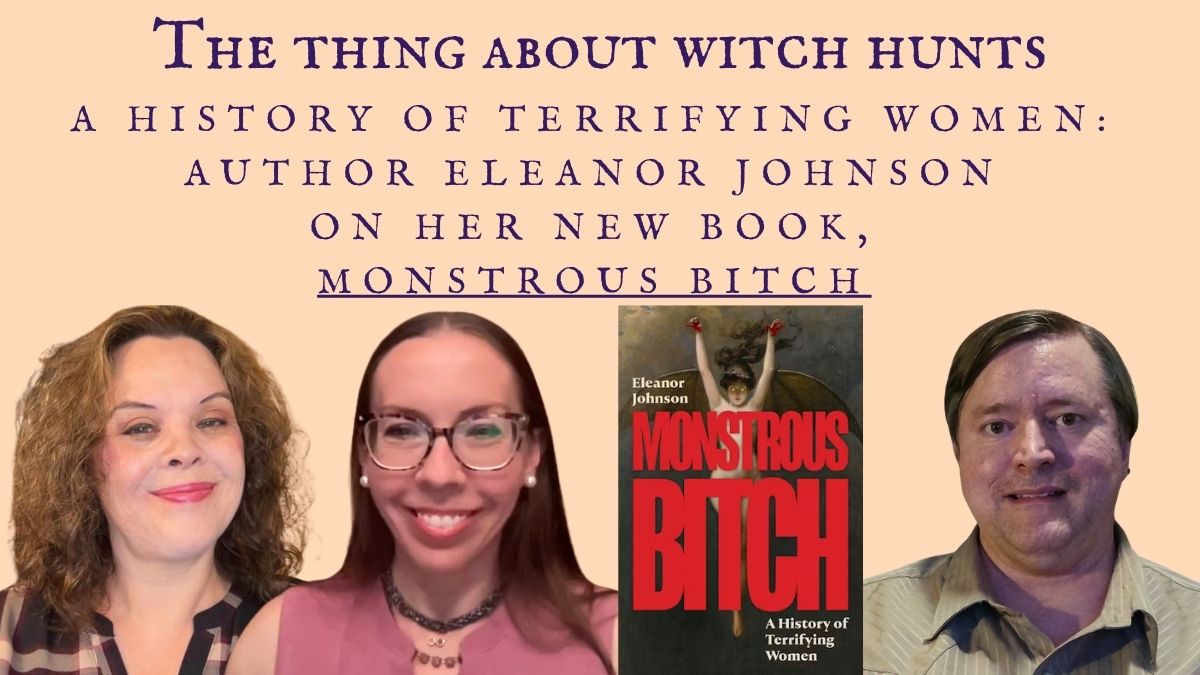
Medievalist and Columbia professor Dr. Eleanor Johnson joins us to trace the 4,000-year lineage behind her new book, Monstrous Bitch, connecting ancient Mesopotamian demon Lamashtu to Greek and Roman lamiae, medieval and early modern witch persecutions, and modern horror cinema. We follow how patriarchal cultures repeatedly weaponized a recurring “triptych” of accusations—women’s voices, sexuality or predation, and reproductive autonomy—turning mythic monstrosity into the idea that any woman could be a witch, and later reshaping the figure into the vampire. We also confront the terror of heritable witchcraft accusations, including Salem’s Sarah Good and Dorothy Good, and discuss the devil-contract conspiracy framework in Christian witch ideology, alongside historical opponents who challenged it. Johnson highlights recent films that reinterpret the “monstrous bitch” as feminist resistance, and shares release details for Monstrous Bitch (Oct. 6), her Eleanor’s Horrors Substack, and the paperback edition of Scream With Me.
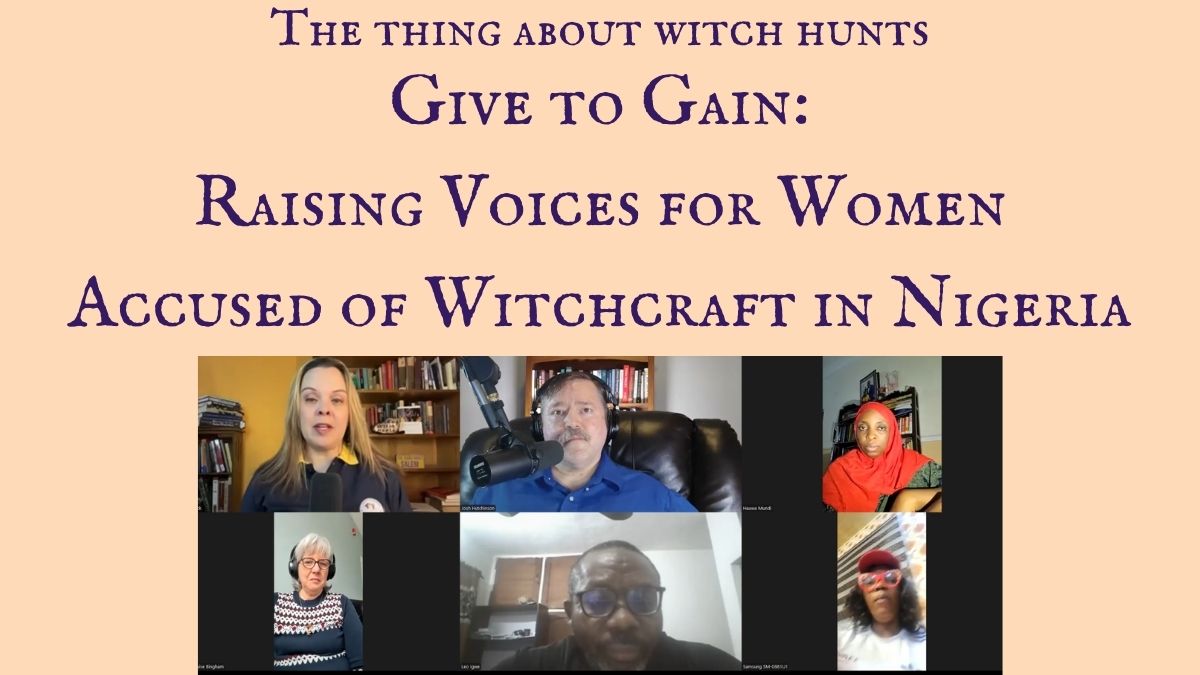
In honor of International Women’s Day 2026, End Witch Hunts hosted a powerful panel discussion bringing together advocates, legal experts, journalists, and survivors to raise awareness about witchcraft accusations targeting women in Nigeria and across Africa. This conversation is part of the global “Give to Gain” initiative — the theme of International Women’s Day 2026 — calling on individuals, organizations, and governments to give resources, empathy, legal support, and voice so that women accused of witchcraft can gain justice, safety, and dignity.
Witchcraft accusations disproportionately target women, especially those who are poor, widowed, elderly, or otherwise vulnerable. Accusation can mean social ostracism, physical violence, displacement, imprisonment, and even death. Our panelists shared firsthand experience, legal expertise, and on-the-ground advocacy work illuminating what is happening in Nigeria today and what all of us can do about it.
In This Episode
How witchcraft accusations specifically harm women and compound existing inequality
The psychological toll of accusation, including self-doubt and mental health impacts
Legal protections that exist in Nigeria and why they are not being used
How women can seek justice through courts, NGOs, and community channels even without financial resources
The role of patriarchy, poverty, and community silence in perpetuating accusation
Why empowerment and financial independence are protective factors
How diaspora communities outside Nigeria are funding witchcraft accusations back home
What governments, international organizations, media, and individuals can give to create real change
The critical importance of reaching rural communities in local languages
Cases Highlighted in This Episode
A woman remanded in prison in Nigeria is currently awaiting a fundamental rights action being prepared by Advocacy for Alleged Witches. Court proceedings in her case have been stalled because the court registrar refuses to sign documents without payment — a corrupt but common barrier that keeps accused women trapped in the system.
A woman being forcibly removed from her home — on the very evening of this panel — was told she must produce 20,000 naira to get police to act on her behalf. Without the funds, she had no immediate protection.
A woman in Imo State, southern Nigeria is being targeted by accusations funded remotely by two Nigerian relatives living in the United States. Those accusers are sending money from abroad to bribe local police, courts, vigilante groups, and community leaders — a stark reminder that witchcraft accusation is not only a local issue but an international one with global consequences.
Dr. Leo Igwe is the director of Advocacy for Alleged Witches (AfAW), an initiative working to end witch hunts in Africa by 2030, and the Critical Thinking Social Empowerment Foundation. A board member of Humanist International and the Humanist Association of Nigeria, Dr. Igwe earned his doctoral degree from the University of Bayreuth, Germany, where he wrote his thesis on witchcraft accusations.
Chief Magistrate Safiya Musa Salihu is a Chief Magistrate in Bauchi State, Nigeria, and Vice Chairman of the International Federation of Women Lawyers (FIDA), Bauchi branch. She has trained paralegals across multiple communities and works fearlessly to ensure that accused women have access to justice.
Hauwa Mundi is a broadcast journalist with Radio Nigeria — the largest radio network in Africa with over 40 million listeners — a social media influencer, and a member of Advocacy for Alleged Witches. She uses her platform to challenge belief in witchcraft and amplify the stories of the accused.
Maimunat Mohammed is an Information Officer at a university in Minna and representative of the Niger State Branch of Advocacy for Alleged Witches. She shared her own experience of being accused alongside her mother following her father’s death, and her years of advocating for her family in the face of community hostility.
Dr. Barrister is the National President of the Association of Women against Gender-Based Violence and founder of the ADI Foundation in Bayelsa State, Nigeria, working for justice and security for vulnerable persons.
You do not have to be an expert or a lawyer to make a difference. Share this episode. Talk about witchcraft accusations in your circles. Challenge misinformation when you see it on social media. Donate to organizations doing on-the-ground advocacy work. If you are in Nigeria or know someone who is facing accusation, you can go directly to a magistrate court without a lawyer and without paying police fees — you will be heard. Visit endwitchhunts.org to learn more, find resources, and connect with our work worldwide.
Join us each day March 15-21 as we participate in Podcasthon 2025, where more than 1,500 podcasters unite to amplify causes close to their hearts. We’re proud to participate with our nonprofit End Witch Hunts, which is working to educate about persecution of alleged witches worldwide. When you think of the Salem Witch Trials, it might seem like ancient history—an open-and-shut case from a bygone era. But as Sarah reveals, “The witch hunting story is bigger than just Salem. Pull back each layer and you find that witch hunts aren’t a tall tale or an opened and shut case.” One minute you think you know the truth. The next, you realize you don’t know the half of it.
Throughout this special week-long series, we’ll explore how witch hunts transcend ancient historic documents and continue happening today. In this installment We examine literal witch hunts—where fear of witchcraft drives accusations of supernatural harm—featuring insights from Economist Boris Gershman on global witchcraft beliefs and the path toward ending these dangerous persecutions. Tune in daily as we uncover this complex story layer by layer. Learn more at podcasthon.org and discover how you can help at www.endwitchhunts.org.
In this episode, Professor Victoria Canning from Lancaster University discusses the overlooked intersection of criminology and witchcraft persecution. Through the lens of “zemiology”—the study of social harm—Canning examines how witchcraft accusations create profound physical, psychological, and cultural damage. Central to our conversation is her concept of “torturous violence,” which expands definitions of torture beyond state actions to include sustained community violence with similar traumatic effects. This framework helps explain how witchcraft accusations function as mechanisms of social control, particularly against women. Canning advocates for an “activist criminology” that uses evidence to drive social change and helps practitioners identify and respond to witchcraft-related persecution. Join us for this informative conversation bridging criminology and witchcraft studies to address these overlooked forms of violence.
Content warning: Contains descriptions of violence.
This International Women’s Day, we revisit the story of Arminda de Jesus, a 32-year-old mother accused of witchcraft in 1933 Portugal. Through our interview with Dr. Inês Tadeu from the University of Madeira, we present the historical facts of this little-known case from the village of Soalhães. Dr. Tadeu’s research through trial records and newspaper accounts provides context for understanding how witchcraft accusations persisted into the 20th century. Arminda’s case, occurring just 22 years after the first International Women’s Day, illustrates the ongoing threat faced by women accused of witchcraft globally.
Content warning: Contains descriptions of violence.
Join us for an informative International Women’s Day 2025 episode where we explore this year’s theme: “Accelerate Action.” We’re shining a light on a global crisis often hidden from headlines – women and girls being accused of witchcraft, subjected to violence, exiled from their communities, and even killed.
Discover how International Women’s Day initiatives have already made tangible progress in combating these human rights violations. Since launching our podcast in 2022, we’ve covered heartbreaking realities affecting women worldwide, and today we’ll connect the core meaning of International Women’s Day directly to ongoing advocacy efforts against modern witchcraft accusations.
This episode provides essential information to help you connect and amplify your voice for change. Join us to discover the power of collective action and how International Women’s Day is still accelerating progress for vulnerable women across the globe.
To honor Women’s History Month and March 8, International Women’s Day we have created a special episode with Colorado State University’s Dr. Ann Little who specializes in the history of colonial America, with special emphasis on the history of women, gender and sexuality. She is a professor, author and expert consultant for Who Do You Think You Are? We discuss past and persisting mentalities toward and in women including their fertility and sexuality power in society. What is the impact of this narrative on historic witch trials and in modern attitudes influencing women’s rights?