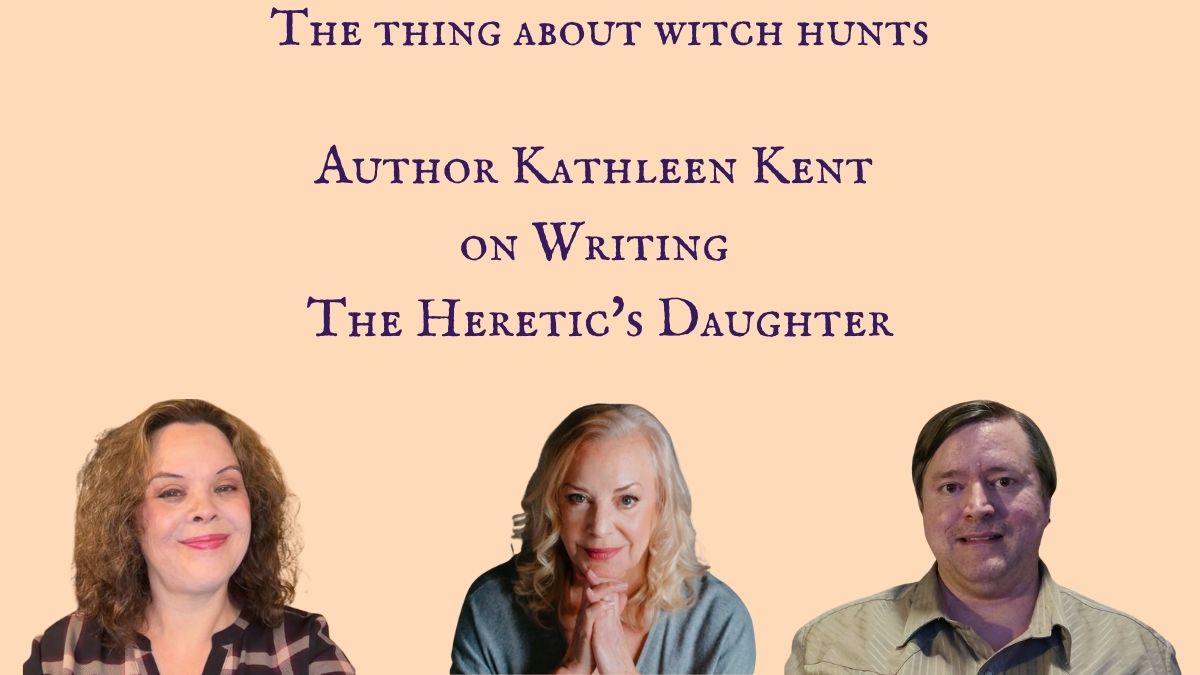
Enjoy this in-depth author interview with New York Times bestselling author Kathleen Kent. Kathleen opens up about her writing process, her journey from aspiring writer to published novelist, and the craft behind transforming family history into compelling historical fiction.
Kathleen’s debut novel, The Heretic’s Daughter, tells the story of her ancestor Martha Carrier, who was executed during the Salem Witch Trials on August 19, 1692. Martha was from Andover, the town with the most accused witches was blamed for a smallpox epidemic that killed 13 people. Even when her children were tortured into confessing against her, Martha refused to admit to crimes she didn’t commit.
This episode offers invaluable insights for aspiring novelists and historical fiction writers, covering everything from research techniques to finding your voice as a writer. Whether you’re working on your first novel or looking to deepen your craft, Kathleen’s experience and teaching expertise provide practical guidance for writers at every level.
About Kathleen Kent
Kathleen Kent is a New York Times bestselling author and member of the Texas Institute of Letters. Her novels include:
The Heretic’s Daughter (David J. Langum Sr. Award for American Historical Fiction, Will Rogers Medallion Award)
The Traitor’s Wife
The Outcasts (American Library Association “Top Pick” for Historical Fiction)
The Dime, The Burn, and The Pledge (Edgar Award-nominated crime trilogy)
Black Wolf
Kathleen teaches writing workshops and has worked with Texas Writes to mentor aspiring authors.
Episode Highlights for Writers
Kathleen’s journey from aspiring writer to published author
The writing process behind The Heretic’s Daughter
Research techniques for historical fiction writers
How to balance historical accuracy with storytelling
Finding and developing your unique voice as a writer
Working with family history and sensitive historical material
Navigating the publishing process
Teaching writing and what aspiring novelists need to know
Transitioning between historical fiction and crime fiction genres
For History Enthusiasts
Martha Carrier’s powerful story of resistance
The Andover witch trials and why this town had the most accusations
The 1690 smallpox epidemic and its connection to witch accusations
How children were tortured into testifying against their parents
Josh Hutchinson: [00:00:00] ” Thou shalt not suffer a witch to live.”
Josh Hutchinson: Welcome to another episode of Thou Shalt Not Suffer: The Witch Trial podcast. I’m Josh Hutchinson.
Sarah Jack: And I’m Sarah Jack.
Josh Hutchinson: Today’s guest is the extraordinary author Katherine Howe. We’ll speak with her about the causes of the Salem Witch Hunt and about her new book on pirates. I’m excited to talk about Salem Witch Hunt again and really curious what her book is about.
Sarah Jack: Yeah, it doesn’t matter what time of year.
Josh Hutchinson: [00:01:00] It’s always Christmas for pirates.
Sarah Jack: Just like Katherine’s other books, you are going to be delighted by the characters and the adventure. Fun getting to hear about it, and it’s gonna be hard to wait for the publishing.
Josh Hutchinson: She has wild swashbuckling shenanigans. But first, on a more serious note, we talk Salem, Witch Trials, what caused them, what didn’t cause them, why Katherine Howe it gets fired up about certain topics.
Sarah Jack: We get to a lot of layers.
Josh Hutchinson: Peeling that onion.
Sarah Jack: We just take Katherine right into the depths of the mechanics.
Josh Hutchinson: We talk about the different spheres that Malcolm Gaskill spoke about that are nested in each other and how each of those [00:02:00] spheres contributed to the witch-hunt.
Sarah Jack: We talk about what kind of perspective do we need to be using when we look back at the individuals that were in a different time in history.
Josh Hutchinson: Oh yes, we do that, don’t we? Wow, this is gonna be one hell of an episode!
Sarah Jack: Aren’t they all?
Josh Hutchinson: Yes, but I have a good feeling about this one. It’s gonna be something special.
Sarah Jack: It’s another dynamic conversation with a phenomenal author and researcher, and she does not hold back.
Josh Hutchinson: She does not. The emotions come out. Be ready.
Josh Hutchinson: I’m going to talk about the before the Salem Witch Trials, what the conditions were in Massachusetts Bay Colony and Salem Village and Andover.
Josh Hutchinson: Colonies used to have charters, so they [00:03:00] were officially recognized by the English government to govern themselves without direct supervision from the Crown and Parliament. Massachusetts Bay lost its colonial charter in 1684, when King Charles II revoked it because they had been naughty boys. And when the witch hunt began in early 1692, they still didn’t have a charter, so they were in legal limbo.
Josh Hutchinson: In addition, they were fighting King William’s War and still recovering from King Philip’s War, which was the costliest and bloodiest of the colonial wars, occurring between 1675 and 1678. In fact, the Massachusetts economy did not recover to pre-war levels [00:04:00] until the 1800s, after the Revolution.
Josh Hutchinson: Economic hardship resulting from the wars and the collapse of land speculation were also contributed to by an influx of refugees from the frontier in Maine and New Hampshire, and Essex County, where Salem’s located, was especially impacted, due to its proximity to that frontier, being the northernmost county in Massachusetts. Many of the settlers of Salem had moved on to Maine and New Hampshire, only to be forced to return when their villages were burned to the ground.
Josh Hutchinson: Beyond these issues, in Salem, the town had recently gone through a bit of a separation, [00:05:00] where Salem Village was allowed to begin its own church. In 1689, Salem Village hired the fourth in a series of unpopular ministers, and there were disputes over his contract, so there was a lot of tension in the area.
Josh Hutchinson: There was also tension in Andover, which was the hardest hit by the witch trials, with some 45 individuals being accused. There, there was a dispute between two ministers, Francis Dane and Thomas Barnard. Francis Dane was an older gentleman with health issues, who was no longer performing full duties as minister. So they had brought in Thomas Barnard, a younger man to take over some of [00:06:00] his duties, but were still paying both men in 1692, leading to tensions within the community that may have fueled some of the allegations there.
Josh Hutchinson: We’ll get into these issues further with Katherine Howe, and specifically we’ll be discussing Andover in a few weeks with author Richard Hite and get into more of whether the dispute over the ministers did or did not contribute to witch-hunt fever in that community.
Sarah Jack: That was good, Josh. Thanks, Josh.
Josh Hutchinson: You’re welcome. It was a fun one to do, and we’re going to dig into that stuff some more with our guest.
Sarah Jack: I am excited to introduce author Katherine Howe, whose works include The Physick Book of Deliverance Dane, Conversion, [00:07:00] The Daughters of Temperance Hobbs. She’s an editor of The Penguin Book of Witches and co-author of Vanderbilt.
Josh Hutchinson: We’ve read that you’re actually connected to somebody accused, which is an interesting connection. So can you tell us about who it is that’s your ancestor?
Katherine Howe: It’s a little bit of a funny story. So my last name is Howe, like, how are you? But with an “e” on the end. And one of the witches who was accused towards the beginning of the Salem panic and who was put to death was Elizabeth Howe. And she was from the same broad region that my family was from also. So it wasn’t a huge surprise when my aunt, back in the nineties, she was doing some genealogical research, and she figured out that that Elizabeth Howe is, I think it’s like my eighth great aunt. So it’s a lateral thing, rather than a direct thing. But at the time, she discovered that Elizabeth [00:08:00] Howe was related to us that way and also that Elizabeth Proctor was also a eighth or ninth great aunt, as well.
Katherine Howe: Just not all that surprising given that those communities were pretty small, and there were lots of intermarriages between different family groups and things like that. So it was in the nineties when I first learned that and thought, of course, it being the nineties and me being a grunge kid, and I thought was like, “oh, that’s so badass. That’s so metal.” thought that was the greatest thing ever.
Katherine Howe: I didn’t give it much thought beyond that, until I was actually living in that region of New England, because my family left New England in the 1930s. I grew up with this sense of it as like the motherland, but I didn’t actually grow up there myself. So I arrived in this region with this kind of funny twin consciousness of, oh, this is home, but I’m also a stranger here. And so it was being a stranger in this place that I felt this kinship that probably contributed somewhat to my getting started [00:09:00] writing fiction.
Katherine Howe: My first book was The Physick Book of Deliverance Dane, which was something I started working on when I was in graduate school at Boston University and just trying to think about the humanity of people living in this time and the, maybe a funny little detail. So one of the historians of witchcraft who I really admire the most is a woman named Mary Beth Norton, who wrote a book called In The Devil’s Snare, which anyone is interested in Salem has to know Professor Norton’s work, cause she’s just like the kind of detail that she can bring to it. And she writes in a novelistic sort of way. It’s just like the most gripping account of Salem ever. And Professor Norton has said that the more you work on witchcraft, the more superstitious you become. And I have to say that this is true. As evidenced by the anecdote I’m about to tell you.
Katherine Howe: So my first book was The Physick Book of Deliverance Dane. It asked, “what if one of the Salem witches the real [00:10:00] thing?” But the real thing the way the colonists believe, which is to be not in that pointy hat fantasy, Harry Potter Sense.
Katherine Howe: And I built that story around a woman named Deliverance Dane who’s a real person. And she was a minor person in the Salem Witch crisis. She was accused towards the end of the panic. She was not put to death. She really, like, was a footnote, I think, in the real history of Salem. And so I felt like it was okay to build a more fantastical story.
Katherine Howe:Physick Book is a magical realist story, so I wanted room to have kind of a fantastical story around a real person. And so I picked her because of her obscurity, but also because of her name. Her name is so evocative of this particular moment in time of this like subculture that she was living in, Puritan New England, Deliverance Dane. Just amazing. So that is why I chose to write about her.
Katherine Howe: That book [00:11:00] came out in 2009, and so several years later I was futsing about on a genealogy website because of course, for people who are interested in family history, life’s gotten a lot easier. Over the last couple of years, with the advent of digital humanities and so many more ways of doing research online. Like, when my aunt was doing research in the nineties, it was really hard to do, and now it’s actually much more accessible, which is a huge gift.
Katherine Howe: So I’m messing about, point, click, point, click, and I come upon Nathaniel Dane, which is actually the name of a character in the book that I wrote, and I was like, “huh, that’s a weird coincidence. Who knew?” Point, click, point, click, point, click. Lo and behold, I learned that it turns out Deliverance Dane, the real one, is my eighth great-grandmother. And so she’s more closely related to me, genetically speaking, than Elizabeth Howe, even though Elizabeth Howe and I have the same last name. And I had [00:12:00] zero idea, no idea whatsoever, and I’d written an entire novel about this person and found that there she was, just hanging out, waiting for me. So I definitely have gotten more superstitious the longer I’ve worked on witchcraft.
Josh Hutchinson: That’s a very strange thing to have happen to you. But it turns out that Deliverance Dane is actually my like eighth or ninth great grand aunt, and Elizabeth Jackson Howe is also an aunt, and Deliverance Dane, in her confession, says that she worked with Mary Osgood, and that’s my grandmother. I connected to a lot of the people you’re connected to.
Katherine Howe: So we’re cousins, Josh.
Josh Hutchinson: And Sarah’s my cousin through Mary Esty.
Katherine Howe: Wow.
Josh Hutchinson: Yeah. It’s a small world when you get back to those little towns back there.
Katherine Howe: Yes. It really is, for sure. It’s still pretty far back there. It’s a long time ago. It was very funny. I once did a book event, and someone came out to me very emotional, [00:13:00] and they were, turns out, a descendant of a judge from the Salem trials. And this person wanted very much to personally apologize to me. And I was like, ” no, it’s really, it’s okay”. Like he’s, this is not something that you need to feel badly about. This is, everything’s fine, cool’s fine. But it is interesting to me how close people can feel to people who are living in such a distant time period.
Josh Hutchinson: We definitely feel connected to our ancestors, and we talk to a lot of descendants of which trial victims, and they have an emotional bond with those ancestors, but that was so long ago. Did you get interested in Salem because of your connection with Howe and Proctor?
Katherine Howe: Partly. I went to graduate school for American and New England studies, which is like interdisciplinary American history. And I actually came to it from an art history [00:14:00] background. I have a background in visual culture, and it’s a where for grad school visual culture and also material culture, which is to say, stuff, objects. On a whim, my husband and I moved to Marblehead, Massachusetts, which is a small town on the water close to modern-day Salem.
Katherine Howe: We’re having this conversation in October, and there was just an article on Boston Globe about how like a hundred thousand people came to Salem for Halloween and running streets. Salem is a town of 40,000 people. I can’t even wrap my head around how many people they cramming in this season. And a lot of people come to Salem for Halloween. It’s like Halloween Central, and understandably.
Katherine Howe: But it was interesting to me while I was living in Marblehead and I was studying history. And I was living in a house that was built in 1705. And so one thing I have to say is people associate me so closely with Salem, because I’ve written so much Salem fiction. I grew up in [00:15:00] Houston, Texas. Okay. So the oldest building extant in Houston, Texas is a wine bar that was originally built as a bakery, and it’s from 1856. So the oldest building in the entire city that I grew up in is six years younger than the new edition of the house that I was living in in Marblehead, Massachusetts. Earlier, when I was talking about having a sense of being home but being a stranger there. I brought my new south eyes to this incredibly old environment, because Marblehead has the biggest collection of century houses in the entire country. They even have more than Colonial Williamsburg, for instance, except that in Marblehead, the houses have been continually occupied.
Katherine Howe: On the second floor of the house was an apartment, but the house had been a single-family house, been carved into apartments. Pine floors were like foot wide, and the ceilings were incredibly low. Like, you couldn’t stretch your arms over your head, cuz [00:16:00] the ceilings were so low. And this is actually when I learned for the first time, talking material culture, that bed headboards actually have a function. They’re not just decorative. And I discovered this, because we were so broke in grad school that we would turn the heat down as far as we could manage.
Katherine Howe: And so the room that we used as our bedroom, ice would form on the inside of the windows, because it was so cold, and we were so broke. And so when we were first living there, we had this futon I’d brought with me from Texas, of course. And there was no headboard on the futon. And so we were freezing, just like having your head up by this wall with ice on the window. We were freezing cold. And it wasn’t until we got like a bed with a headboard, we like, “oh, this is a lot warmer. This is great.” We just only then did I discover that a headboard really is important, at least if you’re living in New England.
Katherine Howe: And in this room, the bedroom that we had was tucked under the eaves of the lean-to part of a house. So if you’re familiar with colonial architecture, houses tended to be built in stages. You’d have room here and a [00:17:00] room here, and you have maybe you’d add a second floor and you might add a lean-to in the back to add some extra space. So we were in what had been the lean-to, and there was a little door that went into the back stair, and over the back stair, there was this little horseshoe-shaped charm over the back door that had been painted over. And of course, horseshoes are something that I think all over the country, we all recognize what they mean, and they mean that they’re there for luck or for protection. And you see this all over the place. This is a piece of folk magic belief that is incredibly widespread, such that we don’t even really notice it, as evidenced by the fact that you can buy horseshoe necklaces at Tiffany’s, wherever. We don’t even think about it anymore. But it was interesting to me to see this little remnant piece of magic. It wasn’t a real horseshoe. It was clearly there. It was tiny. It was a charm. It had been made as a charm, sold as a charm.
Katherine Howe: And so then I started looking around and noticing horseshoes wherever I went. And it got me thinking [00:18:00] between the fact that there was this little remnant magic shred, that there was that and also the fact that I was in this physical space that people had been moving through, who had been present when the trials were happening. Like we were only one town over from Salem, and, of course, when the trials were happening, people were traveling from towns all over the place to come and see, because it was a huge spectacle. People were talking about it.
Katherine Howe: So there was one day when I was sitting and thinking, like, “someone’s foot has been on this board, this actual board under my hand. The same foot was standing and watching what was going on.” And something about that tangibility or that proximate tangibility was really moving to me, and it got me thinking about the humanity of people who were living through that very strange moment in time, cuz I feel like much of the time their humanity is elided by our presentist biases or what have you. I feel like in [00:19:00] highly fantasy versions of witchcraft, the humanity of the people in the past is elided, and in, certainly in Arthur Miller, the actual humanity of people is alighted.
Katherine Howe: I started thinking about what became the story in Physick Book from that perspective, from like occupying this very weird, specific physical space as a stranger and trying to think about what it meant to be in that space and like how it felt to be in this space, over this incredible span of years, and how, in one sense, the early modern period is this incredibly alien and remote time. Their understanding of how reality worked is very different from our understanding of how reality works. But at the same time, there are certain common elements of common humanity that persist, like lying in bed and being freezing cold, unless you have a headboard at your head, and so a lot of my fiction, my desire to write fiction came [00:20:00] from thinking about these common points of humanity across really wide, gaping spans of time.
Josh Hutchinson: Can you give us a little background on what the situation was in Massachusetts Bay, when the witch trials started?
Katherine Howe: A few things were happening. A question that I get a lot is, what is the proximate cause o f the Salem Witch crisis, what caused it? And the thing that I think is interesting about that question is that it suggests that it would be so much easier if there were just one cause, if we could just point to the thing, and be like, “oh, that’s the thing.”
Katherine Howe: When we were corresponding, Josh, you mentioned the ergot hypothesis, that back in the seventies, somebody floated the idea that maybe all the afflicted girls had eaten moldy bread and were suffering from ergotism, and they were all tripping outta their mind. And that hypothesis was actually dismissed, I think, six months after it was first floated. But it still bubbles up periodically in [00:21:00] documentaries and popular discourses about Salem, because, and I think the reason that it doesn’t go away is because it’s so simple. It’s so tidy to be like, “okay, that’s the thing.”
Katherine Howe: And the truth of the matter is there isn’t one thing. The way that I sometimes talk about it is that it’s like a Venn diagram, and Salem is the point of the intersection of all the overlapping circles.
Katherine Howe: So one overlapping circle is the very specific kind of religion that everyone in Salem adhered to. It was a world view that did not hold that there was anything outside of Christianity. So, for instance, the indigenous population that was already living in Massachusetts at that time, by virtue of not being adherents of Christianity in their very specific puritan worldview, that which is not Christian is by definition devilish, and it was actually Mary Beth Norton who’s made the point that a lot of the language that the [00:22:00] people at Salem use to describe the devil is language that is used to describe indigenous people. So, one big Venn diagram circle is the specific religious and cultural moment that they’re living in.
Katherine Howe: Another diagram circle that we could point to is the weather, that the first panicky behavior that erupts with Betty Parris and with Abigail Williams, it starts in January, January, super cold in Massachusetts, cold, dark. The sun sets at 4:30 in the afternoon. And I’m not exaggerating, like it is dark AF. And and that’s true in the 17th century, as it’s today. And also in 1690s, North America was in miniature ice age. It was even colder and more bitter than it is now in Massachusetts.
Katherine Howe: Another piece is pretty relentless class and gender context. The girls who first experienced symptoms that they describe as [00:23:00] fits are Betty Parris, daughter of Samuel Parris, who’s the unpopular minister in Salem Village, Abigail Williams, who’s his 11-year-old, she’s described as being his niece, although that had a different meaning for them than it does for us today, but she was bound out to service.
Katherine Howe: So can you imagine living in a culture where when you can’t afford to feed your 11-year-old, you just give her to somebody to live with, for her to work for them? You just give her away. And so Abigail was this lonely, impoverished, starving, freezing child whose job it was to obey everyone all the time.
Katherine Howe: Oftentimes, I think with great sympathy about Abigail Williams, poor Abigail, who, by the way, in Arthur Miller is turned into a 17-year-old temptress. She’s a child. She’s a child. And if you look at the descriptions of her behavior that are described as her being in her fits, a lot of her behavior sounds to me like playing, [00:24:00] like running around in circles and flapping your arms and saying, ” whish” and saying that you’re gonna fly at the chimney.
Katherine Howe: Is that devilish possession, or is it an 11 year old girl being silly? And I feel like that is a, that is something that’s worth thinking about. So there’s the kind of class and gender politics, that’s another big.
Katherine Howe: So there are a number of different aspects, but you were asking about the politics and the charter. So this is another pretty big circle. So, typically in the early modern period in the colonies, if someone was accused as a witch, they would be accused and have a trial, and if they were found guilty, by the way, it’s hard to find people guilty. They actually had a pretty high bar for for evidence at that time. Believe it or not, you could be tried and found guilty, and if you’re found guilty, you could be put to death, and that could happen within a matter of weeks. Salem, the panic begins in January, the first hangings aren’t until June. That’s like a huge long span of time. And the reason for that long span of time is because the Glorious Revolution was unfolding.
Katherine Howe: Back in England at that [00:25:00] time, Massachusetts Charter had expired, so they didn’t have the legal wherewithal to hold a trial. That’s why the Salem trial trials are conducted by a special Court of Oyer and Terminer. They basically had to convene like a special tribunal to deal with this problem that had come together. In fact, there’s some historians who wondered if the Court of Oyer and Terminer didn’t just deal with witchcraft. They were supposed to deal with all the rest of the backlog. But we just don’t know what that backlog was, cause the records of the witch trials are what have survived.
Katherine Howe: And then there’s another piece of the Venn diagram, and we have to consider it. At the very beginning, the very first person who’s accused as a witch is accused by Abigail and Betty and she’s the only person who has less social and cultural power than they do. And they accuse Tituba or Titube Indian, who is an enslaved woman in the Parris household.
Katherine Howe: So she’s basically the only person who has less ability to protect herself than these children themselves do. And so Tituba’s accused. She [00:26:00] has two confessions, and there’s some evidence that she is beaten in between the two confessions. And in one of the confessions, Tituba introduces the idea of a conspiracy. She says that there is a group of witches at work in Salem Village. She doesn’t know who they are or how many.
Katherine Howe: And so at one point early on, there’s actually a sermon is preached in Salem Village that I’m gonna mangle the title, but it’s something along the lines of “Christ Knows How Many Devils There Are.” And so you have this idea of an unknown number of conspirators, who must be discovered. And when you have this undefined, invisible threat and also no legal relief, there’s no like pressure valve that this tension could be released by, because of the like, unfortunate timing of the expiration of the charter.
Katherine Howe: So you bring [00:27:00] all of these circles in the Venn diagram together, and that is why Salem gets as big as it does. And by the time Salem was over and done, 19 people were put to death and hundreds had been accused, hundreds in a period of time when a given town would only have a couple thousand people.
Josh Hutchinson: That was a great, thorough explanation of how it took all these different factors to create the situation. It wasn’t something, a single bullet theory, that you can put to rest.
Katherine Howe: But I think one reason that, that we keep craving for simplicity is because with a simple explanation for why than it’s easier to consign, to history. It’d be so much more encouraging or it’d be such a relief to be able to say, “Oh, it was air got poisoning. No big deal. That’s all.” But like the fact that it, what really was at stake was this intersection of circumstances and that everyone who was a participant in [00:28:00] Salem pretty much believed that they were doing the right thing. Not only the right thing, but the necessary thing to save their community. That to me is also a moving but also terrifying thing to remember and to realize.
Katherine Howe: Because certainly we all, we’ve all lived through moments where we are convinced that we’re doing the right thing, only to see ourselves perpetuating horrors, and that is I think that’s one of the reasons we as a culture are never really able to let go of Salem.
Sarah Jack: You said, ” as a culture, we’re never able to let go of Salem.” Nathaniel Hawthorne wrote, ” shall we never get rid of this past? It lies upon the present like a giant’s dead body.” I’m wondering what you think you would write now about that.
Katherine Howe: Hawthorne in particular is someone who, like he personally, so felt the weight of Salem’s past in a very personal way, because he was a descendant of Judge Hathorne, obviously. And because he was living there himself, and for many [00:29:00] generations, in fact, much during much of the time period when Hawthorne was living in Salem, the witch trials were not discussed in polite society. This was true into the 20th century, actually. They were not discussed. It was not something that was brought up. It’s certainly something my family never talked about until this is something that my, my aunt uncovered. There was a sense of embarrassment attached to it, I think.
Katherine Howe: But I’m also intrigued by the fact that when Hawthorne has tried to grapple with it, and he has tried to grapple with it, he took the line from he, he knew what had happened. Like he took a line from Sarah Good and put it in the mouth of Matthew Maule, in The House of the Seven Gables.
Katherine Howe: Was it Hawthorne who grumbled about “damn scribbling women?” I think it was. I think it was. And so this is me tweaking his nose a little bit, but Sarah Good. Sarah Good was a beggar. Okay. She was destitute. She was one of the first people accused, because she was in no position to defend herself. She was thrown into jail. She has a baby on her and like [00:30:00] toddler, essentially with her, the baby dies while they’re in jail. The toddler, whose name is Dorothy, ends up losing her mind and has to be like supported by the town after the trials are all over. So like this person is in absolutely dire straits and is and suffers mightily at the hands of the community where she lives and who’s supposed to be helping them.
Katherine Howe: And when she’s on the scaffold, she says the most badass thing anyone has ever said in history of time, my unbiased opinion. She says, “I’m no more than a witch than you are a wizard, and if you take away my life, God will give you blood to drink.” And I wish I had that kind of wherewithal, because who has that kind of wherewithal under in those circumstances?
Katherine Howe: And so Hawthorne takes this line, Hawthorne knows it’s happened, and he puts this line in a guy, in a guy’s mouth. I understand that he’s writing in the 19th century. I get it. But at the same time, I think it’s impossible to look [00:31:00] at Salem and not consider gender politics in place. The fact that virtually everyone who’s accused and put to death was a woman. Any man who was accused cuz he’s associated with a woman who was already accused. Giles Corey was crushed to death between stones. He’s accused cuz his wife, Martha’s accused first, but also the accusers are initially children, but then also women. So there’s a really intense gender politics in place here.
Katherine Howe: So your question was, the past lying with the weight of the giant and what would Hawthorne say today? And I’m actually curious what Hawthorne would say about it today. I think he would sympathize with, or maybe be aggravated by the fact that we’re still having the conversation that he was having a hundred and fifty years ago. But at the same time, I feel like we’re talking about different things from what he was concerned. And and also I think he would be really annoyed because I write novels. I’m a woman.
Sarah Jack: I love [00:32:00] that you brought up that he took Sarah’s words and gave them to a man, because it just dawned on me very recently that Ann Putnam didn’t read her own apology. I just assumed, and I think that possibly other descendants, we read that, we think I don’t know what we really think about it. We’re evaluating what it says anyways, but we’re doing that with her voice in our head, and no, it was not.
Katherine Howe: One thing that, that continues to interest me, as a history person, about Salem is that it’s one of the rare instances when regular people are at the center of the store. So much of history, especially the further you go into the past, the vast majority of people who’ve been alive in history of ever, have left no record of themselves. They weren’t literate, they weren’t of sufficient note to have their burial place noted, [00:33:00] and so much of history, even academic history, as it’s gotten more serious about excavating stories, just by the nature of the way that archives come to exist, there’s still going to be a bias towards power.
Katherine Howe: There’s gonna be a bias towards privilege and a bias towards power, and, when it comes to Salem, that is one of the rare instances where the bias towards power falls away, because the people who are at the center of the drama are regular people, and where historians have put the work in to try to excavate what is able to be excavated of these lives that otherwise would’ve been invisible to us.
Katherine Howe: Would we have known Abigail Williams ever existed, if she hadn’t been part of the Salem Witch Trials? We would not have? And in fact, even with her central position at the beginning of the panic, we don’t know what happened to her. We don’t know where she went. We don’t know how old she was when she died. Nobody actually knows for sure.
Katherine Howe: And so particularly talking about people who are not literate, Anne [00:34:00] Putnam had her confession read. If I remember correctly, Anne Putnam wasn’t literate. And so you’re right in saying here’s this apology that she delivered in front of everybody and that it was read on her behalf. To what extent was she the author of her own apology? And it’s impossible to say. It’s impossible to know.
Katherine Howe: And it’s one of the reasons that you’ve touched on one of my rant buttons, I’m sorry to report, but as a writer of historical fiction, like I have so little patience for historical fiction about kings and queens. I don’t give a damn about kings and queens. Who cares? They get enough attention, they have enough records, they’re all literate, everyone documents every single thing that they do. And I do not give a damn, because history pays them enough attention, and I’m so much more interested in trying to excavate the history of people who would otherwise be forgotten.
Sarah Jack: I caught that from you reading Conversion, because your [00:35:00] main character, Colleen, she’s getting to give us the firsthand experience like no other afflicted person was able to do.
Katherine Howe: Thank you for saying that. I confess I haven’t looked at Conversion in kind a long time. You’re making me think I should look at it again, cuz there’s actually a group of high school students who are reading it right now and I’m gonna talk to next week. I should read that book.
Katherine Howe: But I appreciate you saying that, because I feel like, like one question I sometimes wrestle with as a history person and someone who’s a novelist is what does historical fiction have to offer that nonfiction doesn’t have to offer? Like, why not just write a really good history of something?
Katherine Howe: And I feel like in many instances, in the cases where a story cannot be recovered, that’s where historical fiction can be a really wonderful intervention. If you can build a credible world with credible material culture, and credible details, and credible politics, and credible ideology, and then [00:36:00] people it with people who are credible people, it is a way of accessing history that otherwise is not extant, where it doesn’t exist.
Katherine Howe: Is there going to be some imagination involved? Obviously, but it is, I feel like that’s where the opportunity lies. And I realize we’ve gotten off Salem a little ,bit and I apologize, but it’s something that I think about a lot. Like, particularly for some, a story that’s as revisited as often as the Salem story is, what does fiction have to offer? Like why tell a fictional version of this story? I feel like fiction gives you permission to fill in and shade in stories that where there just is no other shading available. And that to me seems like the real area of opportunity for storytelling.
Josh Hutchinson: I wanted to ask you about the afflicted girls. Do you think it’s plausible that conversion disorder could [00:37:00] explain some of the fits?
Katherine Howe: Yes and no. I’ll explain that hedge of an answer. For one thing I find it always a little bit tricky to apply contemporary psychoanalytic categories to people in the past. Like on the one hand, I believe very urgently in, the shared humanity of people in the past, but at the same time, like we take as natural so many habits of mind that are actually very historically contingent. The fact that you and I might casually talk about what our dreams mean or what our subconscious motivations might be for something like that is indicative of post-psychoanalytic. And I think it’s tricky to try to access the interior light of people who are living in a different moment, especially a moment like the early [00:38:00] modern in Massachusetts. It’s even hard for a scholar of that time period to really grasp the extent to which Christianity informed every, single aspect of existence.
Katherine Howe: So for my second novel I was working on. No, it’s Physick Book. I was reading up about alchemy, and like we know about alchemy as this pseudoscientific practice in early modern practice in which someone tries to turn that into gold. Okay, fine. But that’s actually not what it was. It is actually a way of understanding the order of the universe that took as scientific fact the perfectability of the human soul.
Katherine Howe: There’s this tense layering of religion and materiality and mirroring of structures and images like, like as soon as I would get close to thinking I understood alchemical thought, it would slither out of my grasp. And I would realize this because I’m just [00:39:00] too much of someone born in the 20th century to, to I will never actually really understand that intellectual landscape.
Katherine Howe: So when you ask can conversion disorder explain the girls’ behavior? Like in a way yes. But in another way I don’t know that we can actually really understand their selfhood, the way that these girls thought about themselves or understood themselves as individuals.
Katherine Howe: It’s just very different from the way that we think. It’s very different. So that there’s that qualification. With that qualification in place, I would say that, so conversion disorder is where you are under so much stress that your body converts it into physical symptoms. And then mass psychogenic illness is when a group of people experience strange behavior together.
Katherine Howe: And there are many examples of mass psychogenic illness [00:40:00] or mass psychogenic illness expressions of conversion disorder, and many examples of it across cultures, across time, across continents, across ethnicities. And it very often happens among adolescent girls, for whatever reason. Maybe cause we are conditioned to be more like socially engaged with other people. Who knows? You can try to explain it a number of different ways.
Katherine Howe: But it’s not only adolescent girls. I think that it is, this is gonna be a controversial thing to say, but like the recent incidences of Havana Syndrome are pretty clearly an example of mass psychogenic illness. Now it’s important to say that mass psychogenic illness is real. It counts as a real thing. It’s not just people like, it’s not all in your head. You know what I mean? Like the fact that it is, that it has its origin in mental disorder doesn’t make it any less real to the body. Conversion disorder is a disorder. It is your body being sick. It’s just that the sickness originates from [00:41:00] inside your own organism. That doesn’t make it count less. You know what I mean?
Katherine Howe: All of which is to say, did a group of girls start exhibiting strange behavior? Yes. Did it spread from girl to girl on networks of kinship and friendship? It did. But at the same time, their behavior, when you say “fits” today, that has a very specific connotation. And it sounds like a epileptic seizure or something like that to, to us today. If I say, “Oh my gosh, I just saw this person have a fit.” You’d be like, “Oh no.” And you’d imagine that they fell down twitching and foaming at the mouth, but that’s not what they were doing.
Katherine Howe: What they were doing was behaving out of the ordinary. So like earlier we were talking about Abigail running around flapping her wings and saying, her arms, and saying, “whish, whish, whish.” That is her in her fits. Or like another instance of Abigail in her fits is when she challenges Deodat Lawson to name his text. She like gets up in the middle of church and like mouths off to this very famous divine and rolls her eyes about how boring it’s gonna be when he reads his text. That’s [00:42:00] not her having a fit. That’s her misbehaving.
Katherine Howe: But her behavior was such a challenge to the gender and economic power structure that was in place while she was living. It was so out of the ordinary that her community could only chalk it up to devilish influence because it was that unimaginable that she would behave this way.
Katherine Howe: So was there a social illness aspect to the afflicted girl’s behavior? I feel certain, yes. So that, that’s my long and qualified example about or discussion of conversion disorder.
Josh Hutchinson: Do you think that they were really afraid of witches and that the fear of witches might have also translated?
Katherine Howe: Sure. Oh, for sure. Yeah. I think the fear was real. I think it is a mistake to either chalk it up as craven opportunism or as naked stupidity or superstition. One of the [00:43:00] things that I think is important, I like to give people the benefit of the doubt who live in the past and that is that like absolutely they were afraid.
Katherine Howe: Can you imagine, what does it feel like to live in a world where you really, actually, honest to gosh believe that the devil can go walk about on the earth, as a real person and that he can disguise himself as people you know and love and trust? That at any given time, I could be talking to you right now, Josh, and you could be the devil in disguise, and I wouldn’t know it.
Katherine Howe: That’s a and if you really believe that, you really do believe that, and you actually really believe that hell is a real place that you can go there if you make a mistake. That there is no, this is another like aspect of puritan belief, that like they believed in the elect. The idea that you have no way of saving yourself. That your being saved was only up to God, and you had no control [00:44:00] over it whatsoever. Like what? You couldn’t go to confession. You couldn’t do penance. You could try your best to behave, but it was ultimately just up to God.
Katherine Howe: What an existentially dreadful way to live your life, to have no certainty. It’s a little, a really hard life, first of all, and to believe that there was such a thing as paradise after death, but to have no idea whether or not you got to go there and that nothing you did made any difference. And that everywhere, at every turn, the devil was waiting to trip you up. Like that would be a difficult and impossible mental landscape to occupy.
Katherine Howe: So yes, if your question was did they really believe in witchcraft and was that fear, could not fear contribute to their behavior? Like absolutely. What a terrifying way to live, and also what a relief. Like one of the reasons that I think witches [00:45:00] was such a persuasive idea for so many people at that time was wouldn’t it be great if something was going bad in your life, to be able to not try to see it as a sign of God’s Ill favor, but instead to have someone to blame for it? To be like, “it’s not me. I’m not messing up here. Someone’s doing this to me.”
Katherine Howe: I think that’s also very human, that human feeling. It’s not just bad luck or misfortune or like the luck of the draw, and it’s so much more of a, “no, this person doing something to me. They wish me ill, and that’s why my life is hard.” I think that’s a very human way to be.
Josh Hutchinson: Yeah. We talked a little about Anne Putnam, Jr.’s apology earlier, and she still does that in her apology. “The devil made me do it.” And Samuel Sewall does the same thing, like the two big apologies that come about after Salem is over after everything’s done are Ann Putnam’s and [00:46:00] Samuel Sewall’s apology. But Samuel’s apology, too, is weird where he like, first of all, he comes to it. It’s not that he stops believing in witchcraft or stops believing that there is an invisible world. He comes to it after a series of wonders and marbles, including, if I remember correctly, like his house being tilted with stones. Who knows what really happened? And maybe there was like a passing hailstorm is how it took it.
Katherine Howe: But he comes to it after a series of wonders and marvels, and he comes to believe that the devil tricked them all. That it wasn’t that that the devil wasn’t luring people into witchcraft. Instead, the devil obscured the minds of the people who are supposed to keep the community safe. And but also what a horrifying thing to, to come to believe about yourself. To look back at your actions and think you’re doing the right thing, and think that you are saving your community from the most threatening presence that your imagination can come up with, and instead to conclude that, no, what happened [00:47:00] was that threatening presence tricked you. That you were so weak that you were fooled. Like what a, what a heinous thing to believe about yourself. It’s a very punishing worldview that they subscribe to.
Josh Hutchinson: Do you see any modern parallels to the Witch hunt?
Katherine Howe: Sure. A few years ago a historian of witchcraft named John Demos published a book about witch hunting, in which he has a chapter about the 1980s daycare satanism thing that happened, much of which I was only dimly aware of, being a small person in 1980s myself.
Katherine Howe: But what happened was, a group of people were put on trial, actually put on trial and actually convicted of having you run a daycare center and used the children in satanic rituals. And at the time that it was happening, and this is preposterous, like I, it’s actually just like on the surface of it, I think [00:48:00] preposterous. I think, taken out context, any of us looking at this would say, “this makes, this is ridiculous. Obviously this did not happen.” And at the time that it was unfolding, John Demos saw it unfolding and he was like, “Oh my God, it’s Salem all over again.” Like the same pieces are in place, like the idea of a conspiracy, the idea of trusted people that you cannot trust, the idea of children being at risk.
Katherine Howe: And I think that you see some of the same hysteria and language. I don’t like using the word hysteria, cuz it’s such a specific word, but you see some of this in like contemporary corners of the conspiracy internet, where I try not to spend any time, but Isn’t that Pizzagate? Isn’t there some like thing not too long ago about worrying a particular pizzeria was like putting kids at risk in this same kind of way? Like you see the same kind of like at any time that someone worries that children are at risk, there will be a lot of open-mindedness about it.
Katherine Howe: But of course, here’s me getting political. Like, of course, children actually literally are at risk [00:49:00] by, by school shooting, right? Like the one thing that would really keep children really safe in places where they’re supposed to feel safe and trust people around them, is if they restricted access to military assault weapons. That’s my opinion. My opinion is that if we really care about keeping children safe, we take those guns off the street, right, full stop. But feel free to send me hate mail. I can be reached to KatherineHowe.com/contact.
Sarah Jack: So I think asking the question about are there parallels, we have these modern parallels that are popping into our heads. We have our strong feelings, but what can the understanding of the Colonial Witch trials and those before do to help us with these parallels? Can it help us? Will it help?
Katherine Howe: I’d like to think that it can. One of the things that I like to say when talking about Salem is that I feel that one of the reasons we can’t let Salem go. As a culture, like we come back to it and we, like we can’t let it go.[00:50:00]
Katherine Howe: And I feel that the reason that we can’t let it go, among the many reasons, but I think one of the big reasons is that it forces us to confront how fragile our ideals really are. We are an unusual country in that in many respects, we are, notwithstanding those of us who were brought here against our will, which is many of us, but broadly construed, you could argue that we are something of an intentional community.
Katherine Howe: That the only thing that really holds us together is this set of shared ideals, and that some of our shared ideals include religious freedom. They include a social safety net. That we value people who are different from us, that we value people who are vulnerable. ” Bring us you’re tired, your poor, your huddled masses.” Like that, that arguably this is an ideal that we hold in common. This is an organizing principle of the culture in which we live.
Katherine Howe: And yet Salem is this instance where everybody, believing they were doing the [00:51:00] absolute right thing, instead put to death, the state put to death 19 people. That, in the course of doing the right thing, the state did the absolute wrong thing, and they also put to death people who were, many of them were vulnerable in their community. People who were more likely to be accused were those who were at the most vulnerable, who were the most out step vulnerable in community. And so I feel like Salem is an instructive moment for that, because here’s this moment where, in the course of being convinced of our total moral authority and correctness, a huge miscarriage of justice took place.
Katherine Howe: And I think that’s a really difficult thing to reconcile. And I think especially for a country like ours, where also so many of us are brought up to look to the colonial period for our origin, that we’re told, rightly or wrongly, that we are taught to look into the 18th, and to a lesser extent [00:52:00] the 17th century, and see in it the seeds of the country that we would become.
Katherine Howe: Maybe that’s another way of thinking about it. Like another way of thinking about it, is it more productive to think about what we want the future to look like than it is to try to think about what the past has to tell us? That’s a question. That’s a question that I think is interesting. One, particularly for an intentional community like ours. We have, we get to reinvent ourselves as a country, and we get to decide, and what kind of place do we want to be? Do we want to be the kind of place that protects vulnerable people? Do we want to be the kind of place that protects people who are at risk, who are different from us, who are angry, who are grumpy, who read too many books? I would prefer to live in a place that protects those kinds of people. But we get to choose We choose who we protect.
Sarah Jack: We can make that choice, and not only is it going to stop suffering here, there are places in this world that are still totally captured by [00:53:00] doing the wrong thing, thinking they’re doing the right thing, witch hunting. This discussion it is about us here, but it’s about us there.
Sarah Jack: You have referred to time so much. That is such a strong piece of this. Even in Conversion, one of the simple quotes you have says, “any number of things could happen in the time it took to go down the hall.” You like go right to the time thing. And today when you started talking, you talked about time. And I look at the history, I look at us now, how do we all get caught up on this witch-hunting mentality and start looking out for humanity and protecting other?
Katherine Howe: It’s a hard thing. It’s a really hard thing. And I wish I had easy answers for it. I think simply the act of reflection and awareness is an important one. Stopping to interrogate what our assumptions are.
Josh Hutchinson: We’ve talked about a lot of heavy things. [00:54:00] I wondered if we could switch and discuss your new book project. What can you tell us about it?
Katherine Howe: Oh, so many things. So I’m obsessed with pirates, who isn’t? Hopefully, the answer is everyone is obsessed with pirates.
Katherine Howe: So I have a book coming out in fall, and I think they’re gonna let me keep the title. And you. Okay, Josh, Sarah, you guys have to tell me what you think of the title. You ready? So get comfortable, here it is: A True Account of Hannah Masury’s Sojourn Amongst the Pyrates, Written by Herself. That’s the title. It’s a mouthful.
Katherine Howe: It starts in Boston in 1726 at a very real an actual pirate trial that really did happen. Like most of my stuff, it’s, it is grounded in actual facts and then becomes what I’m describing as a little bit like Gone Girl meets Treasure Island. And I had so much fun with it, and I’m really excited about it. And it is a little bit of a departure from what I’ve done, but it is about a girl, Hannah Masury, who has to disguise herself in order to escape some pretty heavy circumstances. And she [00:55:00] ends up basically stealing away on what turns out to be a pirate ship. And we have to follow her on her adventures.
Katherine Howe: And I have so much fun with some basic pirate tropes. There is treasure, there is a parrot. It’s so much fun, and there’s also some, a little bit of romance, and I have the most fun ever.
Josh Hutchinson: Sounds like a fun one to read.
Katherine Howe: I really hope so.
Sarah Jack: I’m so delighted by what I just heard.
Katherine Howe: That makes me very happy. Makes me very happy. It’s weird because it’s one of the, it’s probably the most violent book I’ve written. If y’all have read my stuff, then you know I’m a teensy bit squeemish and shy away from. So there’s some violence in this book, but what’s strange about it is, I didn’t invent any of it. It is actually all from historical record. I take no responsibility whatsoever for any of the stuff that happens in this book, because it all ripped from the headlines. It all really happened.
Josh Hutchinson: And was Hannah herself based on a real [00:56:00] person?
Katherine Howe: Hannah is based on a couple of people. She’s inspired in part by real accounts of Anne Bonny and Mary Read, who are two working-class women, who ended up disguising themselves as men and going raiding in Jamaica at the end of the 17th century. They were real people ,and there was a real Hannah Masury ,who I talk about a little bit in the author’s note of the book. She was a 19th-century person, and she ended up, I was inspired when I came across her. She was the wife of a ship captain. She was married to a ship captain, and she ended up putting down a mutiny by herself, armed only with a pistol, in the Pacific Ocean.
Katherine Howe: And so I read about her, and she didn’t have any children, and I was like, “oh my gosh, I am obsessed with you.” And so I decided to name my awesome pirate after her. Hannah, Hannah comes from a couple of different sources, but I really like her as a person. She’s a tough character .
Josh Hutchinson: Sounds like it. You said that it’s set [00:57:00] around a pirate trial in Boston?
Katherine Howe: Yeah, it starts, the action starts in Boston in 1726, and in 1726, it’s the end of the golden age of piracy. It’s actually funny that the Salem period, like the witch craze, the end of the witch craze and golden age of piracy are at the same time period, which I think is interesting. And a guy named William Fly was tried as a pirate, and the person who ministered to him and preached about him was none other than Cotton Mather .
Katherine Howe: So Cotton Mather by then was this like hugely famous, successful cleric. He was really rich. He was, like, had a very popular ministry and so he had taken it upon himself to crusade against piracy. So he tries to bring William Fly and his compatriots back to God, and he’s there when they’re hanged. William Fly was hanged, and then he was gibbeted. He was, his body was hung in chains on a tiny island in the Boston Harbor Islands and left [00:58:00] there to rot. He was really avid as a warning to other people who might go out on the account, which is a way of describing going, turning pirate.
Katherine Howe: And so I was fascinated by this. It was only a hundred years later that excursion boats are starting to leave Boston. Like steam boats are going from Boston to Nahant. This is no time all. To think that you could go by Nixes Mate, which is where William Fly was hanged and chained. You could go by there and to see you remnant oft remain dangling there.
Katherine Howe: So that’s where the action begins at William Fly’s trial, and things even crazier.
Josh Hutchinson: Sounds like a fun ride. .
Katherine Howe: I’m excited for it. I’m not sure when it’s coming out. I think it’s gonna be November, 2023. So it’s coming up.
Josh Hutchinson: Here’s Sarah with an important update on what’s happening now in your world.
Sarah Jack: Thank you for listening a few minutes longer to hear End Witch Hunts World Advocacy News. How many innocent world citizens [00:59:00] is it okay to accept as suffering from violent brutalization, due to harmful practices related to accusations of harmful witchcraft and ritual attacks? These attacks are happening now to thousands of innocent people, who are not causing supernatural harm but are being punished by their community, as if they are the ultimate explanation.
Sarah Jack: They are innocent, not dangerous witches. These attacks are happening across countries of Africa and Asia. Please see the show notes for links to read about how some countries have advocacy groups working to intercede. When there is not an answer for unexpected bad luck, unfortunate death, or personal misfortune, blaming others for supernatural malevolence is the actual crime. This witch fear is still causing unfounded, violent attacks against women, children, and sometimes men. Listen and watch for the reports. These attacks are reported on.
Sarah Jack: The Northern Ireland borough of Larne wants to commemorate [01:00:00] eight Witch trial victims from the Islandmagee Witch Trial that took place on March 31st, 1711. A borough counselor raised questions very recently of whether the eight women and a man who were found guilty of witchcraft were actually innocent. In the trial era, using witchcraft was a covenant with the devil against the victims. When this counselor questioned if it is within the counsel’s capacity to say they were innocent, he’s questioning if the accused were indeed working with the devil himself to cause harm.
Sarah Jack: Is it within human capacity to not assign witch harm guilt onto others? I want to answer that question right now. Yes, it is within our capacity to stop questioning other people about their status as a supernaturally harmful witch. It is our duty to stop questioning accused witch innocence, past or present. These accused people were not, and today’s accused witches are not, causing the supernatural harm that is feared of them.
Sarah Jack: [01:01:00] This week, academic research was published that is “a new global data set on contemporary witchcraft beliefs .” It has determined that witchcraft beliefs cut across sociodemographic groups, but are less widespread among the more educated and economically secure. Country-level variation in the prevalence of witchcraft beliefs is systematically linked to a number of cultural, institutional, psychological, and socioeconomic characteristics. Altogether, the resulting data set covers more than 140,000 individuals from 95 countries and territories and 5 continents. Over 40% of all survey respondents claim to believe in witchcraft. Stay tuned for a discussion on this research outcome. Find a link to the report in the show notes.
Sarah Jack: While we watch and wait, let’s support the victims across the world where innocent people are being targeted by superstitious sphere. Support them by acknowledging and sharing their stories. Please use all your communication channels to be an [01:02:00] intervener and stand with them. The world must stop hunting witches. Please follow our End Witch Hunt movement on Twitter @_endwitchhunts. And visit our website, endwitchhunts.org.
Josh Hutchinson: Thank you, Sarah, for that eye-opening update.
Josh Hutchinson: Thank you for listening to Thou Shalt Not Suffer: The Witch Trial Podcast.
Join us next week for a special Connecticut witch trial victim descendant episode.
Josh Hutchinson: And join us in our efforts to end modern witch hunts. Go to endwitchhunts.Org.
Sarah Jack: Subscribe to our podcast wherever you listen.
Josh Hutchinson: Visit thoushaltnotsuffer.com.
Sarah Jack: Remember to tell your friends that you love what you’ve been hearing on Thou Shalt Not Suffer, so that they will not miss out.
Josh Hutchinson: Have a great today and a beautiful tomorrow.
This October, we’re diving into the fascinating story of Margaret Jones—the first woman tried for witchcraft in Massachusetts—through Andrea Catalano’s debut novel The First Witch of Boston. Josh and Sarah explore this gripping historical fiction that sheds light on a witch trial that happened decades before Salem, in 1648. Discover why this lesser-known story deserves your attention and hear from the author herself about bringing Margaret Jones’s tale to life.
Episode Highlights
October Witchcraft Season: Josh and Sarah kick off the spookiest month with increased witchcraft content
Pre-Salem History: Learn about Massachusetts witch trials that occurred 44 years before the famous Salem trials
Margaret Jones’s Story: The 1648 execution that changed colonial history
Author Interview: Exclusive conversation with debut novelist Andrea Catalano
Chart-Topping Success: How this historical fiction novel reached the top of Amazon charts
Historical Accuracy Meets Fiction: Why Margaret Jones’s story was “ripe for telling”
Key Topics Covered
First Massachusetts witch trial (1648)
Margaret Jones execution
Pre-Salem witchcraft persecution
Colonial Boston history
Historical fiction as a vehicle for forgotten women’s stories
Andrea Catalano’s research and writing process
Featured Book
The First Witch of Boston by Andrea Catalano
Genre: Historical Fiction
Subject: Margaret Jones, executed for witchcraft in 1648
Amazon bestseller with positive critical reception
Why Listen
If you’re interested in:
Witch trial history beyond Salem
Colonial American history
Women’s forgotten stories
Historical fiction
October/Halloween content
Witchcraft history
Keywords
Witch trials, Massachusetts history, Salem witch trials, Margaret Jones, 1648, colonial America, witchcraft history, historical fiction, Andrea Catalano, The First Witch of Boston, Boston history, pre-Salem witch hunts, Halloween podcast, October episodes, women’s history, forgotten history
Subscribe & Support
Join Josh Hutchinson and Sarah Jack every week for your dose of witchcraft history. Subscribe to The Thing About Witch Hunts for more fascinating stories about persecution, superstition, and the women who were accused.
Perfect listening for October, Halloween season, or anytime you want to explore the darker corners of American colonial history.
With his highly anticipated debut graphic novel “More Weight: A Salem Story” releasing, Massachusetts-born author Ben Wickey joins us for an exclusive pre-launch interview about this Alan Moore-praised “appalling masterpiece.” The Edward Gorey Award-winning artist’s first solo work tells the harrowing tale of Giles Corey, the only person pressed to death under stones during the infamous 1692 Salem Witch Trials.
What makes this upcoming graphic novel release extraordinary? Beyond Wickey’s stunning and unmatched visual storytelling that brings historical horror to visceral life, he is a descendant of Salem Witch Trial victim Mary Easty, bringing deeply personal perspective to this decade-long project that Publishers Weekly compared to “From Hell.”
We explore the pre-release excitement, Wickey’s meticulous research using historical documents, and his innovative dual-timeline narrative featuring Nathaniel Hawthorne interludes. Using the graphic novel format, Wickey cuts through pop culture mythology to restore the genuine horror and humanity of Salem’s history.
Discover how Corey transformed from testifying against his wife Martha to defiantly uttering his final words “more weight,” and why this Salem witch hunt story will captivate readers everywhere.
Dive with us into one of the most infamous chapters of American history—the Salem Witch Trials. Returning to the show is author and host of The Salem Witch Trials Podcast, Greg Houle, who brings a unique perspective to these events through his historical fiction novel, The Putnams of Salem. As a descendant of Thomas Putnam Jr., a key accuser in the trials, Greg has a personal connection to the story that inspired his writing.
Greg shares his journey in crafting The Putnams of Salem, exploring how his lineage influenced his portrayal of the historical figures involved. Greg’s innovative storytelling approach in his book, which features a dual narrative from the perspectives of Thomas Putnam Jr. and his daughter Ann, offers fresh insights into the trials’ dynamics.
In this conversation we discuss the complexities of the Salem Witch Trials, and the significance of challenging common misconceptions and humanizing the individuals through podcasting and writing. We also discuss how his successful podcast, The Salem Witch Trials Podcast, complements his novel by offering deeper insights..
Throughout our conversation, we examine themes of fear, frontier conflicts, and the personal motivations of those involved in the trials, offering a nuanced perspective that only descendants could provide on a widely misunderstood episode in American history.
Whether you’re a history buff, a fiction lover, or simply curious about the Salem Witch Trials, this episode by Salem descendants promises a fascinating discussion on how fiction can shed light on historical truths and the complexities of the past.
Meet author Janice C. Thompson. Her debut historical novel, Dry Tinder tells the story of Sarah Towne, aka Sarah Cloyce. We share an interesting conversation with Janice about the book, the characters, the meaning behind the title and the founding of Framingham, Massachusetts. She shares her experiences researching and writing historical fiction and self publishing. You will sense her love for local history and fascinating, character-driven stories as we discuss Salem Witch Trial events and individuals. Drawing from her metaphor of a tinder box ready for a spark, we address reasons why we witch hunt, how we witch hunt and how we stop hunting witches. Dry Tinder is out now, order your copy today. Purchasing link is below.
[00:00:20] Josh Hutchinson: Hello, and welcome to Thou Shalt Not Suffer: The Witch Trial Podcast. I'm Josh Hutchinson.
[00:00:26] Sarah Jack: And I'm Sarah Jack.
[00:00:28] Josh Hutchinson: Today's guest is Janice C. Thompson, author of the historical novel Dry Tinder: A Tale of Rivalry and Injustice in Salem Village.
[00:00:37] Sarah Jack: Dry Tinder is a chance to step back in time and use your imagination to be with the Towne family and their experiences.
[00:00:49] Josh Hutchinson: That's right. We're gonna learn about the Towne Sisters.
[00:00:53] Sarah Jack: Learn about the daughters of William and Joanna Towne, Rebecca, Mary, and Sarah.
[00:01:00] Josh Hutchinson: Especially Sarah. We'll also learn about the Putnam's and Thomas Danforth.
[00:01:09] Sarah Jack: A magistrate we don't often hear of or talk about.
[00:01:13] Josh Hutchinson: Who was at the examination of Sarah Cloyce, the protagonist of Dry Tinder.
[00:01:22] Sarah Jack: And who also founded the town that some of the refugees from the Salem Witch Trials reestablish themselves in.
[00:01:31] Josh Hutchinson: We learn about the founding of Framingham, Massachusetts, where Sarah Cloyce and her husband Peter settled after the Salem Witch trials and changed their last name to Clayes.
[00:01:46] Sarah Jack: There isn't much there historically to tell the story, but there is a road named Salem End Lane.
[00:01:57] Josh Hutchinson: And one thing that we keep encountering is just how much people care about the legacy of the Towne sisters, even people with no relation. And we know that there are quite a lot of descendants. The Towne Family Association is very active and regularly does trips back to Salem and Framingham.
[00:02:22] Sarah Jack: Yes, there are individuals who have contributed to the preservation of the history, the physical history of the Towne family, as well as, making sure the story is told.
[00:02:38] Josh Hutchinson: One thing that really interested me in this interview, as a writer, is we got to talk to Janice about her experience as a first time author and first time writing a historical fiction work and the challenges involved in that and the self-publishing process.
[00:03:02] Sarah Jack: And now you get to hear from her, Janice Thompson, a writer and also the co-founder of Harpswell News in Harpswell, Maine. She's a lover of local history and fascinating character-driven stories. Her first novel, Dry Tinder, is based on the true story of the Towne sisters-- three innocent, godly women falsely accused of witchcraft in 1692. As told through the perspective of Sarah Towne, the story becomes personal.
[00:03:28] Josh Hutchinson: Can you tell us a little bit about your background?
[00:03:32] Janice C Thompson: Sure. First I have no relation to the Towne family, to my characters. People are thinking, they call me cousin, the Towne family descendants, which is cute.
[00:03:43] Josh Hutchinson: I just wanted to mention that Sarah and I are both Towne descendants.
[00:03:48] Janice C Thompson: Oh, nice.
[00:03:49] Josh Hutchinson: I'm a Mary Esty, and she's Mary and Rebecca.
[00:03:53] Janice C Thompson: Okay. Wonderful. Well, A lot of people are, and I thought, why am I so obsessed with this story? So I actually, I did that genealogical. I'm like, I must, this blood must be in me. But it's not, but I feel like I'm an honorary Towne at this point
[00:04:11] Sarah Jack: I love that. There tends to be this draw and protection towards those sisters from even outside the family. And it always means a lot to me to see that. I think that's really amazing.
[00:04:25] Janice C Thompson: I play in the local concert band. I play trombone. And there is a Nurse in the band, and I gave her the book at the end of the rehearsal last week, and I was in tears. I'm like, "you really need to have this book." So it's meaningful to me, too.
[00:04:42] Josh Hutchinson: You said you've been working on this book for 20 years. How did you come to write this?
[00:04:47] Janice C Thompson: In 2004, my then husband and my two year old child moved into a home in Ashland, Massachusetts, which is about 25 miles directly west of Boston. It's a bedroom community for Boston, a commuter town. And it abuts, it's right next door to Framingham. Most people know of Framingham, not Ashland. It's between Framingham and Hopkinton. Hopkinton is where the Boston Marathon starts, so people know that and they know Framingham.
But anyway, one of the things that really sold us on this house is that it abutted 800 acres of conservation forest with marked trails. Actually, there was a trailhead, like a trail spur that went right into our yard. So we'd often see people come out, they're like, oh, we shouldn't be here. But anyway, just very quickly, after we bought the house, some neighbors came over and we had some coffee, and they said, "oh, have you been to the witch caves out back your house?" And I said, "I don't know what that is." And they said, "oh, yes, it's, the witches escaped from Salem during the trials, and that's where they lived. They hid out in those caves." And I'm thinking, "that's weird because I'm 30 miles southwest of Salem and Salem Village, Danvers, and why would they do that? That seems really weird."
So I looked into it thinking that it was probably an urban legend. Come to find out there was some truth to it, that the story goes that Thomas Danforth, who was the deputy governor the year before, during the trials, good friends with Samuel Sewell, oversaw Sarah's initial examination. This was before the Court of Oyer and Terminer. He oversaw this and put her in jail. And as we all know, Mary and Rebecca were hanged, and Sarah survived just because it was good timing, as we know how.
Anyway, so she was let go, and then the next thing, she and her extended family, so there were some Bridges and there were some Nurses and there all the names that we know left Salem Village and they settled this wilderness to the west of Boston that was owned, these acres, thousands of acres were owned by Thomas Danforth. They had been granted to him by the colony, but he was the treasurer of Harvard. So he was always a Cambridge man. He never settled the lands. So these people came, and they settled the place. They built a meeting house, they had a burying ground, and they ended up incorporating the town of Framingham in 1700. And they called it Framingham because Thomas Danforth was from Framlingham in England. I also found out that these people had built their homes and farms along a road that still exists that's called Salem End Road. And that's the reason why, because they were from Salem.
[00:07:50] Sarah Jack: Is there anything about the experience of writing a first book that you would like to share? What that is like?
[00:08:01] Janice C Thompson: It's really hard. It's harder than I thought. And part of it is because I really wanted it to be authentic. I'm a reader. I love historical fiction. And what my pet peeve is that someone might say, oh, I'm gonna set this story in New York City in the 1880s, say, and then the characters all speak like we do. And you don't really get that sense of place and time. And so I really wanted to be authentic. And as you might have seen in the appendices, I did take liberties with some of the characters just because I can't write about people having 12 kids and having 12 characters. You know, I just can't do that.
It was hard, because I was struggling with the truth of it but also having a book that people wanted to read that was accessible. I remember showing it to Margo early on, and she said, "Janice you can't have your characters talk like they actually did, because it's very off-putting, it's not accessible."
And then I was also trying to figure out, like we have, we're in the 21st century. We have this cultural and social perspective as a result of being in the modern society. And I count myself as a feminist and I fight the man and all of that. But if you are in, if you're Sarah and Mary and Rebecca, and you're in that society in that time, would you even question anything?
Now we know in the fifties and sixties women were starting to say, "no, I don't wanna, I don't like this. I don't, I wanna live a different kind of life. I'm unhappy. I'm unfulfilled." But if you're out 300 plus years ago, and you're in the wilderness, and you don't know if you're gonna make it through the winter, and you are also in this very patriarchal society, would you even complain?
So I really wanted Sarah to be this rebel. But I also wanted it to be authentic. So I was really trying to add more nuance to all of their characters, because nothing in this story, as you probably know, is black and white. A lot of people say, "oh yeah, these girls were evil." I think that they would have PTSD, and they were suffering too. It's not black and white. And you see that all the time in movies and plays, and I just didn't wanna write that kind of book. And I also really wanted to set it up, this context, starting 20 years before that sets up this tinderbox.
And that's actually one of the reasons why I self-published, because the literary agents who were interested in the story said, "I'll take this on, but you have to cut out everything except for just the drama of what happened in 1692. That's what people wanna read. And it has to be accessible. It has to be mass marketed. It has to, you have to sell a lot of copies."
I would love for this to be a bestseller, of course, but I also wanted to write the story I wanted to write. So it was very difficult to say to these professionals, "I think I know better about my book than you do," especially as a first author with a first book. Who am I to do that? So yeah, it was fraught. It was really fraught. I'm starting to write another story that was like set in the nineties in Boston. That's not historic at all. That is so easy. You just say, woo. "What do I want my character to say right now?" It's like I could just make it up. But here I didn't wanna do it, so it was hard, and I don't think I'm ever gonna do it again, not this kind of story. Because I just was so engrossed with it, loved it all, but yeah ready to get it out there into the world.
[00:11:50] Josh Hutchinson: I can relate to a lot of that. I started writing my first novel towards the end of 2008, and I haven't got it ready for publishing yet. Other things keep happening and
[00:12:05] Janice C Thompson: Oh yeah.
[00:12:06] Josh Hutchinson: then you've gotta start over.
[00:12:08] Janice C Thompson: That was one of the issues too, 'cause I've always had to have a full-time job. And I have this notebook this thick with my notes, but you're right. You let it go, and then you have to start all over again. You have to say, "who are these characters? I have forgotten."
And then you get really into it, but then life happens, and you can't focus on it anymore. So that's the reason why I really didn't wanna work at a day job. I wanted to just get to it. That didn't happen. Since we've been up here, I haven't had a full-time job, so I did have more time to focus on it.
[00:12:41] Josh Hutchinson: That's great, and I'm glad that you did it. And I really like the attention to detail in there. And you talked about, you started the story 20 years beforehand to give the background and I think that's so important, because a lot of people just don't understand why the Salem Witch Trials happened.
[00:13:04] Janice C Thompson: Yes.
[00:13:05] Josh Hutchinson: They try to look at things like Margo's favorite thing, that ergot, and it's not that simple.
[00:13:10] Janice C Thompson: love to be in the room when someone asks her about that, because she's very good at hiding her disdain as she responds to that. But yes, and I also find that, in the various depictions and throughout the ages, it's like, it's an anomaly. It just happened and it was mysterious and, yeah, maybe there was poisoning, we don't quite know. But, and then it just disappeared into thin air.
The whole cover of the book is the map of this disputed territory. I actually started it 40 years before, but I did have to cut it down a little bit. And I focused in the original version, I focused more on that boundary dispute, but, I remember it was Marilynne who said, and she read the beginning of it too. And she said, "Janice, you and I are fascinated by this sort of stuff, but it gets very complicated, and I don't think a lot of people would like to know this much detail." So that was one big edit that I did. I cut out like maybe 50 pages. That was painful 'cause I liked the 50 pages, but I did want people to get engaged in it right off the bat.
And so when I had this scene come into my head, and it was very clear to me, a nice spring day, Sarah's walking along the river with a baby. And once that hit, once that got into my head, I'm like, okay, this is where I'm going to start. But yeah, it was difficult. And also if my eighth grade creative writing teacher could hear you, that would be very lovely because I just remember he used to say details, throw in the details, make the reader feel and hear what these characters are doing. So I learned that in eighth grade.
[00:15:01] Sarah Jack: As a descendant and a, possibly because I'm a female as well, the beginning really did pull me in a very nostalgic way, because you meet Sarah first, her motherhood, she's by herself looking for a little wiggle room from the what's pressing in on the women in that society, just in her own outfit and her hair. And then I got to listen to her and her sisters have a conversation in a kitchen. How amazing was that? I was so fascinated. I loved that I could picture Rebecca, Rebecca taking Hannah, Mary working, Sarah trying to relax from the situation that had just happened with her beverage. I just loved it.
[00:15:50] Janice C Thompson: Oh, thank you. I myself have four sisters. I'm in the middle, like Sarah, and this is probably one of the, one of the reasons why I resonated with her, because I'm very close with my sisters. We're a very tight-knit family, and they're a lot different than I am. For example, they're very religious and I'm not, so I was inhabiting Sarah at that point when she said, "why can't I be more like my sisters?" That's an experience that I've had for a very long time. So you have to walk that line between intense love and devotion and frustration, and that's what I wanted to bring out and even in that initial conversation, because Sarah was getting annoyed with them, when they chastised her for taking off her cap.
[00:16:39] Josh Hutchinson: That whole episode with the cap is so indicative of the kind of details that you put in there that really ground people in the time. So I think it was very important how you give a subtle explainer of what life is like in the 17th century for women without just doing a big data dump.
[00:17:03] Janice C Thompson: Well, and that's why these resources were so helpful. Like I have books, you probably saw in the bibliography, I think there were a hundred listings there, but some of them were like life in the Colony in the 1600s and that's what I really wanted to see. I really wanted to find out.
You know how they have those huge fireplaces with the iron thing across it that they hung pots from? I didn't know what that was called, and I didn't wanna say, oh, that iron thing that goes across, so I did a little bit quick research, and it's a crane, it's called a crane. So I'm like, "and so Sarah hung this pot on the crane." And for example, like how did they get around? Did they have a wagon? Did they have to hire a wagon? Did they have horses?
Going up to the Rebecca nurse homestead and just being able to sit there and absorb that house, which we're so lucky that it's still there. All of those resources were enormously helpful. And it was fun. I used to like it. It's, "oh, I don't know that. So let's do a little bit of Google research and figure it out." At one point they're doing like, I was wondering about games, for example, did they even have games? And then I learned about this glyphs that it's like the tongue twisters that we have, that was a, that was like what they did in the 1500s. And so I want all of those things I wanted to add into it to just add layers to it.
[00:18:34] Josh Hutchinson: It gets you into the world, so you see what the characters are experiencing, what they're up against, and yeah, it's very helpful. So you mentioned that you start the novel early. What years does the novel cover?
[00:18:50] Janice C Thompson: It starts 22 years before, so that was 1670. So that was just about the time when William died. And then I play up the whole thing about Joanna being thought of as a witch and it was known that witchcraft it would go from mother to daughter. And I was thinking what was that about?
Some scholar had traced that actual scene about when the minister drinks too much ale and that went to trial, and so when, in my book, when they're at trial, some of that is lifted verbatim from that transcript of that particular trial. That's one of the things that I then grabbed onto. It's okay, I wanna make Joanna be a rebel as well, but I wanna also explain whether, if people thought that she was a witch, why didn't she get arrested for it?
And in my book, it's because she went inward and she's I'm not gonna deal with anybody anymore because I'm so upset. So I wanted to bring that out. But William had died, and so I figured maybe she went a little bit bonkers in grief, maybe she changed her own personality because now he's gone. And I envisioned that he was a, an evening factor for her but without him she didn't know how to act anymore. So I wanted to bring that in. So I started at 20, in 1670 when, so Sarah is married to Edmund Bridges, and she has just had her first baby, Hannah.
[00:20:38] Sarah Jack: I think that is a really relatable time in a family's life that people can connect with. When the head of a family is gone, it's a huge adjustment for the widow, for the descendants. So that would've already started a transition in their lives.
[00:21:01] Janice C Thompson: yeah. I was trying to trace all of the, that went down through the years, the uncertainty and the fear, and when people live in that kind of environment, which by the way we're living in today, people make bad decisions, and they act out of fear. And yes, you're absolutely right, when it's this close-knit family and the patriarch has died.
And I think of this family, this extended family, as a very close family that's a little bit different than other families, because they just kept having babies because they needed to people to till the fields and all of that. Children were seen and not heard. But I envisioned the Towne family as somewhat different than that. Again, totally fabricated. This is the fiction part, that how do they do that and still be in this very rigid society? But I do think that William's dying was a catalyst for at least Joanna getting into trouble.
[00:22:06] Josh Hutchinson: And I wanted to ask what's the significance of the title, Dry Tinder?
[00:22:12] Janice C Thompson: Yeah. When that, it's funny because whenever I do marketing all the time, and so I'm always thinking of designs and headlines and when we do an appeal for the annual fund, or we're doing this kind of brochure or we're doing this e-blast and whatever, and usually my creative process with that is it just comes to me. It'll just, like, all of a sudden I'll be like, "okay, I want this." We're working on a booklet now. It's a tasting book for an event that I'm doing. And it's okay, I know what it's supposed to be. Throughout the entire writing of this book, the title wasn't coming to me. And I always said, it doesn't matter, because I'm so far away from publication that I don't care.
But when I thought of Dry Tinder about a year ago, and I, it really caught on because I'm trying to describe a tinder box. So in the appendices, I say something like a carelessly lit match to dry tinder, the conflagration that follows is not a surprise. So that's where it came from.
That said, I had to struggle with it, because one of the many misconceptions about this story is that these people were burned at the stake, and Dry Tinder connotes that. But I was so married to the title that I just decided to do it anyway.
[00:23:36] Josh Hutchinson: I think it's apt for the way that the conflagration of the witch trials happened. Starts with little spark and then it just, the flames fan out everywhere.
[00:23:50] Janice C Thompson: And I tried to pepper the whole thing with oh, she, the anger that ran through her felt a flame or I tried to bring that theme in a couple of little, a little places. But yeah, I do think that that's the thing that fascinated me the most, because I've been fascinated with this story for whatever reason my whole life.
And so when I started doing that research, I researched it back to England in the 1620s. In the beginning, I even had like backstories about William and Joanna when they were just meeting in their church, and because I kept going back, and I kept going, 'cause I can see the thread, but I just figured I have to stop somewhere.
In fact, I'm not gonna do this, but it would be fun to to do a prequel to about William and Joanna and where they came from. The whole Thomas Danforth, I cut 50 pages outta that backstory. I had the whole thing about how he grew up in in Framlingham and about his parents and all of this. So there is more on the cutting room floor than is in the book right now.
So that's the thing that fascinated me. It's duh, I could've, in hindsight you could see, yeah, something's gonna happen in this society that's not gonna be fun. Makes me worry about today, I have to say. Like, where is this all gonna lead to?
I was actually not as interested. The trials were like the same. Every single one was the same. They'd say, "oh, why are you hurting this girl?" "I'm not." "Obviously you are." It, how many times can you write that? How many times can you write it so that it's different every time?
That's the reason why I didn't go into the three trials, 'cause they were the same. Some of it had some twists. Like Rebecca, they said she was fine, she was innocent, and then they said, no, go back and try again. So there were little things that were different. But I really didn't, I didn't wanna write that. It bored me.
[00:25:49] Josh Hutchinson: We've talked about the Towne sisters. Who were some of the other main characters?
[00:25:57] Janice C Thompson: The, so they're the sisters, and then of course there's the Putnam clan. And I set it up, even though we know there are a lot of other people who were living there, I set it up as a rivalry between the Townes and the Putnams and who were their fans or their friends or whatever. So those were the main characters.
But then, and this was another choice too, I really wanted to write about Thomas Danforth and Samuel Sewell, because I know that Samuel Sewell is famous. You could read the apology that he's famous for giving a public apology many years later. In fact, I used to work at the Boston Athenaeum, which is right across the street from the State House, and you can see a portrait, a painting of Samuel Sewell in the State House giving that apology.
I was so intrigued with what I first found out about, like, why did Thomas Danforth invite this family? I really wanted to talk about Danforth. There's not a lot written about him. And when I was at the Athenaeum, I remember talking to the curator of paintings and sculpture, and he looked into it and he said, "yeah, Thomas Danforth doesn't have a formal portrait done," which is very unusual for magistrates at that time. That's an interesting little tidbit. We hear about Cotton Mather, we hear about Samuel Sewell, but we don't hear that much about Danforth. But he was right there. So I brought him in halfway through and the ministers, and that was another part that that's based on reality that these ministers and these magistrates actually went back and used the Bible, passages in the Bible, to belie the thou shalt not suffer a witch to live.
 So I just love that sort of intellectual exercise of these ministers. They had a fine line to walk, because they believed in evil, in the devil, in witchcraft, but then they thought maybe that's not happening here, and that's a cognitive dissonance there. So how did they make that dissonance go away? And they did it through biblical texts. So I really wanted to bring those in, those people in, too. I just thought that was interesting.
So there were the Boston contingent, the Boston and Cambridge contingent, the power structure. And then it was these poor people in this little village. So those were my main characters.
[00:28:25] Josh Hutchinson: Which makes me think of your appendices. You also have bios in there for the characters, so something people can refer to as they're reading.
[00:28:38] Janice C Thompson: Because I've talked to the people like Margo and Marilynne and Tad Baker and Bernie Rosenthal. I didn't want them to poo poo like to say, ugh, this is just fiction and whatever. So I figured I would bring it up in the appendices about the difference between this story and what was real. Like a beef that I have with The Crucible is that Arthur Miller names that hanging judge, who we know is William Stoughton. He named him Thomas Danforth. And so now a lot of people, they think it's, oh yes, Thomas Danforth was the hanging judge. And that's what happens when you write fiction. People don't understand that it's fiction. So I just wanted to underscore that I want to have some creative license, but I also don't want to perpetuate lies. So that's why I thought it was important to put that in.
[00:29:38] Sarah Jack: I think it's so great because we need that creative license. It's a teaching mechanism too, and, but people do need to learn to be able to recognize and do their own look into the history. We want people to have that critical thinking that they can enjoy historical fiction but not get confused, and we have to teach them that. And your book is a great example of how it can be done.
[00:30:11] Janice C Thompson: Yeah. Marilynne's book, the Six Women of Salem, does it very well, too, because she does that like those beginning chapters. She would just come up with a scene of, Rebecca was, carrying the water, whatever. You can breathe life into these characters.
We don't really know how they work, but we have some evidence, through transcripts and all of that. I just want it to be true to the story, but not mislead. The Crucible thing, Margo talks about this too, that, John Proctor was supposedly having an affair with Abigail. It was not Daniel Day Lewis, that was not John Proctor. So yeah, that was important to me.
[00:30:52] Josh Hutchinson: People do get some wrong ideas from historical fiction, interpreting it as history when you know you have to have that creative license, because we don't have a hundred percent of the details of these people's lives. So of course you've got to connect the dots and fill in the blanks.
[00:31:15] Janice C Thompson: Yeah. Yep. Absolutely.
[00:31:18] Sarah Jack: What would you like readers to take away from your book?
[00:31:21] Janice C Thompson: That's a good question. If I look at it from a macro level, I think that I would like for people to think about what ignorance and fear and uncertainty can do to a community. And again, I'm looking through my current day eyes, because we have to really be careful. It could easily happen today.
On a more personal level, at the sort of coming down from 30,000 feet, I want people to fall in love with these sisters. I want them to think, "I wish I had those sisters," and I want people to understand how, again, things are not black and white sometimes, and it's important to just remember that. And I just, I want people to really enjoy it, too. It's hard when you're into a story that's based on research to write something that would actually be enjoyable and it's not gonna be like a history lesson. I want people to not be able to put this book down. And a number of people have told me that, and that's what I want. I'm not doing this to get rich.
[00:32:42] Josh Hutchinson: People are drawn in to Salem with this kind of glamorous, romanticized view of everything, and it's just so important once they're drawn in to make sure that they're leaving with the right lessons.
[00:32:58] Janice C Thompson: But my book, it is pretty serious. I was at a book signing here locally yesterday, and it Harpswell is a very touristy place. It's a tiny little town, but it doubles in population with our summer residents and then tourist, because it's beautiful. It's like a postcard. So I was at one of these gift shops with all the tourists, and somebody said, "why would I wanna read this book? It's so sad. It's so down." I said, "yeah, but it's okay 'cause you'll be dazzled with my writing style. So that'll even out the subject matter." Yeah.
[00:33:34] Josh Hutchinson: There you go.
[00:33:36] Janice C Thompson: Yeah. And the thing is, too, there is redemption with Thomas Danforth saying, "I apologize." But it is sad, because I think she lost her religion. And it would be nice to say that everyone lived happily ever after, but they didn't. They changed their name to Clayes when they went to Framingham, and the story is that she never left the house, that she became housebound, because she couldn't deal with people and she's, we think that she's in the burying ground. It's 1704 and then it just says S. So she didn't, even if she's even buried there, she didn't want anybody to come visit her. So that's a really sad story. These families were destroyed.
I'm hoping that sort of scene with a redemption with Thomas Danforth will be enough of a Oh, okay. Okay. There's some little bright spot at the end, and it's just that it's not that everybody just died and everybody was sad and, yeah, but she only lived like another 10 years. She didn't live very long in Framingham.
[00:34:50] Josh Hutchinson: And I know she must have suffered in jail and losing her sisters. The suffering must have been so intense. I can understand why you might be reclusive and not wanna go out where people might accuse you again.
[00:35:08] Janice C Thompson: Yes. Yes. Yes, that's what I imagine. Do you know the book, Currents of Malice? It's about Mary, but it's about the whole family. And there are some chapters in the end where the families, the surviving members of the families were trying to get Parris out. They were trying to get recompense, they were trying to get retribution.
And Peter was part of that, but he left, the other, they said, "oh, he's left the area." And I imagine that must've been difficult for him, too, because, yeah, you want to be there, you wanna get revenge, you wanna, but then who wants to be in this community? Who you thought was your close knit? You thought they were your family, family in Christ, and who would just turn on you? And then there was no repercussion. Like these people, the accusers were never brought to trial. They just went away, or they just stayed there. There was no retribution.
I can understand. You just wanna get out of dodge and try to forget it. She was also devastated, and I could understand why she would never wanna go outta the house.
[00:36:18] Josh Hutchinson: Yeah, we, when we talked to Rachel Christ-Doane, we were talking to her about Dorothy Good's life after the trials and how tragic a story that continued to be. And I think that was sadly the way it was for so many of the families and individuals. How do you just go back to normal life after that?
[00:36:42] Janice C Thompson: One of the things that was very inspiring was that PBS Three Sovereigns for Sarah. And I thought it was interesting, because at the end they were talking about, what happened to different people, and those girls did not live good lives afterward. They were pretty tragic.
And it also supports the theory that they had PTSD. And I imagine, once the hysteria died down, knowing that you just accused these people probably added to the trauma. Because a lot of them didn't have families. A lot of them were refugees. They were maids. They didn't have any agency at all.
[00:37:23] Sarah Jack: I think about the young age of some of the afflicted and even the ones that were women but young. And then you look at the timeline of when hangings ended, with witch accusations, did these girls, women ever look back and think there were adults overseeing what was going on? I don't know. It wasn't like they grew up and then they continued to be part of hanging witches for the rest of their lives.
[00:37:50] Janice C Thompson: I think that they were sorely manipulated by their parents. That's why I have the scene where the girls are upstairs and they're hearing downstairs the conversation about Rebecca, and then all of a sudden Rebecca's being called out on. I do think that was probably part of it.
And again, there was no sort of social safety net afterward. They didn't have, the Putnams had, they had families, but, I'm talking about Abigail herself and Mary Warren and people who just, they were servants. And I imagine that you get older you know and you think, "oh my God, what did I do?" I also imagine that they probably, they might've been ostracized by the very people who manipulated them. Because, again, the tide was turning, and there were people thinking, "oh, this is was not a good thing after all." So I actually in a way feel sorry for those girls. It wasn't that all of a sudden evil sprang in these kids and then they decided to just put people to death. I don't think that's what happened.
[00:38:54] Josh Hutchinson: I think they were such vulnerable people. A number of them you mentioned were refugees from the wars in Maine and had seen their families get killed and managed to escape. But, they're totally devastated like by that for the rest of their lives.
[00:39:16] Janice C Thompson: They're alone. They don't have, they have to work, 12 year olds, in a community where, in a society where you don't have any agency as a young person yeah. I do think that there's this sort of group think that happens like that.
[00:39:31] Josh Hutchinson: Yeah, I'm kin to Mercy Lewis. I appreciate that people taking a more balanced view of the afflicted. We have to understand the accuser side to understand why the witch trials happened and why things like that happen today. You have to understand both sides. You can't only understand the victim side.
[00:39:57] Janice C Thompson: Yes. That's right. Yep.
[00:39:59] Josh Hutchinson: You mentioned early on that we're living in a time today that's not unlike the times of yesterday. So how, what sort of parallels are you seeing?
[00:40:13] Janice C Thompson: Again, when there is a lot of uncertainty and fear, people make bad decisions. And so for example, today there is a lot of economic inequality, and while I don't agree, I understand that people who have suffered the most from that inequality feel angry and afraid. And when you're in that state, it's easier to say, "I'm just gonna find a scapegoat." They're suffering from a bigger picture of inequality, of the money goes to the owners and, blah, blah, blah.
So I think that's what's happening. And that's why we're so polarized, because we both think both sides of the politic, like we're, it's the other side that's gonna hurt it. Look at the rhetoric. Some of the rhetoric is just crazy. And you're like, where did you come up with that? But again, if you're acting out of fear and anger, that's what happens. And I do think that's what was happening.
I was very interested in, I think it was Nissenbaum and Boyer. They were talking about the sociological aspects of things and the fact that Thomas Putnam, Jr. was expecting a big inheritance from his father. And that's true. The father didn't give him anything. And then it was the same thing that happened with Mary Carr. So these two people who were expecting to be moving up in the world and having all this money now doesn't get the money and God forbid his stepbrother is getting the money instead. And then they look at people like the Nurses who were very poor in Salem Town and then all of a sudden own this big farm. What's up with that? Why are you getting ahead? And that could be very scary. And I think that was what motivated the Putnams, 'cause they were losing power in the community. So I think there are a lot of parallels.
[00:42:27] Josh Hutchinson: Yeah. I think what you talked about with the economic stress there is an important factor in why the witch trials happened. What are some of the other key factors we should know about? What was in the Tinderbox?
[00:42:44] Janice C Thompson: So there's the economic discrepancies, there's the border disputes that, that south of the Ipswich River. That's why I feature it in the map. There was the strict, the religious restrictions. There were the wars, worried about making it through the winter, and not being able to agree on a minister. That is weird. Because this whole community couldn't figure out, couldn't decide on a minister. And that was unusual in the colony. Usually they would have ministers who would stay there for life, what's up with that? What's going on in Salem Village?
But I think the thing that was the tipping point was when the colony lost the charter. Because you've had this government for what, 40, 50, 60 years. You've created courts, you've created structures. And then now it's okay, you don't have a charter. You might get a charter, or you might not. So your governmentless at that point. And I think that was the tipping point and then also, by the way, the whole thing about the halfway covenant that was happening in the church as well, that.
It's just so funny because when you hear the rhetoric then about, oh, kids these days, they're worse than we were. That's happening today. It happens with every, single generation. So there were some people, some ministers who said, let's come up with this Halfway Covenant so that we can bring more people into the church, because there's now more lying and fornication and thievery and all of that sort of stuff. People are moving away from God, which is another one of those pillars that people count on, and you take that away, too, and so then there were the conservative ministers like Parris saying, Uhuh, we're not gonna have the halfway Covenant. You need to follow those laws. You need to have evidence for your conversion experience and all of that. So there was a lot of tenuousness in the church, as well. I think those are the elements to the tinderbox.
[00:44:50] Josh Hutchinson: I think that's so important you brought that point up, because we think of Puritan Massachusetts as being this very homogenous society where the rules were set from the top, but no, you had different congregations, and they weren't always in agreement with each other.
[00:45:11] Janice C Thompson: I also think it's the town and country thing. In Salem town, this is a port city, and so you're getting ships coming from Spain and Barbados, and there were black people, there were people speaking different languages. There were the merchant class who were making money off of building a ship and then getting a piece of all of that haul.
And that's what happens today here, too. It tends to be the cities on the coasts. It's more diverse. And so when you're rubbing shoulders with people who are very different from you, you learn how to get along, like that there are actually other ways of looking at the world, but then you're dealing with Salem Village, and they're the farmers, that's why I tried to have when Sarah went with Edmund to have their ordinary in Salem town, like she was hearing a lot of that stuff. So she was, in my mind, she's like more worldly than the Putnams, say.
And again, that's what's happening today. So when you don't have diversity of thought you can very easily just have not necessarily good or truthful ways of looking at the world. When you're not in a diverse area, you're not encouraged to think differently. For me, in my life, I grew up in upstate New York and in a very religious family. I just didn't know anything different, because it was quite an insulated, insulated community. And then when I go to college, Oh my God. At lunchtime people would be coming from their classes and say, oh my God, did you hear about Prohibition? Or, oh, I just learned about this new mathematical theory or whatever. It like leads to this kind of intellectual discussions, which some people hate. But for me, it opened up my whole perspective, because I started talking with people who are not me, who are not like me. And when you don't have that opportunity, it's easy to be insular in your thinking.
[00:47:28] Josh Hutchinson: I thought that ordinary was such a good setting to have early in the story, because of that very reason. There's all these different people from different backgrounds. It shows you that it wasn't just the English Puritan people
[00:47:46] Janice C Thompson: Yes.
[00:47:46] Josh Hutchinson: Salem. There were other people from, and people in Salem had been to far -flung places.
[00:47:54] Janice C Thompson: And that part of the story was actually true. But it also was a great construct, because a woman in the colony would not be interested or even have access to discussions about politics. And but Sarah had her overhearing the magistrates who were coming. And so that was that. She set me up with a great construct to do that.
[00:48:18] Josh Hutchinson:  Did you have anything in particular you wanted to be sure to talk about today?
[00:48:24] Janice C Thompson: I really hope that people enjoy it, and I hope people will get something out of it. Genealogical connection is so important to me, even though I'm not a descendant. I think, again, spending time with the Towne family, there's this continual closeness in this family. And people get very emotional about it.
Marker
[00:48:45] Janice C Thompson: When I was back in Framingham, I was the president of the Framingham History Center and we did this program called Voices in the Burying Ground around Halloween, even though it wasn't scary, and I reenacted Sarah complete with the outfit and everything. So we had the people of note who were buried in that cemetery. The tour would go around and visit the different graves, and we would talk about this and everything. And a bunch of the Towne Family Association members came up from Connecticut to see this. And this little girl, eight year old girl, comes up and says, "oh, hi Aunt Sarah." And she starts asking me questions and that's so cool. At the same time, I want this story to resonate with people who are not Townes, and so far that seems to be happening.
Marker
[00:49:38] Janice C Thompson: And I want people to write me reviews on Amazon, because that's the thing. I'm selling a lot of books myself, but those reviews are the things that get the public to be interested. This has really been a labor of love, and I hope that comes through.
[00:49:55] Josh Hutchinson: We encourage listeners to please do that. Pick up a copy of the book, read it, review it. That will help get the story out there. And where can people pick up the book?
[00:50:09] Janice C Thompson: It's in hardcover, paperback, and ebook on Amazon. I do sell it directly. People can contact me through my website janicethompson.net. And I'm also here in Maine. A lot of the local shops and the independent bookstores have taken it. And so if you're in Maine, I always say go to the bookstores and get it, because I want people to support independent publishing. And also if they buy it from these stores, the stores will buy more from me.
[00:50:39] Sarah Jack: And now for a minute with Mary.

[00:50:51] Mary Bingham: Two weeks ago, four days after I was told that I had to move because my lease was going to be up in June of 2024, a tree fell and took out the courtyard attached to my apartment and damaged the overhang, missing my window by about a foot. It will cost hundreds of dollars to repair the courtyard and the overhang, I'm sure. If this was colonial times, I could have been accused of witchcraft. That's right. If this was the late 1600s, my landlord could say that my specter somehow caused that tree to fall, causing considerable damage to the property on purpose.
On a more serious note, in 1688, Rebecca Nurse confronted her neighbor, Sarah Holton, because the Holton's pigs kept breaking through their fence, charging into the Nurses' fields and destroying their crops. That was serious, destroyed crops meant less food for the Nurses. Shortly after this confrontation, Sarah Holton's husband, Benjamin, became ill and sadly died. Sarah doesn't say anything until four years later, when she offers a deposition against Rebecca in 1692. Really? Why wait? One can only speculate. Maybe Sarah believed all along that Rebecca's specter caused harm to her husband. It could be that Benjamin's illness was unknown to the doctor and that Sarah needed to believe that something caused her husband's death. This was not an uncommon belief amongst the Puritans. They believed that everything happened for a reason.
Four years later, Rebecca was accused, arrested, and removed from her home and sent to jail. Maybe it was then that Sarah said, "aha. That's it. Rebecca's specter caused my husband to die." This belief in bewitchment or someone manipulating nature to cause bad weather conditions, crop failures, harm to another person's environment, and most sadly, death to a family when scientific evidence was not known, had deadly consequences, such deadly consequences that one accused could hang. This was only one element in the case of Rebecca nurse, but it was an element of many of the cases in colonial British America. Sadly, it is an element in many of the cases of deadly witch hunts today. Luckily, I will not be accused of bewitchment because that tree fell onto the courtyard, but others living in Africa, Ghana, India, Papua New Guinea and other places are accused of affecting nature to cause harm to others at an alarming deadly rate. Please educate yourself regarding ongoing witch hunts. Thank you.


[00:53:59] Sarah Jack: Thank you, Mary.
[00:54:02] Josh Hutchinson: Here's Sarah with End Witch Hunts News.

[00:54:12] Sarah Jack: End Witch Hunts, a nonprofit 501(c)(3), Weekly News Update. Thank you for being a part of the journey of discovery around witch hunts past and present. Take a look at our episode catalog. It is amazing. It is amazing because historians, authors, academics, economists, advocates, artists and descendants of accused witches have generously given us insightful and meaningful conversation week after week and entrusted Josh and I with their message to you.
Have you read any of our guest's books? Have you pulled up their research and articles to continue learning? Please do. Josh and I are constantly reading to bring you the best research and conversations on witch hunts. You can be reading and talking about it, too. Find links to articles in our show notes. Find and follow our team and guests like Dr. Leo Igwe and Mary Bingham on social media. Many are sharing blogs and articles regularly. Are you following Margo Burns? She has many presentations coming up this fall. Share the links with your friends. Buy books for gifts. Find our guest titles in our nonprofit bookshop, also linked in the show notes. Buy titles at your local independent bookshop or directly from the guests. There are so many great reads, and we are very grateful that each of these academics and researchers have given their time to talk about their work on this podcast.
We want this podcast to reach the world with news that witch hunts are real but that witches are not causing harm with supernatural attacks. That witch hunting is complex and nuanced but not a mystery. Witch hunting is a current crisis, and we all need to be educated on the ways societies find themselves scapegoating those that cannot possibly be the cause of suffering. The targeted individuals become innocent sufferers themselves due to anger and fear. Every week, Thou Shalt Not Suffer podcast brings both the history of the past witch trials and news and education about the current global effort of ending modern witch hunts. I hope you are being transformed by the education around witch hunts. Are you talking about our End Witch Hunts advocacy questions? Why do we witch-hunt? How do we witch-hunt? How do we stop hunting witches?
Thank you for being a part of the Thou Shalt Not Suffer podcast community. We appreciate your listening and support. Keep sharing our episodes with your friends, have conversations with them about what you are learning and how you want to jump in and end witch hunts with your particular abilities, influence, and network. Community development that works to end witch hunts is an ongoing, long-term, collective effort for all of us to participate in. You can learn more by visiting our websites and the websites listed in our show notes for more information about country specific advocacy groups and development plans in motion across the globe.
Get involved. Visit endwitchhunts.org. To support us, make a tax-deductible donation, purchase books from our bookshop, or merch from our Zazzle shop. Have you considered supporting the production of the podcast by joining us as a super listener? Your super listener donation is tax-deductible. Thank you for being a part of our work.

[00:57:18] Josh Hutchinson: Thank you, Sarah.
[00:57:20] Sarah Jack: You're welcome.
[00:57:21] Josh Hutchinson: And thank you so much for listening to Thou Shalt Not Suffer: The Witch Trial Podcast.
[00:57:27] Sarah Jack: Join us next week.
[00:57:29] Josh Hutchinson: Hit the subscribe button wherever you're listening to this podcast.
[00:57:34] Sarah Jack: Find more episodes at thoushaltnotsuffer.com.
[00:57:38] Josh Hutchinson: Remember to tell everyone you know and everybody you meet about Thou Shalt Not Suffer.
[00:57:44] Sarah Jack: Support our efforts to end modern witch hunts. Visit endwitchhunts.org to learn more.
[00:57:49] Josh Hutchinson: Have a great today and a beautiful tomorrow.
Presenting New York Times best selling author Katherine Howe. She discusses how we should view the individuals from the Salem, MA witch trial history. Katherine gives us an exciting preview of her current fiction book project on 17th century female pirates:: A True Account of Hannah Masury’s Sojourn Amongst the Pyrates, Written by Herself: a novel. We continue the conversation inquiring with our advocacy questions: Why do we witch hunt? How do we witch hunt? How do we stop hunting witches?
[00:00:00] Josh Hutchinson: " Thou shalt not suffer a witch to live."
[00:00:03]
[00:00:24] Josh Hutchinson: Welcome to another episode of Thou Shalt Not Suffer: The Witch Trial podcast. I'm Josh Hutchinson.
[00:00:31] Sarah Jack: And I'm Sarah Jack.
[00:00:33] Josh Hutchinson: Today's guest is the extraordinary author Katherine Howe. We'll speak with her about the causes of the Salem Witch Hunt and about her new book on pirates. I'm excited to talk about Salem Witch Hunt again and really curious what her book is about.
[00:00:56] Sarah Jack: Yeah, it doesn't matter what time of year.
[00:00:59] Josh Hutchinson: [00:01:00] It's always Christmas for pirates.
[00:01:02] Sarah Jack: Just like Katherine's other books, you are going to be delighted by the characters and the adventure. Fun getting to hear about it, and it's gonna be hard to wait for the publishing.
[00:01:17] Josh Hutchinson: She has wild swashbuckling shenanigans. But first, on a more serious note, we talk Salem, Witch Trials, what caused them, what didn't cause them, why Katherine Howe it gets fired up about certain topics.
[00:01:37] Sarah Jack: We get to a lot of layers.
[00:01:40] Josh Hutchinson: Peeling that onion.
[00:01:42] Sarah Jack: We just take Katherine right into the depths of the mechanics.
[00:01:48] Josh Hutchinson: We talk about the different spheres that Malcolm Gaskill spoke about that are nested in each other and how each of those [00:02:00] spheres contributed to the witch-hunt.
[00:02:03] Sarah Jack: We talk about what kind of perspective do we need to be using when we look back at the individuals that were in a different time in history.
[00:02:12] Josh Hutchinson: Oh yes, we do that, don't we? Wow, this is gonna be one hell of an episode!
[00:02:19] Sarah Jack: Aren't they all?
[00:02:20] Josh Hutchinson: Yes, but I have a good feeling about this one. It's gonna be something special.
[00:02:26] Sarah Jack: It's another dynamic conversation with a phenomenal author and researcher, and she does not hold back.
[00:02:36] Josh Hutchinson: She does not. The emotions come out. Be ready.
[00:02:43] I'm going to talk about the before the Salem Witch Trials, what the conditions were in Massachusetts Bay Colony and Salem Village and Andover.
[00:02:56] Colonies used to have charters, so they [00:03:00] were officially recognized by the English government to govern themselves without direct supervision from the Crown and Parliament. Massachusetts Bay lost its colonial charter in 1684, when King Charles II revoked it because they had been naughty boys. And when the witch hunt began in early 1692, they still didn't have a charter, so they were in legal limbo.
[00:03:34] In addition, they were fighting King William's War and still recovering from King Philip's War, which was the costliest and bloodiest of the colonial wars, occurring between 1675 and 1678. In fact, the Massachusetts economy did not recover to pre-war levels [00:04:00] until the 1800s, after the Revolution.
[00:04:04] Economic hardship resulting from the wars and the collapse of land speculation were also contributed to by an influx of refugees from the frontier in Maine and New Hampshire, and Essex County, where Salem's located, was especially impacted, due to its proximity to that frontier, being the northernmost county in Massachusetts. Many of the settlers of Salem had moved on to Maine and New Hampshire, only to be forced to return when their villages were burned to the ground.
[00:04:50] Beyond these issues, in Salem, the town had recently gone through a bit of a separation, [00:05:00] where Salem Village was allowed to begin its own church. In 1689, Salem Village hired the fourth in a series of unpopular ministers, and there were disputes over his contract, so there was a lot of tension in the area.
[00:05:23] There was also tension in Andover, which was the hardest hit by the witch trials, with some 45 individuals being accused. There, there was a dispute between two ministers, Francis Dane and Thomas Barnard. Francis Dane was an older gentleman with health issues, who was no longer performing full duties as minister. So they had brought in Thomas Barnard, a younger man to take over some of [00:06:00] his duties, but were still paying both men in 1692, leading to tensions within the community that may have fueled some of the allegations there.
[00:06:13] We'll get into these issues further with Katherine Howe, and specifically we'll be discussing Andover in a few weeks with author Richard Hite and get into more of whether the dispute over the ministers did or did not contribute to witch-hunt fever in that community.
[00:06:35] Sarah Jack: That was good, Josh. Thanks, Josh.
[00:06:39] Josh Hutchinson: You're welcome. It was a fun one to do, and we're going to dig into that stuff some more with our guest.
[00:06:48] Sarah Jack: I am excited to introduce author Katherine Howe, whose works include The Physick Book of Deliverance Dane, Conversion, [00:07:00] The Daughters of Temperance Hobbs. She's an editor of The Penguin Book of Witches and co-author of Vanderbilt.
[00:07:09] Josh Hutchinson: We've read that you're actually connected to somebody accused, which is an interesting connection. So can you tell us about who it is that's your ancestor?
[00:07:22] Katherine Howe: It's a little bit of a funny story. So my last name is Howe, like, how are you? But with an "e" on the end. And one of the witches who was accused towards the beginning of the Salem panic and who was put to death was Elizabeth Howe. And she was from the same broad region that my family was from also. So it wasn't a huge surprise when my aunt, back in the nineties, she was doing some genealogical research, and she figured out that that Elizabeth Howe is, I think it's like my eighth great aunt. So it's a lateral thing, rather than a direct thing. But at the time, she discovered that Elizabeth [00:08:00] Howe was related to us that way and also that Elizabeth Proctor was also a eighth or ninth great aunt, as well.
[00:08:07] Just not all that surprising given that those communities were pretty small, and there were lots of intermarriages between different family groups and things like that. So it was in the nineties when I first learned that and thought, of course, it being the nineties and me being a grunge kid, and I thought was like, "oh, that's so badass. That's so metal." thought that was the greatest thing ever.
[00:08:27] I didn't give it much thought beyond that, until I was actually living in that region of New England, because my family left New England in the 1930s. I grew up with this sense of it as like the motherland, but I didn't actually grow up there myself. So I arrived in this region with this kind of funny twin consciousness of, oh, this is home, but I'm also a stranger here. And so it was being a stranger in this place that I felt this kinship that probably contributed somewhat to my getting started [00:09:00] writing fiction.
[00:09:00] My first book was The Physick Book of Deliverance Dane, which was something I started working on when I was in graduate school at Boston University and just trying to think about the humanity of people living in this time and the, maybe a funny little detail. So one of the historians of witchcraft who I really admire the most is a woman named Mary Beth Norton, who wrote a book called In The Devil's Snare, which anyone is interested in Salem has to know Professor Norton's work, cause she's just like the kind of detail that she can bring to it. And she writes in a novelistic sort of way. It's just like the most gripping account of Salem ever. And Professor Norton has said that the more you work on witchcraft, the more superstitious you become. And I have to say that this is true. As evidenced by the anecdote I'm about to tell you.
[00:09:54] So my first book was The Physick Book of Deliverance Dane. It asked, "what if one of the Salem witches the real [00:10:00] thing?" But the real thing the way the colonists believe, which is to be not in that pointy hat fantasy, Harry Potter Sense.
[00:10:07] And I built that story around a woman named Deliverance Dane who's a real person. And she was a minor person in the Salem Witch crisis. She was accused towards the end of the panic. She was not put to death. She really, like, was a footnote, I think, in the real history of Salem. And so I felt like it was okay to build a more fantastical story.
[00:10:30] Physick Book is a magical realist story, so I wanted room to have kind of a fantastical story around a real person. And so I picked her because of her obscurity, but also because of her name. Her name is so evocative of this particular moment in time of this like subculture that she was living in, Puritan New England, Deliverance Dane. Just amazing. So that is why I chose to write about her.
[00:10:59] That book [00:11:00] came out in 2009, and so several years later I was futsing about on a genealogy website because of course, for people who are interested in family history, life's gotten a lot easier. Over the last couple of years, with the advent of digital humanities and so many more ways of doing research online. Like, when my aunt was doing research in the nineties, it was really hard to do, and now it's actually much more accessible, which is a huge gift.
[00:11:25] So I'm messing about, point, click, point, click, and I come upon Nathaniel Dane, which is actually the name of a character in the book that I wrote, and I was like, "huh, that's a weird coincidence. Who knew?" Point, click, point, click, point, click. Lo and behold, I learned that it turns out Deliverance Dane, the real one, is my eighth great-grandmother. And so she's more closely related to me, genetically speaking, than Elizabeth Howe, even though Elizabeth Howe and I have the same last name. And I had [00:12:00] zero idea, no idea whatsoever, and I'd written an entire novel about this person and found that there she was, just hanging out, waiting for me. So I definitely have gotten more superstitious the longer I've worked on witchcraft.
[00:12:11] Josh Hutchinson: That's a very strange thing to have happen to you. But it turns out that Deliverance Dane is actually my like eighth or ninth great grand aunt, and Elizabeth Jackson Howe is also an aunt, and Deliverance Dane, in her confession, says that she worked with Mary Osgood, and that's my grandmother. I connected to a lot of the people you're connected to.
[00:12:39] Katherine Howe: So we're cousins, Josh.
[00:12:40] Josh Hutchinson: And Sarah's my cousin through Mary Esty.
[00:12:44] Katherine Howe: Wow.
[00:12:45] Josh Hutchinson: Yeah. It's a small world when you get back to those little towns back there.
[00:12:50] Katherine Howe: Yes. It really is, for sure. It's still pretty far back there. It's a long time ago. It was very funny. I once did a book event, and someone came out to me very emotional, [00:13:00] and they were, turns out, a descendant of a judge from the Salem trials. And this person wanted very much to personally apologize to me. And I was like, " no, it's really, it's okay". Like he's, this is not something that you need to feel badly about. This is, everything's fine, cool's fine. But it is interesting to me how close people can feel to people who are living in such a distant time period.
[00:13:26] Josh Hutchinson: We definitely feel connected to our ancestors, and we talk to a lot of descendants of which trial victims, and they have an emotional bond with those ancestors, but that was so long ago. Did you get interested in Salem because of your connection with Howe and Proctor?
[00:13:51] Katherine Howe: Partly. I went to graduate school for American and New England studies, which is like interdisciplinary American history. And I actually came to it from an art history [00:14:00] background. I have a background in visual culture, and it's a where for grad school visual culture and also material culture, which is to say, stuff, objects. On a whim, my husband and I moved to Marblehead, Massachusetts, which is a small town on the water close to modern-day Salem.
[00:14:19] We're having this conversation in October, and there was just an article on Boston Globe about how like a hundred thousand people came to Salem for Halloween and running streets. Salem is a town of 40,000 people. I can't even wrap my head around how many people they cramming in this season. And a lot of people come to Salem for Halloween. It's like Halloween Central, and understandably.
[00:14:41] But it was interesting to me while I was living in Marblehead and I was studying history. And I was living in a house that was built in 1705. And so one thing I have to say is people associate me so closely with Salem, because I've written so much Salem fiction. I grew up in [00:15:00] Houston, Texas. Okay. So the oldest building extant in Houston, Texas is a wine bar that was originally built as a bakery, and it's from 1856. So the oldest building in the entire city that I grew up in is six years younger than the new edition of the house that I was living in in Marblehead, Massachusetts. Earlier, when I was talking about having a sense of being home but being a stranger there. I brought my new south eyes to this incredibly old environment, because Marblehead has the biggest collection of century houses in the entire country. They even have more than Colonial Williamsburg, for instance, except that in Marblehead, the houses have been continually occupied.
[00:15:46] On the second floor of the house was an apartment, but the house had been a single-family house, been carved into apartments. Pine floors were like foot wide, and the ceilings were incredibly low. Like, you couldn't stretch your arms over your head, cuz [00:16:00] the ceilings were so low. And this is actually when I learned for the first time, talking material culture, that bed headboards actually have a function. They're not just decorative. And I discovered this, because we were so broke in grad school that we would turn the heat down as far as we could manage.
[00:16:16] And so the room that we used as our bedroom, ice would form on the inside of the windows, because it was so cold, and we were so broke. And so when we were first living there, we had this futon I'd brought with me from Texas, of course. And there was no headboard on the futon. And so we were freezing, just like having your head up by this wall with ice on the window. We were freezing cold. And it wasn't until we got like a bed with a headboard, we like, "oh, this is a lot warmer. This is great." We just only then did I discover that a headboard really is important, at least if you're living in New England.
[00:16:48] And in this room, the bedroom that we had was tucked under the eaves of the lean-to part of a house. So if you're familiar with colonial architecture, houses tended to be built in stages. You'd have room here and a [00:17:00] room here, and you have maybe you'd add a second floor and you might add a lean-to in the back to add some extra space. So we were in what had been the lean-to, and there was a little door that went into the back stair, and over the back stair, there was this little horseshoe-shaped charm over the back door that had been painted over. And of course, horseshoes are something that I think all over the country, we all recognize what they mean, and they mean that they're there for luck or for protection. And you see this all over the place. This is a piece of folk magic belief that is incredibly widespread, such that we don't even really notice it, as evidenced by the fact that you can buy horseshoe necklaces at Tiffany's, wherever. We don't even think about it anymore. But it was interesting to me to see this little remnant piece of magic. It wasn't a real horseshoe. It was clearly there. It was tiny. It was a charm. It had been made as a charm, sold as a charm.
[00:17:54] And so then I started looking around and noticing horseshoes wherever I went. And it got me thinking [00:18:00] between the fact that there was this little remnant magic shred, that there was that and also the fact that I was in this physical space that people had been moving through, who had been present when the trials were happening. Like we were only one town over from Salem, and, of course, when the trials were happening, people were traveling from towns all over the place to come and see, because it was a huge spectacle. People were talking about it.
[00:18:26] So there was one day when I was sitting and thinking, like, "someone's foot has been on this board, this actual board under my hand. The same foot was standing and watching what was going on." And something about that tangibility or that proximate tangibility was really moving to me, and it got me thinking about the humanity of people who were living through that very strange moment in time, cuz I feel like much of the time their humanity is elided by our presentist biases or what have you. I feel like in [00:19:00] highly fantasy versions of witchcraft, the humanity of the people in the past is elided, and in, certainly in Arthur Miller, the actual humanity of people is alighted.
[00:19:12] I started thinking about what became the story in Physick Book from that perspective, from like occupying this very weird, specific physical space as a stranger and trying to think about what it meant to be in that space and like how it felt to be in this space, over this incredible span of years, and how, in one sense, the early modern period is this incredibly alien and remote time. Their understanding of how reality worked is very different from our understanding of how reality works. But at the same time, there are certain common elements of common humanity that persist, like lying in bed and being freezing cold, unless you have a headboard at your head, and so a lot of my fiction, my desire to write fiction came [00:20:00] from thinking about these common points of humanity across really wide, gaping spans of time.
[00:20:06] Josh Hutchinson: Can you give us a little background on what the situation was in Massachusetts Bay, when the witch trials started?
[00:20:17] Katherine Howe: A few things were happening. A question that I get a lot is, what is the proximate cause o f the Salem Witch crisis, what caused it? And the thing that I think is interesting about that question is that it suggests that it would be so much easier if there were just one cause, if we could just point to the thing, and be like, "oh, that's the thing."
[00:20:36] When we were corresponding, Josh, you mentioned the ergot hypothesis, that back in the seventies, somebody floated the idea that maybe all the afflicted girls had eaten moldy bread and were suffering from ergotism, and they were all tripping outta their mind. And that hypothesis was actually dismissed, I think, six months after it was first floated. But it still bubbles up periodically in [00:21:00] documentaries and popular discourses about Salem, because, and I think the reason that it doesn't go away is because it's so simple. It's so tidy to be like, "okay, that's the thing."
[00:21:11] And the truth of the matter is there isn't one thing. The way that I sometimes talk about it is that it's like a Venn diagram, and Salem is the point of the intersection of all the overlapping circles.
[00:21:24] So one overlapping circle is the very specific kind of religion that everyone in Salem adhered to. It was a world view that did not hold that there was anything outside of Christianity. So, for instance, the indigenous population that was already living in Massachusetts at that time, by virtue of not being adherents of Christianity in their very specific puritan worldview, that which is not Christian is by definition devilish, and it was actually Mary Beth Norton who's made the point that a lot of the language that the [00:22:00] people at Salem use to describe the devil is language that is used to describe indigenous people. So, one big Venn diagram circle is the specific religious and cultural moment that they're living in.
[00:22:15] Another diagram circle that we could point to is the weather, that the first panicky behavior that erupts with Betty Parris and with Abigail Williams, it starts in January, January, super cold in Massachusetts, cold, dark. The sun sets at 4:30 in the afternoon. And I'm not exaggerating, like it is dark AF. And and that's true in the 17th century, as it's today. And also in 1690s, North America was in miniature ice age. It was even colder and more bitter than it is now in Massachusetts.
[00:22:50] Another piece is pretty relentless class and gender context. The girls who first experienced symptoms that they describe as [00:23:00] fits are Betty Parris, daughter of Samuel Parris, who's the unpopular minister in Salem Village, Abigail Williams, who's his 11-year-old, she's described as being his niece, although that had a different meaning for them than it does for us today, but she was bound out to service.
[00:23:17] So can you imagine living in a culture where when you can't afford to feed your 11-year-old, you just give her to somebody to live with, for her to work for them? You just give her away. And so Abigail was this lonely, impoverished, starving, freezing child whose job it was to obey everyone all the time.
[00:23:42] Oftentimes, I think with great sympathy about Abigail Williams, poor Abigail, who, by the way, in Arthur Miller is turned into a 17-year-old temptress. She's a child. She's a child. And if you look at the descriptions of her behavior that are described as her being in her fits, a lot of her behavior sounds to me like playing, [00:24:00] like running around in circles and flapping your arms and saying, " whish" and saying that you're gonna fly at the chimney.
[00:24:05] Is that devilish possession, or is it an 11 year old girl being silly? And I feel like that is a, that is something that's worth thinking about. So there's the kind of class and gender politics, that's another big.
[00:24:16] So there are a number of different aspects, but you were asking about the politics and the charter. So this is another pretty big circle. So, typically in the early modern period in the colonies, if someone was accused as a witch, they would be accused and have a trial, and if they were found guilty, by the way, it's hard to find people guilty. They actually had a pretty high bar for for evidence at that time. Believe it or not, you could be tried and found guilty, and if you're found guilty, you could be put to death, and that could happen within a matter of weeks. Salem, the panic begins in January, the first hangings aren't until June. That's like a huge long span of time. And the reason for that long span of time is because the Glorious Revolution was unfolding.
[00:24:57] Back in England at that [00:25:00] time, Massachusetts Charter had expired, so they didn't have the legal wherewithal to hold a trial. That's why the Salem trial trials are conducted by a special Court of Oyer and Terminer. They basically had to convene like a special tribunal to deal with this problem that had come together. In fact, there's some historians who wondered if the Court of Oyer and Terminer didn't just deal with witchcraft. They were supposed to deal with all the rest of the backlog. But we just don't know what that backlog was, cause the records of the witch trials are what have survived.
[00:25:28] And then there's another piece of the Venn diagram, and we have to consider it. At the very beginning, the very first person who's accused as a witch is accused by Abigail and Betty and she's the only person who has less social and cultural power than they do. And they accuse Tituba or Titube Indian, who is an enslaved woman in the Parris household.
[00:25:50] So she's basically the only person who has less ability to protect herself than these children themselves do. And so Tituba's accused. She [00:26:00] has two confessions, and there's some evidence that she is beaten in between the two confessions. And in one of the confessions, Tituba introduces the idea of a conspiracy. She says that there is a group of witches at work in Salem Village. She doesn't know who they are or how many.
[00:26:20] And so at one point early on, there's actually a sermon is preached in Sermon Village that I'm gonna man the title, but it's something along the lines of "Christ Knows How Many Devils There Are." And so you have this idea of an unknown number of conspirators, who must be discovered. And when you have this undefined, invisible threat and also no legal relief, there's no like pressure valve that this tension could be released by, because of the like, unfortunate timing of the expiration of the charter.
[00:26:58] So you bring [00:27:00] all of these circles in the Venn diagram together, and that is why Salem gets as big as it does. And by the time Salem was over and done, 19 people were put to death and hundreds had been accused, hundreds in a period of time when a given town would only have a couple thousand people.
[00:27:16] Josh Hutchinson: That was a great, thorough explanation of how it took all these different factors to create the situation. It wasn't something, a single bullet theory, that you can put to rest.
[00:27:32] Katherine Howe: But I think one reason that, that we keep craving for simplicity is because with a simple explanation for why than it's easier to consign, to history. It'd be so much more encouraging or it'd be such a relief to be able to say, "Oh, it was air got poisoning. No big deal. That's all." But like the fact that it, what really was at stake was this intersection of circumstances and that everyone who was a participant in [00:28:00] Salem pretty much believed that they were doing the right thing. Not only the right thing, but the necessary thing to save their community. That to me is also a moving but also terrifying thing to remember and to realize.
[00:28:13] Because certainly we all, we've all lived through moments where we are convinced that we're doing the right thing, only to see ourselves perpetuating horrors, and that is I think that's one of the reasons we as a culture are never really able to let go of Salem.
[00:28:25] Sarah Jack: You said, " as a culture, we're never able to let go of Salem." Nathaniel Hawthorne wrote, " shall we never get rid of this past? It lies upon the present like a giant's dead body." I'm wondering what you think you would write now about that.
[00:28:43] Katherine Howe: Hawthorne in particular is someone who, like he personally, so felt the weight of Salem's past in a very personal way, because he was a descendant of Judge Hathorne, obviously. And because he was living there himself, and for many [00:29:00] generations, in fact, much during much of the time period when Hawthorne was living in Salem, the witch trials were not discussed in polite society. This was true into the 20th century, actually. They were not discussed. It was not something that was brought up. It's certainly something my family never talked about until this is something that my, my aunt uncovered. There was a sense of embarrassment attached to it, I think.
[00:29:23] But I'm also intrigued by the fact that when Hawthorne has tried to grapple with it, and he has tried to grapple with it, he took the line from he, he knew what had happened. Like he took a line from Sarah Good and put it in the mouth of Matthew Maule, in The House of the Seven Gables.
[00:29:39] Was it Hawthorne who grumbled about "damn scribbling women?" I think it was. I think it was. And so this is me tweaking his nose a little bit, but Sarah Good. Sarah Good was a beggar. Okay. She was destitute. She was one of the first people accused, because she was in no position to defend herself. She was thrown into jail. She has a baby on her and like [00:30:00] toddler, essentially with her, the baby dies while they're in jail. The toddler, whose name is Dorothy, ends up losing her mind and has to be like supported by the town after the trials are all over. So like this person is in absolutely dire straits and is and suffers mightily at the hands of the community where she lives and who's supposed to be helping them.
[00:30:23] And when she's on the scaffold, she says the most badass thing anyone has ever said in history of time, my unbiased opinion. She says, "I'm no more than a witch than you are a wizard, and if you take away my life, God will give you blood to drink." And I wish I had that kind of wherewithal, because who has that kind of wherewithal under in those circumstances?
[00:30:45] And so Hawthorne takes this line, Hawthorne knows it's happened, and he puts this line in a guy, in a guy's mouth. I understand that he's writing in the 19th century. I get it. But at the same time, I think it's impossible to [00:31:00] look at Salem and not consider gender politics in place. The fact that virtually everyone who's accused and put to death was a woman. Any man who was accused cuz he's associated with a woman who was already accused. Giles Corey was crushed to death between stones. He's accused cuz his wife, Martha's accused first, but also the accusers are initially children, but then also women. So there's a really intense gender politics in place here.
[00:31:28] So your question was, the past lying with the weight of the giant and what would Hawthorne say today? And I'm actually curious what Hawthorne would say about it today. I think he would sympathize with, or maybe be aggravated by the fact that we're still having the conversation that he was having a hundred and fifty years ago. But at the same time, I feel like we're talking about different things from what he was concerned. And and also I think he would be really annoyed because I write novels. I'm a woman.
[00:31:58] Sarah Jack: I [00:32:00] love that you brought up that he took Sarah's words and gave them to a man, because it just dawned on me very recently that Ann Putnam didn't read her own apology. I just assumed, and I think that possibly other descendants, we read that, we think I don't know what we really think about it. We're evaluating what it says anyways, but we're doing that with her voice in our head, and no, it was not.
[00:32:30] Katherine Howe: One thing that, that continues to interest me, as a history person, about Salem is that it's one of the rare instances when regular people are at the center of the store. So much of history, especially the further you go into the past, the vast majority of people who've been alive in history of ever, have left no record of themselves. They weren't literate, they weren't of sufficient note to have their burial place noted, [00:33:00] and so much of history, even academic history, as it's gotten more serious about excavating stories, just by the nature of the way that archives come to exist, there's still going to be a bias towards power.
[00:33:13] There's gonna be a bias towards privilege and a bias towards power, and, when it comes to Salem, that is one of the rare instances where the bias towards power falls away, because the people who are at the center of the drama are regular people, and where historians have put the work in to try to excavate what is able to be excavated of these lives that otherwise would've been invisible to us.
[00:33:40] Would we have known Abigail Williams ever existed, if she hadn't been part of the Salem Witch Trials? We would not have? And in fact, even with her central position at the beginning of the panic, we don't know what happened to her. We don't know where she went. We don't know how old she was when she died. Nobody actually knows for sure.
[00:33:56] And so particularly talking about people who are not literate, Anne [00:34:00] Putnam had her confession read. If I remember correctly, Anne Putnam wasn't literate. And so you're right in saying here's this apology that she delivered in front of everybody and that it was read on her behalf. To what extent was she the author of her own apology? And it's impossible to say. It's impossible to know.
[00:34:19] And it's one of the reasons that you've touched on one of my rant buttons, I'm sorry to report, but as a writer of historical fiction, like I have so little patience for historical fiction about kings and queens. I don't give a damn about kings and queens. Who cares? They get enough attention, they have enough records, they're all literate, everyone documents every single thing that they do. And I do not give a damn, because history pays them enough attention, and I'm so much more interested in trying to excavate the history of people who would otherwise be forgotten.
[00:34:54] Sarah Jack: I caught that from you reading Conversion, because [00:35:00] your main character, Colleen, she's getting to give us the firsthand experience like no other afflicted person was able to do.
[00:35:09] Katherine Howe: Thank you for saying that. I confess I haven't looked at Conversion in kind a long time. You're making me think I should look at it again, cuz there's actually a group of high school students who are reading it right now and I'm gonna talk to next week. I should read that book.
[00:35:22] But I appreciate you saying that, because I feel like, like one question I sometimes wrestle with as a history person and someone who's a novelist is what does historical fiction have to offer that nonfiction doesn't have to offer? Like, why not just write a really good history of something?
[00:35:38] And I feel like in many instances, in the cases where a story cannot be recovered, that's where historical fiction can be a really wonderful intervention. If you can build a credible world with credible material culture, and credible details, and credible politics, and credible ideology, and then [00:36:00] people it with people who are credible people, it is a way of accessing history that otherwise is not extant, where it doesn't exist.
[00:36:11] Is there going to be some imagination involved? Obviously, but it is, I feel like that's where the opportunity lies. And I realize we've gotten off Salem a little ,bit and I apologize, but it's something that I think about a lot. Like, particularly for some, a story that's as revisited as often as the Salem story is, what does fiction have to offer? Like why tell a fictional version of this story? I feel like fiction gives you permission to fill in and shade in stories that where there just is no other shading available. And that to me seems like the real area of opportunity for storytelling.
[00:36:52] Josh Hutchinson: I wanted to ask you about the afflicted girls. Do you think it's plausible that conversion disorder could [00:37:00] explain some of the fits?
[00:37:01] Katherine Howe: Yes and no. I'll explain that hedge of an answer. For one thing I find it always a little bit tricky to apply contemporary psychoanalytic categories to people in the past. Like on the one hand, I believe very urgently in, the shared humanity of people in the past, but at the same time, like we take as natural so many habits of mind that are actually very historically contingent. The fact that you and I might casually talk about what our dreams mean or what our subconscious motivations might be for something like that is indicative of post-psychoanalytic. And I think it's tricky to try to access the interior light of people who are living in a different moment, especially a moment like the early [00:38:00] modern in Massachusetts. It's even hard for a scholar of that time period to really grasp the extent to which Christianity informed every, single aspect of existence.
[00:38:15] So for my second novel I was working on. No, it's Physick Book. I was reading up about alchemy, and like we know about alchemy as this pseudoscientific practice in early modern practice in which someone tries to turn that into gold. Okay, fine. But that's actually not what it was. It is actually a way of understanding the order of the universe that took as scientific fact the perfectability of the human soul.
[00:38:41] There's this tense layering of religion and materiality and mirroring of structures and images like, like as soon as I would get close to thinking I understood alchemical thought, it would slither out of my grasp. And I would realize this because I'm just [00:39:00] too much of someone born in the 20th century to, to I will never actually really understand that intellectual landscape.
[00:39:09] So when you ask can conversion disorder explain the girls' behavior? Like in a way yes. But in another way I don't know that we can actually really understand their selfhood, the way that these girls thought about themselves or understood themselves as individuals.
[00:39:28] It's just very different from the way that we think. It's very different. So that there's that qualification. With that qualification in place, I would say that, so conversion disorder is where you are under so much stress that your body converts it into physical symptoms. And then mass psychogenic illness is when a group of people experience strange behavior together.
[00:39:56] And there are many examples of mass psychogenic illness [00:40:00] or mass psychogenic illness expressions of conversion disorder, and many examples of it across cultures, across time, across continents, across ethnicities. And it very often happens among adolescent girls, for whatever reason. Maybe cause we are conditioned to be more like socially engaged with other people. Who knows? You can try to explain it a number of different ways.
[00:40:22] But it's not only adolescent girls. I think that it is, this is gonna be a controversial thing to say, but like the recent incidences of Havana Syndrome are pretty clearly an example of mass psychogenic illness. Now it's important to say that mass psychogenic illness is real. It counts as a real thing. It's not just people like, it's not all in your head. You know what I mean? Like the fact that it is, that it has its origin in mental disorder doesn't make it any less real to the body. Conversion disorder is a disorder. It is your body being sick. It's just that the sickness originates [00:41:00] from inside your own organism. That doesn't make it count less. You know what I mean?
[00:41:03] All of which is to say, did a group of girls start exhibiting strange behavior? Yes. Did it spread from girl to girl on networks of kinship and friendship? It did. But at the same time, their behavior, when you say "fits" today, that has a very specific connotation. And it sounds like a epileptic seizure or something like that to, to us today. If I say, "Oh my gosh, I just saw this person have a fit." You'd be like, "Oh no." And you'd imagine that they fell down twitching and foaming at the mouth, but that's not what they were doing.
[00:41:32] What they were doing was behaving out of the ordinary. So like earlier we were talking about Abigail running around flapping her wings and saying, her arms, and saying, "whish, whish, whish." That is her in her fits. Or like another instance of Abigail in her fits is when she challenges Deodat Lawson to name his text. She like gets up in the middle of church and like mouths off to this very famous divine and rolls her eyes about how boring it's gonna be when he reads his text. That's [00:42:00] not her having a fit. That's her misbehaving.
[00:42:02] But her behavior was such a challenge to the gender and economic power structure that was in place while she was living. It was so out of the ordinary that her community could only chalk it up to devilish influence because it was that unimaginable that she would behave this way.
[00:42:20] So was there a social illness aspect to the afflicted girl's behavior? I feel certain, yes. So that, that's my long and qualified example about or discussion of conversion disorder.
[00:42:34] Josh Hutchinson: Do you think that they were really afraid of witches and that the fear of witches might have also translated?
[00:42:43] Katherine Howe: Sure. Oh, for sure. Yeah. I think the fear was real. I think it is a mistake to either chalk it up as craven opportunism or as naked stupidity or superstition. One of [00:43:00] the things that I think is important, I like to give people the benefit of the doubt who live in the past and that is that like absolutely they were afraid.
[00:43:08] Can you imagine, what does it feel like to live in a world where you really, actually, honest to gosh believe that the devil can go walk about on the earth, as a real person and that he can disguise himself as people you know and love and trust? That at any given time, I could be talking to you right now, Josh, and you could be the devil in disguise, and I wouldn't know it.
[00:43:30] That's a and if you really believe that, you really do believe that, and you actually really believe that hell is a real place that you can go there if you make a mistake. That there is no, this is another like aspect of puritan belief, that like they believed in the elect. The idea that you have no way of saving yourself. That your being saved was only up to God, and you had no control [00:44:00] over it whatsoever. Like what? You couldn't go to confession. You couldn't do penance. You could try your best to behave, but it was ultimately just up to God.
[00:44:10] What an existentially dreadful way to live your life, to have no certainty. It's a little, a really hard life, first of all, and to believe that there was such a thing as paradise after death, but to have no idea whether or not you got to go there and that nothing you did made any difference. And that everywhere, at every turn, the devil was waiting to trip you up. Like that would be a difficult and impossible mental landscape to occupy.
[00:44:44] So yes, if your question was did they really believe in witchcraft and was that fear, could not fear contribute to their behavior? Like absolutely. What a terrifying way to live, and also what a relief. Like one of the reasons that I think witches [00:45:00] was such a persuasive idea for so many people at that time was wouldn't it be great if something was going bad in your life, to be able to not try to see it as a sign of God's Ill favor, but instead to have someone to blame for it? To be like, "it's not me. I'm not messing up here. Someone's doing this to me."
[00:45:20] I think that's also very human, that human feeling. It's not just bad luck or misfortune or like the luck of the draw, and it's so much more of a, "no, this person doing something to me. They wish me ill, and that's why my life is hard." I think that's a very human way to be.
[00:45:39] Josh Hutchinson: Yeah. We talked a little about Anne Putnam, Jr.'s apology earlier, and she still does that in her apology. "The devil made me do it."
[00:45:49] Katherine Howe: And Samuel Sewall does the same thing, like the two big apologies that come about after Salem is over after everything's done are Ann Putnam's and [00:46:00] Samuel Sewall's apology. But Samuel's apology, too, is weird where he like, first of all, he comes to it. It's not that he stops believing in witchcraft or stops believing that there is an invisible world. He comes to it after a series of wonders and marbles, including, if I remember correctly, like his house being tilted with stones. Who knows what really happened? And maybe there was like a passing hailstorm is how it took it.
[00:46:22] But he comes to it after a series of wonders and marvels, and he comes to believe that the devil tricked them all. That it wasn't that that the devil wasn't luring people into witchcraft. Instead, the devil obscured the minds of the people who are supposed to keep the community safe. And but also what a horrifying thing to, to come to believe about yourself. To look back at your actions and think you're doing the right thing, and think that you are saving your community from the most threatening presence that your imagination can come up with, and instead to conclude that, no, what happened [00:47:00] was that threatening presence tricked you. That you were so weak that you were fooled. Like what a, what a heinous thing to believe about yourself. It's a very punishing worldview that they subscribe to.
[00:47:16] Josh Hutchinson: Do you see any modern parallels to the Witch hunt?
[00:47:20] Katherine Howe: Sure. A few years ago a historian of witchcraft named John Demos published a book about witch hunting, in which he has a chapter about the 1980s daycare satanism thing that happened, much of which I was only dimly aware of, being a small person in 1980s myself.
[00:47:41] But what happened was, a group of people were put on trial, actually put on trial and actually convicted of having you run a daycare center and used the children in satanic rituals. And at the time that it was happening, and this is preposterous, like I, it's actually just like on the surface of it, I [00:48:00] think preposterous. I think, taken out context, any of us looking at this would say, "this makes, this is ridiculous. Obviously this did not happen." And at the time that it was unfolding, John Demos saw it unfolding and he was like, "Oh my God, it's Salem all over again." Like the same pieces are in place, like the idea of a conspiracy, the idea of trusted people that you cannot trust, the idea of children being at risk.
[00:48:24] And I think that you see some of the same hysteria and language. I don't like using the word hysteria, cuz it's such a specific word, but you see some of this in like contemporary corners of the conspiracy internet, where I try not to spend any time, but Isn't that Pizzagate? Isn't there some like thing not too long ago about worrying a particular pizzeria was like putting kids at risk in this same kind of way? Like you see the same kind of like at any time that someone worries that children are at risk, there will be a lot of open-mindedness about it.
[00:48:55] But of course, here's me getting political. Like, of course, children actually literally are at [00:49:00] risk by, by school shooting, right? Like the one thing that would really keep children really safe in places where they're supposed to feel safe and trust people around them, is if they restricted access to military assault weapons. That's my opinion. My opinion is that if we really care about keeping children safe, we take those guns off the street, right, full stop. But feel free to send me hate mail. I can be reached to KatherineHowe.com/contact.
[00:49:21] Sarah Jack: So I think asking the question about are there parallels, we have these modern parallels that are popping into our heads. We have our strong feelings, but what can the understanding of the Colonial Witch trials and those before do to help us with these parallels? Can it help us? Will it help?
[00:49:43] Katherine Howe: I'd like to think that it can. One of the things that I like to say when talking about Salem is that I feel that one of the reasons we can't let Salem go. As a culture, like we come back to it and we, like we can't let it go.[00:50:00]
[00:50:00] And I feel that the reason that we can't let it go, among the many reasons, but I think one of the big reasons is that it forces us to confront how fragile our ideals really are. We are an unusual country in that in many respects, we are, notwithstanding those of us who were brought here against our will, which is many of us, but broadly construed, you could argue that we are something of an intentional community.
[00:50:26] That the only thing that really holds us together is this set of shared ideals, and that some of our shared ideals include religious freedom. They include a social safety net. That we value people who are different from us, that we value people who are vulnerable. " Bring us you're tired, your poor, your huddled masses." Like that, that arguably this is an ideal that we hold in common. This is an organizing principle of the culture in which we live.
[00:50:52] And yet Salem is this instance where everybody, believing they were doing the [00:51:00] absolute right thing, instead put to death, the state put to death 19 people. That, in the course of doing the right thing, the state did the absolute wrong thing, and they also put to death people who were, many of them were vulnerable in their community. People who were more likely to be accused were those who were at the most vulnerable, who were the most out step vulnerable in community. And so I feel like Salem is an instructive moment for that, because here's this moment where, in the course of being convinced of our total moral authority and correctness, a huge miscarriage of justice took place.
[00:51:41] And I think that's a really difficult thing to reconcile. And I think especially for a country like ours, where also so many of us are brought up to look to the colonial period for our origin, that we're told, rightly or wrongly, that we are taught to look into the 18th, and to a lesser [00:52:00] extent the 17th century, and see in it the seeds of the country that we would become.
[00:52:04] Maybe that's another way of thinking about it. Like another way of thinking about it, is it more productive to think about what we want the future to look like than it is to try to think about what the past has to tell us? That's a question. That's a question that I think is interesting. One, particularly for an intentional community like ours. We have, we get to reinvent ourselves as a country, and we get to decide, and what kind of place do we want to be? Do we want to be the kind of place that protects vulnerable people? Do we want to be the kind of place that protects people who are at risk, who are different from us, who are angry, who are grumpy, who read too many books? I would prefer to live in a place that protects those kinds of people. But we get to choose We choose who we protect.
[00:52:47] Sarah Jack: We can make that choice, and not only is it going to stop suffering here, there are places in this world that are still totally captured [00:53:00] by doing the wrong thing, thinking they're doing the right thing, witch hunting. This discussion it is about us here, but it's about us there.
[00:53:10] You have referred to time so much. That is such a strong piece of this. Even in Conversion, one of the simple quotes you have says, "any number of things could happen in the time it took to go down the hall." You like go right to the time thing. And today when you started talking, you talked about time. And I look at the history, I look at us now, how do we all get caught up on this witch-hunting mentality and start looking out for humanity and protecting other?
[00:53:42] Katherine Howe: It's a hard thing. It's a really hard thing. And I wish I had easy answers for it. I think simply the act of reflection and awareness is an important one. Stopping to interrogate what our assumptions are.
[00:53:56] Josh Hutchinson: We've talked about a lot of heavy things. [00:54:00] I wondered if we could switch and discuss your new book project. What can you tell us about it?
[00:54:06] Katherine Howe: Oh, so many things. So I'm obsessed with pirates, who isn't? Hopefully, the answer is everyone is obsessed with pirates.
[00:54:13] So I have a book coming out in fall, and I think they're gonna let me keep the title. And you. Okay, Josh, Sarah, you guys have to tell me what you think of the title. You ready? So get comfortable, here it is: A True Account of Hannah Masury's Sojourn Amongst the Pyrates, Written by Herself. That's the title. It's a mouthful.
[00:54:30] It starts in Boston in 1726 at a very real an actual pirate trial that really did happen. Like most of my stuff, it's, it is grounded in actual facts and then becomes what I'm describing as a little bit like Gone Girl meets Treasure Island. And I had so much fun with it, and I'm really excited about it. And it is a little bit of a departure from what I've done, but it is about a girl, Hannah Masury, who has to disguise herself in order to escape some pretty heavy circumstances. And [00:55:00] she ends up basically stealing away on what turns out to be a pirate ship. And we have to follow her on her adventures.
[00:55:06] And I have so much fun with some basic pirate tropes. There is treasure, there is a parrot. It's so much fun, and there's also some, a little bit of romance, and I have the most fun ever.
[00:55:18] Josh Hutchinson: Sounds like a fun one to read.
[00:55:22] Katherine Howe: I really hope so.
[00:55:24] Sarah Jack: I'm so delighted by what I just heard.
[00:55:28] Katherine Howe: That makes me very happy. Makes me very happy. It's weird because it's one of the, it's probably the most violent book I've written. If y'all have read my stuff, then you know I'm a teensy bit squeemish and shy away from. So there's some violence in this book, but what's strange about it is, I didn't invent any of it. It is actually all from historical record. I take no responsibility whatsoever for any of the stuff that happens in this book, because it all ripped from the headlines. It all really happened.
[00:55:55] Josh Hutchinson: And was Hannah herself based on a real person?[00:56:00]
[00:56:00] Katherine Howe: Hannah is based on a couple of people. She's inspired in part by real accounts of Anne Bonny and Mary Read, who are two working-class women, who ended up disguising themselves as men and going raiding in Jamaica at the end of the 17th century. They were real people ,and there was a real Hannah Masury ,who I talk about a little bit in the author's note of the book. She was a 19th-century person, and she ended up, I was inspired when I came across her. She was the wife of a ship captain. She was married to a ship captain, and she ended up putting down a mutiny by herself, armed only with a pistol, in the Pacific Ocean.
[00:56:39] And so I read about her, and she didn't have any children, and I was like, "oh my gosh, I am obsessed with you." And so I decided to name my awesome pirate after her. Hannah, Hannah comes from a couple of different sources, but I really like her as a person. She's a tough character .
[00:56:56] Josh Hutchinson: Sounds like it. You said that it's set [00:57:00] around a pirate trial in Boston?
[00:57:03] Katherine Howe: Yeah, it starts, the action starts in Boston in 1726, and in 1726, it's the end of the golden age of piracy. It's actually funny that the Salem period, like the witch craze, the end of the witch craze and golden age of piracy are at the same time period, which I think is interesting. And a guy named William Fly was tried as a pirate, and the person who ministered to him and preached about him was none other than Cotton Mather .
[00:57:32] So Cotton Mather by then was this like hugely famous, successful cleric. He was really rich. He was, like, had a very popular ministry and so he had taken it upon himself to crusade against piracy. So he tries to bring William Fly and his compatriots back to God, and he's there when they're hanged. William Fly was hanged, and then he was gibbeted. He was, his body was hung in chains on a tiny island in the Boston Harbor Islands and [00:58:00] left there to rot. He was really avid as a warning to other people who might go out on the account, which is a way of describing going, turning pirate.
[00:58:09] And so I was fascinated by this. It was only a hundred years later that excursion boats are starting to leave Boston. Like steam boats are going from Boston to Nahant. This is no time all. To think that you could go by Nixes Mate, which is where William Fly was hanged and chained. You could go by there and to see you remnant oft remain dangling there.
[00:58:29] So that's where the action begins at William Fly's trial, and things even crazier.
[00:58:36] Josh Hutchinson: Sounds like a fun ride. .
[00:58:38] Katherine Howe: I'm excited for it. I'm not sure when it's coming out. I think it's gonna be November, 2023. So it's coming up.
[00:58:46] Josh Hutchinson: Here's Sarah with an important update on what's happening now in your world.
[00:58:51] Sarah Jack: Thank you for listening a few minutes longer to hear End Witch Hunts World Advocacy News. How many innocent world citizens [00:59:00] is it okay to accept as suffering from violent brutalization, due to harmful practices related to accusations of harmful witchcraft and ritual attacks? These attacks are happening now to thousands of innocent people, who are not causing supernatural harm but are being punished by their community, as if they are the ultimate explanation.
[00:59:20] They are innocent, not dangerous witches. These attacks are happening across countries of Africa and Asia. Please see the show notes for links to read about how some countries have advocacy groups working to intercede. When there is not an answer for unexpected bad luck, unfortunate death, or personal misfortune, blaming others for supernatural malevolence is the actual crime. This witch fear is still causing unfounded, violent attacks against women, children, and sometimes men. Listen and watch for the reports. These attacks are reported on.
[00:59:55] The Northern Ireland borough of Larne wants to [01:00:00] commemorate eight Witch trial victims from the Islandmagee Witch Trial that took place on March 31st, 1711. A borough counselor raised questions very recently of whether the eight women and a man who were found guilty of witchcraft were actually innocent. In the trial era, using witchcraft was a covenant with the devil against the victims. When this counselor questioned if it is within the counsel's capacity to say they were innocent, he's questioning if the accused were indeed working with the devil himself to cause harm.
[01:00:32] Is it within human capacity to not assign witch harm guilt onto others? I want to answer that question right now. Yes, it is within our capacity to stop questioning other people about their status as a supernaturally harmful witch. It is our duty to stop questioning accused witch innocence, past or present. These accused people were not, and today's accused witches are not, causing the supernatural harm that is feared of them.
[01:00:59] [01:01:00] This week, academic research was published that is "a new global data set on contemporary witchcraft beliefs ." It has determined that witchcraft beliefs cut across sociodemographic groups, but are less widespread among the more educated and economically secure. Country-level variation in the prevalence of witchcraft beliefs is systematically linked to a number of cultural, institutional, psychological, and socioeconomic characteristics. Altogether, the resulting data set covers more than 140,000 individuals from 95 countries and territories and 5 continents. Over 40% of all survey respondents claim to believe in witchcraft. Stay tuned for a discussion on this research outcome. Find a link to the report in the show notes.
[01:01:48] While we watch and wait, let's support the victims across the world where innocent people are being targeted by superstitious sphere. Support them by acknowledging and sharing their stories. Please use all your communication channels to be an [01:02:00] intervener and stand with them. The world must stop hunting witches. Please follow our End Witch Hunt movement on Twitter @_endwitchhunts. And visit our website, endwitchhunts.org.
[01:02:11] Josh Hutchinson: Thank you, Sarah, for that eye-opening update.
[01:02:16] Thank you for listening to Thou Shalt Not Suffer: The Witch Trial Podcast.
[01:02:21] Sarah Jack: Join us next week for a special Connecticut witch trial victim descendant episode.
[01:02:31] Josh Hutchinson: And join us in our efforts to end modern witch hunts. Go to endwitchhunts.Org.
[01:02:38] Sarah Jack: Subscribe to our podcast wherever you listen.
[01:02:41] Josh Hutchinson: Visit thoushaltnotsuffer.com.
[01:02:44] Sarah Jack: Remember to tell your friends that you love what you've been hearing on Thou Shalt Not Suffer, so that they will not miss out.
[01:02:52] Josh Hutchinson: Have a great today and a beautiful tomorrow.
[01:02:56] [01:03:00]
Presenting author and communications professional Greg Houle. He discusses his upcoming novel, “The Putnams of Salem”. Listen as he gives us a glimpse of what he imagines the first person perspective could have been for Ann Putnam Jr, and her father Thomas Putnam. What role did they play in the trials? His fictional short stories are linked below. We continue the conversation inquiring with our advocacy questions: Why do we witch hunt? How do we witch hunt? How do we stop hunting witches? Links: Greg Houle Website
[00:00:00] Josh Hutchinson: "Thou shalt not suffer a witch to live." Exodus 22:18.
[00:00:05]
[00:00:26] Josh Hutchinson: Welcome to another episode of Thou Shalt Not Suffer: The Witch Trial Podcast. I'm Josh Hutchinson.
[00:00:33] Sarah Jack: And I'm Sarah Jack.
[00:00:35] Josh Hutchinson: Today's guest is Greg Houle, an author currently working on a novel about the Putnams of Salem.
[00:00:43] Sarah Jack: Because you like the show, please share it with your friends, family, and followers.
[00:00:47] Josh Hutchinson: We hope you're enjoying a wonderful Thanksgiving. Have a slice of Turkey for me.
[00:00:53] Sarah Jack: Share the mashed potatoes.
[00:00:55] Josh Hutchinson: Pass that gravy.
[00:00:58] Sarah Jack: This is a great topic for [00:01:00] Thanksgiving. I'm looking forward to talking to a Putnam of Salem descendant.
[00:01:06] Josh Hutchinson: Yes, and we hope this episode gives you lots of conversation ideas for your Thanksgiving dinner.
[00:01:15] Sarah Jack: Especially if you've been having boundary disputes with your friends or family.
[00:01:21] Josh Hutchinson: Make a peace offering, and be sure to watch Planes, Trains, and Automobiles, the best Thanksgiving anything ever made, hands down.
[00:01:33] Sarah Jack: But only after you watched Holly Hunter's Home for the Holidays.
[00:01:36] Josh Hutchinson: Then get back to your Walking Dead marathon. That's what you're really watching. Or House of the Dragon.
[00:01:42] Sarah Jack: And now Josh is gonna tell us some history about the Putnams of Salem.
[00:01:47] Josh Hutchinson: The Putnams of Salem Village were instigators of the Witch Hunt. Thomas Putnam and his brother, Edward, were two of the four men who [00:02:00] filed the first complaints against Sarah Good, Sarah Osborne, and Tituba. Thomas went on to make 35 complaints, testify against 17 people, and record 120 depositions, including those of his daughter Ann Putnam, Jr., who was the first villager outside of the parsonage to be afflicted. Later on, she was joined by her mother Ann Putnam, Sr. and their maid, Mercy Lewis, among the ranks of the afflicted. The Putnam family was an important family in the village for three generations. 12 out of the original 25 villagers to sign the church covenant were Putnams, and they ranked among the top taxpayers in the village, along with the Porters.
[00:02:55] After accusing many people and going through [00:03:00] all her theatrics in the courtroom, Ann Putnam, Jr. did apologize in 1706, specifically to Rebecca Nurse's family, but also to the whole village, as she joined the church under the new minister, Joseph Green.
[00:03:17] Sarah Jack: Thank you for introducing us to the Putnams of Salem. I cannot wait to get more of these details from Greg.
[00:03:23] Josh Hutchinson: You're welcome. I'm also looking forward to hearing this family covered in depth. They were so heavily involved, what they did in the witch trials, which was so much. So many Putnams were involved in so many ways.
[00:03:40] Sarah Jack: I'm so happy to welcome Greg Houle, writer of short fiction and author of The Putnams of Salem, coming 2025.
[00:03:49] Greg Houle: So I came into this story, the story of Salem and the Salem witch hysteria like a lot of people do, with a personal family connection to it.[00:04:00] My mother is a Putnam. She is a direct as descendant of Thomas Putnam, Jr., who, along with his oldest daughter Ann, were probably two of the most prolific accusers during the Salem witch hysteria. But yet, despite that connection, I really didn't have any interest in exploring the story as I was growing up. And in spite of having a really intense, lifelong interest in history, I really didn't care, and I think part of that was because of the fact that Salem is such a huge story, and it has a life of its own, and it's become this kind of larger than life almost true crime story.
[00:04:44] And I think a lot of times what has happened is it's deflected a lot of the attention away from the important things, the victims, why it happened, how can we prevent it from happening in the future, that [00:05:00] sort of thing. It was always an interesting thing to be connected to, so many of us are.
[00:05:04] Everything changed in the summer of 2021. And that is that summer, I live in LA now, and my wife and daughter went back east to visit our family, and my wife's family lives in Boston. And while we were there, we decided, let's go to Salem. And we went there, I thought, "Okay I really want to connect my daughter to my, her grandmother's side of the family. I really ought to understand the story better and really dig into it. "And that's really what I did.
[00:05:35] And as soon as I did that, I became immediately enamored by what was going on in the heads of someone like Thomas Putnam, Jr. and Ann. So you have someone who's accusing all of these people, and then you have another one who is said to be afflicted. And I started exploring [00:06:00] that. And this is the part that's unknowable for a historian. So we all wish we could be inside their heads and understanding what's going on during that time. I thought the best way to explore it would really be to look at the environment in which they were in, the things that led to Salem and what happened there and then really just use fiction at that point to tell the story, and, of course, no historian would ever use conjecture , but the beauty of fiction is you can do that. And I think what I tried to do initially in this short story and then now to much greater depth in the novel, is really explore that and look at the forces that created this really tragic event.
[00:06:54] The short story and the novel, at least a tentative title of the novel is The Putnams of Salem. [00:07:00] And there is a sort of subtitle that I'm throwing around. That's really The Fall of an American Family. Not sure how my family will feel about that, but it's what we find out in this story.
[00:07:14] And I think it's really quite fascinating when you think about all the different forces involved in the world that they were living. One of the major themes of the short story and the novel is really fear and the way in which fear drives a lot of what happens and the various types of fear and various sources of fear, from the fear that's inherent within the Puritan religion to fear of the native population. In the case of Thomas Putnam, there's fear of losing your place in society. The sense that throughout history there's the common case of [00:08:00] the patriarch of a family kind of building something, the second generation making it stronger, and then the third generation messing it up somehow. Thomas Putnam Jr. was the third generation of the Putnams in America, and it really does follow that trajectory. And I think it's really interesting when you insert this man into these circumstances and you see the way in which it drove him to do some pretty awful things.
[00:08:30] Josh Hutchinson: You've touched on it already, but how did you go from where you were doing your research into your family to deciding to write stories and then a novel about them?
[00:08:43] Greg Houle: Yeah, it's a great question. I, again, a lot of the impetus for this was my 12 year old daughter at the time and really wanting to connect her to this story in a way that I thought was meaningful. For me it was about really trying to get behind any [00:09:00] lore that existed within our family to the actual story, and it's not always easy to do when you're dealing with 17th century America. You can't always get every detail.
[00:09:14] In my family, there was not a lot of detail. I think there was always the sense of we are connected to this great American story, "great" in quotes, by the way. And isn't that fascinating? But I think, for me, my interest in history has always been about the fact that it is multi-dimensional and dynamic. I think what tends to happen with history is over time we flatten it out, and it becomes very one dimensional. So the sort of typical story of Salem is that it's these sort of fundamental crazy puritans who experience something one [00:10:00] day, start accusing women of witchcraft, and then put them to death. And while the basic facts may be true, there's so much more involved in that story. They lived in a different world than we live in today, obviously, but they still wanted to succeed.
[00:10:21] They laughed sometimes. They cried. They had fights, and they, wanted to be successful. And I think a lot of times we forget that. And in looking at the story, the part that really fascinated me was thinking about the context of this tragedy within that parameter.
[00:10:43] And so for me that's my entry point into this. And so when I really thought about both Thomas and Ann, I kept thinking, " what must be going on in our heads?" I think a lot of times our simple answer is Thomas [00:11:00] is a devout Puritan, and he believes wholeheartedly that all these people he's accusing are witches. And isn't that crazy? But the reality of the fact is that's probably not true, right? He was very strategic in his efforts. Again, we don't wanna have too much conjecture here and assume that we know everything that was going on, but, for me, I was fascinated by that.
[00:11:26] And then you also have Ann, who, in my writing of her, tried to present her as the sort of typical, idealized Puritan girl who's really trying to do all the right things and failing because of her affliction. We know that her afflictions are probably not a real thing, but they are something, and it's it's a sort of interesting juxtaposition between [00:12:00] the two of them. And that was what really fascinated me.
[00:12:03] Josh Hutchinson: For our listeners who aren't as familiar with the Putnams, can you explain Thomas's role in the trials?
[00:12:11] Greg Houle: The sort of patriarch of that family was John Putnam, who came over during the great Puritan migration, came over from England probably in the early 1630s. He was one of, not the initial group of settlers that settled Salem, but he was there a few years later. Pretty prominent landowner. But one of the things that the Putnams at least say that they always wanted to do was create this kind of communal society in Salem, where it was a little bit more, " we're not worried about individual wealth, we're gonna just try to bring everyone up."
[00:12:51] But again, this was at a time where everyone, where Puritans were much more sanguine about their prospects and in the new [00:13:00] world. And I think by the time we get to the witch hysteria 60 years later, everything, the shine has come off a little bit. But so John was the initial patriarch of the family, and then Thomas Sr. was, of course, Thomas Jr.'s father, and he built their land holdings. They were farmers. He was pretty privileged person, but things were different for him, and they weren't quite so easy. By the time we get to 1692, Thomas is still doing pretty well, and his family is pretty prominent.
[00:13:39] He was known as Sergeant Thomas Putnam, because he fought in King Philip's War, which was, some say, the bloodiest war in colonial American history, where it was, in many ways, almost like a akin to a world war in some respect. [00:14:00] It was fought throughout New England between the colonists and their Native allies and other native communities. I think by the time of the Salem witch hysteria, 1692, Thomas was a much different person than his father and his grandfather.
[00:14:21] I think that there are a couple of things that, that are going on. One is the realization that the Puritans are not going to have a shining city on the hill like they initially thought. Now, that doesn't mean that, that they weren't still trying, or they didn't still believe that they were superior in many ways. But I think they realized at that point that wasn't gonna be easy.
[00:14:49] The relationships that they had with the native populations in New England had really soured to the point where that [00:15:00] had created a lot of fear. You may have talked about the fact that they that Massachusetts did not have a charter at that time, had lost its charter. So there's a lot of uncertainty there. So I think, the way I portrayed in the novel and the short story, to some extent, is that Thomas is really this fading patriarch but family that is still prominent, but like a lot of people with power, he wants to do whatever it takes to keep that power, and this opportunity arises, and he takes advantage of it.
[00:15:35] Josh Hutchinson: What were some of the things that he did during the witch-hunt that stand out to mark him as a prominent figure?
[00:15:43] Greg Houle: So he accused many people of witchcraft. He also pretty much wrote all of the documents that needed to be submitted to court for Ann, so he was really orchestrating a lot of that. There [00:16:00] was also, as I'm sure you're aware, quite a rift in the community and had been for generations about who leads the church, and Thomas was very much in favor of the head of the church, Samuel Parris, but others were not. There was a lot of choosing sides there, and that became a big part of it as well.
[00:16:26] In terms of his actual role, he was there during the very first examinations of the first three witches when they were examined by the magistrates. The first three were Sarah Good, Sarah Osborne, and Tituba, who were three kind of outcasts. But he was there and playing a very prominent role. I think that he saw himself as a leader. He was, a military [00:17:00] leader and a fairly wealthy person with land, and I think he saw his role as being someone who should take a prominent role during a time like this. And he certainly did. And I think, certainly, as I explore in the novel, he uses that as an opportunity to really reshape the nature of his relationships.
[00:17:26] Sarah Jack: What you had just said about growing and securing their wealth with that land, I think that was a really big part of the fight, as well as having a stake in what was happening with the church.
[00:17:40] Greg Houle: That's a great point. I think that another interesting component with Thomas is his father, Thomas Sr., remarried at a very older age, so Thomas had a half brother who ended up inheriting a lot of what he was expecting to inherit. In many [00:18:00] ways, he comes across by 1692 as really just having this series of just one after another of what he would think are tragedies. But again, the thing I kept coming back to and what was fascinating to me was this idea that, you have this privileged person who's then throwing a fit because he's not getting his way every time.
[00:18:23] Maybe I'm projecting something that's 330 years old to today, but I really, that was the thing that I kept coming back to, and a lot of it is tied up in those land disputes and the endless lawsuits and the just no way to ever solve these problems, either in court or outside of court. And it really brought it to the forefront that you realize that they have a lot of these kind of frivolous and difficult problems that we all deal with [00:19:00] today. And I think, again, going back to what I said earlier, we tend to just have this very one dimensional view that they were this sort of whole community block that just all did, were in lockstep with each other, and it's just not like that.
[00:19:17] The other thing I explore in the novel and have fun with is their desire to gossip and just really spread these, rumors and innuendo and all of this other stuff. Obviously, a lot of it was part of the driving force of the accusations of witchcraft, but it's really tied up in the same disputes, those family squabbles. They were a big deal obviously, but they go back generations. When you start digging into it, you realize, you know, what a mess it actually is.
[00:19:56] Sarah Jack: And it sounds like getting to look inside [00:20:00] the Putnam family the way you are doing it with your novel is a way to redeem them.
[00:20:05] Greg Houle: That's a really great point. I hope so. There's a lot of redeeming that needs to be done. The one thing that I've never really been able to quite put my finger on, and I think it's really difficult, because we don't have full knowledge in the historical record, and that sort of thing is what role someone like Thomas really did play. I think, obviously, it's clear he made a lot of accusations.
[00:20:34] I'm making a lot of conjecture that was purposeful and political and driven by anger and annoyance and all these other things, but we don't really know how true that is. And we don't know if he got caught up with the people on his side of the argument. And so it's really one of those things where I want to be a little [00:21:00] careful. I certainly don't pull any punches and protect my family members, but I don't really know, and I've never really been able to pinpoint the role precisely that the Putnams played.
[00:21:15] And, for me, what's more interesting actually is to think about the role that Ann played as a 12 year old , because, you imagine a scenario where she is really believing that she has done something wrong, or she, like a lot of Puritans at the time, thinking that they've let the devil into their being and into their world. But then there's a part of me that thinks, "or was she just doing what her father wanted her to do?" so it becomes one of those things where those are the unknowable questions that I think are challenging for us to understand.
[00:21:55] But you can certainly, looking at the history, looking at [00:22:00] the situation of the Putnam family, you can see where they may have said, "hey, let's just make this thing happen. Let's just keep pushing it forward and see what we can do." And perhaps that was what happened, and that's what's so challenging about this, because we never really will know. But part of what's fun about writing historical fiction is you can then tell the story the way you want to tell it, right?
[00:22:27] Josh Hutchinson: I think the way that you're telling it is so important, because to understand how witch hunts happen, we need to get into the head of both sides of them. So we need to know the people who were making the accusations, what were they thinking, what was going on in their minds, so we can learn from that, and I think it's just terrific that you are exploring, getting inside the heads of Thomas and Ann in the way that you [00:23:00] are.
[00:23:00] Greg Houle: Thank you. I think you're right. That's the part that is just so fascinating. I think a lot of it, and certainly the work that you're doing here with the podcast is really touching on this as well, but I think we live in modern times, and I think we can't help but think about the way that works today, the way, you know, people are exposed to certain media and develop certain beliefs, and then that manifests itself in certain actions. And so I think the whole time that I've been working on this, that's always been in my mind is it's easy for us in a one dimensional world to say Thomas was just a leader in the community. He was a devout Puritan. He firmly believed that these women were evil, and he just [00:24:00] wanted to cleanse Salem, which, by the way, the novel is a dual narrative between, first person narrative with Thomas and Anne, and he's basically saying that the whole time, he's saying, "no, I'm just trying to cleanse our community."
[00:24:14] But I think as intelligent people, we know that cannot possibly be the case, that it isn't just black and white, that there may be an inkling of that there. We don't want to completely dismiss it, but it's just too convenient for him not to have taken the opportunity to, essentially, engage in behavior that resulted in the deaths of many needlessly.
[00:24:45] Josh Hutchinson: I like the way you frame it as, in the terms of, dimensions that we look at, history as this one dimensional black and white thing. And I like how you're getting into [00:25:00] the persons of these complicated people, getting into their minds and their characters to analyze them from a human perspective and make them three dimensional. I think that's very important to our modern understanding of how we operate today.
[00:25:18] Greg Houle: Yeah, that's right. I think it's a really important component anytime we look at history, I think, for anyone, and I'm sure you both feel the same way. Anyone who has real interest in history tends to be interested in the fact that it's really about people, right? And it's about decisions they make and then how those decisions affect other decisions. And this kind of long stretch of what occurs. And I think, a lot of times, people think of history as a series of events and things that happen at certain dates. And it really is about taking that three dimensional or [00:26:00] multidimensional view and really trying to understand what was going through the minds of people when these things were happening.
[00:26:07] I think the probably any legitimate historian listening to me would be very angry, because without actual historical record or information, you can't extrapolate what is actually happening. But I do think the value of something like historical fiction, in this case, is really trying to use your knowledge and the information you have to make those leaps a little bit and try to understand it.
[00:26:39] One thing I'll say about the novel is that I really tried hard to make it plausible. Obviously, I wasn't privy to what was going on inside of Thomas or Ann's mind, wasn't privy to a lot of conversations that they may have had with other people, but the world in which they lived [00:27:00] and the thinking that they had were, it's legitimate, and I'm trying to create something is realistic in terms of, how they would respond to those things. And I think, when you look today, at similar manifestations of persecution, you really do the same thing.
[00:27:23] Josh Hutchinson: What can you tell us about Ann Jr. And her struggles during all of this?
[00:27:31] Greg Houle: She, very early on, was afflicted, and I'm using the air quotes, and struggled a lot with various manifestations of that affliction. But one thing about Ann that you can tell from what sparse information is available about her, is that she was pretty well liked. And she seemed to, at [00:28:00] least the way I present her is, she was a good girl, I guess you could say, for lack of a better way of putting it, that she tried to live the way Puritan girls were meant to be living.
[00:28:15] What is very interesting, though, about Ann is in 1706, when she went back to the church in Salem and requested to take communion and become a member of the church. And that was when she essentially apologized, although it was a semi apology.
[00:28:42] Sarah Jack: I think readers would love to hear what she was thinking around that. We have the apology, but I wanna know what she was thinking. I've seen so many family researchers or descendants of the accused talk about that, and they have different [00:29:00] perspectives, which I always enjoy reading. Some feel that it was very acceptable, especially based on what her beliefs of the devil's work in her life would've been. Others think it was not really good enough. Getting to hear what was going on in her mind around the apology would be really interesting.
[00:29:20] Greg Houle: I agree. It's a very rare example for us to hear from someone who was involved so early on being also involved at the end like this. My view is that Ann was a broken woman at that time, and my thinking, and again I wanna preface this by saying, "of course I could be completely wrong here," but my thinking is that, by that point, everyone knew, of course, that what happened in 1692 was this horrible thing, and she was this last vestige of that. And so [00:30:00] my read of the situation is that she is this outcast, and at the end of the novel, there's a sort of epilogue where this comes up, and the pastor, Pastor Green at the time, is hesitating and thinking, "do I really wanna let this person back into the church? I worked so hard to try to bring us back together." And, ultimately, of course, does, because she really has nothing else.
[00:30:29] Both her parents died the same year, in 1699. She never married. By all accounts, her experience was the kind of thing that basically ruined her life. And by the time 1706 rolls around, she basically just realizes that the only thing she has is the church, and she'll do anything to be a part of it. So that's my read. Now, whether or not it is sincere,[00:31:00] I think it's really hard to speculate about. I think that it's very plausible that it was not, but it's also plausible that, there is a way of thinking about it where Ann truly was an innocent victim. Not saying that's the case, but she may very well have manifested all of these afflictions and challenges and that she was encouraged by her father and others and that by the time they were all gone, she thought it was safe now to beg for mercy and try to live a life where she could be member of the church again.
[00:31:43] Sarah Jack: I had mentioned family researchers and descendants. I'm wondering, are you ready for other Putnam descendants and other descendants to reach out to you about the book you're writing?
[00:31:54] Greg Houle: You know, I really would love to hear what they have to say. I'm sure I could learn a lot [00:32:00] from those folks. So I really am interested in that. You know, I'm not someone who wants to defend the Putnams or what occurred here. So I'm happy to have those discussions. I think that's a very dangerous thing, so I would not wanna do that at all, but I would definitely love to hear what others know, and the Putnam family has a very important long legacy in New England, and there's a lot to be proud of, but this is not one of those events that anyone should be proud of.
[00:32:33] Sarah Jack: One of the things that you can be proud of is that there were seven Putnam that signed Rebecca Nurse's petition.
[00:32:41] Greg Houle: I think, you know, it speaks to another aspect of the Salem witch hysteria that really fascinates me, is how quickly it seemed to go south, right? The whole collection of events took place in a very short period of time, but it was like [00:33:00] all of a sudden the bottom fell out and everyone realized it was as if they woke up and realized what were we doing? And so that's something that I'm not really that knowledgeable about, would love to know more about, because I think it's really like a community of people realizing at that moment that they were on the wrong side of history and saying, "what are we doing? What have we done? How can we get out of it?" And I think, that's why we see some of this stuff happening so quickly after, and even maybe why we saw Ann petition to, to want to join the church again.
[00:33:40] Josh Hutchinson: I can totally relate to that. I'm a descendant of, among others, Joseph Hutchinson, who was one, along with Thomas Putnam, who complained against the original three suspects, but then later on he changes sides and defends Rebecca nurse. [00:34:00] So I've been exploring that a lot in my own mind, how you start off believing in this witchcraft and then at some point you realize you are on the wrong side of history.
[00:34:14] Greg Houle: The one thing I'll add to that is, when you think of the first three women who were accused, they were clearly outside the norm of late 17th century Puritan society. Tituba is a slave from the West Indies. Sarah Good is essentially homeless, for the most part. Sarah Osborne was always outside of the norms. In the beginning you think, "of course they're gonna be the ones who were accused." But it's interesting as the accusations continue to fly going forward. When you get to someone like Rebecca Nurse, who is not like those folks, and that she was [00:35:00] well respected, it's almost like the fire burned out of control, and you had a point where maybe people realized, "what are we doing at that point?" I think maybe some of that was what was happening, and that's where you get people switching sides ,and there are multiple cases of that sort of thing. And I think part of that has to do with the fact that, I don't know if anyone really expected it to become this kind of inferno that ended up really engulfing the entire community.
[00:35:39] Sarah Jack: Yeah, I think about that too, cuz I think about when I first realized that people were writing testimony and defense of Rebecca and signing some petitions for her, and there were a lot, I remember thinking, "how was this not enough?" And also, [00:36:00] when her verdict was changed on her. I just remember, I'm like, "how could that happen?" And it's just another tell of how out of control, when a fire takes off, sometimes you just don't have enough water to put it out right then, and that was definitely happening.
[00:36:20] Greg Houle: Yeah I think in many ways this goes back to the kind of perfect storm that existed, where you have, you know, a community appearance that is moving away from their original purpose, or they know that they're not as pious as they should be at this point, three generations on, you have fear of, " what's gonna happen to our charter? Are we going to remain a colony of England?" And then you have this really burgeoning concern over the native population and the conflicts that were existing there. You have just the [00:37:00] inherent concern that exists within the Puritan religion of, " am I going to heaven?" This idea of predetermination and that you don't even really know and it's all determined. "Am I on God's path? I don't know."
[00:37:15] And I think it was almost like this perfect storm, where some things happen. Some people who are outcast get accused as. One would expect in a case like this, and then it just took off from there, and I would contend that people like Thomas Putnam were fanning the flames. There were others, as well. But I think that is part of what speaks to this, is that convergence of all of those different things and the kind of fear and concern about the future and what their world was gonna be like.
[00:37:54] I think, also, this may be a reach, they're going into a new century soon, and I think there was a [00:38:00] lot of concern about, " who are we gonna be?" There was, after King Philip's War, there was a lot of concern that it was so gruesome that, "are we turning into these savages, who we claim they are?" So there's all kinds of components here, and I think it's interesting how they all play together.
[00:38:18] Josh Hutchinson: It was a grand conflagration. In previous witch trial cases, you'd have one, maybe two people get accused at a time. And I think that's what they expected in the beginning, when you had those first three outsiders accused. But then you get things like Tituba's confession, where she says there's nine witches, and you have people like Samuel Parris fanning the flames every week in church. And, like you said, a perfect storm of ingredients had to come together for it to continue and to expand the way it did.[00:39:00]
[00:39:00] Greg Houle: Yeah. And I'm glad you brought up Tituba, because I think that was really the linchpin of a lot of this. And that scene is portrayed in the novel, and the way I portray it is they, it's almost like boiler plate. Sarah Good, Sarah Osborne, of course they're gonna deny it, but we know they're witches. And then Tituba comes and says, "yeah, the devil came to me. Yeah, he wanted me to kill these girls. Yes, there was a yellow bird," and saying all this stuff that they are suddenly thinking, "whoa, wait a minute, we weren't expecting this."
[00:39:36] So I think in many ways her saying the things that she said to the magistrates really helped get the wheels turning in the heads of a lot of people like Thomas Putnam. Again, it's conjecture, I know, but I think that it's an interesting concept to think about that, that really helped turn the tide a little [00:40:00] bit and fan the flames further.
[00:40:02] Sarah Jack: And, like you said, there was this uncertainty with the charter. We know there was deceit with the new charter that ended up coming, but the court that was opened that, that was certain, that had procedure. It gave the powerful men power. So you had that piece sliding in when everything else was uncertain.
[00:40:27] Greg Houle: Yeah, that's a really important point. It was a sense of certainty at a time of great uncertainty. And that helps push the process along. And, also, and maybe we're gonna touch on this, but the other aspect that really fascinates me is how, the new governor's wife suddenly gets accused and everything falls apart at that point. So it also is a nice button to the story in the sense that you realize these external forces [00:41:00] are really what is driving this, rather than the Satan, the underworld, these dark forces. It's endlessly fascinating, but there are all kinds of those markers along the way that you see, where you realize, "okay, this is why this happened, or this is why this didn't happen, and et cetera."
[00:41:21] Sarah Jack: Yeah, I'm thinking, when would've the devil have got his foot in the door on some of this? It was already full.
[00:41:28] Greg Houle: I don't know. Yeah. I think again, looking at it from our eyes now with everything we see and just seeing the, maybe some of it, and it's not, not trying to be political, and the novel is not political in that regard, but I think it's, we see divisions in our own society and you see how those divisions are further exploited. And so it's very easy to look back through that lens and [00:42:00] see where that is happening. And I think I was doing a lot of that as I was researching and writing this, this novel.
[00:42:08] Josh Hutchinson: So what does it boil down to? What you are trying to say through your writing on the Putnams?
[00:42:16] Greg Houle: That's a really great question. For me, the biggest thing that I want to say, I think about the Putnam's is that it's the story of this privileged family who was losing its privilege. And in many ways, as that happened, you see what the family did in order to try to retain that power. For me, that's what I kept coming back to, is that there is this sort of multi-generational, pretty powerful family that is losing its power in [00:43:00] that moment, and the years leading up to the Salem witch hysteria, it's a fading family. That's why I said earlier that a good subtitle for the book would be The Fall of an American Family, because I think it really is that kind of story, and so for me it's about telling that story through this sort of famous American tragedy. And that's, I think, probably the biggest thing that I want to try to do.
[00:43:32] Sarah Jack: When you talk about their fall, and when one reads about all of their tactics with what was happening with all the families and the boundaries and stuff, they were really put trying to push forward. They were really fighting tooth and nail to not lose footing.
[00:43:51] Greg Houle: That's something that I really try to explore through various flashbacks and so forth. And the novel is just the [00:44:00] idea that Thomas Jr., In particular, has the weight of the world on his shoulders. His father did so much to try to build it up, and now it's all on him, and you can feel it slipping away. But he's very arrogant, and he's got a lot of hubris, and he just is gonna keep saying that he's great. And what's interesting about how it appears during the witch hysteria at Salem is that you see there, you witness the fall, you witness the way in which he was trying to take advantage of this opportunity and failing, ultimately.
[00:44:44] And that's what I really enjoyed exploring, even though it is a tragic story within my own family. And of course, again, a lot of this is fiction. I don't wanna sound like I know everything that went on inside his [00:45:00] head, but I do think that it's all plausible, and I think, the way the story sort of progresses before and after Salem, you see it, as we already talked about with Ann, you see what happens to her. She fades from history at that point. And that's, in many ways, a metaphor for the entire family. Now, I don't mean to say that my Putnam family no longer exists. They're fine. They're all over the country, but it's not the same. So that is what I was trying to tell that story through this major event.
[00:45:38] Josh Hutchinson: What do you hope people take away from your stories and your novel?
[00:45:43] Greg Houle: I think the biggest thing I'd like for them to take away is realize that what we've been talking about in terms of the multi-dimensional aspect of history is real. When we think of [00:46:00] the Salem witch hysteria, we often think about it as, "well, there was witchcraft and these, this monolithic group of puritans then went crazy and accused witches and then put them to death," but the reality, of course, is that there were a lot of things that led up to that and a lot of things that happened after it. And I think for me the biggest takeaway's for people to see this story as a larger story, as the story of various things occurring at the same time, rather than just this one snapshot of an event.
[00:46:46] Because, going back to what I said earlier, my feeling with Salem is that it is often almost like a caricature of what we talk about, this idea that this thing happened [00:47:00] and isn't that crazy? But the reality is it happened for a variety of reasons. And to me the biggest takeaway that someone reading the novel would get would be, "wow, I understand that there are multidimensions to this. And isn't that an interesting way of thinking of it?
[00:47:20] Sarah Jack: I think right now as a society, there's a growing number of people who are learning to look at history dimensionally. So many of us were taught it as a snapshot, and I think everyone is ready. Not everyone, I think the amount of people ready to take a deeper look is now, and I think that's why historical fiction is important, and the history's important, but I think it's great timing. I think your book is coming at a great, I know it's, you still have a little while before it's released, but that just means more people are gonna be ready to receive it.
[00:47:56] Greg Houle: I think the same is true with podcasts. I think that's why we're having a [00:48:00] moment with podcasts. I think that's why, even when you look at like true crime series and things that really take a deep dive into these stories that were often very flat and one dimensional, I think that is, you're right that we're at a time where a lot of people are interested in that, and for me that was really what I was trying to do here is create some dimension to this story. Now, I don't claim to be the first person ever to do that, many others have, but I think that there needs to be as much of that as possible, in order for people to be able to connect to the elements that we hopefully will learn from and avoid, as we go into the future.
[00:48:45] Josh Hutchinson: I think your writing is so important to help people understand what really happened. I know it is fiction, but it gets people into the right mindset to [00:49:00] start exploring possibilities of what happened and to reflect on what's happening now. So I highly recommend that everybody read it. How can people access your writing currently?
[00:49:14] Greg Houle: I guess the easiest way is they can visit my website, which is greghoule.info, that's g r e g h o u l e.info. There are links to some of my writing about the book, and I'll continue to build that up prior to publication.
[00:49:32] Josh Hutchinson: Thank you. We very much appreciate you and your wisdom, and you've gone a long way towards answering the fundamental questions that are behind the podcast. We like to get in every episode part of the how do we hunt witches why do we hunt witches, how can we turn away from hunting witches? And your [00:50:00] answers have been quite elegant, speaking on those questions.
[00:50:05] Greg Houle: Obviously, it was much different, but they had the same sensibilities. They wanted to succeed. They wanted to defeat their enemies, and they wanted to make sure that their kids succeeded. And there were a lot of the same fears that they had that are very familiar to us today.
[00:50:27] Josh Hutchinson: Yeah. I like to point out that witch hunting in one form or another has been going on as long as humans have been around, because we, though the technology evolves and our beliefs evolve, at the core of us, we still have those same insecurities and fears that you point out.
[00:50:51] And now Sarah's here with another update on real-life witch-hunts happening in the present day.
[00:50:58] Sarah Jack: Welcome to this [00:51:00] episodes Witchcraft Fear Victim Advocacy Report, sponsored by End Witch Hunts News. Today's Thanksgiving 2022 in the United States. I thank you for tuning into our weekly End Witch Hunts News. Thank you to the advocates across the globe standing in the gap. For those who can't, thank you for being an activist against witchcraft.
[00:51:21] On its 47th session, the United Nations Human Rights Council adopted a resolution on July 12th, 2021 for the promotion and protection of all human rights, civil, political, economics, social, and cultural rights, including the right to development. Here is what they resolved regarding the situation of the violations and abuses of human rights rooted in harmful practices related to accusations of witchcraft and ritual attacks. It requests the United Nations High Commissioner for Human Rights to organize an expert consultation with states and other relevant stakeholders, including the United Nations [00:52:00] Secretariat and relevant bodies, representatives of subregional and regional organizations, international human rights mechanisms, national human rights institutions, and non-governmental organizations, the result of which will help the office of the High Commissioner to prepare a study on the situation of the violations that abuses of human rights, rooted in harmful practices related to accusations of witchcraft and ritual attacks, as well as stigmatization and to inform further action by existing mechanisms at the United Nations and to submit a report thereon to the Human Rights Council at its 52nd session.
[00:52:39] Mr. Volker Turk is the current United Nations High Commissioner for Human Rights. He took up official functions as high commissioner on October 17th, 2022. His Twitter handle is @ V O L K E R _ T U R K. Let him know you support his taking a suggested action on the [00:53:00] resolution. Let him know people like you stand against these violations and support finding solutions. Thank him for his work and accomplishments.
[00:53:07] Next, support the Connecticut Witch Trial Exoneration Project. You can support the project by sharing @_endwitchhunts, CT Witch Hunt, and CT Witch Memorial social media, and especially the news interviews in the first three Thou Shalt Not Suffer Podcast episodes. You can support the project by signing your name on the change.org petition. All these links are in our show episode notes. Go to the links, learn, support, and share.
[00:53:36] When the state of Connecticut moves forward with an exoneration for their accused witches, they're taking state action that stands with the promotion and protection of all human rights. Their exoneration decision is for Connecticut, but it is also for Africa and Asia. Their decision shows where they stand on violations and abuses of human rights, rooted in harmful practices related to accusations of witchcraft and ritual attacks, as [00:54:00] well as stigma.
[00:54:01] While we watch and wait, let's support the victims across the world where innocent people are being targeted by superstitious fear. Support them by acknowledging and sharing their stories. Please use all your communication channels to be an intervener and stand with them. The world must stop hunting witches. Please follow our End Witch Hunt movement on Twitter @_endwitchhunts and visit our website at endwitchhunts.org.
[00:54:25] Josh Hutchinson: Thank you, Sarah.
[00:54:26] Sarah Jack: You're welcome. Join us next week.
[00:54:29] Josh Hutchinson: Like, subscribe, or follow wherever you get podcasts.
[00:54:32] Sarah Jack: Visit thoushaltnotsuffer.com often.
[00:54:35] Josh Hutchinson: And join our Discord for rousing discussions of the show.
[00:54:41] Sarah Jack: Follow us on social media, links in description.
[00:54:45] Josh Hutchinson: Remember to tell your friends, family, and anybody else you run into about Thou Shalt Not Suffer: The Witch Trial Podcast.
[00:54:53] Sarah Jack: Catch you next time.
[00:54:55] Josh Hutchinson: Have a great today and a beautiful tomorrow.
[00:54:59] [00:55:00]
Presenting Malcolm Gaskill, one of Britain’s leading experts in the history of witchcraft. He has authored several highly acclaimed books including: Witchfinders: A Seventeenth-Century English Tragedy, Between Two Worlds: How the English Became Americans and The Ruin of All Witches: Life and Death in the New World. Enjoy this interview that will inform your mind and engage your imagination. Join us now as we discuss the founding community of Springfield MA. including dialog on its founder, colonist William Pynchon, neighbor fallout, and the circumstances around the witchcraft accusations in the community. What will you find out about the real-life fairytale of Mary Lewis and brick maker Hugh Parsons? We look for answers to our advocacy questions: Why do we witch hunt? How do we witch hunt? How do we stop hunting witches?
Enjoy this special preview of our next episode featuring an engaging interview with Historian Malcolm Gaskill, the author of the book The Ruin of All Witches. This greatly anticipated Springfield, Massachusetts witch trial history book releases November 1, 2022 in the United States. Pre-order yours today.